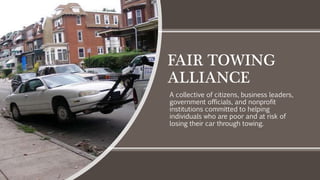
FAIR TOWING
ALLIANCE
A collective of citizens, business leaders,
government officials, and nonprofit
institutions committed to helping
individuals who are poor and at risk of
losing their car through towing.
Introduction
 The impact on many people who are poor when their car is towed:
 Permanent loss of car
 Loss of employment
 Loss of access to education
 Loss of shelter for some
 Extensive Study Completed In California ~ Towed Into Debt ~ was
relied upon to help create this overview.
 Study included: Public Law Center, Legal Services of Northern
California, Lawyer's Committee for Civil Rights for San Francisco
Bay Area, Bay Area Legal Aid, Western Center on Law and Poverty,
American Civil Liberties Union of California, Public Counsel, Legal
Aid Foundation of Los Angeles, East Bay Community Law
Center, Analysis Group.
Fair Towing Alliance
 Primary Work:
 Supporting individuals in circumstances
when they are at risk of being towed.
 Public policy and legislative advocacy at
the local and state level
 Alliance Members:
 Individuals
 Business leaders
 Government Officials
 Law Enforcement
 Legislators and local officials
 Attorneys
CHALLENGES FOR THE
POOR AFTER LOSING CAR
Many cars are towed for
matters not related to
public safety.
Tags, Tickets, and Time
 In California one fourth of tows are related to out-of-date tags, past
parking tickets, and parking in one sport for more than 72 hours.
 These tows result in cars being sold by government / tow company 2-6 times more frequently than
cars towed for other reasons.
 In San Francisco 50% of cars towed for outstanding parking tickets and 57% of cars
towed for lapsed registration were sold since they were not recovered by the owner.
 The average cost to recover a vehicle from debt related tow is $1,100
 Many cities are losing money on their towing programs since a sizeable number of
cars are not claimed and later sold at auction for far less than the cost to tow,
store, and conduct the needed administrative and legal documents for the auction
sale.
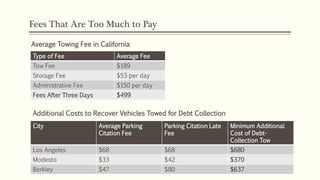
Fees That Are Too Much to Pay
Type of Fee Average Fee
Tow Fee $189
Storage Fee $53 per day
Administrative Fee $150 per day
Fees After Three Days $499
City Average Parking
Citation Fee
Parking Citation Late
Fee
Minimum Additional
Cost of Debt-
Collection Tow
Los Angeles $68 $68 $680
Modesto $33 $42 $370
Berkley $47 $80 $637
Average Towing Fee in California
Additional Costs to Recover Vehicles Towed for Debt Collection
Personal Economic Impact on Losing Car
 The second highest self-reported cause for the inability to work is lack of access to
transportation.
 Car ownership plays a bigger role in getting a job than a HS diploma or citizenship.
 People with cars leave unemployment and welfare faster than those who do not have a
car.
 People with a car are 2X more likely to remain employed at current employer after two
years if they have a car.
 Those who take a car loan attain an 8.2% increase in compensation – one third
of employees indicate more than a 10% raise.
 Unpaid tow fees can still be collected by Tow Company. For example, if total tow fees
are $3,000 (tow, storage for 30 days, and administrative fees) and the car sells for $500
at auction the former owner is still liable for $2,500 and is sued. The person who did not
have money to pay for three days storage is obligated to pay for 30 days storage.
Public Transportation
 Public transportation is often not accessible to the poor.
 Public transportation is slow and expensive.
 People with a car have a wider range of employment
opportunities.
 Access to a car helps workers achieve 40-hour work
week.
 Commuting Penalty leads to employees working
nine hours less than car owners.
 Car owners in the same position as someone who relies
on public transport make $.70 - $2.06 more per hour.
Additional Challenges for Families and the Community
 Negatively Impact Public Benefits for the Poor
 Some benefits have work requirements.
 Access to Education
 Not all school transportion is safe, voucher students, about 50% of children (in California) are driven to
school instead.
 Limit Housing Opportunities
 Gentrifiction has pushed Section 8 and affordable housing farther from jobs commonly held by
employees who are poor. People struggle between a job they can get to and a home they can afford.
 Individuals Living in their Vehicles
 In Los Angeles County fifty percent of children who are unhoused live in cars.
 The Economic Roundtable of Los Angeles found that initially one-third of people who are homeless live
in their vehicle and one year later only one-sixth live in vehicles and most have moved to a tent. The
Roundtable’s report linked the loss of cars to towing for tickets and tags.
Summary
 Towing for tickets, tags, and time:
 Disproportionally impacts the
poor
 Is a direct threat to the
finances, economic
prospects, reception of public
benefits, education, housing
opportunities, and shelter
when living in a car
 Is an initiative that results in
the government losing
money
 Is an initiative that crushes
families and drives them
further into debt
 Towing for tickets, tags, and
time is counterproductive to
the common good
Public Policy and Legislation
Common sense actions
that save the
government money and
help poor families.
Challenges That Could Be Addressed Through Improved Public
Policy and Legislative Action
 Lien sales are costly, ineffective and the government often loses money on tows.
 Towing for tickets, tags, and time is bad for business.
 Towing for tickets, tags, and time often moves people from work to welfare.
 Upon release from the hospital or jail people find their car has been towed after
sitting in one location for more than 72 hours which jeopardizes their ability to work.
 The victims of car theft, even when their car has been recovered by the police, may
not have the needed resources to pay the impound fees and are unable to recover
their car. Victims may also be invoiced or sued for the expenses related to the
storage and selling of their stolen car – since they lacked several hundred dollars to
have the car released in the first place.
 Excessive government action: In 2016, 215,389 and in 2017, 224,900 cars were
towed for non-emergency and non-safety reasons in the State of California.
Constitutional Issues
 Fourth Amendment prohibits warrantless tows
 Tows, without a warrant, for tickets, tags, and time because there are fees and fines due violate the
Fourth Amendment. Tickets, tags, and time are not emergencies, crimes, or safety issues.
 Fourteenth Amendment’s due process clause requires adequate notice and
opportunity to contest a tow
 The government must provide notice – before seizing the property of a citizen – and with enough
time for the individual to challenge the intended action
 Eighth Amendment excessive fines clause prohibits disproportionate financial
penalties
 SCOTUS (Timbs v. Indiana) indicated the excessive fines clause applies to the states and that
government must not impose fines that are out of proportion to the crime committed, that
government-imposed fines must “not be so large as to deprive (an offender) of his livelihood” and
that no one shall have a larger fine than their “circumstances or personal estate will bear.”
 Fourteenth Amendment prohibits punishing a person for poverty
 SCOTUS has long held that punishing someone who is unable to pay violates Due Process and Equal
Protection Clauses of the Fourteenth Amendment.

TowJam: Working Poor Losing Jobs Over Unjust Towing Practices

  • 1.
    FAIR TOWING ALLIANCE A collectiveof citizens, business leaders, government officials, and nonprofit institutions committed to helping individuals who are poor and at risk of losing their car through towing.
  • 2.
    Introduction  The impacton many people who are poor when their car is towed:  Permanent loss of car  Loss of employment  Loss of access to education  Loss of shelter for some  Extensive Study Completed In California ~ Towed Into Debt ~ was relied upon to help create this overview.  Study included: Public Law Center, Legal Services of Northern California, Lawyer's Committee for Civil Rights for San Francisco Bay Area, Bay Area Legal Aid, Western Center on Law and Poverty, American Civil Liberties Union of California, Public Counsel, Legal Aid Foundation of Los Angeles, East Bay Community Law Center, Analysis Group.
  • 3.
    Fair Towing Alliance Primary Work:  Supporting individuals in circumstances when they are at risk of being towed.  Public policy and legislative advocacy at the local and state level  Alliance Members:  Individuals  Business leaders  Government Officials  Law Enforcement  Legislators and local officials  Attorneys
  • 4.
    CHALLENGES FOR THE POORAFTER LOSING CAR Many cars are towed for matters not related to public safety.
  • 5.
    Tags, Tickets, andTime  In California one fourth of tows are related to out-of-date tags, past parking tickets, and parking in one sport for more than 72 hours.  These tows result in cars being sold by government / tow company 2-6 times more frequently than cars towed for other reasons.  In San Francisco 50% of cars towed for outstanding parking tickets and 57% of cars towed for lapsed registration were sold since they were not recovered by the owner.  The average cost to recover a vehicle from debt related tow is $1,100  Many cities are losing money on their towing programs since a sizeable number of cars are not claimed and later sold at auction for far less than the cost to tow, store, and conduct the needed administrative and legal documents for the auction sale.
  • 6.
    Fees That AreToo Much to Pay Type of Fee Average Fee Tow Fee $189 Storage Fee $53 per day Administrative Fee $150 per day Fees After Three Days $499 City Average Parking Citation Fee Parking Citation Late Fee Minimum Additional Cost of Debt- Collection Tow Los Angeles $68 $68 $680 Modesto $33 $42 $370 Berkley $47 $80 $637 Average Towing Fee in California Additional Costs to Recover Vehicles Towed for Debt Collection
  • 7.
    Personal Economic Impacton Losing Car  The second highest self-reported cause for the inability to work is lack of access to transportation.  Car ownership plays a bigger role in getting a job than a HS diploma or citizenship.  People with cars leave unemployment and welfare faster than those who do not have a car.  People with a car are 2X more likely to remain employed at current employer after two years if they have a car.  Those who take a car loan attain an 8.2% increase in compensation – one third of employees indicate more than a 10% raise.  Unpaid tow fees can still be collected by Tow Company. For example, if total tow fees are $3,000 (tow, storage for 30 days, and administrative fees) and the car sells for $500 at auction the former owner is still liable for $2,500 and is sued. The person who did not have money to pay for three days storage is obligated to pay for 30 days storage.
  • 8.
    Public Transportation  Publictransportation is often not accessible to the poor.  Public transportation is slow and expensive.  People with a car have a wider range of employment opportunities.  Access to a car helps workers achieve 40-hour work week.  Commuting Penalty leads to employees working nine hours less than car owners.  Car owners in the same position as someone who relies on public transport make $.70 - $2.06 more per hour.
  • 9.
    Additional Challenges forFamilies and the Community  Negatively Impact Public Benefits for the Poor  Some benefits have work requirements.  Access to Education  Not all school transportion is safe, voucher students, about 50% of children (in California) are driven to school instead.  Limit Housing Opportunities  Gentrifiction has pushed Section 8 and affordable housing farther from jobs commonly held by employees who are poor. People struggle between a job they can get to and a home they can afford.  Individuals Living in their Vehicles  In Los Angeles County fifty percent of children who are unhoused live in cars.  The Economic Roundtable of Los Angeles found that initially one-third of people who are homeless live in their vehicle and one year later only one-sixth live in vehicles and most have moved to a tent. The Roundtable’s report linked the loss of cars to towing for tickets and tags.
  • 10.
    Summary  Towing fortickets, tags, and time:  Disproportionally impacts the poor  Is a direct threat to the finances, economic prospects, reception of public benefits, education, housing opportunities, and shelter when living in a car  Is an initiative that results in the government losing money  Is an initiative that crushes families and drives them further into debt  Towing for tickets, tags, and time is counterproductive to the common good
  • 11.
    Public Policy andLegislation Common sense actions that save the government money and help poor families.
  • 12.
    Challenges That CouldBe Addressed Through Improved Public Policy and Legislative Action  Lien sales are costly, ineffective and the government often loses money on tows.  Towing for tickets, tags, and time is bad for business.  Towing for tickets, tags, and time often moves people from work to welfare.  Upon release from the hospital or jail people find their car has been towed after sitting in one location for more than 72 hours which jeopardizes their ability to work.  The victims of car theft, even when their car has been recovered by the police, may not have the needed resources to pay the impound fees and are unable to recover their car. Victims may also be invoiced or sued for the expenses related to the storage and selling of their stolen car – since they lacked several hundred dollars to have the car released in the first place.  Excessive government action: In 2016, 215,389 and in 2017, 224,900 cars were towed for non-emergency and non-safety reasons in the State of California.
  • 13.
    Constitutional Issues  FourthAmendment prohibits warrantless tows  Tows, without a warrant, for tickets, tags, and time because there are fees and fines due violate the Fourth Amendment. Tickets, tags, and time are not emergencies, crimes, or safety issues.  Fourteenth Amendment’s due process clause requires adequate notice and opportunity to contest a tow  The government must provide notice – before seizing the property of a citizen – and with enough time for the individual to challenge the intended action  Eighth Amendment excessive fines clause prohibits disproportionate financial penalties  SCOTUS (Timbs v. Indiana) indicated the excessive fines clause applies to the states and that government must not impose fines that are out of proportion to the crime committed, that government-imposed fines must “not be so large as to deprive (an offender) of his livelihood” and that no one shall have a larger fine than their “circumstances or personal estate will bear.”  Fourteenth Amendment prohibits punishing a person for poverty  SCOTUS has long held that punishing someone who is unable to pay violates Due Process and Equal Protection Clauses of the Fourteenth Amendment.

Editor's Notes

  • #2 NOTE: Want a different image on this slide? Select the picture and delete it. Now click the Pictures icon in the placeholder to insert your own image.