TORNADO
IN DEPTH
thor
thunder
tro
tronar
tronada
tornar
tornada
tornada
tronada
+
tornada
TORNADO
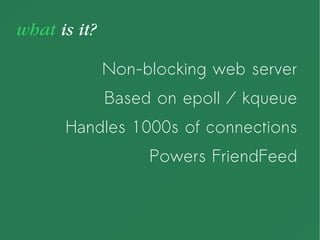
what is it?
Non-blocking web server
Based on epoll / kqueue
Handles 1000s of connections
Powers FriendFeed
why do you even care?
Know what you use
I can't trust
what I don't know
Learning and sharing: fun!
what do you use it for?
We built a
Scalable
Distributed
Fault tolerant
High load
...thing
[CITATION NEEDED]
oscar.vilaplana@paylogic.eu
TORNADO
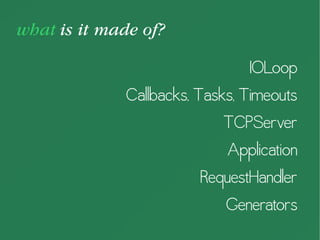
what is it made of?
IOLoop
Callbacks, Tasks, Timeouts
TCPServer
Application
RequestHandler
Generators
can I extend it?
Sure!
It's easy
How would we make
a simple TCPServer?
0b_tcpserver.py
show me the source!
GETTING
STARTED
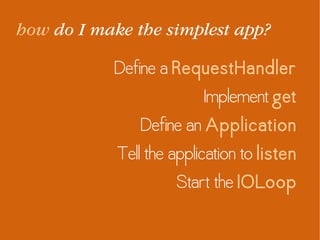
how do I make the simplest app?
Define a RequestHandler
Implement get
Define an Application
Tell the application to listen
Start the IOLoop
01_getting_started.py
show me the source!
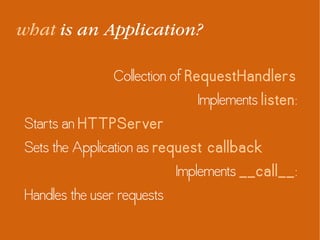
what is an Application?
Collection of RequestHandlers
Implements listen:
Starts an HTTPServer
Sets the Application as request callback
Implements __call__:
Handles the user requests
t1_application_listen.py
show me the source!
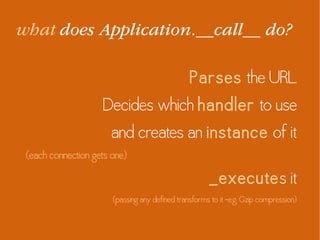
what does Application.__call__ do?
Parses the URL
Decides which handler to use
and creates an instance of it
(each connection gets one)
_executes it
(passing any defined transforms to it –e.g, Gzip compression)
t2_application_call.py
show me the source!
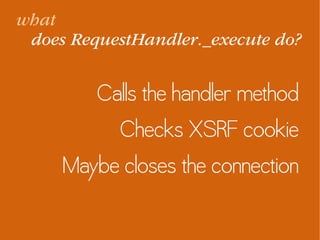
what
does RequestHandler._execute do?
Calls the handler method
Checks XSRF cookie
Maybe closes the connection
t3_request_handler_
_execute.py
show me the source!
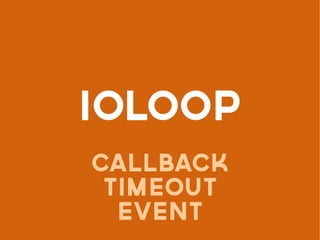
IOLOOP
CALLBACK
TIMEOUT
event
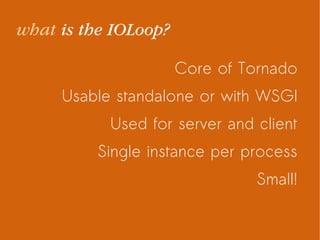
Core of Tornado
Usable standalone or with WSGI
Used for server and client
Single instance per process
Small!
what is the IOLoop?
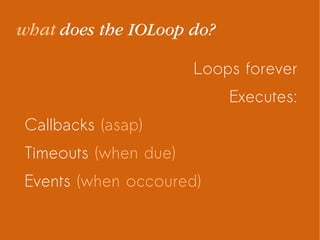
Loops forever
Executes:
Callbacks (asap)
Timeouts (when due)
Events (when occoured)
what does the IOLoop do?
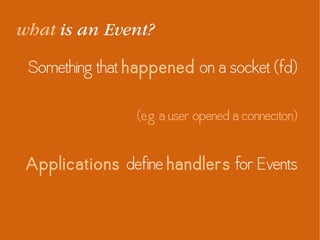
what is an Event?
Something that happened on a socket (fd)
(e.g. a user opened a conneciton)
Applications define handlers for Events
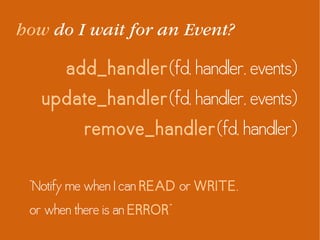
how do I wait for an Event?
add_handler(fd, handler, events)
update_handler(fd, handler, events)
remove_handler(fd, handler)
“Notify me when I can READ or WRITE,
or when there is an ERROR”
IOLOOP
THE LOOP
in four steps
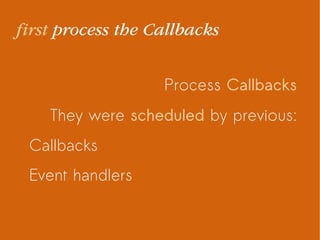
Process Callbacks
They were scheduled by previous:
Callbacks
Event handlers
first process the Callbacks
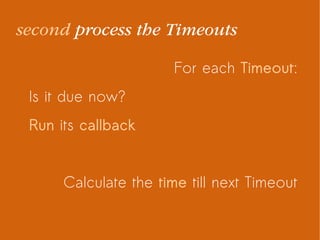
For each Timeout:
Is it due now?
Run its callback
Calculate the time till next Timeout
second process the Timeouts
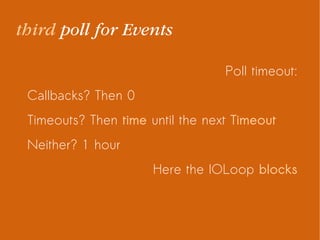
Poll timeout:
Callbacks? Then 0
Timeouts? Then time until the next Timeout
Neither? 1 hour
Here the IOLoop blocks
third poll for Events
For each (file descriptor, Event):
Call its handler
...and repeat the loop
and fourth process the Events
THE
EXAMPLE
WHAT it
really does
01_getting_started.py
show me the source!
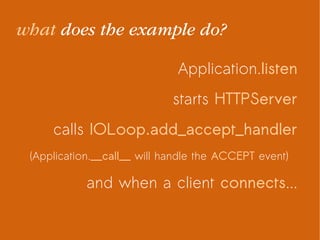
Application.listen
starts HTTPServer
calls IOLoop.add_accept_handler
(Application.__call__ will handle the ACCEPT event)
and when a client connects...
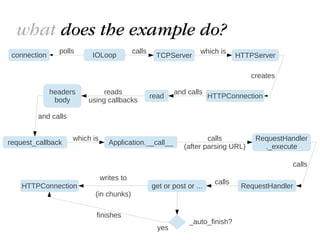
what does the example do?
IOLoop
polls
connection TCPServer
calls
HTTPServer
which is
HTTPConnection
creates
read
and callsheaders
body
reads
using callbacks
request_callback
and calls
Application.__call__
which is RequestHandler
._execute
calls
(after parsing URL)
RequestHandler
calls
get or post or ...
calls
HTTPConnection
writes to
(in chunks)
_auto_finish?
finishes
yes
t4_simple_ioloop.py
show me the source!
Scheduled
tasks
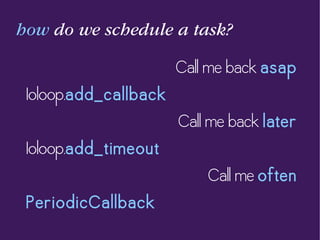
how do we schedule a task?
Call me back asap
Ioloop.add_callback
Call me back later
Ioloop.add_timeout
Call me often
PeriodicCallback
02_scheduled_tasks.py
show me the source!
how does add_callback work?
Adds the callback to the list of
callbacks.
(and wraps it in a threadlocal-like stack context)
what do you mean, threadlocal-like?
StackContext
Keeps track of the socket connection
Handles association between socket and
Application classes
t6_add_callback.py
show me the source!
how does add_timeout work?
Pushes the timeout to the heap
of timeouts.
(and wraps it in a threadlocal-like stack context too)
t7_add_timeout.py
show me the source!
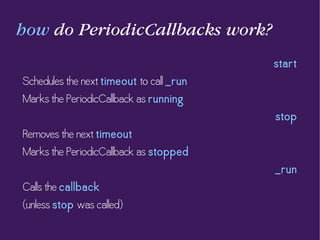
how do PeriodicCallbacks work?
start
Schedules the next timeout to call _run
Marks the PeriodicCallback as running
stop
Removes the next timeout
Marks the PeriodicCallback as stopped
_run
Calls the callback
(unless stop was called)
t8_periodic_callback.py
show me the source!
what about Callback?
Indeed.
Async
handlers
asynchronous@
&
auto_ _finish
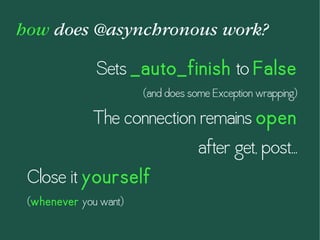
how does @asynchronous work?
Sets _auto_finish to False
(and does some Exception wrapping)
The connection remains open
after get, post...
Close it yourself
(whenever you want)
03_fetch_async.py
show me the source!
I put a callback on your callback
Nested callbacks
make ugly code.
what about Callback?
Indeed.
generators
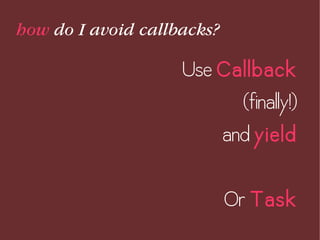
how do I avoid callbacks?
Use Callback
(finally!)
and yield
Or Task
04_fetch_gen.py
show me the source!
Yield
points
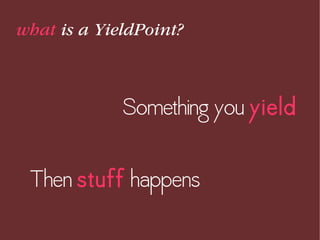
what is a YieldPoint?
Something you yield
Then stuff happens
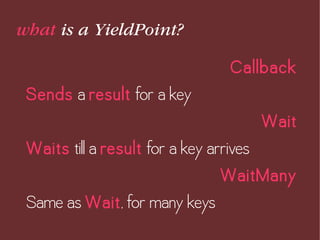
what is a YieldPoint?
Callback
Sends a result for a key
Wait
Waits till a result for a key arrives
WaitMany
Same as Wait, for many keys
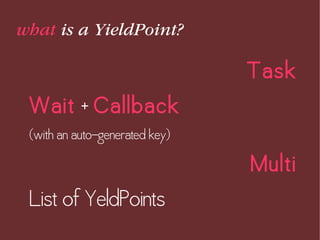
Task
Wait + Callback
(with an auto-generated key)
Multi
List of YeldPoints
what is a YieldPoint?
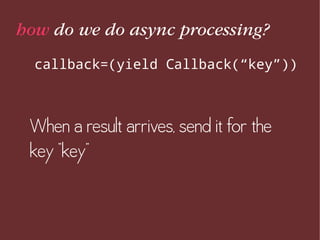
how do we do async processing?
callback=(yield Callback(“key”))
When a result arrives, send it for the
key “key”
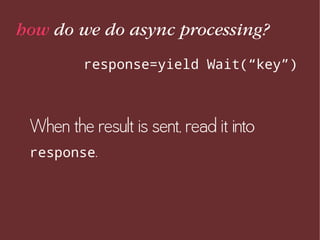
how do we do async processing?
response=yield Wait(“key”)
When the result is sent, read it into
response.
04_fetch_gen.py
show me the source!
05_task.py
show me the source!
t9_yield_points.py
show me the source!
websockets
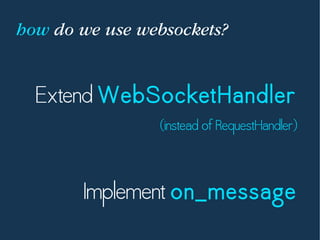
how do we use websockets?
Extend WebSocketHandler
(instead of RequestHandler)
Implement on_message
06_websocket.py
show me the source!
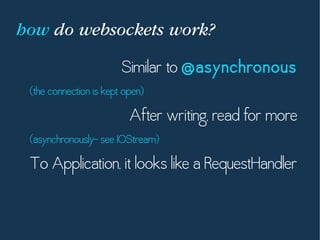
how do websockets work?
Similar to @asynchronous
(the connection is kept open)
After writing, read for more
(asynchronously—see IOStream)
To Application, it looks like a RequestHandler
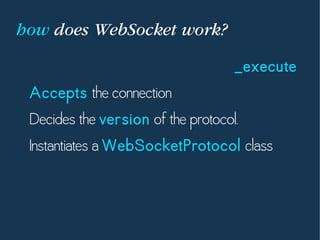
how does WebSocket work?
_execute
Accepts the connection
Decides the version of the protocol.
Instantiates a WebSocketProtocol class
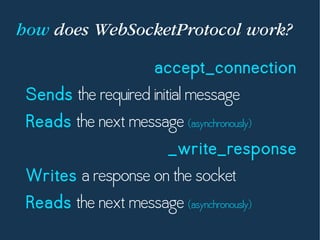
how does WebSocketProtocol work?
accept_connection
Sends the required initial message
Reads the next message (asynchronously)
_write_response
Writes a response on the socket
Reads the next message (asynchronously)
ta_websocket.py
show me the source!
iostream
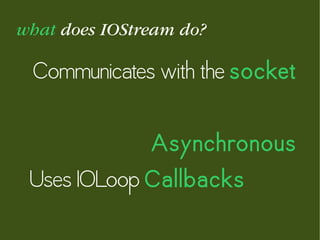
what does IOStream do?
Communicates with the socket
Asynchronous
Uses IOLoop Callbacks
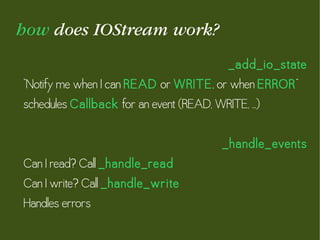
how does IOStream work?
_add_io_state
“Notify me when I can READ or WRITE, or when ERROR”
schedules Callback for an event (READ, WRITE, ...)
_handle_events
Can I read? Call _handle_read
Can I write? Call _handle_write
Handles errors
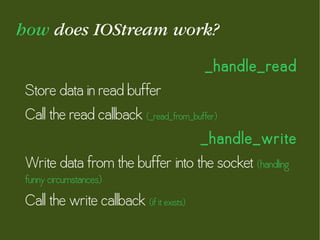
how does IOStream work?
_handle_read
Store data in read buffer
Call the read callback (_read_from_buffer)
_handle_write
Write data from the buffer into the socket (handling
funny circumstances)
Call the write callback (if it exists)
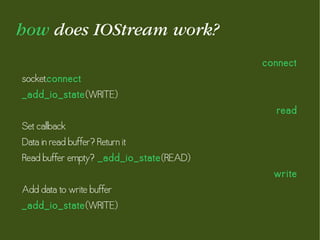
how does IOStream work?
connect
socket.connect
_add_io_state(WRITE)
read
Set callback
Data in read buffer? Return it
Read buffer empty? _add_io_state(READ)
write
Add data to write buffer
_add_io_state(WRITE)
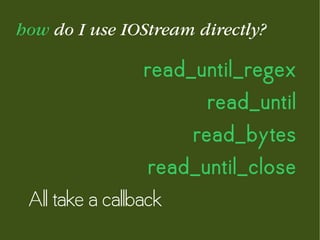
how do I use IOStream directly?
read_until_regex
read_until
read_bytes
read_until_close
All take a callback
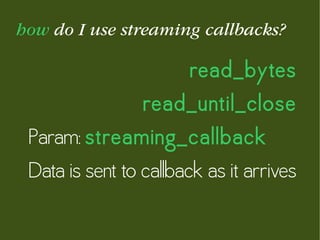
how do I use streaming callbacks?
read_bytes
read_until_close
Param: streaming_callback
Data is sent to callback as it arrives
0a_async_callback.py
show me the source!
database
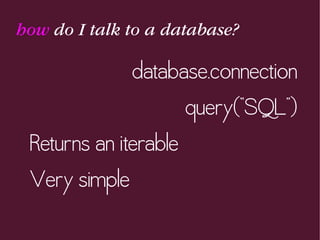
how do I talk to a database?
database.connection
query(“SQL”)
Returns an iterable
Very simple
07_db.py
show me the source!
Not async!
asyncmongo
what is asyncmongo?
Asynchronous MongoDB client
Uses Tornado's IOLoop
how do I use asyncmongo?
asyncmongo.Client
db.find
takes a callback parameter
08_mongo.py
show me the source!
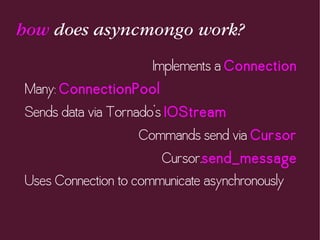
how does asyncmongo work?
Implements a Connection
Many: ConnectionPool
Sends data via Tornado's IOStream
Commands send via Cursor
Cursor.send_message
Uses Connection to communicate asynchronously
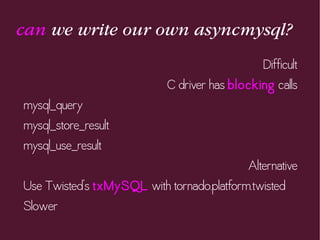
can we write our own asyncmysql?
Difficult
C driver has blocking calls
mysql_query
mysql_store_result
mysql_use_result
Alternative
Use Twisted's txMySQL with tornado.platform.twisted
Slower
Q A&
GRAZIE!
source: uncertain (sorry!)
dev@oscarvilaplana.cat

Tornado in Depth