Economics / Grade12 Topic 1 Notes Nkangala District/ 2026
Page
3
TOPIC 1: CIRCULAR FLOW
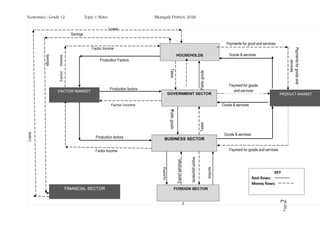
Circular flow is a model that show the relationships between income, production
and expenditure. It is a representation of how the economy works.
UNIT 1: PARTICIPANTS IN THE OPEN ECONOMY
- Open economy is an economy that engages in international trade, therefore it
has four participants which are:
Households
- Households are the primary (main) participants in the economy as they own all
factors of production.
- They four factors of production are, land, labour, capital and entrepreneurship
- They sell their factors of production on the factor market to government and
firms.
- They receive payments (incomes) for their factors of production (rent, wages,
interest and profit).
- They consume goods and services which they buy from producers/firms.
- They pay tax to government and buy goods and services from the business
sector
Business Sector / firms/ producers
- Businesses buy factors of production in the factor market to produce goods and
services
- Businesses sell goods and services on the product market to household and
government
- They pay tax to government from which they receive public goods such as
infrastructure
Government/ Public sector / State
- Government refers to different levels of governance namely local, provincial and
national level.
- It buys factors of production from households on the factor market.
- It uses the factors of production bought to produce public goods and services
e.g. education, health etc.
- It also buys goods and services from the business sector on the product market.
- It receives tax revenue from households, firms and foreign sector.
- Foreign sector
- Foreign sector consists of all other countries in the world which can engage in
business transactions with South Africa
- Foreign sector sells goods and services to the domestic market and this are
called imports
- South African firms sell goods and services to the foreign sector and this are
called exports
- Exports bring money in to the country while imports takes it out of the country
4.
Economics / Grade12 Topic 1 Notes Nkangala District/ 2026
Page
4
Financial sector
− Financial sector consists of banks, insurance companies, JSE and Pension Funds.
− It act as a link between households and firms who have surplus money and others
in the economy who require funds.
− The money that households and firms provide to the financial sector is referred to
as savings.
− Businesses can borrow money from the financial institutions and use it to purchase
capital goods
− This spending on capital equipment by firms is referred to as investment.
REAL AND MONEY FLOWS IN THE CIRCULAR FLOW
Three most important flows in circular flow are production, expenditure and income.
These flows consist of real and money flows
• Real flows
− Factors of production: from households to firms and government.
− Goods and services: from firms to consumers and government.
− Public goods: from government to firms, household and foreign sector
− Imports: from foreign sector to business sector.
− Exports: from business sector to foreign countries.
−
• Money flows
− Incomes for factors of production: from firms and government sector
− Import payment: from business sector to foreign sector
− Export earnings: from foreign sector to the business sector
− Taxation: from business sector, households, foreign sector to government
− Payment for goods and services: from government and households
LEAKAGES AND INJECTIONS IN THE CIRCULAR FLOW
• LEAKAGES (L = T + S + M)
− Leakages are all economic activities that withdraws money from the circular flow.
Examples of leakages are:
− Taxation (T): Households pay income tax to government on their incomes earned
from selling factors of production. Government also taxes expenditure on goods and
services e.g. VAT.
− Savings (S): refers to part of the income that is not spent on current consumption,
but reserved for future use. The money leaves the circular flow to the financial
institutions such as banks.
− Import payment (M): this is money spent
− on foreign goods and services, therefore the money is withdrawn from the economy
(circular flow) to foreign countries.
5.
Economics / Grade12 Topic 1 Notes Nkangala District/ 2026
Page
5
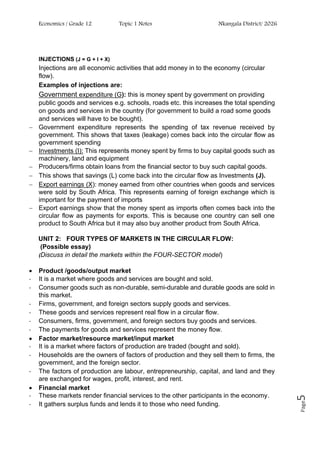
INJECTIONS (J = G + I + X)
Injections are all economic activities that add money in to the economy (circular
flow).
Examples of injections are:
Government expenditure (G): this is money spent by government on providing
public goods and services e.g. schools, roads etc. this increases the total spending
on goods and services in the country (for government to build a road some goods
and services will have to be bought).
− Government expenditure represents the spending of tax revenue received by
government. This shows that taxes (leakage) comes back into the circular flow as
government spending
− Investments (I): This represents money spent by firms to buy capital goods such as
machinery, land and equipment
− Producers/firms obtain loans from the financial sector to buy such capital goods.
− This shows that savings (L) come back into the circular flow as Investments (J).
− Export earnings (X): money earned from other countries when goods and services
were sold by South Africa. This represents earning of foreign exchange which is
important for the payment of imports
− Export earnings show that the money spent as imports often comes back into the
circular flow as payments for exports. This is because one country can sell one
product to South Africa but it may also buy another product from South Africa.
UNIT 2: FOUR TYPES OF MARKETS IN THE CIRCULAR FLOW:
(Possible essay)
(Discuss in detail the markets within the FOUR-SECTOR model)
• Product /goods/output market
- It is a market where goods and services are bought and sold.
- Consumer goods such as non-durable, semi-durable and durable goods are sold in
this market.
- Firms, government, and foreign sectors supply goods and services.
- These goods and services represent real flow in a circular flow.
- Consumers, firms, government, and foreign sectors buy goods and services.
- The payments for goods and services represent the money flow.
• Factor market/resource market/input market
- It is a market where factors of production are traded (bought and sold).
- Households are the owners of factors of production and they sell them to firms, the
government, and the foreign sector.
- The factors of production are labour, entrepreneurship, capital, and land and they
are exchanged for wages, profit, interest, and rent.
• Financial market
- These markets render financial services to the other participants in the economy.
- It gathers surplus funds and lends it to those who need funding.
6.
Economics / Grade12 Topic 1 Notes Nkangala District/ 2026
Page
6
- Two kinds of financial markets are money and capital markets.
- Money market is a market for short-term loans and savings (three years and shorter)
- It includes inter-banking lending for a period as short as overnight.
- The securities traded include short-term deposits, short-term debentures, and
treasury bills.
- The SARB is a key institution in this market.
- Capital market is a market for long-term savings and loans.
- JSE is a key institution in this market as it trades in shares.
- Examples of securities traded in this market are long-term deposits, mortgage
bonds, shares, and unit trusts.
• Foreign exchange market
− It is a market where currencies are exchanged for one another e.g. rands for dollars.
− It originates when one country imports goods from another country and domestic
currency has to be exchanged in order to pay for such imports.
− It is a multi-national market as the currencies of all the countries are traded in this
market.
− Foreign exchange can be bought and sold at banks and foreign exchange agencies.
UNIT 3: NATIONAL ACCOUNT AGGREGATES
− National Accounts Aggregate is a summary of a record of a country’s economic
activities, which are production, income, and expenditure.
− Therefore, a country‘s GDP can be calculated using the production method, income
method, and expenditure method.
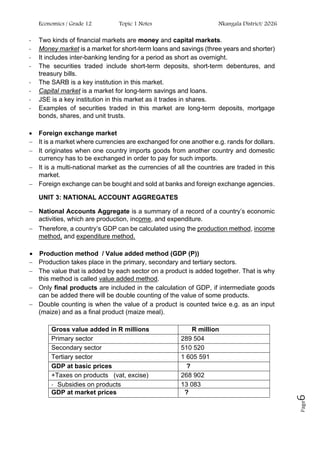
• Production method / Value added method (GDP (P))
− Production takes place in the primary, secondary and tertiary sectors.
− The value that is added by each sector on a product is added together. That is why
this method is called value added method.
− Only final products are included in the calculation of GDP, if intermediate goods
can be added there will be double counting of the value of some products.
− Double counting is when the value of a product is counted twice e.g. as an input
(maize) and as a final product (maize meal).
Gross value added in R millions R million
Primary sector 289 504
Secondary sector 510 520
Tertiary sector 1 605 591
GDP at basic prices ?
+Taxes on products (vat, excise) 268 902
- Subsidies on products 13 083
GDP at market prices ?
7.
Economics / Grade12 Topic 1 Notes Nkangala District/ 2026
Page
7
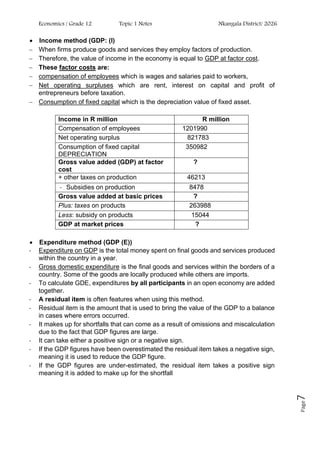
• Income method (GDP: (I)
− When firms produce goods and services they employ factors of production.
− Therefore, the value of income in the economy is equal to GDP at factor cost.
− These factor costs are:
− compensation of employees which is wages and salaries paid to workers,
− Net operating surpluses which are rent, interest on capital and profit of
entrepreneurs before taxation.
− Consumption of fixed capital which is the depreciation value of fixed asset.
Income in R million R million
Compensation of employees 1201990
Net operating surplus 821783
Consumption of fixed capital
DEPRECIATION
350982
Gross value added (GDP) at factor
cost
?
+ other taxes on production 46213
- Subsidies on production 8478
Gross value added at basic prices ?
Plus: taxes on products 263988
Less: subsidy on products 15044
GDP at market prices ?
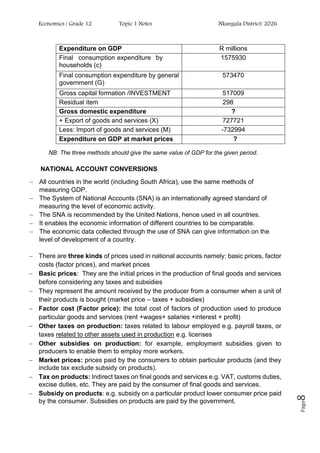
• Expenditure method (GDP (E))
- Expenditure on GDP is the total money spent on final goods and services produced
within the country in a year.
- Gross domestic expenditure is the final goods and services within the borders of a
country. Some of the goods are locally produced while others are imports.
- To calculate GDE, expenditures by all participants in an open economy are added
together.
- A residual item is often features when using this method.
- Residual item is the amount that is used to bring the value of the GDP to a balance
in cases where errors occurred.
- It makes up for shortfalls that can come as a result of omissions and miscalculation
due to the fact that GDP figures are large.
- It can take either a positive sign or a negative sign.
- If the GDP figures have been overestimated the residual item takes a negative sign,
meaning it is used to reduce the GDP figure.
- If the GDP figures are under-estimated, the residual item takes a positive sign
meaning it is added to make up for the shortfall
8.
Economics / Grade12 Topic 1 Notes Nkangala District/ 2026
Page
8
Expenditure on GDP R millions
Final consumption expenditure by
households (c)
1575930
Final consumption expenditure by general
government (G)
573470
Gross capital formation /INVESTMENT 517009
Residual item 298
Gross domestic expenditure ?
+ Export of goods and services (X) 727721
Less: Import of goods and services (M) -732994
Expenditure on GDP at market prices ?
NB: The three methods should give the same value of GDP for the given period.
NATIONAL ACCOUNT CONVERSIONS
− All countries in the world (including South Africa), use the same methods of
measuring GDP.
− The System of National Accounts (SNA) is an internationally agreed standard of
measuring the level of economic activity.
− The SNA is recommended by the United Nations, hence used in all countries.
− It enables the economic information of different countries to be comparable.
− The economic data collected through the use of SNA can give information on the
level of development of a country.
− There are three kinds of prices used in national accounts namely: basic prices, factor
costs (factor prices), and market prices
− Basic prices: They are the initial prices in the production of final goods and services
before considering any taxes and subsidies
− They represent the amount received by the producer from a consumer when a unit of
their products is bought (market price – taxes + subsidies)
− Factor cost (Factor price): the total cost of factors of production used to produce
particular goods and services (rent +wages+ salaries +interest + profit)
− Other taxes on production: taxes related to labour employed e.g. payroll taxes, or
taxes related to other assets used in production e.g. licenses
− Other subsidies on production: for example, employment subsidies given to
producers to enable them to employ more workers.
− Market prices: prices paid by the consumers to obtain particular products (and they
include tax exclude subsidy on products).
− Tax on products: Indirect taxes on final goods and services e.g. VAT, customs duties,
excise duties, etc. They are paid by the consumer of final goods and services.
− Subsidy on products: e.g. subsidy on a particular product lower consumer price paid
by the consumer. Subsidies on products are paid by the government.
9.
Economics / Grade12 Topic 1 Notes Nkangala District/ 2026
Page
9
NOMINAL GDP vs REAL GDP
− Nominal GDP: is also referred to as GDP at current prices.
− It gives the monetary value of prices of the goods and services produced at the
prices of year of production.
− It is obtained by multiplying the quantity (of current year) by the prices of current
year.
− The prices include the effect of inflation (inflation not taken into consideration)
Real GDP: is also referred to as GDP at constant prices.
− It is the monetary value of all final goods and services produced within the country as
expressed in constant prices (prices of a base year).
− It can be obtained by multiplying the quantity of the current year by the prices of the
base year.
− The GDP figures have been adjusted for inflation, meaning the effect of inflation has
been removed.
− To remove the effects of inflation, the GDP deflator can also be used to compare the
prices of the current year to the prices of the base year.
− Real GDP is used to measure economic growth.
CONVERTING DOMESTIC FIGURES TO NATIONAL FIGURES
GDP TO GNI
GDP + (plus) primary income from the rest of the world)
- (minus) primary income to the rest of the world
Example:
R millions
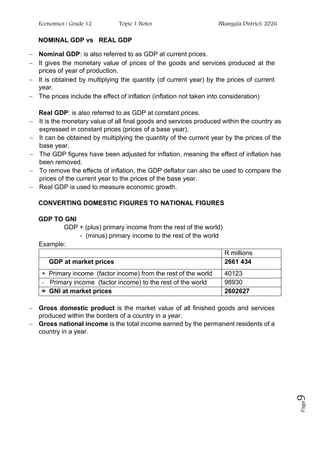
GDP at market prices 2661 434
+ Primary income (factor income) from the rest of the world 40123
- Primary income (factor income) to the rest of the world 98930
= GNI at market prices 2602627
− Gross domestic product is the market value of all finished goods and services
produced within the borders of a country in a year.
− Gross national income is the total income earned by the permanent residents of a
country in a year.
10.
Economics / Grade12 Topic 1 Notes Nkangala District/ 2026
Page
10
CONVERTING GDP TO GNP
GDP + primary income from the rest of the world
- primary income to the rest of the world
Example:
R millions
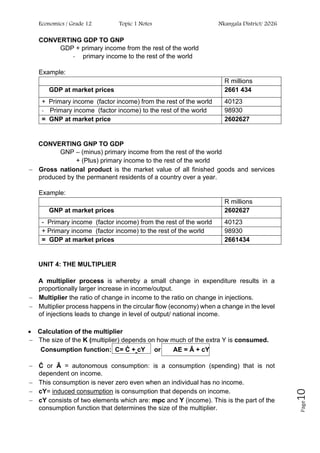
GDP at market prices 2661 434
+ Primary income (factor income) from the rest of the world 40123
- Primary income (factor income) to the rest of the world 98930
= GNP at market price 2602627
CONVERTING GNP TO GDP
GNP – (minus) primary income from the rest of the world
+ (Plus) primary income to the rest of the world
− Gross national product is the market value of all finished goods and services
produced by the permanent residents of a country over a year.
Example:
R millions
GNP at market prices 2602627
- Primary income (factor income) from the rest of the world 40123
+ Primary income (factor income) to the rest of the world 98930
= GDP at market prices 2661434
UNIT 4: THE MULTIPLIER
A multiplier process is whereby a small change in expenditure results in a
proportionally larger increase in income/output.
− Multiplier the ratio of change in income to the ratio on change in injections.
− Multiplier process happens in the circular flow (economy) when a change in the level
of injections leads to change in level of output/ national income.
• Calculation of the multiplier
− The size of the K (multiplier) depends on how much of the extra Y is consumed.
Consumption function: C= Ċ + cY or AE = Ā + cY
− Ċ or Ā = autonomous consumption: is a consumption (spending) that is not
dependent on income.
− This consumption is never zero even when an individual has no income.
− cY= induced consumption is consumption that depends on income.
− cY consists of two elements which are: mpc and Y (income). This is the part of the
consumption function that determines the size of the multiplier.
11.
Economics / Grade12 Topic 1 Notes Nkangala District/ 2026
Page
11
• TWO-SECT ECONOMY
− It is a simple economy with only two participants which are Households and Firms
− Aggregate expenditure (AE) = C + I
− Leakage = S and Injection = I
− In multiplier, Income Y is always equal to 1, so mpc + mps must always equal to 1.
SCENARIO
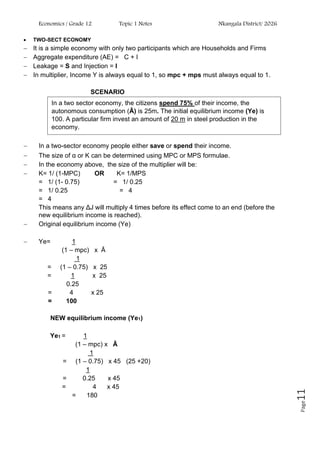
− In a two-sector economy people either save or spend their income.
− The size of α or K can be determined using MPC or MPS formulae.
− In the economy above, the size of the multiplier will be:
− K= 1/ (1-MPC) OR K= 1/MPS
= 1/ (1- 0.75) = 1/ 0.25
= 1/ 0.25 = 4
= 4
This means any ΔJ will multiply 4 times before its effect come to an end (before the
new equilibrium income is reached).
− Original equilibrium income (Ye)
− Ye= 1
(1 – mpc) x Ᾱ
1
= (1 – 0.75) x 25
= 1 x 25
0.25
= 4 x 25
= 100
NEW equilibrium income (Ye1)
Ye1 = 1
(1 – mpc) x Ᾱ
1
= (1 – 0.75) x 45 (25 +20)
1
= 0.25 x 45
= 4 x 45
= 180
In a two sector economy, the citizens spend 75% of their income, the
autonomous consumption (Ā) is 25m. The initial equilibrium income (Ye) is
100. A particular firm invest an amount of 20 m in steel production in the
economy.
12.
Economics / Grade12 Topic 1 Notes Nkangala District/ 2026
Page
12
e
e1
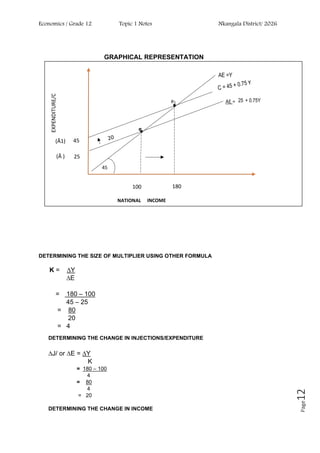
GRAPHICAL REPRESENTATION
DETERMINING THE SIZE OF MULTIPLIER USING OTHER FORMULA
K = ∆Y
∆E
= 180 – 100
45 – 25
= 80
20
= 4
DETERMINING THE CHANGE IN INJECTIONS/EXPENDITURE
∆J/ or ∆E = ∆Y
K
= 180 – 100
4
= 80
4
= 20
DETERMINING THE CHANGE IN INCOME
45
AE =Y
AE = 25 + 0.75Y
45
100 180
NATIONAL INCOME
(Ā )
(Ā1)
25
13.
Economics / Grade12 Topic 1 Notes Nkangala District/ 2026
Page
13
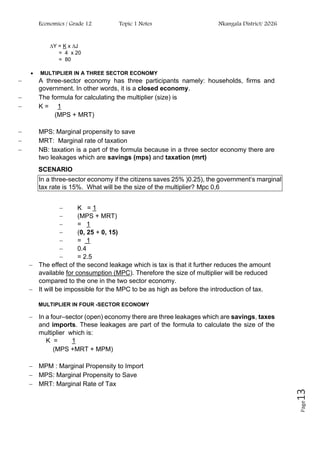
∆Y = K x ∆J
= 4 x 20
= 80
• MULTIPLIER IN A THREE SECTOR ECONOMY
− A three-sector economy has three participants namely: households, firms and
government. In other words, it is a closed economy.
− The formula for calculating the multiplier (size) is
− K = 1
(MPS + MRT)
− MPS: Marginal propensity to save
− MRT: Marginal rate of taxation
− NB: taxation is a part of the formula because in a three sector economy there are
two leakages which are savings (mps) and taxation (mrt)
SCENARIO
In a three-sector economy if the citizens saves 25% )0.25), the government‘s marginal
tax rate is 15%. What will be the size of the multiplier? Mpc 0,6
− K = 1
− (MPS + MRT)
− = 1
− (0, 25 + 0, 15)
− = 1
− 0.4
− = 2.5
− The effect of the second leakage which is tax is that it further reduces the amount
available for consumption (MPC). Therefore the size of multiplier will be reduced
compared to the one in the two sector economy.
− It will be impossible for the MPC to be as high as before the introduction of tax.
MULTIPLIER IN FOUR -SECTOR ECONOMY
− In a four–sector (open) economy there are three leakages which are savings, taxes
and imports. These leakages are part of the formula to calculate the size of the
multiplier which is:
K = 1
(MPS +MRT + MPM)
− MPM : Marginal Propensity to Import
− MPS: Marginal Propensity to Save
− MRT: Marginal Rate of Tax
14.
Economics / Grade12 Topic 1 Notes Nkangala District/ 2026
Page
14
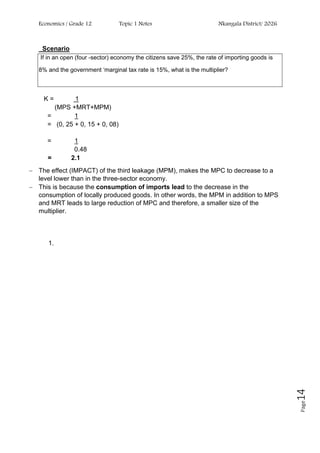
Scenario
If in an open (four -sector) economy the citizens save 25%, the rate of importing goods is
8% and the government ‘marginal tax rate is 15%, what is the multiplier?
K = 1
(MPS +MRT+MPM)
= 1
= (0, 25 + 0, 15 + 0, 08)
= 1
0.48
= 2.1
− The effect (IMPACT) of the third leakage (MPM), makes the MPC to decrease to a
level lower than in the three-sector economy.
− This is because the consumption of imports lead to the decrease in the
consumption of locally produced goods. In other words, the MPM in addition to MPS
and MRT leads to large reduction of MPC and therefore, a smaller size of the
multiplier.
1.