Top
Interview Questions Asked to a
Penetration Tester
Introduction
Are you ready to step into the world of cybersecurity as a penetration tester?
Penetration testing is one of the most exciting and critical roles in cybersecurity,
requiring a sharp mind and technical expertise. If you are preparing for an
interview, it is important to know the top questions hiring managers might ask to
assess your skills and experience.
www.infosectrain.com
Here is the list of the top 20 common interview questions for
Penetration Testers.
1. Explain information security.
Information security is the practice of safeguarding information from
unauthorized access, disclosure, use, interruption, alteration, or destruction. It
involves implementing measures to ensure confidentiality, integrity, and
availability of data, safeguarding against threats and vulnerabilities.
2. Describe buffer overflow.
Buffer overflow is a security vulnerability that occurs when a program or
process attempts to store more data than the allocated buffer, which can
cause overwritten memory and potential exploitation by attackers to execute
malicious code.
3. What is traceroute?
Traceroute is a network diagnostic technique that maps the route traversed by
packets from a source to a destination or target, revealing the intermediate
points or devices and their response times. It helps to uncover potential
vulnerabilities or misconfigurations along the route.
4. What are the types of penetration testing?
There are several types of penetration testing, including:
External Testing: Assessing the security of externally accessible systems and
networks.
www.infosectrain.com
Internal Testing: Evaluating the security of internal systems and networks
from within the organization.
Wireless Network Testing: Evaluating the security of wireless devices
networks.
Web Application Testing: Focusing on identifying vulnerabilities specific to
web applications.
Mobile Application Testing: Assessing the security of mobile applications
running on different platforms.
Social Engineering Testing: Evaluating human vulnerabilities through
manipulation and deception.
Physical Penetration Testing: Assessing the physical security controls of an
organization, such as access controls and surveillance.
5. What methods are used to prevent brute force hacks?
There are several methods used to prevent brute force attacks:
Enforce strong password policies
Implement rate-limiting mechanisms
Implement CAPTCHA
Implement Two-Factor Authentication (2FA)
Deploy IDS or IPS solutions
Implement robust monitoring and logging mechanisms
Configure account lockout policies
Keep systems and applications updated with the latest security patches
User education and awareness
www.infosectrain.com
6. Define honeypot.
A honeypot is a security mechanism or system designed to attract and deceive
potential attackers. It acts as a simulated target or resource to lure attackers
into interacting with it. Its primary purpose is to gather information about an
attacker's tactics, techniques, and intentions, allowing security professionals
to study and analyze their behavior.
7. Explain footprinting.
Footprinting is the process of collecting data about a target system,
organization, or individual to gain an understanding of its infrastructure,
systems, and potential vulnerabilities. It involves gathering data from public
sources, such as websites, social media, DNS records, and search engines.
8. What is a security misconfiguration vulnerability?
Security misconfiguration vulnerability refers to insecure or incorrect
configuration of software, systems, or network components, leading to
potential security breaches.
9. What does the term "privilege escalation" mean?
Privilege escalation refers to gaining higher access or privileges on a system or
network than initially intended or assigned. It involves exploiting
vulnerabilities or misconfigurations to elevate one's privileges from a
restricted user account to a higher level, such as an administrator or root
access.
10. What are the differences between a penetration test
and a vulnerability scan?
Differences between penetration testing and a vulnerability scan are:
www.infosectrain.com
Penetration Test
It actively exploits vulnerabilities to
assess system security.
It simulates real-world attacks and
attempts to gain unauthorized
access.
It provides detailed findings, including
vulnerabilities, attack paths, and
potential impact.
It evaluates both technical and
human vulnerabilities.
It requires skilled testers to analyze
and exploit vulnerabilities.
It identifies known vulnerabilities
in a system or network.
Its automated scanning tools
assess systems for known security
weaknesses.
It provides a list of vulnerabilities,
categorized by severity, with
recommendations for remediation.
It primarily focuses on technical
vulnerabilities, not human or
process-related issues.
It can be performed by IT staff with
basic knowledge of scanning tools.
Vulnerability Scan
11. What are black box and white box testing?
Black box and white box testing are penetration testing approaches.
Black box testing: In this testing approach, testers have zero knowledge of
the system being tested and approach it as an external attacker. They assess
the system's functionality and security without any internal details.
White box testing: Testers have complete system knowledge in this testing
approach, including architecture and source code. They assess the system's
internal workings, vulnerabilities, and security controls.
www.infosectrain.com
12. Describe network penetration testing.
Network penetration testing, also known as network security testing, is a
systematic and proactive assessment of a network's security posture. It
involves simulating real-world attacks to detect vulnerabilities, weaknesses,
and potential entry points within a network infrastructure.
13. Why is penetration testing crucial to an organization's
risk management plan?
Penetration testing is crucial to the risk management plan of an
organization as it:
Identifies vulnerabilities and weaknesses before attackers exploit them
Enhances overall security posture
Assesses the effectiveness of security controls
Helps prioritize and allocate resources for mitigation
Validates the effectiveness of incident response procedures
Demonstrates compliance with regulatory requirements
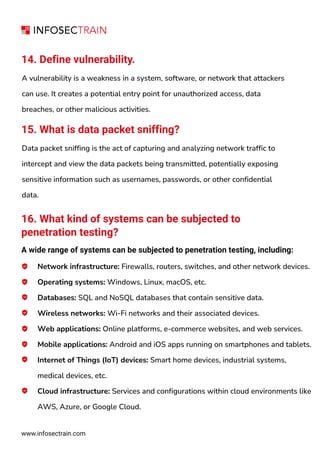
14. Define vulnerability.
A vulnerability is a weakness in a system, software, or network that attackers
can use. It creates a potential entry point for unauthorized access, data
breaches, or other malicious activities.
15. What is data packet sniffing?
Data packet sniffing is the act of capturing and analyzing network traffic to
intercept and view the data packets being transmitted, potentially exposing
sensitive information such as usernames, passwords, or other confidential
data.
16. What kind of systems can be subjected to
penetration testing?
A wide range of systems can be subjected to penetration testing, including:
Network infrastructure: Firewalls, routers, switches, and other network devices.
Operating systems: Windows, Linux, macOS, etc.
Databases: SQL and NoSQL databases that contain sensitive data.
Wireless networks: Wi-Fi networks and their associated devices.
Web applications: Online platforms, e-commerce websites, and web services.
Mobile applications: Android and iOS apps running on smartphones and tablets.
Internet of Things (IoT) devices: Smart home devices, industrial systems,
medical devices, etc.
Cloud infrastructure: Services and configurations within cloud environments like
AWS, Azure, or Google Cloud.
www.infosectrain.com
18. What is SSL stripping?
SSL stripping is a method where an attacker intercepts HTTPS connections
and converts them to unencrypted HTTP, potentially disclosing sensitive
information exchanged between the user and the website.
19. Define Local File Inclusion (LFI).
Local File Inclusion (LFI) is a vulnerability in web applications where an
attacker can exploit improper input mechanisms to include and execute local
files on the server, potentially accessing sensitive information or executing
malicious code.
www.infosectrain.com
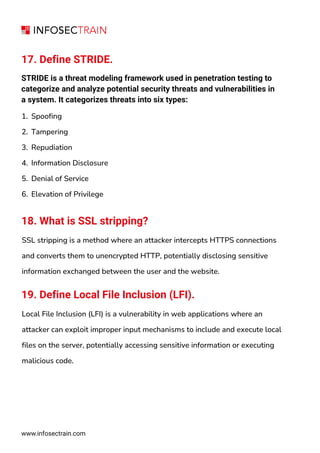
17. Define STRIDE.
STRIDE is a threat modeling framework used in penetration testing to
categorize and analyze potential security threats and vulnerabilities in
a system. It categorizes threats into six types:
1. Spoofing
2. Tampering
3. Repudiation
4. Information Disclosure
5. Denial of Service
6. Elevation of Privilege
www.infosectrain.com
20. Explain the Broken Access Control vulnerability.
A Broken Access Control vulnerability is a security flaw that occurs when
access controls and restrictions in a system are not adequately implemented
or enforced. It allows unauthorized users to gain privileged access to
resources, functionality, or data they should not be able to access. It can lead
to unauthorized data exposure, data manipulation, or even full compromise of
the system.
www.infosectrain.com | sales@infosectrain.com

Top Interview Questions for Penetration Testers.pdf

  • 1.
    Top Interview Questions Askedto a Penetration Tester
  • 2.
    Introduction Are you readyto step into the world of cybersecurity as a penetration tester? Penetration testing is one of the most exciting and critical roles in cybersecurity, requiring a sharp mind and technical expertise. If you are preparing for an interview, it is important to know the top questions hiring managers might ask to assess your skills and experience.
  • 3.
    www.infosectrain.com Here is thelist of the top 20 common interview questions for Penetration Testers. 1. Explain information security. Information security is the practice of safeguarding information from unauthorized access, disclosure, use, interruption, alteration, or destruction. It involves implementing measures to ensure confidentiality, integrity, and availability of data, safeguarding against threats and vulnerabilities. 2. Describe buffer overflow. Buffer overflow is a security vulnerability that occurs when a program or process attempts to store more data than the allocated buffer, which can cause overwritten memory and potential exploitation by attackers to execute malicious code. 3. What is traceroute? Traceroute is a network diagnostic technique that maps the route traversed by packets from a source to a destination or target, revealing the intermediate points or devices and their response times. It helps to uncover potential vulnerabilities or misconfigurations along the route. 4. What are the types of penetration testing? There are several types of penetration testing, including: External Testing: Assessing the security of externally accessible systems and networks.
  • 4.
    www.infosectrain.com Internal Testing: Evaluatingthe security of internal systems and networks from within the organization. Wireless Network Testing: Evaluating the security of wireless devices networks. Web Application Testing: Focusing on identifying vulnerabilities specific to web applications. Mobile Application Testing: Assessing the security of mobile applications running on different platforms. Social Engineering Testing: Evaluating human vulnerabilities through manipulation and deception. Physical Penetration Testing: Assessing the physical security controls of an organization, such as access controls and surveillance. 5. What methods are used to prevent brute force hacks? There are several methods used to prevent brute force attacks: Enforce strong password policies Implement rate-limiting mechanisms Implement CAPTCHA Implement Two-Factor Authentication (2FA) Deploy IDS or IPS solutions Implement robust monitoring and logging mechanisms Configure account lockout policies Keep systems and applications updated with the latest security patches User education and awareness
  • 5.
    www.infosectrain.com 6. Define honeypot. Ahoneypot is a security mechanism or system designed to attract and deceive potential attackers. It acts as a simulated target or resource to lure attackers into interacting with it. Its primary purpose is to gather information about an attacker's tactics, techniques, and intentions, allowing security professionals to study and analyze their behavior. 7. Explain footprinting. Footprinting is the process of collecting data about a target system, organization, or individual to gain an understanding of its infrastructure, systems, and potential vulnerabilities. It involves gathering data from public sources, such as websites, social media, DNS records, and search engines. 8. What is a security misconfiguration vulnerability? Security misconfiguration vulnerability refers to insecure or incorrect configuration of software, systems, or network components, leading to potential security breaches. 9. What does the term "privilege escalation" mean? Privilege escalation refers to gaining higher access or privileges on a system or network than initially intended or assigned. It involves exploiting vulnerabilities or misconfigurations to elevate one's privileges from a restricted user account to a higher level, such as an administrator or root access.
  • 6.
    10. What arethe differences between a penetration test and a vulnerability scan? Differences between penetration testing and a vulnerability scan are: www.infosectrain.com Penetration Test It actively exploits vulnerabilities to assess system security. It simulates real-world attacks and attempts to gain unauthorized access. It provides detailed findings, including vulnerabilities, attack paths, and potential impact. It evaluates both technical and human vulnerabilities. It requires skilled testers to analyze and exploit vulnerabilities. It identifies known vulnerabilities in a system or network. Its automated scanning tools assess systems for known security weaknesses. It provides a list of vulnerabilities, categorized by severity, with recommendations for remediation. It primarily focuses on technical vulnerabilities, not human or process-related issues. It can be performed by IT staff with basic knowledge of scanning tools. Vulnerability Scan
  • 7.
    11. What areblack box and white box testing? Black box and white box testing are penetration testing approaches. Black box testing: In this testing approach, testers have zero knowledge of the system being tested and approach it as an external attacker. They assess the system's functionality and security without any internal details. White box testing: Testers have complete system knowledge in this testing approach, including architecture and source code. They assess the system's internal workings, vulnerabilities, and security controls. www.infosectrain.com 12. Describe network penetration testing. Network penetration testing, also known as network security testing, is a systematic and proactive assessment of a network's security posture. It involves simulating real-world attacks to detect vulnerabilities, weaknesses, and potential entry points within a network infrastructure. 13. Why is penetration testing crucial to an organization's risk management plan? Penetration testing is crucial to the risk management plan of an organization as it: Identifies vulnerabilities and weaknesses before attackers exploit them Enhances overall security posture Assesses the effectiveness of security controls Helps prioritize and allocate resources for mitigation Validates the effectiveness of incident response procedures Demonstrates compliance with regulatory requirements
  • 8.
    14. Define vulnerability. Avulnerability is a weakness in a system, software, or network that attackers can use. It creates a potential entry point for unauthorized access, data breaches, or other malicious activities. 15. What is data packet sniffing? Data packet sniffing is the act of capturing and analyzing network traffic to intercept and view the data packets being transmitted, potentially exposing sensitive information such as usernames, passwords, or other confidential data. 16. What kind of systems can be subjected to penetration testing? A wide range of systems can be subjected to penetration testing, including: Network infrastructure: Firewalls, routers, switches, and other network devices. Operating systems: Windows, Linux, macOS, etc. Databases: SQL and NoSQL databases that contain sensitive data. Wireless networks: Wi-Fi networks and their associated devices. Web applications: Online platforms, e-commerce websites, and web services. Mobile applications: Android and iOS apps running on smartphones and tablets. Internet of Things (IoT) devices: Smart home devices, industrial systems, medical devices, etc. Cloud infrastructure: Services and configurations within cloud environments like AWS, Azure, or Google Cloud. www.infosectrain.com
  • 9.
    18. What isSSL stripping? SSL stripping is a method where an attacker intercepts HTTPS connections and converts them to unencrypted HTTP, potentially disclosing sensitive information exchanged between the user and the website. 19. Define Local File Inclusion (LFI). Local File Inclusion (LFI) is a vulnerability in web applications where an attacker can exploit improper input mechanisms to include and execute local files on the server, potentially accessing sensitive information or executing malicious code. www.infosectrain.com 17. Define STRIDE. STRIDE is a threat modeling framework used in penetration testing to categorize and analyze potential security threats and vulnerabilities in a system. It categorizes threats into six types: 1. Spoofing 2. Tampering 3. Repudiation 4. Information Disclosure 5. Denial of Service 6. Elevation of Privilege
  • 10.
    www.infosectrain.com 20. Explain theBroken Access Control vulnerability. A Broken Access Control vulnerability is a security flaw that occurs when access controls and restrictions in a system are not adequately implemented or enforced. It allows unauthorized users to gain privileged access to resources, functionality, or data they should not be able to access. It can lead to unauthorized data exposure, data manipulation, or even full compromise of the system.
  • 11.