Articial Intelligence Governance Professional
Exam Preparation Guide
IAPP AIGP
Table of Contents
What is AIGP Certication?
Pre-Requisites
Exam Details
How to book the AIGP Exam?
Exam Retake Policy
How to Renew the AIGP Certication?
Why Do Organizations Need an AIGP Professional?
Different Roles in AIGP
How to Prepare for the AIGP Certication Exam?
Understand the Exam Objectives
Adopt a Governance-First Mindset
Create a Study Plan
Critical Concepts You Must Master
Study Resources (Books, Practice Papers, Videos, Training)
Gain Technical Knowledge
Attain Relevant Certication (If Required)
Develop Practical Skills
Enhance Soft Skills
Gain Real-World Experience
Network and Build Professional Relationships
Summary
03
04
05
06
07
07
08
09
10
10
10
11
12
13
15
16
17
18
19
20
21
www.infosectrain.com 03
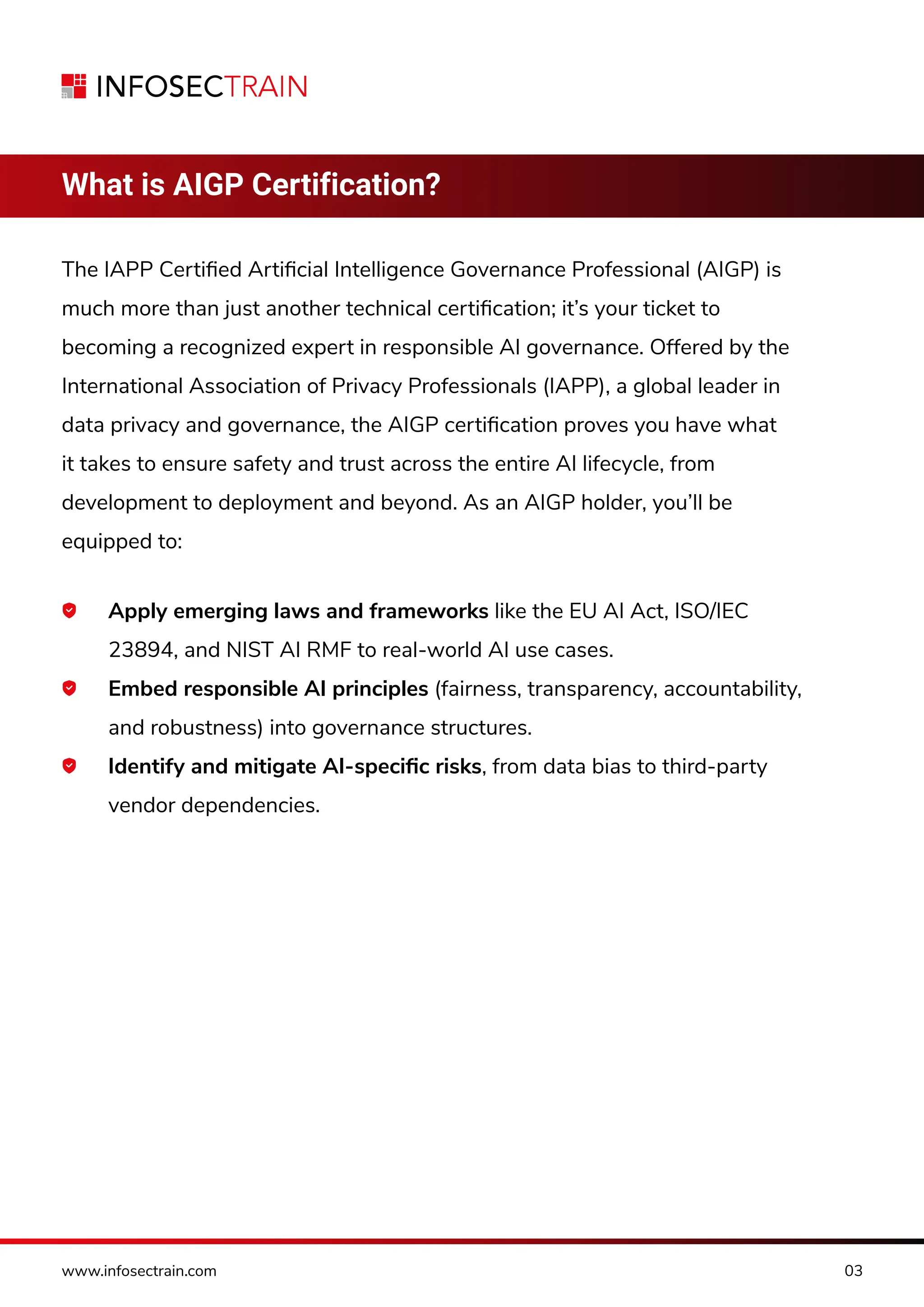
What is AIGP Certification?
The IAPP Certied Articial Intelligence Governance Professional (AIGP) is
much more than just another technical certification; it’s your ticket to
becoming a recognized expert in responsible AI governance. Offered by the
International Association of Privacy Professionals (IAPP), a global leader in
data privacy and governance, the AIGP certication proves you have what
it takes to ensure safety and trust across the entire AI lifecycle, from
development to deployment and beyond. As an AIGP holder, you’ll be
equipped to:
Apply emerging laws and frameworks like the EU AI Act, ISO/IEC
23894, and NIST AI RMF to real-world AI use cases.
Embed responsible AI principles (fairness, transparency, accountability,
and robustness) into governance structures.
Identify and mitigate AI-specic risks, from data bias to third-party
vendor dependencies.
www.infosectrain.com 04
No strict formal pre-requisites to register for the exam. It’s best if you
have basic knowledge of:
Having a background in law, compliance, cybersecurity, or tech is a
bonus but not a deal-breaker.
AI concepts
Data privacy and protection
Governance and risk management
Pre-Requisites
www.infosectrain.com 05
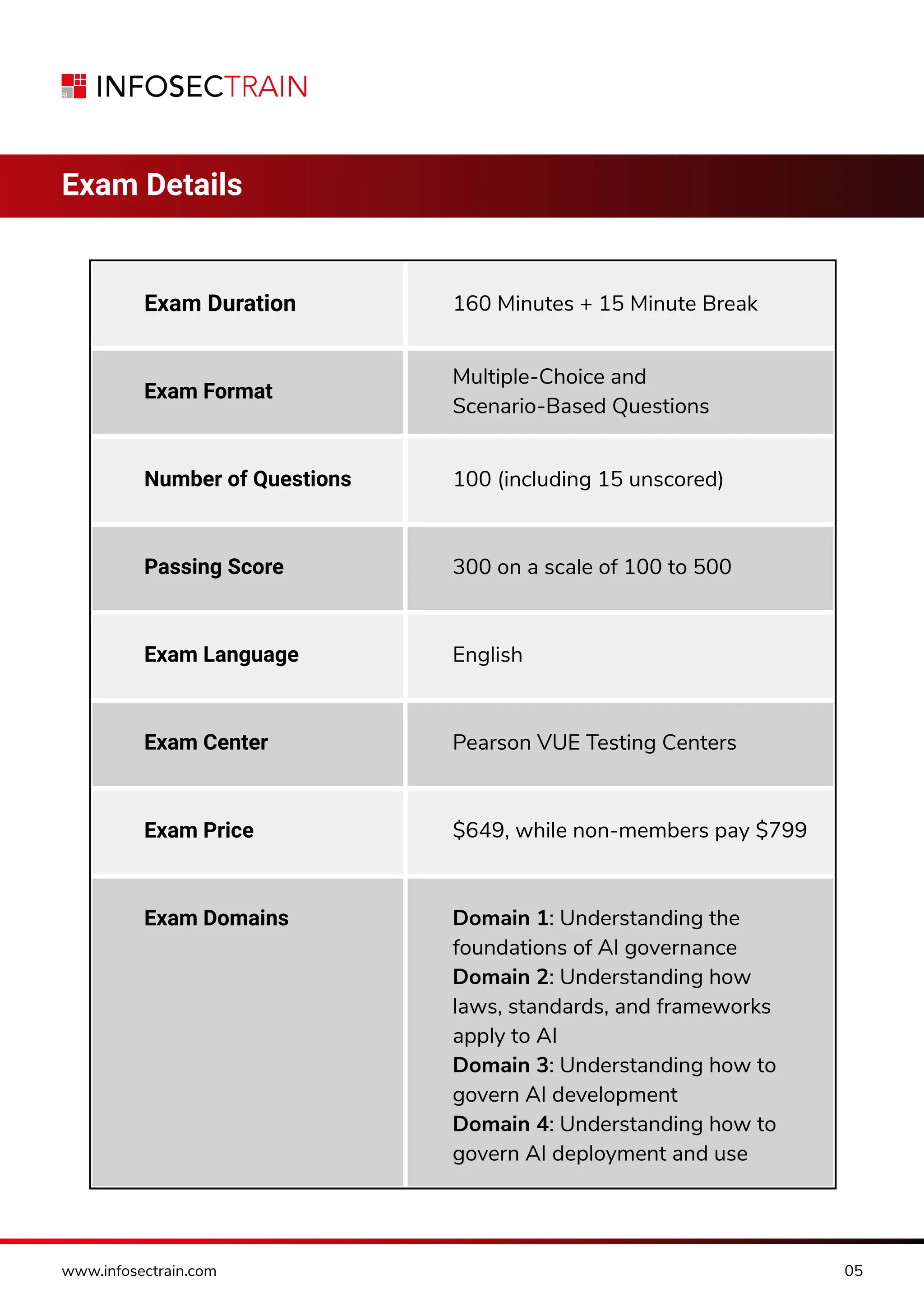
Exam Duration
Exam Format
Number of Questions
Passing Score
Exam Language
Exam Center
Exam Price
Exam Domains
160 Minutes + 15 Minute Break
Multiple-Choice and
Scenario-Based Questions
100 (including 15 unscored)
300 on a scale of 100 to 500
English
Pearson VUE Testing Centers
$649, while non-members pay $799
Domain 1: Understanding the
foundations of AI governance
Domain 2: Understanding how
laws, standards, and frameworks
apply to AI
Domain 3: Understanding how to
govern AI development
Domain 4: Understanding how to
govern AI deployment and use
Exam Details
www.infosectrain.com 06
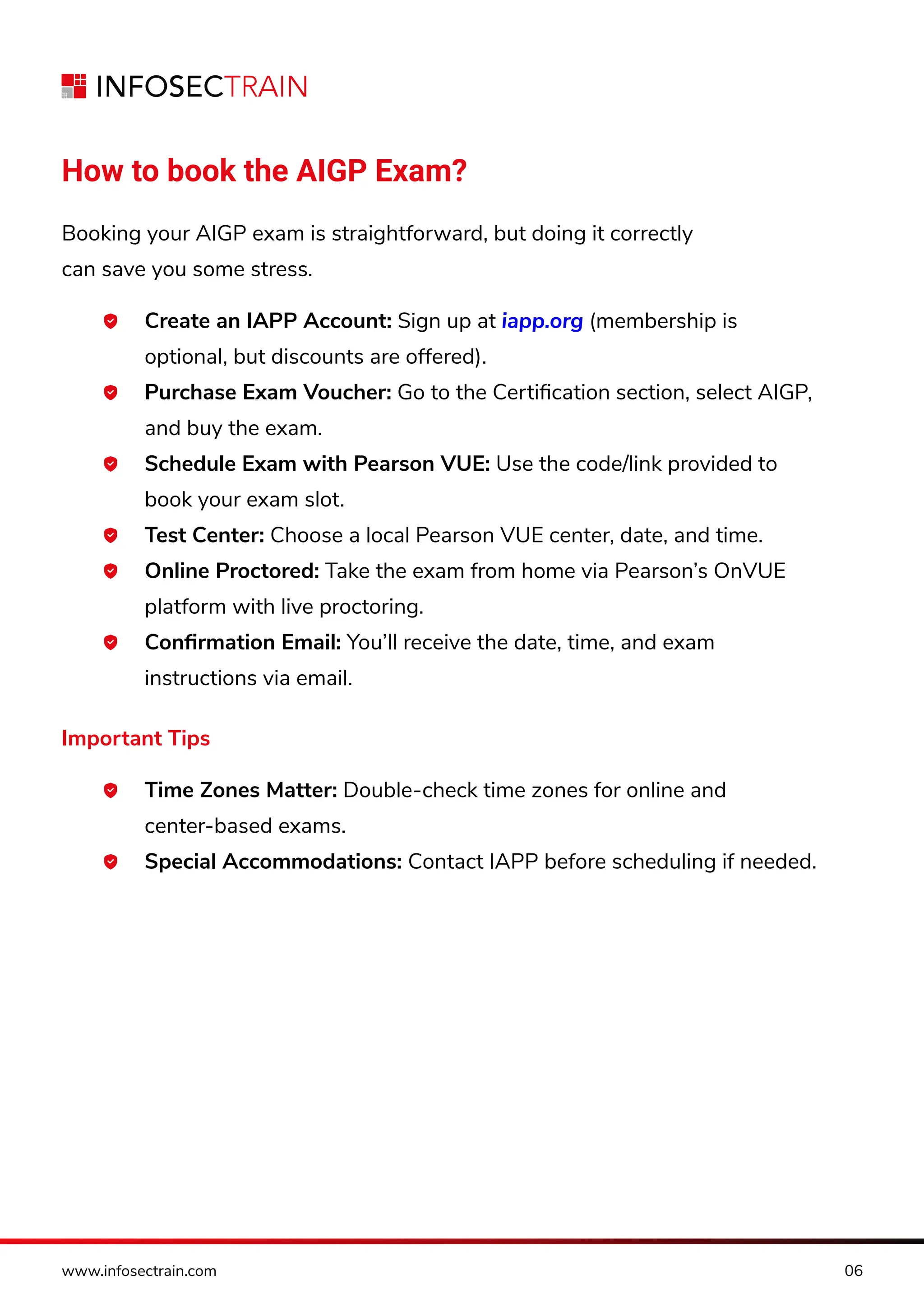
Create an IAPP Account: Sign up at iapp.org (membership is
optional, but discounts are offered).
Purchase Exam Voucher: Go to the Certication section, select AIGP,
and buy the exam.
Schedule Exam with Pearson VUE: Use the code/link provided to
book your exam slot.
Test Center: Choose a local Pearson VUE center, date, and time.
Online Proctored: Take the exam from home via Pearson’s OnVUE
platform with live proctoring.
Confirmation Email: You’ll receive the date, time, and exam
instructions via email.
How to book the AIGP Exam?
Booking your AIGP exam is straightforward, but doing it correctly
can save you some stress.
Important Tips
Time Zones Matter: Double-check time zones for online and
center-based exams.
Special Accommodations: Contact IAPP before scheduling if needed.
www.infosectrain.com 07
Exam Retake Policy
Nobody likes to think about failing, but knowing the rules is good.
Waiting Period: You must wait 7 days before retaking the exam.
Retake Fees: Reduced fee for IAPP members (around $475).
Retake Registration: Rebook through your IAPP prole once your
result is updated.
No Limit on Attempts: No yearly cap; retake as needed after the
waiting period.
Learn and Improve: Analyses weak topics and tough questions after
each attempt.
How to Renew the AIGP Certification?
Certication is not a one-and-done deal; you must maintain it.
Certication Term: An AIGP certication is typically valid for a period
(often two years) before renewal is required. This aligns with other
IAPP certications, which need renewal every 24 months.
Continuing Privacy Education (CPE) Credits: IAPP uses CPE credits
as the primary way to renew certications. As an AIGP, you will likely
need to earn a set number of CPE credits.
Maintaining Membership or Paying Renewal Fee: To keep any IAPP
certication active, you must either remain an IAPP member in good
standing or pay a separate renewal fee every cycle.
www.infosectrain.com 08
Why Do Organizations Need an AIGP Professional?
Here’s why companies across industries are eagerly seeking professionals
with AIGP expertise:
Ethical Al
Implementation
Navigating
Al Laws
Risk
Management
Global Standards
and Recognition
Ensures Al systems
adhere to fairness,
transparency, and
accountability
principles
Keeps businesses
compliant with
evolving Al
regulations
Builds frameworks
to address
Al-related risks
Provides
internationally
recognized expertise
for multinational
corporations
www.infosectrain.com 09
Different Roles in AIGP
AI Compliance
Ofcer
Ensures Al
systems comply
with regulations
Data Privacy
Consultant
Advises on
managing
personal data
in Al
AI Governance
Lead
Develops and
implements. Al
governance
frameworks
Risk &
Compliance
Manager
Manages risks in
Al technologies
AI Ethics
Manager
Oversees ethical
considerations
in Al
www.infosectrain.com 10
How to Prepare for the AIGP Certification Exam?
Now we get to the heart of the matter: how do you prepare effectively and
condently for the AIGP exam? Preparing for a certication exam can feel
daunting, especially one as comprehensive as AIGP. But with the right
strategy and resources, you can set yourself up for success.
1. Understand the Exam Objectives
2. Adopt a Governance-First Mindset
Start with the end in mind. Before diving into books or courses,
understand exactly what the AIGP exam will test you on. Download
and study the ofcial AIGP Body of Knowledge (BoK) and Exam
Blueprint from IAPP. These documents tell you exactly what’s
tested; no guesswork needed.
Passing the AIGP exam means:
End-to-End Lifecycle Thinking: Understand AI’s journey from
data sourcing to deployment.
Risk-First Approach: For every AI application, ask: "What could
go wrong?"
Framework Alignment: Map real-world scenarios to frameworks
like the EU AI Act, NIST AI RMF, and ISO/IEC 23894.
Scenario-Based Thinking: Train yourself to apply concepts to
case studies and simulated incidents.
www.infosectrain.com 11
3. Create a Study Plan
With the exam objectives in hand, it’s time to chart your course. A study
plan is your roadmap from now until exam day. Without one, it’s easy to
get lost or procrastinate. Here’s how to craft a solid plan:
Set a Target Exam Date: First, decide when you want to take the exam. Be
realistic; a common prep window is around 2-3 months of study if you're
working full-time.
Break Down the Domains: Divide the number of weeks you have by the
number of domains (remember, there are four main domains). Some
domains might be larger or more challenging for you, so allocate more time
to those.
Weekly and Daily Goals: For each week in your plan, set specic topics or
chapters to cover. For example, “Week 1: cover AI principles and ethics;
Week 2: cover AI regulatory frameworks (GDPR, AI Act, etc.).” Then break
it further: “Monday: read about AI principles (transparency, fairness);
Tuesday: case studies on AI failures; Wednesday: laws overview; ... and so
on.
Mix-Up Study Activities: Don’t assign reading for every single day; you’ll
burn out. Instead, mix in watching a video or webinar one day, doing
practice questions another, and making flashcards another day. A varied
plan keeps you engaged.
Include Breaks and Buffer: No one can study seven days a week for three
months straight. Schedule at least one day off from studying each week to
recharge. Also, pad your schedule, knowing life happens, build a one-week
buffer before the exam for unexpected delays (work emergencies, etc.).
Track Progress: As you proceed, track your progress against the plan. If
you slip behind, adjust the plan early, maybe push the exam date a bit, or
intensify your study for a couple of weeks rather than cramming at the last
minute.
www.infosectrain.com 12
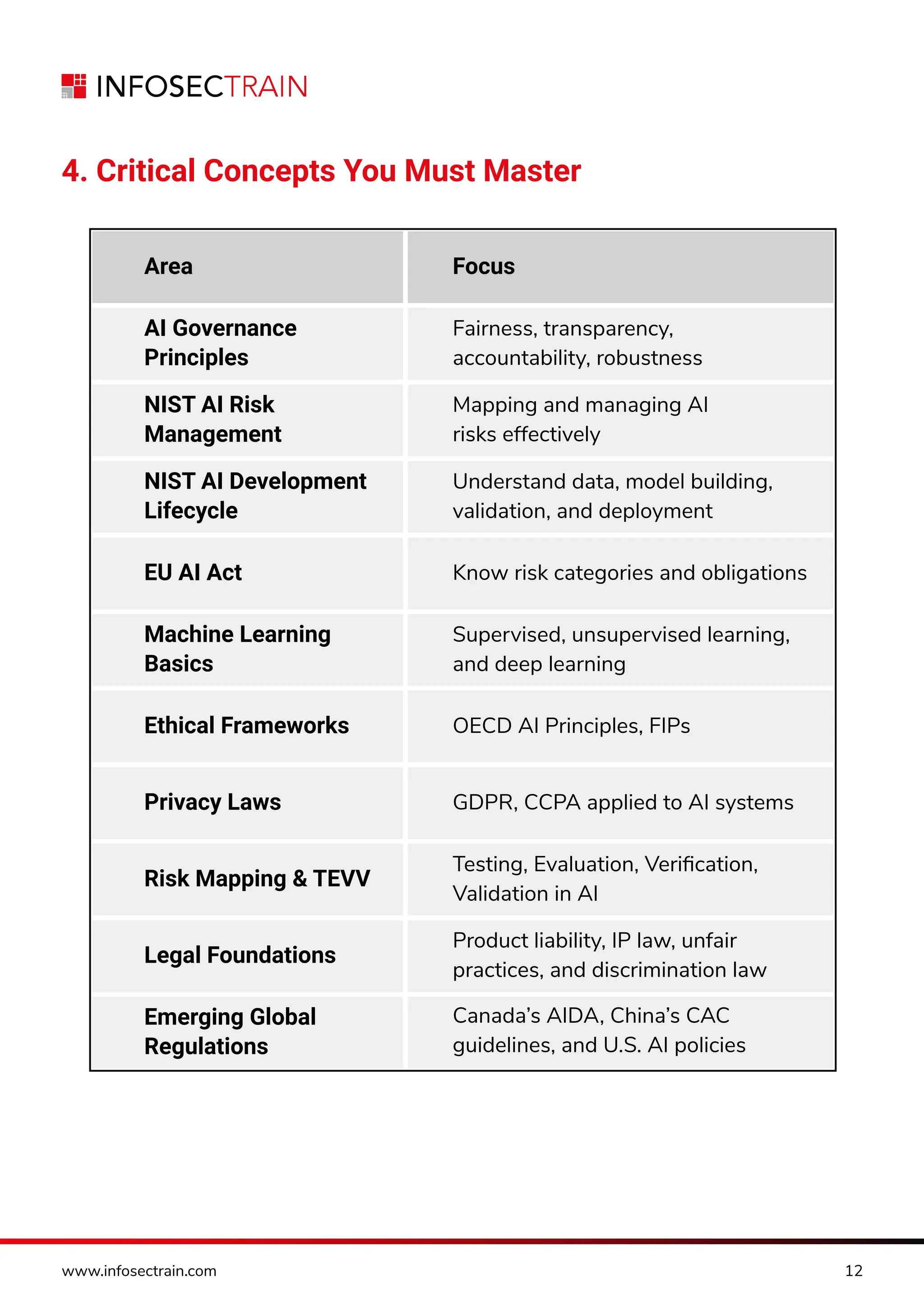
4. Critical Concepts You Must Master
Area Focus
AI Governance
Principles
Fairness, transparency,
accountability, robustness
NIST AI Risk
Management
Mapping and managing AI
risks effectively
NIST AI Development
Lifecycle
Understand data, model building,
validation, and deployment
EU AI Act Know risk categories and obligations
Machine Learning
Basics
Supervised, unsupervised learning,
and deep learning
Ethical Frameworks OECD AI Principles, FIPs
Privacy Laws GDPR, CCPA applied to AI systems
Risk Mapping & TEVV
Testing, Evaluation, Verication,
Validation in AI
Legal Foundations
Product liability, IP law, unfair
practices, and discrimination law
Emerging Global
Regulations
Canada’s AIDA, China’s CAC
guidelines, and U.S. AI policies
www.infosectrain.com 13
5. Study Resources (Books, Practice Papers,
Videos, Training)
Your study plan will only be as good as the resources you use. Quality
study materials can make a huge difference in understanding the content
and ultimately acing the exam.
Ofcial IAPP Study Guide: Start with ofcial materials if available. The
IAPP often provides an ofcial AIGP study guide or textbook. This is
gold because it’s aligned exactly with the exam syllabus. According to
one source, a comprehensive IAPP AIGP Study Guide covers all the
syllabus topics, provides easy-to-understand explanations, and even
practical examples.
Books and Publications: Beyond ofcial guides, look for books on AI
governance, AI ethics, and privacy that cover the material. As of now,
there might not be a plethora of AIGP-specific books besides IAPP’s
own, but topics like “ethical AI”, “AI law”, etc., are covered in academic
and professional books.
Practice Papers and Question Banks: Practice questions are your best
friend for exam prep. They test your knowledge and get you in the
mindset of how questions are asked.
Mock Exams: In addition to practice question sets, take full-length
mock exams as you approach test day. Platforms like CertFun offer
realistic practice exams with an interface similar to the actual test.
Training Courses: Self-study is great, but guided preparation can make
all the difference. If you prefer structured learning, consider enrolling in
ofcial or third-party training programs aligned with the AIGP syllabus.
InfosecTrain’s AIGP training is specifically designed to cover the exam
objectives thoroughly, with expert guidance and hands-on practice.
Access structured learning, hands-on exercises, practice questions,
and insider exam tips.
www.infosectrain.com 14
Videos and Webinars: Sometimes, hearing someone explain a concept
can make it click better than reading about it. There are YouTube videos
and webinars focused on AI governance, AI ethics, and privacy. The
IAPP frequently hosts webinars on AI topics, which are great because
they’re often hosted by practitioners and may count for CPE credits, too.
Community Resources and Forums: Sometimes, the best tips come
from peers. Join forums (like Reddit/privacy or /privacy exams or IAPP’s
own community boards). People often share which resources helped
them or even their personal study notes. Engaging with community
forums can provide unique insights and answer doubts.
Flashcards: For quick reviews, especially for denitions (e.g., key terms
like “machine learning”, “neural network”, types of bias, names of laws,
etc.), flashcards are handy. You can make your own or find pre-made
ones.
Exam Day Tip: Read each question carefully; many are scenario-based.
Manage time smartly: aim to nish the rst pass in
90 minutes.
Flag confusing questions and return later; don’t panic.
Trust your preparation; don’t overthink simple questions.
Stay calm and condent; most passers feel the exam is
tough but fair if prepared right.
Note: Read each question carefully. Eliminate wrong options and trust
your preparation to spot the best answers.
www.infosectrain.com 15
6. Gain Technical Knowledge
“Technical” here doesn’t mean you need to code an AI model from scratch,
but you should be comfortable with the technology you're going to govern.
Understand AI Systems in Practice: Dive a bit deeper into how AI
systems are developed and deployed. For example, learn about
different types of AI algorithms (supervised vs unsupervised
learning, common algorithms like decision trees, neural networks,
etc.), and where they’re used (vision, NLP, etc.).
AI Infrastructure and Tools: Familiarize yourself with the
ecosystem. Cloud AI services (like AWS, Azure AI, Google AI) vs.
on-premise development, what tools/data science teams use
(Python, TensorFlow, etc.).
Data Management: Since AI is data-driven, know the technical
aspects of data governance. How is data stored? What’s a data lake
vs. a database? How to ensure data quality? Also, techniques like
anonymization or encryption are used to protect data feeding AI.
Follow Tech News in AI: Keep an eye on the latest AI technology.
The exam might include contemporary issues (since IAPP updates
exams regularly). Know what things like ChatGPT are (large
language models), and what the current debates are (e.g., AI
recognition issues, deepfakes, etc.).
www.infosectrain.com 16
7. Attain Relevant Certification (If Required)
While preparing for AIGP, you might realize that some foundational
certifications or training could bolster your readiness. This step isn’t
mandatory for everyone, but for some, pursuing another certication
before or alongside AIGP could be benecial.
Privacy Certications (CIPP/x or CIPM): If you come from an AI/tech
background with little exposure to privacy laws, an IAPP privacy
certication like CIPP/E (Europe), CIPP/US (United States), or
CIPM (privacy program management) can provide a solid grounding in
data protection concepts. These are not required for AIGP, but there is
an overlap, especially around privacy laws and program governance.
For example, CIPP/E would give you depth in GDPR, which can directly
help with AIGP’s coverage of how laws apply to AI. CIPM teaches how
to implement privacy programs, which is analogous to implementing an
AI governance program.
Technical Certications (AI/ML or Cloud): On the tech side, there are
emerging AI certications like those from cloud providers (e.g.,
Microsoft has an AI Fundamentals certication, Google Cloud has a
Professional ML Engineer certification). While these aren’t
governance-focused, they teach AI concepts. If you nd structured
learning via a certification program helpful, an “AI fundamentals”
certication could be a great complement. Similarly, if you lack an IT
background, a general IT governance or security certication (like
ISACA’s CRISC for risk management, or CGEIT for IT governance)
might cover governance frameworks that relate to AI. Again, not
required, but if you already have them, they’ll complement your AIGP
learning journey.
www.infosectrain.com 17
8. Develop Practical Skills
Knowledge is essential, but so are practical skills. It's the ability to apply
what you know in real-world situations. The AIGP exam may present
scenario questions that test your practical judgment, and beyond the
exam, employers will value your hands-on abilities.
Don’t Overdo It: On the flip side, don’t feel obligated to collect
certications. Practical experience and skills matter a lot too. Use
certifications strategically. If you’re early in your career, one or two
well-chosen certications (like AIGP plus one foundational
certication) are plenty to establish credibility. More certications can
come later as needed.
Case Studies and Scenario Practice: Engage with real or ctional case
studies of AI governance successes or failures. For example, read about
instances where AI went wrong, like the classic case of a hiring
algorithm that was biased, or a facial recognition system that raised
privacy alarms.
Policy Drafting and Documentation: One very tangible skill in
governance is writing policies or guidelines. Try drafting a brief “AI
Ethics Policy” or “AI Governance Charter” for a hypothetical company. It
doesn’t have to be perfect, but the exercise forces you to articulate
governance concepts in a structured way. Similarly, practice creating a
simple risk assessment checklist for an AI project.
Tool Use: Are there tools or software for AI governance? It’s an
emerging area, but you could explore things like AI audit tools or
bias detection tools if they're available in your environment. For
example, some ML model platforms have bias scan features. Playing
with those can show you what kinds of metrics or outputs governance
folks look at.
www.infosectrain.com 18
9. Enhance Soft Skills
When we talk about preparation, we often focus on technical and
knowledge skills. However, soft skills are equally important for both the
exam and your career as an AIGP.
Communication: As an AI Governance Expert, you’ll communicate with
various stakeholders, Data Scientists, Executives, Legal Counsel, maybe
even external regulators or the public. You need to explain complex AI
issues in simple terms. Practice writing and speaking clearly about
technical topics.
Critical Thinking: Develop the habit of questioning assumptions and
looking at problems from multiple angles. If someone says, “This AI
model is 95% accurate, so it’s fine,” a critical thinker might ask, “What
about the 5%? Who’s in that 5%? Any pattern there?” For exam
questions, this skill helps eliminate wrong choices; you can critically
analyze options and spot which one has a flaw.
Adaptability and Continuous Learning: Show that you can learn on
the fly and adapt to new information. The AI field will keep changing;
maybe a new law will pass or a new type of AI tech will emerge. Being
mentally flexible and eager to learn will keep you on top.
www.infosectrain.com 19
10. Gain Real-World Experience
If you have the opportunity, nothing beats real-world experience to solidify
your understanding and enhance your exam readiness. Not everyone will
have direct AI governance experience (it’s a new field!). But you likely have
related experiences to draw on, or you can seek out mini-experiences.
Look at your current role and identify any tasks or projects that
touch on AI or data governance. Perhaps your company is
experimenting with an AI tool; volunteer to be part of that project,
even if in a minor way.
If possible, do a bit of consulting or volunteering. Maybe a friend’s
company is deploying a chatbot; you could offer to review it from
an ethical or privacy standpoint as a learning exercise.
The IAPP often shares real-world use cases through articles and
conference sessions. Read case studies on the IAPP website
about how companies tackle AI governance. This can count as
“experience by proxy”.
www.infosectrain.com 20
11. Network and Build Professional Relationships
Networking might not seem directly related to passing an exam, but it’s an
underrated part of your preparation and professional growth. It often
emphasizes community and relationships, because they open doors and
provide insights you won’t get solo.
Update your LinkedIn to mention your interest in AI governance or
that you’re pursuing AIGP. Connect with others in the field,
perhaps people with “AIGP” certifications (LinkedIn now has
AIGP on the list since it’s official). You can even post about
preparing for AIGP and ask if others want to form a study group
or share advice.
There are individuals who frequently discuss AI governance, AI
ethics, and privacy on social media or blogs. Follow them (on
Twitter/X, LinkedIn, Medium). They often share the latest news or
perspectives that can complement your textbook knowledge.
www.infosectrain.com 21
Summary
By following this comprehensive guide, you’ll be well on your way to taking
the AIGP exam and becoming a certied Articial Intelligence Governance
Professional. We covered everything from understanding what the AIGP
certication entails through detailed preparation strategies to why this
certication can be a game-changer for organizations and your career.
Good luck on your exam preparation journey! Stay curious, stay ethical, and
keep learning; those qualities will serve you well as an AIGP and a leader in
the AI era. Now, go out there and show the world that with the proper
preparation and mindset, you can master AI governance and help create a
future where innovation and responsibility go hand in hand.
Happy studying and all the best on your AIGP exam!
www.infosectrain.com 01
Contact us
www.infosectrain.com
sales@infosectrain.com
Follow us on

IAPP AIGP Exam Preparation Guide 2025.pdf

  • 1.
    Articial Intelligence GovernanceProfessional Exam Preparation Guide IAPP AIGP
  • 2.
    Table of Contents Whatis AIGP Certication? Pre-Requisites Exam Details How to book the AIGP Exam? Exam Retake Policy How to Renew the AIGP Certication? Why Do Organizations Need an AIGP Professional? Different Roles in AIGP How to Prepare for the AIGP Certication Exam? Understand the Exam Objectives Adopt a Governance-First Mindset Create a Study Plan Critical Concepts You Must Master Study Resources (Books, Practice Papers, Videos, Training) Gain Technical Knowledge Attain Relevant Certication (If Required) Develop Practical Skills Enhance Soft Skills Gain Real-World Experience Network and Build Professional Relationships Summary 03 04 05 06 07 07 08 09 10 10 10 11 12 13 15 16 17 18 19 20 21
  • 3.
    www.infosectrain.com 03 What isAIGP Certification? The IAPP Certified Artificial Intelligence Governance Professional (AIGP) is much more than just another technical certification; it’s your ticket to becoming a recognized expert in responsible AI governance. Offered by the International Association of Privacy Professionals (IAPP), a global leader in data privacy and governance, the AIGP certification proves you have what it takes to ensure safety and trust across the entire AI lifecycle, from development to deployment and beyond. As an AIGP holder, you’ll be equipped to: Apply emerging laws and frameworks like the EU AI Act, ISO/IEC 23894, and NIST AI RMF to real-world AI use cases. Embed responsible AI principles (fairness, transparency, accountability, and robustness) into governance structures. Identify and mitigate AI-specific risks, from data bias to third-party vendor dependencies.
  • 4.
    www.infosectrain.com 04 No strictformal pre-requisites to register for the exam. It’s best if you have basic knowledge of: Having a background in law, compliance, cybersecurity, or tech is a bonus but not a deal-breaker. AI concepts Data privacy and protection Governance and risk management Pre-Requisites
  • 5.
    www.infosectrain.com 05 Exam Duration ExamFormat Number of Questions Passing Score Exam Language Exam Center Exam Price Exam Domains 160 Minutes + 15 Minute Break Multiple-Choice and Scenario-Based Questions 100 (including 15 unscored) 300 on a scale of 100 to 500 English Pearson VUE Testing Centers $649, while non-members pay $799 Domain 1: Understanding the foundations of AI governance Domain 2: Understanding how laws, standards, and frameworks apply to AI Domain 3: Understanding how to govern AI development Domain 4: Understanding how to govern AI deployment and use Exam Details
  • 6.
    www.infosectrain.com 06 Create anIAPP Account: Sign up at iapp.org (membership is optional, but discounts are offered). Purchase Exam Voucher: Go to the Certification section, select AIGP, and buy the exam. Schedule Exam with Pearson VUE: Use the code/link provided to book your exam slot. Test Center: Choose a local Pearson VUE center, date, and time. Online Proctored: Take the exam from home via Pearson’s OnVUE platform with live proctoring. Confirmation Email: You’ll receive the date, time, and exam instructions via email. How to book the AIGP Exam? Booking your AIGP exam is straightforward, but doing it correctly can save you some stress. Important Tips Time Zones Matter: Double-check time zones for online and center-based exams. Special Accommodations: Contact IAPP before scheduling if needed.
  • 7.
    www.infosectrain.com 07 Exam RetakePolicy Nobody likes to think about failing, but knowing the rules is good. Waiting Period: You must wait 7 days before retaking the exam. Retake Fees: Reduced fee for IAPP members (around $475). Retake Registration: Rebook through your IAPP prole once your result is updated. No Limit on Attempts: No yearly cap; retake as needed after the waiting period. Learn and Improve: Analyses weak topics and tough questions after each attempt. How to Renew the AIGP Certification? Certication is not a one-and-done deal; you must maintain it. Certication Term: An AIGP certication is typically valid for a period (often two years) before renewal is required. This aligns with other IAPP certications, which need renewal every 24 months. Continuing Privacy Education (CPE) Credits: IAPP uses CPE credits as the primary way to renew certications. As an AIGP, you will likely need to earn a set number of CPE credits. Maintaining Membership or Paying Renewal Fee: To keep any IAPP certication active, you must either remain an IAPP member in good standing or pay a separate renewal fee every cycle.
  • 8.
    www.infosectrain.com 08 Why DoOrganizations Need an AIGP Professional? Here’s why companies across industries are eagerly seeking professionals with AIGP expertise: Ethical Al Implementation Navigating Al Laws Risk Management Global Standards and Recognition Ensures Al systems adhere to fairness, transparency, and accountability principles Keeps businesses compliant with evolving Al regulations Builds frameworks to address Al-related risks Provides internationally recognized expertise for multinational corporations
  • 9.
    www.infosectrain.com 09 Different Rolesin AIGP AI Compliance Ofcer Ensures Al systems comply with regulations Data Privacy Consultant Advises on managing personal data in Al AI Governance Lead Develops and implements. Al governance frameworks Risk & Compliance Manager Manages risks in Al technologies AI Ethics Manager Oversees ethical considerations in Al
  • 10.
    www.infosectrain.com 10 How toPrepare for the AIGP Certification Exam? Now we get to the heart of the matter: how do you prepare effectively and confidently for the AIGP exam? Preparing for a certification exam can feel daunting, especially one as comprehensive as AIGP. But with the right strategy and resources, you can set yourself up for success. 1. Understand the Exam Objectives 2. Adopt a Governance-First Mindset Start with the end in mind. Before diving into books or courses, understand exactly what the AIGP exam will test you on. Download and study the official AIGP Body of Knowledge (BoK) and Exam Blueprint from IAPP. These documents tell you exactly what’s tested; no guesswork needed. Passing the AIGP exam means: End-to-End Lifecycle Thinking: Understand AI’s journey from data sourcing to deployment. Risk-First Approach: For every AI application, ask: "What could go wrong?" Framework Alignment: Map real-world scenarios to frameworks like the EU AI Act, NIST AI RMF, and ISO/IEC 23894. Scenario-Based Thinking: Train yourself to apply concepts to case studies and simulated incidents.
  • 11.
    www.infosectrain.com 11 3. Createa Study Plan With the exam objectives in hand, it’s time to chart your course. A study plan is your roadmap from now until exam day. Without one, it’s easy to get lost or procrastinate. Here’s how to craft a solid plan: Set a Target Exam Date: First, decide when you want to take the exam. Be realistic; a common prep window is around 2-3 months of study if you're working full-time. Break Down the Domains: Divide the number of weeks you have by the number of domains (remember, there are four main domains). Some domains might be larger or more challenging for you, so allocate more time to those. Weekly and Daily Goals: For each week in your plan, set specific topics or chapters to cover. For example, “Week 1: cover AI principles and ethics; Week 2: cover AI regulatory frameworks (GDPR, AI Act, etc.).” Then break it further: “Monday: read about AI principles (transparency, fairness); Tuesday: case studies on AI failures; Wednesday: laws overview; ... and so on. Mix-Up Study Activities: Don’t assign reading for every single day; you’ll burn out. Instead, mix in watching a video or webinar one day, doing practice questions another, and making flashcards another day. A varied plan keeps you engaged. Include Breaks and Buffer: No one can study seven days a week for three months straight. Schedule at least one day off from studying each week to recharge. Also, pad your schedule, knowing life happens, build a one-week buffer before the exam for unexpected delays (work emergencies, etc.). Track Progress: As you proceed, track your progress against the plan. If you slip behind, adjust the plan early, maybe push the exam date a bit, or intensify your study for a couple of weeks rather than cramming at the last minute.
  • 12.
    www.infosectrain.com 12 4. CriticalConcepts You Must Master Area Focus AI Governance Principles Fairness, transparency, accountability, robustness NIST AI Risk Management Mapping and managing AI risks effectively NIST AI Development Lifecycle Understand data, model building, validation, and deployment EU AI Act Know risk categories and obligations Machine Learning Basics Supervised, unsupervised learning, and deep learning Ethical Frameworks OECD AI Principles, FIPs Privacy Laws GDPR, CCPA applied to AI systems Risk Mapping & TEVV Testing, Evaluation, Verification, Validation in AI Legal Foundations Product liability, IP law, unfair practices, and discrimination law Emerging Global Regulations Canada’s AIDA, China’s CAC guidelines, and U.S. AI policies
  • 13.
    www.infosectrain.com 13 5. StudyResources (Books, Practice Papers, Videos, Training) Your study plan will only be as good as the resources you use. Quality study materials can make a huge difference in understanding the content and ultimately acing the exam. Official IAPP Study Guide: Start with official materials if available. The IAPP often provides an official AIGP study guide or textbook. This is gold because it’s aligned exactly with the exam syllabus. According to one source, a comprehensive IAPP AIGP Study Guide covers all the syllabus topics, provides easy-to-understand explanations, and even practical examples. Books and Publications: Beyond official guides, look for books on AI governance, AI ethics, and privacy that cover the material. As of now, there might not be a plethora of AIGP-specific books besides IAPP’s own, but topics like “ethical AI”, “AI law”, etc., are covered in academic and professional books. Practice Papers and Question Banks: Practice questions are your best friend for exam prep. They test your knowledge and get you in the mindset of how questions are asked. Mock Exams: In addition to practice question sets, take full-length mock exams as you approach test day. Platforms like CertFun offer realistic practice exams with an interface similar to the actual test. Training Courses: Self-study is great, but guided preparation can make all the difference. If you prefer structured learning, consider enrolling in official or third-party training programs aligned with the AIGP syllabus. InfosecTrain’s AIGP training is specifically designed to cover the exam objectives thoroughly, with expert guidance and hands-on practice. Access structured learning, hands-on exercises, practice questions, and insider exam tips.
  • 14.
    www.infosectrain.com 14 Videos andWebinars: Sometimes, hearing someone explain a concept can make it click better than reading about it. There are YouTube videos and webinars focused on AI governance, AI ethics, and privacy. The IAPP frequently hosts webinars on AI topics, which are great because they’re often hosted by practitioners and may count for CPE credits, too. Community Resources and Forums: Sometimes, the best tips come from peers. Join forums (like Reddit/privacy or /privacy exams or IAPP’s own community boards). People often share which resources helped them or even their personal study notes. Engaging with community forums can provide unique insights and answer doubts. Flashcards: For quick reviews, especially for definitions (e.g., key terms like “machine learning”, “neural network”, types of bias, names of laws, etc.), flashcards are handy. You can make your own or find pre-made ones. Exam Day Tip: Read each question carefully; many are scenario-based. Manage time smartly: aim to finish the first pass in 90 minutes. Flag confusing questions and return later; don’t panic. Trust your preparation; don’t overthink simple questions. Stay calm and confident; most passers feel the exam is tough but fair if prepared right. Note: Read each question carefully. Eliminate wrong options and trust your preparation to spot the best answers.
  • 15.
    www.infosectrain.com 15 6. GainTechnical Knowledge “Technical” here doesn’t mean you need to code an AI model from scratch, but you should be comfortable with the technology you're going to govern. Understand AI Systems in Practice: Dive a bit deeper into how AI systems are developed and deployed. For example, learn about different types of AI algorithms (supervised vs unsupervised learning, common algorithms like decision trees, neural networks, etc.), and where they’re used (vision, NLP, etc.). AI Infrastructure and Tools: Familiarize yourself with the ecosystem. Cloud AI services (like AWS, Azure AI, Google AI) vs. on-premise development, what tools/data science teams use (Python, TensorFlow, etc.). Data Management: Since AI is data-driven, know the technical aspects of data governance. How is data stored? What’s a data lake vs. a database? How to ensure data quality? Also, techniques like anonymization or encryption are used to protect data feeding AI. Follow Tech News in AI: Keep an eye on the latest AI technology. The exam might include contemporary issues (since IAPP updates exams regularly). Know what things like ChatGPT are (large language models), and what the current debates are (e.g., AI recognition issues, deepfakes, etc.).
  • 16.
    www.infosectrain.com 16 7. AttainRelevant Certification (If Required) While preparing for AIGP, you might realize that some foundational certifications or training could bolster your readiness. This step isn’t mandatory for everyone, but for some, pursuing another certification before or alongside AIGP could be beneficial. Privacy Certifications (CIPP/x or CIPM): If you come from an AI/tech background with little exposure to privacy laws, an IAPP privacy certification like CIPP/E (Europe), CIPP/US (United States), or CIPM (privacy program management) can provide a solid grounding in data protection concepts. These are not required for AIGP, but there is an overlap, especially around privacy laws and program governance. For example, CIPP/E would give you depth in GDPR, which can directly help with AIGP’s coverage of how laws apply to AI. CIPM teaches how to implement privacy programs, which is analogous to implementing an AI governance program. Technical Certifications (AI/ML or Cloud): On the tech side, there are emerging AI certifications like those from cloud providers (e.g., Microsoft has an AI Fundamentals certification, Google Cloud has a Professional ML Engineer certification). While these aren’t governance-focused, they teach AI concepts. If you find structured learning via a certification program helpful, an “AI fundamentals” certification could be a great complement. Similarly, if you lack an IT background, a general IT governance or security certification (like ISACA’s CRISC for risk management, or CGEIT for IT governance) might cover governance frameworks that relate to AI. Again, not required, but if you already have them, they’ll complement your AIGP learning journey.
  • 17.
    www.infosectrain.com 17 8. DevelopPractical Skills Knowledge is essential, but so are practical skills. It's the ability to apply what you know in real-world situations. The AIGP exam may present scenario questions that test your practical judgment, and beyond the exam, employers will value your hands-on abilities. Don’t Overdo It: On the flip side, don’t feel obligated to collect certifications. Practical experience and skills matter a lot too. Use certifications strategically. If you’re early in your career, one or two well-chosen certifications (like AIGP plus one foundational certification) are plenty to establish credibility. More certifications can come later as needed. Case Studies and Scenario Practice: Engage with real or fictional case studies of AI governance successes or failures. For example, read about instances where AI went wrong, like the classic case of a hiring algorithm that was biased, or a facial recognition system that raised privacy alarms. Policy Drafting and Documentation: One very tangible skill in governance is writing policies or guidelines. Try drafting a brief “AI Ethics Policy” or “AI Governance Charter” for a hypothetical company. It doesn’t have to be perfect, but the exercise forces you to articulate governance concepts in a structured way. Similarly, practice creating a simple risk assessment checklist for an AI project. Tool Use: Are there tools or software for AI governance? It’s an emerging area, but you could explore things like AI audit tools or bias detection tools if they're available in your environment. For example, some ML model platforms have bias scan features. Playing with those can show you what kinds of metrics or outputs governance folks look at.
  • 18.
    www.infosectrain.com 18 9. EnhanceSoft Skills When we talk about preparation, we often focus on technical and knowledge skills. However, soft skills are equally important for both the exam and your career as an AIGP. Communication: As an AI Governance Expert, you’ll communicate with various stakeholders, Data Scientists, Executives, Legal Counsel, maybe even external regulators or the public. You need to explain complex AI issues in simple terms. Practice writing and speaking clearly about technical topics. Critical Thinking: Develop the habit of questioning assumptions and looking at problems from multiple angles. If someone says, “This AI model is 95% accurate, so it’s fine,” a critical thinker might ask, “What about the 5%? Who’s in that 5%? Any pattern there?” For exam questions, this skill helps eliminate wrong choices; you can critically analyze options and spot which one has a flaw. Adaptability and Continuous Learning: Show that you can learn on the fly and adapt to new information. The AI field will keep changing; maybe a new law will pass or a new type of AI tech will emerge. Being mentally flexible and eager to learn will keep you on top.
  • 19.
    www.infosectrain.com 19 10. GainReal-World Experience If you have the opportunity, nothing beats real-world experience to solidify your understanding and enhance your exam readiness. Not everyone will have direct AI governance experience (it’s a new field!). But you likely have related experiences to draw on, or you can seek out mini-experiences. Look at your current role and identify any tasks or projects that touch on AI or data governance. Perhaps your company is experimenting with an AI tool; volunteer to be part of that project, even if in a minor way. If possible, do a bit of consulting or volunteering. Maybe a friend’s company is deploying a chatbot; you could offer to review it from an ethical or privacy standpoint as a learning exercise. The IAPP often shares real-world use cases through articles and conference sessions. Read case studies on the IAPP website about how companies tackle AI governance. This can count as “experience by proxy”.
  • 20.
    www.infosectrain.com 20 11. Networkand Build Professional Relationships Networking might not seem directly related to passing an exam, but it’s an underrated part of your preparation and professional growth. It often emphasizes community and relationships, because they open doors and provide insights you won’t get solo. Update your LinkedIn to mention your interest in AI governance or that you’re pursuing AIGP. Connect with others in the field, perhaps people with “AIGP” certifications (LinkedIn now has AIGP on the list since it’s official). You can even post about preparing for AIGP and ask if others want to form a study group or share advice. There are individuals who frequently discuss AI governance, AI ethics, and privacy on social media or blogs. Follow them (on Twitter/X, LinkedIn, Medium). They often share the latest news or perspectives that can complement your textbook knowledge.
  • 21.
    www.infosectrain.com 21 Summary By followingthis comprehensive guide, you’ll be well on your way to taking the AIGP exam and becoming a certified Artificial Intelligence Governance Professional. We covered everything from understanding what the AIGP certification entails through detailed preparation strategies to why this certification can be a game-changer for organizations and your career. Good luck on your exam preparation journey! Stay curious, stay ethical, and keep learning; those qualities will serve you well as an AIGP and a leader in the AI era. Now, go out there and show the world that with the proper preparation and mindset, you can master AI governance and help create a future where innovation and responsibility go hand in hand. Happy studying and all the best on your AIGP exam!
  • 22.