IMPROVING PATIENT ACCESS
TO ACUTE CARE SERVICES
A practical toolkit for use in public hospitals
                 Developed by the Clinical Excellence Commission


                         Clinical Excellence Commission
Dear reader,
   As you are no doubt aware, the flow of patients through an acute hospital
depends upon a complex set of relationships between many departments,
services and people. Achieving improvements in the way patients move
through such a complex system requires a coordinated approach to admission,
treatment and discharge of patients based on core principles of system
engineering. It requires hospitals to untangle the complexity of their existing
processes so they can understand where the key bottlenecks exist within their
clinical units. It also requires a fundamental commitment to providing safe,
effective, efficient and timely care where services are designed first and
foremost according to patient needs.
   Successfully improving flow across an organisation requires an extraordinary
level of commitment to a complex and exhaustive change process. It also
requires acknowledgement that there may, at times, be a requirement to tackle
issues that have previously been “sacred cows” within your organisation. For
these problems to be solved, leaders in your organisation must be committed
to this change process in very practical ways. Appropriate time and resources
should be allocated to ensure the improvement process is successful. A realistic
assessment of the number of individuals and teams needing dedicated time
away from their usual clinical duties to commit to the change process should be
made, and steps taken to ensure that they have the capacity to do so.
   This Toolkit is designed to be an aid to you and your organisation should
you choose to embark upon the journey to improve patient access to acute
services. The Toolkit is a compilation of strategies and ideas from multiple
sources including:
  The NSW Institute for Clinical Excellence Patient Flow and
  Safety Collaborative
  NSW Health documents and projects
  Access projects within New South Wales Public Hospitals
     Weekend Discharge project
     Effective Discharge Planning Framework
     Emergency Department Access projects including the Rapid Emergency
     Access Team (REAT) and Emergency Medical Unit (EMU) projects
                                                                                       Improving Patient Access to Acute Care Services


     Operating Theatre project
  Best practice sites identified during consultation with Area Health Services (AHS)
  Other local, national and international experts, literature and projects
  reporting success in improving patient flow.
Particular acknowledgement is made of the contribution of leaders of the
modernisation process within the UK National Health Service (Helen Bevan,
Kate Silvester, Richard Lendon, Ben Gowland, Karen Castille and many others)
to much of the thinking contained in the Toolkit. Similarly, the Australian
members of the Access Improvement Taskforce listed at the end of this

                                                                                       1
document have all contributed greatly to ensuring that locally applicable
                                                  solutions are contained within this document.
                                                     The Toolkit is aimed at hospitals providing acute adult medical and surgical
                                                  care, although many of the principles may be applicable in obstetric, paediatric
                                                  and mental health services. The Toolkit does not specifically address flow issues
                                                  for these streams of patients.
                                                      The level of evidence for many of the interventions described in the Toolkit
                                                  is Level II, Level III or Level IV. The interventions described however, have
                                                  been shown to produce results at least at a local level. The Toolkit does not
                                                  claim to be a comprehensive list of effective strategies and interventions.
                                                  Rather it seeks to describe an approach that your organisation could adopt as
                                                  it starts to redesign its patient care processes, and to describe some practical
                                                  interventions that have been found to be useful in organisations elsewhere.
                                                  If an intervention isn’t included this does not mean that it is ineffective or
                                                  that its use is not recommended. Similarly, interventions that have worked
                                                  elsewhere may not be suitable, or may need to be adapted, for your institution.
                                                  Careful analysis of your local data needs to form the basis upon which you
                                                  determine which interventions are most appropriate to implement locally. This
                                                  preliminary analysis of local data is discussed in Section 2.2 - Review data to
                                                  understand hospital activity and performance.
                                                     We believe that the principles contained in this Toolkit can be applied to
                                                  small-scale (local clinical unit level) to large-scale (whole hospital) redesign
                                                  programs. The complexity and resource requirements may differ according
                                                  to the size of the project, but the fundamentals — of removing barriers to
                                                  efficient patient flow through providing care based on the needs and experience
                                                  of patients as they travel through the organisation — will remain the same
                                                  regardless of the project size. We hope that you will find this Toolkit useful as
                                                  you embark upon redesigning how patients interact with your health service.
                                                     Lastly, I would like to acknowledge the work of the team at the Clinical
                                                  Excellence Commission that have put this toolkit together. Louise Kershaw,
                                                  Director of the Patient Flow and Safety Collaborative, has assembled a vast
                                                  array of interventions that have been shown to improve patient access to
                                                  acute services and was a key driver in the writing of this toolkit. Together,
                                                  Louise, Lorraine McEvilly and Celia Mahoney have worked tirelessly to manage
Improving Patient Access to Acute Care Services


                                                  the Patient Flow and Safety Collaborative and to produce the final toolkit. My
                                                  deepest thanks go to these extraordinary individuals.
                                                    Best wishes and good luck,


                                                  Dr. Rohan Hammett
                                                  Director
                                                  Healthcare Improvement Projects
                                                  NSW Clinical Excellence Commission
                                                  March 2005
2
Contents
HOW TO USE THIS TOOLKIT                                                      6
1. INTRODUCTION                                                              7
2. PLANNING THE IMPROVEMENT WORK                                            11
  2.1     Identify and define the problem                                   12
  2.2     Review data to understand hospital activity and performance       12
  2.3     Engage clinicians and convene the redesign team                   14
  2.3.1   Leadership                                                        14
  2.3.2   Team members                                                      15
  2.4     Diagnostic Work                                                   16
  2.4.1   Understanding the current systems and processes                   16
  2.4.2   Tools for understanding processes                                 17
  2.5     Determine your aim                                                19
  2.6     Designing and implementing changes                                20
  2.6.1   Identify interventions to implement                               20
  2.6.2   Practical ideas for effecting change                              21
  2.6.3   Implementation plan                                               22
  2.7     Analyse the Results                                               23
  2.7.1   Methods of measurement                                            23
  2.8     Communicating the change                                          24
  2.8.1   Key factors for successfully managing change                      25
          Case study - Western Sydney AHS -
          Neck of Femur Patient Flow Group                                  26
          Checklist prior to starting your improving access project         34
3. INTERVENTIONS                                                            35
  3.1      General strategies                                               36
  3.1.1    Shared work plans, practices and schedules
           within multi-disciplinary teams                                  36
  3.1.2    Develop multi-disciplinary evidence based pathways               37
  3.1.3    Relative performance table                                       37
  3.1.4    Convene a redesign team                                          38
  3.1.5    Improve communication systems                                    38
  3.1.6    Referral to specialist services                                  39
  3.1.7    Service level agreements                                         39
                                                                                 Improving Patient Access to Acute Care Services


  3.1.8    Managing capacity to respond to need for services                39
  3.1.9    Minimise variation in capacity to provide care                   40
  3.1.10   Change to 7 day a week services                                  40
  3.1.11   Buffer beds                                                      40
  3.1.12   Smoothing variation in elective activity                         41
  3.1.13   Develop advanced nursing roles                                   41
  3.1.14   Up-skilling peripheral hospitals for complex patient needs       42
  3.1.15   Align staff specialist/consultants work to maximise efficiency   42
  3.1.16   Bed management system                                            43
  3.1.17   Centralised bed authority/bed co-ordinator                       43
  3.1.18   Regular multi-disciplinary bed meetings                          45
                                                                                 3
3.1.19   Teleconference bed updates                                    45
                                                  3.1.20   Clinical prioritisation of patients                           45
                                                  3.1.21   Reconfigure beds to reduce outliers                           46
                                                  3.1.22   Over Census Policy                                            46
                                                  3.1.23   Guidelines and protocols for test ordering                    47
                                                  3.1.24   Review permissions to order tests                             48
                                                  3.1.25   Prioritise tests for Emergency Department
                                                           or patients waiting for discharge                             48
                                                  3.1.26   Allocated time for emergency cases                            48
                                                  3.1.27   Appropriate information on request form                       49
                                                  3.1.28   Patients attending for tests                                  49
                                                  3.1.29   Stratified test ordering                                      50
                                                  3.2      Emergency patient flow                                        51
                                                  3.2.1    Pre-bypass hospital early warning system                      51
                                                  3.2.2    Streaming techniques                                          53
                                                  3.2.3    Alternate admission processes                                 53
                                                  3.2.4    Develop alternate services to prevent ED presentation         54
                                                  3.2.5    Advanced nursing and allied health practitioner roles         54
                                                  3.2.6    Fast Track                                                    54
                                                  3.2.7    See and Treat                                                 55
                                                  3.2.8    Lean thinking                                                 56
                                                  3.2.9    Clinical pathways around presenting problems not diagnoses    57
                                                  3.2.10   ED access to day surgical list bookings                       57
                                                  3.2.11   Communications clerk                                          58
                                                  3.2.12   Emergency medicine unit                                       58
                                                  3.2.13   Flag and case manage frequent attendees                       58
                                                  3.3      Improving Flow of Emergency Surgical Patients                 59
                                                  3.3.1    Clinical guidelines or pathways                               59
                                                  3.3.2    Team briefing and debriefing sessions                         60
                                                  3.3.3    Emergency department physician admission rites                60
                                                  3.3.4    Review existing demand for emergency operating theatre time   61
                                                  3.3.5    Prioritisation protocol                                       61
                                                  3.3.6    Prioritisation team                                           61
                                                  3.3.7    Pre-operative placement of patients waiting for OT            61
                                                  3.4      Medical strategies                                            62
                                                  3.4.1    Medical assessment and planning unit                          62
Improving Patient Access to Acute Care Services


                                                  3.4.2    Day only admission ward for ED patients                       62
                                                  3.4.3    Flag and case manage frequent medical admitted patients       62
                                                  3.4.4    Trial at home program                                         63
                                                  3.4.5    Improve appropriateness of admission                          63
                                                  3.4.6    Safety risk assessment                                        63
                                                  3.5      Improving communication                                       64
                                                  3.5.1    Improving communication with GPs and community nursing        64
                                                  3.5.2    Generic transfer/discharge to hospital form for
                                                           all residential aged care facilities (nursing homes)          65
                                                  3.5.3    Link ‘discharge from ward time’ with ‘admission
                                                           from Emergency Department’ time                               65
4
3.5.4    Scheduled transfers                                      65
  3.6      Improving discharge processes                            66
  3.6.1    Discharge risk assessment form                           66
  3.6.2    Admission and discharge plan                             67
  3.6.3    Criteria driven discharge                                67
  3.6.4    Nurse activated discharge                                67
  3.6.5    Monday morning audit                                     68
  3.6.6    Weekend discharge pharmacy                               68
  3.6.7    Multi-disciplinary Discharge Meetings                    69
  3.6.8    Informing patients and carers about their discharge      70
  3.6.9    Discharge checklist                                      70
  3.6.10   Estimated day of discharge                               71
  3.6.11   Estimated length of stay table                           71
  3.6.12   Compare the estimated date of discharge
           to the actual date of discharge                          72
  3.7      Aged care                                                73
  3.7.1    Aged care assessment team (ACAT)                         73
  3.7.2    Transitional care beds                                   73
  3.7.3    Community transitional care beds                         73
  3.7.4    ComPacks service model                                   74
  3.7.5    Purchase transitional care beds                          74
  3.7.6    Direct emergency admission protocol                      74
  3.7.7    “Dependant care” stream of patients managed
           by specialist nurse practitioner                         74
  3.7.8    Walking assistance program                               75
  3.8      Elective Patient Flow                                    75
  3.8.1    Quarantined elective surgical beds                       75
  3.8.2    Criteria driven discharge                                75
  3.8.3    Surgical pathways and estimated day of discharge (EDD)   76
  3.8.4    Increase day of surgery admission rates and
           manage performance outliers better                       76
  3.8.5    Audit all theatre delays or cancellations                76
  3.8.6    Surgical peri-operative liaison nurses                   76
  3.8.7    Medihotels                                               77
                                                                         Improving Patient Access to Acute Care Services


  3.8.8    Flexible staffing                                        77
  3.8.9    Align leave of multi-disciplinary surgical teams         77
  3.8.10   Clinical teams operating pooled referrals                77
  3.8.11   Clinical pathways                                        77
  3.8.12   Improve completion of consent forms                      78
  3.8.13   Marking operating site                                   78
  3.8.14   Improve compliance with fasting requirements             78
  3.8.15 Predict surgical case length accurately                    78
GLOSSARY OF TERMS                                                   79
ACKNOWLEDGEMENTS                                                    80
                                                                         5
How to use this Toolkit
                                                  The Improving Patient Access Toolkit is divided into the following sections:
                                                    Introduction to patient flow
                                                    Planning the improvement work
                                                        Diagnosing flow problems in your organisation
                                                        Key elements of an access improvement project
                                                    Interventions/change ideas
                                                     The Toolkit has been designed with the intention that you should adopt a
                                                  systematic approach to improving patient flow across your organisation. To do
                                                  this, you should start at the beginning of the Toolkit and work your way through
                                                  the different stages of designing and implementing a successful redesign
                                                  program. However, should you simply want change ideas and strategies to
                                                  implement, you should go directly to the interventions section where there are
                                                  detailed descriptions of many specific changes you can test.
                                                    Throughout the document you will find the following icons that will guide
                                                  you to useful resources.


                                                  Key to icons:

                                                                Tool available on CD Rom


                                                                Hospitals where interventions are in place


                                                                Resource available on the internet
Improving Patient Access to Acute Care Services


                                                                Bookmark link within document


6
1. Introduction
 Introduction to the principles
 of managing patient flow
   During the course of a single treatment journey a patient will interact with
dozens of clinicians and clinical and non-clinical services that have the potential
to impact on their care. There are multiple steps and handovers that need to
occur smoothly for the patient to receive optimal care in as timely a manner as
possible. At key points in a hospital where many patients are interacting with a
single service (e.g. in the emergency, radiology, and pathology departments or
in the operating theatres) there is great potential for delays in the treatment of
one patient to result in flow-on of delays to other patients and to other services
throughout the hospital. Like a pebble causing ripples on a pond, relatively
small delays in the treatment of one or two individuals may have significant
ramifications for flow of patients across the whole organisation.
   It is vital that hospitals have an understanding of the key groups of patients
they treat, and the type of care required to produce optimally efficient
management of flow of these patients. Interestingly, in most acute hospitals
patients fall into one of three categories:
   Category 1 - short stay patients with an average
   length of stay (ALOS) of less than 48 hours
   Category 2 – multi-day patients with an ALOS of less than 10 days
   Category 3 – patients with an ALOS greater than 10 days.
   It is useful, in planning service delivery, to think of how services can be
arranged to optimise flow for these three groups of patients. As can be seen in
Figure 1, the majority of patients fit into category 2 (ALOS <10 days). For these
patients even a small reduction in length of stay will produce significant bed
                                                                                      Improving Patient Access to Acute Care Services


capacity within an organisation. For example, if discharge planning processes
were improved, or delays in diagnostic tests eliminated, resulting in an
improvement in ALOS of 0.5 days, dozens of beds would be made available.
   For patients in category 1 (ALOS <48 hours), strategies to provide
alternatives to acute hospital admission are likely to be most effective. For
example hospital-in-the-home services that can provide intravenous antibiotics
for cellulitis, or additional support services for elderly patients following a
fall, or provision of care for nursing home patients directly in their residential
facility, may all prevent admission for these patients.

                                                                                      7
For category 3 patients (ALOS > 10 days) strategies focussed on
                                                  prevention of adverse events, improved liaison with community care
                                                  providers and case management may all help prevent the extreme lengths of
                                                  stay often seen in these patients.
                                                      In general, the types of services required to ensure optimal flow for each
                                                  category of patient will be similar almost regardless of the specific clinical
                                                  condition that has brought them into hospital. For example most category 1
                                                  patients require some simple diagnostic tests, short-term intravenous therapy
                                                  of some sort and some nursing care or monitoring for a short period of time.
                                                  If services are redesigned appropriately, much of this care could be provided
                                                  in facilities other than the acute hospital e.g. ambulatory care units, nursing
                                                  homes, general practice, or the patient’s home.
                                                     Similarly, the patients in category 2 will require diagnostic services, medical and
                                                  nursing management and planning to provide appropriate support post-discharge.
                                                  Much of this care can be planned before admission for elective patients, or very
                                                  early during their admission for emergency patients. The key constraint areas of
                                                  the hospital (e.g. radiology, pathology, operating theatres, intensive care) can
                                                  plan how many of these patients will require their services based on historical or
                                                  prospective data to minimise delays to their treatment. This will enable a matching
                                                  of capacity and demand that will improve the efficient flow of these patients and
                                                  prevent delays that increase length of stay and result in flow-on effects across the
                                                  whole organisation.

                                                  Figure 1


                                                   Length of stay | Medical Patients
                                                   250


                                                   200
                                                                                                                           Category 1 | prevent admission

                                                   150
                                                                                                                           Category 2 | take a day off clinically unnecessary
Improving Patient Access to Acute Care Services


                                                                                                                                        ALoS and it has a dramatic effect
                                                   100
                                                                                                                           Category 3 | these patients may have more
                                                                                                                                        complex support needs
                                                    50


                                                     0
                                                         1   3   5   7   9   11   13   15   17   19    21   23   25   27   29   31   33   35   37   39   41   43   45   47   49   51   53   55   57   59

                                                                                                                 Length of stay (days) | Average LoS = 7.24 days
                                                                                                      Source | Kate Silvester / Richard Lendon / Improvement Partnership for Hospitals


8
The importance of managing variation
   Many of the delays that plague patients attempting to access acute services
are not due to inadequate resources, but rather the result of the variation with
which these resources are utilised. For example, many hospitals have extensive
waiting lists for outpatient clinic appointments. When an analysis is undertaken
of the number of clinic appointment times available, it is often the case that the
current clinical capacity actually matches the demand for the service, except
that every time there is a public holiday or a conference, the outpatient clinic is
cancelled and as a result a waiting list is produced. If clinics were rescheduled
rather than cancelled this would not occur.
   Similarly, the variation in the number of patients a hospital admits for
elective surgery may in itself be contributing to waiting lists, access block
and surgical cancellations. The graph shown in figure 2 below is taken from a
hospital that on average admitted 49.7 patients every day. In the top part of
the graph you can see that the number of patients admitted varied between
24 and 78 on any single day. To ensure it could provide enough beds for all
patients on 99.9% of days, this hospital required 78 beds to be kept open for
elective admissions. In the bottom part of the graph the same average number
of patients were admitted (49.7) but, by reducing the variation in the number
of patients admitted (38-70 cf 24-78), the number of beds required to ensure
availability for 99.9% of patients was reduced to 68.

Figure 2

Total Admissions | April-November
  80
                                                                                    78 beds
  70                                                                                required each
  60                                                                                day to give
  50
                                                                                    99.9% chance
                                                                                    of admission
  40
                                                                                            Admissions
  30
                                                                                            Average = 49.7
  20                                                                                        UPL = 78.1
                                                                                                               Improving Patient Access to Acute Care Services


Standardised Admissions | April-November
  80

  70                                                                                68 beds
  60
                                                                                    required each
                                                                                    day to give
  50
                                                                                    99.9% chance
  40                                                                                of admission
                                                                                            Admissions
  30
                                                                                            Average = 49.7
  20                                                                                        UPL = 67.9


                            Daily bed requirement reduced from 78 to 68
                            Source | Kate Silvester / Richard Lendon / Improvement Partnership for Hospitals   9
Thus if we manage the variation in the way we provide our services, we will
                                                  find greater capacity to deliver services in an efficient manner. Interestingly,
                                                  in most hospitals elective activity varies far greater than emergency activity
                                                  on a daily basis. Similarly, there is often far more variability in the number
                                                  of patients discharged than the number of patients admitted. Both of these
                                                  processes (number of elective patients admitted and number of patients
                                                  discharged) can be managed by the organisation itself. Understanding the
                                                  management of variation in service delivery is crucial to smoothing the flow of
                                                  patients through acute hospitals.
                                                     Gaining a greater understanding of the way in which patients move into,
                                                  through and out of the organisation and the bottlenecks that are hindering
                                                  efficient movement will assist in understanding which changes should be
                                                  made to gain improvement. To do this effectively an organisation will need to
                                                  examine its own data to identify patterns in activity that need to be redesigned.
                                                  The resources below contain more detailed descriptions of the information
                                                  contained in this introduction and can be referred to in order to gain a greater
                                                  understanding of the key principles of managing patient flow. The Toolkit may
                                                  then be utilised to redesign the way a patient travels through the system.

                                                    Improving patient flow


                                                               www.steyn.org.uk/


                                                    Queuing theory (NHS website)
                                                              Patient flows, waiting and managerial learning paper (NHS)
                                                              www.cognitus.co.uk/healthcare.html#1

                                                              NHS Flow Management Wizard
                                                              www.natpact.nhs.uk/demand_management/wizards/big_wizard/
                                                              index.php?page=/demand_management/wizards/big_wizard/Step_
                                                              4/Basic_Queuing_Theory.php
Improving Patient Access to Acute Care Services


                                                              Foundations of demand and capacity (NHS presentation)


10
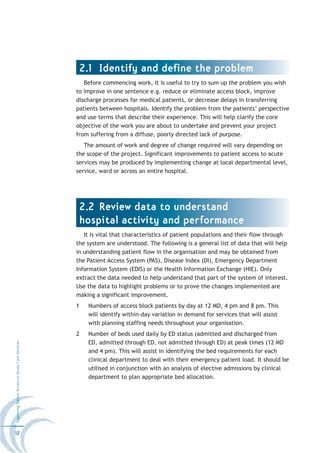
2. Planning the
improvement work
Successful implementation of changes will depend on effective
project management throughout the period of the project.

Project steps
  Identify and
  define the
  problem
                      review data to understand
                      activity and performance


                      engage clinicians and
                      convene the redesign team


                      complete baseline
                      diagnostic work


                      determine the aim


                      identify interventions to trial


                      design and implement
                      the changes
                                                                              Improving Patient Access to Acute Care Services


                      analyse the results


                      build in accountability to
                      help sustain changes

                                                                communicate
                                                                the changes
                                                                              11
2.1 Identify and define the problem
                                                     Before commencing work, it is useful to try to sum up the problem you wish
                                                  to improve in one sentence e.g. reduce or eliminate access block, improve
                                                  discharge processes for medical patients, or decrease delays in transferring
                                                  patients between hospitals. Identify the problem from the patients’ perspective
                                                  and use terms that describe their experience. This will help clarify the core
                                                  objective of the work you are about to undertake and prevent your project
                                                  from suffering from a diffuse, poorly directed lack of purpose.
                                                     The amount of work and degree of change required will vary depending on
                                                  the scope of the project. Significant improvements to patient access to acute
                                                  services may be produced by implementing change at local departmental level,
                                                  service, ward or across an entire hospital.


                                                   2.2 Review data to understand
                                                   hospital activity and performance
                                                     It is vital that characteristics of patient populations and their flow through
                                                  the system are understood. The following is a general list of data that will help
                                                  in understanding patient flow in the organisation and may be obtained from
                                                  the Patient Access System (PAS), Disease Index (DI), Emergency Department
                                                  Information System (EDIS) or the Health Information Exchange (HIE). Only
                                                  extract the data needed to help understand that part of the system of interest.
                                                  Use the data to highlight problems or to prove the changes implemented are
                                                  making a significant improvement.
                                                  1   Numbers of access block patients by day at 12 MD, 4 pm and 8 pm. This
                                                      will identify within-day variation in demand for services that will assist
                                                      with planning staffing needs throughout your organisation.
                                                  2   Number of beds used daily by ED status (admitted and discharged from
                                                      ED, admitted through ED, not admitted through ED) at peak times (12 MD
Improving Patient Access to Acute Care Services


                                                      and 4 pm). This will assist in identifying the bed requirements for each
                                                      clinical department to deal with their emergency patient load. It should be
                                                      utilised in conjunction with an analysis of elective admissions by clinical
                                                      department to plan appropriate bed allocation.


12
3    Count the number of beds required to cover a given proportion of days
     (e.g. 95% of days). This will help you to understand the size of the
     improvement required to eliminate access block in your organisation.
4    Number of access block patients for each day of week. This will identify
     the between-day variation in demand for services to assist with planning
     schedules for clinical activity and staffing.
5    Percentage of overnight access block patients who reach a ward bed
     before midday. This will help identify any problems related to turnover of
     available beds.
6    Distribution of specialties for access block patients (% bed use by
     Consultant Medical Officer specialty). This will help identify departments
     in which redesign processes might be most useful, or in which there may
     be a need for additional resources to improve flow.
7    Percentage bed base by Consultant Medical Officer specialty (Emergency
     and non-emergency bed distributions). This will enable a current appraisal
     of bed utilisation and management of bed allocation on a data-based
     rather than historical basis.
8    Outliers by Consultant Medical Officer specialty and ward — bed days used.
     This will identify the degree of disorganisation of current bed management
     practices and provide a focus to case management models to improve
     length of stay for these patients.
9    Emergency overnight medical discharge rate by day of week (% weekend
     discharge). This will characterise variation in discharge practices across
     days of the week. It should be done for a 12-month period. Note the peaks
     in discharge prior to public holidays. Readmission rates after these public
     holidays usually do not change despite the high discharge rates suggesting
     that these patients really were ready for discharge. You can check these
     readmission rates in your own organisation.
10   Elective overnight admission rate by day of week. This will show the
     variation in elective services in your organisation. If this variability can be
     minimised it will, of itself, create extra bed capacity in your organisation.
                                                                                        Improving Patient Access to Acute Care Services


11   Analysis of length of stay against benchmark by Consultant Medical Officer.
     This will help identify variation in clinical practices that may be contributing
     to delays for patients. These can be addressed by the clinical unit manager.


                                                                                        13
For access to or assistance with extracting the above data, contact the hospital
                                                  case mix manager (or person who collates data for reporting to the health
                                                  department). They will have access to the data and the skills and knowledge
                                                  to extract this data or will be able to suggest other sources of assistance.
                                                  Alternatively your executive sponsor will be useful in securing the services of
                                                  an appropriately skilled person to do this.


                                                              Access Blocked Patient Analysis 2002-2003 (NSH)


                                                              Hospital Flow Measurement Guide (IHI)
                                                              www.qualityhealthcare.org/IHI/Topics/Flow/PatientFlow/
                                                              EmergingContent/HospitalFlowMeasurementGuide.htm


                                                   2.3 Engage clinicians and
                                                   convene the redesign team

                                                  2.3.1 Leadership
                                                     Effective leadership is crucial to maintaining a focus on improving the
                                                  patient experience. The team should include:
                                                    someone with the skills, energy and enthusiasm to lead the project,
                                                    strong medical and nursing leadership at all organisational levels,
                                                    clinician managers who are effective champions for the project. They have
                                                    an important role in spreading improvements to other departments and may
                                                    be required to performance manage individual variance,
                                                    individual clinician leaders who participate and use their influence to
                                                    support change amongst their colleagues,
Improving Patient Access to Acute Care Services


                                                    leaders with a clear vision of the project who can sell this vision to others.


14
2.3.2 Team members
   When bringing together a project group or a redesign team ensure
there is a mix of administration, medicine, nursing and allied health
representation relevant to the project’s aims. Enthusiasm and interest in
the project are essential qualities to look for in team members. They should
also have an operational role in the processes to be changed. Many sites
that have successfully improved patient flows have also actively involved
consumers in the work of their teams, in a manner appropriate to the
context of the organisation.
  Team members also need to take the following roles:


2.3.2.1 Executive sponsor
  Previous experience has demonstrated that effective sponsorship at an
executive level is crucial to successful implementation of organisational
change. Executive sponsors need to be at Area Health Service level or
executive level in a facility i.e. Director of Clinical Services or Hospital
Executive Director and be:
  someone with enough influence in the organisation to oversee the change,
  someone prepared to set aside time for the project.


2.3.2.2 Clinical leaders
  Most projects require a nursing lead and a medical lead. They should be
someone who:
  understands the processes of care,
  is able to provide technical expertise in order to produce solutions that are
  technically proper, ethically sound and effective,
  can provide effective leadership,
  is an opinion leader who can influence his/her peers to produce
                                                                                  Improving Patient Access to Acute Care Services


  improvement in existing systems of care delivery.


                                                                                  15
2.3.2.3 Project co-ordinator
                                                  Someone who:
                                                    understands not only the details of the system, but also the various effects
                                                    of making change(s) in the system,
                                                    has the necessary skills, including computer literacy, project management
                                                    and high-level organisational skills,
                                                    ideally has some experience in change management, process mapping and
                                                    Clinical Practice Improvement (CPI) techniques.


                                                  2.4 Diagnostic Work

                                                  2.4.1 Understanding the current
                                                  systems and processes
                                                    Identify what the main streams of activity are within the service where
                                                    you are seeking improvements e.g. elective day of surgery admission
                                                    stream, emergency medical admit and discharge from ED, elective medical
                                                    procedure admissions.
                                                    Identify what the key processes and issues are within those streams, using a
                                                    variety of means that collect patient and staff perspectives of the problem.
                                                    Use interviews, focus groups, patient journeys and process mapping.
                                                    Review:
                                                       current or recent projects, their aims and outcomes to date,
                                                       current policies and procedure manuals,
                                                       currently available data.
                                                                         Measurement for Improvement, Improvement Leaders’
                                                                         Guide (NHS)
Improving Patient Access to Acute Care Services


                                                                         www.modern.nhs.uk/improvementguides/
                                                                         measurement/


16
2.4.2 Tools for understanding processes

2.4.2.1 Process mapping
   The flow of patients through hospital, whether as emergency admission,
ED presentation, outpatient or for an elective procedure, involves multiple
processes, many of which may be repeated approximately the same way for
every patient. Even very complex procedures may be standardised, based on
sound scientific practice. This can help to reduce variation and inefficiency
caused by poor communication and redundant complexity. Process mapping is
a technique to identify inefficiencies; redundant steps in clinical workflow;
bottlenecks or blockage points where time or resources are wasted.
            Improving Patient Flows - Guide to Process Mapping
            (Institute for Clinical Excellence)
            Improvement Leaders Guide to Process Mapping, Analysis and
            Redesign 2002 (NHS)
            Easy Guide to Clinical Practice Improvement 2002 (NSW Health)


2.4.2.2 Patient journey
   Tracking a patient’s journey through the healthcare system is a simple way
to understand where problems lie and how the service looks through the eyes of
a patient. Any member of staff can do this by shadowing a patient through the
system and keeping a time log of activities. Alternatively, ask a patient or their
carer to write a diary of their experience. The patient journey may be used to
verify findings of the process mapping exercise and will allow identification of
any waits and delays in real time.


            Patient Journey Tools (Institute for Clinical Excellence)
                                                                                     Improving Patient Access to Acute Care Services


                                                                                     17
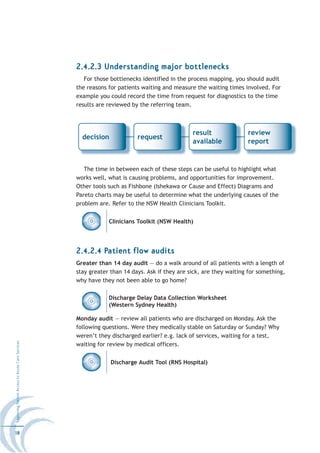
2.4.2.3 Understanding major bottlenecks
                                                     For those bottlenecks identified in the process mapping, you should audit
                                                  the reasons for patients waiting and measure the waiting times involved. For
                                                  example you could record the time from request for diagnostics to the time
                                                  results are reviewed by the referring team.


                                                                                              result               review
                                                    decision             request
                                                                                              available            report


                                                     The time in between each of these steps can be useful to highlight what
                                                  works well, what is causing problems, and opportunities for improvement.
                                                  Other tools such as Fishbone (Ishekawa or Cause and Effect) Diagrams and
                                                  Pareto charts may be useful to determine what the underlying causes of the
                                                  problem are. Refer to the NSW Health Clinicians Toolkit.


                                                              Clinicians Toolkit (NSW Health)


                                                  2.4.2.4 Patient flow audits
                                                  Greater than 14 day audit — do a walk around of all patients with a length of
                                                  stay greater than 14 days. Ask if they are sick, are they waiting for something,
                                                  why have they not been able to go home?

                                                              Discharge Delay Data Collection Worksheet
                                                              (Western Sydney Health)

                                                  Monday audit — review all patients who are discharged on Monday. Ask the
                                                  following questions. Were they medically stable on Saturday or Sunday? Why
                                                  weren’t they discharged earlier? e.g. lack of services, waiting for a test,
Improving Patient Access to Acute Care Services


                                                  waiting for review by medical officers.


                                                               Discharge Audit Tool (RNS Hospital)


18
2.5 Determine your aim
   Develop a statement about the aim of your project. An aim is used to keep
the team focused on what it is trying to achieve and provide a measure for the
project’s success.
Based on your diagnostic data, determine aims that include:
  the percentage improvement you will work towards achieving,
  the time within which you will achieve the aim.
Example: To have less than 10% of 75 year old patients experiencing four hour
access block within six months.
It is important to note a few key points about these aims:
1 Use the diagnostic work to find what is important to the different
  stakeholder groups involved. Engage the team with something that matters
  to each of them.
2 Once the issues the team wish to address are clear, set aims at hospital
  and departmental level that act as levers to engage change at ward and
  individual clinician level.
3 Make the aims SMART i.e. specific, measurable, achievable, results
  orientated and time scheduled.
The aims should describe:
  what is expected to happen,
  the system to be improved,
  the setting or sub-population of patients,
  goals.

            Develop Your Aims from your Diagnostics Presentation
            (Institute for Clinical Excellence)
                                                                                 Improving Patient Access to Acute Care Services


                                                                                 19
2.6 Designing and implementing changes

                                                  2.6.1 Identify interventions to implement
                                                      Once problems and issues have been identified and prioritised a decision
                                                  needs to be made regarding what changes you will implement to achieve the
                                                  aim. Go to Section 3 of the Toolkit which has a range of ideas, suggestions and
                                                  changes implemented in other organisations. Read through the interventions
                                                  listed in the appropriate section and download any references or tools. At
                                                  a redesign team meeting agree on a list of interventions you wish to trial
                                                  or implement, based on the results of your diagnostic work. It is important
                                                  to focus on interventions relevant to those significant problems identified
                                                  during your diagnostic analysis. Look for the common sense solutions before
                                                  introducing radical change. Many of these will emerge during process mapping
                                                  and redesign activity.
                                                     In some cases, a decision to implement a particular strategy may be made
                                                  straight away. This is appropriate where there is a high level of confidence
                                                  from the diagnostic work and evidence from other organisations where it is in
                                                  place, that it will effect an improvement. However other interventions will
                                                  need to be trialled, adapted to local context and evaluated for effectiveness
                                                  before a decision to implement is made. Clinical Practice Improvement (CPI)
                                                  methodology is a useful tool for trialing interventions.

                                                              Easy Guide to Clinical Practice Improvement Methodology
                                                              (NSW Health)
                                                              PDSA Worksheet (Institute for Clinical Excellence)
Improving Patient Access to Acute Care Services


20
2.6.2 Practical ideas for effecting change
  Create a culture where change is encouraged and people are willing to try
something new.
  Use cases that actually happened in your hospital to demonstrate process
  and system problems affecting patient outcomes to foster organisational and
  individual will to change.
  Publicise the findings of the diagnostic work to highlight problem areas and
  engage clinical staff and management.
  Use success stories to create an expectation that change can occur.
  Establish a process in your hospital or department to keep up to date with
  the current best practice.
  Use incentives, e.g. wards with high morning discharge rates given priority
  for receiving extra staff.
  Acknowledge and celebrate success when it is achieved.
This should help to create a culture where things change/improve constantly so
that a state of change/improvement becomes the stable state.

                       Improvement Leaders Guide -
                       Managing the Human Dimension of Change (NHS)
                       www.modern.nhs.uk/improvementguides/human

           Organisational Change, a Review for Healthcare Managers,
           Professionals and Researchers (NHS)
           www.sdo.lshtm.ac.uk/pdf/changemanagement_review.pdf

           Making Informed Decisions on Change (NHS)
           www.sdo.lshtm.ac.uk/pdf/changemanagement_booklet.pdf

           Quality collaboratives: Lessons from research
           (The Nordic School of Public Health)
                                                                                 Improving Patient Access to Acute Care Services


           Improvement Leaders Guide - Spread and Sustainability, 2002
           (NHS)


                                                                                 21
2.6.3 Implementation plan
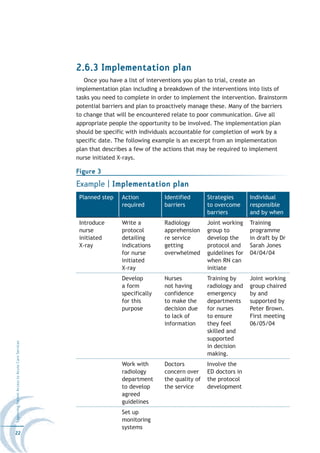
                                                     Once you have a list of interventions you plan to trial, create an
                                                  implementation plan including a breakdown of the interventions into lists of
                                                  tasks you need to complete in order to implement the intervention. Brainstorm
                                                  potential barriers and plan to proactively manage these. Many of the barriers
                                                  to change that will be encountered relate to poor communication. Give all
                                                  appropriate people the opportunity to be involved. The implementation plan
                                                  should be specific with individuals accountable for completion of work by a
                                                  specific date. The following example is an excerpt from an implementation
                                                  plan that describes a few of the actions that may be required to implement
                                                  nurse initiated X-rays.

                                                  Figure 3
                                                  Example | Implementation plan
                                                   Planned step   Action          Identified       Strategies       Individual
                                                                  required        barriers         to overcome      responsible
                                                                                                   barriers         and by when
                                                   Introduce      Write a         Radiology        Joint working    Training
                                                   nurse          protocol        apprehension     group to         programme
                                                   initiated      detailing       re service       develop the      in draft by Dr
                                                   X-ray          indications     getting          protocol and     Sarah Jones
                                                                  for nurse       overwhelmed      guidelines for   04/04/04
                                                                  initiated                        when RN can
                                                                  X-ray                            initiate
                                                                  Develop         Nurses           Training by      Joint working
                                                                  a form          not having       radiology and    group chaired
                                                                  specifically    confidence       emergency        by and
                                                                  for this        to make the      departments      supported by
                                                                  purpose         decision due     for nurses       Peter Brown.
                                                                                  to lack of       to ensure        First meeting
                                                                                  information      they feel        06/05/04
                                                                                                   skilled and
                                                                                                   supported
Improving Patient Access to Acute Care Services


                                                                                                   in decision
                                                                                                   making.
                                                                  Work with       Doctors          Involve the
                                                                  radiology       concern over     ED doctors in
                                                                  department      the quality of   the protocol
                                                                  to develop      the service      development
                                                                  agreed
                                                                  guidelines
                                                                  Set up
                                                                  monitoring
                                                                  systems
22
2.7 Analyse the results
   The team should determine how to measure the progress of their work and
develop a strategy to achieve this. Avoid the temptation to spend so much time
collecting or pursuing “perfect” data that the improvement work doesn’t get
started. Measurement plays the following important roles.
  Key measures are required to assess progress on your aim.
  Specific measures can be used to learn more about the problems that exist
  within the system.
  Balancing measures are needed to assess whether the system as a whole is
  being improved.
  Data from the system (including from patients and staff) can be used to
  focus improvement and refine changes.


2.7.1 Methods of measurement
  Different methods may be used to gain measures, both qualitative and
quantitative, to provide the information described above.
  Clinical measures of patients’ health
  Documentation of behaviour
  Questionnaires
  Interviews
  Assessments
  Summary of databases
  Chart audits
  Observations
                                                                                 Improving Patient Access to Acute Care Services


                                                                                 23
Once process mapping is complete it usually highlights areas requiring further
                                                  information gathering or audit. This will help the team to fully understand the
                                                  nature and size of the problem to be addressed and prioritise the area to work on.

                                                              Measurement Strategy Worksheet
                                                              (Institute for Clinical Excellence)


                                                              Measurement Presentation - Helen Ganley (NSH)


                                                              Weekend Discharge Audit Report (RNS Hospital)


                                                                          SPC for Beginners - Powerpoint Presentation (NHS)
                                                                          www.modern.nhs.uk/InnovationandKnowledge
                                                                          Group/7338/SPC_for_beginners_web.ppt


                                                              Patient Perceived Needs Survey (NICS)


                                                   2.8 Communicating the change
                                                     For these projects to work smoothly there needs to be good communication
                                                  with individuals, departments, patients, providers, management and clinicians.
                                                     As interventions are implemented, display information about the changes
                                                  that have been made and the results achieved in a clear graphical format. Show
                                                  performance against targets.
                                                      Every individual in the healthcare team including nurses, doctors, allied
                                                  health professionals, administrators, managers, secretaries, cleaners, food
                                                  services and porters, play a significant part in the patient’s journey. They will
                                                  all offer a different and valuable perspective. Remember, if people know what
Improving Patient Access to Acute Care Services


                                                  is going on and are actively involved, they will have greater ownership of the
                                                  problem and the solutions.
                                                     Identify data and measures that have “shock” value and use them to gain
                                                  acknowledgement of the problem and engagement of staff in the need for
                                                  change. Identify all those who have some role to play in the care processes that
                                                  you aim to change and be open and share information with them.


24
2.8.1 Key factors for successfully managing change
  Evidence suggests that the following factors all significantly improve the
chances of a project making an effective and sustainable impact.
  An organisational will and commitment to change the system to, first and
  foremost, meet the needs of the patients.
  Visible commitment from executive and senior management.
  Local ownership of solutions to the problems encountered by local clinical
  and management teams.
  Resources committed to the redesign process, including personnel
  experienced in change management to facilitate this locally.
  A core multi-disciplinary team who drive change, facilitated and supported
  by a project coordinator.
  Medical, nursing and allied health engagement, leadership, and participation
  in the team.
  Investigation and data analysis of existing issues and problems utilising
  tools such as extensive process mapping and redesign of inefficient
  processes of care.
  Rapid implementation of strategies that have been shown to be effective in
  improving flow in similar hospitals.


                                                                                 Improving Patient Access to Acute Care Services


                                                                                 25
Case study - Western Sydney AHS -
                                                   Neck of Femur Patient Flow Group:
                                                  Contact Details: Maria Lingam     maria_lingham@wsahs.nsw.gov.au
                                                                      Rosio Cordova rosio_cordova@wsahs.nsw.gov.au


                                                  Team Members
                                                  Cathie Whitehurst             Executive Representative

                                                  Celine Hill                   Team Leader, Trauma Program Manager

                                                  Rosio Cordova                 Facilitator, Quality Manager

                                                  Maria Lingam                  Clinical Nurse Consultant (Orthopaedics)

                                                  Narelle Allen                 Clinical Nurse Educator (Orthopaedics)

                                                  Gail Hook                     NUM, D4A (Orthopaedics ward)

                                                  Robert Dowsett                Director ED Westmead

                                                  Gayle McInerney               Director ED Auburn

                                                  Geoff Shead                   Surgery Stream representative

                                                  Randolph Gray                 Orthopaedic Registrar

                                                  Elizabeth Stafidas            Surgical Support Services representative

                                                  Peter Landau                  Staff Specialist, Geriatric Medicine

                                                  Sue Voss                      Anaesthetics Consultant

                                                  Linda Gutierrez               Trauma Data Manager

                                                  Dr John Fox                   Director, Orthopaedics Unit, Westmead Hospital

                                                  Dr Roger Brighton             Director, Orthopaedics Unit, Blacktown Hospital
Improving Patient Access to Acute Care Services


                                                  The Aim
                                                    According to evidence-based best practice, patients with fracture of the
                                                  neck of femur (NOF) should have early surgery (within 24 to 36 hours) once a
                                                  medical assessment has been made.
                                                     The aim of the project was to increase by 25% the current rate of patients
                                                  with NOF fractures (those patients who were identified clinically fit and not
                                                  requiring extensive diagnostic tests) having an operation within 24 hours by
                                                  January 2004.
26
Background
  Analysis of data previous to project commencement (Jan 02 to Jun 03)
  identified that only 42% of patients with neck of femur fracture were
  reaching theatre within 24 hours.
  Furthermore, an audit on patients who didn’t go to theatre within 24 hours
  demonstrated 30% didn’t do so because they were unfit and/or required extensive
  diagnostic tests such as bone scan and Magnetic Resonance Imaging (MRI).
  Based on the analysis, it was evident that we were able to improve
  access to theatre for those patients who were delayed for other reasons
  than identified above.


Project Development
   A multi-disciplinary team was formed with representatives of key
stakeholders including cross campus representation to facilitate transfer of
knowledge and expertise. A number of tools were used to determine the nature
and extent of the problem and to identify how change could be achieved within
the resources available.
   A brainstorming exercise took place in order to identify the current patient
journey (Figure 7 - page 32). This identified the following issues:
  Patients with NOF fracture were in most cases referred for geriatric review
  before seeing the Orthopaedic registrar: especially in cases where there is
  pain but X-ray is normal and patient is able to walk.
  Geriatric review only occurs during working hours. Patients presenting after
  hours have to wait until next day.
  Orthopaedic review only occurs until 9pm, if a call is made after that
  time then the patient will wait in ED until the next day to be seen by the
  Orthopaedic registrar.
  The Anaesthetist can request further medical review, delaying operating
  time (which can take an extra day).
                                                                                    Improving Patient Access to Acute Care Services


  Patients from district hospitals usually wait longer due to the lack of bed
  and/or incomplete documentation.
Customer expectations were collected anecdotally. Expectations from the
following customers and service partners were noted:
  Patients wanted to receive prompt and adequate treatment and staff
expressed their will to provide patients with efficient services.


                                                                                    27
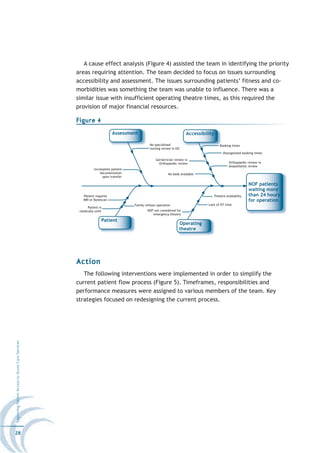
A cause effect analysis (Figure 4) assisted the team in identifying the priority
                                                  areas requiring attention. The team decided to focus on issues surrounding
                                                  accessibility and assessment. The issues surrounding patients’ fitness and co-
                                                  morbidities was something the team was unable to influence. There was a
                                                  similar issue with insufficient operating theatre times, as this required the
                                                  provision of major financial resources.

                                                  Figure 4
                                                                        Assessment                                 Accessibility

                                                                                           No specialised                           Booking times
                                                                                           nursing review in ED
                                                                                                                                      Disorganised booking times

                                                                                               Geriatrician review vs
                                                                                                 Orthopaedic review                       Orthopaedic review vs
                                                                                                                                          Anaesthetist review
                                                            Incomplete patient
                                                                documentation                          No beds available
                                                                 upon transfer

                                                                                                                                                      NOF patients
                                                                                                                                                      waiting more
                                                     Patient requires                                                           Theatre availablity   than 24 hours
                                                     MRI or Bonescan                                                                                  for operation
                                                                                 Family refuses operation                    Lack of OT time
                                                        Patient is
                                                   medically unfit                       NOF not considered for
                                                                                            emergency theatre
                                                                 Patient
                                                                                                               Operating
                                                                                                               theatre


                                                  Action
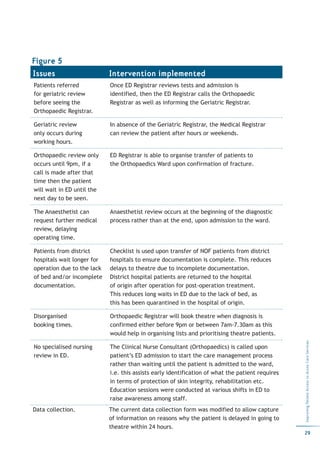
                                                     The following interventions were implemented in order to simplify the
                                                  current patient flow process (Figure 5). Timeframes, responsibilities and
                                                  performance measures were assigned to various members of the team. Key
                                                  strategies focused on redesigning the current process.
Improving Patient Access to Acute Care Services


28
Figure 5
Issues                      Intervention implemented
Patients referred           Once ED Registrar reviews tests and admission is
for geriatric review        identified, then the ED Registrar calls the Orthopaedic
before seeing the           Registrar as well as informing the Geriatric Registrar.
Orthopaedic Registrar.

Geriatric review            In absence of the Geriatric Registrar, the Medical Registrar
only occurs during          can review the patient after hours or weekends.
working hours.

Orthopaedic review only     ED Registrar is able to organise transfer of patients to
occurs until 9pm, if a      the Orthopaedics Ward upon confirmation of fracture.
call is made after that
time then the patient
will wait in ED until the
next day to be seen.

The Anaesthetist can        Anaesthetist review occurs at the beginning of the diagnostic
request further medical     process rather than at the end, upon admission to the ward.
review, delaying
operating time.

Patients from district      Checklist is used upon transfer of NOF patients from district
hospitals wait longer for   hospitals to ensure documentation is complete. This reduces
operation due to the lack   delays to theatre due to incomplete documentation.
of bed and/or incomplete    District hospital patients are returned to the hospital
documentation.              of origin after operation for post-operation treatment.
                            This reduces long waits in ED due to the lack of bed, as
                            this has been quarantined in the hospital of origin.

Disorganised                Orthopaedic Registrar will book theatre when diagnosis is
booking times.              confirmed either before 9pm or between 7am-7.30am as this
                            would help in organising lists and prioritising theatre patients.
                                                                                                  Improving Patient Access to Acute Care Services


No specialised nursing      The Clinical Nurse Consultant (Orthopaedics) is called upon
review in ED.               patient’s ED admission to start the care management process
                            rather than waiting until the patient is admitted to the ward,
                            i.e. this assists early identification of what the patient requires
                            in terms of protection of skin integrity, rehabilitation etc.
                            Education sessions were conducted at various shifts in ED to
                            raise awareness among staff.
Data collection.            The current data collection form was modified to allow capture
                            of information on reasons why the patient is delayed in going to
                            theatre within 24 hours.
                                                                                                  29
Results
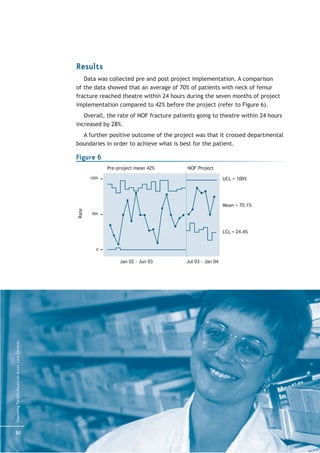
                                                     Data was collected pre and post project implementation. A comparison
                                                  of the data showed that an average of 70% of patients with neck of femur
                                                  fracture reached theatre within 24 hours during the seven months of project
                                                  implementation compared to 42% before the project (refer to Figure 6).
                                                     Overall, the rate of NOF fracture patients going to theatre within 24 hours
                                                  increased by 28%.
                                                    A further positive outcome of the project was that it crossed departmental
                                                  boundaries in order to achieve what is best for the patient.

                                                  Figure 6
                                                                Pre-project mean 42%        NOF Project

                                                         100%                                                UCL = 100%


                                                                                                             Mean = 70.1%
                                                  Rate


                                                         50%


                                                                                                             LCL = 24.4%


                                                            0


                                                                     Jan 02 - Jun 03       Jul 03 - Jan 04
Improving Patient Access to Acute Care Services


30
Holding the gains
   There are a number of strategies in place to sustain improvements post
project such as:
  Continued data collection process for the NOF information to review ongoing
  performance indicators and provide performance report to management.
  Monthly monitoring of performance and presentation of findings to
  management meetings of Orthopaedics, Anaesthetics, Geriatrics as well as
  ward staff.
  Orientation of Orthopaedic and Geriatric Registrars on the NOF Program and
  management guidelines.
  Continue active communication between the fractured neck of femur team
  and the Orthopaedic Registrars to deal with any new reasons for delays.
  Establish communication between the ASET team CNC and the Orthopaedics
  CNC to identify NOF patients early in Emergency.
  Continue early medical review/Geriatric Registrar.
  Organise fractured neck of femur case conferences twice weekly to monitor
  appropriateness of the current patient journey.


                                                                                Improving Patient Access to Acute Care Services


                                                                                31
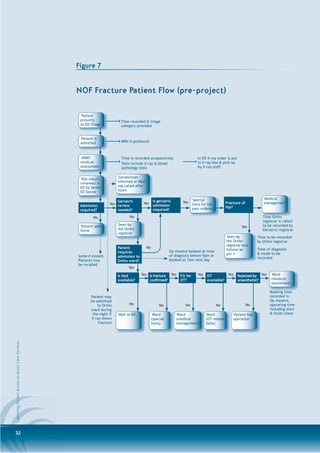
Figure 7


                                                  NOF Fracture Patient Flow (pre-project)

                                                    Patient
                                                   presents               Time recorded & triage
                                                   to ED-Triage           category provided


                                                   Patient is
                                                   admitted               MRN is produced


                                                   JRMO                    Time is recorded prospectively                    In ED X-ray order is put
                                                   medical                 Tests include X-ray & blood                       in X-ray box & pick up
                                                   assessment              pathology tests                                   by X-ray staff


                                                   Test results           Geriatrician
                                                   reviewed in           informed or Med.
                                                   ED by Senior          reg called after
                                                   ED Doctor             hours

                                                                                                                          Special                                     Medical
                                                                        Geriatric               Is geriatric      Yes                           Fracture of
                                                                    Yes review           Yes                              tests for hip                               management
                                                   Admission                                    admission                                       hip?
                                                   required?            needed?                 required?                 pain ordered

                                                          No                   No                                                                                     Time Ortho
                                                                                                                                                                      registrar is called
                                                   Patient sent          Seen by                                                                                      to be recorded by
                                                                                                                                                          Yes
                                                   home                  the Ortho                                                                                    Geriatric registrar
                                                                         registrar
                                                                                                                                                Seen by            Time to be recorded
                                                                                                                                                the Ortho          by Ortho registrar
                                                                                                                                                registrar and
                                                                         Patient          No                                                                       Time of diagnosis
                                                                                                          Op theatre booked at time             follows as
                                                                         requires                                                               per 1              & mode to be
                                                  Some # missed.         admission to                     of diagnosis before 9pm or
                                                                                                                                                                   recorded
                                                  Patients may           Ortho ward?                      booked at 7am next day
                                                  be recalled
                                                                               Yes

                                                                         Is bed         Yes Is fracture Yes     Fit for      Yes   OT            Yes    Rejected by Yes    Ward
                                                                         available?         confirmed?          OT?                available?           anaesthetist?      (medical
                                                                                                                                                                           assessment)

                                                                                                                                                                          Booking time
                                                         Patient may                                                                                                      recorded in
                                                         be admitted                                                                                                      Op theatre,
                                                             to Ortho          No                   No             No                     No                  No          operating time
                                                         ward during                                                                                                      including start
                                                          the night if   Wait in ED             Ward           Ward                Ward             Patient has           & finish times
                                                         X-ray shows                           (special        (medical            (OT rebook       operation
                                                             fracture                          tests)          management)         daily)
Improving Patient Access to Acute Care Services


32
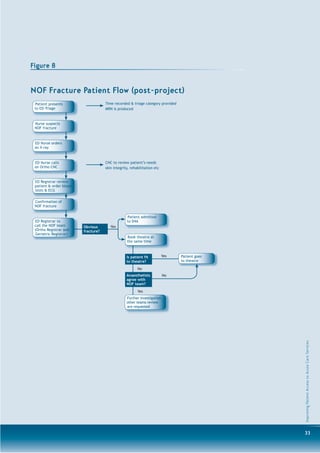
Figure 8


NOF Fracture Patient Flow (post-project)
 Patient presents                    Time recorded & triage category provided
 to ED-Triage                        MRN is produced


 Nurse suspects
 NOF fracture


 ED Nurse orders
 an X-ray


 ED Nurse calls                      CNC to review patient’s needs
 on Ortho CNC                        skin integrity, rehabilitation etc


 ED Registrar review
 patient & order blood
 tests & ECG


 Confirmation of
 NOF fracture

                                                  Patient admitted
 ED Registrar to                                  to D4A
 call the NOF team       Obvious        Yes
 (Ortho Registrar and    fracture?
 Geriatric Registrar)
                                                  Book theatre at
                                                  the same time


                                                  Is patient fit          Yes   Patient goes
                                                  to theatre?                   to theatre

                                                         No
                                                  Anaesthetists           No
                                                  agree with
                                                  NOF team?
                                                         Yes
                                                  Further investigation,
                                                  other teams review
                                                  are requested                                Improving Patient Access to Acute Care Services


                                                                                               33
Checklist
                                                  prior to starting your
                                                  improving access project

                                                     Organisational commitment secured


                                                     Principles of change understood


                                                     Diagnostic work


                                                     Scope of project defined


                                                     Engagement of stakeholders


                                                     Convene project team


                                                     Project aim agreed with team


                                                     Defined project plan


                                                     Potential interventions identified


                                                     Measurement strategy in place


                                                     PDSA cycles planned
Improving Patient Access to Acute Care Services


34
3. Interventions
   An intervention is a change, idea or strategy that is designed to improve
outcomes for patients, staff and the organisation. These interventions are
tried and tested ideas and may produce dramatic improvements in patient
flow in an organisation where they have not previously existed. However, these
“fixes” may not produce long-term sustained improvement unless a structured,
organisation-wide redesign process occurs. It is likely that long-term gains will
only be sustained by adapting an organisational approach to matching service
capacity and demand and smoothing variation in activity as outlined in the
general interventions below.
  The interventions are divided into three sections:
  General strategies
  Emergency patient flow
  Elective patient flow


The layout for each intervention is as follows:
Intervention title - a short description of the intervention and key elements of
implementation.

            Tools to assist with implementing the intervention are contained
            in the attached CD. A tool is anything that is of practical use in
            implementing the change. This may be a checklist, Powerpoint
            presentation or file.

            A hospital or organisation where the intervention is in place
            - not a comprehensive list as these interventions are often in
            place in many sites.

            Resources – These are links to websites or reference
            documents that contains more detail on the intervention or
            any reported results.
                                                                                    Improving Patient Access to Acute Care Services


            Bookmark link within document.


                                                                                    35
3.1 General strategies
                                                     These interventions have a whole of organisation or hospital scope, may
                                                  be applied to many different types of patients or are applicable in many
                                                  different settings.

                                                              Tools - Patient Flow
                                                              www.ihi.org/IHI/Topics/Flow/PatientFlow/Tools/

                                                      A common cause of miscommunication and delay is a lack of clarity among
                                                  all members of the multi-disciplinary team about what should be done
                                                  (therapy) and when (urgency). It can cause delays in the patient receiving the
                                                  most appropriate care or treatment and non-compliance with evidence based
                                                  best practice.


                                                  3.1.1 Shared work plans, practices and schedules within
                                                  multi-disciplinary teams
                                                     Coordinate ward rounds, team meetings and case conferences and publicise
                                                  regular meeting times to maximise opportunities for communication regarding
                                                  patient management. Leadership from senior clinical staff is pivotal to the
                                                  viability of scheduled multi-disciplinary meetings as it requires all team
                                                  members to attend and be punctual. Consider rescheduling meetings if the
                                                  team is on call, to minimise interruptions. Allocate responsibility to one person
                                                  to communicate changed times or cancellations.

                                                              Royal Prince Alfred Hospital


                                                     Where possible have consistency in work practices. For example use the
                                                  same forms across areas that share staff or use similar layout of equipment in
                                                  treatment rooms. Shared referral criteria, documentation and clinical protocols
                                                  will make the patient journey safer and reduce the margin for error.
Improving Patient Access to Acute Care Services


                                                              Royal North Shore, Prince of Wales,
                                                              Hornsby and Albury Hospitals


                                                              Multi-Disciplinary Assessment Form (RNS Hospital)


                                                              Draft National Medication Chart (Safety and Quality Council)
                                                              www.safetyandquality.org/index.cfm?page=Action&anc=Health%20R
                                                              eform%20%2D%20Safety%20and%20Quality%20Action%20Areas
36
3.1.2 Develop multi-disciplinary evidence based pathways
   To provide consistent, streamlined patient care, develop evidence based
pathways for high volume ED presentations and/or admissions. Or to save time,
borrow someone else’s and convene a multi-disciplinary team to modify them
to meet local needs.
            www.mja.com.au/public/issues/180_06_150304/suppl_contents_
            150304.html
            www.cochrane.org/index0.htm
            www.nicsl.com.au/projects_projects_detail.
            aspx?view=6&subpage=28
            www.nicsl.com.au/knowledge_literature.aspx


            TASC Chest Pain and Stroke Pathways (Nepean Hospital)


            Nepean, Gosford, Royal North Shore and Dubbo Hospitals


3.1.3 Relative performance table
   Provide feedback to individual clinicians and wards on their performance
on key indicators e.g. unplanned readmission rates. Where performance or
improvement is inconsistent between departments or clinicians, consider
making this information publicly available. This does not have to involve large
amounts of data and can use measures relevant to the department and changes
being implemented (e.g. number of operations delayed due to incomplete
consent forms by surgeon, weekend discharge rate by ward and/or physician).

            Wyong, Dubbo and Royal North Shore Hospitals

                       Western Australian Audit of Surgical Mortality Annual
                       Report 2003 pp 38-41
                                                                                  Improving Patient Access to Acute Care Services


                       www.waasm.uwa.edu.au/


                                                                                  37
3.1.4 Convene a redesign team
                                                     Whenever change is being considered in a process or system, convene a
                                                  team who will take ownership and drive the change and communicate it to
                                                  others. Ensure participation from all groups that have active involvement in
                                                  the system. At the process mapping workshop identify participants who appear
                                                  to take ownership of the issues and the problems that are identified. Include
                                                  someone from each of the key stakeholder groups including representation
                                                  from “upstream” and “downstream” of the processes of concern. The redesign
                                                  team will prioritise the problems (waits, bottlenecks etc.) identified during the
                                                  operations review and process mapping sessions. Measure, where necessary, to
                                                  detect at which steps in the process delays occur. This data is used to inform
                                                  the team in their redesign of the process.

                                                              Redesign Team Success - Who to involve to ensure success -
                                                              Powerpoint Presentation (Institute for Clinical Excellence)


                                                              St George, Liverpool, Albury and Dubbo Hospitals


                                                              The Clinicians Toolkit, Easy Guide to Clinical Practice
                                                              Improvement (NSW Health)


                                                              Link to engage clinicians and convene the redesign team


                                                  3.1.5 Improve communication systems
                                                     Review suitability of existing information technology (IT) systems, paging
                                                  systems, number and placement of telephones or computers. Try innovative
                                                  solutions such as:
                                                    Communication clerks.
                                                    Personal Digital Assistant’s solutions such as electronic reminders, electronic
Improving Patient Access to Acute Care Services


                                                    guideline documents etc.
                                                    Other IT solutions such as point of care ordering systems.
                                                    Staff exchange between wards, departments or hospitals.
                                                    Scheduled multi-disciplinary case meetings.
                                                    Team briefing or debriefing sessions.
                                                              Link to Improve Discharge Processes
                                                              Link to Surgical Strategies
                                                              Link to Emergency Department Strategies
38
3.1.6 Referral to specialist services
   Develop alternate methods for referral to specialist services e.g. fax or
email. Establish a common departmental email address that is accessible to all
members of the specialist team so that on call rosters do not need to be known
by those who are referring patients.
   Privacy note: Our advice from NSW Health is that it is acceptable to send
patient information necessary for a referral using AHS email servers but that
confidential information should not be sent through commercial email providers.


3.1.7 Service level agreements
   Develop and implement internal and external service agreements. Internal
service level agreements may for example be established between ED and
wards around agreed time to transfer, or with radiology regarding time to
report available. External agreements may be used to facilitate patient
transfer between tertiary referral/base and peripheral hospitals. Include
peripheral hospitals in a process mapping session looking at patient flow
between the hospitals. Develop an area clinical services and bed management
plan that includes transfer and clinical criteria protocols that have been
agreed with peripheral hospitals. Broker management (including bed
manager) and medical staff agreement for base hospitals to take patients
not able to be managed by peripherals and peripherals to take patients not
requiring base hospital level support. Include inter-hospital transfers in the
bed management prioritisation protocols.


            Wollongong, Albury, St George and Calvary Hospitals


            Link to Management of Hospital Beds
                                                                                    Improving Patient Access to Acute Care Services


3.1.8 Managing capacity to respond to need for services
   Capacity refers to the ability of an organisation to provide a specific volume
of service and is determined by the resources it has and the efficiency with
which the resources are used. Demand for health care is fairly consistent and
predictable. Introducing variation and unpredictability into capacity to provide
care (e.g. not providing seven day a week diagnostic or allied health services)
causes waits and delays.


                                                                                    39
3.1.9 Minimise variation in capacity to provide care
                                                     Use staggered accrued days off (ADO) instead of hospital wide ADO’s.
                                                  Reschedule vital clinics so that they are not cancelled when there is a public
                                                  holiday.


                                                  3.1.10 Change to seven day a week services
                                                     Change to seven day a week services and reward those that provide this.
                                                  Look at services such as radiology, imaging and allied health to ensure there is
                                                  weekend access, especially for those patients waiting for discharge who cannot
                                                  leave until they have been seen by one of these services. Ensure all inpatients
                                                  receive a medical review seven days per week — if they are sick enough to
                                                  require a bed in hospital, they are sick enough to have daily review of their
                                                  management plan.


                                                  3.1.11 Buffer beds
                                                     Buffer beds are used to supply capacity at those times when historical data
                                                  predicts there will be an increased need for beds. Commonly they will be
                                                  opened on Monday, Tuesday and Wednesdays, or evenings. These are the times
                                                  when demand for elective surgical beds is greatest and access block is likely to
                                                  be at its highest level.

                                                              St Vincent’s Health, Victoria
Improving Patient Access to Acute Care Services


40
3.1.12 Smoothing variation in elective activity
   Where there are waiting lists, or difficulty in managing operating theatre
availability, smooth the system wide flow of elective surgery admissions. Data
on demand for operating rooms can be used to work with surgeons to adjust
the scheduling of surgical patients. Do a small test first, limiting or capping
elective surgical admissions within a defined unit with one specialty:
1 Identify the average daily number of elective surgical admissions.
2 Limit the admissions for the day to the average daily number of elective
  surgical admissions (may take less but not more than the average).
3 Analyse the results of the test and use this information to work with
  surgeons to adjust scheduling of surgical patients.
            Case for Improvement, Institute for Healthcare Improvement
            www.qualityhealthcare.org/QHC/Topics/Flow/

            NHS Improvement Leaders Guide to Matching Capacity and Demand
            www.modern.nhs.uk/improvementguides/capacity


3.1.13 Develop advanced nursing roles
   Further develop specialist roles for nursing or allied health staff. Review the
skill mix in your team, where gaps exist, consider who may be able to fill them
and the education and training required. Where appropriate, consider models
where nurses have ultimate responsibility for patient management. Develop the
role of enrolled nurses to be accredited to take on more responsibilities.


 Redesign Tip
 During the redesign process identify those bottlenecks that
 occur as a result of patients waiting for one member of the
 multi-disciplinary team. Review the tasks performed by that
 team member. Ask:
                                                                                     Improving Patient Access to Acute Care Services


 1. Can any of these tasks be performed
    by another team member?
 2. Will that team member require additional
    training or education in order to perform
    the tasks safely and effectively?
 3. What additional communication processes need to be
    established to ensure coordination of care?


                                                                                     41
3.1.14 Up-skilling peripheral hospitals for complex
                                                  patient needs
                                                     Where the peripheral hospital doesn’t have the skills to look after particular
                                                  patients (e.g. a PICC line or PEG tube) organise a training session by a nurse
                                                  from the base or tertiary hospital. This person may also act as a contact point
                                                  for problems and issues encountered by the peripheral hospital in management
                                                  of related technical or procedural problems. This encourages sharing of
                                                  skills and enables nurses to maintain their standards of clinical practice.
                                                  Alternatively, skills may be developed in the community or be made available
                                                  by the hospital as part of an outreach service thereby preventing unnecessary
                                                  transport to hospital.

                                                              Dubbo Hospital


                                                  3.1.15 Align staff specialist/consultants work to
                                                  maximise efficiency
                                                     Organise across hospital coverage of specialty teams (e.g. don’t have a
                                                  surgical team on the emergency roster on days when they have an elective
                                                  surgical list). Broker agreement between medical specialists to pool patients and
                                                  deliver 365 day a year medical review by the team. This may require medical
                                                  specialists to agree on a routine therapeutic plan (pathway) and a facility for
                                                  providing hand over for those patients deviating from the agreed plan.
Improving Patient Access to Acute Care Services


42
Management of hospital beds
    The management and coordination of placement of patients
 in appropriate inpatient beds is a complex and challenging
 logistical exercise. However, it is critical to achieving best
 outcomes for patients and a harmonious low-stress working
 environment for staff.


3.1.16 Bed management system
   Use a centralised bed management system with seven-day bed management/
patient flow personnel responsible for all admissions and transfers.


3.1.17 Centralised bed authority/bed coordinator
   Assign a person to act as the centralised bed authority for each shift in
smaller hospitals (fewer than 200 beds). Ensure they have access to up to
date bed information. Assign a location or group of individuals to act as the
centralised bed authority in larger hospitals (more than 200 beds). The team
should be informed of all admissions and discharges and can help find the most
effective way to bring patients into beds for both elective and emergency
procedures/treatment. Key responsibilities of the centralised bed management
team include convening multi-disciplinary bed meetings, diagnosing issues
around bed management and coordinating development and implementation of
strategies to realign bed stock and bed management processes.
            Bed Management Information Sheet (St George Hospital).
            Example of two strategies that facilitate the discharge of
            patients at St George.
            Projected activity report template (St George Hospital).
                                                                                 Improving Patient Access to Acute Care Services


                                                                                 43
The patient flow or bed management team
                                                     Each hospital should have a core patient flow management
                                                  team with operational responsibility for bed management,
                                                  including the following people:
                                                     Bed manager/patient flow manager who has the support
                                                  of the executive for decision-making and communicates with
                                                  units about placements and anticipated bed needs. This person
                                                  should have networking skills and credibility with senior clinical
                                                  staff. The role will also serve as a conduit for all direct patient
                                                  admissions and have a watching brief on other avenues of
                                                  admission outlined in alternate admission processes.


                                                              Nepean Hospital

                                                     Executive sponsor – A senior manager (e.g. Director of
                                                  Clinical Services, Director of Nursing or hospital Executive
                                                  Director) who ensures high-level support and action where
                                                  needed to drive change.
                                                     Medical leader to provide input into bed management
                                                  meetings and coordinate weekend discharge ward rounds.
                                                  They should have the seniority and influence to follow-up with
                                                  specialist clinicians if a patient seems to be inappropriately
                                                  occupying an inpatient bed. They should convene/attend
                                                  meetings of senior staff to ensure that extra ward rounds or
                                                  reviews take place if required.

                                                              RNS Hospital


                                                              Weighting the Wait
                                                              Powerpoint Presentation (RNS Hospital)
Improving Patient Access to Acute Care Services


44
3.1.18 Regular multi-disciplinary bed meetings
   Convene a morning multi-disciplinary meeting to discuss the bed situation
for the day. Identify the pressures in the system, plan for admissions and
discharges to occur at an appropriate time and brainstorm ideas to prevent
access block. This meeting should also improve communication, as each
department will be aware of the facility wide difficulties. Also called “bed
parliament” or “bed huddle”.


3.1.19 Teleconference bed updates
   Set up regular teleconference meeting times during the day to update bed
status and help co-ordinate flow throughout the hospital.


3.1.20 Clinical prioritisation of patients
   Wards have ownership of their specialty beds and decision-making
responsibility for accepting patients for admission to the ward with strict rules
for prioritisation and acceptance of patients for admission as agreed with the
central bed management authority. Use of a uniform prioritisation system
promotes equity of access and provides a logical basis for prioritising need. Use
the following decision making hierarchy for admitting patients:
1 Retrieve outliers
2 Accept own specialty patients from ED
3 Accept own specialty transfers from lower service level hospital
4 Bring in elective patients
5 Accept other specialty patients from ED

 Redesign tip
   Use this intervention to decrease outliers. Adapt the protocol
 above or develop your own guidelines for prioritising patient need.
                                                                                    Improving Patient Access to Acute Care Services


            St Vincent’s Health, Victoria


                                                                                    45
Case study
                                                      St Vincent’s Health made significant improvements in their
                                                   access block, length of stay and elective surgery cancellation
                                                   rates by implementation of ward bed ownership and patient
                                                   admission prioritisation rules. They also introduced:
                                                      a structured process for admitting patients,
                                                      planned weekend bed closures and extended opening,
                                                      multi-disciplinary team discharge meetings,
                                                      services such as a “medihotel” and “awaiting placement
                                                      ward” to prevent patients from being admitted and
                                                      occupying a bed earlier than necessary when coming in for
                                                      elective surgery.


                                                  3.1.21 Reconfigure beds to reduce outliers
                                                     The evidence is that outlying patients (those that are accommodated on
                                                  a ward not catering to the patient’s requirements for specialist nursing care)
                                                  have poorer outcomes and longer length of stay. Understand each specialties’
                                                  bed capacity in relation to the demands placed on them. The number of beds
                                                  in each specialty in a hospital is usually historically determined rather than
                                                  related to the volume required by patient activity. Reduction of the number
                                                  and incidence of outliers becomes more difficult as occupancy rates increase.
                                                  Reduce bed occupancy by introducing strictly controlled buffer beds.


                                                              Link to Buffer Beds 3.1.11


                                                  3.1.22 Over census policy
Improving Patient Access to Acute Care Services


                                                      An over census policy is based on the premise that it is better to have one
                                                  extra patient on a ward than 15 extra patients in an ED. The bed manager visits
                                                  all units to identify available beds and staff assigned to them. An assessment of
                                                  ward staff capacity to safely take additional admissions is made. Each patient
                                                  waiting admission in the ED is assigned to an inpatient hallway bed and no unit
                                                  will be assigned more than two over census patients. Establish strict criteria
                                                  for selecting and prioritising these patients (e.g. must have stable vital signs).
                                                  If considering this intervention, negotiation with your organisation’s nursing
                                                  establishment is essential prior to implementation.


46
Case study
    The over census policy was introduced in Stony Brook
 Hospital, Kentucky. The ED was having continuing problems
 becoming blocked due to too many patients waiting for
 admission to an inpatient bed. This adversely affected their
 ability to provide safe, prompt emergency care. The wards
 gave problems with discharging patients as the reason they
 could not take ED patients. They introduced a “full capacity
 protocol”. When a predefined number of patients are waiting
 for admission in ED, patients are placed in hallways of the
 wards they will be admitted to. Strict criteria for placement
 in a hallway bed was established and adhered to. This shifted
 the responsibility of the patient from ED, who has little
 influence over the discharge process, to the ward orchestrating
 the discharge. The system led to a reduction in delays and
 blockages in the discharge process, better resource utilisation,
 better access to emergency care and prompter access to
 appropriate inpatient care.

               Full Capacity Protocol
               (Stony Brook University Hospital, Kentucky USA)
               www.viccellio.com/overcrowding.htm

               Adopt a Boarder, Urgent Matters E-Newsletter
               (George Washington University Medical Centre, School of
               Public Health and Health Services, Washington DC, USA)
               www.urgentmatters.org/enewsletter/vol1_issue4/P_adopt_
               boarder.asp


3.1.23 Guidelines and protocols for test ordering
   Develop clear guidelines for ordering specific diagnostic tests. There may be
                                                                                         Improving Patient Access to Acute Care Services


either a list of tests for a medical condition (e.g. Pulmonary Embolus clinical
protocol) or a list of indications for a specific test (e.g. indications for head CT).
             Deep Vein Thrombosis Clinical Protocol,
             Monash Medical Centre, Victoria
             Pulmonary Embolism Clinical Protocol,
             Monash Medical Centre, Victoria


                                                                                         47
3.1.24 Review permissions to order tests
                                                     Develop protocols for ordering specific tests. Nurse initiated X-ray in the ED
                                                  can help fast track patients and ensure test results are available when the patient
                                                  has their initial medical assessment. In the case of a patient entering ED with
                                                  pneumonia, a nurse initiated chest X-ray at triage can decrease time to antibiotics.

                                                              Pathology Traffic Light Protocol (Lyell McEwin Hospital, SA)
                                                              Radiology Traffic Light Protocol (Northern Sydney Health)


                                                              Hornsby, Coffs Harbour, Canberra and RNS Hospitals


                                                              Rational Investigation Ordering Collaborative Project
                                                              www.nsahs.nsw.gov.au/teachresearch/cpiu/rio_project.shtml


                                                  3.1.25 Prioritise tests for emergency department or
                                                  patients waiting for discharge
                                                     Introduce a simple system such as coloured stickers or different coloured
                                                  pathology form for emergency department or discharge pathology.

                                                              Sydney, Wollongong, Albury and Dubbo Hospitals


                                                              Post-op Hip/Knee Stamp (Wollongong Hospital)


                                                  3.1.26 Allocated time for emergency cases
                                                     For specialty procedures that have waiting lists such as CT and ultrasound,
                                                  review historical data and determine predictable level of emergency demand
                                                  and allocate “emergency slots” in the appointment schedule.
Improving Patient Access to Acute Care Services


                                                              Liverpool, Dubbo, Sydney and Sydney Eye Hospitals


48
Case study – Pathology
    Sydney Hospital identified waits for pathology results as
 a major source of delay in their emergency department. A
 process mapping session identified multiple issues and some
 easy quick wins. Their key interventions were:
    increased number of tests done on site rather than being
    sent to another campus,
    changes to hours of service,
    changes to pathology collectors schedule to better
    coordinate demand with service availability,
    changes to local courier service,
    increased communication between laboratory and ED staff.
    They achieved a sustained reduction in time to pathology
 results from a mean time of 116 minutes to 65 minutes.


3.1.27 Appropriate information on request form
   Educate JMOs and other staff on correct completion of request forms including
location of the patient and clinical notes. Have correct phone numbers for
clinician’s point of contact for radiology rooms on display in ED and wards.

            Liverpool and Albury Hospitals


3.1.28 Patients attending for tests
   Where the patient has to attend a particular department for a test, ensure
there are sufficient portering/transport services to minimise delays and
waits. Redesign processes for calling for and transporting patients. Review
                                                                                   Improving Patient Access to Acute Care Services


communications for these services and try using two-way radios or a computer
system for tracking patient’s movements around the hospital departments.

            Albury, Dubbo, Wollongong and John Hunter Hospitals


                                                                                   49
3.1.29 Stratified test ordering
                                                     The literature suggests that 20-30% of all pathology tests ordered are
                                                  inappropriate. To increase appropriateness and cut down on unnecessary test
                                                  use, introduce a stratified ordering system in which certain tests need to be
                                                  approved by a registrar or senior clinician. Results in organisations using this
                                                  approach demonstrated reduction in inappropriate tests.
                                                              Radiology Traffic Light Order System (NSH) Radiology Request
                                                              Form for Stratified Ordering (Dubbo Hospital)
                                                              Pathology Traffic Light Protocol (Lyell McEwin Hospital, SA)


                                                   Case study
                                                      During the Patient Flow and Safety Collaborative, Albury
                                                   Hospital aimed to improve the flow of patients in the ED. At
                                                   a process mapping session, radiology diagnostic imaging was
                                                   identified as a major bottleneck. Audit of length of time taken
                                                   to complete various phases of the patient journey confirmed
                                                   delays were occurring at multiple steps. They implemented a
                                                   raft of interventions including:
                                                      Designated triage number for x-ray,
                                                      Second pager implemented internally for trauma calls,
                                                      Wardsperson called by triage nurse or clerk,
                                                      ED initiated call in of second radiographer for prolonged
                                                      delays or significant backlog,
                                                      Back up wardsperson if ED wardsperson is busy,
                                                      PAC system implemented,
                                                      Multi-disciplinary team meetings between ED, Radiology
                                                      Department and Wardspersons Department.
Improving Patient Access to Acute Care Services


50
3.2 Emergency patient flow

3.2.1 Pre-bypass hospital early warning system
   The hospital early warning system is a coordinated hospital-wide response
that occurs when a hospital is at high risk of going on ambulance bypass. For
this system to work a substantive process of engaging all clinical departments
in committing to enact the agreed protocols needs to occur.


            The Austin and Repatriation Hospital, Victoria


                                                                                 Improving Patient Access to Acute Care Services


                                                                                 51
Case study – hospital early warning system
                                                  (HEWS)
                                                     The Austin Hospital was concerned that their ability to
                                                  respond and recover from stresses placed on the organisation,
                                                  exhibited by increased levels of access block, could
                                                  compromise emergency patient care. They recognised that
                                                  ambulance bypass is a significant hospital event and not just an
                                                  ED problem. They also thought, when the probability of bypass
                                                  in the next hour was high, that an organised, systematic,
                                                  hospital-wide response could assist in avoiding bypass and
                                                  improving emergency patient care. The HEWS system was the
                                                  hospital-wide response at Austin. It had ED director support and
                                                  authorisation and was coordinated by the bed manager or after
                                                  hours site manager with teleconferences occurring regularly
                                                  three times a day and at times when pre-bypass is declared.
                                                  The Austin designated pre-bypass as an internal emergency
                                                  – “Yellow Code 3- Pre-bypass” commonly called Respond Yellow.
                                                     Prior to a Respond Yellow being called there are a series of
                                                  actions that the ED has to perform.
                                                     When a Respond Yellow is called this triggers a further series
                                                  of actions by a range of people across the organisation.
                                                    A further refinement of the system was introduced whereby
                                                  each Respond Yellow is classified as a:
                                                    Bed Access Response – where there is a lack of beds available
                                                    to ED patients
                                                    Clinical Activity Response – where there are many ill patients
                                                    needing clinical assessment at a single point of time in the ED
                                                  Response by hospital staff is different depending on the type
                                                  of alert.
                                                     A trial comparing hospitals using a HEWS system with those
Improving Patient Access to Acute Care Services


                                                  who weren’t showed a greater reduction in bypass in the HEWS
                                                  group despite them seeing more patients and taking more
                                                  ambulance patients. The HEWS group also showed an 88 minute
                                                  reduction (11.4%) in ED length of stay for admitted patients.

                                                            HEWS Tool - HEWS ED Actions prior to declaring Pre-bypass
                                                            HEWS Tool Pre-bypass Protocols
                                                            HEWS Tool - Response by medical staff

52
Results - HEWS implementation - The Austin


3.2.2 Streaming techniques
   Streaming techniques recognise alternate methods of grouping and managing
ED patient queues than through a universal triage system. Streaming occurs in a
variety of forms and is based on recognition of the benefits of dividing patients
into alternate streams and journeys to better manage bottlenecks and waits.


3.2.3 Alternate admission processes
   Develop and formalise other avenues for emergency patient admission to a
hospital bed other than through ED. These alternate avenues may be managed
by a bed/patient flow manager with agreed criteria for entry to ensure
appropriateness. Other patient journeys include direct:
                                                                                    Improving Patient Access to Acute Care Services


  admission to ward by specialist team or GP,
  referral to hospital in the home,
  referral to hospital ambulatory care,
  admission from specialty clinic to ward.


                                                                                    53
3.2.4 Develop alternate services to prevent
                                                  ED presentation
                                                     Develop and formalise other journeys for emergency patients other than
                                                  presentation to ED. These services may include:
                                                    chronic disease case manager and/or hospital in the home,
                                                    referral to community care,
                                                    community facilitated care packages - ComPacks,
                                                    accessible specialist outpatient clinic appointments for “urgent patients”,
                                                    direct referral to hospital ambulatory care,
                                                    GP after hours clinics.


                                                  3.2.5 Advanced nursing and allied health practitioner roles
                                                     Use nurses with advanced clinical skills e.g. clinical initiative nurses, who
                                                  work from protocols and guidelines to fast track the assessment and treatment
                                                  of ED patients. Use physiotherapists to oversee and deliver management of
                                                  minor fractures.

                                                              The ED Work Practice Review Project 2001
                                                              (Wollongong Hospital)


                                                  3.2.6 Fast Track
                                                     Fast Track refers to type of streaming where an alternative patient pathway
                                                  (or part of a pathway) can be dealt with rapidly, in the primary care section
                                                  (e.g. “walking wounded”) as part of the ED service.
                                                                          Fast Track Interventions in the ED
                                                                          (NICS - Literature Review)
                                                                          www.nicsl.com.au/knowledge_literature.aspx
Improving Patient Access to Acute Care Services


54
3.2.7 See and Treat
   See and Treat is a type of fast tracking where a senior clinician or clinical
team triages patients and provides immediate care and disposition where
possible. It may be most useful to implement in an ED with a high volume of
low acuity patients with straightforward presenting problems. It is a model
for seeing, triaging and offering on-the-spot treatment to patients with minor
ailments or injuries so that they are in the Emergency Department for as short
a length of time as possible.


                                See and Treat, NHS


                                Calvary Hospital - ACT

                                            Fast Track Interventions in the ED
                                            (NICS - Literature Review)
                                            www.nicsl.com.au/knowledge_literature_detail.
                                            aspx?view=15


Figure 9


Calvary Hospital - Reduction in the number
of patient queries on waiting time in ED as
a result of implementing see and treat
                    250


                    200
Number of queries


                    150
                                                                                                         Improving Patient Access to Acute Care Services


                    100


                     50


                      0
                          Wk1   Wk2   Wk3   Wk4   Wk5    Wk6   Wk7   Wk8   Wk9   Wk10 Wk11   Wk12 Wk13
                                                           Week


                                                                                                         55
Figure 10


                                                  Calvary Hospital - Reduction in the number of “did not
                                                  waits” in ED as a result of implementing see and treat
                                                                 60


                                                                 50


                                                                 40
                                                  Total number


                                                                 30


                                                                 20


                                                                 10


                                                                  0
                                                                      B1   B2   Wk1   Wk2 Wk3   Wk4 Wk5   Wk6   Wk7 Wk8 Wk9 Wk10 Wk11 Wk12
                                                                                                   Week


                                                  3.2.8 Lean thinking
                                                     Identify common processes from the main streams of patients within the ED.
                                                  At each step of the process identify and eradicate steps that are wasted time
                                                  and effort from the optimal patient outcome perspective.

                                                                           The Key Lean Thinking Principles (Lean Australia)
                                                                           www.leanaust.com/about.htm
Improving Patient Access to Acute Care Services


56
Redesign tip
    Use lean thinking principles when you are redesigning your
 processes. Lean thinking identifies activities that add value to
 what you are trying to achieve in your organisation. It identifies
 those activities that don’t add value and creates flow by
 radically reorganising processes and creating a pull through the
 system. Identify any sources of waste and redesign individual
 process steps to eradicate:
    overproduction (services available but not used),
    waiting,
    transporting (provide services in the
    location they are needed),
    inappropriate or unnecessary processing
    (only do things once),
    unnecessary inventory (equipment or
    supplies not used or turned over),
    unnecessary movement (futile activity which
    adds no value to the patient experience).


3.2.9 Clinical pathways around presenting problems not
diagnoses
   Develop clinical pathways or guidelines for management of high volume
presentations particularly where there is evidence of poor patient outcomes or
evidence-based treatment is not being delivered.

            Dubbo, Nepean, John Hunter and Blacktown Hospitals

            TASC Chest Pain and Stroke Pathways (Nepean Hospital)
                                                                                  Improving Patient Access to Acute Care Services


            Fractured NOF Guidelines (Hornsby Hospital)
            Paediatric Presentation Protocols (Blacktown Hospital)


3.2.10 ED access to day surgical list bookings
   Set up a process enabling ED doctors to book patients in for day surgery the
following day. This allows patients to be sent home rather than taking an ED or
inpatient bed.

            Royal North Shore Hospital
                                                                                  57
Redesign tip
                                                      Ensure that a process is in place for patients to be properly
                                                   informed about fasting, OT time, and the need to provide
                                                   transport home.
                                                      Set up a process for the ED to communicate essential
                                                   information to the day surgical ward and the OT so these
                                                   departments are prepared to receive the patient when they
                                                   present.


                                                  3.2.11 Communications clerk
                                                     Process map communication channels within the emergency department.
                                                  Redesign processes and institute a new position in ED that is responsible
                                                  for answering phone calls, coordinating patient movement between other
                                                  departments such as radiology and the wards. Use the process redesign to
                                                  inform their role and job description.

                                                              Wollongong and John Hunter Hospitals


                                                  3.2.12 Emergency medicine unit
                                                     Patients who require a short period of admission for observation and
                                                  treatment (e.g. < 24 hours) are admitted to a short stay bed in an EMU. To be
                                                  effective, the unit should be operated as an extension of ED services, adjacent
                                                  to and staffed by the ED. Strict protocols around patient selection and length of
                                                  stay need to be enacted to ensure throughput is maintained.

                                                              St George and Hornsby Hospitals
Improving Patient Access to Acute Care Services


                                                              EMU Net News Reference Article (ARCHI)


                                                  3.2.13 Flag and case manage frequent attendees
                                                     This is a preventative model of care, targeting high users of the public
                                                  hospital system, which aims to provide more coordinated care between
                                                  hospital and primary care. Frequent ED attendees that could have been more
                                                  appropriately case managed in primary care are identified. A nurse case


58
manager is based in ED and works with primary and community care service
providers to coordinate the patients’ care.

            The Austin and Repatriation Medical Centre and the Alfred
            Hospital, Victoria


            The Hospital Admission Risk Program (HARP), (Royal District
            Nursing Service, Victoria)
            www.rdns.com.au/Innovation/HARP.htm
            www.health.vic.gov.au/hdms/harp/index.htm

            HARP - Reducing the Avoidable Use of Hospitals (ARCHI)
            www.archi.net.au/content/index.phtml?itemId=tag./document/
            index.phtml/id/3056


 3.3 Improving flow of
 emergency surgical patients
            Link to elective patient flow strategies (page 75)


3.3.1 Clinical guidelines or pathways
   Clinical guidelines or pathways — for high volume emergency cases such as
fractured hip — ensure correct emergency theatre prioritisation and protocols
for test ordering, management of anti-coagulation therapy and anaesthetic/
medical/aged care consultation.

            Liverpool, St George, Tamworth, Albury, Westmead, Hornsby
            and Port Macquarie Hospitals


            Fractured NOF Guidelines (Hornsby Hospital)
                                                                                Improving Patient Access to Acute Care Services


            Step Guide to Improving Operating Theatre Performance, 2002
            (NHS)


                                                                                59
3.3.2 Team briefing and debriefing sessions
                                                     After complex cases convene a quick meeting of multi-disciplinary team
                                                  members to review aspects of pre-operative and intraoperative care. Focus on
                                                  processes and communication. Don’t make it a name and blame exercise but
                                                  use it as an opportunity to discuss changes to improve care next time.


                                                  3.3.3 Emergency department physician admission rites
                                                     Emergency department physicians may be given admission rites for specific
                                                  presentations or diagnoses. Identify those emergency surgical presentations
                                                  where diagnoses are relatively straightforward and need for admission is
                                                  predictable. For these patient groups broker agreement amongst specialty
                                                  teams to allow ED physician admission rights and early transfer of patient to an
                                                  appropriate ward. This may be written into guidelines or pathways.

                                                              Albury Hospital


                                                              Emergency Patient Admissions Policy (Albury Hospital)


                                                   Prioritisation and provision of
                                                   emergency theatre time
                                                      Ensuring there is adequate theatre availability is essential
                                                   for providing good clinical outcomes and preventing surgical
                                                   patients taking up valuable beds while waiting for their
                                                   operation to be performed.
Improving Patient Access to Acute Care Services


60
3.3.4 Review existing demand for
emergency operating theatre time
    Review theatre usage hours by type of surgery and time of demand.
Using this information, ensure adequate emergency operating theatre time
is provided during and out of hours. Use an afternoon trauma list to avoid
repeated cancellation of lower priority cases not deemed to be urgent enough
to operate on between 10pm and 8am.

            Liverpool, Tweed and Port Macquarie Hospitals


3.3.5 Prioritisation protocol
  Have a prioritisation protocol that provides transparency to emergency
operating theatre scheduling and monitor cases not achieving benchmark “to
operating theatre” times.

            Emergency Theatre Allocation Guidelines (WAHS)
            Emergency Surgery Guidelines (Liverpool Hospital)


3.3.6 Prioritisation team
   The admitting surgical team performs an initial assessment of urgency for
each patient requiring emergency surgery. A designated senior anaesthetist and
peri-operative nurse have the right to challenge the assessment of urgency. The
team of anaesthetist, nurse and surgeon then negotiate priorities (based on a
protocol) and agree final schedule of emergency cases.

            Liverpool Hospital


3.3.7 Pre-operative placement of patients waiting for OT
                                                                                  Improving Patient Access to Acute Care Services


  Patients who are waiting for emergency surgery to be nursed on a specialty
ward rather than being left to wait in the emergency department.

            Albury and Liverpool Hospitals


            Emergency Patient Admissions Policy (Albury Hospital)


                                                                                  61
3.4 Medical strategies

                                                  3.4.1 Medical Assessment and Planning Unit
                                                     The MAPU is a physician led unit which has 365 day a year general physician
                                                  cover to review new medical admissions. It has a strict management protocol
                                                  that includes a maximum LOS of two days, monitored beds, increased allied
                                                  health staff levels, full time resident medical officer cover and twice-daily
                                                  specialist medical review.

                                                              Royal Brisbane Hospital


                                                              Responses to Access Block in Australia - Queensland (MJA)
                                                              www.mja.com.au/public/issues/178_03_030203/cam10542_ash_
                                                              fm.html


                                                  3.4.2 Day only admission ward for ED patients
                                                     This ward functions as a temporary location for the admitted patients in ED.
                                                  Selected patients are accommodated there while waiting for a ward bed. It can
                                                  be part of the discharge lounge or EMU. The beds operate for eight to 12 hours
                                                  per day during busy periods (as determined during diagnostic work). It may be
                                                  used to transfer a predictable number of patients from the ED every morning.

                                                              John Hunter and Blacktown Hospitals


                                                  3.4.3 Flag and case manage frequent
                                                  medical admitted patients
                                                     Provide case management across the acute and chronic setting for patients
Improving Patient Access to Acute Care Services


                                                  who are admitted frequently. Provide specialist nursing consultants who work
                                                  within a multi-disciplinary team to manage these patients across the acute
                                                  community interface.
                                                              Heart Failure Program (St George Hospital)
                                                              Heart Failure Program Direct Admission from GP (Royal North
                                                              Shore Hospital)


62
Some chronic care or aged care patients may be referred directly from their
GP into a specialist hospital or community team. Set up the process and criteria
for appropriate direct admission. Educate GPs and provide them with contact
details to enact this.


3.4.4 Trial at home program
   This program provides the opportunity for a patient to go home for an
overnight stay before they have been discharged. Similar to a “gate pass”, it
allows patients to test their level of confidence in being cared for at home.
Notes are kept on the ward and it is guaranteed a bed will be found if needed,
the next day (or week). The patient does not have to present in the ED to be
readmitted. This reduces the number of patients who readmit within 48 hours
of discharge and diverts work from the ED.

            Tamworth Hospital


3.4.5 Improve appropriateness of admission
   Develop a set of criteria for admission for high volume patient groups.
Audit for inappropriate admissions and performance manage, or call admitting
consultant, to justify their decision to admit to an appropriate audit committee.


3.4.6 Safety risk assessment
   Safety risk assessments are intended to reduce the likelihood of a patient
being involved in an adverse event, thus reducing the length of stay. If a risk
assessment shows that a patient is at high risk of falling, a falls prevention
strategy or protocol should be put in place for that patient. A risk assessment
allows careful planning of appropriate interventions for an at risk patient. This
information should be collected when the patient enters the system and updated
when there is a change in their condition. Keep the information visible to prevent
                                                                                     Improving Patient Access to Acute Care Services


the patient repeatedly telling different people the same information.

            Royal North Shore, Broken Hill and Prince of Wales Hospitals


            Adverse Patient Outcome Program - Powerpoint Presentation
            (John Flynn and Tweed Hospitals)


                                                                                     63
3.5 Improving communication

                                                  3.5.1 Improving communication with GPs
                                                  and community nursing
                                                     Improving communication with primary care and community care providers
                                                  will increase patient safety, smooth the transition home and decrease
                                                  unplanned readmissions. The following strategies have proven to be effective in
                                                  improving the flow of information out of the acute care setting:
                                                    Clear delineation of staff roles and responsibility for communication with
                                                    GPs and community services.
                                                    A legible accurate discharge summary that includes reasons for changes in
                                                    ongoing treatment such as medication dosage. Audit the number of patients
                                                    who are discharged without a discharge summary.
                                                    Educate hospital doctors on the importance of timely discharge
                                                    summaries through induction and regular feedback, especially in the
                                                    discharge planning meetings.
                                                    Electronic discharge summaries.
                                                    DOCFAX consent form reviewed and implemented to allow for faxing (rather
                                                    than mailing) discharge summaries. (Hospitals, like most big organisations have
                                                    a delay in their mailing system caused by additional steps in the process).
                                                    Clerical support provided to standardise the settings on fax machines with
                                                    quick dial GP numbers.
                                                    Process for obtaining GP contact details from patient at the time of admission.
                                                    GP contact details on central database and updated regularly from
                                                    division of GP’s.
                                                    Informed consent for collection, use and disclosure of health information
                                                    obtained and signed in the pre admission clinic and emergency department.
Improving Patient Access to Acute Care Services


                                                              The Tweed Hospital, RPA and SESAHS Hospitals


                                                              Discharge Prescription Form
                                                              (Sydney Hospital and Sydney Eye Hospitals)

                                                              NSW Electronic Discharge Referral System Project
                                                              www.ciap.health.nsw.gov.au/project/gp/edrs.html/#areaprog/


64
3.5.2 Generic transfer/discharge to hospital form for all
residential aged care facilities (nursing homes)
   Convene a meeting of DONs from surrounding nursing homes and negotiate
agreement on common processes and documentation for transfer and discharge
of nursing home patients. This will help facilitate admission in ED, continuity of
care and discharge planning from time of admission.

            Hornsby Hospital


3.5.3 Link “discharge from ward time” with “admission
from emergency department” time
   Review all ED patients who will require admission to an inpatient ward and
estimate the time they will be ready for transfer. The ward the patient will be
transferred to then manages their discharges to occur in time to have the bed
available at the ED “ready for transfer time”. An appointment time for transfer
may be made between the ED and the ward.
            Discharge Appointment Time Intervention (RNS Hospital)
            Proposed Protocol for Piloting of Discharge Appointment Time
            (NSH)


3.5.4 Scheduled transfers
    A variation on the linked discharge and admission intervention. Schedule
all internal patient transfers and discharges. This allows synchronisation of
transfers and staff workload.
            Scheduling Transfers and Discharge
            www.ihi.org/IHI/Topics/Flow/PatientFlow/Changes/
            ScheduletheDischarge.htm
                                                                                     Improving Patient Access to Acute Care Services


                                                                                     65
3.6 Improving discharge processes
                                                     Reviewing and improving discharge processes on a ward and hospital-wide
                                                  basis is crucial to achieving efficient patient flow. Effort spent improving other
                                                  areas may be wasted if discharge processes are disorganised.

                                                              Effective Discharge Planning Framework and
                                                              Implementation Strategy (NSW Health)


                                                  3.6.1 Discharge risk assessment form
                                                      A risk assessment is a useful tool for preventing problems in the discharge of
                                                  a patient to the community. An effective discharge risk assessment is one that
                                                  is carried out prior to, or on admission to hospital and is broad enough to cover
                                                  most common issues. The risk assessment should highlight:
                                                    problems that may prevent patients being discharged as soon as they are
                                                    medically stable.
                                                    any services or treatment a patient may need to prepare for discharge.
                                                    any services or treatment a patient may need after discharge.
                                                  Examples of discharge risk include polypharmacy, pressure sore, special
                                                  dietary needs or poor mobility. A risk assessment as a stand-alone document
                                                  is fairly meaningless but needs to be a trigger for activation of a series of
                                                  processes and protocols.
                                                              Implementing Discharge Risk Screening Tool (NSW Health)
                                                              Discharge Risk Assessment Screening Tool (RPA Hospital)
                                                              Discharge Risk Screen Example (NSW Health)
Improving Patient Access to Acute Care Services


66
3.6.2 Admission and discharge plan
   Anticipate and plan for discharge from the time of admission. Include
discharge risk screening and actions as a result of risk screening, in the nursing
care plan.

            Albury, Dubbo, Wollongong, Queanbeyan and Broken Hill
            Hospitals

            Discharge Plan (Dubbo Hospital)
            Guidelines for Discharge Planning (Wagga Wagga Hospital)
            Ward Discharge Checklist, (RNS Hospital)

   Some hospitals have one document that incorporates both the discharge risk
assessment and the safety risk assessment. This may take longer to implement
as it requires input and sign-off from all professions and disciplines.

            Multi-Disciplinary Assessment Form (RNS Hospital)
            Care Plan Audit Tool (RPA Hospital)


3.6.3 Criteria driven discharge
    Develop consensus with medical staff on a process and criteria for discharge.
Use either a discharge checklist, or document in the patient’s progress notes, a
list of conditions to be met and treatment to be completed prior to discharge.


            Discharge Checklist example (NSW Health)


3.6.4 Nurse activated discharge
   Discharge patients when they are medically stable and ready, not the next day
after a consultant ward round or after they have a non-urgent test. Implementing
nurse activated discharge under medical direction ensures that no patients are
                                                                                     Improving Patient Access to Acute Care Services


unnecessarily delayed due to lack of medical cover. This is a similar concept
to protocol driven discharge in that once the predetermined treatment and
management criteria have been met, the patient can leave hospital.

            Broken Hill Hospital


            Nurse Initiated Discharge Policy (Dubbo Hospital)


                                                                                     67
3.6.5 Monday morning audit
                                                     Review all the patients who are stable and ready for discharge. Look at how
                                                  many patients are stable enough to have been discharged earlier i.e. on the
                                                  Saturday or Sunday and reasons for delay.

                                                              Nepean and Port Macquarie Hospitals


                                                              Discharge Audit Tool (RNS Hospital)


                                                              Link to Diagnostic Work


                                                  3.6.6 Weekend discharge pharmacy
                                                     One of the identified causes of delays to discharging patients is the lack of
                                                  weekend pharmacy services. Have a store of commonly prescribed medications
                                                  accessible to medical staff or a senior nurse manager who has received training
                                                  to dispense these items safely. Send the patients home with 24 or 48 hours
                                                  supply of medications. Alternatively, broker agreement with a community
                                                  pharmacy to supply the medications at neutral cost to the hospitals.

                                                              Tamworth and Albury Hospitals


                                                    Add the scheduled date and time of discharge to medication prescription to
                                                  enable prioritisation of completion of discharge scripts by hospital pharmacy.

                                                              Wollongong Hospital


                                                     Keep a drug trolley on a ward stocked with generic medications to provide a
Improving Patient Access to Acute Care Services


                                                  supply for weekend discharges.

                                                              Hornsby Hospital


68
Case study
    Tamworth Hospital identified a number of issues that
 prevented smooth and timely discharge of their patients. They
 implemented a number of interventions including:
    a potential weekend discharge list used by after hours nurse
    managers to identify patients who may be discharged,
    a review of efficiency of VMO rounds and instigation of a
    ward round trolley for use by JMOs so they have easy access
    to items required to finalise discharge documentation at the
    time of the round,
    data collection and feedback to medical VMO’s on variation
    in LOS,
    redesign booking in process for day only medical admissions,
    external benchmarking,
    education for clinicians on relevance and use of estimated
    discharge date (EDD).
 They were able to achieve 100% of patients on their “potential
 discharges” list actually discharged on that day. They also
 increased their weekend discharge rate from 15% to 17%.


3.6.7 Multi-disciplinary discharge meetings
   Members of the multi-disciplinary team meet to discuss patients with
complex discharge needs. Where possible and appropriate have community
nursing representation at these meetings.

           Royal Prince Alfred and Queanbeyan Hospitals


           Guidelines for Multi-disciplinary Team Meetings (RPA Hospital)
                                                                            Improving Patient Access to Acute Care Services


                                                                            69
3.6.8 Informing patients and carers
                                                  about their discharge
                                                     Provide information to raise awareness of discharge and its timing to
                                                  staff, patients and carers to ensure realistic expectations of the discharge
                                                  process. There are some elements of the process that patients or their
                                                  families can and should take responsibility for themselves such as organising
                                                  transport home. Communication of the estimated day of discharge to
                                                  patients and their families allows them to take a more active and effective
                                                  role in planning for their discharge.
                                                              Patient Information Brochure Example (NSW Health)
                                                              Patient Discharge Brochure (Liverpool Hospital)
                                                              Leaving Hospital Patient Brochure (Tweed Hospital)
                                                              Discharge Planning Brochure (Tweed Hospital)
                                                              Nursing Home Final - Questionnaire (Centre for Allied Health
                                                              Evidence, University of SA and Department Public Health,
                                                              Adelaide University)


                                                              www.unisa.edu.au/cahe


                                                  3.6.9 Discharge checklist
                                                     A discharge checklist is another way to plan the patients’ discharge
                                                  effectively. Use a simple checklist or make note of all tasks to be completed
                                                  and patients’ needs to be met prior to them leaving the hospital.

                                                              Royal North Shore Hospital


                                                              Discharge Checklist Example (NSW Health)
Improving Patient Access to Acute Care Services


70
3.6.10 Estimated day of discharge
   Note the estimated day of discharge (EDD) on admission or when the treating
team first reviews the patient. Communicate EDD with team, including the
patient and their family. The EDD should be utilised by the multi-disciplinary
team for planning discharge. When implementing an EDD intervention,
extensive promotion and education is required regarding its rationale and use.
Audit reasons why the patient was not discharged on their estimated discharge
date and analyse reasons for delay if patient is medically stable. The EDD may
be established using either of two methods or a combination of both:
  Medical staff to document EDD in the medical record or on a ward
  communications board.
  Negotiate agreement with medical staff on estimated length of stay for high
  volume presentations. Nursing staff may then use this to document EDD.

            Coffs Harbour, Prince of Wales, Royal Prince Alfred, Dubbo,
            Hornsby, Nepean and Queanbeyan Hospitals

            Estimated Discharge Date Tool (Dubbo Hospital)
            Implementing Estimated Date for Discharge Tool (NSW Health)
            EDD Staff Information Brochure (Hornsby Hospital)
            Estimated Discharge Date Poster (Prince of Wales Hospital)
            EDD Stamp (Wyong Hospital)


3.6.11 Estimated length of stay table
   To assist with implementation of the EDD, develop an Average Length of Stay
(ALOS) table for your ward using data from the HIE. Base the table on diagnosis
and procedure data not coded DRGs. Use data from the previous six months for
that ward. Update the table every 6-12 months as changes to treatment and
management regimes may alter ALOS significantly.
  average length of stay table laminated and placed at work station
                                                                                  Improving Patient Access to Acute Care Services


  average length of stay table updated six monthly to accommodate changes
  in clinical practice


                                                                                  71
3.6.12 Compare the estimated date of discharge to the
                                                  actual date of discharge
                                                     Where the actual date of discharge occurs after the estimated date of
                                                  discharge identify causes not related to the medical condition of the patient.
                                                  This should provide an opportunity to identify emerging trends of barriers to
                                                  discharge and also identify areas successfully meeting EDDs and the methods
                                                  used to achieve this.

                                                              Tamworth Hospital

                                                              Estimated Discharge Date and Actual Discharge Date Variance
                                                              Monitoring Tool (Tweed Hospital)
                                                              Estimated Day Discharge versus Actual Day Discharge Variance
                                                              Monitoring Tool (NSW Health)


                                                   Case study
                                                      Wyong Hospital identified significant variance in medical
                                                   length of stay between individual clinicians and a low weekend
                                                   discharge rate. After process mapping they implemented a
                                                   range of interventions in their 30 bed acute medical ward
                                                   including personal discharge information tags for nurses;
                                                   documentation of EDD including an EDD stamp and visual
                                                   prompting on ward whiteboards; introduction of a fourth
                                                   medical team and trial of a discharge coordinator.
                                                      They achieved a reduction in ALOS of 11.3%; an increase
                                                   in weekend discharge rates from 10% to 22% and improved
                                                   discharge risk assessment and documentation of EDD. The
                                                   discharge coordinator was integral to the success of the
                                                   improved risk assessment.
Improving Patient Access to Acute Care Services


72
3.7 Aged care

3.7.1 Aged care assessment team (ACAT)
   An ACAT team provides specialist assessment and recommendations for the
care of frail and elderly patients. Referral criteria and contact details for the
ACAT team should be clearly visible in the ED. Set up processes so that patients
are referred to the service as early as triage. Encourage early multi-disciplinary
care with the aged care service and the ED working together to ensure a
smooth journey for an older person entering hospital. An early ACAT assessment
may speed the process of aged care or community care placement.

            Prince of Wales, Royal Prince Alfred Hospital, St George,
            Westmead and Hornsby Hospitals


3.7.2 Transitional care beds
   Transitional care beds are beds made available for patients recuperating
from their acute illness, waiting for community services or for nursing home
placement to become available. These patients may be accommodated in
beds with appropriate staffing, with a strong rehabilitation focus and with an
increased level of allied health services. Transfer of convalescing patients to
transitional care beds prevents blocking of acute ward beds with patients who
do not require a high level of acute specialty medical or nursing input.


3.7.3 Community transitional care beds
  Patients have their transitional care provided for them at home. GPs, nursing
and allied health professionals care for patients in the home while they wait for
appropriate placement or are rehabilitated and maintained within the community.


            ComPacks Guidelines and Information (NSW Health)
                                                                                     Improving Patient Access to Acute Care Services


                                                                                     73
3.7.4 ComPacks service model
                                                     The ComPacks service model is based on community case management and
                                                  service brokerage. It targets inpatients requiring two or more community care
                                                  services and aims to return them home safely with the support they require.
                                                  Hospital staff identify patients eligible for a ComPack and then initiate the
                                                  involvement of a contracted community care case manager (community options
                                                  programs managers) who have responsibility for:
                                                    working with hospital staff to jointly manage each eligible patient’s discharge,
                                                    brokering for the care and support services for a period of up to six weeks
                                                    and linking them into long term sustainable services where required.


                                                  3.7.5 Purchase transitional care beds
                                                    A hospital may purchase transitional care beds from a community nursing
                                                  home for aged care patients. This funds nursing homes to provide extra staffing
                                                  capacity required.

                                                              Royal North Shore Hospital


                                                  3.7.6 Direct emergency admission protocol
                                                    Fast track transfer of older people to an appropriate ward rather than
                                                  keeping them in the emergency department.

                                                              Albury Hospital


                                                              Emergency Patient Admissions Policy (Albury Hospital)


                                                              Link to Alternate Admission Processes
Improving Patient Access to Acute Care Services


                                                  3.7.7 “Dependant care” stream of patients managed by
                                                  specialist nurse practitioner
                                                     This intervention is aimed at patients who have a number of complex co-
                                                  morbidities requiring a high level of support for their personal needs. The
                                                  patient’s overall management is coordinated by a nurse practitioner.


74
3.7.8 Walking assistance program
   Prevent deconditioning of at risk older patients caused by inactivity resulting
from their hospitalisation. Use an enrolled nurse assistant from outpatients
department or nursing pool to walk patients twice a day seven days a week.
This has demonstrated improvements in patient mobility and satisfaction.

            Functional Conditioning Program
            (RNS Hospital and Bayside Health)


 3.8 Elective patient flow
    Improved knowledge and management of elective surgical throughput offers
one of the greatest opportunities to modify and smooth hospital workload. This
is primarily because the specialty bed type, estimated length of stay and ICU
use of each patient can be accurately predicted and so may be planned for.


3.8.1 Quarantined elective surgical beds
   Allocate a defined number of beds and staff for quarantined elective surgical
beds. These beds will not be available to medical patients being admitted
through the ED. The number of beds to be quarantined will require careful
analysis of actual surgical activity requirements and acute admissions via ED.
The strategy should decrease the volume of elective surgical patients cancelled
but should be accompanied by service agreements to ensure efficient utilisation
of these beds 365 days of the year.


3.8.2 Criteria driven discharge
   Develop consensus with medical staff on process and criteria. Incorporate
into a clinical pathway, use a discharge checklist or list of criteria written in
progress notes, for patients to complete prior to discharge.
                                                                                     Improving Patient Access to Acute Care Services


            Discharge Checklist Example (NSW Health)


            Link to Improving Discharge Processes


                                                                                     75
3.8.3 Surgical pathways and estimated day of discharge
                                                  (EDD)
                                                     Work out the average length of stay for standard elective surgical procedures
                                                  and use this to give all patients an estimated discharge day. Link discharge
                                                  planning processes to the EDD.


                                                  3.8.4 Increase day of surgery admission rates and
                                                  manage performance outliers better
                                                     Bring patients in for preparation earlier by using outpatient pre-operative
                                                  assessment clinics. Any necessary tests, pre-anaesthetic assessment, an
                                                  explanation of their procedure and consent, may be completed at an
                                                  outpatient appointment.


                                                  3.8.5 Audit all theatre delays or cancellations
                                                     Implement a system to identify all OT cancellations or delays in operation
                                                  start time. Use process mapping or other diagnostic techniques to identify
                                                  reasons for delay or cancellation. Redesign processes to improve pre-operative
                                                  preparation and eliminate other causes for delay.

                                                              Liverpool and Westmead Hospital


                                                              OT Postponement Report Form (Liverpool Hospital)


                                                  3.8.6 Surgical peri-operative liaison nurses
                                                    Employ specialist nurses to manage elective surgical streams and case-
                                                  manage specific cases. These nurses may assist in managing interfaces between
Improving Patient Access to Acute Care Services


                                                  ED, day surgery, wards, operating theatre and ICU.

                                                              Royal Prince Alfred Hospital


76
3.8.7 Medihotels
   Use commercial motel/hotel, existing unit accommodation (nurses’ home)
or purpose built facility to accommodate low acuity patients that can attend to
their own personal care but need inpatient/ambulatory care and are unable to
travel from home daily. Determine entry criteria and staff appropriately.

            St Vincent’s Health, Victoria and Monash Medical Centre,
            Victoria


3.8.8 Flexible staffing
   Match elective surgical bed availability and staffing to demand for beds. Use
anticipated admission data to map demand on a day to day basis.


3.8.9 Align leave of multi-disciplinary surgical teams
   Map surgeon, anaesthetist and nursing leave and where possible align
leave within teams. This helps prevent theatre closures, downtime and
under-utilising staff.


3.8.10 Clinical teams operating pooled referrals
   A cooperative arrangement where the medical clinician group manage
patients as a team rather than as individual clinicians. Clinicians’ annual leave,
conference leave etc, is coordinated within the group. This allows waiting lists
to be managed with significantly increased capacity. On average patients wait
shorter lengths of time to have a procedure and less theatre time is wasted.

            Royal Prince Alfred Hospital Cardiac Surgery Team


3.8.11 Clinical pathways
                                                                                     Improving Patient Access to Acute Care Services


   Clinical pathways for short stay elective cases including pathology and
radiological investigations required.

            23 hour Clinical Guideline Template (RNS Hospital)
            Elective Surgical Program Presentation (Auburn Hospital)


            Royal North Shore and Auburn Hospitals


                                                                                     77
3.8.12 Improve completion of consent forms
                                                     Process map completing of consent for main streams of surgical patients.
                                                  Identify problems and solutions. If redesigning processes does not deliver
                                                  satisfactory improvement try displaying number of operations against number
                                                  of consent forms completed on patient arrival at OT by surgeon.

                                                              Dubbo Hospital


                                                  3.8.13 Marking operating site
                                                     Mark operating site and complete consent form concurrently. Follow ACSQHC
                                                  guidelines for surgical site marking to reduce advent events.


                                                              www.safetyandquality.org


                                                  3.8.14 Improve compliance with fasting requirements
                                                     Use clear signs at the patient bedside and in the notes indicating if the
                                                  patient is nil by mouth or needs to stop taking a routine medication etc.


                                                  3.8.15 Predict surgical case length accurately
                                                     Scheduling surgical cases and adhering to the scheduled operating list is
                                                  complicated by the fact that the demand for surgery is often unpredictable and
                                                  the length of the surgery for similar cases varies. To better manage the surgical
                                                  schedule, use control charts to plot data over time and study variation in case
                                                  length. The control chart provides estimates of the variation that should be taken
                                                  into account in scheduling. A control chart will identify the normal variation in
                                                  the system, as well as variation due to unusual or unpredictable cases.
Improving Patient Access to Acute Care Services


                                                     Unusual variation may be related to routine cases that develop
                                                  unpredictable complications, unexpected shortages of staff, last-minute
                                                  changes in a surgeon’s schedule, and unavailable equipment. These special
                                                  causes of delay are not predictable, but can be eliminated or minimised by
                                                  building contingencies into the system to reduce their impact.
                                                    Study variation in different types of surgical cases, variation among
                                                    surgeons, and other sources of variation.
                                                    Schedule complex or unpredictable cases at the end of the day or in a
                                                    separate room to minimise their impact on the start of other cases.
78
Case study
    During a process mapping session, Dubbo Base Hospital identified several problems
 that caused delays in the transition of patients through the operating theatre.
 These included patients arriving on the day of surgery without consent forms signed;
 shortage of OT trolleys; no-one available at the OT desk to accept handover of
 patients; difficulties scheduling out of hours surgery and lack of coordination between
 day surgery unit and the OT. They implemented a combination of interventions
 including:
    redesign of scheduling process with clear accountability for OT manager,
    appointment of OT patient reception coordinator,
    appointment of OT CNS position to coordinate theatre schedule,
    redesign of processes that coordinate the day surgery and radiology interface,
    graph and display the number of patients by surgeon with consent forms not complete.
 Better coordination within different hospital units has resulted from these changes.
 Maximum time from call for patient to OT door went from 65 minutes to eight
 minutes. Maximum patient waiting time for check in to theatres went from 40 minutes
 to five minutes.


Glossary of terms
Aim - an objective or desired outcome.

Barriers - problems encountered that impede or prevent implementation of
interventions or affecting any type of change.

Clinician - any medical, nursing or allied health staff member who is involved
in the clinical care of the patient.

Criteria - a set of conditions to be met.
                                                                                           Improving Patient Access to Acute Care Services


Interventions - a change made to a process or activity that affects the way
clinical or administrative work is done.

Outliers (Ward outliers) - patients who are being nursed on a specialty ward that
is not aligned to the condition for which they are primarily receiving treatment.

Project Management - the planning and organisation of a specific undertaking
or course of action which has a defined objective.

Protocol - a set of rules or procedures to follow in a specified situation.

Weekend Discharge - the number of patients discharged on Saturday and Sunday
as a proportion of the total number of patients discharged in a seven day week.
                                                                                           79
Acknowledgements
                                                  The Clinical Excellence Commission wishes to acknowledge the contribution of
                                                  the following people in development of the toolkit:
                                                  Louise Kershaw - Director, Patient Flow and Safety Collaborative and
                                                  Director, Project and Data Management
                                                  Lorraine McEvilly - Project Coordinator, Patient Flow and Safety Collaborative
                                                  and Director, Chronic Care Collaborative
                                                  Celia Mahoney - Administration Officer
                                                  Participating hospitals and team members of the
                                                  ICE Patient Flow and Safety Collaborative.
                                                  Ellin Trickey - Project Officer
                                                  Rohan Hammett - Director, Health Care Improvement Projects
                                                  The numerous members of the health workforce who were consulted in the
                                                  development of this toolkit.


                                                  Members of the Patient Flow and
                                                  Safety Collaborative Planning Group
                                                  Mary Chiarella (Co-chair)                Pat Cregan (Co-chair)
                                                  Sally McCarthy                           Jenny Becker
                                                  Jeff Rowland                             Lorraine Lovitt
                                                  John de Campo                            Kym Scanlon
                                                  Judy Lumby                               Rob Day
                                                  Louise Kershaw                           Tony O’Connell
                                                  Roy Donnelly                             Linda Sorrell
                                                  Ian O’Rourke                             Rohan Hammett
                                                  Anna Thornton                            Lorraine McEvilly
                                                  Linda Justin


                                                  Members of the Access Improvement Working Party
                                                  Cameron Bennett                          Louise Kershaw
Improving Patient Access to Acute Care Services


                                                  Greg Rochford                            David Ben-Tovim
                                                  Marcus Kennedy                           Anna Thornton
                                                  George Braitberg                         Sally McCarthy
                                                  Paul Tridgell                            Adam Chan
                                                  Brian McCaughan                          Don Campbell
                                                  Bernadette McDonald                      Barbara Daly
                                                  Tony O’Connell                           Rohan Hammett
                                                  Ian O’Rourke                             Philip Hoyle
                                                  Drew Richardson                          Greg Knoblanche
                                                  Maureen Robinson
80
The Clinical Excellence Commission also wishes to acknowledge
the following organisations and individuals for allowing their
documents to be used as resources in this toolkit:

  Albury Base Hospital
  Auburn Hospital
  Austin and Repatriation Medical Centre, Victoria
  Australian Resource Centre for Healthcare Innovations (ARCHI)
  Blacktown and Mount Druitt Health
  Central Coast Area Health Service
  Dubbo Base Hospital
  Associate Professor Karen Grimmer, Centre for Allied Health Evidence,
  University of South Australia
  Liverpool Hospital
  Monash Medical Centre, Victoria
  Mr John Moss, Department of Public Health, Adelaide University
  National Health Service Modernisation Agency, UK
  National Institute of Clinical Studies (NICS)
  Northern Sydney Health
  NSW Health
  John Ovretveit, Professor of Health Policy and Management,
  the Nordic School of Public Health
  Sue Quayle, ARCHI
  Royal Prince Alfred Hospital
  South East Sydney Area Health Service
  Dr Peter Stuart, Lyell McEwin Hospital, South Australia
  Tweed Hospital
  Western Australian Audit of Surgical Mortalities
  Western Sydney Health
  Wollongong Hospital


Contacts
For further information please go to www.cec.health.nsw.gov.au
Clinical Excellence Commission

Toolkit for bed managers

  • 1.
    IMPROVING PATIENT ACCESS TOACUTE CARE SERVICES A practical toolkit for use in public hospitals Developed by the Clinical Excellence Commission Clinical Excellence Commission
  • 3.
    Dear reader, As you are no doubt aware, the flow of patients through an acute hospital depends upon a complex set of relationships between many departments, services and people. Achieving improvements in the way patients move through such a complex system requires a coordinated approach to admission, treatment and discharge of patients based on core principles of system engineering. It requires hospitals to untangle the complexity of their existing processes so they can understand where the key bottlenecks exist within their clinical units. It also requires a fundamental commitment to providing safe, effective, efficient and timely care where services are designed first and foremost according to patient needs. Successfully improving flow across an organisation requires an extraordinary level of commitment to a complex and exhaustive change process. It also requires acknowledgement that there may, at times, be a requirement to tackle issues that have previously been “sacred cows” within your organisation. For these problems to be solved, leaders in your organisation must be committed to this change process in very practical ways. Appropriate time and resources should be allocated to ensure the improvement process is successful. A realistic assessment of the number of individuals and teams needing dedicated time away from their usual clinical duties to commit to the change process should be made, and steps taken to ensure that they have the capacity to do so. This Toolkit is designed to be an aid to you and your organisation should you choose to embark upon the journey to improve patient access to acute services. The Toolkit is a compilation of strategies and ideas from multiple sources including: The NSW Institute for Clinical Excellence Patient Flow and Safety Collaborative NSW Health documents and projects Access projects within New South Wales Public Hospitals Weekend Discharge project Effective Discharge Planning Framework Emergency Department Access projects including the Rapid Emergency Access Team (REAT) and Emergency Medical Unit (EMU) projects Improving Patient Access to Acute Care Services Operating Theatre project Best practice sites identified during consultation with Area Health Services (AHS) Other local, national and international experts, literature and projects reporting success in improving patient flow. Particular acknowledgement is made of the contribution of leaders of the modernisation process within the UK National Health Service (Helen Bevan, Kate Silvester, Richard Lendon, Ben Gowland, Karen Castille and many others) to much of the thinking contained in the Toolkit. Similarly, the Australian members of the Access Improvement Taskforce listed at the end of this 1
  • 4.
    document have allcontributed greatly to ensuring that locally applicable solutions are contained within this document. The Toolkit is aimed at hospitals providing acute adult medical and surgical care, although many of the principles may be applicable in obstetric, paediatric and mental health services. The Toolkit does not specifically address flow issues for these streams of patients. The level of evidence for many of the interventions described in the Toolkit is Level II, Level III or Level IV. The interventions described however, have been shown to produce results at least at a local level. The Toolkit does not claim to be a comprehensive list of effective strategies and interventions. Rather it seeks to describe an approach that your organisation could adopt as it starts to redesign its patient care processes, and to describe some practical interventions that have been found to be useful in organisations elsewhere. If an intervention isn’t included this does not mean that it is ineffective or that its use is not recommended. Similarly, interventions that have worked elsewhere may not be suitable, or may need to be adapted, for your institution. Careful analysis of your local data needs to form the basis upon which you determine which interventions are most appropriate to implement locally. This preliminary analysis of local data is discussed in Section 2.2 - Review data to understand hospital activity and performance. We believe that the principles contained in this Toolkit can be applied to small-scale (local clinical unit level) to large-scale (whole hospital) redesign programs. The complexity and resource requirements may differ according to the size of the project, but the fundamentals — of removing barriers to efficient patient flow through providing care based on the needs and experience of patients as they travel through the organisation — will remain the same regardless of the project size. We hope that you will find this Toolkit useful as you embark upon redesigning how patients interact with your health service. Lastly, I would like to acknowledge the work of the team at the Clinical Excellence Commission that have put this toolkit together. Louise Kershaw, Director of the Patient Flow and Safety Collaborative, has assembled a vast array of interventions that have been shown to improve patient access to acute services and was a key driver in the writing of this toolkit. Together, Louise, Lorraine McEvilly and Celia Mahoney have worked tirelessly to manage Improving Patient Access to Acute Care Services the Patient Flow and Safety Collaborative and to produce the final toolkit. My deepest thanks go to these extraordinary individuals. Best wishes and good luck, Dr. Rohan Hammett Director Healthcare Improvement Projects NSW Clinical Excellence Commission March 2005 2
  • 5.
    Contents HOW TO USETHIS TOOLKIT 6 1. INTRODUCTION 7 2. PLANNING THE IMPROVEMENT WORK 11 2.1 Identify and define the problem 12 2.2 Review data to understand hospital activity and performance 12 2.3 Engage clinicians and convene the redesign team 14 2.3.1 Leadership 14 2.3.2 Team members 15 2.4 Diagnostic Work 16 2.4.1 Understanding the current systems and processes 16 2.4.2 Tools for understanding processes 17 2.5 Determine your aim 19 2.6 Designing and implementing changes 20 2.6.1 Identify interventions to implement 20 2.6.2 Practical ideas for effecting change 21 2.6.3 Implementation plan 22 2.7 Analyse the Results 23 2.7.1 Methods of measurement 23 2.8 Communicating the change 24 2.8.1 Key factors for successfully managing change 25 Case study - Western Sydney AHS - Neck of Femur Patient Flow Group 26 Checklist prior to starting your improving access project 34 3. INTERVENTIONS 35 3.1 General strategies 36 3.1.1 Shared work plans, practices and schedules within multi-disciplinary teams 36 3.1.2 Develop multi-disciplinary evidence based pathways 37 3.1.3 Relative performance table 37 3.1.4 Convene a redesign team 38 3.1.5 Improve communication systems 38 3.1.6 Referral to specialist services 39 3.1.7 Service level agreements 39 Improving Patient Access to Acute Care Services 3.1.8 Managing capacity to respond to need for services 39 3.1.9 Minimise variation in capacity to provide care 40 3.1.10 Change to 7 day a week services 40 3.1.11 Buffer beds 40 3.1.12 Smoothing variation in elective activity 41 3.1.13 Develop advanced nursing roles 41 3.1.14 Up-skilling peripheral hospitals for complex patient needs 42 3.1.15 Align staff specialist/consultants work to maximise efficiency 42 3.1.16 Bed management system 43 3.1.17 Centralised bed authority/bed co-ordinator 43 3.1.18 Regular multi-disciplinary bed meetings 45 3
  • 6.
    3.1.19 Teleconference bed updates 45 3.1.20 Clinical prioritisation of patients 45 3.1.21 Reconfigure beds to reduce outliers 46 3.1.22 Over Census Policy 46 3.1.23 Guidelines and protocols for test ordering 47 3.1.24 Review permissions to order tests 48 3.1.25 Prioritise tests for Emergency Department or patients waiting for discharge 48 3.1.26 Allocated time for emergency cases 48 3.1.27 Appropriate information on request form 49 3.1.28 Patients attending for tests 49 3.1.29 Stratified test ordering 50 3.2 Emergency patient flow 51 3.2.1 Pre-bypass hospital early warning system 51 3.2.2 Streaming techniques 53 3.2.3 Alternate admission processes 53 3.2.4 Develop alternate services to prevent ED presentation 54 3.2.5 Advanced nursing and allied health practitioner roles 54 3.2.6 Fast Track 54 3.2.7 See and Treat 55 3.2.8 Lean thinking 56 3.2.9 Clinical pathways around presenting problems not diagnoses 57 3.2.10 ED access to day surgical list bookings 57 3.2.11 Communications clerk 58 3.2.12 Emergency medicine unit 58 3.2.13 Flag and case manage frequent attendees 58 3.3 Improving Flow of Emergency Surgical Patients 59 3.3.1 Clinical guidelines or pathways 59 3.3.2 Team briefing and debriefing sessions 60 3.3.3 Emergency department physician admission rites 60 3.3.4 Review existing demand for emergency operating theatre time 61 3.3.5 Prioritisation protocol 61 3.3.6 Prioritisation team 61 3.3.7 Pre-operative placement of patients waiting for OT 61 3.4 Medical strategies 62 3.4.1 Medical assessment and planning unit 62 Improving Patient Access to Acute Care Services 3.4.2 Day only admission ward for ED patients 62 3.4.3 Flag and case manage frequent medical admitted patients 62 3.4.4 Trial at home program 63 3.4.5 Improve appropriateness of admission 63 3.4.6 Safety risk assessment 63 3.5 Improving communication 64 3.5.1 Improving communication with GPs and community nursing 64 3.5.2 Generic transfer/discharge to hospital form for all residential aged care facilities (nursing homes) 65 3.5.3 Link ‘discharge from ward time’ with ‘admission from Emergency Department’ time 65 4
  • 7.
    3.5.4 Scheduled transfers 65 3.6 Improving discharge processes 66 3.6.1 Discharge risk assessment form 66 3.6.2 Admission and discharge plan 67 3.6.3 Criteria driven discharge 67 3.6.4 Nurse activated discharge 67 3.6.5 Monday morning audit 68 3.6.6 Weekend discharge pharmacy 68 3.6.7 Multi-disciplinary Discharge Meetings 69 3.6.8 Informing patients and carers about their discharge 70 3.6.9 Discharge checklist 70 3.6.10 Estimated day of discharge 71 3.6.11 Estimated length of stay table 71 3.6.12 Compare the estimated date of discharge to the actual date of discharge 72 3.7 Aged care 73 3.7.1 Aged care assessment team (ACAT) 73 3.7.2 Transitional care beds 73 3.7.3 Community transitional care beds 73 3.7.4 ComPacks service model 74 3.7.5 Purchase transitional care beds 74 3.7.6 Direct emergency admission protocol 74 3.7.7 “Dependant care” stream of patients managed by specialist nurse practitioner 74 3.7.8 Walking assistance program 75 3.8 Elective Patient Flow 75 3.8.1 Quarantined elective surgical beds 75 3.8.2 Criteria driven discharge 75 3.8.3 Surgical pathways and estimated day of discharge (EDD) 76 3.8.4 Increase day of surgery admission rates and manage performance outliers better 76 3.8.5 Audit all theatre delays or cancellations 76 3.8.6 Surgical peri-operative liaison nurses 76 3.8.7 Medihotels 77 Improving Patient Access to Acute Care Services 3.8.8 Flexible staffing 77 3.8.9 Align leave of multi-disciplinary surgical teams 77 3.8.10 Clinical teams operating pooled referrals 77 3.8.11 Clinical pathways 77 3.8.12 Improve completion of consent forms 78 3.8.13 Marking operating site 78 3.8.14 Improve compliance with fasting requirements 78 3.8.15 Predict surgical case length accurately 78 GLOSSARY OF TERMS 79 ACKNOWLEDGEMENTS 80 5
  • 8.
    How to usethis Toolkit The Improving Patient Access Toolkit is divided into the following sections: Introduction to patient flow Planning the improvement work Diagnosing flow problems in your organisation Key elements of an access improvement project Interventions/change ideas The Toolkit has been designed with the intention that you should adopt a systematic approach to improving patient flow across your organisation. To do this, you should start at the beginning of the Toolkit and work your way through the different stages of designing and implementing a successful redesign program. However, should you simply want change ideas and strategies to implement, you should go directly to the interventions section where there are detailed descriptions of many specific changes you can test. Throughout the document you will find the following icons that will guide you to useful resources. Key to icons: Tool available on CD Rom Hospitals where interventions are in place Resource available on the internet Improving Patient Access to Acute Care Services Bookmark link within document 6
  • 9.
    1. Introduction Introductionto the principles of managing patient flow During the course of a single treatment journey a patient will interact with dozens of clinicians and clinical and non-clinical services that have the potential to impact on their care. There are multiple steps and handovers that need to occur smoothly for the patient to receive optimal care in as timely a manner as possible. At key points in a hospital where many patients are interacting with a single service (e.g. in the emergency, radiology, and pathology departments or in the operating theatres) there is great potential for delays in the treatment of one patient to result in flow-on of delays to other patients and to other services throughout the hospital. Like a pebble causing ripples on a pond, relatively small delays in the treatment of one or two individuals may have significant ramifications for flow of patients across the whole organisation. It is vital that hospitals have an understanding of the key groups of patients they treat, and the type of care required to produce optimally efficient management of flow of these patients. Interestingly, in most acute hospitals patients fall into one of three categories: Category 1 - short stay patients with an average length of stay (ALOS) of less than 48 hours Category 2 – multi-day patients with an ALOS of less than 10 days Category 3 – patients with an ALOS greater than 10 days. It is useful, in planning service delivery, to think of how services can be arranged to optimise flow for these three groups of patients. As can be seen in Figure 1, the majority of patients fit into category 2 (ALOS <10 days). For these patients even a small reduction in length of stay will produce significant bed Improving Patient Access to Acute Care Services capacity within an organisation. For example, if discharge planning processes were improved, or delays in diagnostic tests eliminated, resulting in an improvement in ALOS of 0.5 days, dozens of beds would be made available. For patients in category 1 (ALOS <48 hours), strategies to provide alternatives to acute hospital admission are likely to be most effective. For example hospital-in-the-home services that can provide intravenous antibiotics for cellulitis, or additional support services for elderly patients following a fall, or provision of care for nursing home patients directly in their residential facility, may all prevent admission for these patients. 7
  • 10.
    For category 3patients (ALOS > 10 days) strategies focussed on prevention of adverse events, improved liaison with community care providers and case management may all help prevent the extreme lengths of stay often seen in these patients. In general, the types of services required to ensure optimal flow for each category of patient will be similar almost regardless of the specific clinical condition that has brought them into hospital. For example most category 1 patients require some simple diagnostic tests, short-term intravenous therapy of some sort and some nursing care or monitoring for a short period of time. If services are redesigned appropriately, much of this care could be provided in facilities other than the acute hospital e.g. ambulatory care units, nursing homes, general practice, or the patient’s home. Similarly, the patients in category 2 will require diagnostic services, medical and nursing management and planning to provide appropriate support post-discharge. Much of this care can be planned before admission for elective patients, or very early during their admission for emergency patients. The key constraint areas of the hospital (e.g. radiology, pathology, operating theatres, intensive care) can plan how many of these patients will require their services based on historical or prospective data to minimise delays to their treatment. This will enable a matching of capacity and demand that will improve the efficient flow of these patients and prevent delays that increase length of stay and result in flow-on effects across the whole organisation. Figure 1 Length of stay | Medical Patients 250 200 Category 1 | prevent admission 150 Category 2 | take a day off clinically unnecessary Improving Patient Access to Acute Care Services ALoS and it has a dramatic effect 100 Category 3 | these patients may have more complex support needs 50 0 1 3 5 7 9 11 13 15 17 19 21 23 25 27 29 31 33 35 37 39 41 43 45 47 49 51 53 55 57 59 Length of stay (days) | Average LoS = 7.24 days Source | Kate Silvester / Richard Lendon / Improvement Partnership for Hospitals 8
  • 11.
    The importance ofmanaging variation Many of the delays that plague patients attempting to access acute services are not due to inadequate resources, but rather the result of the variation with which these resources are utilised. For example, many hospitals have extensive waiting lists for outpatient clinic appointments. When an analysis is undertaken of the number of clinic appointment times available, it is often the case that the current clinical capacity actually matches the demand for the service, except that every time there is a public holiday or a conference, the outpatient clinic is cancelled and as a result a waiting list is produced. If clinics were rescheduled rather than cancelled this would not occur. Similarly, the variation in the number of patients a hospital admits for elective surgery may in itself be contributing to waiting lists, access block and surgical cancellations. The graph shown in figure 2 below is taken from a hospital that on average admitted 49.7 patients every day. In the top part of the graph you can see that the number of patients admitted varied between 24 and 78 on any single day. To ensure it could provide enough beds for all patients on 99.9% of days, this hospital required 78 beds to be kept open for elective admissions. In the bottom part of the graph the same average number of patients were admitted (49.7) but, by reducing the variation in the number of patients admitted (38-70 cf 24-78), the number of beds required to ensure availability for 99.9% of patients was reduced to 68. Figure 2 Total Admissions | April-November 80 78 beds 70 required each 60 day to give 50 99.9% chance of admission 40 Admissions 30 Average = 49.7 20 UPL = 78.1 Improving Patient Access to Acute Care Services Standardised Admissions | April-November 80 70 68 beds 60 required each day to give 50 99.9% chance 40 of admission Admissions 30 Average = 49.7 20 UPL = 67.9 Daily bed requirement reduced from 78 to 68 Source | Kate Silvester / Richard Lendon / Improvement Partnership for Hospitals 9
  • 12.
    Thus if wemanage the variation in the way we provide our services, we will find greater capacity to deliver services in an efficient manner. Interestingly, in most hospitals elective activity varies far greater than emergency activity on a daily basis. Similarly, there is often far more variability in the number of patients discharged than the number of patients admitted. Both of these processes (number of elective patients admitted and number of patients discharged) can be managed by the organisation itself. Understanding the management of variation in service delivery is crucial to smoothing the flow of patients through acute hospitals. Gaining a greater understanding of the way in which patients move into, through and out of the organisation and the bottlenecks that are hindering efficient movement will assist in understanding which changes should be made to gain improvement. To do this effectively an organisation will need to examine its own data to identify patterns in activity that need to be redesigned. The resources below contain more detailed descriptions of the information contained in this introduction and can be referred to in order to gain a greater understanding of the key principles of managing patient flow. The Toolkit may then be utilised to redesign the way a patient travels through the system. Improving patient flow www.steyn.org.uk/ Queuing theory (NHS website) Patient flows, waiting and managerial learning paper (NHS) www.cognitus.co.uk/healthcare.html#1 NHS Flow Management Wizard www.natpact.nhs.uk/demand_management/wizards/big_wizard/ index.php?page=/demand_management/wizards/big_wizard/Step_ 4/Basic_Queuing_Theory.php Improving Patient Access to Acute Care Services Foundations of demand and capacity (NHS presentation) 10
  • 13.
    2. Planning the improvementwork Successful implementation of changes will depend on effective project management throughout the period of the project. Project steps Identify and define the problem review data to understand activity and performance engage clinicians and convene the redesign team complete baseline diagnostic work determine the aim identify interventions to trial design and implement the changes Improving Patient Access to Acute Care Services analyse the results build in accountability to help sustain changes communicate the changes 11
  • 14.
    2.1 Identify anddefine the problem Before commencing work, it is useful to try to sum up the problem you wish to improve in one sentence e.g. reduce or eliminate access block, improve discharge processes for medical patients, or decrease delays in transferring patients between hospitals. Identify the problem from the patients’ perspective and use terms that describe their experience. This will help clarify the core objective of the work you are about to undertake and prevent your project from suffering from a diffuse, poorly directed lack of purpose. The amount of work and degree of change required will vary depending on the scope of the project. Significant improvements to patient access to acute services may be produced by implementing change at local departmental level, service, ward or across an entire hospital. 2.2 Review data to understand hospital activity and performance It is vital that characteristics of patient populations and their flow through the system are understood. The following is a general list of data that will help in understanding patient flow in the organisation and may be obtained from the Patient Access System (PAS), Disease Index (DI), Emergency Department Information System (EDIS) or the Health Information Exchange (HIE). Only extract the data needed to help understand that part of the system of interest. Use the data to highlight problems or to prove the changes implemented are making a significant improvement. 1 Numbers of access block patients by day at 12 MD, 4 pm and 8 pm. This will identify within-day variation in demand for services that will assist with planning staffing needs throughout your organisation. 2 Number of beds used daily by ED status (admitted and discharged from ED, admitted through ED, not admitted through ED) at peak times (12 MD Improving Patient Access to Acute Care Services and 4 pm). This will assist in identifying the bed requirements for each clinical department to deal with their emergency patient load. It should be utilised in conjunction with an analysis of elective admissions by clinical department to plan appropriate bed allocation. 12
  • 15.
    3 Count the number of beds required to cover a given proportion of days (e.g. 95% of days). This will help you to understand the size of the improvement required to eliminate access block in your organisation. 4 Number of access block patients for each day of week. This will identify the between-day variation in demand for services to assist with planning schedules for clinical activity and staffing. 5 Percentage of overnight access block patients who reach a ward bed before midday. This will help identify any problems related to turnover of available beds. 6 Distribution of specialties for access block patients (% bed use by Consultant Medical Officer specialty). This will help identify departments in which redesign processes might be most useful, or in which there may be a need for additional resources to improve flow. 7 Percentage bed base by Consultant Medical Officer specialty (Emergency and non-emergency bed distributions). This will enable a current appraisal of bed utilisation and management of bed allocation on a data-based rather than historical basis. 8 Outliers by Consultant Medical Officer specialty and ward — bed days used. This will identify the degree of disorganisation of current bed management practices and provide a focus to case management models to improve length of stay for these patients. 9 Emergency overnight medical discharge rate by day of week (% weekend discharge). This will characterise variation in discharge practices across days of the week. It should be done for a 12-month period. Note the peaks in discharge prior to public holidays. Readmission rates after these public holidays usually do not change despite the high discharge rates suggesting that these patients really were ready for discharge. You can check these readmission rates in your own organisation. 10 Elective overnight admission rate by day of week. This will show the variation in elective services in your organisation. If this variability can be minimised it will, of itself, create extra bed capacity in your organisation. Improving Patient Access to Acute Care Services 11 Analysis of length of stay against benchmark by Consultant Medical Officer. This will help identify variation in clinical practices that may be contributing to delays for patients. These can be addressed by the clinical unit manager. 13
  • 16.
    For access toor assistance with extracting the above data, contact the hospital case mix manager (or person who collates data for reporting to the health department). They will have access to the data and the skills and knowledge to extract this data or will be able to suggest other sources of assistance. Alternatively your executive sponsor will be useful in securing the services of an appropriately skilled person to do this. Access Blocked Patient Analysis 2002-2003 (NSH) Hospital Flow Measurement Guide (IHI) www.qualityhealthcare.org/IHI/Topics/Flow/PatientFlow/ EmergingContent/HospitalFlowMeasurementGuide.htm 2.3 Engage clinicians and convene the redesign team 2.3.1 Leadership Effective leadership is crucial to maintaining a focus on improving the patient experience. The team should include: someone with the skills, energy and enthusiasm to lead the project, strong medical and nursing leadership at all organisational levels, clinician managers who are effective champions for the project. They have an important role in spreading improvements to other departments and may be required to performance manage individual variance, individual clinician leaders who participate and use their influence to support change amongst their colleagues, Improving Patient Access to Acute Care Services leaders with a clear vision of the project who can sell this vision to others. 14
  • 17.
    2.3.2 Team members When bringing together a project group or a redesign team ensure there is a mix of administration, medicine, nursing and allied health representation relevant to the project’s aims. Enthusiasm and interest in the project are essential qualities to look for in team members. They should also have an operational role in the processes to be changed. Many sites that have successfully improved patient flows have also actively involved consumers in the work of their teams, in a manner appropriate to the context of the organisation. Team members also need to take the following roles: 2.3.2.1 Executive sponsor Previous experience has demonstrated that effective sponsorship at an executive level is crucial to successful implementation of organisational change. Executive sponsors need to be at Area Health Service level or executive level in a facility i.e. Director of Clinical Services or Hospital Executive Director and be: someone with enough influence in the organisation to oversee the change, someone prepared to set aside time for the project. 2.3.2.2 Clinical leaders Most projects require a nursing lead and a medical lead. They should be someone who: understands the processes of care, is able to provide technical expertise in order to produce solutions that are technically proper, ethically sound and effective, can provide effective leadership, is an opinion leader who can influence his/her peers to produce Improving Patient Access to Acute Care Services improvement in existing systems of care delivery. 15
  • 18.
    2.3.2.3 Project co-ordinator Someone who: understands not only the details of the system, but also the various effects of making change(s) in the system, has the necessary skills, including computer literacy, project management and high-level organisational skills, ideally has some experience in change management, process mapping and Clinical Practice Improvement (CPI) techniques. 2.4 Diagnostic Work 2.4.1 Understanding the current systems and processes Identify what the main streams of activity are within the service where you are seeking improvements e.g. elective day of surgery admission stream, emergency medical admit and discharge from ED, elective medical procedure admissions. Identify what the key processes and issues are within those streams, using a variety of means that collect patient and staff perspectives of the problem. Use interviews, focus groups, patient journeys and process mapping. Review: current or recent projects, their aims and outcomes to date, current policies and procedure manuals, currently available data. Measurement for Improvement, Improvement Leaders’ Guide (NHS) Improving Patient Access to Acute Care Services www.modern.nhs.uk/improvementguides/ measurement/ 16
  • 19.
    2.4.2 Tools forunderstanding processes 2.4.2.1 Process mapping The flow of patients through hospital, whether as emergency admission, ED presentation, outpatient or for an elective procedure, involves multiple processes, many of which may be repeated approximately the same way for every patient. Even very complex procedures may be standardised, based on sound scientific practice. This can help to reduce variation and inefficiency caused by poor communication and redundant complexity. Process mapping is a technique to identify inefficiencies; redundant steps in clinical workflow; bottlenecks or blockage points where time or resources are wasted. Improving Patient Flows - Guide to Process Mapping (Institute for Clinical Excellence) Improvement Leaders Guide to Process Mapping, Analysis and Redesign 2002 (NHS) Easy Guide to Clinical Practice Improvement 2002 (NSW Health) 2.4.2.2 Patient journey Tracking a patient’s journey through the healthcare system is a simple way to understand where problems lie and how the service looks through the eyes of a patient. Any member of staff can do this by shadowing a patient through the system and keeping a time log of activities. Alternatively, ask a patient or their carer to write a diary of their experience. The patient journey may be used to verify findings of the process mapping exercise and will allow identification of any waits and delays in real time. Patient Journey Tools (Institute for Clinical Excellence) Improving Patient Access to Acute Care Services 17
  • 20.
    2.4.2.3 Understanding majorbottlenecks For those bottlenecks identified in the process mapping, you should audit the reasons for patients waiting and measure the waiting times involved. For example you could record the time from request for diagnostics to the time results are reviewed by the referring team. result review decision request available report The time in between each of these steps can be useful to highlight what works well, what is causing problems, and opportunities for improvement. Other tools such as Fishbone (Ishekawa or Cause and Effect) Diagrams and Pareto charts may be useful to determine what the underlying causes of the problem are. Refer to the NSW Health Clinicians Toolkit. Clinicians Toolkit (NSW Health) 2.4.2.4 Patient flow audits Greater than 14 day audit — do a walk around of all patients with a length of stay greater than 14 days. Ask if they are sick, are they waiting for something, why have they not been able to go home? Discharge Delay Data Collection Worksheet (Western Sydney Health) Monday audit — review all patients who are discharged on Monday. Ask the following questions. Were they medically stable on Saturday or Sunday? Why weren’t they discharged earlier? e.g. lack of services, waiting for a test, Improving Patient Access to Acute Care Services waiting for review by medical officers. Discharge Audit Tool (RNS Hospital) 18
  • 21.
    2.5 Determine youraim Develop a statement about the aim of your project. An aim is used to keep the team focused on what it is trying to achieve and provide a measure for the project’s success. Based on your diagnostic data, determine aims that include: the percentage improvement you will work towards achieving, the time within which you will achieve the aim. Example: To have less than 10% of 75 year old patients experiencing four hour access block within six months. It is important to note a few key points about these aims: 1 Use the diagnostic work to find what is important to the different stakeholder groups involved. Engage the team with something that matters to each of them. 2 Once the issues the team wish to address are clear, set aims at hospital and departmental level that act as levers to engage change at ward and individual clinician level. 3 Make the aims SMART i.e. specific, measurable, achievable, results orientated and time scheduled. The aims should describe: what is expected to happen, the system to be improved, the setting or sub-population of patients, goals. Develop Your Aims from your Diagnostics Presentation (Institute for Clinical Excellence) Improving Patient Access to Acute Care Services 19
  • 22.
    2.6 Designing andimplementing changes 2.6.1 Identify interventions to implement Once problems and issues have been identified and prioritised a decision needs to be made regarding what changes you will implement to achieve the aim. Go to Section 3 of the Toolkit which has a range of ideas, suggestions and changes implemented in other organisations. Read through the interventions listed in the appropriate section and download any references or tools. At a redesign team meeting agree on a list of interventions you wish to trial or implement, based on the results of your diagnostic work. It is important to focus on interventions relevant to those significant problems identified during your diagnostic analysis. Look for the common sense solutions before introducing radical change. Many of these will emerge during process mapping and redesign activity. In some cases, a decision to implement a particular strategy may be made straight away. This is appropriate where there is a high level of confidence from the diagnostic work and evidence from other organisations where it is in place, that it will effect an improvement. However other interventions will need to be trialled, adapted to local context and evaluated for effectiveness before a decision to implement is made. Clinical Practice Improvement (CPI) methodology is a useful tool for trialing interventions. Easy Guide to Clinical Practice Improvement Methodology (NSW Health) PDSA Worksheet (Institute for Clinical Excellence) Improving Patient Access to Acute Care Services 20
  • 23.
    2.6.2 Practical ideasfor effecting change Create a culture where change is encouraged and people are willing to try something new. Use cases that actually happened in your hospital to demonstrate process and system problems affecting patient outcomes to foster organisational and individual will to change. Publicise the findings of the diagnostic work to highlight problem areas and engage clinical staff and management. Use success stories to create an expectation that change can occur. Establish a process in your hospital or department to keep up to date with the current best practice. Use incentives, e.g. wards with high morning discharge rates given priority for receiving extra staff. Acknowledge and celebrate success when it is achieved. This should help to create a culture where things change/improve constantly so that a state of change/improvement becomes the stable state. Improvement Leaders Guide - Managing the Human Dimension of Change (NHS) www.modern.nhs.uk/improvementguides/human Organisational Change, a Review for Healthcare Managers, Professionals and Researchers (NHS) www.sdo.lshtm.ac.uk/pdf/changemanagement_review.pdf Making Informed Decisions on Change (NHS) www.sdo.lshtm.ac.uk/pdf/changemanagement_booklet.pdf Quality collaboratives: Lessons from research (The Nordic School of Public Health) Improving Patient Access to Acute Care Services Improvement Leaders Guide - Spread and Sustainability, 2002 (NHS) 21
  • 24.
    2.6.3 Implementation plan Once you have a list of interventions you plan to trial, create an implementation plan including a breakdown of the interventions into lists of tasks you need to complete in order to implement the intervention. Brainstorm potential barriers and plan to proactively manage these. Many of the barriers to change that will be encountered relate to poor communication. Give all appropriate people the opportunity to be involved. The implementation plan should be specific with individuals accountable for completion of work by a specific date. The following example is an excerpt from an implementation plan that describes a few of the actions that may be required to implement nurse initiated X-rays. Figure 3 Example | Implementation plan Planned step Action Identified Strategies Individual required barriers to overcome responsible barriers and by when Introduce Write a Radiology Joint working Training nurse protocol apprehension group to programme initiated detailing re service develop the in draft by Dr X-ray indications getting protocol and Sarah Jones for nurse overwhelmed guidelines for 04/04/04 initiated when RN can X-ray initiate Develop Nurses Training by Joint working a form not having radiology and group chaired specifically confidence emergency by and for this to make the departments supported by purpose decision due for nurses Peter Brown. to lack of to ensure First meeting information they feel 06/05/04 skilled and supported Improving Patient Access to Acute Care Services in decision making. Work with Doctors Involve the radiology concern over ED doctors in department the quality of the protocol to develop the service development agreed guidelines Set up monitoring systems 22
  • 25.
    2.7 Analyse theresults The team should determine how to measure the progress of their work and develop a strategy to achieve this. Avoid the temptation to spend so much time collecting or pursuing “perfect” data that the improvement work doesn’t get started. Measurement plays the following important roles. Key measures are required to assess progress on your aim. Specific measures can be used to learn more about the problems that exist within the system. Balancing measures are needed to assess whether the system as a whole is being improved. Data from the system (including from patients and staff) can be used to focus improvement and refine changes. 2.7.1 Methods of measurement Different methods may be used to gain measures, both qualitative and quantitative, to provide the information described above. Clinical measures of patients’ health Documentation of behaviour Questionnaires Interviews Assessments Summary of databases Chart audits Observations Improving Patient Access to Acute Care Services 23
  • 26.
    Once process mappingis complete it usually highlights areas requiring further information gathering or audit. This will help the team to fully understand the nature and size of the problem to be addressed and prioritise the area to work on. Measurement Strategy Worksheet (Institute for Clinical Excellence) Measurement Presentation - Helen Ganley (NSH) Weekend Discharge Audit Report (RNS Hospital) SPC for Beginners - Powerpoint Presentation (NHS) www.modern.nhs.uk/InnovationandKnowledge Group/7338/SPC_for_beginners_web.ppt Patient Perceived Needs Survey (NICS) 2.8 Communicating the change For these projects to work smoothly there needs to be good communication with individuals, departments, patients, providers, management and clinicians. As interventions are implemented, display information about the changes that have been made and the results achieved in a clear graphical format. Show performance against targets. Every individual in the healthcare team including nurses, doctors, allied health professionals, administrators, managers, secretaries, cleaners, food services and porters, play a significant part in the patient’s journey. They will all offer a different and valuable perspective. Remember, if people know what Improving Patient Access to Acute Care Services is going on and are actively involved, they will have greater ownership of the problem and the solutions. Identify data and measures that have “shock” value and use them to gain acknowledgement of the problem and engagement of staff in the need for change. Identify all those who have some role to play in the care processes that you aim to change and be open and share information with them. 24
  • 27.
    2.8.1 Key factorsfor successfully managing change Evidence suggests that the following factors all significantly improve the chances of a project making an effective and sustainable impact. An organisational will and commitment to change the system to, first and foremost, meet the needs of the patients. Visible commitment from executive and senior management. Local ownership of solutions to the problems encountered by local clinical and management teams. Resources committed to the redesign process, including personnel experienced in change management to facilitate this locally. A core multi-disciplinary team who drive change, facilitated and supported by a project coordinator. Medical, nursing and allied health engagement, leadership, and participation in the team. Investigation and data analysis of existing issues and problems utilising tools such as extensive process mapping and redesign of inefficient processes of care. Rapid implementation of strategies that have been shown to be effective in improving flow in similar hospitals. Improving Patient Access to Acute Care Services 25
  • 28.
    Case study -Western Sydney AHS - Neck of Femur Patient Flow Group: Contact Details: Maria Lingam maria_lingham@wsahs.nsw.gov.au Rosio Cordova rosio_cordova@wsahs.nsw.gov.au Team Members Cathie Whitehurst Executive Representative Celine Hill Team Leader, Trauma Program Manager Rosio Cordova Facilitator, Quality Manager Maria Lingam Clinical Nurse Consultant (Orthopaedics) Narelle Allen Clinical Nurse Educator (Orthopaedics) Gail Hook NUM, D4A (Orthopaedics ward) Robert Dowsett Director ED Westmead Gayle McInerney Director ED Auburn Geoff Shead Surgery Stream representative Randolph Gray Orthopaedic Registrar Elizabeth Stafidas Surgical Support Services representative Peter Landau Staff Specialist, Geriatric Medicine Sue Voss Anaesthetics Consultant Linda Gutierrez Trauma Data Manager Dr John Fox Director, Orthopaedics Unit, Westmead Hospital Dr Roger Brighton Director, Orthopaedics Unit, Blacktown Hospital Improving Patient Access to Acute Care Services The Aim According to evidence-based best practice, patients with fracture of the neck of femur (NOF) should have early surgery (within 24 to 36 hours) once a medical assessment has been made. The aim of the project was to increase by 25% the current rate of patients with NOF fractures (those patients who were identified clinically fit and not requiring extensive diagnostic tests) having an operation within 24 hours by January 2004. 26
  • 29.
    Background Analysisof data previous to project commencement (Jan 02 to Jun 03) identified that only 42% of patients with neck of femur fracture were reaching theatre within 24 hours. Furthermore, an audit on patients who didn’t go to theatre within 24 hours demonstrated 30% didn’t do so because they were unfit and/or required extensive diagnostic tests such as bone scan and Magnetic Resonance Imaging (MRI). Based on the analysis, it was evident that we were able to improve access to theatre for those patients who were delayed for other reasons than identified above. Project Development A multi-disciplinary team was formed with representatives of key stakeholders including cross campus representation to facilitate transfer of knowledge and expertise. A number of tools were used to determine the nature and extent of the problem and to identify how change could be achieved within the resources available. A brainstorming exercise took place in order to identify the current patient journey (Figure 7 - page 32). This identified the following issues: Patients with NOF fracture were in most cases referred for geriatric review before seeing the Orthopaedic registrar: especially in cases where there is pain but X-ray is normal and patient is able to walk. Geriatric review only occurs during working hours. Patients presenting after hours have to wait until next day. Orthopaedic review only occurs until 9pm, if a call is made after that time then the patient will wait in ED until the next day to be seen by the Orthopaedic registrar. The Anaesthetist can request further medical review, delaying operating time (which can take an extra day). Improving Patient Access to Acute Care Services Patients from district hospitals usually wait longer due to the lack of bed and/or incomplete documentation. Customer expectations were collected anecdotally. Expectations from the following customers and service partners were noted: Patients wanted to receive prompt and adequate treatment and staff expressed their will to provide patients with efficient services. 27
  • 30.
    A cause effectanalysis (Figure 4) assisted the team in identifying the priority areas requiring attention. The team decided to focus on issues surrounding accessibility and assessment. The issues surrounding patients’ fitness and co- morbidities was something the team was unable to influence. There was a similar issue with insufficient operating theatre times, as this required the provision of major financial resources. Figure 4 Assessment Accessibility No specialised Booking times nursing review in ED Disorganised booking times Geriatrician review vs Orthopaedic review Orthopaedic review vs Anaesthetist review Incomplete patient documentation No beds available upon transfer NOF patients waiting more Patient requires Theatre availablity than 24 hours MRI or Bonescan for operation Family refuses operation Lack of OT time Patient is medically unfit NOF not considered for emergency theatre Patient Operating theatre Action The following interventions were implemented in order to simplify the current patient flow process (Figure 5). Timeframes, responsibilities and performance measures were assigned to various members of the team. Key strategies focused on redesigning the current process. Improving Patient Access to Acute Care Services 28
  • 31.
    Figure 5 Issues Intervention implemented Patients referred Once ED Registrar reviews tests and admission is for geriatric review identified, then the ED Registrar calls the Orthopaedic before seeing the Registrar as well as informing the Geriatric Registrar. Orthopaedic Registrar. Geriatric review In absence of the Geriatric Registrar, the Medical Registrar only occurs during can review the patient after hours or weekends. working hours. Orthopaedic review only ED Registrar is able to organise transfer of patients to occurs until 9pm, if a the Orthopaedics Ward upon confirmation of fracture. call is made after that time then the patient will wait in ED until the next day to be seen. The Anaesthetist can Anaesthetist review occurs at the beginning of the diagnostic request further medical process rather than at the end, upon admission to the ward. review, delaying operating time. Patients from district Checklist is used upon transfer of NOF patients from district hospitals wait longer for hospitals to ensure documentation is complete. This reduces operation due to the lack delays to theatre due to incomplete documentation. of bed and/or incomplete District hospital patients are returned to the hospital documentation. of origin after operation for post-operation treatment. This reduces long waits in ED due to the lack of bed, as this has been quarantined in the hospital of origin. Disorganised Orthopaedic Registrar will book theatre when diagnosis is booking times. confirmed either before 9pm or between 7am-7.30am as this would help in organising lists and prioritising theatre patients. Improving Patient Access to Acute Care Services No specialised nursing The Clinical Nurse Consultant (Orthopaedics) is called upon review in ED. patient’s ED admission to start the care management process rather than waiting until the patient is admitted to the ward, i.e. this assists early identification of what the patient requires in terms of protection of skin integrity, rehabilitation etc. Education sessions were conducted at various shifts in ED to raise awareness among staff. Data collection. The current data collection form was modified to allow capture of information on reasons why the patient is delayed in going to theatre within 24 hours. 29
  • 32.
    Results Data was collected pre and post project implementation. A comparison of the data showed that an average of 70% of patients with neck of femur fracture reached theatre within 24 hours during the seven months of project implementation compared to 42% before the project (refer to Figure 6). Overall, the rate of NOF fracture patients going to theatre within 24 hours increased by 28%. A further positive outcome of the project was that it crossed departmental boundaries in order to achieve what is best for the patient. Figure 6 Pre-project mean 42% NOF Project 100% UCL = 100% Mean = 70.1% Rate 50% LCL = 24.4% 0 Jan 02 - Jun 03 Jul 03 - Jan 04 Improving Patient Access to Acute Care Services 30
  • 33.
    Holding the gains There are a number of strategies in place to sustain improvements post project such as: Continued data collection process for the NOF information to review ongoing performance indicators and provide performance report to management. Monthly monitoring of performance and presentation of findings to management meetings of Orthopaedics, Anaesthetics, Geriatrics as well as ward staff. Orientation of Orthopaedic and Geriatric Registrars on the NOF Program and management guidelines. Continue active communication between the fractured neck of femur team and the Orthopaedic Registrars to deal with any new reasons for delays. Establish communication between the ASET team CNC and the Orthopaedics CNC to identify NOF patients early in Emergency. Continue early medical review/Geriatric Registrar. Organise fractured neck of femur case conferences twice weekly to monitor appropriateness of the current patient journey. Improving Patient Access to Acute Care Services 31
  • 34.
    Figure 7 NOF Fracture Patient Flow (pre-project) Patient presents Time recorded & triage to ED-Triage category provided Patient is admitted MRN is produced JRMO Time is recorded prospectively In ED X-ray order is put medical Tests include X-ray & blood in X-ray box & pick up assessment pathology tests by X-ray staff Test results Geriatrician reviewed in informed or Med. ED by Senior reg called after ED Doctor hours Special Medical Geriatric Is geriatric Yes Fracture of Yes review Yes tests for hip management Admission admission hip? required? needed? required? pain ordered No No Time Ortho registrar is called Patient sent Seen by to be recorded by Yes home the Ortho Geriatric registrar registrar Seen by Time to be recorded the Ortho by Ortho registrar registrar and Patient No Time of diagnosis Op theatre booked at time follows as requires per 1 & mode to be Some # missed. admission to of diagnosis before 9pm or recorded Patients may Ortho ward? booked at 7am next day be recalled Yes Is bed Yes Is fracture Yes Fit for Yes OT Yes Rejected by Yes Ward available? confirmed? OT? available? anaesthetist? (medical assessment) Booking time Patient may recorded in be admitted Op theatre, to Ortho No No No No No operating time ward during including start the night if Wait in ED Ward Ward Ward Patient has & finish times X-ray shows (special (medical (OT rebook operation fracture tests) management) daily) Improving Patient Access to Acute Care Services 32
  • 35.
    Figure 8 NOF FracturePatient Flow (post-project) Patient presents Time recorded & triage category provided to ED-Triage MRN is produced Nurse suspects NOF fracture ED Nurse orders an X-ray ED Nurse calls CNC to review patient’s needs on Ortho CNC skin integrity, rehabilitation etc ED Registrar review patient & order blood tests & ECG Confirmation of NOF fracture Patient admitted ED Registrar to to D4A call the NOF team Obvious Yes (Ortho Registrar and fracture? Geriatric Registrar) Book theatre at the same time Is patient fit Yes Patient goes to theatre? to theatre No Anaesthetists No agree with NOF team? Yes Further investigation, other teams review are requested Improving Patient Access to Acute Care Services 33
  • 36.
    Checklist prior to starting your improving access project Organisational commitment secured Principles of change understood Diagnostic work Scope of project defined Engagement of stakeholders Convene project team Project aim agreed with team Defined project plan Potential interventions identified Measurement strategy in place PDSA cycles planned Improving Patient Access to Acute Care Services 34
  • 37.
    3. Interventions An intervention is a change, idea or strategy that is designed to improve outcomes for patients, staff and the organisation. These interventions are tried and tested ideas and may produce dramatic improvements in patient flow in an organisation where they have not previously existed. However, these “fixes” may not produce long-term sustained improvement unless a structured, organisation-wide redesign process occurs. It is likely that long-term gains will only be sustained by adapting an organisational approach to matching service capacity and demand and smoothing variation in activity as outlined in the general interventions below. The interventions are divided into three sections: General strategies Emergency patient flow Elective patient flow The layout for each intervention is as follows: Intervention title - a short description of the intervention and key elements of implementation. Tools to assist with implementing the intervention are contained in the attached CD. A tool is anything that is of practical use in implementing the change. This may be a checklist, Powerpoint presentation or file. A hospital or organisation where the intervention is in place - not a comprehensive list as these interventions are often in place in many sites. Resources – These are links to websites or reference documents that contains more detail on the intervention or any reported results. Improving Patient Access to Acute Care Services Bookmark link within document. 35
  • 38.
    3.1 General strategies These interventions have a whole of organisation or hospital scope, may be applied to many different types of patients or are applicable in many different settings. Tools - Patient Flow www.ihi.org/IHI/Topics/Flow/PatientFlow/Tools/ A common cause of miscommunication and delay is a lack of clarity among all members of the multi-disciplinary team about what should be done (therapy) and when (urgency). It can cause delays in the patient receiving the most appropriate care or treatment and non-compliance with evidence based best practice. 3.1.1 Shared work plans, practices and schedules within multi-disciplinary teams Coordinate ward rounds, team meetings and case conferences and publicise regular meeting times to maximise opportunities for communication regarding patient management. Leadership from senior clinical staff is pivotal to the viability of scheduled multi-disciplinary meetings as it requires all team members to attend and be punctual. Consider rescheduling meetings if the team is on call, to minimise interruptions. Allocate responsibility to one person to communicate changed times or cancellations. Royal Prince Alfred Hospital Where possible have consistency in work practices. For example use the same forms across areas that share staff or use similar layout of equipment in treatment rooms. Shared referral criteria, documentation and clinical protocols will make the patient journey safer and reduce the margin for error. Improving Patient Access to Acute Care Services Royal North Shore, Prince of Wales, Hornsby and Albury Hospitals Multi-Disciplinary Assessment Form (RNS Hospital) Draft National Medication Chart (Safety and Quality Council) www.safetyandquality.org/index.cfm?page=Action&anc=Health%20R eform%20%2D%20Safety%20and%20Quality%20Action%20Areas 36
  • 39.
    3.1.2 Develop multi-disciplinaryevidence based pathways To provide consistent, streamlined patient care, develop evidence based pathways for high volume ED presentations and/or admissions. Or to save time, borrow someone else’s and convene a multi-disciplinary team to modify them to meet local needs. www.mja.com.au/public/issues/180_06_150304/suppl_contents_ 150304.html www.cochrane.org/index0.htm www.nicsl.com.au/projects_projects_detail. aspx?view=6&subpage=28 www.nicsl.com.au/knowledge_literature.aspx TASC Chest Pain and Stroke Pathways (Nepean Hospital) Nepean, Gosford, Royal North Shore and Dubbo Hospitals 3.1.3 Relative performance table Provide feedback to individual clinicians and wards on their performance on key indicators e.g. unplanned readmission rates. Where performance or improvement is inconsistent between departments or clinicians, consider making this information publicly available. This does not have to involve large amounts of data and can use measures relevant to the department and changes being implemented (e.g. number of operations delayed due to incomplete consent forms by surgeon, weekend discharge rate by ward and/or physician). Wyong, Dubbo and Royal North Shore Hospitals Western Australian Audit of Surgical Mortality Annual Report 2003 pp 38-41 Improving Patient Access to Acute Care Services www.waasm.uwa.edu.au/ 37
  • 40.
    3.1.4 Convene aredesign team Whenever change is being considered in a process or system, convene a team who will take ownership and drive the change and communicate it to others. Ensure participation from all groups that have active involvement in the system. At the process mapping workshop identify participants who appear to take ownership of the issues and the problems that are identified. Include someone from each of the key stakeholder groups including representation from “upstream” and “downstream” of the processes of concern. The redesign team will prioritise the problems (waits, bottlenecks etc.) identified during the operations review and process mapping sessions. Measure, where necessary, to detect at which steps in the process delays occur. This data is used to inform the team in their redesign of the process. Redesign Team Success - Who to involve to ensure success - Powerpoint Presentation (Institute for Clinical Excellence) St George, Liverpool, Albury and Dubbo Hospitals The Clinicians Toolkit, Easy Guide to Clinical Practice Improvement (NSW Health) Link to engage clinicians and convene the redesign team 3.1.5 Improve communication systems Review suitability of existing information technology (IT) systems, paging systems, number and placement of telephones or computers. Try innovative solutions such as: Communication clerks. Personal Digital Assistant’s solutions such as electronic reminders, electronic Improving Patient Access to Acute Care Services guideline documents etc. Other IT solutions such as point of care ordering systems. Staff exchange between wards, departments or hospitals. Scheduled multi-disciplinary case meetings. Team briefing or debriefing sessions. Link to Improve Discharge Processes Link to Surgical Strategies Link to Emergency Department Strategies 38
  • 41.
    3.1.6 Referral tospecialist services Develop alternate methods for referral to specialist services e.g. fax or email. Establish a common departmental email address that is accessible to all members of the specialist team so that on call rosters do not need to be known by those who are referring patients. Privacy note: Our advice from NSW Health is that it is acceptable to send patient information necessary for a referral using AHS email servers but that confidential information should not be sent through commercial email providers. 3.1.7 Service level agreements Develop and implement internal and external service agreements. Internal service level agreements may for example be established between ED and wards around agreed time to transfer, or with radiology regarding time to report available. External agreements may be used to facilitate patient transfer between tertiary referral/base and peripheral hospitals. Include peripheral hospitals in a process mapping session looking at patient flow between the hospitals. Develop an area clinical services and bed management plan that includes transfer and clinical criteria protocols that have been agreed with peripheral hospitals. Broker management (including bed manager) and medical staff agreement for base hospitals to take patients not able to be managed by peripherals and peripherals to take patients not requiring base hospital level support. Include inter-hospital transfers in the bed management prioritisation protocols. Wollongong, Albury, St George and Calvary Hospitals Link to Management of Hospital Beds Improving Patient Access to Acute Care Services 3.1.8 Managing capacity to respond to need for services Capacity refers to the ability of an organisation to provide a specific volume of service and is determined by the resources it has and the efficiency with which the resources are used. Demand for health care is fairly consistent and predictable. Introducing variation and unpredictability into capacity to provide care (e.g. not providing seven day a week diagnostic or allied health services) causes waits and delays. 39
  • 42.
    3.1.9 Minimise variationin capacity to provide care Use staggered accrued days off (ADO) instead of hospital wide ADO’s. Reschedule vital clinics so that they are not cancelled when there is a public holiday. 3.1.10 Change to seven day a week services Change to seven day a week services and reward those that provide this. Look at services such as radiology, imaging and allied health to ensure there is weekend access, especially for those patients waiting for discharge who cannot leave until they have been seen by one of these services. Ensure all inpatients receive a medical review seven days per week — if they are sick enough to require a bed in hospital, they are sick enough to have daily review of their management plan. 3.1.11 Buffer beds Buffer beds are used to supply capacity at those times when historical data predicts there will be an increased need for beds. Commonly they will be opened on Monday, Tuesday and Wednesdays, or evenings. These are the times when demand for elective surgical beds is greatest and access block is likely to be at its highest level. St Vincent’s Health, Victoria Improving Patient Access to Acute Care Services 40
  • 43.
    3.1.12 Smoothing variationin elective activity Where there are waiting lists, or difficulty in managing operating theatre availability, smooth the system wide flow of elective surgery admissions. Data on demand for operating rooms can be used to work with surgeons to adjust the scheduling of surgical patients. Do a small test first, limiting or capping elective surgical admissions within a defined unit with one specialty: 1 Identify the average daily number of elective surgical admissions. 2 Limit the admissions for the day to the average daily number of elective surgical admissions (may take less but not more than the average). 3 Analyse the results of the test and use this information to work with surgeons to adjust scheduling of surgical patients. Case for Improvement, Institute for Healthcare Improvement www.qualityhealthcare.org/QHC/Topics/Flow/ NHS Improvement Leaders Guide to Matching Capacity and Demand www.modern.nhs.uk/improvementguides/capacity 3.1.13 Develop advanced nursing roles Further develop specialist roles for nursing or allied health staff. Review the skill mix in your team, where gaps exist, consider who may be able to fill them and the education and training required. Where appropriate, consider models where nurses have ultimate responsibility for patient management. Develop the role of enrolled nurses to be accredited to take on more responsibilities. Redesign Tip During the redesign process identify those bottlenecks that occur as a result of patients waiting for one member of the multi-disciplinary team. Review the tasks performed by that team member. Ask: Improving Patient Access to Acute Care Services 1. Can any of these tasks be performed by another team member? 2. Will that team member require additional training or education in order to perform the tasks safely and effectively? 3. What additional communication processes need to be established to ensure coordination of care? 41
  • 44.
    3.1.14 Up-skilling peripheralhospitals for complex patient needs Where the peripheral hospital doesn’t have the skills to look after particular patients (e.g. a PICC line or PEG tube) organise a training session by a nurse from the base or tertiary hospital. This person may also act as a contact point for problems and issues encountered by the peripheral hospital in management of related technical or procedural problems. This encourages sharing of skills and enables nurses to maintain their standards of clinical practice. Alternatively, skills may be developed in the community or be made available by the hospital as part of an outreach service thereby preventing unnecessary transport to hospital. Dubbo Hospital 3.1.15 Align staff specialist/consultants work to maximise efficiency Organise across hospital coverage of specialty teams (e.g. don’t have a surgical team on the emergency roster on days when they have an elective surgical list). Broker agreement between medical specialists to pool patients and deliver 365 day a year medical review by the team. This may require medical specialists to agree on a routine therapeutic plan (pathway) and a facility for providing hand over for those patients deviating from the agreed plan. Improving Patient Access to Acute Care Services 42
  • 45.
    Management of hospitalbeds The management and coordination of placement of patients in appropriate inpatient beds is a complex and challenging logistical exercise. However, it is critical to achieving best outcomes for patients and a harmonious low-stress working environment for staff. 3.1.16 Bed management system Use a centralised bed management system with seven-day bed management/ patient flow personnel responsible for all admissions and transfers. 3.1.17 Centralised bed authority/bed coordinator Assign a person to act as the centralised bed authority for each shift in smaller hospitals (fewer than 200 beds). Ensure they have access to up to date bed information. Assign a location or group of individuals to act as the centralised bed authority in larger hospitals (more than 200 beds). The team should be informed of all admissions and discharges and can help find the most effective way to bring patients into beds for both elective and emergency procedures/treatment. Key responsibilities of the centralised bed management team include convening multi-disciplinary bed meetings, diagnosing issues around bed management and coordinating development and implementation of strategies to realign bed stock and bed management processes. Bed Management Information Sheet (St George Hospital). Example of two strategies that facilitate the discharge of patients at St George. Projected activity report template (St George Hospital). Improving Patient Access to Acute Care Services 43
  • 46.
    The patient flowor bed management team Each hospital should have a core patient flow management team with operational responsibility for bed management, including the following people: Bed manager/patient flow manager who has the support of the executive for decision-making and communicates with units about placements and anticipated bed needs. This person should have networking skills and credibility with senior clinical staff. The role will also serve as a conduit for all direct patient admissions and have a watching brief on other avenues of admission outlined in alternate admission processes. Nepean Hospital Executive sponsor – A senior manager (e.g. Director of Clinical Services, Director of Nursing or hospital Executive Director) who ensures high-level support and action where needed to drive change. Medical leader to provide input into bed management meetings and coordinate weekend discharge ward rounds. They should have the seniority and influence to follow-up with specialist clinicians if a patient seems to be inappropriately occupying an inpatient bed. They should convene/attend meetings of senior staff to ensure that extra ward rounds or reviews take place if required. RNS Hospital Weighting the Wait Powerpoint Presentation (RNS Hospital) Improving Patient Access to Acute Care Services 44
  • 47.
    3.1.18 Regular multi-disciplinarybed meetings Convene a morning multi-disciplinary meeting to discuss the bed situation for the day. Identify the pressures in the system, plan for admissions and discharges to occur at an appropriate time and brainstorm ideas to prevent access block. This meeting should also improve communication, as each department will be aware of the facility wide difficulties. Also called “bed parliament” or “bed huddle”. 3.1.19 Teleconference bed updates Set up regular teleconference meeting times during the day to update bed status and help co-ordinate flow throughout the hospital. 3.1.20 Clinical prioritisation of patients Wards have ownership of their specialty beds and decision-making responsibility for accepting patients for admission to the ward with strict rules for prioritisation and acceptance of patients for admission as agreed with the central bed management authority. Use of a uniform prioritisation system promotes equity of access and provides a logical basis for prioritising need. Use the following decision making hierarchy for admitting patients: 1 Retrieve outliers 2 Accept own specialty patients from ED 3 Accept own specialty transfers from lower service level hospital 4 Bring in elective patients 5 Accept other specialty patients from ED Redesign tip Use this intervention to decrease outliers. Adapt the protocol above or develop your own guidelines for prioritising patient need. Improving Patient Access to Acute Care Services St Vincent’s Health, Victoria 45
  • 48.
    Case study St Vincent’s Health made significant improvements in their access block, length of stay and elective surgery cancellation rates by implementation of ward bed ownership and patient admission prioritisation rules. They also introduced: a structured process for admitting patients, planned weekend bed closures and extended opening, multi-disciplinary team discharge meetings, services such as a “medihotel” and “awaiting placement ward” to prevent patients from being admitted and occupying a bed earlier than necessary when coming in for elective surgery. 3.1.21 Reconfigure beds to reduce outliers The evidence is that outlying patients (those that are accommodated on a ward not catering to the patient’s requirements for specialist nursing care) have poorer outcomes and longer length of stay. Understand each specialties’ bed capacity in relation to the demands placed on them. The number of beds in each specialty in a hospital is usually historically determined rather than related to the volume required by patient activity. Reduction of the number and incidence of outliers becomes more difficult as occupancy rates increase. Reduce bed occupancy by introducing strictly controlled buffer beds. Link to Buffer Beds 3.1.11 3.1.22 Over census policy Improving Patient Access to Acute Care Services An over census policy is based on the premise that it is better to have one extra patient on a ward than 15 extra patients in an ED. The bed manager visits all units to identify available beds and staff assigned to them. An assessment of ward staff capacity to safely take additional admissions is made. Each patient waiting admission in the ED is assigned to an inpatient hallway bed and no unit will be assigned more than two over census patients. Establish strict criteria for selecting and prioritising these patients (e.g. must have stable vital signs). If considering this intervention, negotiation with your organisation’s nursing establishment is essential prior to implementation. 46
  • 49.
    Case study The over census policy was introduced in Stony Brook Hospital, Kentucky. The ED was having continuing problems becoming blocked due to too many patients waiting for admission to an inpatient bed. This adversely affected their ability to provide safe, prompt emergency care. The wards gave problems with discharging patients as the reason they could not take ED patients. They introduced a “full capacity protocol”. When a predefined number of patients are waiting for admission in ED, patients are placed in hallways of the wards they will be admitted to. Strict criteria for placement in a hallway bed was established and adhered to. This shifted the responsibility of the patient from ED, who has little influence over the discharge process, to the ward orchestrating the discharge. The system led to a reduction in delays and blockages in the discharge process, better resource utilisation, better access to emergency care and prompter access to appropriate inpatient care. Full Capacity Protocol (Stony Brook University Hospital, Kentucky USA) www.viccellio.com/overcrowding.htm Adopt a Boarder, Urgent Matters E-Newsletter (George Washington University Medical Centre, School of Public Health and Health Services, Washington DC, USA) www.urgentmatters.org/enewsletter/vol1_issue4/P_adopt_ boarder.asp 3.1.23 Guidelines and protocols for test ordering Develop clear guidelines for ordering specific diagnostic tests. There may be Improving Patient Access to Acute Care Services either a list of tests for a medical condition (e.g. Pulmonary Embolus clinical protocol) or a list of indications for a specific test (e.g. indications for head CT). Deep Vein Thrombosis Clinical Protocol, Monash Medical Centre, Victoria Pulmonary Embolism Clinical Protocol, Monash Medical Centre, Victoria 47
  • 50.
    3.1.24 Review permissionsto order tests Develop protocols for ordering specific tests. Nurse initiated X-ray in the ED can help fast track patients and ensure test results are available when the patient has their initial medical assessment. In the case of a patient entering ED with pneumonia, a nurse initiated chest X-ray at triage can decrease time to antibiotics. Pathology Traffic Light Protocol (Lyell McEwin Hospital, SA) Radiology Traffic Light Protocol (Northern Sydney Health) Hornsby, Coffs Harbour, Canberra and RNS Hospitals Rational Investigation Ordering Collaborative Project www.nsahs.nsw.gov.au/teachresearch/cpiu/rio_project.shtml 3.1.25 Prioritise tests for emergency department or patients waiting for discharge Introduce a simple system such as coloured stickers or different coloured pathology form for emergency department or discharge pathology. Sydney, Wollongong, Albury and Dubbo Hospitals Post-op Hip/Knee Stamp (Wollongong Hospital) 3.1.26 Allocated time for emergency cases For specialty procedures that have waiting lists such as CT and ultrasound, review historical data and determine predictable level of emergency demand and allocate “emergency slots” in the appointment schedule. Improving Patient Access to Acute Care Services Liverpool, Dubbo, Sydney and Sydney Eye Hospitals 48
  • 51.
    Case study –Pathology Sydney Hospital identified waits for pathology results as a major source of delay in their emergency department. A process mapping session identified multiple issues and some easy quick wins. Their key interventions were: increased number of tests done on site rather than being sent to another campus, changes to hours of service, changes to pathology collectors schedule to better coordinate demand with service availability, changes to local courier service, increased communication between laboratory and ED staff. They achieved a sustained reduction in time to pathology results from a mean time of 116 minutes to 65 minutes. 3.1.27 Appropriate information on request form Educate JMOs and other staff on correct completion of request forms including location of the patient and clinical notes. Have correct phone numbers for clinician’s point of contact for radiology rooms on display in ED and wards. Liverpool and Albury Hospitals 3.1.28 Patients attending for tests Where the patient has to attend a particular department for a test, ensure there are sufficient portering/transport services to minimise delays and waits. Redesign processes for calling for and transporting patients. Review Improving Patient Access to Acute Care Services communications for these services and try using two-way radios or a computer system for tracking patient’s movements around the hospital departments. Albury, Dubbo, Wollongong and John Hunter Hospitals 49
  • 52.
    3.1.29 Stratified testordering The literature suggests that 20-30% of all pathology tests ordered are inappropriate. To increase appropriateness and cut down on unnecessary test use, introduce a stratified ordering system in which certain tests need to be approved by a registrar or senior clinician. Results in organisations using this approach demonstrated reduction in inappropriate tests. Radiology Traffic Light Order System (NSH) Radiology Request Form for Stratified Ordering (Dubbo Hospital) Pathology Traffic Light Protocol (Lyell McEwin Hospital, SA) Case study During the Patient Flow and Safety Collaborative, Albury Hospital aimed to improve the flow of patients in the ED. At a process mapping session, radiology diagnostic imaging was identified as a major bottleneck. Audit of length of time taken to complete various phases of the patient journey confirmed delays were occurring at multiple steps. They implemented a raft of interventions including: Designated triage number for x-ray, Second pager implemented internally for trauma calls, Wardsperson called by triage nurse or clerk, ED initiated call in of second radiographer for prolonged delays or significant backlog, Back up wardsperson if ED wardsperson is busy, PAC system implemented, Multi-disciplinary team meetings between ED, Radiology Department and Wardspersons Department. Improving Patient Access to Acute Care Services 50
  • 53.
    3.2 Emergency patientflow 3.2.1 Pre-bypass hospital early warning system The hospital early warning system is a coordinated hospital-wide response that occurs when a hospital is at high risk of going on ambulance bypass. For this system to work a substantive process of engaging all clinical departments in committing to enact the agreed protocols needs to occur. The Austin and Repatriation Hospital, Victoria Improving Patient Access to Acute Care Services 51
  • 54.
    Case study –hospital early warning system (HEWS) The Austin Hospital was concerned that their ability to respond and recover from stresses placed on the organisation, exhibited by increased levels of access block, could compromise emergency patient care. They recognised that ambulance bypass is a significant hospital event and not just an ED problem. They also thought, when the probability of bypass in the next hour was high, that an organised, systematic, hospital-wide response could assist in avoiding bypass and improving emergency patient care. The HEWS system was the hospital-wide response at Austin. It had ED director support and authorisation and was coordinated by the bed manager or after hours site manager with teleconferences occurring regularly three times a day and at times when pre-bypass is declared. The Austin designated pre-bypass as an internal emergency – “Yellow Code 3- Pre-bypass” commonly called Respond Yellow. Prior to a Respond Yellow being called there are a series of actions that the ED has to perform. When a Respond Yellow is called this triggers a further series of actions by a range of people across the organisation. A further refinement of the system was introduced whereby each Respond Yellow is classified as a: Bed Access Response – where there is a lack of beds available to ED patients Clinical Activity Response – where there are many ill patients needing clinical assessment at a single point of time in the ED Response by hospital staff is different depending on the type of alert. A trial comparing hospitals using a HEWS system with those Improving Patient Access to Acute Care Services who weren’t showed a greater reduction in bypass in the HEWS group despite them seeing more patients and taking more ambulance patients. The HEWS group also showed an 88 minute reduction (11.4%) in ED length of stay for admitted patients. HEWS Tool - HEWS ED Actions prior to declaring Pre-bypass HEWS Tool Pre-bypass Protocols HEWS Tool - Response by medical staff 52
  • 55.
    Results - HEWSimplementation - The Austin 3.2.2 Streaming techniques Streaming techniques recognise alternate methods of grouping and managing ED patient queues than through a universal triage system. Streaming occurs in a variety of forms and is based on recognition of the benefits of dividing patients into alternate streams and journeys to better manage bottlenecks and waits. 3.2.3 Alternate admission processes Develop and formalise other avenues for emergency patient admission to a hospital bed other than through ED. These alternate avenues may be managed by a bed/patient flow manager with agreed criteria for entry to ensure appropriateness. Other patient journeys include direct: Improving Patient Access to Acute Care Services admission to ward by specialist team or GP, referral to hospital in the home, referral to hospital ambulatory care, admission from specialty clinic to ward. 53
  • 56.
    3.2.4 Develop alternateservices to prevent ED presentation Develop and formalise other journeys for emergency patients other than presentation to ED. These services may include: chronic disease case manager and/or hospital in the home, referral to community care, community facilitated care packages - ComPacks, accessible specialist outpatient clinic appointments for “urgent patients”, direct referral to hospital ambulatory care, GP after hours clinics. 3.2.5 Advanced nursing and allied health practitioner roles Use nurses with advanced clinical skills e.g. clinical initiative nurses, who work from protocols and guidelines to fast track the assessment and treatment of ED patients. Use physiotherapists to oversee and deliver management of minor fractures. The ED Work Practice Review Project 2001 (Wollongong Hospital) 3.2.6 Fast Track Fast Track refers to type of streaming where an alternative patient pathway (or part of a pathway) can be dealt with rapidly, in the primary care section (e.g. “walking wounded”) as part of the ED service. Fast Track Interventions in the ED (NICS - Literature Review) www.nicsl.com.au/knowledge_literature.aspx Improving Patient Access to Acute Care Services 54
  • 57.
    3.2.7 See andTreat See and Treat is a type of fast tracking where a senior clinician or clinical team triages patients and provides immediate care and disposition where possible. It may be most useful to implement in an ED with a high volume of low acuity patients with straightforward presenting problems. It is a model for seeing, triaging and offering on-the-spot treatment to patients with minor ailments or injuries so that they are in the Emergency Department for as short a length of time as possible. See and Treat, NHS Calvary Hospital - ACT Fast Track Interventions in the ED (NICS - Literature Review) www.nicsl.com.au/knowledge_literature_detail. aspx?view=15 Figure 9 Calvary Hospital - Reduction in the number of patient queries on waiting time in ED as a result of implementing see and treat 250 200 Number of queries 150 Improving Patient Access to Acute Care Services 100 50 0 Wk1 Wk2 Wk3 Wk4 Wk5 Wk6 Wk7 Wk8 Wk9 Wk10 Wk11 Wk12 Wk13 Week 55
  • 58.
    Figure 10 Calvary Hospital - Reduction in the number of “did not waits” in ED as a result of implementing see and treat 60 50 40 Total number 30 20 10 0 B1 B2 Wk1 Wk2 Wk3 Wk4 Wk5 Wk6 Wk7 Wk8 Wk9 Wk10 Wk11 Wk12 Week 3.2.8 Lean thinking Identify common processes from the main streams of patients within the ED. At each step of the process identify and eradicate steps that are wasted time and effort from the optimal patient outcome perspective. The Key Lean Thinking Principles (Lean Australia) www.leanaust.com/about.htm Improving Patient Access to Acute Care Services 56
  • 59.
    Redesign tip Use lean thinking principles when you are redesigning your processes. Lean thinking identifies activities that add value to what you are trying to achieve in your organisation. It identifies those activities that don’t add value and creates flow by radically reorganising processes and creating a pull through the system. Identify any sources of waste and redesign individual process steps to eradicate: overproduction (services available but not used), waiting, transporting (provide services in the location they are needed), inappropriate or unnecessary processing (only do things once), unnecessary inventory (equipment or supplies not used or turned over), unnecessary movement (futile activity which adds no value to the patient experience). 3.2.9 Clinical pathways around presenting problems not diagnoses Develop clinical pathways or guidelines for management of high volume presentations particularly where there is evidence of poor patient outcomes or evidence-based treatment is not being delivered. Dubbo, Nepean, John Hunter and Blacktown Hospitals TASC Chest Pain and Stroke Pathways (Nepean Hospital) Improving Patient Access to Acute Care Services Fractured NOF Guidelines (Hornsby Hospital) Paediatric Presentation Protocols (Blacktown Hospital) 3.2.10 ED access to day surgical list bookings Set up a process enabling ED doctors to book patients in for day surgery the following day. This allows patients to be sent home rather than taking an ED or inpatient bed. Royal North Shore Hospital 57
  • 60.
    Redesign tip Ensure that a process is in place for patients to be properly informed about fasting, OT time, and the need to provide transport home. Set up a process for the ED to communicate essential information to the day surgical ward and the OT so these departments are prepared to receive the patient when they present. 3.2.11 Communications clerk Process map communication channels within the emergency department. Redesign processes and institute a new position in ED that is responsible for answering phone calls, coordinating patient movement between other departments such as radiology and the wards. Use the process redesign to inform their role and job description. Wollongong and John Hunter Hospitals 3.2.12 Emergency medicine unit Patients who require a short period of admission for observation and treatment (e.g. < 24 hours) are admitted to a short stay bed in an EMU. To be effective, the unit should be operated as an extension of ED services, adjacent to and staffed by the ED. Strict protocols around patient selection and length of stay need to be enacted to ensure throughput is maintained. St George and Hornsby Hospitals Improving Patient Access to Acute Care Services EMU Net News Reference Article (ARCHI) 3.2.13 Flag and case manage frequent attendees This is a preventative model of care, targeting high users of the public hospital system, which aims to provide more coordinated care between hospital and primary care. Frequent ED attendees that could have been more appropriately case managed in primary care are identified. A nurse case 58
  • 61.
    manager is basedin ED and works with primary and community care service providers to coordinate the patients’ care. The Austin and Repatriation Medical Centre and the Alfred Hospital, Victoria The Hospital Admission Risk Program (HARP), (Royal District Nursing Service, Victoria) www.rdns.com.au/Innovation/HARP.htm www.health.vic.gov.au/hdms/harp/index.htm HARP - Reducing the Avoidable Use of Hospitals (ARCHI) www.archi.net.au/content/index.phtml?itemId=tag./document/ index.phtml/id/3056 3.3 Improving flow of emergency surgical patients Link to elective patient flow strategies (page 75) 3.3.1 Clinical guidelines or pathways Clinical guidelines or pathways — for high volume emergency cases such as fractured hip — ensure correct emergency theatre prioritisation and protocols for test ordering, management of anti-coagulation therapy and anaesthetic/ medical/aged care consultation. Liverpool, St George, Tamworth, Albury, Westmead, Hornsby and Port Macquarie Hospitals Fractured NOF Guidelines (Hornsby Hospital) Improving Patient Access to Acute Care Services Step Guide to Improving Operating Theatre Performance, 2002 (NHS) 59
  • 62.
    3.3.2 Team briefingand debriefing sessions After complex cases convene a quick meeting of multi-disciplinary team members to review aspects of pre-operative and intraoperative care. Focus on processes and communication. Don’t make it a name and blame exercise but use it as an opportunity to discuss changes to improve care next time. 3.3.3 Emergency department physician admission rites Emergency department physicians may be given admission rites for specific presentations or diagnoses. Identify those emergency surgical presentations where diagnoses are relatively straightforward and need for admission is predictable. For these patient groups broker agreement amongst specialty teams to allow ED physician admission rights and early transfer of patient to an appropriate ward. This may be written into guidelines or pathways. Albury Hospital Emergency Patient Admissions Policy (Albury Hospital) Prioritisation and provision of emergency theatre time Ensuring there is adequate theatre availability is essential for providing good clinical outcomes and preventing surgical patients taking up valuable beds while waiting for their operation to be performed. Improving Patient Access to Acute Care Services 60
  • 63.
    3.3.4 Review existingdemand for emergency operating theatre time Review theatre usage hours by type of surgery and time of demand. Using this information, ensure adequate emergency operating theatre time is provided during and out of hours. Use an afternoon trauma list to avoid repeated cancellation of lower priority cases not deemed to be urgent enough to operate on between 10pm and 8am. Liverpool, Tweed and Port Macquarie Hospitals 3.3.5 Prioritisation protocol Have a prioritisation protocol that provides transparency to emergency operating theatre scheduling and monitor cases not achieving benchmark “to operating theatre” times. Emergency Theatre Allocation Guidelines (WAHS) Emergency Surgery Guidelines (Liverpool Hospital) 3.3.6 Prioritisation team The admitting surgical team performs an initial assessment of urgency for each patient requiring emergency surgery. A designated senior anaesthetist and peri-operative nurse have the right to challenge the assessment of urgency. The team of anaesthetist, nurse and surgeon then negotiate priorities (based on a protocol) and agree final schedule of emergency cases. Liverpool Hospital 3.3.7 Pre-operative placement of patients waiting for OT Improving Patient Access to Acute Care Services Patients who are waiting for emergency surgery to be nursed on a specialty ward rather than being left to wait in the emergency department. Albury and Liverpool Hospitals Emergency Patient Admissions Policy (Albury Hospital) 61
  • 64.
    3.4 Medical strategies 3.4.1 Medical Assessment and Planning Unit The MAPU is a physician led unit which has 365 day a year general physician cover to review new medical admissions. It has a strict management protocol that includes a maximum LOS of two days, monitored beds, increased allied health staff levels, full time resident medical officer cover and twice-daily specialist medical review. Royal Brisbane Hospital Responses to Access Block in Australia - Queensland (MJA) www.mja.com.au/public/issues/178_03_030203/cam10542_ash_ fm.html 3.4.2 Day only admission ward for ED patients This ward functions as a temporary location for the admitted patients in ED. Selected patients are accommodated there while waiting for a ward bed. It can be part of the discharge lounge or EMU. The beds operate for eight to 12 hours per day during busy periods (as determined during diagnostic work). It may be used to transfer a predictable number of patients from the ED every morning. John Hunter and Blacktown Hospitals 3.4.3 Flag and case manage frequent medical admitted patients Provide case management across the acute and chronic setting for patients Improving Patient Access to Acute Care Services who are admitted frequently. Provide specialist nursing consultants who work within a multi-disciplinary team to manage these patients across the acute community interface. Heart Failure Program (St George Hospital) Heart Failure Program Direct Admission from GP (Royal North Shore Hospital) 62
  • 65.
    Some chronic careor aged care patients may be referred directly from their GP into a specialist hospital or community team. Set up the process and criteria for appropriate direct admission. Educate GPs and provide them with contact details to enact this. 3.4.4 Trial at home program This program provides the opportunity for a patient to go home for an overnight stay before they have been discharged. Similar to a “gate pass”, it allows patients to test their level of confidence in being cared for at home. Notes are kept on the ward and it is guaranteed a bed will be found if needed, the next day (or week). The patient does not have to present in the ED to be readmitted. This reduces the number of patients who readmit within 48 hours of discharge and diverts work from the ED. Tamworth Hospital 3.4.5 Improve appropriateness of admission Develop a set of criteria for admission for high volume patient groups. Audit for inappropriate admissions and performance manage, or call admitting consultant, to justify their decision to admit to an appropriate audit committee. 3.4.6 Safety risk assessment Safety risk assessments are intended to reduce the likelihood of a patient being involved in an adverse event, thus reducing the length of stay. If a risk assessment shows that a patient is at high risk of falling, a falls prevention strategy or protocol should be put in place for that patient. A risk assessment allows careful planning of appropriate interventions for an at risk patient. This information should be collected when the patient enters the system and updated when there is a change in their condition. Keep the information visible to prevent Improving Patient Access to Acute Care Services the patient repeatedly telling different people the same information. Royal North Shore, Broken Hill and Prince of Wales Hospitals Adverse Patient Outcome Program - Powerpoint Presentation (John Flynn and Tweed Hospitals) 63
  • 66.
    3.5 Improving communication 3.5.1 Improving communication with GPs and community nursing Improving communication with primary care and community care providers will increase patient safety, smooth the transition home and decrease unplanned readmissions. The following strategies have proven to be effective in improving the flow of information out of the acute care setting: Clear delineation of staff roles and responsibility for communication with GPs and community services. A legible accurate discharge summary that includes reasons for changes in ongoing treatment such as medication dosage. Audit the number of patients who are discharged without a discharge summary. Educate hospital doctors on the importance of timely discharge summaries through induction and regular feedback, especially in the discharge planning meetings. Electronic discharge summaries. DOCFAX consent form reviewed and implemented to allow for faxing (rather than mailing) discharge summaries. (Hospitals, like most big organisations have a delay in their mailing system caused by additional steps in the process). Clerical support provided to standardise the settings on fax machines with quick dial GP numbers. Process for obtaining GP contact details from patient at the time of admission. GP contact details on central database and updated regularly from division of GP’s. Informed consent for collection, use and disclosure of health information obtained and signed in the pre admission clinic and emergency department. Improving Patient Access to Acute Care Services The Tweed Hospital, RPA and SESAHS Hospitals Discharge Prescription Form (Sydney Hospital and Sydney Eye Hospitals) NSW Electronic Discharge Referral System Project www.ciap.health.nsw.gov.au/project/gp/edrs.html/#areaprog/ 64
  • 67.
    3.5.2 Generic transfer/dischargeto hospital form for all residential aged care facilities (nursing homes) Convene a meeting of DONs from surrounding nursing homes and negotiate agreement on common processes and documentation for transfer and discharge of nursing home patients. This will help facilitate admission in ED, continuity of care and discharge planning from time of admission. Hornsby Hospital 3.5.3 Link “discharge from ward time” with “admission from emergency department” time Review all ED patients who will require admission to an inpatient ward and estimate the time they will be ready for transfer. The ward the patient will be transferred to then manages their discharges to occur in time to have the bed available at the ED “ready for transfer time”. An appointment time for transfer may be made between the ED and the ward. Discharge Appointment Time Intervention (RNS Hospital) Proposed Protocol for Piloting of Discharge Appointment Time (NSH) 3.5.4 Scheduled transfers A variation on the linked discharge and admission intervention. Schedule all internal patient transfers and discharges. This allows synchronisation of transfers and staff workload. Scheduling Transfers and Discharge www.ihi.org/IHI/Topics/Flow/PatientFlow/Changes/ ScheduletheDischarge.htm Improving Patient Access to Acute Care Services 65
  • 68.
    3.6 Improving dischargeprocesses Reviewing and improving discharge processes on a ward and hospital-wide basis is crucial to achieving efficient patient flow. Effort spent improving other areas may be wasted if discharge processes are disorganised. Effective Discharge Planning Framework and Implementation Strategy (NSW Health) 3.6.1 Discharge risk assessment form A risk assessment is a useful tool for preventing problems in the discharge of a patient to the community. An effective discharge risk assessment is one that is carried out prior to, or on admission to hospital and is broad enough to cover most common issues. The risk assessment should highlight: problems that may prevent patients being discharged as soon as they are medically stable. any services or treatment a patient may need to prepare for discharge. any services or treatment a patient may need after discharge. Examples of discharge risk include polypharmacy, pressure sore, special dietary needs or poor mobility. A risk assessment as a stand-alone document is fairly meaningless but needs to be a trigger for activation of a series of processes and protocols. Implementing Discharge Risk Screening Tool (NSW Health) Discharge Risk Assessment Screening Tool (RPA Hospital) Discharge Risk Screen Example (NSW Health) Improving Patient Access to Acute Care Services 66
  • 69.
    3.6.2 Admission anddischarge plan Anticipate and plan for discharge from the time of admission. Include discharge risk screening and actions as a result of risk screening, in the nursing care plan. Albury, Dubbo, Wollongong, Queanbeyan and Broken Hill Hospitals Discharge Plan (Dubbo Hospital) Guidelines for Discharge Planning (Wagga Wagga Hospital) Ward Discharge Checklist, (RNS Hospital) Some hospitals have one document that incorporates both the discharge risk assessment and the safety risk assessment. This may take longer to implement as it requires input and sign-off from all professions and disciplines. Multi-Disciplinary Assessment Form (RNS Hospital) Care Plan Audit Tool (RPA Hospital) 3.6.3 Criteria driven discharge Develop consensus with medical staff on a process and criteria for discharge. Use either a discharge checklist, or document in the patient’s progress notes, a list of conditions to be met and treatment to be completed prior to discharge. Discharge Checklist example (NSW Health) 3.6.4 Nurse activated discharge Discharge patients when they are medically stable and ready, not the next day after a consultant ward round or after they have a non-urgent test. Implementing nurse activated discharge under medical direction ensures that no patients are Improving Patient Access to Acute Care Services unnecessarily delayed due to lack of medical cover. This is a similar concept to protocol driven discharge in that once the predetermined treatment and management criteria have been met, the patient can leave hospital. Broken Hill Hospital Nurse Initiated Discharge Policy (Dubbo Hospital) 67
  • 70.
    3.6.5 Monday morningaudit Review all the patients who are stable and ready for discharge. Look at how many patients are stable enough to have been discharged earlier i.e. on the Saturday or Sunday and reasons for delay. Nepean and Port Macquarie Hospitals Discharge Audit Tool (RNS Hospital) Link to Diagnostic Work 3.6.6 Weekend discharge pharmacy One of the identified causes of delays to discharging patients is the lack of weekend pharmacy services. Have a store of commonly prescribed medications accessible to medical staff or a senior nurse manager who has received training to dispense these items safely. Send the patients home with 24 or 48 hours supply of medications. Alternatively, broker agreement with a community pharmacy to supply the medications at neutral cost to the hospitals. Tamworth and Albury Hospitals Add the scheduled date and time of discharge to medication prescription to enable prioritisation of completion of discharge scripts by hospital pharmacy. Wollongong Hospital Keep a drug trolley on a ward stocked with generic medications to provide a Improving Patient Access to Acute Care Services supply for weekend discharges. Hornsby Hospital 68
  • 71.
    Case study Tamworth Hospital identified a number of issues that prevented smooth and timely discharge of their patients. They implemented a number of interventions including: a potential weekend discharge list used by after hours nurse managers to identify patients who may be discharged, a review of efficiency of VMO rounds and instigation of a ward round trolley for use by JMOs so they have easy access to items required to finalise discharge documentation at the time of the round, data collection and feedback to medical VMO’s on variation in LOS, redesign booking in process for day only medical admissions, external benchmarking, education for clinicians on relevance and use of estimated discharge date (EDD). They were able to achieve 100% of patients on their “potential discharges” list actually discharged on that day. They also increased their weekend discharge rate from 15% to 17%. 3.6.7 Multi-disciplinary discharge meetings Members of the multi-disciplinary team meet to discuss patients with complex discharge needs. Where possible and appropriate have community nursing representation at these meetings. Royal Prince Alfred and Queanbeyan Hospitals Guidelines for Multi-disciplinary Team Meetings (RPA Hospital) Improving Patient Access to Acute Care Services 69
  • 72.
    3.6.8 Informing patientsand carers about their discharge Provide information to raise awareness of discharge and its timing to staff, patients and carers to ensure realistic expectations of the discharge process. There are some elements of the process that patients or their families can and should take responsibility for themselves such as organising transport home. Communication of the estimated day of discharge to patients and their families allows them to take a more active and effective role in planning for their discharge. Patient Information Brochure Example (NSW Health) Patient Discharge Brochure (Liverpool Hospital) Leaving Hospital Patient Brochure (Tweed Hospital) Discharge Planning Brochure (Tweed Hospital) Nursing Home Final - Questionnaire (Centre for Allied Health Evidence, University of SA and Department Public Health, Adelaide University) www.unisa.edu.au/cahe 3.6.9 Discharge checklist A discharge checklist is another way to plan the patients’ discharge effectively. Use a simple checklist or make note of all tasks to be completed and patients’ needs to be met prior to them leaving the hospital. Royal North Shore Hospital Discharge Checklist Example (NSW Health) Improving Patient Access to Acute Care Services 70
  • 73.
    3.6.10 Estimated dayof discharge Note the estimated day of discharge (EDD) on admission or when the treating team first reviews the patient. Communicate EDD with team, including the patient and their family. The EDD should be utilised by the multi-disciplinary team for planning discharge. When implementing an EDD intervention, extensive promotion and education is required regarding its rationale and use. Audit reasons why the patient was not discharged on their estimated discharge date and analyse reasons for delay if patient is medically stable. The EDD may be established using either of two methods or a combination of both: Medical staff to document EDD in the medical record or on a ward communications board. Negotiate agreement with medical staff on estimated length of stay for high volume presentations. Nursing staff may then use this to document EDD. Coffs Harbour, Prince of Wales, Royal Prince Alfred, Dubbo, Hornsby, Nepean and Queanbeyan Hospitals Estimated Discharge Date Tool (Dubbo Hospital) Implementing Estimated Date for Discharge Tool (NSW Health) EDD Staff Information Brochure (Hornsby Hospital) Estimated Discharge Date Poster (Prince of Wales Hospital) EDD Stamp (Wyong Hospital) 3.6.11 Estimated length of stay table To assist with implementation of the EDD, develop an Average Length of Stay (ALOS) table for your ward using data from the HIE. Base the table on diagnosis and procedure data not coded DRGs. Use data from the previous six months for that ward. Update the table every 6-12 months as changes to treatment and management regimes may alter ALOS significantly. average length of stay table laminated and placed at work station Improving Patient Access to Acute Care Services average length of stay table updated six monthly to accommodate changes in clinical practice 71
  • 74.
    3.6.12 Compare theestimated date of discharge to the actual date of discharge Where the actual date of discharge occurs after the estimated date of discharge identify causes not related to the medical condition of the patient. This should provide an opportunity to identify emerging trends of barriers to discharge and also identify areas successfully meeting EDDs and the methods used to achieve this. Tamworth Hospital Estimated Discharge Date and Actual Discharge Date Variance Monitoring Tool (Tweed Hospital) Estimated Day Discharge versus Actual Day Discharge Variance Monitoring Tool (NSW Health) Case study Wyong Hospital identified significant variance in medical length of stay between individual clinicians and a low weekend discharge rate. After process mapping they implemented a range of interventions in their 30 bed acute medical ward including personal discharge information tags for nurses; documentation of EDD including an EDD stamp and visual prompting on ward whiteboards; introduction of a fourth medical team and trial of a discharge coordinator. They achieved a reduction in ALOS of 11.3%; an increase in weekend discharge rates from 10% to 22% and improved discharge risk assessment and documentation of EDD. The discharge coordinator was integral to the success of the improved risk assessment. Improving Patient Access to Acute Care Services 72
  • 75.
    3.7 Aged care 3.7.1Aged care assessment team (ACAT) An ACAT team provides specialist assessment and recommendations for the care of frail and elderly patients. Referral criteria and contact details for the ACAT team should be clearly visible in the ED. Set up processes so that patients are referred to the service as early as triage. Encourage early multi-disciplinary care with the aged care service and the ED working together to ensure a smooth journey for an older person entering hospital. An early ACAT assessment may speed the process of aged care or community care placement. Prince of Wales, Royal Prince Alfred Hospital, St George, Westmead and Hornsby Hospitals 3.7.2 Transitional care beds Transitional care beds are beds made available for patients recuperating from their acute illness, waiting for community services or for nursing home placement to become available. These patients may be accommodated in beds with appropriate staffing, with a strong rehabilitation focus and with an increased level of allied health services. Transfer of convalescing patients to transitional care beds prevents blocking of acute ward beds with patients who do not require a high level of acute specialty medical or nursing input. 3.7.3 Community transitional care beds Patients have their transitional care provided for them at home. GPs, nursing and allied health professionals care for patients in the home while they wait for appropriate placement or are rehabilitated and maintained within the community. ComPacks Guidelines and Information (NSW Health) Improving Patient Access to Acute Care Services 73
  • 76.
    3.7.4 ComPacks servicemodel The ComPacks service model is based on community case management and service brokerage. It targets inpatients requiring two or more community care services and aims to return them home safely with the support they require. Hospital staff identify patients eligible for a ComPack and then initiate the involvement of a contracted community care case manager (community options programs managers) who have responsibility for: working with hospital staff to jointly manage each eligible patient’s discharge, brokering for the care and support services for a period of up to six weeks and linking them into long term sustainable services where required. 3.7.5 Purchase transitional care beds A hospital may purchase transitional care beds from a community nursing home for aged care patients. This funds nursing homes to provide extra staffing capacity required. Royal North Shore Hospital 3.7.6 Direct emergency admission protocol Fast track transfer of older people to an appropriate ward rather than keeping them in the emergency department. Albury Hospital Emergency Patient Admissions Policy (Albury Hospital) Link to Alternate Admission Processes Improving Patient Access to Acute Care Services 3.7.7 “Dependant care” stream of patients managed by specialist nurse practitioner This intervention is aimed at patients who have a number of complex co- morbidities requiring a high level of support for their personal needs. The patient’s overall management is coordinated by a nurse practitioner. 74
  • 77.
    3.7.8 Walking assistanceprogram Prevent deconditioning of at risk older patients caused by inactivity resulting from their hospitalisation. Use an enrolled nurse assistant from outpatients department or nursing pool to walk patients twice a day seven days a week. This has demonstrated improvements in patient mobility and satisfaction. Functional Conditioning Program (RNS Hospital and Bayside Health) 3.8 Elective patient flow Improved knowledge and management of elective surgical throughput offers one of the greatest opportunities to modify and smooth hospital workload. This is primarily because the specialty bed type, estimated length of stay and ICU use of each patient can be accurately predicted and so may be planned for. 3.8.1 Quarantined elective surgical beds Allocate a defined number of beds and staff for quarantined elective surgical beds. These beds will not be available to medical patients being admitted through the ED. The number of beds to be quarantined will require careful analysis of actual surgical activity requirements and acute admissions via ED. The strategy should decrease the volume of elective surgical patients cancelled but should be accompanied by service agreements to ensure efficient utilisation of these beds 365 days of the year. 3.8.2 Criteria driven discharge Develop consensus with medical staff on process and criteria. Incorporate into a clinical pathway, use a discharge checklist or list of criteria written in progress notes, for patients to complete prior to discharge. Improving Patient Access to Acute Care Services Discharge Checklist Example (NSW Health) Link to Improving Discharge Processes 75
  • 78.
    3.8.3 Surgical pathwaysand estimated day of discharge (EDD) Work out the average length of stay for standard elective surgical procedures and use this to give all patients an estimated discharge day. Link discharge planning processes to the EDD. 3.8.4 Increase day of surgery admission rates and manage performance outliers better Bring patients in for preparation earlier by using outpatient pre-operative assessment clinics. Any necessary tests, pre-anaesthetic assessment, an explanation of their procedure and consent, may be completed at an outpatient appointment. 3.8.5 Audit all theatre delays or cancellations Implement a system to identify all OT cancellations or delays in operation start time. Use process mapping or other diagnostic techniques to identify reasons for delay or cancellation. Redesign processes to improve pre-operative preparation and eliminate other causes for delay. Liverpool and Westmead Hospital OT Postponement Report Form (Liverpool Hospital) 3.8.6 Surgical peri-operative liaison nurses Employ specialist nurses to manage elective surgical streams and case- manage specific cases. These nurses may assist in managing interfaces between Improving Patient Access to Acute Care Services ED, day surgery, wards, operating theatre and ICU. Royal Prince Alfred Hospital 76
  • 79.
    3.8.7 Medihotels Use commercial motel/hotel, existing unit accommodation (nurses’ home) or purpose built facility to accommodate low acuity patients that can attend to their own personal care but need inpatient/ambulatory care and are unable to travel from home daily. Determine entry criteria and staff appropriately. St Vincent’s Health, Victoria and Monash Medical Centre, Victoria 3.8.8 Flexible staffing Match elective surgical bed availability and staffing to demand for beds. Use anticipated admission data to map demand on a day to day basis. 3.8.9 Align leave of multi-disciplinary surgical teams Map surgeon, anaesthetist and nursing leave and where possible align leave within teams. This helps prevent theatre closures, downtime and under-utilising staff. 3.8.10 Clinical teams operating pooled referrals A cooperative arrangement where the medical clinician group manage patients as a team rather than as individual clinicians. Clinicians’ annual leave, conference leave etc, is coordinated within the group. This allows waiting lists to be managed with significantly increased capacity. On average patients wait shorter lengths of time to have a procedure and less theatre time is wasted. Royal Prince Alfred Hospital Cardiac Surgery Team 3.8.11 Clinical pathways Improving Patient Access to Acute Care Services Clinical pathways for short stay elective cases including pathology and radiological investigations required. 23 hour Clinical Guideline Template (RNS Hospital) Elective Surgical Program Presentation (Auburn Hospital) Royal North Shore and Auburn Hospitals 77
  • 80.
    3.8.12 Improve completionof consent forms Process map completing of consent for main streams of surgical patients. Identify problems and solutions. If redesigning processes does not deliver satisfactory improvement try displaying number of operations against number of consent forms completed on patient arrival at OT by surgeon. Dubbo Hospital 3.8.13 Marking operating site Mark operating site and complete consent form concurrently. Follow ACSQHC guidelines for surgical site marking to reduce advent events. www.safetyandquality.org 3.8.14 Improve compliance with fasting requirements Use clear signs at the patient bedside and in the notes indicating if the patient is nil by mouth or needs to stop taking a routine medication etc. 3.8.15 Predict surgical case length accurately Scheduling surgical cases and adhering to the scheduled operating list is complicated by the fact that the demand for surgery is often unpredictable and the length of the surgery for similar cases varies. To better manage the surgical schedule, use control charts to plot data over time and study variation in case length. The control chart provides estimates of the variation that should be taken into account in scheduling. A control chart will identify the normal variation in the system, as well as variation due to unusual or unpredictable cases. Improving Patient Access to Acute Care Services Unusual variation may be related to routine cases that develop unpredictable complications, unexpected shortages of staff, last-minute changes in a surgeon’s schedule, and unavailable equipment. These special causes of delay are not predictable, but can be eliminated or minimised by building contingencies into the system to reduce their impact. Study variation in different types of surgical cases, variation among surgeons, and other sources of variation. Schedule complex or unpredictable cases at the end of the day or in a separate room to minimise their impact on the start of other cases. 78
  • 81.
    Case study During a process mapping session, Dubbo Base Hospital identified several problems that caused delays in the transition of patients through the operating theatre. These included patients arriving on the day of surgery without consent forms signed; shortage of OT trolleys; no-one available at the OT desk to accept handover of patients; difficulties scheduling out of hours surgery and lack of coordination between day surgery unit and the OT. They implemented a combination of interventions including: redesign of scheduling process with clear accountability for OT manager, appointment of OT patient reception coordinator, appointment of OT CNS position to coordinate theatre schedule, redesign of processes that coordinate the day surgery and radiology interface, graph and display the number of patients by surgeon with consent forms not complete. Better coordination within different hospital units has resulted from these changes. Maximum time from call for patient to OT door went from 65 minutes to eight minutes. Maximum patient waiting time for check in to theatres went from 40 minutes to five minutes. Glossary of terms Aim - an objective or desired outcome. Barriers - problems encountered that impede or prevent implementation of interventions or affecting any type of change. Clinician - any medical, nursing or allied health staff member who is involved in the clinical care of the patient. Criteria - a set of conditions to be met. Improving Patient Access to Acute Care Services Interventions - a change made to a process or activity that affects the way clinical or administrative work is done. Outliers (Ward outliers) - patients who are being nursed on a specialty ward that is not aligned to the condition for which they are primarily receiving treatment. Project Management - the planning and organisation of a specific undertaking or course of action which has a defined objective. Protocol - a set of rules or procedures to follow in a specified situation. Weekend Discharge - the number of patients discharged on Saturday and Sunday as a proportion of the total number of patients discharged in a seven day week. 79
  • 82.
    Acknowledgements The Clinical Excellence Commission wishes to acknowledge the contribution of the following people in development of the toolkit: Louise Kershaw - Director, Patient Flow and Safety Collaborative and Director, Project and Data Management Lorraine McEvilly - Project Coordinator, Patient Flow and Safety Collaborative and Director, Chronic Care Collaborative Celia Mahoney - Administration Officer Participating hospitals and team members of the ICE Patient Flow and Safety Collaborative. Ellin Trickey - Project Officer Rohan Hammett - Director, Health Care Improvement Projects The numerous members of the health workforce who were consulted in the development of this toolkit. Members of the Patient Flow and Safety Collaborative Planning Group Mary Chiarella (Co-chair) Pat Cregan (Co-chair) Sally McCarthy Jenny Becker Jeff Rowland Lorraine Lovitt John de Campo Kym Scanlon Judy Lumby Rob Day Louise Kershaw Tony O’Connell Roy Donnelly Linda Sorrell Ian O’Rourke Rohan Hammett Anna Thornton Lorraine McEvilly Linda Justin Members of the Access Improvement Working Party Cameron Bennett Louise Kershaw Improving Patient Access to Acute Care Services Greg Rochford David Ben-Tovim Marcus Kennedy Anna Thornton George Braitberg Sally McCarthy Paul Tridgell Adam Chan Brian McCaughan Don Campbell Bernadette McDonald Barbara Daly Tony O’Connell Rohan Hammett Ian O’Rourke Philip Hoyle Drew Richardson Greg Knoblanche Maureen Robinson 80
  • 83.
    The Clinical ExcellenceCommission also wishes to acknowledge the following organisations and individuals for allowing their documents to be used as resources in this toolkit: Albury Base Hospital Auburn Hospital Austin and Repatriation Medical Centre, Victoria Australian Resource Centre for Healthcare Innovations (ARCHI) Blacktown and Mount Druitt Health Central Coast Area Health Service Dubbo Base Hospital Associate Professor Karen Grimmer, Centre for Allied Health Evidence, University of South Australia Liverpool Hospital Monash Medical Centre, Victoria Mr John Moss, Department of Public Health, Adelaide University National Health Service Modernisation Agency, UK National Institute of Clinical Studies (NICS) Northern Sydney Health NSW Health John Ovretveit, Professor of Health Policy and Management, the Nordic School of Public Health Sue Quayle, ARCHI Royal Prince Alfred Hospital South East Sydney Area Health Service Dr Peter Stuart, Lyell McEwin Hospital, South Australia Tweed Hospital Western Australian Audit of Surgical Mortalities Western Sydney Health Wollongong Hospital Contacts For further information please go to www.cec.health.nsw.gov.au
  • 84.