To See and to Touch the Light Source


                 Mizuno Masanori, Nagoya University
                 Motoyama Kiyofumi, Nagoya University
There is no image in the electric technology


■ Lev Manovichʼs classification of the screen
 ‣ “The classical / dynamic screen” = There is image on the screen
 ‣ “The real-time / interactive screen” = There is no image on the screen
By imposing unvisualizable relationships that are the result of instant speed,
electric technology dethrones the visual sense and restores us to the dominion
of synesthesia, and the close inter-involvement of the other senses.
                                                   Marshall McLuhan (1964), Understanding media

■ The technology of electricity can precisely control the light source
 ‣ CRT may be a kind of light source for us
    - We can directly look into “something radiant” on the light source
        •   “Something radiant” takes us back to a place of “the close inter-
            involvement with various close senses”
A study for new interactive way from a view point of our senses


■ Now sourcepeople use the computer in order to draw something with the
  light
        many


  ‣ We draw the image on some materials since ancient time
    - CRT is a kind of the light source: It is something immaterial
        •   How can we draw “something radiant” on the light source?

■ What is the meaning of Ivan Sutherlandʼs Sketchpad?
     Sketchpad exemplified a new paradigm of interacting with computers: by
     changing something on the screen, the operator changed something in
     the computer's memory. The real-time screen became interactive.
                                               Lev Manovich (2001), The language of new media

  ‣  A study for new drawing action from a relationship among the
     electrical technology, the light source and our senses.
Sketchpad demo movie (1962) from Alan Kayʼs video lecture, Doing with images makes symbols
No ink, no mark


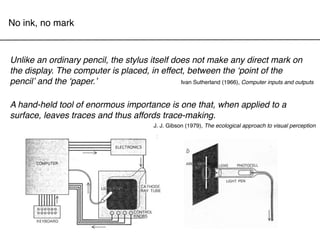
Unlike an ordinary pencil, the stylus itself does not make any direct mark on
the display. The computer is placed, in effect, between the ʻpoint of the
pencilʼ and the ʻpaper.ʼ                       Ivan Sutherland (1966), Computer inputs and outputs


A hand-held tool of enormous importance is one that, when applied to a
surface, leaves traces and thus affords trace-making.
                                              J. J. Gibson (1979), The ecological approach to visual perception
Something is drawn on the radiant surface without a mark


■ CRT has a radiant screen
 ‣ A picture painted by a sharply focused beam of electrons
     - A beam of electrons controlled by electrical signals
■ Light pen is a photosensitive device
 ‣ Responds to the light
     - Light is transformed into electrical signals
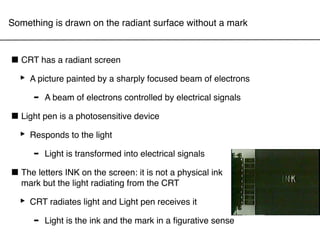
■ The letters INK onradiating from thenot a physical ink
  mark but the light
                     the screen: it is
                                       CRT

  ‣ CRT radiates light and Light pen receives it
     - Light is the ink and the mark in a figurative sense
There is a rupture in what we see


■ How is Sketchpad able to draw something using light without a mark?
 ‣ What is the radiant surface of CRT?
■ George Berkleyʼs theory of vision
    - “Picture”: Light, shade, and colors
         •   Vision part of what we can see

     -   “Image”: Projected on the retina as a copy of the physical world

         •   Tactile part of what we can see
                                        George Berkley(1709), An essay towards a new theory of vision


  ‣ What we see is made combinedsenses experience and tactile
    perception, which are
                          up of two
                                    by our
                                           called vision
Loss of direct vision


■ The rupture suggested by Berkley became an actuality in 19th century
 ‣ We canʼt believe that what we see is something tangible
    - We can see just “light, shade, and colors”
          •   How can we deal with the loss of direct vision?

■ An experiment for dealing with the loss of direct vision
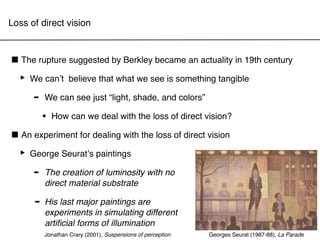
 ‣ George Seuratʼs paintings
     - The creation ofsubstrate with no
       direct material
                       luminosity


      -   His last major paintings are
          experiments in simulating different
          artificial forms of illumination
          Jonathan Crary (2001), Suspensions of perception   Georges Seurat (1987-88), La Parade
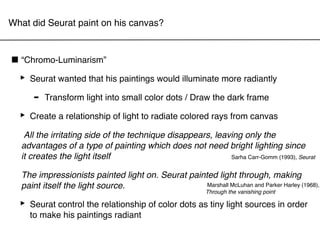
What did Seurat paint on his canvas?


■ “Chromo-Luminarism”
 ‣ Seurat wanted that his paintings would illuminate more radiantly
     - Transform light into small color dots / Draw the dark frame
 ‣ Create a relationship of light to radiate colored rays from canvas
   All the irritating side of the technique disappears, leaving only the
  advantages of a type of painting which does not need bright lighting since
  it creates the light itself                               Sarha Carr-Gomm (1993), Seurat


  The impressionists painted light on. Seurat painted light through, making
  paint itself the light source.                   Marshall McLuhan and Parker Harley (1968),
                                                          Through the vanishing point

  ‣ Seurat control the relationship of color dots as tiny light sources in order
    to make his paintings radiant
Light contains information


■ The ambient light reflecting on many physical objects
 ‣ The ambient light has information on the environment
■ The radiant light reaches us without reflecting on many physical objects
  from the light source

  ‣ Is there any kind of information in the radiant light?
     - A single spot of light in darkness conveys only a minimum of
         information to an eye

         •   Radiant light directly show us information about themselves

      ➡ It has no material information≒It is something immaterial
  It is hardly an object, not a substance, and it has a very unusual surface. A
  fire is a terrestrial event, with a beginning and an end, giving off heat and
  consuming fuel.                    James J. Gibson (1979), The ecological approach to visual perception
The light source is merely a phenomenon


■ The light source presents “something radiant”
 ‣ This seems tangible but actually not tangible
    - Indeterminate information
■ What Seurat achieved is to show indeterminate information on his canvas
 ‣ Create “something radiant” by a relationship of tiny color dots
    - Present the light source with precisely control of painting brush
 ‣ Seurat had to freeze the phenomenon of the light source
  “The momentary occurrence of the light source; to turn the light on and off”
                                    James J. Gibson (1979), The ecological approach to visual perception
  ➡ It is a limits without the electrical technology
The device completely controls the indeterminate information


■ Control the flickering of the light source
 ‣ The traditional media cannot control it
    - “The classical screen” and “The dynamic screen”
 ‣ The electronic media can control it
    - “The real-time screen” and “The interactive screen”
■ What is the meaning of CRT?
 ‣ This device can completely control the electrical power and
   represent “something radiant” with
                                          the flickering light source


     -   There is no direct material substrate which evokes a perception of
         object; There is only phenomenon on CRT surface
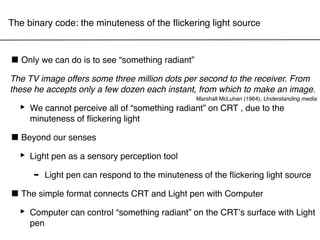
The binary code: the minuteness of the flickering light source


■ Only we can do is to see “something radiant”
The TV image offers some three million dots per second to the receiver. From
these he accepts only a few dozen each instant, from which to make an image.
                                                 Marshall McLuhan (1964), Understanding media

  ‣ We cannot perceive all of “something radiant” on CRT , due to the
    minuteness of flickering light

■ Beyond our senses
 ‣ Light pen as a sensory perception tool
     - Light pen can respond to the minuteness of the flickering light source
■ The simple format connects CRT and Light pen with Computer
 ‣ Computer can control “something radiant” on the CRTʼs surface with Light
    pen
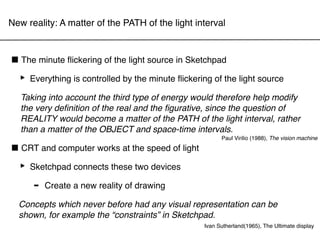
New reality: A matter of the PATH of the light interval


■ The minute flickering of the light source in Sketchpad
 ‣ Everything is controlled by the minute flickering of the light source
   Taking into account the third type of energy would therefore help modify
   the very definition of the real and the figurative, since the question of
   REALITY would become a matter of the PATH of the light interval, rather
   than a matter of the OBJECT and space-time intervals.
                                                        Paul Virilio (1988), The vision machine

■ CRT and computer works at the speed of light
 ‣ Sketchpad connects these two devices
    - Create a new reality of drawing
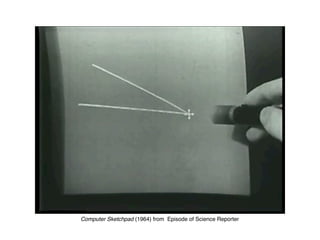
  Concepts which never before had any visual representation can be
  shown, for example the “constraints” in Sketchpad.
                                                  Ivan Sutherland(1965), The Ultimate display
Computer Sketchpad (1964) from Episode of Science Reporter
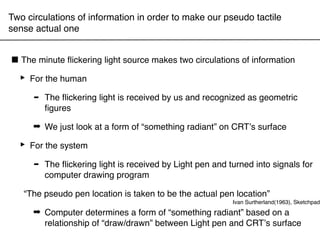
Two circulations of information in order to make our pseudo tactile
sense actual one


■ The minute flickering light source makes two circulations of information
 ‣ For the human
    - The flickering light is received by us and recognized as geometric
       figures

      ➡ We just look at a form of “something radiant” on CRTʼs surface

  ‣ For the system
     - The flickering light program by Light pen and turned into signals for
        computer drawing
                           is received


   “The pseudo pen location is taken to be the actual pen location”
                                                         Ivan Surtherland(1963), Sketchpad
      ➡ Computer determines a form of “something radiant” based on a
        relationship of “draw/drawn” between Light pen and CRTʼs surface
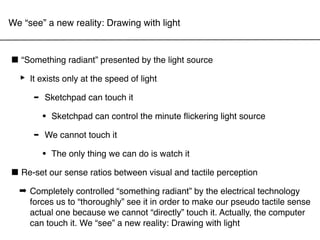
We “see” a new reality: Drawing with light


■ “Something radiant” presented by the light source
 ‣ It exists only at the speed of light
     - Sketchpad can touch it
          •   Sketchpad can control the minute flickering light source

      -   We cannot touch it

          •   The only thing we can do is watch it

■ Re-set our sense ratios between visual and tactile perception
  ➡ Completely controlled “something radiant” by the electrical technology
    forces us to “thoroughly” see it in order to make our pseudo tactile sense
    actual one because we cannot “directly” touch it. Actually, the computer
    can touch it. We “see” a new reality: Drawing with light

To See And To Touch the Light Source

  • 1.
    To See andto Touch the Light Source Mizuno Masanori, Nagoya University Motoyama Kiyofumi, Nagoya University
  • 2.
    There is noimage in the electric technology ■ Lev Manovichʼs classification of the screen ‣ “The classical / dynamic screen” = There is image on the screen ‣ “The real-time / interactive screen” = There is no image on the screen By imposing unvisualizable relationships that are the result of instant speed, electric technology dethrones the visual sense and restores us to the dominion of synesthesia, and the close inter-involvement of the other senses. Marshall McLuhan (1964), Understanding media ■ The technology of electricity can precisely control the light source ‣ CRT may be a kind of light source for us - We can directly look into “something radiant” on the light source • “Something radiant” takes us back to a place of “the close inter- involvement with various close senses”
  • 3.
    A study fornew interactive way from a view point of our senses ■ Now sourcepeople use the computer in order to draw something with the light many ‣ We draw the image on some materials since ancient time - CRT is a kind of the light source: It is something immaterial • How can we draw “something radiant” on the light source? ■ What is the meaning of Ivan Sutherlandʼs Sketchpad? Sketchpad exemplified a new paradigm of interacting with computers: by changing something on the screen, the operator changed something in the computer's memory. The real-time screen became interactive. Lev Manovich (2001), The language of new media ‣ A study for new drawing action from a relationship among the electrical technology, the light source and our senses.
  • 4.
    Sketchpad demo movie(1962) from Alan Kayʼs video lecture, Doing with images makes symbols
  • 5.
    No ink, nomark Unlike an ordinary pencil, the stylus itself does not make any direct mark on the display. The computer is placed, in effect, between the ʻpoint of the pencilʼ and the ʻpaper.ʼ Ivan Sutherland (1966), Computer inputs and outputs A hand-held tool of enormous importance is one that, when applied to a surface, leaves traces and thus affords trace-making. J. J. Gibson (1979), The ecological approach to visual perception
  • 6.
    Something is drawnon the radiant surface without a mark ■ CRT has a radiant screen ‣ A picture painted by a sharply focused beam of electrons - A beam of electrons controlled by electrical signals ■ Light pen is a photosensitive device ‣ Responds to the light - Light is transformed into electrical signals ■ The letters INK onradiating from thenot a physical ink mark but the light the screen: it is CRT ‣ CRT radiates light and Light pen receives it - Light is the ink and the mark in a figurative sense
  • 7.
    There is arupture in what we see ■ How is Sketchpad able to draw something using light without a mark? ‣ What is the radiant surface of CRT? ■ George Berkleyʼs theory of vision - “Picture”: Light, shade, and colors • Vision part of what we can see - “Image”: Projected on the retina as a copy of the physical world • Tactile part of what we can see George Berkley(1709), An essay towards a new theory of vision ‣ What we see is made combinedsenses experience and tactile perception, which are up of two by our called vision
  • 8.
    Loss of directvision ■ The rupture suggested by Berkley became an actuality in 19th century ‣ We canʼt believe that what we see is something tangible - We can see just “light, shade, and colors” • How can we deal with the loss of direct vision? ■ An experiment for dealing with the loss of direct vision ‣ George Seuratʼs paintings - The creation ofsubstrate with no direct material luminosity - His last major paintings are experiments in simulating different artificial forms of illumination Jonathan Crary (2001), Suspensions of perception Georges Seurat (1987-88), La Parade
  • 9.
    What did Seuratpaint on his canvas? ■ “Chromo-Luminarism” ‣ Seurat wanted that his paintings would illuminate more radiantly - Transform light into small color dots / Draw the dark frame ‣ Create a relationship of light to radiate colored rays from canvas All the irritating side of the technique disappears, leaving only the advantages of a type of painting which does not need bright lighting since it creates the light itself Sarha Carr-Gomm (1993), Seurat The impressionists painted light on. Seurat painted light through, making paint itself the light source. Marshall McLuhan and Parker Harley (1968), Through the vanishing point ‣ Seurat control the relationship of color dots as tiny light sources in order to make his paintings radiant
  • 10.
    Light contains information ■The ambient light reflecting on many physical objects ‣ The ambient light has information on the environment ■ The radiant light reaches us without reflecting on many physical objects from the light source ‣ Is there any kind of information in the radiant light? - A single spot of light in darkness conveys only a minimum of information to an eye • Radiant light directly show us information about themselves ➡ It has no material information≒It is something immaterial It is hardly an object, not a substance, and it has a very unusual surface. A fire is a terrestrial event, with a beginning and an end, giving off heat and consuming fuel. James J. Gibson (1979), The ecological approach to visual perception
  • 11.
    The light sourceis merely a phenomenon ■ The light source presents “something radiant” ‣ This seems tangible but actually not tangible - Indeterminate information ■ What Seurat achieved is to show indeterminate information on his canvas ‣ Create “something radiant” by a relationship of tiny color dots - Present the light source with precisely control of painting brush ‣ Seurat had to freeze the phenomenon of the light source “The momentary occurrence of the light source; to turn the light on and off” James J. Gibson (1979), The ecological approach to visual perception ➡ It is a limits without the electrical technology
  • 12.
    The device completelycontrols the indeterminate information ■ Control the flickering of the light source ‣ The traditional media cannot control it - “The classical screen” and “The dynamic screen” ‣ The electronic media can control it - “The real-time screen” and “The interactive screen” ■ What is the meaning of CRT? ‣ This device can completely control the electrical power and represent “something radiant” with the flickering light source - There is no direct material substrate which evokes a perception of object; There is only phenomenon on CRT surface
  • 13.
    The binary code:the minuteness of the flickering light source ■ Only we can do is to see “something radiant” The TV image offers some three million dots per second to the receiver. From these he accepts only a few dozen each instant, from which to make an image. Marshall McLuhan (1964), Understanding media ‣ We cannot perceive all of “something radiant” on CRT , due to the minuteness of flickering light ■ Beyond our senses ‣ Light pen as a sensory perception tool - Light pen can respond to the minuteness of the flickering light source ■ The simple format connects CRT and Light pen with Computer ‣ Computer can control “something radiant” on the CRTʼs surface with Light pen
  • 14.
    New reality: Amatter of the PATH of the light interval ■ The minute flickering of the light source in Sketchpad ‣ Everything is controlled by the minute flickering of the light source Taking into account the third type of energy would therefore help modify the very definition of the real and the figurative, since the question of REALITY would become a matter of the PATH of the light interval, rather than a matter of the OBJECT and space-time intervals. Paul Virilio (1988), The vision machine ■ CRT and computer works at the speed of light ‣ Sketchpad connects these two devices - Create a new reality of drawing Concepts which never before had any visual representation can be shown, for example the “constraints” in Sketchpad. Ivan Sutherland(1965), The Ultimate display
  • 15.
    Computer Sketchpad (1964)from Episode of Science Reporter
  • 16.
    Two circulations ofinformation in order to make our pseudo tactile sense actual one ■ The minute flickering light source makes two circulations of information ‣ For the human - The flickering light is received by us and recognized as geometric figures ➡ We just look at a form of “something radiant” on CRTʼs surface ‣ For the system - The flickering light program by Light pen and turned into signals for computer drawing is received “The pseudo pen location is taken to be the actual pen location” Ivan Surtherland(1963), Sketchpad ➡ Computer determines a form of “something radiant” based on a relationship of “draw/drawn” between Light pen and CRTʼs surface
  • 17.
    We “see” anew reality: Drawing with light ■ “Something radiant” presented by the light source ‣ It exists only at the speed of light - Sketchpad can touch it • Sketchpad can control the minute flickering light source - We cannot touch it • The only thing we can do is watch it ■ Re-set our sense ratios between visual and tactile perception ➡ Completely controlled “something radiant” by the electrical technology forces us to “thoroughly” see it in order to make our pseudo tactile sense actual one because we cannot “directly” touch it. Actually, the computer can touch it. We “see” a new reality: Drawing with light

Editor's Notes

  • #3 Lev Manovich classifies the screen into “classical”, “dynamic”, “real time” and “interactive”. Classical means the picture. Dynamic means the picture + motion, for example, a film. He makes a distinction between a film and an electrical device for the moving image. Electrical devices have no still image like a flame of the film. The image on an electrical device is is constantly and continually updated at a sufficient speed in real time. Therefore, He says: What is displayed on a “real time” screen is not an image in the traditional sense. And, the cathode-ray tube (CRT) is the first real time screen. We want to focus this separation and CRT, because there is the electric technology Since the invention of CRT, we have been able to precisely control electrical light. Accordingly we directly look at electric light in many ways like TV, Computer monitor. We could think that CRT may be a kind of the light source. I would like to say this situation means that we don't look at the image but the light source.
  • #4 Lev Manovich classifies the screen into “classical”, “dynamic”, “real time” and “interactive”. Classical means the picture. Dynamic means the picture + motion, for example, a film. He makes a distinction between a film and an electrical device for the moving image. Electrical devices have no still image like a flame of the film. The image on an electrical device is constantly updated at a sufficient speed in real time. Therefore, He says: What is displayed on a “real time” screen is not an image in the traditional sense. And, the cathode-ray tube (CRT) is the first device to control the light in order to show us something. We want to focus the separation, dynamic and real time because it happened with the electric technology McLuhan pointed out the power of electricity like this; by imposing unvisualizable relationships that are the result of instant speed, electric technology dethrones the visual sense and restores us to the dominion of synesthesia, and the close inter-involvement of the other senses From McLuhan, we would like to make a hypothesis about what we see in TV or computer monitor. In dark room, we cannot and do not directly see film projector. Because it is too bright for our eye. However, we can directly see TV or Computer monitor lights itself. Because the light is completely controlled for our eye. So, we now directly watch an electrical light source. I would like to say that CRT may work as a kind of artificial light source for us. And, the technology of electricity made it possible to control the light to show us something like image. We can directly look into “something radiant” on the light source. Therefore, CRT shows us not the image but “something radiant” on its surface. “Something radiant” takes back to a place of “the close inter-involvement with various close senses”.
  • #5 Why does Manovich consider that the screen becomes interactive when our action combines with real time screen? We draw the image since ancient time. It is interactive action for making the image with many materials. However, the CRT shows us not the image, but it is just the light source. It is something immaterial. This change might lead us to drastically change our interactive action. This might be a reason that Manovich uses the word “interactive”. Now many people use the computer in order to draw something with the light source. As already stated by Manovich, Sketchpad showed us an essence in new interactive action that changing something on the screen changed something in the computer’s memory. However, we have not yet considered this new interactive way from a view point of our senses. Therefore, we would like to explore this new drawing action from a relationship among the electrical technology, the light source and our senses.
  • #6 This is a demo movie about Sketchpad (1962). The Skethpad was created in by Ivan Sutherland at the Lincoln Laboratory of the Massachusetts Institute of Technology in the 1960’s. The system of the Skethpad is composed of the TX-2 computer, CRT display, light pen and control knobs, and it could accurately draw geometric configurations on the display using the light pen. The Lincoln Laboratory has been linking the computer and visual display unit for research on interaction between human and computer from the earliest phase of computer history in the 1950’s. It was a natural for Sutherland to use the CRT as a device for inputting and outputting computer information.
  • #7 Sutherland describes the characteristics of the Sketchpad: Unlike an ordinary pencil, the stylus itself does not make any direct mark on the display. The computer is placed, in effect, between the “point of the pencil” and the “paper.” This statement that no mark is left on the writing surface unlike an ordinary pencil is different to the conventional idea of “graphic act” . J.J. Gibson describes the pen must afford to inscribe a trajectory of the trace. Regis Debray says “to write is to inscribe”. However, when Sutherland connected the computer to the CRT as “the paper” and the light pen as “the pencil”, we can draw something without making a mark. Why we can do that? In order to make it clear, we consider what CRT as the paper and Light pen as the pencil mean.
  • #8 From a technological view point, The CRT has a radiant screen which can visualize a lot of information by electronic beams. And, electronic beams manipulated by electronic signals at a high speed (Haworth, 1948, p.1). The light pen is a device for capturing light. Robert Stotz described “a photosensitive device which responds to the light generated by an intensified point on the scope face and which amplifies, shapes and transmits this response back to the computer where it can be tested by the program and used as a branch condition.” Sutherland linked these two devices to the computer. As such, the Sketchpad displays the letters INK on the screen at start-up, but it is not a physical ink mark but the light radiating from the CRT. By the light pen capturing that light, the graphic act begins. Only light exists, since the light directly links the light pen and CRT without making a mark. The CRT radiates light and the light pen receives it. Here, light itself is the ink and the mark in a figurative sense. What is important with the Skethpad is that the graphic act is performed by directly handling the light. As a result, something is drawn on the radiant surface without a mark. However, what makes it possible to draw something with light itself?
  • #9 We must think about how Sketchpad is able to draw something using the light source without a mark. For that, we would examine what the radiant surface of the CRT shows us. In order to make it clear, We will refer to G. Berkeley’s theory of vision. Berkeley categorized what we see as follows. Pictures can be understood in a twofold sense, or as two kinds quite dissimilar and heterogeneous, the one consisting of light, shade, and colours; the other not properly pictures, but images projected on the retina. We will call those "pictures" and these "images” for distinction. The former are visible and the peculiar objects of sight. The latter are so far otherwise that a human blind from his birth may perfectly imagine, understand, and comprehend them. (Berkeley, 1963, p.143.) It is important for us that Berkeley what we see is made up of two senses called vision and tactile perception, which are combined by our experience. However, this suggests that there is a rapture of our vision; vision and tactile.
  • #10 We must think about how Skethpad is able to draw something using the light source without a mark. For that, we would examine what the radiant surface of the CRT shows us. In order to make it clear, We will refer to G. Berkeley’s theory of vision. Berkeley categorized what we see as follows. Pictures can be understood in a twofold sense, or as two kinds quite dissimilar and heterogeneous, the one consisting of light, shade, and colours; the other not properly pictures, but images projected on the retina. We will call those "pictures" and these "images” for distinction. The former are visible and the peculiar objects of sight. The latter are so far otherwise that a humanblind from his birth may perfectly imagine, understand, and comprehend them. (Berkeley, 1963, p.143.) It is important for us that Berkeley indicates in “the new theory of vision” that what we see is made up of two senses called vision and tactile perception of a different nature, which are combined by our experience. However, this suggests that there is a rift at the same time; which is to say that our experience is only just holding vision and tactile sense together in what we see.
  • #11 Jonathan Crary points out that 19th century physiologists handled “picture” and “image” as different things in what we see. The rupture suggested by Berkeley created an actual division. We can’t believe that what we see is something tangible. We can see just “light, shade, and colors.” Crary says that it was the “loss of direct vision” in our vision. How can we fill the loss of tactile sense with light? Crary focuses George Seurat to consider how people feel the “loss of direct vision” in 19th century. George Seurat was a painter who had complete confidence in science and technology and applied the theories of physiology and optics in his work. Therefore, he was very sensitive for the change of our vision. To put it another way, Seurat’s work concretizes the modern dilemma of the disappearance of aura more acutely than any other art practice. It can be reasonably claimed that his paintings are the first attempt to rationally produce aura, and his “theories” an attempt to concoct its formula. His immersion in the mechanics of vision was directed to the creation of luminosity with no direct material substrate, of a chromatic unfolding existing apart from the mere objectivity of the work, which “appears” only in a subjective, even “interpersonal” relation to it. (Crary, 1999 p. 225) Aura’s literal meaning is “radiation of light” The modern dilemma of the disappearance of “radiation of light” Electrical light has no direct material substrate
  • #12 Jonathan Crary points out that 19th century physiologists handled “picture” and “image” as different things in what we see. The rupture suggested by Berkeley created an actual division. We can’t believe that what we see is something tangible. We can see just “light, shade, and colors.” Crary says that it was the “loss of direct vision” in our vision. How can we deal with the loss of tactile sense with light? Crary focuses George Seurat to consider an experiment for dealing with the loss of direct vision. George Seurat was a painter who had complete confidence in science and technology and applied the theories of physiology and optics in his work. Therefore, he was very sensitive for the change of our vision. Crary says that Seurat’s painting’s goal was the creation of luminosity with no direct material substrate, and, It is then no accident that his last major paintings are experiments in simulating different artificial forms of illumination Crary’s analysis of Seurat suggests that Seurat would like to make his canvas something immaterial and draw his painting as the light itself. To put it another way, Seurat’s work concretizes the modern dilemma of the disappearance of aura more acutely than any other art practice. It can be reasonably claimed that his paintings are the first attempt to rationally produce aura, and his “theories” an attempt to concoct its formula. His immersion in the mechanics of vision was directed to the creation of luminosity with no direct material substrate, of a chromatic unfolding existing apart from the mere objectivity of the work, which “appears” only in a subjective, even “interpersonal” relation to it. But even to attempt the creation of this luminous effect means bringing into the work the forms of rationalization that eradicated aura in the first place. It is then no accident that his last major paintings are experiments in simulating different artificial forms of illumination, and that he situates both artist and spectator in a world bereft of “natural” white light, where the opposition of day and night is dissolved. (Crary, 1999 p. 225)
  • #13 But even to attempt the creation of this luminous effect means bringing into the work the forms of rationalization that eradicated aura in the first place. It is then no accident that his last major paintings are experiments in simulating different artificial forms of illumination, and that he situates both artist and spectator in a world bereft of “natural” white light, where the opposition of day and night is dissolved. (Crary, 1999 p. 225) Aura’s literal meaning is “radiation of light” The modern dilemma of the disappearance of “radiation of light” Electrical light has no direct material substrate Controlling something as the light source
  • #14 Seurat was a post-impressionist painter and the technique he used was called “pointillism”. However, Seurat himself called his technique “chromo-luminarism” . This means that Seurat’s objective was to project what Berkeley calls “light, shade and colours” towards the spectator rather than to paint an object with many small dots. The small dots which are characteristic of Seurat did not have a large significance on their own. But, it is a system for creating the relationship of light to radiate coloured rays from the canvas. The painter Paul Signac said: “All the irritating side of the technique disappears, leaving only the advantages of a type of painting which does not need bright lighting since it creates the light itself”. McLuhan said: “The impressionists painted light on. Seruat painted light through, making paint itself the light source” From these statements, we might say that Seurat would like to control the relationship of color dots as tiny light sources in order to make his paintings radiant. Next, we will look at the properties of this light source from the viewpoint of J.J. Gibson’s ecological optics.
  • #15 The most important aspect in J.J. Gibson’s ecological optics is that “light contains information.” According to Gibson, by light reflecting on many physical objects, a sequence of light is created. This is the ambient light, which surrounds us. T his ambient light also has invariants within the complex light sequence which holds information about the environment. The light we normally see is this ambient light. However, there is also light which is radiated from a light source and reaches us without having an association with the environment and Gibson calls this radiant light. Gibson quotes that the light source teaches the man’s senses the minimal information that light is illuminating. In other words, radiant light is a light that is only associated with the light source, and to see radiant light means to see the light source. Seeing the radiant light results in information which is different to what we obtain from the act of seeing ambient light which we generally perform. Gibson thinks a fire is one example of the radiant light, and says as follow;..... -- Is there any kind of information in radiant light? The answer must be yes, for the spectrum of any radiant beam specifies vibrations in the atoms that emitted the energy. The astronomer with a spectroscope can identify the substance of a star. One could aim the instrument at a luminous object and determine whether it is incandescent, fluorescent, bioluminescent, etc. But note that an eye cannot do this; it cannot register the distribution of wavelengths and cannot measure their absolute intensities. This is not the kind of information an eye can pick up. A single spot of light in darkness conveys only a minimum of information to an eye. (pp. 190-191)
  • #16 The light source only has information which indicates its presence. Therefore, we could say that a light source, just like fire, has no material substrate. We can see only phenomenon of the light source. This seems tangible but actually not tangible. In short, the light source presents us “something radiant” “Something radiant” is different from the image in the traditional sense. Because the image based on the ambient light has information of tactile sense, “Something radiant” based on the radiant light has no information of tactile sense, it is a very unique surface, hardly a object. Therefore, we cannot clearly analyze what there is. However, we can see “something radiant”. If we can control the indeterminate information presented by a light source, we can create a presence of something by only “light, shade, and colors”. It will be possible to deal with the loss of image. What Seurat achieved was to show indeterminate information on his canvas. He created something radiant as a relationship of tiny color dots He presented the light source with his precisely control of painting brush. However, an essence of the light source is “the momentary occurrence; to turn the light on and off” So, when he wanted to controll the light source, Seurat had to freeze the phenomenon of the light source as small coloured dots. It is a limits without the electrical technology
  • #17 What exists there is only information that “there is” something which radiates light and other information does not exist. Therefore, the light directly radiated from a light source does not have a light sequence. Conversely, since a light source only has information which indicates its presence, it is not premised on the environment for reflecting to obtain information. From the above, we could say that a light source, just like fire, has no material substrate, and is a phenomenon of radiating luminance which seems tangible but actually not tangible, and although a person who sees it cannot verify what is there due to its radiance, a person would think that “there is something” there which is radiating light. This is the peculiar information a light source presents. That is to say, a light source is merely a phenomenon which presents minimal information; the “presence/non-presence” of light, but because of that, it gives indeterminate information to the spectator which cannot be clearly analysed to say that there is something there. Therefore, if we can control the indeterminate information presented by a light source and show it so that the spectator could create an image there, it will be possible to fill the loss of image. What Seurat achieved was the use of indeterminate information, i.e., the “presence of something”, presented by the light source by freely controlling the light source, which was impossible to do for many years. The method used was to create a mosaic of light by meticulously patch-working the light source. This enabled the loss of image to be filled. Seurat was ahead of the CRT in that he used the indeterminate information presented by the light source. However, Seurat had no choice but to freeze “the momentary occurrence of the light source; to turn the light on and off” as small coloured dots when he manipulated the light source.
  • #18 The traditional media, painting or picture, film, could not manipulate the flickering of the light source. However, the CRT is able to show the flickering of the light source by controlling it with the electricity. In other words, the CRT is a device which completely controls the flickering of light source and represents something radiant for us. There is no direct material substrate which evokes a perception of object; There is only phenomenon on CRT surface.
  • #19 McLuhan pointed out the power of electricity like this; by imposing unvisualizable relationships that are the result of instant speed, electric technology dethrones the visual sense and restores us to the dominion of synesthesia, and the close interinvolvement of the other senses The technology of electricity made it possible to control light source. And, it made it possible for us to look into the light source as “something radiant”. For the uncertainty of “something radiant”, we are taken back to “he place of inter-involvement with various close senses.
  • #20 Even though the electric technology took us the place of inter-involvement with various close senses, Only we can do it to see “something radiant” until the invention of computer Because the light flickering is too minute for us to perceive everything. Human creates the form projected from the information he can perceive. Just as McLuhan points out this is something TV viewers perform every day. And, McLuhan says that to see TV is to touch TV. TV is a kind of device for our tactile. If we go beyond our senses in order to see everything, the minuteness of the flickering light source, we can not only see “something radiant” but also touch it. Skethpad has one thing that is different to a TV viewer. Skethpad has the light pen as a sensory perception tool which can respond to the flickering of the light source with minute intervals, which cannot be perceived by human. The simple format of turning on and off, which the light source presents, is the same format which computers use to handle information. This simple format connects CRT and Light pen with Computer. The computer in Sketchpad can control the minete flickering light, “something radiant” on the CRT’s surface with Light pen
  • #21 In this way, on the Sketchpad, everything is controlled by the minute flickering of the light source. According to Virilio, This phenomenon of the momentary flickering of light source which cannot be detected by human has created new energy and presented a problem of a new reality. Virilio quotes: Taking into account the third type of energy would therefore help modify the very definition of the real and the figurative, since the question of REALITY would become a matter of the PATH of the light interval, rather than a matter of the OBJECT and space-time intervals. This problem has hovered around since the creation of a device which cuts out a moment called a photograph. What has actualised this more is the CRT which creates the “light=mark of intervals” beyond the threshold at a mechanical speed by using electric light, and the computer which has the capacity to control the power created by the speed of light. The Sketchpad is something that connects these two devices which have the speed of light that creates a new reality. If Sketchpad shows us new reality, it has some examples for new reality. Sutherland said; Concepts which never before had any visual representation can be shown, for example the “constraints” in Sketchpad
  • #22 This demo movie shows us an example of Constraint. A form of “something radiant” is generated where is different from an actual path of Light pen Sutherland says: “The pseudo pen location is taken to be the actual pen location” Constraint A specific storage representation of a relationship between variables which limits the freedom of the variables, i.e., reduces the number of degrees of freedom of the system. Also, constraint is sometimes used to mean a type of constraint, as in “there are seventeen atomic constraints.”
  • #23 Why constraints happened in Sketchpad Sketchpad has two circulations of information. The minute flickering of the light source makes two circulations of information: one is for the human and the other is for the system. In a circulation of information for the man, the flickering light is received by us and recognized as geometric figures. This means that we just look at a form of “something radiant” on CRT’s surface. In a circulation of information for the system, the flickering light is received by Light pen and turned into signals for computer drawing program. Sutherland says: “The pseudo pen location is taken to be the actual pen location” This means that computer determines a form of “something radiant” based on a relationship of “draw / drawn” between Light pen and CRT’s surface -- Human creates a form of "something radiant" from the information he can perceive, although the viewer cannot usually perceive everything, due to the minuteness of flickering light. However, with Sketchpad, users have light pen as a sensory perception tool, which can respond to the flickering of the light source within minute intervals, which cannot be perceived by human alone.
  • #24 Even though the electric technology took us the place of inter-involvement with various close senses Only we can do it to see “something radiant” until connecting CRT with Computer The simple format of turning on and off, which the light source presents, is the same format as the binary scale, which is the format computers use to handle information. So the CRT is the appropriate information display device for the computer. The computer can control the CRT’s radiant surface And, compared to a light sequence of ambient light created by many reflections from the environment, a phenomenon which shows that “something is there” can be controlled by an amount of information that is incomparably less.
  • #25 The CRT can control the flickering of thousands of light sources according to the computer’s control using the power of electricity. However, due to the minuteness of their intervals, the user cannot perceive all of them. Humancreates the form of “something” projected from the information he can perceive. Just as McLuhan points out this is something TV viewers perform every day. However, a Skethpad user has one thing that is different to a TV viewer. Skethpad user has the light pen as a sensory perception tool which can respond to the flickering of the light source with minute intervals, which cannot be perceived by man. The light pen is a device for changing the light from the CRT into electronic signals to send them back to the computer. What is actually perceived there is the minute flickering of the light source. The light pen and the user are both looking at the flickering of the light source shown by the CRT, but owing to the difference in the sensitivity of perception related to the flickering of the light source, the information they receive is different.
  • #26 Looking into the minute flickering of the light source by Light pen on Sketchpad, the relationship of “draw/drawn” determines "something radiant" presented by the light source. This “something radiant” cannot be reached or touched by humans because it exists only at the speed of light. In other words, we don't draw anything which we can touch.
  • #27 The minuteness of the flickering light source present “something radiant”. “Something radiant” needs new drawing action because it is different from the image in traditional sense. Sketchpad can touch "something radiant" because it can control the minute flickering light source. “Something radiant” exists only at the speed of light, so the only thing we can do is see it. These make it possible to re-set our sense ration between of visual and tactile. Completely controlled “something radiant” by the electrical technology forces us to “thoroughly” see it in order to make our pseudo tactile sense actual one because we cannot “directly” touch it. Actually, the computer can touch it. We “see” a new reality: Drawing with light Seurat and McLuhan might aware this new tactile sense in the electrical age. But they couldn’t realize it in practice. Surtherland’s Sketchpad realized it, and we always perceive this new vision and tactile sense with computer. To make our pseudo tactile sense actual one, We just “see” a new reality: Drawing with light