Tiv

   Laura Bohannan
Shakespeare in the Bush
Key Terms
•   Age grade
•   Chiefdom
•   Cultural Relativism
•   Levirate
•   Polygyny
•   Socialization
•   Assignments on time
•   Quiz Friday
TIV
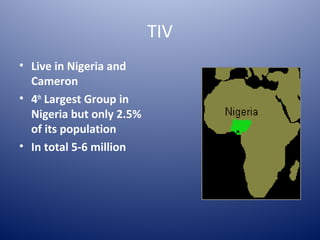
• Live in Nigeria and
  Cameron
• 4th Largest Group in
  Nigeria but only 2.5%
  of its population
• In total 5-6 million
TIV Social Structure
      •   Before the British lived in stockaded villages of
          perhaps 500 to 600 people.
      •   After established smaller compounds spread
          more or less evenly over the land containing
          from 12 to 120 people.
      •   Eighty three percent of the males in each
          compound were members of the patrilineage
      •   Reception huts, each identified by the name of
          a mature male member of the compound, are
          arranged in a circle or an oval, their entrances
          facing in toward the center
      •   Behind each reception hut is a sleeping hut for
          each of that man s wives.
      •   Granaries of several sorts are associated with
          sleeping huts.
Traditional Economy
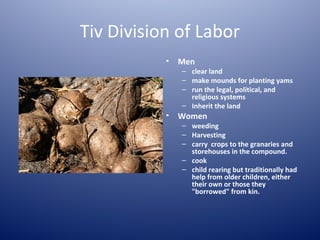
• Subsistence farmers
   – Yams
   – Sweet potatoes;
   – Maize for Beer
• Peanuts, peppers,
  several types of cucurbit,
  tomatoes, okra, and
  cotton
• Greens, mushrooms,
  seeds, leaves, and plants
  to be used in sauces.
• Goats, sheep, chickens,
  ducks, and guinea hens
Tiv Division of Labor
           •   Men
               – clear land
               – make mounds for planting yams
               – run the legal, political, and
                 religious systems
               – Inherit the land
           •   Women
               – weeding
               – Harvesting
               – carry crops to the granaries and
                 storehouses in the compound.
               – cook
               – child rearing but traditionally had
                 help from older children, either
                 their own or those they
                 "borrowed" from kin.
Traditional Kinship
•   Patrilineal
•   Polygyny
•   Every married woman has her
    own hut
•   The husband's reception hut is
    surrounded by the huts of his
    wives.
•   Each married woman has her
    own store of food; she cooks and
    takes food to her husband every
    day, and he shares it with all the
    children present.
•   What about the single men?

Tiv 2012

  • 1.
    Tiv Laura Bohannan Shakespeare in the Bush
  • 2.
    Key Terms • Age grade • Chiefdom • Cultural Relativism • Levirate • Polygyny • Socialization • Assignments on time • Quiz Friday
  • 3.
    TIV • Live inNigeria and Cameron • 4th Largest Group in Nigeria but only 2.5% of its population • In total 5-6 million
  • 4.
    TIV Social Structure • Before the British lived in stockaded villages of perhaps 500 to 600 people. • After established smaller compounds spread more or less evenly over the land containing from 12 to 120 people. • Eighty three percent of the males in each compound were members of the patrilineage • Reception huts, each identified by the name of a mature male member of the compound, are arranged in a circle or an oval, their entrances facing in toward the center • Behind each reception hut is a sleeping hut for each of that man s wives. • Granaries of several sorts are associated with sleeping huts.
  • 5.
    Traditional Economy • Subsistencefarmers – Yams – Sweet potatoes; – Maize for Beer • Peanuts, peppers, several types of cucurbit, tomatoes, okra, and cotton • Greens, mushrooms, seeds, leaves, and plants to be used in sauces. • Goats, sheep, chickens, ducks, and guinea hens
  • 6.
    Tiv Division ofLabor • Men – clear land – make mounds for planting yams – run the legal, political, and religious systems – Inherit the land • Women – weeding – Harvesting – carry crops to the granaries and storehouses in the compound. – cook – child rearing but traditionally had help from older children, either their own or those they "borrowed" from kin.
  • 7.
    Traditional Kinship • Patrilineal • Polygyny • Every married woman has her own hut • The husband's reception hut is surrounded by the huts of his wives. • Each married woman has her own store of food; she cooks and takes food to her husband every day, and he shares it with all the children present. • What about the single men?