Electromagnetic Fields
4.40
PROBLEMS
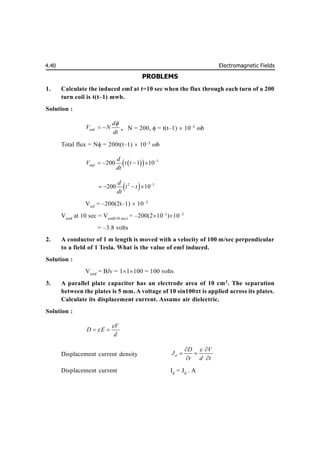
1. Calculate the induced emf at t=10 sec when the flux through each turn of a 200
turn coil is t(t–1) mwb.
Solution :
emf
d
V N
dt

  , N = 200, = t(t–1)  10–3
b
Total flux = N = 200t(t–1)  10–3
b
 
  3
200 1 10
emf
d
V t t
dt

   
 
2 3
200 10
d
t t
dt

   
Vref
= –200(2t–1)  10–3
Vemf
at 10 sec = Vemf(10 sec)
= –200(210–1
)10–3
= –3.8 volts
2. A conductor of 1 m length is moved with a velocity of 100 m/sec perpendicular
to a field of 1 Tesla. What is the value of emf induced.
Solution :
Vemf
= Blv = 11100 = 100 volts
3. A parallel plate capacitor has an electrode area of 10 cm2
. The separation
between the plates is 5 mm. A voltage of 10 sin100t is applied across its plates.
Calculate its displacement current. Assume air dielectric.
Solution :
V
D E
d


 
Displacement current density d
D V
J
t d t

 
 
 
Displacement current Id
= Jd
. A
Time Varying Fields and Maxwell’s Equations 4.41
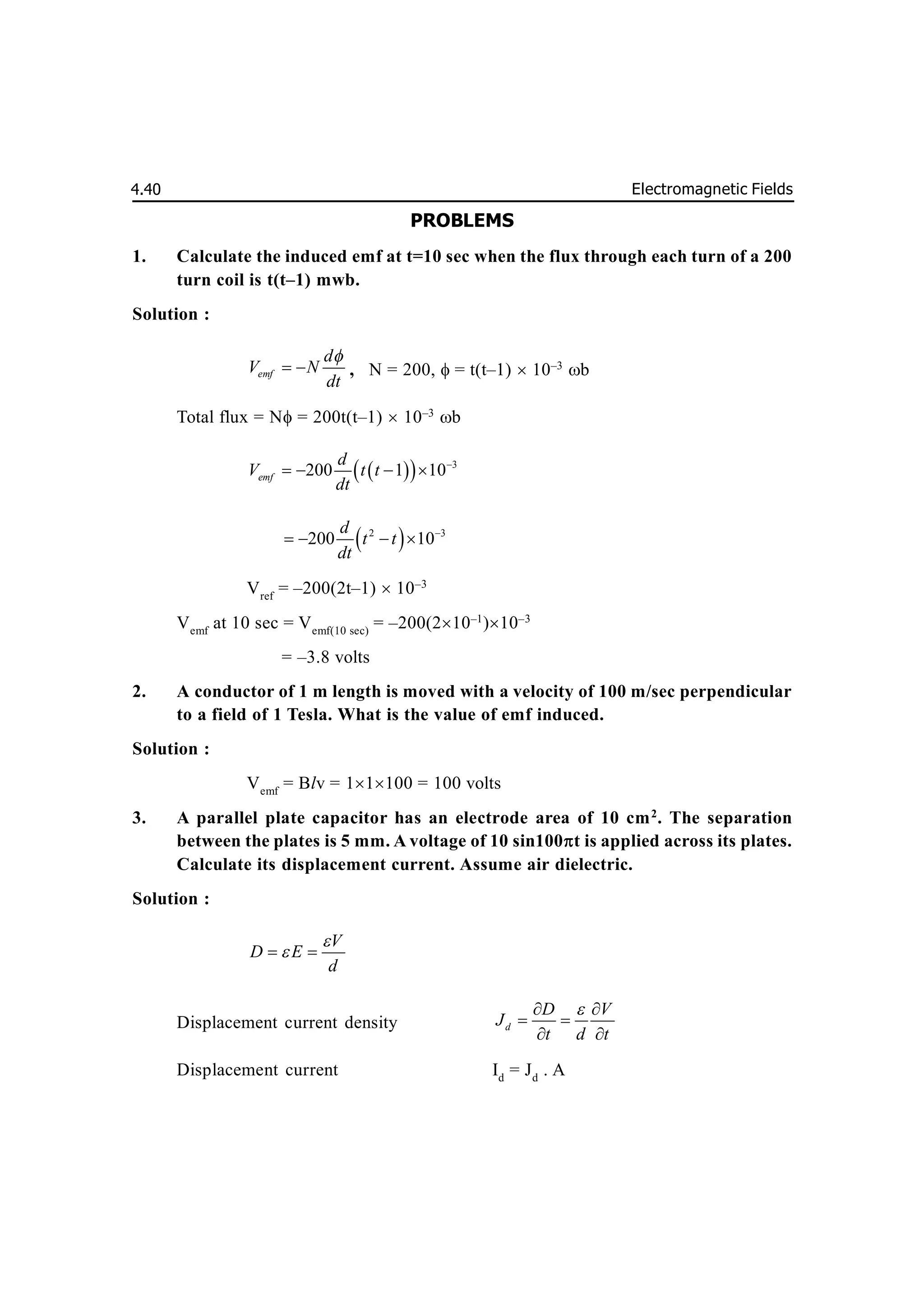
.A dV
d dt
  
  
 
d
dV
I C
dt

Capacitance
12 4
0
3
8.854 10 1 10 10
5 10
r A
C
d
   

   
 

= 1.77  10–12
farad
 
12
1.77 10 10sin100
d
dV d
I C t
dt dt


  
= 1.7  10–12
(10 cos 100t) (100)
Id
= 5.56  10–9
cos 100 t Amps.
4. If 2
x y z
D = 20xa -15ya + Kza μC/m

 
 

, find the value of K to satisfy the Maxwell’s
s
equations for region = 0, V
= 0.
Solution :
Point form of Gauss law for electric field is given by
.D = V
= 0
. 0
y
x z
D
D D
D
x y z

 
    
  
     
20 15 0
x y Kz
x y z
  
   
  
20 – 15 + K = 0, K = –5
5. Calculate the emf induced in a circuit having an inductance of 700 H if the
current through it varies at the rate of 5000 A per second.
Solution :
emf
di
V L
dt

= 700  10–6
 5000
= 3.5 volts
Electromagnetic Fields
4.42
6. Find the constant k, if the Electric flux density in a charge free region is given
by 2
10 5 /
x y z
D xa ya kza C m

  
 
 
 

.
Solution :
.D = 0 for a charge free region
0
y
x z
D
D D
x y z

 
  
  
     
2
10 5 0
x y kz
x y z
  
  
  
10 + 5 + 2kz = 0
2kz = –15
15
2
k
z


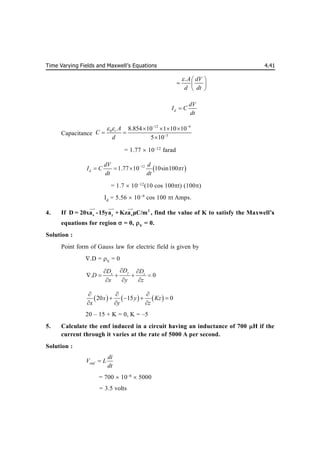
7. If B=0.01 sin 377t, determine the Emf developed about the path r = 0.5m, z=0
and t = 0.
Solution :
 = BA  b
= B  r2
= 0.01 sin 377t    (0.5)2
= 7.853  10–3
sin 377 t b
emf
d
V
dt

 
 
3
7.853 10 sin377
d
t
dt

  
Vemf
= 7.853  10–3
 [377 cos 377t]
At t = 0, cos 377t = cos 0 = 1
Vemf
= –7.853  10–3
 377
Vemf
= –2.9609 Volts
Time Varying Fields and Maxwell’s Equations 4.43
8. A conductor 1 cm in length is parallel to z-axis and rotates at radius of 25 cm at
1200 rpm. Find the induced voltage, if the radial field is given by r
B = 0.4a
 

Tesla.
Solution :
 
emf
V v B dl
 

 
 

The angular velocity  = 2 f rad/sec.
In 1 minute there are 1200 revolutions
1
2 1200 40 /sec
60
rad
  
   
v = r = 25  10–2
 40 m/sec
31.416 /
a m s




0.4 r
B a

 

z
dl dz a
 

 

 
emf
L
V v B dl
 

 


 
3.146 0.4 .
emf z
V a a dz a
 
 


 
 

r z
a a a
   

 

12.56 .
emf z
L
V dz a
 



 
0.01
0
12.56
emf
V z
  where the length of conductor is 1 cm
= –12.56  0.01
Vemf
= –0.1256 Volts = –125.6 mV
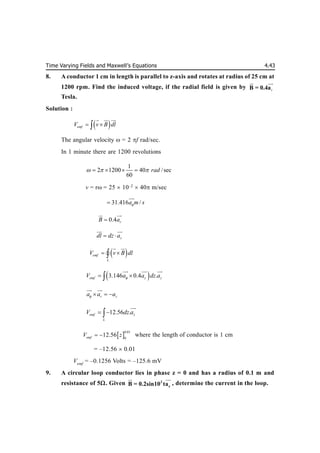
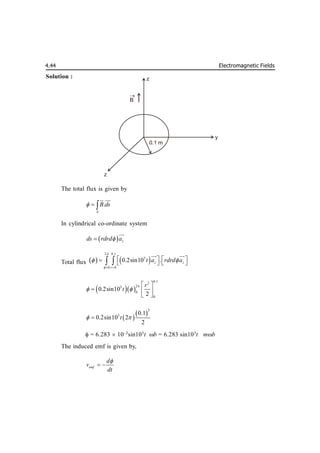
9. A circular loop conductor lies in phase z = 0 and has a radius of 0.1 m and
resistance of 5. Given 3
z
B = 0.2sin10 ta
 

, determine the current in the loop.
Electromagnetic Fields
4.44
Solution :
The total flux is given by
.
S
B ds
  

 

In cylindrical co-ordinate system
  z
ds rdrd a




Total flux    
2 0.1
3
0 0
0.2sin10 .
z z
r
t a rdrd a


 
 
   
  
 
 

 

  
0.1
2
2
3
0
0
0.2sin10
2
r
t

 
 
  
 
 
 
2
3 0.1
0.2sin10 2
2
t
 

 = 6.283  10–3
sin103
t b = 6.283 sin103
t mb
The induced emf is given by,
emf
d
v
dt

 
z
y
z
B

0.1 m
Time Varying Fields and Maxwell’s Equations 4.45
3 3
6.283 10 sin10
d
t
dt


 
 
 
= –6.283  10–3
 cos 103
t  103
Vemf
= –6.283 cos103
t V
The current is the conductor is given by
Induced Emf
Resistance
i 
3
6.283cos10
5
t
 
i = –1.2567 cos 103
t Amps.
10. If the Magnetic field H = [3x cos + 6y sin ]. Find the current density J

if the
fields are invariant with time.
Solution :
The point form of Maxwells second equation is,
D
H J
t

  



But as the fields are time invariant, 0
D
t



Hence H J
 


/ / /
0 0 3 cos 6 sin
x y z
x y z
a a a
H
x y
 
       


 
 



   
3 cos 6 sin 3 cos 6 sin
x y
H x y a x y a
y x
   
 
    
 

 
 

6sin 3cos
x y
H J a a
 
   

 

Electromagnetic Fields
4.46
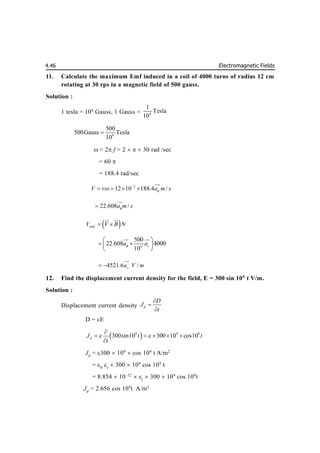
11. Calculate the maximum Emf induced in a coil of 4000 turns of radius 12 cm
rotating at 30 rps in a magnetic field of 500 gauss.
Solution :
1 tesla = 104
Gauss, 1 Gauss = 4
1
Tesla
10
4
500
500Gauss Tesla
10

 = 2 f = 2  30 rad /sec
= 60 
= 188.4 rad/sec
2
12 10 188.4 /
V r a m s

 
   


22.608 /
a m s




 
emf
V V B N
 

 

4
500
22.608 4000
10
r
a a

 
 
 
 

 

4521.6 /
z
a V m
 


12. Find the displacement current density for the field, E = 300 sin 109
t V/m.
Solution :
Displacement current density d
D
J
t



D = E
 
9 9 9
300sin10 300 10 cos10
d
J t t
t
 

    

Jd
= 300  109
 cos 109
t A/m2
= 0
r
 300  109
cos 109
t
= 8.854  10–12
 r
 300  109
cos 109
t
Jd
= 2.656 cos 109
t A/m2
Time Varying Fields and Maxwell’s Equations 4.47
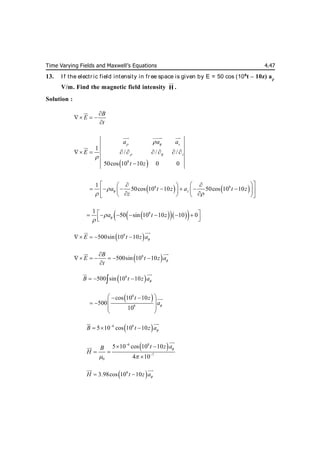
13. I f the electr ic field intensity in fr ee space is given by E = 50 cos (108
t – 10z) a
V/m. Find the magnetic field intensity H


.
Solution :
B
E
t

  


 
8
1
/ / /
50cos 10 10 0 0
z
z
a a a
E
t z
 
 


       


 
 


   
8 8
1
50cos 10 10 50cos 10 10
z
a t z a t z
z


 
 
 
 
 
      
 
   
 
   
 
 
  
 
8
1
50 sin 10 10 10 0
a t z



 
      
 
 
 
8
500sin 10 10
E t z a
   
 

 
8
500sin 10 10
B
E t z a
t


     

 

 
8
500 sin 10 10
B t z a
  

 

 
8
8
cos 10 10
500
10
t z
a
 
 
 
 
 
 


 
6 8
5 10 cos 10 10
B t z a

  
 

 
6 8
7
0
5 10 cos 10 10
4 10
t z a
B
H

 


 
 





 
8
3.98cos 10 10
H t z a
 

 

Electromagnetic Fields
4.48
14. Given the conduction current density in a lossy dielectric as JC
= 0.02 sin 109
t
A/m2
. Find the displacement current density if  = 103
 /m and r
= 6.5.
Solution :
JC
= Conduction Current = E
JC
= 103
E = 0.02 sin109
t
(or)
9
5 9
3
0.02sin10
2 10 sin10 /
10
t
E t N m

  
Displacement current density d
D
J
t



D = E
 
5 9
2 10 sin10
d
E
J t
t t
  
 
  
 
= 0
 r
 2  10–5
 109
 cos 109
t
= 8.854  10–12
 6.5  10–5
 109
 cos 109
t
= 1.15110–6
cos109
t A/m2
15. Find the amplitude of displacement current density inside a capacitor where
r
= 600 and D = 310–6
sin[6106
t – 0.3464x]az
C/m2
.
Solution :
Displacement current density D
D
J
t



 
6 6
3 10 sin 6 10 0.3464
D z
D
J t x a
t t

   
    
 
 


 
6 6 6
3 10 6 10 cos 6 10 0.3464 z
t x a

      


JD
= 18 cos (6106
t – 0.3464x) z
a


A/m2
The amplitude of displacement current density is JD
= 18 A/m2
Time Varying Fields and Maxwell’s Equations 4.49
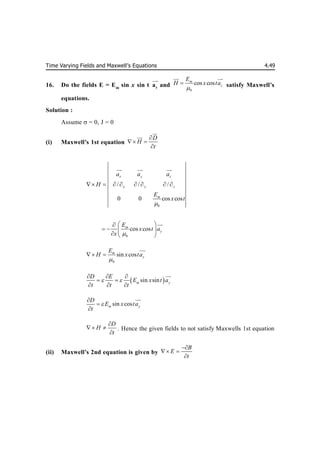
16. Do the fields E = Em
sin x sin t y
a


and
0
cos cos
m
z
E
H x ta



 

satisfy Maxwell’s
s
equations.
Solution :
Assume  = 0, J = 0
(i) Maxwell’s 1st equation
D
H
t

 




0
/ / /
0 0 cos cos
x y z
x y z
m
a a a
H
E
x t

       

 
 

0
cos cos
m
y
E
x t a
x 
 

   
  


0
sin cos
m
y
E
H x ta

 


 
sin sin
m y
D E
E x t a
t t t
 
  
 
  


sin cos
m y
D
E x ta
t






D
H
t

 

. Hence the given fields to not satisfy Maxwells 1st equation
(ii) Maxwell’s 2nd equation is given by
B
E
t

 

Electromagnetic Fields
4.50
/ / /
0 sin sin 0
x y z
x y z
m
a a a
E
E x t
       

 
 


 
sin sin
m z
E x t a
x





cos sin
m z
E E x ta
 
 

0
cos cos
m
z
E
B H
x t a
t t t
 

 
  
     
    


 
0
cos sin
m
z
E
B
x t a
t



  



If  =0
then
cos sin
m z
B
E x ta
t





Since
B
E
t

 


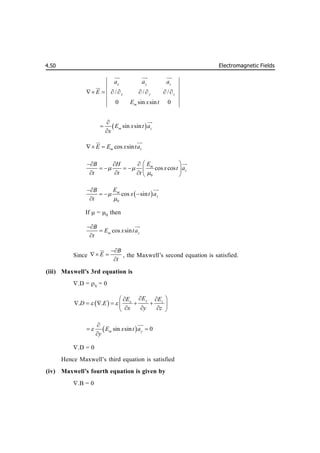
, the Maxwell’s second equation is satisfied.
(iii) Maxwell’s 3rd equation is
.D =V
= 0
 
. .
y
x z
E
E E
D E
x y z
 

 
 
     
 
  
 
 
sin sin 0
m y
E x t a
y


 



.D =0
Hence Maxwell’s third equation is satisfied
(iv) Maxwell’s fourth equation is given by
.B = 0
Time Varying Fields and Maxwell’s Equations 4.51
 
0 0 0
0
. . cos cos
y
x m
z
H
H E
H
B E x t
x y z z
  

 
  
 
  
         
 
 
   
 
   
 
.B = 0
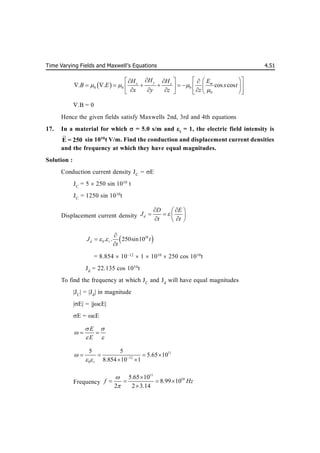
Hence the given fields satisfy Maxwells 2nd, 3rd and 4th equations
17. In a material for which  = 5.0 s/m and t
= 1, the electric field intensity is
E = 250


sin 1010
t V/m. Find the conduction and displacement current densities
and the frequency at which they have equal magnitudes.
Solution :
Conduction current density JC
= E
JC
= 5  250 sin 1010
t
JC
= 1250 sin 1010
t
Displacement current density d
D E
J
t t

 
 
   
 
 
 
10
0. . 250sin10
d r
J t
t
 



= 8.854  10–12
 1  1010
 250 cos 1010
t
Jd
= 22.135 cos 1010
t
To find the frequency at which JC
and Jd
will have equal magnitudes
|JC
| = |Jd
| in magnitude
|E| = |jE|
E = E
E
E
 

 
 
11
12
0
5 5
5.65 10
8.854 10 1
r

  
   
 
Frequency
11
10
5.65 10
8.99 10
2 2 3.14
f Hz



   

Electromagnetic Fields
4.52
18. Find the amplitude of displacement current density in the air near car antenna
where the field strength of the FM signal is
 
8
80cos 6.277 10 2.092 /
z
E t y a V m
  
 

Solution :
0
D
D E
J
t t

 
 
 
 
 
12 8
8.854 10 80cos 6.277 10 2.092 z
t y a
t
 
   



= 8.854  10–12
80  6.277  108
[–sin(6.277 108
t–2.092 y)]
 
8
0.445sin 6.277 10 2.092
D z
J t y a
   


19. The conduction cur rent flowing through a wire with conductivity =3107
s/m
and the relative permeability r
= 1 is given by IC
= 3 sin t (mA). If  = 108
rad/sec. Find the displacement current.
Solution :
Conduction current IC
= 3 sin t  10–3
amperes
where  = 108
rad/sec
Conduction current density JC
= E
8 3
7
3sin10 10
3 10
C C
J I t
E
A A
 

  
  
8 10
sin10 10
/
t
E V m
A



Displacement current density D
D E
J
t t

 
 
 
8 10
0
sin10 10
d
t
J
t A


 
 
  
  
8 8 10
0
cos10 10 10
t
A


 

Time Varying Fields and Maxwell’s Equations 4.53
12 2 8
8.854 10 10 cos10 t
A
 
  

14 8
8.854 10 cos10
D
t
J
A



Displacement current ID
= JD
 A
ID
= 8.854  10–14
cos 108
t amps
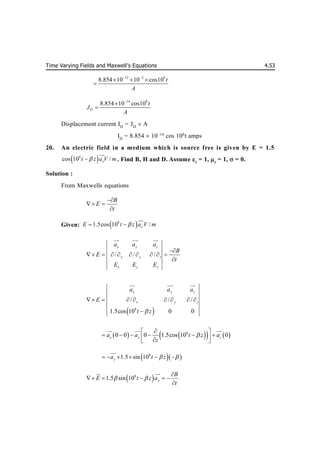
20. An electric field in a medium which is source free is given by E = 1.5
 
8
cos 10 /
x
t z a V m




. Find B, H and D. Assume r
= 1, r
= 1,  = 0.
Solution :
From Maxwells equations
B
E
t

 

Given:  
8
1.5cos 10 /
x
E t z a V m

 


/ / /
x y z
x y z
x y z
a a a
B
E
t
E E E

        


 
 

 
8
/ / /
1.5cos 10 0 0
x y z
x y z
a a a
E
t z

       


 
 

   
   
8
0 0 0 1.5cos 10 0
x y z
a a t z a
z


 
     
 

 

 
 

  
8
1.5 sin 10
y
a t z
 
     


 
8
1.5 sin 10 y
B
E t z a
t
 

    

 

Electromagnetic Fields
4.54
 
8
1.5 sin 10 y
B
t z a
t
 

  



 
8
1.5 sin 10 y
B t z a dt
 
   



 
 
8
8
cos 10
1.5
10
y
t z
a


 
 


 
8 8 2
1.5 10 cos 10 A/m
y
B t z a
 

  


 
8 8
7
0
1.5 10 cos 10
4 10
y
t z
B
H a
 
 


 
 



 
8
0.01194cos 10 A/m
y
H t z a

 


D = E = 0
r
E
 
12 8
8.854 10 1 1.5cos 10 /
x
t z a V m


    


 
12 8
13.281 10 cos 10 /
x
t z a V m


  


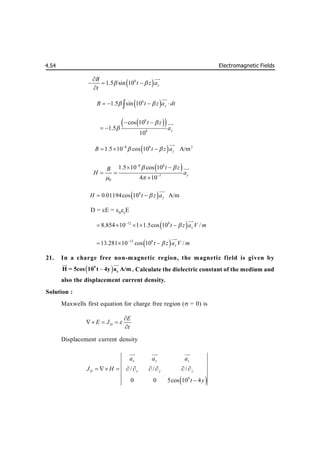
21. In a charge free non-magnetic region, the magnetic field is given by
 

9
z
H = 5cos 10 t 4y a A/m

 

. Calculate the dielectric constant of the medium and
also the displacement current density.
Solution :
Maxwells first equation for charge free region ( = 0) is
D
E
E J
t


  

Displacement current density
 
9
/ / /
0 0 5cos 10 4
x y z
D x y z
a a a
J H
t y
        


 
 

Time Varying Fields and Maxwell’s Equations 4.55
 
9
/ 5cos10 4
x y
a t y
   


 
  
9
5 sin 10 4 4
x
a t y
    


 
9
20sin 10 4
D x
J t y a
 


 
9
20sin 10 4
D x
E
J t y a
t


  



 
9
20
sin 10 4 x
E t y a dt

  



 
9
9
20
cos 10 4
10
x
E t y a


 


From Maxwell’s 2nd equation
0
H
E
t


  

 
 
7 9
0 4 10 5cos 10 4 z
H
t y a
t t
  
 
    
 


 
7 9 9
4 10 5 sin 10 4 10 z
y y a
 
      


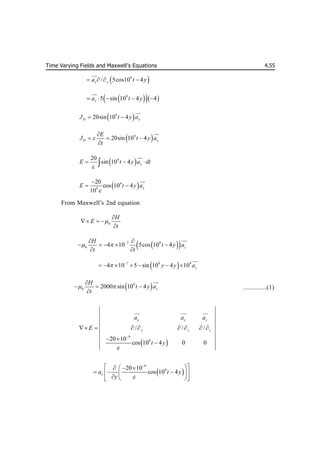
 
9
0 2000 sin 10 4 z
H
t y a
t
 

  



..............(1)
 
9
9
/ / /
20 10
cos 10 4 0 0
x y z
x y z
a a a
E
t y


       
 


 
 

 
9
9
20 10
cos 10 4
z
a t y
y 

 
 
  
  
 
 
  
 
Electromagnetic Fields
4.56
 
  
9
9
20 10
sin 10 4 4 z
t y a



   


 
9
9
80 10
sin 10 4 z
E t y a



  
 

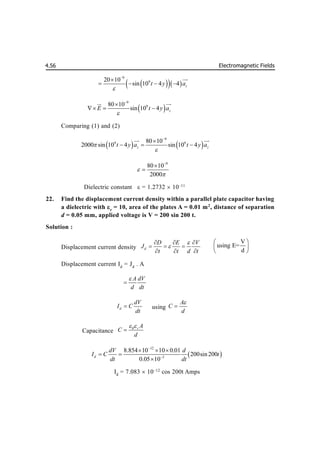
Comparing (1) and (2)
   
9
9 9
80 10
2000 sin 10 4 sin 10 4
z z
t y a t y a




  

 

9
80 10
2000





Dielectric constant  = 1.2732  10–11
22. Find the displacement current density within a parallel plate capacitor having
a dielectric with r
= 10, area of the plates A = 0.01 m2
, distance of separation
d = 0.05 mm, applied voltage is V = 200 sin 200 t.
Solution :
Displacement current density d
D E V
J
t t d t


  
  
  
V
using E=
d
 
 
 
Displacement current Id
= Jd
. A
A dV
d dt


d
dV
I C
dt
 using
A
C
d


Capacitance
0 r A
C
d
 

 
12
3
8.854 10 10 0.01
200sin200
0.05 10
d
dV d
I C t
dt dt


  
 

Id
= 7.083  10–12
cos 200t Amps
Time Varying Fields and Maxwell’s Equations 4.57
The displacement current density
12
7.083 10 cos200
0.01
d
d
I t
J
A


 
Jd
= 70.832  10–3
cos 200t A/m2
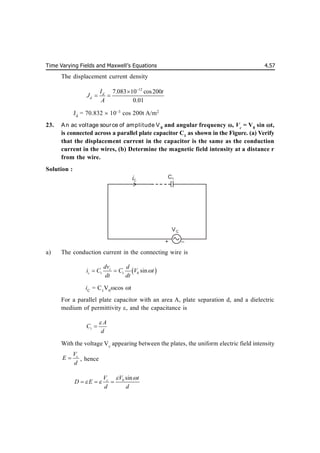
23. An ac voltage source of amplitude V0
and angular frequency , Vc
= V0
sin t,
is connected across a parallel plate capacitor C1
as shown in the Figure. (a) Verify
that the displacement current in the capacitor is the same as the conduction
current in the wires, (b) Determine the magnetic field intensity at a distance r
from the wire.
Solution :
a) The conduction current in the connecting wire is
 
1 1 0 sin
c
c
dv d
i C C V t
dt dt

 
iC
= C1
V0
cos t
For a parallel plate capacitor with an area A, plate separation d, and a dielectric
medium of permittivity , and the capacitance is
1
A
C
d


With the voltage Vc
appearing between the plates, the uniform electric field intensity
c
V
E
d
 , hence
0 sin
c
V V t
D E
d d
 
 
  
+ –
VC
iC
C1
Electromagnetic Fields
4.58
The displacement current is then
0 cos
S
D A
D ds V t
t d

 
  
   
 
  

= C1
V0
 cos t = iC
Thus iD
= iC
b) The magnetic field intensity at a distance r from the conducting wire can be found
by applying the Ampere’s circuital law.
C
H dl I
 


2rH
= C1
V0
cos t
1 0
cos /
2
CV
H t A m
r
  


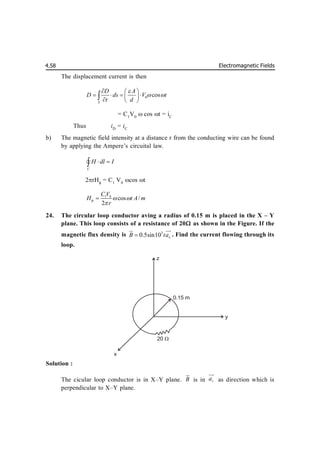
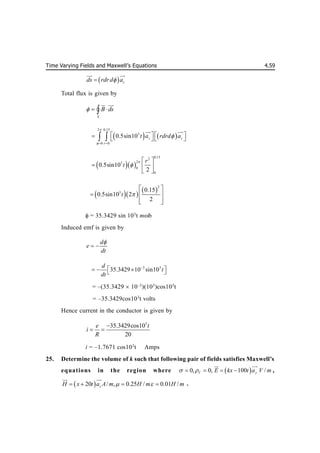
24. The circular loop conductor aving a radius of 0.15 m is placed in the X – Y
plane. This loop consists of a resistance of 20 as shown in the Figure. If the
magnetic flux density is 3
0.5sin10 x
B ta


 

. Find the current flowing through its
loop.
Solution :
The cicular loop conductor is in X–Y plane. B


is in z
a


as direction which is
perpendicular to X–Y plane.
z
y
x
0.15 m
20 
Time Varying Fields and Maxwell’s Equations 4.59
  z
ds rdrd a



 

Total flux is given by
S
B ds
  


 


   
2 0.15
3
0 0
0.5sin10 z z
r
t a rdrd a



 
   
  
 
 

 

  
0.15
2
2
3
0
0
0.5sin10
2
r
t


 
  
 
  
 
2
3 0.15
0.5sin10 2
2
t 
 
  
 
 
 = 35.3429 sin 103
t mb
Induced emf is given by
d
e
dt

 
3 3
35.3429 10 sin10
d
t
dt

 
  
 
= –(35.3429  10–3
)(103
)cos103
t
= –35.3429cos103
t volts
Hence current in the conductor is given by
3
35.3429cos10
20
e t
i
R

 
i = –1.7671 cos103
t Amps
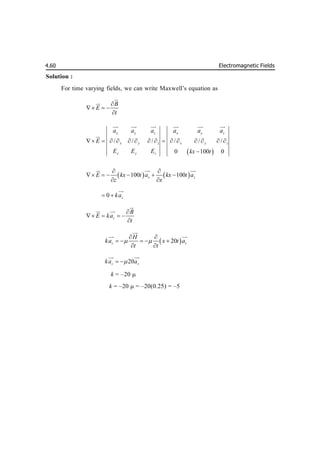
25. Determine the volume of k such that following pair of fields satisfies Maxwell’s
equations in the region where  
0, 0, 100 /
V y
E kx t a V m
 
   
 

,
 
20 / , 0.25 / 0.01 /
z
H x t a A m H m H m
 
   

 

.
Electromagnetic Fields
4.60
Solution :
For time varying fields, we can write Maxwell’s equation as
B
E
t

  




 
/ / / / / /
0 100 0
x y z x y z
x y z x y z
x y z
a a a a a a
E
E E E kx t
              


 
 
 
 
 


   
100 100
x z
E kx t a kx t a
z x
 
     
 
 
 

0 z
ka
 


z
B
E ka
t

   



 

 
20
z z
H
ka x t a
t t
 
 
    
 



 

20
z z
ka a

 

 

k = –20 
k = –20  = –20(0.25) = –5

TIME-VARYING FIELDS AND MAXWELL's EQUATIONS -Unit4- problems

  • 1.
    Electromagnetic Fields 4.40 PROBLEMS 1. Calculatethe induced emf at t=10 sec when the flux through each turn of a 200 turn coil is t(t–1) mwb. Solution : emf d V N dt    , N = 200, = t(t–1)  10–3 b Total flux = N = 200t(t–1)  10–3 b     3 200 1 10 emf d V t t dt        2 3 200 10 d t t dt      Vref = –200(2t–1)  10–3 Vemf at 10 sec = Vemf(10 sec) = –200(210–1 )10–3 = –3.8 volts 2. A conductor of 1 m length is moved with a velocity of 100 m/sec perpendicular to a field of 1 Tesla. What is the value of emf induced. Solution : Vemf = Blv = 11100 = 100 volts 3. A parallel plate capacitor has an electrode area of 10 cm2 . The separation between the plates is 5 mm. A voltage of 10 sin100t is applied across its plates. Calculate its displacement current. Assume air dielectric. Solution : V D E d     Displacement current density d D V J t d t        Displacement current Id = Jd . A
  • 2.
    Time Varying Fieldsand Maxwell’s Equations 4.41 .A dV d dt         d dV I C dt  Capacitance 12 4 0 3 8.854 10 1 10 10 5 10 r A C d             = 1.77  10–12 farad   12 1.77 10 10sin100 d dV d I C t dt dt      = 1.7  10–12 (10 cos 100t) (100) Id = 5.56  10–9 cos 100 t Amps. 4. If 2 x y z D = 20xa -15ya + Kza μC/m       , find the value of K to satisfy the Maxwell’s s equations for region = 0, V = 0. Solution : Point form of Gauss law for electric field is given by .D = V = 0 . 0 y x z D D D D x y z                  20 15 0 x y Kz x y z           20 – 15 + K = 0, K = –5 5. Calculate the emf induced in a circuit having an inductance of 700 H if the current through it varies at the rate of 5000 A per second. Solution : emf di V L dt  = 700  10–6  5000 = 3.5 volts
  • 3.
    Electromagnetic Fields 4.42 6. Findthe constant k, if the Electric flux density in a charge free region is given by 2 10 5 / x y z D xa ya kza C m            . Solution : .D = 0 for a charge free region 0 y x z D D D x y z                2 10 5 0 x y kz x y z          10 + 5 + 2kz = 0 2kz = –15 15 2 k z   7. If B=0.01 sin 377t, determine the Emf developed about the path r = 0.5m, z=0 and t = 0. Solution :  = BA  b = B  r2 = 0.01 sin 377t    (0.5)2 = 7.853  10–3 sin 377 t b emf d V dt      3 7.853 10 sin377 d t dt     Vemf = 7.853  10–3  [377 cos 377t] At t = 0, cos 377t = cos 0 = 1 Vemf = –7.853  10–3  377 Vemf = –2.9609 Volts
  • 4.
    Time Varying Fieldsand Maxwell’s Equations 4.43 8. A conductor 1 cm in length is parallel to z-axis and rotates at radius of 25 cm at 1200 rpm. Find the induced voltage, if the radial field is given by r B = 0.4a    Tesla. Solution :   emf V v B dl         The angular velocity  = 2 f rad/sec. In 1 minute there are 1200 revolutions 1 2 1200 40 /sec 60 rad        v = r = 25  10–2  40 m/sec 31.416 / a m s     0.4 r B a     z dl dz a         emf L V v B dl          3.146 0.4 . emf z V a a dz a            r z a a a         12.56 . emf z L V dz a        0.01 0 12.56 emf V z   where the length of conductor is 1 cm = –12.56  0.01 Vemf = –0.1256 Volts = –125.6 mV 9. A circular loop conductor lies in phase z = 0 and has a radius of 0.1 m and resistance of 5. Given 3 z B = 0.2sin10 ta    , determine the current in the loop.
  • 5.
    Electromagnetic Fields 4.44 Solution : Thetotal flux is given by . S B ds        In cylindrical co-ordinate system   z ds rdrd a     Total flux     2 0.1 3 0 0 0.2sin10 . z z r t a rdrd a                         0.1 2 2 3 0 0 0.2sin10 2 r t               2 3 0.1 0.2sin10 2 2 t     = 6.283  10–3 sin103 t b = 6.283 sin103 t mb The induced emf is given by, emf d v dt    z y z B  0.1 m
  • 6.
    Time Varying Fieldsand Maxwell’s Equations 4.45 3 3 6.283 10 sin10 d t dt         = –6.283  10–3  cos 103 t  103 Vemf = –6.283 cos103 t V The current is the conductor is given by Induced Emf Resistance i  3 6.283cos10 5 t   i = –1.2567 cos 103 t Amps. 10. If the Magnetic field H = [3x cos + 6y sin ]. Find the current density J  if the fields are invariant with time. Solution : The point form of Maxwells second equation is, D H J t        But as the fields are time invariant, 0 D t    Hence H J     / / / 0 0 3 cos 6 sin x y z x y z a a a H x y                        3 cos 6 sin 3 cos 6 sin x y H x y a x y a y x                    6sin 3cos x y H J a a          
  • 7.
    Electromagnetic Fields 4.46 11. Calculatethe maximum Emf induced in a coil of 4000 turns of radius 12 cm rotating at 30 rps in a magnetic field of 500 gauss. Solution : 1 tesla = 104 Gauss, 1 Gauss = 4 1 Tesla 10 4 500 500Gauss Tesla 10   = 2 f = 2  30 rad /sec = 60  = 188.4 rad/sec 2 12 10 188.4 / V r a m s          22.608 / a m s       emf V V B N       4 500 22.608 4000 10 r a a              4521.6 / z a V m     12. Find the displacement current density for the field, E = 300 sin 109 t V/m. Solution : Displacement current density d D J t    D = E   9 9 9 300sin10 300 10 cos10 d J t t t          Jd = 300  109  cos 109 t A/m2 = 0 r  300  109 cos 109 t = 8.854  10–12  r  300  109 cos 109 t Jd = 2.656 cos 109 t A/m2
  • 8.
    Time Varying Fieldsand Maxwell’s Equations 4.47 13. I f the electr ic field intensity in fr ee space is given by E = 50 cos (108 t – 10z) a V/m. Find the magnetic field intensity H   . Solution : B E t         8 1 / / / 50cos 10 10 0 0 z z a a a E t z                           8 8 1 50cos 10 10 50cos 10 10 z a t z a t z z                                         8 1 50 sin 10 10 10 0 a t z                   8 500sin 10 10 E t z a          8 500sin 10 10 B E t z a t               8 500 sin 10 10 B t z a          8 8 cos 10 10 500 10 t z a                 6 8 5 10 cos 10 10 B t z a          6 8 7 0 5 10 cos 10 10 4 10 t z a B H                 8 3.98cos 10 10 H t z a      
  • 9.
    Electromagnetic Fields 4.48 14. Giventhe conduction current density in a lossy dielectric as JC = 0.02 sin 109 t A/m2 . Find the displacement current density if  = 103  /m and r = 6.5. Solution : JC = Conduction Current = E JC = 103 E = 0.02 sin109 t (or) 9 5 9 3 0.02sin10 2 10 sin10 / 10 t E t N m     Displacement current density d D J t    D = E   5 9 2 10 sin10 d E J t t t           = 0  r  2  10–5  109  cos 109 t = 8.854  10–12  6.5  10–5  109  cos 109 t = 1.15110–6 cos109 t A/m2 15. Find the amplitude of displacement current density inside a capacitor where r = 600 and D = 310–6 sin[6106 t – 0.3464x]az C/m2 . Solution : Displacement current density D D J t      6 6 3 10 sin 6 10 0.3464 D z D J t x a t t                   6 6 6 3 10 6 10 cos 6 10 0.3464 z t x a           JD = 18 cos (6106 t – 0.3464x) z a   A/m2 The amplitude of displacement current density is JD = 18 A/m2
  • 10.
    Time Varying Fieldsand Maxwell’s Equations 4.49 16. Do the fields E = Em sin x sin t y a   and 0 cos cos m z E H x ta       satisfy Maxwell’s s equations. Solution : Assume  = 0, J = 0 (i) Maxwell’s 1st equation D H t        0 / / / 0 0 cos cos x y z x y z m a a a H E x t                0 cos cos m y E x t a x              0 sin cos m y E H x ta        sin sin m y D E E x t a t t t             sin cos m y D E x ta t       D H t     . Hence the given fields to not satisfy Maxwells 1st equation (ii) Maxwell’s 2nd equation is given by B E t    
  • 11.
    Electromagnetic Fields 4.50 / // 0 sin sin 0 x y z x y z m a a a E E x t                  sin sin m z E x t a x      cos sin m z E E x ta      0 cos cos m z E B H x t a t t t                        0 cos sin m z E B x t a t          If  =0 then cos sin m z B E x ta t      Since B E t      , the Maxwell’s second equation is satisfied. (iii) Maxwell’s 3rd equation is .D =V = 0   . . y x z E E E D E x y z                       sin sin 0 m y E x t a y        .D =0 Hence Maxwell’s third equation is satisfied (iv) Maxwell’s fourth equation is given by .B = 0
  • 12.
    Time Varying Fieldsand Maxwell’s Equations 4.51   0 0 0 0 . . cos cos y x m z H H E H B E x t x y z z                                         .B = 0 Hence the given fields satisfy Maxwells 2nd, 3rd and 4th equations 17. In a material for which  = 5.0 s/m and t = 1, the electric field intensity is E = 250   sin 1010 t V/m. Find the conduction and displacement current densities and the frequency at which they have equal magnitudes. Solution : Conduction current density JC = E JC = 5  250 sin 1010 t JC = 1250 sin 1010 t Displacement current density d D E J t t                10 0. . 250sin10 d r J t t      = 8.854  10–12  1  1010  250 cos 1010 t Jd = 22.135 cos 1010 t To find the frequency at which JC and Jd will have equal magnitudes |JC | = |Jd | in magnitude |E| = |jE| E = E E E        11 12 0 5 5 5.65 10 8.854 10 1 r           Frequency 11 10 5.65 10 8.99 10 2 2 3.14 f Hz        
  • 13.
    Electromagnetic Fields 4.52 18. Findthe amplitude of displacement current density in the air near car antenna where the field strength of the FM signal is   8 80cos 6.277 10 2.092 / z E t y a V m       Solution : 0 D D E J t t            12 8 8.854 10 80cos 6.277 10 2.092 z t y a t          = 8.854  10–12 80  6.277  108 [–sin(6.277 108 t–2.092 y)]   8 0.445sin 6.277 10 2.092 D z J t y a       19. The conduction cur rent flowing through a wire with conductivity =3107 s/m and the relative permeability r = 1 is given by IC = 3 sin t (mA). If  = 108 rad/sec. Find the displacement current. Solution : Conduction current IC = 3 sin t  10–3 amperes where  = 108 rad/sec Conduction current density JC = E 8 3 7 3sin10 10 3 10 C C J I t E A A          8 10 sin10 10 / t E V m A    Displacement current density D D E J t t        8 10 0 sin10 10 d t J t A             8 8 10 0 cos10 10 10 t A     
  • 14.
    Time Varying Fieldsand Maxwell’s Equations 4.53 12 2 8 8.854 10 10 cos10 t A       14 8 8.854 10 cos10 D t J A    Displacement current ID = JD  A ID = 8.854  10–14 cos 108 t amps 20. An electric field in a medium which is source free is given by E = 1.5   8 cos 10 / x t z a V m     . Find B, H and D. Assume r = 1, r = 1,  = 0. Solution : From Maxwells equations B E t     Given:   8 1.5cos 10 / x E t z a V m      / / / x y z x y z x y z a a a B E t E E E                    8 / / / 1.5cos 10 0 0 x y z x y z a a a E t z                         8 0 0 0 1.5cos 10 0 x y z a a t z a z                         8 1.5 sin 10 y a t z             8 1.5 sin 10 y B E t z a t            
  • 15.
    Electromagnetic Fields 4.54   8 1.5sin 10 y B t z a t            8 1.5 sin 10 y B t z a dt              8 8 cos 10 1.5 10 y t z a           8 8 2 1.5 10 cos 10 A/m y B t z a           8 8 7 0 1.5 10 cos 10 4 10 y t z B H a                8 0.01194cos 10 A/m y H t z a      D = E = 0 r E   12 8 8.854 10 1 1.5cos 10 / x t z a V m            12 8 13.281 10 cos 10 / x t z a V m        21. In a charge free non-magnetic region, the magnetic field is given by    9 z H = 5cos 10 t 4y a A/m     . Calculate the dielectric constant of the medium and also the displacement current density. Solution : Maxwells first equation for charge free region ( = 0) is D E E J t       Displacement current density   9 / / / 0 0 5cos 10 4 x y z D x y z a a a J H t y                
  • 16.
    Time Varying Fieldsand Maxwell’s Equations 4.55   9 / 5cos10 4 x y a t y            9 5 sin 10 4 4 x a t y          9 20sin 10 4 D x J t y a       9 20sin 10 4 D x E J t y a t           9 20 sin 10 4 x E t y a dt          9 9 20 cos 10 4 10 x E t y a       From Maxwell’s 2nd equation 0 H E t           7 9 0 4 10 5cos 10 4 z H t y a t t                 7 9 9 4 10 5 sin 10 4 10 z y y a              9 0 2000 sin 10 4 z H t y a t          ..............(1)   9 9 / / / 20 10 cos 10 4 0 0 x y z x y z a a a E t y                      9 9 20 10 cos 10 4 z a t y y                     
  • 17.
    Electromagnetic Fields 4.56     9 9 20 10 sin 10 4 4 z t y a            9 9 80 10 sin 10 4 z E t y a          Comparing (1) and (2)     9 9 9 80 10 2000 sin 10 4 sin 10 4 z z t y a t y a            9 80 10 2000      Dielectric constant  = 1.2732  10–11 22. Find the displacement current density within a parallel plate capacitor having a dielectric with r = 10, area of the plates A = 0.01 m2 , distance of separation d = 0.05 mm, applied voltage is V = 200 sin 200 t. Solution : Displacement current density d D E V J t t d t            V using E= d       Displacement current Id = Jd . A A dV d dt   d dV I C dt  using A C d   Capacitance 0 r A C d      12 3 8.854 10 10 0.01 200sin200 0.05 10 d dV d I C t dt dt         Id = 7.083  10–12 cos 200t Amps
  • 18.
    Time Varying Fieldsand Maxwell’s Equations 4.57 The displacement current density 12 7.083 10 cos200 0.01 d d I t J A     Jd = 70.832  10–3 cos 200t A/m2 23. An ac voltage source of amplitude V0 and angular frequency , Vc = V0 sin t, is connected across a parallel plate capacitor C1 as shown in the Figure. (a) Verify that the displacement current in the capacitor is the same as the conduction current in the wires, (b) Determine the magnetic field intensity at a distance r from the wire. Solution : a) The conduction current in the connecting wire is   1 1 0 sin c c dv d i C C V t dt dt    iC = C1 V0 cos t For a parallel plate capacitor with an area A, plate separation d, and a dielectric medium of permittivity , and the capacitance is 1 A C d   With the voltage Vc appearing between the plates, the uniform electric field intensity c V E d  , hence 0 sin c V V t D E d d        + – VC iC C1
  • 19.
    Electromagnetic Fields 4.58 The displacementcurrent is then 0 cos S D A D ds V t t d                 = C1 V0  cos t = iC Thus iD = iC b) The magnetic field intensity at a distance r from the conducting wire can be found by applying the Ampere’s circuital law. C H dl I     2rH = C1 V0 cos t 1 0 cos / 2 CV H t A m r      24. The circular loop conductor aving a radius of 0.15 m is placed in the X – Y plane. This loop consists of a resistance of 20 as shown in the Figure. If the magnetic flux density is 3 0.5sin10 x B ta      . Find the current flowing through its loop. Solution : The cicular loop conductor is in X–Y plane. B   is in z a   as direction which is perpendicular to X–Y plane. z y x 0.15 m 20 
  • 20.
    Time Varying Fieldsand Maxwell’s Equations 4.59   z ds rdrd a       Total flux is given by S B ds              2 0.15 3 0 0 0.5sin10 z z r t a rdrd a                        0.15 2 2 3 0 0 0.5sin10 2 r t               2 3 0.15 0.5sin10 2 2 t            = 35.3429 sin 103 t mb Induced emf is given by d e dt    3 3 35.3429 10 sin10 d t dt         = –(35.3429  10–3 )(103 )cos103 t = –35.3429cos103 t volts Hence current in the conductor is given by 3 35.3429cos10 20 e t i R    i = –1.7671 cos103 t Amps 25. Determine the volume of k such that following pair of fields satisfies Maxwell’s equations in the region where   0, 0, 100 / V y E kx t a V m          ,   20 / , 0.25 / 0.01 / z H x t a A m H m H m           .
  • 21.
    Electromagnetic Fields 4.60 Solution : Fortime varying fields, we can write Maxwell’s equation as B E t           / / / / / / 0 100 0 x y z x y z x y z x y z x y z a a a a a a E E E E kx t                                  100 100 x z E kx t a kx t a z x                0 z ka     z B E ka t              20 z z H ka x t a t t                  20 z z ka a        k = –20  k = –20  = –20(0.25) = –5