

Maxwell's equations
1
Contents
1. Introduction
2. Gauss’s law for electric fields
3. Gauss’s law for magnetic fields
4. Faraday’s law
5. The Ampere-Maxwell law
2
Introduction
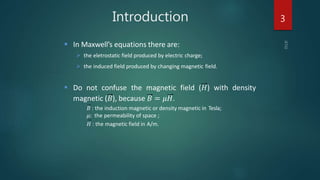
 In Maxwell’s equations there are:
 the eletrostatic field produced by electric charge;
 the induced field produced by changing magnetic field.
 Do not confuse the magnetic field (𝐻) with density
magnetic (𝐵), because 𝐵 = 𝜇𝐻.
𝐵 : the induction magnetic or density magnetic in Tesla;
𝜇: the permeability of space ;
𝐻 : the magnetic field in A/m.
3
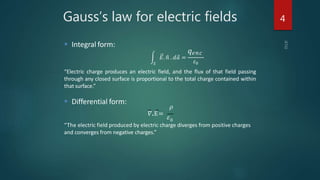
 Integral form:
“Electric charge produces an electric field, and the flux of that field passing
through any closed surface is proportional to the total charge contained within
that surface.”
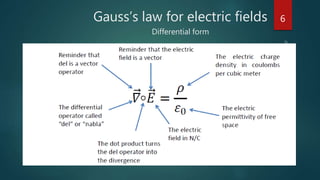
 Differential form:
𝜌
𝛻.E=
𝜀0
“The electric field produced by electric charge diverges from positive charges
and converges from negative charges.”
Gauss’s law for electric fields
𝑆
𝐸. 𝑛 . 𝑑 𝑎 =
‫ݍ‬݁݊ܿ
𝜀0
4
Gauss’s law for electric fields
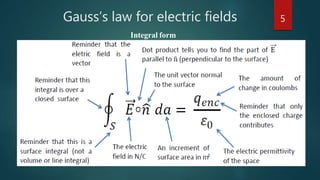
Integral form
5
Gauss’s law for electric fields
Differential form
6
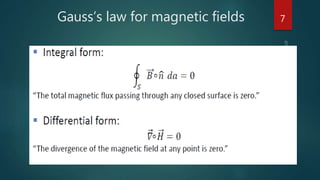
Gauss’s law for magnetic fields 7
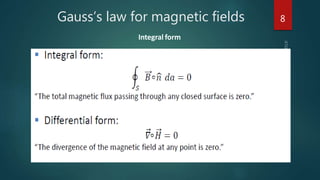
Gauss’s law for magnetic fields
Integral form
8
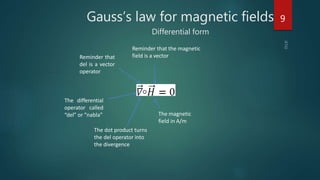
Gauss’s law for magnetic fields
Differential form
Reminder that
del is a vector
operator
Reminder that the magnetic
field is a vector
The magnetic
field in A/m
The dot product turns
the del operator into
the divergence
The differential
operator called
“del” or “nabla”
9
Faraday’s law
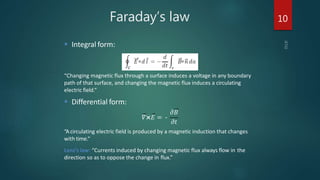
 Integral form:
“Changing magnetic flux through a surface induces a voltage in any boundary
path of that surface, and changing the magnetic flux induces a circulating
electric field.“
 Differential form:
𝛻×𝐸 = -
𝜕𝐵
𝜕𝑡
“Acirculating electric field is produced by a magnetic induction that changes
with time.“
Lenz’s law: “Currents induced by changing magnetic flux always flow in the
direction so as to oppose the change in flux.”
10
Faraday’s law
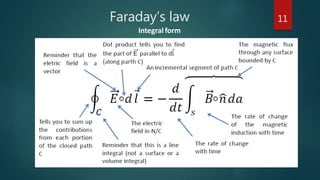
Integral form
Dot product tells you to find
the part of E parallel to d l
(along parth C)
11
Faraday’s law
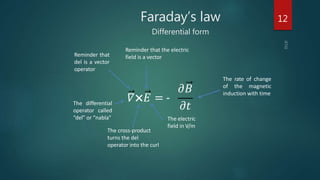
Differential form
𝛻×𝐸 = -
𝜕𝐵
𝜕𝑡
Reminder that
del is a vector
operator
Reminder that the electric
field is a vector
The electric
field in V/m
The cross-product
turns the del
operator into the curl
The differential
operator called
“del” or “nabla”
The rate of change
of the magnetic
induction with time
12
The Ampere-Maxwell law 13
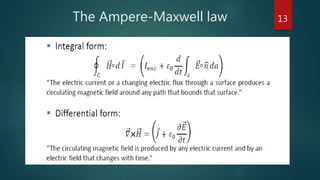
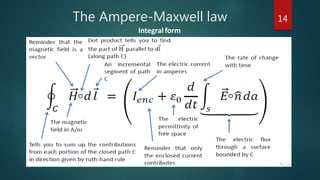
The Ampere-Maxwell law
Integral form
14
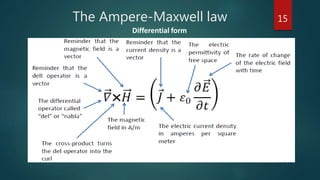
The Ampere-Maxwell law
Differential form
15
Reference
 FLEISCH, DANIEL A. A Student’s Guide to Maxwell’s Equations. First
published. United States of America by Cambrige University Press,
2008.
16

Maxwell's equations 3rd 2

  • 1.
  • 2.
    Contents 1. Introduction 2. Gauss’slaw for electric fields 3. Gauss’s law for magnetic fields 4. Faraday’s law 5. The Ampere-Maxwell law 2
  • 3.
    Introduction  In Maxwell’sequations there are:  the eletrostatic field produced by electric charge;  the induced field produced by changing magnetic field.  Do not confuse the magnetic field (𝐻) with density magnetic (𝐵), because 𝐵 = 𝜇𝐻. 𝐵 : the induction magnetic or density magnetic in Tesla; 𝜇: the permeability of space ; 𝐻 : the magnetic field in A/m. 3
  • 4.
     Integral form: “Electriccharge produces an electric field, and the flux of that field passing through any closed surface is proportional to the total charge contained within that surface.”  Differential form: 𝜌 𝛻.E= 𝜀0 “The electric field produced by electric charge diverges from positive charges and converges from negative charges.” Gauss’s law for electric fields 𝑆 𝐸. 𝑛 . 𝑑 𝑎 = ‫ݍ‬݁݊ܿ 𝜀0 4
  • 5.
    Gauss’s law forelectric fields Integral form 5
  • 6.
    Gauss’s law forelectric fields Differential form 6
  • 7.
    Gauss’s law formagnetic fields 7
  • 8.
    Gauss’s law formagnetic fields Integral form 8
  • 9.
    Gauss’s law formagnetic fields Differential form Reminder that del is a vector operator Reminder that the magnetic field is a vector The magnetic field in A/m The dot product turns the del operator into the divergence The differential operator called “del” or “nabla” 9
  • 10.
    Faraday’s law  Integralform: “Changing magnetic flux through a surface induces a voltage in any boundary path of that surface, and changing the magnetic flux induces a circulating electric field.“  Differential form: 𝛻×𝐸 = - 𝜕𝐵 𝜕𝑡 “Acirculating electric field is produced by a magnetic induction that changes with time.“ Lenz’s law: “Currents induced by changing magnetic flux always flow in the direction so as to oppose the change in flux.” 10
  • 11.
    Faraday’s law Integral form Dotproduct tells you to find the part of E parallel to d l (along parth C) 11
  • 12.
    Faraday’s law Differential form 𝛻×𝐸= - 𝜕𝐵 𝜕𝑡 Reminder that del is a vector operator Reminder that the electric field is a vector The electric field in V/m The cross-product turns the del operator into the curl The differential operator called “del” or “nabla” The rate of change of the magnetic induction with time 12
  • 13.
  • 14.
  • 15.
  • 16.
    Reference  FLEISCH, DANIELA. A Student’s Guide to Maxwell’s Equations. First published. United States of America by Cambrige University Press, 2008. 16