6-1
6-1
Time Value of Money
Value of Money = f(Time)
6-2
Chapter outline
• The concept of TVM
• Interest rate (Meaning, Components, Simple vs
Compound)
• Time lines (why important?)
• Present value, Future value
• Annuities (ordinary vs annuity due)
• Nominal/Quoted vs Effective Interest rates
• Amortization Schedule
6-3
Time Value of Money
Define
Indicates the purchasing power of money changes during time
being or the money in your hand now is not equal to the
money will be in future
Why matters
- Inflation/Deflation
- Uncertainty/Risk
- Opportunity costs
Applications
• planning for retirement,
• valuing stocks and bonds,
• setting up loan payment schedules, and making corporate
decisions regarding investing in new plant and equipment
6-4
Interest Rate
An interest rate is the percentage of principal
charged by the lender for the use of its money/fund
Components:
- Inflation
- Opportunity cost
- Risk
Simple vs Compound Interest Rate
6-5
Time lines
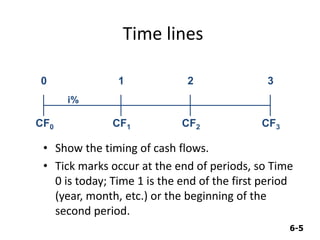
• Show the timing of cash flows.
• Tick marks occur at the end of periods, so Time
0 is today; Time 1 is the end of the first period
(year, month, etc.) or the beginning of the
second period.
CF0 CF1 CF3
CF2
0 1 2 3
i%
6-6
Drawing time lines:
$100 lump sum due in 2 years;
3-year $100 ordinary annuity
100 100
100
0 1 2 3
i%
3 year $100 ordinary annuity
100
0 1 2
i%
$100 lump sum due in 2 years
6-7
Drawing time lines:
Uneven cash flow stream; CF0 = -$50,
CF1 = $100, CF2 = $75, and CF3 = $50
100 50
75
0 1 2 3
i%
-50
Uneven cash flow stream
6-8
What is the future value (FV) of an initial $100
after 3 years, if i/YR = 10%?
• Finding the FV of a cash flow or series of cash
flows when compound interest is applied is
called compounding.
• FV can be solved by using the arithmetic,
financial calculator, and spreadsheet methods.
FV = ?
0 1 2 3
10%
100
6-9
Solving for FV:
The arithmetic method
• After 1 year:
FV1 = PV ( 1 + i ) = $100 (1.10)
= $110.00
• After 2 years:
FV2 = PV ( 1 + i )2 = $100 (1.10)2
=$121.00
• After 3 years:
FV3 = PV ( 1 + i )3 = $100 (1.10)3
=$133.10
• After n years (general case):
FVn = PV ( 1 + i )n
6-10
FV (some examples)
If Cash inflow and outflow one time:
- If you deposit $1000 for 10 years at 12% interest rate, how much will you
receive after 10 years? Calculate and show time lines.
- If your grand father deposited $5000 before 30 years at 10% interest rate
at a commercial bank, how much would you receive today. Show
calculations and time lines.
If there is more than one cash outflow and one cash
inflow:
- If you deposit $1000 now, $5000 after 1 year, $6000 after 2 year, and
$4000 after 3 years, how much will you receive after 4 years at 10%
interest rate. Show calculations and time lines.
- If your forefathers deposited $10000 before 50 years at 6% interest rate,
and more $10000 before 30 years at 8% interest rate. How much in total
you would receive today. Show calculations and time lines of each
scenario.

Time value ch6

  • 1.
    6-1 6-1 Time Value ofMoney Value of Money = f(Time)
  • 2.
    6-2 Chapter outline • Theconcept of TVM • Interest rate (Meaning, Components, Simple vs Compound) • Time lines (why important?) • Present value, Future value • Annuities (ordinary vs annuity due) • Nominal/Quoted vs Effective Interest rates • Amortization Schedule
  • 3.
    6-3 Time Value ofMoney Define Indicates the purchasing power of money changes during time being or the money in your hand now is not equal to the money will be in future Why matters - Inflation/Deflation - Uncertainty/Risk - Opportunity costs Applications • planning for retirement, • valuing stocks and bonds, • setting up loan payment schedules, and making corporate decisions regarding investing in new plant and equipment
  • 4.
    6-4 Interest Rate An interestrate is the percentage of principal charged by the lender for the use of its money/fund Components: - Inflation - Opportunity cost - Risk Simple vs Compound Interest Rate
  • 5.
    6-5 Time lines • Showthe timing of cash flows. • Tick marks occur at the end of periods, so Time 0 is today; Time 1 is the end of the first period (year, month, etc.) or the beginning of the second period. CF0 CF1 CF3 CF2 0 1 2 3 i%
  • 6.
    6-6 Drawing time lines: $100lump sum due in 2 years; 3-year $100 ordinary annuity 100 100 100 0 1 2 3 i% 3 year $100 ordinary annuity 100 0 1 2 i% $100 lump sum due in 2 years
  • 7.
    6-7 Drawing time lines: Unevencash flow stream; CF0 = -$50, CF1 = $100, CF2 = $75, and CF3 = $50 100 50 75 0 1 2 3 i% -50 Uneven cash flow stream
  • 8.
    6-8 What is thefuture value (FV) of an initial $100 after 3 years, if i/YR = 10%? • Finding the FV of a cash flow or series of cash flows when compound interest is applied is called compounding. • FV can be solved by using the arithmetic, financial calculator, and spreadsheet methods. FV = ? 0 1 2 3 10% 100
  • 9.
    6-9 Solving for FV: Thearithmetic method • After 1 year: FV1 = PV ( 1 + i ) = $100 (1.10) = $110.00 • After 2 years: FV2 = PV ( 1 + i )2 = $100 (1.10)2 =$121.00 • After 3 years: FV3 = PV ( 1 + i )3 = $100 (1.10)3 =$133.10 • After n years (general case): FVn = PV ( 1 + i )n
  • 10.
    6-10 FV (some examples) IfCash inflow and outflow one time: - If you deposit $1000 for 10 years at 12% interest rate, how much will you receive after 10 years? Calculate and show time lines. - If your grand father deposited $5000 before 30 years at 10% interest rate at a commercial bank, how much would you receive today. Show calculations and time lines. If there is more than one cash outflow and one cash inflow: - If you deposit $1000 now, $5000 after 1 year, $6000 after 2 year, and $4000 after 3 years, how much will you receive after 4 years at 10% interest rate. Show calculations and time lines. - If your forefathers deposited $10000 before 50 years at 6% interest rate, and more $10000 before 30 years at 8% interest rate. How much in total you would receive today. Show calculations and time lines of each scenario.