Career Unit
 The “work force” is a huge part of your life
 People in the work force range from 16 years
old until you die, so it is a big part of your life
 People work to pay for the basic necessities
of life.
 You will spend 30-40 years of your life
working
 Most people will spend a significant time
amount of time preparing to enter the work
force
You want to go through many steps in order to pick a
career you should:
1. explore the different career categories to learn what
each entails
2. Determine each job available within each career
category
3. Find out how much education, training, and special
skills are required for each category
4. Estimate how much money can be earned in each
career over a lifetime
Remember careers aren’t just about whether you like it or
not your lifestyle needs to match the career
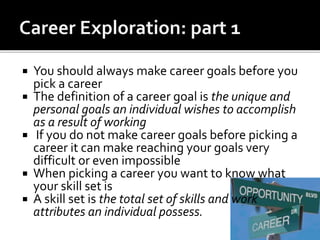
 You should always make career goals before you
pick a career
 The definition of a career goal is the unique and
personal goals an individual wishes to accomplish
as a result of working
 If you do not make career goals before picking a
career it can make reaching your goals very
difficult or even impossible
 When picking a career you want to know what
your skill set is
 A skill set is the total set of skills and work
attributes an individual possess.
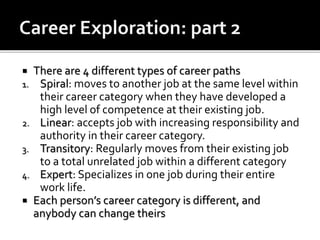
 There are 4 different types of career paths
1. Spiral: moves to another job at the same level within
their career category when they have developed a
high level of competence at their existing job.
2. Linear: accepts job with increasing responsibility and
authority in their career category.
3. Transitory: Regularly moves from their existing job
to a total unrelated job within a different category
4. Expert: Specializes in one job during their entire
work life.
 Each person’s career category is different, and
anybody can change theirs
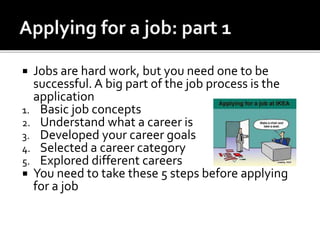
 Jobs are hard work, but you need one to be
successful. A big part of the job process is the
application
1. Basic job concepts
2. Understand what a career is
3. Developed your career goals
4. Selected a career category
5. Explored different careers
 You need to take these 5 steps before applying
for a job
 There is a lot of information in a resume, but
information that must be on it is:
1. Personal and Contact information
2. Summary of your education
3. Summary of your skills and training
4. Work history
5. Hobbies/activities/interests
6. References
1. What is your greatest weakness?
2. What is your greatest strength?
3. Do you take work home with you?
4. How many hours do you normally work?
5. What are you passionate about?
1. What motivates you?
2. What are your salary expectations?
3. What are your pet peeves
4. Do you prefer to work independently or on a
team
5. What do people most often criticize about
you?
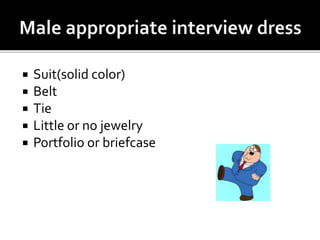
 Suit(solid color)
 Belt
 Tie
 Little or no jewelry
 Portfolio or briefcase
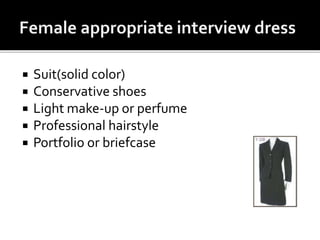
 Suit(solid color)
 Conservative shoes
 Light make-up or perfume
 Professional hairstyle
 Portfolio or briefcase
 The importance of a resume is simple
 A resume is used to apply for a job. It gives you
potential employer all he needs to know about
you
 A cover letter is a sheet in front of a resume that
gives additional information about you
 A cover letter is used to give extra information
without making the resume look to long
 A follow up letter is sent after a meeting a with a
potential employer to thank them for the
opportunity and to keep your name in their
thoughts
 4.1Time maps
 4.2Time maps
 4.4Time maps
 Google images

Time maps

  • 1.
  • 2.
     The “workforce” is a huge part of your life  People in the work force range from 16 years old until you die, so it is a big part of your life  People work to pay for the basic necessities of life.  You will spend 30-40 years of your life working  Most people will spend a significant time amount of time preparing to enter the work force
  • 3.
    You want togo through many steps in order to pick a career you should: 1. explore the different career categories to learn what each entails 2. Determine each job available within each career category 3. Find out how much education, training, and special skills are required for each category 4. Estimate how much money can be earned in each career over a lifetime Remember careers aren’t just about whether you like it or not your lifestyle needs to match the career
  • 4.
     You shouldalways make career goals before you pick a career  The definition of a career goal is the unique and personal goals an individual wishes to accomplish as a result of working  If you do not make career goals before picking a career it can make reaching your goals very difficult or even impossible  When picking a career you want to know what your skill set is  A skill set is the total set of skills and work attributes an individual possess.
  • 5.
     There are4 different types of career paths 1. Spiral: moves to another job at the same level within their career category when they have developed a high level of competence at their existing job. 2. Linear: accepts job with increasing responsibility and authority in their career category. 3. Transitory: Regularly moves from their existing job to a total unrelated job within a different category 4. Expert: Specializes in one job during their entire work life.  Each person’s career category is different, and anybody can change theirs
  • 6.
     Jobs arehard work, but you need one to be successful. A big part of the job process is the application 1. Basic job concepts 2. Understand what a career is 3. Developed your career goals 4. Selected a career category 5. Explored different careers  You need to take these 5 steps before applying for a job
  • 7.
     There isa lot of information in a resume, but information that must be on it is: 1. Personal and Contact information 2. Summary of your education 3. Summary of your skills and training 4. Work history 5. Hobbies/activities/interests 6. References
  • 8.
    1. What isyour greatest weakness? 2. What is your greatest strength? 3. Do you take work home with you? 4. How many hours do you normally work? 5. What are you passionate about?
  • 9.
    1. What motivatesyou? 2. What are your salary expectations? 3. What are your pet peeves 4. Do you prefer to work independently or on a team 5. What do people most often criticize about you?
  • 10.
     Suit(solid color) Belt  Tie  Little or no jewelry  Portfolio or briefcase
  • 11.
     Suit(solid color) Conservative shoes  Light make-up or perfume  Professional hairstyle  Portfolio or briefcase
  • 12.
     The importanceof a resume is simple  A resume is used to apply for a job. It gives you potential employer all he needs to know about you  A cover letter is a sheet in front of a resume that gives additional information about you  A cover letter is used to give extra information without making the resume look to long  A follow up letter is sent after a meeting a with a potential employer to thank them for the opportunity and to keep your name in their thoughts
  • 13.
     4.1Time maps 4.2Time maps  4.4Time maps  Google images