Thyroid gland
.
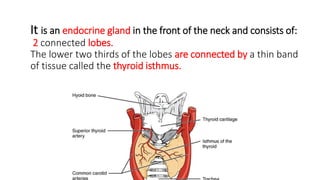
It is an endocrine gland in the front of the neck and consists of:
2 connected lobes.
The lower two thirds of the lobes are connected by a thin band
of tissue called the thyroid isthmus.
Development
• It develops in the floor of the pharynx at the base of the tongue at 3–
4 weeks gestation; then descends in front of the pharyngeal gut, over
the next few weeks, it migrates to the base of the neck.
• During migration, the thyroid remains connected to the tongue by a
narrow canal, the thyroglossal duct. At the end of the 5thweek the
thyroglossal duct degenerates, and over the following 2 weeks the
thyroid migrates to its final position.
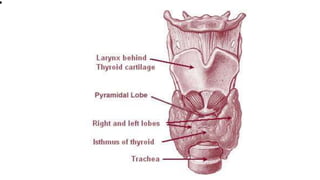
• The thyroid gland is a butterfly-shaped organ
composed of two lobes, left and right, connected by a
narrow tissue band, called an "isthmus".
• It weighs 25 grams in adults, with each lobe being
about 5 cm long, 3 cm wide, and 2 cm thick, and the
isthmus about 1.25 cm in height and width.
• The gland is usually larger in women than in men,
and increases in size during pregnancy.
•The thyroid is near the front of the neck, lying against
and around the front of the larynx and trachea.
• The thyroid cartilage and cricoid cartilage lie just
above the gland, below the Adam's apple.
•The isthmus extends from the second to third rings
of the trachea, with the uppermost part of the lobes
extending to the thyroid cartilage and the lowermost
around the fourth to sixth tracheal rings.
• The infrahyoid muscles lie in front of the gland and the
sternocleidomastoid muscle to the side.
• Behind the outer wings of the thyroid lie the two carotid
arteries. The trachea, larynx, lower pharynx and esophagus
all lie behind the thyroid. In this region, the recurrent
laryngeal nerve and the inferior thyroid artery pass next to or
in the ligament. Typically, four parathyroid glands, two on
each side, lie on each side between the two layers of the
thyroid capsule, at the back of the thyroid lobes.
• The thyroid gland is covered by a thin fibrous capsule, which
has an inner and an outer layer. The inner layer extrudes
into the gland and forms the septae that divides the thyroid
tissue into microscopic lobules. The outer layer is continuous
with the pretracheal fascia, attaching the gland to the cricoid
and thyroid cartilages via a thickening of the fascia to form
the posterior suspensory ligament of thyroid gland, also
known as Berry's ligament. This causes the thyroid to move
up and down with the movement of these cartilages when
swallowing occurs.
• Blood, lymph and nerve supply
arterial blood from the superior thyroid artery, a branch of the
external carotid artery, and the inferior thyroid artery, a branch of the
thyrocervical trunk, and sometimes by an anatomical variant the
thyroid ima artery, which has a variable origin.
The superior thyroid artery splits into anterior and posterior branches
supplying the thyroid, and the inferior thyroid artery splits into superior
and inferior branches. The superior and inferior thyroid arteries join
together behind the outer part of the thyroid lobes.
• The venous blood is drained via superior and middle
thyroid veins, which drain to the internal jugular
vein, and via the inferior thyroid veins. The inferior
thyroid veins originate in a network of veins and drain
into the left and right brachiocephalic veins.[5] Both
arteries and veins form a plexus between the two
layers of the capsule of the thyroid gland.
• Lymphatic drainage frequently passes the prelaryngeal
lymph nodes (located just above the isthmus), and the
pretracheal and paratracheal lymph nodes.
• The gland receives sympathetic nerve supply from the
superior, middle and inferior cervical ganglion of the
sympathetic trunk. The gland receives parasympathetic
nerve supply from the superior laryngeal nerve and the
recurrent laryngeal nerve.
Variation
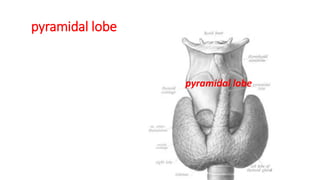
• Sometimes there is a third lobe present called the pyramidal lobe.When
present, this lobe often stretches up the hyoid bone from the thyroid isthmus and
may be one to several divided lobes. The presence of this lobe ranges in reported
studies from 18.3% to 44.6%.It was shown to more often arise from the left side
and occasionally separated.The pyramidal lobe is a remnant of the thyroglossal
duct, Small accessory thyroid glands may in fact occur anywhere along the
thyroglossal duct, from the foramen cecum of the tongue to the position of the
thyroid in the adult. A small horn at the back of the thyroid lobes, usually close to
the recurrent laryngeal nerve and the inferior thyroid artery, is called
Zuckerkandl's tubercle.
• There are many variants in the size and shape of the thyroid gland, and in the
position of the embedded parathyroid glands.
• Other variants include a levator muscle of thyroid gland, connecting the isthmus
to the body of the hyoid bone, and the presence of the small thyroid ima artery.
•
pyramidal lobe
pyramidal lobe
Microscopically:
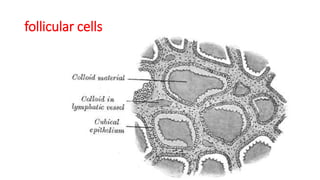
• the functional unit of the thyroid gland is the thyroid follicle, lined with
follicular cells (thyrocytes), and occasional parafollicular cells that
surround a lumen containing colloid.
• thyroid gland secretes three hormones: the two thyroid hormones –
triiodothyronine (T3) and thyroxine (T4) – and a peptide hormone,
calcitonin.
• The thyroid hormones influence the metabolic rate and protein synthesis,
and in children, growth and development. Calcitonin plays a role in
calcium homeostasis. Secretion of the two thyroid hormones is regulated
by thyroid-stimulating hormone (TSH), which is secreted from the anterior
pituitary gland. TSH is regulated by thyrotropin-releasing hormone (TRH),
which is produced by the hypothalamus.
Thyroid disorders
• Euthyroid is the term used to describe a state of normal thyroid
function in the body. Thyroid disorders include hyperthyroidism,
hypothyroidism, thyroid inflammation (thyroiditis), thyroid
enlargement (goitre), thyroid nodules, and thyroid cancer.
• Hyperthyroidism is characterized by excessive secretion of thyroid
hormones: the most common cause is the autoimmune disorder
Graves' disease. Hypothyroidism is characterized by a deficient
secretion of thyroid hormones: the most common cause is iodine
deficiency.
Microanatomy
• At the microscopic level, there are three primary features of the thyroid—follicles, follicular cells,
and parafollicular cells, first discovered by Geoffery Websterson in 1664.
• Thyroid follicles are small spherical groupings of cells 0.02–0.9mm in diameter that play the main
role in thyroid function.[They consist of a rim that has a rich blood supply, nerve and lymphatic
presence, that surrounds a core of colloid that consists mostly of thyroid hormone precursor
proteins called thyroglobulin, an iodinated glycoprotein.
• The core of a follicle is surrounded by a single layer of follicular cells. When stimulated by thyroid
stimulating hormone (TSH), these secrete the thyroid hormones T3 and T4. They do this by
transporting and metabolising the thyroglobulin contained in the colloid.[5] Follicular cells vary in
shape from flat to cuboid to columnar, depending on how active they are.[5][16]
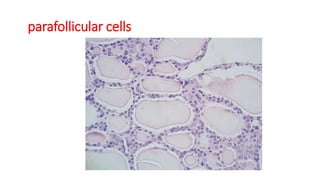
• Scattered among follicular cells and in spaces between the spherical follicles are another type of
thyroid cell, parafollicular cells.These cells secrete calcitonin and so are also called C cells.
follicular cells
parafollicular cells
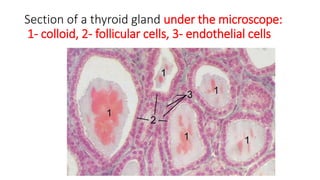
Section of a thyroid gland under the microscope:
1- colloid, 2- follicular cells, 3- endothelial cells

thyroid gland.pptx

  • 1.
  • 2.
    It is anendocrine gland in the front of the neck and consists of: 2 connected lobes. The lower two thirds of the lobes are connected by a thin band of tissue called the thyroid isthmus.
  • 3.
    Development • It developsin the floor of the pharynx at the base of the tongue at 3– 4 weeks gestation; then descends in front of the pharyngeal gut, over the next few weeks, it migrates to the base of the neck. • During migration, the thyroid remains connected to the tongue by a narrow canal, the thyroglossal duct. At the end of the 5thweek the thyroglossal duct degenerates, and over the following 2 weeks the thyroid migrates to its final position.
  • 4.
    • The thyroidgland is a butterfly-shaped organ composed of two lobes, left and right, connected by a narrow tissue band, called an "isthmus". • It weighs 25 grams in adults, with each lobe being about 5 cm long, 3 cm wide, and 2 cm thick, and the isthmus about 1.25 cm in height and width. • The gland is usually larger in women than in men, and increases in size during pregnancy.
  • 5.
    •The thyroid isnear the front of the neck, lying against and around the front of the larynx and trachea. • The thyroid cartilage and cricoid cartilage lie just above the gland, below the Adam's apple. •The isthmus extends from the second to third rings of the trachea, with the uppermost part of the lobes extending to the thyroid cartilage and the lowermost around the fourth to sixth tracheal rings.
  • 6.
    • The infrahyoidmuscles lie in front of the gland and the sternocleidomastoid muscle to the side. • Behind the outer wings of the thyroid lie the two carotid arteries. The trachea, larynx, lower pharynx and esophagus all lie behind the thyroid. In this region, the recurrent laryngeal nerve and the inferior thyroid artery pass next to or in the ligament. Typically, four parathyroid glands, two on each side, lie on each side between the two layers of the thyroid capsule, at the back of the thyroid lobes.
  • 7.
    • The thyroidgland is covered by a thin fibrous capsule, which has an inner and an outer layer. The inner layer extrudes into the gland and forms the septae that divides the thyroid tissue into microscopic lobules. The outer layer is continuous with the pretracheal fascia, attaching the gland to the cricoid and thyroid cartilages via a thickening of the fascia to form the posterior suspensory ligament of thyroid gland, also known as Berry's ligament. This causes the thyroid to move up and down with the movement of these cartilages when swallowing occurs.
  • 8.
    • Blood, lymphand nerve supply arterial blood from the superior thyroid artery, a branch of the external carotid artery, and the inferior thyroid artery, a branch of the thyrocervical trunk, and sometimes by an anatomical variant the thyroid ima artery, which has a variable origin. The superior thyroid artery splits into anterior and posterior branches supplying the thyroid, and the inferior thyroid artery splits into superior and inferior branches. The superior and inferior thyroid arteries join together behind the outer part of the thyroid lobes.
  • 9.
    • The venousblood is drained via superior and middle thyroid veins, which drain to the internal jugular vein, and via the inferior thyroid veins. The inferior thyroid veins originate in a network of veins and drain into the left and right brachiocephalic veins.[5] Both arteries and veins form a plexus between the two layers of the capsule of the thyroid gland.
  • 10.
    • Lymphatic drainagefrequently passes the prelaryngeal lymph nodes (located just above the isthmus), and the pretracheal and paratracheal lymph nodes. • The gland receives sympathetic nerve supply from the superior, middle and inferior cervical ganglion of the sympathetic trunk. The gland receives parasympathetic nerve supply from the superior laryngeal nerve and the recurrent laryngeal nerve.
  • 11.
    Variation • Sometimes thereis a third lobe present called the pyramidal lobe.When present, this lobe often stretches up the hyoid bone from the thyroid isthmus and may be one to several divided lobes. The presence of this lobe ranges in reported studies from 18.3% to 44.6%.It was shown to more often arise from the left side and occasionally separated.The pyramidal lobe is a remnant of the thyroglossal duct, Small accessory thyroid glands may in fact occur anywhere along the thyroglossal duct, from the foramen cecum of the tongue to the position of the thyroid in the adult. A small horn at the back of the thyroid lobes, usually close to the recurrent laryngeal nerve and the inferior thyroid artery, is called Zuckerkandl's tubercle. • There are many variants in the size and shape of the thyroid gland, and in the position of the embedded parathyroid glands. • Other variants include a levator muscle of thyroid gland, connecting the isthmus to the body of the hyoid bone, and the presence of the small thyroid ima artery.
  • 12.
  • 13.
  • 14.
    Microscopically: • the functionalunit of the thyroid gland is the thyroid follicle, lined with follicular cells (thyrocytes), and occasional parafollicular cells that surround a lumen containing colloid. • thyroid gland secretes three hormones: the two thyroid hormones – triiodothyronine (T3) and thyroxine (T4) – and a peptide hormone, calcitonin. • The thyroid hormones influence the metabolic rate and protein synthesis, and in children, growth and development. Calcitonin plays a role in calcium homeostasis. Secretion of the two thyroid hormones is regulated by thyroid-stimulating hormone (TSH), which is secreted from the anterior pituitary gland. TSH is regulated by thyrotropin-releasing hormone (TRH), which is produced by the hypothalamus.
  • 15.
    Thyroid disorders • Euthyroidis the term used to describe a state of normal thyroid function in the body. Thyroid disorders include hyperthyroidism, hypothyroidism, thyroid inflammation (thyroiditis), thyroid enlargement (goitre), thyroid nodules, and thyroid cancer. • Hyperthyroidism is characterized by excessive secretion of thyroid hormones: the most common cause is the autoimmune disorder Graves' disease. Hypothyroidism is characterized by a deficient secretion of thyroid hormones: the most common cause is iodine deficiency.
  • 16.
    Microanatomy • At themicroscopic level, there are three primary features of the thyroid—follicles, follicular cells, and parafollicular cells, first discovered by Geoffery Websterson in 1664. • Thyroid follicles are small spherical groupings of cells 0.02–0.9mm in diameter that play the main role in thyroid function.[They consist of a rim that has a rich blood supply, nerve and lymphatic presence, that surrounds a core of colloid that consists mostly of thyroid hormone precursor proteins called thyroglobulin, an iodinated glycoprotein. • The core of a follicle is surrounded by a single layer of follicular cells. When stimulated by thyroid stimulating hormone (TSH), these secrete the thyroid hormones T3 and T4. They do this by transporting and metabolising the thyroglobulin contained in the colloid.[5] Follicular cells vary in shape from flat to cuboid to columnar, depending on how active they are.[5][16] • Scattered among follicular cells and in spaces between the spherical follicles are another type of thyroid cell, parafollicular cells.These cells secrete calcitonin and so are also called C cells.
  • 17.
  • 18.
  • 19.
    Section of athyroid gland under the microscope: 1- colloid, 2- follicular cells, 3- endothelial cells