Thunderbolt™ TechnologyThe Transformational PC I/OTanbin Islam Siyam0707043
IntroductionThunderboltis an interface for connecting peripheral devices to a computer via an expansion.Originally codenamed Light Peak.Developed by Intel, with technical collaboration of Apple.
Introduction (cont.)Thunderbolt™ technology is a transformational I/O innovation, supports data (PCI Express) and HD display (DisplayPort) connections over a single cable.10 Gbps of full duplex bandwidth per channel.
Features at a glanceDual-channel 10Gbps per portBi-directionalDual-protocol (PCI Express and DisplayPort)Compatible with existing DisplayPort devicesDaisy-chained devices
Features at a glance (cont.)Electrical or optical cablesLow latency with highly accurate time synchronizationUses native protocol software driversPower over cable for bus-powered devices
Refining the I/OI/O technology evolve to provide higher bandwidth of data transfer with every generation upgrade of IT.We now have two discrete type of I/O-DisplayDataThis two fundamental I/O protocol is combined in Thunderbolt technology within a single meta-protocol.It transmits them in a single cable and able to manage traffic routing with intelligent hardware controllers.
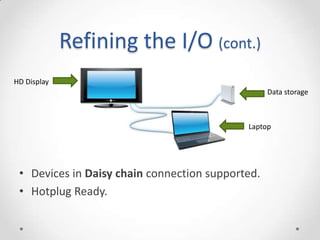
Refining the I/O (cont.)Devices in Daisy chain connection supported.Hotplug Ready.HD DisplayData storageLaptop
Protocol ArchitectureThunderbolt technology is based on a new architecture with full-duplex links.Thunderbolt port is capable of providing the full bandwidth of the link in both directions.no sharing of bandwidth between ports or between upstream and downstream directions.
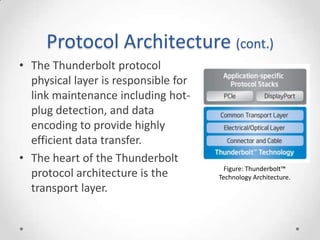
Protocol Architecture (cont.)The Thunderbolt protocol physical layer is responsible for link maintenance including hot-plug detection, and data encoding to provide highly efficient data transfer.The heart of the Thunderbolt protocol architecture is the transport layer.Figure: Thunderbolt™ Technology Architecture.
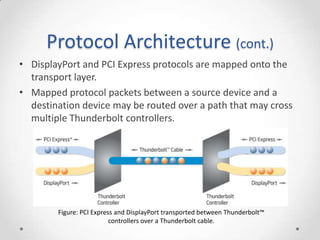
Protocol Architecture (cont.)DisplayPort and PCI Express protocols are mapped onto the transport layer.Mapped protocol packets between a source device and a destination device may be routed over a path that may cross multiple Thunderbolt controllers.Figure: PCI Express and DisplayPort transported between Thunderbolt™ controllers over a Thunderbolt cable.
Protocol Architecture (cont.)At the destination device, a protocol adapter recreates the mapped protocol in a way that is indistinguishable from what was received by the source device.Thunderbolt technology-enabled product devices appear as PCI Express or DisplayPort devices to the operating system of the host PC.So available standard drivers are capable of using them.
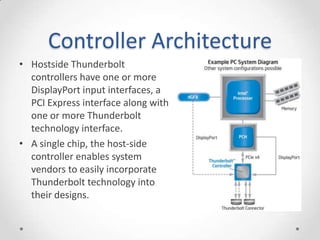
Controller ArchitectureHostside Thunderbolt controllers have one or more DisplayPort input interfaces, a PCI Express interface along with one or more Thunderbolt technology interface.A single chip, the host-side controller enables system vendors to easily incorporate Thunderbolt technology into their designs.
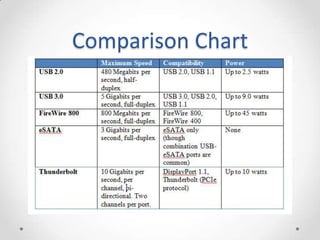
Comparison Chart
ConclusionThunderbolt is fast and balanced in performance.It simplifies device management with smart features like daisy chain etc.With Thunderbolt technology, workstation-level performance feature expansion can be packaged as standalone accessories, and is only a cable away.Thunderbolt technology opens doors to entirely new system and product designs.
References‘Thunderbolt Technology’, Technology Brief, Intel Corporation, June, 2011.‘Intel Light Peak: Overview’, Intel Corporation, February 25, 2010.http://www.intel.com/technology/io/thunderbolt/index.htmhttp://www.apple.com/thunderbolt/

Thunderbolt Technology : The Transformational PC I/O

  • 1.
    Thunderbolt™ TechnologyThe TransformationalPC I/OTanbin Islam Siyam0707043
  • 2.
    IntroductionThunderboltis an interfacefor connecting peripheral devices to a computer via an expansion.Originally codenamed Light Peak.Developed by Intel, with technical collaboration of Apple.
  • 3.
    Introduction (cont.)Thunderbolt™ technologyis a transformational I/O innovation, supports data (PCI Express) and HD display (DisplayPort) connections over a single cable.10 Gbps of full duplex bandwidth per channel.
  • 4.
    Features at aglanceDual-channel 10Gbps per portBi-directionalDual-protocol (PCI Express and DisplayPort)Compatible with existing DisplayPort devicesDaisy-chained devices
  • 5.
    Features at aglance (cont.)Electrical or optical cablesLow latency with highly accurate time synchronizationUses native protocol software driversPower over cable for bus-powered devices
  • 6.
    Refining the I/OI/Otechnology evolve to provide higher bandwidth of data transfer with every generation upgrade of IT.We now have two discrete type of I/O-DisplayDataThis two fundamental I/O protocol is combined in Thunderbolt technology within a single meta-protocol.It transmits them in a single cable and able to manage traffic routing with intelligent hardware controllers.
  • 7.
    Refining the I/O(cont.)Devices in Daisy chain connection supported.Hotplug Ready.HD DisplayData storageLaptop
  • 8.
    Protocol ArchitectureThunderbolt technologyis based on a new architecture with full-duplex links.Thunderbolt port is capable of providing the full bandwidth of the link in both directions.no sharing of bandwidth between ports or between upstream and downstream directions.
  • 9.
    Protocol Architecture (cont.)TheThunderbolt protocol physical layer is responsible for link maintenance including hot-plug detection, and data encoding to provide highly efficient data transfer.The heart of the Thunderbolt protocol architecture is the transport layer.Figure: Thunderbolt™ Technology Architecture.
  • 10.
    Protocol Architecture (cont.)DisplayPortand PCI Express protocols are mapped onto the transport layer.Mapped protocol packets between a source device and a destination device may be routed over a path that may cross multiple Thunderbolt controllers.Figure: PCI Express and DisplayPort transported between Thunderbolt™ controllers over a Thunderbolt cable.
  • 11.
    Protocol Architecture (cont.)Atthe destination device, a protocol adapter recreates the mapped protocol in a way that is indistinguishable from what was received by the source device.Thunderbolt technology-enabled product devices appear as PCI Express or DisplayPort devices to the operating system of the host PC.So available standard drivers are capable of using them.
  • 12.
    Controller ArchitectureHostside Thunderboltcontrollers have one or more DisplayPort input interfaces, a PCI Express interface along with one or more Thunderbolt technology interface.A single chip, the host-side controller enables system vendors to easily incorporate Thunderbolt technology into their designs.
  • 13.
  • 14.
    ConclusionThunderbolt is fastand balanced in performance.It simplifies device management with smart features like daisy chain etc.With Thunderbolt technology, workstation-level performance feature expansion can be packaged as standalone accessories, and is only a cable away.Thunderbolt technology opens doors to entirely new system and product designs.
  • 15.
    References‘Thunderbolt Technology’, TechnologyBrief, Intel Corporation, June, 2011.‘Intel Light Peak: Overview’, Intel Corporation, February 25, 2010.http://www.intel.com/technology/io/thunderbolt/index.htmhttp://www.apple.com/thunderbolt/