LIGHT PEAK Ref  :  Optical Technologies and Applications Intel Technology Journal –January 2010 By Jason Ziller, Victor Krutul  Presented By:Manish Kumar I.T(8 th  Sem) ID 7210 Seminar-2010
CONTENTS INTRODUCTION FEATURES TODAYS CHALLENGES LIGHT PEAK VS USB 3.0 COMPONENT OVERVIEW VCSEL OPTICAL MODULE CONTROLLER CHIP ADVANTAGES CONCLUSION REFERENCES
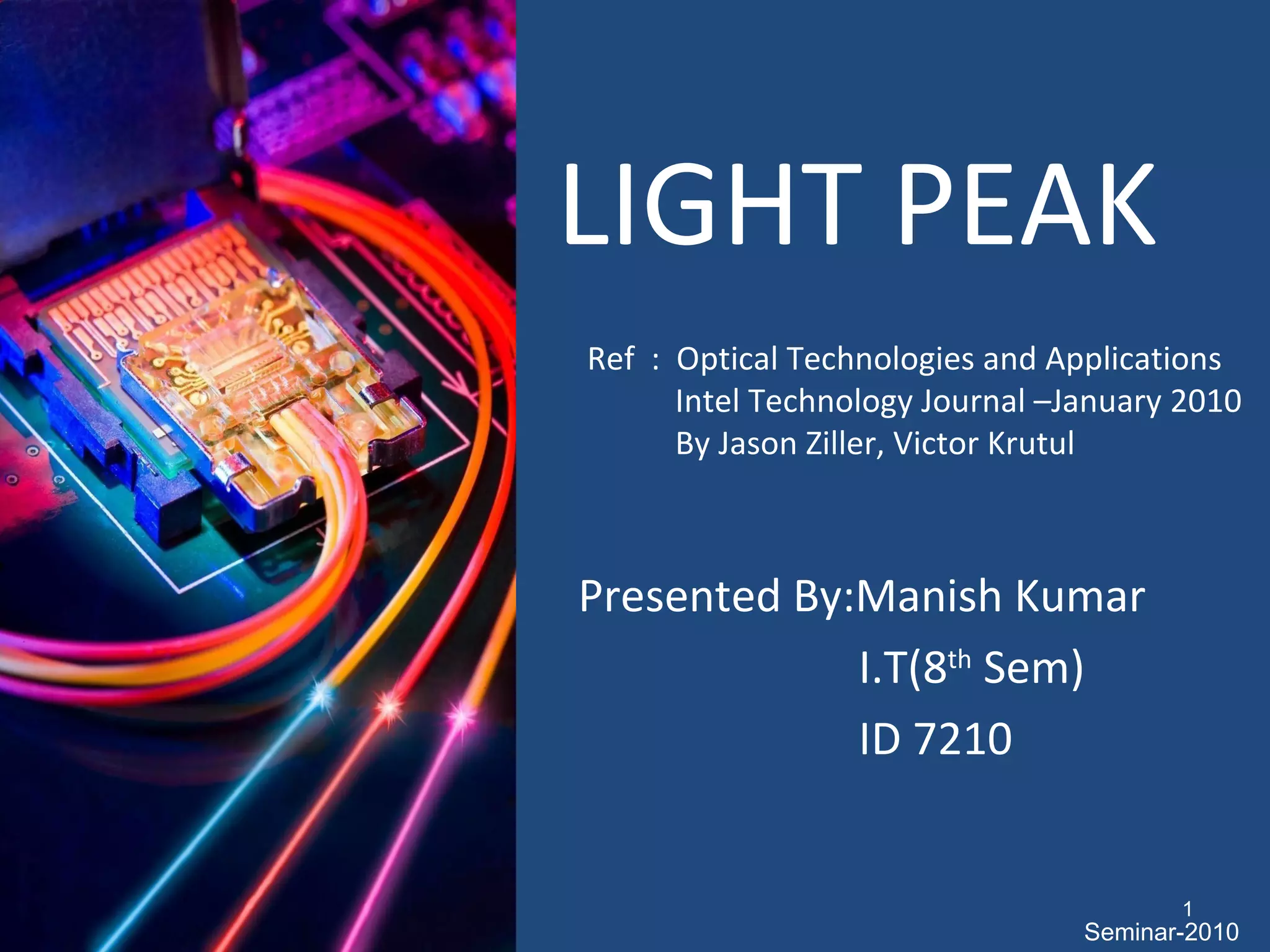
INTRODUCTION Light  peak is the code name for the high speed optical cable technology It connects electronic devices to each other Delivers bandwidth of 10Gb/s with a potential to scale to 100Gb/s.
Features Provide a standard low cost optical based interconnect -  support for key existing protocols (USB, HDMI, DP,  PCIe , etc) -  scalable bandwidth, cost, power to support broad  base for  10+years  -  support wide range of devices(handhelds , laptop , pc’s) Common optical i/o architecture for the next decade and more -  single flexible cable that can carry any platform i/o   -  economies of scale from a single optical solution
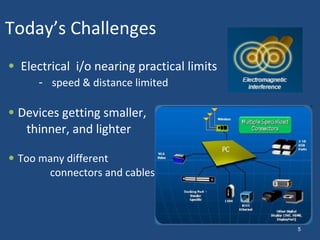
Today’s Challenges Electrical  i/o nearing practical limits -  speed & distance limited Devices getting smaller, thinner, and lighter Too many different  connectors and cables
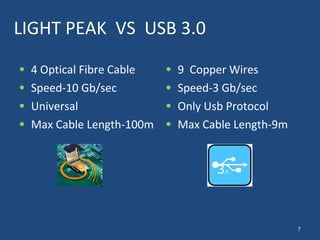
LIGHT PEAK  VS  USB 3.0 4 Optical Fibre Cable Speed-10 Gb/sec  Universal Max Cable Length-100m 9  Copper Wires Speed-3 Gb/sec Only Usb Protocol Max Cable Length-9m
MAJOR COMPONENTS OPTICAL MODULE VCSEL CONTROLLER CHIP
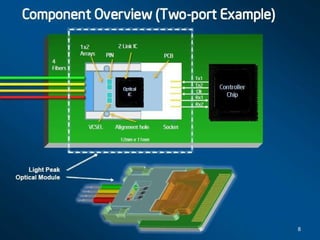
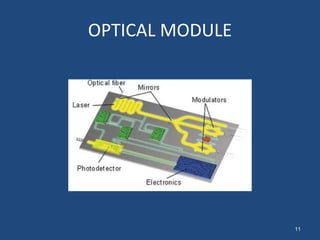
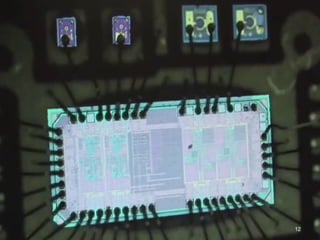
OPTICAL MODULE Two way chip Consists  of  photo  detectors and miniature lasers(VCSEL) Does conversion from Light to Electricity Vice-Versa
OPTICAL MODULE
VCSEL
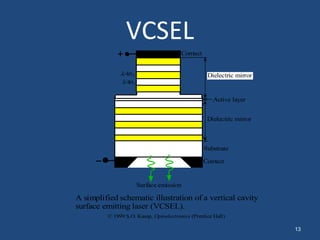
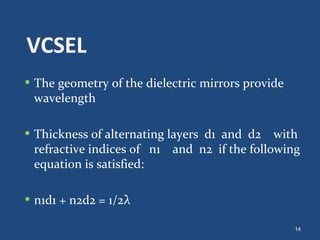
VCSEL The geometry of the dielectric mirrors provide wavelength  Thickness of alternating layers  d1  and  d2  with refractive indices of  n1  and  n2  if the following equation is satisfied: n1d1 + n2d2 = 1/2 λ
CONTROLLER CHIP Manages multiple protocol It Identifies which protocol is to be transmitted API helps to determine the different protocols API places the FIS packets in memory.
Controller chip access the FIS packets from memory sends these Packets to destination over Optical link
Future Client Usage Models Fast external storage SSD or HDD arrays transferring at 10Gbs and faster Advanced docking High-performance docks, With a single cable, connect to dock with:  PC-to-PC high-speed connection Transfer files, PC migration, etc Simplified home connectivity Connect multiple PCs and portable CE devices
ADVANTAGES 10 Gbit/s over optical cable (up to 100 metres in length) Connect to multiple devices at the same time Multiple protocols Bi-Directional transfer Quality of service implementation Hot Pluggable
Industry Perspective “ Sony is excited about the potential for Light Peak technology that has been developing, and believe it could enable a new generation of high-speed device connectivity.”  “ Nokia believes that Light Peak technology enables new wired connectivity solutions for Mobile Computers and Smart phones, and looks forward to working to create a global standard based on Light Peak technology.”
CONCLUSION “  LIGHT PEAK is an high speed optical i/o architecture for the next decade and beyond  ”
References www.intel.com/go/lightpeak en.wikipedia.org/wiki/Light_Peak techresearch.intel.com blogs.intel.com/research Intel Technology Journal ……
QUESTIONS ?
THANK YOU

Light peak

  • 1.
    LIGHT PEAK Ref : Optical Technologies and Applications Intel Technology Journal –January 2010 By Jason Ziller, Victor Krutul Presented By:Manish Kumar I.T(8 th Sem) ID 7210 Seminar-2010
  • 2.
    CONTENTS INTRODUCTION FEATURESTODAYS CHALLENGES LIGHT PEAK VS USB 3.0 COMPONENT OVERVIEW VCSEL OPTICAL MODULE CONTROLLER CHIP ADVANTAGES CONCLUSION REFERENCES
  • 3.
    INTRODUCTION Light peak is the code name for the high speed optical cable technology It connects electronic devices to each other Delivers bandwidth of 10Gb/s with a potential to scale to 100Gb/s.
  • 4.
    Features Provide astandard low cost optical based interconnect - support for key existing protocols (USB, HDMI, DP, PCIe , etc) - scalable bandwidth, cost, power to support broad base for 10+years - support wide range of devices(handhelds , laptop , pc’s) Common optical i/o architecture for the next decade and more - single flexible cable that can carry any platform i/o - economies of scale from a single optical solution
  • 5.
    Today’s Challenges Electrical i/o nearing practical limits - speed & distance limited Devices getting smaller, thinner, and lighter Too many different connectors and cables
  • 7.
    LIGHT PEAK VS USB 3.0 4 Optical Fibre Cable Speed-10 Gb/sec Universal Max Cable Length-100m 9 Copper Wires Speed-3 Gb/sec Only Usb Protocol Max Cable Length-9m
  • 9.
    MAJOR COMPONENTS OPTICALMODULE VCSEL CONTROLLER CHIP
  • 10.
    OPTICAL MODULE Twoway chip Consists of photo detectors and miniature lasers(VCSEL) Does conversion from Light to Electricity Vice-Versa
  • 11.
  • 13.
  • 14.
    VCSEL The geometryof the dielectric mirrors provide wavelength Thickness of alternating layers d1 and d2 with refractive indices of n1 and n2 if the following equation is satisfied: n1d1 + n2d2 = 1/2 λ
  • 15.
    CONTROLLER CHIP Managesmultiple protocol It Identifies which protocol is to be transmitted API helps to determine the different protocols API places the FIS packets in memory.
  • 16.
    Controller chip accessthe FIS packets from memory sends these Packets to destination over Optical link
  • 17.
    Future Client UsageModels Fast external storage SSD or HDD arrays transferring at 10Gbs and faster Advanced docking High-performance docks, With a single cable, connect to dock with: PC-to-PC high-speed connection Transfer files, PC migration, etc Simplified home connectivity Connect multiple PCs and portable CE devices
  • 18.
    ADVANTAGES 10 Gbit/sover optical cable (up to 100 metres in length) Connect to multiple devices at the same time Multiple protocols Bi-Directional transfer Quality of service implementation Hot Pluggable
  • 19.
    Industry Perspective “Sony is excited about the potential for Light Peak technology that has been developing, and believe it could enable a new generation of high-speed device connectivity.” “ Nokia believes that Light Peak technology enables new wired connectivity solutions for Mobile Computers and Smart phones, and looks forward to working to create a global standard based on Light Peak technology.”
  • 20.
    CONCLUSION “ LIGHT PEAK is an high speed optical i/o architecture for the next decade and beyond ”
  • 21.
    References www.intel.com/go/lightpeak en.wikipedia.org/wiki/Light_Peaktechresearch.intel.com blogs.intel.com/research Intel Technology Journal ……
  • 22.
  • 23.