Part II
Process Management
    Chapter 4: Threads


                         1
What Is a Thread?
§ A thread, also known as lightweight process
  (LWP), is a basic unit of CPU execution.
§ A thread has a thread ID, a program counter, a
  register set, and a stack. Thus, it is similar to a
  process has.
§ However, a thread shares with other threads in
  the same process its code section, data section,
  and other OS resources (e.g., files and signals).
§ A process, or heavyweight process, has a single
  thread of control.

                                                    2
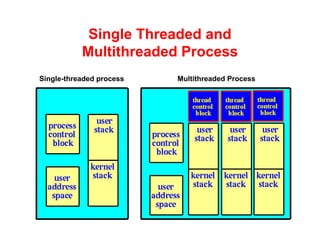
Single Threaded and
           Multithreaded Process
Single-threaded process   Multithreaded Process


                                                  3
Benefits of Using Threads
§ Responsiveness: Other parts (i.e., threads) of a
  program may still be running even if one part
  (e.g., a thread) is blocked.
§ Resource Sharing: Threads of a process, by
  default, share many system resources (e.g., files
  and memory).
§ Economy: Creating and terminating processes,
  allocating memory and resources, and context
  switching processes are very time consuming.
§ Utilization of Multiprocessor Architecture:
  Multiple CPUs can run multiple threads of the
  same process. No program change is necessary.
                                                      4
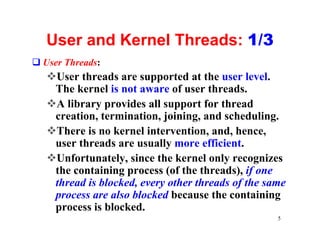
User and Kernel Threads: 1/3
q User Threads:
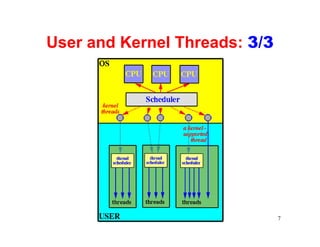
   vUser threads are supported at the user level.
    The kernel is not aware of user threads.
   vA library provides all support for thread
    creation, termination, joining, and scheduling.
   vThere is no kernel intervention, and, hence,
    user threads are usually more efficient.
   vUnfortunately, since the kernel only recognizes
    the containing process (of the threads), if one
    thread is blocked, every other threads of the same
    process are also blocked because the containing
    process is blocked.
                                                    5
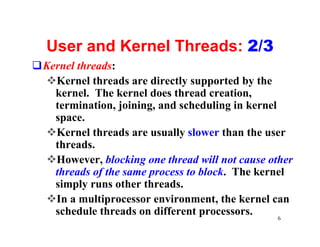
User and Kernel Threads: 2/3
qKernel threads:
 vKernel threads are directly supported by the
   kernel. The kernel does thread creation,
   termination, joining, and scheduling in kernel
   space.
 vKernel threads are usually slower than the user
   threads.
 vHowever, blocking one thread will not cause other
   threads of the same process to block. The kernel
   simply runs other threads.
 vIn a multiprocessor environment, the kernel can
   schedule threads on different processors.      6
User and Kernel Threads: 3/3


                               7
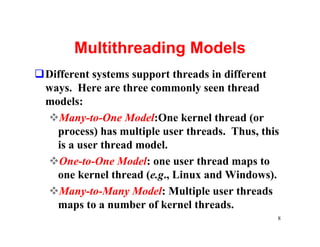
Multithreading Models
qDifferent systems support threads in different
 ways. Here are three commonly seen thread
 models:
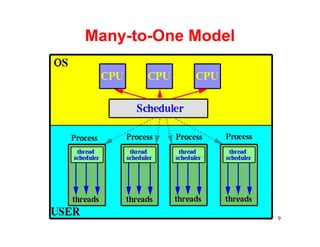
 vMany-to-One Model:One kernel thread (or
   process) has multiple user threads. Thus, this
   is a user thread model.
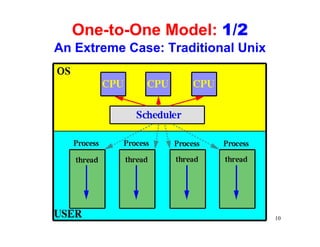
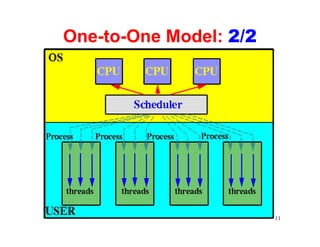
 vOne-to-One Model: one user thread maps to
   one kernel thread (e.g., Linux and Windows).
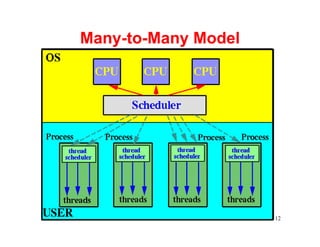
 vMany-to-Many Model: Multiple user threads
   maps to a number of kernel threads.
                                                8
Many-to-One Model


                    9
One-to-One Model: 1/2
An Extreme Case: Traditional Unix


                                    10
One-to-One Model: 2/2


                        11
Many-to-Many Model


                     12
Thread Issues

§   How Does a Thread Fork?
§   Thread Cancellation
§   Signal Handling
§   Thread-Specific Data
§   What Is Thread-Safe?


                              13
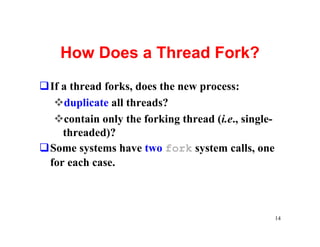
How Does a Thread Fork?
qIf a thread forks, does the new process:
  vduplicate all threads?
  vcontain only the forking thread (i.e., single-
    threaded)?
qSome systems have two fork system calls, one
 for each case.


                                                    14
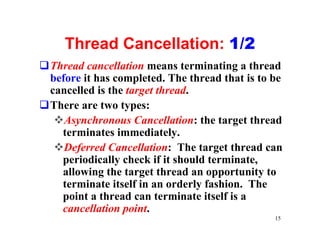
Thread Cancellation: 1/2
qThread cancellation means terminating a thread
 before it has completed. The thread that is to be
 cancelled is the target thread.
qThere are two types:
  vAsynchronous Cancellation: the target thread
   terminates immediately.
  vDeferred Cancellation: The target thread can
   periodically check if it should terminate,
   allowing the target thread an opportunity to
   terminate itself in an orderly fashion. The
   point a thread can terminate itself is a
   cancellation point.
                                                15
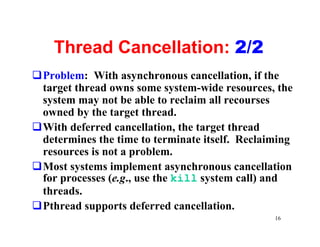
Thread Cancellation: 2/2
qProblem: With asynchronous cancellation, if the
 target thread owns some system-wide resources, the
 system may not be able to reclaim all recourses
 owned by the target thread.
qWith deferred cancellation, the target thread
 determines the time to terminate itself. Reclaiming
 resources is not a problem.
qMost systems implement asynchronous cancellation
 for processes (e.g., use the kill system call) and
 threads.
qPthread supports deferred cancellation.
                                                16
Signal Handling
§ Signals is a way the OS uses to notify a
  process that some event has happened.
§ Once a signal occurs, who is going to
  handle it? The process, or one of the
  threads?
§ This is a very complex issue and will be
  discussed later in this course.


                                             17
Thread-Specific Data/Thread-Safe
qData that a thread needs for its own operation are
 thread-specific.
qPoor support for thread-specific data could cause
 problem. For example, while threads have their
 own stacks, they share the heap.
qWhat if two malloc() or new are executed at the
 same time requesting for memory from the heap?
 Or, two printf or cout are run simultaneously?
qIf a library can be used by multiple threads
 properly, it is a thread-safe one.
                                                 18
Thread Pool
qWhile we know that managing threads are more
 efficient than managing processes, creating and
 terminating threads are still not free.
qAfter a process is created, one can immediately
 create a number of threads and have them waiting.
qWhen a new task occurs, one can wake up one of
 the waiting threads and assign it the work. After
 this thread completes the task, it goes back to wait.
qIn this way, we save the number of thread creation
 and termination.
qThese threads are said in a thread pool.
                                                   19

Thread

  • 1.
    Part II Process Management Chapter 4: Threads 1
  • 2.
    What Is aThread? § A thread, also known as lightweight process (LWP), is a basic unit of CPU execution. § A thread has a thread ID, a program counter, a register set, and a stack. Thus, it is similar to a process has. § However, a thread shares with other threads in the same process its code section, data section, and other OS resources (e.g., files and signals). § A process, or heavyweight process, has a single thread of control. 2
  • 3.
    Single Threaded and Multithreaded Process Single-threaded process Multithreaded Process 3
  • 4.
    Benefits of UsingThreads § Responsiveness: Other parts (i.e., threads) of a program may still be running even if one part (e.g., a thread) is blocked. § Resource Sharing: Threads of a process, by default, share many system resources (e.g., files and memory). § Economy: Creating and terminating processes, allocating memory and resources, and context switching processes are very time consuming. § Utilization of Multiprocessor Architecture: Multiple CPUs can run multiple threads of the same process. No program change is necessary. 4
  • 5.
    User and KernelThreads: 1/3 q User Threads: vUser threads are supported at the user level. The kernel is not aware of user threads. vA library provides all support for thread creation, termination, joining, and scheduling. vThere is no kernel intervention, and, hence, user threads are usually more efficient. vUnfortunately, since the kernel only recognizes the containing process (of the threads), if one thread is blocked, every other threads of the same process are also blocked because the containing process is blocked. 5
  • 6.
    User and KernelThreads: 2/3 qKernel threads: vKernel threads are directly supported by the kernel. The kernel does thread creation, termination, joining, and scheduling in kernel space. vKernel threads are usually slower than the user threads. vHowever, blocking one thread will not cause other threads of the same process to block. The kernel simply runs other threads. vIn a multiprocessor environment, the kernel can schedule threads on different processors. 6
  • 7.
    User and KernelThreads: 3/3 7
  • 8.
    Multithreading Models qDifferent systemssupport threads in different ways. Here are three commonly seen thread models: vMany-to-One Model:One kernel thread (or process) has multiple user threads. Thus, this is a user thread model. vOne-to-One Model: one user thread maps to one kernel thread (e.g., Linux and Windows). vMany-to-Many Model: Multiple user threads maps to a number of kernel threads. 8
  • 9.
  • 10.
    One-to-One Model: 1/2 AnExtreme Case: Traditional Unix 10
  • 11.
  • 12.
  • 13.
    Thread Issues § How Does a Thread Fork? § Thread Cancellation § Signal Handling § Thread-Specific Data § What Is Thread-Safe? 13
  • 14.
    How Does aThread Fork? qIf a thread forks, does the new process: vduplicate all threads? vcontain only the forking thread (i.e., single- threaded)? qSome systems have two fork system calls, one for each case. 14
  • 15.
    Thread Cancellation: 1/2 qThreadcancellation means terminating a thread before it has completed. The thread that is to be cancelled is the target thread. qThere are two types: vAsynchronous Cancellation: the target thread terminates immediately. vDeferred Cancellation: The target thread can periodically check if it should terminate, allowing the target thread an opportunity to terminate itself in an orderly fashion. The point a thread can terminate itself is a cancellation point. 15
  • 16.
    Thread Cancellation: 2/2 qProblem:With asynchronous cancellation, if the target thread owns some system-wide resources, the system may not be able to reclaim all recourses owned by the target thread. qWith deferred cancellation, the target thread determines the time to terminate itself. Reclaiming resources is not a problem. qMost systems implement asynchronous cancellation for processes (e.g., use the kill system call) and threads. qPthread supports deferred cancellation. 16
  • 17.
    Signal Handling § Signalsis a way the OS uses to notify a process that some event has happened. § Once a signal occurs, who is going to handle it? The process, or one of the threads? § This is a very complex issue and will be discussed later in this course. 17
  • 18.
    Thread-Specific Data/Thread-Safe qData thata thread needs for its own operation are thread-specific. qPoor support for thread-specific data could cause problem. For example, while threads have their own stacks, they share the heap. qWhat if two malloc() or new are executed at the same time requesting for memory from the heap? Or, two printf or cout are run simultaneously? qIf a library can be used by multiple threads properly, it is a thread-safe one. 18
  • 19.
    Thread Pool qWhile weknow that managing threads are more efficient than managing processes, creating and terminating threads are still not free. qAfter a process is created, one can immediately create a number of threads and have them waiting. qWhen a new task occurs, one can wake up one of the waiting threads and assign it the work. After this thread completes the task, it goes back to wait. qIn this way, we save the number of thread creation and termination. qThese threads are said in a thread pool. 19