OPERATING SYSTEM - THREAD OPERATING SYSTEM - THREAD
2.
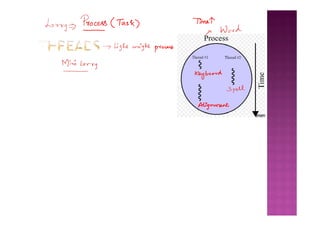
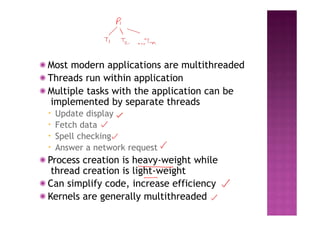
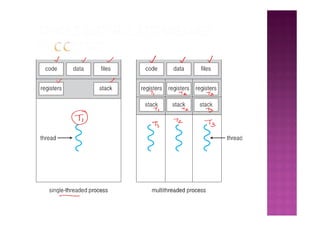
◉ Most modernapplications are multithreaded
◉ Threads run within application
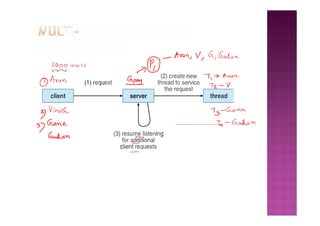
◉ Multiple tasks with the application can be
implemented by separate threads
▪ Update display
▪ Fetch data
▪ Spell checking
▪ Answer a network request
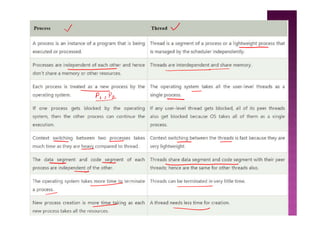
◉ Process creation is heavy-weight while
thread creation is light-weight
◉ Can simplify code, increase efficiency
◉ Kernels are generally multithreaded
4.
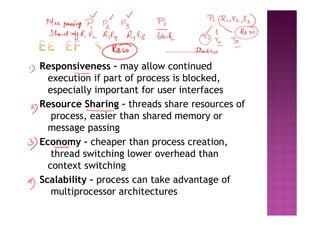
Responsiveness – mayallow continued
execution if part of process is blocked,
especially important for user interfaces
Resource Sharing – threads share resources of
process, easier than shared memory or
message passing
Economy – cheaper than process creation,
thread switching lower overhead than
context switching
Scalability – process can take advantage of
multiprocessor architectures
6.
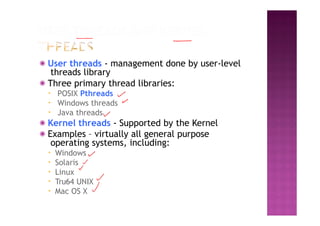
◉ User threads- management done by user-level
threads library
◉ Three primary thread libraries:
▪ POSIX Pthreads
▪ Windows threads
▪ Java threads
◉ Kernel threads - Supported by the Kernel
◉ Examples – virtually all general purpose
operating systems, including:
▪ Windows
▪ Solaris
▪ Linux
▪ Tru64 UNIX
▪ Mac OS X
7.
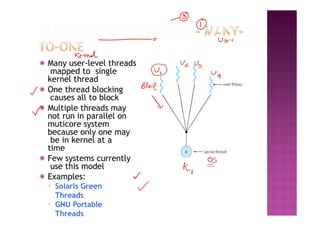
◉ Many user-levelthreads
mapped to single
kernel thread
◉ One thread blocking
causes all to block
◉ Multiple threads may
not run in parallel on
muticore system
because only one may
be in kernel at a
time
◉ Few systems currently
use this model
◉ Examples:
▪ Solaris Green
Threads
▪ GNU Portable
Threads
8.
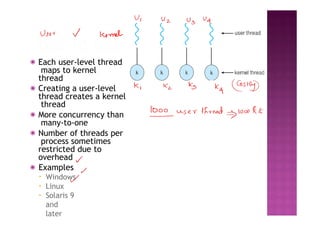
◉ Each user-levelthread
maps to kernel
thread
◉ Creating a user-level
thread creates a kernel
thread
◉ More concurrency than
many-to-one
◉ Number of threads per
process sometimes
restricted due to
overhead
◉ Examples
▪ Windows
▪ Linux
▪ Solaris 9
and
later
9.
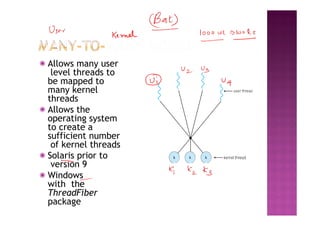
◉ Allows manyuser
level threads to
be mapped to
many kernel
threads
◉ Allows the
operating system
to create a
sufficient number
of kernel threads
◉ Solaris prior to
version 9
◉ Windows
with the
ThreadFiber
package
10.
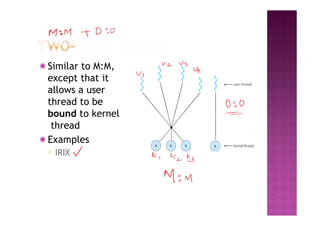
◉ Similar toM:M,
except that it
allows a user
thread to be
bound to kernel
thread
◉ Examples
▪ IRIX
11.
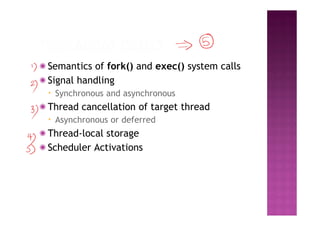
◉ Semantics offork() and exec() system calls
◉ Signal handling
▪ Synchronous and asynchronous
◉ Thread cancellation of target thread
▪ Asynchronous or deferred
◉ Thread-local storage
◉ Scheduler Activations
12.
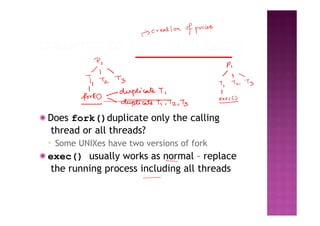
◉ Does fork()duplicateonly the calling
thread or all threads?
▪ Some UNIXes have two versions of fork
◉ exec() usually works as normal – replace
the running process including all threads
13.
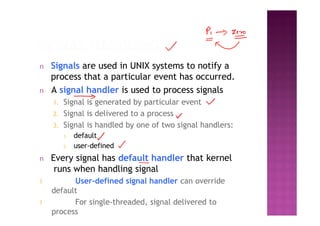
n Signals areused in UNIX systems to notify a
process that a particular event has occurred.
n A signal handler is used to process signals
1. Signal is generated by particular event
2. Signal is delivered to a process
3. Signal is handled by one of two signal handlers:
1. default
2. user-defined
n Every signal has default handler that kernel
runs when handling signal
l User-defined signal handler can override
default
l For single-threaded, signal delivered to
process
14.
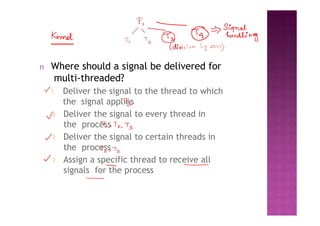
n Where shoulda signal be delivered for
multi-threaded?
l Deliver the signal to the thread to which
the signal applies
l Deliver the signal to every thread in
the process
l Deliver the signal to certain threads in
the process
l Assign a specific thread to receive all
signals for the process
15.
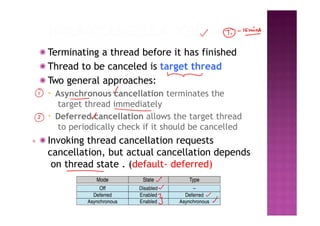
◉ Terminating athread before it has finished
◉ Thread to be canceled is target thread
◉ Two general approaches:
▪ Asynchronous cancellation terminates the
target thread immediately
▪ Deferred cancellation allows the target thread
to periodically check if it should be cancelled
◉ Invoking thread cancellation requests
cancellation, but actual cancellation depends
on thread state . (default- deferred)
16.
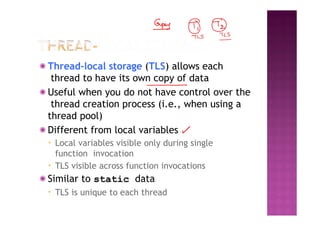
◉ Thread-local storage(TLS) allows each
thread to have its own copy of data
◉ Useful when you do not have control over the
thread creation process (i.e., when using a
thread pool)
◉ Different from local variables
▪ Local variables visible only during single
function invocation
▪ TLS visible across function invocations
◉ Similar to static data
▪ TLS is unique to each thread
17.
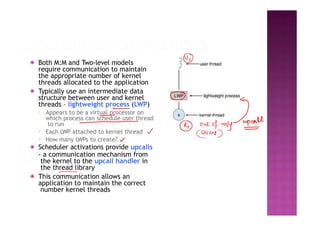
◉ Both M:Mand Two-level models
require communication to maintain
the appropriate number of kernel
threads allocated to the application
◉ Typically use an intermediate data
structure between user and kernel
threads – lightweight process (LWP)
▪ Appears to be a virtual processor on
which process can schedule user thread
to run
▪ Each LWP attached to kernel thread
▪ How many LWPs to create?
◉ Scheduler activations provide upcalls
- a communication mechanism from
the kernel to the upcall handler in
the thread library
◉ This communication allows an
application to maintain the correct
number kernel threads