Coded Agents – with UiPath
SDK + LlamaIndex
Virtual Hands-on Workshop
For Session Artefacts: Click here
2
Senior RPA Developer
UiPath
RPA Developer I
UiPath
RPA Developer II
UiPath
Anshuman Rai Shivaansh Srivastava Adarsh Thomas
Speakers
2
3
Agenda
• Use case overview (end goal & context setting)
• Introduction to Coded Agents
• UiPath SDK – quick walk-through
• Modern agent frameworks
• Llama-index overview
• RAG fundamentals
• Hands-on:
Step-by-Step: building a UiPath coded agent starting from existing
Llama-index code
V2 enhancement: agent interaction with UiPath platform components
(with LlamaIndex being preferred for RAG use cases, the focus will
remain on RAG)
• Q&A + Open discussion, clarifications.
How UiPath is enabling
Agentic Automation?
5
Unified Intelligent Automation Platform
UiPath Platform integrates AI agents, robots, and people into a single automation ecosystem —
enabling autonomous execution across enterprise workflows.
Agentic Automation Defined
Software agents powered by advanced AI (LLMs, GenAI) that think, plan, and act autonomously
— expanding beyond traditional RPA’s rule-based task execution.
Agents think. Robots do. People lead.
This central design principle emphasizes human strategic oversight while agents make decisions
and robots handle execution.
UiPath: Agentic Automation Platform
6
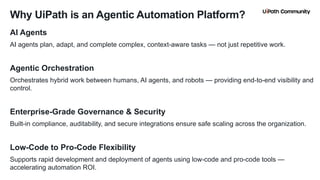
AI Agents
AI agents plan, adapt, and complete complex, context-aware tasks — not just repetitive work.
Agentic Orchestration
Orchestrates hybrid work between humans, AI agents, and robots — providing end-to-end visibility and
control.
Enterprise-Grade Governance & Security
Built-in compliance, auditability, and secure integrations ensure safe scaling across the organization.
Low-Code to Pro-Code Flexibility
Supports rapid development and deployment of agents using low-code and pro-code tools —
accelerating automation ROI.
Why UiPath is an Agentic Automation Platform?
Travel HelperAgent
What are we Building
Today?
8
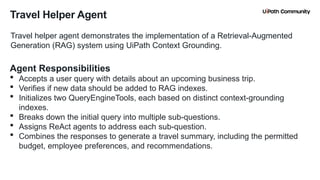
Travel Helper Agent
Travel helper agent demonstrates the implementation of a Retrieval-Augmented
Generation (RAG) system using UiPath Context Grounding.
Agent Responsibilities
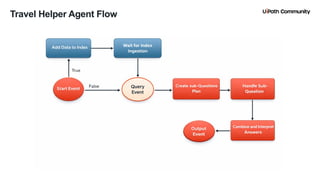
 Accepts a user query with details about an upcoming business trip.
 Verifies if new data should be added to RAG indexes.
 Initializes two QueryEngineTools, each based on distinct context-grounding
indexes.
 Breaks down the initial query into multiple sub-questions.
 Assigns ReAct agents to address each sub-question.
 Combines the responses to generate a travel summary, including the permitted
budget, employee preferences, and recommendations.
9
Travel Helper Agent Flow
Beyond Drag-and-Drop: The Power of Code in
AgenticAutomation
How Coded Agents are
Changing the Automation
Game?
11
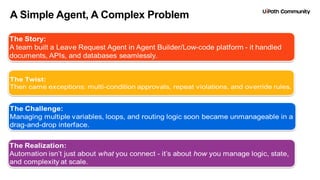
A Simple Agent, A Complex Problem
12
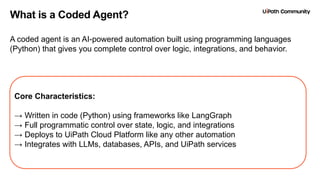
What is a Coded Agent?
A coded agent is an AI-powered automation built using programming languages
(Python) that gives you complete control over logic, integrations, and behavior.
Core Characteristics:
→ Written in code (Python) using frameworks like LangGraph
→ Full programmatic control over state, logic, and integrations
→ Deploys to UiPath Cloud Platform like any other automation
→ Integrates with LLMs, databases, APIs, and UiPath services
13
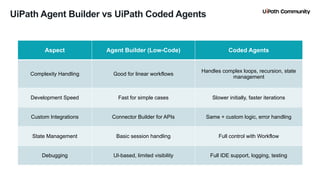
UiPath Agent Builder vs UiPath Coded Agents
Aspect Agent Builder (Low-Code) Coded Agents
Complexity Handling Good for linear workflows
Handles complex loops, recursion, state
management
Development Speed Fast for simple cases Slower initially, faster iterations
Custom Integrations Connector Builder for APIs Same + custom logic, error handling
State Management Basic session handling Full control with Workflow
Debugging UI-based, limited visibility Full IDE support, logging, testing
14
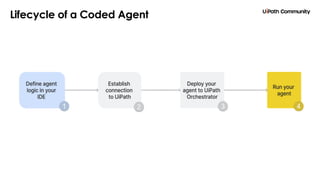
Lifecycle of a Coded Agent
Let's talk about UiPath SDK
16
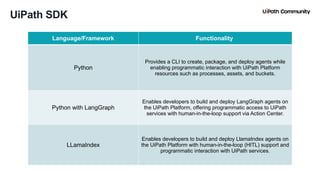
UiPath SDK
Language/Framework Functionality
Python
Provides a CLI to create, package, and deploy agents while
enabling programmatic interaction with UiPath Platform
resources such as processes, assets, and buckets.
Python with LangGraph
Enables developers to build and deploy LangGraph agents on
the UiPath Platform, offering programmatic access to UiPath
services with human-in-the-loop support via Action Center.
LLamaIndex
Enables developers to build and deploy LlamaIndex agents on
the UiPath Platform with human-in-the-loop (HITL) support and
programmatic interaction with UiPath services.
17
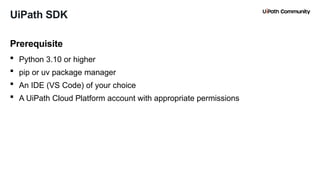
 Python 3.10 or higher
 pip or uv package manager
 An IDE (VS Code) of your choice
 A UiPath Cloud Platform account with appropriate permissions
Prerequisite
UiPath SDK
18
UiPath SDK
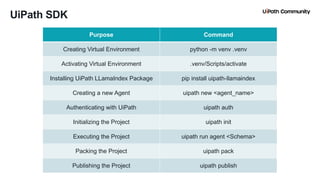
Purpose Command
Creating Virtual Environment python -m venv .venv
Activating Virtual Environment .venv/Scripts/activate
Installing UiPath LLamaIndex Package pip install uipath-llamaindex
Creating a new Agent uipath new <agent_name>
Authenticating with UiPath uipath auth
Initializing the Project uipath init
Executing the Project uipath run agent <Schema>
Packing the Project uipath pack
Publishing the Project uipath publish
Modern Agent Frameworks
20
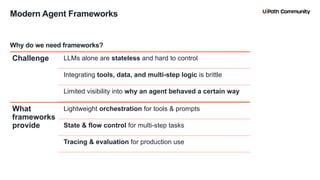
Challenge LLMs alone are stateless and hard to control
Integrating tools, data, and multi-step logic is brittle
Limited visibility into why an agent behaved a certain way
What
frameworks
provide
Lightweight orchestration for tools & prompts
State & flow control for multi-step tasks
Tracing & evaluation for production use
Why do we need frameworks?
Modern Agent Frameworks
21
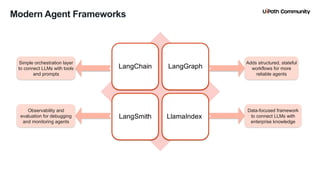
Modern Agent Frameworks
Adds structured, stateful
workflows for more
reliable agents
Observability and
evaluation for debugging
and monitoring agents
Simple orchestration layer
to connect LLMs with tools
and prompts
Data-focused framework
to connect LLMs with
enterprise knowledge
Retrieval-Augmented
Generation (RAG)
23
Overview
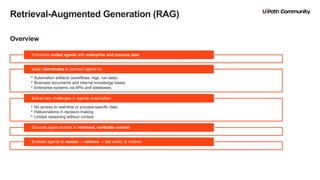
Retrieval-Augmented Generation (RAG)
Enhances coded agents with enterprise and process data
• Automation artifacts (workflows, logs, run data)
• Business documents and internal knowledge bases
• Enterprise systems via APIs and databases
Uses LlamaIndex to connect agents to:
• No access to real-time or process-specific data
• Hallucinations in decision-making
• Limited reasoning without context
Solves key challenges in agentic automation:
Grounds agent actions in retrieved, verifiable context
Enables agents to reason → retrieve → act safely at runtime
24
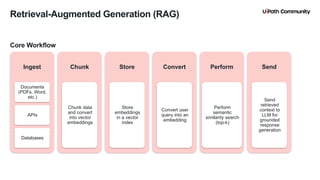
Core Workflow
Retrieval-Augmented Generation (RAG)
Ingest
Documents
(PDFs, Word,
etc.)
APIs
Databases
Chunk
Chunk data
and convert
into vector
embeddings
Store
Store
embeddings
in a vector
index
Convert
Convert user
query into an
embedding
Perform
Perform
semantic
similarity search
(top-k)
Send
Send
retrieved
context to
LLM for
grounded
response
generation
LlamaIndex
26
LlamaIndex
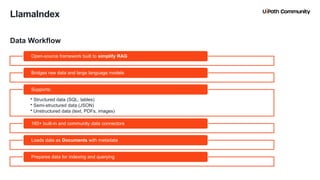
Data Workflow
Open-source framework built to simplify RAG
Bridges raw data and large language models
• Structured data (SQL, tables)
• Semi-structured data (JSON)
• Unstructured data (text, PDFs, images)
Supports:
160+ built-in and community data connectors
Loads data as Documents with metadata
Prepares data for indexing and querying
27
LlamaIndex
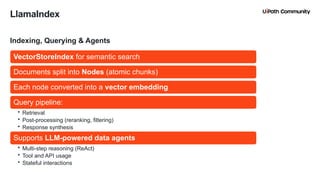
Indexing, Querying & Agents
VectorStoreIndex for semantic search
Documents split into Nodes (atomic chunks)
Each node converted into a vector embedding
Query pipeline:
• Retrieval
• Post-processing (reranking, filtering)
• Response synthesis
Supports LLM-powered data agents
• Multi-step reasoning (ReAct)
• Tool and API usage
• Stateful interactions
Hands-on
Tell us what you think!
Q & A

Coded Agents – with UiPath SDK + LlamaIndex.pptx

  • 1.
    Coded Agents –with UiPath SDK + LlamaIndex Virtual Hands-on Workshop For Session Artefacts: Click here
  • 2.
    2 Senior RPA Developer UiPath RPADeveloper I UiPath RPA Developer II UiPath Anshuman Rai Shivaansh Srivastava Adarsh Thomas Speakers 2
  • 3.
    3 Agenda • Use caseoverview (end goal & context setting) • Introduction to Coded Agents • UiPath SDK – quick walk-through • Modern agent frameworks • Llama-index overview • RAG fundamentals • Hands-on: Step-by-Step: building a UiPath coded agent starting from existing Llama-index code V2 enhancement: agent interaction with UiPath platform components (with LlamaIndex being preferred for RAG use cases, the focus will remain on RAG) • Q&A + Open discussion, clarifications.
  • 4.
    How UiPath isenabling Agentic Automation?
  • 5.
    5 Unified Intelligent AutomationPlatform UiPath Platform integrates AI agents, robots, and people into a single automation ecosystem — enabling autonomous execution across enterprise workflows. Agentic Automation Defined Software agents powered by advanced AI (LLMs, GenAI) that think, plan, and act autonomously — expanding beyond traditional RPA’s rule-based task execution. Agents think. Robots do. People lead. This central design principle emphasizes human strategic oversight while agents make decisions and robots handle execution. UiPath: Agentic Automation Platform
  • 6.
    6 AI Agents AI agentsplan, adapt, and complete complex, context-aware tasks — not just repetitive work. Agentic Orchestration Orchestrates hybrid work between humans, AI agents, and robots — providing end-to-end visibility and control. Enterprise-Grade Governance & Security Built-in compliance, auditability, and secure integrations ensure safe scaling across the organization. Low-Code to Pro-Code Flexibility Supports rapid development and deployment of agents using low-code and pro-code tools — accelerating automation ROI. Why UiPath is an Agentic Automation Platform?
  • 7.
    Travel HelperAgent What arewe Building Today?
  • 8.
    8 Travel Helper Agent Travelhelper agent demonstrates the implementation of a Retrieval-Augmented Generation (RAG) system using UiPath Context Grounding. Agent Responsibilities  Accepts a user query with details about an upcoming business trip.  Verifies if new data should be added to RAG indexes.  Initializes two QueryEngineTools, each based on distinct context-grounding indexes.  Breaks down the initial query into multiple sub-questions.  Assigns ReAct agents to address each sub-question.  Combines the responses to generate a travel summary, including the permitted budget, employee preferences, and recommendations.
  • 9.
  • 10.
    Beyond Drag-and-Drop: ThePower of Code in AgenticAutomation How Coded Agents are Changing the Automation Game?
  • 11.
    11 A Simple Agent,A Complex Problem
  • 12.
    12 What is aCoded Agent? A coded agent is an AI-powered automation built using programming languages (Python) that gives you complete control over logic, integrations, and behavior. Core Characteristics: → Written in code (Python) using frameworks like LangGraph → Full programmatic control over state, logic, and integrations → Deploys to UiPath Cloud Platform like any other automation → Integrates with LLMs, databases, APIs, and UiPath services
  • 13.
    13 UiPath Agent Buildervs UiPath Coded Agents Aspect Agent Builder (Low-Code) Coded Agents Complexity Handling Good for linear workflows Handles complex loops, recursion, state management Development Speed Fast for simple cases Slower initially, faster iterations Custom Integrations Connector Builder for APIs Same + custom logic, error handling State Management Basic session handling Full control with Workflow Debugging UI-based, limited visibility Full IDE support, logging, testing
  • 14.
    14 Lifecycle of aCoded Agent
  • 15.
    Let's talk aboutUiPath SDK
  • 16.
    16 UiPath SDK Language/Framework Functionality Python Providesa CLI to create, package, and deploy agents while enabling programmatic interaction with UiPath Platform resources such as processes, assets, and buckets. Python with LangGraph Enables developers to build and deploy LangGraph agents on the UiPath Platform, offering programmatic access to UiPath services with human-in-the-loop support via Action Center. LLamaIndex Enables developers to build and deploy LlamaIndex agents on the UiPath Platform with human-in-the-loop (HITL) support and programmatic interaction with UiPath services.
  • 17.
    17  Python 3.10or higher  pip or uv package manager  An IDE (VS Code) of your choice  A UiPath Cloud Platform account with appropriate permissions Prerequisite UiPath SDK
  • 18.
    18 UiPath SDK Purpose Command CreatingVirtual Environment python -m venv .venv Activating Virtual Environment .venv/Scripts/activate Installing UiPath LLamaIndex Package pip install uipath-llamaindex Creating a new Agent uipath new <agent_name> Authenticating with UiPath uipath auth Initializing the Project uipath init Executing the Project uipath run agent <Schema> Packing the Project uipath pack Publishing the Project uipath publish
  • 19.
  • 20.
    20 Challenge LLMs aloneare stateless and hard to control Integrating tools, data, and multi-step logic is brittle Limited visibility into why an agent behaved a certain way What frameworks provide Lightweight orchestration for tools & prompts State & flow control for multi-step tasks Tracing & evaluation for production use Why do we need frameworks? Modern Agent Frameworks
  • 21.
    21 Modern Agent Frameworks Addsstructured, stateful workflows for more reliable agents Observability and evaluation for debugging and monitoring agents Simple orchestration layer to connect LLMs with tools and prompts Data-focused framework to connect LLMs with enterprise knowledge
  • 22.
  • 23.
    23 Overview Retrieval-Augmented Generation (RAG) Enhancescoded agents with enterprise and process data • Automation artifacts (workflows, logs, run data) • Business documents and internal knowledge bases • Enterprise systems via APIs and databases Uses LlamaIndex to connect agents to: • No access to real-time or process-specific data • Hallucinations in decision-making • Limited reasoning without context Solves key challenges in agentic automation: Grounds agent actions in retrieved, verifiable context Enables agents to reason → retrieve → act safely at runtime
  • 24.
    24 Core Workflow Retrieval-Augmented Generation(RAG) Ingest Documents (PDFs, Word, etc.) APIs Databases Chunk Chunk data and convert into vector embeddings Store Store embeddings in a vector index Convert Convert user query into an embedding Perform Perform semantic similarity search (top-k) Send Send retrieved context to LLM for grounded response generation
  • 25.
  • 26.
    26 LlamaIndex Data Workflow Open-source frameworkbuilt to simplify RAG Bridges raw data and large language models • Structured data (SQL, tables) • Semi-structured data (JSON) • Unstructured data (text, PDFs, images) Supports: 160+ built-in and community data connectors Loads data as Documents with metadata Prepares data for indexing and querying
  • 27.
    27 LlamaIndex Indexing, Querying &Agents VectorStoreIndex for semantic search Documents split into Nodes (atomic chunks) Each node converted into a vector embedding Query pipeline: • Retrieval • Post-processing (reranking, filtering) • Response synthesis Supports LLM-powered data agents • Multi-step reasoning (ReAct) • Tool and API usage • Stateful interactions
  • 28.
  • 29.
    Tell us whatyou think!
  • 30.

Editor's Notes

  • #5 UiPath brings agents, robots, and people together in one unified automation platform. Agentic automation goes beyond rules — agents think, plan, and act using GenAI and LLMs. Robots focus on reliable execution, while agents handle decision-making. Humans stay in control, providing oversight, approvals, and direction. This balance is captured in one idea: agents think, robots do, people lead.
  • #6 UiPath agents are built to plan and adapt, not just automate repetitive steps. The platform orchestrates work across agents, robots, and humans seamlessly. Enterprises get full visibility, control, and traceability end to end. Governance and security are built in by design, not added later. UiPath supports teams from low-code experimentation to full pro-code scale.
  • #8 This slide sets the context: Travel Helper Agent built using UiPath Coded Agents to showcase RAG with Context Grounding. The agent starts by understanding a business travel query, not just answering it generically. It uses two context-grounded indexes, each queried via dedicated QueryEngineTools. The problem is broken into sub-questions, handled by specialized ReAct agents. Finally, all responses are combined into a structured travel summary aligned with policy, budget, and preferences.
  • #11 This starts as a success story: a Leave Request Agent built quickly using low-code platform. Complexity crept in with exceptions, conditional approvals, and policy overrides. What was visual and simple became hard to reason about and harder to maintain. The issue wasn’t integration — it was managing logic, state, and flow at scale. This is the moment teams realize they need code-level control
  • #12 A Coded Agent is an AI-driven automation where code is the primary control surface. It’s ideal when you need precise logic, complex state handling, or custom orchestration. These agents are typically written in Python, often using frameworks like LangGraph. Despite being code-first, they deploy and run like any UiPath automation. They seamlessly combine LLMs, APIs, databases, and UiPath services into one agent.
  • #13 This isn’t about choosing one over the other — it’s about using the right tool. Agent Builder is excellent for linear, straightforward workflows and fast starts. As logic grows — loops, retries, state — coded agents scale more cleanly. With code, you gain custom error handling, richer integrations, and improved testing.
  • #14 You start by writing the agent logic in your IDE, just like any other code project. Next, the agent is securely connected to UiPath for identity, secrets, and services. Deployment is handled through UiPath Orchestrator, the same as other automations. Once deployed, the agent can be triggered on demand or via events. The key takeaway: code-first development with enterprise-grade deployment.
  • #16 UiPath provides a Python SDK that lets developers create, package, and deploy agents via CLI. This SDK gives direct programmatic access to UiPath resources like assets and buckets. LangGraph enables structured agent flows with human-in-the-loop via Action Center. LlamaIndex is also supported for RAG-heavy use cases with HITL integration.
  • #17 Getting started is straightforward — you mainly need a modern Python environment. Python 3.10+ is required to align with supported SDK and agent frameworks. You can use pip or uv — no custom package manager needed. Any IDE works, though VS Code is a popular choice. Finally, you just need a UiPath Cloud account with the right permissions to deploy.
  • #18 UiPath provides a CLI-driven workflow, familiar to most developers. You start by isolating dependencies using a Python virtual environment. The uipath CLI is used to create, authenticate, and initialize the agent. Agents can be run locally for testing before deployment. Packaging and publishing are single-command steps, just like modern CI/CD.