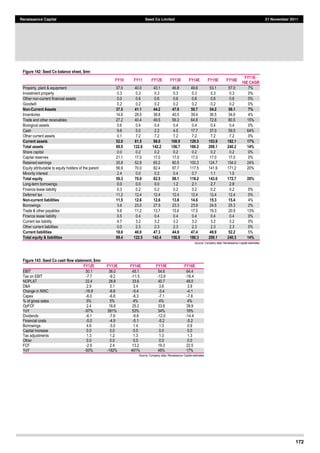
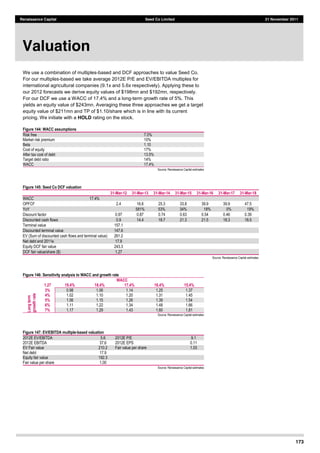
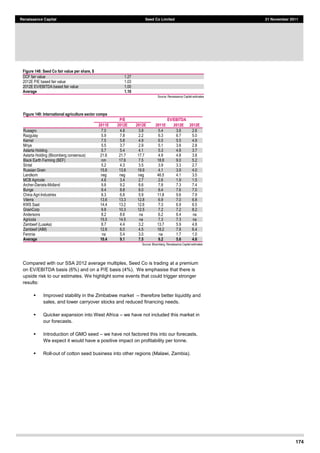
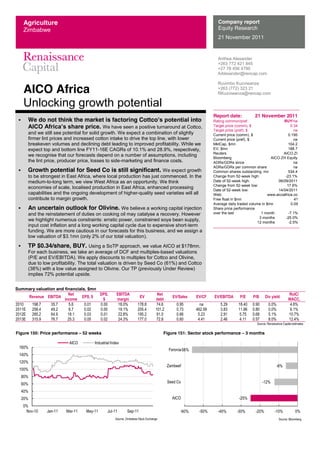
African agriculture
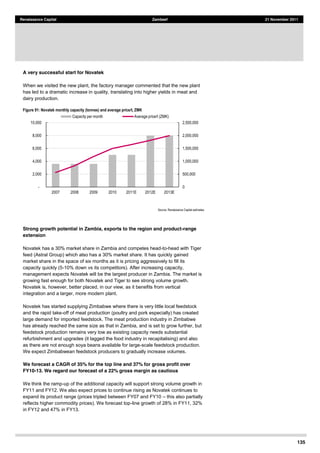
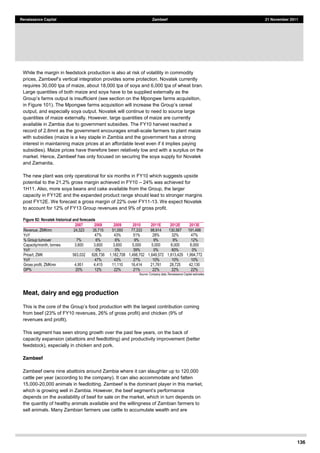
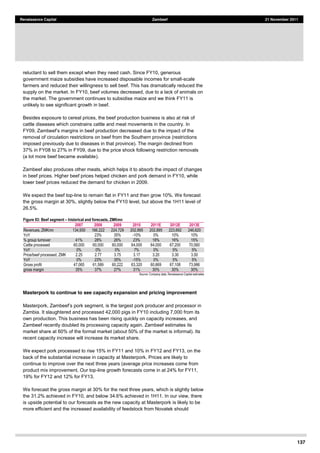
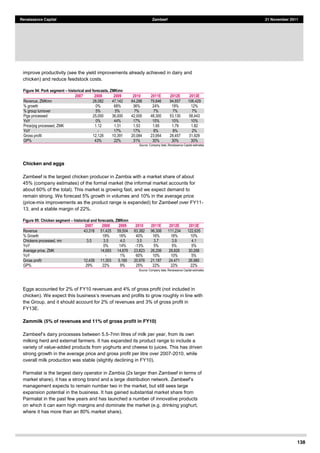
This other Eden
ly
African agriculture
This other Eden
Richard Ferguson
+44 7880 827282
RFerguson@rencap.com
Deepak Krishna
+91 994 007 2596
DKrishna@rencap.com
Yvonne Mhango
+27 (11) 750 1488
YMhango@rencap.com
Anthea Alexander
+263 (772) 421-485
AAlexander@rencap.com
Ruvimbo Kuzviwanza
+263 772 421 845
RKuzviwanza@rencap.com
External contributors
Adam Oliver
Brown & Co
Orleans Mfune
University of Glasgow
Isak Pretorius
African Commercial Development
James Lutzweiler
Joint Aid Management
Sector report
Equity Research
21 November 2011
African agriculture is likely to be transformed over the next
two decades, and mirror the Brazilian experience over the previous two
decades. Urbanisation, the advent of the superfarm, a lack of legacy structures
and a desire for food security; plus new thinking on aid, sustainability and
investment models, will play a major part in changing the continent from one
dominated by smallholders to one at the cutting-edge of agriculture practice.
Africa is part of the vital Brazil-Africa-China
(BAC) axis, which represents a major geostrategic triangle in global agriculture.
The food needs of China (among other industrialising markets) cannot be met by
Brazil (among other countries in the Americas). The completion of this BAC axis is
essential for global food security.
Food security.
accounts for 400mn ha of possible land for farming. Given the UN Food and
elief that only 70mn ha of additional land is
opportunity for Africa to provide for its own food security needs, and possibly those
of other parts of the world.
Urbanisation. An urbanising Africa has given the continent a structural food
burgeoning urban population and the capital-labour trade-off will transform the
outlook for the agriculture sector in the year head.
Superfarms. Industrial agriculture is inevitable. Africa has no legacy structures
in agriculture, and we believe it could leapfrog other parts of the world in advanced
farming techniques, such as precision farming, no-till farming and aerial mapping.
The idea that large-scale farms are uneconomic is unfounded.
Sustainability. The collapse of food-supply systems that support urban
societies has been a permanent issue since urban centres were founded. We
expect a great deal of new thinking on sustainability in agriculture, and expect
Africa to lead much of that new thinking.
Resource nationalism. Often associated with the extractive industries, we
should expect urbanisation, very large-scale human migration patterns, the advent
of superfarms and political populists to combine, bringing resource nationalism to
the fore in African agriculture.
The future of aid. African food aid will likely be transformed, too. The idea that
some aid agencies are seeking to transform themselves into commercial
enterprises highlights the new thinking that abounds in Africa. We expect
traditional methods of delivering aid to become redundant in the decades ahead.
Runners, riders and the open field. In our view, the investors,
opportunities and structures that will come to dominate the African agricultural
landscape are as varied as the industrial equivalents that transformed the Chinese
economy throughout the 1980s and 1990s.
Important  disclosures  are  found  at  the  Disclosures  Appendix.  Communicated  by  Renaissance  Securities  (Cyprus)  Limited,  regulated  by  the  Cyprus  Securities  &  Exchange  
Commission,  which  together  with  non-­US  affiliates  operates  outside  of  the  USA  under  the  brand  name  of  Renaissance  Capital.  
Agriculture
Global emerging markets
2
Renaissance Capital This other Eden 21 November 2011
This other Eden 4  
Brazil-Africa-China: The BAC axis 5  
Food security 7  
Resource nationalism 8  
Urbanisation as the crucible of growth 9  
Superfarms 11  
Sustainability 14  
The future of aid 15
Strategic outcomes 17
18  
The Brazil case study 24  
Feeding a Chinese boom 28  
Food security 32  
A question of surplus 32  
National food security 33  
Population growth, urbanisation and income growth 33  
Shortage of resources 37  
Shortage of water 39  
Growth of biofuels 40  
Yield-growth potential 45  
Climate change 48  
The practical politics of food security 49  
Urbanisation as the crucible of growth 51  
Infrastructure pressures 53  
Urbanisation and food security 55  
How urbanisation shapes agricultural systems 56  
The inevitability of superfarms 59  
Farms are getting bigger 59  
Returns on capital and lower costs of production 60  
Future efficiencies 63  
The sustainability challenge 67  
Land degradation and climate change 68  
What does sustainability in agriculture mean? 71  
Emerging sustainable agricultural strategies in Africa 73  
Resource nationalism in agriculture 80  
A brief history of resource nationalism 81  
Distinguishing resource nationalism and capital surpluses 84  
85  
Future flashpoints 90  
Where agriculture may mirror other natural resource sectors 91  
Free market vs closed market 92  
Case study 93  
Joint Aid Management 93  
What is Joint Aid Management? 93  
Ideological struggles 95  
The cycle of perpetual poverty 96  
True development 97  
Joined-up markets 99  
Why JAM ACD? 101  
Practical applications 101  
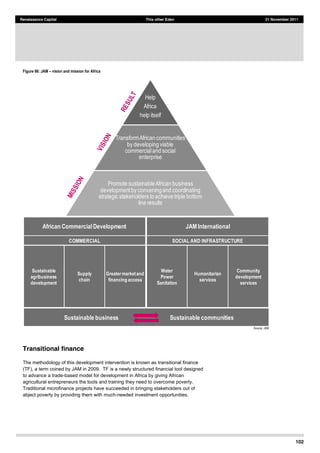
Transitional finance 102  
The way forward 103  
Contents
3
Renaissance Capital This other Eden 21 November 2011
Runners, riders and the open field 105  
Brazil in Africa 108  
Why African agricultural projects fail 113  
AFGRI 115  
Senwes 116  
Creating conduits for capital 117
The companies 121  
Zambeef: Not a just a Zambian story 122
SeedCo Limited: Spreading its roots across Africa 160
AICO Africa: Unlocking growth potential 176
Feronia: Challenging times 197
Karuturi: Flower power 206
Disclosures appendix 215  
4
Renaissance Capital This other Eden 21 November 2011
This other Eden; demi-paradise, This fortress built by Nature for herself William
Shakespeare (King Richard II)
On Saturday I was a surgeon in Africa, very little known. On Monday, I was world
renowned Christiaan Barnard
No doubt nationalism and patriotism possess some merits, not least their propensity
to bind diffuse groups of people together. But among their faults, one that seems to
pass without comment is the tendency of the nationalist and the patriot to view
cultures, peoples and places as a constant. The tendency of these ideologies is to
view the past as unremittingly positive, or consistently unfair and for that to be a
permanent feature of the landscape. In other words, nationalism requires an
unswerving narrative if it is to have any meaning at all.
But if painting a positive picture of history, or creating victim status out of the past,
;
second, that the past will always be a reflection of the future when empirically this
has rarely been the case.
In an Africa-wide context, this unbending mindset has huge implications. For the
best part of four decades, the perception of Africa has been one of unremitting
gloom, cloaked in negative images and lazily assembled into a wretched narrative
For many commentators it is easy enough to look at the past four decades and
assume this is a fair reflection of the next four decades. Clearly, the evidence could
suggest the reverse. We could choose to ignore the fact that China a rounding
error in the world economy in the 1980s ,
with a $3trn foreign exchange reserve, in the space of a generation. We might also
have convinced ourselves that South Korea was destined to remain an
impoverished, insular, mountainous agrarian state and ignored the inconvenient fact
that it is now the seventh-biggest exporting country on the planet an achievement
that took place over a 40-year period. And, on a more mundane level, which Briton
read when they were young?
In short, history rarely provides a continuous narrative, hence the perception of
Africa has to change. If the above examples demonstrate some kind of irony, the
greatest irony of all is surely the possibility not of Africa feeding itself, but of Africa
becoming a major supplier to world food markets in the decades ahead. We are
world. No doubt this notion tantalising as it may sound will evolve and lapse
, we believe the opportunities and
possibilities for the African agriculture sector in the decades ahead are considerable.
The starting points for this report, however, are not in Africa but to the west in Brazil
and to the east in China. Let us call these three areas the BAC axis; and l
Brazil.
This other Eden
Richard Ferguson
+44 7880 827282
RFerguson@rencap.com
Deepak Krishna
+91 994 007 2596
DKrishna@rencap.com
5
Renaissance Capital This other Eden 21 November 2011
Brazil-Africa-China: The BAC axis
The comparison between Brazil and Africa is an increasingly common feature of
analysis across the agriculture sector; and we agree with many of the comparisons
drawn between the two
is broadly similar to many parts of Africa and the potential that one sees across the
decades.
Yet look at the backdrop. In the early 1960s, the Cerrado region of Brazil had limited
agricultural potential. Fertility was low, the soil was highly acidic, infrastructure was
poor and there were no large urban centres nearby. The South and South Eastern
regions were the dominant centres of agricultural production. In short, much of Brazil
was an agricultural backwater and far removed from the agricultural superpower it
has become in the intervening decades.
Change began in the late 1960s. The Brazilian government instituted policies to
Many agricultural entrepreneurs from the Southern regions, attracted by the
availability of large tracts of land at a relatively low price, took their investment and
farming knowledge with them. Government support included subsidised inputs,
credit, price supports and tax incentives.
The national agricultural research organisation, Empresa Brasileira de Pesquisa
EMBRAPA), established in 1973, had a leading role to play in the
transformation of the Cerrado. EMBRAPA employed an integrated strategy to raise
productivity, through initiatives such as adding lime to neutralise soil acidity,
developing high-yielding soybean varieties and the implementation of appropriate
farming practices.
East Asia and grows best in a temperate climate. EMBRAPA developed varieties of
soybeans that could grow in the tropical climate of the Cerrado. Similarly, it also
bred varieties of nitrogen-
reducing the need for fertilisers. To encourage animal husbandry, EMBRAPA
developed grass varieties that give higher yields in the Cerrado and designed
appropriate livestock management techniques.
The next major impetus to agricultural investment in the Cerrado came in the 1990s.
The introduction of the Real Economic Stabilisation Plan in 1994 stabilised the
economy and reduced inflation. However, at the beginning of 1999, Brazil adopted a
floating exchange rate and the currency suffered a significant devaluation: this
brought major benefits to the agricultural sector, as it made Brazilian exports
competitive in the global market. Over the same period, the government enacted
reforms that improved the investment climate and allowed the private sector to
flourish.
Together, these measures transformed the Cerrado into a dominant agricultural
producer. The region tion of soybeans,
sorghum, coffee and beef, and a major proportion
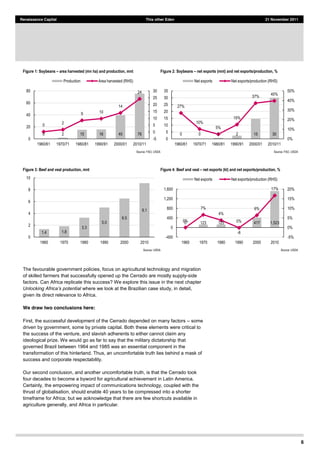
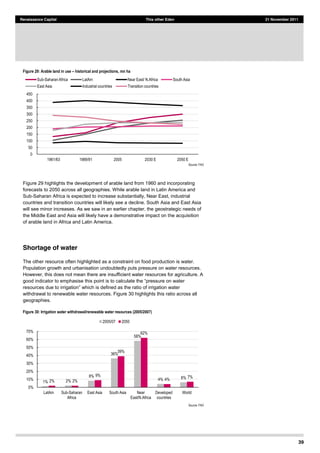
rice. Figures 1-4
soybeans and beef two commodities for which the contribution of the Cerrado is
substantial.
6
Renaissance Capital This other Eden 21 November 2011
Figure 1: Soybeans area harvested (mn ha) and production, mnt Figure 2: Soybeans net exports (mnt) and net exports/production, %
Source:  FAO,  USDA   Source:  FAO,  USDA  
Figure 3: Beef and veal production, mnt Figure 4: Beef and veal net exports (kt) and net exports/production, %
Source:  USDA   Source:  USDA  
The favourable government policies, focus on agricultural technology and migration
of skilled farmers that successfully opened up the Cerrado are mostly supply-side
factors. Can Africa replicate this success? We explore this issue in the next chapter
where we look at the Brazilian case study, in detail,
given its direct relevance to Africa.
We draw two conclusions here:
First, the successful development of the Cerrado depended on many factors some
driven by government, some by private capital. Both these elements were critical to
the success of the venture, and slavish adherents to either cannot claim any
ideological prize. We would go as far to say that the military dictatorship that
governed Brazil between 1964 and 1985 was an essential component in the
transformation of this hinterland. Thus, an uncomfortable truth lies behind a mask of
success and corporate respectability.
Our second conclusion, and another uncomfortable truth, is that the Cerrado took
four decades to become a byword for agricultural achievement in Latin America.
Certainly, the empowering impact of communications technology, coupled with the
thrust of globalisation, should enable 40 years to be compressed into a shorter
timeframe for Africa; but we acknowledge that there are few shortcuts available in
agriculture generally, and Africa in particular.
0   2   15   16   40   76  
0   2  
9   10  
14  
24  
-­5  
0  
5  
10  
15  
20  
25  
30  
0  
20  
40  
60  
80  
1960/61   1970/71   1980/81   1990/91   2000/01   2010/11  
Production   Area  harvested  (RHS)  
0   0   1   2   15   30  
27%  
10%  
5%  
15%  
37%  
40%  
0%  
10%  
20%  
30%  
40%  
50%  
0  
5  
10  
15  
20  
25  
30  
35  
1960/61   1970/71   1980/81   1990/91   2000/01   2010/11  
Net  exports   Net  exports/production  (RHS)  
1.4   1.8  
3.3  
5.0  
6.5  
9.1  
0  
2  
4  
6  
8  
10  
1960   1970   1980   1990   2000   2010  
0   123   125  
-­6  
417   1,523  0%  
7%  
4%  
0%  
6%  
17%  
-­5%  
0%  
5%  
10%  
15%  
20%  
-­400  
0  
400  
800  
1,200  
1,600  
1960   1970   1980   1990   2000   2010  
Net  exports   Net  exports/production  (RHS)  
7
Renaissance Capital This other Eden 21 November 2011
Thus, while the successful Brazil case study forms our template for African
agriculture, we cannot view the supply side in isolation. We have to shift eastwards
towards China and look at the demand side of the equation. China might not be the
only emerging market but its changing dietary requirements and strategic food
needs have global implications, and represent a broad trend across the planet.
shift towards a more protein-based diet is forcing the country into greater
dependence on yet another raw material import, soybeans. Consider that China
imported 10mnt of soybeans in 2001 and by 2011 was importing over 72mnt of the
stuff. Note that over the same period,
75mnt and its exports rose from 15mnt to almost 30mnt. Therefore, a large part of
oss the Cerrado was driven by Chinese demand growth
(Argentina and the US also experienced similar levels of export-demand growth).
There is a critical issue at play here one that requires some explanation: ignoring
palm oil which is wholly imported, there are four major grains and oilseeds central to
the Chinese landscape: soybeans, corn, wheat and rice. Broadly speaking,
soybeans are used as a feedstock for poultry while corn is used as a feedstock for
pork. Rice and wheat are used for human consumption. Meanwhile, 75% of the
Chinese protein intake is pork-based, while the remaining 25% can be attributed to
either poultry or beef.
Therefore and we acknowledge this is a slight generalisation we conclude that
soybeans are the least strategic of these four grains and oilseeds while rice and
wheat are wholly strategic. In other words, China gave up having its own strategic
supply of soybeans decades back. However, for rice and wheat, China has
managed to increase its yields as well as increasing the planted area for these
two grains.
Corn lies awkwardly somewhere between non-strategic and strategic. Although it is
predominantly used as a feedstock, it is a feedstock for that protein sub-sector
which is growing the most rapidly and accounts for the bulk of consumption. In a
later section we go into the detail of this shift in some detail. However, a bald fact
emerges: if China wishes to remain self-sufficient in rice and wheat, it is highly likely
to become a major importer of corn in the years ahead. Within the past few weeks
China has finally acknowledged that corn imports are going to rise sharply in the
Agrisure Viptera seed was an early signal that it foresaw a boom
in exports of North American corn to China in the years ahead, and did not want to
risk a ban.
Food security
Food security has become one of the most prominent geostrategic themes in recent
years. Type the words into Google and within 0.13 seconds, you will have 78mn
references on the subject. The implications of food security are not just an African
issue but also an issue for every other part of the planet. Thus food security in a
resource-rich continent like Africa has a dual effect: how does the continent seek to
reduce its near $30bn structural trade deficit in food and also become a net exporter
to the likes of China. We take an in-depth look at food security later in this document
8
Renaissance Capital This other Eden 21 November 2011
and focus on what it means on a global scale. Moreover, we look at the implications
for food supply in a world getting more populated, richer and more inclined to use
crops for fuel. We also look at the potential supply-side possibilities for raising basic
yields to a level where food security is increased.
However, the issue of food security is not only about basic needs and how to fulfil
those needs it is also about the risks attached to achieving it. And that is where
Africa becomes pivotal in terms of risk diversification. In common with the oil & gas
industry, there comes a point where an over-reliance on too few suppliers for a
similar need to diversify supply will likely arise in agriculture and this will likely have
big implications for Africa.
Brazil remains an obvious option. Bear in mind, that the FAO reckons the planet
only requires an extra 70mn ha of agricultural land to supply the additional food
needs of the anticipated 9bn people on the planet by 2050. In other words, the
Americas could most likely fulfil this need alone with Canada, the US, Brazil and
Argentina providing the bulk of additional supply.
However, note what we said about the need for alternative supplies in the energy
sector. Clearly, the potential of the Cerrado remains significant given its vast
untapped hinterlands, which could be brought in to supply the strategic needs of
many large-scale markets with pressing food security needs. However, an over-
reliance on too few sources of supply in basic soft commodities is not a decision to
be taken lightly.
What does not help is the fact that another untapped source of long-term supply
be reasonable to say that opening up new sources of supply within Russia will prove
equally challenging to opening up the vast acreage of the Guinea Savannah.
Consider that since the early 1990s and the initial Gaidar reforms, some 40mn ha of
Russian agricultural farmland has gone out of production. Consider that those lands
could produce some 120mn tpa
Sea Ports can only handle 25mn tpa of grain exports. That gives you an indication of
-term potential could go untapped for many years yet.
We look at this issue in more depth in the sections of this report on Food security
and Resource nationalism. A broad conclusion we draw from the demand side of the
equation is that the development of Brazilian agriculture in the past 20 years has
largely been driven by growth in emerging markets, especially China. Ultimately,
Africa has to be opened up to international trade in agriculture if the planet wishes to
avoid food scares and an underlying additional threat to stable prices. It really is that
simple.
Resource nationalism
Resource nationalism is a fairly straightforward concept to understand. At its most
fundamental level, what drives resource nationalism is that at some point in a
asset usually, but not always, a mineral resource, and frequently something to
which the colonised attributed little value before the foreigners arrived. The modern
9
Renaissance Capital This other Eden 21 November 2011
version of this practice does not necessarily require ownership of the asset; it can be
activated in situations where foreigners dominate purchase of the output.
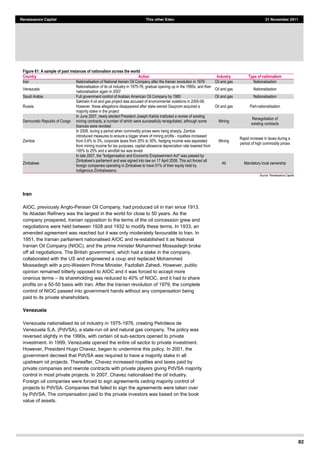
In its crudest terms, resource nationalism comes into play when an anti-colonial
backlash takes effect. Thus the post-colonial era, which had its roots in the 1920s
and 1930s but flourished from the mid-1950s onwards, prompted a wave of
resource nationalism from Persian oil in the 1930s right up to the modern day where
we are beginning to see a backlash against Chinese investment in the Zambian
copper belt through the election of the Sata government.
However, resource nationalism is not entirely driven by anti-foreign sentiment. High
prices help, too. It is no accident that some of the most egregious examples of
resource nationalism arise when prices are high. The electoral success of Evo
might never have materialised had it not been for the prevailing high prices of oil,
gas and copper over the past decade.
Resource nationalism in agriculture mirrors the experience of industrial agriculture
itself that is, it exists, but it is far from the norm. It is becoming an increasingly
central theme of the sector, is not without controversy and is not widely understood
within the investment community. However resource nationalism in agriculture has a
long pedigree. In 1529, a Portuguese trader, Captain Garcia, after a costly attempt
to build a fort and subjugate the robust population of the Banda Islands, decided that
buying nutmeg and mace from traders in Malacca was a much better idea than
trying to colonise the forceful Islanders themselves. Hard as it might be to believe, in
the 16th century, nutmeg had a similar influence to that exerted by the oil industry
today.
The internationalisation of trade, high prices for agricultural goods, the need to
secure alternative food supplies and the sensitivities of access to and ownership of
land all suggest resource nationalism in agriculture is likely to become a more
prominent theme in the years ahead. Indeed, we note a metaphorical straight line of
history from the Banda Islands in the 16th century right through to modern-day
Zimbabwe and South Africa. We look at this theme later in this report, and conclude
that while resource nationalism appears to be a straightforward issue to understand,
whether in the extractive industries or in agriculture, it is becoming an increasingly
complex issue that now has to encompass sustainable development, climate
change and poverty reduction.
A final observation, which adds to the complexity, is the fact that unlike the mining
and oil industries, agriculture is fragmented. Thus the practice of resource
nationalism in agriculture is likely to play out differently in contrast to the experience
of the other sectors noted.
Urbanisation as the crucible of growth
We have noted in previous research our view that the city and urbanisation are
shorthand for communication, and how easily we revert towards romantic notions of
the rural idyll vs the ghastly complexities of cities. You do not need to be French to
revel in the notion of la patrimoine; English to understand the notion of a green and
10
Renaissance Capital This other Eden 21 November 2011
pleasant land; or Chinese to see clan, kinship and countryside as a trinity of identity.
For many, the countryside has cultural roots that run deep.
bricolage cities may look like a modern vision of awfulness,
feel like it. In fact we would go as far to say that creativity in Paris is more likely
threatened by the fact that the place feels more like a museum than a cultural
crucible. That is not something anyone can say about Nairobi or Lagos.
that cities represent progress in contrast to rural constituencies. In truth, the English
version of Marx is mistranslated from the original German and a more accurate
reflection of the word idiotismus is separation, i.e., the notion that rural life brings
isolation in its wake. Thus isolation stifles innovation while the city is a place of
revolutions. However, the key point and we address this later is that cities are
not only the focal point of revolutions, change and innovation; they also force
concomitant change on the countryside because isolation is no longer tenable.
Like most things in life the twin issues of urbanisation vs rural separation are
somewhat more complex than many NGOs with their anti-development agendas
emotion, rose-
economic alternatives on offer. Make no mistake: people have taken their chances
in festering, disease-ridden slums for centuries as a preference to living as a serf.
Therein lies the great paradox of urbanisation. The discomforts, unrest and trials of
the urban environment are all offset by the opportunities that originate in that same
urban environment. In short, cities are not just a great civilising force for good; they
also liberate the mind, deliver economic freedom and are an immeasurable positive
sign of progress.
favourites, trotted out with stunning regularity, is the
We do not argue with the assertion that Africa is a continent made up of
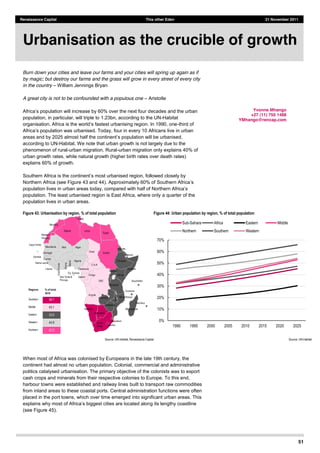
emerging economies and thus it is a simple truth to say that 60% of Africans live
rural lives, 65% of the Sub-Saharan workforce is employed on the land and 30% of
the c
land implies a need for alternative policy responses to the inevitability of
urbanisation is surely ludicrous. If Africans have an attachment to the land, we could
say with equal validi
poverty.
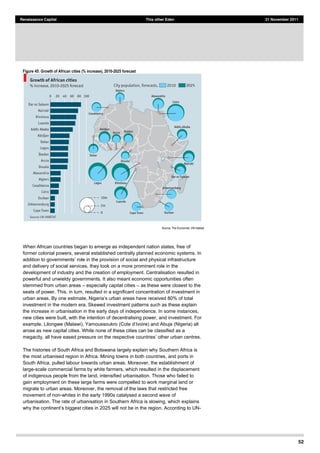
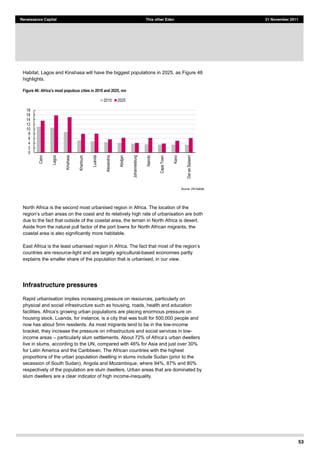
Yvonne Mhango, our Sub-Saharan Africa economist, looks at the phenomenon of
urbanisation in this report. The phenomenon is borne out by statistics, which can
only be expressed in terms of an entire continent seemingly on the move. For
example, in 1950, there was not a single city with over 750,000 inhabitants; 50 years
later there were 231 cities which had surpassed this number; urban growth rates are
above 3% pa in many parts of Africa, in 2001, 306mn Africans lived in cities and,
according to the UN, this will increase to 787m by 2025, implying urban populations
adding 20mn new residents every year.
But, the critical conclusion is less to do with urbanisation and more to with how it
drives unexpected progress and change in the countryside. Consider the Lewis
11
Renaissance Capital This other Eden 21 November 2011
Turning Point published in 1954 and named after Arthur Lewis, a Nobel Prize-
winning economist. His theory postulates that a cheap supply of labour from the
countryside keeps industrial wages down but eventually they will rise when the rural
labour pool tapers off.
The theory has been given a new lease of life in the years since his death in 1991
given the migratory flows of peoples from the poor south to the rich north. Moreover
it is a theory that has been played out widely in China where vast surpluses of rural
competitively priced as the country engages in its own urban revolution.
But the interesting impact is not so much what happens in the cities but what the
Lewis Turning Point means for the countryside. As more and more workers flood
into urban environments and the readily available pool of cheap surplus labour
disappears, farmers are forced into a straightforward labour-capital shift. In short,
farms must mechanise if they are to maintain their competitive position.
The key conclusion we drawn from this shift and we see this as possibly one of the
most important aspects of this report is the extent to which the countryside has to
react to urbanisation in terms of output. The evidence suggests that an inability to
keep up with this strategic shift led directly to the food deficit, which has become
endemic across SSA.
Smallholders, too, must make a decision: if they dedicate their supply of labour to
generating urban-derived income what do they do with their land? Another way to
look at this conundrum takes the form of a question: is the rise of the superfarm
inevitable?
Superfarms
The rise of the superfarm is a relatively modern phenomenon. There are possibly
fewer than 100 industrial groups or organisations that own, lease or operate farms of
over 100,000 ha. An additional complication is that defining what constitutes a farm
is hardly a straightforward exercise. After all, a 200,000 ha farm is most likely to be a
series of clusters of 1,000-10,000 ha farms.
Arguments for or against smallholders and superfarms have become increasingly
simplistic in recent years. Thus, we are increasingly faced with an
argument that has descended into soundbites and trite mantras that can be broadly
summarised as smallholder good, superfarm bad...or vice versa.
The reality is more complex; and it is not a question of good vs evil, rather what is
inevitable and pragmatic. We look at the more emotive issues later in this
introduction when we investigate the future of aid; but first we address some
fundamental questions relating to superfarms.
Do economies of scale exist in agriculture?
They may or may not. The fact is that many industries are subject to the
fallacy of size. Spend any time in China, as one of the authors of this report
did for half his professional life, and everything soon comes down to size
12
Renaissance Capital This other Eden 21 November 2011
and scale. Likewise, consider the spurious assumptions made over the
economies of scale that are supposedly attached to banking and mobile
telecoms. They barely exist, but management spends a lot of time
suggesting they do. Agriculture is possibly similar. The purchasing power
on inputs or selling power on output that comes with a 100,000 ha farm is
likely to be no greater than a 1,000 ha farm. This is accentuated by two
factors: first, managing 100,000 ha under a single corporate umbrella is
more likely to result in managerial dis-economies of scale; and second: 100
farmers managing 1,000 ha plots each can easily form a co-operative,
which will provide them with all the purchasing benefits of the superfarm
and none of the managerial dis-economies of scale. The lack of middle
management in agriculture is something we look at in detail in the final
section of this report.
, why do superfarms exist?
Historical reasons play a part, especially in East Africa, Southern Africa,
Argentina, Brazil and the CIS. Technology and IT have also played a part:
managing a 100,000 ha farm has become possible with the advent of new
technologies. Superfarms also exist because they act as conduits for
investment capital. In short, while managerial or operating economies of
scale might not exist, financial economies of scale do.
If smallholders form co-ops, can they compete against superfarms?
Unlikely. Urbanisation and the variables it brings into play challenge the
farms are
less than 2 ha in size and combined they likely account for between 60-
70% of global output. Put bluntly, the economics of the smallholder are less
than optimal. They have little purchasing power on the input side, they are
perpetually undercapitalised and although they could form large co-ops
and some do the non-agricultural trade-offs (which we investigate in the
urbanisation section of this report) are unlikely to be reversed.
If smallholders had access to capital, would it make a difference?
It would make a huge difference. The fact is that appropriate access to
capital at all levels could probably triple yields among smallholders in many
agricult
in the late 1970s were down to improved access to capital. However, two
caveats should be noted here: first, in Brazil large-scale corporate farms
have come to dominate capital flows over time, and second, Chinese
peasants still leave the countryside in enormous numbers, despite the
massive improvement in Chinese rural living from 1978.
But many of these superfarms seem to be unprofitable?
Not necessarily. Some are enormously profitable, while others make huge
losses. Much of this comes down a variety of factors: the timing of
expansion, which part of the value chain they operate on, management
-
scale farming.
13
Renaissance Capital This other Eden 21 November 2011
So, there is a future for the medium-sized farm in Africa?
In some ways, yes, but it might only be an intermediate step for all we
know at this stage. Much land aggregation in West Africa is actually
attributable to rich urban dwellers acquiring land from smallholders who
move to the city in search of work. However, this process is ongoing and
what is to say that the rich urban dweller does not continue to aggregate
land as a business as more becomes available.
We consider a few issues at this stage. The first is something we have already
outlined: that we might only be at an intermediate stage in the development of farms
as large-scale corporate entities. Twenty years back, IT systems did not exist that
would have allowed these businesses to exist. And, while a 100,000 ha farm might
sound like a formidable entity, it is only formidable in relation to other farms. Against
Royal Bank of Scotland, Deutsche Telekom, Apple Inc and Unilever, it is a minnow.
Second, we note all the factors that we cannot possibly know at this stage. The
telecoms and internet sectors provide useful templates. In these sub-sectors
businesses were unprofitable for years before enjoying significant pay-offs, many
years after they commenced operation or were licensed. Consider Amazon: founded
in 1994 and just as it became profitable six or seven years later it embarked on
another frenzy of launching multiple loss-leading lines outside its core books activity.
Had it not engaged in that strategy, others would have done so before turning their
a
situation existed with the wireless operators where profitability was a distant
prospect in the early 1990s. If you were a profitable wireless operator in 1992 and
decided to stay that way, it was most likely you would have been out of business by
the end of the decade.
Is farming going through a similar transformation? The previous non-farming
examples were seeking an assortment of corporate objectives: critical mass, market
share, purchasing power and maybe even those elusive economies of scale, all of
which would lead to returns for investors. The farming industry, too, might have a
number of holy grails, which it too is seeking out: low crop correlation is one. What
this means is that a diverse range of agricultural products is grown across multiple
geographies and therefore, the business has a lower risk profile. And that requires
scale operations. Meanwhile, the range of technologies that will characterise the
next generation of farming is not going to come cheap. Smallholders simply do not
have the means to employ the levels of capital that will be required to upgrade the
industry.
John Kenneth Galbraith recognised this last phenomenon in The New Industrial
Estate, in 1967. Although 44 years of hindsight allows us to question some of the
conclusions expressed, he was broadly correct in his assumption that a more
complex business environment required a more bureaucratic and scientific approach
to commerce with a management class to match. The growing complexity of
agriculture and farming suggests that this under-capitalised, under-invested and
under-industrialised sector is about to mirror the transformation that characterised
other industries in the 1950s and 1960s.
Ultimately, the debate over superfarms comes down to money. How does one
create a conduit for capital for investment in agriculture? Can smallholders provide
that conduit? If so, it would be reasonable to assume they had a future in this most
14
Renaissance Capital This other Eden 21 November 2011
strategic of industries. However, the volatility of food prices, the rapid urbanisation
that characterises large parts of our planet, the relative undercapitalisation of the
sector and the sheer variability of the agricultural labour force in its current form all
suggest that in creating those conduits for capital, superfarms are likely to play a
hugely important role in attracting capital to the sector.
These are some of the issues, which Adam Oliver attempts to address in his section
on superfarms. We understand how EMBRAPA has become a pioneer in all kinds of
advanced and sophisticated agricultural methods: perhaps Africa can experience
something similar.
Sustainability
We have discussed urbanisation and the rise of the superfarm, and outlined some of
our broad conclusions. However, we have yet to address the essential issue of
sustainability. One of the overriding issues for humanity is that every civilisation,
city-state and society with an urban heartland has been built upon the availability of
food and water. In fact it is the existence of those food and water resources, which
has allowed urban societies to flourish. However, over time, every single one of
those civilisations, societies and states has collapsed because its depleted and
exhausted hinterlands could not supply its cities with their food and water needs.
To give a single, stark example: Roman civilisation was built on an availability of
food resources in the hinterlands around the city of Rome itself. When the Roman
Empire dissolved in the 5th century AD, it had become increasingly reliant on food
imports from far-flung outposts of its empire, including Egypt. In short, Rome, an
urbanised empire, had no food security and was ultimately unsustainable. If only this
was an isolated example then perhaps we could rest our minds and assume that
somehow the planet can muddle through. The truth that needs to be universally
acknowledged is that every civilisation has collapsed because it could not address
the sustainability issue.
We firmly believe markets and free trade c
However, if we have learned anything from the financial crisis it is that free markets
give the appearance of functioning well up to the point at which they fail
catastrophically. Unfortunately, catastrophic failures of financial and food markets
have devastating consequences for entire societies. Thus, we would do well to find
some answers on the question of sustainability that do not involve stocking up on
baked beans, high-velocity rifles and checking out the classified ads for rental
properties in Montana.
We do not take an entirely misanthropic view and that somehow we have been lucky
so far. As we see it, societies have chosen to accept the multiple benefits of
progress without simultaneously questioning any parallel costs that might emerge
with that progress. Consider the car: most people would acknowledge the huge
benefits that accrue from the development of the automobile and most would be
pragmatic enough to know that it comes with many economic, social and
environmental costs attached.
With agriculture we know the benefits of tarmac, refrigeration, chemical fertilisers,
irrigation, genetic modification of seeds and how all of these benefits have allowed
15
Renaissance Capital This other Eden 21 November 2011
us to feed ever-growing numbers of urban populations and stretch our supply lines
over an increasingly widespread area. No doubt, the wonders of genetic
modification will allow us to maintain this position for some time yet, and the weather
may well be on our side. However, the biggest cost of all is probably the one for
which the bill has yet to be presented.
In other words, we need to acknowledge both the economic costs and the seemingly
inevitable lessons of history. How the day will most likely come when these
fantastically intricate systems malfunction. And that is where sustainability comes in.
The manner in which we address these issues will require neither a slavish
adherence to markets nor a belief in the power of government to do good. Like the
, but above
all it will require pragmatism, clever thinking and open minds.
Orleans Mfune, a Zambian national, is about to complete his PhD at Glasgow
University. He has spent the past few years of his life looking deeply at this issue of
sustainability, and in particular the notion of conservation agriculture. In an era
where we might need to question many of our prevailing orthodoxies, he offers
some unconventional insights into how best to address the issues of sustainability in
Africa.
The future of aid
In 1984 during a great African famine, a South African businessman, Peter Pretorius
sold his possessions and drove into Mozambique to help alleviate the suffering that
had engulfed large parts of East Africa that year. During his trek, Pretorius was
trapped in a refugee camp with no food, water or spare clothing alongside 34,000
starving people. Within a day he was forced to drink the same tainted water as
everyone else and he helped to bury 30 dead every day. Ten days later, Pretorius
was rescued and returned to South Africa where he founded Joint Aid Management
(JAM).
Twenty-seven years later, JAM feeds 700,000 African schoolchildren on a daily
basis. That alone makes for an interesting story but what makes it compelling is the
fact that JAM is in the midst of transforming itself from humanitarian aid agency to
commercial organisation under the auspices of a new corporate entity called African
Commercial Development.
This has huge implications: for too long humanitarian aims and commercial
ambitions have been viewed as mutually exclusive. The few who occupy the tents
that the moral compass revolves around them and not those in the glass block
temples to finance that tower over them. This is sketched out on a wider African
canvas, where too many aid agencies set agendas that we believe hamper
commercial development across the continent. If you want to read a document
paved with good intentions, and which lays claims to the moral high ground, check
, Growing a better future: food justice in a resource-constrained
world published on 1 June 2011.
This is no place to assess the entire document, but we believe many of the
observations and views expressed in this report are contradictory, ill thought-out or
16
Renaissance Capital This other Eden 21 November 2011
illogical so much so that it makes a nonsense of any conclusions made. In our
view, the report e to saving the world. Here are a
few randomly chosen statements.
On page 16:
However, we only need to get two pages further
on and page 18 has the following observation
deals reportedly under negotiation or completed, covering 80m hectares since 2000
.
On page 19, Oxfam criticises the approach taken by one prominent agriculture
investor in Africa, which is
thing. It strikes us as a manifestly better strategy than watching the farm fall into ruin
like so many investment projects have done over the past 30-40 years (thus creating
the problem in the first place). However, it is the next statement that is truly
staggering in its lack of understanding of how markets work. ains
that some investors will be interested only in the easy return on land, rather than the
.
What we fail to understand here is how the land can rapidly appreciate if no food is
grown on it? No yield, no value it is that simple. For sure, if they mean using the
land for development, we can just about understand the point being made. However
this would suggest that urbanisation had taken off to such an extent that those
ill be making money hand over
fist.
On page 39:
$317bn in 2008 as investors stampeded to a safe haven from capital markets in
soft commodities crashing from their 1Q08 highs as the financial crisis took hold. We
would never have seen agriculture as a safe haven in 2008, or any other year. A
product whose output is weather dependent is not a safe haven. More to the point
we would not have followed the above statement with the following observation on
page 47
.
Were it not for the fact that Oxfam is an influential organisation and is engaged in
some noble work, you could discard this, or at least treat it as pure comedy gold.
That committee-driven reports like this are taken seriously, tells us that something,
somewhere has gone terribly wrong. Adam Smith, a Scottish philosopher who, like
Keynes, has been hijacked in recent decades, is best known for An Inquiry into the
Nature and Causes of the Wealth of Nations, originally published in 1776. A less
well-known work, but one we believe ought to be equally prominent, is The Theory
of Moral Sentiments published 17 years earlier, in 1759. In short, this book married
self-interest with moral judgement and laid the foundations of modern capitalism. In
modern Africa and perhaps across a wider universe these days somehow the
link between an innate sense of morality and self-interest seems to have been lost.
Perhaps this split is not irreversible. What the philosophy of Adam Smith said some
250 years ago, and the actions of some of the more forward-thinking aid
17
Renaissance Capital This other Eden 21 November 2011
organisations today, tell us is that capitalism and morality are not mutually exclusive
and that the link between the two can be restored. On a less philosophical and more
practical level, JAM provides an example of an organisation that has forced itself to
address the difficult questions of what aid is for, is it sustainable and does it liberate
or subjugate its recipients.
In the chapter on the future of aid Isak Pretorius and Jim Lutzweiler of JAM/ACD
look at the issue of aid and how a humanitarian business can be transformed and
fashioned into an entirely different type of organisation. Its success is tied in with
that of Africa and its aim is simply to put its aid arm out of business. In short, the
success of this initiative means that there will be no JAM tomorrow. Perhaps Oxfam
might learn something from them.
Strategic outcomes
The chapters throughout this report highlight a number of the strategic themes that
we believe will be played out across the sector in the next few years. Nevertheless,
we do not suggest that this report is anything near a definitive document. It merely
highlights the macro factors we believe will influence the African agriculture sector in
the years ahead. But if these factors influence the sector, what are the investments
themselves likely to look like in the years ahead?
If Africa represents a final frontier in investment, we think it is possible that some of
the investment models that are likely to emerge already exist elsewhere.
An obvious constraint is the mismatch between investors and the vehicles into which
they can invest. A paradox that has endured in recent years is that agriculture
remains an industry of global importance, of enormous interest to investors and one
undergoing some profound structural change. Despite all this, listed, liquid vehicles
remain the exception rather than the norm (although not in the capital-intensive
inputs side of the business involving seeds, fertilisers and machinery). In short, the
conduits for capital are as weak as the physical goods markets in which they invest.
One parallel worth considering is that of China. The earliest businesses to tap
foreign capital on public markets were the B-share markets in Shanghai and
Shenzhen. This was followed by H-shares in Hong Kong, the so-called red chips,
and finally a raft of state-owned enterprises listed under a variety of methods on
several exchanges simultaneously. All were responses to the demands of investors,
and we expect to see something similar emerge in the years ahead, across Africa.
There is also an alternative integrated value-chain model, which is a regular feature
among Russian, Brazilian and Ukrainian businesses. This, too, could form a
template for African enterprises and it would not surprise us to see a large amount
of backwards vertical integration take place across Africa among various food
processing companies which have some brand value.
Our key conclusion is that the type of vehicles that will dominate African agriculture
in the years ahead may not even exist yet. Just as investor interest in Shanghai
Dazhong Taxi and Shanghai Industrial Sewing Machine was eclipsed by the likes of
CNOOC, China Mobile and ICBC, we could see a similar trajectory in African
agriculture.
18
Renaissance Capital This other Eden 21 November 2011
Few people at the beginning of the 19
th
century needed an adman to tell them what
they wanted J K Galbraith
The most tragic paradox of our time is to be found in the failure of nation states to
recognise the imperatives of internationalism Earl Warren
It seems f , a
China that is big, successful and growing rapidly, is somehow seen as an existential
threat to the rest of the world whether through the relentless ambition of its
institutions, its overpowering need for resources or its towering desire to be taken
seriously as a leading power.
If this is success, logic would have it that Africa, with its perennial economic
underperformance and seeming lack of overarching ambition, is viewed positively as
a result. Not a bit of it. Overpopulation is seen as a problem, so too are disease and
famine, despite the ability of the latter to sort out the former. Well-worn media
images of failure are firmly entrenched in the public mind for generations. Thus the
threat.
Perhaps the human mind simply cannot cope with too much optimism
simultaneously. Thankfully, perhaps,
Finns and Russians. So, we believe it is probably best to look at Africa and China in
tandem, rather than in ill-fated isolation, for no better reason than the fact that their
individual economic success is likely to be mutually dependent on each other.
In our view, unlocking the potential of African agriculture is likely to emerge as one
of the great geostrategic themes of the next two decades. Again, in a world laden
with ironies and paradoxes, the availability of fertile land, an abundant water supply
and a vast, inexpensive pool labour have not transformed Africa into an agricultural
powerhouse. Instead, Africa remains a net importer of food and in substantial
quantities as a $28bn annual food deficit suggests.
We acknowledge the potential for the last paragraph to return some decades in the
future to torture us in our dotage,
1970s. Nevertheless, we believe many of the structural impediments to agricultural
growth in Africa are being removed in such a manner that the sector can undergo a
renaissance.
We have all become increasingly aware of the demand side of the equation and the
familiar drivers of food demand population, urbanisation and income growth
coupled with new factors, such as biofuels. All these are inexorably leading to
increased food requirements. We look at these in greater depth in the section on
food security. However, we conclude that while the world is not in imminent danger
of societal collapse through a lack of food and capabilities for producing it, the world
needs to find ways of opening up if it is to meet demand in the years ahead.
-
Saharan Africa consists of 2.3bn ha of land. Nearly 1bn ha is suitable for rain-fed
crop produ
these lands is 80-100% of the maximum theoretical yield. To put this into
perspective, in 2005 the total arable land in use in Sub-Saharan Africa amounted to
Richard Ferguson
+44 7880 827282
RFerguson@rencap.com
Deepak Krishna
+91 994 007 2596
DKrishna@rencap.com
19
Renaissance Capital This other Eden 21 November 2011
236mn ha, or only about 24% of the total suitable area. Obviously, not all of this land
extreme assumption, the land in use would still only be just over half the potential
Figure 5: Sub-­Saharan Africa's agricultural potential -­ Land area, mn ha
Source:  FAO  
Clearly, not all 1bn ha of suitable land can be cropped and by extension, not all of
already under use for non-agricultural activities such as human settlement,
economic infrastructure, forests, protected areas and so on. Even so, the sheer
scale of the potential gives us a high degree of comfort.
A more focused study, conducted by the World Bank, explores the potential of the
Sub- o-economic region
encompassing approximately 600mn ha of land in Sub-Saharan Africa, with a warm
tropical climate, annual precipitation of 800-1,200 mm and generally poor soil
quality. Of this, nearly 400mn ha of land can be used for agriculture. However, at the
current juncture, less than 10% of that land is in agricultural use.
2,287  
1,031  
421  
236  
0  
500  
1,000  
1,500  
2,000  
2,500  
Total  area   Land  suitable  for  crop  
production  
Very  suitable  land   Arable  land  in  use  (2005)  
20
Renaissance Capital This other Eden 21 November 2011
Figure 6: Guinea Savannah region in Sub-­Saharan Africa
Source:  IFPRI  via  World  Bank  
The study features several countries, most of which fall within the Guinea Savannah
zone; and Figure 7 shows the extent to which this fertile belt is underutilised in the
countries featured.
Figure 7: Extent of Guinea Savannah area in a few African countries, mn ha
Source:  World  Bank  
79  
91  
75  
54  
58   60  
2  
18  
1  
0  
20  
40  
60  
80  
100  
Mozambique   Nigeria   Zambia  
Total  area   Guinea  Savannah  area   Guinea  Savannah  area  cropped  
21
Renaissance Capital This other Eden 21 November 2011
To understand the scope for expansion, consider that the FAO estimates the
additional land required to feed a larger and richer world in 2050 at only 71mn ha.
We explore this in more detail in the section on food security.
Figure 8 shows the Sub-Saharan countries, which have over 50mn ha of suitable
cropland that is not currently in agricultural use. Although these numbers do not
exclude human settlements, forests and so on, they demonstrate not only the
agricultural potential of Africa but also how future needs could be met by a small,
rather than a large, number of countries.
Figure 8: Arable land and suitable cropland balance in a few African countries, mn ha
Source:  FAO  
As we have noted before, land is only one part of the supply equation; an adequate
water supply is also essential to ensure that the land can fulfil its potential. Again,
mirroring the availability of land, Africa is also endowed with sufficient water
resources both renewable and precipitation. Of the available water, only around
2% is used for irrigation, leaving sufficient scope for expansion. We focus on this
issue on the following section on food security.
So, if the availability of land and water is not an issue then the impediment between
potential output and actual output is the wide differences in yields achieved in Africa
compared with the rest of the world. Figures 9-12 compare the average yields from
2000 to 2009 for several key commodities across various regions.
Figure 9: Corn yield, 2000-­2009 average, t/ha Figure 10: Wheat yield, 2000-­2009 average, t/ha
Source:  FAO   Source:  FAO  
  7       4    
  20    
  5       3    
  12    
  181    
  77       74    
  57       54       54    
0  
40  
80  
120  
160  
200  
DRC   Angola   Sudan   Mozambique   Zambia   Tanzania  
Arable  land,  2009   Suitable  cropland  balance  
6.5   6.3  
5.6  
4.7  
4.1  
1.8  
0  
2  
4  
6  
8  
Americas   Oceania   Europe   World   Asia   Africa  
3.5  
2.8   2.7   2.6  
2.2  
1.6  
0  
1  
2  
3  
4  
Europe   World   Asia   Americas   Africa   Oceania  
22
Renaissance Capital This other Eden 21 November 2011
Figure 11: Rice yield, 2000-­2009 average, t/ha Figure 12: Soybeans yield, 2000-­2009 average, t/ha
Source:  FAO   Source:  FAO  
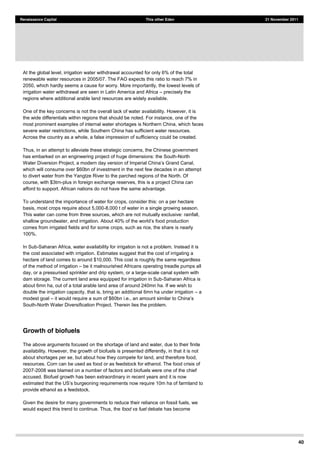
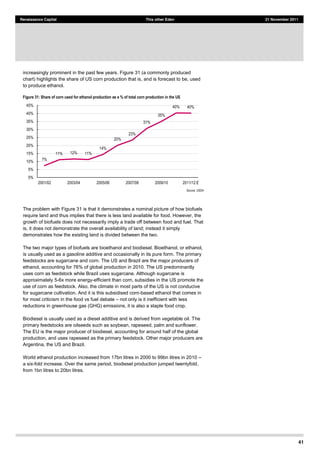
As the evidence above illustrates, African yields are the lowest in the world for corn,
rice and soybeans and above only Oceania for wheat. To get an idea of the extent
of possible improvement, consider Figure 13, which shows the long-term
sustainable cereal (wheat, corn and rice) yields that can be achieved in Africa with
varying levels of inputs. In this context, the levels are generically defined, and
represent farming technology, nutrient inputs, and management practices.
Figure 13: Cereal yields in Africa, t/ha
Source:  FAO  
If African cereal yields improve to the level achievable with intermediate inputs, it
would imply a large increase in agricultural output. For some historical perspective
consider the evolution of cereal yields over the past five decades in Africa and Asia.
In the 1960s, Asian yields were about 46% higher than African yields. But, over the
next two decades as the green revolution spread throughout Asia and skipped
Africa, the difference in yields widened. In the 1990s, Asian yields were nearly
double African yields. Only in the past decade have African yields grown faster than
Asian yields, narrowing the gap marginally. The strong growth trajectory
experienced over the past 10 years suggests African agriculture can be transformed
if these improvements are maintained over the course of the following decade.
7.9  
5.8  
4.7  
4.1   4.1  
2.4  
0  
1  
2  
3  
4  
5  
6  
7  
8  
9  
Oceania   Europe   Americas   Asia   World   Africa  
2.6  
2.3  
2.0  
1.7  
1.4  
1.1  
0  
1  
2  
3  
Americas   World   Oceania   Europe   Asia   Africa  
2.0  
0.4  
3.0  
5.8  
0  
1  
2  
3  
4  
5  
6  
7  
Avg  2000-­2009   Long-­term  sustainable  
with  low  inputs  
Long-­term  sustainable  
with  intermediate  inputs  
Long-­term  sustainable  
with  high  inputs  
23
Renaissance Capital This other Eden 21 November 2011
Figure 14: Average cereal yields, t/ha
Source:  FAO  
To get an idea of what these higher yields might mean for Africa, consider the
yield was 2.2
t/ha. Increasing the yield to 3 t/ha would increase the output to 148mnt without any
additional harvested area. In other words, output would increase by more than one-
third. However, even this increased production would not have been sufficient to
satisfy demand, as cereal consumption in 2009 was 152mnt.
By 2050, the FAO expects cereal consumption in developing countries to grow more
than 60% from current levels. If we assume a similar growth trajectory for Africa,
consumption in 2050 would be approximately 243mnt. The FAO also expects 27%
growth in arable land in Africa during the same period implying an additional 63mn
ha for cereals. If we assume that African yield growth in the next four decades is
similar to that of Asian yield growth over the past four decades, African cereal yields
in 2050 would be approximately 3.5 t/ha. This would imply production of
approximately 219mnt still some 24mnt below 2050 consumption.
While it may not seem to be much of an improvement from the current deficit of
44mnt, we regard the above assumptions as conservative. Based on the extent of
land availability and the increasingly global focus on African agriculture, the planted
area is likely to increase by more than 27%, we think. Similarly, African yield growth
is likely to be faster than Asian yield growth because the latter experience provides
valuable lessons for Africa. Moreover, technological transfer will also have a positive
impact. However, any reduction in the deficit should be welcome, especially when it
is realised despite an increase in competition.
The preceding section looked mainly at cereals. However, Africa also has the
potential to make an impact in other commodities such as palm oil and sugar. In
these cases, climate and geography in much of Sub-Saharan Africa gives it a
competitive advantage. For example, Malaysia and Indonesia are beginning to face
limits to the expansion of palm oil production. A grant of $1bn from the government
of Norway to the government of Indonesia to reduce its deforestation rates might
$20bn-plus annual investment in its domestic oil industry, but
it does give an indication of potential supply constraints in Southeast Asia. Future
growth will likely have to come from countries such as the Democratic Republic of
1.1  
1.3  
1.5  
1.7  
2.0  
1.6  
2.1  
2.8  
3.3  
3.6  
0  
1  
2  
3  
4  
1960s   1970s   1980s   1990s   2000s  
Africa   Asia  
24
Renaissance Capital This other Eden 21 November 2011
Lest it appear that we are confusing potential with performance, we acknowledge
that it is easier to calculate increases in yields and output than to actually realise
them. There are numerous road blocks, ranging from lack of capital, sub-optimal
farming practices and a lack of skilled labour, to non-availability of high-yielding
seeds and unfavourable government policies. The World Bank study on the Guinea
Savannah region we cited earlier explores a few of these issues. Specifically, it
compares the Guinea Savannah region in Africa with similar agro-ecological zones,
namely the Cerrado region in Brazil and the North Eastern region of Thailand, both
of which have been which transformed from relatively backward agricultural regions
to successful agricultural exporters.
The Brazil case study
As noted, potential remains just that unless a concerted effort is made to unlock it.
Brazil is a staggeringly successful example of a nation where a large-scale
hinterland was transformed into an agricultural stronghold over the course of several
decades. However, before we look at the steps taken to turn Brazil from agricultural
backwater to agricultural powerhouse, we note four broad factors to dispel any
myths and pre-conceived notions about the Brazilian agriculture sector:
This process from the formation of EMBRAPA in 1973 to the point where a
wider investor community began to take notice of the Brazilian agriculture
sector took more than three decades. Commentators, all too frequently,
overlook these lead times. In short, it was not an overnight success story.
Another factor worth emphasising at the outset is that this was initially a
government-inspired plan to develo
much of the success of the project could be attributed to the fact that it was
executed under a military dictatorship.
Brazilian infrastructure and supply are still in poor shape. Some 93% of the
e unpaved, port bottlenecks are the norm, large-scale
public infrastructure investment programmes have failed to achieve their
necessitates a 2,000 km journey.
There are both private sector and public sector aspects to the Brazilian
case study. The success of the Cerrado development is not fully
attributable to either. Instead, it relied on focused strategic aims set out by
government, and a resourceful private sector willing to take risks in an area
lacking a history of large-scale agriculture.
As noted, t
agricultural sector. Government incentives for agricultural producers are wide
ranging and have contributed significantly to growth in the sector. These include
preferential credit, tax exemptions, financing for agricultural research, marketing and
infrastructure improvements as well as an array of Federal, State, and local
subsidies. Despite that, public expenditure on the agricultural sector is low
compared with recent years. Agricultural expenditure accounted for only 1.8% of
total government expenditure in the period between 2003 and 2005, compared with
5.6% in the period between 1985 and 1989.
25
Renaissance Capital This other Eden 21 November 2011
The development of Braz griculture sector
factors many of which date back decades. Whether in agriculture or in other
policymaking frameworks, decisions and policies implemented in the distant past
stranger to this truism. Moreover, we cannot isolate the successes and say that they
were due to a free market model or an interventionist model: it all depends how you
look at it. Some of the successes were even rooted in an initial failure e.g., the
devaluation of the currency in 1998-1999 was a policy failure with hugely positive
implications for the agriculture sector. The modern evolution of the Brazilian
agricultural sector can be divided into three distinct phases.
The geographic expansion phase (1945-early 1970s)
The intervention/modernisation phase (early 1970s-late 1980s)
The free market period (early 1990s-present)
The geographic expansion phase (1945-early 1970s)
Brazilian agriculture remained primitive during this phase. Yields were consistently
low and there were few policy initiatives to modernise the sector. It was
characterised by an export sector that relied primarily on coffee, cotton, sugar and a
few minor commodities and a semi-subsistence sector that produced for the
domestic market. In common with neighbouring Argentina the government ensured
that it was the urban-industrial constituency which was favoured at the expense of
next door, the Brazilian government implemented an import-substitution strategy to
promote domestic economic growth while limiting foreign debt and foreign
exchange. B , using both direct and
indirect policies in an effort to supply the urban sector with cheap agricultural
products. Export quotas and licences, as well as prohibitions on trade, were applied
sporadically, and
agricultural commodities.
Incredibly, the overall performance of the agriculture sector during the period was
reasonable, due to horizontal (i.e., geographic) expansion. No doubt, import
substitution and industrialisation policies were major disincentives to investment by
landowners and farmers. However, these were circumvented through the
maintenance of adequate land access on concessionary terms. Geographic
expansion, through the incorporation of new land and aggressive road construction
policies, resulted in an annual crop output growth of 4.3% over the period between
1949 and 1963. Yields remained ghastly, however. While the region witnessed a
mere 17% yield increase from 1949 until 1969, the total cultivated area increased by
almost 83%, to over 39m ha, in the same period.
The intervention/modernisation phase (early 1970s-late 1980s)
As horizontal growth reached its natural limits by the end of the 1960s, the
agriculture sector underwent a phase of modernisation driven by capital inputs and
strong government intervention. The increased emphasis on capital intensity was
aimed at the bigger agri-businesses and ensured that access equipment and
26
Renaissance Capital This other Eden 21 November 2011
chemicals were more readily available. The government introduced a far-reaching
reformulation of agricultural strategy which included some key initiatives outlined
below.
The establishment of a rural credit system in 1965 providing financing on
easy terms to commercial agriculture.
The implementation of a broad-based research body focusing on
agriculture in 1973 the EMBRAPA system.
An improvement in the instruments used in, and the administration of,
minimum price policies.
Inducements for the formation and expansion of agribusiness complexes.
The availability of subsidised credit expanded markedly and, until the mid-1980s, it
had a remarkable impact on both production and productivity. However, in the
1980s, the effectiveness of agricultural credit in expanding output began to weaken
as the debt crisis took hold and the rural credit system became increasingly
regarded as wasteful and distorted. In the second half of the 1980s the incentives
and subsidies of the credit policy were replaced with those provided by the minimum
price policy. The minimum price policy, together with the currency devaluations of
the 1980s, brought about a considerable expansion and diversification of agricultural
exports.
The output of grains and oilseeds increased from 22mnt in 1965, to 58mnt in 1985
and 72mnt in 1989. Exports increased from $1.3bn in 1965, to $5bn in 1975. In a
span of about 20 years, Brazilian agro-industrial exports became increasingly
diversified, going beyond a small group of tropical commodities (mainly coffee,
sugar and cocoa) and incorporating new products such as soybeans, meat, ethanol
and fruit. However, agricultural exports increased at a much slower pace than the
to 30% in 1990.
The free-market period (early 1990s-present)
The agriculture sector expanded rapidly in the mid-1980s when the policies, which
had diverted resources from agriculture towards the industrial and services sectors,
were dropped. Economic reforms in 1985 eliminated domestic and export taxes on
agricultural products. Export restrictions on soybeans, cotton and meat were also
removed, as was the requirement for corn import licences. During the early 1990s,
government intervention and support measures were reduced; some state-owned
enterprises were sold, minimum support prices were abolished, government
purchases of wheat and milk were removed and the marketing boards for coffee,
sugar and wheat were abolished.
However, possibly the most significant economic factor affecting agricultural output
in Brazil since the mid-1990s was macroeconomic: the introduction of the Real
Economic Stabilisation Plan. With inflation levels in excess of 1,000% before 1994,
the government introduced the Real, which stabilised the economy, reduced inflation
to approximately 5% per year and ignited a consumption boom which lasted five
years. However, in early- 1999, Brazil adopted a floating exchange rate, which led to
a significant devaluation of the currency. Being a low-cost industry with a propensity
27
Renaissance Capital This other Eden 21 November 2011
especially soybean and meat production. As a result, production of major crops
(soybeans, corn, rice, edible beans, and wheat) rose to 54mnt in 1990, double the
1970 level.
It might seem unusual for a sector to perform well under two seemingly contrasting
economic environments. In retrospect, the reason is probably quite simple. The
introduction of the real (in conjunction with the microeconomic reforms of that time)
helped to promote a more benign investment and domestic consumption
environment so that when currency devaluation came, export growth gained
prominence.
The reforms of the 1990s have proved enduring. Crop production in Brazil reached
an all-time high in 2008, more than a fourfold increase from 1970 and double that of
1990. Exports witnessed a sharp increase in the period 1990-2009, with total export
value increasing sixfold in the period.
The role of government
As outlined in the previous section, agricultural policy goals and programmes in
Brazil have changed significantly over time. During the mid-1960s, the sector was
uncompetitive except for a few tropical products such as coffee and sugar and
was characterised by an uneven distribution of farm income which almost
institutionalised large and unproductive landholdings. The period between the mid-
1960s and the early 1980s was a period in which government intervention was the
norm: in agricultural commodity markets, by means of subsidised rural credit, with
price support mechanisms, through government purchases and storage of excess
supply and so on. During this period, agricultural policy centred on the objective of
promoting food security for an urbanising population while compensating the
agricultural sector for its anti-export bias.
However, calamity almost inevitably leads to reform, and the debt crisis of the 1980s
forced the Brazilian government to reduce support to farmers and review its sector
policy goals. Structural reforms introduced in the early-1990s witnessed the
elimination of export taxes and price controls, deregulation and liberalisation of
commodity markets, the unilateral reduction of trade barriers and the introduction of
private instruments for agricultural financing.
Significant policy changes were introduced by 1995, shifting the priority towards land
reform and family farming. The government created a new ministry, the Ministry of
Agrarian Development (MDA), to run programmes targeted at family-run farms and
land reform. It also adopted policies targeted at family agriculture (known as
PRONAF), including subsidised credit lines, capacity building, research, and
extension services. Federal government expenditure on land reform increased from
6% of total farm programme spending during the Sarney administration (1985-1990)
to 45% during the first Lula administration (2003-2005). The number of agriculture-
related programmes increased from 30 before 2000 to 100 in 2003. Overall,
however, government expenditure on agriculture decreased both in relative and
absolute terms and traditional agriculture expenditure was sacrificed to support land
reform programmes. It fell from 5.6% of total government expenditure during the
Sarney administration to about 1.8% by 2005.
28
Renaissance Capital This other Eden 21 November 2011
With significant institutional and policy changes, the Brazilian agriculture system
made the transition from a traditional local business to an increasingly global and
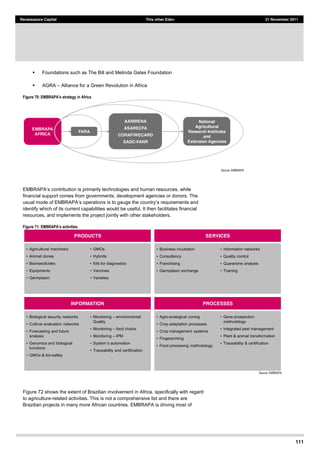
industrial model. Rising incomes, urbanisation, economic liberalisation and access
to competitive raw materials led to an investment boom by multinational food
processors and retailers during the 1990s. Increased foreign direct investment (FDI)
by large private agribusinesses displaced domestic competitors, increased industry
concentration and eliminated many medium and small companies. Farmers in Brazil
are increasingly exposed to markets that are much more demanding in terms of food
quality and safety, are more concentrated and vertically integrated and are more
open to international competition.
Figure 15: Average annual expenditure on agricultural policies (base year 2005), BRLmn
Period
Traditional
agriculture
Agrarian organisation
(land reforms)
Total
Traditional
agriculture/Total
Agrarian
organisation/Total
Agricultural expenditure/Total
government expenditure
1985-­1989     19,549   1330   20,879   94%   6%   5.6%  
1990-­1994     17,510   1229   18,739   93%   7%   2.8%  
1995-­1998     15,273   3,342   18,615   82%   18%   3.4%  
1999-­2002     8,712   3,290   12,002   73%   27%   2.0%  
2003-­2005     5,901   4,809   10,710   55%   45%   1.8%  
Source:  American  Agricultural  Economics  Association  
The detail outlined above is in isolation interesting but not of direct relevance to
Africa. For sure, it offers a possible template for development of the African
agriculture sector but it is the relationship between Brazilian supply-side factors and
Chinese demand factors, which are more relevant to African agriculture.
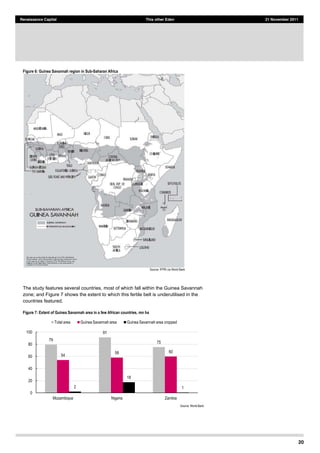
Feeding a Chinese boom
side of the world, namely China, and its inexorable rising demand for soybeans over
the past decade.
The Chinese consumption boom cannot be considered new news these days. The
world has become familiar with a richer, more urbanised China and its increasing
consumption of meat and, thus, its increasing demand for grains and oilseed
feedstock. While we do not agree with the scaremongering that usually
accompanies this analysis, we believe that Chinese self-sufficiency in several key
grains wheat, rice and corn is likely to be reversed in a dramatic fashion over the
next few years.
In 2001 the average Chinese consumed around 43 kg of meat pa, of which almost
75% was pork. Overall the country consumed 54.7mnt of meat at that time. Over the
next decade annual per capita consumption rose to approximately 54 kg, a 22%
increase while overall consumption rose by 25% to 68.4mnt.
29
Renaissance Capital This other Eden 21 November 2011
Figure 16: Total meat consumption, mnt
Country 2001 2002 2003 2004 2005 2006 2007 2008 2009 2010 2011E
China 54.7 55.9 57.6 58.5 60.8 62.1 60.2 64.8 66.8 69.2 68.4
Japan   5.4   5.5   5.5   5.4   5.6   5.6   5.6   5.6   5.7   5.8   5.7  
South  Korea   2.2   2.4   2.4   2.3   2.3   2.5   2.6   2.7   2.7   2.9   2.9  
Hong  Kong   0.7   0.7   0.7   0.8   0.8   0.8   0.8   0.8   0.9   0.9   0.9  
Taiwan   1.7   1.7   1.7   1.7   1.7   1.7   1.6   1.5   1.6   1.6   1.6  
Singapore   0.2   0.2   0.3   0.3   0.3   0.2   0.3   0.3   0.3   0.3   0.3  
EU   37.6   39.0   39.0   38.7   39.2   38.8   40.3   39.8   39.8   39.8   39.5  
US   34.6   36.0   36.0   36.8   37.0   37.5   37.8   37.1   36.6   36.5   36.3  
Russia   5.9   6.5   6.5   6.3   6.9   7.2   7.8   8.4   8.2   8.3   8.4  
India   2.5   2.8   3.0   3.3   3.5   3.7   4.0   4.4   4.5   4.6   4.7  
Source:  USDA  
Impressive as this increase may be, we see further scope for growth. Consider that
the average Taiwanese in 2001 consumed around 75 kg of meat annually. In the
past decade, the Taiwanese diet has witnessed a 4% decline in overall meat
consumption, but the per capita consumption is still almost 71 kg over 31% more
than the corresponding figure for the average Chinese
consumption equalises with Taiwan, it will require approximately 91mnt of additional
grains slightly more than the entire corn output of Brazil and Argentina in 2011.
Figure 17: Annual per capita total meat consumption, kg
Country 2001 2011 2020E 2025E
China 44 54 67 73
Japan   43   46   49   51  
South  Korea   46   60   70   76  
Hong  Kong   107   143   151   156  
Taiwan   75   71   82   87  
EU   73   77   79   80  
US   113   108   107   109  
Russia   41   58   64   67  
India   3   4   4   4  
Source:  FAPRI  
Of course, some might be tempted to use the per capita consumption statistic for
Hong Kong as a future target for China. However, at 143 kg per person, more than
double the Taiwanese figure, we believe Hong Kong is an extreme case on account
of its unusual status as a regional hub with a large influx of foreigners and tourists.
Regardless, we believe meat consumption will continue to increase as incomes rise.
We also note that FAPRI does not expect Chinese per capita consumption to reach
current Taiwanese consumption levels until 2025. We add one caveat here (which
we believe confirms the conservative nature of our view): that is, our benchmarks
suggest Taiwanese meat consumption stagnates at 71kg per person while FAPRI
forecasts that it will rise to 87kg by 2025. These long-term forecasts are below
current US levels of consumption but we believe it much more likely that world
protein consumption will level out sharply at some point in the future. The key factor
though is that consumption in China will undoubtedly rise and using Taiwanese
current consumption as a benchmark is a highly conservative approach.
To understand the longer-term implications, we need only look at what has
happened with soybeans in China over the past decade.
30
Renaissance Capital This other Eden 21 November 2011
In
stagnated for a decade and only managed to get above 16mnt in 2004 and 2005.
This year, the US Department of Agriculture expects it to decline to 14mnt. Exports
are almost non-existent but domestic consumption has rocketed from 28.3mnt in
been met by imports, which have risen from 10.4mnt to 56.5mnt in the same period.
Most of this increase in imports of about 46mnt has been met by Argentina, Brazil
and the US, which have increased their exports in the same period by about 36mnt.
Specifically, Brazilian exports during this period rose nearly 22mnt, thanks mostly to
nsformation.
Figure 18: Soybean statistics
2001 2002 2003 2004 2005 2006 2007 2008 2009 2010 2011E
Area,  mn  ha   9.5   8.7   9.3   9.6   9.6   9.3   8.8   9.1   9.2   8.5   8.3  
Yield,  t/ha   1.6   1.9   1.7   1.8   1.7   1.6   1.5   1.7   1.6   1.8   1.7  
Production,  mnt   15.4   16.5   15.4   17.4   16.4   15.1   13.4   15.5   15.0   15.1   14.0  
Imports,  mnt   10.4   21.4   16.9   25.8   28.3   28.7   37.8   41.1   50.3   52.3   56.5  
Exports,  mnt   0.3   0.3   0.3   0.4   0.4   0.4   0.5   0.4   0.2   0.2   0.2  
Consumption,  mnt   28.3   35.3   34.4   40.2   44.4   46.1   49.8   51.4   59.4   66.0   71.6  
Ending  stocks,  mnt   2.1   4.5   2.1   4.7   4.6   1.8   2.8   7.6   13.3   14.6   13.3  
Source:  USDA  
The key thing to note is that the domestic planted area and yields simply could not
respond to this additional demand. In 2001, 9.5mn ha of Chinese land yielded 1.6
t/ha of soybean. A decade later, the land had declined to 8.3mn ha, while the yield
had stagnated at 1.7 t/ha.
Consider the situation in the major grains corn, rice and wheat. As Figure 19
shows, over the past five years, harvested area has increased about 3.7mn ha for
corn, about 0.7mn ha for wheat and 1.4mn ha for rice. Further, a good part of that
increase happened in the first two years the last two years have seen a minimal
increase in harvested area for rice and wheat. Similarly, yields for all three grains
have seen only marginal improvement. While imports are currently negligible, we
believe a repeat of what happened with soybeans is very much possible in the next
few years.
Figure 19: Statistics on corn, wheat and rice
2007 2008 2009 2010 2011E
Corn               
Area,  mn  ha   29.5   29.9   31.2   32.5   33.2  
Yield,  t/ha   5.2   5.6   5.3   5.5   5.6  
Wheat               
Area,  mn  ha   23.7   23.6   24.3   24.3   24.4  
Yield,  t/ha   4.6   4.8   4.7   4.7   4.8  
Rice               
Area,  mn  ha   28.9   29.2   29.6   29.8   30.4  
Yield,  t/ha   6.4   6.6   6.6   6.6   6.6  
Source:  USDA  
A similar scenario is being played out in oilseeds other than soybean.
farmland is under pressure from growing urbanisation, and consequently, demand
for cooking oil is being met less by domestic oilseeds (e.g. soybean and rapeseed)
and more by imported palm oil.
31
Renaissance Capital This other Eden 21 November 2011
Figure 20: China oilseeds (ex. soybeans) area harvested (mn ha) and palm oil imports, mnt
Source:  USDA  
While we limited the discussion in the preceding section to China, similar dietary
changes are under way in a number of other emerging economies. As demand
rises, internal constraints in a number of geographies are becoming apparent. In our
view, this is a great opportunity for Latin America, the CIS and Africa. We see the
example of the Cerrado as a harbinger of things to come, and expect more
Cerrados to emerge especially in Africa. Similar to how the Cerrado benefitted
we believe Africa could benefit from
increased global demand for corn, palm oil and other crops.
We conclude with what may seem a controversial view. China and other key
industrialising nations will face a number of challenges in supplying their growing
protein needs from domestic sources. Thus they will look to improve their strategic
supplies from one of the three areas outlined previously the Americas, the CIS and
Africa. The Americas could certainly supply China with an additional 100mnt-plus of
grains and oilseeds to satisfy those growing protein needs. However as we outline in
the sections on food security and resource nationalism, an ever-increasing reliance
on an undiversified group of supplier nations does not make strategic sense, and
brings additional risks for the likes of China.
Meanwhile, the problem with additional supplies from the CIS is the nature of
bottlenecks around places such as the Black Sea. According to estimates from
Bloomberg, private and public investment in Russian port infrastructure will be
approximately $600mn to end-2014, with potential additional throughput of almost
19mnt of grains. This is a big uplift, but perhaps insufficient to satisfy the wider
demand picture. As experience demonstrates, export bans and quotas have been a
regular feature in the CIS in recent years, therefore food security concerns are
heightened, rather than eliminated.
This draws us to what we see as an inescapable view. China and the world in
general does not just need Africa to satisfy its grain and oilseed demands; it also
needs Africa to provide it with broader food security. Hence, Africa a continent
plagued by well-entrenched media images of famine, poverty and relentless food
shortages is required to give the world food security.
0  
2  
4  
6  
8  
10  
12  
14  
16  
18  
20  
0  
2  
4  
6  
8  
10  
2001/02   2003/04   2005/06   2007/08   2009/10   2011/12  E  
Area  harvested  (RHS)   Palm  oil  Imports  
32
Renaissance Capital This other Eden 21 November 2011
The first lesson of economics is scarcity: there is never enough of anything to fully
satisfy all those who want it. The first lesson of politics is to disregard the first lesson
of economics Thomas Sowell
We will bankrupt ourselves in the vain search for absolute security Dwight D.
Eisenhower
The World Health Organis security
are: 1) food availability; 2) food access sufficient resources to obtain food; and 3)
food use appropriate use based on knowledge of basic nutrition and care as well
as adequate water and sanitation. Our focus is on the first element food availability
a global issue, in contrast with the national-level issues of food access and food
use.
A question of surplus
"This natural inequality of the two powers, of population, and of production of the
earth, and that great law of our nature which must constantly keep their effects
equal, form the great difficulty that appears to me insurmountable in the way to the
perfectibility of society."
We would not describe our outlook as neo-Malthusian. As noted, many
commentators tend to express their views at extreme ends of the spectrum of
opinion, when the truth probably lies somewhere in between. So, arguments of food
security can typically be distilled into two opposing views: how can government
intervention prevent a tragedy; or how can free markets resolve the issues. While
we agree the planet faces serious challenges in feeding itself, we believe the
difficulties will most likely be created by errors of human intervention. That is not to
say we see ourselves as slavish free-marketers: to avoid the of
Malthusianism will likely require foresight, clever thinking, some planning, a lot of co-
operation and a fair bit of luck. Markets, too, will play a major part.
For example, we accept the endless (and consistently unlearned) lesson of history
that every urbanised society eventually struggles to feed itself. Whether ancient
Rome, the Mayan civilisation or the great drought of the 1870s, few urbanised
societies can buy permanent food security. Stretched supply lines, weather
disruption, wrecked soils, over-fertilisation, vast swathes of monocultures, mutating
pests and so on all suggest a day of reckoning ahead unless questions are
answered about how we produce, store, distribute and consume food; and how we
organise the structures of the agriculture and food industries in the future.
settlements arose in the Sumerian valley. Ultimately, societies have been able to
bring other factors into play (chemical fertilisers, insecticides, new seed strains,
mechanisation, new planted areas, and so on) and these have allowed humans to
multiply in both number and wealth. Thomas Malthus, in the early 19th century,
wrote that population is eventually checked by famine, disease and war. He
Food security
Richard Ferguson
+44 7880 827282
RFerguson@rencap.com
Deepak Krishna
+91 994 007 2596
DKrishna@rencap.com
33
Renaissance Capital This other Eden 21 November 2011
observed that population would sooner or later outstrip agricultural production and
drive living standards towards subsistence level.
Malthusianism made a return to prominence in the 1960s when Paul Ehrlich wrote
"the battle to feed all of humanity is over ... In the 1970s and 1980s hundreds of
millions of people will starve to death in spite of any crash programs embarked upon
now." The Club of Rome a global think tank, formed of people from academia, civil
society, diplomacy and industry
predicted economic and societal collapse in the 21st century.
The 2008 food crisis provided another opportunity for these concerns to regain their
prominence in public debate. And this time, along with the familiar demons of over-
population and resource depletion, we had new ones such as climate change and
the rise of biofuels. Food riots in parts of the world were held out as harbingers of
wider societal breakdown. Fortunately, the world was saved as a bigger harvest the
following year tempered prices. However, was the shortage of 2008 a one-off
situation created by droughts in Russia and Australia or was it one likely to recur
with increasing frequency? We dismiss Malthus at our peril.
National food security
Looking at food security, it is rarely global worries that come to the forefront of
, the focus is narrower on national food availability. Even if
there is sufficient food on the planet, the distribution of that food might be uneven.
As seen in 2008, export bans and import tariffs can severely hinder normal trade
flows and exacerbate any crisis. So, countries try to achieve a level of self-
sufficiency that does not put them at the mercy of the market. From an economic
perspective, this is inefficient. However, it is inescapable.
The whole idea of food security feeds into some fairly deep-rooted human fears.
That perhaps explains why the backdrop to food security is consistently Malthusian
(i.e. pessimistic, and almost apocalyptic in nature). Of equal note, the arguments are
ordinary discourse. Here we outline and assess the merits of the various arguments
in detail.
Population growth, urbanisation and income growth
According to the United Nations (UN), the global population is set to increase from
6.7bn currently to about 9.3bn by 2050. It had reached 3bn by 1960, and took only a
further 40 years to add 3bn more people. The next 3bn will be with us within the next
30 years. A near-
30 years, coupled with steadily rising incomes and increasing urbanisation will place
significant ation growth rate is in
long-term decline, this will not prevent the population rising significantly in the years
ahead.
34
Renaissance Capital This other Eden 21 November 2011
Figure 21: Global population and population growth rate
Source:  United  Nations,  Population  Database  
Crucially, population growth over the following decades will be concentrated among
developing countries and frontier markets. In fact, by 2030, low-fertility countries
which are mostly developed countries are likely to experience a decline in
population with all gains thereafter
Figure 22: Contribution to global population increase
Source:  United  Nations,  Population  Database  
Population growth is a sufficient catalyst in increasing the overall demand for food.
However, a major driving force behind food consumption is increasing urbanisation.
We look at this section in greater detail in the urbanisation section of this report but
the following points are worth emphasising in relation to food security. This is
especially prominent in developing markets where urbanisation rates are rising
sharply. According to the UN some 69
by 2050, in contrast with 51% now.
0.0%  
0.5%  
1.0%  
1.5%  
2.0%  
2.5%  
0  
1  
2  
3  
4  
5  
6  
7  
8  
9  
10  
1950   1960   1970   1980   1990   2000   2010   2020   2030   2040   2050  
Global  population  (in  billions)   Global  population  growth  rate  (%)  
0%  
10%  
20%  
30%  
40%  
50%  
60%  
70%  
80%  
90%  
100%  
1950   1960   1970   1980   1990   2000   2010   2020   2030   2040   2050  
More  developed  countries   Less  developed  countries   Least  developed  countries  
35
Renaissance Capital This other Eden 21 November 2011
Figure 23: Urbanisation percentage (urban population/total population)
Source:  United  Nations,  World  Urbanisation  Prospects  
Simultaneously, income growth is also widely expected to be strongest in
developing countries (see Figure 24).
Figure 24: Per capita GDP growth rate (based on purchasing power parity)
Source:  IMF,  World  Economic  Outlook  Database  
Together, we believe these trends will lead to a gradual shift in diets towards
increased protein content, in the form of meat and dairy products, which multiply the
need for grains it takes approximately 7 kg of feed grain to produce 1 kg of beef, 4
kg for 1 kg of pork and 2 kg of grains for 1 kg of poultry. This phenomenon is
something we
demands. China is at the forefront of a trend that is happening across many
emerging markets.
0%  
20%  
40%  
60%  
80%  
100%  
1950   1960   1970   1980   1990   2000   2010   2020   2030   2040   2050  
More  developed  countries   Less  developed  countries  
Least  developed  countries   World  
-­5%  
-­3%  
-­1%  
1%  
3%  
5%  
7%  
9%  
11%  
13%  
15%  
1992   1994   1996   1998   2000   2002   2004   2006   2008   2010   2012   2014   2016  
Advanced  economies   Emerging  and  developing  economies  
36
Renaissance Capital This other Eden 21 November 2011
Figure 25: Kg of feed grain required to produce 1 kg of meat
Source:  Doane,  PotashCorp  
One aspect of this increased protein intake which is often ignored by
commentators is that the consumption of cereals as a source of nutrition can
decline as well. That is, as consumers eat more meat this reduces the amount of
cereals they consume directly. Thus, while the amount of grains indirectly consumed
through meat increases, the amount of grains directly consumed declines. The
balance of these two opposing grain consumption trends is not always positive
that is, higher protein intake need not always result in higher grain consumption, as
seen in the case of Chinese consumers over the past two decades.
As Figure 26 shows, for both urban and rural dwellers, the per capita increase in
indirect grain consumption through meat was less than half of the per capita
decrease in direct grain consumption over 1990-2009.
Figure 26: Changing consumption patterns in China, kg/year
1990 2009
Net
change
Grain to meat
conversion ratio
Net increase
in grain use
Urban per capita consumption of               
Grain   130.7   81.3   -­49.4      -­49.4  
Pork   18.5   20.5   2.0   4.0   8.2  
Beef  and  mutton   3.3   3.7   0.4   7.0   2.9  
Poultry   3.4   10.5   7.1   2.0   14.1  
Net change in urban per capita demand for grain -­24.2
                 
Rural per capita consumption of               
Grain   262.1   189.3   -­72.8      -­72.8  
Pork   10.5   14.0   3.4   4.0   13.7  
Beef  and  mutton   0.8   1.4   0.6   7.0   4.0  
Poultry   1.3   4.3   3.0   2.0   6.0  
Net change in rural per capita demand for grain -­49.2
Source:  FAO,  Renaissance  Capital  estimates  
While the per capita values show a decline in total grain consumption, we do not
assume this will be mirrored at an aggregate level in the future. First, although
population is still growing. Second, the decline in urban per capita direct grain
consumption is showing signs of levelling off. It has, in fact, been rising, from a low
of 75.9 kg in 2006. This means that in future, urban grain consumption combining
direct and indirect will most likely increase even on a per capita basis. Finally, we
have restricted our analysis to the use of grains for food. In other words, we have
2.0  
4.0  
7.0  
0  
1  
2  
3  
4  
5  
6  
7  
8  
Poultry   Pork   Beef  
37
Renaissance Capital This other Eden 21 November 2011
omitted the impact of industrial uses of grain such as ethanol production, which will
likely have an impact in the years ahead.
Taking all these factors into account, the FAO says that, to feed this larger, richer
and more urban population, food production must increase by 70% (in value terms),
with annual cereal production increasing from the current 2.1bnt to 3bnt, and annual
meat production rising from the current 270mnt to 470mnt. While these required
increments are huge, they do not constitute the full picture. We must also examine
the supply side of the situation.
Shortage of resources
The most common argument regarding resource shortages contends that land and
water are finite resources and are already fully utilised. Certainly, both are finite, but
our concern is whether the finite quantity available for agriculture is sufficient for
global requirements.
Arable land per capita has been on the decline for several decades now and is likely
to continue to do so. This is often cited as an indicator that global food requirements
are running ahead of the land available to supply those requirements.
Figure 27: Arable land per capita, ha
Source:  FAO  
However, looking at declining arable land per capita in isolation only proves that
population growth is greater than arable land growth. It ignores the impact of the
Green Revolution in the 1960s and 1970s, which transformed yields in developing
countries. The focus needs to be on the land growth required for higher crop
production after accounting for yield growth and increase in cropping intensity
and to ask whether it is feasible.
Based on the Global Agro-Ecological Zone (GAEZ) study, about 4.2bn ha of land in
the world is suitable to some extent for rain-fed agriculture. Of this, some 1.6bn ha is
under cultivation currently while approximately 2.6bn ha is available for expansion.
In other words, the amount of unused arable land is more than 1.5x the amount of
currently used arable land.
0.15  
0.20  
0.25  
0.30  
0.35  
0.40  
0.45  
1961   1964   1967   1970   1973   1976   1979   1982   1985   1988   1991   1994   1997   2000   2003   2006  
38
Renaissance Capital This other Eden 21 November 2011
Figure 28: Arable land in use and potential arable land for expansion, mn ha
Source:  FAO  
Clearly, this suggests the potential land available for agriculture is considerable.
However, there are caveats. It does not take into account the use of this land for
other purposes such all other non-agricultural activities including forests, protected
areas, h
definition of arable land is very wide (any land capable of supporting a single crop at
a minimum yield). This suggests a potential mismatch between the amount of
agricultural land available and the type of crops we actually want to grow on it.
Finally, much of the unused land has other constraints such as ecological fragility,
low fertility and toxicity and so on. This implies that using this land would require
considerable investment, if indeed it is possible to farm it.
Although there are no estimates for how much arable land is still available once all
these factors are taken into account, the sheer magnitude of the total availability
should provide a reasonably high degree of comfort. An FAO study, The Resource
Outlook to 2050, estimates that arable land worldwide will likely increase from 1.6bn
ha to 1.67bn ha in 2050. In other words, of the total 2.6bn ha unused arable land
available, only about 70mn ha is likely to be added to production by 2050.
Therefore, by implication the world should be looking at significant yield
enhancements in the years ahead.
Given the outcomes of the Green Revolution in the 1960s and 1970s, this is not
something we should see as too much of a surprise. After all the Green Revolution
was mostly about the transfer of technologies from developed-country laboratories
and R&D centres to developing markets. If anything this process has accelerated in
recent years through trade liberalisation.
1,602
2,576
World
Arable  land  in  use,  2005  (mn  ha)
Suitable  cropland  balance  (mn  ha)
203
861
LatAm
236
786
Sub-­‐Saharan  Africa
235
131
East  Asia206
14
South  Asia
247 250
Transition  
countries
388
486
Industrial  countries 86
13
Near  East/N.Africa
39
Renaissance Capital This other Eden 21 November 2011
Figure 29: Arable land in use historical and projections, mn ha
Source:  FAO  
Figure 29 highlights the development of arable land from 1960 and incorporating
forecasts to 2050 across all geographies. While arable land in Latin America and
Sub-Saharan Africa is expected to increase substantially, Near East, industrial
countries and transition countries will likely see a decline. South Asia and East Asia
will see minor increases. As we saw in an earlier chapter, the geostrategic needs of
the Middle East and Asia will likely have a demonstrative impact on the acquisition
of arable land in Africa and Latin America.
Shortage of water
The other resource often highlighted as a constraint on food production is water.
Population growth and urbanisation undoubtedly puts pressure on water resources.
However, this does not mean there are insufficient water resources for agriculture. A
good indicator to emphasise this point is to calculate
resourc defined as the ratio of irrigation water
withdrawal to renewable water resources. Figure 30 highlights this ratio across all
geographies.
Figure 30: Irrigation water withdrawal/renewable water resources (2005/2007)
Source:  FAO  
0    
50    
100    
150    
200    
250    
300    
350    
400    
450    
  1961/63     1989/91   2005     2030  E     2050  E  
Sub-­Saharan  Africa   LatAm   Near  East/  N.Africa   South  Asia  
East  Asia   Industrial  countries   Transition  countries  
1%   2%  
8%  
36%  
58%  
4%   6%  
2%   2%  
9%  
39%  
62%  
4%  
7%  
0%  
10%  
20%  
30%  
40%  
50%  
60%  
70%  
LatAm   Sub-­Saharan  
Africa  
East  Asia   South  Asia   Near  
East/N.Africa  
Developed  
countries  
World  
2005/07   2050  
40
Renaissance Capital This other Eden 21 November 2011
At the global level, irrigation water withdrawal accounted for only 6% of the total
renewable water resources in 2005/07. The FAO expects this ratio to reach 7% in
2050, which hardly seems a cause for worry. More importantly, the lowest levels of
irrigation water withdrawal are seen in Latin America and Africa precisely the
regions where additional arable land resources are widely available.
One of the key concerns is not the overall lack of water availability. However, it is
the wide differentials within regions that should be noted. For instance, one of the
most prominent examples of internal water shortages is Northern China, which faces
severe water restrictions, while Southern China has sufficient water resources.
Across the country as a whole, a false impression of sufficiency could be created.
Thus, in an attempt to alleviate these strategic concerns, the Chinese government
has embarked on an engineering project of huge dimensions: the South-North
which will consume over $60bn of investment in the next few decades in an attempt
to divert water from the Yangtze River to the parched regions of the North. Of
course, with $3trn-plus in foreign exchange reserves, this is a project China can
afford to support. African nations do not have the same advantage.
To understand the importance of water for crops, consider this: on a per hectare
basis, most crops require about 5,000-8,000 t of water in a single growing season.
This water can come from three sources, which are not mutually exclusive: rainfall,
comes from irrigated fields and for some crops, such as rice, the share is nearly
100%.
In Sub-Saharan Africa, water availability for irrigation is not a problem. Instead it is
the cost associated with irrigation. Estimates suggest that the cost of irrigating a
hectare of land comes to around $10,000. This cost is roughly the same regardless
of the method of irrigation be it malnourished Africans operating treadle pumps all
day, or a pressurised sprinkler and drip system, or a large-scale canal system with
dam storage. The current land area equipped for irrigation in Sub-Saharan Africa is
about 6mn ha, out of a total arable land area of around 240mn ha. If we wish to
double the irrigation capacity, that is, bring an additional 6mn ha under irrigation a
modest goal it would require a sum of $60bn i.e.
South-North Water Diversification Project. Therein lies the problem.
Growth of biofuels
The above arguments focused on the shortage of land and water, due to their finite
availability. However, the growth of biofuels is presented differently, in that it is not
about shortages per se, but about how they compete for land, and therefore food,
resources. Corn can be used as food or as feedstock for ethanol. The food crisis of
2007-2008 was blamed on a number of factors and biofuels were one of the chief
accused. Biofuel growth has been extraordinary in recent years and it is now
provide ethanol as a feedstock.
Given the desire for many governments to reduce their reliance on fossil fuels, we
would expect this trend to continue. Thus, the food vs fuel debate has become
41
Renaissance Capital This other Eden 21 November 2011
increasingly prominent in the past few years. Figure 31 (a commonly produced
chart) highlights the share of US corn production that is, and is forecast to be, used
to produce ethanol.
Figure 31: Share of corn used for ethanol production as a % of total corn production in the US
Source:  USDA  
The problem with Figure 31 is that it demonstrates a nominal picture of how biofuels
require land and thus implies that there is less land available for food. However, the
growth of biofuels does not necessarily imply a trade off between food and fuel. That
is, it does not demonstrate the overall availability of land; instead it simply
demonstrates how the existing land is divided between the two.
The two major types of biofuels are bioethanol and biodiesel. Bioethanol, or ethanol,
is usually used as a gasoline additive and occasionally in its pure form. The primary
feedstocks are sugarcane and corn. The US and Brazil are the major producers of
ethanol, accounting for 76% of global production in 2010. The US predominantly
uses corn as feedstock while Brazil uses sugarcane. Although sugarcane is
approximately 5-6x more energy-efficient than corn, subsidies in the US promote the
use of corn as feedstock. Also, the climate in most parts of the US is not conducive
for sugarcane cultivation. And it is this subsidised corn-based ethanol that comes in
for most criticism in the food vs fuel debate not only is it inefficient with less
reductions in greenhouse gas (GHG) emissions, it is also a staple food crop.
Biodiesel is usually used as a diesel additive and is derived from vegetable oil. The
primary feedstocks are oilseeds such as soybean, rapeseed, palm and sunflower.
The EU is the major producer of biodiesel, accounting for around half of the global
production, and uses rapeseed as the primary feedstock. Other major producers are
Argentina, the US and Brazil.
World ethanol production increased from 17bn litres in 2000 to 99bn litres in 2010
a six-fold increase. Over the same period, biodiesel production jumped twentyfold,
from 1bn litres to 20bn litres.
7%  
11%   12%   11%  
14%  
20%  
23%  
31%  
35%  
40%   40%  
0%  
5%  
10%  
15%  
20%  
25%  
30%  
35%  
40%  
45%  
2001/02   2003/04   2005/06   2007/08   2009/10   2011/12  E  
42
Renaissance Capital This other Eden 21 November 2011
Figure 32: Ethanol production split (2010) Figure 33: Biodiesel production split (2010)
Source:  OECD-­  FAO  Agricultural  Outlook  2011-­2020   Source:  OECD-­  FAO  Agricultural  Outlook  2011-­2020  
While the growth of biofuels in the past decade has been impressive, our concern is
with future growth. The key driver of future growth is likely to be government
s Renewable Fuel Standard (RFS)
Renewable Energy Directive calls for its member states to replace 10% of transport
fuels with renewable fuels by 2020.
While these mandates are clearly positive for biofuels, they are not positive for all
biofuels. Put bluntly, not all biofuels are equal. Since the primary objective of using
biofuels is to reduce GHG emissions associated with fossil fuels, GHG emission
reduction is the criterion used to classify biofuels. For example, the GHG emission
reduction achieved by substituting gasoline with ethanol derived from corn in the US
is approximately 10-30%, while the reduction achieved by using Brazilian
sugarcane-derived ethanol is about 86-90%. Hence, it would be more efficient to
use ethanol derived from sugarcane, rather than from corn. This difference stems
from factors such as the energy-efficiency of the crop, use of chemical fertilisers and
agricultural machinery during cultivation, the use of energy for processing and
transport and so on.
Recognising this need to look at GHG emission, most biofuels policies have
additional criteria in addition to volume mandates. In the US RFS, advanced biofuels
must account for 79bn litres, or about 58% of total biofuel output. In this context,
advanced biofuels are those that achieve a 50% reduction over baseline lifecycle
GHG emissions. Furthermore, all biofuels must achieve a minimum GHG emission
biofuels to demonstrate GHG
savings of 35% versus fossil fuels, with the savings threshold rising to 50% by 2017
and 60% by 2018.
These additional criteria will have the effect of shifting biofuel production away from
inefficient feedstocks such as US corn and palm sourced from land where
rainforests previously stood. Instead, the use of efficient feedstocks such as
Brazilian sugarcane and perhaps Jatropha grown on marginal land will increase.
Furthermore, the production of biofuels such as cellulosic biofuels and algae fuels
would increase. Together these changes would reduce the pace of growth of
agricultural land used for biofuels, thus weakening the primary argument in the food
vs fuel debate. To get an idea of the scope of reduction possible, consider the
following the US Department of Energy estimates that if algae fuel were to replace
US  
49%  
Brazil  
27%  
EU  
6%  
Others  
18%  
EU  
50%  
Argentina  
11%  
Brazil  
12%  
US  
5%  
India  
1%  
Others  
21%  
43
Renaissance Capital This other Eden 21 November 2011
all the petroleum fuel in the US. It would require about 3.9mn ha, or about half of
Scotland, or less than an eighth of the US corn harvested area in 2010/2011.
wth forecasts for
ethanol and biodiesel. According to the OECD-FAO Agricultural Outlook 2011-2020,
global ethanol production will likely increase from 99bn litres in 2010 to 155bn litres
in 2020, while global biodiesel production will likely increase from 20bn litres to 42bn
litres over the same period. Similar to the current situation, the US and Brazil will
likely account for the bulk of global ethanol production, and the EU will likely account
for the largest share of global biodiesel production.
Figure 34: Ethanol production split (2020) Figure 35: Biodiesel production split (2020)
Source:  OECD-­  FAO  Agricultural  Outlook  2011-­2020   Source:  OECD-­  FAO  Agricultural  Outlook  2011-­2020  
For our analysis, we look to the area of land required to satisfy these production
numbers. Unfortunately, this is not easy, given the various feedstocks that can be
used with differing harvest yields and biofuel extraction yields. For example, the
volume of ethanol that can currently be produced from a hectare of land is
approximately 3,747 litres from US corn and 7,495 litres using Brazilian sugarcane.
Meanwhile others, such as algae or switchgrass-derived biofuels would not require
arable land. To get around these problems, we have adopted an extreme scenario,
whereby all biofuels in 2020 are produced from agricultural crops, thus placing
maximum stress on arable land.
Figure 36 illustrates the additional land required globally in 2020 for ethanol
production based on OECD-FAO forecasts. We have assumed that all ethanol in the
US is from corn and in Brazil from sugarcane. In the rest of the world, feedstocks
vary, but we have assumed a yield similar to that of corn to maintain a conservative
approach. Under these assumptions, additional land required globally for ethanol
production is 11.7mn ha.
US  
41%  
Brazil  
32%  
EU  
11%  
Others  
16%  
EU  
42%  
Argentina  
8%  
US  
10%  
Brazil  
7%  
India  
8%  
Others  
25%  
44
Renaissance Capital This other Eden 21 November 2011
Figure 36: Additional land requirement for ethanol in 2020 extreme scenario
2010 2020E
US  Ethanol  production,  mn  l 48,470   63,961  
Corn  used  for  ethanol,  bu 5,020   6,624  
Ethanol  yield,  l/bu 9.7   9.7  
Corn  yield,  bu/acre 157.1   157.1  
Ethanol  yield,  l/acre 1,517   1,517  
Ethanol  yield,  l/ha 3,747   3,747  
Land  required,  mn  ha 12.9   17.1  
Additional land required       4.1
        
Brazil  ethanol  production,  mn  l 26,720   50,393  
Ethanol  yield  from  sugarcane,  l/ha 7,495   7,495  
Land  required,  mn  ha 3.6   6.7     
Additional land required       3.2
        
Global  ethanol  production,  mn  l 99,423   1,54,962  
Rest  of  the  world  ethanol  production,  mn  l 24,233   40,608  
Ethanol  yield,  l/ha 3,747   3,747  
Land  required,  mn  ha 6.5   10.8     
Additional land required       4.4
        
Additional land required globally       11.7
Source:  USDA,  OECD-­  FAO  Agricultural  Outlook  2011-­2020,  Renaissance  Capital  estimates  
A similar calculation for biodiesel is shown in Figure 37. We have assumed that the
EU uses rapeseed as a feedstock while Argentina, Brazil and the US use soybeans
and sunflower as feedstock. For the rest of the world primarily India, Indonesia
and Malaysia we have assumed that the feedstocks used are Jatropha and palm.
Under these assumptions, additional land required globally for biodiesel production
is 18.8mn ha.
Figure 37: Additional land requirement for biodiesel in 2020 extreme scenario
2010 2020E
EU  Biodiesel  production,  mn  l   9,920   17,610  
Biodiesel  yield  from  rapeseed,  l/ha   954   954  
Land  required,  mn  ha   10.4   18.5  
Additional land required       8.1
        
Argentine,  Brazil  and  US  biodiesel  production,  mn  l   5,536   10,373  
Biodiesel  yield  from  soybeans  and  sunflower,  l/ha   645   645  
Land  required,  mn  ha   8.6   16.1     
Additional land required       7.5
        
Global  biodiesel  production,  mn  l   19,826   41,917  
Rest  of  the  world  biodiesel  production,  mn  l   4,370   13,934  
Biodiesel  yield  from  Jatropha  and  palm,  l/ha   2,936   2,936  
Land  required,  mn  ha   1.5   4.7     
Additional land required       3.3
        
Additional land required globally       18.8
Source:  OECD-­  FAO  Agricultural  Outlook  2011-­2020,  Renaissance  Capital  estimates  
Thus, to produce biofuels solely from agricultural crops would likely require an
additional 30.5m ha land by 2020. Note that this is an extreme scenario and it relies
on the following assumptions: no improvements in crop yields and no uplift in
ethanol or biodiesel extraction yields. With improvements in technology, it is highly
likely that yields will increase, and consequently reduce land requirements.
45
Renaissance Capital This other Eden 21 November 2011
Furthermore, as noted, both the US and EU require a certain percentage of biofuels
to come from advanced biofuels i.e. from sugarcane, algae or cellulose which
would again reduce arable land requirements. Similarly, Jatropha for biodiesel can
grow on marginal and degraded land, further reducing arable land requirement.
Finally, biodiesel from recycled vegetable oil or animal fat would have no land
requirements.
To get a more realistic picture, consider the US and EU biofuel mandates. The US
requires 58% of total biofuels in 2022 to be advanced biofuels, which are most likely
to be based on sugarcane, algae and cellulose. Similarly, the EU mandate requires
GHG savings of 60% by 2018, and this is unlikely to be achieved with agricultural
crop as feedstocks. Based on this, we can make a conservative assumption that
only about 50% of total biofuel production in 2020 will come from agricultural crops.
While biofuel from algae and cellulosic feedstocks will likely require land, it need not
be arable land. Thus the arable land requirement of 30.5mn ha that we have
calculated above would be halved to 15.3mn ha.
To put this in perspective, the additional land requirement of 15.3mn ha represents a
little less than 1% of the total arable land in use globally. It is about 8% of the
potential arable land available for expansion in Brazil, or about 19% of the potential
arable land available for expansion in the Democratic Republic of Congo. In
summary, Mark Twain was only half-right when he said, l
it anymore. .
Yield-growth potential
The three sources of growth in crop production are arable land expansion bringing
more area under production; growth in cropping intensity increasing multiple
cropping and shortening fallow periods; and yield increases. As Figure 38 shows,
the FAO expects yield increases to continue to be the major source of growth in
crop production.
Figure 38: Sources of growth in global crop production
Source:  FAO  
In terms of growth in yields, this translates to an annual growth that is about one-
third of what was achieved in the past 50 years.
14%   9%  
9%   14%  
77%   77%  
0%  
20%  
40%  
60%  
80%  
100%  
1961-­2005   2005-­2050  E  
Arable  land  expansion   Increases  in  cropping  intensity   Yield  increases  
46
Renaissance Capital This other Eden 21 November 2011
Figure 39: Annual growth in yields
Source:  FAO  
To see if such yield increases are feasible, let us first look at current yields across
countries. For the purposes of this analysis, we will focus on wheat. Broadly,
however, the results will likely be similar for most other crops
wheat yield was 9.3 t/ha, 1 t/ha. If we consider only
those countries that have over 50,000 ha under wheat cultivation, the top 10% had
an average yield of 8.2 t/ha while the bottom 10% had an average yield of 1.3 t/ha
i.e., nearly one-sixth. Another group of countries to look at is those with the largest
areas under cultivation, as any increase in their yields would have a major impact on
production. The average wheat yield for the top 10% of countries, according to area
under wheat cultivation, is 2.6 t/ha nearly one-third of that in the top-yielding
countries.
Figure 40: Wheat yield distribution (2009)
Source:  FAO  
These vast differences in yields between countries would seem to indicate that
further growth in global yields should be attainable, if the laggard countries could
simply catch up with the leaders. However, not all these yield differences can be
bridged. One part of this difference is due to the varying agro-ecological
environment all other things being equal, wheat yields are likely to be higher in the
fertile Black Earth region of Ukraine than in the arid steppes of Mongolia. The yield
difference, stemming from these non-transferable factors, cannot be bridged.
2.1%  
1.8%  
2.0%  
0.7%  
0.6%   0.6%  
0.0%  
0.5%  
1.0%  
1.5%  
2.0%  
2.5%  
  Wheat     Rice     Maize  
1961-­2007   2007-­2050  
8.2  
1.3  
2.6  
0  
1  
2  
3  
4  
5  
6  
7  
8  
9  
Top  10%  (by  yield)   Bottom  10%  (by  yield)   Top  10%  (by  area)  
47
Renaissance Capital This other Eden 21 November 2011
However, other factors, such as crop management practices, can be transferred.
The yield difference arising from these factors can be bridged if economically
feasible and it is the reduction of this difference, which will likely contribute to the
growth in global average yields. Figure 41 shows the ratio of actual average wheat
yields between 2003-2007 and the agro-ecologically attainable average wheat yields
for a few countries.
Figure 41: Actual average wheat yield (2003-­2007)/average attainable wheat yield (%)
Source:  FAO  
For most countries, the actual wheat yield is a small fraction of the attainable yield,
with a few countries from the EU demonstrating long-term outperformance. This
difference means that there is a significant scope for improvement in yields.
However, a few caveats are in order. To obtain these higher yields requires large
levels of investment coupled with changes in crop management practices. It follows
that this would increase the cost of production, and be justifiable only in an
environment of higher prices.
To conclude, yield increases are fully capable of being the primary driver of growth
in crop production and driven by key areas. Moreover, all the yield increases noted
above are for the existing plant varieties and based on existing farming practices.
Any improvements such as, genetically modified varieties that are higher yielding,
drought- or pest-resistant and so on, would surprise on the upside.
33%   33%   34%   35%  
42%   44%  
50%   53%   54%   56%   57%  
89%   93%  
109%  
130%  132%  
0%  
20%  
40%  
60%  
80%  
100%  
120%  
140%  
Romania      
Kazakhstan  
Australia  
Ukraine      
Turkey  
US  
Russia  
Hungary      
Poland      
Italy  
Argentina  
Canada  
France      
Germany  
UK  
Denmark  
48
Renaissance Capital This other Eden 21 November 2011
Climate change
Although scientific consensus on the need to mitigate the effects of anthropologically
induced climate change has been part of conventional wisdom for a while, political
consensus is far from reality. The implication here is that mitigating steps are
unlikely to be adequate or timely. Accordingly, we think it is appropriate to consider
the effects of climate change on agriculture.
Agriculture is highly vulnerable to climate change. The failure of many societies
throughout history has been driven by the impact of climate change.
Seasonal changes in temperature and rainfall can affect yields, pests, weeds,
growing seasons, planting and harvesting schedules and land suitability. Although
there will also be a positive effect on a few crops in a few regions where the climate
becomes more suitable for agriculture, on a global level the effect may well be
negative. Unfortunately, these effects are hard to quantify, especially on a global
scale.
According t
Climate Change: Impact on Agriculture and Costs of Adaptation
human well-
Yields of major crops will decline in developing countries especially South
Asia.
Crop production will decrease considerably in South Asia and Sub-Saharan
Africa. For instance, in South Asia, relative to a no-climate-change
scenario, rice production could decline by 14%, wheat by 44-49%, and
maize by 9-19%.
Latin America would see minor gains for most crops, although this would
be easily offset by losses in the rest of the world.
The Intergovernmental Panel on Climate Change (IPCC) also draws similar
conclusions in its Fourth Assessment Report of 2007.
In Africa, climate variability and change will likely severely compromise
agricultural production and access to food.
By the mid-21
st
century, in East and Southeast Asia, crop yields could
increase up to 20%, while in Central and South Asia, yields could decrease
by up to 30%.
In Southern Europe, climate change would likely reduce crop productivity.
In Northern Europe, the initial effect of climate change was projected to
increase crop yields.
In drier areas of Latin America, productivity of some important crops would
likely decrease.
Setting aside precise numbers, the conclusion to be drawn is that climate change, if
unmitigated, can affect food security in a substantial manner. However, its effects
are not in the near future, and some mitigation efforts are under way. Hence, we
would be able to get a more specific understanding of its impact only over time.
49
Renaissance Capital This other Eden 21 November 2011
The practical politics of food security
The narrower aspect of food security that we have already touched on (i.e. national
food security), is what drives the politics of food security. This came sharply into
focus during 2007-2008, when the prices of agricultural commodities across the
board rose sharply. Exporting countries restricted exports through bans, quotas and
taxes, leading to further increase in prices as trade volumes shrank.
Figure 42 highlights the history of wheat prices during that period. Clearly, the
dynamics of supply and demand are a major determinant of price. However, more
interestingly, export restrictions have also played an important part in price
movements. Other commodities, such as rice, have witnessed similar export
restrictions and subsequent price increases.
Figure 42: Wheat price history 2007/2008
Source:  Renaissance  Capital  
While the global price may have increased as a consequence of these actions,
domestic prices in countries that imposed restrictions saw only modest price rise.
This is an important point as it highlights the distorted incentives and the inability of
importing and exporting countries to align their interests. For example, as noted by
the FAO, the imposition of a ban on rice exports by Vietnam (in September 2007)
and India (November 2007), substantially reduced global trade and increased prices.
The Philippines, a major rice importer, imported rice at $700/t in April 2008 and at
more than $1,100 per tonne in May 2008, while the average price in 2007 was
$332.4/t. In contrast, domestic prices in India saw much smaller increases. In May
2008, rice was trading at $367/t in India, only a 7% increase from November 2007.
Interestingly, Vietnam saw domestic rice price increasing 63% over the same period
to $670/t, despite the export restrictions. The reason for that was a lack of faith in
160
210
260
310
360
410
460
510
Dec-­‐06 Mar-­‐07 Jun-­‐07 Sep-­‐07 Dec-­‐07 Mar-­‐08 Jun-­‐08 Sep-­‐08 Dec-­‐08
May 2007
demand  forecasts  for  the  
2007/08  season  project  global  
ending  stocks  at  113.4mnt,  the  
lowest  since  1981/82
September 2007
USDA  further  lowers  2007/08  
global  ending  stocks  to  
112.4mnt,  the  lowest  in  30  years,  
on  the  back  of  drought  in  
Australia
Russia  mulls  imposing  a  10%  
wheat  export  duty
October 2007
India  bans  exports  of  wheat  
flour,  and  indefinitely  extends  the  
ban  on  wheat  exports
January 2008
Russia  imposes  a  40%  duty  on  
wheat  exports
Pakistan  imposes  a  35%  duty  on  
wheat  exports
China  imposes  a  20%  export  tax  
on  wheat
April 2008
Ukraine  withdraws  grain  export  
restrictions
International  Grains  Council  
expects  global  wheat  production  
to  rise  7%  to  646mnt  in  2008/09
May 2008
demand  forecasts  for  the  
2008/09  season  project  record  
global  production  of  656mnt  and  
ending  stocks  at  124mnt,  up   June 2008
Australia  is  expected  to  recover  
from  a  long  drought,  and  
produce  one  of  its  biggest  wheat  
harvests
September 2008
India  allows  export  of  wheat  
seeds
Kazakhstan  lifts  ban  on    wheat  
exports
December 2008
India  announces  that  it  would  
export  2mnt  of  wheat
50
Renaissance Capital This other Eden 21 November 2011
panic buying and hoarding. This highlights how difficult it is to stabilise domestic
prices when there is a global crisis, and that it is not just a matter of restricting
exports.
To avoid being exposed to the diktats of agricultural exporters, importing nations
scrambled to ensure their food security. One possible strategy, which may be
employed by the likes of China and various Middle Eastern countries, is land
acquisition in places such as Africa and Latin America. The logic, seemingly, is that,
since the importing countries do not have spare land or resources such as water,
they are acquiring it in places that have these resources, thus guaranteeing food
security.
We see this differently. Land outside your borders does not purchase any security. If
the host country imposes an export ban, it would be universal. Mere ownership of
land would not grant exemption from an export ban defeating the very purpose of
owning that land. Why, then, are countries pursuing such a strategy?
, really. Investment by foreign governments (or their
agents) in Asia and the Middle East has actually been marginal. As we highlight in
the section, Runners, riders and the open field, although there have been numerous
announcements of investments, very few have materialised. Moreover, in proportion
to the total land available for expansion in Africa, these projects are minuscule. In
addition, how much of that marginal investment has been due to food security
concerns and how much of it has been due to the recycling of trade surpluses or
petrodollars. How much of it comes down to a natural investment diversification
strategy? After all, such a strategy fits in with a wider theme that we believe is
playing out the shift in food production towards low-cost producers (as seen in
manufacturing and IT services over the past few decades).
Another emerging approach to food security by this type of investor is the
establishment of a trading house as followed by Abu Dhabi Sources. However, we
see the same problem with this as with buying land. Ownership does not necessarily
equal possession. For instance, if the grain owned by Abu Dhabi sources is stored in
elevators overseas, it does not improve food security in any way. We believe this,
too, has more to do with investment diversification than food security.
More importantly, as witnessed several times in recent months, the establishment of
offtake agreements across Africa is proving difficult to implement. Many
governments and companies are reticent about the establishment of these
agreements in nations where periodic food shortages are the norm. Clearly, we are
still in the earliest stages of development of this model, which harnesses these trade
flows; therefore, it is possible that offtake agreements become more prominent over
time. If they do become more prominent as a method of ensuring food security, we
believe it more likely that they will become widespread and diversified across the
food security becomes little more than a short-term political fix, which will deliver
little more than long-term political problems.
51
Renaissance Capital This other Eden 21 November 2011
Burn down your cities and leave our farms and your cities will spring up again as if
by magic; but destroy our farms and the grass will grow in every street of every city
in the country William Jennings Bryan
A great city is not to be confounded with a populous one Aristotle
ecades and the urban
population, in particular, will triple to 1.23bn, according to the UN-Habitat
-third of
, four in every 10 Africans live in urban
according to UN-Habitat. We note that urban growth is not largely due to the
phenomenon of rural-urban migration. Rural-urban migration only explains 40% of
urban growth rates, while natural growth (higher birth rates over death rates)
explains 60% of growth.
Northern Africa (see Figure 43 and 44
population lives in urban areas today, compared with
population. The least urbanised region is East Africa, where only a quarter of the
population lives in urban areas.
Figure 43: Urbanisation by region, % of total population Figure 44: Urban population by region, % of total population
Source:  UN-­Habitat,  Renaissance  Capital   Source:  UN-­Habitat  
When most of Africa was colonised by Europeans in the late 19th century, the
continent had almost no urban population. Colonial, commercial and administrative
politics catalysed urbanisation. The primary objective of the colonists was to export
cash crops and minerals from their respective colonies to Europe. To this end,
harbour towns were established and railway lines built to transport raw commodities
from inland areas to these coastal ports. Central administration functions were often
placed in the port towns, which over time emerged into significant urban areas. This
g its lengthy coastline
(see Figure 45).
Regions % of total,
2010
Southern 58.7
Middle 43.1
Eastern 23.6
Western 44.9
Northern 51.2
DRC
Uganda
Burkina  Faso
Uganda
Eq.  Guinea
Liberia
Nigeria
Kenya
Ghana
Zambia
Zimbabwe
Angola
Tanzania
DRC
Ethiopia
Namibia
Senegal
Mali Niger
Chad
Guinea
C.A.R.
Cameroon
Botswana
Congo
Gabon
Mozambique
Madagascar
Sudan
South  
Africa
Cape  Verde
Seychelles
Djibouti
Somalia
Sao  Tome  &  
Principe
Egypt
Gambia
LibyaAlgeria
Morocco
Tunisia
Western  
Sahara
Mauritania
Sierra  Leone
Somalia
Malawi
Benin
Swaziland
Lesotho
Comoros
Mauritius
Uganda
0%  
10%  
20%  
30%  
40%  
50%  
60%  
70%  
1990   1995   2000   2005   2010   2015   2020   2025  
Sub-­Sahara   Africa   Eastern   Middle  
Northern   Southern   Western  
Urbanisation as the crucible of growth
Yvonne Mhango
+27 (11) 750 1488
YMhango@rencap.com
52
Renaissance Capital This other Eden 21 November 2011
Figure 45: Growth of African cities (% increase), 2010-­2025 forecast
Source:  The  Economist,  UN-­Habitat  
When African countries began to emerge as independent nation states, free of
former colonial powers, several established centrally planned economic systems. In
addition to governments role in the provision of social and physical infrastructure
and delivery of social services, they took on a more prominent role in the
development of industry and the creation of employment. Centralisation resulted in
powerful and unwieldy governments. It also meant economic opportunities often
stemmed from urban areas especially capital cities as these were closest to the
seats of power. This, in turn, resulted in a significant concentration of investment in
have received 80% of total
investment in the modern era. Skewed investment patterns such as these explain
the increase in urbanisation in the early days of independence. In some instances,
new cities were built, with the intention of decentralising power, and investment. For
example, Lilongwe (Malawi), Yamoussoukro and Abuja (Nigeria) all
arose as new capital cities. While none of these cities can be classified as a
megacity, all have eased pressure on the respective
The histories of South Africa and Botswana largely explain why Southern Africa is
the most urbanised region in Africa. Mining towns in both countries, and ports in
South Africa, pulled labour towards urban areas. Moreover, the establishment of
large-scale commercial farms by white farmers, which resulted in the displacement
of indigenous people from the land, intensified urbanisation. Those who failed to
gain employment on these large farms were compelled to work marginal land or
migrate to urban areas. Moreover, the removal of the laws that restricted free
movement of non-whites in the early 1990s catalysed a second wave of
urbanisation. The rate of urbanisation in Southern Africa is slowing, which explains
be in the region. According to UN-
53
Renaissance Capital This other Eden 21 November 2011
Habitat, Lagos and Kinshasa will have the biggest populations in 2025, as Figure 46
highlights.
Figure 46 populous cities in 2010 and 2025, mn
Source:  UN-­Habitat  
North Africa is the second most urbanised region in Africa. The location of the
due to the fact that outside of the coastal area, the terrain in North Africa is desert.
Aside from the natural pull factor of the port towns for North African migrants, the
coastal area is also significantly more habitable.
countries are resource-light and are largely agricultural-based economies partly
explains the smaller share of the population that is urbanised, in our view.
Infrastructure pressures
Rapid urbanisation implies increasing pressure on resources, particularly on
physical and social infrastructure such as housing, roads, health and education
housing stock. Luanda, for instance, is a city that was built for 500,000 people and
now has about 5mn residents. As most migrants tend to be in the low-income
bracket, they increase the pressure on infrastructure and social services in low-
income areas particularly slum settlement
live in slums, according to the UN, compared with 46% for Asia and just over 30%
for Latin America and the Caribbean. The African countries with the highest
proportions of the urban population dwelling in slums include Sudan (prior to the
secession of South Sudan), Angola and Mozambique, where 94%, 87% and 80%
respectively of the population are slum dwellers. Urban areas that are dominated by
slum dwellers are a clear indicator of high income-inequality.
0  
2  
4  
6  
8  
10  
12  
14  
16  
18  
Cairo  
Lagos  
Kinshasa  
Khartoum  
Luanda  
Alexandria  
Abidjan  
Johannesburg  
Nairobi  
Cape  Town  
Kano  
Dar  es  Salaam  
2010   2025  
54
Renaissance Capital This other Eden 21 November 2011
Figure 47
Note:  *  -­  year  2005  
Source:  UN-­Habitat  
Swelling urban populations require a concomitant increase in social and physical
infrastructure to prevent the existing infrastructure from coming under unbearable
improvement in water sanitation than they have in water supply and electricity (see
Figure 48). More work therefore needs to be done to improve sanitation facilities in
to utilities are Dar es Salaam (Tanzania), Kano (Nigeria) and Luanda (Angola).
Figure 48: Urban households with access to improved water, sanitation and electricity, % of total
Source:  UN-­Habitat  
0%  
10%  
20%  
30%  
40%  
50%  
60%  
70%  
80%  
90%  
100%  
Sudan  
Angola*  
Mozambique  
Ethiopia  
Congo  (Kinshasa)  
Rwanda  
Malawi  
Nigeria  
Tanzania  
Zambia  
Kenya  
Cameroon  
Ghana  
South  Africa  
Zimbabwe  
Egypt  
0%  
10%  
20%  
30%  
40%  
50%  
60%  
70%  
80%  
90%  
100%  
Cairo  (2005)  
Lagos  (2003)  
Kinshasa  (2007)  
Luanda  (2006)  
Alexandria  (2005)  
Abidjan  (2005)  
Nairobi  (2003)  
Cape  Town  (1998)  
Kano  (2003)  
Dar  es  Salaam  
(2004)  
Access  to  improved  water   Access  to  improved  water  sanitation   Access  to  electricity  
55
Renaissance Capital This other Eden 21 November 2011
Urbanisation and food security
As noted, the influx of rural migrants into urban areas is not the biggest contributor
to the ever-increasing population growth of African cities; urban birth rates have a
bigger effect. However, concerns arise that rural migration leads to a decline in
small-scale food producers and this may undermine food security given that most
urban dwellers are net food buyers.
Having looked at the issue of food security, we turn to its relationship with
urbanisation. Consider the notion of food security from the perspective of four
dimensions, as defined by Marutschke (2009): availability, stability, safety and
access. The migration of small-
question of food availability in the future. As Africa moves towards the 2025
threshold when half its population will live in urban areas, according to UN-Habitat,
we expect food demand to come from a population of net food buyers. Food
demand will have to be met by rural and peri-urban areas, and may be
supplemented by food imports.
Availability. One of the problems facing expanding cities is the ability of local
hinterlands to meet new demand patterns, due to land-use changes associated with
urbanisation and rising competition for irrigation water. Prime agricultural land may
be transformed into residential or industrial areas as urban areas grow a problem
experienced in China in recent years. According to research carried out 12 years
ago by Maxwell et al, an estimated 2,600 ha of agricultural land in Accra, Ghana
was converted annually. This process can only have accelerated in the intervening
years.
Urbanisation is also accompanied by rising demand for water, which could crowd out
agricultural demand. In a review of water policies covering two-
countries, it was found that in the 1970s most urban areas drew water from
groundwater sources in, or close to the city. However, as urbanisation pushes up
water demand for domestic and industrial use, many countries are increasingly
drawing upon ground and surface water further from the city. This is placing
pressures on distant ecosystems and lowering water tables, which could result in
increasingly dry zones. As most African agriculture is rain-fed, declining water tables
are negative for crop yields and production. This, in turn, pushes rural populations
towards urban centres, thus exacerbating the pressure on water demand and
creating a vicious circle.
Stability. Ensuring food stability as Africa urbanises implies securing consistent
access to food. Expanding urban areas suggests that increasing amounts of food
pressure on rural infrastructure, transport networks and food distribution centres.
One Nigerian study (Bayo, 2006) estimated that for a city of approximately 4mn
residents, food requirements average about 3000 tpd. This is equivalent to
approximately two 3-tonne trucks entering the city every three minutes. Thus,
ensuring food access to urban dwellers will bring with it logistical challenges with
regard to transport and traffic congestion. This applies for both locally produced and
imported food.
Safety. Urbanisation has been found to increase diet diversity, which could
compromise food safety as food in urban areas is increasingly consumed outside
domestic venues. In Tanzania, approximately 70% of the caloric requirements of low
56
Renaissance Capital This other Eden 21 November 2011
and middle-income households are met by street food, according to the FAO. In a
survey (Maxwell et al, 2000) of 559 urban households in Accra, it was found that
unregulated, lack sanitation facilities, running water, and adequate refrigeration,
there are strong links between the food they produce and the prevalence of
gastrointestinal infections. Therefore, there is less food safety in urban areas and
particularly for those on low incomes.
Access. According to Matuschke (2009), because most urban dwellers buy most of
the food they consume, having sufficient resources to afford a healthy diet becomes
the most important dimension of food security in urban areas. According to the
Maxwell study, residents in many developing world cities buy more than 90% of their
food. Moreover, the poor spend the largest share of their disposable income on
food. Urban dwellers are therefore more dependent on cash incomes and
employment opportunities than their rural counterparts. Food prices are therefore
also very significant in urban areas.
Sub- 2/day), which combine per
capita food demand (daily calorie intake per person) and population densities
(people/km2) are generally low compared with Asia, according to the Matuschke
study. Food density levels measure food demand in a given area over a certain time
period. Today, only the cities in West Africa and a few areas around Lake Victoria, in
East Africa, have high food density levels. In 2050, food density is projected to
increase around the highly populated coastal areas of West Africa, particularly
Nigeria. This growth will be driven by urbanisation. If these urban areas are not able
to adapt to changing conditions, the risk of food insecurity will increase in places like
Nig
Africa will also see an increase in food density, particularly in Ethiopia, Burundi,
Rwanda, the Democratic Republic of Congo, and Uganda.
How urbanisation shapes agricultural systems
African urbanisation need not necessarily result in higher risks of food insecurity.
Research by Tiffen (2003) suggests production systems can adapt to increasing
urbanisation. Tiffen argues that the process of urbanisation is often accompanied by
an evolution of farming systems, which will sustain food security. This is outlined in
Figure 49. Over time, as agricultural labourers move into the manufacturing and
services sectors, farming evolves from labour-intensive smallholder practices
towards large-scale, capital-intensive and productive farming methods. Meanwhile,
the growing purchasing power of urban areas, in turn, provides a ready market for
agricultural produce.
Urban areas not only attract labour from rural areas but also their products, including
food. There is thus a symbiotic relationship between agricultural (largely rural) and
non-agricultural (largely urban) sectors of an economy that evolves over time. In
phase A of Figure 49 almost all labour is involved in food production for its own
household (subsistence farming), at low levels of output per labourer. If any chart
pinpoints the positive outlook for African agriculture it is this one.
57
Renaissance Capital This other Eden 21 November 2011
Figure 49: Agriculture, manufacture and service sector labour over time
Note:  Arrows  show  positions  of  low  income  and  lower  middle  income  countries  in  1960  and  1980,  as  given  in  World  Bank  (1983)  
Source:  Tiffen,  M.  (2003).  Transition  in  Sub-­Sahara  Africa:  Agriculture,  Urbanisation  and  Income  Growth.  World  Development,  31(8),  1343-­1366.  
In effect, Figure 49 highlights how agricultural labour and non-agricultural labour
the urban area, which in turn supplies goods and services to its rural counterpart.
Moving out of phase A is slow and a significant challenge. Tiffen estimates that
Phase A, where most of the workforce is involved in agriculture, typically lasts many
centuries. However, phase B, where the agriculture labour force-to-total labour force
ratio begins to fall at an increasing rate, can be accomplished in 50-500 years.
phase A to Phase B than Britain did, during its industrialisation period, in the 1700s.
Most of Africa is in the early stage of phase B. In the early and slow part of phase B,
access to external capital and (export) markets assists the development of the non-
agricultural sector and transport facilities.
ening up market opportunities for farmers, and
encouraging rural households to provide a surplus above family needs in return for
desirable goods and inputs. In countries with large numbers of smallholder farmers,
which characterises most of SSA, their additional purchasing power stimulates the
consumer goods and services sectors, as well as the production of inputs for
agriculture, thus freeing up labour for more intensive farming. As farmers become a
local, effective, cash-earning market, this will in turn spur the growth of urban areas.
pull labour out of agriculture, leading to the faster stages of phase B. At a certain
point, even in populations that are still growing, the actual number of people involved
in agriculture will begin to drop, including their share in the workforce. At this stage,
the need for additional capital to substitute for labour, in all sectors including
agriculture, will grow. A tendency towards bigger, capital-intensive farms will develop
as phase C approaches.
As most of Africa is still in the early stage of phase B, the overriding policy objective
-scale farming sector. This
requires many repeated small private investments including developing new land,
58
Renaissance Capital This other Eden 21 November 2011
acquisition of new inputs, increasing the value of livestock held, planting and
nurturing tree seedlings and so on. The cumulative size of these incremental and
intermittent investments depends on whether there is an enabling policy
environment. Private investment in agriculture will be most effective if there are
appropriate public investments outside agriculture, including communications
infrastructure.
African farmers can meet internal demand without increasing productivity only if they
transfer resources from export crops (including cocoa, cotton and coffee) to food
crops. Most countries on the continent do not export more than 20% of their
agricultural production value, implying that 80% is consumed locally. Internal
consumption of crops has thus grown alongside urbanisation to such a point that it is
more important than exported crops, as we would expect for countries in the
transition phase B illustrated in Figure 49.
rban population and market over time is especially visible
increased by about 8% pa, while the rural increase was closer to 1.6% pa. This
strong urban growth explains why Kano will b 10 most populous
cities by 2025. To provide for the urban areas, each rural household needed to
supply 10x as much grain to urban markets, on average, in 1991, compared with
1952. Since then the lack of investment in Nigeria (and much of SSA) has meant
that local supply has not kept pace with demand and imports have resulted in
significant food deficits.
In northern Nigeria, the most efficient farms were concentrated in high-density areas
with access to good market facilities, which highlight the importance of public
infrastructure. Large-scale farms around Kano increased significantly in the late
1990s but they only make up about 5% of total agricultural production.
is telling
that until 1998, there was no collective urban investment in electricity, telephones
business activities are limited to services to travellers, marketing crafts and small
industries that can still operate competitively without power. The proportion of
low relative to the African average of 40% and moderately lower than the East Africa
(as defined by UN-Habitat) average of almost 24%. Farmers from the district of
Makueni had some access, albeit on poor roads, to the big cities of Mombasa and
Nairobi for their high value crops such as fruit and vegetables, but had no
comparative advantage in producing maize for these cities.
So, the issues are clear: an urbanising Africa is positive for agricultural growth. We
could be negative and say that rising food deficits indicate the agriculture sector has
fallen behind in terms of productivity. However, we believe this simply indicates the
scale of the opportunity. Over the long term, a growing population, greater
urbanisation, an existing structural food deficit and growing international food needs
are four factors which we think if addressed with appropriate public policy
responses and the clever application of private capital could turn African
agriculture into one of the great investment themes of the next few decades.
59
Renaissance Capital This other Eden 21 November 2011
We must do our utmost to develop large farms and to convert them into grain
factories for a country organised on a modern scientific basis Joseph Stalin
Farming looks mighty easy when your plough is a pencil and you are a thousand
miles from the cornfield Dwight D. Eisenhower
The debate over the optimum size of farms is not a new one. The central argument
is the extent to which large-scale farms can achieve economies of scale over their
small-scale peers. This debate has, in recent years, become more prominent with
the emergence of the so-called superfarm. The objective of this section is to
examine the hypothesis that the dominance of these businesses is inevitable. Global
food demand is undergoing a major structural shift and this could lead to a
concentration of output in those regions that offer the least cost of production on
farms that can produce commodity crops at the lowest unit cost. Are superfarms
extracting economies of scale? Is their rise a cause or effect of capital deployment in
the sector? Is their rise inevitable in the long run, as supply challenges force
efficiency improvements?
For the purpose of our analysis, we consider a superfarm as a farming company or
corporation that actively crops (not just owns or controls) in excess of 100,000 ha.
The particular geographies we are interested in, and to which this phenomenon is
relevant, are Africa, South America (specifically Argentina and Brazil) and Eastern
Europe (specifically Ukraine and Russia).
Farms are getting bigger
Figure 50: Mean US farm size, 1910-­2010, acres
Source:  Mac  Donald  2011  
Agricultural production is shifting to larger farms. In Europe and North America, farm
sizes have been increasing, on average, since 1950. In Africa, Asia and Latin
America, by contrast, farm sizes declined in the late 20th century (although for
reasons more connected with land redistribution). For centuries, family farms have
been the most efficient way to organise agricultural production. Farm sizes continue
to vary widely, but a significant 60-70% of the
absolute terms are under 2 ha in size. According to one study by Zimmer, Deblitz
0  
50  
100  
150  
200  
250  
1910   1920   1930   1940   1950   1960   1970   1980   1990   2000   2010  
The inevitability of superfarms
Adam Oliver
Brown & Co
Richard Ferguson
+44 7880 827282
RFerguson@rencap.com
60
Renaissance Capital This other Eden 21 November 2011
and Isermeyer, however, the median area of wheat grown in the US, for example,
more than doubled from 162 ha to 364 ha between 1987 and 2007.
Figure 51: Median harvested area in the US by commodity, acres
Source:  Zimmer,  Deblitz,  Isermeyer  
However, we note clear parallels between shifts in the developed and developing
world in terms of relative factor costs of production; and this is what leads to larger
farms. Looking backwards, we see little evidence of economies of scale (after
certain low-level thresholds are reached) in the developed world since the Second
World War, and yet farm sizes have increased. According to a recent study
(MacDonald 2011) one of the major reasons for this structural shift has been an
increase in non-farm earnings plus a relative decline in the cost of capital. In simple
terms, labour left the agricultural sector, as it has done consistently and rapidly
throughout the industrial age.
Simultaneously, the adoption of new capital equipment meant remaining labour
could farm larger areas i.e. productivity improved. In short, capital substituted labour.
It is often a cause of some debate as whether the development of labour-saving
equipment was a cause or effect of reducing numbers of people working in the
sector. Kislev and Petersen (1982) argued that the causal relationship between the
relative change in factor costs of production and increase in farm size was further
underlined by the fact that in the 1970s, a long-run trend of rising relative labour
prices ended, as did a long-run increase in farm size.
Returns on capital and lower costs of production
Figure 52 shows median rates of return on equity (RoE) as measured by total
harvested area. The evidence seems unambiguous: larger farms achieve
substantially higher returns than medium-sized farms across the two main cereals,
and broadly across soybeans. However, do larger farms necessarily mean lower
costs of production?
0  
200  
400  
600  
800  
1,000  
1,200  
1987   1997   2007  
Corn   Cotton   Rice   Soybeans   Wheat  
61
Renaissance Capital This other Eden 21 November 2011
Figure 52: Median RoE for US crop farms by harvested area and commodity
Note:  Data  2008-­2010  pooled  
Source:  Mac  Donald  2011  
commodity cost of production (COP) estimate based
on field-level analysis. Overall this does not provide any evidence for lower costs of
production at a field level for enterprises operating on more than, say, 20 ha.
However, field-level cost estimates have to use estimates based on equipment
service hours and labour hours used. In other words they use divisible equipment
and labour costs. This ignores the reality that a 20 ha farmer may be utilising 20% of
his equipment capacity and a 5,000 ha farmer may be utilising 100% (or vice versa)
of his equipment capacity. The larger farmer may therefore be operating at
significantly lower equipment cost per hectare compared with the smaller farmer but
this or any other effect is not allowed for in the ERS analysis.
So, how do we explain no evidence for a lower field-level cost of production on
larger farms and simultaneously higher overall returns on capital? The reality is that
there are field-scale operational efficiencies that typically come in the form of labour
and machinery savings. A 550 hp tractor with an 18-metre drill seeding 300 ha/day
has a much lower overall operational cost per hectare than an 80 hp tractor with a 3
metre drill seeding 25 ha/day. Both require one operator and a second person
loading the drill. However, we remain cautious in looking at these large datasets, as
they can distort reality. At this stage, however, we assume a 550 hp tractor and 18-
metre drill require a great deal more capital than their small-scale equivalent. This is
an issue to which we will return.
Other important factors that influence field-level costs are the ability to use GM crops
and minimum tillage or no-till conservation practices. These can have a marked
impact on field-level costs. The ability to use herbicide-tolerant seeds means that an
operator can apply one post-emergent herbicide rather than, say, three thereby
reducing overall operating costs. Of greater importance is no-till farming where the
ability to seed directly into previous crop residues without cultivation or soil inversion
significantly reduces overall operating costs. This comes in the form of lower overall
machinery and equipment requirements (thus, lower capital employed per hectare)
plus lower overall operating costs per hectare and per tonne produced.
Zimmer et al framed this through an analysis of IFCN (International Farm
Comparison Network) data and demonstrated a clear relationship between farm size
and overall cost of production.
-­4  
-­2  
0  
2  
4  
6  
8  
10  
10-­49   100-­249   250-­499   500-­999   1000-­1999   >1999  
MedianRoE(%)
Harvested area (acres)
Corn   Soybeans   Wheat  
62
Renaissance Capital This other Eden 21 November 2011
Figure 53: Farm size vs cost of production
Note:  t  RE     tonnes  of  rapeseed  equivalent  
Source:  Zimmer,  Deblitz,  Isermeyer  
We note, however, that diminishing returns begin to set in at a relatively early farm
size of approximately 1,000 ha.
The second part relates to indirect costs, which often form the largest variable
between businesses of similar sizes and also between businesses of different sizes.
Indirect costs are all those elements that are not directly related to area or
production-based costs. They include property costs, machinery repairs and spares,
energy costs, office and administration, rental costs, insurance, finance and
depreciation. These are often the most difficult costs to establish and can be widely
variable. Observations across a wide range of farms across different continents
indicate there are economies of scale relating to indirect costs up to a point, but that
on these economies of scale can also turn into diseconomies of scale.
Figure 54: Illustrative indirect costs vs farm size
Source:  Brown  &  Co  
Phase 1 is a well documented stage of farm development that typically allows family
members to farm more land with the same overall level of indirect costs. Phase 2
then indicates a mid-range acceleration of these economies of scale as largely the
same resources can manage 1,000 ha not only 500 ha. Phase 3 represents (based
on the evidence to date) the optimum farm size as far as indirect costs are
0  
50  
100  
150  
200  
250  
300  
350  
500   1,000   1,500   2,000   2,500  
Costofproduction($/tRE)
Farm size (ha)
400  
450  
500  
550  
600  
650  
700  
750  
800  
100  
200  
300  
400  
500  
1,000  
2,000  
4,000  
8,000  
16,000  
32,000  
64,000  
128,000  
Illustrativeindirectcosts($/ha)
Farm size (ha)
Phase  4:  Large  scale  
diseconomies  of  scale  
Phase  1:  Small  scale  
economies  of  scale  
Phase  2:  mid  range  
accelerated  economies  of  
scale  
Phase  3:    Diminishing  
returns  
63
Renaissance Capital This other Eden 21 November 2011
concerned when there is a range of diminishing marginal returns. Finally, phase 4 is
the point at which diseconomies of scale begin to take effect. This is where decision-
making processes become divorced from reality on the ground, layers of
management (farm level, regional, head office) tend to add cost rather than value
carried out on his or her own: for example, engineering, human resources, legal,
finance, marketing, purchasing and so on.
What conclusions do we draw relating to optimum-farm size and the overall
efficiency levels of superfarms? Before we address that, we note that most
superfarms are in their infancy and relatively undeveloped when it comes to
management structures and operating systems. Superfarms, outside Latin
omena and do not have
a lengthy history. Excluding the wholesale failure of the Communist experience,
there is no institutional or collective or even corporate experience of how to manage
and integrate 100,000 ha-plus. These farms are of course not 100,000 ha of
contiguous land but many individual units made up of 1-10,000 ha individual farms
with a holding company structure trying to ensure consistency of approach and
technical competence. How are they different to large co-operatives one might ask?
Senior managers often have to deal with disparate land holdings that are the result
of previous managements rushing out to acquire land during the years 2006-2008.
Little focus (if any) was placed on operational efficiencies at the point of acquisition
as the focus was on the swift acquisition of land during a period of high commodity
prices. In summary, and in common with many other industrial sectors, a short-term
mentality set in.
So, how does the evidence for operating efficiencies and economies of scale at
superfarms look? Mixed, is the short answer. At field level there are often
economies of scale derived from machinery and labour savings. Typically, however,
and at the present time, the evidence is of diseconomies (and specifically
managerial diseconomies) of scale relating to what happens before and after the
field gate. The indirect costs shown in Figure 54 illustrate what can happen when
superfarms do not control indirect costs and become swamped with burgeoning
bureaucracies that inhibit effective decision-making. The critical question, however,
is: can field-scale economies outweigh managerial diseconomies of scale? Current
evidence says no, but we think this may be about to change.
Future efficiencies
Much is made of the detrimental impact of the human effect at the ground level. At
best, this is often seen as adding an inconsistency into the management process. At
worst, it is viewed as solidly detrimental to the management process. If the human
effect is so negative, does this explain the prevalence of the family-farming model?
Alternatively, given the human element involved, why is the family-farming model so
prevalent? Consider the following characteristics of the family-farming model and
how they might be contribute to its prevalence. First, family farms can provide an
attention to detail afforded by family members who can cultivate, drill, monitor,
spray, fertilise, harvest and then store the crop. This means that individuals know
every detail of every field and can adjust inputs and timings accordingly, often in
subtle ways.
64
Renaissance Capital This other Eden 21 November 2011
Second, success is very often tied to the efficacy and timing of specific tasks.
Optimal timing of input applications is critical. These can change subtly with the
weather and workloads vary significantly throughout the year. These variables,
many of which are weather dependent and often cannot be controlled, therefore
mean that agriculture does not lend itself easily to standard operating procedures. A
recent study by MacDonald seemed to confirm that the family-based owner-operator
enterprise produces a more efficient reward and incentive system than large-scale
enterprises. This may or may not be true but until now the incentive systems
implemented on large-scale enterprises have been ineffective, weak and have
certainly not rewarded individuals that can make a real difference to the timeliness
and quality of operations.
There is some evidence that this may be changing. In some cases this means
systems are actually being introduced (i.e. from scratch) and in other cases systems
are being changed so they become relevant and have the intended effect of
incentivising management and staff to make and take the right decisions. This could
make a material difference if incentives can be re-aligned.
However, it is likely to be a step change in the use of technology that will drive the
efficiencies of large-scale enterprises. Indeed it is possible that scale-related
technological innovations could, in principal, be so large that the management
advantages held by family farms is swiftly rendered redundant.
Areas and innovations, which can standardise operating procedures, and remove
scale. Clearly, family farms will also have similar access to management innovations
but it is more likely that, in the medium term, larger-scale enterprises will receive a
greater return on these investments for the simple reason that they will have the
necessary access to capital in order to be able to pay for them.
Satellite-based imaging. Take for example, the use of satellite-based
imaging coupled with soil analysis. These practices, in their earliest stages
of development, provide good examples of how in the future many
management decisions, such as nitrogen fertiliser application, may be
taken by the farmer on the ground but it could be the case that the scientific
application of technology may improve the effectiveness and efficiency of
large-scale agricultural enterprises.
Precision-based farming technologies. These aim to identify in-field
variability and its causes, and prescribe site-specific input applications that
match varying crop and soil needs and apply the inputs as required.
Reduction of input levels, increased efficiency of those inputs and improved
timing of the inputs are the overall goals. The benefits are reduced overall
costs, greater accuracy of input applications and efficacy and therefore
increased productivity. The technology is moving rapidly and in many ways
it is likely to evolve further and become particularly effective on large-scale
enterprises where detailed knowledge of individual fields/crops needs to be
mapped. A simple example: nutrient maps reveal the variability of nutrients
across an individual field. Precision-methods allow data to be gathered and
interpreted. Then the tractor moves across the field using software
connected to GPS and it automatically varies the rate of fertiliser
application according to the data gathered. The potential here is that
65
Renaissance Capital This other Eden 21 November 2011
technology replaces or at least augments the eyes and ears of the
farmer. On a 100,000 ha enterprise this is invaluable as it improves
management effectiveness dramatically, goes some way to the removal of
human variability and ensures the management process is internalised (i.e.
open to review and adjustment almost in real time).
No-till farming. When this technology is coupled up with no-till farming,
major efficiency improvements begin to gain traction. Lower fuel
requirements, lower machinery costs, more efficient and accurate input
applications, lower overall machinery and equipment requirements all
combine to mean lower capital requirements as well. However, and this is
where we return to the issue of capital requirements, there is still a huge
capital requirement involved in the establishment and implementation of
such large-scale enterprises. The major reason for this is that in countries
where this type of technology is either developed, or developing,
infrastructure improvements are paramount. On farm storage, bringing land
in to production, improving (or simply building on-farm) infrastructure,
acquiring machinery and equipment, improving soil pH levels, funding crop
inputs and working capital, all take considerable amounts of capital.
One of the fundamental constraints on farm size (and the family farming model)
historically has been access to capital. In the 20th century one of the significant
drivers of the increase in farm size was the relative shift in the cost of capital versus
labour.
If the agricultural sector can corporatise successfully, and technology can be
harnessed to reverse some of the diseconomies of scale observed recently, is it
reasonable to assume capital will be allocated to large-scale enterprises? We think
so. Food production is much more than the efficient operation of large-scale
enterprises: a wealth of other factors not least government action ultimately set
the framework by which food production can succeed or otherwise.
We noted in the last bullet point, on no-till farming and its possibilities, that
infrastructure improvements were a necessary and vital component in the
application of these technologies. Clearly, this has significant ramifications for Africa.
It would be e
(that it is poor; its agriculture sector is not just undercapitalised, it is subsistent; and
that smallholders will always dominate).
We believe the other fundamental pressures on the need to supply the burgeoning
, coupled with demands among certain key international
emerging markets, mean African agriculture could leapfrog its international peers,
simply because it does not have to contend with legacy systems and structures.
This is not a new theme. The wreckage of German and Japanese industry after the
Second World War, the development of wireless networks in Asia, where analogue
networks had barely existed before millions of subscribers were being added to
newly established digital networks and greenfield automobile plants all demonstrate
the effectiveness of developing business without the hindrance of legacies.
Could Africa replicate the experience in Brazil, where an agricultural backwater
turned itself into an agricultural superpower over four decades, due to a lack of
legacy structures? We note the ability of large-scale enterprises to aggregate large
66
Renaissance Capital This other Eden 21 November 2011
amounts of land and capital with relative ease compared with Europe and the US. If
this promise of economies of scale turns out to be a reality, Africa is poised to be a
major beneficiary and leader in the field of large-scale farming.
67
Renaissance Capital This other Eden 21 November 2011
Sustainability means running the global environment Earth Inc. like a
corporation: with depreciation, amortisation and maintenance accounts. In other
words, keeping the asset whole, rather than undermining your natural capital
Maurice Strong
We have to find a way of dealing with this that engenders confidence, trust, gives us
every chance of getting the right outcome and boosts both sustainability and
economic return at the same time John Anderson
The focus in African agriculture has largely been on the need to develop
technologies that can deliver food at lower cost for a rapidly growing (and
urbanising) population. Per capita, agricultural food production in Africa remains
lower than in any other continent, and food security is still a major challenge.
Inadequate use of external farm inputs, a lack of irrigation infrastructure and other
agriculture. Much attention, over many decades, has been given to programmes
however, has been given to the ecological risks that equally have the potential to
retard agricultural production and undermine human welfare across the continent.
Environmental problems such as land degradation, water pollution, climate change
and loss of biodiversity are now recognised as some of the most serious threats to
human welfare.
Agriculture, which accounts for more than 12% of the ear
only seen as one of the major sources of these environmental problems, but is also
a sector that is highly vulnerable to these risks. Agricultural output is associated with
water pollution from excessive use of agricultural chemicals (fertilisers, pesticides,
herbicides and so on), loss of biodiversity and soils degradation resulting from
inappropriate farming techniques. At the same time, agriculture faces an uncertain
future in the face of global environmental challenges such as climate change.
In recognition of these ecological challenges, an increasing emphasis is being
placed on sustainability in agriculture. Sustainability draws attention to the need for
agriculture to meet current and future food demands without causing irreparable
damage to the resource base an important goal for African agriculture. In addition,
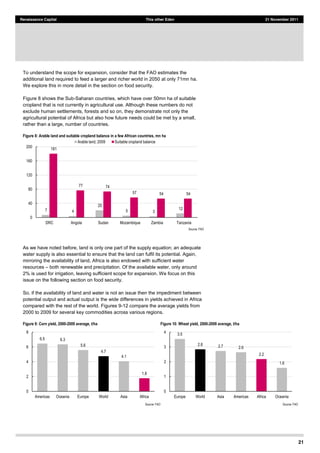
we will examine the ascendancy of new sustainable strategies in Africa with the
potential to mitigate the adverse ecological effects of agriculture and to provide a
buffer against future ecological threats such as climate change. Increasingly, it is
argued that these strategies herald a new era as demand for sustainably produced
agricultural output continues to rise.
The chapter consists of four main sections. In the first, we draw attention to two of
the most pressing ecological challenges: land degradation and climate change. In
the second, we examine the notion of sustainability as a means of addressing these
ecological challenges. The third section examines organic agriculture and
conservation agriculture as two sustainable strategies gaining ground across Africa.
We argue here that these strategies have the potential to herald a new era for
African agriculture. Of course, there are pessimists who believe that we are at
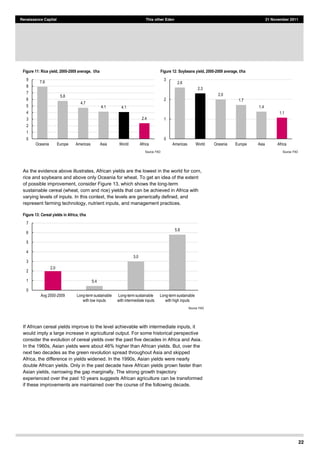
ecological limits and nothing can save us from an impending environmental crisis.
By drawing attention to these strategies, we demonstrate that African agriculture can
achieve growth with minimal environmental impact as well as provide a buffer
against future ecological threats. We close our analysis of sustainability issues by
The sustainability challenge
Orleans Mfune
University of Glasgow
Richard Ferguson
+44 7880 827282
RFerguson@rencap.com
68
Renaissance Capital This other Eden 21 November 2011
examining the notion of payments for ecosystem services and eco-labelling as tools
that present an opportunity for advancing sustainability in African agriculture.
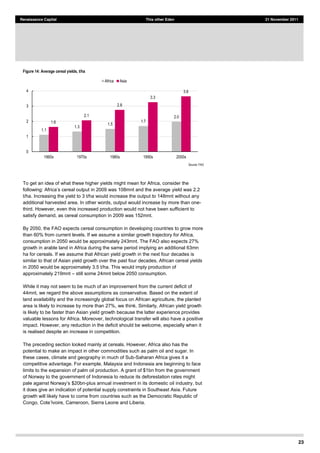
Land degradation and climate change
While there are many environmental challenges associated with African agriculture,
there is agreement that land degradation and climate change are among the most
pressing concerns. In this section, we show the extent of these problems in Africa
and their implications for African agriculture growth before discussing sustainable
agricultural strategies with potential to address these challenges.
Land degradation
In simple terms, land degradation refers to the reduction in the biological productivity
of land. According to the USDA, global land productivity has declined by 50% with
only 11% of the global land surface now considered as prime farmland. Although
most of the statistics on the extent of African land degradation are unreliable, the
FAO reckons that African yields are 2-40% lower than they should be due to
degradation. Figure 55 highlights estimates of African land degradation and how it
compares with other regions.
Figure 55: Estimates of land degradation in Africa and other regions, mn ha
Region Total land
Degraded
land
Percentage
degraded
Africa   187   121   65%  
Asia   536   206   38%  
South  America   142   64   45%  
Central  America   38   28   74%  
North  America   236   63   26%  
Europe   287   72   25%  
Oceania   49   8   16%  
Source:  AU/NEPAD,  2006  
Figure 55
degradation has the potential not only to disrupt food production and exacerbate
ecological hazards. According to the FAO, African countries have lost significant
quantities of their soils to various forms of land degradation. Some areas of Africa
are said to be losing over 50 tpa of soil per hectare. This is roughly equivalent to a
loss of about 50bn tpa of nitrogen, 2bn tpa of phosphorus and 41bn tpa of
potassium.
Soil degradation is a major problem in Somalia, Sudan, Niger, Mauritania, Ghana,
Nigeria, Ethiopia, Senegal, Rwanda, Liberia, the DRC and the Central African
Republic. Deforestation and agricultural methods that undermine the resource base
are the main culprits. Agricultural methods that remove trees from farmland and
arable expansion into forested areas all exacerbate degradation. In addition, land
degradation has been worsened by the fact that land preparation in Africa is often
carried out by tractors or ox-drawn ploughs. From an environmental point of view,
this has an adverse effect on soil structure, water holding capacity and soil fertility.
The Golden Valley Agricultural Research Trust (GART) in Zambia, for example,
notes that successful ploughing at a constant soil depth can lead to the formation of
hard pans that prevent crop root penetration and water infiltration.
69
Renaissance Capital This other Eden 21 November 2011
population. However, while human population pressure is important when looking at
land degradation, it is now commonly agreed that high population growth is not
necessarily the cause of land degradation, rather it is what humans do to the land
that is the main cause. In other words, it is unsustainable land management
practices that are detrimental to the resource base and not population per se. It
follows that if unsustainable human action has been responsible for extensive land
degradation, human action can also do much to maintain land quality or reverse
degradation. This underscores the importance of sustainable agricultural strategies
with the potential to maintain the biological productivity of the land and to trigger the
rehabilitation of degraded lands. It is argued that millions of hectares of land can be
restored through sustainable agricultural strategies thus allowing agriculture to grow
without expanding into forests and other sensitive ecosystems. The reclamation of
degraded land may allow more land to be available for agriculture and counter the
notion that we are rapidly running out of cropland.
Climate change
Although scepticism abounds, it is now broadly agreed that the earth has warmed
over the past century. Climate change is already contributing to warmer and drier
conditions, which affect the development and growth of plants and other biological
organisms across the world. So far, the IPCC notes that decadal warming rates of
0.29 degrees Celsius in the African tropical forests and 0.1 to 0.3 degrees Celsius in
South Africa have been observed. In addition, between 1961 and 2000, there was
an increase in the number of warm spells over Southern and Western Africa and a
decrease in the number of extremely cold days. In terms of precipitation, climate
change will possibly trigger a decrease in rainfall across some parts of Africa and, at
the same time, lead to an increase in heavy rainfall events in other parts. For
example, a decrease of rainfall of between 2-4% in rainfall in some parts of West
and central Africa has been observed. In addition, climate change may induce
salinity conditions, increase heat stress and influence hydrological water balances
with significant implications for the amount of water available for crop production and
livestock.
Although Africa has contributed little to GHG emissions, due to its lower economic
output and industrial activity, the Stockholm Environmental Institute notes that
African countries are disproportionately vulnerable to the impact of climate change.
The difficulties that Africa could face under climate change are perhaps being played
out in one of the worst droughts in 60 years and which struck much of East Africa
this year. Under a climate change scenario, the IPCC warns that drought episodes
are likely to become more frequent and increase in geographic extent. Currently,
more than one- -prone areas. Figure 56
shows the frequency of droughts in African countries between 1970 and 2004. In at
least 15 African nations, more than 10 drought episodes were experienced between
these years.
70
Renaissance Capital This other Eden 21 November 2011
Figure 56: African droughts over 1970-­2004, no. of droughts
Source:  UNECA,  2011  
An increase in droughts and other climate-related problems could slow African
agriculture growth significantly. The IPCC notes that areas in the Sahara are likely to
experience agricultural losses of between 2-7% of GDP while Northern and
Southern Africa losses may range between 0.4-1.3%. On the other hand, Western
and Central African areas might experience losses of between 2-4% of GDP.
According to the IFPRI, cereal production for a range of crops in Africa is expected
to decline by over 3% by 2050 with wheat and sweet potatoes expected to be the
worst affected. That said, yields of crops such as millet and sorghum, known to be
stress-tolerant, are expected to increase with climate change. Therefore, although
many crops could see a decline in production under certain climate change
scenarios, some crops should deliver higher yields.
1   2
3   5
6   9
>  10
No  data /  
no  events
Uganda
Benin
Burkina  Faso
Uganda
Eq.  Guinea
Liberia
Nigeria
Kenya
Ghana
Zambia
Zimbabwe
Angola
Tanzania
DRC
Ethiopia
Namibia
Senegal
Mali Niger
Chad
Guinea
C.A.R.
Cameroon
Botswana
Congo
Gabon
Mozambique
Madagascar
Sudan
South  
Africa
Djibouti
Somalia
Egypt
Gambia
LibyaAlgeria
Morocco
Tunisia
Western  
Sahara
Mauritania
Sierra  Leone
Somalia
Malawi
Benin
Swaziland
Lesotho
Uganda
71
Renaissance Capital This other Eden 21 November 2011
Figure 57: Projected changes in crop yields due to climate change (2050)
Source:  International  Food  Policy  Research  Institute  2010  
The vulnerability of agriculture to droughts is exacerbated by the fact that African
agriculture is largely rainfall-dependent less
are irrigated. The Swedish Environmental Institute notes that despite the fact that
of
is allocated to the sector. This poor funding partially
explains the region s failure to invest in expensive irrigation infrastructure
development. An important policy concern today is to prevent further climate change
and mitigating its impact on various social and economic sectors, including
agriculture. This requires focusing attention on agricultural strategies that contribute
to the reduction of greenhouse gases emissions and allow adaptation to any
changes. In short, it requires giving more attention to sustainability issues.
What does sustainability in agriculture mean?
The challenges outlined in the preceding section provide an indication of the extent
, and show the need to take seriously the notion
of sustainability in agriculture. The African agriculture sector needs to respond
urgently to current environmental challenges and provide a buffer against future
threats such as climate change. This is what we may term the sustainability
challenge. Although sustainability is often subject to different interpretations by
different commentators, it simply means current and future demands for agricultural
products must be met in an economically and socially viable manner, without
compromising the resource base on which agriculture depends.
In other words, sustainability in agriculture holds that it is possible to increase
agricultural production while conserving the environment. As a term, sustainability
has its roots in ecology and is used to describe the ability of ecosystems such as
forests, wetlands and aquatic systems to maintain ecological processes and
productivity into the future. It means that resources must be utilised at a rate at
which they can be naturally replenished. It also means that this generation has the
responsibility to leave better opportunities for future generations something that is
not possible if the resource base is severely depleted.
Put simply, for agriculture to be sustainable, it must address three issues:
-­25%  
-­20%  
-­15%  
-­10%  
-­5%  
0%  
5%  
Wheat   Sweet  
potatoes  
and  yams  
Cassava   Corn   Rice   Sugarcane   Millet   Sorghum  
72
Renaissance Capital This other Eden 21 November 2011
First, it must address the negative environmental and social effects of farming, such
as pollution of aquatic and terrestrial systems due to use of fertilisers, pesticides and
other agrichemicals; and soil compaction due to ploughing of agricultural lands. We
acknowledge that use of external inputs has played an important role in the
advancement of agriculture, and in ensuring production keeps pace with population
growth. Moreover, others have argued that this technological, capital-intensive
agricultural model is still the best answer to the issue of African food security. While
we agree that there is still a place for external inputs in African agriculture, and
indeed, vast numbers of African farmers still require access to these assets,
research also shows that extensive use of these inputs is ecologically unsustainable
in the long run. Moreover, in the face of global environmental changes, strategies
long-term
viability of African agriculture. Consequently, embracing the notion of sustainability
implies making important adjustments to the conventional technologically capital-
intensive agricultural model in order to relate agriculture to the ecological realities
the planet faces.
Second, sustainability implies that agriculture should provide a cushion against
present and future ecological threats such as climate change. In other words, it
implies building resilient farming systems in order to respond to ecological threats.
Resilience the antithesis of vulnerability refers to the ability of a system to
withstand shocks and stresses associated with environmental change such as
droughts, floods and pest attacks. The thinking here is that agriculture must reduce
its impact on the environment, while at the same time protect itself against future
risks if it is to be sustainable.
Third, in addition to addressing the impact of agriculture and building resilience,
sustainability in agriculture also implies going beyond mere crop production and
venturing into complex areas such as habitat protection, biodiversity conservation,
carbon sequestration and water purification. These elements are known as
environmental (or ecosystem) services, which agricultural landscapes can produce
for the benefit of society besides food and fibres. The term applied to agriculture,
that produces such a combination of outputs is multifunctional agriculture.
Sustainability recognises the multifunctional nature of agricultural landscapes rather
than the narrow view of agricultural landscapes as spaces for crop production. In
this way, agriculture can contribute towards the creation of a sustainable future for
humanity by not only being a producer of food and fibres, but by also protecting and
enhancing important environmental services required for regulating life support
integrating agro-forestry systems in farming landscapes. According to the IPCC, an
increase in vegetation density may result in a year round cooling of 0.8 degrees
Celsius in the tropics, including the tropical areas of Africa. In this regard,
sustainable agriculture may be key to arresting an increase in greenhouse gases
and improving the conservation of biodiversity.
73
Renaissance Capital This other Eden 21 November 2011
Emerging sustainable agricultural strategies in Africa
This sustainability challenge for African agriculture calls for innovative thinking that
allows the development of new agriculture strategies that incorporate this notion of
sustainability. Governments, international NGOs and businesses across the world,
have engaged in efforts to promote sustainable agricultural strategies. In OECD
countries, for example, more than 400 policy measures have been adopted and
implemented to make farming sustainable. Similarly, in Africa, two important
sustainable agricultural strategies are gaining ground among both smallholder
farmers and large-scale farmers. These are organic agriculture and conservation
agriculture. Although the two are still in their infancy, they are redefining agricultural
practice in Africa and may be important practices in the future.
Organic agriculture
It is estimated by the EU that worldwide, nearly 40mn ha of land is under organic
agriculture. In addition, worldwide demand for organic agricultural products, boosted
by consumer concerns over the environmental effects of agriculture is increasing
steadily. In Africa, there are already over 150,000 certified organic farmers. In
addition, the International Federation on Organic Agriculture Movements (IFOAM)
notes that there are many more organic farmers in the informal sector who are not
captured in these statistics. The main crops that are organically grown include
olives, oil palm, cotton, cocoa and coffee. Figures 58-59 present statistics on the
top-performing African countries in organic agriculture.
Figure 58: The 10 countries with the most organic agricultural land
Source:  IFOAM,  2008  
0  
20  
40  
60  
80  
100  
120  
140  
160  
180  
Burkina  Faso  
Morocco  
Congo  
Madagascar  
Ivory  Coast  
Ghana  
Tanzania  
South  Africa  
Uganda  
Tunisia  
74
Renaissance Capital This other Eden 21 November 2011
Figure 59: The 10 countries with highest number of organic farms in Africa
Source:  IFOAM,  2008  
Organic agriculture seeks to restrict, or eliminate entirely, the use of chemical
fertilisers, pesticides, growth regulators (such as hormones, livestock antibiotics,
food additives and GMOs) as well as other external inputs. Instead, organic
agriculture places emphasis on crop rotation, use of green manure (cover crops)
and biological means of controlling pests and organic manure. The use of legumes,
which can be intercropped with cereals, rotated or used in improved fallow systems,
is an important component of organic agriculture. Research has shown that
leguminous plants can biologically supply important nutrients such as nitrogen while
also providing food for human beings and livestock. Figure 60 illustrates the capacity
of certain legumes to improve soil fertility.
Figure 60: Estimated nitrogen fixation in the soil by food legumes
Legume species Nitrogen fixed, kg/ha/year
Sesbania  rostrata   400  
Jackbean  (Canavalia  ensiformis)   240  
Velvet  beans  (Mucuna  pruriens)   339  
Cowpea  (Vigna  unguiculata)   198  
Sunhemp  (Crotalaria  spp)   169  
Guar  (Cynamopsis  tetragonoloba)   130  
Green  gram  (Vigna  radiate)   64  
Source:  GART  2007  yearbook  
By improving the productivity of land through biological means such as the use of
legumes, organic agriculture provides an opportunity to arrest land degradation
without use of synthetic fertilisers. Other benefits of organic agriculture, according to
the FAO (2008), include increased water retention in soils, improvement in the water
table (with more water available for drinking and production during the dry season),
reduced soil erosion and improved soil organic matter. Organic agriculture also
leads to better carbon sequestration and increased on-farm biodiversity than
conventional agriculture. In addition, it is argued that organic agriculture can improve
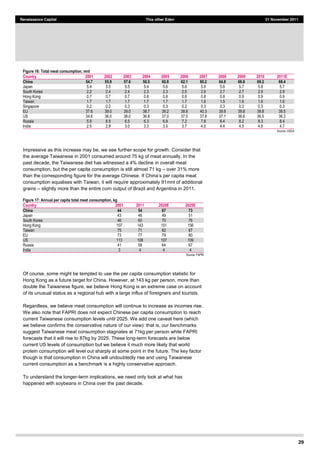
the livelihoods of small-scale farmers who practice agriculture on marginal lands.
However, despite the increased demand for organic products and these
environmental benefits, there are still some important concerns that that yields in
organically managed agriculture where external inputs are excluded are still much
lower than conventional agriculture. This has often raised the question of organic
-rising food needs in Africa and other parts of
0  
10  
20  
30  
40  
50  
60  
70  
80  
90  
100  
Ghana  
Togo  
Congo  
Madagascar  
Mali  
Burkina  Faso  
Zambia  
Kenya  
Tanzania  
Uganda  
75
Renaissance Capital This other Eden 21 November 2011
the world. However, research also shows that organic farms can withstand shocks
and stresses associated with a changing climate better than conventional
agriculture. Consequently, during drought periods, the yields from organic
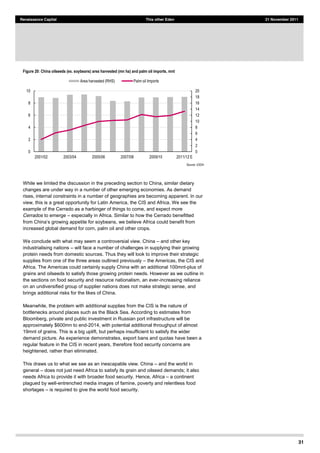
agriculture are said to be significantly higher than in conventional agriculture.
Similarly, in much drier areas, organic agriculture performs much better than
conventional agriculture. In this regard, despite the controversies surrounding the
yields from organic agriculture, we have no doubt that organic agriculture has
greater potential in fostering the resilience of farming systems to shocks and
stresses under a changing scenario than conventional agriculture.
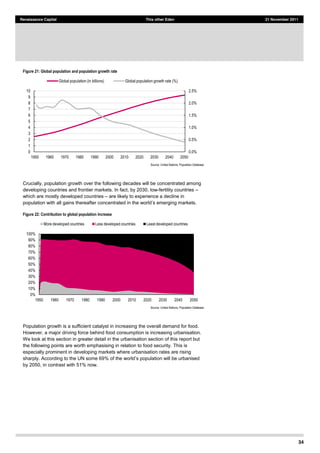
Conservation agriculture
Another important sustainable agricultural strategy that is gaining ground in Africa is
conservation agriculture. In Zambia, both commercial and small-scale farmers
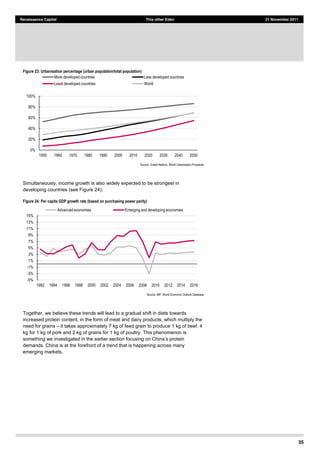
practice conservation agriculture. It is estimated that over 160,000 farmers
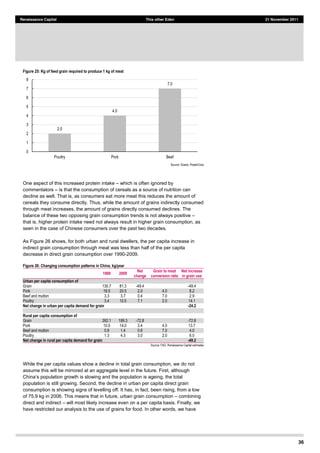
representing 10% ll-scale farmers are now practising
conservation agriculture. In Zimbabwe, there are 50,000 farmers under conservation
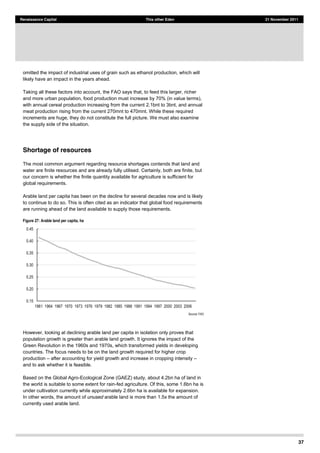
agriculture. Conservation agriculture has its origins in the Americas where it has
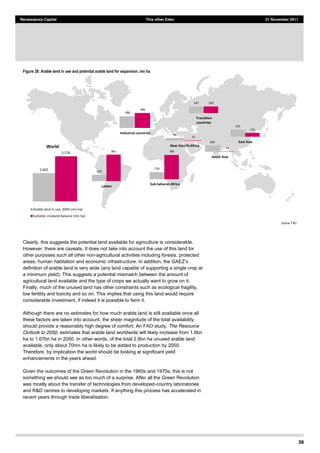
been used as a strategy for mitigating risks associated with dry climatic conditions.
In regions, like Brazi -year
history; in Africa; it is still in its infancy with Zambia and Zimbabwe seen as pioneers.
Over the past 10 years, considerable efforts have been made in Zambia to adapt the
model to an African context.
Like organic agriculture, conservation agriculture is a low-impact strategy. However,
conservation agriculture does not entirely reject the use of fertilisers, herbicides and
pesticides. Instead, it emphasises a combination of sustainable agricultural practices
that include efficient or reduced use of external inputs. Conservation has three main
principles: minimum soil disturbance through zero or minimum tillage, permanent
soil cover and crop rotation. In other words, conservation agriculture seeks to
combine minimum tillage with use of crop rotation, retention of crop residues, use of
cover crops, agro-forestry systems and the efficient use of external inputs. This
means that it can combine both organic and non-organic elements of agriculture. In
fact, it can combine different farming configurations as long as the three principles
above are retained.
Minimum tillage in conservation agriculture is achieved through use of ripping
technology (tractor- or ox-drawn) or, for poorer farmers, through the creation of
permanent planting basins with hand hoes. It is argued that conservation tillage
reduces soil disturbance to a minimum of 10-12%. In addition, minimum tillage
allows farmers to reduce energy consumption, retain moisture and decrease the
depletion of carbon stored as partially degraded organic matter in the soil. By using
minimum tillage, underlying soil pans, which have also been ploughed successfully,
can also be broken thereby allowing for adequate root penetration (GART). In
addition, by combining minimum tillage with the use of lime, improving fallow
systems and the application of animal manure, conservation tillage can trigger an
important process of restoring degraded lands in Africa. It is important to note here
that minimum tillage is a strict requirement for conservation agricultural producers. In
contrast, organic farmers are not mandated to adopt minimum tillage. However,
some organic farmers adopt minimum tillage because of its wider benefits.
According to the World Agroforestry Centre, currently about 100mn ha of land
worldwide are under minimum tillage. Although the trend in Africa is rising, only
500,000 ha is currently under minimum tillage.
76
Renaissance Capital This other Eden 21 November 2011
Permanent soil cover in conservation agriculture is achieved through the retention of
crop residues and the use of cover crops. This works to prevent soil erosion,
improve soil organic matter and moisture. Conservation agriculture may also include
agro-forestry systems in which wood perennials are deliberately integrated on
cropland. Often, Farmers are encouraged to integrate wood perennials with the
capacity to improve the productive capacity of land (e.g. through nitrogen fixation
and increase in organic litter). For example, in Zambia, Faidherbia Albida has
become the preferred tree species used in conservation agriculture. As a multi-
purpose tree, research has shown that the tree has potential to reduce the amount
of fertiliser used on farm plots. According to the GART research unit in Zambia, the
leaves of the Faidherbia Albida can contain 3.6% of nitrogen. A six-year-old tree is
capable of shedding 500 kg of leaf dry matter the equivalent of applying 18 kg of
fertiliser per ha. Research in Malawi Rhoades also shows that maize yields under
Faidherbia Albida, can reach up to 3 t/ha compared with 0.5 t/ha away from the
canopy. Apart from improving soil fertility, wood perennials also help in preventing
soil erosion, enhancing biodiversity, carbon sequestration and improving the
resilience of agriculture to climactic shocks and stresses, such as droughts and
floods.
These are important ecosystem services, and increasingly they are in demand. In
addition to the ecological benefits derived from agro-forestry systems, the integration
of woody material on farm plots can provide additional livelihood benefits for small-
scale farmers. For example, farmers can obtain fuel wood, construction materials
and other products from trees on the farm plots. In this regard, the choice of trees
used in conservation agriculture systems is crucial.
While there is still debate regarding the profitability of organic agriculture, research
has so far shown that yields in conservation agriculture are much higher than in
conventional agriculture. Conservation agriculture has the potential to increase
cereal yields by over 100% without requiring an increase in cultivated land. Since
Africa needs sustainable agricultural strategies that not only address ecological risks
but also result in higher output, perhaps this approach provides an innovative and
appealing agricultural strategy to both small and large-scale producers.
Conservation agriculture offers African farmers the opportunity to undertake
profitable agriculture, while building resilience against current and future ecological
risks. As the Zambia Conservation Farming Unit puts it, it allows farmers to
regenerate, rather than exploit the resource base.
In Zambia, much effort has been placed in the development of high-yielding and
early-maturing crop varieties. An important concern here, however, is that in the
quest to promote hybrid crop varieties, indigenous crop varieties that small-scale
farmers are already using may be rejected. Some of the local varieties are oriented
wledge of their agro-
ecosystems. Sustainability in this regard, may entail incorporating the knowledge
and practices of these farmers, an important element often ignored in conventional
agriculture.
While a range of sustainable agricultural techniques is becoming more widely
available to farmers, one of the major challenges for sustainable agriculture in Africa
is the mechanism of how to promote sustainability to levels that have a significant
influence on food security and the environment. Clearly, policy responses are
required at both national and international levels in terms of the development of
supportive policies and markets for sustainable output. One of the most important
77
Renaissance Capital This other Eden 21 November 2011
questions is how to motivate farmers to adopt sustainability measures that are
beneficial to the environment and society considering that some of the measures
imply additional costs to farmers. Equally important is how to persuade businesses
and consumers to buy into these strategies in order to create a sustainable future.
A range of measures is now used worldwide to bring various actors into the
sustainability agenda. These include the use of mandatory regulations and advisory
measures. Mandatory regulations imply that governments develop legislation that
compels agricultural producers and businesses to adopt sustainability measures.
-and-
agenda, increased attention is turning to the use of flexible economic instruments. In
particular, discussions on innovative measures to promote sustainability are
focusing on payments for ecosystem services from agriculture and the use of
premium pricing through eco-labelling. In the next section, we discuss how these
instruments work.
Direct payments for environmental measures
One of the mechanisms to have emerged to advance sustainable agriculture is the
use of direct financial rewards for farmers who incorporate environmental
sustainability measures into their farming systems. As already noted, sustainability
means that farmers should not only be considered as producers of food and fibres,
but also as providers of environmental services that benefit wider society. However,
note that while food and fibres have been produced traditionally for sale or
consumption, such that they are highly visible to the market, the same cannot be
said of environmental services from agricultural areas. For example, ecological
services that improve water and air quality can be enjoyed by everyone and are, in
effect, public goods. In addition, consumers are largely unaware about the role of
ecosystem services in their welfare. Under these circumstances, ecosystem
services have often been viewed as non-tradable goods, thus leaving farmers with
few incentives to protect or enhance them. The reality, however, is that these public
goods can easily be degraded and threaten human welfare. In this regard, it is
argued that there is a need to make markets for ecosystem services and
environmental products more visible to the all stakeholders. Mechanisms which
allow farmers to be paid for undertaking measures with environmental benefits are
ayments for ecosystem [or environmental] services
(PES). These provide financial incentives for farmers to adopt environmental
measures. The underlying premise is that farmers have to be paid for delivering a
public good as well as for opportunity costs incurred from undertaking environmental
measures in their farming systems.
While the market is said to be the major player in PES mechanisms, the reality is
that markets for ecosystem services from agricultural environments are still very
much undeveloped. In developed countries, most PES initiatives rely on public
payment schemes. In the EU, for example, efforts to establish a sustainable
agriculture culture have resulted in the development of publicly funded agri-
environmental schemes in which farmers voluntarily agree to modify their
agricultural activities in favour of sustainability issues. Thus, some 30mn ha of land
(24% of available agriculture land) comes under some form of agri-environmental
measures. While the use of public funds for sustainable agriculture is feasible in
developed countries, we doubt whether the same can be done in developing
countries. In Africa, direct payments to farmers using public funds have yet to enter
78
Renaissance Capital This other Eden 21 November 2011
the political agenda among governments or regional bodies such as SADC or
COMESA; thus their acceptability is still unknown.
An important development that may have significant implications for sustainability is
the idea of soil carbon markets given the potential to sequester and store soil
carbon. The World Bank (among others) argues that soil carbon markets can
environmental services. It is argued that this provides incentives for farmers to
undertake sustainable agriculture measures that help them to adapt to climate
change. Although these ideas are still in their infancy they are likely to dominate
future climate change debates, particularly in terms of post-Kyoto climate change
mitigation strategies. Doubts remain whether small-scale farmers can benefit from
carbon markets considering the nature of property rights in much of Africa and the
transaction costs involved. Little is known over the exact impact that such markets
would have on poor farmers.
Eco-labelling and premium pricing
An alternative means of providing incentives for farmers and businesses to commit
themselves to sustainable practices is the use of eco-labelling and premium pricing.
Eco-labels provide an opportunity for agricultural commodities produced in an
ecologically sustainable manner to command premium prices. A label acts as a seal
of approval that the commodity has been produced in a manner that satisfies
established sustainability criteria. The criteria could be resource efficiency or an
equity concern. It may also be that the product is organically produced or from a
conservation agriculture farm. Some examples of prominent eco-labels include Fair
Trade and Rainfall Alliance. While some labels are known internationally, some are
to market rice and other products produced in an environmentally friendly manner.
Some African countries already have their own organic agricultural standards,
including Tunisia, Egypt and the East African Community countries of Tanzania,
Kenya, Rwanda, Uganda and Burundi.
It is important here that we distinguish between a single attribute label and a multi-
attribute label. For a single attribute label, a product need only meet one
sustainability element, for example, a reduction in the use of external inputs at the
production stage. On the other hand, a multi-attribute label may look at several
characteristics or the entire cycle of the agricultural commodity being marketed from
production to retail shelf. The credibility of a label can be enhanced through third-
party certification where an independent organisation certifies that a particular
product meets the set sustainability standard. While it is not rare for producers to
certify themselves, for the sake of transparency it is obviously desirable that
sustainable agricultural products are certified by an independent organisation. In this
regard, it is also important for farmers and retailers to understand the credibility of
the organisation behind a label and the criteria followed in the labelling process.
Sustainability thrives on the premise that producers, consumers and businesses all
need to be aware of their environmental responsibilities. Eco-labels provide
information to retailers and consumers about the sustainability characteristics of the
product on the market. For example, the label may show that the product is from
organic farms or conservation agriculture farms. The value of eco-label products is
growing rapidly. For example, a University of California study notes that retail sales
of foods labelled as organic increased from $3.8bn in 1997 to $16.7bn in 2006. A
79
Renaissance Capital This other Eden 21 November 2011
basic assumption of eco-labelling is that consumers are willing to pay for sustainably
produced agricultural products to compensate for the cost of adopting sustainability
measures in farming. If consumers are willing to pay for it, then agribusinesses are
more likely to invest in measures to improve the environmental quality of their
products. UNEP notes that eco-labels provide producers and sellers with an
incentive to innovate. For example, they can change inputs or adopt different
technologies to lower environmental burdens. It also acts as an important marketing
tool with the capacity to improve the image of market participants involved in the
production and selling of eco-friendly goods. It is our view that with increasing
sustainability concerns, eco-labels will likely become a common feature of the
African agriculture sector.
Conclusions
We have highlighted a range of ecological challenges in African agriculture today.
We have argued that the twin goals of improving productivity and achieving food
security are at much greater risk if these issues are not addressed. While political
support continues to be given to capital and technology-intensive production,
believe that the ecological realities confronting the continent demand that attention is
also paid to strategies that address these challenges. Sustainable strategies such as
organic and conservation agriculture signal the emergence of a new way of thinking
in Africa. Although still in their infancy, sustainable agricultural strategies are
emerging as important competitors to conventional agricultural strategies. Strategies
such as conservation agriculture, for example, are already showing signs of being
more productive than conventional agriculture without any need to increase the
amount of land cultivated. We would emphasise, however, that to make a
fundamental and marked shift into the mainstream these strategies require
supportive policies and markets. It is these issues, which are likely to dominate the
future debate surrounding sustainable agriculture.
80
Renaissance Capital This other Eden 21 November 2011
Nationalism is an infantile disease. It is the measles of mankind Albert Einstein
Nationalism is power hunger tempered by self-deception George Orwell
The policy of state actors to take control of their natural resources sectors is a
simple enough concept to understand. Resource nationalism is a phrase with which
we have become familiar in recent years, although it is hardly a new phenomenon.
The notion became more pertinent in the aftermath of the colonial era as national
governments sought to take control of those assets that, in many cases, prompted
colonisation in the first place. In a post-colonial era, it could be claimed that resource
nationalism has been underpinned by several periods of inflation, most notably in
the early 1970s and the rise in commodities prices the so-called supercycle that
has characterised the past decade.
Any two-minute analysis of the causes of resource nationalism would undoubtedly,
nine times out of 10, capture and focus on these two drivers i.e. high prices and
post-colonial attitudes. However, as Halina Ward of the International Institute for
Environment and Development (IIED) points out, the issue has become more
complex in recent years and now incorporates issues such as resource security,
climate change, sustainable development and poverty reduction. Ward correctly
pinpoints that these are all interrelated and have shifted the terms of the debate from
what emerged in the 1960s (i.e. de-colonisation) and the 1970s (i.e. high resource
prices).
But if high prices and post-colonial attitudes are historic and practical drivers of
resource nationalism, there is another aspect to the subject: namely where the
sentiment originates. Ward splits these into two: producer-country nationalism and
consumer-country nationalism. Without wishing to overstate the obvious, producer-
country nationalism takes place where the resource is based and consumer-country
nationalism is where a consuming country seeks to take control of an exogenous
resource.
Ward argues that a third strand of resource nationalism has emerged in recent
years, driven by the actions of SWFs and external investors and resulting in
defensive reactions from countries targeted for investment. In other words, SWF
investment is driven neither by producer-country nationalism nor consumer-country
nationalism but something specific to the SWFs. There is an element of truth to this
observation but we would counterargue that the motives of SWFs are both complex
and emphatically not uniform.
To demonstrate this point, consider how the colonialism that characterised earlier
ages was not driven by a desire for conquest for the sake of it. The Portuguese,
Spanish, British, French and Dutch rarely subjugated populations unless they were
adjacent to or above a healthy deposit of some resource whether it was gold, spices
or copper.
Even the Chinese who are viewed, often mistakenly, as recent participants in this
process have a history of engaging in consumer-country resource nationalism.
ong,
Julius Nyerere and Kenneth Kaunda co-operated to build the Tanzara railway line,
which linked Tanzanian port city of Dar-Es-
by its need to secure supplies to promote that development as far back as the
Resource nationalism in agriculture
Richard Ferguson
+44 7880 827282
RFerguson@rencap.com
Deepak Krishna
+91 994 007 2596
DKrishna@rencap.com
81
Renaissance Capital This other Eden 21 November 2011
1960s. And that type of consumer-resource nationalism is greatly in evidence to this
day.
However, can we say the same for Saudi Arabia? Apart from the obvious producer-
country nationalism surrounding the formation of Saudi Aramco, which we outline in
the following pages, consumer-country nationalism is not a major feature of Saudi
Arabian, or most other Gulf-state, overseas investment. That said, we do
acknowledge that the Saudi Arabian wheat-growing operations in Egypt fall into this
consumer-country nationalism definition. Broadly speaking, however, the drivers of
SWF investment either fall into one of the two conventional definitions of resource
nationalism at all. In short, a distinction may
be misplaced.
However, where we think
sector, we may be about to witness a major shift whereby the behaviour of many
SWFs converges into the consumer-country category. The growing urgency within
-term food needs is
mirrored in an increasingly similar situation among the oil-producing nations of the
Middle East and one which has been hastened by the Arab Spring.
The oil & gas and mining sectors have shaped the debate in the past and continued
to do so in recent years. Thus, before we look at some of the theoretical
considerations of resource nationalism and its possible impact on the agriculture
sector we turn to how the debate has been framed by these other resource groups.
A brief history of resource nationalism
Not all cases are the straightforward ones of suspending property rights and taking
control of private assets with, or without, compensation. Some cases are the more
issues as varied as tax-evasion, anti-competitive practices, and negligence with
regard to safety, followed by punitive fines and eventually by state takeover. Or, it
could be harassment through increased taxes, royalties, and legislation mandating
compulsory stakes for the local government. The following provides a broad display
of how resource nationalism has been employed in the modern era.
82
Renaissance Capital This other Eden 21 November 2011
Figure 61: A sample of past instances of nationalism across the world
Country Action Industry Type of nationalism
Iran   Nationalisation  of  National  Iranian  Oil  Company  after  the  Iranian  revolution  in  1979   Oil  and  gas   Nationalisation  
Venezuela  
Nationalisation  of  its  oil  industry  in  1975-­76;;  gradual  opening  up  in  the  1990s,  and  then  
nationalisation  again  in  2007  
Oil  and  gas   Nationalisation  
Saudi  Arabia   Full  government  control  of  Arabian  American  Oil  Company  by  1980   Oil  and  gas   Nationalisation  
Russia  
Sakhalin  II  oil  and  gas  project  was  accused  of  environmental  violations  in  2005-­06.  
However,  these  allegations  disappeared  after  state-­owned  Gazprom  acquired  a  
majority  stake  in  the  project  
Oil  and  gas   Part-­nationalisation  
Democratic  Republic  of  Congo  
In  June  2007,  newly  elected  President  Joseph  Kabila  instituted  a  review  of  existing  
mining  contracts,  a  number  of  which  were  successfully  renegotiated,  although  some  
licences  were  revoked  
Mining  
Renegotiation  of    
existing  contracts  
Zambia  
In  2008,  during  a  period  when  commodity  prices  were  rising  sharply,  Zambia  
introduced  measures  to  ensure  a  bigger  share  of  mining  profits  -­  royalties  increased  
from  0.6%  to  3%,  corporate  taxes  from  25%  to  30%,  hedging  income  was  separated  
from  mining  income  for  tax  purposes,  capital  allowance  depreciation  rate  lowered  from  
100%  to  25%  and  a  windfall  tax  was  levied  
Mining  
Rapid  increase  in  taxes  during  a    
period  of  high  commodity  prices  
Zimbabwe  
In  late  2007,  the  "Indigenisation  and  Economic  Empowerment  Act"  was  passed  by  
Zimbabwe's  parliament  and  was  signed  into  law  on  17  April  2008.  This  act  forced  all  
foreign  companies  operating  in  Zimbabwe  to  have  51%  of  their  equity  held  by  
indigenous  Zimbabweans.  
All   Mandatory  local  ownership  
Source:  Renaissance  Capital  
Iran
AIOC, previously Anglo-Persian Oil Company, had produced oil in Iran since 1913.
Its Abadan Refinery was the largest in the world for close to 50 years. As the
company prospered, Iranian opposition to the terms of the oil concession grew and
negotiations were held between 1928 and 1932 to modify these terms. In 1933, an
amended agreement was reached but it was only moderately favourable to Iran. In
1951, the Iranian parliament nationalised AIOC and re-established it as National
Iranian Oil Company (NIOC), and the prime minister Mohammed Mossadegh broke
off all negotiations. The British government, which had a stake in the company,
collaborated with the US and engineered a coup and replaced Mohammed
Mossadegh with a pro-Western Prime Minister, Fazlollah Zahedi. However, public
opinion remained bitterly opposed to AIOC and it was forced to accept more
onerous terms its shareholding was reduced to 40% of NIOC, and it had to share
profits on a 50-50 basis with Iran. After the Iranian revolution of 1979, the complete
control of NIOC passed into government hands without any compensation being
paid to its private shareholders.
Venezuela
Venezuela nationalised its oil industry in 1975-19
Venezuela S.A. (PdVSA), a state-run oil and natural gas company. The policy was
reversed slightly in the 1990s, with certain oil sub-sectors opened to private
investment. In 1999, Venezuela opened the entire oil sector to private investment.
However, President Hugo Chavez, began to undermine this policy. In 2001, the
government decreed that PdVSA was required to have a majority stake in all
upstream oil projects. Thereafter, Chavez increased royalties and taxes paid by
private companies and rewrote contracts with private players giving PdVSA majority
control in most private projects. In 2007, Chavez nationalised the oil industry.
Foreign oil companies were forced to sign agreements ceding majority control of
projects to PdVSA. Companies that failed to sign the agreements were taken over
by PdVSA. The compensation paid to the private investors was based on the book
value of assets.
83
Renaissance Capital This other Eden 21 November 2011
Saudi Arabia
Arabian American Oil Company (or Aramco) had been extracting oil from Saudi
Arabia since 1938 after several fruitless years of drilling since 1933. The original
shareholders in the concession Socal, a forerunner of Chevron sold a 50% stake
to Texaco in 1936. In 1950, King Abdul Aziz Ibn Saud, using the possible
nationalisation of the country's oil facilities as a bargaining tool, put pressure on
Aramco to agree to a 50/50 profit share. In 1973, following US support for Israel
during the 1973 Arab-Israeli War, the Saudi government acquired a 25% stake in
Aramco. In 1974, this stake was lifted to a majority stake of 60%. The Saudi
government took full control of Aramco by 1980. The name Saudi Aramco was
adopted in 1988. Compensation paid to the external shareholders was based on
book value.
Russia
Resource nationalism has become a common theme in Russia in recent years.
What gives it a peculiar Russian twist is that occasionally the nationalism has less to
do with foreign ownership and more to do with domestic ownership concentrated
among wealthy elites. The saga of Yukos, then one of the largest non-state oil
companies in the world, is a case in point. In October 2003, the Russian government
arrested Mikhail Khodorkovsky, the majority owner of Yukos on charges of fraud,
ntled
and sold, mostly to state-owned Rosneft, which was subsequently listed on the LSE
in 2006.
Thus the Yukos case becomes something of an oddity and cannot be considered
resource nationalism in the conventional sense of the phrase, given that the
company was owned by Russians nationalised by the Russian state and
subsequently privatised through a listing on the LSE thereby bringing in non-Russian
shareholders.
An example of resource nationalism in a more conventional sense lies in the
development of the Sakhalin II oil & gas project, which was accused of
environmental violations by the Russian state in 2005-2006. At that time, it was the
only major project that did not include a Russian partner. Eventually, state-owned
Gazprom acquired a majority stake in the project and the environmental allegations
evaporated.
The Democratic Republic of Congo (DRC)
In June 2007, newly elected President Joseph Kabila instituted a review of 57
existing mining contracts as well as six mining conventions. Although a number of
contracts were successfully renegotiated, some licences were revoked. The most
prominent dispute involved Canadian mining company First Quantum Minerals and
the IFC, the World Bank's private sector arm, whose copper and cobalt mining
concessions in Katanga Province were revoked by Presidential Decree in 2010 after
a review in mid-2009 by the Congolese government. This case is still subject to ICC
arbitration proceedings in Paris.
Again, on the surface at least, this has all the hallmarks of old-fashioned resource
nationalism. However, what does provide an additional complication is the fact that
unlike many of the oil & gas examples provided earlier, the Kolwezi project,
84
Renaissance Capital This other Eden 21 November 2011
previously owned and managed by First Quantum, did not transfer directly to a
government owned entity. Instead, the asset was sold in January 2011 to Dan
Gertler, an Israeli entrepreneur. Moreover, the reviews of mining contracts and the
conventions were agreed by most market participants, which seems to suggest the
First Quantum dispute was specific to the company. The government also indicated
that all future mining discoveries must be state controlled through a 51% equity
stake.
Zambia
In 2008, at a time when commodity prices were rising sharply, Zambia introduced
measures to ensure a bigger share of mining profits. The move was mistimed,
however, catching the downturn in global commodity prices. Tax revenues from
copper sales in 2009 were only $78mn, vs $128mn in 2008, despite a 20% increase
in output. The measures imposed by the government nullified the development
agreements established to govern relationships between the government and mining
companies. The new measures included increasing royalties from 0.6% to 3%,
raising corporate taxes from 25% to 30%, the separation of hedging income from
mining income for tax purposes, lowering the capital allowance depreciation rate
from 100% to 25% and levying a windfall tax. However, the windfall tax was later
withdrawn following a fall in metals prices and: unsurprisingly, in the wake of a
recovery in prices, there have been calls within government and the media to
introduce the measure.
Zimbabwe
In late 2007, the Indigenisation and Economic Empowerment Act was passed by
Zimbabwe's parliament and signed into law on 17 April 2008. This compelled all
foreign companies operating in Zimbabwe to have 51% of their equity held by
indigenous Zimbabweans. In 2010 the government followed the passage of the Act
with the publication of regulations requiring companies to provide information to the
Minister of Youth Development, Indigenisation and Empowerment, as well as
including an indigenisation implementation plan by April 2010. This process is
ongoing: some of the major mining groups, including the two largest platinum mining
groups, Zimplats and Mimosa, both majority-owned by Impala Platinum, were given
ultimatums to present their plans for indigenisation or face losing their licences in
September 2011.
The Zimbabwe case study sits alongside the complexities of the parallel process of
land reform in the country, which has seen ownership of significant tracts of
agricultural land shift from local white farmers to black farmers. We look at this issue
in greater depth in the section Runners, riders and the open field.
Distinguishing resource nationalism and capital surpluses
We have previously taken the view that resource nationalism especially its
consumer-country variety has had less to do with strategic development, and more
to do with the sensible recycling of large current-account surpluses. The persistence
of these surpluses and the increasingly strategic thrust of the investments completed
perhaps points to a different dynamic than we previously thought. Part of this reflects
how we were shaped by our own experiences of Japanese investment in the 1980s,
85
Renaissance Capital This other Eden 21 November 2011
which seemingly had no centralised strategic theme. After all, acquiring the
Rockefeller Centre, Columbia Pictures and various chemicals companies suggests
an almost accidental portfolio approach guided by a national need to recycle vast
current account surpluses.
Similarly, in the 1980s, when a newly recapitalised British commercial sector
effectively backed by oil revenues and a correspondingly strong pound, began to
invest overseas, it acquired assets according to private strategic demand and had
little to do with consumer-country resource nationalism. That the UK accounted for
some 27% of total foreign direct investment in the US at its peak, highlighted the
diversity of those investments.
Before we turn to the potential for resource nationalism to become a more prominent
theme in the agriculture sector, we need to turn to the tools available to national
provides some useful techniques, which have been employed widely across the
mining and energy sectors. We note some of the more egregious examples from the
agriculture sector.
(1) Renegotiation or cancellation of existing natural resource contracts
The renegotiations of mining contracts in Zambia and the DRC fit in with this
methodology. The land nationalisation programme in Zimbabwe and its subsequent
redistribution to the indigenous population also contains some of these hallmarks.
South African land reform, still benign at this stage, has the potential to become
more contentious over time. For example, in South Africa, the government holds
some 30% of all land, but it remains unaudited in term of its capabilities. Meanwhile,
past grievances from the apartheid era are conveniently employed while deficiencies
in policymaking over the past 17 years of the post-apartheid era have been ignored
according to the opposition.
In short, renegotiation of contracts, whether by coercion or by following the rule of
law, is already in evidence across two of the more advanced agriculture landscapes
in Africa. Given that African agriculture is likely to expand in much the same manner
as Brazilian agriculture did in the 1990s and 2000s, we can see this tactic becoming
a major feature of the resource nationalism debate in the years ahead.
A harbinger could be seen in the agriculture sector in May 2011 when media reports
concession by a third to 100,000 ha. The reason stated was government concerns
over the ability of a single company to manage such a large area and also to enable
an annual migration of antelopes. At first glance, this looked like a classic case of
renegotiation of an existing contract. However, Karuturi Global swiftly clarified that it
would develop 100,000 ha in the first phase and the rest later and thus was in no
danger of losing the other 200,000 ha. A false alarm, but perhaps a view of the
future.
86
Renaissance Capital This other Eden 21 November 2011
(2) Rejection of particular kinds of governance frameworks (such as
production-sharing contracts)
In a sense, this categorisation is an extension of the previous aspect, i.e.
renegotiation or cancellation of contracts. Also worth highlighting is how a number of
geostrategic shifts are playing a part in this aspect of resource nationalism.
Globalisation, the emergence of the Washington Consensus, the roles of NGOs,
supranational authorities have all led to a blurring of the respective roles of the state
and the private sector. This allows governance frameworks to be challenged or
rejected.
Added to the issues outlined above is a range of other issues which affect
governance on many levels; for example, environmental standards, sustainability
guidelines, health and safety regulations, subsidy regimes, institutional involvement
and so on. In other words, the possibility to interfere in governance frameworks has
increased exponentially in recent years.
.e. the round
with agriculture and services at its cent
forerunner, the General Agreement on Tariffs and Trade (GATT), in 1947 and
involving 153 countries, highlights the difficulties in finding common ground
especially in an area like agriculture. In short, the opportunities for resource
nationalism to flourish through the workings of governance frameworks are
wideranging.
(3) Nationalisation
Nationalisation in the oil & gas sector is obvious and well known: NIOC, Aramco,
PdVSA and Yukos represent four prominent nationalisations over the past 50 years.
Nationalisation in the agriculture sector, however, is a more complicated affair. This
is a slight generalisation but what prevents the agriculture sector being nationalised
in the same manner as oil and gas corporations is its fragmentation, i.e. the sector is
still dominated by undercapitalised smallholders in contrast with the large corporate
entities (and therefore easier targets) that prevail in the oil & gas sector.
Moreover, not only is the sector fragmented, agricultural nationalisations in the past
have also usually had disastrous consequences. Usually nationalisation has been
associated with collectivisation: the
enterprises and the obliteration of the Kulak class in the 1920s were followed by
famine in the 1930s. Nationalisation of the Chinese agricultural sector and the
obliteration of the landlord class in the 1950s were followed by a famine neatly
sandwiched between the Great Leap Forward and the Great Cultural Revolution.
1970s resulted in a famine within six years of its implementation
In summary, the nationalisation of land is seemingly counterproductive. In a sector
prone to volatile output, highly fragmented and undercapitalised, outright land
nationalisations is a dangerous notion. We think even the slowest-witted politician
probably recognises this.
Contrast this with the oil & gas sector. It does not matter that PdVSA drills for oil in a
complex geology and that it is an inefficient producer. The fact it can still produce an
87
Renaissance Capital This other Eden 21 November 2011
inefficient 2.2mn bpd of oil a day provides considerable scope for a government-
owned corporation to bribe the electorate with its own store of wealth.
However, note the example of resource nationalism of the Yukos affair in Russia
outlined earlier. This involved the nationalisation of an existing domestically owned
asset, which was eventually sold to international investors and other domestic
owners. So, it was different to the other forms of resource nationalism in that foreign
involvement remained a lesser issue. This could provide a parallel of what might
occur in South Africa and has already happened in Zimbabwe in recent years. It is
possible that land nationalisation and redistribution becomes a feature of the South
African (SA) landscape in the future. We see clear implications, not just for South
African agriculture under this scenario but also for the rest of African agriculture.
Just as China needs to diversify its basic food sources to reduce its risk exposure to
too few supplier nations, SA farmers are in a similar position and need to diversify
into other jurisdictions. For all the talk of SA farmers shifting to places like Georgia
and Ukraine, most will continue to work in Africa. Thus any possible nationalisation
and/or redistribution of land is likely to provide SSA with a pool of skilled managers
capable of resolving the crisis of middle management that is a hallmark of the
agriculture industry (see Runners, riders and the open field).
(4) Rapid increases in taxes payable by natural resource companies in times
of high commodity prices
Again, this was the favoured methodology employed by the Zambian government in
its negotiations with the mining companies over the past few years and outlined
previously. It is also one of the most effective weapons at the disposal of national
governments when they seek to redress some imbalance, grievance or injustice and
it has been used with devastating effect in the agriculture sector. One of the most
prominent manifestations of this policymaking tool was in Argentina when the
government imposed a 10% export tax on primary agriculture produce including
soybeans, corn and wheat to replace revenues lost during the collapse of the
Convertibility System in December 2001. By November 2007, these taxes had risen
sharply the lowest rate was 28% (wheat) and the highest was 35% (soybeans).
Overall, export taxes accounted for some 43% of all taxes paid for the sector. By
March 2008, a national strike and a narrow vote in the Senate, prevented
agricultural export taxes being raised to a range of 39-44%.
We see another parallel with Argentina as worth highlighting. In 2003, the agriculture
dependence of the government on this sector is something that might well apply
across Africa in the years ahead if the agriculture sector does begin to account for a
greater share of GDP.
However, this is possibly a longer-term issue to consider, rather than a short-term
one. One crucial difference between the Argentine example and most African
countries is that the former concentrated on export taxes which were: 1) relatively
easy to enforce, and 2) under the control of the national government, rather than the
powerful provincial governments. The fact remains that African food exports are
unlikely to be a major theme in the next decade. The c
ensures import substitution is likely to be a greater issue than export-led growth.
88
Renaissance Capital This other Eden 21 November 2011
The output of land is easy to monitor,
Therefore, we expect tax raids to become a more important feature of the
agricultural sector in the years ahead.
(5) Stringent and mandatory regulation of local content
This is a common feature of oil licensing. In the bids rounds for Nigerian oil blocks in
2000, 2005 and 2006,
the bidder had to outline the extent to which Nigerian goods and services would be
part of their bid. The original requirement was extended in the 2005 round, when
effectively businesses majority-
owned by Nigerians. This was not a new phenomenon: in 1969 at the earliest
stages of development of the Nigerian oil industry the government set out local
content rules with the passage of the Petroleum Act.
Clearly, this tool could be used with relative ease across the agriculture sector. The
Russian government proposed a system in March 2009 that would grant subsidised
loans on how much local agricultural machinery and primary product were acquired
by the borrower. The Ukrainian government is also considering the imposition of
legislation that would permit ownership of land, but restrict it to Ukrainian nationals
and businesses.
It does not take a huge leap of imagination to see how a localisation policy could be
implemented through inputs, on seeds, fertilisers and machinery. Alternatively, we
could look at this from the consumer-country nationalism perspective and the ability
companies benefitted. We would go as far to suggest that at some point in the next
could be involved in some local
content dispute in Africa, with argument centred on loans linked to machinery
purchases. A common enough theme in the arms industry we fully expect it to be
replicated in the agriculture industry in the years ahead.
(6) Restrictions on exports of natural resource products
This area has seen the clearest example of agriculture resource nationalism.
Consider the export bans put in place across multiple countries (Russia, Ukraine,
Kazakhstan, Argentina and others) during the 2008 food scare. During that crisis, it
was difficult to distinguish how much of policymaking was driven by a genuine fear
that continuing to export would have reduced food security levels to dangerous
levels, and how much was due to a desire to put a lid on domestic inflationary
pressures. Most likely, we believe, it was driven by both factors, and the fact that
both existed highlights why policy measures were activated so rapidly.
This is not a monopoly of producer-country resource nationalism; it also has
implications for consumer-country resource nationalism. We believe one of the more
explosive geostrategic themes over the next two decades will be the need for
consumer countries to guarantee food supplies when restrictions are implemented
that at some point in the not-too-
We would add that this possible enactment of restrictions during periods of food
insecurity has possibly hindered investment in the sector. We believe firmly in
89
Renaissance Capital This other Eden 21 November 2011
number of governments, corporations and funds which hesitate to make investments
because of the need for one party to establish an offtake agreement and the other
parties to see the potential areas of conflict inherent in that agreement. The logic of
the argument is seemingly irrefutable: you cannot achieve food security if it done at
This is an area we investigate in other sections of this report. Suffice to say at this
juncture this will be one of the most critical aspects of agricultural policy in the years
ahead especially in a part of the world plagued by food insecurity for generations.
(7) Reservation of specified quantities of natural resources, on grounds of
national security, food security or energy security
An alternative to outright export bans is to implement a quota system. This is already
a standard feature of the agriculture sector. Ukraine implemented a quota system for
all cereals in the final quarter of 2010 when a drought hit CIS supplies in contrast
with Russia, which implemented an export ban similar to that initiated in 2008. The
quota system in Ukraine permitted 3mnt of maize exports and 1mnt of wheat
exports.
We believe this is likely to become a major feature of the agriculture sector in Africa
in the years ahead. Where it becomes more controversial is that in Africa, droughts
and shortfalls can be replaced by more ominous words like famine. As noted above,
we do not think it will be politically possible for the export of food to take place when
parts of Africa suffer from reasonably regular periods of food shortages. In short, we
think quotas are likely to become a component of the resource nationalism debate in
the years ahead.
(8) Requirements for investors to make increasing contributions to direct
social spending by executing infrastructure projects; or investing in a variety
of social investment projects in localities; or at the national level where they
invest
We believe this is likely to play a major part in government policies in the years
ahead. However in our view, the sensitivities surrounding land, agriculture, food and
exports are all so apparent in Africa that the investor that fails to put social policy at
the heart of his or her investment programme is likely to suffer a major commercial
handicap in the years ahead.
Governance across much of Sub-Saharan Africa is weak, and has been replaced, to
an extent, by that provided by international institutions and NGOs. This feeds down
into many programmes tailored by investing organisations. Clearly, this might
change over time as institutions are strengthened and the wealth effect begins to
spread. However, it is likely to be a focal point going forward, and we have no doubt
it could be used to promote resource nationalism.
90
Renaissance Capital This other Eden 21 November 2011
Future flashpoints
If these are some of the direct and indirect means available to enforce resource
nationalism, what does the future hold, specifically in terms of African agriculture? In
its simplest terms, Africa has productive potential while China has long-term
strategic needs across a range of key grains and oilseeds. Yet,
investment policy in overseas food supply has been tactical and marginal, rather
than strategic and wide-ranging. Why is this the case? And why it is different to the
experience in the energy and the mining sectors where China has gone to
considerable lengths to secure oil and mineral supplies?
The reasons are fourfold, in our view: two are political, and two structural:
The primary political issue is clear: despite its long-term strategic food needs,
China can, in the short-to-medium term, rely on a narrow range of strategic suppliers
such as Brazil, Argentina and the US until it figures out a way to bring other strategic
suppliers into play. This lack of diversification is offset by the fact that while the
Americas may be a stopgap measure for China, it could at least endure for years. In
a sense, we acknowledge this issue (see our previous comments on resource
nationalism).
The second political theme is that land remains a deeply sensitive issue.
Consider that China, in addition to other food importing emerging markets, has three
ways of securing supplies: it can buy land and farm it, lease land and farm it, or
secure supplies through off-take agreements. None of these issues is
uncontroversial. The ownership of land is political, leasing the land still suggests
disruption whether social or economic, and finally the establishment of an offtake
agreement, despite the comforting absence of ownership or leasing rights, would
have major political ramifications in the event of a famine.
Consider the case of Daewoo in Madagascar now a cautionary tale for prospective
Logistics negotiated a 99-year lease on some 1.3mn ha of land in Madagascar
to grow corn and oil palm. The massive scale
of the project and the generous terms that Daewoo received fuelled widespread
protests against the deal and the government. While not the sole cause, opposition
to the deal was one of the reasons for the eventual downfall of then president, Marc
Ravalomanana.
The first structural reason why China has not invested heavily in the African
agriculture sector directly is the fragmented nature of the sector. As we noted
earlier, acquiring a deposit of oil and getting it out of the ground and into a refined
state within your own market despite any geological and engineering challenges
along the way is relatively straightforward compared to building an agriculture
supply chain. Perhaps we can summarise best this way: the oil industry has plenty
of middle managers who can get oil from A to B. Agriculture lacks an industrial
middle management capable of doing the same. This is an issue we explore in
greater detail in the section Runners, riders and the open field. To emphasise the
point of fragmentation vs concentration: ask which is easier to implement an
effective scorched-earth policy on agricultural land, or a scorched earth policy on oil
wells (as conducted, for example, by retreating Iraqi forces fleeing Kuwait).
91
Renaissance Capital This other Eden 21 November 2011
The second structural reason is the lack of an integrated approach to
agriculture investment. Unfortunately one of the biggest challenges in agriculture,
especially in areas where farming is already marginal, is to see beyond the
individual assets and ask how integrated they are. Therefore, an agricultural land
bank is worthless if you have to travel 300 km for a bag of fertiliser or 600 km to a
processing facility. What use are empty grain silos if you have nothing to fill them
with? Even if you have storage facilities and productive farmers filling them do you
also have relationships with food processors to ensure a market for the basic
product? The inability of many investors to take an integrated approach to
agriculture is usually why so many of them become, or will become, distressed
assets.
To answer all four points requires a great deal of imagination, strategic foresight and
execution skill; and given the lengthy lead times in agriculture it is hardly surprising
that the level of investment among the food-consumer countries, or their proxies,
has been marginal, despite their long-term needs.
Where agriculture may mirror other natural resource
sectors
As can be seen from the examples outlined above, we conclude that several themes
might play out across the agriculture sector with particular reference to resource
nationalism in the years ahead. Clearly, the conditions that characterised an earlier
wave of resource nationalism in the energy sector in the post-WWII landscape (high
prices and anti-colonial sentiment) remain capable of acting as catalysts in the
agriculture sector.
High prices are a predictable catalyst for resource nationalism. Undoubtedly there
are examples where resource nationalism was conducted in an era when oil and gas
prices were not necessarily high (the nationalisation of the NIOC in the early 1950s
was a prominent example). Nevertheless, the bulk of nationalisation or renegotiation
of contracts, shareholdings and so on took place when prices were high. Even the
full nationalisation of the NIOC did not take place until 1980.
Throughout this section we have focused on resource nationalism as an issue that
connects internal and external forces. However, within the agriculture sector, the
flashpoints are equally likely to be internal. As noted in the urbanisation-focused
section of this report, the newly urbanised seem to be among the biggest buyers of
agricultural land outside the cities. Accordingly, the areas of friction in the next few
years are equally likely to be domestic affairs driven by divisions among the urban
rich, the urban poor and the rural poor, as they are by external forces.
Figure 62 highlights some prominent examples of resource nationalism, primarily
trade restrictions that were imposed during the 2007-2008 commodities price rise.
92
Renaissance Capital This other Eden 21 November 2011
Figure 62: A sample of trade restrictions imposed during 2007-­2008
Date Country Commodity Action
November  2007   India   Rice   Ban  on  non-­basmati  rice  exports  
March  2008   Vietnam   Rice   Tightening  of  export  restrictions  
April  2008   India   Rice   Export  tax  on  premium  basmati  rice  
           
March  2007   Argentina   Wheat   Ban  on  exports  
July  2007   Ukraine   Wheat   Strict  export  quotas  
November  2007   Russia   Wheat   Export  tax  
April  2008   Kazakhstan   Wheat   Ban  on  exports  
           
December  2007   China   Grains  and  oilseeds   Removal  of  VAT  rebate  for  exports  
January  2008   China   Grains  and  oilseeds   Export  tax  
Source:  Defra  (UK),  FAO,  Renaissance  Capital  
Free market vs closed market
At the heart of the issue over resource nationalism is a paradox. On one hand, the
opening up of agricultural markets in the past decade, the establishment of new
production centres and a continuous improvement in investment flows into the
sector all suggest theoretically at least that agriculture is opening up, liberalising
and becoming much more free. One might even extrapolate this into a view that the
Washington Consensus is coming to agriculture as the sector takes on more of an
industrial and corporate form.
But while it is an easy and appealing picture to paint, it is an inaccurate reflection
of what is likely. In reality, just as it has always been, the agriculture sector will
remain a series of paradoxes, contradictions and inconsistencies. So, while the
language of the free market will be spoken, the underlying reality will still involve
subsidies, co-operatives, government controls and an array of taxes, controls,
checks, balances and bureaucracy.
Estate in the late-1950s understood how markets and bureaucracy would need to
rub alongside one another. Many years ago when one of the authors of this section
was scribbling away in Hong Kong, he would see this concept in practice. While the
Crown Colony was viewed as a paragon of free-market virtue, it was in reality,
dominated by private-sector cartels or regulated duopolies and monopolies. We
believe it is fitting to see the agriculture sector in these terms.
So this brings us to a conclusion: resource nationalism is a fact of life in the energy
and mining sectors. It will likely become a major feature of the agriculture sector in
the years ahead, as well. However, there are crucial differences, including the
fragmentation of the latter vs the former. It will also act as a brake on investment
unless the process is managed well by investors and governments. We emphasise
that the existence of resource nationalism does not necessarily imply an ill-
functioning market; rather it may well mirror other conventional industrial sectors
where ownership restrictions have been a fact of life for decades.
The lessons we draw from the Cerrado transformation, for Africa, are simple
government policies that offer incentives to agriculture, a favourable investment
climate, availability of credit, investment in infrastructure, improved access to
markets and investment in technology. Africa is currently lagging behind in most of
these aspects, although some countries are ahead of the rest.
93
Renaissance Capital This other Eden 21 November 2011
In this section of the report Isak Pretorius, CEO of African Commercial
Development, and James Lutzweiler, Vice-President of Strategic Development at
Joint Aid Management,
Those NGOs with an anti-development agenda can take their business elsewhere
Oluniyi Robbin-Coker (Economic Adviser to President Koroma of Sierra Leone)
What has caused more misery than the follies of the compassionate? Friedrich
Nietzsche
What is Joint Aid Management?
Joint Aid Management (JAM) began 27 years ago during the famine and crisis in
Mozambique in the early 1980s. Responding to widespread suffering, a South
African businessman, Peter Pretorius, invested all he had to begin a vocation to
reach those who were dying of hunger. In 1984, he was stranded in Pambarra,
Mozambique, at a food distribution centre for 10 days without food or a change of
clothes alongside 34,000 starving people. Each day more than 30 people died and
he helped bury them in shallow trench graves. Broken by the reality of this suffering,
Peter resolved to feed and help as many people as possible.
fortified blended foods and provide logistics, transport and storage in areas with little
infrastructure. JAM developed its own end-to-end supply chain capabilities, built
manufacturing facilities, procured regional commodities, established trucking fleets
and provided warehouse space, scheduling and maintenance. After the war in
Mozambique, JAM evolved into one of the largest school feeding organisations in
Africa. Today, it feeds over 700,000 children each school day in Angola,
Mozambique, South Africa and South Sudan.
This work continues, but JAM acknowledges the need to face the issue of
sustainability. School feeding programmes are not sustainable since primary school
students are not a market. However, providing a daily school meal has a hugely
positive impact on the academic and general well being of students. Accordingly,
JAM works with host governments to create national school feeding programmes
funded by national budget expenditure and creating opportunities for corporate
sponsors to join hands with government. While it may not be sustainable in a
commercial sense (i.e. a viable business), JAM notes that it has the potential to be
sustainable in a social welfare sense.
JAM found it
necessary to reflect on the reality of sustainability and look at what its humanitarian
interventions were doing. The organisation concluded that all its interventions were
unsustainable unless it fundamentally altered its approach to the question of aid.
Although JAM had established a solid supply chain organisation and commercial
expertise, it was developed out of need, not profit. The aim was only to feed children
while the value added in the business transactions were of secondary concern. The
perspective was one of charity rather than investing in a supply chain. The outcome
was the priority and the process was important only to the extent that it supported
Case study
Joint Aid Management
Isak Pretorius
African Commercial Development
James Lutzweiler
Joint Aid Management
94
Renaissance Capital This other Eden 21 November 2011
the outcome. Despite the possibility to add value to the processing and movement of
blended foods, many commercial opportunities were overlooked because JAM did
not consider how to use this infrastructure to leverage commercial business
particularly in the agriculture value chain. The organisation kept coming back to the
same question: could it remain true to our mission and do business at the same
time?
In the debates over development aid, there are well-founded reasons to join the
bandwagon of critics. There is a deep and prestigious literature replete with
examples of how aid has failed to bring about positive change in the lives of those
ravaged by poverty. What JAM presents here, however, is not a tale of failure but
rather a vision for success borne out of decades of well-meaning but fundamentally
flawed aid programmes.
Criticism of development aid focuses on foreign bilateral government aid,
development industry contractors, humanitarian aid and pure charity. For
convenience, let us call this group the aid industry. Each of these four categories
ought to have an interdependent role to facilitate outcomes in favour of the
impoverished. Unfortunately, the aid industry has, for most of its history, either
misunderstood or misdirected the promise to help. Passion and energy that has
been spent over decades of unmet expectation needs to take a new approach.
Above all it needs to demonstrate that charitable aid is noble but investment [as aid]
is divine.
JAM has firm roots in humanitarian aid: its programmes focus on nutritional feeding,
school feeding, assistance to orphans and vulnerable children, the provision of water
and sanitation as well as skills development and community training. JAM believes
that without education there can be no development and without adequate
nutrition there cannot be effective education.
Feeding children, partnering with communities to address health and social issues
and providing comfort from the distress of poverty is widely accepted as,
instinctively, the right thing to do. However, this action alone is insufficient and
the current development aid model
promotes a myth of sustainability. In fact, pause to consider th
ised in the 1987 publication, Our Common Future.
It is actually a tautology that has defined two generations of development theory. It
stands to reason that if an aid programme is not sustainable, it is not development.
The term was composed originally to establish a link between meeting the needs of
become, however, the myth of development, because the theory was predicated on
the notion of aid as charity meeting the needs of the poor instead of being driven
by how to create wealth among developing nations to eradicate poverty.
Thus, donors and development practitioners today at the end of each funding
proposal are compelled to explain how the funds and activities will be sustainable--
the veritable Holy Grail of development. The reality is, however, that the current aid
model must integrate with the commercial sector. Six generations and an entire aid
industry have been predicated on giving at the expense of investing. Michael
The Road To Hell raised these issues as far back as 1997 and another
generation has continued to give in the intervening years.
95
Renaissance Capital This other Eden 21 November 2011
Given this collective, credible body of evidence JAM finds itself at a point that forces
the aid industry to answer an uncomfortable question: can humanitarian
organisations preserve their noble posture when outcomes are tied to commercial
development? Has imbalanced economic growth preserved poverty? This is where
the discussion must now begin and how the issue must be framed. The aim of
development must be changed from a never-ending subsidy to the supposedly
permanently helpless poor to a transformation of those poor into self-sustaining,
self-perpetuating producers of wealth.
Ideological struggles
struggle with this question is not new. An ideological battle, at one point
involving the WTO, emerged in 2005 as to the appropriateness of in-kind food aid,
even calling into question whether its underpinnings were moral. The point here is
not to argue the merits of in-kind food aid but to show how old model thinking was
being argued in a well-
the time as a solution to combat the predatory practice of agricultural subsidies in
the West and directly support millions of local smallholder farmers, bypassing the
immoral and ignoble commercial farming establishment and the government policies
that upheld them. The problem was that a Washington consensus of NGOs knew
that business
solution they were seeking rested in reaching out to the commercial enemy they
were attacking, thus continuing an entrenched policy tradition of well-meaning
NGOs.
JAM argued that the proposed policy solution was being made without a clear
understanding of its practical outcomes. Hunger is not going to be eliminated solely
by directing money from foreign donors into recipient markets, particularly in the
absence of significant institutional, structural and policy change in those markets.
, the water is proposed massive
increases in foreign aid, and the bucket riddled with holes is the current state of
most agricultural markets in the developing world.
Specifically, the increased foreign aid is not going to be benign and will most likely
exacerbate the problem. In 2005/2006 local purchase studies conducted by the
WFP in Uganda and Ethiopia bore some startling results for the supporters of local
purchase. They discovered that a few individuals heavily influence weak commodity
markets. In effect they become price setters in local markets. Thus, well-meaning
NGOs were actually supporting policies that fostered more unstable agricultural
markets and created price fluctuations that either harmed local smallholder farm
gate prices (since they are price takers) or increased the market price for
consumers.
Around the time of this debate, an article was published in Business Report on 29
October 2008 stating that South Africa was looking to: 1) protect its markets from
imports in certain sectors, 2) strengthen its position with strategic grain reserves,
and 3) implement stronger protective agricultural policies to stabilise domestic
supply. The most significant effect of this policy shift was on the distribution of
commodities around the region, which were meant to address other countries' food
insecurity problems. The WFP spent approximately $280mn in Southern African
local (i.e. regional) purchases in 2007, buying from South African markets and
96
Renaissance Capital This other Eden 21 November 2011
distributing throughout the region. That was a significant contribution to rein in the
outflow of commodities and reduced domestic supplies. This was implemented by
the strongest agricultural economy in Africa as considered how to protect itself from
an impending food crisis. It was an exemplary step taken to prevent a crisis before it
erupted.
This discussion is important because it pinpoints a mentality that needs to change.
NGOs know they need to engage in agricultural markets but, because of a
perpetuated myth of neutrality and impartiality, they operate above the system.
NGOs wanted to play by a set of flawed rules, ignoring how the world really works.
The net effect of local purchase is that government "aid" agencies are becoming
commercial traders and creating false markets within an agricultural economy. In
order to sustain a market presence, there would have to be long-term funding for
t sustainable.
its role not only as
Thus, JAM was left with a choice either to continue in a tradition of charity or engage
properly in commercial activity. It chose the latter and established a for-profit
business that will focus primarily on agricultural development in Africa - African
Commercial Development (ACD).
-
model reflects a desire to own or invest in as many links in the supply chain as
possible. Commercial failure across the continent is caused by constraints that
would cause a business to fail anywhere in the world: single product factories that
do not operate year round, and therefore suffer from high unit costs, the difficulties
of maintaining skilled staff, poor health conditions of the workforce, lack of
education, lack of critical mass, poor farming techniques and lack of inputs. All of
these create a weak environment to attract investment capital and promote
economic growth.
The cycle of perpetual poverty
How is it that decades of work and billions of dollars applied via the aid industry a
cycle of poverty has been perpetuated and reinforced? A community living in abject
poverty (i.e., less than $2 per day) is a common recipient of international aid. These
inputs arrive in different forms, either in microcredit loans or through numerous
donor-led projects. Aid artificially props up the community or individual and often
accomplishes what the international aid industry refers to as community
development. This assistance injects people into a new reality, often doubling or
tripling an income to $4 or $6 per day, temporarily improving and saving lives.
However, while this certainly improves lives, it does not truly offer a long-term
solution to poverty. While $4 or $6 per day may not be abject poverty, it is still
poverty.
Despite real change in Africa, vulnerable communities remain exposed to common
shocks. When universal shocks such as wars, droughts, floods and other natural or
man-made disasters occur, a $4-a-day community will lack the resilience to absorb
these shocks and the realities of everyday life. Without that ability, a community,
97
Renaissance Capital This other Eden 21 November 2011
which has enjoyed an improvement from the traditional community development
project, will immediately return to abject poverty. In an emergency, the international
aid community will again inject aid dollars back into a vulnerable community in the
form of emergency relief aid and later development aid. That system of aid has
perpetuated a cycle of dependency because it never addresses the long-term
reasons why people need help or their need to create resilient communities.
Figure 63: Traditional aid response
Source:  JAM  
True development
In order to create lasting change the international development industry needs to re-
focus its efforts on true growth and development. Rather than present solutions that
bring communities and individuals from abject poverty to a higher level of poverty,
our industry must aim higher and break this cycle. True development is a system
that develops communities to the point that they can resist common vulnerabilities
The key to this goal is to link communities into world markets, using the resources
and industry that most communities can easily access and currently utilise: the
agricultural sector.
The success of the US and other western democracies is due, in part, to the
modernisation of the agricultural sector. As US commercial farms expanded, more
subsistence smallholder farmers moved off the land and into other industries.
Support industries developed, fostering growth in both the agricultural and industrial
sectors. By applying the lessons learned from historical successes in the United
States and elsewhere, the importance of sustained real economic growth is
recognised. Current aid structures, however, stymie this growth by artificially inflating
economies and denying necessary growth. Perhaps, this could be seen as an
African version of Dutch disease. A bridging mechanism is required then to facilitate
the inclusion of the African agricultural sector into the modern global economy. Only
by generating demand for African output can sustained growth occur.
In a 2009 article in Foreign Policy magazine, Robert Paarlberg pointed out that 60%
of all Africans live and farm in rural areas, often making less than $1 per day.
far
States because they lack all the basic necessities for productive farming: improved
seeds, fertilizers, water, electrical power, education and rural roads to connect them
PERPETUAL
POVERTY
> $4
ABJECT POVERTY
< $2
AID
INPUT
(Relief)
AID
INPUT
(Development)
AID
INPUT
(Development)
SHOCK
98
Renaissance Capital This other Eden 21 November 2011
to m Nevertheless, rather than investing in agricultural development, over
the past three decades
assistance budget for Africa by 85 percent. The United States now spends 20 times
as much on food aid to Africa as it spends on agricultural development to help
. Paarlberg urges that
It is through investment in the agricultural sector that Africa will start to develop key
institutions, markets, infrastructure and technology that are crucial to the creation of
commercial farms with increased access to greater markets on a national, regional,
and international scale, we can break out of the cycle of perpetual poverty.
Sustainable development is further characteris
and accumulate wealth rather than simply trying to survive. Subsistence
communities are unfamiliar with wealth creation and accumulation but more simply
with survival. In contrast, the paradigm shift in development that JAM envisions will,
it hopes, result in the integration of the economically poor into a commercial value
chain with national, regional, and international reach. Through a three-point
programme of: 1) developing micro-economies, 2) introducing subsistence
communities to access and linkages into a better market system, and 3) mentoring
such communities to move from a smallholder society to that of an integrated
agricultural economy, infrastructure can be modernised and formal and lasting
employment created in a sector where risk, instability and food insecurity can be
managed.
Traditional aid projects only reinforce smallholder famers as subsistence farmers.
JAM asserts that
the systems and capacity must be created for them to become commercial farmers.
Through the creation of commercial farms and a more integrated farming industry,
African populations can begin to create and accumulate wealth. These micro-
economies will then result in numerous support industries (see below) and further
market development thus creating a formal employment sector of entrepreneurs
and employees rather than numerous smallholders competing continuously in a self-
defeating cycle.
Modernisation of the agriculture sector will lead to the development of support
industries such as logistics networks, secondary and tertiary processing plants, retail
outlets and many other small industries. Low-yield and subsistence farming will give
way to a system of mutual beneficiaries rather than self-defeating competition.
Rather than flooding a market with numerous examples of the same product, as
many development projects accomplish, it is possible to create and foster the need
for new support products and industries.
The key thing here is that by creating a successful agribusiness, former subsistence
farmers move into other sub-sectors along the agriculture value chain. New
industries and diversification mean a society that has the ability to absorb shocks
and that should mean an end to dependency on the international aid system.
99
Renaissance Capital This other Eden 21 November 2011
Joined-up markets
African agricultural markets are often isolated and fragmented. Where trading does
exist it is often thwarted by severe market dysfunction. To understand how a
functioning market ought to work, consider three separate players:
1. Local communities
2. Regional and national groups and alliances
3. International and multinational entities
While agricultural trade does exist in Africa, it often cannot successfully access
these other two players.
Figure 64: The problem
Source:  JAM  
Figure 64 illustrates these relationships. Local farmers and traders have limited
access up the chain where true opportunity lies due to severe market dislocations.
Where trade does exist in the system, local traders often exploit this market
imperfection for their
confined to his village or city market, often with hundreds of small farmers selling the
same product at the same price. In the event that the farmer does have access to a
trader, the latter explo
prices for his commodities. While there is interaction between the international and
regional levels, these relationships are characterised by chronic dysfunction.
Multinational  and  International
Regional  and  National
Local
Dysfunction
Break
Regionaland National
tradersexploitmarket
dysfunction
Localtradersexploit
marketAccessbreak
100
Renaissance Capital This other Eden 21 November 2011
The smallholder farmer in Angola who farms on 1 ha of land may produce 1-1.5 tons
of tomatoes. The smallholder lacks infrastructure, storage and transport. He or she
can only access a local market. His only opportunity for resale is a trader who gives
him a set price for the product. This same trader may sell the same product at the
regional level for three-to-four times the price offered to the smallholder. As a result,
the true value and is never transferred down to the undercapitalised farmer.
How does one go about eradicating these market inefficiencies to create true
commercial market linkages across Africa? The solution is to create local markets
that have the capacity to feed into reliable regional and international markets, which
in turn, have the capacity to move products and commodities through the value
chain while receiving the benefits of trade as it moves down the chain. This results in
a system where the local markets feed into and are reliant on national, regional, and
international markets and in turn, these markets are reliant on local markets.
These links create proper market access and foster international alliances and
relationships that will have the capacity to create a major customer base for African
agribusiness products.
Figure 65: Commercial market linkages and relationship map
Source:  JAM  
By developing links among the three entities illustrated in the figure above, market
dysfunction could be eliminated. Giving the Angolan tomato farmer options and
access will increase his productive capacity as well as providing him or her with
improved cash flows and the opportunity to accumulate capital and wealth.
Traditional aid in providing assistance to these smallholder farmers in purchasing
seeds, fertilisers and so on, thus becomes proper investment in moving them to a
future of self sufficiency through increased yields and higher prices for their output.
Multinational  and  International
Regional  and  National
Local
Interregionaland Internationalmarkets
Globaland multinationalalliances
Multinationalcorporations
Multinationalcustomers
Regionaland nationalcommerce
Regionaland nationalmarkets
Middleincome/middleclass
Regionaland nationalgovernment
Regionalalliances
Localmerchants
Localgovernment
Individualsand communities
Smallholderbusiness
101
Renaissance Capital This other Eden 21 November 2011
All these developments promote the development of an African middle class. The
virtuous circle of wealth accumulation brings higher savings rates and this brings in
additional investment. And the emergence of an African middle class results in
political change as well as governments finding themselves answerable to
taxpayers, rather than the aid industry.
Why JAM ACD?
Facing these challenges is not academic, according to JAM. The organisation
asserts that an effective agri-consumer business in Africa means having a physical
presence, networks of colleagues, strong government relationships, a reputation for
integrity and a diversified strategy for both agricultural inputs and outputs. JAM
claims
create sustainable communities and businesses. It can access government aid
funding to conduct agricultural training and implement education, healthcare, and
nutrition programmes in a targeted and coordinated manner.
Companies can attempt the same but at great cost and with the likelihood of low
returns. Failed aid programmes are easily paralleled by failed corporate community
engagement in Africa. This model allows corporates to do what they are good at
doing business and making returns for investors and allows the humanitarian
partner to engage with communities. JAM ACD aims to bridge the two.
Practical applications
To begin the process of linking local smallholder farmers into a true market system,
JAM - ACD is in the process of establishing a large-scale commercial farm in
Mozambique. By working in partnership with existing commercial farms, JAM is
looking to provide a bridge between local smallholder farms and international
retailers. It has developed a system of mentoring whereby JAM guides smallholders
through the process of modernising and developing their resources to their full
potential. The organisation reports that initial tests conducted in Ghana suggest that
with these measures, it can double maize yields from 1.5 t/ha to 3 t/ha. Thus a
simple system of mentoring and knowledge sharing could take those yields still
further. Once the venture comes to fruition, we believe that more efficient
smallholder farming businesses can take their own high-yield production while ACD
has the capacity to service offtake agreements with international retailers.
102
Renaissance Capital This other Eden 21 November 2011
Figure 66: JAM vision and mission for Africa
Source:  JAM  
Transitional finance
The methodology of this development intervention is known as transitional finance
(TF), a term coined by JAM in 2009. TF is a newly structured financial tool designed
to advance a trade-based model for development in Africa by giving African
agricultural entrepreneurs the tools and training they need to overcome poverty.
Traditional microfinance projects have succeeded in bringing stakeholders out of
abject poverty by providing them with much-needed investment opportunities.
Help
Africa
help  itself
Transform  African  communities  
by  developing  viable  
commercial  and  social  
enterprise
Promote  sustainable  African  business  
development  by  convening  and  coordinating  
strategic  stakeholders  to  achieve  triple  bottom  
line  results
JAM International
Water
Power
Sanitation
Humanitarian
services
Community
development
services
SOCIAL AND INFRASTRUCTURE
African CommercialDevelopment
Sustainable
agribusiness
development
Supply
chain
Greatermarketand
financing access
COMMERCIAL
Sustainable business Sustainable communities
103
Renaissance Capital This other Eden 21 November 2011
However, JAM believes a gap still exists between individual/family level
microfinance loans from and the business of commercial loans. TF acts as a bridge
between these two loan spectrums. Whereas a $225 microfinance loan can help
subsistence farmers by increasing their living wages from $2/day to $4/day, TF
should be able to take those same emerging smallholder farmers into strong
commercial agreements with input and equipment suppliers, offtake partners,
irrigation and logistics groups and so on. JAM estimates that a three-year loan of
$4,500 can make a significant difference to output. To gain funding, farmers must
demonstrate an ability to thrive in a commercial setting while mentoring and
supporting other farmers in the community to improve their capacity. Farmers who
participate in TF become investors back into the TF model to benefit other farmers.
TF brings ownership, partnership and responsibility as well as binding communities
together through economic growth.
The way forward
JAM fostered the concept of ACD, but the new company is a strategic joint venture
with a Zimbabwean investment institution, Tetrad Group, which itself was founded in
agricultural supply chain and support industries. Therefore, ACD is a combination of
practical supply chain experience and financial services and structuring expertise.
Our vision is to demonstrate to investors that unlocking the potential of commercial
scale production and logistics is not only possible, but has already begun.
-scale farmers
because they feel this is the most expedient route to scale up the impact of their
donations, but this is not the long-
agricultural needs. The TF
small-scale farmers one of emerging commercial farmer connected to newly
formed commodity value chains feeding into global supply chains.
The current challenges are significant. The first challenge is to convince investors to
see the opportunity; the next is to convince them to be patient. Anyone who sells
quick returns in Africa is likely not your best partner. What might be considered a
small investment outside the continent ($1-5mn) is considerable in most agriculture
projects. Larger projects may attract the scale necessary to attract investors and if
packaged correctly can be quite powerful. However, country-specific agriculture
markets need to expand from small beginnings.
The second challenge is to identify those strategic investments that will form the
building blocks of a stable agricultural economy. Ghana and Ethiopia have
succeeded in developing speciality crops market in cocoa and coffee respectively
and other countries such as Rwanda and Uganda have followed this lead. Focused
investment in niche markets has provided attractive returns for investors. Similar
examples can be found in the fresh cut-flower business in Kenya and fish farming in
Tanzania. Yet, while these businesses are profitable, they do not constitute a broad
agriculture sector. This will be achieved only when primary production of staple
crops such as maize, soya, and wheat are established and become profitable. That
will induce significant investment in infrastructure, logistics, transport networks, and
export facilities. However, to get to the point where the business is regularly
104
Renaissance Capital This other Eden 21 November 2011
attracting $100m investments requires patience. Achieving scale will not happen
overnight.
The third challenge is to identify the right set of strategic partners. An entire value-
chain approach demands strong partnerships and joint ventures. Companies that
have evolved to own large sections of the supply chain in the West need to
understand that while this is the correct approach,
complex markets.
105
Renaissance Capital This other Eden 21 November 2011
I was seldom able to see an opportunity until it had long ceased to be one Mark
Twain
We had to scramble to mount some reach and get into places and be competitive on
the ground Brit Hume
Go back six years and try to frame a view of African agriculture. Certainly, the global
sector has its large, liquid components fertilisers, seeds and trading are prominent,
Geographically, most of the action
which still constitutes a small component of most investment portfolios was in the
CIS, Latin America and parts of Asia. Africa was barely a blip on the global
agriculture radar screen.
How things change. As we noted earlier growing needs across a range of emerging
markets means that Africa is at the epicentre of the structural shifts influencing the
sector. Undoubtedly investment in the sector specifically its African arm remains
at the pioneering stage. However, that is changing rapidly. To say that it is fast
becoming mainstream would be little more than cheap talk but it is rapidly entering
the collective mindset.
In terms of external participation, a number of frontier investors are prominent in
private equity and some hedge funds have invested in a number of projects across
the Continent. What has also sparked the most interest, however, is the emergence
of Chinese state-owned enterprises, Middle East sovereign wealth funds (SWF) and
a raft of Indian, Malaysian and Singaporean commercial businesses.
Meanwhile, Brazil has become extensively involved through the involvement of
EMBRAPA, the research organisation established by the government in 1973 to
promote development
arm, the IFC, is also heavily involved in the sector. And then there is the unique
status of the old South African co-operatives, which have been transformed into
broad agribusinesses in recent years. The likes of Afgri and Senwes will most likely
have a role to play in another transformation that of African agriculture.
These different investors follow different strategies. Some buy or lease large tracts
of land and grow the crops they choose; others have small directly owned
operations and complement it with out-grower schemes; some collaborate on
research. So, broadly, it is either a land-based strategy or IP-based. We believe it
would be instructive to compare and contrast these different strategies.
The most common route, and one that has attracted largely negative attention, is the
land-based one. Media stories on large land deals in Africa appear at regular
on. No doubt a number of these transactions provide few benefits to the local
population, but we also believe that, if done correctly, these large-scale farming
operations have the potential to contribute positively to food security in Africa and
possibly the world.
Consider the strategy of SWFs. In our view, the food security angle that is pitched as
the reason for investment is in reality a new objective. In the past, much of the
investment was simply the recycling of current account surpluses an issue we
have explored in the section in the section on food security. This realignment of
objectives is nothing new and something one of the authors witnessed more than a
Runners, riders and the open field
Richard Ferguson
+44 7880 827282
RFerguson@rencap.com
Deepak Krishna
+91 994 007 2596
DKrishna@rencap.com
106
Renaissance Capital This other Eden 21 November 2011
decade back when we happened to be involved in an offshore development scheme
in a Gulf State. Originally, the development was little more than a property venture
but turned into a communications hub as the TMT bubble expanded. Once it had
burst, the investment opportunity metamorphosed into the creation of a financial
hub. Once that bubble burst, it reverted to a property venture.
The point is not to denigrate the motives of SWFs in their African investment plans.
Rather it is to point out that there can be a perception gap in that stated ambitions
on the one side are subject to radical overhaul over time. Simultaneously,
expectations on the other side, whether from governments, communities in which
investments have been made or the NGOs with their anti-development agendas,
can end up being unrealistic, myopic or hostile.
Therefore, an ambitious announcement by a SWF or foreign government designed
to allay domestic fears or insecurities is taken at face value by the other key parties
outlined above. The reality is that the noise associated with SWF land acquisition
has been considerably louder than the actual investment programmes themselves.
That said we are well aware of the risks in making such a sweeping statement. It
c
governments and the SWFs. In other words, are governments, SWFs and other
agents of the
conducted and concluded in secretive environments.
Chinese investment is something of a conundrum. Much is made of it but it appears
to be at the margins. The conundrum is twofold: first, Chinese investment in Africa
has been vast in recent years but the investment has focused on the extractive
industries and various ancillary industries. Second, despite the obvious demand
needs, Chinese land deals are a lot less obvious than we might otherwise assume.
For all the talk of land grabs, evidence is difficult to establish.
Take for example the alleged Chinese investments in African palm oil conducted, it
is said, through various state-
demand for palm oil coupled with the supply constraints beginning to emerge in
Malaysia and Indonesia, suggest this is a sensible investment option. However,
these alleged investments are even more secretive than others and it is difficult to
determine accurately what the transactions genuinely entail.
Consider, for instance, Chinese agricultural investment in the DRC. Media reports
s concession to cultivate palm on an
area ranging between 100,000 ha to a somewhat larger 3m ha of land. However, by
most accounts, there has been little progress on the ground. And such hyperbole is
not restricted to land alone apparently. Another common refrain is that China will
send 1mn farmers to settle in Africa. Thankfully, the 1mn number has remained
unchanged for many years now.
And what is true for the Chinese is most likely true for the others, too. Many of the
possible transactions that feature in press reports are most likely based on idle
speculation. Unfortunately, we have no reliable way to know for sure. However, even
if we assumed that all these transactions are genuine, the total land under cultivation
is no more than a tiny fraction of the 400mn ha of suitable land in the Guinea
Savannah region, of which only 10% is currently cropped.
107
Renaissance Capital This other Eden 21 November 2011
What we can say, however, is that an opaque transaction conducted in secrecy
does not provide an answer to the question of how much emerging market food
needs are going to change in the years ahead. It is quite one thing to acquire a
batch of land secretly in the DRC; it is quite another to find an additional long-term
supply need of over 100mnt of grains and oilseeds and cloak the lease
arrangements in secrecy.
However, more important than understanding the nature of these transactions, we
need to recognise that motives and needs are shifting and somewhat dramatically.
this report. Meanwhile the Arab Spring has had a galvanising impact on various
governments and their SWF offshoots. Thus we may be on the cusp of a major
change not just in sentiment but also in levels of investment.
A more obvious market participant is the involvement of the SE Asian palm oil
producers in Africa. The involvement of companies, such as Sime Darby, Wilmar,
Olam and Golden Agri-Resources, in the African palm oil sector is an indication of
several themes: 1) rising demand for palm oil in China and India, 2) supply
constraints emerging in Indonesia and Malaysia, 3) a need to develop equatorial
belts in Africa and Latin America to fulfil these imbalances.
Unlike the Chinese and Middle-eastern companies, investment from India is almost
exclusively through private companies. Government support is in the form of
bilateral investment promotion and protection agreements (for example, with
Ethiopia), simpler regulations on outward FDI and soft loans. Through the SIVA
group, Indian interests in palm oil stretch cross the DRC, Liberia, Sierra Leone and
Figure 67 provides a graphical representation of several major deals that have been
concluded or are under negotiation in Africa. Given the secrecy around such large
deals, a few caveats are in order true ownership of the project may be masked;
the land area mentioned is the maximum area that is planned to be cultivated over
the long-term; land may be bought or leased and some of these projects may not
materialise. Moreover, it is important to note that, besides these large-scale
investment proposals, there are a large number of deals that involve land areas
under 25,000 ha, both in the countries highlighted below and in other countries such
as Mali, Sierra Leone, Tanzania and Kenya.
108
Renaissance Capital This other Eden 21 November 2011
Figure 67: A sample of agri investments in Africa
Source:  Renaissance  Capital  
Brazil in Africa
Although Brazil has a range of leading corporate farming groups such as SLC
Agricola, Brazilian involvement in Africa is driven primarily through EMBRAPA. The
of working a land-based strategy, EMBRAPA works alongside existing development
initiatives in Africa and provides technical expertise and assistance.
countries and to promote its
-how to
improve food security and promote social and economic development across Africa.
What makes EMPRAPA unique is its focus on value-added services, specialist skills
and intellectual property rather than land. This mirrors the experience of the
(i.e.
private players invested in the land while EMBRAPA focused on the technological
aspects of development). Specifically, EMBRAPA plans to transfer Brazilian
agricultural technologies tested and adapted to the conditions of each African
country. A few of the areas that are covered include agro-energy, tropical fruit
production, vegetables production and processing, post-harvest technologies and
animal husbandry.
SUDAN (NORTH / SOUTH)
Jarch Capital  (US)   800,000  ha
South  Korea   690,000  ha  for  rice
Nile  Trading  and  Development  (US)  
600,000  ha
UAE   400,000  ha
TANZANIA
CAMS  Group  (UK)   45,000  ha  fro  
biofuel
UGANDA
WILMAR  (Singapore)   40,000  ha  for  
palm
LIBERIA
EPOL  (UK,  India)   169,000  ha  for  
palm
Sime Darby  (Malaysia)   220,000  ha  
for  palm
GAR  (Singapore)   220,000  ha  for  
palm
GABON
Olam (Singapore)   300,000  ha  for  
palm  and  rubber
CAMEROON
Sime  Darby  (Malaysia)   300,000  ha  
for  palm
Biopalm  Energy  (Singapore,  India)  
200,000  ha  for  palm
ETHIOPIA
Karuturi (India)   300,000  ha  for  
cereals,  sugar  and  palm
Shapoorji (India)   50,000  ha    for  
biofuel
Ruchi Soya  (India)   25,000  ha  for  
soybeans
REPUBLIC OF CONGO
ENI  (Italy)   70,000  ha  for  palm
DRC
Feronia (Canada)   100,000  ha  for  
palm
109
Renaissance Capital This other Eden 21 November 2011
A major reason why EMBRAPA can pursue such a strategy is the agricultural
similarities between Brazil and Africa, specifically Sub-Saharan Africa. Given that
both regions lie across similar latitudes, they enjoy similar biomes. There are semi-
arid regions, humid forests and savannas in both Brazil and Africa. Moreover, they
also have other similarities relevant for agriculture, such as similar distribution of soil
types and similar phosphorous retention potential.
Figure 68: Agricultural similarities between Africa and Brazil
Source:  EMBRAPA  
While sharing similar agro-ecological zones is a useful attribute, what further
we
outlined in an earlier chapter, the Cerrado was transformed from a relatively
backward agricultural region to a leading producer and exporter within a few
relevant and applicable to Africa, especially in the Guinea Savannah region.
Another success story that sets Brazil apart is its sugarcane-based ethanol industry.
In response to the 1973 oil crisis and coincidentally the year in which EMBRAPA
was founded Brazil embarked on an ambitious plan to replace gasoline with
ethanol. Under the - programme (Pro
national ethanol programme launched in 1975, sugarcane cultivation was expanded
and incentives provided to increase the use of ethanol as fuel. A good measure of
the success of this initiative is the market for flex-fuel vehicles (FFVs), which can run
on any blend of gasoline and ethanol. Introduced in 2003, these vehicles accounted
for about 77% of all new light vehicles production in 2010.
Similar  biomes   both  have  semi-­arid  regions,  humid  forests  and  savannas
Composition  of  soil  types  are  similar
Distribution  of  major  land  resource  stresses  is  similar
Other  similarities  include  phosphorous  retention  potential  and  soil  moisture  
regimes
The  development  of  the  Cerradofrom  the  1970s  will  likely  mirror  the  
development  of  the  Guinea  Savannah  in  the  next  20  years
110
Renaissance Capital This other Eden 21 November 2011
Figure 69: Total light vehicles production ('000) and FFVs production as a % of total light vehicles
production
Source:  Anafavea  
We noted earlier that the global market for biofuels is widely expected to witness
rapid growth in the years ahead. The agro-ecological conditions across vast areas of
Africa
To transfer its know-how, EMBRAPA operates through bilateral and multilateral
agreements. Rather than act independently, EMBRAPA aligns itself with existing
development initiatives in Africa. For instance, the Comprehensive Africa Agriculture
for Africa's Development (NEPAD) programme has identified four pillars for African
development land and water management; market access; food supply and
hunger; agricultural research. EMBRAPA contributes to the first three pillars, and
partners with Forum for Agricultural Research in Africa (FARA) to the fourth pillar.
Other organisations that EMBRAPA works with are:
SADC-FANR Southern African Development Community - Food,
Agriculture and Natural Resources
CORAF/WECARD West and Central African Council for Agricultural
Research and Development
ASARECA Association for Strengthening Agricultural Research in
Eastern and Central Africa
AARIRENA Association of Agricultural Research Institutions in the Near
East and North Africa
EAC East African Community
SADC Southern Economic Development Community
ECOWAS Economic Community of West African States
ADB African Development Bank
3%  
15%  
36%  
56%  
69%  
75%  
84%  
77%  
0%  
20%  
40%  
60%  
80%  
100%  
0  
500  
1,000  
1,500  
2,000  
2,500  
3,000  
3,500  
2003   2004   2005   2006   2007   2008   2009   2010  
Total  light  vehicles  production   FFVs  production  as  a  %  of  total  light  vehicles  production  (RHS)  
111
Renaissance Capital This other Eden 21 November 2011
Foundations such as The Bill and Melinda Gates Foundation
AGRA Alliance for a Green Revolution in Africa
Figure 70:
Source:  EMBRAPA  
financial support comes from governments, development agencies or donors. The
identify which of its current capabilities would be useful. It then facilitates financial
resources, and implements the project jointly with other stakeholders.
Figure 71:
Source:  EMBRAPA  
Figure 72 shows the extent of Brazilian involvement in Africa, specifically with regard
to agriculture-related activities. This is not a comprehensive list and there are
Brazilian projects in many more African countries. EMBRAPA is driving most of
EMBRAPA
AFRICA
FARA
AARIRENA
ASARECFA
CORAF/WECARD
SADC-FANR
National
Agricultural
Research Institutes
and
Extension Agencies
PRODUCTS
Agricultural machinery
Animal clones
Bioinsecticides
Equipments
Germplasm
GMOs
Hybrids
Kits for diagnostics
Vaccines
Varieties
PROCESSES
Agro-ecological zoning
Crop adaptation processes
Crop management systems
Fingerprinting
Food processing methodology
Gene prospection
methodology
Integrated pest management
Plant & animal transformation
Traceability & certification
INFORMATION
Biological security networks
Cultivar evaluation networks
Forecasting and future
analysis
Genomics and biological
functions
GMOs & bio-safety
Monitoring environmental
Quality
Monitoring food chains
Monitoring IPM
System´s automation
Traceability and certification
SERVICES
Business incubation
Consultancy
Franchising
Germplasm exchange
Information networks
Quality control
Quarantine analysis
Training
112
Renaissance Capital This other Eden 21 November 2011
these, with the rest handled by other specialised research organisations, such as the
Executive Commission of the Cacao Cultivation Plan (CEPLAC).
Figure 72: A sample of B -­related activities in Africa
Source:  EMBRAPA  
Outside the usual factors that affect investment in every African business sector,
(e.g., corruption, the absence of a rule of law, weak property rights and so on) there
are a number of factors, which add to the challenges for the African agriculture
sector. These are:
The lack of a co-ordinated approach between public and private-sector
interests
The inability of private-sector market investors to develop an integrated
approach across the value chain
A lack of equilibrium in the competing interests of the private and public
sectors
The lack of either concentrated funding or a consistent supply of funding for
long-term projects
ALGERIA
Forest  ecosystems  management  and  
monitoring;;  conservation  of  water  and  
soil  resources  in  wetlands;;  
strengthening  dairy  cattle  farming
CHAD
Enhance  competitiveness  of  cotton  
production  chain
SENEGAL
Support  to  the  national   biofuel
programme;;  development  of  rice  
culture
MOZAMBIQUE
Technical  support  for  the  agricultural  
and  livestock  innovation  platform;;  
implementation  of  community  seed  
banks
TANZANIA
Improvement  of  cashew  nut  post-­
harvest  technologies
BURKINA FASO
Strengthening  of  dairy  cattle  farming;;  
enhance  competitiveness  of  cotton  
production  chain
TUNISIA
Development  of  eucalyptus  farming
GHANA
Sugarcane-­based  energy  farming
MALI
Enhance  competitiveness  of  cotton  
production  chain
NIGERIA
Cassava  production  and  agro-­
industrial  processing;;  tropical  fruit  and  
vegetable  production  and  processing
ZAMBIA
Biofuel production
CAMEROON
Development  of  sustainable  cacao  
cultivation
REPUBLIC OF CONGO
Strengthening  of  cacao  production;;  
transfer  of  techniques  for  cultivation  of  
African  oil  palm;;  transfer  of  techniques  
to  support  Congolese  modernisation  of  
sugar  and  alcohol  sector
113
Renaissance Capital This other Eden 21 November 2011
Why African agricultural projects fail
some of these issues. Consider that a defining characteristic of the
African agricultural landscape is the fragmented nature of both the investment
opportunities and the investor base. Thus, one excellent investment prospect can
struggle to raise $500,000 while another investment with considerably weaker
prospects can raise $25mn with relative ease.
The reason for the failure of many African projects is two-fold: over-ambition and the
lack of an integrated approach to the investment. Over-ambition is obvious: we can
pick out a dozen projects that have stalled because the original plans to develop
several hundred thousand hectares of land ran out of money, experts in palm oil find
out that triple-cropping of oilseeds and grains is outside their sphere of expertise,
money is dissipated in the multiple unforeseen events which the original business
plan had not forecasted, etc. Aggregating land is easy everything else is difficult.
The lack of an integrated approach to investment is less obvious. Even in
environments like Ukraine, Russia and Argentina where large-scale farming has a
long history an elementary infrastructure existed that allowed the agriculture sector
to flourish. Ports, silos and the associated infrastructure that allows an industrial
agriculture system to exist may not have been brilliant under the communist or only
slightly less ruinous Peronist system of government, but they did exist.
Fast forward to Africa: we have already noted how much investor focus is on the
availability of a single resource (i.e., land mostly) and questions surrounding all the
other essential constituent parts of an industrial farming apparatus are ignored. In
short, parties invest in a land bank and, within the early periods of the project, they
begin to understand that the lack of a road, elevator facilities, a skilled labour pool
which understands how to harvest, conveniently positioned processing facilities and
so on, are all likely to contribute to the failure of the project. Put it another way: the
soils in some co
paved road and the nearest place you can purchase a bag of fertiliser is 200 km
, and
many African projects, as they stand, will struggle.
Thus the lack of an integrated approach is one of the principal bottlenecks to
investment in the African agricultural system. There are plenty of governments,
which recognise this fact but recognition of the fact alone cannot eliminate it. Thus
the generosity of some governments in terms of the assets and infrastructure they
will put into a project becomes pointless. For example, a group of elevators given to
ve anything
to put in those elevators.
Broadly speaking, we make a few observations:
A land-based strategy no matter how cheap, how long the leases, how
many out-growers are involved, how big the area offered, is likely to fail in
the absence of other necessary conditions. If land was all that mattered,
African agriculture would be flourishing already.
The pool of skilled labour managerial and operational is lacking in all
parts of Africa. Large-scale ventures might have a readily available pool of
114
Renaissance Capital This other Eden 21 November 2011
cheap labour at their disposal. Critically, agriculture is the one business
.
Governments are desperate to find potential investors to alleviate their food
deficits, slow down the irreversible shift from rural areas to urban centres,
provide employment opportunities in processing activities and so on.
Commercial growth in the agriculture sector is surprisingly dependent upon
non-agricultural growth opportunities. Thus the presence of a mining
infrastructure and its associated benefits can be a major help to the
agriculture sector.
Too few investment opportunities begin at one end of the value chain and
set out a strategy to build a consumer brand at the other end. GADCO in
Ghana is a good example of a company attempting to build an entire value
chain, from farm to consumer brand.
What this suggests is that there are a number of intellectual conundrums, which
need to be taken into account; a geostrategic need for industrial quantities of food
on the one hand and a grossly undercapitalised localised sector on the other. We
are aware of several institutions that have expressed a wish to invest large
quantities in African agriculture but which struggle to find the correct vehicle in which
to invest.
We see a number of problems here. First, the operational risks of establishing an
agricultural supply chain are so complex that large sums of capital can swiftly
become small sums of capital. Only four years ago, three of the authors were
involved in an agriculture listing, which saw $350mn of capital raised in an IPO
dissipate to $60mn over that period. And this was a straightforward agriculture
company with few of the complexities of a value chain to worry about and also
working in a region with a reasonably functioning infrastructure.
A second problem is the wariness of some organisations in taking large sums of
cash from investors and applying it to agriculture projects. Unbelievable as this may
sound, their reasons were sound and can be summarised by three over-riding
features: 1) an understanding of the previous point that agriculture can become a
big, black hole for capital, 2) the need to keep expectations in check again related
to the previous point, and 3) the political difficulties in arranging offtake agreements
with overseas organisations in areas where periodic food shortages are the norm.
Third, how does one address the crisis of middle management? When we say
middle management, we are identifying what we see as a key bottleneck across the
sector. The nature of strategic programmes as initiated by the likes of the SWFs, the
Gates Foundation, AGRA, assorted development agencies, national governments
and so on might involve millions of hectares of land and grand development
schemes. At the other end of the spectrum is a readily available pool of cheap
labour. Yet, in the middle there is a significant lack of skilled labour that can manage
200-1,000 ha projects i.e., the approximate size of operation where proper industrial
agriculture begins and smallholding/labour-intensive farming ends.
In short, agriculture is one of the few industries in the world where there is a dearth
of middle managers. In effect, what we are asserting here is that one of the principal
bottlenecks lies in the lack of a talent pool, which can take on large-scale projects
115
Renaissance Capital This other Eden 21 November 2011
and execute them successfully. The only organisations with the talent pools,
logistics expertise and financing skills capable of addressing these issues are not to
be found in Brazil or in the developed world. Instead, they are to be found in South
Africa.
South Africa is a repository of expertise, intellectual property and know-how that is
unrivalled across the continent. While the country might lack an EMBRAPA or large-
scale industrial farming groups, it does also possess an unparalleled knowledge of
African agriculture, first-rate agricultural skills and an expertise that spans the entire
associations, which have been transformed into broad-based agriculture businesses
with excellent knowledge of logistics, financing and input supply. Half a dozen of
them matter and here we profile two of the most advanced: AFGRI and Senwes.
AFGRI
AFGRI can trace its roots to a cooperative set up in the early part of the last century,
Today the business, listed on the Johannesburg Stock Exchange, is involved in a
wide of activities along the agricultural value chain. The main activities include an
agricultural supplies business and financial services. In addition, the company
produces animal feeds, poultry and oils. Figure 73 summarises the range of
Figure 73: A sample of agri investments in Africa
Source:  Company  data  
AFGRI
sale of agricultural inputs. AFGRI is the largest single John Deere franchise in
Animal protein
Feed  for  livestock  ad  
dairy  industries;;  
integrated  poultry  
operation  
Oil and protein
Cotton  seed  and  
soybean  processing
AFGRI FOODS
DIRECT
SUPPLIERS
Manufacture  of  
primary  inputs  
such  as  seeds  
and  fertilisers   no  
AFGRI  presence
RETAIL
Agricultural,  home  
and  garden,  
outdoor  and  DIY  
products  and  
services  
Retail &
Mechanisation
Primary  inputs,  
machinery  and  
advisory  services
Grain
management
Storage  facilities  and  
logistics  management
AFGRI AGRI SERVICES
AGFRI FINANCIAL SERVICES
Financing  for  farmers,  insurance,  financing  for  agri  
corporates,  and  commodities  broking
Manufacturin
g
Growing
season
Storage &
Trade
Processing
End
customers
Plant SaleTradeHarvest
116
Renaissance Capital This other Eden 21 November 2011
Africa. The company is also a major provider in the grain handling and storage
business. AFGRI has a total storage capacity of more than 4.3mnt spread across 65
silos and nine bunkers in South Africa and Zambia.
In the f
extraction, animal feeds and poultry products. AFGRI is a large oilseed processer
with the capacity to process 80,000 tonnes of soybeans, 30,000 tonnes of
cottonseed and 80,000 tonnes of sunflower seed. The company is also a leading
animal feed producer in South Africa, with an annual capacity of over 1mnt,
supplying poultry, dairy, beef, sheep, game and pet food markets. In addition,
birds a week.
management, lending and insurance. Figure 74 shows the contribution from the
-tax profit in 2011.
Figure 74: Segmental split of AFGRI's profit before tax, 2011
Source:  Company  data  
Senwes
Similar to AFGRI, Senwes traces its roots to a century-old co-operative business in
equipment, grain handling and storage, specialised agricultural services, and
financial services.
over 70 silos and bunkers with a total storage
-
economic studies, evaluation of agricultural technology, animal stock management
programmes, soil analysis and mapping and so on. S
division offers financial products to farmers and grain off-takers.
In 2011, Senwes and Bunge, the US-based agricultural trading and food processing
group, formed a joint venture, which was 51% owned by Bunge and 49% owned by
Senwes. The joint venture is expected to focus on business development across the
SADC region.
The segmental break- set out in Figure 75.
Agri  services  
44%  
Financial  services  
11%  
Foods  
45%  
117
Renaissance Capital This other Eden 21 November 2011
Figure 75: Segmental split of Senwes's profit, 2011
Source:  Company  data  
Creating conduits for capital
As noted, the lack of a functioning infrastructure on one side coupled with the lack of
an integrated approach to investments on the other, means corporations that
provide something approaching an integrated value chain and have deep knowledge
of farming in difficult African environments are likely to have a natural advantage
over competing organisations.
They are, however, unlikely to be the only players in the market. Moreover, their
position requires strategic drive and carries significant execution risk. As agricultural
enterprises, they undoubtedly understand these risks better than most and their
organisational structures are almost tailor-made to carry out this process. As we also
noted earlier, a key difficulty, which has long been a conundrum for the agriculture
sector, has been its undercapitalisation and lack of industrial weight. It remains at
heart an industry dominated by corner shops. In an urbanising landscape that
structure will change significantly over the next two-to-three decades.
Nevertheless, the needs of investors usually shape the investment vehicles
themselves. The fact is that African agriculture is likely to require considerable
amounts of investment if its potential is to be realised. That suggests to us that IPOs
or private-equity fundraisings in the range of $30-100m may be necessary stages for
the development of the sector in the years ahead, but will prove insufficient in
addressing the scale of the opportunity.
One model we might see adapted to the specific needs of African agriculture is the
Chinese asset injection theme, which gained prominence in the mid-to-late 1990s. It
is worth highlighting how this model addressed a particularly acute bottleneck for
funding between China and Hong Kong.
After the experiments of the Shanghai and Shenzhen B-share markets, which
permitted foreigners to invest in Chinese equities, Chinese SOEs began to list in
Hong Kong. These so-called H-shares became increasingly prominent and soon
-scale industrial enterprises in the oil, banking and telecoms
sectors followed.
Financial  and  agri  
services  
52%  
Sale  of  inputs  and  
equipment  
7%  
Grain  handling  and  
storage  
40%  
Others  
1%  
118
Renaissance Capital This other Eden 21 November 2011
However, few of these IPOs were straightforward listings. Instead, unlisted and
state-owned parent companies based in China listed some of the assets in Hong
Kong and eventually began to inject other parts of the group into the listed entity.
Thus China Mobile began life as two listed provincial wireless networks in Hong
Kong and eventually consisted of operations in all 31 Chinese provinces and
municipalities within three-to-four years and several rounds of asset injections. Major
users of this model were the municipal authorities themselves the most notable
being Beijing Enterprises and Shanghai Industrial, which would acquire listed shells
in Hong Kong for this purpose and then inject illiquid local assets (e.g. property
portfolios) into these listed shells.
The key point for the SOE or province/municipality was to inject the assets into the
listed vehicle at an attractive discount to ensure investor interest while
simultaneously owning a majority of the stock, which benefitted from the investor
interest. Thus a virtuous circle was created and the model, when it worked properly,
was a great success in promoting investment into Mainland entities. It should be
added that the scheme could be subject to speculative abuse and did have obvious
conflicts of interest.
this chapter and others, the need for enormous sums of capital to develop the
agriculture sector is at odds with the relative illiquidity of the vehicles as they stand.
Moreover, national governments are desperate to develop their own domestic
agribusiness industries. Finally, the need for an integrated approach to investment,
as we said previously, is essential to a successful investment.
The answer to these conundrums and conflicts could be to list national development
projects. Not only could they be liquid investment vehicles, they could be diversified
not just in terms of vertical integration but also in terms of crops. After all, a lack of
crop correlation is something of an agricultural holy grail, has still not been achieved
by most agribusinesses and is likely to materialise either in Africa or Brazil. Above
all, government could take a sizeable stake to ensure that the interests of taxpayers
are aligned with those of investors. They could also promote the development of
local capital markets.
Another investment shift we might witness in the years ahead is the emergence of
local food processing/consumer companies investing in agriculture across the
Continent. Consider that the agricultural investment success stories in Eastern
Europe and the CIS are, more often than not, the integrated agriculture groups such
as RusAgro, Cherkizovo, MHP, Kernel and Astarta. A decade ago most of these
companies focused on food processing and consumer branding and did not have
interests in primary production. Now, most of them are among the biggest farmers in
Russia or Ukraine. A major investment attraction of these integrated enterprises is
a large part of the value chain and also have an internal natural hedge against
swings in soft commodity prices. In many cases, food-processing groups are
relatively liquid investments compared to the pure primary producers.
Whether or not these integrated enterprises remain as long-term business models
remains to be seen. Much of that will depend on whether the risk reduction that
comes from geographic expansion is lower than the risk reduction that comes from
controlling a value chain. What we are suggesting here is that a liquid investment in
volatile primary production but with assets across, say, three continents is a more
119
Renaissance Capital This other Eden 21 November 2011
desirable investment than one where the company controls the value chain and has
an internal hedge. Given that industrial agriculture is at the earliest stage of
development, it is too early to say what will appeal more to investors over the long
term.
What we can say though is that given the scale of the opportunity and the relative
ease with which food-processing groups can raise capital, it might be the case that
many emerging African consumer brands begin to invest in primary production. It
happened in Brazil, it took place in Russia and Ukraine something broadly similar
might take place in Africa in the years ahead. Most likely it will emerge as an
intermediate model in our view, but equally, it could endure for many years.
So, where are we now? At a halfway house it would appear. Seventeen years ago,
one of the authors was closely involved in the listing of a B-share Chinese state-
owned business called Shanghai Industrial Sewing Machine. It was the single stock
we can recall among the six B-shares we listed in a six-month period at the end of
1993 and the beginning of 1994. At the time it was considered real pioneering stuff.
And yet, within a few years Shanghai Industrial Sewing Machine disappeared from
any investor radar screen that it might have been on. We are, however, much more
familiar with names like China Mobile, CNOOC, Sinopec and Bank of China, all of
which represented a much more advanced notion of Chinese capital markets.
Therefore, in terms of African agriculture (and perhaps Africa as a whole), we could
be at a similar stage to where China was in 1993 in terms of creating conduits of
capital for listed enterprises. We have private-equity investments, we have hedge
fund investments, we have a multitude of small, slightly illiquid, pioneering listed
enterprises and on the sidelines we have SWFs, national governments, aid agencies
with commercial ambitions and deep commitments to change Africa. Then there are
the food-processing groups, the old South African trading businesses and the
vehicles, which we have only begun to consider. This is a world of infinite possibility
and possibly infinite outcomes. Welcome to Africa this other Eden.
120
Renaissance Capital This other Eden 21 November 2011
121
Renaissance Capital This other Eden 21 November 2011
Thecompanies
Zambeef
Not just a Zambian story
Anthea Alexander
+263 772 421 845
+27 78 456 4790
AAlexander@rencap.com
Ruvimbo Kuzviwanza
+263 772 421 845
RKuzviwanza@rencap.com
Initiation of coverage
Equity Research
21 November 2011
Consumer & Retail
Zambia
Report date: 21 November 2011
Rating common, LuSE BUY
Rating common, AIM HOLD
Target price (comm), LuSE, ZMK 4,289
Target price (pref), na na
Current price (comm), LuSE, ZMK 3,000
Current price (comm), AIM, GBP 0.50
Current price (pref), na na
MktCap, ZMKmn 797,655
EV, ZMKmn 1,015,699
Reuters ZAMB.LZ
Bloomberg ZAMBEEF.ZL
ADRs/GDRs since na
ADRs/GDRs per common share na
Common shares outstanding, LuSE, mn 194.3
Common shares outstanding, AIM, mn 53.7
Change from 52-week high: -28.6%
Date of 52-week high: 15/07/2011
Change from 52-week low: 20.0%
Date of 52-week low: 22/3/2011
Web: www.zambeefplc.com
Major shareholder
with shareholding
Standard Chartered
Nominees 47%
Share price performance
over the last 1 month -3.2%
3 months -20.8%
12 months -18.7%
Zambeef is one of the largest food producers in Zambia, a
country with significant potential for food production thanks to its large and highly
productive undeveloped arable land and large water resources. Zambeef owns
the largest irrigated row-cropping farms in the country and is integrated from
grain production to food processing, distribution and retail, with large market
shares in meat, oil and dairy.
The acquisition of Mpongwe farms will increase the cereals output of
the Group to 131.4kt by FY13, from an average of 47.5kt over FY07-10. A lack of
soya and volatility in other crops has been a
(Zamanita) and feedstock production. We believe an increase in
harvest will substantially improve volume growth potential and the profitability of
these segments, and should also benefit meat and dairy production.
We believe Zambeef can replicate its model in Nigeria and
Ghana, where it partners with Shoprite in the distribution of meat products, and
has the option to expand this partnership to establish a range comparable with its
suggests strong growth for Zambeef.
Strong growth. We expect revenue and EBITDA to rise at respective CAGRs
of 17% and 57% over FY10-13, on the back of strong volume growth in Zambia
and West Africa. We regard our forecasts as conservative, however, and we see
many areas for potential positive surprises on revenues and margins.
We initiate coverage with a TP of ZMK4,289 (GBP0.536) and
BUY on the Zambian listing (ZAMB.LZ) and a HOLD on the
London listing (ZAM LN). Based on a DCF and multiples-based valuation
(EV/EBITDA), our fair value range is ZMK4,233-4,345 per share, vs a current
share price of ZMK3,000 in Lusaka and ZMK4,000 in London (GBP0.50) (as of
16 November). Based on our estimates and the share price in Lusaka, Zambeef
trades at respective P/E and EV/EBITDA multiples of 5.9x and 4.4x for 2012E,
putting it at a discount to 51% for P/E and 28% for EV/EBITDA on our estimates.
The share price in London implies 2012E multiples of 7.8x P/E and 6.0x
EV/EBITDA a discount of 35% based on P/E and 2% based on EV/EBITDA.
Summary valuation and financials, $mn
Revenue EBITDA
Net
income
EPS, $ DPS, $
EBITDA
margin
EV
Net
debt
EV/Sales, x EV/CF, x
EV/
EBITDA, x
P/E, x P/B, x
Div
yield, %
RoAE
2010   797,060   71,087   22,498   140   54   8.9   1,035,406   220,562   1.30   18.46   14.53   21.43   1.03   1.8   4.6  
2011E   920,536   121,615   64,626   261   91   13.2   1,029,165   214,320   1.12   105.34   8.49   11.51   0.97   3.0   9.9  
2012E   1,097,250   206,478   128,001   516   181   18.8   964,090   149,246   0.94   8.54   5.00   5.81   0.87   6.0   15.8  
2013E   1,271,479   248,024   155,519   627   220   19.5   864,493   49,648   0.81   6.23   4.16   4.78   0.78   7.3   17.2  
   Source:  Company  data,  Renaissance  Capital  estimates  
Figure 76: Price performance on LuSE 52 weeks
Source:  Lusaka  Stock  Exchange  
0%  
50%  
100%  
150%  
200%  
Nov-­10  
Dec-­10  
Jan-­11  
Feb-­11  
Mar-­11  
Mar-­11  
Apr-­11  
May-­11  
Jun-­11  
Jul-­11  
Aug-­11  
Sep-­11  
Oct-­11  
Nov-­11  
Zambeef   All  Share  Index  
Figure 77: Sector stock performance 3 months
Source:  LuSE,  Bloomberg  
-­25%  
-­12%  
-­6%  
-­56%  
-­60%   -­50%   -­40%   -­30%   -­20%   -­10%   0%  
AICO  
Seed  Co  
Zambeef  
Feronia  
123
Renaissance Capital Zambeef 21 November 2011
Strong growth potential in Zambia and West Africa
We think Zambeef is well placed to benefit from rising food demand in Zambia and
West Africa. Its integrated model, from cereals to meat production and distribution
and retail through various outlets (its own, in partnership with Shoprite and
wholesale), has helped the Group to grow rapidly in Zambia and build strong
positions in meat, oil and dairy. We expect growth of 12% and 11% in GDP per
capita in 2011 and 2012, respectively. Consumption of meat and dairy products is
low in Zambia and we expect growth in disposable income to drive strong growth in
food demand.
acquisition of farms in the Copperbelt (Mpongwe), if completed,
and should improve volume growth and
profitability in oil and feedstock production. These two segments previously lacked
sufficient quantities of soya beans to operate optimally and meet market demand.
We expect substantial improvements across both.
The cost of the acquisition (at $47mn) seems attractive to us, given the potential
increase in cereals. Also, the price paid by Zambeef was substantially below an
independent valuation of the farms by Knight Frank, which came in at $59mn
(December 2009).
Great potential in West Africa. Zambeef is partnering with Shoprite in Nigeria and
Ghana to replicate its Zambian model, and we believe West Africa offers even more
potential for Zambeef than Zambia, owing to its much larger and fast-growing urban
population. Having encountered logistics problems in sourcing quality meat in
Nigeria for a number of years, Zambeef has set up its own farm close to Lagos (in
Ogun state, under a long-term lease), which should enable it to supply much greater
volumes with improved quality. We expect West African growth to accelerate in the
coming years (a CAGR of 59% over FY10-13E).
We expect adjusted net profit to increase at a CAGR of 71% over FY10-13, on
the back of strong volume growth in crops (a higher-margin business vs the Group
average), and margin and volume improvements in oil and feedstock. The FY10
numbers are easy comparables to beat (despite a larger cultivated area), with cereal
output down 46% YoY, to its lowest level since 2006. We regard our FY11-13
forecasts as cautious. Specifically:
For crops: we assume lower yields than the historical levels of the existing
business, and much lower gross margins than historical levels and
management targets.
We do not fully factor in the potential gains from new and greater animal
feed production capacity at Novatek Animal Feeds (Novatek; a Zambeef
Group division). The FY10 financials did not reflect the potential profitability
of this asset.
Food production: we forecast slight margin erosion in meat production,
despite potential efficiency gains from increased output at Novatek.
Zammilk has a promising outlook, in our view, and we think this segment
could also surprise on the upside in terms of revenue growth and margins.
Investment summary
124
Renaissance Capital Zambeef 21 November 2011
West Africa: we factor in only half the potential revenue growth of
expansion, owing to challenging logistics).
In addition to the potential upside from crops and food production in Zambia and
West Africa, we cannot factor in the potential of:
Further expansion in Zambia after Zambeef ramps up its current capacity in
oil, feedstock and food production.
The ramp-up of palm plantations which the company expects to start
yielding in 2014.
The opportunity of further expansion with Shoprite, notably in Zimbabwe,
DRC, Tanzania and Uganda (no agreement has been signed yet). The
potential African partnership with Shoprite is a unique opportunity, in our
view, and only Zambeef has developed this type of partnership with
Shoprite in several countries.
Valuation: Until early April, Zambeef traded at substantial discounts to SSA peers
which we believe were unwarranted. The shares at end-March traded at ZMK2,505.
Currently (16 November) the shares trade at ZMK3,000 in Lusaka and GBP0.50 in
London (ZMK4,000). Also, the 56% increase in the number of shares post the rights
issue and the placement of shares on AIM imply an increase of 101% in the
weighted market capitalisation of Zambeef (based on the share prices in Lusaka
78% of the shares trade in Lusaka and London). Hence, the discounts to peers
have reduced.
For our previous valuation we used 2011 multiples and forecasts for our peer
valuation. We update our valuation using 2012 multiples and calendarised forecasts.
We highlight that our 2012E numbers include substantial growth from the acquisition
(EPS rising from ZMK125 in 2010 to ZMK186 in 2011 and ZMK485 in 2012). Based
on the share price in Lusaka, the discount on 2012 calendarised multiples declined
from 49% to a 28% using EV/EBITDA and 65% discount to 51% using P/E. The
share price in London implies 2% discount to peers 2012 EV/EBITDA multiples and
35% discount on P/E. Zambeef benefits from large tax breaks and we expect its
effective tax rate to range between 7% and 9% over 2011-13. Given the lower tax
rate, we would expect Zambeef to trade at a discount It is for this
reason that we only use EV/EBITDA multiples in our peer valuation.
Our SSA food peers mostly include Nigerian food plays and Innscor Africa. Nigerian
food plays have much higher returns (RoE and profit margins), less volatility in
profitability, stronger balance sheet and relatively less exposure to agri-risks. We
believe that Zambeef should trade at a discount to these peers.
We use a DCF- and multiples-
valuation range comes in between ZMK4,233 (DCF) and ZMK4,345 per share
(based on peers average 2012 calendarised EV/EBITDA). We base our target price
in the middle of that range, at ZMK4,289, which implies 43% upside to the current
share price of ZMK3,000 in Lusaka and 7% upside to the share price in London.
Our valuation includes the capital raising ($55mn) the cost of acquiring the
Mpongwe farms ($47mn) and the capex which will be spent on Mpongwe this year
125
Renaissance Capital Zambeef 21 November 2011
($5mn), as well as the growth and margin improvements to be driven by this
acquisition. As noted elsewhere in this report, we think that if the integration or
expansion of Mpongwe is delayed, Zambeef could miss its growth and margin-
improvement targets. Any delay in Mpongwe would have a substantial impact on
egments and would have a significantly negative impact on
valuation. However, we believe the risk of delays is relatively limited, as the farms
will continue to be run by the same management and most of the area for irrigation
expansion is already prepared.
Key risks:
Volatility in the prices of commodities and agricultural inputs (fertilisers,
feedstock). Even in the context of declining prices, Zambeef is negatively
exposed. Its inputs have been hedged with up to 12-month contracts in the
past, but it could not match this duration in hedging revenues (Zamanita
made large losses on forward contracts in FY09 when commodity prices
declined; the management team has since changed).
Livestock diseases are relatively frequent in Zambia and have already
the past (as reported in the annual reports for FY09 beef prices decline
and FY10 the milking herd had to
agricultural production can be affected negatively by adverse weather
affect its business.
Slower expansion at Mpongwe: we make highly conservative assumptions
about output from Zambeef farms, and use management guidance for
Mpongwe. If the expansion of Mpongwe is delayed, output could miss
affected negatively.
Hence, large movements in the currency have previously had negative
126
Renaissance Capital Zambeef 21 November 2011
Zambeef is one of the largest agri-businesses in Zambia, and is integrated from the
production of cereals to the distribution of meat and dairy products. Zambia offers
strong potential for agriculture as it has large amounts of undeveloped arable land
annual report) with regular rains. Only 15% of its arable land is exploited (source:
Knight Frank) and it is well-placed to support industrial farming. Zambian land offers
very high yields on both rain-fed and irrigated plantations. Zambian agriculture also
has two full growing seasons in a year.
Zambia has a population of 12mn, including a 4.2mn-strong urban population. We
expect the Zambian economy to grow 6.9% and 6.1% in 2011 and 2012,
respectively, on the back of strong growth in agricultural output (good rains),
manufacturing and the mining sector. GDP/capita averages $1,270, and we expect it
to grow 12% and 11% in 2011 and 2012, respectively.
Zambeef has operations all along the value chain in row cropping, edible oil,
feedstock, beef, chicken, eggs, pigs and dairy production, retail distribution in stores
and restaurants. Zambeef distributes its products partially through its own retail
network and partially using other retailers in Zambia (including a concessionary
agreement with Shoprite to run 20 butcheries in Zambia). We think the Group is very
well placed to benefit from food-demand growth in Zambia and across the region.
The Group also started operations in Nigeria and Ghana in 2005 and 2007,
respectively, where it produces and processes meat and distributes most of this
Nigeria and Ghana as S
substantial market share in meat production in Nigeria and Ghana, and possibly do
so with other products if it expands its product range as it has in Zambia. We see
very significant potential for Zambeef to replicate its Zambian model in West Africa.
Figure 78: Zambeef FY10 revenue breakdown Figure 79: Zambeef FY10 gross profit breakdown
Source:  Company  data      Source:  Company  data  
The Group increased revenue at a CAGR of 25% over FY07-10, but gross profit
grew more slowly (a CAGR of 13%), due to adverse weather, volatility in commodity
prices and the kwacha and a series of acquisitions some of which have been
dilutive (especially
main issue in the past few years has been a lack of soya and the volatility of
Beef  
23%  
Pork  
7%  
Chicken  
9%  
Eggs  
2%  
Zammilk  
5%  Zamchick  Inns  
1%  
Feedstock  
9%  
Edible  oils  
27%  
Crops  
6%  
Zamfish  
1%  
Zamflour  
5%  
Zamleather    
1%  
West  Africa  
3%  
Beef  
26%  
Pork  
8%  
Chicken  
9%  Eggs  
4%  
Zammilk  
11%  
Zamchick  Inns  
2%  
Feedstock  
7%  
Edible  oils  
15%  
Crops  
9%  
Zamfish  
1%  
Zamflour  
4%  
Zamleather    
2%  
West  Africa  
3%  
One of the largest
Zambian agri-businesses
127
Renaissance Capital Zambeef 21 November 2011
commodity prices, which has particularly affected Zamanita. Its planned acquisition
of farms in the Copperbelt should resolve this issue, in our view.
products to the DRC (Katanga), Zimbabwe and other countries in the region.
Figure 80
Source:  Company  data  
Zambeef crop farms
Zambeef increased its number of farms in 2008 to secure grain for its feedstock
production and help to ensure the highest productivity in meat (especially in pork
and chicken) and dairy production. Zambeef owns farms in different Zambian
provinces (see Figure 80) and has developed one of the largest irrigated row-
cropping operations in SSA (according to management). In FY10, it had 5,000 ha of
irrigated plantation and 1,500 ha of rain-fed plantation. It continues to expand and
has entered into a conditional agreement to acquire farms in Mpongwe (in the
Copperbelt) which will add 10,700 ha to the Gro
approximately 3,000 ha of irrigated plantations (the total area of Mpongwe farms is
46,876 ha, but only approximately 10,700 ha is cleared today). The irrigated
plantations at Mpongwe will be expanded to 5,000 ha by FY13, according to the
Group.
The acquisition of Mpongwe will be transformational, in our view, as it will double the
-fed
als harvest
128
Renaissance Capital Zambeef 21 November 2011
(see Figure 82; the section on Mpongwe in this report sets out greater detail on the
assets to be acquired and our expectations).
Figure 81: Zambeef rain-­ Figure 82
Source:  Company  data,  Renaissance  Capital  estimates     
   Source:  Company  data,  Renaissance  Capital  estimates     
The proposed acquisition of Mpongwe substantially increases plantations and
meat and dairy production (by providing grain for feedstock production) and supplies
feedstock production need more soya and the Mpongwe acquisition is set to more
Beyond the Mpongwe acquisition, we see potential for expansion at these farms
first through an increase in the irrigated area (taken from rain-fed). There are
irrigated area at a relatively low cost, as most of the infrastructure is already built.
Depending on the progression of cereal prices and the growth in the Gr
production (and feedstock and grain needs) Zambeef will decide to invest more in
irrigation and expand its plantations further.
Our cautious forecasts for output growth and gross margins factors in the risk
of unfavourable weather.
0  
2,000  
4,000  
6,000  
8,000  
10,000  
12,000  
2007   2008   2009   2010   2011E   2012E   2013E  
Rain-­fed   Irrigated  
0  
20,000  
40,000  
60,000  
80,000  
100,000  
120,000  
140,000  
2007   2008   2009   2010   2011E   2012E   2013E  
129
Renaissance Capital Zambeef 21 November 2011
Figure 83: Maize, wheat and soya beans world prices, USc/bushel Figure 84: Soya oil world prices, USc/lb
  
Source:  I-­Net  Bridge      Source:  I-­Net  Bridge  
Output and revenues in the crops segment have been volatile, due to changes in
profit varying from a high of 23% in 2008 to a low of 9% in 2009. In FY10, output
declined 46% YoY, from 65kt to 35kt, and revenues declined 27% YoY (having
already declined by 2% in FY09; see Figure 85) which the FY10 annual report
explained as a consequence of bad weather. The sale of Nanga farms also had a
substantial impact on revenues, if adjusted for the sale of Nanga farms, revenues
would have been down 2% according to management. The acquisition of Nanga
farms in FY08 explains a large part of the revenue increase in that year and
numbers have not been adjusted to reflect organic sales growth only. The change in
crop mix also negatively affected output of FY10 (and average yield), as more soya
means lower output but is better for the Group (we assume a yield of 3.5 t/ha on
rain-fed soya and 7.8 t/ha on maize).
The average yield (see Figure 86) is a raw comparison of the grain output and the
area (hectares) available to the Group. It will not reflect changes in the crop mix, but
crop revenues should reflect changes in mix that result in better profitability/ha and
margins in edible oils and animal feed production should also reflect a change in mix
that was positive for soya (or more generally grain) intake. This raw average yield
would also be affected by the choice of the Group not to use its available area
(information on the cultivated area is not available in the annual report, only the total
available area is set out).
Our forecasts are based on management expectations of average yields in
Mpongwe will be on soya which should substantially increase in proportion of the
total of Mpongwe (see Mpongwe section).
0  
200  
400  
600  
800  
1,000  
1,200  
1,400  
1,600  
1,800  
Jan-­08  
Apr-­08  
Jul-­08  
Oct-­08  
Jan-­09  
Apr-­09  
Jul-­09  
Oct-­09  
Jan-­10  
Apr-­10  
Jul-­10  
Oct-­10  
Jan-­11  
Wheat   Soya  bean   Maize  
0  
10  
20  
30  
40  
50  
60  
70  
1-­Jan-­00  
9-­Feb-­00  
19-­Mar-­00  
27-­Apr-­00  
5-­Jun-­00  
14-­Jul-­00  
22-­Aug-­00  
30-­Sep-­00  
8-­Nov-­00  
17-­Dec-­00  
25-­Jan-­01  
5-­Mar-­01  
13-­Apr-­01  
22-­May-­01  
30-­Jun-­01  
8-­Aug-­01  
16-­Sep-­01  
25-­Oct-­01  
3-­Dec-­01  
11-­Jan-­02  
19-­Feb-­02  
30-­Mar-­02  
Soya  oil  
130
Renaissance Capital Zambeef 21 November 2011
Figure 85: Zambeef crop output (tonnes) and revenues, ZMKbn Figure 86: Changes in the average yield per hectare and average price per
tonne for Zambeef crop operations
Source:  Company  data,  Renaissance  Capital  estimates      Source:  Company  data,  Renaissance  Capital  estimates  
farms, however we still expect a recovery from the low level of FY10 to 40kt (+14%
total grain output to rise by 81% in FY11, to 63kt, including 23kt from Mpongwe (only
wheat for FY11). For FY12 and FY13, we respectively forecast 95% and 7% YoY
. We
think this is conservative, as it assumes a stable average yield of 6.9 t/ha for our
forecast horizon well below the yield achieved between FY07 and FY09 on more
typical weather conditions (between 8.5 t/ha and 10.0 t/ha). Zambeef continues to
invest substantially in its farms. It has already spent $16mn on the farms acquired in
2008, and plans to spend a further $1.7mn on these (not the Mpongwe farms, where
it plans to spend a total of $15mn after completion of the acquisition). This should
improve yields, and we therefore see upside potential to our crop output forecasts
(see detailed forecasts in Figure 87).
Due to the high proportion of intra-group transactions on crops, we do not forecast
revenues in this segment based on future cereal prices, even though these
increase of at least 30% to reflect the rise in most commodity prices (maize prices
remain low in Zambia, however). For FY12E and FY13E, we do not factor in any
price increase. These forecasts imply crop revenue growth of 135% in FY11, 95% in
FY12 and 7% in FY13.
Gross margins appeared very low for 1H11 therefore we forecast a gross margin of
35% for crops for FY11. For FY12-13 we cautiously forecast 40% below the
average of FY07-10 (46%) for Zambeef farms and well below management
expectations for Mpongwe (54% for FY12 and FY13). This factors in the risks
related to weather conditions and the integration of the acquisition, but reinforces
our view that there is upside potential to our forecasts if these risks do not
materialise.
revenues and 23% of gross profit by FY13.
0  
10,000  
20,000  
30,000  
40,000  
50,000  
60,000  
70,000  
80,000  
90,000  
2007   2008   2009   2010  
Grain  output   Revenues  
-­60%  
-­50%  
-­40%  
-­30%  
-­20%  
-­10%  
0%  
10%  
20%  
30%  
40%  
50%  
2008   2009   2010  
Change  in  average  yield   Change  in  average  price  
131
Renaissance Capital Zambeef 21 November 2011
Figure 87: Crop output and revenue forecasts (not adjusted for the acquisition and subsequent sale of Nanga farms)
2007 2008 2009 2010 2011E 2012E 2013E
Revenue,  ZMKmn   46,612   78,869   77,573   56,996   134,118   260,884   278,243  
%  growth   0%   69%   -­2%   -­27%   135%   80%   7%  
Price   0%   35%   -­24%   36%   30%   0%   0%  
Volume   0%   25%   30%   -­46%   81%   95%   7%  
%  group  turnover   14%   13%   9%   6%   12%   18%   17%  
Area  irrigated,  ha   2,700   4,380   5,000   5,000   7,994   8,994   9,994  
YoY   0%   62%   14%   0%   60%   13%   11%  
Area  dry,  ha   1,500   1,500   1,500   1,500   1,500   9,167   7,167  
YoY   0%   0%   0%   0%   0%   511%   -­22%  
Total  grain  output,  tonnes   40,000   50,000   65,000   35,000   63,353   123,233   131,433  
YoY   0%   25%   30%   -­46%   81%   95%   7%  
Zambeef  existing  farms  output,  tonnes   40,000   50,000   65,000   35,000   40,000   45,000   45,000  
YoY   0%   25%   30%   -­46%   14%   0%   0%  
Mpongwe  output,  tonnes   -­   -­   -­   -­   23,353   78,233   86,433  
%  of  total  output   0   0%   0%   0%   37%   63%   66%  
Average  yield,  t/ha   9.5   8.5   10   5.4   6.7   6.8   7.7  
YoY   0%   -­11%   18%   -­46%   34%   -­6%   13%  
Average  price/t,  ZMKmn   1.2   1.6   1.2   1.6   2.1   2.1   2.1  
YoY   -­   0%   0%   0%   0%   -­   -­  
Maize  output,  tonnes   8,940   5,836   14,000   10,000   13,000   34,630   34,630  
YoY   0%   -­35%   140%   -­29%   30%   166%   0%  
Soya  output,  tonnes   10  000   10,000   12,000   10,000   12,000   42,450   42,850  
YoY   0%   0%   20%   -­17%   20%   254%   1%  
Wheat  output,  tonnes   21  060   34,164   39,000   15,000   38,353   46,153   53,953  
YoY   0%   62%   14%   -­62%   156%   20%   17%  
Gross  profit   25,507   43,156   28,617   21,997   46,941   104,354   111,297  
GP%   55%   55%   37%   39%   35%   40%   40%  
%  of  the  Group  GP   20%   23%   13%   9%   16%   25%   23%  
Source:  Company  data,  Renaissance  Capital  estimates  
Expansion to palm plantations
Zambeef has started a palm plantation in northern Zambia, which offers a
favourable climate in which to grow palm. It has already planted the first 3,500 ha
and will gradually expand the planted area over the coming years (the total potential
cultivated area could reach 20,000 ha). The first fruits are expected in FY14.
This will be the first commercial palm plantation in Zambia. Zambeef imports
substantial quantities of palm oil for its edible oil production (see below) and the
average price landed in Lusaka is currently $1,650/t (including $150/t for sea freight,
$250/t for road transportation and 5% in duty). Local palm will allow substantial
savings for the Group, and there is substantial demand for palm oil in the region.
Zambia and most of its neighbouring countries are net importers of palm oil.
Zamanita (see below) imports roughly 30% of the volumes consumed in Zambia and
there is significant potential for Zambeef to replace its imports and others with its
own production.
We expect this segment to start contributing to the Group in 2014, when the first
harvest will be used for oil production by the company. This is not included in our
forecasts or valuation.
132
Renaissance Capital Zambeef 21 November 2011
Zamanita: Edible oils
In 2008, Zambeef bought Zamanita, the largest edible oil producer in Zambia, which
sells palm, soya and cottonseed oils, as well as animal feed cake (a byproduct of oil
crushing that is a key ingredient in animal feedstock). It also produces small
volumes of water and margarine. Zambeef bought Zamanita to sell its cooking oil,
water and margarine through its retail network and use the animal feed cake to
expand its production of animal feedstock (a description of this business follows).
businesses.
The Zamanita acquisition has been very margin-dilutive, as its business generated a
lower margin than the Group (large portion of low-value-added imports), needed
substantial restructuring and suffered from losses on its forward soya-purchases
and an increase in duty rates. Also, three years after integration, margins remain
below target, due to a lack of soya beans on the market, which prevents Zamanita
from reaching full utilisation.
Product-mix shift towards soya oil and cake to help margins
Zamanita currently imports RDB palm oil, processes it, packages it and distributes it
network and other retailers. This is a low value-added
business compared with oil crushing and generates low returns. The potential
sustainable gross margin of the palm oil import business is about 12%, according to
management guidance. However, due to high volatility in exchange rates and oil
palm prices, and an unfavourable duty regime, Zamanita had even lower margins on
its palm oil business in FY10 (a 0% gross margin during some quarters).
The crushing of soya beans and cotton seeds and the sale of soya cake are much
more profitable than the distribution of refined palm oil. Zambeef generates high
set at import parity (landed oil costs include duties and high transport costs).
However, Zamanita has not been able to capitalise on its potential for soya bean
crushing, due to insufficient supply in Zambia. Its soya crushing is currently
key driver for margin improvements at Zamanita.
Management has said that when it acquired Zamanita, the product mix was 75%
30%. Management has guided on gross margins of approximately 12% for palm oil
imports and 50% for soya and cotton crushing. In our view, a 50% gross margin for
soya and cotton crushing is realistic in a scenario of high edible oil prices globally,
as Zambeef prices its local production at import parity. However, the 50/50 mix
target has so far been unachievable, due to the lack of soya beans. We revise our
intake forecasts and we think intake should reach 28% of soya and cotton in FY11
and 37% for FY12 (from 35% and 45% respectively).
Zambeef plans $3.8mn of capex in Zamanita to improve and slightly expand
capacity (to 75kt of soya bean intake) and packaging. This should also improve
efficiency and support margins.
133
Renaissance Capital Zambeef 21 November 2011
In FY10, Zambeef secured 35kt of soya beans for Zamanita, 3kt of cotton seeds and
imported 18kt of palm oil. Assuming respective extraction ratios of 21% and 16% for
FY10, soya beans 25% and cotton seed 2%. This was already an improvement on
FY09 (see our estimated breakdown in Figure 89) however,
margin declined that year despite the improved mix, due to losses on forward soya
contracts, duties on palm oil imports and FX movements.
-13. We
forecast the cotton seeds intake to rise to 4kt in FY11 and 15kt for FY12 and FY13.
We revise downward our forecast for soya intake to 35kt in 2011 (in line with
company guidance), 45kt in FY12E and 60kt in FY13E. Soya crushing capacity
should peak at 70k tpa by FY14, acc
gross margin to rise to 18% in FY11, 22% in FY12 and 25% in FY12, based on a
gross margin of 45% for soya and cotton crushing. This is relatively cautious, in our
view, and factors in the risk of volatility in palm oil prices and exchange rates both
reached 19% in FY08 and 24% in FY09, thanks to a strong increase in volumes and
prices (revenues up 102% in FY09) and an improved mix. We believe margins
should return to the high level of FY09 by FY14.
Figure 88
volumes, kt
Figure 89
Source:  Company  data,  Renaissance  Capital  estimates      Source:  Renaissance  Capital  estimates  
Based on our forecasts, Zamanita will remain a key segment of the Group and
account for 22% of revenues by 2013E and 19% of gross profit. Medium-to-long
term, we see substantial growth potential for Zamanita, as even at full capacity it will
only supply a proportion of the cooking oil consumed in Zambia (18k tpa of palm oil
out of a 60k tpa market) and a large part of the market remains imported. If the
supply of grain increases and allows more production, Zambeef will be well placed
0%  
5%  
10%  
15%  
20%  
25%  
30%  
0  
10  
20  
30  
40  
2008   2009   2010   2011E   2012E   2013E  
Imported  palm  oil   Cotton  seeds  crushing  
Soya  beans  crushing   Gross  margin  
79%   78%   73%   72%  
63%   58%  
19%   22%  
25%   25%  
28%   35%  
2%   0%   2%   3%   8%   8%  
0%  
10%  
20%  
30%  
40%  
50%  
60%  
70%  
80%  
90%  
100%  
2008   2009   2010   2011E   2012E   2013E  
Palm   Soya   Cotton  
134
Renaissance Capital Zambeef 21 November 2011
Figure 90: Zamanita historicals and forecasts
2008 2009 2010 2011E 2012E 2013E
Revenue,  ZMKmn   119,971   242,277   239,946   289,794   331,160   362,533  
%  growth   0%   102%   -­1%   21%   14%   9%  
Price   0%   0%   5%   20%   0%   0%  
Volume   0%   0%   10%   1%   14%   9%  
Palm  oil  intake,  kt   17   18   18   18   18   18  
Soya  bean  crushed,  kt   23   28   35   35   45   60  
in  %  of  group  output   230%   233%   350%   292%   106%   140%  
crushing  ratio   18%   18%   18%   18%   18%   18%  
Soya  oil  crushing,  kt   4   5   6   6   8   11  
Cotton  seeds  crushed,  kt   3   0   3   4   15   15  
crushing  ratio   16%   16%   16%   16%   16%   16%  
Cotton  seed  oil  crushing,  kt   0.5   0.0   0.5   0.6   2.4   2.4  
Total  oil  output,  kt   22   23   25   25   29   31  
YoY   0%   7%   8%   1%   14%   9%  
%  of  imported  palm  oil   79%   78%   73%   72%   63%   58%  
%  of  soya  oil   19%   22%   25%   25%   28%   35%  
%  of  cotton  seed  oil   2%   0%   2%   3%   8%   8%  
Gross  profit,  ZMKmn   22,274   58,880   36,048   52,163   72,855   90,633  
GP%   19%   24%   15%   18%   22%   25%  
Source:  Company  data,  Renaissance  Capital  estimates  
Palm oil production and better capacity should also help profitability
Zamanita currently incurs seafreight costs, road transportation costs and duties of
$365/t on palm oil imports from Malaysia. Longer term, we expect the replacement
profitability at Zamanita, as the 50% of volumes in palm oil should reach similar
l
gradually start replacing imports from FY14, if the plantation achieves its production
targets on time.
Novatek: Animal feed
production (internal feedstock sales currently account for 35% of the total) as well as
external clients (meat and dairy producers competing with Zambeef). Before FY10,
Zambeef was producing 3,600 tpm of feedstock on site (close to its farms) and was
mainly focused on supplying internal demand. The strong growth in meat and dairy
production in Zambia and the rest of the region has created huge demand for
feedstock, and Zambeef has sought to serve that demand.
In February 2010, Zambeef invested in and commissioned a modern, large-scale
plant, with capacity of 8,000 tpm for internal demand and external clients. Packaging
capacity has recently been increased to 7,000 tpm (from 5,000 tpm). The demand
for bulk feedstock (not packaged) is currently limited (but could increase in the
medium term). Hence, the plant operates at the maximum of its packaging capacity
(very low bulk sales). The feedstock is Novatek-branded, and is aggressively
feedstock business greater scale and reduces the cost to the Group of supplying its
internal feedstock demand.
135
Renaissance Capital Zambeef 21 November 2011
A very successful start for Novatek
When we visited the new plant, the factory manager commented that the new plant
has led to a dramatic increase in quality, translating into higher yields in meat and
dairy production.
Figure 91: Novatek monthly capacity (tonnes) and average price/t, ZMK
Source:  Renaissance  Capital  estimates  
Strong growth potential in Zambia, exports to the region and product-range
extension
Novatek has a 30% market share in Zambia and competes head-to-head with Tiger
feed (Astral Group) which also has a 30% market share. It has quickly gained
market share in the space of six months as it is pricing aggressively to fill its
capacity quickly (5-10% down vs its competitors). After increasing capacity,
management expects Novatek will be the largest producer in Zambia. The market is
growing fast enough for both Novatek and Tiger to see strong volume growth.
Novatek is, however, better placed, in our view, as it benefits from vertical
integration and a larger, more modern plant.
Novatek has started supplying Zimbabwe where there is very little local feedstock
and the rapid take-off of meat production (poultry and pork especially) has created
large demand for imported feedstock. The meat production industry in Zimbabwe
has already reached the same size as that in Zambia, and is set to grow further, but
feedstock production remains very low as existing capacity needs substantial
refurbishment and upgrades (it lagged the food industry in recapitalising) and also
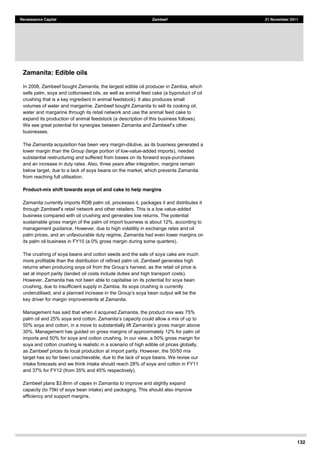
as there are not enough soya beans available for large-scale feedstock production.
We expect Zimbabwean feedstock producers to gradually increase volumes.
We forecast a CAGR of 35% for the top line and 37% for gross profit over
FY10-13. We regard our forecast of a 22% gross margin as cautious
We think the ramp-up of the additional capacity will support strong volume growth in
FY11 and FY12. We also expect prices to continue rising as Novatek continues to
expand its product range (prices tripled between FY07 and FY10 this also partially
reflects higher commodity prices). We forecast top-line growth of 28% in FY11, 32%
in FY12 and 47% in FY13.
0  
500,000  
1,000,000  
1,500,000  
2,000,000  
2,500,000  
  -­        
  2,000    
  4,000    
  6,000    
  8,000    
  10,000    
2007   2008   2009   2010   2011E   2012E   2013E  
Capacity  per  month   Average  price/t  (ZMK)  
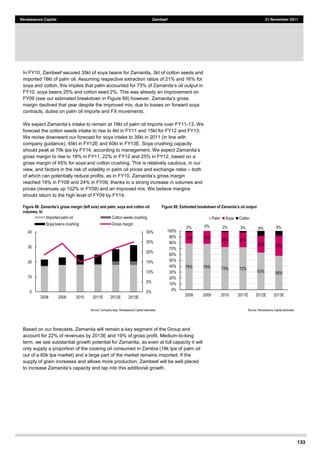
136
Renaissance Capital Zambeef 21 November 2011
While the margin in feedstock production is also at risk of volatility in commodity
protection. Novatek currently
requires 30,000 tpa of maize, about 18,000 tpa of soya and 6,000 tpa of wheat bran.
Large quantities of both maize and soya have to be supplied externally as the
farms output is insufficient (see section on the Mpongwe farms acquisition,
output, and especially soya output. Novatek will continue to need to source large
quantities of maize externally. However, large quantities of maize are currently
available in Zambia due to government subsidies. The FY10 harvest reached a
record of 2.8mnt as the government encourages small-scale farmers to plant maize
with subsidies (maize is a key staple in Zambia and the government has a strong
interest in maintaining maize prices at an affordable level even if it implies paying
subsidies). Maize prices have therefore been relatively low and with a surplus on the
market. Hence, Zambeef has only focused on securing the soya supply for Novatek
and Zamanita.
The new plant was only operational for six months in FY10 which suggests upside
potential to the 21.2% gross margin achieved in FY10 24% was achieved for
1H11. Also, more soya beans and cake available from the Group, the larger
capacity in FY12E and the expanded product range should lead to stronger margins
post FY12E. We forecast a gross margin of 22% over FY11-13. We expect Novatek
to account for 12% of FY13 Group revenues and 9% of gross profit.
Figure 92: Novatek historical and forecasts
2007 2008 2009 2010 2011E 2012E 2013E
Revenue,  ZMKmn   24,323   35,715   51,093   77,333   98,914   130,567   191,498  
YoY      47%   43%   51%   28%   32%   47%  
%  Group  turnover   7%   6%   6%   9%   9%   9%   12%  
Capacity/month,  tonnes   3,600   3,600   3,600   5,000   5,000   8,000   8,000  
YoY      0%   0%   39%   0%   60%   0%  
Price/t,  ZMK   563,032   826,736   1,182,708   1,498,702   1,648,572   1,813,429   1,994,772  
YoY      47%   43%   27%   10%   10%   10%  
Gross  profit,  ZMKmn   4,951   4,415   11,110   16,414   21,761   28,725   42,130  
GP%   20%   12%   22%   21%   22%   22%   22%  
Source:  Company  data,  Renaissance  Capital  estimates  
Meat, dairy and egg production
from beef (23% of FY10 revenues, 26% of gross profit) and chicken (9% of
revenues and profit).
This segment has seen strong growth over the past few years, on the back of
capacity expansion (abattoirs and feedlotting) and productivity improvement (better
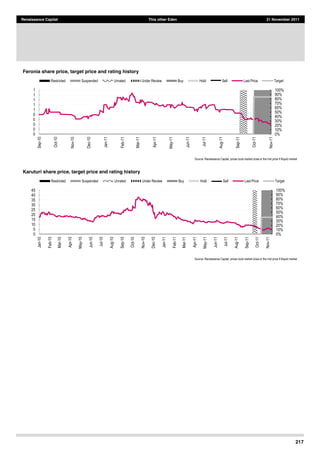
feedstock), especially in chicken and pork.
Zambeef
Zambeef owns nine abattoirs around Zambia where it can slaughter up to 120,000
cattle per year (according to the company). It can also accommodate and fatten
15,000-20,000 animals in feedlotting. Zambeef is the dominant player in this market,
depends on the availability of beef for sale on the market, which in turn depends on
the quantity of healthy animals available and the willingness of Zambian farmers to
sell animals. Many Zambian farmers use cattle to accumulate wealth and are
137
Renaissance Capital Zambeef 21 November 2011
reluctant to sell them except when they need cash. Since FY10, generous
government maize subsidies have increased disposable incomes for small-scale
farmers and reduced their willingness to sell beef. This has dramatically reduced the
supply on the market. In FY10, beef volumes decreased, due to a lack of animals on
the market. The government continues to subsidise maize and we think FY11 is
unlikely to see significant growth in beef.
Besides exposure to cereal prices, the beef production business is also at risk of
cattle diseases which constrains cattle and meat movements in the country. In
removal of circulation restrictions on beef from the Southern province (restrictions
imposed previously due to diseases in that province). The margin declined from
37% in FY08 to 27% in FY09, due to the price shock following restriction removals
(a lot more beef became available).
Zambeef also produces other meats, which helps it to absorb the impact of changes
in beef prices. Higher beef prices helped chicken and pork demand in FY10, while
lower beef prices reduced the demand for chicken in 2009.
We expect the beef top-line to remain flat in FY11 and then grow 10%. We forecast
the gross margin at 30%, slightly below the FY10 level, but above the 1H11 level of
26.5%.
Figure 93: Beef segment historical and forecasts, ZMKmn
2007 2008 2009 2010 2011E 2012E 2013E
Revenues,  ZMKmn   134,930   166,222   224,729   202,895   202,895   223,692   246,620  
YoY      23%   35%   -­10%   0%   10%   10%  
%  group  turnover   41%   28%   26%   23%   18%   16%   15%  
Cattle  processed   60,000   60,000   60,000   64,000   64,000   67,200   70,560  
YoY   0%   0%   0%   7%   0%   5%   5%  
Price/beef  processed,  ZMK   2.25   2.77   3.75   3.17   3.20   3.30   3.50  
YoY   0%   23%   35%   -­15%   0%   5%   5%  
Gross  profit   47,065   61,589   60,222   63,320   60,869   67,108   73,986  
gross  margin   35%   37%   27%   31%   30%   30%   30%  
Source:  Company  data,  Renaissance  Capital  estimates  
Masterpork to continue to see capacity expansion and pricing improvement
Zambia. It slaughtered and processed 42,000 pigs in FY10 including 7,000 from its
own production. This business has been rising quickly on capacity increases, and
Zambeef recently doubled its processing capacity again. Zambeef estimates its
market share at 60% of the formal market (about 50% of the market is informal). Its
recent capacity increase will increase its market share.
We expect pork processed to rise 15% in FY11 and 10% in FY12 and FY13, on the
back of the substantial increase in capacity at Masterpork. Prices are likely to
continue to improve over the next three years (average price increases come from
product mix improvement. Our top-line growth forecasts come in at 24% for FY11,
19% for FY12 and 12% for FY13.
We forecast the gross margin at 30% for the next three years, which is slightly below
the 31.2% achieved in FY10, and below 34.6% achieved in 1H11. In our view, there
is upside potential to our forecasts as the new capacity at Masterpork is likely to be
more efficient and the increased availability of feedstock from Novatek should
138
Renaissance Capital Zambeef 21 November 2011
improve productivity (see the yield improvements already achieved in dairy and
chicken) and reduce feedstock costs.
Figure 94: Pork segment historical and forecasts, ZMKmn
2007 2008 2009 2010 2011E 2012E 2013E
Revenue,  ZMKmn      28,082   47,142   64,288   79,846   94,857   106,429  
%  growth      0%   68%   36%   24%   19%   12%  
%  group  turnover      5%   5%   7%   7%   7%   7%  
Pigs  processed      25,000   36,000   42,000   48,300   53,130   58,443  
YoY      0%   44%   17%   15%   10%   10%  
Price/pig  processed,  ZMK      1.12   1.31   1.53   1.65   1.79   1.82  
YoY      -­   17%   17%   8%   8%   2%  
Gross  profit      12,128   10,391   20,084   23,954   28,457   31,929  
GP%      43%   22%   31%   30%   30%   30%  
Source:  Company  data,  Renaissance  Capital  estimates  
Chicken and eggs
Zambeef is the largest chicken producer in Zambia with a market share of about
45% (company estimates) of the formal market (the informal market accounts for
about 60% of the total). This market is growing fast, and we expect demand to
remain strong. We forecast 5% growth in volumes and 10% in the average price
(price-mix improvements as the product range is expanded) for Zambeef over FY11-
13, and a stable margin of 22%.
Figure 95: Chicken segment historical and forecasts, ZMKmn
2007 2008 2009 2010 2011E 2012E 2013E
Revenue   43,318   51,425   59,504   83,382   96,306   111,234   122,635  
%  Growth      19%   16%   40%   16%   16%   10%  
Chickens  processed,  mn   3.5   3.5   4.0   3.5   3.7   3.9   4.1  
YoY      0%   14%   -­13%   5%   5%   5%  
Average  price,  ZMK      14,693   14,876   23,823   26,206   28,826   30,268  
YoY      -­   1%   60%   10%   10%   5%  
Gross  profit   12,439   11,303   5,185   20,978   21,187   24,471   26,980  
GP%   29%   22%   9%   25%   22%   22%   22%  
Source:  Company  data,  Renaissance  Capital  estimates  
Eggs accounted for 2% of FY10 revenues and 4% of gross profit (not included in
the Group, and it should account for 2% of revenues and 3% of gross profit in
FY13E.
Zammilk (5% of revenues and 11% of gross profit in FY10)
between 5.5-7mn litres of milk per year, from its own
milking herd and external farmers. It has expanded its product range to include a
variety of value-added products from yoghurts and cheese to juices. This has driven
strong growth in the average price and gross profit per litre over 2007-2010, while
overall milk production was stable (slightly declining in FY10).
Parmalat is the largest dairy operator in Zambia (2x larger than Zambeef in terms of
market share), it has a strong brand and a large
management expects to remain number two in the market, but still sees large
expansion potential in the business. It has gained substantial market share from
Parmalat in the past few years and has launched a number of innovative products
on which it can earn high margins and dominate the market (e.g. drinking yoghurt,
where it has more than an 80% market share).
139
Renaissance Capital Zambeef 21 November 2011
We regard our forecasts as cautious (see below), and assume no further market
is also strong, and we
believe it has the potential to gain market share from Parmalat. Also, its vertical
integration lower in the value chain is a significant advantage. We believe this
and
upwards integration (better position than Parmalat) and strong focus on innovation
could contribute to making it a dominant player in dairy, in Zambia and the region.
Over 2007- -line growth (a CAGR of 14%) was more driven by
an improving price-mix (more value added products) than by volumes. Management
has commented that it intends to increase the milking herd and that milking herd
yields have increased 30% since Novatek starting producing specific dairy feed six-
to-12 months ago.
We forecast sales to continue increasing at a CAGR of 14% for FY11-13, partially
on volumes (more cows and better yields) and continuing price improvements (more
value-added products). Zammilk earns the highest gross margins in the Group, with
an average of 61% over FY07-10, taking into account years where feedstock prices
were high (a low of 45% in FY09). We see potential upside on margins as the price-
mix and better yields should continue to help profitability. We cautiously forecast the
gross margin at 60% for FY11-13 (67% was achieved in 1H11).
Zammilk will account for 4% of FY13 Group revenues and 8% of gross profit.
However, we believe there is potential for Zammilk to grow much faster than our
forecasts.
Figure 96: Zammilk historicals and forecasts (the average price/litre also includes value-­added products)
2007 2008 2009 2010 2011E 2012E 2013E
Revenue,  ZMKmn   28,797   32,202   40,789   42,572   49,282   57,051   62,898  
YoY      12%   27%   4%   16%   16%   10%  
Milking  herd,  cows   850   850   850   700   735   772   810  
YoY   -­   -­   -­   -­18%   5%   5%   5%  
l/cow   24   24   24   22   23   24   24  
YoY   -­   -­   -­   -­   5%   5%   0%  
Total  milk  annually,  mn  litres   7.30   7.30   7.30   5.50   6.10   6.70   7.00  
YoY   -­   -­   -­   -­25%   10%   10%   5%  
Average  price/litre,  ZMK   3,945   4,411   5,588   7,740   8,127   8,534   8,960  
YoY   -­   12%   27%   39%   5%   5%   5%  
Gross  profit,  ZMKmn   21,325   19,158   18,197   27,665   29,569   34,230   37,739  
Margin   74%   60%   45%   65%   60%   60%   60%  
Gross  profit/litre,  ZMK   2,921   2,624   2,493   5,030   4,876   5,120   5,376  
YoY      -­10%   -­5%   102%   -­3%   5%   5%  
Source:  Company  data,  Renaissance  Capital  estimates  
Shoprite/independent supermarket butcheries) that sell its meat, dairy, oil and other
(95% of meat and dairy volumes, and 40% of edible oils) and has been a key driver
-line growth.
Zambeef continues to expand its own retail network and plans to open eight more
stores by end-FY11 (mostly in the Copperbelt, but also in other outlying areas of
Zambia) (seven were opened during 1H11 and eight existing stores were
140
Renaissance Capital Zambeef 21 November 2011
refurbished). Shoprite has plans to continue expanding its footprint in Zambia, and
Zambeef is expected to remain its partner.
Figure 97: Zambeef retail network (number of stores) Figure 98
  
Source:  Company  data,  Renaissance  Capital  estimates      Source:  Company  data  
Expansion into wholesale distribution
As in the rest of SSA, the majority of food distribution remains informal, and
Zambeef intends to address this market with a new wholesale network. These
wholesale warehouses will sell perishable and non-perishable Zambeef products to
informal traders. Two wholesale depots were opened during 1H11 and subsequent
centres are planned for Chingola and Solwezi to obtain market share from the
informal sector.
Other businesses
Zamflour and Zamloaf: 5% of revenues and 4% of gross profit in FY10
Zambeef mills a large quantity of its wheat to sell flour and produce bakery products
all sold through its retail network.
Zamfish: 1% of revenues and gross profit in FY10
Zambeef has started importing fish to expand its protein range, and sees potential in
this business as demand for protein grows in the region, with fish accounting for a
substantial part of this growth.
Zamleather and Zamshu: 1% of revenues and 2% gross profit in FY10
This business uses meat byproducts (cattle hides) to produce leather and shoes,
which are exported as wet blue and sold as finished leather, and converted to shoes
and industrial leatherwear for sale through its supermarket and retail network
(Shoprite and independents; not in Zambeef food stores, 1% of revenues and 2%
gross profit in FY10) and mining and security companies.
0  
20  
40  
60  
80  
100  
120  
140  
2006   2007   2008   2009   2010   2011E  
Lusaka,  33%  
Copperbelt,  
37%  
Rest  of  
Zambia,  30%  
141
Renaissance Capital Zambeef 21 November 2011
Figure 99: Zamleather, Zamshu, Zamfish, Zamflour, Zamloaf historicals and forecasts, ZMKmn
2007 2008 2009 2010 2011E 2012E 2013E
Zamleather and Zamshu                     
Revenue   9,296   8,846   8,542   10,749   11,286   11,851   12,443  
%  growth   0%   -­5%   -­3%   26%   5%   5%   5%  
%  group  turnover   3%   1%   1%   1%   1%   1%   1%  
Gross  profit   4,384   2,057   2,347   3,739   3,725   3,911   4,106  
GP%   47%   23%   28%   35%   33%   33%   33%  
Zamfish                     
Revenue   1,266   2,505   7,930   8,992   10,341   11,892   13,676  
%  growth   0%   98%   217%   13%   15%   15%   15%  
%  group  turnover   0%   0%   1%   1%   1%   1%   1%  
Gross  profit   751   776   2,023   2,300   2,645   3,042   3,498  
GP%   59%   31%   26%   26%   26%   26%   26%  
Zamflour and Zamloaf                     
Revenue   13,673   31,063   47,156   47,276   52,004   57,204   62,924  
%  growth   0%   127%   52%   0%   10%   10%   10%  
%  group  turnover   4%   5%   5%   5%   5%   4%   4%  
Gross  profit,  ZMKmn   1,196   5,561   4,990   10,818   9,361   10,297   11,326  
GP%   9%   18%   11%   23%   18%   18%   18%  
Source:  Company  data,  Renaissance  Capital  estimates  
Zamchick Inns: 1% of group FY10 revenues, 2% of gross profit
This business consists of eight fast-food restaurants offering chicken-based dishes.
The concept is currently under review as the chain has not grown for the past two
years while the company has been establishing a new strategy. It recently hired a
new manager to lead the segment, and is currently fine-tuning the new strategy
before implementing in the coming months or years. Management believes there is
substantial potential for the chain to take market share and be profitable as it owns
the supply.
We do not account for substantial growth. We expect Zamchick Inns to remain a
small business within the next three years.
Figure 100: Zamchick financials and forecasts, ZMKmn
2007 2008 2009 2010 2011E 2012E 2013E
Revenue   6,804   7,255   8,297   8,547   8,974   9,872   10,859  
%  growth      7%   14%   3%   5%   10%   10%  
%  group  turnover   2%   1%   1%   1%   1%   1%   1%  
Number  of  restaurants            8   9   10   11  
Revenue  per  restaurant            1,068   997   987   987  
YoY            0%   -­7%   -­1%   0%  
Gross  profit   2,450   2,062   3,188   3,758   3,231   3,554   3,909  
GP%   36%   28%   38%   44%   36%   36%   36%  
Source:  Company  data,  Renaissance  Capital  estimates  
142
Renaissance Capital Zambeef 21 November 2011
The Mpongwe acquisition will help Zambeef secure enough supply for the
turnaround of Zamanita (edible oils) and the ramp-up of Novatek (feedstock), and
achieve better returns on its food production (on better feedstock).
Record-high yields and abundant water for irrigation
The farms cover three estates totalling approximately 47,000 ha, including 12,700
ha of cleared land (2,000 ha are dedicated to Jatropha and will not be used to
A report by independent consultant, Bosch, hired by Zambeef to assess the
agricultural potential of Mpongwe, identified large water reserves, allowing a rapid
2,000-ha increase in the irrigated area, to 5,000 ha. The Kafue river is close to the
farms (adjacent to one of the estates) and can provide additional water for irrigation.
Management is confident that there is sufficient water to irrigate 10,000 ha in
Mpongwe if need be, although this will depend on cereal prices and the needs of the
Group.
Soil quality at Mpongwe is very high and the level of precipitation is optimal. The
rain-fed plantations here exceed the yields achieved by Zamb
plantations to date. Its record yields for cereals are well above the level used in our
forecasts (the highest yield for soya beans was 4.2 t/ha and we use 3.7 t/ha in our
forecasts for irrigated soya). In our view, the yield used in our forecasts factors in the
risk from adverse weather conditions and delays to refurbishment and expansion of
the farms.
The farms, including land, equipment and machinery, were independently valued by
Knight Frank at ZMK282bn ($59mn) in December 2009, suggesting the price paid
by Zambeef ($47mn) is attractive (only assets were acquired, no liabilities included).
We have no clear explanation for why the previous owner, ETC, accepted a lower
amount than
Why did Zambeef need to buy the Mpongwe farms?
While the farms had the potential to produce 31k tpa of soya (after expansion), the
current owner had a different view on production and allocation of land between
soya and maize, as it is does not have higher value-added production (such as
edible oil or feedstock) that required soya, as Zambeef does. ETC would choose to
allocate land to crops depending on the expected value of the harvest (grain prices,
output expectations in Zambia, potential for exports) and would not necessarily
for Zambeef to negotiate to be the sole offtaker of the crop as ETC would also sell
part o
buy between 10-15kt of soya from ETC. We note that 20kt would account for
entire harvest (5.5 ha x 3.75 t/ha mostly irrigated amounts to 20kt). We believe
Zambeef may not b
The Mpongwe farms acquisition
143
Renaissance Capital Zambeef 21 November 2011
Zambeef, as the owner of the farms, should be able to maximise soya output (by
undertaking the necessary capex on irrigation refurbishment and expansion) and will
be the sole offtaker of the harvest. Without this additional intake of soya, it will be
difficult to achieve the intended turnaround at Zamanita and the ramp-up of Novatek.
Figures 101, 105 and 106 illustrate the large increase in cereals required by the
Group.
Figure 101: Zambeef cereals requirements vs Group cereals output, tonnes
2007 2008 2009 2010 2011E 2012E 2013E
Total  wheat  requirements   34,320   34,320   34,320   36,000   36,000   39,600   39,600  
%  of  group  output   163%   100%   88%   240%   94%   86%   73%  
Bakeries   30,000   30,000   30,000   30,000   30,000   30,000   30,000  
Novatek   4,320   4,320   4,320   6,000   6,000   9,600   9,600  
Total  maize  requirements   26,160   26,160   26,160   35,400   35,400   55,200   55,200  
%  of  group  output   293%   448%   187%   354%   272%   159%   159%  
Bakeries   2,400   2,400   2,400   2,400   2,400   2,400   2,400  
Novatek   23,760   23,760   23,760   33,000   33,000   52,800   52,800  
Zamanita/Novatek  soya  requirements      10,000   12,000   33,000   35,000   45,000   60,000  
%  of  group  output      100%   100%   330%   292%   106%   140%  
Source:  Company  data,  Renaissance  Capital  estimates  
The expansion of Mpongwe
The capex plan for the expansion of Mpongwe follows the recommendation of the
Bosch report, which recommended that $15mn should be spent on refurbishing and
expanding the irrigation systems of the farms. This will enable the irrigation area to
be expanded by 2,000 ha and improve the existing 3,000 ha irrigated. Compared
Zambeef has spent $16mn on expanding Chiawa by 1,700 ha, gets much lower
yields on this farm and took (relatively) much longer than the expected two years for
Mpongwe.
The faster and cheaper expansion of Mpongwe reflects the fact that the farm has
large quantities of land cleared and prepared for plantations and Zambeef is
therefore saving substantial capex and time (according to management, clearance
and preparation would have cost up to $5,000/ha and taken from six months to a
year). 10,700 ha of Mpongwe farms are already available (excluding the area where
Jatropha is planted) for plantation and irrigation at relatively low cost which makes
the farms even more attractive (see Figures 103 and 104, the area earmarked for
the irrigation expansion is highlighted in blue and is already cleared and ready for
cultivation). Figures 103 and 104 show that there is a significant area of land
available at the farms for further expansion of the irrigated area.
144
Renaissance Capital Zambeef 21 November 2011
Figure 102: Mpongwe farms output forecasts, tonnes
2010 2011E 2012E 2013E 2014E 2015E
Soya  -­  dry  plantation   4,208   4,208   5,535   3,535   3,535   3,535  
expected  yield   3.5   3.5   3.5   3.5   3.5   3.5  
Soya    -­  irrigated  plantation   1,247   1,247   2,994   4,994   4,994   4,994  
expected  yield   3.7   3.7   3.7   3.7   3.7   3.7  
Total  soya  -­  area  planted   5,455   5,455   8,529   8,529   8,529   8,529  
Average  yield   3.5   3.5   3.6   3.6   3.6   3.6  
Total  soya  production   19,342   19,342   30,450   30,850   30,850   30,850  
YoY   0%   0%   57%   1%   0%   0%  
Maize  -­  dry  plantation   2,518   2,518   2,132   2,132   2,132   2,132  
expected  yield   7.8   7.8   7.8   7.8   7.8   7.8  
Total  maize  production   9,727   9,727   16,630   16,630   16,630   16,630  
YoY   0%   0%   71%   0%   0%   0%  
Wheat  -­  irrigated  plantation   1,326   2,994   3,994   4,994   4,994   4,994  
expected  yield   7.8   7.8   7.8   7.8   7.8   7.8  
Total  wheat  production   10,343   23,353   31,153   38,953   38,953   38,953  
YoY   0%   126%   33%   25%   0%   0%  
Total  grain  output   39,411   52,422   78,233   86,433   86,433   86,433  
YoY   0%   33%   49%   10%   0%   0%  
Total  dry   5,455   5,455   7,667   5,667   5,667   5,667  
YoY   0%   0%   41%   -­26%   0%   0%  
Total  irrigated  (double  crop  -­  summer  and  winter)   2,573   4,241   6,988   9,988   9,988   9,988  
YoY   0%   65%   65%   43%   0%   0%  
Source:  Company  data,  Renaissance  Capital  estimates  
Figure 103: Mpongwe fams: Aerial view of Chambatata and Nampamba (two of the three estates). Area
highlighted in blue is earmarked for irrigation expansion
Source:  Google  maps  
145
Renaissance Capital Zambeef 21 November 2011
Figure 104: Mpongwe fams: Aerial view of Chambatata and Nampamba (planned new irrigated fields
highlighted)
  
Source:  Google  maps  
Production forecasts: Any delay will be negative for the rest of the business
Our forecasts are based on management targets for expansion at Mpongwe. Any
delay in the implementation of the expansion would imply lower output and,
potentially, a slower turnaround at Zamanita and ramp-up at Novatek. Our forecasts
farms are, however, very cautious (see previous section) and
we see substantial upside risk to that output.
A delay at Mpongwe, would also have a negative impact on food production (lower
availability of feedstock) but our forecasts cautiously exclude any margin
improvements from better feedstock.
In terms of project delivery, the Group has typically suffered from delays in
implementing new operations (Novatek started a year behind plan, the Zamchick Inn
expansion has been put on ho
Mpongwe should be more successful, as this is not a new business to the Group
(Zambeef runs other farms and has retained existing management at Mpongwe);
and the fact that the land is already cleared and prepared should make this
expansion easier than other earlier projects.
146
Renaissance Capital Zambeef 21 November 2011
Figure 105 Figure 106
  
Source:  Renaissance  Capital  estimates      Source:  Renaissance  Capital  estimates  
0%  
70%  
140%  
210%  
280%  
350%  
420%  
0  
10  
20  
30  
40  
50  
60  
70  
2008   2009   2010   2011E   2012E   2013E  
Soya  beans  intake   as  %  of  the  group's  harvest  
0%  
50%  
100%  
150%  
200%  
250%  
300%  
Maize     Soya  beans  and  cake   Wheat  bran  
2010E   2011E   2012E  
147
Renaissance Capital Zambeef 21 November 2011
Zambeef started operations in West Africa in 2005, when it accompanied Shoprite
now runs butcheries in two Shoprite stores in Lagos and one in Ghana. Zambeef
has also invested in a farm in Ogun state (long-term lease), close to Lagos, and
meat processing in Ghana (based on mostly imported meat).
We think Nigeria and Ghana offer a very significant opportunity for Zambeef to
repeat its successful Zambian model in much more populous countries with rapidly
rising urban populations. Demand for processed meat arising from formal sector
expansion in West Africa is likely to be very strong, and the combined population of
population Zambeef can reach in Zambia.
Shoprite expansion in West Africa; potential for Zambeef
expansion in these countries as Zambeef intends to continue partnering with
Shoprite. Shoprite had first-mover advantage in Nigeria, and has since been
followed by other South African and international retailers. Shoprite now plans to
accelerate its expansion in West Africa: it has said it should have at least 100 stores
in Nigeria (over the medium-to-long term; this is quoted from an interview with
report Shoprite Expansion strategy 20 questions
for management, dated 8 March 2011) and that expansion was getting easier in
Nigeria owing to real estate developers and banks become more supportive.
Shoprite opened one new store in Enugu in September 2011 and expects to roll out
three more over the next 12 months. Other large Nigerian cities will be targeted,
such as Abuja, Port Harcourt, Illorin, Kano and Kaduna.
year, and almost double the following year (this only takes into account the potential
from the partnership with Shoprite; Zambeef could also develop its own network or
distribution). While demand in Nigeria will absorb six new stores per year, on our
estimates, logistics remain a challenge, and we therefore base our forecasts on
three Shoprite openings per year (see below).
In Ghana, expansion will be slower as demand is not as large as in Nigeria. On the
other hand, logistics here are much easier and we believe it reasonable to expect
one new store opening every two years, implying strong growth for Zambeef (from
its current base of two butcheries).
Expansion in farming and processing to support growth
Growth in Nigeria has been constrained by the import ban on meat and the
difficulties in sourcing good quality meat locally. Zambeef has now invested in its
own farm in Ogun state, and will spend $1.3mn in FY11 to upgrade and expand its
abattoirs and processing facilities. We think these investments will allow Zambeef to
grow much faster in Nigeria.
West African expansion
148
Renaissance Capital Zambeef 21 November 2011
Nigeria accounted for 2% of FY10 revenues and Ghana for 1%. We expect this
contribution to increase to 8% of group revenues by FY13. Our forecasts imply a
revenue CAGR of 59% over FY10-13 of 42% and
much faster than the 18% achieved over FY07-10. This acceleration will be made
Nigeria, according to Shoprite.
Zambeef has the opportunity to partner with Shoprite in other SSA countries,
including Tanzania, DRC, Zimbabwe and Uganda (no agreement has been signed
yet). This is not included in our model, but we think it could become a major
opportunity for the Group over the medium-to-long term.
Figure 107: Zambeef in West Africa historical and forecasts
2007 2008 2009 2010 2011E 2012E 2013E
Revenue,  ZMKmn   12,389   22,150   32,222   30,785   34,213   83,249   123,327  
%  growth      79%   45%   -­4%   11%   143%   48%  
%  group  turnover   4%   4%   4%   3%   3%   6%   8%  
Nigeria,  ZMKmn            18,885   21,718   57,009   95,775  
YoY               15%   163%   68%  
Butcheries  and  stores            2   2   5   8  
Revenue/store,  ZMKmn            9,443   10,859   11,402   11,972  
YoY               15%   5%   5%  
Ghana,  ZMKmn            11,900   12,495   26,240   27,551  
YoY               5%   110%   5%  
Butcheries  and  stores            1   1   2   2  
Revenue/store,  ZMKmn            11,900   12,495   13,120   13,776  
YoY               5%   5%   5%  
Gross  profit,  ZMKmn   2,416   2,744   7,029   7,481   7,527   18,315   27,132  
GP%   20%   12%   22%   24%   22%   22%   22%  
Source:  Company  data,  Renaissance  Capital  estimates  
149
Renaissance Capital Zambeef 21 November 2011
Adjusted net profit to show 71% CAGR FY10-13E
Our estimate of a 71% CAGR for net profit implies a CAGR of 70% for EPS
(including dilution from the acquisition). Our adjusted net profit forecasts have
increased by c. ZMK6bn for FY11, and ZMK11-12bn for FY12 and FY13 compared
to our previous expectations. The main reason for the better net profit forecasts is
lower interest costs than previously expected as the acquisition of the Mpongwe was
entirely financed by new equity while we had assumed that 50% would be financed
by debt.
FY10 is adjusted for an FX loss of ZMK8bn (see P&L in Figure 113). Our FY11E
forecasts are likely to include an FX gain (1H11 actuals included an FX gain of
ZMK7.5bn.
This seems an ambitious growth target, but we have taken relatively cautious
estimates on many aspects of our model:
Crops: We assume lower yields than the historical levels of the existing
business, and much lower gross margins than historical levels and
management targets.
We do not fully factor in the potential gains from Novatek
larger capacity. FY10 financials did not reflect the potential profitability of
this plant.
Food production: We forecast slight margin erosion in meat production,
despite the potential efficiency gains that will come from the increased
output at Novatek
Zammilk has a promising outlook, in our view, and we think this segment
could also surprise on the upside in terms of revenue growth and margins.
West Africa: We factor in only half the potential of revenue growth from
nsion plans
We regard our forecasts as conservative, as we seek to factor in downside risks
conditions) and the risks related to the proposed Mpongwe acquisition (delay in
expansion or difficulties in financing it).
Our revised segment forecasts imply top-line growth of 14% in FY11, 20% in FY12
and 17% in FY13. Our gross margin forecasts come in at 34% in FY11, 39% for
FY12 and 39% for FY13, with the increased contribution of crops the most important
driver for margin expansion.
Our forecasts come in broadly in line with management guidance on the bottom line.
The
growth in the crops segment (a higher-margin business vs the Group average),
strong margins at Zamanita (edible oils, which accounts for a large part of Group
revenues), strong growth at Zammilk (a higher-margin business, but small) and
strong growth in West Africa.
Group forecasts
150
Renaissance Capital Zambeef 21 November 2011
Figure 108: Segment historicals and forecasts
2007-­10 RC estimates 2010-­13
Crops  
Revenue  CAGR   7%   70%  
Average  gross  margin   46%   38%  
Edible  oils  
Revenue  CAGR   41%   15%  
Average  gross  margin   19%   22%  
Novatek  
Revenues  CAGR   47%   35%  
Average  gross  margin   19%   22%  
Beef  
Revenue  CAGR   15%   7%  
Average  gross  margin   32%   30%  
Chicken  
Revenue  CAGR   24%   14%  
Average  gross  margin   21%   22%  
Pork  (2008-­2010)  
Revenue  CAGR   51%   18%  
Average  gross  margin   32%   30%  
Milk  
Revenue  CAGR   14%   14%  
Average  gross  margin   61%   60%  
West  Africa  
Revenue  CAGR   35%   59%  
Average  gross  margin   20%   22%  
Source:  Company  data,  Renaissance  Capital  estimates  
Our Group forecasts are lower than management guidance at the top-line level and
higher at the gross margin level. We still regard our margin assumptions as
cautious.
We forecast administrative expenses will increase 10% per year over FY11-13.
Administrative expenses have typically grown slower than sales in the past and
came down from 30% of revenues in FY06 to 23% in FY10. We forecast a gradual
decline to 20% of sales by FY13. We forecast depreciation between 5% and 4% of
sales over FY11 and FY13, broadly in line with company guidance. Our forecasts
imply an EBIT margin of 7% in FY11E, rising to 14% in FY13E.
The acquisition has been priced at $47mn (ZMK229bn) and has been fully financed
by a rights issue at ZMK2,975 per share. This led to an increase in the number of
shares from 159mn to 248mn (89mn new shares).
We forecast a tax rate of 7% for FY11, rising gradually to 9% in FY13E. This is
above the company guidance of a tax rate of 6% over the period, as Zambeef
benefits from significant tax breaks for the large investments it has made over
previous years (Zambian Development Agency Investment Promotion and
Protection agreement signed in 2009).
Figure 109: Renaissance forecasts for the Group, ZMKmn
2011E 2012E 2013E
Group  turnover   876,655   1,052,180   1,232,461  
YoY   14%   20%   17%  
Group  gross  profit   295,004   413,200   479,242  
Margin   34%   39%   39%  
EBIT   57,566   142,804   178,053  
Adjusted  net  profit   46,065   120,308   151,077  
Capex   85,860   49,328   38,064  
Source:  Company  data,  Renaissance  Capital  estimates  
We forecast a dividend payout of 35% over FY11-13, in line with management
guidance. Our forecast capex is based on management guidance and the
recommendation of the Bosch report on the expansion of the Mpongwe farms (see
previous section).
151
Renaissance Capital Zambeef 21 November 2011
Impact of the Mpongwe acquisition and capital raising on
Zambeef balance sheet and key ratios
debt/EBITDA declining from 3.5x in 2010 to 2.4x in 2011. The EBITDA will
improve by 55% YoY in 2011 from a relatively low base as Zambeef 2010
EBITDA was lower than Zambeef 2008 EBITDA. The EBITDA growth will
be driven by operational improvements in Zambeef existing segments and
the contribution of Mpongwe farms. The net debt will remain broadly in line
see detailed balance sheet forecasts below. Zambeef interest cover will
increase to 7.2x in 2011 from 3.3x in 2010.
Zambeef RoE will increase to 6% in 2011 from 4% in 2010 which remains
well below historical levels (peak of 24% in 2006 down to 15% in 2007, 9%
in 2008 and 4% in 2009).
Zambeef calendarised P/E declines from 22.1x in 2010 to 13.7x in 2011.
Figure 110: Zambeef's capex breakdown per segment, $mn    Figure 111: Zambeef's capex progression, ZMKmn
Source:  Renaissance  Capital  estimates      Source:  Renaissance  Capital  estimates  
0  
5  
10  
15  
20  
25  
Crops  
Zamanita  
Novatek  
Food  
Retail  Zambia  
Zamleather  
West  Africa  
2011E   2012E   2013E  
  -­        
  20,000    
  40,000    
  60,000    
  80,000    
  100,000    
  120,000    
  140,000    
  160,000    
0%  
2%  
4%  
6%  
8%  
10%  
12%  
14%  
16%  
18%  
20%  
2009   2010   2011E   2012E   2013E  
Capex   %  sales  
152
Renaissance Capital Zambeef 21 November 2011
Figure 112: Key ratios
2010 2011E 2012E 2013E
RoE   4%   6%   15%   16%  
Net  debt/EBITDA   3.50   2.40   0.90   0.30  
Net  debt/equity   48%   30%   21%   8%  
Interest  cover  (EBIT/interests)   3.30   7.20   11.90   14.80  
PE   24.1   16.1   6.2   4.9  
Cal  PE   22.1   13.7   5.9   4.8  
Divi  yield   2%   2%   6%   7%  
EV/EBITDA   15.4   10.0   4.7   3.0  
Cal  EV/EBITDA   14.1   8.7   4.4   3.2  
Adjusted  net  profit   29,985   46,065   120,308   151,077  
Source:  Company  data,  Renaissance  Capital  estimates  
Figure 113: Zambeef consolidated P&L, ZMKmn
2006 2007 2008 2009 2010 2011E 2012E 2013E
Net  revenues   223,782   291,971   492,698   697,317   770,528   876,655   1,052,180   1,232,461  
YoY      30%   69%   42%   10%   14%   20%   17%  
Cost  of  sales   -­123,350   -­163,515   -­301,817   -­478,141   -­526,561   -­581,651   -­638,980   -­753,219  
%  of  sales   -­55%   -­56%   -­61%   -­69%   -­68%   -­66%   -­61%   -­61%  
Gross  profit   223,782   291,971   492,698   697,317   770,528   876,655   1,052,180   1,232,461  
Margin   45%   44%   39%   31%   32%   34%   39%   39%  
YoY         49%   15%   11%   21%   40%   16%  
Other  operating  income/costs   1,662   244   736   1,741   -­1,533           
Administrative  expenses   -­68,044   -­85,713   -­123,899   -­178,168   -­179,990   -­197,989   -­217,787   -­239,566  
%  of  sales   -­30%   -­29%   -­25%   -­26%   -­23%   -­23%   -­21%   -­19%  
YoY      26%   45%   44%   1%   10%   10%   10%  
EBITDA   34,050   42,987   67,718   42,750   62,445   97,016   195,413   239,676  
Margin   15%   15%   14%   6%   8%   11%   19%   19%  
Depreciation   -­10,092   -­11,918   -­19,039   -­24,573   -­28,683   -­39,449   -­52,609   -­61,623  
%  of  sales   -­5%   -­4%   -­4%   -­4%   -­4%   -­5%   -­5%   -­5%  
Operating  profit   23,958   31,069   48,679   18,177   33,761   57,566   142,804   178,053  
Margin   11%   11%   10%   3%   4%   7%   14%   14%  
Net  exchange  (losses)/gains         3,533   -­66,519   -­7,990           
Profit  on  disposal  of  investment/assets            65,790              
Finance  costs   -­2,509   -­2,857   -­8,018   -­13,595   -­10,236   -­8,000   -­12,000   -­12,000  
Profit  before  taxation   21,449   28,212   44,194   3,853   15,534   49,566   130,804   166,053  
YoY      32%   57%   -­91%   303%   219%   164%   27%  
Income  tax  credit/(expense)   -­1,784   -­4,688   -­5,919   12,164   4,286   -­3,470   -­10,464   -­14,945  
Tax  rate   -­8%   -­17%   -­13%         -­7%   -­8%   -­9%  
Profit  after  taxation   19,665   23,524   38,275   16,017   19,820   46,096   120,339   151,108  
YoY      20%   63%   -­58%   24%   133%   161%   26%  
Profit  attributable  to  equity  holders   19,634   23,500   37,367   15,670   19,789   46,065   120,308   151,077  
YoY      20%   59%   -­58%   26%   133%   161%   0.26  
Adjusted  attributable  profit   19,634   23,500   34,307   16,399   27,780   46,065   120,308   151,077  
YoY      20%   46%   -­52%   69%   54%   161%   26%  
Dividend  paid/(gross)   -­8,500   -­9,500   -­13,600      -­7,916   -­16,123   -­42,108   -­52,877  
Payout   -­43%   -­40%   -­36%   0%   -­40%   -­35%   -­35%   -­35%  
Source:  Company  data,  Renaissance  Capital  estimates  
Figure 114: Zambeef cash flows, ZMKmn
2011E 2012E 2013E
EBIT   57,566   142,804   178,053  
Tax  on  EBIT   -­4,030   -­11,424   -­16,025  
Tax  rate   -­7%   -­8%   -­9%  
NOPAT   53,536   131,379   162,028  
Depreciation   39,449   52,609   61,623  
Change  in  working  capital   -­30,163   -­26,329   -­27,042  
Capex   -­85,860   -­49,328   -­38,064  
Acquisition  Mpongwe   -­227,472        
Operating  free  cash  flows   -­23,037   108,331   158,545  
Interest  costs  paid   -­8,000   -­12,000   -­12,000  
Adjustment  in  taxes   560   960   1,080  
Dividend   -­16,123   -­42,108   -­52,877  
Capital  raising   264,000        
Change  in  net  debt  (FCF)   -­10,072   55,183   94,748  
Source:  Renaissance  Capital  estimates  
P&L, balance-sheet and
cash-flow forecasts
153
Renaissance Capital Zambeef 21 November 2011
Figure 115: Zambeef summary Group forecasts, ZMKmn
2007 2008 2009 2010 2011E 2012E 2013E
Crops  revenues   46,612   78,869   77,573   56,996   134,118   260,884   278,243  
YoY      69%   -­2%   -­3%   135%   95%   7%  
%  group  revenues   14%   13%   9%   6%   12%   18%   17%  
Crops  gross  profit   25,507   43,156   28,617   21,997   46,941   104,354   111,297  
margin   55%   55%   37%   39%   35%   40%   40%  
%  group  gross  profit   20%   23%   13%   9%   16%   25%   23%  
Zamanita  revenues      119,971   242,277   239,946   289,794   331,160   362,533  
YoY         102%   -­1%   21%   14%   9%  
%  group  revenues      20%   28%   27%   26%   23%   22%  
Zamanita  gross  profit      22,274   58,880   36,048   52,163   72,855   90,633  
margin      19%   24%   15%   18%   22%   25%  
%  group  gross  profit      12%   27%   15%   17%   17%   19%  
Novatek  revenues   24,323   35,715   51,093   77,333   98,914   130,567   191,498  
YoY      47%   43%   51%   28%   32%   47%  
%  group  revenues   7%   6%   6%   9%   9%   9%   12%  
Novatek  gross  profit   4,951   4,415   11,110   16,414   21,761   28,725   42,130  
margin   20%   12%   22%   21%   22%   22%   22%  
%  group  gross  profit   4%   2%   5%   7%   7%   7%   9%  
Beef  revenues   134,930   166,222   224,729   202,895   202,895   223,692   246,620  
YoY      23%   35%   -­10%   0%   10%   10%  
%  group  revenues   41%   28%   26%   23%   19%   16%   15%  
Beef  gross  profit   47,065   61,589   60,222   63,320   60,869   67,108   73,986  
margin   35%   37%   27%   31%   30%   30%   30%  
%  group  gross  profit   37%   32%   27%   26%   20%   16%   15%  
Chicken  revenues   43,318   51,425   59,504   83,382   96,306   111,234   122,635  
YoY      19%   16%   40%   16%   16%   10%  
%  group  revenues   13%   9%   7%   9%   9%   8%   8%  
Chicken  gross  profit   12,439   11,303   5,185   20,978   21,187   24,471   26,980  
margin   29%   22%   9%   25%   22%   22%   22%  
%  group  gross  profit   10%   6%   2%   9%   7%   6%   6%  
Pork  revenues      28,082   47,142   64,288   79,846   94,857   106,429  
YoY      0%   68%   36%   24%   19%   12%  
%  group  revenues      5%   5%   7%   7%   7%   7%  
Pork  gross  profit      12,128   10,391   20,084   23,954   28,457   31,929  
margin      43%   22%   31%   30%   30%   30%  
%  group  gross  profit      6%   5%   8%   8%   7%   7%  
Milk  revenues   28,797   32,202   40,789   42,572   49,282   57,051   62,898  
YoY      12%   27%   4%   16%   16%   10%  
%  group  revenues   9%   5%   5%   5%   5%   4%   4%  
Milk  gross  profit   21,325   19,158   18,197   27,665   29,569   34,230   37,739  
margin   74%   59%   45%   65%   60%   60%   60%  
%  group  gross  profit   17%   10%   8%   11%   10%   8%   8%  
Zamflour  +  Zamloaf  revenues   13,673   31,063   47,156   47,276   52,004   57,204   62,924  
YoY      127%   52%   0%   10%   10%   10%  
%  group  revenues   4%   5%   5%   5%   5%   4%   4%  
Zamflour  +  Zamloaf  gross  profit   1,196   5,561   4,990   10,818   9,361   10,297   11,326  
margin   9%   18%   11%   23%   18%   18%   18%  
%  group  gross  profit   1%   3%   2%   4%   3%   2%   2%  
Zamchick  Inn  +  Zamfish  +  Zamleather  +  Zamshu  
+  Eggs  revenues  
24,707   26,615   37,218   47,239   55,238   61,946   66,726  
YoY      8%   40%   27%   17%   12%   8%  
%  group  revenues   8%   4%   4%   5%   5%   4%   4%  
Zamchick  Inn  +  Zamfish  +  Zamleather  +  Zamshu  
+  Eggs  gross  profit  
11,397   8,081   14,555   19,162   21,672   24,389   26,090  
margin   46%   30%   39%   41%   39%   39%   39%  
%  group  gross  profit   9%   4%   7%   8%   7%   6%   5%  
West  Africa  revenues   12,389   22,150   32,222   30,785   34,213   83,249   123,327  
YoY      79%   45%   -­4%   11%   143%   48%  
%  group  revenues   4%   4%   4%   3%   3%   6%   8%  
West  Africa  gross  profit   2,416   2,744   7,029   7,481   7,527   18,315   27,132  
margin   20%   12%   22%   24%   22%   22%   22%  
%  group  gross  profit   2%   1%   3%   3%   3%   4%   6%  
Source:  Renaissance  Capital  estimates  
154
Renaissance Capital Zambeef 21 November 2011
We use a DCF- and multiples-based approach to determine a fair value range for
the equity of Zambeef. Our peer group comprises other food companies listed in
SSA, South Africa and developed markets. Our valuation range comes in between
ZMK1,050bn and ZMK1,078bn, vs a current weighted market capitalisation of
ZMK798bn.
Our valuation range implies a target price of ZMK4,289 (or GBP0.536) compared
with a share price of ZMK3,000 in Lusaka and GBP0.50 in London.
Figure 116: Zambeef Summary valuation
TP  ZMK   4,289  
TP  GBp   53.6  
Upside/downside  in  Lusaka   43%  
Upside/downside  in  London   7%  
Weighted  market  cap   797,655  
Vs  April   101%  
Number  of  shares  Lusaka   194.3  
Number  of  shares  London   53.7  
Source:  Bloomberg,  Renaissance  Capital  estimates  
Peer valuation
Zambeef is currently more vertically integrated than most of the listed peers we have
identified, and we think it could offer substantial upside potential in earnings from the
benefits of the acquisition of Mpongwe farms, the turnaround of Zamanita and the
ramp-up of Novatek.
SSA peers currently trade at an average P/E of 12x and EV/EBITDA of 6.1x for
2012, on our estimates (see below). Zambeef trades at calendarised 2012 multiples
of 5.9x PE and 4.4x EV/EBITDA (based on Lusaka share price). Zambeef is trading
at a 51% discount on a P/E basis and a 28% discount to an EV/EBITDA basis.
However we would expect it to trade at a lower P/E given its lower tax rate (we
forecast 7% for 2011). We only use EV/EBITDA multiples for our peer valuation. We
emphasize that our forecasts for 2012 and beyond are dependent on the return on
the acquisition and imply substantial growth in EBITDA and net profit.
In comparison, meat, poultry and grain producers from other South Africa and
developed markets are currently trading at higher EV/EBITDA multiples but on
slightly lower P/E multiples
prospects warrant a premium to SA and developed market producers, in our view,
and we feel comfortable using the multiples of the SSA peer group to value the
shares.
Valuation
155
Renaissance Capital Zambeef 21 November 2011
Figure 117: Valuation matrix
SSA food stocks
Bloomberg
ticker
EV/EBITDA P/E
2011E 2012E 2013E 2011E 2012E 2013E
Nestle  Foods  Nigeria  PLC   NESTLE  NL   xx   15.1   14.7   11.5   25.2   25.4   19.3  
Dangote  Sugar  Refinery  PLC   DANGSUGA  NL         2.0   1.8      5.3   3.2  
Flour  Mills  of  Nigeria  PLC   FLOURMIL  NL      3.4   2.8   2.4   9.1   6.7   8.0  
Unilever  Nigeria  PLC   UNILEVER  NL      10.9   9.3   7.4   19.6   17.7   14.2  
PZ  Cussons  Nigeria  PLC   PZ  NL      10.5   10.8   8.2   16.3   20.4   12.5  
Dangote  Flour  Mills  PLC   DANGFLOU  NL   xx      2.2   3.0      2.7   4.8  
UAC  of  Nigeria  PLC   UACN  NL      4.4   3.7      12.1   10.2   8.8  
Innscor  Africa  Ltd   INAF  ZH      5.0   2.8   2.4   11.1   7.3   6.3  
Average         8.2   6.1   5.2   15.6   12.0   9.6  
Zambeef     Lusaka  shares         8.7   4.4   3.2   13.7   5.9   4.8  
Discount  to  SSA  food  peers         6%   -­28%   -­39%   -­12%   -­51%   -­50%  
Zambeef     London  shares         12.6   6.0   4.5   18.2   7.8   6.4  
Discount  to  SSA  food  peers         53%   -­2%   -­15%   17%   -­35%   -­34%  
Meat, poultry and grain producers                        
Rainbow  chicken   RBWJ.J      7.0   6.6   5.9   12.5   11.7   10.3  
Astral  foods   ARLJ.J      6.0   5.8   5.3   9.6   9.1   7.9  
Chekizovo   GCHE.MM      6.2   5.3   4.9   5.7   4.9   4.5  
Gruma   GRUMAB.MX      6.3   5.5   4.9   3.1   9.6   7.8  
JBS   JBSS3.SA      9.4   7.1   6.3      17.4   11.3  
BRF  Brasil  Foods   BRFS3.SA      10.9   9.9   8.5   18.2   14.1   12.4  
Marfrig  Alimentos   MRFG3.SA      7.2   5.9   5.0         18.9  
Emerging  markets  meat  and  poultry  producers         7.6   6.6   6.0   9.8   11.1   11.4  
Tyson  foods   TSN.N      4.8   4.7   4.3   10.1   9.6   8.3  
Sanderson  Farm  Inc   SAFM.O         10.3   5.9      26.0   11.8  
Pilgrim's  Pride  Corp   PPC.N         6.7   4.5      19.8   7.6  
Developed  markets  food  producers  (excl  SAFM.O)         4.8   7.2   4.9   10.1   18.5   9.2  
Kernel   KERN.WA      5.8   5.2   5.3   6.4   6.0   5.8  
SLC  Agricola   SLCE3.SA      7.1   7.1   7.9   14.8   15.1   16.2  
Adecoagro   AGRO.K      7.1   7.1   7.9   33.2   27.3   18.9  
Emerging  markets  grain  producers/farms         6.7   6.5   7.0   18.1   16.1   13.6  
Bunge   BG.N      7.6   6.8   6.3   10.5   9.3   8.5  
Grain  corp   GNC.AX      7.1   7.2   8.1   9.7   10.0   12.1  
Archer-­Daniels-­Midland  Co   ADM      7.5   6.9   7.1   9.9   8.9   8.6  
KWS  Saat  AG   KWSG.DE      6.6   6.1   6.0   14.3   13.2   13.0  
Developed  markets  grain  producers         7.2   6.8   6.9   11.1   10.4   10.6  
Source:  Reuters,  Renaissance  Capital  estimates  
We use the calendarised 2012E EBITDA data (6.1x multiple) to set the top of our
valuation range of ZMK1,078bn for the equity of Zambeef, compared with a current
market value of ZMK798bn. This gives us a fair value per share of ZMK4,345.
Figure 118: Multiple-­based valuation
2012E  EV/EBITDA   6.1  
2012E  EBITDA  (ZMKmn)   206,478  
EV  Fair  value   1,250,460  
Net  debt   172,933  
Equity  fair  value   1,077,527  
Shares  in  issue  (mn)   248  
Fair  value  per  share  (ZMK)   4,345  
Upside   45%  
Source:  Renaissance  Capital  estimates  
DCF valuation
We estimate the cost of equity of Zambeef at 24%, based on a risk-free rate of 15%
(10-year Zambian government bond yield), a market risk premium of 5%, and
estimated beta of 1.7. The after-tax cost of debt is 7%, and our WACC comes in at
18%. These numbers are in-line with our previous estimates (before the fund
raising). We however change our long-term growth rate to 5% from 3% which we
think was too low.
156
Renaissance Capital Zambeef 21 November 2011
Our DCF fair value comes in at ZMK1,050bn and at ZMK4,233 per share. Figure
114 shows the breakdown of our DCF calculations. Figure 121 sets out our cash-
flow forecasts.
Figure 119: WACC calculations
Risk-­free rate 15%
Market  risk  premium   5%  
Beta   1.70  
Cost  of  equity   24%  
Cost  of  debt  after  tax   7%  
WACC   18%  
D/E   50%  
Long-­term  growth  rate   5%  
Source:  Renaissance  Capital  estimates  
Figure 120: DCF summary, ZMKmn
Sum  of  discounted  operating  cash  flows   560,666  
Discounted  terminal  value   466,670  
EV   1,027,336  
Net  debt  1H11   232,703  
Equity  value,  ZMKmn   1,049,806  
Equity  value  per  share   4,233  
Upside   41%  
Source:  Renaissance  Capital  estimates:  
Figure 121: DCF, ZMKmn
Sep-­12 Sep-­13 Sep-­14 Sep-­15 Sep-­16 Sep-­17 Sep-­18 Sep-­19 Sep-­20
Operating  FCF   108,331   158,545   187,641   203,234   216,944   233,551   245,083   257,941   264,674  
YoY   NA   46%   18%   8%   7%   8%   5%   5%   3%  
discount  rate   86%   73%   62%   52%   44%   37%   31%   27%   22%  
Discounted  cash  flows   93,252   115,332   115,350   105,580   95,241   86,646   76,838   68,340   59,260  
Terminal  value                           2,084,308  
Discounted  terminal  value                           466,670  
EV                           1,282,509  
Net  debt  1H11                           232,703  
Equity  value  (ZMKmn)                           1,049,806  
Per  share                           4,233  
Upside/Downside  to  current  share  price  in  Lusaka                     41%  
Source:  Renaissance  Capital  estimates:  
Comparison with our previous valuation range
We previously (April 2011) valued Zambeef equity between ZMK628-782bn. This
was an equity range based on a DCF method and a 2011E EV/EBITDA
(calendarised) multiple-based method. This valuation range was post-money and
acquisition (including a fund raising to pay for the acquisition and including the
benefits of the Mpongwe acquisition). That average of that range implied fair value
per share of ZMK4,434 before dilution (number of shares of 159mn). That compared
with a price of ZMK2,505 in end-March 2011.
For our revised valuation we use 2012 multiples as opposed to 2011 multiples (as
we near 2011 year-end). Our 2012 estimates imply substantial growth in EBITDA
and net income, which explains the higher valuation. But we emphasize that our
forecasts for 2012 and beyond are dependent on the return on the acquisition. Our
revised fair value range is ZMK1,050-1,078bn. If we compare our EV/EBITDA based
valuation (ZMK1,078bn) with our previous estimate (using 2012) it is 5% lower.
Compared to our previous valuation, our DCF fair value increased by 67% (due to
157
Renaissance Capital Zambeef 21 November 2011
time value and long-term growth rate). We do not use the P/E-based valuation for
our fair value range and target price calculation (see above).
This improvement in the valuation range is not quite sufficient to offset the 56%
dilution of the capital raising (56% increase in the number of shares). Our new range
of ZMK1,050-1,078bn implies a target price of ZMK4,289/share post dilution
(number of shares of 248mn). This is a 3% decline from the target price implied by
our previous estimate. If we use the previous valuation range (but using 2012
multiples based value of ZMK1,139bn) and the new number of shares, this implies
an average fair value per share of ZMK3,563. The improvements on the P&L and
balance sheet add ZMK588 per share (not accounting for change in long-term
growth rate).
Our TP of ZMK4,289 implies 43% potential upside to the Lusaka share price
therefore we place a BUY rating on Lusaka-listed shares. Our TP in GBP is 53.6
which is 7% share price on AIM (GBP50) which is at a premium to
those in Lusaka (33%). Therefore we place a HOLD rating on shares listed on
AIM.
Sensitivity of our valuation to our key assumptions for
Crops and Zamanita
farms: For FY11 we assume only 40kt and for FY12E-13E we forecast 45kt
vs a peak of 65kt in FY09 and an average of 51.667kt between FY07-09.
existing farms and management forecasts of 54% for the Mpongwe farms.
For FY11 we have lowered our margin assumption to 35% based on low
profitability in 1H11.
There could be substantial upside potential to our DCF- and multiples-based
valuation if we were to change these assumptions (for FY12 onwards). With 65kt at
value would
come in 18% higher at ZMK1,242bn and our 2012E (calendar) EV/EBITDA-based
fair value would be 22% higher at ZMK1,313bn.
under irrigation
expanded over the years, so we would not be surprised to see these farms reaching
a much higher output than our base-case forecast of 40kt. We have remained
cautious on output and margins, to factor in weather-related risk. If this risk does not
158
Renaissance Capital Zambeef 21 November 2011
Figure 122: DCF fair value sensitivity to our assumptions in the crops division
Gross margin in the crops division
34% 36% 38% 40% 42% 44% 46%
Cerealoutputin
Zambeef'sexiting
farms
15,000 846,074   868,743   891,413   914,083   936,753   959,422   982,092  
25,000 884,529   909,460   934,392   959,324   984,256   1,009,188   1,034,119  
35,000 922,984   950,177   977,371   1,004,565   1,031,759   1,058,953   1,086,147  
45,000 961,438   990,894   1,020,350   1,049,806   1,079,262   1,108,718   1,138,174  
55,000 999,893   1,031,611   1,063,329   1,095,047   1,126,765   1,158,483   1,190,201  
15,000 1,038,348   1,072,328   1,106,308   1,140,288   1,174,268   1,208,248   1,242,228  
25,000 1,076,803   1,113,045   1,149,287   1,185,529   1,221,771   1,258,013   1,294,255  
Source:  Renaissance  Capital  estimates  
Figure 123: EV/EBITDA fair value sensitivity to our assumptions in the crops division
Gross margin in the crops division
34% 36% 38% 40% 42% 44% 46%
Cerealoutputin
Zambeef'sexiting
farms
15,000 828,108   854,901   881,694   908,486   935,279   962,072   988,864  
25,000 876,003   905,613   935,223   964,833   994,443   1,024,054   1,053,664  
35,000 923,898   956,326   988,753   1,021,180   1,053,608   1,086,035   1,118,463  
45,000 971,793   1,007,038   1,042,283   1,077,527   1,112,772   1,148,017   1,183,262  
55,000 1,019,688   1,057,750   1,095,812   1,133,874   1,171,937   1,209,999   1,248,061  
15,000 1,067,583   1,108,463   1,149,342   1,190,221   1,231,101   1,271,980   1,312,860  
25,000 1,115,478   1,159,175   1,202,872   1,246,568   1,290,265   1,333,962   1,377,659  
Source:  Renaissance  Capital  estimates  
We have also made relatively conservative assumptions for the recovery of margins
at Zamanita: at 18% in FY11E, rising to 25% by FY13E. The margin at Zamanita
was 19% in FY08 and 24% in FY09, despite a limited intake of soya beans. The
,
adverse price progressions, an increase in import duties on palm oil as well as
losses on forward contracts for soya beans and soya cake. We have been cautious
on margins to factor in the risk of volatility in soya prices and potential losses on
hedging. However, management has commented that hedges on soya beans for
Zamanita were now covered by forward soya cake sales (excluding sales to
Novatek)
production will provide some protection, assuming Novatek has better pricing power
than Zamanita. The sensitivity analysis below shows the impact on our DCF and
multiples-based fair value if the margin in FY12 is different from our assumption of
22% (after FY12 we see it rising by 3 ppts in FY13 [base case 25%]).
We assume Zamanita will be able to purchase 45kt of soya beans in FY12 and 15kt
more in FY12 (the additional production from Mpongwe farms). The level of soya
segments higher in the value chain, and therefore the impact on our valuation for the
Group.
If Zambeef was able to secure 55kt of soya beans in FY12
was 2 ppts higher than our base-case forecasts, our DCF and multiples-based fair
values would increase 4% and 7%, respectively.
159
Renaissance Capital Zambeef 21 November 2011
Figure 124: DCF fair value sensitivity to our assumptions for Zamanita
Gross margin of Zamanita
19% 20% 21% 22% 23% 24% 25%
Soyabeansintakein
FY12(FY13isthe
same+15kt)
45kt in FY12E 15 950,099   954,210   958,320   962,430   966,540   970,650   974,760  
60kt in FY13E 25 978,313   982,727   987,141   991,555   995,970   1,000,384   1,004,798  
70kt in FY14E 35 1,006,526   1,011,244   1,015,962   1,020,681   1,025,399   1,030,117   1,034,836  
45 1,034,739   1,039,761   1,044,784   1,049,806   1,054,829   1,059,851   1,064,874  
55kt in FY12E 55 1,062,952   1,068,278   1,073,605   1,078,932   1,084,258   1,089,585   1,094,911  
70kt in FY13E 65 1,091,165   1,096,796   1,102,426   1,108,057   1,113,688   1,119,318   1,124,949  
80kt in FY14E 75 1,119,378   1,125,313   1,131,248   1,137,182   1,143,117   1,149,052   1,154,987  
Source:  Renaissance  Capital  estimates  
Figure 125: EV/EBITDA fair value sensitivity to our assumptions for Zamanita
Gross margin of Zamanita
19% 20% 21% 22% 23% 24% 25%
Soyabeansintakein
FY12(FY13isthe
same+15kt)
45kt in FY12E 15 934,500   952,835   971,171   989,506   1,007,842   1,026,178   1,044,513  
60kt in FY13E 25 959,665   979,392   999,119   1,018,847   1,038,574   1,058,301   1,078,029  
70kt in FY14E 35 984,830   1,005,949   1,027,068   1,048,187   1,069,306   1,090,425   1,111,544  
45 1,009,995   1,032,506   1,055,017   1,077,527   1,100,038   1,122,549   1,145,060  
55kt in FY12E 55 1,035,160   1,059,063   1,082,965   1,106,868   1,130,770   1,154,673   1,178,576  
70kt in FY13E 65 1,060,325   1,085,620   1,110,914   1,136,208   1,161,502   1,186,797   1,212,091  
80kt in FY14E 75 1,085,490   1,112,176   1,138,862   1,165,548   1,192,235   1,218,921   1,245,607  
Source:  Renaissance  Capital  estimates  
Figure 126: DCF sensitivity to our WACC and LT growth rate assumptions
LT growth rate
2% 3% 4% 5% 6% 7% 8%
WACC
19.8% 842,225   863,374   887,195   914,228   945,169   980,932   1,022,740  
19.3% 877,010 900,187 926,388 956,245 990,581   1,030,484   1,077,429  
18.8% 913,937   939,386   968,267   1,001,323   1,039,531   1,084,196   1,137,108  
18.3% 953,207   981,207   1,013,113   1,049,806   1,092,449   1,142,617   1,202,495  
17.8% 995,043   1,025,915   1,061,250   1,102,092   1,149,838   1,206,397   1,274,461  
17.3% 1,039,698   1,073,815   1,113,048   1,158,645   1,212,287   1,276,312   1,354,057  
16.8% 1,087,461   1,125,254   1,168,938   1,220,004   1,280,498   1,353,296   1,442,576  
Source:  Renaissance  Capital  estimates  
Seed Co Limited
Spreading its roots across Africa
Anthea Alexander
+263 (772) 421 845
+27 78 456 4790
AAlexander@rencap.com
Ruvimbo Kuzviwanza
+263 (772) 323 21
RKuzviwanza@rencap.com
Initiation of coverage
Equity Research
21 November 2011
Report date: 21 November 2011
Rating common/pref. HOLD/na
Target price (comm), $ 1.10
Target price (pref), $ na
Current price (comm), $ 1.07
Current price (pref), $ na
MktCap, $mn 211.5
EV, $mn 229.4
Reuters SEED.ZI
Bloomberg SEEDCO ZH
ADRs/GDRs since na
ADRs/GDRs per common share na
Common shares outstanding, mn 192.3
Change from 52-week high: -24.6%
Date of 52-week high: 17/03/2011
Change from 52-week low: 12.6%
Date of 52-week low: 30/12/2010
Web: www.seedco.co
Free float in $mn 80
Major shareholder
with shareholding
AICO Africa
51%
Average daily traded volume in $mn 0.09
Share price performance
over the last 1 month -7.0%
3 months -12.3%
12 months -2.7%
Dominant seed producer in Southern Africa. Seed Co is the biggest
seed house in Zimbabwe (70% market share), Zambia (50%) and Malawi (50%).
We think its strong research capabilities, its growing reputation and knowledge of
Africa markets will aid its expansion ambitions into the rest of Africa.
We think East Africa will be the G .
Seed Co is
already selling in this region (8-10kt) and has recently commenced local
production. In Kenya it is only selling seed suitable for lowland areas but the real
growth opportunity lies in the highlands market (35kt in size vs 8kt for lowlands).
Research work on a suitable variety is ongoing and management expects the first
varieties to be commercialised soon. Collaboration work with research institutions
in West Africa is gathering steam and we view this market as a medium- to long-
term opportunity.
Catalysts for margin growth. We see upside to EBITDA margins coming
from economies of scale, localised production in East Africa, enhanced
processing capabilities, and ongoing development of higher quality seed
varieties. We also think a potential alliance with Monsanto will help it keep
abreast of modern developments and should prepare it for when GMO
(genetically manufactured organisms) seed comes to Africa.
We see upside risks to our forecasts. Potential catalysts that we have
not accounted for include: 1) quicker expansion into West Africa; 2) introduction
of GMO seed; 3) expansion of cotton seed business; and 4) a sooner-than-
While
we think upside risks are higher, potential downside risks include liquidity
constraints in Zimbabwe, credit risk and FX risk.
We initiate coverage of Seed Co with a HOLD rating and TP of
$1.10/share. Our TP is derived from multiples-based and DCF valuations and
trading at a premium to its peers 4% on 2012 P/E and 6% EV/EBITDA, on our
estimates.
Summary valuation and financials, $mn
Revenue EBITDA
Net
income
EPS, $
DPS,
$
EBITDA
margin, %
EV
Net
debt
EV/Sales EV/CF EV/EBITDA P/E P/B Div yield, % RoAE, %
2010   92.6   26.1   16.3   0.09   0.01   28.1%   217.7   12.0   2.42   11.61   8.58   12.58   3.06   0.5%   8.5%  
2011E   114.4   31.8   18.2   0.09   0.02   27.8%   229.2   23.5   1.96   4.30   7.04   11.29   2.59   2.3%   7.5%  
2012E   132.2   37.6   21.8   0.11   0.04   28.4%   227.1   21.3   1.69   2.02   5.95   9.44   2.18   3.5%   7.1%  
2013E   151.8   46.2   27.9   0.15   0.05   30.4%   216.9   11.1   1.47   1.41   4.84   7.38   1.82   4.5%   7.4%  
   Source:  Renaissance  Capital  estimates  
Figure 127: Price performance 52 weeks
  
Source:  Zimbabwe  Stock  Exchange  
0%  
20%  
40%  
60%  
80%  
100%  
120%  
140%  
160%  
Nov-­10  
Dec-­10  
Jan-­11  
Feb-­11  
Mar-­11  
Apr-­11  
May-­11  
Jun-­11  
Jul-­11  
Aug-­11  
Sep-­11  
Oct-­11  
Seed  Co   Industrial  Index  
Figure 128: Sector stock performance 3 months
Source:  Zimbabwe  Stock  Exchange,  Bloomberg  
-­25%  
-­12%  
-­6%  
-­56%  
-­60%   -­50%   -­40%   -­30%   -­20%   -­10%   0%  
AICO  
Seed  Co  
Zambeef  
Feronia  
Agriculture
Sub-Saharan Africa / Zimbabwe
161
Renaissance Capital Seed Co Limited 21 November 2011
We think Seed Co offers exposure to
climatic advantages are supportive of growth in the future. We think penetration of
the seed market is still relatively low, particularly in East and West Africa, and the
opportunity for improved seed is significant.
Seed Co has a strong foothold in Southern Africa with leading market share in
Zimbabwe, Zambia and Malawi. Its research capabilities are the cornerstone of its
success and going forward this should be helped by enhanced marketing and sales
aid its expansion ambitions into East and West Africa. We see upside to margins
coming from economies of scale, localised production in East Africa, enhanced
processing capabilities, and ongoing development of higher quality seed varieties.
We also think a potential alliance with Monsanto will help them keep abreast of
modern developments and should prepare them for when GMO seed comes to
Africa.
We forecast top-line growth of 14.8% CAGR (over FY11-16E) and EBITDA and net
income growth of 19%and 19.8%, respectively. We highlight the upside risks to our
estimates. Potential catalysts that we have not accounted for include: 1) quicker
expansion into West Africa; 2) introduction of GMO seed; 3) roll-out of cotton seed
business into other countries; and 4) a sooner-than-expected improvement in
We initiate on Seed Co with a HOLD rating and TP of $1.10/share. This is based on
an average of multiples-based and DCF valuations which give a range of $192-
$248mn. Seed Co is trading at a premium to its peers (international agricultural
comps) on a 2012 P/E and EV/EBITDA basis of 4% and 6%, respectively, on our
estimates.
Figure 129: Seed Co fair value per share ($)  
  
DCF  fair  value   1.27  
2012e  PE  based  fair  value   1.03  
2012e  EV/EBITDA  based  fair  value   1.00  
Seed Co TP 1.10
Current  share  price   1.07  
Potential upside/(downside) 3%
Source:  Renaissance  Capital  estimates  
We think the upside risks to our forecasts are higher but we highlight the potential
downside risks:
Liquidity constraints in Zimbabwe our sales forecasts are relatively
cautious, reflecting some level of risk.
Credit risk government is a major buyer in some markets (Zimbabwe,
Zambia, Malawi).
FX risk currency depreciation in Malawi is a concern.
High carryover stock and working capital constraints however we think
cash generation will be strong and accessibility to borrowings will be
sufficient to fund it.
Investment summary
162
Renaissance Capital Seed Co Limited 21 November 2011
Seed Co Limited is a producer, marketer and retailer of certified crop seeds in
Africa. It listed on the Zimbabwe Stock Exchange in 1996 and AICO Africa (also
listed) owns a 51% stake. Most of its cereals and oil crop seed varieties are
proprietary, and developed and bred at its own research stations, and seed is
produced from its own parent seed under contract by an established producer
65-70% of revenue); other seed varieties include wheat, soya bean, and cotton seed
(which together account for approx 20-30%), as well as barley, sorghum and ground
nut seed.
Seed Co is the largest seed house in Zimbabwe (70% market share), Zambia (50%),
and Malawi (50%), and it also has operations in Botswana and East Africa (46%
share in Tanzania and 10% in Kenya). Its subsidiary Quton (75% owned) focuses on
cotton seed production. Currently Seed Co supplies seed to a total of 13 African
countries.
Figure 130: Group structure
                                                                
                        
Seed Co Limited


Property  Owning  
Companies  Zimbabwe  
  
Regional  Operations  
Seed  Co  International  
Botswana  (100%)  
    
Seed  Co  Botswana  
(100%)  
    
Regional  Operations  
Seed  Co  Zambia  (87%)  


Seed  Co  International  
Tanzania  (100%)  
    
Agri  Seed  Co  Kenya  
(100%)  
    
Quton  Tanzania  (75%)  
    
Seed  Co  Malawi  (100%)  


Source:  Company  website  
Growth has been driven by dollarisation of the Zimbabwe economy, as well as
expansion of regional operations
The dollarisation of the Zimbabwean economy brought some stability to the
business sector and Seed Co benefited from better seed pricing which was the key
driver of revenue Zimbabwe turnover increased four times in FY10 relative to
FY09. Better pricing has also encouraged higher production volumes maize seed
production increased 166% in FY11 vs FY10 in Zimbabwe.
Seed Co was established in Zimbabwe but over the years it has been expanding its
production and sales into other African countries in its drive to become a major
player in the African seed market. Figure 131 shows how its maize sales volumes
have progressed in the region.
Company overview
163
Renaissance Capital Seed Co Limited 21 November 2011
Figure 131: Hybrid maize sales volumes, Zimbabwe vs regional, tonnes
Source:  Company  data  
Figure 132: Revenue split by region, $mn
Source:  Company  data  
Maize seed traditionally accounts for 65-
seed is more stable because of repeat buying (it can be retained at most once due
to its short life span). Soya on the other hand is an open-pollinated variety for which
retention rates are higher. The proportion of maize seed in FY11 was lower due to a
rebound in cotton seed demand.
Figure 133: FY11 sales volumes split by seed type
Source:  Company  data  
0  
10,000  
20,000  
30,000  
40,000  
50,000  
60,000  
2002   2003   2004   2005   2006   2007   2008   2009   2010  
Zimbabwe   Regional  
6  
25   31  20  
22  
26  
6  
12  
14  
6  
5  
13  
16  
14  
14  
0  
20  
40  
60  
80  
100  
120  
FY09   FY10   FY11  
Zimbabwe   Zambia   Malawi   Quton   SCI  &  East  Africa  
Maize  
53%  
Cotton  
24%  
Wheat  
7%  
Soyabeans  
8%   Other  
8%  
164
Renaissance Capital Seed Co Limited 21 November 2011
We see significant growth potential for this group and we highlight some positive
think combined, could lead to strong performance.
Investment case
Potential for significant growth in SSA agriculture
Despite abundant agricultural land in Africa, most countries suffer from large food
deficits due to underinvestment in the sector. There is a growing emphasis on the
continent to achieve food self-sufficiency and given the increased support from
governments and food agencies we think Seed Co is well placed to benefit from
growing demand for seed. The global hybrid market is estimated at $30bn worldwide
and Africa has a penetration rate of only 23%, with most countries not using any
hybrid seeds (according to management).
Penetration of East and West Africa markets still relatively low
Seed markets in Southern Africa are much more developed and competition much
more intense. Seed Co has dominant market share in Zimbabwe (70%), Zambia
(50%) and Malawi (50%). Major competitors include Pannar, Pioneer, and
Monsanto.
Figure 134: Market share data by country (FY11 data)
Zimbabwe Zambia Malawi Tanzania
Seed company % Seed company % Seed company % Seed company %
Seed  Co     70%   Seed  Co   50%   Seed  Co   50%   Seed  Co   46%  
Pannar   10%   MRI   17%   Monsanto   23%   Pannar   9%  
Pioneer   8%   Zamseed   15%   Demeter   19%   Monsanto   9%  
Other   12%   Pannar   12%   Other   8%   Pioneer   6%  
    
  
Pioneer   3%  
     
Other   30%  
    
  
Monsanto   3%  
           
Source:  Company  data  
East Africa is the next growth hub for Seed Co, in our view. Whilst Seed Co is
already selling to these regions (8-10kt), production has only recently commenced
and this should benefit profitability with savings coming through elimination of
transport costs and agency costs. Seed Co has dominant share of the Tanzania
market in hybrid maize seed (46%) and an exclusive contract to supply cotton seed
for the next seven years. Seed Co has also recently set up a small processing plant
in Ethiopia following a successful pilot production (achieving yields of 4.5t/ha). The
scope for growth in these markets is significant; management estimate the market
size for hybrid seed is 41kt in Kenya and 44kt in Ethiopia. In Kenya Seed Co is only
selling seed suitable for lowlands, which is less than a quarter the size for highlands
seed. Research work on a suitable variety is ongoing and management expects the
first varieties to be commercialised soon.
We view West Africa as a medium- to long-term opportunity. Collaboration work
with research institutions (IITA and Cymmty) in West Africa is gathering steam and
in the medium- to long-term this could potentially be a big market for Seed Co. We
note that Seed Co has developed a strong foothold in the Africa space, particularly
Southern Africa. We believe it understands how to operate in Africa, and this
together with its growing reputation will aid its expansion ambitions. Given
uncertainty on the timeline we exclude this market from our forecasts.
Outlook
165
Renaissance Capital Seed Co Limited 21 November 2011
Upside to sales in Zimbabwe
The recovery in seed production in Zimbabwe has been impressive, but sales have
not grown at the same pace, we think due to low liquidity and lack of funding for
small-scale farmers. This last season the Group built up significant reserves (we
estimate 10kt). Having received approval to export excess seed, we think Seed Co
will be able to use the reserves to meet demand in other markets if need be. Going
forward we expect a gradual improvement in sales in Zimbabwe together with
increased production in other markets (mostly East Africa) this should be very
positive for sales volume growth.
Performance driven by research capabilities
Seed Co has six research centres across Africa three in Zimbabwe, two in Zambia
and one in Kenya (newly acquired). Seed Co attributes its success to its innovation
and new product advancement, and in FY11 investment in R&D was up 124% to
$3.2mn (3.3% revenue vs 1.9% in FY10). New processing capabilities are helping
to reduce release periods, and the group has achieved a constant rise in production
quality and genetic purity of all seeds this is positive for the price mix. In FY11 the
group released five new cultivars characterised by high-yield potential and stability.
We see a huge opportunity for improved seed in Africa given the positive attributes
being achieved and how these would benefit agricultural development (drought
resistant, high yield).
Preparing for GMO production
There is a huge opportunity in GMO seed which is not yet used commercially in
Africa, outside South Africa. A number of countries allow GMO production trials
under supervision, and it is believed that acceptance is growing and commercial use
is imminent. The impact this could have on yields is significant. For example we
believe GMO cotton seed can allow for a doubling of yields. Seed Co is pursuing
alliances with Monsanto to keep abreast of modern developments in breeding
technology such as introduction of GMO traits. A technological transfer agreement is
expected to be finalised soon.
Development of cotton seed business
In FY11 there was a notable increase in demand for cotton seed in Zimbabwe. In
Tanzania, Seed Co has secured an exclusive contract to supply cotton seed for
seven years (through its subsidiary Quton Tanzania). Production in Tanzania is
expected to reach 1.3kt in FY12 and 7kt in FY13 (management guidance). Plans are
also under way to set up a cotton multiplication business in Malawi, and Zambia has
also expressed interest (our forecasts do not take into account these potential new
markets).
Upside to operating margins
Gross margins recovered 8 ppts in FY11 to 51% due to production efficiencies and
lower production costs. This is where margins should be according to management
but we think there is some upside potential as seed varieties continue to improve.
Looking at comparable companies such as Monsanto, Syngenta and KWS Saat,
50% and above appears to be the industry standard.
However, we see the most upside at the EBITDA level, and we think this uplift will
come from:
166
Renaissance Capital Seed Co Limited 21 November 2011
Regional expansion As the Group scales up production in new markets
we expect to see benefits from economies of scale.
Savings from localised production Production in East Africa will save on
transport and agency costs (seed previously transported from Zambia).
Management estimate transport costs were $230/t.
Consolidation of Zambia operations Processing and storage of seed will
be centralised which should save on transport and storage costs, thus
enhancing operational efficiencies.
Better processing technologies A new plant was commissioned in Zambia
in July 2011 and another facility is under construction in Malawi. A new acid
de-linting plant has been ordered for Quton Tanzania and a small plant has
been established in Ethiopia to process current production.
New and improved seed varieties
to work on improving existing seed varieties and adopting new breeding
techniques. The Group has six research centres located in Zimbabwe,
Zambia and Kenya and in FY11 five new seed varieties were released
(high yielding maize and wheat, and three red leaf blotch resistant soya
bean varieties).
Potential introduction of GMO traits If commercial use of GMO seed is
accepted, and Seed Co reaches an agreement with Monsanto, we expect
both partners will share in the uplift in profitability.
Drought conditions in Kenya and elections in Southern Africa promoting
demand
Management expects that successive droughts in Kenya and lack of reserves will
support demand this season. Dry conditions in Zimbabwe earlier in the year may
also support stronger demand this season (although we believe funding is the key
constraint). In the run-up to elections, we tend to see increased spend by
governments on food programmes and we expect this may have stimulated higher
demand in Zambia and Malawi this year. In 2012 or 2013 this might be a catalyst for
sales growth in Zimbabwe.
Enhanced marketing and sales efforts
Management is focused on strengthening its marketing functions and improving its
distribution channels. In the past expenditure on this function has been low, with all
attention on production. In FY11 investment in branding and marketing was up 65%
and new managers were appointed in Zimbabwe, Zambia and Malawi.
167
Renaissance Capital Seed Co Limited 21 November 2011
Seed Co has access to cheap borrowings
7% in other regions. Management does not anticipate additional financing
requirements for the Zimbabwe business which is highly cash generative. Capital
expenditure will only be required for expansion activities and Seed Co has access to
finance outside Zimbabwe at relatively cheap rates. In the past, it has been able to
raise borrowings through its Botswana subsidiary at rates of about 5%.
Downside risks
Constrained liquidity in Zimbabwe
Whilst production has rebounded strongly, liquidity and funding of agriculture remain
the key constraints. There is significant upside for sales growth if funding for the
sector improves, and at more affordable rates. Political instability continues to
discourage FDI which impacts on liquidity in the economy and banking sector, and
absence of lo
Management has said that the grower base may need to be rationalised depending
on the uptake of seed this season. While current indications are for strong demand it
still expects to carryover stock into FY13. It is likely it will scale down production next
year to eat into stocks. We expect a gradual pick-up in sales and we think maize
seed production in Zimbabwe will actually decline on average over FY12-16 (14.7%
CAGR).
Credit risk
The government is a major customer, particularly in Zimbabwe, Zambia and Malawi.
Challenging environments in Zimbabwe and Malawi, in particular, increase the risk
of default. In FY11 full provision was made for credit losses of amounts due from the
Reserve Bank of Zimbabwe. FY11 trade receivables were up $14.3mn vs FY10 but
amounts owed by the Malawian and Zambian governments were expected to be
paid after YE ($30mn has subsequently been collected).
Higher funding costs for carryover seed
Inventories grew 95% YoY in FY11 (and 121% in 1H12) as a result of the carryover
stock accumulated in Zimbabwe. While this may give the Group a strategic
increased from 169 days in FY10 to 282 days in FY11 (on our estimates), and short-
term borrowings increased to $23mn (from $3.6mn) to fund the increased
production. While this is a risk, we think cash generation will remain strong and
sufficient borrowings can be accessed to finance the carryover (without a significant
deterioration in interest cover). We also think future production in Zimbabwe will
slow as a result of the excess supply.
Foreign exchange risk
With operations in a number of countries, Seed Co is exposed to foreign exchange
risk. Malawi in particular is a concern given the level of currency depreciation.
168
Renaissance Capital Seed Co Limited 21 November 2011
Maize seed sales to drive the top line
We forecast total volumes produced will grow at 11.9% CAGR over FY11-16E and
sales will grow at 13.7% CAGR. We expect that hybrid maize will continue to drive
volumes, accounting for 59% of sales in FY16; however we think production will
significantly lag sales. We expect production and sales CAGRs of 5.5% and 16.1%,
respectively. The following charts give a breakdown of our forecasts by seed type
and location.
Figure 135: Production vs. sales forecasts for total seed volumes, tonnes
Source:  Company  data,  Renaissance  Capital  estimates  
Figure 136: Production vs. sales forecasts for hybrid maize seed volumes, tonnes
  Source:  Company  data,  Renaissance  Capital  estimates  
  -­        
  20,000    
  40,000    
  60,000    
  80,000    
  100,000    
  120,000    
FY11   FY12E   FY13E   FY14E   FY15E   FY16E  
Toal  seed  production   Total  seed  sales  
  -­        
  10,000    
  20,000    
  30,000    
  40,000    
  50,000    
  60,000    
  70,000    
FY11   FY12E   FY13E   FY14E   FY15E   FY16E  
Maize  production   Maize  sales  
Financial forecasts
169
Renaissance Capital Seed Co Limited 21 November 2011
Figure 137: Sales split by seed type for FY16
    
Source:  Renaissance  Capital  estimates  
Figure 138: Maize seed sales forecasts by location, tonnes
Source:  Renaissance  Capital  estimates  
We think ongoing improvement to seed varieties will be positive for the price mix
(the link between seed pricing and commodity prices is reducing). We estimate 2%
pa growth in pricing. This gives us revenue growing at 14.8% CAGR (FY11-16E).
For FY12 we forecast 23% top-line growth vs management guidance of 25% we
think Zimbabwe sales may be lower but we expect good growth in other regions and
seed varieties (particularly cotton).
Stronger bottom-line growth from production efficiencies
We expect some growth in gross margins (we forecast 53.7% by FY16) but we think
EBITDA margins could grow on the back of operational efficiencies and with
economies of scale. We think 35% is achievable by FY16 and we expect EBITDA
CAGR of 19.3%. We think an increase in finance expenses (slightly offset by lower
cost of debt) will result in the similar growth at the bottom line (20.1% CAGR). This
gives us a forecast of 22.4% net margin by FY16 which looks easily achievable to us
based on historical margins (achieved 24% in FY09. Earlier years are not
comparable because of a hyperinflationary environment).
Hybrid  maize    
59%  
Cotton  
25%  
Wheat  
5%  
Soya  bean  
6%  
Other  
5%  
  -­        
  10,000    
  20,000    
  30,000    
  40,000    
  50,000    
  60,000    
  70,000    
FY12E   FY13E   FY14E   FY15E   FY16E  
Zimbabwe   Zambia   Malawi   Kenya  &  Tanzania   Other  
170
Renaissance Capital Seed Co Limited 21 November 2011
Figure 139: EBIT/t and net income/t (of sales), $
Source:  Company  data,  Renaissance  Capital  estimates  
Cash generation should remain strong despite increasing funding
requirements
Given our outlook for higher reserves of seed we think short-term funding and net
working capital will remain high in FY12 (23% and 60% of sales respectively), but
should decline after that as stocks are depleted. We think cash generation will
remain strong and interest cover should remain sufficient (6.0x in FY12 improving to
12.4x in FY16). We think capex will be 4-5% of revenue going forward. We
conservatively forecast dividend payout of 33% but looking at cash generation we
think there is upside risk to these estimates.
Figure 140: Comparison of OpFCF (after capex), dividends, and FCF, $mn
Source:  Renaissance  Capital  estimates
463  
430  
462  
514  
564  
615  
317  
264  
294  
337  
377  
417  
0  
100  
200  
300  
400  
500  
600  
700  
FY11   FY12E   FY13E   FY14E   FY15E   FY16E  
EBIT/tonne   Net  income/tonne  
-­5  
0  
5  
10  
15  
20  
25  
30  
35  
40  
45  
FY12E   FY13E   FY14E   FY15E   FY16E  
OpFcF   Dividends   FcF  
171
Renaissance Capital Seed Co Limited 21 November 2011
Figure 141: Seed Co P&L, $mn   
FY10 FY11 FY12E FY13E FY14E FY15E FY16E
FY11E-­16E
CAGR
Revenue   77.0   97.8   119.9   136.4   156.9   176.3   194.8   15%  
YoY  
  
27.0%   22.6%   13.7%   15.1%   12.4%   10.5%  
  
Cost  of  Sales   (43.6)   (48.1)   (59.0)   (67.1)   (75.6)   (83.3)   (90.2)   13%  
YoY  
  
10.3%   22.6%   13.8%   12.7%   10.2%   8.3%  
  
%  of  net  revenue   -­56.7%   -­49.2%   -­49.2%   -­49.2%   -­48.2%   -­47.2%   -­46.3%  
  
Gross  profit   33.4   49.7   60.9   69.2   81.3   93.0   104.6   16%  
YoY  
  
49.0%   22.6%   13.6%   17.4%   14.4%   12.5%  
  
GP  margin  (%)     43.3%   50.8%   50.8%   50.8%   51.8%   52.8%   53.7%  
  
Other  operating  income   2.0   3.7   2.4   2.7   3.1   3.5   3.9   1%  
YoY  
  
85.9%   -­35.2%   13.7%   15.1%   12.4%   10.5%  
  
Operating  expenses   -­15.7   -­25.2   -­30.4   -­32.9   -­35.9   -­38.4   -­40.3   10%  
YoY  
  
60.5%   20.5%   8.2%   9.3%   6.8%   5.0%  
  
%  of  net  revenue   -­20.4%   -­25.8%   -­25.3%   -­24.1%   -­22.9%   -­21.8%   -­20.7%  
  
EBITDA   19.7   28.2   33.0   39.1   48.5   58.2   68.2   19%  
YoY  
  
43.5%   16.9%   18.6%   24.1%   19.9%   17.3%  
  
EBITDA  margin  (%)   25.5%   28.8%   27.5%   28.7%   30.9%   33.0%   35.0%  
  
Depreciation     (1.2)   (2.7)   (2.9)   (3.1)   (3.4)   (3.6)   (3.9)   7%  
YoY  
  
125.0%   8.0%   7.7%   8.5%   6.1%   6.9%  
  
EBIT   18.5   25.5   30.1   36.0   45.1   54.6   64.4   20%  
YoY  
  
38.2%   17.9%   19.6%   25.5%   20.9%   18.0%  
  
EBIT  margin  (%)   24.0%   26.1%   25.1%   26.4%   28.8%   30.9%   33.0%  
  
Net  interest  expense   -­1.2   -­2.9   -­5.0   -­4.9   -­5.1   -­5.2   -­5.2   12%  
YoY  
  
141.7%   74.0%   -­2.8%   3.1%   2.3%   0.5%  
  
PBT   18.0   23.4   25.0   31.1   40.1   49.4   59.2   20%  
YoY  
  
30.6%   6.7%   24.1%   29.0%   23.3%   19.8%  
  
Tax   -­4.5   -­6.0   -­6.4   -­7.9   -­10.2   -­12.6   -­15.1   20%  
Effective  tax  rate  (%)   -­25.1%   -­25.5%   -­25.5%   -­25.5%   -­25.5%   -­25.5%   -­25.5%  
  
PAT   13.5   17.5   18.6   23.1   29.9   36.8   44.1   20%  
YoY  
  
29.9%   6.7%   24.1%   29.0%   23.3%   19.8%  
  
PAT  margin  (%)   17.5%   17.9%   15.5%   17.0%   19.0%   20.9%   22.6%  
  
Minority  interest   (0.6)   0.0   (0.2)   (0.2)   (0.3)   (0.4)   (0.4)  
  
YoY  
        
24.1%   29.0%   23.3%   19.8%  
  
Net  profit   12.9   17.5   18.5   22.9   29.6   36.4   43.7   20%  
YoY  
  
35.7%   5.6%   24.1%   29.0%   23.3%   19.8%  
  
Net  profit  margin  (%)   16.7%   17.9%   15.4%   16.8%   18.8%   20.7%   22.4%  
  
YoY  
  
6.8%   -­13.9%   9.2%   12.1%   9.7%   8.4%  
  
Total  common  dividend   2.7   4.5   6.1   7.6   9.8   12.0   14.4   26%  
Source:  Company  data,  Renaissance  Capital  estimates  
172
Renaissance Capital Seed Co Limited 21 November 2011
Figure 142: Seed Co balance sheet, $mn
FY10 FY11 FY12E FY13E FY14E FY15E FY16E
FY11E-­
16E CAGR
Property,  plant  &  equipment   37.0   40.0   43.1   46.8   49.6   53.1   57.0   7%  
Investment  property   0.3   0.3   0.3   0.3   0.3   0.3   0.3   0%  
Other  non-­current  financial  assets   0.0   0.6   0.6   0.6   0.6   0.6   0.6   0%  
Goodwill   0.2   0.2   0.2   0.2   0.2   0.2   0.2   0%  
Non-­Current Assets 37.5 41.1 44.2 47.9 50.7 54.2 58.1 7%
Inventories   14.6   28.5   38.8   40.5   39.4   36.5   34.6   4%  
Trade  and  other  receivables   27.2   40.4   49.5   56.3   64.8 72.8 80.5 15%  
Biological  assets   0.6   0.4   0.4   0.4   0.4   0.4 0.4 0%  
Cash   9.6   5.0   2.2   4.5   17.7   37.0   59.5   64%  
Other  current  assets   0.1   7.2   7.2   7.2   7.2   7.2   7.2   0%  
Current assets 52.0 81.5 98.0 108.9 129.5 153.9 182.1 17%
Total assets 89.5 122.6 142.2 156.7 180.2 208.1 240.2 14%
Share  capital   0.0   0.2   0.2   0.2   0.2   0.2   0.2   0%  
Capital  reserves   21.1   17.0   17.0   17.0   17.0   17.0   17.0   0%  
Retained  earnings   35.8   52.8   65.2   80.5   100.3   124.7   154.0   24%  
Equity  attributable  to  equity  holders  of  the  parent   56.9   70.0   82.4   97.7   117.5   141.9   171.2   20%  
Minority  interest   2.4   0.0   0.2   0.4   0.7   1.1   1.5  
  
Total equity 59.3 70.0 82.5 98.1 118.2 143.0 172.7 20%
Long-­term  borrowings   0.0   0.0   0.0   1.2   2.1   2.7   2.8  
  
Finance  lease  liability   0.3   0.2   0.2   0.2   0.2   0.2   0.2   0%  
Deferred  tax   11.2   12.4   12.4   12.4   12.4   12.4   12.4   0%  
Non-­current liabilities 11.5 12.6 12.6 13.8 14.6 15.3 15.4 4%  
Borrowings   3.6   23.0   27.5   23.3   23.9   24.5   25.3   2%  
Trade  &  other  payables   9.8   11.2   13.7   15.6   17.5   19.3   20.9   13%  
Finance  lease  liability   0.5   0.4   0.4   0.4   0.4   0.4   0.4   0%  
Current  tax  liability   4.7   3.2   3.2   3.2   3.2   3.2   3.2   0%  
Other  current  liabilities   0.0   2.3   2.3   2.3   2.3   2.3   2.3   0%  
Current liabilities 18.6 40.0 47.3 44.9 47.4 49.9 52.2 5%  
Total equity & liabilities 89.4 122.5 142.4 156.8 180.3 208.1 240.3 14%
Source:  Company  data,  Renaissance  Capital  estimates  
Figure 143: Seed Co cash flow statement, $mn
FY12E FY13E FY14E FY15E FY16E
EBIT   30.1   36.0   45.1   54.6   64.4  
Tax  on  EBIT   -­7.7   -­9.2   -­11.5   -­13.9   -­16.4  
NOPLAT   22.4   26.8   33.6   40.7   48.0  
D&A   2.9   3.1   3.4   3.6   3.9  
Change  in  NWC   -­16.9   -­6.6   -­5.4   -­3.4   -­4.1  
Capex   -­6.0   -­6.8   -­6.3   -­7.1   -­7.8  
%  of  gross  sales   5%   5%   4%   4%   4%  
OpFCF   2.4   16.6   25.3   33.8   39.9  
YoY   -­97%   581%   53%   34%   18%  
Dividends   -­6.1   -­7.6   -­9.8   -­12.0   -­14.4  
Financial  costs   -­5.0   -­4.9   -­5.1   -­5.2   -­5.2  
Borrowings   4.6   -­3.0   1.4   1.3   0.9  
Capital  increase   0.0   0.0   0.0   0.0   0.0  
Tax  adjustments   1.3   1.2   1.3   1.3   1.3  
Other   0.0   0.0   0.0   0.0   0.0  
FCF   -­2.9   2.4   13.2   19.3   22.5  
YoY   -­50%   -­182%   461%   46%   17%  
Source:  Company  data,  Renaissance  Capital  estimates  
     
173
Renaissance Capital Seed Co Limited 21 November 2011
We use a combination of multiples-based and DCF approaches to value Seed Co.
For our multiples-based we take average 2012E P/E and EV/EBITDA multiples for
international agricultural companies (9.1x and 5.6x respectively). Applying these to
our 2012 forecasts we derive equity values of $198mn and $192mn, respectively.
For our DCF we use a WACC of 17.4% and a long-term growth rate of 5%. This
yields an equity value of $243mn. Averaging these three approaches we get a target
equity value of $211mn and TP of $1.10/share which is in line with its current
pricing. We initiate with a HOLD rating on the stock.
Figure 144: WACC assumptions
Risk  free   7.0%  
Market  risk  premium   10%  
Beta   1.10  
Cost  of  equity   17%  
After  tax  cost  of  debt   13.5%  
Target  debt  ratio   14%  
WACC   17.4%  
Source:  Renaissance  Capital  estimates  
Figure 145: Seed Co DCF valuation
                 31-­Mar-­12 31-­Mar-­13 31-­Mar-­14 31-­Mar-­15 31-­Mar-­16 31-­Mar-­17 31-­Mar-­18
WACC   17.4%  
                    OPFCF  
  
2.4   16.6   25.3   33.8   39.9   39.9   47.5  
YoY  
     
581%   53%   34%   18%   0%   19%  
Discount  factor  
  
0.97   0.87   0.74   0.63   0.54   0.46   0.39  
Discounted  cash  flows   0.9   14.4   18.7   21.3   21.5   18.3   18.5  
Terminal  value  
  
157.1  
                 Discounted  terminal  value   147.6  
                 EV  (Sum  of  discounted  cash  flows  and  terminal  value)   261.2  
                 Net  debt  end  2011e   17.9  
                 Equity  DCF  fair  value   243.3  
                 DCF  fair  value/share  ($)   1.27  
                 Source:  Renaissance  Capital  estimates  
Figure 146: Sensitivity analysis to WACC and growth rate
WACC
Longterm
growthrate
1.27 19.4% 18.4% 17.4% 16.4% 15.4%
3% 0.98   1.06   1.14   1.25   1.37  
4% 1.02   1.10   1.20   1.31   1.45  
5% 1.06   1.15   1.26   1.39   1.54  
6% 1.11   1.22   1.34   1.48   1.66  
7% 1.17   1.29   1.43   1.60   1.81  
Source:  Renaissance  Capital  estimates  
Figure 147: EV/EBITDA multiple-­based valuation
2012E  EV/EBITDA   5.6   2012E  P/E   9.1  
2012E  EBITDA   37.6   2012E  EPS   0.11  
EV  Fair  value   210.2   Fair  value  per  share   1.03  
Net  debt   17.9  
     
Equity  fair  value   192.3  
     
Fair  value  per  share   1.00  
     
Source:  Renaissance  Capital  estimates  
Valuation
174
Renaissance Capital Seed Co Limited 21 November 2011
Figure 148: Seed Co fair value per share, $
DCF  fair  value   1.27  
2012E  P/E  based  fair  value   1.03  
2012E  EV/EBITDA  based  fair  value   1.00  
Average 1.10
Source:  Renaissance  Capital  estimates  
Compared with our SSA 2012 average multiples, Seed Co is trading at a premium
on EV/EBITDA basis (6%) and on a P/E basis (4%). We emphasise that there is
upside risk to our estimates. We highlight some events that could trigger stronger
results:
Improved stability in the Zimbabwe market therefore better liquidity and
sales, and lower carryover stocks and reduced financing needs.
Quicker expansion into West Africa we have not included this market in
our forecasts.
Introduction of GMO seed we have not factored this into our forecasts.
We expect it would have a positive impact on profitability per tonne.
Roll-out of cotton seed business into other regions (Malawi, Zambia).
Figure 149: International agriculture sector comps
P/E EV/EBITDA
2011E 2012E 2012E 2011E 2012E 2012E
Rusagro   7.0   4.8   3.8   5.4   3.6   2.6  
Razgulay   5.9   7.8   2.2   6.3   6.7   5.0  
Kernel   7.5   5.8   4.9   6.5   5.5   4.9  
Mriya   5.5   3.7   2.9   5.1   3.6   2.8  
Astarta  Holding   5.7   5.4   4.1   5.3   4.8   3.7  
Astarta  Holding  (Bloomberg  consensus)   21.6   21.7   17.7   4.9   4.8   3.8  
Black  Earth  Farming  (BEF)   nm   17.6   7.5   18.8   9.0   5.2  
Sintal   5.2   4.3   3.5   3.9   3.3   2.7  
Russian  Grain   15.6   13.8   19.9   4.1   3.9   4.0  
Landkom   neg   neg   neg   46.5   4.1   3.5  
MCB  Agricole   4.6   3.4   2.7   2.6   1.9   1.5  
Archer-­Daniels-­Midland   9.8   9.2   8.6   7.8   7.3   7.4  
Bunge   9.4   8.8   8.0   8.4   7.6   7.0  
China  Agri-­Industries   8.3   6.8   5.9   11.8   9.6   7.9  
Viterra   13.6   13.3   12.8   6.9   7.0   6.8  
KWS  Saat   14.4   13.2   12.6   7.3   6.9   6.5  
GrainCorp     9.8   10.3   12.5   7.2   7.2   8.2  
Andersons   8.2   8.6   na   6.2   6.4   na  
Agricola   15.5   14.5   na   7.3   7.3   na  
Zambeef  (Lusaka)   8.7   4.4   3.2   13.7   5.9   4.8  
Zambeef  (AIM)   12.6   6.0   4.5   18.2   7.8   6.4  
Feronia   na   5.4   3.0   na   1.7   1.0  
Average 10.4 9.1 7.5 9.2 5.6 4.6
Source:  Bloomberg,  Renaissance  Capital  estimates  
ly
AICO Africa
Unlocking growth potential
Anthea Alexander
+263 772 421 845
+27 78 456 4790
AAlexander@rencap.com
Ruvimbo Kuzviwanza
+263 (772) 323 21
RKuzviwanza@rencap.com
Company report
Equity Research
21 November 2011
Report date: 21 November 2011
Rating common/pref. BUY/na
Target price (comm), $ 0.34
Target price (pref), $ na
Current price (comm), $ 0.195
Current price (pref), $ na
MktCap, $mn 104.2
EV, $mn 188.7
Reuters AICO.ZI
Bloomberg AICO ZH Equity
ADRs/GDRs since na
ADRs/GDRs per common share na
Common shares outstanding, mn 534.4
Change from 52-week high: -23.1%
Date of 52-week high: 06/09/2011
Change from 52-week low: 17.6%
Date of 52-week low: 14/04/2011
Web: www.aicoafrica.co
Free float in $mn 41
Average daily traded volume in $mn 0.09
Share price performance
over the last 1 month -7.1%
3 months -25.0%
12 months -2.5%
We do not think the market is factoring Cottco
. We have seen a positive turnaround at Cottco,
and we still see potential for solid growth. We expect a combination of slightly
firmer lint prices and increased cotton intake to drive the top line, with lower
breakeven volumes and declining debt leading to improved profitability. While we
expect top and bottom line FY11-16E CAGRs of 10.1% and 28.9%, respectively,
we recognise that our forecasts depend on a number of assumptions, including
the lint price, producer price, losses to side-marketing and finance costs.
Growth potential for Seed Co is still significant. We expect growth
to be strongest in East Africa, where local production has just commenced. In the
medium-to-long term, we view West Africa as an opportunity. We think
economies of scale, localised production in East Africa, enhanced processing
capabilities and the ongoing development of higher-quality seed varieties will all
contribute to margin growth.
An uncertain outlook for Olivine. We believe a working capital injection
and the reinstatement of duties on cooking oil may catalyse a recovery. However
we highlight numerous constraints: erratic power, constrained soya bean supply,
input cost inflation and a long working capital cycle due to expensive short-term
funding. We are more cautious in our forecasts for this business, and we assign a
low valuation of $3.1mn (only 2% of our total valuation).
TP $0.34/share, BUY. Using a SoTP approach, we value AICO at $178mn.
For each business, we take an average of DCF and multiples-based valuations
(P/E and EV/EBITDA). We apply discounts to multiples for Cottco and Olivine,
due to low profitability. The total valuation is driven by Seed Co (61%) and Cottco
(38%) with a low value assigned to Olivine. Our TP (previously Under Review)
implies 72% potential upside.
Summary valuation and financials, $mn
Revenue EBITDA
Net
income
EPS, $
DPS,
$
EBITDA
margin
EV
Net
debt
EV/Sales EV/CF EV/EBITDA P/E P/B Div yield
RoIC/
WACC,
2010   198.7   35.7   5.6   0.01   0.00   18.0%   178.8   74.6   0.95   na   5.29   18.40   0.90   0.0%   4.6%  
2011E   258.4   49.2   8.7   0.02   0.00   19.1%   205.4   101.2   0.73   462.59   3.83   11.96   0.80   0.0%   6.1%  
2012E   285.2   64.9   18.1   0.03   0.01   22.8%   195.2   91.0   0.66   5.23   2.91   5.75   0.68   5.1%   10.7%  
2013E   315.9   76.7   25.3   0.05   0.02   24.3%   177.0   72.8   0.60   4.41   2.46   4.11   0.57   8.0%   12.4%  
   Source:  Renaissance  Capital  estimates  
Figure 150: Price performance 52 weeks
  Source:  Zimbabwe  Stock  Exchange  
0%  
20%  
40%  
60%  
80%  
100%  
120%  
140%  
160%  
Nov-­10   Jan-­11   Mar-­11   May-­11   Jul-­11   Sep-­11  
AICO   Industrial  Index  
Figure 151: Sector stock performance 3 months
Source:  Bloomberg  
-­25%  
-­12%  
-­6%  
-­56%  
-­60%   -­50%   -­40%   -­30%   -­20%   -­10%   0%  
AICO  
Seed  Co  
Zambeef  
Feronia  
Agriculture
Zimbabwe
176
Renaissance Capital AICO Africa 21 November 2011
Based on recent developments in global and local markets, together with changed
expectations with regard to its financing strategy, we update our forecasts and
valuation for AICO; however, our investment case remains intact. Based on our
updated financial forecasts and using a SoTP method in our valuation, we obtain a
2012 TP of $0.34/share (previously Under Review), implying 72% potential upside.
We place a BUY rating on the stock.
Figure 152: Valuation summary, $mn
Cottco   67.3  
Seed  Co   107.9  
Olivine   3.1  
EV   178.3  
Shares  in  issue,  mn   531  
TP,  $   0.34  
Current  price,  $   0.195  
Upside  potential   72%  
Source:  Renaissance  Capital  estimates  
suggests no value is given to Cottco or Olivine: we believe
investors are getting these companies for free.
We are positive on the outlook for Cottco. FY11 performance showed a marked,
improvement which we attribute to the reduction of overheads and improving cotton
intake and lint prices. This recovery is from a low base, and we still see significant
potential for growth. We think a combination of slightly firmer lint prices and
increased cotton intake will drive the top line, and lower breakeven volumes and
declining debt will lead to improved profitability. We conservatively forecast revenue
and net income will grow at 10.1% and 28.9% CAGRs, respectively, over FY11-16.
We recognise that our forecasts depend on a number of assumptions such as the
lint price, producer price, losses to side-marketing and finance costs.
Seed Co continues to deliver solid performance, and we still see significant
growth potential, particularly in East Africa and West Africa (in the medium-to-long
term). We think economies of scale, localised production in East Africa, enhanced
processing capabilities, and the ongoing development of higher-quality seed
varieties will all contribute to margin growth. We forecast revenue and net income
will grow at 14.8% and 20.1% CAGRs, respectively, over FY11-16.
The outlook for Olivine is still uncertain, in our view. While a recent working
capital injection may help production output, and the reinstatement of duties on
cooking oil should improve competitiveness, we think there are still a number of
constraints. These include erratic power, constrained soya bean supply, input cost
inflation, and a long working capital cycle due to expensive short-term funding. We
are more cautious in our forecast for this business; we expect a top line CAGR of
31.4% (FY11-16), but we think the business will only turn a profit in FY14.
Investment summary
177
Renaissance Capital AICO Africa 21 November 2011
Group overview
AICO Africa Limited is an agro-industrial conglomerate listed on the Zimbabwe
Stock Exchange. The group comprises three core businesses The Cotton
Company of Zimbabwe (Cottco; 100% owned), Seed Co Limited (51% owned), and
Olivine Holdings (49% JV with Industrial Development Corporation). Non-core
operations which are up for disposal include Scottco (a spinning business) and
Exhort Enterprises (a processor of frozen vegetables).
Cottco: Turnaround in progress
Cottco is the biggest cotton processor and marketer in Sub-Saharan Africa, with
nine ginneries across the country. Cottco is involved in every facet of cotton
production and sales, including the provision of agronomic advisory services,
production and merchandising of planting seed, supply of chemicals and fertiliser,
ginning, warehousing as well as marketing lint and cotton seed in global and local
markets. Its historical market share (over FY03-10) has averaged 50%-plus, and its
main competitors include Cargill Zimbabwe and Olam International (with 20% and
10% market shares, respectively).
Cottco has performed poorly since the Zimbabwean economy dollarised. This
reflects a number of negative factors/trends, including high overheads, expensive
legacy short-term debt (over $45mn), a loss of cotton intake to side-marketers and
failure to cash-in on rising lint prices. Cottco appears to have turned around its
fortunes, delivering a profit in FY11 (YE March) despite market expectations of a
loss. We attribute the improvement in FY11 to the reduction of overheads, and
improving cotton intake and lint prices. The debt overhang continues to weigh on
profitability. Despite this recovery, it is off a low base and we still see significant
potential for growth. We highlight some positive trends and potential catalysts that
we believe could encourage better performance going forward.
Potential for increased national output: GMO seed a potential catalyst
National output rebounded following dollarisation, and rising producer prices
encouraged increased acreage (prices increased from $0.30/kg in 2009 to $0.80/kg
in early 2011). Growth seems to have levelled off more recently, we think due to
funding constraints in the sector. Better liquidity together with improved contractor
confidence could result in increased acreage, in our view. We think a more powerful
catalyst for cotton output, however, is the introduction of genetically modified (GMO)
seed which is still not used commercially in Africa (apart from South Africa).Trials
are permissible under supervision, and management believes commercial use is
potentially two-to-three years away. We think yields could potentially double from
0.7-0.8 t/ha (as has happened in other regions).
Company and market update
178
Renaissance Capital AICO Africa 21 November 2011
Figure 153: Zimbabwe national cotton output, kt
*Discrepancies  between  government  figures  and  industry  figures  
Source:  Commercial  Farmers  Union,  Fiscal  Policy  and  Monetary  Policy  statements  
Tightened legislation reducing side-marketing and expected to increase
contractor confidence
nded by the private sector by way of input
credit schemes. Cotton ginners and merchants belonging to the Cotton Ginners
Association (CGA) contract farmers to produce cotton and provide them with inputs
at the start of the season. Once the crop is harvested, farmers are committed to
selling the raw cotton to contractors and they receive a net payment for the crop (at
a price agreed at the start of the season). Unregulated buyers emerged during
hyperinflation, offering higher prices to farmers for cotton that they had not funded.
Cottco lost out on 33kt of intake in FY10, as a result of side-marketing, representing
a $30mn loss of revenue, on our estimates. Legislation introduced in 2009 (Statutory
Instrument 142, and later SI 63) brought more order to the process, but proper
enforcement is a greater concern, we believe. Awareness of establishing long-term
relationships between farmers and contractors and the benefits to both parties,
appears to be growing (according to management). Management expects less side-
sales going forward. We expect an improvement but we still account for some level
of risk (10%-15% losses). If side-sales are successfully reduced this could be very
confidence and could encourage greater supply of inputs.
This means more acreage under crop and potentially better yields (there is no need
to stretch inputs thinly if they are more readily available).
Lint prices declining, but still above historical levels
Lint prices rose sharply from 4Q10 (CY) peaking in March 2011 (Cotlook A reached
$2.44/lb), and the season average doubled YoY. Cottco failed to cash-in on these
high prices with its FY11 lint sales; however, in FY12 we believe more than one-third
was sold at prices ranging from $1.85-2.00/lb (according to management). Prices
have since softened to just over $1/lb but this is still above historical levels (Cotlook
A Index 10-year average $0.60/lb), and in particular above prices achieved by
Cottco in prior years. The ICAC expects a rise in world cotton production in 2011-
2012, encouraged by higher producer prices. A surplus and improvement in the
global stocks-to-use ratio is expected to put downward pressure on prices, but they
are not expected to fall to previous levels of $0.60/lb (according to ICAC). However,
we think prices are more likely to rise with a combination of unrelenting Chinese
278   278  
353  
335  
196  
253  
330  
198  
260   255  
223   210  
200   195  
60  
47  
0  
50  
100  
150  
200  
250  
300  
350  
400  
1998   1999   2000   2001   2002   2003   2004   2005   2006   2007   2008   2009   2010   2011  
Industry  estimates   Government  overestimates  
179
Renaissance Capital AICO Africa 21 November 2011
demand, supply constraints, as well as monetary easing which is likely to have an
inflationary impact. To be conservative, we assume $1/lb for FY13 and $0.90/lb from
FY14 onwards.
Figure 154: Cotlook A Index, January 2001-­September 2011
Source:  National  Cotton  Council  of  America    
Overheads reduced, benefits should continue to accrue in FY12
A voluntary retrenchment exercise saw permanent headcount reduced by more than
half (from 540 to 220) in FY11, with $2.7mn paid in severance packages (a non-
recurring cost). Break-even volumes are now significantly lower and we should
continue to see the benefits reflecting at the EBITDA line.
Elimination/restructuring of legacy short-term debt
-term legacy debt (annual revolving debt) is $38mn (it was
much higher previously but $15mn has been restructured with long-term debt and
$5mn paid off). Following pushback on a proposed equity raise, and given
challenges/delays in raising debt, management has earmarked proceeds from
disposals of non-core businesses to write down this debt. This will be complemented
by internally generated cash, and potentially long-term debt if it can be secured
(AICO was negotiating with lenders at the time of the FY11 results release [28 June
2011]). In June, management was estimating it would be out of the debt position in
12-18 months. We expect raising finance to remain a challenge in the near term,
and we understand that disposal of the non-core businesses is also proving
challenging. Therefore, we are relatively conservative in our forecasts, assuming a
gradual payoff using only internal resources. We think this could take closer to five
years and we estimate that the total debt balance will reduce to $12mn by FY16. We
forecast an improvement in interest cover from 1.1x in FY11 to 4.2x in FY16. We
think the reduction in finance costs alone will improve net margins by 2 ppts over
FY11-16.
0  
50  
100  
150  
200  
250  
Jan-­01  
May-­01  
Sep-­01  
Jan-­02  
May-­02  
Sep-­02  
Jan-­03  
May-­03  
Sep-­03  
Jan-­04  
May-­04  
Sep-­04  
Jan-­05  
May-­05  
Sep-­05  
Jan-­06  
May-­06  
Sep-­06  
Jan-­07  
May-­07  
Sep-­07  
Jan-­08  
May-­08  
Sep-­08  
Jan-­09  
May-­09  
Sep-­09  
Jan-­10  
May-­10  
Sep-­10  
Jan-­11  
May-­11  
Sep-­11  
180
Renaissance Capital AICO Africa 21 November 2011
Figure 155: Finance costs ($mn) vs interest cover ratio, x
  
Source:  Company  data,  Renaissance  Capital  estimates  
Expansion into new markets
Management has expressed an intention to expand into other SSA countries,
l
main focus will first be on improving profitability at the Zimbabwe operation. We do
not incorporate this in our forecasts.
Risks
Climatic risk: Cotton grows well in semi-arid conditions, but sufficient rainfall is a
key component for a good crop.
Side-marketing: Lax enforcement of regulations is a risk. We still account for some
level of side-marketing in our forecasts (10-15%).
Falling lint prices: Prices have declined sharply this year from over $2/lb to $1/lb,
and indications are that further declines are possible in the short term. We have
assumed a constant price of $0.90/lb for cotton from FY14, but we see downside
risk to this estimate.
Negotiating producer prices: This is a contentious issue every season, and there
is pressure on contractors to support farmers with good prices. For FY12 we believe
farmers were being paid $0.80-90/kg. This
margins given that lint prices have subsequently declined: this will depend on
whether producer prices were revised downwards, and how much lint Cottco was
able to sell forward at the high pricing.
Financial forecasts
We are fairly cautious in our growth forecasts given uncertainty on the political
outlook (which has a huge bearing on the economy and liquidity). At
results presentation (16 November), management indicated that national output had
  13.2    
  15.3    
  11.9    
  10.0    
  9.1    
  7.6    
  1.1       1.2    
  2.0    
  2.5    
  3.2    
  4.2    
  -­        
  0.5    
  1.0    
  1.5    
  2.0    
  2.5    
  3.0    
  3.5    
  4.0    
  4.5    
  -­        
  2.0    
  4.0    
  6.0    
  8.0    
  10.0    
  12.0    
  14.0    
  16.0    
  18.0    
FY11   FY12E   FY13E   FY14E   FY15E   FY16E  
$mn  
Finance  costs   Interest  cover  
181
Renaissance Capital AICO Africa 21 November 2011
declined to 242kt due to drought conditions in some p
intake had also declined (7% YoY) to 103kt. We think actual intake will grow at
CAGR of 10% over FY11-16E, which gives intake of 181kt by FY16E well below
Figure 156: Forecasts for national c
*national  output  figures  are  government  estimates  
Source:  Company  data,  Renaissance  Capital  estimates  
For FY12 we assume one-half of lint was sold forward at higher prices, and we use
an average price of $1.40/lb for the year (we assume one-half at $1.80/lb and the
remainder at $1.00/lb). While we think prices may actually rise, we cautiously
forecast a price of $1/lb for FY13 and $0.90/share for FY14 onwards, giving revenue
growth of 10.1% (CAGR FY11-16E).
little upside potential from this level. We actually expect a decline in FY12; because
high producer prices were paid throughout the season (we estimate $0.90/kg). We
think a combination of higher intake, lower break-even volumes and a gradual
decline in finance costs (following the write-down of legacy debt) will contribute to
solid bottom-line growth from FY13 onwards. We think the EBITDA margin could
grow to 20.8% by FY16, from 17.1% in FY11 (we forecast only 14.6% for FY12) and
the net margin could more than double from 5% in FY11 to 10.9% in FY16 (we
forecast 1.3% for FY12).
We think these estimates are cautious; a number of events could trigger much
stronger performance, specifically:
The introduction of GMO cotton seed
An improvement in political and economic stability: better liquidity and
support for farmers
Higher cotton prices
Securing long-term funding to restructure short-term debt
Regional expansion
111   103   131   152   167   181  
0  
50  
100  
150  
200  
250  
300  
350  
400  
FY11   FY12E   FY13E   FY14E   FY15E   FY16E  
Cottco  intake   National  output  
182
Renaissance Capital AICO Africa 21 November 2011
157: Cottco margin progression and our forecasts
Source:  Company  data,  Renaissance  Capital  estimates  
Figure 158: Cottco EBIT/tonne of intake, net income/t
  
Source:  Company  data,  Renaissance  Capital  estimates  
23%  
32%  
25%  
33%   32%   33%   33%  
4%  
17%  
15%  
20%   20%   20%   21%  
-­19%  
5%  
1%  
7%   8%   10%   11%  
-­30%  
-­20%  
-­10%  
0%  
10%  
20%  
30%  
40%  
FY10   FY11   FY12E   FY13E   FY14E   FY15E   FY16E  
Gross   EBITDA   Net  
0  
20  
40  
60  
80  
100  
120  
140  
160  
180  
200  
FY11   FY12E   FY13E   FY14E   FY15E   FY16E  
EBIT/tonne   Net  income/tonne  
183
Renaissance Capital AICO Africa 21 November 2011
Figure 159: Cottco financial forecasts
FY11 FY12E FY13E FY14E FY15E FY16E FY11E-­16E CAGR
National  output,  kt   268   242   266   293   322   348   5%  
Growth  
  
-­10%   10%   10%   10%   8%  
  
Targeted  intake,  t   144   140   154   169   186   201   7%  
Growth  
  
-­3%   10%   10%   10%   8%  
  
Actual  intake,  t   111   103   131   152   167   181   10%  
%  of  target   77%   74%   85%   90%   90%   90%  
  
Lint  sold,  mn  lb   100   93   118   137   151   163   10%  
Growth  
  
-­7%   26%   16%   10%   8%  
  
Lint  price,  $/lb   0.88   1.40   1.00   0.90   0.90   0.90   0%  
Lint  revenue,  $mn   88.2   130.4   117.8   123.5   135.8   146.7   11%  
Growth  
  
48%   -­10%   5%   10%   8%  
  
Other  revenue,  $mn   15.6   12.2   15.4   17.9   19.7   21.3   6%  
Cottco  revenue,  $mn   103.7   142.6   133.2   141.4   155.6   168.0   10%  
Growth  
  
38%   -­7%   6%   10%   8%  
  
Internal  revenue   -­10.0   -­9.8   -­12.3   -­16.2   -­19.7   -­21.3  
  
Net  revenue,  $mn   93.7   132.9   120.9   125.3   135.8   146.7   9%  
Growth  
  
42%   -­9%   4%   8%   8%  
  
Gross  profit,  $mn   33.2   35.8   44.5   45.7   50.7   54.7   11%  
Growth  
  
8%   24%   3%   11%   8%  
  
%  revenue   32.0%   25.1%   33.4%   32.3%   32.6%   32.6%  
  
EBITDA   17.7   20.9   26.8   27.7   31.8   35.0   15%  
Growth  
  
18%   28%   3%   15%   10%  
  
%  revenue   17.1%   14.6%   20.1%   19.6%   20.4%   20.8%  
  
EBIT     14.1   17.9   23.8   24.7   28.8   32.0   18%  
Growth  
  
26%   33%   4%   17%   11%  
  
%  revenue   13.6%   12.5%   17.9%   17.5%   18.5%   19.1%  
  
PBT   2.5   2.6   11.9   14.7   19.8   24.5   58%  
Growth  
  
2%   367%   23%   34%   24%  
  
%  revenue   2.4%   1.8%   9.0%   10.4%   12.7%   14.6%  
  
Net  income   5.2   1.9   9.0   11.0   14.8   18.3   29%  
Growth  
  
-­63%   367%   23%   34%   24%  
  
%  revenue   5.0%   1.3%   6.7%   7.8%   9.5%   10.9%  
  
Source:  Renaissance  Capital  estimates  
Scenario analysis
Our forecasts hinge on a number of key assumptions, including the lint price,
producer price, losses to side-marketing and finance costs. We highlight three
scenarios bear, base and bull cases, to show sensitivities to these factors (see
Figure 158).
Figure 160: Scenario analysis assumptions for FY12 performance
Base case Bear case Bull case
Lint  price,  $/lb 1.40   1.20   1.60  
Producer  price,  $/kg 0.90   0.95   0.80  
Interest  expense,  $mn   -­15.3   -­19.3   -­11.3  
Source:  Renaissance  Capital  estimates  
184
Renaissance Capital AICO Africa 21 November 2011
Figure 161: Revenue, EBITDA and PAT forecasts under three scenarios, $mn
  Source:  Renaissance  Capital  estimates  
We also show a sensitivity analysis of our PAT forecasts to the lint price. While
Cottco does enter into forward contracts to protect against price volatility, we think
changes in price will have a significant impact on profitability.
Figure 162: Sensitivity of PAT to lint price  
Lint price, $/lb  
PAT $mn 0.70 0.80 0.90 1.00 1.10 1.20
FY13E     0.7   3.5   6.2   9.0 11.7   14.4  
FY14E   4.6   7.8   11.0 14.2   17.4   20.6  
FY15E     7.8   11.3   14.8 18.3   21.8   25.4  
FY16E   -­7.6   10.8   14.6 18.3   22.1   25.9  
Source:  Renaissance  Capital  estimates  
Valuation
We value Cottco using an average of P/E and EV/EBITDA multiples-based
valuations, as well as DCF. For peer comparison, we use international agriculture
profitability. We use 2012E discounted multiples of 7.7x (P/E) and 4.7x
(EV/EBITDA). For our DCF, we use a WACC of 19.8% (cost of equity 21%, after-tax
cost of debt 15%, and target debt ratio 20%) and a long-term growth rate of 5%.
Taking an average of all three methods yields an equity value of $67.3mn.
Figure 163: Cottco DCF valuation
31 March  
2012E
31 March
2013E
31 March
2014E
31 March
2015E
31 March
2016E
31 March
2017E
31 March
2018E
WACC  used  in  DCF   19.8%  
                    
Op.  CF  
  
(1.6)   10.8   11.1   14.0   17.3   20.1   22.7  
YoY  
     
-­757%   3%   27%   23%   17%   13%  
Discount  factor  
  
0.97   0.85   0.71   0.59   0.50   0.41   0.35  
Discounted  cash  flows   (0.6)   9.2   7.9   8.4   8.6   8.4   7.9  
Terminal  value  
  
60.4  
                 
Discounted  terminal  value   56.7  
                 
EV  (sum  of  discounted  cash  flows  and  terminal  value)   106.4  
                 
Net  debt,  end-­2011E   40.0  
                 
Equity  DCF  fair  value   66.4  
                 
Source:  Renaissance  Capital  estimates  
161  
38  
18  
143  
21  
2  
124  
3  
-­14  
-­40  
-­20  
0  
20  
40  
60  
80  
100  
120  
140  
160  
180  
Revenue   EBITDA   PAT  
Bull   Base   Bear  
185
Renaissance Capital AICO Africa 21 November 2011
Figure 164: EV/EBITDA multiples-­based valuation
2012E  EV/EBITDA   4.7   2012E  P/E   7.7  
2012E  EBITDA   25.3   2012E  net  income   7.2  
EV  fair  value,  $mn   119.9   Equity  fair  value,  $mn   55.5  
Net  debt,  $mn   40.0  
     
Equity  fair  value,  $mn   79.9  
     
Source:  Renaissance  Capital  estimates  
Figure 165: Cottco fair value, $mn
DCF  fair  value   66.4  
2012E  P/E-­based  fair  value,  $mn   55.5  
2012E  EV/EBITDA  based  fair  value   79.9  
Average 67.3
Source:  Renaissance  Capital  estimates  
Figure 166: International agriculture sector comps
P/E EV/EBITDA
2011E 2012E 2012E 2011E 2012E 2012E
Rusagro   5.6   6.9   5.8   4.7   4.7   3.4  
Razgulay   5.6   4.3   2.4   5.9   5.5   4.9  
Kernel   7.6   5.9   5.0   6.5   5.5   4.9  
Mriya   5.5   3.8   2.9   5.2   3.6   2.8  
Astarta  Holding   7.0   6.6   5.0   6.2   5.6   4.3  
Astarta  Holding  (Bloomberg  consensus)   26.8   24.8   21.2   6.0   5.4   4.5  
Black  Earth  Farming  (BEF)   nm   19.5   8.3   19.9   10.0   5.7  
Sintal   8.7   7.1   5.8   6.1   5.1   4.2  
Russian  Grain   15.7   13.2   19.3   4.2   3.8   4.0  
Landkom   neg   7.2   3.1   2.9   1.6   1.0  
MCB  Agricole   5.7   4.3   3.3   3.5   2.6   2.0  
Archer-­Daniels-­Midland   8.4   8.1   7.3   7.9   7.3   7.6  
Bunge   8.4   8.2   7.5   8.1   7.2   6.7  
China  Agri-­Industries   8.7   7.1   6.4   10.3   8.4   7.1  
Viterra   13.0   12.1   11.8   7.4   7.3   6.8  
KWS  Saat   12.2   12.9   11.8   6.4   6.5   6.1  
GrainCorp     8.9   9.6   11.8   6.7   7.0   7.9  
Andersons   8.4   8.7   na   6.3   6.6   na  
Agricola   13.1   12.1   na   6.4   6.2   na  
Zambeef  (Lusaka)   8.7   4.4   3.2   13.7   5.9   4.8  
Zambeef  (AIM)   12.6   6.0   4.5   18.2   7.8   6.4  
Feronia   na   5.4   3.0   na   1.7   1.0  
Average 10.4 9.1 7.6 7.1 5.6 4.7
Discount   15%  
              
Discounted multiples 8.8 7.7 6.5 6.0 4.7 4.0
Source:  Bloomberg,  Renaissance  Capital  estimates  
186
Renaissance Capital AICO Africa 21 November 2011
Seed Co: Delivering solid growth
Seed Co develops, produces markets and sells hybrid maize and other broad acre
crop seeds, and is the market leader in Zimbabwe, Zambia and Malawi. It is 51%
owned by AICO but it is also separately listed on the ZSE. We rate Seed Co HOLD
with a TP of $1.10/share (see separate Seed Co section, included in this report).
Investment case
The dominant seed producer in Southern Africa: Seed Co is the biggest seed
house in Zimbabwe (70% market share), Zambia (50%) and Malawi (50%). We think
its strong research capabilities, growing reputation and knowledge of African
markets will aid its expansion ambitions into the rest of Africa.
These are potentially
region (8-10kt) and has recently commenced local production. In Kenya it is only
selling seed suitable for lowland areas but the real growth opportunity lies in the
highlands market (35kt in size vs. 8k for lowlands). Research work on a suitable
variety is ongoing, and management expect the first varieties to be commercialised
soon. Collaboration work with research institutions in West Africa is gathering steam
and we view this market as a medium-to-long-term opportunity.
Catalysts for margin growth. We see upside to EBITDA margins coming from
economies of scale, localised production in East Africa, enhanced processing
capabilities and the ongoing development of higher quality seed varieties. We also
think a potential alliance with Monsanto will help it stay abreast of modern
developments and should prepare it for when GMO seed comes to Africa.
We see upside risks to our forecasts. Potential catalysts that we have not
accounted for include: 1) quicker expansion into West Africa, 2) the introduction of
GMO seed, 3) the roll-out of the cotton seed business into other countries, and 4) a
sooner-than-
landscape. While we think upside risks are higher, we see potential downside risks
including liquidity constraints in Zimbabwe, credit risk and FX risk.
187
Renaissance Capital AICO Africa 21 November 2011
Summary of forecasts
Figure 167: Seed Co financial forecasts
FY11 FY12E FY13E FY14E FY15E FY16E FY11E-­16E CAGR
Seed  Co  revenue   97.8   119.9   136.4   156.9   176.3   194.8   15%  
Growth  
  
23%   14%   15%   12%   10%  
  Gross  profit,  $mn   49.7   60.9   69.2   81.3   93.0   104.6   16%  
Growth  
  
23%   14%   17%   14%   12%  
  %  revenue   51%   51%   51%   52%   53%   54%  
  EBITDA   28.2   33.0   39.1   48.5   58.2   68.2   19%  
Growth  
  
17%   19%   24%   20%   17%  
  %  revenue   29%   28%   29%   31%   33%   35%  
  EBIT     25.5   30.1   36.0   45.1   54.6   64.4   20%  
Growth  
  
18%   20%   25%   21%   18%  
  %  revenue   26%   25%   26%   29%   31%   33%  
  PBT   23.4   25.0   31.1   40.1   49.4   59.2   20%  
Growth  
  
7%   24%   29%   23%   20%  
  %  revenue   24%   21%   23%   26%   28%   30%  
  Net  income   17.5   18.5   22.9   29.6   36.4   43.7   20%  
Growth  
  
6%   24%   29%   23%   20%  
  
%  revenue   18%   15%   17%   19%   21%   22%  
  
Source:  Renaissance  Capital  estimates  
Valuation
Figure 168: Seed Co fair value, $mn
DCF  fair  value   243.4  
2012E  P/E-­based  fair  value   197.6  
2012E  EV/EBITDA  based  fair  value   192.2  
Average   211.1  
AICO's 51% share 107.9
Source:  Renaissance  Capital  estimates  
Olivine Holdings: Weighing on group performance
Olivine is a manufacturer and marketer of household goods and fast-moving
consumer goods (FMCG)
margarine, soaps, and canned foods. AICO owns 49% and holds the management
contract (it is accounted for as a JV). The other 51% is held by the Industrial
Development Corporation of Zimbabwe (IDC).
U deliver
profits have
Olivine. Recovery of this sector has been slow, largely due to a lack of liquidity to
finance recapitalisation, insufficient output from local agriculture, erratic utilities
supply, increased overheads, and competition from cheap imports. The outlook for
this sector is still uncertain, however management maintains this is an important
component of group growth. It has strong synergies with Cottco and the byproduct of
the ginning process (cotton seed) is part of the value-add process at Olivine.
We highlight some potential catalysts that could kick start the recovery of this
business.
188
Renaissance Capital AICO Africa 21 November 2011
Working capital injection
Both partners in Olivine (AICO and IDC) agreed to inject capital for working capital
and debt restructuring, and so far $4.1mn has been injected by AICO (according to
management). Another $7.5mn is expected by end Jan 2012 ($6mn from IDC and
dividend for FY11 ($2.3mn) as well as funds from disposal of investment property
(estimated value $2.7mn). We have already seen evidence of volume growth with
working capital availability in November and December 2010, turnover doubled as
a result of funding. Current indications from management are that output is
improving slowly but more capital is needed to significantly boost production. The
lead time to increase production is also at least 60 days (which is the shipping time
for palm sterring, a key input for soap production). The Group is targeting $70-80mn
for FY13-FY14.
Duties reinstated on oils
At the 1H11 budget announcement Finance Minister Tendai Biti reinstated duties on
various basic goods, one of which was cooking oil (15% on soya bean cooking oil
and 5% on palm cooking oil). Olivine has been unable to compete on price with
imports but this protection should improve competitiveness slightly, and in turn boost
sales and profitability, in our view. If output improves for other products such as
margarines and soaps then we expect similar protection will be offered.
A number of constraints still exist:
Power supply disruptions: these result in downtime and low productivity, and we
nt
has been looking at other options to solve the issue, such as generators, or installing
a turbine in existing boilers to generate power. Such projects would involve capex,
and given that working capital is likely to be the first priority we expect power to
remain a concern in the short-to-medium term.
Soya bean supply: Olivine has crushing capacity of 70kt and 80kt for cotton seed
and soya bean, respectively. Cotton seed is procured from Cottco (credit limits
restrict supply) but local soya bean production is well below national requirements.
Production is less than 20kt whereas the country needs about 220kt (according to
to secure. Zambia and Malawi export but they have to satisfy local demand first, and
as Zimbabwe is GMO-free, seed cannot be sourced from countries like SA and
Brazil. Without a recovery in local production we think it could be difficult for Olivine
to increase utilisation to full capacity. Management is looking at contracting its own
farmers going forward.
Input cost inflation: commodity prices have escalated, soya was up to
approximately $600/t in March 2011 and cotton seed had increased to $220/t (from
$180/t) according to management. The palm sterring price has more than doubled.
Some inflation was passed onto consumers, most likely due to a strong rand which
made imports less competitive. However margins were impacted and going forward
we think it will be difficult for Olivine to pass on costs, especially now we are seeing
some weakness in the rand.
189
Renaissance Capital AICO Africa 21 November 2011
Expensive short-term funding and a long working capital cycle: Olivine has a
long working capital cycle of 126 days, and we note mismatch between trade
finance (270 days) and local borrowings (90 days) which has resulted in cash flow
problems. Management believes the cash cycle could be reduced to 120 days if
suitable short- or long-term funding is secured. Following the recent working capital
injection, it expects to be operating with positive cash flow in the next few months.
Financial forecasts
We are cautious in our forecasts for this business because of its poor track record
and failure to deliver on previous targets. We think the recent injection will help
output but we expect most of the benefits will only accrue from FY13 onwards, given
the lead time to increase production and significant working capital requirements.
Based on 1H12 results (16 November) volumes are down YoY (19%) and utilisation
remains low at 25-30%. We forecast 25% utilisation for the full year, improving to
35% in FY13 and eventually to 75
$70mn-$80mn will only be achieved FY14-15.
Gross margins are growing off a low base and we expect a significant improvement
over FY11 (which was 8%) as volumes improve. Management highlighted that
margins in 3Q11 and 4Q11 were 16% and 18% respectively. Assuming cost
pressures increase we conservatively estimate 15% for FY12E. By FY16 we think a
24.5% margin is achievable. Management thinks a small profit is possible in FY13
but we assume a small loss. We think a small profit is possible in FY14 and net
margins may grow to 7.5% by FY16E.
190
Renaissance Capital AICO Africa 21 November 2011
Figure 169: Olivine financial forecasts
FY11 FY12E FY13E FY14E FY15E FY16E FY11-­16E CAGR
Production,  kt 37   38   53   68   90   113   25%  
growth  %  
  
2%   40%   29%   33%   25%  
  Utilisation,  %   25%   25%   35%   45%   60%   75%  
  Average  price,  $/t   1,026   1,232   1,269   1,307   1,346   1,386   6%  
Growth  
  
20%   3%   3%   3%   3%  
  Revenue,  $mn   38   46   67   88   121   156   33%  
Internal  sales,  $mn   -­2   -­2   -­3   -­4   -­6   -­8   33%  
AICO's  49%  share,  $mn   19   21   31   41   56   73   31%  
Growth
  
16%   44%   32%   37%   29%  
  Gross  profit,  $mn   1.5   3.2   5.4   8.2   12.5   17.8   64%  
Growth  
  
118%   68%   51%   53%   42%  
  
%  revenue   8.0%   15.0%   17.5%   19.9%   22.2%   24.5%  
  
EBITDA   -­2.2   -­0.4   1.1   2.8   5.8   9.8  
  
Growth  
  
-­80%   -­351%   162%   104%   70%  
  
%  revenue   -­11.7%   -­2.0%   3.5%   6.9%   10.2%   13.5%  
  
EBIT     -­3.8   -­1.4   0.1   1.7   4.6   8.5  
  
Growth  
  
-­62%   -­104%   2999%   164%   86%  
  
%  revenue   -­20.3%   -­6.7%   0.2%   4.2%   8.1%   11.7%  
  
PBT   -­5.0   -­2.7   -­1.3   0.5   3.3   7.3  
  
Growth  
  
-­46%   -­53%   -­136%   626%   119%  
  
%  revenue   -­27.0%   -­12.6%   -­4.1%   1.1%   5.9%   10.0%  
  
Net  income   -­4.1   -­2.0   -­0.9   0.3   2.5   5.5  
  
Growth  
  
-­50%   -­53%   -­136%   626%   119%  
  
%  revenue   -­22.0%   -­9.4%   -­3.1%   0.8%   4.4%   7.5%  
  
Source:  Renaissance  Capital  estimates  
Valuation
We use the same approach as for Cottco and Seed Co except we exclude the P/E
multiples-based approach because we think Olivine will be loss-making in FY12 and
FY13. Our comps consist of edible oil producers and we use average 2012E
EV/EBITDA multiple of 6.0x (after applying a 20% discount because Olivine is loss-
making). For our DCF we use a WACC of 21% (cost of equity 24%, after tax cost of
debt 9%, target debt ratio 20%) and a long-term growth rate of 5%. Taking an
average of these two approaches yields an equity value of $3.1mn.
Figure 170: Olivine DCF valuation
Mar-­12E Mar-­13E Mar-­14E Mar-­15E Mar-­16E Mar-­17E Mar-­18E
WACC  used  in  DCF   21.0%                       
OpFCF      -­6.1   -­6.0   -­1.6   1.7   0.7   2.4   3.5  
YoY         -­2%   -­73%   -­206%   -­60%   247%   46%  
Discount  factor      1.0   0.8   0.7   0.6   0.5   0.4   0.3  
Discounted  cash  flows   (2.2)   (5.1)   (1.1)   1.0   0.3   1.0   1.1  
Terminal  value      7.5                    
Discounted  terminal  value   7.1                    
EV  (Sum  of  discounted  cash  flows  and  terminal  value)   2.1                    
Net  debt  end  2011E   0.0                    
Equity  DCF  fair  value   2.1                    
Source:  Renaissance  estimates  
  
191
Renaissance Capital AICO Africa 21 November 2011
Figure 171: EV/EBITDA multiples-­based valuation
2012E  EV/EBITDA   6.0  
2012E  EBITDA   0.7  
EV  fair  value,  $mn   4.2  
Net  debt   0.0  
Equity  fair  value   4.2  
Source:  Renaissance  Capital  estimates  
Figure 172: Olivine fair value, $mn
DCF  fair  value   2.1  
2012E  EV/EBITDA  based  fair  value   4.2  
Average 3.1
Source:  Renaissance  Capital  estimates  
Figure 173: International edible oil comps
P/E EV/EBITDA
2011E 2012E 2012E 2011E 2012E 2012E
Wilmar   16.4   14.2   12.3   18.3   15.9   14.3  
IOI  Corporation   15.2   14.3   14.1   11.4   10.7   10.9  
Archer-­Daniels-­
Midland  
9.8 9.2 8.6 7.8 7.3 7.4
Bunge   9.4 8.8 8.0 8.4 7.6 7.0
Kuala  Lumpur  
Kepong  
15.6 15.5 14.8 10.7 10.3 9.8
Golden  Agri-­
Resources  
12.8 13.2 11.9 7.4 7.6 6.9
China  Agri-­Industries   8.3 6.8 5.9 11.8 9.6 7.9
United  Plantations   9.0 8.7 na 5.3 5.2 na
IJM  Plantations   12.3 12.7 12.6 7.6 7.6 7.6
Agricola   16.1 15.5 14.5 7.8 7.3 7.3
Sipef   8.4 11.0 10.7 5.1 6.0 6.0
TSH  Resources   11.8 11.3 10.2 10.1 9.6 8.8
TH  Plantations   9.4 10.1 9.6 5.3 5.7 5.4
Chin  Teck  
Plantations  
7.9 7.7 7.7 5.8 5.4 5.4
Kwantas   6.5 6.0 na 6.8 6.0 na
Elstar  Oils   neg na na na na na
Zambeef  (Lusaka)   8.7 4.4 3.2 13.7 5.9 4.8
Zambeef  (AIM)   12.6 6.0 4.5 18.2 7.8 6.4
Feronia   na 5.4 3.0 na 1.7 1.0
Average 11.6 10.1 9.6 8.7 7.5 7.2
Discount   20%
              
Discounted
multiples
9.3 8.1 7.7 7.0 6.0 5.7
Source:  Bloomberg,  Renaissance  Capital  estimates  
     
192
Renaissance Capital AICO Africa 21 November 2011
Combining our revenue forecasts for each business (and deducting internal
revenue) we obtain a FY12 revenue forecast of $274mn, and we expect growth of
14.5% (CAGR FY11-16E) at the top line. We think gross margins may be slightly
lower in FY12 (36.5%) vs FY11 (40.6%) driven by weaker margins at Cottco; but we
think gross margins can grow to 42.8% by FY16. We expect the EBITDA margin to
grow 8 ppts (to 27.3%), driven by improvements at all three businesses. Interest
cover should improve following the reduction of debt at Cottco: we think it will
improve to 7.5x in FY16 from 1.9x in FY11. Assuming an effective tax rate of 25%
(7% in FY10-11) we expect the net margin to grow to 11.2% in FY16 (from 4.2% in
FY11), and forecast growth of 39.1% (CAGR) at the bottom line (FY11-16E).
Figure 174: Revenue forecasts split by business, $mn
Source:  Renaissance  Capital  estimates    
Figure 175: EBITDA and net income forecasts
Source:  Renaissance  Capital  estimates  
94  
133   121   125   136   147  
98  
120   136   157  
176  
195  
19  
21   31  
41  
56  
73  
0  
50  
100  
150  
200  
250  
300  
350  
400  
450  
FY11   FY12E   FY13E   FY14E   FY15E   FY16E  
Cottco   Seed  Co   Olivine  
41  
52  
69  
79  
95  
113  
9   9  
21  
26  
36  
47  
0  
20  
40  
60  
80  
100  
120  
FY11   FY12E   FY13E   FY14E   FY15E   FY16E  
EBITDA   Net  income  
Group financial forecasts
193
Renaissance Capital AICO Africa 21 November 2011
We use a SoTP methodology to value AICO. Summing the valuations we obtained
for each business we obtain an equity value of $178mn. This gives a TP of
$0.34/share which offers 72% potential upside. Looking at our set of agricultural
comps and based on our 2012E estimates, AICO is trading at a substantial discount
to its peers 36% on P/E basis and 48% on EV/EBITDA basis. We have a BUY
rating on AICO.
Figure 176: AICO SoTP valuation, $mn
Cottco   67.3  
Seed  Co   107.9  
Olivine   3.1  
Equity  value   178.3  
Shares  in  issue   531.0  
TP 0.34
Current  price   0.20  
Upside potential 72%
Source:  Renaissance  Capital  estimates  
Looking at current market valuations for AICO and Seed Co, it appears the market
t relative to Seed Co was even higher prior to announcement of
While it has reduced, we still think the market is undervaluing
this stock. We value Cottco at $67.3mn 38% of our total valuation for AICO. We
Co at $108mn (61% of our AICO valuation and in line
higher relative to Seed Co.
Figure 177: AICO premium (discount) to Seed Co
Source:  Zimbabwe  Stock  Exchange  
-­40%  
-­30%  
-­20%  
-­10%  
0%  
10%  
20%  
30%  
Nov-­10   Jan-­11   Mar-­11   May-­11   Jul-­11   Sep-­11  
Group valuation
194
Renaissance Capital AICO Africa 21 November 2011
Figure 178: AICO P&L, $mn
FY10 FY11 FY12E FY13E FY14E FY15E FY16E FY11E-­16E CAGR
Revenue   162.9 210.6 274.3 288.2 323.3 368.5 414.1 14%
YoY  
  
29.3%   30.2%   5.1%   12.2%   14.0%   12.4%  
  
Cost  of  sales   (109.4)   (125.1)   (174.3)   (169.1)   (188.1)   (212.3)   (237.0)   14%  
YoY  
  
14.4%   39.3%   -­3.0%   11.2%   12.9%   11.6%  
  
%  of  net  revenue   -­67.1%   -­59.4%   -­63.5%   -­58.7%   -­58.2%   -­57.6%   -­57.2%  
  
Gross  profit   53.5   85.5   100.0   119.1   135.2   156.2   177.1   16%  
YoY  
  
59.8%   16.9%   19.1%   13.4%   15.6%   13.4%  
  
GP  margin,  %     32.9%   40.6%   36.5%   41.3%   41.8%   42.4%   42.8%  
  
Other  operating  income   4.2   5.2   5.5   5.8   6.5   5.5   6.2   4%  
YoY  
  
23.7%   5.3%   5.1%   12.2%   -­14.5%   12.4%  
  
Operating  expenses   -­37.7   -­49.9   -­53.5   -­56.2   -­63.0   -­66.3   -­70.4   7%  
YoY  
  
32.3%   7.3%   5.1%   12.2%   5.2%   6.1%  
  
%  of  net  revenue   -­23.1%   -­23.7%   -­19.5%   -­19.5%   -­19.5%   -­18.0%   -­17.0%  
  
EBITDA   20.1   40.9   52.0   68.7   78.6   95.4   112.9   23%  
YoY  
  
103.8%   27.2%   32.1%   14.4%   21.4%   18.4%  
  
EBITDA  margin,  %   12.3%   19.4%   19.0%   23.8%   24.3%   25.9%   27.3%  
  
Depreciation     (7.3)   (7.7)   (6.8)   (7.7)   (8.0)   (8.3)   (8.5)   2%  
YoY  
  
5.0%   -­10.8%   13.5%   3.7%   3.3%   1.9%  
  
EBIT   12.8   33.2   45.2   60.9   70.6   87.1   104.5   26%  
YoY  
  
160.1%   35.9%   34.9%   15.8%   23.5%   19.9%  
  
EBIT  margin,  %   7.8%   15.8%   16.5%   21.1%   21.8%   23.6%   25.2%  
  
Net  interest  expense   -­10.8   -­17.2   -­21.6   -­18.1   -­16.3   -­15.5   -­14.0  
  
YoY  
  
58.7%   25.7%   -­16.3%   -­9.8%   -­5.2%   -­9.9%  
  
PBT   4.9   20.0   23.6   42.8   54.2   71.6   90.5   35%  
YoY  
  
310.6%   17.7%   81.9%   26.6%   32.1%   26.4%  
  
Tax   -­0.3   -­1.5   -­5.9   -­10.7   -­13.6   -­17.9   -­22.6   73%  
Effective  tax  rate,  %   -­7.0%   -­7.2%   -­25.0%   -­25.0%   -­25.0%   -­25.0%   -­25.0%  
  
PAT   4.5   18.6   17.7   32.1   40.7   53.7   67.9   30%  
YoY  
  
309.3%   -­4.9%   81.9%   26.6%   32.1%   26.4%  
  
PAT  margin,  %   2.8%   8.8%   6.4%   11.1%   12.6%   14.6%   16.4%  
  
Minority  interest   (6.7)   (8.5)   (9.0)   (11.2)   (14.5)   (17.9)   (21.4)   20%  
YoY  
        
24.1%   29.0%   23.3%   19.8%  
  
Net  profit   (4.3)   8.9   8.6   20.9   26.2   35.9   46.5   39%  
YoY  
  
-­309.5%   -­3.7%   142.5%   25.2%   37.0%   29.7%  
  
Net  profit  margin,  %   -­2.6%   4.2%   3.1%   7.3%   8.1%   9.7%   11.2%  
  
YoY  
  
-­262.0%   -­26.0%   130.8%   11.7%   20.2%   15.4%  
  
Total  common  dividend   0.0   0.0   0.0   6.9   8.6   11.8   15.3  
  
Source:  Company  data,  Renaissance  Capital  estimates  
Appendix
195
Renaissance Capital AICO Africa 21 November 2011
Figure 179: AICO balance sheet, $mn
FY10 FY11 FY12E FY13E FY14E FY15E FY16E
FY11E-­16E
CAGR
Property,  plant  &  equipment   116.8   104.2   118.2   122.6   126.7   129.1   132.1   5%  
Investment  property   0.7   0.3   0.3   0.3   0.3   0.3   0.3   0%  
Other     0.1   0.0   0.0   0.0   0.0   0.0   0.0   0%  
Non-­current assets 117.5 104.6 118.6 123.0 127.0 129.4 132.4 5%
Inventories   37.4   55.3   76.4   69.5   72.2   81.4   90.9   10%  
Inputs  scheme  receivables   9.7   21.4   16.9   20.5   22.1   23.9   25.8   4%  
Trade  and  other  receivables   29.9   43.0   56.4   59.2   66.4   75.7   85.1   15%  
Prepayments  for  current  assets   12.0   14.0   19.1   18.5   20.6   23.3   26.0   13%  
Cash   3.4   -­22.6   -­18.8   -­9.0   4.5   19.1   47.7   -­216%  
Other  current  assets   6.0   5.8   5.8   5.8   5.8   5.8   5.8   0%  
Current assets 98.4 116.8 155.7 164.5 191.6 229.2 281.2 19%
Total assets 215.9 221.4 274.3 287.5 318.6 358.6 413.6 13%
Share  capital   0.0   5.3   5.3   5.3   5.3   5.3   5.3   0%  
Capital  reserves   52.5   33.0   33.0   33.0   33.0   33.0   33.0   0%  
Retained  earnings   29.9   42.2   50.9   64.9   82.4   106.4   137.6   27%  
Equity  attributable  to  equity  holders  of  the  parent   82.5   80.6   89.2   103.2   120.8   144.8   175.9   17%  
Minority  interest   32.1   36.0   45.0   56.2   70.7   88.6   110.0   25%  
Total equity 114.6 116.6 134.2 159.5 191.5 233.4 285.9 20%
Long-­term  borrowings   0.0   14.5   21.9   18.7   16.0   14.6   15.2   1%  
Deferred  tax   26.0   18.8   18.8   18.8   18.8   18.8   18.8   0%  
Other   0.3   0.2   0.2   0.2   0.2   0.2   0.2   0%  
Non-­current liabilities 26.2 33.5 40.8 37.7 35.0 33.6 34.2 0%  
Borrowings   48.5   47.4   66.2   58.1   56.8   52.4   50.1   1%  
Trade  &  other  payables   20.6   19.5   28.7   27.8   30.9   34.9   39.0   15%  
Current  tax  liability   4.6   3.4   3.4   3.4   3.4   3.4   3.4   0%  
Other  current  liabilities   1.4   1.1   1.1   1.1   1.1   1.1   1.1   0%  
Current  liabilities   75.1   71.3   99.3   90.3   92.1   91.7   93.5   6%  
Total equity & liabilities 215.9 221.4 274.3 287.5 318.6 358.6 413.6 13%  
Source:  Company  data,  Renaissance  Capital  estimates  
Figure 180: AICO cash flow statement, $mn
FY12E FY13E FY14E FY15E FY16E
EBIT   45.2   60.9   70.6   87.1   104.5  
Tax  on  EBIT   -­11.3   -­15.2   -­17.6   -­21.8   -­26.1  
NOPLAT   33.9   45.7   52.9   65.3   78.4  
D&A   6.8   7.7   8.0   8.3   8.5  
Change  in  NWC   -­26.0   0.2   -­10.5   -­19.0   -­19.4  
Capex   -­20.8   -­12.1   -­12.1   -­10.7   -­11.5  
%  of  gross  sales   -­8%   -­4%   -­4%   -­3%   -­3%  
OpFCF   -­6.1   41.5   38.4   43.9   56.0  
YoY  
  
-­777%   -­8%   14%   27%  
Dividends   0.0   -­6.9   -­8.6   -­11.8   -­15.3  
Financial  costs   -­21.6   -­18.1   -­16.3   -­15.5   -­14.0  
Borrowings   26.2   -­11.2   -­4.0   -­5.8   -­1.6  
Capital  increase   0.0   0.0   0.0   0.0   0.0  
Tax  adjustments   5.4   4.5   4.1   3.9   3.5  
Other   0.0   0.0   0.0   0.0   0.0  
FCF   3.8   9.8   13.5   14.6   28.5  
YoY  
  
157%   37%   9%   95%  
Source:  Company  data,  Renaissance  Capital  estimates  
ly
Feronia
Challenging times
Richard Ferguson
+44 207 367 7991 x8991
RFerguson@rencap.com
Deepak Krishna
+91 994 007 2596
DKrishna@rencap.com
Anthea Alexander
+263 (772) 421-845
AAlexander@rencap.com
Company report
Equity Research
21 November 2011
Report Date 21 November 2011
Rating common BUY
Target Price (comm), CAD 0.390
Current price (comm), CAD 0.225
MktCap, CADmn ($mn) 32.6 ($31.8)
EV, CADmn ($mn) 28.5 ($27.8)
Reuters FRN.V
Bloomberg FRN CN Equity
ADRs/GDRs per common share na
Common shares outstanding, mn 209.455481
Change from 52-week high: -73%
Date of 52-week high: 03 March 2011
Change from 52-week low: 0%
Date of 52-week low: 17 Nov 2011
Web: www.feronia.com
Free float in $mn $32mn
Major shareholder Na
With shareholding Na
Average daily traded volume in $mn Na
Share price performance
over the last 1 month -54%
3 months -60%
12 months -44%
Palm oil fundamentals are strong. Palm oil demand in China and India
remains robust. As local supply is virtually non-existent, their imports are also
increasing. Simultaneously, global supply growth is limited by environmental concerns
in the major producers, Indonesia and Malaysia, giving support to prices and
attracting investor interest in alternative supply sources such as the DRC.
The DRC has long-term potential as an agriculture
destination. one agronomist, the DRC has the
potential to emerge as a major agricultural producer. Its fertile soils, abundant
water resources and favourable climate can support three crops a year, including
cereals and oilseeds affording a degree of diversification. We see the DRC as a
key country inside the BAC axis.
Execution risks remain considerable. While Feronia has rehabilitated
two oil palm mills and its estate roads, progress on increasing production has not
been satisfactory. Similarly, planting of rice, beans and millets has been
problematic and we feel that the company lacks management depth in its nascent
arable operation.
And the DRC is as risky as ever. Long-
from the short-term risks of doing business in the DRC. Civil strife, poor
infrastructure and corruption are a few impediments although, under the current
administration, substantial progress has been made on stabilising the country.
BUY maintained. We have revised our forecasts to reflect a slower rollout in
palm and arable operations. Our DCF-derived fair value, with a WACC of 25%,
comes to CAD0.39, implying 73% upside potential to current price. For scenarios
with WACC ranging from 20% to 30%, and with a pessimistic scenario
considering only palm operations, the fair value range comes to CAD0.23 to
CAD0.69.
Summary valuation and financials, INRmn
Revenue EBITDA
Net
income
EPS, $ DPS, $
EBITDA
margin
EV
Net
debt
EV/Sales EV/CF EV/EBITDA P/E P/B Div yield
RoIC/
WACC
2010   4   -­5   -­7   -­0.09   0.00   -­130%   40   -­9   7.1   nm   nm   nm   nm   0%   nm  
2011E   11   -­4   -­7   -­0.04   0.00   -­41%   28   -­22   2.6   nm   nm   nm   1.2   0%   -­3.4  
2012E   37   16   9   0.04   0.00   43%   34   -­15   0.8   nm   1.7   5.4   1.1   0%   2.5  
2013E   54   28   16   0.08   0.00   51%   34   -­15   0.5   33.3   1.0   3.0   0.7   0%   2.2  
   Source:  Renaissance  Capital  estimates  
Figure 181: Price performance 52 weeks
Source:  Bloomberg  
0  
20  
40  
60  
80  
100  
120  
140  
160  
180  
200  
0  
0.1  
0.2  
0.3  
0.4  
0.5  
0.6  
0.7  
0.8  
0.9  
Nov   Dec   Jan   Feb   Mar   Apr   May   Jun   Jul   Aug   Sep   Oct   Nov  
MSRENCAD FRN.V   Relative  to  MSREN  
Figure 182: Feronia EPS forecast
Source:  Bloomberg  
-­0.12  
-­0.08  
-­0.04  
0.00  
0.04  
0.08  
0.12  
2010   2011E   2012E   2013E   2014E  
Agriculture
Democratic Republic of Congo
197
Renaissance Capital Feronia 21 November 2011
Despite the recent turbulence in financial markets and the global economy, the
outlook for the palm oil sector remains robust. A recently as October, Malaysian
palm oil exports rose 19% m-m and reached a record high of 1.84mnt, indicating the
resilience of this particular sub-sector. Palm oil remains the most widely consumed
vegetable oil in the world, accounting for a little less than one-third of the global
vegetable oil consumption. Most of it is used for cooking purposes, while some is
used for biodiesel. Moreover, in recent years, palm oil has been the fastest-growing
vegetable oil global consumption of palm oil has nearly doubled over the past
decade.
The main drivers of this demand are the emerging economies of China and India
both of which have to import palm oil in quantity to satisfy growing demand.
Together they accounted for 28% of global consumption and 35% of global imports
in 2010/11, according to the USDA. There are a number of macro factors which play
a part in demand all of which are covered in the macro sections of this report:
urbanisation, economic growth and population growth. However, another key driver
of palm
as soybeans, where output has been almost static for well over a decade and palm
oil imports have filled the gap.
In the same way that it is two major markets that are driving overall growth in the
sector, supply is similarly concentrated. Indonesia and Malaysia combined account
for approximately 87% of global palm oil output and both are facing a combination of
natural and environmental constraints on future expansion. Supply is further
restricted by the fact that the most effective way to grow palm oil is near the Equator,
it takes three years to get a first crop from the plant and it takes several more years
for that yield to peak. Thus there is a considerable lag effect. The emergence of
alternative suppliers to SE Asia has become evident across Africa with expanding
businesses across the DRC, Liberia, the Ivory Coast, Cameroon, Ghana, Nigeria
and Sierra Leone as well as in Brazil.
the fact that originally the business
was an existing brownfield operation formerly owned and managed by a division of
Unilever. Two unique advantages came with the ownership of those assets: first, an
existing infrastructure and workforce was in place a decided advantage over
agricultural greenfield developments and second, these operations were so
immaterial to the overall Unilever business that a sale was conducted on favourable
terms to the buyers.
As part of a wider strategy the company has embarked on the creation of a
diversified agricultural enterprise and thus will not restrict its activities to palm oil.
Diversification of revenues across agricultural commodities is a widely desired but
rarely achieved objective, as crops that grow well in a particular agro-ecological
the possibility of growing relatively uncorrelated crops such as long-gestation palm
and short-gestation rice. It is to exploit this opportunity that Feronia has embarked
on a plan to triple crop rice, beans and millet, thus diversifying its risk to a large
extent.
However, agricultural theory as dreamt up by analysts, commentators and
strategists is one thing, and agricultural practice is quite another. While we know the
possible risk diversification that will likely emerge over the long term from this
Investment summary
198
Renaissance Capital Feronia 21 November 2011
and millet is an entirely different proposition to the long-term growth cycle and
cashflows that emerge from palm oil plantations. The tendency in agriculture is to
pin all those products under a single agriculture banner for the sake of descriptive
acturer as
necessarily a good shipbuilder despite the fact that they both come under the
transport equipment manufacturer.
Thus, Feronia is going through a stage in its development when it has to balance
four objectives some of which may be mutually exclusive: a long-term growth
strategy, a need for earnings visibility, a diversification strategy across a range of
crops and, possibly, a strategy to diversify from DRC-centric risk.
This is not an easy path at the best of times. For instance, the company had planned
to increase its palm yields to 6 t/ha and produce 18,000 tonnes of crude palm oil
(CPO) by the end of this year. However, both these objectives are unlikely to be
achieved due to a delay in rehabilitation activities. While a delay in progress is
obviously not desirable, we do not think it is a cause for concern as such problems
are fairly common in agriculture and in Africa. We, however, do downgrade our
forecasts to reflect these delays.
In common with all agriculture companies, Feronia faces difficulties in generating
regular returns. The transition from a palm oil producer to a diversified agricultural
producer will have many pitfalls along the way. The need for large amounts of
capital expenditure, dependency on the weather and poor support infrastructure are
all factors that have to be tackled effectively.
Along with the execution risks, Feronia faces adverse country risk. The DRC is a
difficult business environment. The east of the country remains mired in conflict. The
re the dominant mode of transport, and road and rail
infrastructure remain inadequate.
we have downgraded our forecasts. In the palm business, we are reducing yield
improvements and oil extraction rates. In the agriculture business we are slowing the
operational rollout.
The key challenge is to find suitable benchmarks for the company. As we note in the
valuation section of this note, applying WACCs between 20% and 30% and three
scenarios based simply on a decent outlook for palm and arable and one which is
less optimistic and strips out the arable operation in its entirety results in a valuation
range between CAD0.23 and CAD0.69. The challenge is that these extremes do not
represent extremes both are equally valid. Do not be surprised if we see both
extremes in the following 12-18 months.
On our valuation, the company trades at FY12 EV/EBITDA of 4.9x, representing a
71% discount to global palm oil peers average of 8.4x. How
higher risk profile and the fact that it is at a very early stage in its palm operation
expansion, we believe such a large discount is not unjustified.
199
Renaissance Capital Feronia 21 November 2011
nd and 2mn mature
trees, centred on three estates formerly owned by Unilever and established in 1911.
Currently, only about 12,000 ha of palm is mature and in production, with around
4,000 ha consisting of immature oil palms. Since the plantation was once producing
on 55,000 ha, Feronia intends to slowly increase the area under mature palms.
On the arable side, the company has cleared nearly 2,000 ha of farmland that is now
ready for planting.
and climatic features by planting three crops a year rice in September-February;
beans in February-May; and millet and beans in May-September. However, this
year, the company has only conducted trials and small-scale cultivation for the
purpose of seeds.
the progress on those objectives, at the end of 30 June 2011. As can be seen, the
progress has been slower than planned. While the company has managed to
rehabilitate estate roads and its two oil palm mills, production is behind initial
has been postponed from 2011 to 2012.
Figure 183: Feronia objectives and current status
Objectives Status
Oil palm 2010   
Rehabilitate  two  oil  palm  mills,  restoring  them  back  to  their  rated  capacity  of  10  tonnes  
of  Fresh  Fruit  Bunches  (FFB)  per  hour  
Completed  
Rehabilitate    the    estate    roads    and    engage  additional  transport  contractors  to  
transport  the  FFB  to  the  mill  for  processing  
Completed  
Rehabilitate  the  plantations  at  the  Yaligimba  estate  and  have  equipment  in  place  to  
enable  FFB  from  Yaligimba  estate,  DRC  to  be  transported  by  barge  to  Lokutu  for  
processing    (with  an  estimated  4,500  ha  of  mature  plantations  being  brought  back  into  
production)  
Completed  
Plant  an  additional  1,000  ha  of  new  oil  palms   Completed  
Place  an  order  for  a  new  oil  palm  mill  for  the  Yaligimba  estate,  DRC  
Not  completed.  The  company  has  placed  an  order  for  
a  larger  mill  for  the  Yaligimba  estate  in  2011  
Produce  approximately  8,500  tonnes  of  CPO  
Not  completed  due  to  delay  in  commencement  of  
rehabilitation  activities  
Oil palm 2011   
Produce  approximately  18,000  tonnes  of  CPO  
The  company  expects  that  10,000  tonnes  of  CPO  
and  400  tonnes  of  PKO  will  be  produced  in  2011  
Plant  an  additional  1,000  ha  of  new  oil  palms   Objective  has  changed  and  increased  to  2,000  ha  
Arable 2010   
Clear  and  plant  1,000  ha  of  rice  in  Bas  Congo,  DRC   Not  completed.  Completion  is  expected  in  2011  
Establish  a  drying  and  processing  plant  to  process  the  crop  in  Bas  Congo,  DRC   Not  completed.  Completion  is  expected  in  2011  
Arable 2011   
Harvest,  process  and  sell  approximately  4,000  tonnes  of  rice,  2,400  tonnes  of  edible  
beans  and  800  tonnes  of  millet  
Completion  is  expected  in  2012  as  rice  will  be  sown  
in  4Q11  and  harvested  in  1Q12.  Beans  to  be  sown  
1Q12,  harvested  in  2Q/3Q12  and  millet  to  be  sown  
and  harvested  in  3Q12  
Clear  and  plant  an  additional  1,000  ha  of  land  with  rice  in  Bas  Congo,  DRC  to  reach  
total  production  area  of  2,000  ha  
Objective  has  not  changed  
Source:  Company  data  
While we do not think this warrants a change in our long-term forecasts, we do
downgrade our assumptions of operational parameters such as yields, oil extraction
Operational update
200
Renaissance Capital Feronia 21 November 2011
Forecasts
Figure 184: Revenue forecast, $mn Figure 185: EBITDA forecast, $mn
Source:  Renaissance  Capital  estimates   Source:  Renaissance  Capital  estimates  
4  
11  
37  
54  
88  
0  
30  
60  
90  
120  
2010   2011E   2012E   2013E   2014E  
-­5   -­4  
16  
28  
35  
-­20  
0  
20  
40  
2010   2011E   2012E   2013E   2014E  
Figure 186: Palm operations summary, $mn
Year-­end 31 December 2011E 2012E 2013E 2014E 2015E
Planted  area  -­  including  out-­growers  (ha)   16,635 21,635 25,744 29,716 33,503
Planted  area  under  mature  palm  (ha)   11,995 12,744 14,244 14,716 18,503
Average  FFB  yield  (t/ha)   4.5 10.0 11.4 10.9 9.6
Gross  harvest  of  FFB  ('000  tonnes)   54.0 128.0 162.7 160.2 177.7
CPO  extraction  rate  (%)   17.5% 21.0% 22.5% 22.5% 22.5%
PKO  extraction  rate  (%)   0.7% 1.1% 1.1% 1.1% 1.1%
CPO  production  ('000  tonnes)   9.5 26.9 36.6 36.0 40.0
PKO  production  ('000  tonnes)   0.4 1.3 1.7 1.7 1.9
CPO  average  price  ($/tonne)   990 1,000 1,000 1,000 1,000
PKO  average  price  ($/tonne)   1,287 1,300 1,300 1,300 1,300
CPO  revenue  ($mn)   9 27 37 36 40
PKO  revenue  ($mn)   1 2 2 2 2
Seeds  revenue  ($mn)   1 1 1 1 1
Total revenue ($mn) 11 30 40 39 43
EBITDA ($mn) 0 14 23 21 20
EBITDA  margin   -­3% 48% 58% 54% 46%
EBIT ($mn) -­2 12 19 15 11
EBIT  margin   -­18% 39% 48% 39% 26%
Source:  Renaissance  Capital  estimates  
201
Renaissance Capital Feronia 21 November 2011
Figure 187: Arable operations summary, $mn
Year-­end 31 December 2011E 2012E 2013E 2014E 2015E
Planted area under               
Rice  (first  crop)   0   2,000   4,000   14,000   24,000  
Edible  beans  (second  crop)     0   2,000   4,000   14,000   24,000  
Rice  (second  crop)   0   0   0   0   0  
Millet  (third  crop)   0   1,000   2,000   7,000   12,000  
Edible  beans  (third  crop)   0   400   800   2,800   4,800  
Total planted area (ha) 0 5,400 10,800 37,800 64,800
Yield (t/ha)               
Rice  (first  crop)   2.8   3.0   3.3   3.7   3.8  
Edible  beans  (second  crop)     1.1   1.2   1.3   1.5   1.5  
Rice  (second  crop)   2.8   3.0   3.3   3.7   3.8  
Millet  (third  crop)   0.9   1.0   1.1   1.2   1.2  
Edible  beans  (third  crop)   0.8   0.8   0.9   1.0   1.1  
Gross harvest ('000 tonnes)               
Rice  (first  crop)   0   6   13   51   92  
Edible  beans  (second  crop)     0   2   5   20   37  
Rice  (second  crop)   0   0   0   0   0  
Millet  (third  crop)   0   1   2   8   15  
Edible  beans  (third  crop)   0   0   1   3   5  
Total harvest ('000 tonnes) 0 10 22 83 149
Rice  average  price  ($/tonne)   623   530   477   429   429  
Edible  beans  average  price  ($/tonne)   1,457   1,238   1,115   1,003   1,003  
Millet  average  price  ($/tonne)   525   446   402   361   361  
Rice  revenue  ($mn)   0   3   6   22   40  
Edible  beans  revenue  ($mn)   0   3   7   23   42  
Millet  revenue  ($mn)   0   0   1   3   5  
Total revenue ($mn) 0 7 14 48 87
EBITDA ($mn) -­4 2 5 14 31
EBITDA  margin      25%   33%   29%   35%  
EBIT ($mn) -­4 1 3 9 20
EBIT  margin      16%   19%   19%   23%  
Source:  Renaissance  Capital  estimates  
202
Renaissance Capital Feronia 21 November 2011
-derived equity
value at the end of 2011, after accounting for minority interests, comes to $78mn,
implying a per-share value of CAD0.39, about 73% above the current market price
of CAD0.225.
Figure 188: Feronia DCF, $mn
2011E 2012E 2013E 2014E 2015E 2016E 2017E 2018E 2019E 2020E 2021E 2022E 2023E 2024E 2025E 2026E
EBIT   (6)   13   22   24   32   53   92   134   156   183   200   216   234   251   271   291  
NOPLAT   (6)   13   22   24   32   53   55   80   93   110   120   129   140   151   163   175  
Depreciation   2   3   6   11   19   27   34   41   45   43   44   44   43   41   39   36  
Change  in  w.  cap   (2)   (3)   (3)   (12)   (12)   (15)   (21)   (24)   (5)   (5)   (2)   (2)   (1)   (2)   (2)   (2)  
Capex   (6)   (18)   (24)   (59)   (71)   (67)   (77)   (92)   (34)   (38)   (50)   (41)   (37)   (24)   (22)   (27)  
FCFF (13) (5) 1 (36) (32) (2) (10) 6 99 110 111 130 145 166 177 181
                                                    
Discount  factor      0.80   0.64   0.51   0.41   0.33   0.26   0.21   0.17   0.13   0.11   0.09   0.07   0.05   0.04   0.04  
Discounted  FCFF      (4)   1   (18)   (13)   (1)   (3)   1   17   15   12   11   10   9   8   6  
Sum  of  discounted  FCFF   51                                               
Terminal  value   27                                               
Enterprise value 78                                             
Minority  interest   18                                               
Net  debt  2011E   (22)                                               
Equity  value   82                                               
No.  of  shares   209                                               
Fair  value  ($)   0.39                                               
Fair value (CAD) 0.39                                             
Source:  Renaissance  Capital  estimates  
We have also conducted an analysis to examine a few likely scenarios. As seen in
Figure 189, we imagine three scenarios with WACCs varying from 20% to 30%. In
completely remove any arable contribution to the valuation. This throws up a range
of CAD0.23 to CAD0.69. As we noted in the investment summary, this range is not
merely academic the share price could easily test these extremes.
Figure 189: Scenario analysis
Optimistic Neutral Pessimistic
WACC   20%   25%   30%  
Operations  included  in  valuation   Palm  and  Arable   Palm  and  Arable   Palm  only  
Fair  value  per  share  (CAD)   0.69   0.39   0.23  
Source:  Renaissance  Capital  estimates  
On relative terms, our EV of $78mn implies a 2012E EV/EBITDA multiple of 4.9x.
This is a 71% discount to global palm oil peers. On its current EV, Feronia is trading
at a 2012E EV/EBITDA of 1.7x, or approximately at one fifth of that of its peers.
Valuation
203
Renaissance Capital Feronia 21 November 2011
Figure 190: Feronia peer valuation
Country
MktCap. EV P/E EV/EBITDA
$mn $mn 2011E 2012E 2011E 2012E
Sime  Darby  Bhd   Malaysia   16,947   19,302   13.8   13.5   9.1   8.8  
IOI  Corp  Bhd   Malaysia   10,358   11,423   15.3   14.5   11.5   10.9  
Kuala  Lumpur  Kepong  Bhd   Malaysia   7,124   7,507   15.7   15.5   10.7   10.4  
United  Plantations  BHD   Malaysia   1,207   1,019   9.6   9.3   5.7   5.5  
IJM  Plantations  Bhd   Malaysia   666   602   12.7   13.0   7.5   7.6  
Tradewinds  Plantation  Bhd   Malaysia   604   873   7.2   8.2   5.0   5.5  
Wilmar  International  Ltd   Singapore   25,800   46,599   15.4   13.2   18.0   15.5  
Golden  Agri-­Resources  Ltd   Singapore   6,339   7,057   9.8   9.9   7.0   6.9  
Astra  Agro  Lestari  Tbk  PT   Indonesia   3,972   3,854   13.5   13.5   8.5   8.5  
Sampoerna  Agro  PT   Indonesia   639   634   9.4   9.7   5.8   5.8  
Bakrie  Sumatera  Plantations  Tbk  PT  Indonesia   439   1,292   6.9   6.5   6.8   6.6  
Average 11.8 11.5 8.7 8.4
Source:  Bloomberg,  Renaissance  Capital  estimates  
204
Renaissance Capital Feronia 21 November 2011
Financial statements
Figure 191: Feronia summary financials, Dec YE
Income statement, $mn 2010 2011E 2012E 2013E 2014E
  
Balance sheet, $mn 2010 2011E 2012E 2013E 2014E
Revenue   3.9   10.9   36.7   53.8   87.6  
  
Fixed  assets   11.1   15.7   30.9   48.6   96.6  
Cost  of  sales   (2.3)   (12.2)   (17.1)   (22.4)   (46.4)  
  
Other  non-­current  assets   0.0   0.0   0.0   0.0   0.0  
SG&A  expenses   (6.6)   (3.1)   (3.7)   (3.8)   (5.7)  
  
Non-­current assets 11.1 15.7 30.9 48.6 96.6
EBITDA (5.1) (4.4) 15.9 27.6 35.5
  
Cash  and  cash  equivalents   8.9   21.6   15.5   15.1   17.1  
Depreciation  and  amortisation   (0.1)   (1.7)   (3.3)   (6.0)   (11.3)  
  
Inventories   1.2   2.2   3.0   5.1   16.5  
EBIT (5.2) (6.2) 12.6 21.6 24.2 xx  Receivables   0.3   0.9   3.0   4.4   7.2  
Interest  income   0.0   0.1   0.2   0.2   0.2  
  
Prepaid  expenses   1.0   1.0   1.0   1.0   1.0  
Interest  expense   (0.1)   (0.1)   (0.1)   (0.1)   (1.0)  
  
Other  current  assets   0.0   0.0   0.0   0.0   0.0  
Other  income   (1.1)   (1.1)   (1.1)   (1.1)   (1.1)  
  
Current assets 11.4 25.7 22.5 25.7 41.7
Profit before tax and minorities (6.4) (7.2) 11.7 20.6 22.2
  
Total assets 22.5 41.5 53.4 74.3 138.3
Income  tax   (0.2)   (0.2)   (0.2)   (0.2)   (0.2)  
  
Shareholder's  equity   11.9   40.7   40.7   40.7   40.7  
Profit before minorities (6.5) (7.4) 11.5 20.5 22.1
  
Reserves   0.0   (7.4)   1.4   17.3   35.8  
Minority  interests   0.0   0.0   (2.7)   (4.5)   (3.6)  
  
Minority  interests   0.0   0.0   2.7   7.2   10.9  
Net profit/(loss) for period (6.5) (7.4) 8.8 15.9 18.5
  
Total equity 11.9 33.3 44.8 65.2 87.3
    
                 
Long-­term  debt   0.0   0.0   0.0   0.0   40.0  
Cash flow statement, $mn 2010 2011E 2012E 2013E 2014E
  
Deferred  income  tax   0.8   0.8   0.8   0.8   0.8  
Net  profit  /  (loss)  before  minorities   (6.5)   (7.4)   11.5   20.5   22.1  
  
Other  non-­current  liabilities   6.1   6.1   6.1   6.1   6.1  
Depreciation  and  amortization   0.1   1.7   3.3   6.0   11.3  
  
Non-­current  liabilities   7.0   7.0   7.0   7.0   47.0  
Financial  charges   1.3   0.0   (0.1)   (0.1)   0.8  
  
Accounts  payable   3.4   1.0   1.4   1.8   3.8  
Cashflow before change in w.cap (5.1) (5.7) 14.7 26.4 34.2
  
Short-­term  debt   0.0   0.0   0.0   0.0   0.0  
Decrease  /  (increase)  in  inventories   (0.4)   (1.0)   (0.8)   (2.1)   (11.4)  
  
Other  current  liabilities   0.2   0.2   0.2   0.2   0.2  
Decrease  /  (increase)  in  receivables   0.1   (0.6)   (2.1)   (1.4)   (2.8)  
  
Current liabilities 3.6 1.2 1.6 2.0 4.0
Increase  /  (decrease)  in  accounts  payable   (0.3)   (2.4)   0.4   0.4   2.0  
  
Total liabilities 10.6 8.2 8.6 9.0 51.0
Increase  in  other  assets   (0.7)   0.0   0.0   0.0   0.0  
  
Total equities & liabilities 22.5 41.5 53.4 74.3 138.3
Increase  in  other  liabilities   (1.4)   0.0   0.0   0.0   0.0  


Cashflow from operations (7.8) (9.7) 12.2 23.3 22.1
  
Performance ratios, % 2010 2011E 2012E 2013E 2014E
Purchase/(sale)  of  fixed  assets   (3.6)   (6.4)   (18.4)   (23.7)   (59.3)  
  
EBITDA  margin   -­130%   -­41%   43%   51%   40%  
Cashflow from investing (3.6) (6.4) (18.4) (23.7) (59.3)
  
EBIT  margin   -­134%   -­57%   34%   40%   28%  
Proceeds  from  issue  of  shares   19.8   28.8   0.0   0.0   0.0  
  
Net  Income  margin   -­167%   -­68%   24%   30%   21%  
Increase/(decrease)  in  loans   0.0   0.0   0.0   0.0   40.0  
  
RoAA  
  
-­19%   27%   34%   23%  
Financial  charges   0.0   (0.0)   0.1   0.1   (0.8)  
  
RoAE  
  
-­33%   29%   37% 29%
Dividends  paid   0.0 0.0 0.0 0.0 0.0
  
RoIC  
  
-­84%   62%   54%   30%  
Cashflow from financing 19.8 28.8 0.1 0.1 39.2
  
RoIC/WACC   nm   (3.4)   2.5   2.2   1.2  
Effects  of  foreign  exchange   0.0   0.0   0.0   0.0   0.0  
                   
Change in cash 8.4 12.7 (6.1) (0.3) 1.9
  
Valuation ratios 2010 2011E 2012E 2013E 2014E
Cash  at  beginning  of  period   0.5   8.9   21.6   15.5   15.1  
  
P  /  E  (x)  -­  basic   nm   nm   3.7   2.0   1.8  
Cash at end of period 8.9 21.6 15.5 15.1 17.1
  
P  /  E  (x)  -­  diluted   nm   nm   5.4   3.0   2.5  
                    
P  /  FCFF  (x)  -­  diluted   nm   nm   nm   56.4   nm  
Per share data 2010 2011E 2012E 2013E 2014E
  
P  /  B  (x)  -­  diluted   nm   1.2   1.1   0.7   0.5  
Number  of  shares  -­  basic   99   145   145   145   145  
  
EV  /  sales  (x)   7.1   2.6   0.8   0.5   0.3  
Number  of  shares  -­  diluted   140   209   209   209   209  
  
EV  /  EBITDA  (x)   nm   nm   1.7   1.0   0.8  
EPS  -­  basic   (0.09)   (0.06)   0.06   0.11   0.13  
  
EV  /  FCFF  (x)   nm   nm   nm   33.3   nm  
EPS  -­  diluted   (0.09)   (0.04)   0.04   0.08   0.09  
  
Dividend  yield  (%)   0.0%   0.0%   0.0%   0.0%   0.0%  
DPS   0.00   0.00   0.00   0.00   0.00  
                   
BVPS  -­  diluted  
  
0.19   0.21   0.31   0.42  
                   
FCFF  -­  diluted  
  
(0.07)   (0.02)   0.00   (0.17)  
                   
                   
Growth rates, % 2010 2011E 2012E 2013E 2014E
                   
Revenue  
  
178%   238%   47%   63%  
                   
EBITDA  
  
-­13%   -­458%   73%   28%  
                   
EBIT  
  
18%   -­305%   71%   12%  
                   
Net  Income  
  
13%   -­219%   82%   16%  
                   
EPS  
  
-­53%   -­199%   82%   16%  
                   
                                     
Balance sheet ratios, % 2010 2011E 2012E 2013E 2014E
                   
Debt  /  equity   0%   0%   0%   0%   46%  
                   
Debt  /  capital   0%   0%   0%   0%   31%  
                   
Net  debt  /  equity   -­75%   -­65%   -­35%   -­23%   26%  
                   
Net  debt  /  EBITDA   175%   486%   -­97%   -­55%   65%  
                   Source:  Company  data,  Renaissance  Capital  estimates  
ly
Karuturi Global
Flower power
Deepak Krishna
+91 994 007 2596
DKrishna@rencap.com
Richard Ferguson
+44 207 367 7991 x8991
RFerguson@rencap.com
Company report
Equity Research
21 November 2011
Report date: 21 November 2011
Rating common BUY
Target price (comm), INR 10.58
Current price (comm), INR 4.70
MktCap, INRmn ($mn) 3,786 (74)
EV, INRmn ($mn) 7,866 (155)
Reuters KART.BO
Bloomberg KARG IN Equity
ADRs/GDRs since October 2010
ADRs/GDRs per common share
3 shares = 1
GDR
Common shares outstanding, mn 805.50701
Change from 52-week high: -85%
Date of 52-week high: 24 Nov 2010
Change from 52-week low: +13%
Date of 52-week low: 24 Oct 2011
Web: www.karuturi.com
Free float in $mn 61
Major shareholder Ram Karuturi
with shareholding 18.15%
Average daily traded volume in $mn na
Share price performance
over the last 1 month -14%
3 months -4%
12 months -84%
Strong floriculture business should set a floor for valuation.
With an annual production of over 600mn stems and a 9% market share in the
European cut-flowers market, Karuturi has a strong market position in the
floriculture business. Given that the global cut-flowers industry is relatively
recession- ould set a floor for
Africa macro story and Ethiopian advantages intact. The macro
case for African agriculture is well known and investment flows into the sector
and the continent will continue to grow. Fertile land, low costs and a large local
smart strategic move ideal climatic conditions, favourable government policies,
tariff-free import status with the EU, and proximity to large food-deficit East-
African markets are all in evidence.
However, execution risks are significant. Agriculture comes with
significant risks attached. Arguably the biggest risk and one that can probably
never be mitigated completely is weather. Karuturi got more than a taste of
weather related risk, when its first major harvest in Gambella, Ethiopia, spread
over 12,000 ha was completely lost due to flash floods, and the company had to
recognise losses of INR368mn ($7.2mn).
BUY maintained. To better reflect the current market risk perception, we
have assumed higher WACCs than we did at the time of our initiation in May
2011 higher by 300 to 500bps for the different businesses. Considering only the
floriculture businesses, our forecasts suggest a fair value of INR8.58/share. This,
we believe, should provide a floor to the share price. Adding the agricultural
business gives us a target price of INR10.58/share, implying 125% upside
potential over the current market price.
Summary valuation and financials, INRmn
Revenue EBITDA
Net
income
EPS, INR
DPS,
INR
EBITDA
margin
EV
Net
debt
EV/Sales EV/CF
EV/
EBITDA
P/E P/B
Div
yield
RoIC/
WACC
2011   6,387   2,383   1,550   2.36   0.10   37%   7,866   4,108   1.2   nm   3.3   2.0   0.2   2.1%   0.5  
2012E   7,063   2,613   1,285   1.41   0.10   37%   10,143   6,385   1.1   nm   3.0   3.3   0.3   2.1%   0.5  
2013E   8,838   3,034   1,901   2.04   0.10   34%   10,383   6,625   0.9   18.6   2.6   2.3   0.3   2.1%   0.5  
2014E   10,898   3,679   2,431   2.61   0.10   34%   9,878   6,120   0.7   6.5   2.1   1.8   0.2   2.1%   0.5  
   Source:  Renaissance  Capital  estimates  
Figure 192: Price performance 52 weeks
Source:  Bloomberg  
0  
20  
40  
60  
80  
100  
120  
0  
5  
10  
15  
20  
25  
30  
35  
Nov   Dec   Jan   Feb   Mar   Apr   May   Jun   Jul   Aug   Sep   Oct   Nov  
MSRENINR KART.BO   Relative  to  MSREN  
Figure 193: Karuturi EPS forecast
Source:  Bloomberg  
0.0  
1.0  
2.0  
3.0  
4.0  
2011   2012E   2013E   2014E   2015E  
Agriculture
India/Africa
206
Renaissance Capital Karuturi Global 21 November 2011
However it is the floricultural business that we believe is undervalued. With a lengthy
and are stable. Therefore, the floriculture assets effectively set the floor for the share
price.
The flagship floriculture business is reasonably separated from all the execution
risks associated with agriculture. Karuturi possesses an integrated production model
with in-
operations across India, Kenya and Ethiopia produce over 600mn rose stems
annually spread over an area close to 300 ha.
The global floriculture industry is a $40bn business and with developing countries
such as Russia seeing significant growth, demand is likely to grow steadily. A key
supply-side advantage that Karuturi enjoys is its presence in Kenya and Ethiopia
both of which have recently emerged as production centres with comparative
advantages in land and labour costs.
The story is agriculture not so straightforward. For sure, the African macro story
remains compelling. As we explained in the first half of this report, we expect to see
Africa undergo an agricultural revolution. The supply-side factors such as fertile
arable land, favourable climatic conditions and low operating costs are bolstered by
demand-side factors such as an urbanising population and a growing middle class
across Africa and the world.
Mor
government policies and favourable access to certain lucrative markets. Low-cost
financing, five-year tax holidays and import duty exemption for machinery and inputs
are a few of the incentives offered by the government. Ethiopian exports into the EU
enjoy reduced or nil duty, and are also free of quota restrictions. Finally, Ethiopian
membership of the Common Market for Eastern and Southern Africa (COMESA)
provides a ready market for agricultural commodities.
While these are operational advantages, there are also a couple of risk mitigation
factors. Ethiopia has ratified the convention establishing the Multilateral Investment
Guarantee Agency (MIGA) of the World Bank Group and
MIGA insurance for its project is under process. Furthermore, Indian and Ethiopia
have a Bilateral Investment Promotion and Protection Agreement.
But the above is only one side of the story. Pioneers of industrial-scale farming in
Africa also face substantial execution risks. Generating regular returns from an
agricultural business is a difficult proposition. As the earlier section The inevitability
of superfarms points out, managing vast landholdings, even with external
agricultural consultants, is not easy. Lessons learned in floriculture do not
necessarily transfer directly to cereals and resource nationalism is an ever-present
threat in an urbanising society with many smallholders. For sure, Karuturi will face
numerous challenges, ranging from infrastructure needs, labour shortages,
management capabilities, adverse weather events and so on.
Look at the recent flash floods which affected Karuturi in Ethiopia. In the first half of
the financial year 2012, Karuturi was expected to harvest around 12,000 ha of corn
in its Gambella. However, the entire crop was lost due to flash floods as the Baro
River in breached its protective dykes. In response, the company has slowed down
Investment summary
207
Renaissance Capital Karuturi Global 21 November 2011
its planting schedule for the rest of the year and will instead focus on rebuilding the
dykes. Karuturi will also recognise INR368mn ($7.2mn) of costs associated with the
lost harvest this year and additional capital expenditure incurred for rebuilding the
dykes.
This episode highlights the risks associated with agriculture. Uncertainty is a fact of
life for every farmer but one which some investors often overlook or have trouble
rationalising. While losing a harvest of 12,000 ha is undoubtedly bad, we would
argue that Karuturi has learned an important lesson at a relatively reasonable cost
flash floods at subsequent harvests may well have damaged a much higher
acreage.
d in floriculture and its
willingness to take ambitious risks will stand the company in good stead.
businesses, we have valued the different businesses separately. Our valuation of
the floricultural businesses separately implies a fair value of INR8.58 per share, 83%
above the current market price. Given the stable nature of the floricultural business
justify a negative valuation. Even with higher discount rates than what we assumed
INR10.58/share, implying an upside of 125% above the current price.
On our valuation, Karuturi trades at a 2012E EV/EBITDA of 4.2x a 13% discount to
the global agriculture peers average of 4.8x. We believe this discount is justified
n the agricultural business.
208
Renaissance Capital Karuturi Global 21 November 2011
operations and get 100,000 ha in Gambella under production within the next two
years. In floriculture, the company has expanded its Ethiopian operations and has
further scope to expand production over the next few years.
Ethiopia about 75 ha. However, the potential area that could be cultivated in Wolisso
is 200 ha, and Karuturi aims to reach that level over the next few years. Given
assumed that there is no expansion in Wolisso beyond 100 ha that we expect
Karuturi to reach by FY13. In Kenya, there are no plans to expand beyond the
current 154 ha under production.
Figure 194: Split of area under floriculture, 2011 Figure 195: Split of flower production, 2011
Source:  Company  data   Source:  Company  data  
  
In agriculture, Karuturi controls 311,000 ha of land on lease in the Bako and
Gambella regions of Ethiopia. The company intends to cultivate short-, medium- and
long-gestation crops. In the first phase Karuturi aims to cultivate cereal crops rice
and maize on 65,000 ha and oil palm on 20,000 ha. The company recently
modern agricultural practices and mechanisation to achieve yields higher than the
Ethiopian averages.
As previously mentioned, Karuturi planted 12,000 ha of corn in Gambella early this
year, which was lost due to flash floods. This resulted in a loss of around INR368mn
($7.2mn). It is to be noted that Karuturi had built dikes for 75-80km to protect its
farms against floods. However, the overflow that occurred was above average and
To prevent a recurrence of this situation, Karuturi has engaged WAPCOS (Water
and Power Consultancy Services), an Indian water resources consultancy, and
WaterWatch, a Dutch advisory firm. The company plans to completely overhaul its
irrigation, drainage and flood control systems. Karuturi is now in the process of
reconstructing the damaged dikes and making them taller. This would mean a
slowdown in the company planting schedule. Instead of the 20,000 ha planed for the
second crop this year, the company would now plant between 5 and 10,000 ha.
While the company expects to have around 65,000 ha under corn and rice in
Gambella within two years, we take a more conservative view we forecast the
India  
3%  
Ethiopia  
45%  
Kenya  
52%  
India  
3%  
Ethiopia  
36%  
Kenya  
61%  
Operational update
209
Renaissance Capital Karuturi Global 21 November 2011
company reaching 55,000 ha under cereals in Gambella in five years. We believe
such an approach is wise as translating plans into action is particularly difficult in
agriculture. One only has to look at the recent flooding episode to see the
challenges involved. Once Karuturi manages to complete a couple of harvests, we
forecasts, we have not considered revenues from sugar and cotton as those plans
are still in the early stages.
In fact, the management itself has started becoming more circumspect in its
estimates for instance, while the initial plan was to cover the entire 65,000 ha in
Gambella by Oct-Nov 2012, the company now plans to cultivate only about 20-
25,000 ha by Oct-Nov 2012. Karuturi says that it first wants to ensure that its lands
are adequately protected from floods, before expanding.
To ensure it has a ready market to sell its output, Karuturi is trying enter into off-take
agreements with some African countries. The company has already signed a
Memorandum of Understanding with the Republic of Djibouti for annual supplies of
40,000 tonnes at international prices.
A notable development is Karuturi with local farmers
to jointly develop land. The plan is that Karuturi provides the land and necessary
infrastructure, while entrepreneurs grow crops of their choice. Revenues will be
shared and Karuturi will receive 35-40%. This is an alternative operational model
direct production. As we have said elsewhere
in this report, investors in African agriculture will likely employ varied operational
models in an attempt to find the one most suitable to their risk-reward expectations.
model is to be closely watched.
While these are medium-term developments, in the long-term Karuturi plans to
replicate its Ethiopia model in other countries such as Tanzania, Mozambique,
Senegal and Sierra Leone. The company has begun to look at land opportunities in
these countries.
Forecasts
Figure 196: Revenue forecast, INRmn Figure 197: EBITDA forecast, INRmn
Source:  Renaissance  Capital  estimates   Source:  Renaissance  Capital  estimates  
6,387  
7,063  
8,838  
10,898  
13,764  
0  
2,000  
4,000  
6,000  
8,000  
10,000  
12,000  
14,000  
16,000  
2011   2012E   2013E   2014E   2015E  
2,383   2,613  
3,034  
3,679  
4,948  
0  
1,000  
2,000  
3,000  
4,000  
5,000  
6,000  
7,000  
8,000  
2011   2012E   2013E   2014E   2015E  
210
Renaissance Capital Karuturi Global 21 November 2011
Figure 198: African floriculture operations summary, $mn
Year-­end 31-­March 2011E 2012E 2013E 2014E 2015E
LAND UNDER PRODUCTION (ha)
              
Holeta  -­  Ethiopia   60   60   60   60   60  
Wolisso  -­  Ethiopia   75   75   100   100   100  
Sher  Karuturi  -­  Kenya   154   154   154   154   154  
Land under production (ha) 289 289 314 314 314
                 EFFECTIVE LAND UNDER PRODUCTION (ha)
           
Holeta  -­  Ethiopia   60   60   60   60   60  
Wolisso  -­  Ethiopia   63   75   88   100   100  
Sher  Karuturi  -­  Kenya   148   154   154   154   154  
Effective land under production (ha) 270 289 302 314 314
    
              
INSTALLED CAPACITY (millions of stems per ha)
           
Holeta  -­  Ethiopia   1.8   1.8   1.8   1.8   1.8  
Wolisso  -­  Ethiopia   1.8   1.8   1.8   1.8   1.8  
Sher  Karuturi  -­  Kenya   2.5   2.5   2.5   2.5   2.5  
                 PRODUCTION (millions of stems)
              
Holeta  -­  Ethiopia   108   108   108   108   108  
Wolisso  -­  Ethiopia   113   135   158   180   180  
Sher  Karuturi  -­  Kenya   370   385   385   385   385  
Total production (millions of stems) 590 628 651 673 673
                 EXPORTS (millions of stems)
              
Ethiopia   216   238   260   282   282  
Kenya   370   385   385   385   385  
                 AVERAGE PRICE ($ per stem)
              
Ethiopia  -­  exports   0.31   0.31   0.31   0.31   0.31  
Ethiopia  -­  domestic   0.06   0.06   0.06   0.06   0.06  
Kenya  -­  exports   0.16   0.16   0.16   0.16   0.16  
                 REVENUE ($mn)
              
Ethiopia  -­  exports   67   74   81   87   87  
Ethiopia  -­  domestic   0   0   0   0   0  
Kenya  -­  exports   59   62   62   62   62  
Kenya  -­  domestic   0   0   0   0   0  
Total revenue 126 136 143 149 149
Source:  Renaissance  Capital  estimates  
211
Renaissance Capital Karuturi Global 21 November 2011
Figure 199: African agriculture operations summary, $mn
Year-­end 31-­March 2011E 2012E 2013E 2014E 2015E
LAND UNDER CULTIVATION ('000s of ha)
           
Bako   0   1   5   10   10  
Gambella   0   9   25   40   70  
Land under cultivation ('000s of ha) 0 10 30 50 80
    
              
PLANTED AREA ('000 of ha)
              
Rice   0   0   3   15   15  
Corn   0   9   47   65   105  
Palm  
  
1   5   10   20  
Total planted area 0 10 55 90 140
Effective planted area 0 10 30 50 80
                 YIELD (t/ha)
              
Rice  
  
nm   3.5   3.7   3.7  
Corn  
  
3.5   3.5   3.7   3.7  
Palm  (Fresh  Fruit  Bunches  -­  FFB)  
        
2.5   7.5  
    
              
GROSS HARVEST ('000 of tonnes)
              
Rice   0   0   11   56   56  
Corn   0   30   165   241   389  
Palm  (Fresh  Fruit  Bunches  -­  FFB)   0   0   0   25   150  
                 Rice  recovery  by  milling  (%)  
  
100%   100%   100%   100%  
Crude  palm  oil  (CPO)  extraction  rate  (%)  
     
20%   20%  
Palm  kernel  yield  (%)       
     
4%   4%  
                
SALES ('000 of tonnes)     
           
Rice   0   0   11   56   56  
Corn   0   26   151   221   389  
Palm  -­  CPO   0   0   0   5   30  
Palm  kernel   0   0   0   1   6  
                 AVERAGE PRICE ($ per tonne)
              
Rice   400   400   400   400   400  
Corn   225   225   225   225   225  
Palm  -­  CPO   990   1,000   1,000   1,000   1,000  
Palm  kernel   200   200   200   200   200  
                 REVENUE ($mn)
              
Rice   0   0   4   22   22  
Corn   0   6   34   50   87  
Palm  -­  CPO   0   0   0   5   30  
Palm  kernel   0   0   0   0   1  
Total revenue 0 6 38 77 141
Source:  Renaissance  Capital  estimates  
212
Renaissance Capital Karuturi Global 21 November 2011
We have used the SoTP method to value the company. For each segment, we have
used what we regard as the appropriate WACC and terminal growth rate to calculate
its value. Given the higher risk aversion in the global markets currently, we have
increased the discount rate we use by 300-500bps compared to the ones we used in
May 2011 during our initiation.
We have used a higher WACC for the African operations compared to the Indian
operations. Further, since the floriculture operations in Africa are relatively well-
established, we have used a lower WACC as compared to the African agricultural
operations, which we believe would be the most risky for Karuturi. However, we also
believe that the agricultural operations are likely to see high growth and hence have
assumed a higher terminal growth rate.
Figure 200: Karuturi valuation, INRmn
SEGMENT WACC g EV
CY12E
EBITDA
Implied
multiple
Cereals   25%   3%   1,108   286   3.9  
Palm   25%   3%   241   -­35   nm  
Ethiopian  floriculture   21%   1%   5,990   1,569   3.8  
Kenyan  floriculture   21%   1%   3,766   905   4.2  
Indian  floriculture   19%   1%   886   164   5.4  
Others   19%   1%   179   39   4.6  
Enterprise value 12,170 2,929 4.2
Plus  cash  
     
2,302  
     
Plus  investments  
     
28  
     
Less  debt  
     
6,409  
     
Less  minority  interest  
     
0  
     
Equity value 8,090
     
No.  of  shares  -­  diluted  (mn)  
     
930  
     
Adjustment  factor  (to  get  value  to  31-­Mar-­2012)  
  
1.22  
     
Value per share (INR) 10.58
     
     
Floriculture operations only
     
Enterprise  value  -­  floriculture  
     
10,642  
     
Net  debt,  investments  and  minorities  
     
(4,080)  
     
Equity  value  -­  floriculture  
     
6,562  
     
Adjustment  factor  (to  get  value  to  31-­Mar-­2012)        1.22            
Value per share -­ floriculture (INR) 8.58          
Source:  Renaissance  estimates  
The chart above shows our segmental valuation. We have also calculated the
comes to INR12,170mn or about $240mn, and its fair value comes to
INR10.58/share.
On our forecasts, the floriculture operations alone should have a fair value of
siness, for all the associated risks, is certainly
not value erosive, in our view.
On relative terms, our EV of INR12,170mn implies a 2012E EV/EBITDA multiple of
proven execution capabilities in agriculture.
Valuation
213
Renaissance Capital Karuturi Global 21 November 2011
Figure 201: Karuturi peer valuation  
Country
MktCap. EV P/E EV/EBITDA
$mn $mn 2011E 2012E 2011E 2012E
SLC  Agricola   Brazil   947   1,133   14.6   15.3   7.1   7.2  
Black  Earth  Farming   Russia   312   360   na   8.0   19.5   6.1  
Agroton   Ukraine   132   151   6.2   5.2   4.2   3.5  
Sintal   Ukraine   67   66   33.5   6.4   10.9   4.7  
Landkom   Ukraine   23   22   na   7.9   2.9   2.3  
Average 18.1 8.5 8.9 4.8
Source:  Bloomberg,  Renaissance  Capital  estimates  
214
Renaissance Capital Karuturi Global 21 November 2011
Figure 202: Karuturi Global summary financials, Mar YE
Income statement, INRmn 2011 2012E 2013E 2014E 2015E
  
Balance sheet, INRmn 2011 2012E 2013E 2014E 2015E
Sales   6,387   7,063   8,838   10,898   13,764  
  
Goodwill  on  consolidation   1,127   1,127   1,127   1,127   1,127  
Other  income   65   47   76   74   87  
  
Fixed  assets   12,111   15,382   17,001   18,362   18,586  
Total revenue 6,452 7,110 8,914 10,972 13,851
  
Capital  work  in  progress   1,565   1,565   1,565   1,565   1,565  
Material  costs   (2,129)   (2,223)   (3,436)   (4,675)   (6,116)   xx  Investments   28   28   28   28   28  
Employee  expenses   (424)   (447)   (468)   (484)   (484)  
  
Deferred  tax  assets   2   2   2   2   2  
Selling  &  administrative  expenses   (1,451)   (1,780)   (1,900)   (2,060)   (2,216)  
  
Forex  translation  difference   67   67   67   67   67  
Miscellaneous  expenses   0   0   0   0   0  
  
Non-­current assets 14,901 18,172 19,790 21,152 21,376
Financial  charges   (266)   (258)   (321)   (321)   (321)  
  
Inventories   377   441   517   580   628  
Depreciation  and  amortisation   (619)   (723)   (848)   (951)   (1,031)  
  
Sundry  debtors   1,267   1,401   1,753   2,162   2,731  
Profit/(loss) before tax 1,564 1,679 1,940 2,480 3,683
  
Cash  and  bank  balances   2,302   3,762   3,690   4,332   6,965  
Exceptional  items   0   (368)   0   0   0  
  
Other  current  assets   0   0   0   0   0  
Income  tax   (14)   (26)   (39)   (50)   (221)  
  
Loans  and  advances   1,153   1,153   1,153   1,153   1,153  
Net profit/(loss) for period 1,550 1,285 1,901 2,431 3,462
  
Current assets 5,100 6,758 7,115 8,228 11,478
EBITDA -­ RC definition 2,383 2,613 3,034 3,679 4,948
  
Miscellaneous  expenditure   0   0   0   0   0  
EBIT -­ RC definition 1,765 1,891 2,186 2,728 3,917
  
Total assets 20,000 24,930 26,905 29,379 32,854
  
                 
Share  capital   806   806   806   806   806  
Cashflow statement, INRmn 2011 2012E 2013E 2014E 2015E
  
Share  warrants   0   0   0   0   0  
Net  profit   1,550   1,285   1,901   2,431   3,462  
  
Reserves  and  surplus   12,386   13,577   15,385   17,722   21,091  
Miscellaneous  expenses   0   0   0   0   0  
  
Total equity 13,192 14,383 16,191 18,528 21,896
Depreciation  and  amortization   619   723   848   951   1,031  
  
Loans   5,585   9,185   9,185   9,185   9,185  
Financial  charges   266   258   321   321   321  
  
Deferred  tax  liabilities   0   0   0   0   0  
Cashflow before change in w.cap 2,434 2,266 3,071 3,703 4,814
  
Non-­current liabilities 5,585 9,185 9,185 9,185 9,185
Decrease  /  (increase)  in  inventories   (204)   (63)   (77)   (63)   (49)  
  
Sundry  creditors   824   962   1,130   1,267   1,373  
Decrease  /  (increase)  in  sundry  debtors   (76)   (134)   (352)   (409)   (569)  
  
Provisions   124   124   124   124   124  
Increase  /  (decrease)  in  sundry  
creditors  
(28)   138   168   137   106  
  
Other  current  liabilities   275   275   275   275   275  
Increase  /  (decrease)  in  provisions   43   0   0   0   0  
  
Current liabilities 1,223 1,362 1,529 1,666 1,772
Increase  in  other  assets   (809)   0   0   0   0  
  
Total liabilities 6,809 10,547 10,714 10,852 10,957
Increase  in  other  liabilities   131   0   0   0   0  
  
Total equities and
liabilities
20,000 24,930 26,905 29,379 32,854
Cashflow from operations 1,492 2,206 2,810 3,369 4,303
                    
Purchase/(sale)  of  fixed  assets   (3,556)   (3,994)   (2,467)   (2,313)   (1,255)  
  
Performance ratios, % 2011 2012E 2013E 2014E 2015E
Investments   (15)   0   0   0   0  
  
EBITDA  margin   37%   37%   34%   34%   36%  
Goodwill   (371)   0   0   0   0  
  
EBIT  margin   28%   27%   25%   25%   28%  
Cashflow from investing (3,941) (3,994) (2,467) (2,313) (1,255)
  
Net  Income  margin   24%   18%   22%   22%   25%  
Proceeds  from  issue  of  shares   316   0   0   0   0  
  
RoAA   10%   8%   8%   10%   13%  
Proceeds  from  issue  of  warrants   (760)   0   0   0   0  
  
RoAE   14%   9%   12%   14%   17%  
Increase/(decrease)  in  loans   1,188   3,600   0   0   0  
  
RoIC   12%   10%   10%   11%   15%  
Others   3,692   0   0   0   0  
  
RoIC/WACC   0.5   0.5   0.5   0.5   0.7  
Financial  charges   (266)   (258)   (321)   (321)   (321)  
                    
Dividends  paid   (52)   (81)   (81)   (81)   (81)  
  
Balance sheet ratios, % 2011 2012E 2013E 2014E 2015E
Dividend  distribution  tax  paid   0   (13)   (13)   (13)   (13)  
  
Debt  /  equity   49%   71%   64%   56%   48%  
Cashflow from financing 4,118 3,248 (415) (415) (415)
  
Debt  /  capital   33%   41%   39%   36%   33%  
Net change in cash 1,670 1,461 (72) 642 2,633
  
Net  debt  /  equity   31%   44%   41%   33%   16%  
Cash  at  beginning  of  period   632   2,302   3,762   3,690   4,332  
  
Net  debt  /  EBITDA   172%   244%   218%   166%   73%  
Cash at end of period 2,302 3,762 3,690 4,332 6,965
                    
                    
Valuation ratios 2011 2012E 2013E 2014E 2015E
Per share data 2011 2012E 2013E 2014E 2015E
  
P  /  E  (x)  -­  basic   1.7   2.9   2.0   1.6   1.1  
Number  of  shares  -­  basic   806   806   806   806   806  
  
P  /  E  (x)  -­  diluted   2.0   3.3   2.3   1.8   1.3  
Number  of  shares  -­  diluted   889   930   930   930   930  
  
P  /  FCFF  (x)  -­  diluted   nm   nm   10.3   3.6   1.3  
EPS  -­  basic   2.70   1.59   2.36   3.02   4.30  
  
P  /  B  (x)  -­  diluted   0.2   0.3   0.3   0.2   0.2  
EPS  -­  diluted   2.36   1.41   2.04   2.61   3.72  
  
EV  /  sales  (x)   1.2   1.1   0.9   0.7   0.6  
DPS   0.10   0.10   0.10   0.10   0.10  
  
EV  /  EBITDA  (x)   3.3   3.0   2.6   2.1   1.6  
BVPS  -­  diluted   20.12   15.81   17.41   19.92   23.54  
  
EV  /  FCFF  (x)   nm   nm   18.6   6.5   2.4  
FCFF  -­  diluted   (2.21)   (2.09)   0.46   1.30   3.53  
  
Dividend  yield  (%)   2.1%   2.1%   2.1%   2.1%   2.1%  
                    
Growth rates, % 2011 2012E 2013E 2014E 2015E
                    
Sales   20%   11%   25%   23%   26%  
                    
EBITDA   24%   10%   16%   21%   35%  
                    
EBIT   29%   7%   16%   25%   44%  
                    
Net  Income   8%   -­17%   48%   28%   42%  
                    Source:  Company  data,  Renaissance  Capital  estimates  
Financial statements
Renaissance Capital This other Eden 21 November 2011
215
Analysts certification and disclaimer
This  research  report  has  been  prepared  by  the  research  analyst(s),  whose  name(s)  appear(s)  on  the  front  page  of  this  document,  to  provide  background  information  about  the  
e  the  subject  matter  of  this  report.  Each  research  analyst  hereby  certifies  that  with  respect  to  
the  Issuer  and  such  securities  and  markets,  this  document  has  been  produced  independently  of  the  Issuer  and  all  the  views  expressed  in  this  document  accurately  reflect  his  or  
her  personal  views  about  the  Issuer  and  any  and  all  of  such  securities  and  markets.    Each  research  analyst  and/or  persons  connected  with  any  research  analyst  may  have  
interacted  with  sales  and  trading  personnel,  or  similar,  for  the  purpose  of  gathering,  synthesizing  and  interpreting  market  information.    If  the  date  of  this  report  is  not  current,  the  
  
Each  research  analyst  also  certifies  that  no  part  of  his  or  her  compensation  was,  or  will  be,  directly  or  indirectly  related  to  the  specific  ratings,  forecasts,  estimates,  opinions  or  
enefit  the  investor  clients  of  Renaissance  
Securities  (Cyprus)  Limited  and  any  of  its   is  
impacted  by  overall  Renaissance  Capital  profitability,  which  includes  revenues  from  other  business  units  within  Renaissance  Capital.  
  
Important issuer disclosures
Important  issuer  disclosures  outline  currently  known  conflicts  of  interest  that  may  unknowingly  bias  or  affect  the  objectivity  of  the  analyst(s)  with  respect  to  an  issuer  that  is  the  
subject  matter  of  this  report.    Disclosure(s)  apply  to  Renaissance  Securities  (Cyprus)  Limited  or  any  of  its  direct  or  indirect  subsidiaries  or  affiliates  (which  are  individually  or  
     
  
A complete set of disclosure statements associated with the issuers discussed in the Report is available using
issuers on the Renaissance Capital Research Portal at: http://research.rencap.com/eng/default.asp
  
Zambeef Products Plc RIC: ZAMB.LZ  
Renaissance  Capital  has  lead  managed,  co-­lead  managed,  or  acted  as  global  co-­ordinator  for  a  public  offering  of  the  securities  or  related  derivatives  of  the  issuer  in  the  last  12  
months.  
Renaissance  Capital  has  received  compensation  for  investment  banking  services  from  the  issuer  within  the  last  12  months.  
Renaissance  Capital  is  either  a  market  maker  or  on  a  continuous  basis  is  willing  to  sell  to/buy  from  customers  on  a  principal  basis  the  securities  or  related  securities  of  the  
issuer  at  prices  defined  by  Renaissance  Capital.  
Karuturi Global Ltd RIC: KART.NS  
Renaissance  Capital  has  lead  managed,  co-­lead  managed,  or  acted  as  global  co-­ordinator  for  a  public  offering  of  the  securities  or  related  derivatives  of  the  issuer  in  the  last  12  
months.  
Renaissance  Capital  has  received  compensation  for  investment  banking  services  from  the  issuer  within  the  last  12  months.  
AICO Africa Ltd RIC: AICO.Z  
Renaissance  Capital  is  either  a  market  maker  or  on  a  continuous  basis  has  sold  to/bought  from  customers  on  a  principal  basis  the  securities  or  related  securities  of  the  issuer  at  
prices  defined  by  Renaissance  Capital.  
Feronia RIC: FRN.V  
Renaissance  Capital  has  lead  managed,  co-­lead  managed,  or  acted  as  global  co-­ordinator  for  a  public  offering  of  the  securities  or  related  derivatives  of  the  issuer  in  the  last  12  
months.  
Renaissance  Capital  has  received  compensation  for  investment  banking  services  from  the  issuer  within  the  last  12  months.  
Renaissance  Capital  beneficially  owns  1%  or  more  of  a  class  of  common  equity  securities  of  the  issuer  as  of  last  month s  end  (or  the  prior  month s  end  if  this  report  is  dated  
less  than  10  days  after  the  most  recent  month s  end).  
Renaissance  Capital  is  either  a  market  maker  or  on  a  continuous  basis  is  willing  to  sell  to/buy  from  customers  on  a  principal  basis  the  securities  or  related  securities  of  the  
issuer  at  prices  defined  by  Renaissance  Capital.  
Seed Co Limited RIC: SEED.ZI  
Renaissance  Capital  is  either  a  market  maker  or  on  a  continuous  basis  has  sold  to/bought  from  customers  on  a  principal  basis  the  securities  or  related  securities  of  the  issuer  at  
prices  defined  by  Renaissance  Capital.  
  
Investment ratings
Investment  ratings  may  be  determined  by  the  following  standard  ranges:  Buy (expected  total  return  of  15%  or  more);;  Hold (expected  total  return  of  0-­15%);;  and  Sell (expected  
negative  total  return).  Standard  ranges  do  not  always  apply  to  emerging  markets  sec
securities.  
n  and  dividend  yield  within  the  next  12  months,  unless  
stated  otherwise  in  the  report).  Investment  ratings  are  determined  at  the  time  of  initiation  of  coverage  of  an  issuer  of  equity  securities  or  a  change  in  target  price  of  any  of  the  
  expected  total  returns  may  fall  outside  of  the  range  used  at  the  time  of  setting  a  rating  because  of  price  movement  and/or  volatility.  
  
Where  the  relevant  issuer  has  a  significant  material  event  with  further  information  pending  or  to  be  announced,  it  may  be  necessary  to  temporarily  place  the  investment  rating  
Under Review.  This  does  not  revise  the  previously  published  rating,  but  indicates  that  the  analyst  is  actively  reviewing  the  investment  rating  or  waiting  for  sufficient  information  
to  re-­   
Disclosure appendix
Renaissance Capital This other Eden 21 November 2011
216
Where  coverage  of  the  relevant  issuer  is  due  to  be  maintained  by  a  new  analyst,  on  a  temporary  basis  the  relevant  issuer  will  be  rated  as  Coverage in Transition. Previously  
l  return.  While  rated  as  Coverage  in  Transition,  
Renaissance  Capital  may  not  always  be  able  to  keep  you  informed  of  events  or  provide  background  information  relating  to  the  issuer.  
If  issuing  of  research  is  restricted  due  to  legal,  regulatory  or  contractual  obligations  publishing  investment  ratings  will  be  Restricted.  Previously  published  investment  ratings  
  the  analyst  may  not  always  be  able  to  keep  you  
informed  of  events  or  provide  background  information  relating  to  the  issuer.  
Where  Renaissance  Capital  has  neither  reviewed  nor  revised  its  investment  ratings  on  the  relevant  issuer  for  a  period  of  180  calendar  days,  coverage  shall  be  discontinued.    
Where  Renaissance  Capital  has  not  provided  coverage  of  an  issuer  for  a  period  of  365  calendar  days,  coverage  shall  be  discontinued.  
Where  Renaissance  Capital  has  not  expressed  a  commitment  to  provide  continuous  coverage  and/or  an  expectation  of  total  return,  to  keep  you  informed,  analysts  may  prepare  
reports  covering  significant  events  or  background  information  without  an  investment  rating  (Not Covered).  
Your  decision  to  buy  or  sell  a  security  should  be  based  upon  your  personal  investment  objectives  and  should  be  made  only  after  evaluatin
and  risk.  
Renaissance Capital reserves the right to update or amend its investment ratings in any way and at any time it determines.  
  
Renaissance Capital equity research distribution ratings
Investment Rating Distribution Investment Banking Relationships*
Renaissance Capital Research Renaissance Capital Research
Buy   135   56%      Buy   2   67%  
Hold   71   29%      Hold   1   33%  
Sell   17   7%      Sell   0   0%  
Under  Review   19   8%      Under  Review   0   0%  
Suspended   0   0%      Suspended   0   0%  
Restricted   0   0%      Restricted   0   0%  
   242          3   
*Companies from which RenCap has received compensation within the past 12 months.
NR Not Rated
UR Under Review
  
AICO share price, target price and rating history
  
Source:  Renaissance  Capital,  prices  local  market  close  or  the  mid  price  if  illiquid  market  
  
0%  
10%  
20%  
30%  
40%  
50%  
60%  
70%  
80%  
90%  
100%  
0  
0  
0  
1  
1  
1  
1  
1  
2  
May-­10  
Jun-­10  
Jul-­10  
Aug-­10  
Sep-­10  
Oct-­10  
Nov-­10  
Dec-­10  
Jan-­11  
Feb-­11  
Mar-­11  
Apr-­11  
May-­11  
Jun-­11  
Jul-­11  
Aug-­11  
Sep-­11  
Oct-­11  
Restricted   Suspended   Unrated   Under  Review   Buy   Hold   Sell   Last  Price   Target  
Renaissance Capital This other Eden 21 November 2011
217
Feronia share price, target price and rating history
  
Source:  Renaissance  Capital,  prices  local  market  close  or  the  mid  price  if  illiquid  market  
  
Karuturi share price, target price and rating history
  
Source:  Renaissance  Capital,  prices  local  market  close  or  the  mid  price  if  illiquid  market  
  
0%  
10%  
20%  
30%  
40%  
50%  
60%  
70%  
80%  
90%  
100%  
0  
0  
0  
0  
0  
1  
1  
1  
1  
1  
Sep-­10  
Oct-­10  
Nov-­10  
Dec-­10  
Jan-­11  
Feb-­11  
Mar-­11  
Apr-­11  
May-­11  
Jun-­11  
Jul-­11  
Aug-­11  
Sep-­11  
Oct-­11  
Nov-­11  
Restricted   Suspended   Unrated   Under  Review   Buy   Hold   Sell   Last  Price   Target  
0%  
10%  
20%  
30%  
40%  
50%  
60%  
70%  
80%  
90%  
100%  
0  
5  
10  
15  
20  
25  
30  
35  
40  
45  
Jan-­10  
Feb-­10  
Mar-­10  
Apr-­10  
May-­10  
Jun-­10  
Jul-­10  
Aug-­10  
Sep-­10  
Oct-­10  
Nov-­10  
Dec-­10  
Jan-­11  
Feb-­11  
Mar-­11  
Apr-­11  
May-­11  
Jun-­11  
Jul-­11  
Aug-­11  
Sep-­11  
Oct-­11  
Nov-­11  
Restricted   Suspended   Unrated   Under  Review   Buy   Hold   Sell   Last  Price   Target  
Renaissance Capital research team
Head of Equity Research David Nangle +7 (495)258-7748 DNangle@rencap.com
Deputy Head of Equity Research Milena Ivanova-Venturini +7 (495)258-7916 MIvanovaVenturini@rencap.com
Research COO Ben Carey +44 (207)367-8224 BCarey@rencap.com
Head of South African Research Gerhard Engelbrecht +27 (11)750-1454 GEngelbrecht@rencap.com
Head of Turkish Equity Research Yavuz Uzay +44 (207)367-7982 YUzay@rencap.com
Head of Sub-Saharan African Research Nothando Ndebele +27 (11)750-1472 NNdebele@rencap.com
Name Telephone number Coverage Name Telephone number Coverage
Equity Strategy Oil and gas
Charles Robertson +44 (207) 367-8235 Global Daniel Barcelo +7 (495) 258-7770 x4824 Global
Ovanes Oganisian +7 (495) 258-7906 Russia Ilya Balabanovsky +44 (207) 367-7905 Russia/CIS
Herman van Papendorp +27 (11) 750-1465 South Africa Ildar Davletshin +7 (495) 258-7770 x4971 Russia/CIS
Dragan Trajkov +44 (207) 367-7941 Africa, MENA
Macro and Fixed income research Gerhard Engelbrecht +27 (11) 750-1454 South Africa
Charles Robertson +44 (207) 367-8235 Global Farid Abasov +44 (207) 367-7983 Central Asia
Ivan Tchakarov +7 (495) 258-7770 x7400 Russia/CIS
Mert Yildiz +44 (207) 367-7735 CE3/Turkey Metals and mining
Anastasiya Golovach +38 (044) 492-7382 Ukraine/Belarus Rob Edwards +44 (207) 367-7781 Global
Vladlen Andryushchenko +7 (495) 258-7770 x4908 Russia/CIS Boris Krasnojenov +7 (495) 258-7770 x4219 Russia/CIS
Mikhail Nikitin +7 (495) 258-7789 Russia/CIS Andrew Jones +44 (207) 367-7734 Russia/CIS
Rita Tsovyan +7 (495) 258-7770 x4516 Russia/CIS Ekaterina Gazadze +44 (207) 367-8274 Central Asia
James Lewis +7 (495) 258-7770 x4427 Russia/CIS Jim Taylor +44 (207) 367-7736 South Africa
Natalia Suseeva +7 (495) 258-7770 x4082 Russia/CIS Vasiliy Kuligin +7 (495) 258-7770 x4065 Russia/CIS
Elna Moolman +27 (11) 750-1462 South Africa Christina Claassens +27 (11) 750-1460 South Africa
Busi Radebe +27 (11) 750-1473 South Africa Emma Townshend +27 (21) 794-8345 South Africa
Mamokete Lijane +27 (11) 750-1471 South Africa Leavitt Pope +852 3972-3832 Asia-Pacific
Yvonne Mhango +27 (11) 750-1488 Sub-Saharan Africa Matthew Whittall +852 3972-3835 Asia-Pacific
Banking Media/Technology/Real estate
David Nangle +7 (495) 258-7748 EMEA David Ferguson +7 (495) 641-4189 Russia/CIS, Africa
Milena Ivanova-Venturini +7 (495) 258-7916 Central Asia Anastasia Demidova +7 (495) 258-7770 x4040 Russia/CIS, Africa
Yavuz Uzay +44 (207) 367-7982 Turkey Johan Snyman +27 (11) 750-1432 South Africa
Svetlana Kovalskaya +7 (495) 258-7752 Russia Adriana Benedetti +27 (11) 750-1452 South Africa
Armen Gasparyan +44 (207) 367-7795 CEE
Kirill Rogachev +7 (495) 258-7770 x4015 Russia Utilities
Ilan Stermer +27 (11) 750-1482 South Africa Derek Weaving +44 (207) 367-7793 Russia/CIS
Naeem Badat +27 (11) 750-1431 South Africa Vladimir Sklyar +7 (495) 258-7770 x4624 Russia/CIS
Nothando Ndebele +27 (11) 750-1472 Sub-Saharan Africa
Adesoji Solanke +234 (1) 448-5300 x5384 Sub-Saharan Africa Luxury goods and tobacco/Beverages
Rey Wium +27 (11) 750-1478 Global/South Africa
Chemicals/Engineering/Building materials Ryno Truter +27 (11) 750-1497 South Africa
Mikhail Safin +7 (495) 258-7770 x7550 Russia/CIS
Quantitative analysis
Consumer/Retail/Agriculture Renda Rundle +44 (207) 367-8240 South Africa
Natasha Zagvozdina +7 (495) 258-7753 Eastern Europe, Russia/CIS
Ulyana Lenvalskaya +7 (495) 258-7770 x7265 Eastern Europe, Russia/CIS Paper
Konstantin Fastovets +38 (044) 492-7385 x7125 Ukraine Adriana Benedetti +27 (11) 750-1452 South Africa
Robyn Collins +27 (11) 750-1480 South Africa
Richard Ferguson +44 (207) 367-7991 Global Medium cap/Transport/Construction/Building materials
Roman Ivashko +7 (495) 258-7770 x4994 Russia/CIS John Arron +27 (11) 750-1466 Africa
Jeanine Womersley +27 (11) 750-1458 South Africa
Lauren Beale +27 (11) 750-1424 South Africa Regional research
Yavuz Uzay +44 (207) 367-7982 Turkey
Telecoms/Transportation Mbithe Muema +254 (20) 368-2316 East Africa
Alexander Kazbegi +7 (495) 258-7902 Global Anthea Alexander +263 (772) 421-845 Southern Africa
Ivan Kim +7 (495) 258-7770 x5620 Russia/CIS, Africa Ruvimbo Kuzviwanza +263 (7) 88-317 x8795 Southern Africa
Alexandra Serova +7 (495) 258-7770 x4073 Russia/CIS
Johan Snyman +27 (11) 750-1432 South Africa
Renaissance Capital research is available via the following platforms:
Renaissance research portal: research.rencap.com
Bloomberg: RENA <GO>
Capital IQ: www.capitaliq.com
Renaissance Capital (Hong Kong) Ltd.
Hong Kong
T +852 3972 3800
Renaissance Capital
Moscow
T + 7 (495) 258 7777
Renaissance Capital Ltd.
London
T + 44 (20) 7367 7777
Renaissance Securities (Cyprus) Ltd.
Nicosia
T + 357 (22) 505 800
Renaissance Securities (Nigeria) Ltd.
Lagos
T +234 (1) 448 5300
Renaissance Capital
Nairobi
T +254 (20) 368 2000
Renaissance Capital Ukraine
Kyiv
T +38 (044) 492-7383
Renaissance Capital
Almaty
T + 7 (727) 244 1544
NewWorld Renaissance Securities Ltd
Renaissance Partners
Accra
T +233 (302) 660163
Renaissance Capital
Johannesburg
T +27 (11) 750 1400
Renaissance Capital
Harare
T +263 (4) 788336
Pangaea Renaissance Securities Ltd.
Lusaka
T +260 (21) 123 8709
1 Renaissance Securities (Cyprus) Limited, an indirect subsidiary of Renaissance Capital Holdings
Limited ("Renaissance Capital"), which together with other subsidiaries operates outside of the USA under
the brand name of Renaissance Capital, for contact details see Bloomberg page RENA, or contact the
relevant office. All rights reserved. This document and/or information has been prepared by and, except as
otherwise specified herein, is communicated by Renaissance Securities (Cyprus) Limited, regulated by the
Cyprus Securities and Exchange Commission (License No: KEPEY 053/04). The RenCap-NES Leading
GDP Indicator is a model that seeks to forecast GDP growth and was developed by and is the exclusive
property of Renaissance Capital and the New Economic School (e-mail: nes@nes.ru).
This document is for information purposes only. The information presented herein does not comprise a
prospectus of securities for the purposes of EU Directive 2003/71/EC or Federal Law No. 39-FZ of 22 April
1994 (as amended) of the Russian Federation "On the Securities Market". Any decision to purchase
securities in any proposed offering should be made solely on the basis of the information to be contained in
the final prospectus published in relation to such offering. This document does not form a fiduciary
relationship or constitute advice and is not and should not be construed as an offer, or a solicitation of an
offer, or an invitation or inducement to engage in investment activity, and cannot be relied upon as a
representation that any particular transaction necessarily could have been or can be effected at the stated
price. This document is not an advertisement of securities. Opinions expressed herein may differ or be
contrary to opinions expressed by other business areas or groups of Renaissance Capital as a result of
using different assumptions and criteria. All such information and opinions are subject to change without
notice, and neither Renaissance Capital nor any of its subsidiaries or affiliates is under any obligation to
update or keep current the information contained herein or in any other medium.
Descriptions of any company or companies or their securities or the markets or developments mentioned
herein are not intended to be complete. This document and/or information should not be regarded by
recipients as a substitute for the exercise of their own judgment as the information has no regard to the
specific investment objectives, financial situation or particular needs of any specific recipient. The application
seek independent professional advice on taxation implications before making any investment decision. The
information and opinions herein have been compiled or arrived at based on information obtained from
sources believed to be reliable and in good faith. Such information has not been independently verified, is
ther expressed or implied, is provided in
relation to the accuracy, completeness, reliability, merchantability or fitness for a particular purpose of such
information and opinions, except with respect to information concerning Renaissance Capital, its subsidiaries
and affiliates. All statements of opinion and all projections, forecasts, or statements relating to expectations
own assessment and interpretation of information available to them currently.
The securities described herein may not be eligible for sale in all jurisdictions or to certain categories of
investors. Options, derivative products and futures are not suitable for all investors and trading in these
instruments is considered risky. Past performance is not necessarily indicative of future results. The value of
investments may fall as well as rise and the investor may not get back the amount initially invested. Some
investments may not be readily realisable since the market in the securities is illiquid or there is no
which the investor is exposed may be difficult to quantify. Investments in illiquid securities involve a high
degree of risk and are suitable only for sophisticated investors who can tolerate such risk and do not require
an investment easily and quickly converted into cash. Foreign-currency-denominated securities are subject
to fluctuations in exchange rates that could have an adverse effect on the value or the price of, or income
derived from, the investment. Other risk factors affecting the price, value or income of an investment include
but are not necessarily limited to political risks, economic risks, credit risks, and market risks. Investing in
emerging markets such as Russia, other CIS, African or Asian countries and emerging markets securities
involves a high degree of risk and investors should perform their own due diligence before investing.
Excluding significant beneficial ownership of securities where Renaissance Capital has expressed a
Capital and its affiliates, their directors, representatives, employees (excluding the US broker-dealer unless
specifically disclosed), or clients may have or have had interests in the securities of issuers described in the
Investment Research or long or short positions in any of the securities mentioned in the Investment
Research or other related financial instruments at any time and may make a purchase and/or sale, or offer to
make a purchase and/or sale, of any such securities or other financial instruments from time to time in the
open market or otherwise, in each case as principals or as agents. Where Renaissance Capital has not
Renaissance Capital and its affiliates (excluding the US broker-dealer unless specifically disclosed) may act
or have acted as market maker in the securities or other financial instruments described in the Investment
Research, or in securities underlying or related to such securities. Employees of Renaissance Capital or its
affiliates may serve or have served as officers or directors of the relevant companies. Renaissance Capital
and its affiliates may have or have had a relationship with or provide or have provided investment banking,
capital markets, advisory, investment management, and/or other financial services to the relevant
flow of information contained in one or more areas within the Renaissance Group of companies to which
Renaissance Capital belongs, into other areas, units, groups or affiliates of the Renaissance Group.
The information herein is not intended for distribution to the public and may not be reproduced, redistributed
or published, in whole or in part, for any purpose without the written permission of Renaissance Capital, and
neither Renaissance Capital nor any of its affiliates accepts any liability whatsoever for the actions of third
parties in this respect. This information may not be used to create any financial instruments or products or
any indices. Neither Renaissance Capital and its affiliates, nor their directors, representatives, or employees
accept any liability for any direct or consequential loss or damage arising out of the use of all or any part of
the information herein.
Bermuda: Neither the Bermuda Monetary Authority nor the Registrar of Companies of Bermuda has
approved the contents of this document and any statement to the contrary, express or otherwise, would
constitute a material misstatement and an offence.
EEA States: Distributed by Renaissance Securities (Cyprus) Limited, regulated by Cyprus Securities and
Exchange Commission, or Renaissance Capital Limited, member of the London Stock Exchange and
(as detailed in the FSA rules). Cyprus: Except as otherwise specified herein the information herein is not
intended for, and should not be relied upon by, retail clients of Renaissance Securities (Cyprus) Limited. The
Cyprus Securities and Exchange Commission Investor Compensation Fund is available where Renaissance
Securities (Cyprus) Limited is unable to meet its liabilities to its retail clients, as specified in the Customer
Documents Pack. United Kingdom: Approved and distributed by Renaissance Capital Limited only to
persons who are eligible counterparties or professional clients (as detailed in the FSA Rules). The
information herein doe
protection rules nor compensation scheme may be applied.
Ghana: Distributed through NewWorld Renaissance Securities Ltd, a licenced broker dealer in Accra and an
affiliate of Renaissance Capital.
Hong Kong: Distributed to professional investors (as defined in the Securities and Futures Ordinance and its
subsidiary legislation) by Renaissance Capital (Hong Kong) Limited, regulated by the Hong Kong Securities
and Futures Commission.
Kazakhstan: Distributed by Renaissance Capital Investments Kazakhstan JSC, regulated by the Agency for
the Regulation and Supervision of the Financial Market and Financial Organizations.
Kenya: Distributed by Renaissance Capital (Kenya) Limited, regulated by the Capital Markets Authority.
Nigeria: Distributed by RenCap Securities (Nigeria) Limited, member of The Nigerian Stock Exchange, or
Renaissance Securities (Nigeria) Limited, entities regulated by the Securities and Exchange Commission.
Russia: Distributed by CJSC Renaissance Capital, LLC Renaissance Broker, or Renaissance Online
Limited, entities regulated by the Federal Financial Markets Service.
South Africa: Distributed by Renaissance BJM Securities (Proprietary) Limited, regulated by the
Johannesburg Stock Exchange.
Ukraine: Distributed by Renaissance Capital LLC, authorized to perform professional activities on the
Ukrainian stock market.
United States: Distributed in the United States by RenCap Securities, Inc., member of FINRA and SIPC, or
by a non-US subsidiary or affiliate of Renaissance Capital Holdings Limited that is not registered as a US
broker-dealer (a "non-US affiliate"), to major US institutional investors only. RenCap Securities, Inc. accepts
responsibility for the content of a research report prepared by another non-US affiliate when distributed to US
persons by RenCap Securities, Inc. Although it has accepted responsibility for the content of this research
report when distributed to US investors, RenCap Securities, Inc. did not contribute to the preparation of this
report and the analysts authoring this are not employed by, and are not associated persons of, RenCap
Securities, Inc. Among other things, this means that the entity issuing this report and the analysts authoring
this report are not subject to all the disclosures and other US regulatory requirements to which RenCap
Securities, Inc. and its employees and associated persons are subject. Any US person receiving this report
who wishes to effect transactions in any securities referred to herein should contact RenCap Securities, Inc.,
not its non-US affiliate. RenCap Securities, Inc. is a subsidiary of Renaissance Capital Holdings Limited and
forms a part of a group of companies operating outside of the United States as "Renaissance Capital".
Contact: RenCap Securities, Inc., 780 Third Avenue, 20th Floor, New York, New York 10017, Telephone: +1
(212) 824-1099.
Zambia: Distributed through Pangaea Renaissance Securities Ltd, a licenced broker dealer in Lusaka and
an affiliate of Renaissance Capital.
Zimbabwe: Distributed by the representative office in Harare of Renaissance Africa (Mauritius) Limited, part
of the Renaissance Group.
Other distribution: The distribution of this document in other jurisdictions may be restricted by law and
persons into whose possession this document comes should inform themselves about, and observe, any
such restriction.
Additional information (including information about the RenCap-NES Leading GDP Indicator) and
supporting documentation is available upon request.

This other Eden

  • 1.
  • 2.
    ly African agriculture This otherEden Richard Ferguson +44 7880 827282 RFerguson@rencap.com Deepak Krishna +91 994 007 2596 DKrishna@rencap.com Yvonne Mhango +27 (11) 750 1488 YMhango@rencap.com Anthea Alexander +263 (772) 421-485 AAlexander@rencap.com Ruvimbo Kuzviwanza +263 772 421 845 RKuzviwanza@rencap.com External contributors Adam Oliver Brown & Co Orleans Mfune University of Glasgow Isak Pretorius African Commercial Development James Lutzweiler Joint Aid Management Sector report Equity Research 21 November 2011 African agriculture is likely to be transformed over the next two decades, and mirror the Brazilian experience over the previous two decades. Urbanisation, the advent of the superfarm, a lack of legacy structures and a desire for food security; plus new thinking on aid, sustainability and investment models, will play a major part in changing the continent from one dominated by smallholders to one at the cutting-edge of agriculture practice. Africa is part of the vital Brazil-Africa-China (BAC) axis, which represents a major geostrategic triangle in global agriculture. The food needs of China (among other industrialising markets) cannot be met by Brazil (among other countries in the Americas). The completion of this BAC axis is essential for global food security. Food security. accounts for 400mn ha of possible land for farming. Given the UN Food and elief that only 70mn ha of additional land is opportunity for Africa to provide for its own food security needs, and possibly those of other parts of the world. Urbanisation. An urbanising Africa has given the continent a structural food burgeoning urban population and the capital-labour trade-off will transform the outlook for the agriculture sector in the year head. Superfarms. Industrial agriculture is inevitable. Africa has no legacy structures in agriculture, and we believe it could leapfrog other parts of the world in advanced farming techniques, such as precision farming, no-till farming and aerial mapping. The idea that large-scale farms are uneconomic is unfounded. Sustainability. The collapse of food-supply systems that support urban societies has been a permanent issue since urban centres were founded. We expect a great deal of new thinking on sustainability in agriculture, and expect Africa to lead much of that new thinking. Resource nationalism. Often associated with the extractive industries, we should expect urbanisation, very large-scale human migration patterns, the advent of superfarms and political populists to combine, bringing resource nationalism to the fore in African agriculture. The future of aid. African food aid will likely be transformed, too. The idea that some aid agencies are seeking to transform themselves into commercial enterprises highlights the new thinking that abounds in Africa. We expect traditional methods of delivering aid to become redundant in the decades ahead. Runners, riders and the open field. In our view, the investors, opportunities and structures that will come to dominate the African agricultural landscape are as varied as the industrial equivalents that transformed the Chinese economy throughout the 1980s and 1990s. Important  disclosures  are  found  at  the  Disclosures  Appendix.  Communicated  by  Renaissance  Securities  (Cyprus)  Limited,  regulated  by  the  Cyprus  Securities  &  Exchange   Commission,  which  together  with  non-­US  affiliates  operates  outside  of  the  USA  under  the  brand  name  of  Renaissance  Capital.   Agriculture Global emerging markets
  • 3.
    2 Renaissance Capital Thisother Eden 21 November 2011 This other Eden 4   Brazil-Africa-China: The BAC axis 5   Food security 7   Resource nationalism 8   Urbanisation as the crucible of growth 9   Superfarms 11   Sustainability 14   The future of aid 15 Strategic outcomes 17 18   The Brazil case study 24   Feeding a Chinese boom 28   Food security 32   A question of surplus 32   National food security 33   Population growth, urbanisation and income growth 33   Shortage of resources 37   Shortage of water 39   Growth of biofuels 40   Yield-growth potential 45   Climate change 48   The practical politics of food security 49   Urbanisation as the crucible of growth 51   Infrastructure pressures 53   Urbanisation and food security 55   How urbanisation shapes agricultural systems 56   The inevitability of superfarms 59   Farms are getting bigger 59   Returns on capital and lower costs of production 60   Future efficiencies 63   The sustainability challenge 67   Land degradation and climate change 68   What does sustainability in agriculture mean? 71   Emerging sustainable agricultural strategies in Africa 73   Resource nationalism in agriculture 80   A brief history of resource nationalism 81   Distinguishing resource nationalism and capital surpluses 84   85   Future flashpoints 90   Where agriculture may mirror other natural resource sectors 91   Free market vs closed market 92   Case study 93   Joint Aid Management 93   What is Joint Aid Management? 93   Ideological struggles 95   The cycle of perpetual poverty 96   True development 97   Joined-up markets 99   Why JAM ACD? 101   Practical applications 101   Transitional finance 102   The way forward 103   Contents
  • 4.
    3 Renaissance Capital Thisother Eden 21 November 2011 Runners, riders and the open field 105   Brazil in Africa 108   Why African agricultural projects fail 113   AFGRI 115   Senwes 116   Creating conduits for capital 117 The companies 121   Zambeef: Not a just a Zambian story 122 SeedCo Limited: Spreading its roots across Africa 160 AICO Africa: Unlocking growth potential 176 Feronia: Challenging times 197 Karuturi: Flower power 206 Disclosures appendix 215  
  • 5.
    4 Renaissance Capital Thisother Eden 21 November 2011 This other Eden; demi-paradise, This fortress built by Nature for herself William Shakespeare (King Richard II) On Saturday I was a surgeon in Africa, very little known. On Monday, I was world renowned Christiaan Barnard No doubt nationalism and patriotism possess some merits, not least their propensity to bind diffuse groups of people together. But among their faults, one that seems to pass without comment is the tendency of the nationalist and the patriot to view cultures, peoples and places as a constant. The tendency of these ideologies is to view the past as unremittingly positive, or consistently unfair and for that to be a permanent feature of the landscape. In other words, nationalism requires an unswerving narrative if it is to have any meaning at all. But if painting a positive picture of history, or creating victim status out of the past, ; second, that the past will always be a reflection of the future when empirically this has rarely been the case. In an Africa-wide context, this unbending mindset has huge implications. For the best part of four decades, the perception of Africa has been one of unremitting gloom, cloaked in negative images and lazily assembled into a wretched narrative For many commentators it is easy enough to look at the past four decades and assume this is a fair reflection of the next four decades. Clearly, the evidence could suggest the reverse. We could choose to ignore the fact that China a rounding error in the world economy in the 1980s , with a $3trn foreign exchange reserve, in the space of a generation. We might also have convinced ourselves that South Korea was destined to remain an impoverished, insular, mountainous agrarian state and ignored the inconvenient fact that it is now the seventh-biggest exporting country on the planet an achievement that took place over a 40-year period. And, on a more mundane level, which Briton read when they were young? In short, history rarely provides a continuous narrative, hence the perception of Africa has to change. If the above examples demonstrate some kind of irony, the greatest irony of all is surely the possibility not of Africa feeding itself, but of Africa becoming a major supplier to world food markets in the decades ahead. We are world. No doubt this notion tantalising as it may sound will evolve and lapse , we believe the opportunities and possibilities for the African agriculture sector in the decades ahead are considerable. The starting points for this report, however, are not in Africa but to the west in Brazil and to the east in China. Let us call these three areas the BAC axis; and l Brazil. This other Eden Richard Ferguson +44 7880 827282 RFerguson@rencap.com Deepak Krishna +91 994 007 2596 DKrishna@rencap.com
  • 6.
    5 Renaissance Capital Thisother Eden 21 November 2011 Brazil-Africa-China: The BAC axis The comparison between Brazil and Africa is an increasingly common feature of analysis across the agriculture sector; and we agree with many of the comparisons drawn between the two is broadly similar to many parts of Africa and the potential that one sees across the decades. Yet look at the backdrop. In the early 1960s, the Cerrado region of Brazil had limited agricultural potential. Fertility was low, the soil was highly acidic, infrastructure was poor and there were no large urban centres nearby. The South and South Eastern regions were the dominant centres of agricultural production. In short, much of Brazil was an agricultural backwater and far removed from the agricultural superpower it has become in the intervening decades. Change began in the late 1960s. The Brazilian government instituted policies to Many agricultural entrepreneurs from the Southern regions, attracted by the availability of large tracts of land at a relatively low price, took their investment and farming knowledge with them. Government support included subsidised inputs, credit, price supports and tax incentives. The national agricultural research organisation, Empresa Brasileira de Pesquisa EMBRAPA), established in 1973, had a leading role to play in the transformation of the Cerrado. EMBRAPA employed an integrated strategy to raise productivity, through initiatives such as adding lime to neutralise soil acidity, developing high-yielding soybean varieties and the implementation of appropriate farming practices. East Asia and grows best in a temperate climate. EMBRAPA developed varieties of soybeans that could grow in the tropical climate of the Cerrado. Similarly, it also bred varieties of nitrogen- reducing the need for fertilisers. To encourage animal husbandry, EMBRAPA developed grass varieties that give higher yields in the Cerrado and designed appropriate livestock management techniques. The next major impetus to agricultural investment in the Cerrado came in the 1990s. The introduction of the Real Economic Stabilisation Plan in 1994 stabilised the economy and reduced inflation. However, at the beginning of 1999, Brazil adopted a floating exchange rate and the currency suffered a significant devaluation: this brought major benefits to the agricultural sector, as it made Brazilian exports competitive in the global market. Over the same period, the government enacted reforms that improved the investment climate and allowed the private sector to flourish. Together, these measures transformed the Cerrado into a dominant agricultural producer. The region tion of soybeans, sorghum, coffee and beef, and a major proportion rice. Figures 1-4 soybeans and beef two commodities for which the contribution of the Cerrado is substantial.
  • 7.
    6 Renaissance Capital Thisother Eden 21 November 2011 Figure 1: Soybeans area harvested (mn ha) and production, mnt Figure 2: Soybeans net exports (mnt) and net exports/production, % Source:  FAO,  USDA   Source:  FAO,  USDA   Figure 3: Beef and veal production, mnt Figure 4: Beef and veal net exports (kt) and net exports/production, % Source:  USDA   Source:  USDA   The favourable government policies, focus on agricultural technology and migration of skilled farmers that successfully opened up the Cerrado are mostly supply-side factors. Can Africa replicate this success? We explore this issue in the next chapter where we look at the Brazilian case study, in detail, given its direct relevance to Africa. We draw two conclusions here: First, the successful development of the Cerrado depended on many factors some driven by government, some by private capital. Both these elements were critical to the success of the venture, and slavish adherents to either cannot claim any ideological prize. We would go as far to say that the military dictatorship that governed Brazil between 1964 and 1985 was an essential component in the transformation of this hinterland. Thus, an uncomfortable truth lies behind a mask of success and corporate respectability. Our second conclusion, and another uncomfortable truth, is that the Cerrado took four decades to become a byword for agricultural achievement in Latin America. Certainly, the empowering impact of communications technology, coupled with the thrust of globalisation, should enable 40 years to be compressed into a shorter timeframe for Africa; but we acknowledge that there are few shortcuts available in agriculture generally, and Africa in particular. 0   2   15   16   40   76   0   2   9   10   14   24   -­5   0   5   10   15   20   25   30   0   20   40   60   80   1960/61   1970/71   1980/81   1990/91   2000/01   2010/11   Production   Area  harvested  (RHS)   0   0   1   2   15   30   27%   10%   5%   15%   37%   40%   0%   10%   20%   30%   40%   50%   0   5   10   15   20   25   30   35   1960/61   1970/71   1980/81   1990/91   2000/01   2010/11   Net  exports   Net  exports/production  (RHS)   1.4   1.8   3.3   5.0   6.5   9.1   0   2   4   6   8   10   1960   1970   1980   1990   2000   2010   0   123   125   -­6   417   1,523  0%   7%   4%   0%   6%   17%   -­5%   0%   5%   10%   15%   20%   -­400   0   400   800   1,200   1,600   1960   1970   1980   1990   2000   2010   Net  exports   Net  exports/production  (RHS)  
  • 8.
    7 Renaissance Capital Thisother Eden 21 November 2011 Thus, while the successful Brazil case study forms our template for African agriculture, we cannot view the supply side in isolation. We have to shift eastwards towards China and look at the demand side of the equation. China might not be the only emerging market but its changing dietary requirements and strategic food needs have global implications, and represent a broad trend across the planet. shift towards a more protein-based diet is forcing the country into greater dependence on yet another raw material import, soybeans. Consider that China imported 10mnt of soybeans in 2001 and by 2011 was importing over 72mnt of the stuff. Note that over the same period, 75mnt and its exports rose from 15mnt to almost 30mnt. Therefore, a large part of oss the Cerrado was driven by Chinese demand growth (Argentina and the US also experienced similar levels of export-demand growth). There is a critical issue at play here one that requires some explanation: ignoring palm oil which is wholly imported, there are four major grains and oilseeds central to the Chinese landscape: soybeans, corn, wheat and rice. Broadly speaking, soybeans are used as a feedstock for poultry while corn is used as a feedstock for pork. Rice and wheat are used for human consumption. Meanwhile, 75% of the Chinese protein intake is pork-based, while the remaining 25% can be attributed to either poultry or beef. Therefore and we acknowledge this is a slight generalisation we conclude that soybeans are the least strategic of these four grains and oilseeds while rice and wheat are wholly strategic. In other words, China gave up having its own strategic supply of soybeans decades back. However, for rice and wheat, China has managed to increase its yields as well as increasing the planted area for these two grains. Corn lies awkwardly somewhere between non-strategic and strategic. Although it is predominantly used as a feedstock, it is a feedstock for that protein sub-sector which is growing the most rapidly and accounts for the bulk of consumption. In a later section we go into the detail of this shift in some detail. However, a bald fact emerges: if China wishes to remain self-sufficient in rice and wheat, it is highly likely to become a major importer of corn in the years ahead. Within the past few weeks China has finally acknowledged that corn imports are going to rise sharply in the Agrisure Viptera seed was an early signal that it foresaw a boom in exports of North American corn to China in the years ahead, and did not want to risk a ban. Food security Food security has become one of the most prominent geostrategic themes in recent years. Type the words into Google and within 0.13 seconds, you will have 78mn references on the subject. The implications of food security are not just an African issue but also an issue for every other part of the planet. Thus food security in a resource-rich continent like Africa has a dual effect: how does the continent seek to reduce its near $30bn structural trade deficit in food and also become a net exporter to the likes of China. We take an in-depth look at food security later in this document
  • 9.
    8 Renaissance Capital Thisother Eden 21 November 2011 and focus on what it means on a global scale. Moreover, we look at the implications for food supply in a world getting more populated, richer and more inclined to use crops for fuel. We also look at the potential supply-side possibilities for raising basic yields to a level where food security is increased. However, the issue of food security is not only about basic needs and how to fulfil those needs it is also about the risks attached to achieving it. And that is where Africa becomes pivotal in terms of risk diversification. In common with the oil & gas industry, there comes a point where an over-reliance on too few suppliers for a similar need to diversify supply will likely arise in agriculture and this will likely have big implications for Africa. Brazil remains an obvious option. Bear in mind, that the FAO reckons the planet only requires an extra 70mn ha of agricultural land to supply the additional food needs of the anticipated 9bn people on the planet by 2050. In other words, the Americas could most likely fulfil this need alone with Canada, the US, Brazil and Argentina providing the bulk of additional supply. However, note what we said about the need for alternative supplies in the energy sector. Clearly, the potential of the Cerrado remains significant given its vast untapped hinterlands, which could be brought in to supply the strategic needs of many large-scale markets with pressing food security needs. However, an over- reliance on too few sources of supply in basic soft commodities is not a decision to be taken lightly. What does not help is the fact that another untapped source of long-term supply be reasonable to say that opening up new sources of supply within Russia will prove equally challenging to opening up the vast acreage of the Guinea Savannah. Consider that since the early 1990s and the initial Gaidar reforms, some 40mn ha of Russian agricultural farmland has gone out of production. Consider that those lands could produce some 120mn tpa Sea Ports can only handle 25mn tpa of grain exports. That gives you an indication of -term potential could go untapped for many years yet. We look at this issue in more depth in the sections of this report on Food security and Resource nationalism. A broad conclusion we draw from the demand side of the equation is that the development of Brazilian agriculture in the past 20 years has largely been driven by growth in emerging markets, especially China. Ultimately, Africa has to be opened up to international trade in agriculture if the planet wishes to avoid food scares and an underlying additional threat to stable prices. It really is that simple. Resource nationalism Resource nationalism is a fairly straightforward concept to understand. At its most fundamental level, what drives resource nationalism is that at some point in a asset usually, but not always, a mineral resource, and frequently something to which the colonised attributed little value before the foreigners arrived. The modern
  • 10.
    9 Renaissance Capital Thisother Eden 21 November 2011 version of this practice does not necessarily require ownership of the asset; it can be activated in situations where foreigners dominate purchase of the output. In its crudest terms, resource nationalism comes into play when an anti-colonial backlash takes effect. Thus the post-colonial era, which had its roots in the 1920s and 1930s but flourished from the mid-1950s onwards, prompted a wave of resource nationalism from Persian oil in the 1930s right up to the modern day where we are beginning to see a backlash against Chinese investment in the Zambian copper belt through the election of the Sata government. However, resource nationalism is not entirely driven by anti-foreign sentiment. High prices help, too. It is no accident that some of the most egregious examples of resource nationalism arise when prices are high. The electoral success of Evo might never have materialised had it not been for the prevailing high prices of oil, gas and copper over the past decade. Resource nationalism in agriculture mirrors the experience of industrial agriculture itself that is, it exists, but it is far from the norm. It is becoming an increasingly central theme of the sector, is not without controversy and is not widely understood within the investment community. However resource nationalism in agriculture has a long pedigree. In 1529, a Portuguese trader, Captain Garcia, after a costly attempt to build a fort and subjugate the robust population of the Banda Islands, decided that buying nutmeg and mace from traders in Malacca was a much better idea than trying to colonise the forceful Islanders themselves. Hard as it might be to believe, in the 16th century, nutmeg had a similar influence to that exerted by the oil industry today. The internationalisation of trade, high prices for agricultural goods, the need to secure alternative food supplies and the sensitivities of access to and ownership of land all suggest resource nationalism in agriculture is likely to become a more prominent theme in the years ahead. Indeed, we note a metaphorical straight line of history from the Banda Islands in the 16th century right through to modern-day Zimbabwe and South Africa. We look at this theme later in this report, and conclude that while resource nationalism appears to be a straightforward issue to understand, whether in the extractive industries or in agriculture, it is becoming an increasingly complex issue that now has to encompass sustainable development, climate change and poverty reduction. A final observation, which adds to the complexity, is the fact that unlike the mining and oil industries, agriculture is fragmented. Thus the practice of resource nationalism in agriculture is likely to play out differently in contrast to the experience of the other sectors noted. Urbanisation as the crucible of growth We have noted in previous research our view that the city and urbanisation are shorthand for communication, and how easily we revert towards romantic notions of the rural idyll vs the ghastly complexities of cities. You do not need to be French to revel in the notion of la patrimoine; English to understand the notion of a green and
  • 11.
    10 Renaissance Capital Thisother Eden 21 November 2011 pleasant land; or Chinese to see clan, kinship and countryside as a trinity of identity. For many, the countryside has cultural roots that run deep. bricolage cities may look like a modern vision of awfulness, feel like it. In fact we would go as far to say that creativity in Paris is more likely threatened by the fact that the place feels more like a museum than a cultural crucible. That is not something anyone can say about Nairobi or Lagos. that cities represent progress in contrast to rural constituencies. In truth, the English version of Marx is mistranslated from the original German and a more accurate reflection of the word idiotismus is separation, i.e., the notion that rural life brings isolation in its wake. Thus isolation stifles innovation while the city is a place of revolutions. However, the key point and we address this later is that cities are not only the focal point of revolutions, change and innovation; they also force concomitant change on the countryside because isolation is no longer tenable. Like most things in life the twin issues of urbanisation vs rural separation are somewhat more complex than many NGOs with their anti-development agendas emotion, rose- economic alternatives on offer. Make no mistake: people have taken their chances in festering, disease-ridden slums for centuries as a preference to living as a serf. Therein lies the great paradox of urbanisation. The discomforts, unrest and trials of the urban environment are all offset by the opportunities that originate in that same urban environment. In short, cities are not just a great civilising force for good; they also liberate the mind, deliver economic freedom and are an immeasurable positive sign of progress. favourites, trotted out with stunning regularity, is the We do not argue with the assertion that Africa is a continent made up of emerging economies and thus it is a simple truth to say that 60% of Africans live rural lives, 65% of the Sub-Saharan workforce is employed on the land and 30% of the c land implies a need for alternative policy responses to the inevitability of urbanisation is surely ludicrous. If Africans have an attachment to the land, we could say with equal validi poverty. Yvonne Mhango, our Sub-Saharan Africa economist, looks at the phenomenon of urbanisation in this report. The phenomenon is borne out by statistics, which can only be expressed in terms of an entire continent seemingly on the move. For example, in 1950, there was not a single city with over 750,000 inhabitants; 50 years later there were 231 cities which had surpassed this number; urban growth rates are above 3% pa in many parts of Africa, in 2001, 306mn Africans lived in cities and, according to the UN, this will increase to 787m by 2025, implying urban populations adding 20mn new residents every year. But, the critical conclusion is less to do with urbanisation and more to with how it drives unexpected progress and change in the countryside. Consider the Lewis
  • 12.
    11 Renaissance Capital Thisother Eden 21 November 2011 Turning Point published in 1954 and named after Arthur Lewis, a Nobel Prize- winning economist. His theory postulates that a cheap supply of labour from the countryside keeps industrial wages down but eventually they will rise when the rural labour pool tapers off. The theory has been given a new lease of life in the years since his death in 1991 given the migratory flows of peoples from the poor south to the rich north. Moreover it is a theory that has been played out widely in China where vast surpluses of rural competitively priced as the country engages in its own urban revolution. But the interesting impact is not so much what happens in the cities but what the Lewis Turning Point means for the countryside. As more and more workers flood into urban environments and the readily available pool of cheap surplus labour disappears, farmers are forced into a straightforward labour-capital shift. In short, farms must mechanise if they are to maintain their competitive position. The key conclusion we drawn from this shift and we see this as possibly one of the most important aspects of this report is the extent to which the countryside has to react to urbanisation in terms of output. The evidence suggests that an inability to keep up with this strategic shift led directly to the food deficit, which has become endemic across SSA. Smallholders, too, must make a decision: if they dedicate their supply of labour to generating urban-derived income what do they do with their land? Another way to look at this conundrum takes the form of a question: is the rise of the superfarm inevitable? Superfarms The rise of the superfarm is a relatively modern phenomenon. There are possibly fewer than 100 industrial groups or organisations that own, lease or operate farms of over 100,000 ha. An additional complication is that defining what constitutes a farm is hardly a straightforward exercise. After all, a 200,000 ha farm is most likely to be a series of clusters of 1,000-10,000 ha farms. Arguments for or against smallholders and superfarms have become increasingly simplistic in recent years. Thus, we are increasingly faced with an argument that has descended into soundbites and trite mantras that can be broadly summarised as smallholder good, superfarm bad...or vice versa. The reality is more complex; and it is not a question of good vs evil, rather what is inevitable and pragmatic. We look at the more emotive issues later in this introduction when we investigate the future of aid; but first we address some fundamental questions relating to superfarms. Do economies of scale exist in agriculture? They may or may not. The fact is that many industries are subject to the fallacy of size. Spend any time in China, as one of the authors of this report did for half his professional life, and everything soon comes down to size
  • 13.
    12 Renaissance Capital Thisother Eden 21 November 2011 and scale. Likewise, consider the spurious assumptions made over the economies of scale that are supposedly attached to banking and mobile telecoms. They barely exist, but management spends a lot of time suggesting they do. Agriculture is possibly similar. The purchasing power on inputs or selling power on output that comes with a 100,000 ha farm is likely to be no greater than a 1,000 ha farm. This is accentuated by two factors: first, managing 100,000 ha under a single corporate umbrella is more likely to result in managerial dis-economies of scale; and second: 100 farmers managing 1,000 ha plots each can easily form a co-operative, which will provide them with all the purchasing benefits of the superfarm and none of the managerial dis-economies of scale. The lack of middle management in agriculture is something we look at in detail in the final section of this report. , why do superfarms exist? Historical reasons play a part, especially in East Africa, Southern Africa, Argentina, Brazil and the CIS. Technology and IT have also played a part: managing a 100,000 ha farm has become possible with the advent of new technologies. Superfarms also exist because they act as conduits for investment capital. In short, while managerial or operating economies of scale might not exist, financial economies of scale do. If smallholders form co-ops, can they compete against superfarms? Unlikely. Urbanisation and the variables it brings into play challenge the farms are less than 2 ha in size and combined they likely account for between 60- 70% of global output. Put bluntly, the economics of the smallholder are less than optimal. They have little purchasing power on the input side, they are perpetually undercapitalised and although they could form large co-ops and some do the non-agricultural trade-offs (which we investigate in the urbanisation section of this report) are unlikely to be reversed. If smallholders had access to capital, would it make a difference? It would make a huge difference. The fact is that appropriate access to capital at all levels could probably triple yields among smallholders in many agricult in the late 1970s were down to improved access to capital. However, two caveats should be noted here: first, in Brazil large-scale corporate farms have come to dominate capital flows over time, and second, Chinese peasants still leave the countryside in enormous numbers, despite the massive improvement in Chinese rural living from 1978. But many of these superfarms seem to be unprofitable? Not necessarily. Some are enormously profitable, while others make huge losses. Much of this comes down a variety of factors: the timing of expansion, which part of the value chain they operate on, management - scale farming.
  • 14.
    13 Renaissance Capital Thisother Eden 21 November 2011 So, there is a future for the medium-sized farm in Africa? In some ways, yes, but it might only be an intermediate step for all we know at this stage. Much land aggregation in West Africa is actually attributable to rich urban dwellers acquiring land from smallholders who move to the city in search of work. However, this process is ongoing and what is to say that the rich urban dweller does not continue to aggregate land as a business as more becomes available. We consider a few issues at this stage. The first is something we have already outlined: that we might only be at an intermediate stage in the development of farms as large-scale corporate entities. Twenty years back, IT systems did not exist that would have allowed these businesses to exist. And, while a 100,000 ha farm might sound like a formidable entity, it is only formidable in relation to other farms. Against Royal Bank of Scotland, Deutsche Telekom, Apple Inc and Unilever, it is a minnow. Second, we note all the factors that we cannot possibly know at this stage. The telecoms and internet sectors provide useful templates. In these sub-sectors businesses were unprofitable for years before enjoying significant pay-offs, many years after they commenced operation or were licensed. Consider Amazon: founded in 1994 and just as it became profitable six or seven years later it embarked on another frenzy of launching multiple loss-leading lines outside its core books activity. Had it not engaged in that strategy, others would have done so before turning their a situation existed with the wireless operators where profitability was a distant prospect in the early 1990s. If you were a profitable wireless operator in 1992 and decided to stay that way, it was most likely you would have been out of business by the end of the decade. Is farming going through a similar transformation? The previous non-farming examples were seeking an assortment of corporate objectives: critical mass, market share, purchasing power and maybe even those elusive economies of scale, all of which would lead to returns for investors. The farming industry, too, might have a number of holy grails, which it too is seeking out: low crop correlation is one. What this means is that a diverse range of agricultural products is grown across multiple geographies and therefore, the business has a lower risk profile. And that requires scale operations. Meanwhile, the range of technologies that will characterise the next generation of farming is not going to come cheap. Smallholders simply do not have the means to employ the levels of capital that will be required to upgrade the industry. John Kenneth Galbraith recognised this last phenomenon in The New Industrial Estate, in 1967. Although 44 years of hindsight allows us to question some of the conclusions expressed, he was broadly correct in his assumption that a more complex business environment required a more bureaucratic and scientific approach to commerce with a management class to match. The growing complexity of agriculture and farming suggests that this under-capitalised, under-invested and under-industrialised sector is about to mirror the transformation that characterised other industries in the 1950s and 1960s. Ultimately, the debate over superfarms comes down to money. How does one create a conduit for capital for investment in agriculture? Can smallholders provide that conduit? If so, it would be reasonable to assume they had a future in this most
  • 15.
    14 Renaissance Capital Thisother Eden 21 November 2011 strategic of industries. However, the volatility of food prices, the rapid urbanisation that characterises large parts of our planet, the relative undercapitalisation of the sector and the sheer variability of the agricultural labour force in its current form all suggest that in creating those conduits for capital, superfarms are likely to play a hugely important role in attracting capital to the sector. These are some of the issues, which Adam Oliver attempts to address in his section on superfarms. We understand how EMBRAPA has become a pioneer in all kinds of advanced and sophisticated agricultural methods: perhaps Africa can experience something similar. Sustainability We have discussed urbanisation and the rise of the superfarm, and outlined some of our broad conclusions. However, we have yet to address the essential issue of sustainability. One of the overriding issues for humanity is that every civilisation, city-state and society with an urban heartland has been built upon the availability of food and water. In fact it is the existence of those food and water resources, which has allowed urban societies to flourish. However, over time, every single one of those civilisations, societies and states has collapsed because its depleted and exhausted hinterlands could not supply its cities with their food and water needs. To give a single, stark example: Roman civilisation was built on an availability of food resources in the hinterlands around the city of Rome itself. When the Roman Empire dissolved in the 5th century AD, it had become increasingly reliant on food imports from far-flung outposts of its empire, including Egypt. In short, Rome, an urbanised empire, had no food security and was ultimately unsustainable. If only this was an isolated example then perhaps we could rest our minds and assume that somehow the planet can muddle through. The truth that needs to be universally acknowledged is that every civilisation has collapsed because it could not address the sustainability issue. We firmly believe markets and free trade c However, if we have learned anything from the financial crisis it is that free markets give the appearance of functioning well up to the point at which they fail catastrophically. Unfortunately, catastrophic failures of financial and food markets have devastating consequences for entire societies. Thus, we would do well to find some answers on the question of sustainability that do not involve stocking up on baked beans, high-velocity rifles and checking out the classified ads for rental properties in Montana. We do not take an entirely misanthropic view and that somehow we have been lucky so far. As we see it, societies have chosen to accept the multiple benefits of progress without simultaneously questioning any parallel costs that might emerge with that progress. Consider the car: most people would acknowledge the huge benefits that accrue from the development of the automobile and most would be pragmatic enough to know that it comes with many economic, social and environmental costs attached. With agriculture we know the benefits of tarmac, refrigeration, chemical fertilisers, irrigation, genetic modification of seeds and how all of these benefits have allowed
  • 16.
    15 Renaissance Capital Thisother Eden 21 November 2011 us to feed ever-growing numbers of urban populations and stretch our supply lines over an increasingly widespread area. No doubt, the wonders of genetic modification will allow us to maintain this position for some time yet, and the weather may well be on our side. However, the biggest cost of all is probably the one for which the bill has yet to be presented. In other words, we need to acknowledge both the economic costs and the seemingly inevitable lessons of history. How the day will most likely come when these fantastically intricate systems malfunction. And that is where sustainability comes in. The manner in which we address these issues will require neither a slavish adherence to markets nor a belief in the power of government to do good. Like the , but above all it will require pragmatism, clever thinking and open minds. Orleans Mfune, a Zambian national, is about to complete his PhD at Glasgow University. He has spent the past few years of his life looking deeply at this issue of sustainability, and in particular the notion of conservation agriculture. In an era where we might need to question many of our prevailing orthodoxies, he offers some unconventional insights into how best to address the issues of sustainability in Africa. The future of aid In 1984 during a great African famine, a South African businessman, Peter Pretorius sold his possessions and drove into Mozambique to help alleviate the suffering that had engulfed large parts of East Africa that year. During his trek, Pretorius was trapped in a refugee camp with no food, water or spare clothing alongside 34,000 starving people. Within a day he was forced to drink the same tainted water as everyone else and he helped to bury 30 dead every day. Ten days later, Pretorius was rescued and returned to South Africa where he founded Joint Aid Management (JAM). Twenty-seven years later, JAM feeds 700,000 African schoolchildren on a daily basis. That alone makes for an interesting story but what makes it compelling is the fact that JAM is in the midst of transforming itself from humanitarian aid agency to commercial organisation under the auspices of a new corporate entity called African Commercial Development. This has huge implications: for too long humanitarian aims and commercial ambitions have been viewed as mutually exclusive. The few who occupy the tents that the moral compass revolves around them and not those in the glass block temples to finance that tower over them. This is sketched out on a wider African canvas, where too many aid agencies set agendas that we believe hamper commercial development across the continent. If you want to read a document paved with good intentions, and which lays claims to the moral high ground, check , Growing a better future: food justice in a resource-constrained world published on 1 June 2011. This is no place to assess the entire document, but we believe many of the observations and views expressed in this report are contradictory, ill thought-out or
  • 17.
    16 Renaissance Capital Thisother Eden 21 November 2011 illogical so much so that it makes a nonsense of any conclusions made. In our view, the report e to saving the world. Here are a few randomly chosen statements. On page 16: However, we only need to get two pages further on and page 18 has the following observation deals reportedly under negotiation or completed, covering 80m hectares since 2000 . On page 19, Oxfam criticises the approach taken by one prominent agriculture investor in Africa, which is thing. It strikes us as a manifestly better strategy than watching the farm fall into ruin like so many investment projects have done over the past 30-40 years (thus creating the problem in the first place). However, it is the next statement that is truly staggering in its lack of understanding of how markets work. ains that some investors will be interested only in the easy return on land, rather than the . What we fail to understand here is how the land can rapidly appreciate if no food is grown on it? No yield, no value it is that simple. For sure, if they mean using the land for development, we can just about understand the point being made. However this would suggest that urbanisation had taken off to such an extent that those ill be making money hand over fist. On page 39: $317bn in 2008 as investors stampeded to a safe haven from capital markets in soft commodities crashing from their 1Q08 highs as the financial crisis took hold. We would never have seen agriculture as a safe haven in 2008, or any other year. A product whose output is weather dependent is not a safe haven. More to the point we would not have followed the above statement with the following observation on page 47 . Were it not for the fact that Oxfam is an influential organisation and is engaged in some noble work, you could discard this, or at least treat it as pure comedy gold. That committee-driven reports like this are taken seriously, tells us that something, somewhere has gone terribly wrong. Adam Smith, a Scottish philosopher who, like Keynes, has been hijacked in recent decades, is best known for An Inquiry into the Nature and Causes of the Wealth of Nations, originally published in 1776. A less well-known work, but one we believe ought to be equally prominent, is The Theory of Moral Sentiments published 17 years earlier, in 1759. In short, this book married self-interest with moral judgement and laid the foundations of modern capitalism. In modern Africa and perhaps across a wider universe these days somehow the link between an innate sense of morality and self-interest seems to have been lost. Perhaps this split is not irreversible. What the philosophy of Adam Smith said some 250 years ago, and the actions of some of the more forward-thinking aid
  • 18.
    17 Renaissance Capital Thisother Eden 21 November 2011 organisations today, tell us is that capitalism and morality are not mutually exclusive and that the link between the two can be restored. On a less philosophical and more practical level, JAM provides an example of an organisation that has forced itself to address the difficult questions of what aid is for, is it sustainable and does it liberate or subjugate its recipients. In the chapter on the future of aid Isak Pretorius and Jim Lutzweiler of JAM/ACD look at the issue of aid and how a humanitarian business can be transformed and fashioned into an entirely different type of organisation. Its success is tied in with that of Africa and its aim is simply to put its aid arm out of business. In short, the success of this initiative means that there will be no JAM tomorrow. Perhaps Oxfam might learn something from them. Strategic outcomes The chapters throughout this report highlight a number of the strategic themes that we believe will be played out across the sector in the next few years. Nevertheless, we do not suggest that this report is anything near a definitive document. It merely highlights the macro factors we believe will influence the African agriculture sector in the years ahead. But if these factors influence the sector, what are the investments themselves likely to look like in the years ahead? If Africa represents a final frontier in investment, we think it is possible that some of the investment models that are likely to emerge already exist elsewhere. An obvious constraint is the mismatch between investors and the vehicles into which they can invest. A paradox that has endured in recent years is that agriculture remains an industry of global importance, of enormous interest to investors and one undergoing some profound structural change. Despite all this, listed, liquid vehicles remain the exception rather than the norm (although not in the capital-intensive inputs side of the business involving seeds, fertilisers and machinery). In short, the conduits for capital are as weak as the physical goods markets in which they invest. One parallel worth considering is that of China. The earliest businesses to tap foreign capital on public markets were the B-share markets in Shanghai and Shenzhen. This was followed by H-shares in Hong Kong, the so-called red chips, and finally a raft of state-owned enterprises listed under a variety of methods on several exchanges simultaneously. All were responses to the demands of investors, and we expect to see something similar emerge in the years ahead, across Africa. There is also an alternative integrated value-chain model, which is a regular feature among Russian, Brazilian and Ukrainian businesses. This, too, could form a template for African enterprises and it would not surprise us to see a large amount of backwards vertical integration take place across Africa among various food processing companies which have some brand value. Our key conclusion is that the type of vehicles that will dominate African agriculture in the years ahead may not even exist yet. Just as investor interest in Shanghai Dazhong Taxi and Shanghai Industrial Sewing Machine was eclipsed by the likes of CNOOC, China Mobile and ICBC, we could see a similar trajectory in African agriculture.
  • 19.
    18 Renaissance Capital Thisother Eden 21 November 2011 Few people at the beginning of the 19 th century needed an adman to tell them what they wanted J K Galbraith The most tragic paradox of our time is to be found in the failure of nation states to recognise the imperatives of internationalism Earl Warren It seems f , a China that is big, successful and growing rapidly, is somehow seen as an existential threat to the rest of the world whether through the relentless ambition of its institutions, its overpowering need for resources or its towering desire to be taken seriously as a leading power. If this is success, logic would have it that Africa, with its perennial economic underperformance and seeming lack of overarching ambition, is viewed positively as a result. Not a bit of it. Overpopulation is seen as a problem, so too are disease and famine, despite the ability of the latter to sort out the former. Well-worn media images of failure are firmly entrenched in the public mind for generations. Thus the threat. Perhaps the human mind simply cannot cope with too much optimism simultaneously. Thankfully, perhaps, Finns and Russians. So, we believe it is probably best to look at Africa and China in tandem, rather than in ill-fated isolation, for no better reason than the fact that their individual economic success is likely to be mutually dependent on each other. In our view, unlocking the potential of African agriculture is likely to emerge as one of the great geostrategic themes of the next two decades. Again, in a world laden with ironies and paradoxes, the availability of fertile land, an abundant water supply and a vast, inexpensive pool labour have not transformed Africa into an agricultural powerhouse. Instead, Africa remains a net importer of food and in substantial quantities as a $28bn annual food deficit suggests. We acknowledge the potential for the last paragraph to return some decades in the future to torture us in our dotage, 1970s. Nevertheless, we believe many of the structural impediments to agricultural growth in Africa are being removed in such a manner that the sector can undergo a renaissance. We have all become increasingly aware of the demand side of the equation and the familiar drivers of food demand population, urbanisation and income growth coupled with new factors, such as biofuels. All these are inexorably leading to increased food requirements. We look at these in greater depth in the section on food security. However, we conclude that while the world is not in imminent danger of societal collapse through a lack of food and capabilities for producing it, the world needs to find ways of opening up if it is to meet demand in the years ahead. - Saharan Africa consists of 2.3bn ha of land. Nearly 1bn ha is suitable for rain-fed crop produ these lands is 80-100% of the maximum theoretical yield. To put this into perspective, in 2005 the total arable land in use in Sub-Saharan Africa amounted to Richard Ferguson +44 7880 827282 RFerguson@rencap.com Deepak Krishna +91 994 007 2596 DKrishna@rencap.com
  • 20.
    19 Renaissance Capital Thisother Eden 21 November 2011 236mn ha, or only about 24% of the total suitable area. Obviously, not all of this land extreme assumption, the land in use would still only be just over half the potential Figure 5: Sub-­Saharan Africa's agricultural potential -­ Land area, mn ha Source:  FAO   Clearly, not all 1bn ha of suitable land can be cropped and by extension, not all of already under use for non-agricultural activities such as human settlement, economic infrastructure, forests, protected areas and so on. Even so, the sheer scale of the potential gives us a high degree of comfort. A more focused study, conducted by the World Bank, explores the potential of the Sub- o-economic region encompassing approximately 600mn ha of land in Sub-Saharan Africa, with a warm tropical climate, annual precipitation of 800-1,200 mm and generally poor soil quality. Of this, nearly 400mn ha of land can be used for agriculture. However, at the current juncture, less than 10% of that land is in agricultural use. 2,287   1,031   421   236   0   500   1,000   1,500   2,000   2,500   Total  area   Land  suitable  for  crop   production   Very  suitable  land   Arable  land  in  use  (2005)  
  • 21.
    20 Renaissance Capital Thisother Eden 21 November 2011 Figure 6: Guinea Savannah region in Sub-­Saharan Africa Source:  IFPRI  via  World  Bank   The study features several countries, most of which fall within the Guinea Savannah zone; and Figure 7 shows the extent to which this fertile belt is underutilised in the countries featured. Figure 7: Extent of Guinea Savannah area in a few African countries, mn ha Source:  World  Bank   79   91   75   54   58   60   2   18   1   0   20   40   60   80   100   Mozambique   Nigeria   Zambia   Total  area   Guinea  Savannah  area   Guinea  Savannah  area  cropped  
  • 22.
    21 Renaissance Capital Thisother Eden 21 November 2011 To understand the scope for expansion, consider that the FAO estimates the additional land required to feed a larger and richer world in 2050 at only 71mn ha. We explore this in more detail in the section on food security. Figure 8 shows the Sub-Saharan countries, which have over 50mn ha of suitable cropland that is not currently in agricultural use. Although these numbers do not exclude human settlements, forests and so on, they demonstrate not only the agricultural potential of Africa but also how future needs could be met by a small, rather than a large, number of countries. Figure 8: Arable land and suitable cropland balance in a few African countries, mn ha Source:  FAO   As we have noted before, land is only one part of the supply equation; an adequate water supply is also essential to ensure that the land can fulfil its potential. Again, mirroring the availability of land, Africa is also endowed with sufficient water resources both renewable and precipitation. Of the available water, only around 2% is used for irrigation, leaving sufficient scope for expansion. We focus on this issue on the following section on food security. So, if the availability of land and water is not an issue then the impediment between potential output and actual output is the wide differences in yields achieved in Africa compared with the rest of the world. Figures 9-12 compare the average yields from 2000 to 2009 for several key commodities across various regions. Figure 9: Corn yield, 2000-­2009 average, t/ha Figure 10: Wheat yield, 2000-­2009 average, t/ha Source:  FAO   Source:  FAO    7      4      20      5      3      12      181      77      74      57      54      54     0   40   80   120   160   200   DRC   Angola   Sudan   Mozambique   Zambia   Tanzania   Arable  land,  2009   Suitable  cropland  balance   6.5   6.3   5.6   4.7   4.1   1.8   0   2   4   6   8   Americas   Oceania   Europe   World   Asia   Africa   3.5   2.8   2.7   2.6   2.2   1.6   0   1   2   3   4   Europe   World   Asia   Americas   Africa   Oceania  
  • 23.
    22 Renaissance Capital Thisother Eden 21 November 2011 Figure 11: Rice yield, 2000-­2009 average, t/ha Figure 12: Soybeans yield, 2000-­2009 average, t/ha Source:  FAO   Source:  FAO   As the evidence above illustrates, African yields are the lowest in the world for corn, rice and soybeans and above only Oceania for wheat. To get an idea of the extent of possible improvement, consider Figure 13, which shows the long-term sustainable cereal (wheat, corn and rice) yields that can be achieved in Africa with varying levels of inputs. In this context, the levels are generically defined, and represent farming technology, nutrient inputs, and management practices. Figure 13: Cereal yields in Africa, t/ha Source:  FAO   If African cereal yields improve to the level achievable with intermediate inputs, it would imply a large increase in agricultural output. For some historical perspective consider the evolution of cereal yields over the past five decades in Africa and Asia. In the 1960s, Asian yields were about 46% higher than African yields. But, over the next two decades as the green revolution spread throughout Asia and skipped Africa, the difference in yields widened. In the 1990s, Asian yields were nearly double African yields. Only in the past decade have African yields grown faster than Asian yields, narrowing the gap marginally. The strong growth trajectory experienced over the past 10 years suggests African agriculture can be transformed if these improvements are maintained over the course of the following decade. 7.9   5.8   4.7   4.1   4.1   2.4   0   1   2   3   4   5   6   7   8   9   Oceania   Europe   Americas   Asia   World   Africa   2.6   2.3   2.0   1.7   1.4   1.1   0   1   2   3   Americas   World   Oceania   Europe   Asia   Africa   2.0   0.4   3.0   5.8   0   1   2   3   4   5   6   7   Avg  2000-­2009   Long-­term  sustainable   with  low  inputs   Long-­term  sustainable   with  intermediate  inputs   Long-­term  sustainable   with  high  inputs  
  • 24.
    23 Renaissance Capital Thisother Eden 21 November 2011 Figure 14: Average cereal yields, t/ha Source:  FAO   To get an idea of what these higher yields might mean for Africa, consider the yield was 2.2 t/ha. Increasing the yield to 3 t/ha would increase the output to 148mnt without any additional harvested area. In other words, output would increase by more than one- third. However, even this increased production would not have been sufficient to satisfy demand, as cereal consumption in 2009 was 152mnt. By 2050, the FAO expects cereal consumption in developing countries to grow more than 60% from current levels. If we assume a similar growth trajectory for Africa, consumption in 2050 would be approximately 243mnt. The FAO also expects 27% growth in arable land in Africa during the same period implying an additional 63mn ha for cereals. If we assume that African yield growth in the next four decades is similar to that of Asian yield growth over the past four decades, African cereal yields in 2050 would be approximately 3.5 t/ha. This would imply production of approximately 219mnt still some 24mnt below 2050 consumption. While it may not seem to be much of an improvement from the current deficit of 44mnt, we regard the above assumptions as conservative. Based on the extent of land availability and the increasingly global focus on African agriculture, the planted area is likely to increase by more than 27%, we think. Similarly, African yield growth is likely to be faster than Asian yield growth because the latter experience provides valuable lessons for Africa. Moreover, technological transfer will also have a positive impact. However, any reduction in the deficit should be welcome, especially when it is realised despite an increase in competition. The preceding section looked mainly at cereals. However, Africa also has the potential to make an impact in other commodities such as palm oil and sugar. In these cases, climate and geography in much of Sub-Saharan Africa gives it a competitive advantage. For example, Malaysia and Indonesia are beginning to face limits to the expansion of palm oil production. A grant of $1bn from the government of Norway to the government of Indonesia to reduce its deforestation rates might $20bn-plus annual investment in its domestic oil industry, but it does give an indication of potential supply constraints in Southeast Asia. Future growth will likely have to come from countries such as the Democratic Republic of 1.1   1.3   1.5   1.7   2.0   1.6   2.1   2.8   3.3   3.6   0   1   2   3   4   1960s   1970s   1980s   1990s   2000s   Africa   Asia  
  • 25.
    24 Renaissance Capital Thisother Eden 21 November 2011 Lest it appear that we are confusing potential with performance, we acknowledge that it is easier to calculate increases in yields and output than to actually realise them. There are numerous road blocks, ranging from lack of capital, sub-optimal farming practices and a lack of skilled labour, to non-availability of high-yielding seeds and unfavourable government policies. The World Bank study on the Guinea Savannah region we cited earlier explores a few of these issues. Specifically, it compares the Guinea Savannah region in Africa with similar agro-ecological zones, namely the Cerrado region in Brazil and the North Eastern region of Thailand, both of which have been which transformed from relatively backward agricultural regions to successful agricultural exporters. The Brazil case study As noted, potential remains just that unless a concerted effort is made to unlock it. Brazil is a staggeringly successful example of a nation where a large-scale hinterland was transformed into an agricultural stronghold over the course of several decades. However, before we look at the steps taken to turn Brazil from agricultural backwater to agricultural powerhouse, we note four broad factors to dispel any myths and pre-conceived notions about the Brazilian agriculture sector: This process from the formation of EMBRAPA in 1973 to the point where a wider investor community began to take notice of the Brazilian agriculture sector took more than three decades. Commentators, all too frequently, overlook these lead times. In short, it was not an overnight success story. Another factor worth emphasising at the outset is that this was initially a government-inspired plan to develo much of the success of the project could be attributed to the fact that it was executed under a military dictatorship. Brazilian infrastructure and supply are still in poor shape. Some 93% of the e unpaved, port bottlenecks are the norm, large-scale public infrastructure investment programmes have failed to achieve their necessitates a 2,000 km journey. There are both private sector and public sector aspects to the Brazilian case study. The success of the Cerrado development is not fully attributable to either. Instead, it relied on focused strategic aims set out by government, and a resourceful private sector willing to take risks in an area lacking a history of large-scale agriculture. As noted, t agricultural sector. Government incentives for agricultural producers are wide ranging and have contributed significantly to growth in the sector. These include preferential credit, tax exemptions, financing for agricultural research, marketing and infrastructure improvements as well as an array of Federal, State, and local subsidies. Despite that, public expenditure on the agricultural sector is low compared with recent years. Agricultural expenditure accounted for only 1.8% of total government expenditure in the period between 2003 and 2005, compared with 5.6% in the period between 1985 and 1989.
  • 26.
    25 Renaissance Capital Thisother Eden 21 November 2011 The development of Braz griculture sector factors many of which date back decades. Whether in agriculture or in other policymaking frameworks, decisions and policies implemented in the distant past stranger to this truism. Moreover, we cannot isolate the successes and say that they were due to a free market model or an interventionist model: it all depends how you look at it. Some of the successes were even rooted in an initial failure e.g., the devaluation of the currency in 1998-1999 was a policy failure with hugely positive implications for the agriculture sector. The modern evolution of the Brazilian agricultural sector can be divided into three distinct phases. The geographic expansion phase (1945-early 1970s) The intervention/modernisation phase (early 1970s-late 1980s) The free market period (early 1990s-present) The geographic expansion phase (1945-early 1970s) Brazilian agriculture remained primitive during this phase. Yields were consistently low and there were few policy initiatives to modernise the sector. It was characterised by an export sector that relied primarily on coffee, cotton, sugar and a few minor commodities and a semi-subsistence sector that produced for the domestic market. In common with neighbouring Argentina the government ensured that it was the urban-industrial constituency which was favoured at the expense of next door, the Brazilian government implemented an import-substitution strategy to promote domestic economic growth while limiting foreign debt and foreign exchange. B , using both direct and indirect policies in an effort to supply the urban sector with cheap agricultural products. Export quotas and licences, as well as prohibitions on trade, were applied sporadically, and agricultural commodities. Incredibly, the overall performance of the agriculture sector during the period was reasonable, due to horizontal (i.e., geographic) expansion. No doubt, import substitution and industrialisation policies were major disincentives to investment by landowners and farmers. However, these were circumvented through the maintenance of adequate land access on concessionary terms. Geographic expansion, through the incorporation of new land and aggressive road construction policies, resulted in an annual crop output growth of 4.3% over the period between 1949 and 1963. Yields remained ghastly, however. While the region witnessed a mere 17% yield increase from 1949 until 1969, the total cultivated area increased by almost 83%, to over 39m ha, in the same period. The intervention/modernisation phase (early 1970s-late 1980s) As horizontal growth reached its natural limits by the end of the 1960s, the agriculture sector underwent a phase of modernisation driven by capital inputs and strong government intervention. The increased emphasis on capital intensity was aimed at the bigger agri-businesses and ensured that access equipment and
  • 27.
    26 Renaissance Capital Thisother Eden 21 November 2011 chemicals were more readily available. The government introduced a far-reaching reformulation of agricultural strategy which included some key initiatives outlined below. The establishment of a rural credit system in 1965 providing financing on easy terms to commercial agriculture. The implementation of a broad-based research body focusing on agriculture in 1973 the EMBRAPA system. An improvement in the instruments used in, and the administration of, minimum price policies. Inducements for the formation and expansion of agribusiness complexes. The availability of subsidised credit expanded markedly and, until the mid-1980s, it had a remarkable impact on both production and productivity. However, in the 1980s, the effectiveness of agricultural credit in expanding output began to weaken as the debt crisis took hold and the rural credit system became increasingly regarded as wasteful and distorted. In the second half of the 1980s the incentives and subsidies of the credit policy were replaced with those provided by the minimum price policy. The minimum price policy, together with the currency devaluations of the 1980s, brought about a considerable expansion and diversification of agricultural exports. The output of grains and oilseeds increased from 22mnt in 1965, to 58mnt in 1985 and 72mnt in 1989. Exports increased from $1.3bn in 1965, to $5bn in 1975. In a span of about 20 years, Brazilian agro-industrial exports became increasingly diversified, going beyond a small group of tropical commodities (mainly coffee, sugar and cocoa) and incorporating new products such as soybeans, meat, ethanol and fruit. However, agricultural exports increased at a much slower pace than the to 30% in 1990. The free-market period (early 1990s-present) The agriculture sector expanded rapidly in the mid-1980s when the policies, which had diverted resources from agriculture towards the industrial and services sectors, were dropped. Economic reforms in 1985 eliminated domestic and export taxes on agricultural products. Export restrictions on soybeans, cotton and meat were also removed, as was the requirement for corn import licences. During the early 1990s, government intervention and support measures were reduced; some state-owned enterprises were sold, minimum support prices were abolished, government purchases of wheat and milk were removed and the marketing boards for coffee, sugar and wheat were abolished. However, possibly the most significant economic factor affecting agricultural output in Brazil since the mid-1990s was macroeconomic: the introduction of the Real Economic Stabilisation Plan. With inflation levels in excess of 1,000% before 1994, the government introduced the Real, which stabilised the economy, reduced inflation to approximately 5% per year and ignited a consumption boom which lasted five years. However, in early- 1999, Brazil adopted a floating exchange rate, which led to a significant devaluation of the currency. Being a low-cost industry with a propensity
  • 28.
    27 Renaissance Capital Thisother Eden 21 November 2011 especially soybean and meat production. As a result, production of major crops (soybeans, corn, rice, edible beans, and wheat) rose to 54mnt in 1990, double the 1970 level. It might seem unusual for a sector to perform well under two seemingly contrasting economic environments. In retrospect, the reason is probably quite simple. The introduction of the real (in conjunction with the microeconomic reforms of that time) helped to promote a more benign investment and domestic consumption environment so that when currency devaluation came, export growth gained prominence. The reforms of the 1990s have proved enduring. Crop production in Brazil reached an all-time high in 2008, more than a fourfold increase from 1970 and double that of 1990. Exports witnessed a sharp increase in the period 1990-2009, with total export value increasing sixfold in the period. The role of government As outlined in the previous section, agricultural policy goals and programmes in Brazil have changed significantly over time. During the mid-1960s, the sector was uncompetitive except for a few tropical products such as coffee and sugar and was characterised by an uneven distribution of farm income which almost institutionalised large and unproductive landholdings. The period between the mid- 1960s and the early 1980s was a period in which government intervention was the norm: in agricultural commodity markets, by means of subsidised rural credit, with price support mechanisms, through government purchases and storage of excess supply and so on. During this period, agricultural policy centred on the objective of promoting food security for an urbanising population while compensating the agricultural sector for its anti-export bias. However, calamity almost inevitably leads to reform, and the debt crisis of the 1980s forced the Brazilian government to reduce support to farmers and review its sector policy goals. Structural reforms introduced in the early-1990s witnessed the elimination of export taxes and price controls, deregulation and liberalisation of commodity markets, the unilateral reduction of trade barriers and the introduction of private instruments for agricultural financing. Significant policy changes were introduced by 1995, shifting the priority towards land reform and family farming. The government created a new ministry, the Ministry of Agrarian Development (MDA), to run programmes targeted at family-run farms and land reform. It also adopted policies targeted at family agriculture (known as PRONAF), including subsidised credit lines, capacity building, research, and extension services. Federal government expenditure on land reform increased from 6% of total farm programme spending during the Sarney administration (1985-1990) to 45% during the first Lula administration (2003-2005). The number of agriculture- related programmes increased from 30 before 2000 to 100 in 2003. Overall, however, government expenditure on agriculture decreased both in relative and absolute terms and traditional agriculture expenditure was sacrificed to support land reform programmes. It fell from 5.6% of total government expenditure during the Sarney administration to about 1.8% by 2005.
  • 29.
    28 Renaissance Capital Thisother Eden 21 November 2011 With significant institutional and policy changes, the Brazilian agriculture system made the transition from a traditional local business to an increasingly global and industrial model. Rising incomes, urbanisation, economic liberalisation and access to competitive raw materials led to an investment boom by multinational food processors and retailers during the 1990s. Increased foreign direct investment (FDI) by large private agribusinesses displaced domestic competitors, increased industry concentration and eliminated many medium and small companies. Farmers in Brazil are increasingly exposed to markets that are much more demanding in terms of food quality and safety, are more concentrated and vertically integrated and are more open to international competition. Figure 15: Average annual expenditure on agricultural policies (base year 2005), BRLmn Period Traditional agriculture Agrarian organisation (land reforms) Total Traditional agriculture/Total Agrarian organisation/Total Agricultural expenditure/Total government expenditure 1985-­1989     19,549   1330   20,879   94%   6%   5.6%   1990-­1994     17,510   1229   18,739   93%   7%   2.8%   1995-­1998     15,273   3,342   18,615   82%   18%   3.4%   1999-­2002     8,712   3,290   12,002   73%   27%   2.0%   2003-­2005     5,901   4,809   10,710   55%   45%   1.8%   Source:  American  Agricultural  Economics  Association   The detail outlined above is in isolation interesting but not of direct relevance to Africa. For sure, it offers a possible template for development of the African agriculture sector but it is the relationship between Brazilian supply-side factors and Chinese demand factors, which are more relevant to African agriculture. Feeding a Chinese boom side of the world, namely China, and its inexorable rising demand for soybeans over the past decade. The Chinese consumption boom cannot be considered new news these days. The world has become familiar with a richer, more urbanised China and its increasing consumption of meat and, thus, its increasing demand for grains and oilseed feedstock. While we do not agree with the scaremongering that usually accompanies this analysis, we believe that Chinese self-sufficiency in several key grains wheat, rice and corn is likely to be reversed in a dramatic fashion over the next few years. In 2001 the average Chinese consumed around 43 kg of meat pa, of which almost 75% was pork. Overall the country consumed 54.7mnt of meat at that time. Over the next decade annual per capita consumption rose to approximately 54 kg, a 22% increase while overall consumption rose by 25% to 68.4mnt.
  • 30.
    29 Renaissance Capital Thisother Eden 21 November 2011 Figure 16: Total meat consumption, mnt Country 2001 2002 2003 2004 2005 2006 2007 2008 2009 2010 2011E China 54.7 55.9 57.6 58.5 60.8 62.1 60.2 64.8 66.8 69.2 68.4 Japan   5.4   5.5   5.5   5.4   5.6   5.6   5.6   5.6   5.7   5.8   5.7   South  Korea   2.2   2.4   2.4   2.3   2.3   2.5   2.6   2.7   2.7   2.9   2.9   Hong  Kong   0.7   0.7   0.7   0.8   0.8   0.8   0.8   0.8   0.9   0.9   0.9   Taiwan   1.7   1.7   1.7   1.7   1.7   1.7   1.6   1.5   1.6   1.6   1.6   Singapore   0.2   0.2   0.3   0.3   0.3   0.2   0.3   0.3   0.3   0.3   0.3   EU   37.6   39.0   39.0   38.7   39.2   38.8   40.3   39.8   39.8   39.8   39.5   US   34.6   36.0   36.0   36.8   37.0   37.5   37.8   37.1   36.6   36.5   36.3   Russia   5.9   6.5   6.5   6.3   6.9   7.2   7.8   8.4   8.2   8.3   8.4   India   2.5   2.8   3.0   3.3   3.5   3.7   4.0   4.4   4.5   4.6   4.7   Source:  USDA   Impressive as this increase may be, we see further scope for growth. Consider that the average Taiwanese in 2001 consumed around 75 kg of meat annually. In the past decade, the Taiwanese diet has witnessed a 4% decline in overall meat consumption, but the per capita consumption is still almost 71 kg over 31% more than the corresponding figure for the average Chinese consumption equalises with Taiwan, it will require approximately 91mnt of additional grains slightly more than the entire corn output of Brazil and Argentina in 2011. Figure 17: Annual per capita total meat consumption, kg Country 2001 2011 2020E 2025E China 44 54 67 73 Japan   43   46   49   51   South  Korea   46   60   70   76   Hong  Kong   107   143   151   156   Taiwan   75   71   82   87   EU   73   77   79   80   US   113   108   107   109   Russia   41   58   64   67   India   3   4   4   4   Source:  FAPRI   Of course, some might be tempted to use the per capita consumption statistic for Hong Kong as a future target for China. However, at 143 kg per person, more than double the Taiwanese figure, we believe Hong Kong is an extreme case on account of its unusual status as a regional hub with a large influx of foreigners and tourists. Regardless, we believe meat consumption will continue to increase as incomes rise. We also note that FAPRI does not expect Chinese per capita consumption to reach current Taiwanese consumption levels until 2025. We add one caveat here (which we believe confirms the conservative nature of our view): that is, our benchmarks suggest Taiwanese meat consumption stagnates at 71kg per person while FAPRI forecasts that it will rise to 87kg by 2025. These long-term forecasts are below current US levels of consumption but we believe it much more likely that world protein consumption will level out sharply at some point in the future. The key factor though is that consumption in China will undoubtedly rise and using Taiwanese current consumption as a benchmark is a highly conservative approach. To understand the longer-term implications, we need only look at what has happened with soybeans in China over the past decade.
  • 31.
    30 Renaissance Capital Thisother Eden 21 November 2011 In stagnated for a decade and only managed to get above 16mnt in 2004 and 2005. This year, the US Department of Agriculture expects it to decline to 14mnt. Exports are almost non-existent but domestic consumption has rocketed from 28.3mnt in been met by imports, which have risen from 10.4mnt to 56.5mnt in the same period. Most of this increase in imports of about 46mnt has been met by Argentina, Brazil and the US, which have increased their exports in the same period by about 36mnt. Specifically, Brazilian exports during this period rose nearly 22mnt, thanks mostly to nsformation. Figure 18: Soybean statistics 2001 2002 2003 2004 2005 2006 2007 2008 2009 2010 2011E Area,  mn  ha   9.5   8.7   9.3   9.6   9.6   9.3   8.8   9.1   9.2   8.5   8.3   Yield,  t/ha   1.6   1.9   1.7   1.8   1.7   1.6   1.5   1.7   1.6   1.8   1.7   Production,  mnt   15.4   16.5   15.4   17.4   16.4   15.1   13.4   15.5   15.0   15.1   14.0   Imports,  mnt   10.4   21.4   16.9   25.8   28.3   28.7   37.8   41.1   50.3   52.3   56.5   Exports,  mnt   0.3   0.3   0.3   0.4   0.4   0.4   0.5   0.4   0.2   0.2   0.2   Consumption,  mnt   28.3   35.3   34.4   40.2   44.4   46.1   49.8   51.4   59.4   66.0   71.6   Ending  stocks,  mnt   2.1   4.5   2.1   4.7   4.6   1.8   2.8   7.6   13.3   14.6   13.3   Source:  USDA   The key thing to note is that the domestic planted area and yields simply could not respond to this additional demand. In 2001, 9.5mn ha of Chinese land yielded 1.6 t/ha of soybean. A decade later, the land had declined to 8.3mn ha, while the yield had stagnated at 1.7 t/ha. Consider the situation in the major grains corn, rice and wheat. As Figure 19 shows, over the past five years, harvested area has increased about 3.7mn ha for corn, about 0.7mn ha for wheat and 1.4mn ha for rice. Further, a good part of that increase happened in the first two years the last two years have seen a minimal increase in harvested area for rice and wheat. Similarly, yields for all three grains have seen only marginal improvement. While imports are currently negligible, we believe a repeat of what happened with soybeans is very much possible in the next few years. Figure 19: Statistics on corn, wheat and rice 2007 2008 2009 2010 2011E Corn           Area,  mn  ha   29.5   29.9   31.2   32.5   33.2   Yield,  t/ha   5.2   5.6   5.3   5.5   5.6   Wheat           Area,  mn  ha   23.7   23.6   24.3   24.3   24.4   Yield,  t/ha   4.6   4.8   4.7   4.7   4.8   Rice           Area,  mn  ha   28.9   29.2   29.6   29.8   30.4   Yield,  t/ha   6.4   6.6   6.6   6.6   6.6   Source:  USDA   A similar scenario is being played out in oilseeds other than soybean. farmland is under pressure from growing urbanisation, and consequently, demand for cooking oil is being met less by domestic oilseeds (e.g. soybean and rapeseed) and more by imported palm oil.
  • 32.
    31 Renaissance Capital Thisother Eden 21 November 2011 Figure 20: China oilseeds (ex. soybeans) area harvested (mn ha) and palm oil imports, mnt Source:  USDA   While we limited the discussion in the preceding section to China, similar dietary changes are under way in a number of other emerging economies. As demand rises, internal constraints in a number of geographies are becoming apparent. In our view, this is a great opportunity for Latin America, the CIS and Africa. We see the example of the Cerrado as a harbinger of things to come, and expect more Cerrados to emerge especially in Africa. Similar to how the Cerrado benefitted we believe Africa could benefit from increased global demand for corn, palm oil and other crops. We conclude with what may seem a controversial view. China and other key industrialising nations will face a number of challenges in supplying their growing protein needs from domestic sources. Thus they will look to improve their strategic supplies from one of the three areas outlined previously the Americas, the CIS and Africa. The Americas could certainly supply China with an additional 100mnt-plus of grains and oilseeds to satisfy those growing protein needs. However as we outline in the sections on food security and resource nationalism, an ever-increasing reliance on an undiversified group of supplier nations does not make strategic sense, and brings additional risks for the likes of China. Meanwhile, the problem with additional supplies from the CIS is the nature of bottlenecks around places such as the Black Sea. According to estimates from Bloomberg, private and public investment in Russian port infrastructure will be approximately $600mn to end-2014, with potential additional throughput of almost 19mnt of grains. This is a big uplift, but perhaps insufficient to satisfy the wider demand picture. As experience demonstrates, export bans and quotas have been a regular feature in the CIS in recent years, therefore food security concerns are heightened, rather than eliminated. This draws us to what we see as an inescapable view. China and the world in general does not just need Africa to satisfy its grain and oilseed demands; it also needs Africa to provide it with broader food security. Hence, Africa a continent plagued by well-entrenched media images of famine, poverty and relentless food shortages is required to give the world food security. 0   2   4   6   8   10   12   14   16   18   20   0   2   4   6   8   10   2001/02   2003/04   2005/06   2007/08   2009/10   2011/12  E   Area  harvested  (RHS)   Palm  oil  Imports  
  • 33.
    32 Renaissance Capital Thisother Eden 21 November 2011 The first lesson of economics is scarcity: there is never enough of anything to fully satisfy all those who want it. The first lesson of politics is to disregard the first lesson of economics Thomas Sowell We will bankrupt ourselves in the vain search for absolute security Dwight D. Eisenhower The World Health Organis security are: 1) food availability; 2) food access sufficient resources to obtain food; and 3) food use appropriate use based on knowledge of basic nutrition and care as well as adequate water and sanitation. Our focus is on the first element food availability a global issue, in contrast with the national-level issues of food access and food use. A question of surplus "This natural inequality of the two powers, of population, and of production of the earth, and that great law of our nature which must constantly keep their effects equal, form the great difficulty that appears to me insurmountable in the way to the perfectibility of society." We would not describe our outlook as neo-Malthusian. As noted, many commentators tend to express their views at extreme ends of the spectrum of opinion, when the truth probably lies somewhere in between. So, arguments of food security can typically be distilled into two opposing views: how can government intervention prevent a tragedy; or how can free markets resolve the issues. While we agree the planet faces serious challenges in feeding itself, we believe the difficulties will most likely be created by errors of human intervention. That is not to say we see ourselves as slavish free-marketers: to avoid the of Malthusianism will likely require foresight, clever thinking, some planning, a lot of co- operation and a fair bit of luck. Markets, too, will play a major part. For example, we accept the endless (and consistently unlearned) lesson of history that every urbanised society eventually struggles to feed itself. Whether ancient Rome, the Mayan civilisation or the great drought of the 1870s, few urbanised societies can buy permanent food security. Stretched supply lines, weather disruption, wrecked soils, over-fertilisation, vast swathes of monocultures, mutating pests and so on all suggest a day of reckoning ahead unless questions are answered about how we produce, store, distribute and consume food; and how we organise the structures of the agriculture and food industries in the future. settlements arose in the Sumerian valley. Ultimately, societies have been able to bring other factors into play (chemical fertilisers, insecticides, new seed strains, mechanisation, new planted areas, and so on) and these have allowed humans to multiply in both number and wealth. Thomas Malthus, in the early 19th century, wrote that population is eventually checked by famine, disease and war. He Food security Richard Ferguson +44 7880 827282 RFerguson@rencap.com Deepak Krishna +91 994 007 2596 DKrishna@rencap.com
  • 34.
    33 Renaissance Capital Thisother Eden 21 November 2011 observed that population would sooner or later outstrip agricultural production and drive living standards towards subsistence level. Malthusianism made a return to prominence in the 1960s when Paul Ehrlich wrote "the battle to feed all of humanity is over ... In the 1970s and 1980s hundreds of millions of people will starve to death in spite of any crash programs embarked upon now." The Club of Rome a global think tank, formed of people from academia, civil society, diplomacy and industry predicted economic and societal collapse in the 21st century. The 2008 food crisis provided another opportunity for these concerns to regain their prominence in public debate. And this time, along with the familiar demons of over- population and resource depletion, we had new ones such as climate change and the rise of biofuels. Food riots in parts of the world were held out as harbingers of wider societal breakdown. Fortunately, the world was saved as a bigger harvest the following year tempered prices. However, was the shortage of 2008 a one-off situation created by droughts in Russia and Australia or was it one likely to recur with increasing frequency? We dismiss Malthus at our peril. National food security Looking at food security, it is rarely global worries that come to the forefront of , the focus is narrower on national food availability. Even if there is sufficient food on the planet, the distribution of that food might be uneven. As seen in 2008, export bans and import tariffs can severely hinder normal trade flows and exacerbate any crisis. So, countries try to achieve a level of self- sufficiency that does not put them at the mercy of the market. From an economic perspective, this is inefficient. However, it is inescapable. The whole idea of food security feeds into some fairly deep-rooted human fears. That perhaps explains why the backdrop to food security is consistently Malthusian (i.e. pessimistic, and almost apocalyptic in nature). Of equal note, the arguments are ordinary discourse. Here we outline and assess the merits of the various arguments in detail. Population growth, urbanisation and income growth According to the United Nations (UN), the global population is set to increase from 6.7bn currently to about 9.3bn by 2050. It had reached 3bn by 1960, and took only a further 40 years to add 3bn more people. The next 3bn will be with us within the next 30 years. A near- 30 years, coupled with steadily rising incomes and increasing urbanisation will place significant ation growth rate is in long-term decline, this will not prevent the population rising significantly in the years ahead.
  • 35.
    34 Renaissance Capital Thisother Eden 21 November 2011 Figure 21: Global population and population growth rate Source:  United  Nations,  Population  Database   Crucially, population growth over the following decades will be concentrated among developing countries and frontier markets. In fact, by 2030, low-fertility countries which are mostly developed countries are likely to experience a decline in population with all gains thereafter Figure 22: Contribution to global population increase Source:  United  Nations,  Population  Database   Population growth is a sufficient catalyst in increasing the overall demand for food. However, a major driving force behind food consumption is increasing urbanisation. We look at this section in greater detail in the urbanisation section of this report but the following points are worth emphasising in relation to food security. This is especially prominent in developing markets where urbanisation rates are rising sharply. According to the UN some 69 by 2050, in contrast with 51% now. 0.0%   0.5%   1.0%   1.5%   2.0%   2.5%   0   1   2   3   4   5   6   7   8   9   10   1950   1960   1970   1980   1990   2000   2010   2020   2030   2040   2050   Global  population  (in  billions)   Global  population  growth  rate  (%)   0%   10%   20%   30%   40%   50%   60%   70%   80%   90%   100%   1950   1960   1970   1980   1990   2000   2010   2020   2030   2040   2050   More  developed  countries   Less  developed  countries   Least  developed  countries  
  • 36.
    35 Renaissance Capital Thisother Eden 21 November 2011 Figure 23: Urbanisation percentage (urban population/total population) Source:  United  Nations,  World  Urbanisation  Prospects   Simultaneously, income growth is also widely expected to be strongest in developing countries (see Figure 24). Figure 24: Per capita GDP growth rate (based on purchasing power parity) Source:  IMF,  World  Economic  Outlook  Database   Together, we believe these trends will lead to a gradual shift in diets towards increased protein content, in the form of meat and dairy products, which multiply the need for grains it takes approximately 7 kg of feed grain to produce 1 kg of beef, 4 kg for 1 kg of pork and 2 kg of grains for 1 kg of poultry. This phenomenon is something we demands. China is at the forefront of a trend that is happening across many emerging markets. 0%   20%   40%   60%   80%   100%   1950   1960   1970   1980   1990   2000   2010   2020   2030   2040   2050   More  developed  countries   Less  developed  countries   Least  developed  countries   World   -­5%   -­3%   -­1%   1%   3%   5%   7%   9%   11%   13%   15%   1992   1994   1996   1998   2000   2002   2004   2006   2008   2010   2012   2014   2016   Advanced  economies   Emerging  and  developing  economies  
  • 37.
    36 Renaissance Capital Thisother Eden 21 November 2011 Figure 25: Kg of feed grain required to produce 1 kg of meat Source:  Doane,  PotashCorp   One aspect of this increased protein intake which is often ignored by commentators is that the consumption of cereals as a source of nutrition can decline as well. That is, as consumers eat more meat this reduces the amount of cereals they consume directly. Thus, while the amount of grains indirectly consumed through meat increases, the amount of grains directly consumed declines. The balance of these two opposing grain consumption trends is not always positive that is, higher protein intake need not always result in higher grain consumption, as seen in the case of Chinese consumers over the past two decades. As Figure 26 shows, for both urban and rural dwellers, the per capita increase in indirect grain consumption through meat was less than half of the per capita decrease in direct grain consumption over 1990-2009. Figure 26: Changing consumption patterns in China, kg/year 1990 2009 Net change Grain to meat conversion ratio Net increase in grain use Urban per capita consumption of           Grain   130.7   81.3   -­49.4     -­49.4   Pork   18.5   20.5   2.0   4.0   8.2   Beef  and  mutton   3.3   3.7   0.4   7.0   2.9   Poultry   3.4   10.5   7.1   2.0   14.1   Net change in urban per capita demand for grain -­24.2             Rural per capita consumption of           Grain   262.1   189.3   -­72.8     -­72.8   Pork   10.5   14.0   3.4   4.0   13.7   Beef  and  mutton   0.8   1.4   0.6   7.0   4.0   Poultry   1.3   4.3   3.0   2.0   6.0   Net change in rural per capita demand for grain -­49.2 Source:  FAO,  Renaissance  Capital  estimates   While the per capita values show a decline in total grain consumption, we do not assume this will be mirrored at an aggregate level in the future. First, although population is still growing. Second, the decline in urban per capita direct grain consumption is showing signs of levelling off. It has, in fact, been rising, from a low of 75.9 kg in 2006. This means that in future, urban grain consumption combining direct and indirect will most likely increase even on a per capita basis. Finally, we have restricted our analysis to the use of grains for food. In other words, we have 2.0   4.0   7.0   0   1   2   3   4   5   6   7   8   Poultry   Pork   Beef  
  • 38.
    37 Renaissance Capital Thisother Eden 21 November 2011 omitted the impact of industrial uses of grain such as ethanol production, which will likely have an impact in the years ahead. Taking all these factors into account, the FAO says that, to feed this larger, richer and more urban population, food production must increase by 70% (in value terms), with annual cereal production increasing from the current 2.1bnt to 3bnt, and annual meat production rising from the current 270mnt to 470mnt. While these required increments are huge, they do not constitute the full picture. We must also examine the supply side of the situation. Shortage of resources The most common argument regarding resource shortages contends that land and water are finite resources and are already fully utilised. Certainly, both are finite, but our concern is whether the finite quantity available for agriculture is sufficient for global requirements. Arable land per capita has been on the decline for several decades now and is likely to continue to do so. This is often cited as an indicator that global food requirements are running ahead of the land available to supply those requirements. Figure 27: Arable land per capita, ha Source:  FAO   However, looking at declining arable land per capita in isolation only proves that population growth is greater than arable land growth. It ignores the impact of the Green Revolution in the 1960s and 1970s, which transformed yields in developing countries. The focus needs to be on the land growth required for higher crop production after accounting for yield growth and increase in cropping intensity and to ask whether it is feasible. Based on the Global Agro-Ecological Zone (GAEZ) study, about 4.2bn ha of land in the world is suitable to some extent for rain-fed agriculture. Of this, some 1.6bn ha is under cultivation currently while approximately 2.6bn ha is available for expansion. In other words, the amount of unused arable land is more than 1.5x the amount of currently used arable land. 0.15   0.20   0.25   0.30   0.35   0.40   0.45   1961   1964   1967   1970   1973   1976   1979   1982   1985   1988   1991   1994   1997   2000   2003   2006  
  • 39.
    38 Renaissance Capital Thisother Eden 21 November 2011 Figure 28: Arable land in use and potential arable land for expansion, mn ha Source:  FAO   Clearly, this suggests the potential land available for agriculture is considerable. However, there are caveats. It does not take into account the use of this land for other purposes such all other non-agricultural activities including forests, protected areas, h definition of arable land is very wide (any land capable of supporting a single crop at a minimum yield). This suggests a potential mismatch between the amount of agricultural land available and the type of crops we actually want to grow on it. Finally, much of the unused land has other constraints such as ecological fragility, low fertility and toxicity and so on. This implies that using this land would require considerable investment, if indeed it is possible to farm it. Although there are no estimates for how much arable land is still available once all these factors are taken into account, the sheer magnitude of the total availability should provide a reasonably high degree of comfort. An FAO study, The Resource Outlook to 2050, estimates that arable land worldwide will likely increase from 1.6bn ha to 1.67bn ha in 2050. In other words, of the total 2.6bn ha unused arable land available, only about 70mn ha is likely to be added to production by 2050. Therefore, by implication the world should be looking at significant yield enhancements in the years ahead. Given the outcomes of the Green Revolution in the 1960s and 1970s, this is not something we should see as too much of a surprise. After all the Green Revolution was mostly about the transfer of technologies from developed-country laboratories and R&D centres to developing markets. If anything this process has accelerated in recent years through trade liberalisation. 1,602 2,576 World Arable  land  in  use,  2005  (mn  ha) Suitable  cropland  balance  (mn  ha) 203 861 LatAm 236 786 Sub-­‐Saharan  Africa 235 131 East  Asia206 14 South  Asia 247 250 Transition   countries 388 486 Industrial  countries 86 13 Near  East/N.Africa
  • 40.
    39 Renaissance Capital Thisother Eden 21 November 2011 Figure 29: Arable land in use historical and projections, mn ha Source:  FAO   Figure 29 highlights the development of arable land from 1960 and incorporating forecasts to 2050 across all geographies. While arable land in Latin America and Sub-Saharan Africa is expected to increase substantially, Near East, industrial countries and transition countries will likely see a decline. South Asia and East Asia will see minor increases. As we saw in an earlier chapter, the geostrategic needs of the Middle East and Asia will likely have a demonstrative impact on the acquisition of arable land in Africa and Latin America. Shortage of water The other resource often highlighted as a constraint on food production is water. Population growth and urbanisation undoubtedly puts pressure on water resources. However, this does not mean there are insufficient water resources for agriculture. A good indicator to emphasise this point is to calculate resourc defined as the ratio of irrigation water withdrawal to renewable water resources. Figure 30 highlights this ratio across all geographies. Figure 30: Irrigation water withdrawal/renewable water resources (2005/2007) Source:  FAO   0     50     100     150     200     250     300     350     400     450      1961/63    1989/91   2005    2030  E    2050  E   Sub-­Saharan  Africa   LatAm   Near  East/  N.Africa   South  Asia   East  Asia   Industrial  countries   Transition  countries   1%   2%   8%   36%   58%   4%   6%   2%   2%   9%   39%   62%   4%   7%   0%   10%   20%   30%   40%   50%   60%   70%   LatAm   Sub-­Saharan   Africa   East  Asia   South  Asia   Near   East/N.Africa   Developed   countries   World   2005/07   2050  
  • 41.
    40 Renaissance Capital Thisother Eden 21 November 2011 At the global level, irrigation water withdrawal accounted for only 6% of the total renewable water resources in 2005/07. The FAO expects this ratio to reach 7% in 2050, which hardly seems a cause for worry. More importantly, the lowest levels of irrigation water withdrawal are seen in Latin America and Africa precisely the regions where additional arable land resources are widely available. One of the key concerns is not the overall lack of water availability. However, it is the wide differentials within regions that should be noted. For instance, one of the most prominent examples of internal water shortages is Northern China, which faces severe water restrictions, while Southern China has sufficient water resources. Across the country as a whole, a false impression of sufficiency could be created. Thus, in an attempt to alleviate these strategic concerns, the Chinese government has embarked on an engineering project of huge dimensions: the South-North which will consume over $60bn of investment in the next few decades in an attempt to divert water from the Yangtze River to the parched regions of the North. Of course, with $3trn-plus in foreign exchange reserves, this is a project China can afford to support. African nations do not have the same advantage. To understand the importance of water for crops, consider this: on a per hectare basis, most crops require about 5,000-8,000 t of water in a single growing season. This water can come from three sources, which are not mutually exclusive: rainfall, comes from irrigated fields and for some crops, such as rice, the share is nearly 100%. In Sub-Saharan Africa, water availability for irrigation is not a problem. Instead it is the cost associated with irrigation. Estimates suggest that the cost of irrigating a hectare of land comes to around $10,000. This cost is roughly the same regardless of the method of irrigation be it malnourished Africans operating treadle pumps all day, or a pressurised sprinkler and drip system, or a large-scale canal system with dam storage. The current land area equipped for irrigation in Sub-Saharan Africa is about 6mn ha, out of a total arable land area of around 240mn ha. If we wish to double the irrigation capacity, that is, bring an additional 6mn ha under irrigation a modest goal it would require a sum of $60bn i.e. South-North Water Diversification Project. Therein lies the problem. Growth of biofuels The above arguments focused on the shortage of land and water, due to their finite availability. However, the growth of biofuels is presented differently, in that it is not about shortages per se, but about how they compete for land, and therefore food, resources. Corn can be used as food or as feedstock for ethanol. The food crisis of 2007-2008 was blamed on a number of factors and biofuels were one of the chief accused. Biofuel growth has been extraordinary in recent years and it is now provide ethanol as a feedstock. Given the desire for many governments to reduce their reliance on fossil fuels, we would expect this trend to continue. Thus, the food vs fuel debate has become
  • 42.
    41 Renaissance Capital Thisother Eden 21 November 2011 increasingly prominent in the past few years. Figure 31 (a commonly produced chart) highlights the share of US corn production that is, and is forecast to be, used to produce ethanol. Figure 31: Share of corn used for ethanol production as a % of total corn production in the US Source:  USDA   The problem with Figure 31 is that it demonstrates a nominal picture of how biofuels require land and thus implies that there is less land available for food. However, the growth of biofuels does not necessarily imply a trade off between food and fuel. That is, it does not demonstrate the overall availability of land; instead it simply demonstrates how the existing land is divided between the two. The two major types of biofuels are bioethanol and biodiesel. Bioethanol, or ethanol, is usually used as a gasoline additive and occasionally in its pure form. The primary feedstocks are sugarcane and corn. The US and Brazil are the major producers of ethanol, accounting for 76% of global production in 2010. The US predominantly uses corn as feedstock while Brazil uses sugarcane. Although sugarcane is approximately 5-6x more energy-efficient than corn, subsidies in the US promote the use of corn as feedstock. Also, the climate in most parts of the US is not conducive for sugarcane cultivation. And it is this subsidised corn-based ethanol that comes in for most criticism in the food vs fuel debate not only is it inefficient with less reductions in greenhouse gas (GHG) emissions, it is also a staple food crop. Biodiesel is usually used as a diesel additive and is derived from vegetable oil. The primary feedstocks are oilseeds such as soybean, rapeseed, palm and sunflower. The EU is the major producer of biodiesel, accounting for around half of the global production, and uses rapeseed as the primary feedstock. Other major producers are Argentina, the US and Brazil. World ethanol production increased from 17bn litres in 2000 to 99bn litres in 2010 a six-fold increase. Over the same period, biodiesel production jumped twentyfold, from 1bn litres to 20bn litres. 7%   11%   12%   11%   14%   20%   23%   31%   35%   40%   40%   0%   5%   10%   15%   20%   25%   30%   35%   40%   45%   2001/02   2003/04   2005/06   2007/08   2009/10   2011/12  E  
  • 43.
    42 Renaissance Capital Thisother Eden 21 November 2011 Figure 32: Ethanol production split (2010) Figure 33: Biodiesel production split (2010) Source:  OECD-­  FAO  Agricultural  Outlook  2011-­2020   Source:  OECD-­  FAO  Agricultural  Outlook  2011-­2020   While the growth of biofuels in the past decade has been impressive, our concern is with future growth. The key driver of future growth is likely to be government s Renewable Fuel Standard (RFS) Renewable Energy Directive calls for its member states to replace 10% of transport fuels with renewable fuels by 2020. While these mandates are clearly positive for biofuels, they are not positive for all biofuels. Put bluntly, not all biofuels are equal. Since the primary objective of using biofuels is to reduce GHG emissions associated with fossil fuels, GHG emission reduction is the criterion used to classify biofuels. For example, the GHG emission reduction achieved by substituting gasoline with ethanol derived from corn in the US is approximately 10-30%, while the reduction achieved by using Brazilian sugarcane-derived ethanol is about 86-90%. Hence, it would be more efficient to use ethanol derived from sugarcane, rather than from corn. This difference stems from factors such as the energy-efficiency of the crop, use of chemical fertilisers and agricultural machinery during cultivation, the use of energy for processing and transport and so on. Recognising this need to look at GHG emission, most biofuels policies have additional criteria in addition to volume mandates. In the US RFS, advanced biofuels must account for 79bn litres, or about 58% of total biofuel output. In this context, advanced biofuels are those that achieve a 50% reduction over baseline lifecycle GHG emissions. Furthermore, all biofuels must achieve a minimum GHG emission biofuels to demonstrate GHG savings of 35% versus fossil fuels, with the savings threshold rising to 50% by 2017 and 60% by 2018. These additional criteria will have the effect of shifting biofuel production away from inefficient feedstocks such as US corn and palm sourced from land where rainforests previously stood. Instead, the use of efficient feedstocks such as Brazilian sugarcane and perhaps Jatropha grown on marginal land will increase. Furthermore, the production of biofuels such as cellulosic biofuels and algae fuels would increase. Together these changes would reduce the pace of growth of agricultural land used for biofuels, thus weakening the primary argument in the food vs fuel debate. To get an idea of the scope of reduction possible, consider the following the US Department of Energy estimates that if algae fuel were to replace US   49%   Brazil   27%   EU   6%   Others   18%   EU   50%   Argentina   11%   Brazil   12%   US   5%   India   1%   Others   21%  
  • 44.
    43 Renaissance Capital Thisother Eden 21 November 2011 all the petroleum fuel in the US. It would require about 3.9mn ha, or about half of Scotland, or less than an eighth of the US corn harvested area in 2010/2011. wth forecasts for ethanol and biodiesel. According to the OECD-FAO Agricultural Outlook 2011-2020, global ethanol production will likely increase from 99bn litres in 2010 to 155bn litres in 2020, while global biodiesel production will likely increase from 20bn litres to 42bn litres over the same period. Similar to the current situation, the US and Brazil will likely account for the bulk of global ethanol production, and the EU will likely account for the largest share of global biodiesel production. Figure 34: Ethanol production split (2020) Figure 35: Biodiesel production split (2020) Source:  OECD-­  FAO  Agricultural  Outlook  2011-­2020   Source:  OECD-­  FAO  Agricultural  Outlook  2011-­2020   For our analysis, we look to the area of land required to satisfy these production numbers. Unfortunately, this is not easy, given the various feedstocks that can be used with differing harvest yields and biofuel extraction yields. For example, the volume of ethanol that can currently be produced from a hectare of land is approximately 3,747 litres from US corn and 7,495 litres using Brazilian sugarcane. Meanwhile others, such as algae or switchgrass-derived biofuels would not require arable land. To get around these problems, we have adopted an extreme scenario, whereby all biofuels in 2020 are produced from agricultural crops, thus placing maximum stress on arable land. Figure 36 illustrates the additional land required globally in 2020 for ethanol production based on OECD-FAO forecasts. We have assumed that all ethanol in the US is from corn and in Brazil from sugarcane. In the rest of the world, feedstocks vary, but we have assumed a yield similar to that of corn to maintain a conservative approach. Under these assumptions, additional land required globally for ethanol production is 11.7mn ha. US   41%   Brazil   32%   EU   11%   Others   16%   EU   42%   Argentina   8%   US   10%   Brazil   7%   India   8%   Others   25%  
  • 45.
    44 Renaissance Capital Thisother Eden 21 November 2011 Figure 36: Additional land requirement for ethanol in 2020 extreme scenario 2010 2020E US  Ethanol  production,  mn  l 48,470   63,961   Corn  used  for  ethanol,  bu 5,020   6,624   Ethanol  yield,  l/bu 9.7   9.7   Corn  yield,  bu/acre 157.1   157.1   Ethanol  yield,  l/acre 1,517   1,517   Ethanol  yield,  l/ha 3,747   3,747   Land  required,  mn  ha 12.9   17.1   Additional land required     4.1       Brazil  ethanol  production,  mn  l 26,720   50,393   Ethanol  yield  from  sugarcane,  l/ha 7,495   7,495   Land  required,  mn  ha 3.6   6.7     Additional land required     3.2       Global  ethanol  production,  mn  l 99,423   1,54,962   Rest  of  the  world  ethanol  production,  mn  l 24,233   40,608   Ethanol  yield,  l/ha 3,747   3,747   Land  required,  mn  ha 6.5   10.8     Additional land required     4.4       Additional land required globally     11.7 Source:  USDA,  OECD-­  FAO  Agricultural  Outlook  2011-­2020,  Renaissance  Capital  estimates   A similar calculation for biodiesel is shown in Figure 37. We have assumed that the EU uses rapeseed as a feedstock while Argentina, Brazil and the US use soybeans and sunflower as feedstock. For the rest of the world primarily India, Indonesia and Malaysia we have assumed that the feedstocks used are Jatropha and palm. Under these assumptions, additional land required globally for biodiesel production is 18.8mn ha. Figure 37: Additional land requirement for biodiesel in 2020 extreme scenario 2010 2020E EU  Biodiesel  production,  mn  l   9,920   17,610   Biodiesel  yield  from  rapeseed,  l/ha   954   954   Land  required,  mn  ha   10.4   18.5   Additional land required     8.1       Argentine,  Brazil  and  US  biodiesel  production,  mn  l   5,536   10,373   Biodiesel  yield  from  soybeans  and  sunflower,  l/ha   645   645   Land  required,  mn  ha   8.6   16.1     Additional land required     7.5       Global  biodiesel  production,  mn  l   19,826   41,917   Rest  of  the  world  biodiesel  production,  mn  l   4,370   13,934   Biodiesel  yield  from  Jatropha  and  palm,  l/ha   2,936   2,936   Land  required,  mn  ha   1.5   4.7     Additional land required     3.3       Additional land required globally     18.8 Source:  OECD-­  FAO  Agricultural  Outlook  2011-­2020,  Renaissance  Capital  estimates   Thus, to produce biofuels solely from agricultural crops would likely require an additional 30.5m ha land by 2020. Note that this is an extreme scenario and it relies on the following assumptions: no improvements in crop yields and no uplift in ethanol or biodiesel extraction yields. With improvements in technology, it is highly likely that yields will increase, and consequently reduce land requirements.
  • 46.
    45 Renaissance Capital Thisother Eden 21 November 2011 Furthermore, as noted, both the US and EU require a certain percentage of biofuels to come from advanced biofuels i.e. from sugarcane, algae or cellulose which would again reduce arable land requirements. Similarly, Jatropha for biodiesel can grow on marginal and degraded land, further reducing arable land requirement. Finally, biodiesel from recycled vegetable oil or animal fat would have no land requirements. To get a more realistic picture, consider the US and EU biofuel mandates. The US requires 58% of total biofuels in 2022 to be advanced biofuels, which are most likely to be based on sugarcane, algae and cellulose. Similarly, the EU mandate requires GHG savings of 60% by 2018, and this is unlikely to be achieved with agricultural crop as feedstocks. Based on this, we can make a conservative assumption that only about 50% of total biofuel production in 2020 will come from agricultural crops. While biofuel from algae and cellulosic feedstocks will likely require land, it need not be arable land. Thus the arable land requirement of 30.5mn ha that we have calculated above would be halved to 15.3mn ha. To put this in perspective, the additional land requirement of 15.3mn ha represents a little less than 1% of the total arable land in use globally. It is about 8% of the potential arable land available for expansion in Brazil, or about 19% of the potential arable land available for expansion in the Democratic Republic of Congo. In summary, Mark Twain was only half-right when he said, l it anymore. . Yield-growth potential The three sources of growth in crop production are arable land expansion bringing more area under production; growth in cropping intensity increasing multiple cropping and shortening fallow periods; and yield increases. As Figure 38 shows, the FAO expects yield increases to continue to be the major source of growth in crop production. Figure 38: Sources of growth in global crop production Source:  FAO   In terms of growth in yields, this translates to an annual growth that is about one- third of what was achieved in the past 50 years. 14%   9%   9%   14%   77%   77%   0%   20%   40%   60%   80%   100%   1961-­2005   2005-­2050  E   Arable  land  expansion   Increases  in  cropping  intensity   Yield  increases  
  • 47.
    46 Renaissance Capital Thisother Eden 21 November 2011 Figure 39: Annual growth in yields Source:  FAO   To see if such yield increases are feasible, let us first look at current yields across countries. For the purposes of this analysis, we will focus on wheat. Broadly, however, the results will likely be similar for most other crops wheat yield was 9.3 t/ha, 1 t/ha. If we consider only those countries that have over 50,000 ha under wheat cultivation, the top 10% had an average yield of 8.2 t/ha while the bottom 10% had an average yield of 1.3 t/ha i.e., nearly one-sixth. Another group of countries to look at is those with the largest areas under cultivation, as any increase in their yields would have a major impact on production. The average wheat yield for the top 10% of countries, according to area under wheat cultivation, is 2.6 t/ha nearly one-third of that in the top-yielding countries. Figure 40: Wheat yield distribution (2009) Source:  FAO   These vast differences in yields between countries would seem to indicate that further growth in global yields should be attainable, if the laggard countries could simply catch up with the leaders. However, not all these yield differences can be bridged. One part of this difference is due to the varying agro-ecological environment all other things being equal, wheat yields are likely to be higher in the fertile Black Earth region of Ukraine than in the arid steppes of Mongolia. The yield difference, stemming from these non-transferable factors, cannot be bridged. 2.1%   1.8%   2.0%   0.7%   0.6%   0.6%   0.0%   0.5%   1.0%   1.5%   2.0%   2.5%    Wheat    Rice    Maize   1961-­2007   2007-­2050   8.2   1.3   2.6   0   1   2   3   4   5   6   7   8   9   Top  10%  (by  yield)   Bottom  10%  (by  yield)   Top  10%  (by  area)  
  • 48.
    47 Renaissance Capital Thisother Eden 21 November 2011 However, other factors, such as crop management practices, can be transferred. The yield difference arising from these factors can be bridged if economically feasible and it is the reduction of this difference, which will likely contribute to the growth in global average yields. Figure 41 shows the ratio of actual average wheat yields between 2003-2007 and the agro-ecologically attainable average wheat yields for a few countries. Figure 41: Actual average wheat yield (2003-­2007)/average attainable wheat yield (%) Source:  FAO   For most countries, the actual wheat yield is a small fraction of the attainable yield, with a few countries from the EU demonstrating long-term outperformance. This difference means that there is a significant scope for improvement in yields. However, a few caveats are in order. To obtain these higher yields requires large levels of investment coupled with changes in crop management practices. It follows that this would increase the cost of production, and be justifiable only in an environment of higher prices. To conclude, yield increases are fully capable of being the primary driver of growth in crop production and driven by key areas. Moreover, all the yield increases noted above are for the existing plant varieties and based on existing farming practices. Any improvements such as, genetically modified varieties that are higher yielding, drought- or pest-resistant and so on, would surprise on the upside. 33%   33%   34%   35%   42%   44%   50%   53%   54%   56%   57%   89%   93%   109%   130%  132%   0%   20%   40%   60%   80%   100%   120%   140%   Romania       Kazakhstan   Australia   Ukraine       Turkey   US   Russia   Hungary       Poland       Italy   Argentina   Canada   France       Germany   UK   Denmark  
  • 49.
    48 Renaissance Capital Thisother Eden 21 November 2011 Climate change Although scientific consensus on the need to mitigate the effects of anthropologically induced climate change has been part of conventional wisdom for a while, political consensus is far from reality. The implication here is that mitigating steps are unlikely to be adequate or timely. Accordingly, we think it is appropriate to consider the effects of climate change on agriculture. Agriculture is highly vulnerable to climate change. The failure of many societies throughout history has been driven by the impact of climate change. Seasonal changes in temperature and rainfall can affect yields, pests, weeds, growing seasons, planting and harvesting schedules and land suitability. Although there will also be a positive effect on a few crops in a few regions where the climate becomes more suitable for agriculture, on a global level the effect may well be negative. Unfortunately, these effects are hard to quantify, especially on a global scale. According t Climate Change: Impact on Agriculture and Costs of Adaptation human well- Yields of major crops will decline in developing countries especially South Asia. Crop production will decrease considerably in South Asia and Sub-Saharan Africa. For instance, in South Asia, relative to a no-climate-change scenario, rice production could decline by 14%, wheat by 44-49%, and maize by 9-19%. Latin America would see minor gains for most crops, although this would be easily offset by losses in the rest of the world. The Intergovernmental Panel on Climate Change (IPCC) also draws similar conclusions in its Fourth Assessment Report of 2007. In Africa, climate variability and change will likely severely compromise agricultural production and access to food. By the mid-21 st century, in East and Southeast Asia, crop yields could increase up to 20%, while in Central and South Asia, yields could decrease by up to 30%. In Southern Europe, climate change would likely reduce crop productivity. In Northern Europe, the initial effect of climate change was projected to increase crop yields. In drier areas of Latin America, productivity of some important crops would likely decrease. Setting aside precise numbers, the conclusion to be drawn is that climate change, if unmitigated, can affect food security in a substantial manner. However, its effects are not in the near future, and some mitigation efforts are under way. Hence, we would be able to get a more specific understanding of its impact only over time.
  • 50.
    49 Renaissance Capital Thisother Eden 21 November 2011 The practical politics of food security The narrower aspect of food security that we have already touched on (i.e. national food security), is what drives the politics of food security. This came sharply into focus during 2007-2008, when the prices of agricultural commodities across the board rose sharply. Exporting countries restricted exports through bans, quotas and taxes, leading to further increase in prices as trade volumes shrank. Figure 42 highlights the history of wheat prices during that period. Clearly, the dynamics of supply and demand are a major determinant of price. However, more interestingly, export restrictions have also played an important part in price movements. Other commodities, such as rice, have witnessed similar export restrictions and subsequent price increases. Figure 42: Wheat price history 2007/2008 Source:  Renaissance  Capital   While the global price may have increased as a consequence of these actions, domestic prices in countries that imposed restrictions saw only modest price rise. This is an important point as it highlights the distorted incentives and the inability of importing and exporting countries to align their interests. For example, as noted by the FAO, the imposition of a ban on rice exports by Vietnam (in September 2007) and India (November 2007), substantially reduced global trade and increased prices. The Philippines, a major rice importer, imported rice at $700/t in April 2008 and at more than $1,100 per tonne in May 2008, while the average price in 2007 was $332.4/t. In contrast, domestic prices in India saw much smaller increases. In May 2008, rice was trading at $367/t in India, only a 7% increase from November 2007. Interestingly, Vietnam saw domestic rice price increasing 63% over the same period to $670/t, despite the export restrictions. The reason for that was a lack of faith in 160 210 260 310 360 410 460 510 Dec-­‐06 Mar-­‐07 Jun-­‐07 Sep-­‐07 Dec-­‐07 Mar-­‐08 Jun-­‐08 Sep-­‐08 Dec-­‐08 May 2007 demand  forecasts  for  the   2007/08  season  project  global   ending  stocks  at  113.4mnt,  the   lowest  since  1981/82 September 2007 USDA  further  lowers  2007/08   global  ending  stocks  to   112.4mnt,  the  lowest  in  30  years,   on  the  back  of  drought  in   Australia Russia  mulls  imposing  a  10%   wheat  export  duty October 2007 India  bans  exports  of  wheat   flour,  and  indefinitely  extends  the   ban  on  wheat  exports January 2008 Russia  imposes  a  40%  duty  on   wheat  exports Pakistan  imposes  a  35%  duty  on   wheat  exports China  imposes  a  20%  export  tax   on  wheat April 2008 Ukraine  withdraws  grain  export   restrictions International  Grains  Council   expects  global  wheat  production   to  rise  7%  to  646mnt  in  2008/09 May 2008 demand  forecasts  for  the   2008/09  season  project  record   global  production  of  656mnt  and   ending  stocks  at  124mnt,  up   June 2008 Australia  is  expected  to  recover   from  a  long  drought,  and   produce  one  of  its  biggest  wheat   harvests September 2008 India  allows  export  of  wheat   seeds Kazakhstan  lifts  ban  on    wheat   exports December 2008 India  announces  that  it  would   export  2mnt  of  wheat
  • 51.
    50 Renaissance Capital Thisother Eden 21 November 2011 panic buying and hoarding. This highlights how difficult it is to stabilise domestic prices when there is a global crisis, and that it is not just a matter of restricting exports. To avoid being exposed to the diktats of agricultural exporters, importing nations scrambled to ensure their food security. One possible strategy, which may be employed by the likes of China and various Middle Eastern countries, is land acquisition in places such as Africa and Latin America. The logic, seemingly, is that, since the importing countries do not have spare land or resources such as water, they are acquiring it in places that have these resources, thus guaranteeing food security. We see this differently. Land outside your borders does not purchase any security. If the host country imposes an export ban, it would be universal. Mere ownership of land would not grant exemption from an export ban defeating the very purpose of owning that land. Why, then, are countries pursuing such a strategy? , really. Investment by foreign governments (or their agents) in Asia and the Middle East has actually been marginal. As we highlight in the section, Runners, riders and the open field, although there have been numerous announcements of investments, very few have materialised. Moreover, in proportion to the total land available for expansion in Africa, these projects are minuscule. In addition, how much of that marginal investment has been due to food security concerns and how much of it has been due to the recycling of trade surpluses or petrodollars. How much of it comes down to a natural investment diversification strategy? After all, such a strategy fits in with a wider theme that we believe is playing out the shift in food production towards low-cost producers (as seen in manufacturing and IT services over the past few decades). Another emerging approach to food security by this type of investor is the establishment of a trading house as followed by Abu Dhabi Sources. However, we see the same problem with this as with buying land. Ownership does not necessarily equal possession. For instance, if the grain owned by Abu Dhabi sources is stored in elevators overseas, it does not improve food security in any way. We believe this, too, has more to do with investment diversification than food security. More importantly, as witnessed several times in recent months, the establishment of offtake agreements across Africa is proving difficult to implement. Many governments and companies are reticent about the establishment of these agreements in nations where periodic food shortages are the norm. Clearly, we are still in the earliest stages of development of this model, which harnesses these trade flows; therefore, it is possible that offtake agreements become more prominent over time. If they do become more prominent as a method of ensuring food security, we believe it more likely that they will become widespread and diversified across the food security becomes little more than a short-term political fix, which will deliver little more than long-term political problems.
  • 52.
    51 Renaissance Capital Thisother Eden 21 November 2011 Burn down your cities and leave our farms and your cities will spring up again as if by magic; but destroy our farms and the grass will grow in every street of every city in the country William Jennings Bryan A great city is not to be confounded with a populous one Aristotle ecades and the urban population, in particular, will triple to 1.23bn, according to the UN-Habitat -third of , four in every 10 Africans live in urban according to UN-Habitat. We note that urban growth is not largely due to the phenomenon of rural-urban migration. Rural-urban migration only explains 40% of urban growth rates, while natural growth (higher birth rates over death rates) explains 60% of growth. Northern Africa (see Figure 43 and 44 population lives in urban areas today, compared with population. The least urbanised region is East Africa, where only a quarter of the population lives in urban areas. Figure 43: Urbanisation by region, % of total population Figure 44: Urban population by region, % of total population Source:  UN-­Habitat,  Renaissance  Capital   Source:  UN-­Habitat   When most of Africa was colonised by Europeans in the late 19th century, the continent had almost no urban population. Colonial, commercial and administrative politics catalysed urbanisation. The primary objective of the colonists was to export cash crops and minerals from their respective colonies to Europe. To this end, harbour towns were established and railway lines built to transport raw commodities from inland areas to these coastal ports. Central administration functions were often placed in the port towns, which over time emerged into significant urban areas. This g its lengthy coastline (see Figure 45). Regions % of total, 2010 Southern 58.7 Middle 43.1 Eastern 23.6 Western 44.9 Northern 51.2 DRC Uganda Burkina  Faso Uganda Eq.  Guinea Liberia Nigeria Kenya Ghana Zambia Zimbabwe Angola Tanzania DRC Ethiopia Namibia Senegal Mali Niger Chad Guinea C.A.R. Cameroon Botswana Congo Gabon Mozambique Madagascar Sudan South   Africa Cape  Verde Seychelles Djibouti Somalia Sao  Tome  &   Principe Egypt Gambia LibyaAlgeria Morocco Tunisia Western   Sahara Mauritania Sierra  Leone Somalia Malawi Benin Swaziland Lesotho Comoros Mauritius Uganda 0%   10%   20%   30%   40%   50%   60%   70%   1990   1995   2000   2005   2010   2015   2020   2025   Sub-­Sahara   Africa   Eastern   Middle   Northern   Southern   Western   Urbanisation as the crucible of growth Yvonne Mhango +27 (11) 750 1488 YMhango@rencap.com
  • 53.
    52 Renaissance Capital Thisother Eden 21 November 2011 Figure 45: Growth of African cities (% increase), 2010-­2025 forecast Source:  The  Economist,  UN-­Habitat   When African countries began to emerge as independent nation states, free of former colonial powers, several established centrally planned economic systems. In addition to governments role in the provision of social and physical infrastructure and delivery of social services, they took on a more prominent role in the development of industry and the creation of employment. Centralisation resulted in powerful and unwieldy governments. It also meant economic opportunities often stemmed from urban areas especially capital cities as these were closest to the seats of power. This, in turn, resulted in a significant concentration of investment in have received 80% of total investment in the modern era. Skewed investment patterns such as these explain the increase in urbanisation in the early days of independence. In some instances, new cities were built, with the intention of decentralising power, and investment. For example, Lilongwe (Malawi), Yamoussoukro and Abuja (Nigeria) all arose as new capital cities. While none of these cities can be classified as a megacity, all have eased pressure on the respective The histories of South Africa and Botswana largely explain why Southern Africa is the most urbanised region in Africa. Mining towns in both countries, and ports in South Africa, pulled labour towards urban areas. Moreover, the establishment of large-scale commercial farms by white farmers, which resulted in the displacement of indigenous people from the land, intensified urbanisation. Those who failed to gain employment on these large farms were compelled to work marginal land or migrate to urban areas. Moreover, the removal of the laws that restricted free movement of non-whites in the early 1990s catalysed a second wave of urbanisation. The rate of urbanisation in Southern Africa is slowing, which explains be in the region. According to UN-
  • 54.
    53 Renaissance Capital Thisother Eden 21 November 2011 Habitat, Lagos and Kinshasa will have the biggest populations in 2025, as Figure 46 highlights. Figure 46 populous cities in 2010 and 2025, mn Source:  UN-­Habitat   North Africa is the second most urbanised region in Africa. The location of the due to the fact that outside of the coastal area, the terrain in North Africa is desert. Aside from the natural pull factor of the port towns for North African migrants, the coastal area is also significantly more habitable. countries are resource-light and are largely agricultural-based economies partly explains the smaller share of the population that is urbanised, in our view. Infrastructure pressures Rapid urbanisation implies increasing pressure on resources, particularly on physical and social infrastructure such as housing, roads, health and education housing stock. Luanda, for instance, is a city that was built for 500,000 people and now has about 5mn residents. As most migrants tend to be in the low-income bracket, they increase the pressure on infrastructure and social services in low- income areas particularly slum settlement live in slums, according to the UN, compared with 46% for Asia and just over 30% for Latin America and the Caribbean. The African countries with the highest proportions of the urban population dwelling in slums include Sudan (prior to the secession of South Sudan), Angola and Mozambique, where 94%, 87% and 80% respectively of the population are slum dwellers. Urban areas that are dominated by slum dwellers are a clear indicator of high income-inequality. 0   2   4   6   8   10   12   14   16   18   Cairo   Lagos   Kinshasa   Khartoum   Luanda   Alexandria   Abidjan   Johannesburg   Nairobi   Cape  Town   Kano   Dar  es  Salaam   2010   2025  
  • 55.
    54 Renaissance Capital Thisother Eden 21 November 2011 Figure 47 Note:  *  -­  year  2005   Source:  UN-­Habitat   Swelling urban populations require a concomitant increase in social and physical infrastructure to prevent the existing infrastructure from coming under unbearable improvement in water sanitation than they have in water supply and electricity (see Figure 48). More work therefore needs to be done to improve sanitation facilities in to utilities are Dar es Salaam (Tanzania), Kano (Nigeria) and Luanda (Angola). Figure 48: Urban households with access to improved water, sanitation and electricity, % of total Source:  UN-­Habitat   0%   10%   20%   30%   40%   50%   60%   70%   80%   90%   100%   Sudan   Angola*   Mozambique   Ethiopia   Congo  (Kinshasa)   Rwanda   Malawi   Nigeria   Tanzania   Zambia   Kenya   Cameroon   Ghana   South  Africa   Zimbabwe   Egypt   0%   10%   20%   30%   40%   50%   60%   70%   80%   90%   100%   Cairo  (2005)   Lagos  (2003)   Kinshasa  (2007)   Luanda  (2006)   Alexandria  (2005)   Abidjan  (2005)   Nairobi  (2003)   Cape  Town  (1998)   Kano  (2003)   Dar  es  Salaam   (2004)   Access  to  improved  water   Access  to  improved  water  sanitation   Access  to  electricity  
  • 56.
    55 Renaissance Capital Thisother Eden 21 November 2011 Urbanisation and food security As noted, the influx of rural migrants into urban areas is not the biggest contributor to the ever-increasing population growth of African cities; urban birth rates have a bigger effect. However, concerns arise that rural migration leads to a decline in small-scale food producers and this may undermine food security given that most urban dwellers are net food buyers. Having looked at the issue of food security, we turn to its relationship with urbanisation. Consider the notion of food security from the perspective of four dimensions, as defined by Marutschke (2009): availability, stability, safety and access. The migration of small- question of food availability in the future. As Africa moves towards the 2025 threshold when half its population will live in urban areas, according to UN-Habitat, we expect food demand to come from a population of net food buyers. Food demand will have to be met by rural and peri-urban areas, and may be supplemented by food imports. Availability. One of the problems facing expanding cities is the ability of local hinterlands to meet new demand patterns, due to land-use changes associated with urbanisation and rising competition for irrigation water. Prime agricultural land may be transformed into residential or industrial areas as urban areas grow a problem experienced in China in recent years. According to research carried out 12 years ago by Maxwell et al, an estimated 2,600 ha of agricultural land in Accra, Ghana was converted annually. This process can only have accelerated in the intervening years. Urbanisation is also accompanied by rising demand for water, which could crowd out agricultural demand. In a review of water policies covering two- countries, it was found that in the 1970s most urban areas drew water from groundwater sources in, or close to the city. However, as urbanisation pushes up water demand for domestic and industrial use, many countries are increasingly drawing upon ground and surface water further from the city. This is placing pressures on distant ecosystems and lowering water tables, which could result in increasingly dry zones. As most African agriculture is rain-fed, declining water tables are negative for crop yields and production. This, in turn, pushes rural populations towards urban centres, thus exacerbating the pressure on water demand and creating a vicious circle. Stability. Ensuring food stability as Africa urbanises implies securing consistent access to food. Expanding urban areas suggests that increasing amounts of food pressure on rural infrastructure, transport networks and food distribution centres. One Nigerian study (Bayo, 2006) estimated that for a city of approximately 4mn residents, food requirements average about 3000 tpd. This is equivalent to approximately two 3-tonne trucks entering the city every three minutes. Thus, ensuring food access to urban dwellers will bring with it logistical challenges with regard to transport and traffic congestion. This applies for both locally produced and imported food. Safety. Urbanisation has been found to increase diet diversity, which could compromise food safety as food in urban areas is increasingly consumed outside domestic venues. In Tanzania, approximately 70% of the caloric requirements of low
  • 57.
    56 Renaissance Capital Thisother Eden 21 November 2011 and middle-income households are met by street food, according to the FAO. In a survey (Maxwell et al, 2000) of 559 urban households in Accra, it was found that unregulated, lack sanitation facilities, running water, and adequate refrigeration, there are strong links between the food they produce and the prevalence of gastrointestinal infections. Therefore, there is less food safety in urban areas and particularly for those on low incomes. Access. According to Matuschke (2009), because most urban dwellers buy most of the food they consume, having sufficient resources to afford a healthy diet becomes the most important dimension of food security in urban areas. According to the Maxwell study, residents in many developing world cities buy more than 90% of their food. Moreover, the poor spend the largest share of their disposable income on food. Urban dwellers are therefore more dependent on cash incomes and employment opportunities than their rural counterparts. Food prices are therefore also very significant in urban areas. Sub- 2/day), which combine per capita food demand (daily calorie intake per person) and population densities (people/km2) are generally low compared with Asia, according to the Matuschke study. Food density levels measure food demand in a given area over a certain time period. Today, only the cities in West Africa and a few areas around Lake Victoria, in East Africa, have high food density levels. In 2050, food density is projected to increase around the highly populated coastal areas of West Africa, particularly Nigeria. This growth will be driven by urbanisation. If these urban areas are not able to adapt to changing conditions, the risk of food insecurity will increase in places like Nig Africa will also see an increase in food density, particularly in Ethiopia, Burundi, Rwanda, the Democratic Republic of Congo, and Uganda. How urbanisation shapes agricultural systems African urbanisation need not necessarily result in higher risks of food insecurity. Research by Tiffen (2003) suggests production systems can adapt to increasing urbanisation. Tiffen argues that the process of urbanisation is often accompanied by an evolution of farming systems, which will sustain food security. This is outlined in Figure 49. Over time, as agricultural labourers move into the manufacturing and services sectors, farming evolves from labour-intensive smallholder practices towards large-scale, capital-intensive and productive farming methods. Meanwhile, the growing purchasing power of urban areas, in turn, provides a ready market for agricultural produce. Urban areas not only attract labour from rural areas but also their products, including food. There is thus a symbiotic relationship between agricultural (largely rural) and non-agricultural (largely urban) sectors of an economy that evolves over time. In phase A of Figure 49 almost all labour is involved in food production for its own household (subsistence farming), at low levels of output per labourer. If any chart pinpoints the positive outlook for African agriculture it is this one.
  • 58.
    57 Renaissance Capital Thisother Eden 21 November 2011 Figure 49: Agriculture, manufacture and service sector labour over time Note:  Arrows  show  positions  of  low  income  and  lower  middle  income  countries  in  1960  and  1980,  as  given  in  World  Bank  (1983)   Source:  Tiffen,  M.  (2003).  Transition  in  Sub-­Sahara  Africa:  Agriculture,  Urbanisation  and  Income  Growth.  World  Development,  31(8),  1343-­1366.   In effect, Figure 49 highlights how agricultural labour and non-agricultural labour the urban area, which in turn supplies goods and services to its rural counterpart. Moving out of phase A is slow and a significant challenge. Tiffen estimates that Phase A, where most of the workforce is involved in agriculture, typically lasts many centuries. However, phase B, where the agriculture labour force-to-total labour force ratio begins to fall at an increasing rate, can be accomplished in 50-500 years. phase A to Phase B than Britain did, during its industrialisation period, in the 1700s. Most of Africa is in the early stage of phase B. In the early and slow part of phase B, access to external capital and (export) markets assists the development of the non- agricultural sector and transport facilities. ening up market opportunities for farmers, and encouraging rural households to provide a surplus above family needs in return for desirable goods and inputs. In countries with large numbers of smallholder farmers, which characterises most of SSA, their additional purchasing power stimulates the consumer goods and services sectors, as well as the production of inputs for agriculture, thus freeing up labour for more intensive farming. As farmers become a local, effective, cash-earning market, this will in turn spur the growth of urban areas. pull labour out of agriculture, leading to the faster stages of phase B. At a certain point, even in populations that are still growing, the actual number of people involved in agriculture will begin to drop, including their share in the workforce. At this stage, the need for additional capital to substitute for labour, in all sectors including agriculture, will grow. A tendency towards bigger, capital-intensive farms will develop as phase C approaches. As most of Africa is still in the early stage of phase B, the overriding policy objective -scale farming sector. This requires many repeated small private investments including developing new land,
  • 59.
    58 Renaissance Capital Thisother Eden 21 November 2011 acquisition of new inputs, increasing the value of livestock held, planting and nurturing tree seedlings and so on. The cumulative size of these incremental and intermittent investments depends on whether there is an enabling policy environment. Private investment in agriculture will be most effective if there are appropriate public investments outside agriculture, including communications infrastructure. African farmers can meet internal demand without increasing productivity only if they transfer resources from export crops (including cocoa, cotton and coffee) to food crops. Most countries on the continent do not export more than 20% of their agricultural production value, implying that 80% is consumed locally. Internal consumption of crops has thus grown alongside urbanisation to such a point that it is more important than exported crops, as we would expect for countries in the transition phase B illustrated in Figure 49. rban population and market over time is especially visible increased by about 8% pa, while the rural increase was closer to 1.6% pa. This strong urban growth explains why Kano will b 10 most populous cities by 2025. To provide for the urban areas, each rural household needed to supply 10x as much grain to urban markets, on average, in 1991, compared with 1952. Since then the lack of investment in Nigeria (and much of SSA) has meant that local supply has not kept pace with demand and imports have resulted in significant food deficits. In northern Nigeria, the most efficient farms were concentrated in high-density areas with access to good market facilities, which highlight the importance of public infrastructure. Large-scale farms around Kano increased significantly in the late 1990s but they only make up about 5% of total agricultural production. is telling that until 1998, there was no collective urban investment in electricity, telephones business activities are limited to services to travellers, marketing crafts and small industries that can still operate competitively without power. The proportion of low relative to the African average of 40% and moderately lower than the East Africa (as defined by UN-Habitat) average of almost 24%. Farmers from the district of Makueni had some access, albeit on poor roads, to the big cities of Mombasa and Nairobi for their high value crops such as fruit and vegetables, but had no comparative advantage in producing maize for these cities. So, the issues are clear: an urbanising Africa is positive for agricultural growth. We could be negative and say that rising food deficits indicate the agriculture sector has fallen behind in terms of productivity. However, we believe this simply indicates the scale of the opportunity. Over the long term, a growing population, greater urbanisation, an existing structural food deficit and growing international food needs are four factors which we think if addressed with appropriate public policy responses and the clever application of private capital could turn African agriculture into one of the great investment themes of the next few decades.
  • 60.
    59 Renaissance Capital Thisother Eden 21 November 2011 We must do our utmost to develop large farms and to convert them into grain factories for a country organised on a modern scientific basis Joseph Stalin Farming looks mighty easy when your plough is a pencil and you are a thousand miles from the cornfield Dwight D. Eisenhower The debate over the optimum size of farms is not a new one. The central argument is the extent to which large-scale farms can achieve economies of scale over their small-scale peers. This debate has, in recent years, become more prominent with the emergence of the so-called superfarm. The objective of this section is to examine the hypothesis that the dominance of these businesses is inevitable. Global food demand is undergoing a major structural shift and this could lead to a concentration of output in those regions that offer the least cost of production on farms that can produce commodity crops at the lowest unit cost. Are superfarms extracting economies of scale? Is their rise a cause or effect of capital deployment in the sector? Is their rise inevitable in the long run, as supply challenges force efficiency improvements? For the purpose of our analysis, we consider a superfarm as a farming company or corporation that actively crops (not just owns or controls) in excess of 100,000 ha. The particular geographies we are interested in, and to which this phenomenon is relevant, are Africa, South America (specifically Argentina and Brazil) and Eastern Europe (specifically Ukraine and Russia). Farms are getting bigger Figure 50: Mean US farm size, 1910-­2010, acres Source:  Mac  Donald  2011   Agricultural production is shifting to larger farms. In Europe and North America, farm sizes have been increasing, on average, since 1950. In Africa, Asia and Latin America, by contrast, farm sizes declined in the late 20th century (although for reasons more connected with land redistribution). For centuries, family farms have been the most efficient way to organise agricultural production. Farm sizes continue to vary widely, but a significant 60-70% of the absolute terms are under 2 ha in size. According to one study by Zimmer, Deblitz 0   50   100   150   200   250   1910   1920   1930   1940   1950   1960   1970   1980   1990   2000   2010   The inevitability of superfarms Adam Oliver Brown & Co Richard Ferguson +44 7880 827282 RFerguson@rencap.com
  • 61.
    60 Renaissance Capital Thisother Eden 21 November 2011 and Isermeyer, however, the median area of wheat grown in the US, for example, more than doubled from 162 ha to 364 ha between 1987 and 2007. Figure 51: Median harvested area in the US by commodity, acres Source:  Zimmer,  Deblitz,  Isermeyer   However, we note clear parallels between shifts in the developed and developing world in terms of relative factor costs of production; and this is what leads to larger farms. Looking backwards, we see little evidence of economies of scale (after certain low-level thresholds are reached) in the developed world since the Second World War, and yet farm sizes have increased. According to a recent study (MacDonald 2011) one of the major reasons for this structural shift has been an increase in non-farm earnings plus a relative decline in the cost of capital. In simple terms, labour left the agricultural sector, as it has done consistently and rapidly throughout the industrial age. Simultaneously, the adoption of new capital equipment meant remaining labour could farm larger areas i.e. productivity improved. In short, capital substituted labour. It is often a cause of some debate as whether the development of labour-saving equipment was a cause or effect of reducing numbers of people working in the sector. Kislev and Petersen (1982) argued that the causal relationship between the relative change in factor costs of production and increase in farm size was further underlined by the fact that in the 1970s, a long-run trend of rising relative labour prices ended, as did a long-run increase in farm size. Returns on capital and lower costs of production Figure 52 shows median rates of return on equity (RoE) as measured by total harvested area. The evidence seems unambiguous: larger farms achieve substantially higher returns than medium-sized farms across the two main cereals, and broadly across soybeans. However, do larger farms necessarily mean lower costs of production? 0   200   400   600   800   1,000   1,200   1987   1997   2007   Corn   Cotton   Rice   Soybeans   Wheat  
  • 62.
    61 Renaissance Capital Thisother Eden 21 November 2011 Figure 52: Median RoE for US crop farms by harvested area and commodity Note:  Data  2008-­2010  pooled   Source:  Mac  Donald  2011   commodity cost of production (COP) estimate based on field-level analysis. Overall this does not provide any evidence for lower costs of production at a field level for enterprises operating on more than, say, 20 ha. However, field-level cost estimates have to use estimates based on equipment service hours and labour hours used. In other words they use divisible equipment and labour costs. This ignores the reality that a 20 ha farmer may be utilising 20% of his equipment capacity and a 5,000 ha farmer may be utilising 100% (or vice versa) of his equipment capacity. The larger farmer may therefore be operating at significantly lower equipment cost per hectare compared with the smaller farmer but this or any other effect is not allowed for in the ERS analysis. So, how do we explain no evidence for a lower field-level cost of production on larger farms and simultaneously higher overall returns on capital? The reality is that there are field-scale operational efficiencies that typically come in the form of labour and machinery savings. A 550 hp tractor with an 18-metre drill seeding 300 ha/day has a much lower overall operational cost per hectare than an 80 hp tractor with a 3 metre drill seeding 25 ha/day. Both require one operator and a second person loading the drill. However, we remain cautious in looking at these large datasets, as they can distort reality. At this stage, however, we assume a 550 hp tractor and 18- metre drill require a great deal more capital than their small-scale equivalent. This is an issue to which we will return. Other important factors that influence field-level costs are the ability to use GM crops and minimum tillage or no-till conservation practices. These can have a marked impact on field-level costs. The ability to use herbicide-tolerant seeds means that an operator can apply one post-emergent herbicide rather than, say, three thereby reducing overall operating costs. Of greater importance is no-till farming where the ability to seed directly into previous crop residues without cultivation or soil inversion significantly reduces overall operating costs. This comes in the form of lower overall machinery and equipment requirements (thus, lower capital employed per hectare) plus lower overall operating costs per hectare and per tonne produced. Zimmer et al framed this through an analysis of IFCN (International Farm Comparison Network) data and demonstrated a clear relationship between farm size and overall cost of production. -­4   -­2   0   2   4   6   8   10   10-­49   100-­249   250-­499   500-­999   1000-­1999   >1999   MedianRoE(%) Harvested area (acres) Corn   Soybeans   Wheat  
  • 63.
    62 Renaissance Capital Thisother Eden 21 November 2011 Figure 53: Farm size vs cost of production Note:  t  RE    tonnes  of  rapeseed  equivalent   Source:  Zimmer,  Deblitz,  Isermeyer   We note, however, that diminishing returns begin to set in at a relatively early farm size of approximately 1,000 ha. The second part relates to indirect costs, which often form the largest variable between businesses of similar sizes and also between businesses of different sizes. Indirect costs are all those elements that are not directly related to area or production-based costs. They include property costs, machinery repairs and spares, energy costs, office and administration, rental costs, insurance, finance and depreciation. These are often the most difficult costs to establish and can be widely variable. Observations across a wide range of farms across different continents indicate there are economies of scale relating to indirect costs up to a point, but that on these economies of scale can also turn into diseconomies of scale. Figure 54: Illustrative indirect costs vs farm size Source:  Brown  &  Co   Phase 1 is a well documented stage of farm development that typically allows family members to farm more land with the same overall level of indirect costs. Phase 2 then indicates a mid-range acceleration of these economies of scale as largely the same resources can manage 1,000 ha not only 500 ha. Phase 3 represents (based on the evidence to date) the optimum farm size as far as indirect costs are 0   50   100   150   200   250   300   350   500   1,000   1,500   2,000   2,500   Costofproduction($/tRE) Farm size (ha) 400   450   500   550   600   650   700   750   800   100   200   300   400   500   1,000   2,000   4,000   8,000   16,000   32,000   64,000   128,000   Illustrativeindirectcosts($/ha) Farm size (ha) Phase  4:  Large  scale   diseconomies  of  scale   Phase  1:  Small  scale   economies  of  scale   Phase  2:  mid  range   accelerated  economies  of   scale   Phase  3:    Diminishing   returns  
  • 64.
    63 Renaissance Capital Thisother Eden 21 November 2011 concerned when there is a range of diminishing marginal returns. Finally, phase 4 is the point at which diseconomies of scale begin to take effect. This is where decision- making processes become divorced from reality on the ground, layers of management (farm level, regional, head office) tend to add cost rather than value carried out on his or her own: for example, engineering, human resources, legal, finance, marketing, purchasing and so on. What conclusions do we draw relating to optimum-farm size and the overall efficiency levels of superfarms? Before we address that, we note that most superfarms are in their infancy and relatively undeveloped when it comes to management structures and operating systems. Superfarms, outside Latin omena and do not have a lengthy history. Excluding the wholesale failure of the Communist experience, there is no institutional or collective or even corporate experience of how to manage and integrate 100,000 ha-plus. These farms are of course not 100,000 ha of contiguous land but many individual units made up of 1-10,000 ha individual farms with a holding company structure trying to ensure consistency of approach and technical competence. How are they different to large co-operatives one might ask? Senior managers often have to deal with disparate land holdings that are the result of previous managements rushing out to acquire land during the years 2006-2008. Little focus (if any) was placed on operational efficiencies at the point of acquisition as the focus was on the swift acquisition of land during a period of high commodity prices. In summary, and in common with many other industrial sectors, a short-term mentality set in. So, how does the evidence for operating efficiencies and economies of scale at superfarms look? Mixed, is the short answer. At field level there are often economies of scale derived from machinery and labour savings. Typically, however, and at the present time, the evidence is of diseconomies (and specifically managerial diseconomies) of scale relating to what happens before and after the field gate. The indirect costs shown in Figure 54 illustrate what can happen when superfarms do not control indirect costs and become swamped with burgeoning bureaucracies that inhibit effective decision-making. The critical question, however, is: can field-scale economies outweigh managerial diseconomies of scale? Current evidence says no, but we think this may be about to change. Future efficiencies Much is made of the detrimental impact of the human effect at the ground level. At best, this is often seen as adding an inconsistency into the management process. At worst, it is viewed as solidly detrimental to the management process. If the human effect is so negative, does this explain the prevalence of the family-farming model? Alternatively, given the human element involved, why is the family-farming model so prevalent? Consider the following characteristics of the family-farming model and how they might be contribute to its prevalence. First, family farms can provide an attention to detail afforded by family members who can cultivate, drill, monitor, spray, fertilise, harvest and then store the crop. This means that individuals know every detail of every field and can adjust inputs and timings accordingly, often in subtle ways.
  • 65.
    64 Renaissance Capital Thisother Eden 21 November 2011 Second, success is very often tied to the efficacy and timing of specific tasks. Optimal timing of input applications is critical. These can change subtly with the weather and workloads vary significantly throughout the year. These variables, many of which are weather dependent and often cannot be controlled, therefore mean that agriculture does not lend itself easily to standard operating procedures. A recent study by MacDonald seemed to confirm that the family-based owner-operator enterprise produces a more efficient reward and incentive system than large-scale enterprises. This may or may not be true but until now the incentive systems implemented on large-scale enterprises have been ineffective, weak and have certainly not rewarded individuals that can make a real difference to the timeliness and quality of operations. There is some evidence that this may be changing. In some cases this means systems are actually being introduced (i.e. from scratch) and in other cases systems are being changed so they become relevant and have the intended effect of incentivising management and staff to make and take the right decisions. This could make a material difference if incentives can be re-aligned. However, it is likely to be a step change in the use of technology that will drive the efficiencies of large-scale enterprises. Indeed it is possible that scale-related technological innovations could, in principal, be so large that the management advantages held by family farms is swiftly rendered redundant. Areas and innovations, which can standardise operating procedures, and remove scale. Clearly, family farms will also have similar access to management innovations but it is more likely that, in the medium term, larger-scale enterprises will receive a greater return on these investments for the simple reason that they will have the necessary access to capital in order to be able to pay for them. Satellite-based imaging. Take for example, the use of satellite-based imaging coupled with soil analysis. These practices, in their earliest stages of development, provide good examples of how in the future many management decisions, such as nitrogen fertiliser application, may be taken by the farmer on the ground but it could be the case that the scientific application of technology may improve the effectiveness and efficiency of large-scale agricultural enterprises. Precision-based farming technologies. These aim to identify in-field variability and its causes, and prescribe site-specific input applications that match varying crop and soil needs and apply the inputs as required. Reduction of input levels, increased efficiency of those inputs and improved timing of the inputs are the overall goals. The benefits are reduced overall costs, greater accuracy of input applications and efficacy and therefore increased productivity. The technology is moving rapidly and in many ways it is likely to evolve further and become particularly effective on large-scale enterprises where detailed knowledge of individual fields/crops needs to be mapped. A simple example: nutrient maps reveal the variability of nutrients across an individual field. Precision-methods allow data to be gathered and interpreted. Then the tractor moves across the field using software connected to GPS and it automatically varies the rate of fertiliser application according to the data gathered. The potential here is that
  • 66.
    65 Renaissance Capital Thisother Eden 21 November 2011 technology replaces or at least augments the eyes and ears of the farmer. On a 100,000 ha enterprise this is invaluable as it improves management effectiveness dramatically, goes some way to the removal of human variability and ensures the management process is internalised (i.e. open to review and adjustment almost in real time). No-till farming. When this technology is coupled up with no-till farming, major efficiency improvements begin to gain traction. Lower fuel requirements, lower machinery costs, more efficient and accurate input applications, lower overall machinery and equipment requirements all combine to mean lower capital requirements as well. However, and this is where we return to the issue of capital requirements, there is still a huge capital requirement involved in the establishment and implementation of such large-scale enterprises. The major reason for this is that in countries where this type of technology is either developed, or developing, infrastructure improvements are paramount. On farm storage, bringing land in to production, improving (or simply building on-farm) infrastructure, acquiring machinery and equipment, improving soil pH levels, funding crop inputs and working capital, all take considerable amounts of capital. One of the fundamental constraints on farm size (and the family farming model) historically has been access to capital. In the 20th century one of the significant drivers of the increase in farm size was the relative shift in the cost of capital versus labour. If the agricultural sector can corporatise successfully, and technology can be harnessed to reverse some of the diseconomies of scale observed recently, is it reasonable to assume capital will be allocated to large-scale enterprises? We think so. Food production is much more than the efficient operation of large-scale enterprises: a wealth of other factors not least government action ultimately set the framework by which food production can succeed or otherwise. We noted in the last bullet point, on no-till farming and its possibilities, that infrastructure improvements were a necessary and vital component in the application of these technologies. Clearly, this has significant ramifications for Africa. It would be e (that it is poor; its agriculture sector is not just undercapitalised, it is subsistent; and that smallholders will always dominate). We believe the other fundamental pressures on the need to supply the burgeoning , coupled with demands among certain key international emerging markets, mean African agriculture could leapfrog its international peers, simply because it does not have to contend with legacy systems and structures. This is not a new theme. The wreckage of German and Japanese industry after the Second World War, the development of wireless networks in Asia, where analogue networks had barely existed before millions of subscribers were being added to newly established digital networks and greenfield automobile plants all demonstrate the effectiveness of developing business without the hindrance of legacies. Could Africa replicate the experience in Brazil, where an agricultural backwater turned itself into an agricultural superpower over four decades, due to a lack of legacy structures? We note the ability of large-scale enterprises to aggregate large
  • 67.
    66 Renaissance Capital Thisother Eden 21 November 2011 amounts of land and capital with relative ease compared with Europe and the US. If this promise of economies of scale turns out to be a reality, Africa is poised to be a major beneficiary and leader in the field of large-scale farming.
  • 68.
    67 Renaissance Capital Thisother Eden 21 November 2011 Sustainability means running the global environment Earth Inc. like a corporation: with depreciation, amortisation and maintenance accounts. In other words, keeping the asset whole, rather than undermining your natural capital Maurice Strong We have to find a way of dealing with this that engenders confidence, trust, gives us every chance of getting the right outcome and boosts both sustainability and economic return at the same time John Anderson The focus in African agriculture has largely been on the need to develop technologies that can deliver food at lower cost for a rapidly growing (and urbanising) population. Per capita, agricultural food production in Africa remains lower than in any other continent, and food security is still a major challenge. Inadequate use of external farm inputs, a lack of irrigation infrastructure and other agriculture. Much attention, over many decades, has been given to programmes however, has been given to the ecological risks that equally have the potential to retard agricultural production and undermine human welfare across the continent. Environmental problems such as land degradation, water pollution, climate change and loss of biodiversity are now recognised as some of the most serious threats to human welfare. Agriculture, which accounts for more than 12% of the ear only seen as one of the major sources of these environmental problems, but is also a sector that is highly vulnerable to these risks. Agricultural output is associated with water pollution from excessive use of agricultural chemicals (fertilisers, pesticides, herbicides and so on), loss of biodiversity and soils degradation resulting from inappropriate farming techniques. At the same time, agriculture faces an uncertain future in the face of global environmental challenges such as climate change. In recognition of these ecological challenges, an increasing emphasis is being placed on sustainability in agriculture. Sustainability draws attention to the need for agriculture to meet current and future food demands without causing irreparable damage to the resource base an important goal for African agriculture. In addition, we will examine the ascendancy of new sustainable strategies in Africa with the potential to mitigate the adverse ecological effects of agriculture and to provide a buffer against future ecological threats such as climate change. Increasingly, it is argued that these strategies herald a new era as demand for sustainably produced agricultural output continues to rise. The chapter consists of four main sections. In the first, we draw attention to two of the most pressing ecological challenges: land degradation and climate change. In the second, we examine the notion of sustainability as a means of addressing these ecological challenges. The third section examines organic agriculture and conservation agriculture as two sustainable strategies gaining ground across Africa. We argue here that these strategies have the potential to herald a new era for African agriculture. Of course, there are pessimists who believe that we are at ecological limits and nothing can save us from an impending environmental crisis. By drawing attention to these strategies, we demonstrate that African agriculture can achieve growth with minimal environmental impact as well as provide a buffer against future ecological threats. We close our analysis of sustainability issues by The sustainability challenge Orleans Mfune University of Glasgow Richard Ferguson +44 7880 827282 RFerguson@rencap.com
  • 69.
    68 Renaissance Capital Thisother Eden 21 November 2011 examining the notion of payments for ecosystem services and eco-labelling as tools that present an opportunity for advancing sustainability in African agriculture. Land degradation and climate change While there are many environmental challenges associated with African agriculture, there is agreement that land degradation and climate change are among the most pressing concerns. In this section, we show the extent of these problems in Africa and their implications for African agriculture growth before discussing sustainable agricultural strategies with potential to address these challenges. Land degradation In simple terms, land degradation refers to the reduction in the biological productivity of land. According to the USDA, global land productivity has declined by 50% with only 11% of the global land surface now considered as prime farmland. Although most of the statistics on the extent of African land degradation are unreliable, the FAO reckons that African yields are 2-40% lower than they should be due to degradation. Figure 55 highlights estimates of African land degradation and how it compares with other regions. Figure 55: Estimates of land degradation in Africa and other regions, mn ha Region Total land Degraded land Percentage degraded Africa   187   121   65%   Asia   536   206   38%   South  America   142   64   45%   Central  America   38   28   74%   North  America   236   63   26%   Europe   287   72   25%   Oceania   49   8   16%   Source:  AU/NEPAD,  2006   Figure 55 degradation has the potential not only to disrupt food production and exacerbate ecological hazards. According to the FAO, African countries have lost significant quantities of their soils to various forms of land degradation. Some areas of Africa are said to be losing over 50 tpa of soil per hectare. This is roughly equivalent to a loss of about 50bn tpa of nitrogen, 2bn tpa of phosphorus and 41bn tpa of potassium. Soil degradation is a major problem in Somalia, Sudan, Niger, Mauritania, Ghana, Nigeria, Ethiopia, Senegal, Rwanda, Liberia, the DRC and the Central African Republic. Deforestation and agricultural methods that undermine the resource base are the main culprits. Agricultural methods that remove trees from farmland and arable expansion into forested areas all exacerbate degradation. In addition, land degradation has been worsened by the fact that land preparation in Africa is often carried out by tractors or ox-drawn ploughs. From an environmental point of view, this has an adverse effect on soil structure, water holding capacity and soil fertility. The Golden Valley Agricultural Research Trust (GART) in Zambia, for example, notes that successful ploughing at a constant soil depth can lead to the formation of hard pans that prevent crop root penetration and water infiltration.
  • 70.
    69 Renaissance Capital Thisother Eden 21 November 2011 population. However, while human population pressure is important when looking at land degradation, it is now commonly agreed that high population growth is not necessarily the cause of land degradation, rather it is what humans do to the land that is the main cause. In other words, it is unsustainable land management practices that are detrimental to the resource base and not population per se. It follows that if unsustainable human action has been responsible for extensive land degradation, human action can also do much to maintain land quality or reverse degradation. This underscores the importance of sustainable agricultural strategies with the potential to maintain the biological productivity of the land and to trigger the rehabilitation of degraded lands. It is argued that millions of hectares of land can be restored through sustainable agricultural strategies thus allowing agriculture to grow without expanding into forests and other sensitive ecosystems. The reclamation of degraded land may allow more land to be available for agriculture and counter the notion that we are rapidly running out of cropland. Climate change Although scepticism abounds, it is now broadly agreed that the earth has warmed over the past century. Climate change is already contributing to warmer and drier conditions, which affect the development and growth of plants and other biological organisms across the world. So far, the IPCC notes that decadal warming rates of 0.29 degrees Celsius in the African tropical forests and 0.1 to 0.3 degrees Celsius in South Africa have been observed. In addition, between 1961 and 2000, there was an increase in the number of warm spells over Southern and Western Africa and a decrease in the number of extremely cold days. In terms of precipitation, climate change will possibly trigger a decrease in rainfall across some parts of Africa and, at the same time, lead to an increase in heavy rainfall events in other parts. For example, a decrease of rainfall of between 2-4% in rainfall in some parts of West and central Africa has been observed. In addition, climate change may induce salinity conditions, increase heat stress and influence hydrological water balances with significant implications for the amount of water available for crop production and livestock. Although Africa has contributed little to GHG emissions, due to its lower economic output and industrial activity, the Stockholm Environmental Institute notes that African countries are disproportionately vulnerable to the impact of climate change. The difficulties that Africa could face under climate change are perhaps being played out in one of the worst droughts in 60 years and which struck much of East Africa this year. Under a climate change scenario, the IPCC warns that drought episodes are likely to become more frequent and increase in geographic extent. Currently, more than one- -prone areas. Figure 56 shows the frequency of droughts in African countries between 1970 and 2004. In at least 15 African nations, more than 10 drought episodes were experienced between these years.
  • 71.
    70 Renaissance Capital Thisother Eden 21 November 2011 Figure 56: African droughts over 1970-­2004, no. of droughts Source:  UNECA,  2011   An increase in droughts and other climate-related problems could slow African agriculture growth significantly. The IPCC notes that areas in the Sahara are likely to experience agricultural losses of between 2-7% of GDP while Northern and Southern Africa losses may range between 0.4-1.3%. On the other hand, Western and Central African areas might experience losses of between 2-4% of GDP. According to the IFPRI, cereal production for a range of crops in Africa is expected to decline by over 3% by 2050 with wheat and sweet potatoes expected to be the worst affected. That said, yields of crops such as millet and sorghum, known to be stress-tolerant, are expected to increase with climate change. Therefore, although many crops could see a decline in production under certain climate change scenarios, some crops should deliver higher yields. 1   2 3   5 6   9 >  10 No  data /   no  events Uganda Benin Burkina  Faso Uganda Eq.  Guinea Liberia Nigeria Kenya Ghana Zambia Zimbabwe Angola Tanzania DRC Ethiopia Namibia Senegal Mali Niger Chad Guinea C.A.R. Cameroon Botswana Congo Gabon Mozambique Madagascar Sudan South   Africa Djibouti Somalia Egypt Gambia LibyaAlgeria Morocco Tunisia Western   Sahara Mauritania Sierra  Leone Somalia Malawi Benin Swaziland Lesotho Uganda
  • 72.
    71 Renaissance Capital Thisother Eden 21 November 2011 Figure 57: Projected changes in crop yields due to climate change (2050) Source:  International  Food  Policy  Research  Institute  2010   The vulnerability of agriculture to droughts is exacerbated by the fact that African agriculture is largely rainfall-dependent less are irrigated. The Swedish Environmental Institute notes that despite the fact that of is allocated to the sector. This poor funding partially explains the region s failure to invest in expensive irrigation infrastructure development. An important policy concern today is to prevent further climate change and mitigating its impact on various social and economic sectors, including agriculture. This requires focusing attention on agricultural strategies that contribute to the reduction of greenhouse gases emissions and allow adaptation to any changes. In short, it requires giving more attention to sustainability issues. What does sustainability in agriculture mean? The challenges outlined in the preceding section provide an indication of the extent , and show the need to take seriously the notion of sustainability in agriculture. The African agriculture sector needs to respond urgently to current environmental challenges and provide a buffer against future threats such as climate change. This is what we may term the sustainability challenge. Although sustainability is often subject to different interpretations by different commentators, it simply means current and future demands for agricultural products must be met in an economically and socially viable manner, without compromising the resource base on which agriculture depends. In other words, sustainability in agriculture holds that it is possible to increase agricultural production while conserving the environment. As a term, sustainability has its roots in ecology and is used to describe the ability of ecosystems such as forests, wetlands and aquatic systems to maintain ecological processes and productivity into the future. It means that resources must be utilised at a rate at which they can be naturally replenished. It also means that this generation has the responsibility to leave better opportunities for future generations something that is not possible if the resource base is severely depleted. Put simply, for agriculture to be sustainable, it must address three issues: -­25%   -­20%   -­15%   -­10%   -­5%   0%   5%   Wheat   Sweet   potatoes   and  yams   Cassava   Corn   Rice   Sugarcane   Millet   Sorghum  
  • 73.
    72 Renaissance Capital Thisother Eden 21 November 2011 First, it must address the negative environmental and social effects of farming, such as pollution of aquatic and terrestrial systems due to use of fertilisers, pesticides and other agrichemicals; and soil compaction due to ploughing of agricultural lands. We acknowledge that use of external inputs has played an important role in the advancement of agriculture, and in ensuring production keeps pace with population growth. Moreover, others have argued that this technological, capital-intensive agricultural model is still the best answer to the issue of African food security. While we agree that there is still a place for external inputs in African agriculture, and indeed, vast numbers of African farmers still require access to these assets, research also shows that extensive use of these inputs is ecologically unsustainable in the long run. Moreover, in the face of global environmental changes, strategies long-term viability of African agriculture. Consequently, embracing the notion of sustainability implies making important adjustments to the conventional technologically capital- intensive agricultural model in order to relate agriculture to the ecological realities the planet faces. Second, sustainability implies that agriculture should provide a cushion against present and future ecological threats such as climate change. In other words, it implies building resilient farming systems in order to respond to ecological threats. Resilience the antithesis of vulnerability refers to the ability of a system to withstand shocks and stresses associated with environmental change such as droughts, floods and pest attacks. The thinking here is that agriculture must reduce its impact on the environment, while at the same time protect itself against future risks if it is to be sustainable. Third, in addition to addressing the impact of agriculture and building resilience, sustainability in agriculture also implies going beyond mere crop production and venturing into complex areas such as habitat protection, biodiversity conservation, carbon sequestration and water purification. These elements are known as environmental (or ecosystem) services, which agricultural landscapes can produce for the benefit of society besides food and fibres. The term applied to agriculture, that produces such a combination of outputs is multifunctional agriculture. Sustainability recognises the multifunctional nature of agricultural landscapes rather than the narrow view of agricultural landscapes as spaces for crop production. In this way, agriculture can contribute towards the creation of a sustainable future for humanity by not only being a producer of food and fibres, but by also protecting and enhancing important environmental services required for regulating life support integrating agro-forestry systems in farming landscapes. According to the IPCC, an increase in vegetation density may result in a year round cooling of 0.8 degrees Celsius in the tropics, including the tropical areas of Africa. In this regard, sustainable agriculture may be key to arresting an increase in greenhouse gases and improving the conservation of biodiversity.
  • 74.
    73 Renaissance Capital Thisother Eden 21 November 2011 Emerging sustainable agricultural strategies in Africa This sustainability challenge for African agriculture calls for innovative thinking that allows the development of new agriculture strategies that incorporate this notion of sustainability. Governments, international NGOs and businesses across the world, have engaged in efforts to promote sustainable agricultural strategies. In OECD countries, for example, more than 400 policy measures have been adopted and implemented to make farming sustainable. Similarly, in Africa, two important sustainable agricultural strategies are gaining ground among both smallholder farmers and large-scale farmers. These are organic agriculture and conservation agriculture. Although the two are still in their infancy, they are redefining agricultural practice in Africa and may be important practices in the future. Organic agriculture It is estimated by the EU that worldwide, nearly 40mn ha of land is under organic agriculture. In addition, worldwide demand for organic agricultural products, boosted by consumer concerns over the environmental effects of agriculture is increasing steadily. In Africa, there are already over 150,000 certified organic farmers. In addition, the International Federation on Organic Agriculture Movements (IFOAM) notes that there are many more organic farmers in the informal sector who are not captured in these statistics. The main crops that are organically grown include olives, oil palm, cotton, cocoa and coffee. Figures 58-59 present statistics on the top-performing African countries in organic agriculture. Figure 58: The 10 countries with the most organic agricultural land Source:  IFOAM,  2008   0   20   40   60   80   100   120   140   160   180   Burkina  Faso   Morocco   Congo   Madagascar   Ivory  Coast   Ghana   Tanzania   South  Africa   Uganda   Tunisia  
  • 75.
    74 Renaissance Capital Thisother Eden 21 November 2011 Figure 59: The 10 countries with highest number of organic farms in Africa Source:  IFOAM,  2008   Organic agriculture seeks to restrict, or eliminate entirely, the use of chemical fertilisers, pesticides, growth regulators (such as hormones, livestock antibiotics, food additives and GMOs) as well as other external inputs. Instead, organic agriculture places emphasis on crop rotation, use of green manure (cover crops) and biological means of controlling pests and organic manure. The use of legumes, which can be intercropped with cereals, rotated or used in improved fallow systems, is an important component of organic agriculture. Research has shown that leguminous plants can biologically supply important nutrients such as nitrogen while also providing food for human beings and livestock. Figure 60 illustrates the capacity of certain legumes to improve soil fertility. Figure 60: Estimated nitrogen fixation in the soil by food legumes Legume species Nitrogen fixed, kg/ha/year Sesbania  rostrata   400   Jackbean  (Canavalia  ensiformis)   240   Velvet  beans  (Mucuna  pruriens)   339   Cowpea  (Vigna  unguiculata)   198   Sunhemp  (Crotalaria  spp)   169   Guar  (Cynamopsis  tetragonoloba)   130   Green  gram  (Vigna  radiate)   64   Source:  GART  2007  yearbook   By improving the productivity of land through biological means such as the use of legumes, organic agriculture provides an opportunity to arrest land degradation without use of synthetic fertilisers. Other benefits of organic agriculture, according to the FAO (2008), include increased water retention in soils, improvement in the water table (with more water available for drinking and production during the dry season), reduced soil erosion and improved soil organic matter. Organic agriculture also leads to better carbon sequestration and increased on-farm biodiversity than conventional agriculture. In addition, it is argued that organic agriculture can improve the livelihoods of small-scale farmers who practice agriculture on marginal lands. However, despite the increased demand for organic products and these environmental benefits, there are still some important concerns that that yields in organically managed agriculture where external inputs are excluded are still much lower than conventional agriculture. This has often raised the question of organic -rising food needs in Africa and other parts of 0   10   20   30   40   50   60   70   80   90   100   Ghana   Togo   Congo   Madagascar   Mali   Burkina  Faso   Zambia   Kenya   Tanzania   Uganda  
  • 76.
    75 Renaissance Capital Thisother Eden 21 November 2011 the world. However, research also shows that organic farms can withstand shocks and stresses associated with a changing climate better than conventional agriculture. Consequently, during drought periods, the yields from organic agriculture are said to be significantly higher than in conventional agriculture. Similarly, in much drier areas, organic agriculture performs much better than conventional agriculture. In this regard, despite the controversies surrounding the yields from organic agriculture, we have no doubt that organic agriculture has greater potential in fostering the resilience of farming systems to shocks and stresses under a changing scenario than conventional agriculture. Conservation agriculture Another important sustainable agricultural strategy that is gaining ground in Africa is conservation agriculture. In Zambia, both commercial and small-scale farmers practice conservation agriculture. It is estimated that over 160,000 farmers representing 10% ll-scale farmers are now practising conservation agriculture. In Zimbabwe, there are 50,000 farmers under conservation agriculture. Conservation agriculture has its origins in the Americas where it has been used as a strategy for mitigating risks associated with dry climatic conditions. In regions, like Brazi -year history; in Africa; it is still in its infancy with Zambia and Zimbabwe seen as pioneers. Over the past 10 years, considerable efforts have been made in Zambia to adapt the model to an African context. Like organic agriculture, conservation agriculture is a low-impact strategy. However, conservation agriculture does not entirely reject the use of fertilisers, herbicides and pesticides. Instead, it emphasises a combination of sustainable agricultural practices that include efficient or reduced use of external inputs. Conservation has three main principles: minimum soil disturbance through zero or minimum tillage, permanent soil cover and crop rotation. In other words, conservation agriculture seeks to combine minimum tillage with use of crop rotation, retention of crop residues, use of cover crops, agro-forestry systems and the efficient use of external inputs. This means that it can combine both organic and non-organic elements of agriculture. In fact, it can combine different farming configurations as long as the three principles above are retained. Minimum tillage in conservation agriculture is achieved through use of ripping technology (tractor- or ox-drawn) or, for poorer farmers, through the creation of permanent planting basins with hand hoes. It is argued that conservation tillage reduces soil disturbance to a minimum of 10-12%. In addition, minimum tillage allows farmers to reduce energy consumption, retain moisture and decrease the depletion of carbon stored as partially degraded organic matter in the soil. By using minimum tillage, underlying soil pans, which have also been ploughed successfully, can also be broken thereby allowing for adequate root penetration (GART). In addition, by combining minimum tillage with the use of lime, improving fallow systems and the application of animal manure, conservation tillage can trigger an important process of restoring degraded lands in Africa. It is important to note here that minimum tillage is a strict requirement for conservation agricultural producers. In contrast, organic farmers are not mandated to adopt minimum tillage. However, some organic farmers adopt minimum tillage because of its wider benefits. According to the World Agroforestry Centre, currently about 100mn ha of land worldwide are under minimum tillage. Although the trend in Africa is rising, only 500,000 ha is currently under minimum tillage.
  • 77.
    76 Renaissance Capital Thisother Eden 21 November 2011 Permanent soil cover in conservation agriculture is achieved through the retention of crop residues and the use of cover crops. This works to prevent soil erosion, improve soil organic matter and moisture. Conservation agriculture may also include agro-forestry systems in which wood perennials are deliberately integrated on cropland. Often, Farmers are encouraged to integrate wood perennials with the capacity to improve the productive capacity of land (e.g. through nitrogen fixation and increase in organic litter). For example, in Zambia, Faidherbia Albida has become the preferred tree species used in conservation agriculture. As a multi- purpose tree, research has shown that the tree has potential to reduce the amount of fertiliser used on farm plots. According to the GART research unit in Zambia, the leaves of the Faidherbia Albida can contain 3.6% of nitrogen. A six-year-old tree is capable of shedding 500 kg of leaf dry matter the equivalent of applying 18 kg of fertiliser per ha. Research in Malawi Rhoades also shows that maize yields under Faidherbia Albida, can reach up to 3 t/ha compared with 0.5 t/ha away from the canopy. Apart from improving soil fertility, wood perennials also help in preventing soil erosion, enhancing biodiversity, carbon sequestration and improving the resilience of agriculture to climactic shocks and stresses, such as droughts and floods. These are important ecosystem services, and increasingly they are in demand. In addition to the ecological benefits derived from agro-forestry systems, the integration of woody material on farm plots can provide additional livelihood benefits for small- scale farmers. For example, farmers can obtain fuel wood, construction materials and other products from trees on the farm plots. In this regard, the choice of trees used in conservation agriculture systems is crucial. While there is still debate regarding the profitability of organic agriculture, research has so far shown that yields in conservation agriculture are much higher than in conventional agriculture. Conservation agriculture has the potential to increase cereal yields by over 100% without requiring an increase in cultivated land. Since Africa needs sustainable agricultural strategies that not only address ecological risks but also result in higher output, perhaps this approach provides an innovative and appealing agricultural strategy to both small and large-scale producers. Conservation agriculture offers African farmers the opportunity to undertake profitable agriculture, while building resilience against current and future ecological risks. As the Zambia Conservation Farming Unit puts it, it allows farmers to regenerate, rather than exploit the resource base. In Zambia, much effort has been placed in the development of high-yielding and early-maturing crop varieties. An important concern here, however, is that in the quest to promote hybrid crop varieties, indigenous crop varieties that small-scale farmers are already using may be rejected. Some of the local varieties are oriented wledge of their agro- ecosystems. Sustainability in this regard, may entail incorporating the knowledge and practices of these farmers, an important element often ignored in conventional agriculture. While a range of sustainable agricultural techniques is becoming more widely available to farmers, one of the major challenges for sustainable agriculture in Africa is the mechanism of how to promote sustainability to levels that have a significant influence on food security and the environment. Clearly, policy responses are required at both national and international levels in terms of the development of supportive policies and markets for sustainable output. One of the most important
  • 78.
    77 Renaissance Capital Thisother Eden 21 November 2011 questions is how to motivate farmers to adopt sustainability measures that are beneficial to the environment and society considering that some of the measures imply additional costs to farmers. Equally important is how to persuade businesses and consumers to buy into these strategies in order to create a sustainable future. A range of measures is now used worldwide to bring various actors into the sustainability agenda. These include the use of mandatory regulations and advisory measures. Mandatory regulations imply that governments develop legislation that compels agricultural producers and businesses to adopt sustainability measures. -and- agenda, increased attention is turning to the use of flexible economic instruments. In particular, discussions on innovative measures to promote sustainability are focusing on payments for ecosystem services from agriculture and the use of premium pricing through eco-labelling. In the next section, we discuss how these instruments work. Direct payments for environmental measures One of the mechanisms to have emerged to advance sustainable agriculture is the use of direct financial rewards for farmers who incorporate environmental sustainability measures into their farming systems. As already noted, sustainability means that farmers should not only be considered as producers of food and fibres, but also as providers of environmental services that benefit wider society. However, note that while food and fibres have been produced traditionally for sale or consumption, such that they are highly visible to the market, the same cannot be said of environmental services from agricultural areas. For example, ecological services that improve water and air quality can be enjoyed by everyone and are, in effect, public goods. In addition, consumers are largely unaware about the role of ecosystem services in their welfare. Under these circumstances, ecosystem services have often been viewed as non-tradable goods, thus leaving farmers with few incentives to protect or enhance them. The reality, however, is that these public goods can easily be degraded and threaten human welfare. In this regard, it is argued that there is a need to make markets for ecosystem services and environmental products more visible to the all stakeholders. Mechanisms which allow farmers to be paid for undertaking measures with environmental benefits are ayments for ecosystem [or environmental] services (PES). These provide financial incentives for farmers to adopt environmental measures. The underlying premise is that farmers have to be paid for delivering a public good as well as for opportunity costs incurred from undertaking environmental measures in their farming systems. While the market is said to be the major player in PES mechanisms, the reality is that markets for ecosystem services from agricultural environments are still very much undeveloped. In developed countries, most PES initiatives rely on public payment schemes. In the EU, for example, efforts to establish a sustainable agriculture culture have resulted in the development of publicly funded agri- environmental schemes in which farmers voluntarily agree to modify their agricultural activities in favour of sustainability issues. Thus, some 30mn ha of land (24% of available agriculture land) comes under some form of agri-environmental measures. While the use of public funds for sustainable agriculture is feasible in developed countries, we doubt whether the same can be done in developing countries. In Africa, direct payments to farmers using public funds have yet to enter
  • 79.
    78 Renaissance Capital Thisother Eden 21 November 2011 the political agenda among governments or regional bodies such as SADC or COMESA; thus their acceptability is still unknown. An important development that may have significant implications for sustainability is the idea of soil carbon markets given the potential to sequester and store soil carbon. The World Bank (among others) argues that soil carbon markets can environmental services. It is argued that this provides incentives for farmers to undertake sustainable agriculture measures that help them to adapt to climate change. Although these ideas are still in their infancy they are likely to dominate future climate change debates, particularly in terms of post-Kyoto climate change mitigation strategies. Doubts remain whether small-scale farmers can benefit from carbon markets considering the nature of property rights in much of Africa and the transaction costs involved. Little is known over the exact impact that such markets would have on poor farmers. Eco-labelling and premium pricing An alternative means of providing incentives for farmers and businesses to commit themselves to sustainable practices is the use of eco-labelling and premium pricing. Eco-labels provide an opportunity for agricultural commodities produced in an ecologically sustainable manner to command premium prices. A label acts as a seal of approval that the commodity has been produced in a manner that satisfies established sustainability criteria. The criteria could be resource efficiency or an equity concern. It may also be that the product is organically produced or from a conservation agriculture farm. Some examples of prominent eco-labels include Fair Trade and Rainfall Alliance. While some labels are known internationally, some are to market rice and other products produced in an environmentally friendly manner. Some African countries already have their own organic agricultural standards, including Tunisia, Egypt and the East African Community countries of Tanzania, Kenya, Rwanda, Uganda and Burundi. It is important here that we distinguish between a single attribute label and a multi- attribute label. For a single attribute label, a product need only meet one sustainability element, for example, a reduction in the use of external inputs at the production stage. On the other hand, a multi-attribute label may look at several characteristics or the entire cycle of the agricultural commodity being marketed from production to retail shelf. The credibility of a label can be enhanced through third- party certification where an independent organisation certifies that a particular product meets the set sustainability standard. While it is not rare for producers to certify themselves, for the sake of transparency it is obviously desirable that sustainable agricultural products are certified by an independent organisation. In this regard, it is also important for farmers and retailers to understand the credibility of the organisation behind a label and the criteria followed in the labelling process. Sustainability thrives on the premise that producers, consumers and businesses all need to be aware of their environmental responsibilities. Eco-labels provide information to retailers and consumers about the sustainability characteristics of the product on the market. For example, the label may show that the product is from organic farms or conservation agriculture farms. The value of eco-label products is growing rapidly. For example, a University of California study notes that retail sales of foods labelled as organic increased from $3.8bn in 1997 to $16.7bn in 2006. A
  • 80.
    79 Renaissance Capital Thisother Eden 21 November 2011 basic assumption of eco-labelling is that consumers are willing to pay for sustainably produced agricultural products to compensate for the cost of adopting sustainability measures in farming. If consumers are willing to pay for it, then agribusinesses are more likely to invest in measures to improve the environmental quality of their products. UNEP notes that eco-labels provide producers and sellers with an incentive to innovate. For example, they can change inputs or adopt different technologies to lower environmental burdens. It also acts as an important marketing tool with the capacity to improve the image of market participants involved in the production and selling of eco-friendly goods. It is our view that with increasing sustainability concerns, eco-labels will likely become a common feature of the African agriculture sector. Conclusions We have highlighted a range of ecological challenges in African agriculture today. We have argued that the twin goals of improving productivity and achieving food security are at much greater risk if these issues are not addressed. While political support continues to be given to capital and technology-intensive production, believe that the ecological realities confronting the continent demand that attention is also paid to strategies that address these challenges. Sustainable strategies such as organic and conservation agriculture signal the emergence of a new way of thinking in Africa. Although still in their infancy, sustainable agricultural strategies are emerging as important competitors to conventional agricultural strategies. Strategies such as conservation agriculture, for example, are already showing signs of being more productive than conventional agriculture without any need to increase the amount of land cultivated. We would emphasise, however, that to make a fundamental and marked shift into the mainstream these strategies require supportive policies and markets. It is these issues, which are likely to dominate the future debate surrounding sustainable agriculture.
  • 81.
    80 Renaissance Capital Thisother Eden 21 November 2011 Nationalism is an infantile disease. It is the measles of mankind Albert Einstein Nationalism is power hunger tempered by self-deception George Orwell The policy of state actors to take control of their natural resources sectors is a simple enough concept to understand. Resource nationalism is a phrase with which we have become familiar in recent years, although it is hardly a new phenomenon. The notion became more pertinent in the aftermath of the colonial era as national governments sought to take control of those assets that, in many cases, prompted colonisation in the first place. In a post-colonial era, it could be claimed that resource nationalism has been underpinned by several periods of inflation, most notably in the early 1970s and the rise in commodities prices the so-called supercycle that has characterised the past decade. Any two-minute analysis of the causes of resource nationalism would undoubtedly, nine times out of 10, capture and focus on these two drivers i.e. high prices and post-colonial attitudes. However, as Halina Ward of the International Institute for Environment and Development (IIED) points out, the issue has become more complex in recent years and now incorporates issues such as resource security, climate change, sustainable development and poverty reduction. Ward correctly pinpoints that these are all interrelated and have shifted the terms of the debate from what emerged in the 1960s (i.e. de-colonisation) and the 1970s (i.e. high resource prices). But if high prices and post-colonial attitudes are historic and practical drivers of resource nationalism, there is another aspect to the subject: namely where the sentiment originates. Ward splits these into two: producer-country nationalism and consumer-country nationalism. Without wishing to overstate the obvious, producer- country nationalism takes place where the resource is based and consumer-country nationalism is where a consuming country seeks to take control of an exogenous resource. Ward argues that a third strand of resource nationalism has emerged in recent years, driven by the actions of SWFs and external investors and resulting in defensive reactions from countries targeted for investment. In other words, SWF investment is driven neither by producer-country nationalism nor consumer-country nationalism but something specific to the SWFs. There is an element of truth to this observation but we would counterargue that the motives of SWFs are both complex and emphatically not uniform. To demonstrate this point, consider how the colonialism that characterised earlier ages was not driven by a desire for conquest for the sake of it. The Portuguese, Spanish, British, French and Dutch rarely subjugated populations unless they were adjacent to or above a healthy deposit of some resource whether it was gold, spices or copper. Even the Chinese who are viewed, often mistakenly, as recent participants in this process have a history of engaging in consumer-country resource nationalism. ong, Julius Nyerere and Kenneth Kaunda co-operated to build the Tanzara railway line, which linked Tanzanian port city of Dar-Es- by its need to secure supplies to promote that development as far back as the Resource nationalism in agriculture Richard Ferguson +44 7880 827282 RFerguson@rencap.com Deepak Krishna +91 994 007 2596 DKrishna@rencap.com
  • 82.
    81 Renaissance Capital Thisother Eden 21 November 2011 1960s. And that type of consumer-resource nationalism is greatly in evidence to this day. However, can we say the same for Saudi Arabia? Apart from the obvious producer- country nationalism surrounding the formation of Saudi Aramco, which we outline in the following pages, consumer-country nationalism is not a major feature of Saudi Arabian, or most other Gulf-state, overseas investment. That said, we do acknowledge that the Saudi Arabian wheat-growing operations in Egypt fall into this consumer-country nationalism definition. Broadly speaking, however, the drivers of SWF investment either fall into one of the two conventional definitions of resource nationalism at all. In short, a distinction may be misplaced. However, where we think sector, we may be about to witness a major shift whereby the behaviour of many SWFs converges into the consumer-country category. The growing urgency within -term food needs is mirrored in an increasingly similar situation among the oil-producing nations of the Middle East and one which has been hastened by the Arab Spring. The oil & gas and mining sectors have shaped the debate in the past and continued to do so in recent years. Thus, before we look at some of the theoretical considerations of resource nationalism and its possible impact on the agriculture sector we turn to how the debate has been framed by these other resource groups. A brief history of resource nationalism Not all cases are the straightforward ones of suspending property rights and taking control of private assets with, or without, compensation. Some cases are the more issues as varied as tax-evasion, anti-competitive practices, and negligence with regard to safety, followed by punitive fines and eventually by state takeover. Or, it could be harassment through increased taxes, royalties, and legislation mandating compulsory stakes for the local government. The following provides a broad display of how resource nationalism has been employed in the modern era.
  • 83.
    82 Renaissance Capital Thisother Eden 21 November 2011 Figure 61: A sample of past instances of nationalism across the world Country Action Industry Type of nationalism Iran   Nationalisation  of  National  Iranian  Oil  Company  after  the  Iranian  revolution  in  1979   Oil  and  gas   Nationalisation   Venezuela   Nationalisation  of  its  oil  industry  in  1975-­76;;  gradual  opening  up  in  the  1990s,  and  then   nationalisation  again  in  2007   Oil  and  gas   Nationalisation   Saudi  Arabia   Full  government  control  of  Arabian  American  Oil  Company  by  1980   Oil  and  gas   Nationalisation   Russia   Sakhalin  II  oil  and  gas  project  was  accused  of  environmental  violations  in  2005-­06.   However,  these  allegations  disappeared  after  state-­owned  Gazprom  acquired  a   majority  stake  in  the  project   Oil  and  gas   Part-­nationalisation   Democratic  Republic  of  Congo   In  June  2007,  newly  elected  President  Joseph  Kabila  instituted  a  review  of  existing   mining  contracts,  a  number  of  which  were  successfully  renegotiated,  although  some   licences  were  revoked   Mining   Renegotiation  of     existing  contracts   Zambia   In  2008,  during  a  period  when  commodity  prices  were  rising  sharply,  Zambia   introduced  measures  to  ensure  a  bigger  share  of  mining  profits  -­  royalties  increased   from  0.6%  to  3%,  corporate  taxes  from  25%  to  30%,  hedging  income  was  separated   from  mining  income  for  tax  purposes,  capital  allowance  depreciation  rate  lowered  from   100%  to  25%  and  a  windfall  tax  was  levied   Mining   Rapid  increase  in  taxes  during  a     period  of  high  commodity  prices   Zimbabwe   In  late  2007,  the  "Indigenisation  and  Economic  Empowerment  Act"  was  passed  by   Zimbabwe's  parliament  and  was  signed  into  law  on  17  April  2008.  This  act  forced  all   foreign  companies  operating  in  Zimbabwe  to  have  51%  of  their  equity  held  by   indigenous  Zimbabweans.   All   Mandatory  local  ownership   Source:  Renaissance  Capital   Iran AIOC, previously Anglo-Persian Oil Company, had produced oil in Iran since 1913. Its Abadan Refinery was the largest in the world for close to 50 years. As the company prospered, Iranian opposition to the terms of the oil concession grew and negotiations were held between 1928 and 1932 to modify these terms. In 1933, an amended agreement was reached but it was only moderately favourable to Iran. In 1951, the Iranian parliament nationalised AIOC and re-established it as National Iranian Oil Company (NIOC), and the prime minister Mohammed Mossadegh broke off all negotiations. The British government, which had a stake in the company, collaborated with the US and engineered a coup and replaced Mohammed Mossadegh with a pro-Western Prime Minister, Fazlollah Zahedi. However, public opinion remained bitterly opposed to AIOC and it was forced to accept more onerous terms its shareholding was reduced to 40% of NIOC, and it had to share profits on a 50-50 basis with Iran. After the Iranian revolution of 1979, the complete control of NIOC passed into government hands without any compensation being paid to its private shareholders. Venezuela Venezuela nationalised its oil industry in 1975-19 Venezuela S.A. (PdVSA), a state-run oil and natural gas company. The policy was reversed slightly in the 1990s, with certain oil sub-sectors opened to private investment. In 1999, Venezuela opened the entire oil sector to private investment. However, President Hugo Chavez, began to undermine this policy. In 2001, the government decreed that PdVSA was required to have a majority stake in all upstream oil projects. Thereafter, Chavez increased royalties and taxes paid by private companies and rewrote contracts with private players giving PdVSA majority control in most private projects. In 2007, Chavez nationalised the oil industry. Foreign oil companies were forced to sign agreements ceding majority control of projects to PdVSA. Companies that failed to sign the agreements were taken over by PdVSA. The compensation paid to the private investors was based on the book value of assets.
  • 84.
    83 Renaissance Capital Thisother Eden 21 November 2011 Saudi Arabia Arabian American Oil Company (or Aramco) had been extracting oil from Saudi Arabia since 1938 after several fruitless years of drilling since 1933. The original shareholders in the concession Socal, a forerunner of Chevron sold a 50% stake to Texaco in 1936. In 1950, King Abdul Aziz Ibn Saud, using the possible nationalisation of the country's oil facilities as a bargaining tool, put pressure on Aramco to agree to a 50/50 profit share. In 1973, following US support for Israel during the 1973 Arab-Israeli War, the Saudi government acquired a 25% stake in Aramco. In 1974, this stake was lifted to a majority stake of 60%. The Saudi government took full control of Aramco by 1980. The name Saudi Aramco was adopted in 1988. Compensation paid to the external shareholders was based on book value. Russia Resource nationalism has become a common theme in Russia in recent years. What gives it a peculiar Russian twist is that occasionally the nationalism has less to do with foreign ownership and more to do with domestic ownership concentrated among wealthy elites. The saga of Yukos, then one of the largest non-state oil companies in the world, is a case in point. In October 2003, the Russian government arrested Mikhail Khodorkovsky, the majority owner of Yukos on charges of fraud, ntled and sold, mostly to state-owned Rosneft, which was subsequently listed on the LSE in 2006. Thus the Yukos case becomes something of an oddity and cannot be considered resource nationalism in the conventional sense of the phrase, given that the company was owned by Russians nationalised by the Russian state and subsequently privatised through a listing on the LSE thereby bringing in non-Russian shareholders. An example of resource nationalism in a more conventional sense lies in the development of the Sakhalin II oil & gas project, which was accused of environmental violations by the Russian state in 2005-2006. At that time, it was the only major project that did not include a Russian partner. Eventually, state-owned Gazprom acquired a majority stake in the project and the environmental allegations evaporated. The Democratic Republic of Congo (DRC) In June 2007, newly elected President Joseph Kabila instituted a review of 57 existing mining contracts as well as six mining conventions. Although a number of contracts were successfully renegotiated, some licences were revoked. The most prominent dispute involved Canadian mining company First Quantum Minerals and the IFC, the World Bank's private sector arm, whose copper and cobalt mining concessions in Katanga Province were revoked by Presidential Decree in 2010 after a review in mid-2009 by the Congolese government. This case is still subject to ICC arbitration proceedings in Paris. Again, on the surface at least, this has all the hallmarks of old-fashioned resource nationalism. However, what does provide an additional complication is the fact that unlike many of the oil & gas examples provided earlier, the Kolwezi project,
  • 85.
    84 Renaissance Capital Thisother Eden 21 November 2011 previously owned and managed by First Quantum, did not transfer directly to a government owned entity. Instead, the asset was sold in January 2011 to Dan Gertler, an Israeli entrepreneur. Moreover, the reviews of mining contracts and the conventions were agreed by most market participants, which seems to suggest the First Quantum dispute was specific to the company. The government also indicated that all future mining discoveries must be state controlled through a 51% equity stake. Zambia In 2008, at a time when commodity prices were rising sharply, Zambia introduced measures to ensure a bigger share of mining profits. The move was mistimed, however, catching the downturn in global commodity prices. Tax revenues from copper sales in 2009 were only $78mn, vs $128mn in 2008, despite a 20% increase in output. The measures imposed by the government nullified the development agreements established to govern relationships between the government and mining companies. The new measures included increasing royalties from 0.6% to 3%, raising corporate taxes from 25% to 30%, the separation of hedging income from mining income for tax purposes, lowering the capital allowance depreciation rate from 100% to 25% and levying a windfall tax. However, the windfall tax was later withdrawn following a fall in metals prices and: unsurprisingly, in the wake of a recovery in prices, there have been calls within government and the media to introduce the measure. Zimbabwe In late 2007, the Indigenisation and Economic Empowerment Act was passed by Zimbabwe's parliament and signed into law on 17 April 2008. This compelled all foreign companies operating in Zimbabwe to have 51% of their equity held by indigenous Zimbabweans. In 2010 the government followed the passage of the Act with the publication of regulations requiring companies to provide information to the Minister of Youth Development, Indigenisation and Empowerment, as well as including an indigenisation implementation plan by April 2010. This process is ongoing: some of the major mining groups, including the two largest platinum mining groups, Zimplats and Mimosa, both majority-owned by Impala Platinum, were given ultimatums to present their plans for indigenisation or face losing their licences in September 2011. The Zimbabwe case study sits alongside the complexities of the parallel process of land reform in the country, which has seen ownership of significant tracts of agricultural land shift from local white farmers to black farmers. We look at this issue in greater depth in the section Runners, riders and the open field. Distinguishing resource nationalism and capital surpluses We have previously taken the view that resource nationalism especially its consumer-country variety has had less to do with strategic development, and more to do with the sensible recycling of large current-account surpluses. The persistence of these surpluses and the increasingly strategic thrust of the investments completed perhaps points to a different dynamic than we previously thought. Part of this reflects how we were shaped by our own experiences of Japanese investment in the 1980s,
  • 86.
    85 Renaissance Capital Thisother Eden 21 November 2011 which seemingly had no centralised strategic theme. After all, acquiring the Rockefeller Centre, Columbia Pictures and various chemicals companies suggests an almost accidental portfolio approach guided by a national need to recycle vast current account surpluses. Similarly, in the 1980s, when a newly recapitalised British commercial sector effectively backed by oil revenues and a correspondingly strong pound, began to invest overseas, it acquired assets according to private strategic demand and had little to do with consumer-country resource nationalism. That the UK accounted for some 27% of total foreign direct investment in the US at its peak, highlighted the diversity of those investments. Before we turn to the potential for resource nationalism to become a more prominent theme in the agriculture sector, we need to turn to the tools available to national provides some useful techniques, which have been employed widely across the mining and energy sectors. We note some of the more egregious examples from the agriculture sector. (1) Renegotiation or cancellation of existing natural resource contracts The renegotiations of mining contracts in Zambia and the DRC fit in with this methodology. The land nationalisation programme in Zimbabwe and its subsequent redistribution to the indigenous population also contains some of these hallmarks. South African land reform, still benign at this stage, has the potential to become more contentious over time. For example, in South Africa, the government holds some 30% of all land, but it remains unaudited in term of its capabilities. Meanwhile, past grievances from the apartheid era are conveniently employed while deficiencies in policymaking over the past 17 years of the post-apartheid era have been ignored according to the opposition. In short, renegotiation of contracts, whether by coercion or by following the rule of law, is already in evidence across two of the more advanced agriculture landscapes in Africa. Given that African agriculture is likely to expand in much the same manner as Brazilian agriculture did in the 1990s and 2000s, we can see this tactic becoming a major feature of the resource nationalism debate in the years ahead. A harbinger could be seen in the agriculture sector in May 2011 when media reports concession by a third to 100,000 ha. The reason stated was government concerns over the ability of a single company to manage such a large area and also to enable an annual migration of antelopes. At first glance, this looked like a classic case of renegotiation of an existing contract. However, Karuturi Global swiftly clarified that it would develop 100,000 ha in the first phase and the rest later and thus was in no danger of losing the other 200,000 ha. A false alarm, but perhaps a view of the future.
  • 87.
    86 Renaissance Capital Thisother Eden 21 November 2011 (2) Rejection of particular kinds of governance frameworks (such as production-sharing contracts) In a sense, this categorisation is an extension of the previous aspect, i.e. renegotiation or cancellation of contracts. Also worth highlighting is how a number of geostrategic shifts are playing a part in this aspect of resource nationalism. Globalisation, the emergence of the Washington Consensus, the roles of NGOs, supranational authorities have all led to a blurring of the respective roles of the state and the private sector. This allows governance frameworks to be challenged or rejected. Added to the issues outlined above is a range of other issues which affect governance on many levels; for example, environmental standards, sustainability guidelines, health and safety regulations, subsidy regimes, institutional involvement and so on. In other words, the possibility to interfere in governance frameworks has increased exponentially in recent years. .e. the round with agriculture and services at its cent forerunner, the General Agreement on Tariffs and Trade (GATT), in 1947 and involving 153 countries, highlights the difficulties in finding common ground especially in an area like agriculture. In short, the opportunities for resource nationalism to flourish through the workings of governance frameworks are wideranging. (3) Nationalisation Nationalisation in the oil & gas sector is obvious and well known: NIOC, Aramco, PdVSA and Yukos represent four prominent nationalisations over the past 50 years. Nationalisation in the agriculture sector, however, is a more complicated affair. This is a slight generalisation but what prevents the agriculture sector being nationalised in the same manner as oil and gas corporations is its fragmentation, i.e. the sector is still dominated by undercapitalised smallholders in contrast with the large corporate entities (and therefore easier targets) that prevail in the oil & gas sector. Moreover, not only is the sector fragmented, agricultural nationalisations in the past have also usually had disastrous consequences. Usually nationalisation has been associated with collectivisation: the enterprises and the obliteration of the Kulak class in the 1920s were followed by famine in the 1930s. Nationalisation of the Chinese agricultural sector and the obliteration of the landlord class in the 1950s were followed by a famine neatly sandwiched between the Great Leap Forward and the Great Cultural Revolution. 1970s resulted in a famine within six years of its implementation In summary, the nationalisation of land is seemingly counterproductive. In a sector prone to volatile output, highly fragmented and undercapitalised, outright land nationalisations is a dangerous notion. We think even the slowest-witted politician probably recognises this. Contrast this with the oil & gas sector. It does not matter that PdVSA drills for oil in a complex geology and that it is an inefficient producer. The fact it can still produce an
  • 88.
    87 Renaissance Capital Thisother Eden 21 November 2011 inefficient 2.2mn bpd of oil a day provides considerable scope for a government- owned corporation to bribe the electorate with its own store of wealth. However, note the example of resource nationalism of the Yukos affair in Russia outlined earlier. This involved the nationalisation of an existing domestically owned asset, which was eventually sold to international investors and other domestic owners. So, it was different to the other forms of resource nationalism in that foreign involvement remained a lesser issue. This could provide a parallel of what might occur in South Africa and has already happened in Zimbabwe in recent years. It is possible that land nationalisation and redistribution becomes a feature of the South African (SA) landscape in the future. We see clear implications, not just for South African agriculture under this scenario but also for the rest of African agriculture. Just as China needs to diversify its basic food sources to reduce its risk exposure to too few supplier nations, SA farmers are in a similar position and need to diversify into other jurisdictions. For all the talk of SA farmers shifting to places like Georgia and Ukraine, most will continue to work in Africa. Thus any possible nationalisation and/or redistribution of land is likely to provide SSA with a pool of skilled managers capable of resolving the crisis of middle management that is a hallmark of the agriculture industry (see Runners, riders and the open field). (4) Rapid increases in taxes payable by natural resource companies in times of high commodity prices Again, this was the favoured methodology employed by the Zambian government in its negotiations with the mining companies over the past few years and outlined previously. It is also one of the most effective weapons at the disposal of national governments when they seek to redress some imbalance, grievance or injustice and it has been used with devastating effect in the agriculture sector. One of the most prominent manifestations of this policymaking tool was in Argentina when the government imposed a 10% export tax on primary agriculture produce including soybeans, corn and wheat to replace revenues lost during the collapse of the Convertibility System in December 2001. By November 2007, these taxes had risen sharply the lowest rate was 28% (wheat) and the highest was 35% (soybeans). Overall, export taxes accounted for some 43% of all taxes paid for the sector. By March 2008, a national strike and a narrow vote in the Senate, prevented agricultural export taxes being raised to a range of 39-44%. We see another parallel with Argentina as worth highlighting. In 2003, the agriculture dependence of the government on this sector is something that might well apply across Africa in the years ahead if the agriculture sector does begin to account for a greater share of GDP. However, this is possibly a longer-term issue to consider, rather than a short-term one. One crucial difference between the Argentine example and most African countries is that the former concentrated on export taxes which were: 1) relatively easy to enforce, and 2) under the control of the national government, rather than the powerful provincial governments. The fact remains that African food exports are unlikely to be a major theme in the next decade. The c ensures import substitution is likely to be a greater issue than export-led growth.
  • 89.
    88 Renaissance Capital Thisother Eden 21 November 2011 The output of land is easy to monitor, Therefore, we expect tax raids to become a more important feature of the agricultural sector in the years ahead. (5) Stringent and mandatory regulation of local content This is a common feature of oil licensing. In the bids rounds for Nigerian oil blocks in 2000, 2005 and 2006, the bidder had to outline the extent to which Nigerian goods and services would be part of their bid. The original requirement was extended in the 2005 round, when effectively businesses majority- owned by Nigerians. This was not a new phenomenon: in 1969 at the earliest stages of development of the Nigerian oil industry the government set out local content rules with the passage of the Petroleum Act. Clearly, this tool could be used with relative ease across the agriculture sector. The Russian government proposed a system in March 2009 that would grant subsidised loans on how much local agricultural machinery and primary product were acquired by the borrower. The Ukrainian government is also considering the imposition of legislation that would permit ownership of land, but restrict it to Ukrainian nationals and businesses. It does not take a huge leap of imagination to see how a localisation policy could be implemented through inputs, on seeds, fertilisers and machinery. Alternatively, we could look at this from the consumer-country nationalism perspective and the ability companies benefitted. We would go as far to suggest that at some point in the next could be involved in some local content dispute in Africa, with argument centred on loans linked to machinery purchases. A common enough theme in the arms industry we fully expect it to be replicated in the agriculture industry in the years ahead. (6) Restrictions on exports of natural resource products This area has seen the clearest example of agriculture resource nationalism. Consider the export bans put in place across multiple countries (Russia, Ukraine, Kazakhstan, Argentina and others) during the 2008 food scare. During that crisis, it was difficult to distinguish how much of policymaking was driven by a genuine fear that continuing to export would have reduced food security levels to dangerous levels, and how much was due to a desire to put a lid on domestic inflationary pressures. Most likely, we believe, it was driven by both factors, and the fact that both existed highlights why policy measures were activated so rapidly. This is not a monopoly of producer-country resource nationalism; it also has implications for consumer-country resource nationalism. We believe one of the more explosive geostrategic themes over the next two decades will be the need for consumer countries to guarantee food supplies when restrictions are implemented that at some point in the not-too- We would add that this possible enactment of restrictions during periods of food insecurity has possibly hindered investment in the sector. We believe firmly in
  • 90.
    89 Renaissance Capital Thisother Eden 21 November 2011 number of governments, corporations and funds which hesitate to make investments because of the need for one party to establish an offtake agreement and the other parties to see the potential areas of conflict inherent in that agreement. The logic of the argument is seemingly irrefutable: you cannot achieve food security if it done at This is an area we investigate in other sections of this report. Suffice to say at this juncture this will be one of the most critical aspects of agricultural policy in the years ahead especially in a part of the world plagued by food insecurity for generations. (7) Reservation of specified quantities of natural resources, on grounds of national security, food security or energy security An alternative to outright export bans is to implement a quota system. This is already a standard feature of the agriculture sector. Ukraine implemented a quota system for all cereals in the final quarter of 2010 when a drought hit CIS supplies in contrast with Russia, which implemented an export ban similar to that initiated in 2008. The quota system in Ukraine permitted 3mnt of maize exports and 1mnt of wheat exports. We believe this is likely to become a major feature of the agriculture sector in Africa in the years ahead. Where it becomes more controversial is that in Africa, droughts and shortfalls can be replaced by more ominous words like famine. As noted above, we do not think it will be politically possible for the export of food to take place when parts of Africa suffer from reasonably regular periods of food shortages. In short, we think quotas are likely to become a component of the resource nationalism debate in the years ahead. (8) Requirements for investors to make increasing contributions to direct social spending by executing infrastructure projects; or investing in a variety of social investment projects in localities; or at the national level where they invest We believe this is likely to play a major part in government policies in the years ahead. However in our view, the sensitivities surrounding land, agriculture, food and exports are all so apparent in Africa that the investor that fails to put social policy at the heart of his or her investment programme is likely to suffer a major commercial handicap in the years ahead. Governance across much of Sub-Saharan Africa is weak, and has been replaced, to an extent, by that provided by international institutions and NGOs. This feeds down into many programmes tailored by investing organisations. Clearly, this might change over time as institutions are strengthened and the wealth effect begins to spread. However, it is likely to be a focal point going forward, and we have no doubt it could be used to promote resource nationalism.
  • 91.
    90 Renaissance Capital Thisother Eden 21 November 2011 Future flashpoints If these are some of the direct and indirect means available to enforce resource nationalism, what does the future hold, specifically in terms of African agriculture? In its simplest terms, Africa has productive potential while China has long-term strategic needs across a range of key grains and oilseeds. Yet, investment policy in overseas food supply has been tactical and marginal, rather than strategic and wide-ranging. Why is this the case? And why it is different to the experience in the energy and the mining sectors where China has gone to considerable lengths to secure oil and mineral supplies? The reasons are fourfold, in our view: two are political, and two structural: The primary political issue is clear: despite its long-term strategic food needs, China can, in the short-to-medium term, rely on a narrow range of strategic suppliers such as Brazil, Argentina and the US until it figures out a way to bring other strategic suppliers into play. This lack of diversification is offset by the fact that while the Americas may be a stopgap measure for China, it could at least endure for years. In a sense, we acknowledge this issue (see our previous comments on resource nationalism). The second political theme is that land remains a deeply sensitive issue. Consider that China, in addition to other food importing emerging markets, has three ways of securing supplies: it can buy land and farm it, lease land and farm it, or secure supplies through off-take agreements. None of these issues is uncontroversial. The ownership of land is political, leasing the land still suggests disruption whether social or economic, and finally the establishment of an offtake agreement, despite the comforting absence of ownership or leasing rights, would have major political ramifications in the event of a famine. Consider the case of Daewoo in Madagascar now a cautionary tale for prospective Logistics negotiated a 99-year lease on some 1.3mn ha of land in Madagascar to grow corn and oil palm. The massive scale of the project and the generous terms that Daewoo received fuelled widespread protests against the deal and the government. While not the sole cause, opposition to the deal was one of the reasons for the eventual downfall of then president, Marc Ravalomanana. The first structural reason why China has not invested heavily in the African agriculture sector directly is the fragmented nature of the sector. As we noted earlier, acquiring a deposit of oil and getting it out of the ground and into a refined state within your own market despite any geological and engineering challenges along the way is relatively straightforward compared to building an agriculture supply chain. Perhaps we can summarise best this way: the oil industry has plenty of middle managers who can get oil from A to B. Agriculture lacks an industrial middle management capable of doing the same. This is an issue we explore in greater detail in the section Runners, riders and the open field. To emphasise the point of fragmentation vs concentration: ask which is easier to implement an effective scorched-earth policy on agricultural land, or a scorched earth policy on oil wells (as conducted, for example, by retreating Iraqi forces fleeing Kuwait).
  • 92.
    91 Renaissance Capital Thisother Eden 21 November 2011 The second structural reason is the lack of an integrated approach to agriculture investment. Unfortunately one of the biggest challenges in agriculture, especially in areas where farming is already marginal, is to see beyond the individual assets and ask how integrated they are. Therefore, an agricultural land bank is worthless if you have to travel 300 km for a bag of fertiliser or 600 km to a processing facility. What use are empty grain silos if you have nothing to fill them with? Even if you have storage facilities and productive farmers filling them do you also have relationships with food processors to ensure a market for the basic product? The inability of many investors to take an integrated approach to agriculture is usually why so many of them become, or will become, distressed assets. To answer all four points requires a great deal of imagination, strategic foresight and execution skill; and given the lengthy lead times in agriculture it is hardly surprising that the level of investment among the food-consumer countries, or their proxies, has been marginal, despite their long-term needs. Where agriculture may mirror other natural resource sectors As can be seen from the examples outlined above, we conclude that several themes might play out across the agriculture sector with particular reference to resource nationalism in the years ahead. Clearly, the conditions that characterised an earlier wave of resource nationalism in the energy sector in the post-WWII landscape (high prices and anti-colonial sentiment) remain capable of acting as catalysts in the agriculture sector. High prices are a predictable catalyst for resource nationalism. Undoubtedly there are examples where resource nationalism was conducted in an era when oil and gas prices were not necessarily high (the nationalisation of the NIOC in the early 1950s was a prominent example). Nevertheless, the bulk of nationalisation or renegotiation of contracts, shareholdings and so on took place when prices were high. Even the full nationalisation of the NIOC did not take place until 1980. Throughout this section we have focused on resource nationalism as an issue that connects internal and external forces. However, within the agriculture sector, the flashpoints are equally likely to be internal. As noted in the urbanisation-focused section of this report, the newly urbanised seem to be among the biggest buyers of agricultural land outside the cities. Accordingly, the areas of friction in the next few years are equally likely to be domestic affairs driven by divisions among the urban rich, the urban poor and the rural poor, as they are by external forces. Figure 62 highlights some prominent examples of resource nationalism, primarily trade restrictions that were imposed during the 2007-2008 commodities price rise.
  • 93.
    92 Renaissance Capital Thisother Eden 21 November 2011 Figure 62: A sample of trade restrictions imposed during 2007-­2008 Date Country Commodity Action November  2007   India   Rice   Ban  on  non-­basmati  rice  exports   March  2008   Vietnam   Rice   Tightening  of  export  restrictions   April  2008   India   Rice   Export  tax  on  premium  basmati  rice           March  2007   Argentina   Wheat   Ban  on  exports   July  2007   Ukraine   Wheat   Strict  export  quotas   November  2007   Russia   Wheat   Export  tax   April  2008   Kazakhstan   Wheat   Ban  on  exports           December  2007   China   Grains  and  oilseeds   Removal  of  VAT  rebate  for  exports   January  2008   China   Grains  and  oilseeds   Export  tax   Source:  Defra  (UK),  FAO,  Renaissance  Capital   Free market vs closed market At the heart of the issue over resource nationalism is a paradox. On one hand, the opening up of agricultural markets in the past decade, the establishment of new production centres and a continuous improvement in investment flows into the sector all suggest theoretically at least that agriculture is opening up, liberalising and becoming much more free. One might even extrapolate this into a view that the Washington Consensus is coming to agriculture as the sector takes on more of an industrial and corporate form. But while it is an easy and appealing picture to paint, it is an inaccurate reflection of what is likely. In reality, just as it has always been, the agriculture sector will remain a series of paradoxes, contradictions and inconsistencies. So, while the language of the free market will be spoken, the underlying reality will still involve subsidies, co-operatives, government controls and an array of taxes, controls, checks, balances and bureaucracy. Estate in the late-1950s understood how markets and bureaucracy would need to rub alongside one another. Many years ago when one of the authors of this section was scribbling away in Hong Kong, he would see this concept in practice. While the Crown Colony was viewed as a paragon of free-market virtue, it was in reality, dominated by private-sector cartels or regulated duopolies and monopolies. We believe it is fitting to see the agriculture sector in these terms. So this brings us to a conclusion: resource nationalism is a fact of life in the energy and mining sectors. It will likely become a major feature of the agriculture sector in the years ahead, as well. However, there are crucial differences, including the fragmentation of the latter vs the former. It will also act as a brake on investment unless the process is managed well by investors and governments. We emphasise that the existence of resource nationalism does not necessarily imply an ill- functioning market; rather it may well mirror other conventional industrial sectors where ownership restrictions have been a fact of life for decades. The lessons we draw from the Cerrado transformation, for Africa, are simple government policies that offer incentives to agriculture, a favourable investment climate, availability of credit, investment in infrastructure, improved access to markets and investment in technology. Africa is currently lagging behind in most of these aspects, although some countries are ahead of the rest.
  • 94.
    93 Renaissance Capital Thisother Eden 21 November 2011 In this section of the report Isak Pretorius, CEO of African Commercial Development, and James Lutzweiler, Vice-President of Strategic Development at Joint Aid Management, Those NGOs with an anti-development agenda can take their business elsewhere Oluniyi Robbin-Coker (Economic Adviser to President Koroma of Sierra Leone) What has caused more misery than the follies of the compassionate? Friedrich Nietzsche What is Joint Aid Management? Joint Aid Management (JAM) began 27 years ago during the famine and crisis in Mozambique in the early 1980s. Responding to widespread suffering, a South African businessman, Peter Pretorius, invested all he had to begin a vocation to reach those who were dying of hunger. In 1984, he was stranded in Pambarra, Mozambique, at a food distribution centre for 10 days without food or a change of clothes alongside 34,000 starving people. Each day more than 30 people died and he helped bury them in shallow trench graves. Broken by the reality of this suffering, Peter resolved to feed and help as many people as possible. fortified blended foods and provide logistics, transport and storage in areas with little infrastructure. JAM developed its own end-to-end supply chain capabilities, built manufacturing facilities, procured regional commodities, established trucking fleets and provided warehouse space, scheduling and maintenance. After the war in Mozambique, JAM evolved into one of the largest school feeding organisations in Africa. Today, it feeds over 700,000 children each school day in Angola, Mozambique, South Africa and South Sudan. This work continues, but JAM acknowledges the need to face the issue of sustainability. School feeding programmes are not sustainable since primary school students are not a market. However, providing a daily school meal has a hugely positive impact on the academic and general well being of students. Accordingly, JAM works with host governments to create national school feeding programmes funded by national budget expenditure and creating opportunities for corporate sponsors to join hands with government. While it may not be sustainable in a commercial sense (i.e. a viable business), JAM notes that it has the potential to be sustainable in a social welfare sense. JAM found it necessary to reflect on the reality of sustainability and look at what its humanitarian interventions were doing. The organisation concluded that all its interventions were unsustainable unless it fundamentally altered its approach to the question of aid. Although JAM had established a solid supply chain organisation and commercial expertise, it was developed out of need, not profit. The aim was only to feed children while the value added in the business transactions were of secondary concern. The perspective was one of charity rather than investing in a supply chain. The outcome was the priority and the process was important only to the extent that it supported Case study Joint Aid Management Isak Pretorius African Commercial Development James Lutzweiler Joint Aid Management
  • 95.
    94 Renaissance Capital Thisother Eden 21 November 2011 the outcome. Despite the possibility to add value to the processing and movement of blended foods, many commercial opportunities were overlooked because JAM did not consider how to use this infrastructure to leverage commercial business particularly in the agriculture value chain. The organisation kept coming back to the same question: could it remain true to our mission and do business at the same time? In the debates over development aid, there are well-founded reasons to join the bandwagon of critics. There is a deep and prestigious literature replete with examples of how aid has failed to bring about positive change in the lives of those ravaged by poverty. What JAM presents here, however, is not a tale of failure but rather a vision for success borne out of decades of well-meaning but fundamentally flawed aid programmes. Criticism of development aid focuses on foreign bilateral government aid, development industry contractors, humanitarian aid and pure charity. For convenience, let us call this group the aid industry. Each of these four categories ought to have an interdependent role to facilitate outcomes in favour of the impoverished. Unfortunately, the aid industry has, for most of its history, either misunderstood or misdirected the promise to help. Passion and energy that has been spent over decades of unmet expectation needs to take a new approach. Above all it needs to demonstrate that charitable aid is noble but investment [as aid] is divine. JAM has firm roots in humanitarian aid: its programmes focus on nutritional feeding, school feeding, assistance to orphans and vulnerable children, the provision of water and sanitation as well as skills development and community training. JAM believes that without education there can be no development and without adequate nutrition there cannot be effective education. Feeding children, partnering with communities to address health and social issues and providing comfort from the distress of poverty is widely accepted as, instinctively, the right thing to do. However, this action alone is insufficient and the current development aid model promotes a myth of sustainability. In fact, pause to consider th ised in the 1987 publication, Our Common Future. It is actually a tautology that has defined two generations of development theory. It stands to reason that if an aid programme is not sustainable, it is not development. The term was composed originally to establish a link between meeting the needs of become, however, the myth of development, because the theory was predicated on the notion of aid as charity meeting the needs of the poor instead of being driven by how to create wealth among developing nations to eradicate poverty. Thus, donors and development practitioners today at the end of each funding proposal are compelled to explain how the funds and activities will be sustainable-- the veritable Holy Grail of development. The reality is, however, that the current aid model must integrate with the commercial sector. Six generations and an entire aid industry have been predicated on giving at the expense of investing. Michael The Road To Hell raised these issues as far back as 1997 and another generation has continued to give in the intervening years.
  • 96.
    95 Renaissance Capital Thisother Eden 21 November 2011 Given this collective, credible body of evidence JAM finds itself at a point that forces the aid industry to answer an uncomfortable question: can humanitarian organisations preserve their noble posture when outcomes are tied to commercial development? Has imbalanced economic growth preserved poverty? This is where the discussion must now begin and how the issue must be framed. The aim of development must be changed from a never-ending subsidy to the supposedly permanently helpless poor to a transformation of those poor into self-sustaining, self-perpetuating producers of wealth. Ideological struggles struggle with this question is not new. An ideological battle, at one point involving the WTO, emerged in 2005 as to the appropriateness of in-kind food aid, even calling into question whether its underpinnings were moral. The point here is not to argue the merits of in-kind food aid but to show how old model thinking was being argued in a well- the time as a solution to combat the predatory practice of agricultural subsidies in the West and directly support millions of local smallholder farmers, bypassing the immoral and ignoble commercial farming establishment and the government policies that upheld them. The problem was that a Washington consensus of NGOs knew that business solution they were seeking rested in reaching out to the commercial enemy they were attacking, thus continuing an entrenched policy tradition of well-meaning NGOs. JAM argued that the proposed policy solution was being made without a clear understanding of its practical outcomes. Hunger is not going to be eliminated solely by directing money from foreign donors into recipient markets, particularly in the absence of significant institutional, structural and policy change in those markets. , the water is proposed massive increases in foreign aid, and the bucket riddled with holes is the current state of most agricultural markets in the developing world. Specifically, the increased foreign aid is not going to be benign and will most likely exacerbate the problem. In 2005/2006 local purchase studies conducted by the WFP in Uganda and Ethiopia bore some startling results for the supporters of local purchase. They discovered that a few individuals heavily influence weak commodity markets. In effect they become price setters in local markets. Thus, well-meaning NGOs were actually supporting policies that fostered more unstable agricultural markets and created price fluctuations that either harmed local smallholder farm gate prices (since they are price takers) or increased the market price for consumers. Around the time of this debate, an article was published in Business Report on 29 October 2008 stating that South Africa was looking to: 1) protect its markets from imports in certain sectors, 2) strengthen its position with strategic grain reserves, and 3) implement stronger protective agricultural policies to stabilise domestic supply. The most significant effect of this policy shift was on the distribution of commodities around the region, which were meant to address other countries' food insecurity problems. The WFP spent approximately $280mn in Southern African local (i.e. regional) purchases in 2007, buying from South African markets and
  • 97.
    96 Renaissance Capital Thisother Eden 21 November 2011 distributing throughout the region. That was a significant contribution to rein in the outflow of commodities and reduced domestic supplies. This was implemented by the strongest agricultural economy in Africa as considered how to protect itself from an impending food crisis. It was an exemplary step taken to prevent a crisis before it erupted. This discussion is important because it pinpoints a mentality that needs to change. NGOs know they need to engage in agricultural markets but, because of a perpetuated myth of neutrality and impartiality, they operate above the system. NGOs wanted to play by a set of flawed rules, ignoring how the world really works. The net effect of local purchase is that government "aid" agencies are becoming commercial traders and creating false markets within an agricultural economy. In order to sustain a market presence, there would have to be long-term funding for t sustainable. its role not only as Thus, JAM was left with a choice either to continue in a tradition of charity or engage properly in commercial activity. It chose the latter and established a for-profit business that will focus primarily on agricultural development in Africa - African Commercial Development (ACD). - model reflects a desire to own or invest in as many links in the supply chain as possible. Commercial failure across the continent is caused by constraints that would cause a business to fail anywhere in the world: single product factories that do not operate year round, and therefore suffer from high unit costs, the difficulties of maintaining skilled staff, poor health conditions of the workforce, lack of education, lack of critical mass, poor farming techniques and lack of inputs. All of these create a weak environment to attract investment capital and promote economic growth. The cycle of perpetual poverty How is it that decades of work and billions of dollars applied via the aid industry a cycle of poverty has been perpetuated and reinforced? A community living in abject poverty (i.e., less than $2 per day) is a common recipient of international aid. These inputs arrive in different forms, either in microcredit loans or through numerous donor-led projects. Aid artificially props up the community or individual and often accomplishes what the international aid industry refers to as community development. This assistance injects people into a new reality, often doubling or tripling an income to $4 or $6 per day, temporarily improving and saving lives. However, while this certainly improves lives, it does not truly offer a long-term solution to poverty. While $4 or $6 per day may not be abject poverty, it is still poverty. Despite real change in Africa, vulnerable communities remain exposed to common shocks. When universal shocks such as wars, droughts, floods and other natural or man-made disasters occur, a $4-a-day community will lack the resilience to absorb these shocks and the realities of everyday life. Without that ability, a community,
  • 98.
    97 Renaissance Capital Thisother Eden 21 November 2011 which has enjoyed an improvement from the traditional community development project, will immediately return to abject poverty. In an emergency, the international aid community will again inject aid dollars back into a vulnerable community in the form of emergency relief aid and later development aid. That system of aid has perpetuated a cycle of dependency because it never addresses the long-term reasons why people need help or their need to create resilient communities. Figure 63: Traditional aid response Source:  JAM   True development In order to create lasting change the international development industry needs to re- focus its efforts on true growth and development. Rather than present solutions that bring communities and individuals from abject poverty to a higher level of poverty, our industry must aim higher and break this cycle. True development is a system that develops communities to the point that they can resist common vulnerabilities The key to this goal is to link communities into world markets, using the resources and industry that most communities can easily access and currently utilise: the agricultural sector. The success of the US and other western democracies is due, in part, to the modernisation of the agricultural sector. As US commercial farms expanded, more subsistence smallholder farmers moved off the land and into other industries. Support industries developed, fostering growth in both the agricultural and industrial sectors. By applying the lessons learned from historical successes in the United States and elsewhere, the importance of sustained real economic growth is recognised. Current aid structures, however, stymie this growth by artificially inflating economies and denying necessary growth. Perhaps, this could be seen as an African version of Dutch disease. A bridging mechanism is required then to facilitate the inclusion of the African agricultural sector into the modern global economy. Only by generating demand for African output can sustained growth occur. In a 2009 article in Foreign Policy magazine, Robert Paarlberg pointed out that 60% of all Africans live and farm in rural areas, often making less than $1 per day. far States because they lack all the basic necessities for productive farming: improved seeds, fertilizers, water, electrical power, education and rural roads to connect them PERPETUAL POVERTY > $4 ABJECT POVERTY < $2 AID INPUT (Relief) AID INPUT (Development) AID INPUT (Development) SHOCK
  • 99.
    98 Renaissance Capital Thisother Eden 21 November 2011 to m Nevertheless, rather than investing in agricultural development, over the past three decades assistance budget for Africa by 85 percent. The United States now spends 20 times as much on food aid to Africa as it spends on agricultural development to help . Paarlberg urges that It is through investment in the agricultural sector that Africa will start to develop key institutions, markets, infrastructure and technology that are crucial to the creation of commercial farms with increased access to greater markets on a national, regional, and international scale, we can break out of the cycle of perpetual poverty. Sustainable development is further characteris and accumulate wealth rather than simply trying to survive. Subsistence communities are unfamiliar with wealth creation and accumulation but more simply with survival. In contrast, the paradigm shift in development that JAM envisions will, it hopes, result in the integration of the economically poor into a commercial value chain with national, regional, and international reach. Through a three-point programme of: 1) developing micro-economies, 2) introducing subsistence communities to access and linkages into a better market system, and 3) mentoring such communities to move from a smallholder society to that of an integrated agricultural economy, infrastructure can be modernised and formal and lasting employment created in a sector where risk, instability and food insecurity can be managed. Traditional aid projects only reinforce smallholder famers as subsistence farmers. JAM asserts that the systems and capacity must be created for them to become commercial farmers. Through the creation of commercial farms and a more integrated farming industry, African populations can begin to create and accumulate wealth. These micro- economies will then result in numerous support industries (see below) and further market development thus creating a formal employment sector of entrepreneurs and employees rather than numerous smallholders competing continuously in a self- defeating cycle. Modernisation of the agriculture sector will lead to the development of support industries such as logistics networks, secondary and tertiary processing plants, retail outlets and many other small industries. Low-yield and subsistence farming will give way to a system of mutual beneficiaries rather than self-defeating competition. Rather than flooding a market with numerous examples of the same product, as many development projects accomplish, it is possible to create and foster the need for new support products and industries. The key thing here is that by creating a successful agribusiness, former subsistence farmers move into other sub-sectors along the agriculture value chain. New industries and diversification mean a society that has the ability to absorb shocks and that should mean an end to dependency on the international aid system.
  • 100.
    99 Renaissance Capital Thisother Eden 21 November 2011 Joined-up markets African agricultural markets are often isolated and fragmented. Where trading does exist it is often thwarted by severe market dysfunction. To understand how a functioning market ought to work, consider three separate players: 1. Local communities 2. Regional and national groups and alliances 3. International and multinational entities While agricultural trade does exist in Africa, it often cannot successfully access these other two players. Figure 64: The problem Source:  JAM   Figure 64 illustrates these relationships. Local farmers and traders have limited access up the chain where true opportunity lies due to severe market dislocations. Where trade does exist in the system, local traders often exploit this market imperfection for their confined to his village or city market, often with hundreds of small farmers selling the same product at the same price. In the event that the farmer does have access to a trader, the latter explo prices for his commodities. While there is interaction between the international and regional levels, these relationships are characterised by chronic dysfunction. Multinational  and  International Regional  and  National Local Dysfunction Break Regionaland National tradersexploitmarket dysfunction Localtradersexploit marketAccessbreak
  • 101.
    100 Renaissance Capital Thisother Eden 21 November 2011 The smallholder farmer in Angola who farms on 1 ha of land may produce 1-1.5 tons of tomatoes. The smallholder lacks infrastructure, storage and transport. He or she can only access a local market. His only opportunity for resale is a trader who gives him a set price for the product. This same trader may sell the same product at the regional level for three-to-four times the price offered to the smallholder. As a result, the true value and is never transferred down to the undercapitalised farmer. How does one go about eradicating these market inefficiencies to create true commercial market linkages across Africa? The solution is to create local markets that have the capacity to feed into reliable regional and international markets, which in turn, have the capacity to move products and commodities through the value chain while receiving the benefits of trade as it moves down the chain. This results in a system where the local markets feed into and are reliant on national, regional, and international markets and in turn, these markets are reliant on local markets. These links create proper market access and foster international alliances and relationships that will have the capacity to create a major customer base for African agribusiness products. Figure 65: Commercial market linkages and relationship map Source:  JAM   By developing links among the three entities illustrated in the figure above, market dysfunction could be eliminated. Giving the Angolan tomato farmer options and access will increase his productive capacity as well as providing him or her with improved cash flows and the opportunity to accumulate capital and wealth. Traditional aid in providing assistance to these smallholder farmers in purchasing seeds, fertilisers and so on, thus becomes proper investment in moving them to a future of self sufficiency through increased yields and higher prices for their output. Multinational  and  International Regional  and  National Local Interregionaland Internationalmarkets Globaland multinationalalliances Multinationalcorporations Multinationalcustomers Regionaland nationalcommerce Regionaland nationalmarkets Middleincome/middleclass Regionaland nationalgovernment Regionalalliances Localmerchants Localgovernment Individualsand communities Smallholderbusiness
  • 102.
    101 Renaissance Capital Thisother Eden 21 November 2011 All these developments promote the development of an African middle class. The virtuous circle of wealth accumulation brings higher savings rates and this brings in additional investment. And the emergence of an African middle class results in political change as well as governments finding themselves answerable to taxpayers, rather than the aid industry. Why JAM ACD? Facing these challenges is not academic, according to JAM. The organisation asserts that an effective agri-consumer business in Africa means having a physical presence, networks of colleagues, strong government relationships, a reputation for integrity and a diversified strategy for both agricultural inputs and outputs. JAM claims create sustainable communities and businesses. It can access government aid funding to conduct agricultural training and implement education, healthcare, and nutrition programmes in a targeted and coordinated manner. Companies can attempt the same but at great cost and with the likelihood of low returns. Failed aid programmes are easily paralleled by failed corporate community engagement in Africa. This model allows corporates to do what they are good at doing business and making returns for investors and allows the humanitarian partner to engage with communities. JAM ACD aims to bridge the two. Practical applications To begin the process of linking local smallholder farmers into a true market system, JAM - ACD is in the process of establishing a large-scale commercial farm in Mozambique. By working in partnership with existing commercial farms, JAM is looking to provide a bridge between local smallholder farms and international retailers. It has developed a system of mentoring whereby JAM guides smallholders through the process of modernising and developing their resources to their full potential. The organisation reports that initial tests conducted in Ghana suggest that with these measures, it can double maize yields from 1.5 t/ha to 3 t/ha. Thus a simple system of mentoring and knowledge sharing could take those yields still further. Once the venture comes to fruition, we believe that more efficient smallholder farming businesses can take their own high-yield production while ACD has the capacity to service offtake agreements with international retailers.
  • 103.
    102 Renaissance Capital Thisother Eden 21 November 2011 Figure 66: JAM vision and mission for Africa Source:  JAM   Transitional finance The methodology of this development intervention is known as transitional finance (TF), a term coined by JAM in 2009. TF is a newly structured financial tool designed to advance a trade-based model for development in Africa by giving African agricultural entrepreneurs the tools and training they need to overcome poverty. Traditional microfinance projects have succeeded in bringing stakeholders out of abject poverty by providing them with much-needed investment opportunities. Help Africa help  itself Transform  African  communities   by  developing  viable   commercial  and  social   enterprise Promote  sustainable  African  business   development  by  convening  and  coordinating   strategic  stakeholders  to  achieve  triple  bottom   line  results JAM International Water Power Sanitation Humanitarian services Community development services SOCIAL AND INFRASTRUCTURE African CommercialDevelopment Sustainable agribusiness development Supply chain Greatermarketand financing access COMMERCIAL Sustainable business Sustainable communities
  • 104.
    103 Renaissance Capital Thisother Eden 21 November 2011 However, JAM believes a gap still exists between individual/family level microfinance loans from and the business of commercial loans. TF acts as a bridge between these two loan spectrums. Whereas a $225 microfinance loan can help subsistence farmers by increasing their living wages from $2/day to $4/day, TF should be able to take those same emerging smallholder farmers into strong commercial agreements with input and equipment suppliers, offtake partners, irrigation and logistics groups and so on. JAM estimates that a three-year loan of $4,500 can make a significant difference to output. To gain funding, farmers must demonstrate an ability to thrive in a commercial setting while mentoring and supporting other farmers in the community to improve their capacity. Farmers who participate in TF become investors back into the TF model to benefit other farmers. TF brings ownership, partnership and responsibility as well as binding communities together through economic growth. The way forward JAM fostered the concept of ACD, but the new company is a strategic joint venture with a Zimbabwean investment institution, Tetrad Group, which itself was founded in agricultural supply chain and support industries. Therefore, ACD is a combination of practical supply chain experience and financial services and structuring expertise. Our vision is to demonstrate to investors that unlocking the potential of commercial scale production and logistics is not only possible, but has already begun. -scale farmers because they feel this is the most expedient route to scale up the impact of their donations, but this is not the long- agricultural needs. The TF small-scale farmers one of emerging commercial farmer connected to newly formed commodity value chains feeding into global supply chains. The current challenges are significant. The first challenge is to convince investors to see the opportunity; the next is to convince them to be patient. Anyone who sells quick returns in Africa is likely not your best partner. What might be considered a small investment outside the continent ($1-5mn) is considerable in most agriculture projects. Larger projects may attract the scale necessary to attract investors and if packaged correctly can be quite powerful. However, country-specific agriculture markets need to expand from small beginnings. The second challenge is to identify those strategic investments that will form the building blocks of a stable agricultural economy. Ghana and Ethiopia have succeeded in developing speciality crops market in cocoa and coffee respectively and other countries such as Rwanda and Uganda have followed this lead. Focused investment in niche markets has provided attractive returns for investors. Similar examples can be found in the fresh cut-flower business in Kenya and fish farming in Tanzania. Yet, while these businesses are profitable, they do not constitute a broad agriculture sector. This will be achieved only when primary production of staple crops such as maize, soya, and wheat are established and become profitable. That will induce significant investment in infrastructure, logistics, transport networks, and export facilities. However, to get to the point where the business is regularly
  • 105.
    104 Renaissance Capital Thisother Eden 21 November 2011 attracting $100m investments requires patience. Achieving scale will not happen overnight. The third challenge is to identify the right set of strategic partners. An entire value- chain approach demands strong partnerships and joint ventures. Companies that have evolved to own large sections of the supply chain in the West need to understand that while this is the correct approach, complex markets.
  • 106.
    105 Renaissance Capital Thisother Eden 21 November 2011 I was seldom able to see an opportunity until it had long ceased to be one Mark Twain We had to scramble to mount some reach and get into places and be competitive on the ground Brit Hume Go back six years and try to frame a view of African agriculture. Certainly, the global sector has its large, liquid components fertilisers, seeds and trading are prominent, Geographically, most of the action which still constitutes a small component of most investment portfolios was in the CIS, Latin America and parts of Asia. Africa was barely a blip on the global agriculture radar screen. How things change. As we noted earlier growing needs across a range of emerging markets means that Africa is at the epicentre of the structural shifts influencing the sector. Undoubtedly investment in the sector specifically its African arm remains at the pioneering stage. However, that is changing rapidly. To say that it is fast becoming mainstream would be little more than cheap talk but it is rapidly entering the collective mindset. In terms of external participation, a number of frontier investors are prominent in private equity and some hedge funds have invested in a number of projects across the Continent. What has also sparked the most interest, however, is the emergence of Chinese state-owned enterprises, Middle East sovereign wealth funds (SWF) and a raft of Indian, Malaysian and Singaporean commercial businesses. Meanwhile, Brazil has become extensively involved through the involvement of EMBRAPA, the research organisation established by the government in 1973 to promote development arm, the IFC, is also heavily involved in the sector. And then there is the unique status of the old South African co-operatives, which have been transformed into broad agribusinesses in recent years. The likes of Afgri and Senwes will most likely have a role to play in another transformation that of African agriculture. These different investors follow different strategies. Some buy or lease large tracts of land and grow the crops they choose; others have small directly owned operations and complement it with out-grower schemes; some collaborate on research. So, broadly, it is either a land-based strategy or IP-based. We believe it would be instructive to compare and contrast these different strategies. The most common route, and one that has attracted largely negative attention, is the land-based one. Media stories on large land deals in Africa appear at regular on. No doubt a number of these transactions provide few benefits to the local population, but we also believe that, if done correctly, these large-scale farming operations have the potential to contribute positively to food security in Africa and possibly the world. Consider the strategy of SWFs. In our view, the food security angle that is pitched as the reason for investment is in reality a new objective. In the past, much of the investment was simply the recycling of current account surpluses an issue we have explored in the section in the section on food security. This realignment of objectives is nothing new and something one of the authors witnessed more than a Runners, riders and the open field Richard Ferguson +44 7880 827282 RFerguson@rencap.com Deepak Krishna +91 994 007 2596 DKrishna@rencap.com
  • 107.
    106 Renaissance Capital Thisother Eden 21 November 2011 decade back when we happened to be involved in an offshore development scheme in a Gulf State. Originally, the development was little more than a property venture but turned into a communications hub as the TMT bubble expanded. Once it had burst, the investment opportunity metamorphosed into the creation of a financial hub. Once that bubble burst, it reverted to a property venture. The point is not to denigrate the motives of SWFs in their African investment plans. Rather it is to point out that there can be a perception gap in that stated ambitions on the one side are subject to radical overhaul over time. Simultaneously, expectations on the other side, whether from governments, communities in which investments have been made or the NGOs with their anti-development agendas, can end up being unrealistic, myopic or hostile. Therefore, an ambitious announcement by a SWF or foreign government designed to allay domestic fears or insecurities is taken at face value by the other key parties outlined above. The reality is that the noise associated with SWF land acquisition has been considerably louder than the actual investment programmes themselves. That said we are well aware of the risks in making such a sweeping statement. It c governments and the SWFs. In other words, are governments, SWFs and other agents of the conducted and concluded in secretive environments. Chinese investment is something of a conundrum. Much is made of it but it appears to be at the margins. The conundrum is twofold: first, Chinese investment in Africa has been vast in recent years but the investment has focused on the extractive industries and various ancillary industries. Second, despite the obvious demand needs, Chinese land deals are a lot less obvious than we might otherwise assume. For all the talk of land grabs, evidence is difficult to establish. Take for example the alleged Chinese investments in African palm oil conducted, it is said, through various state- demand for palm oil coupled with the supply constraints beginning to emerge in Malaysia and Indonesia, suggest this is a sensible investment option. However, these alleged investments are even more secretive than others and it is difficult to determine accurately what the transactions genuinely entail. Consider, for instance, Chinese agricultural investment in the DRC. Media reports s concession to cultivate palm on an area ranging between 100,000 ha to a somewhat larger 3m ha of land. However, by most accounts, there has been little progress on the ground. And such hyperbole is not restricted to land alone apparently. Another common refrain is that China will send 1mn farmers to settle in Africa. Thankfully, the 1mn number has remained unchanged for many years now. And what is true for the Chinese is most likely true for the others, too. Many of the possible transactions that feature in press reports are most likely based on idle speculation. Unfortunately, we have no reliable way to know for sure. However, even if we assumed that all these transactions are genuine, the total land under cultivation is no more than a tiny fraction of the 400mn ha of suitable land in the Guinea Savannah region, of which only 10% is currently cropped.
  • 108.
    107 Renaissance Capital Thisother Eden 21 November 2011 What we can say, however, is that an opaque transaction conducted in secrecy does not provide an answer to the question of how much emerging market food needs are going to change in the years ahead. It is quite one thing to acquire a batch of land secretly in the DRC; it is quite another to find an additional long-term supply need of over 100mnt of grains and oilseeds and cloak the lease arrangements in secrecy. However, more important than understanding the nature of these transactions, we need to recognise that motives and needs are shifting and somewhat dramatically. this report. Meanwhile the Arab Spring has had a galvanising impact on various governments and their SWF offshoots. Thus we may be on the cusp of a major change not just in sentiment but also in levels of investment. A more obvious market participant is the involvement of the SE Asian palm oil producers in Africa. The involvement of companies, such as Sime Darby, Wilmar, Olam and Golden Agri-Resources, in the African palm oil sector is an indication of several themes: 1) rising demand for palm oil in China and India, 2) supply constraints emerging in Indonesia and Malaysia, 3) a need to develop equatorial belts in Africa and Latin America to fulfil these imbalances. Unlike the Chinese and Middle-eastern companies, investment from India is almost exclusively through private companies. Government support is in the form of bilateral investment promotion and protection agreements (for example, with Ethiopia), simpler regulations on outward FDI and soft loans. Through the SIVA group, Indian interests in palm oil stretch cross the DRC, Liberia, Sierra Leone and Figure 67 provides a graphical representation of several major deals that have been concluded or are under negotiation in Africa. Given the secrecy around such large deals, a few caveats are in order true ownership of the project may be masked; the land area mentioned is the maximum area that is planned to be cultivated over the long-term; land may be bought or leased and some of these projects may not materialise. Moreover, it is important to note that, besides these large-scale investment proposals, there are a large number of deals that involve land areas under 25,000 ha, both in the countries highlighted below and in other countries such as Mali, Sierra Leone, Tanzania and Kenya.
  • 109.
    108 Renaissance Capital Thisother Eden 21 November 2011 Figure 67: A sample of agri investments in Africa Source:  Renaissance  Capital   Brazil in Africa Although Brazil has a range of leading corporate farming groups such as SLC Agricola, Brazilian involvement in Africa is driven primarily through EMBRAPA. The of working a land-based strategy, EMBRAPA works alongside existing development initiatives in Africa and provides technical expertise and assistance. countries and to promote its -how to improve food security and promote social and economic development across Africa. What makes EMPRAPA unique is its focus on value-added services, specialist skills and intellectual property rather than land. This mirrors the experience of the (i.e. private players invested in the land while EMBRAPA focused on the technological aspects of development). Specifically, EMBRAPA plans to transfer Brazilian agricultural technologies tested and adapted to the conditions of each African country. A few of the areas that are covered include agro-energy, tropical fruit production, vegetables production and processing, post-harvest technologies and animal husbandry. SUDAN (NORTH / SOUTH) Jarch Capital  (US)   800,000  ha South  Korea   690,000  ha  for  rice Nile  Trading  and  Development  (US)   600,000  ha UAE   400,000  ha TANZANIA CAMS  Group  (UK)   45,000  ha  fro   biofuel UGANDA WILMAR  (Singapore)   40,000  ha  for   palm LIBERIA EPOL  (UK,  India)   169,000  ha  for   palm Sime Darby  (Malaysia)   220,000  ha   for  palm GAR  (Singapore)   220,000  ha  for   palm GABON Olam (Singapore)   300,000  ha  for   palm  and  rubber CAMEROON Sime  Darby  (Malaysia)   300,000  ha   for  palm Biopalm  Energy  (Singapore,  India)   200,000  ha  for  palm ETHIOPIA Karuturi (India)   300,000  ha  for   cereals,  sugar  and  palm Shapoorji (India)   50,000  ha    for   biofuel Ruchi Soya  (India)   25,000  ha  for   soybeans REPUBLIC OF CONGO ENI  (Italy)   70,000  ha  for  palm DRC Feronia (Canada)   100,000  ha  for   palm
  • 110.
    109 Renaissance Capital Thisother Eden 21 November 2011 A major reason why EMBRAPA can pursue such a strategy is the agricultural similarities between Brazil and Africa, specifically Sub-Saharan Africa. Given that both regions lie across similar latitudes, they enjoy similar biomes. There are semi- arid regions, humid forests and savannas in both Brazil and Africa. Moreover, they also have other similarities relevant for agriculture, such as similar distribution of soil types and similar phosphorous retention potential. Figure 68: Agricultural similarities between Africa and Brazil Source:  EMBRAPA   While sharing similar agro-ecological zones is a useful attribute, what further we outlined in an earlier chapter, the Cerrado was transformed from a relatively backward agricultural region to a leading producer and exporter within a few relevant and applicable to Africa, especially in the Guinea Savannah region. Another success story that sets Brazil apart is its sugarcane-based ethanol industry. In response to the 1973 oil crisis and coincidentally the year in which EMBRAPA was founded Brazil embarked on an ambitious plan to replace gasoline with ethanol. Under the - programme (Pro national ethanol programme launched in 1975, sugarcane cultivation was expanded and incentives provided to increase the use of ethanol as fuel. A good measure of the success of this initiative is the market for flex-fuel vehicles (FFVs), which can run on any blend of gasoline and ethanol. Introduced in 2003, these vehicles accounted for about 77% of all new light vehicles production in 2010. Similar  biomes   both  have  semi-­arid  regions,  humid  forests  and  savannas Composition  of  soil  types  are  similar Distribution  of  major  land  resource  stresses  is  similar Other  similarities  include  phosphorous  retention  potential  and  soil  moisture   regimes The  development  of  the  Cerradofrom  the  1970s  will  likely  mirror  the   development  of  the  Guinea  Savannah  in  the  next  20  years
  • 111.
    110 Renaissance Capital Thisother Eden 21 November 2011 Figure 69: Total light vehicles production ('000) and FFVs production as a % of total light vehicles production Source:  Anafavea   We noted earlier that the global market for biofuels is widely expected to witness rapid growth in the years ahead. The agro-ecological conditions across vast areas of Africa To transfer its know-how, EMBRAPA operates through bilateral and multilateral agreements. Rather than act independently, EMBRAPA aligns itself with existing development initiatives in Africa. For instance, the Comprehensive Africa Agriculture for Africa's Development (NEPAD) programme has identified four pillars for African development land and water management; market access; food supply and hunger; agricultural research. EMBRAPA contributes to the first three pillars, and partners with Forum for Agricultural Research in Africa (FARA) to the fourth pillar. Other organisations that EMBRAPA works with are: SADC-FANR Southern African Development Community - Food, Agriculture and Natural Resources CORAF/WECARD West and Central African Council for Agricultural Research and Development ASARECA Association for Strengthening Agricultural Research in Eastern and Central Africa AARIRENA Association of Agricultural Research Institutions in the Near East and North Africa EAC East African Community SADC Southern Economic Development Community ECOWAS Economic Community of West African States ADB African Development Bank 3%   15%   36%   56%   69%   75%   84%   77%   0%   20%   40%   60%   80%   100%   0   500   1,000   1,500   2,000   2,500   3,000   3,500   2003   2004   2005   2006   2007   2008   2009   2010   Total  light  vehicles  production   FFVs  production  as  a  %  of  total  light  vehicles  production  (RHS)  
  • 112.
    111 Renaissance Capital Thisother Eden 21 November 2011 Foundations such as The Bill and Melinda Gates Foundation AGRA Alliance for a Green Revolution in Africa Figure 70: Source:  EMBRAPA   financial support comes from governments, development agencies or donors. The identify which of its current capabilities would be useful. It then facilitates financial resources, and implements the project jointly with other stakeholders. Figure 71: Source:  EMBRAPA   Figure 72 shows the extent of Brazilian involvement in Africa, specifically with regard to agriculture-related activities. This is not a comprehensive list and there are Brazilian projects in many more African countries. EMBRAPA is driving most of EMBRAPA AFRICA FARA AARIRENA ASARECFA CORAF/WECARD SADC-FANR National Agricultural Research Institutes and Extension Agencies PRODUCTS Agricultural machinery Animal clones Bioinsecticides Equipments Germplasm GMOs Hybrids Kits for diagnostics Vaccines Varieties PROCESSES Agro-ecological zoning Crop adaptation processes Crop management systems Fingerprinting Food processing methodology Gene prospection methodology Integrated pest management Plant & animal transformation Traceability & certification INFORMATION Biological security networks Cultivar evaluation networks Forecasting and future analysis Genomics and biological functions GMOs & bio-safety Monitoring environmental Quality Monitoring food chains Monitoring IPM System´s automation Traceability and certification SERVICES Business incubation Consultancy Franchising Germplasm exchange Information networks Quality control Quarantine analysis Training
  • 113.
    112 Renaissance Capital Thisother Eden 21 November 2011 these, with the rest handled by other specialised research organisations, such as the Executive Commission of the Cacao Cultivation Plan (CEPLAC). Figure 72: A sample of B -­related activities in Africa Source:  EMBRAPA   Outside the usual factors that affect investment in every African business sector, (e.g., corruption, the absence of a rule of law, weak property rights and so on) there are a number of factors, which add to the challenges for the African agriculture sector. These are: The lack of a co-ordinated approach between public and private-sector interests The inability of private-sector market investors to develop an integrated approach across the value chain A lack of equilibrium in the competing interests of the private and public sectors The lack of either concentrated funding or a consistent supply of funding for long-term projects ALGERIA Forest  ecosystems  management  and   monitoring;;  conservation  of  water  and   soil  resources  in  wetlands;;   strengthening  dairy  cattle  farming CHAD Enhance  competitiveness  of  cotton   production  chain SENEGAL Support  to  the  national   biofuel programme;;  development  of  rice   culture MOZAMBIQUE Technical  support  for  the  agricultural   and  livestock  innovation  platform;;   implementation  of  community  seed   banks TANZANIA Improvement  of  cashew  nut  post-­ harvest  technologies BURKINA FASO Strengthening  of  dairy  cattle  farming;;   enhance  competitiveness  of  cotton   production  chain TUNISIA Development  of  eucalyptus  farming GHANA Sugarcane-­based  energy  farming MALI Enhance  competitiveness  of  cotton   production  chain NIGERIA Cassava  production  and  agro-­ industrial  processing;;  tropical  fruit  and   vegetable  production  and  processing ZAMBIA Biofuel production CAMEROON Development  of  sustainable  cacao   cultivation REPUBLIC OF CONGO Strengthening  of  cacao  production;;   transfer  of  techniques  for  cultivation  of   African  oil  palm;;  transfer  of  techniques   to  support  Congolese  modernisation  of   sugar  and  alcohol  sector
  • 114.
    113 Renaissance Capital Thisother Eden 21 November 2011 Why African agricultural projects fail some of these issues. Consider that a defining characteristic of the African agricultural landscape is the fragmented nature of both the investment opportunities and the investor base. Thus, one excellent investment prospect can struggle to raise $500,000 while another investment with considerably weaker prospects can raise $25mn with relative ease. The reason for the failure of many African projects is two-fold: over-ambition and the lack of an integrated approach to the investment. Over-ambition is obvious: we can pick out a dozen projects that have stalled because the original plans to develop several hundred thousand hectares of land ran out of money, experts in palm oil find out that triple-cropping of oilseeds and grains is outside their sphere of expertise, money is dissipated in the multiple unforeseen events which the original business plan had not forecasted, etc. Aggregating land is easy everything else is difficult. The lack of an integrated approach to investment is less obvious. Even in environments like Ukraine, Russia and Argentina where large-scale farming has a long history an elementary infrastructure existed that allowed the agriculture sector to flourish. Ports, silos and the associated infrastructure that allows an industrial agriculture system to exist may not have been brilliant under the communist or only slightly less ruinous Peronist system of government, but they did exist. Fast forward to Africa: we have already noted how much investor focus is on the availability of a single resource (i.e., land mostly) and questions surrounding all the other essential constituent parts of an industrial farming apparatus are ignored. In short, parties invest in a land bank and, within the early periods of the project, they begin to understand that the lack of a road, elevator facilities, a skilled labour pool which understands how to harvest, conveniently positioned processing facilities and so on, are all likely to contribute to the failure of the project. Put it another way: the soils in some co paved road and the nearest place you can purchase a bag of fertiliser is 200 km , and many African projects, as they stand, will struggle. Thus the lack of an integrated approach is one of the principal bottlenecks to investment in the African agricultural system. There are plenty of governments, which recognise this fact but recognition of the fact alone cannot eliminate it. Thus the generosity of some governments in terms of the assets and infrastructure they will put into a project becomes pointless. For example, a group of elevators given to ve anything to put in those elevators. Broadly speaking, we make a few observations: A land-based strategy no matter how cheap, how long the leases, how many out-growers are involved, how big the area offered, is likely to fail in the absence of other necessary conditions. If land was all that mattered, African agriculture would be flourishing already. The pool of skilled labour managerial and operational is lacking in all parts of Africa. Large-scale ventures might have a readily available pool of
  • 115.
    114 Renaissance Capital Thisother Eden 21 November 2011 cheap labour at their disposal. Critically, agriculture is the one business . Governments are desperate to find potential investors to alleviate their food deficits, slow down the irreversible shift from rural areas to urban centres, provide employment opportunities in processing activities and so on. Commercial growth in the agriculture sector is surprisingly dependent upon non-agricultural growth opportunities. Thus the presence of a mining infrastructure and its associated benefits can be a major help to the agriculture sector. Too few investment opportunities begin at one end of the value chain and set out a strategy to build a consumer brand at the other end. GADCO in Ghana is a good example of a company attempting to build an entire value chain, from farm to consumer brand. What this suggests is that there are a number of intellectual conundrums, which need to be taken into account; a geostrategic need for industrial quantities of food on the one hand and a grossly undercapitalised localised sector on the other. We are aware of several institutions that have expressed a wish to invest large quantities in African agriculture but which struggle to find the correct vehicle in which to invest. We see a number of problems here. First, the operational risks of establishing an agricultural supply chain are so complex that large sums of capital can swiftly become small sums of capital. Only four years ago, three of the authors were involved in an agriculture listing, which saw $350mn of capital raised in an IPO dissipate to $60mn over that period. And this was a straightforward agriculture company with few of the complexities of a value chain to worry about and also working in a region with a reasonably functioning infrastructure. A second problem is the wariness of some organisations in taking large sums of cash from investors and applying it to agriculture projects. Unbelievable as this may sound, their reasons were sound and can be summarised by three over-riding features: 1) an understanding of the previous point that agriculture can become a big, black hole for capital, 2) the need to keep expectations in check again related to the previous point, and 3) the political difficulties in arranging offtake agreements with overseas organisations in areas where periodic food shortages are the norm. Third, how does one address the crisis of middle management? When we say middle management, we are identifying what we see as a key bottleneck across the sector. The nature of strategic programmes as initiated by the likes of the SWFs, the Gates Foundation, AGRA, assorted development agencies, national governments and so on might involve millions of hectares of land and grand development schemes. At the other end of the spectrum is a readily available pool of cheap labour. Yet, in the middle there is a significant lack of skilled labour that can manage 200-1,000 ha projects i.e., the approximate size of operation where proper industrial agriculture begins and smallholding/labour-intensive farming ends. In short, agriculture is one of the few industries in the world where there is a dearth of middle managers. In effect, what we are asserting here is that one of the principal bottlenecks lies in the lack of a talent pool, which can take on large-scale projects
  • 116.
    115 Renaissance Capital Thisother Eden 21 November 2011 and execute them successfully. The only organisations with the talent pools, logistics expertise and financing skills capable of addressing these issues are not to be found in Brazil or in the developed world. Instead, they are to be found in South Africa. South Africa is a repository of expertise, intellectual property and know-how that is unrivalled across the continent. While the country might lack an EMBRAPA or large- scale industrial farming groups, it does also possess an unparalleled knowledge of African agriculture, first-rate agricultural skills and an expertise that spans the entire associations, which have been transformed into broad-based agriculture businesses with excellent knowledge of logistics, financing and input supply. Half a dozen of them matter and here we profile two of the most advanced: AFGRI and Senwes. AFGRI AFGRI can trace its roots to a cooperative set up in the early part of the last century, Today the business, listed on the Johannesburg Stock Exchange, is involved in a wide of activities along the agricultural value chain. The main activities include an agricultural supplies business and financial services. In addition, the company produces animal feeds, poultry and oils. Figure 73 summarises the range of Figure 73: A sample of agri investments in Africa Source:  Company  data   AFGRI sale of agricultural inputs. AFGRI is the largest single John Deere franchise in Animal protein Feed  for  livestock  ad   dairy  industries;;   integrated  poultry   operation   Oil and protein Cotton  seed  and   soybean  processing AFGRI FOODS DIRECT SUPPLIERS Manufacture  of   primary  inputs   such  as  seeds   and  fertilisers   no   AFGRI  presence RETAIL Agricultural,  home   and  garden,   outdoor  and  DIY   products  and   services   Retail & Mechanisation Primary  inputs,   machinery  and   advisory  services Grain management Storage  facilities  and   logistics  management AFGRI AGRI SERVICES AGFRI FINANCIAL SERVICES Financing  for  farmers,  insurance,  financing  for  agri   corporates,  and  commodities  broking Manufacturin g Growing season Storage & Trade Processing End customers Plant SaleTradeHarvest
  • 117.
    116 Renaissance Capital Thisother Eden 21 November 2011 Africa. The company is also a major provider in the grain handling and storage business. AFGRI has a total storage capacity of more than 4.3mnt spread across 65 silos and nine bunkers in South Africa and Zambia. In the f extraction, animal feeds and poultry products. AFGRI is a large oilseed processer with the capacity to process 80,000 tonnes of soybeans, 30,000 tonnes of cottonseed and 80,000 tonnes of sunflower seed. The company is also a leading animal feed producer in South Africa, with an annual capacity of over 1mnt, supplying poultry, dairy, beef, sheep, game and pet food markets. In addition, birds a week. management, lending and insurance. Figure 74 shows the contribution from the -tax profit in 2011. Figure 74: Segmental split of AFGRI's profit before tax, 2011 Source:  Company  data   Senwes Similar to AFGRI, Senwes traces its roots to a century-old co-operative business in equipment, grain handling and storage, specialised agricultural services, and financial services. over 70 silos and bunkers with a total storage - economic studies, evaluation of agricultural technology, animal stock management programmes, soil analysis and mapping and so on. S division offers financial products to farmers and grain off-takers. In 2011, Senwes and Bunge, the US-based agricultural trading and food processing group, formed a joint venture, which was 51% owned by Bunge and 49% owned by Senwes. The joint venture is expected to focus on business development across the SADC region. The segmental break- set out in Figure 75. Agri  services   44%   Financial  services   11%   Foods   45%  
  • 118.
    117 Renaissance Capital Thisother Eden 21 November 2011 Figure 75: Segmental split of Senwes's profit, 2011 Source:  Company  data   Creating conduits for capital As noted, the lack of a functioning infrastructure on one side coupled with the lack of an integrated approach to investments on the other, means corporations that provide something approaching an integrated value chain and have deep knowledge of farming in difficult African environments are likely to have a natural advantage over competing organisations. They are, however, unlikely to be the only players in the market. Moreover, their position requires strategic drive and carries significant execution risk. As agricultural enterprises, they undoubtedly understand these risks better than most and their organisational structures are almost tailor-made to carry out this process. As we also noted earlier, a key difficulty, which has long been a conundrum for the agriculture sector, has been its undercapitalisation and lack of industrial weight. It remains at heart an industry dominated by corner shops. In an urbanising landscape that structure will change significantly over the next two-to-three decades. Nevertheless, the needs of investors usually shape the investment vehicles themselves. The fact is that African agriculture is likely to require considerable amounts of investment if its potential is to be realised. That suggests to us that IPOs or private-equity fundraisings in the range of $30-100m may be necessary stages for the development of the sector in the years ahead, but will prove insufficient in addressing the scale of the opportunity. One model we might see adapted to the specific needs of African agriculture is the Chinese asset injection theme, which gained prominence in the mid-to-late 1990s. It is worth highlighting how this model addressed a particularly acute bottleneck for funding between China and Hong Kong. After the experiments of the Shanghai and Shenzhen B-share markets, which permitted foreigners to invest in Chinese equities, Chinese SOEs began to list in Hong Kong. These so-called H-shares became increasingly prominent and soon -scale industrial enterprises in the oil, banking and telecoms sectors followed. Financial  and  agri   services   52%   Sale  of  inputs  and   equipment   7%   Grain  handling  and   storage   40%   Others   1%  
  • 119.
    118 Renaissance Capital Thisother Eden 21 November 2011 However, few of these IPOs were straightforward listings. Instead, unlisted and state-owned parent companies based in China listed some of the assets in Hong Kong and eventually began to inject other parts of the group into the listed entity. Thus China Mobile began life as two listed provincial wireless networks in Hong Kong and eventually consisted of operations in all 31 Chinese provinces and municipalities within three-to-four years and several rounds of asset injections. Major users of this model were the municipal authorities themselves the most notable being Beijing Enterprises and Shanghai Industrial, which would acquire listed shells in Hong Kong for this purpose and then inject illiquid local assets (e.g. property portfolios) into these listed shells. The key point for the SOE or province/municipality was to inject the assets into the listed vehicle at an attractive discount to ensure investor interest while simultaneously owning a majority of the stock, which benefitted from the investor interest. Thus a virtuous circle was created and the model, when it worked properly, was a great success in promoting investment into Mainland entities. It should be added that the scheme could be subject to speculative abuse and did have obvious conflicts of interest. this chapter and others, the need for enormous sums of capital to develop the agriculture sector is at odds with the relative illiquidity of the vehicles as they stand. Moreover, national governments are desperate to develop their own domestic agribusiness industries. Finally, the need for an integrated approach to investment, as we said previously, is essential to a successful investment. The answer to these conundrums and conflicts could be to list national development projects. Not only could they be liquid investment vehicles, they could be diversified not just in terms of vertical integration but also in terms of crops. After all, a lack of crop correlation is something of an agricultural holy grail, has still not been achieved by most agribusinesses and is likely to materialise either in Africa or Brazil. Above all, government could take a sizeable stake to ensure that the interests of taxpayers are aligned with those of investors. They could also promote the development of local capital markets. Another investment shift we might witness in the years ahead is the emergence of local food processing/consumer companies investing in agriculture across the Continent. Consider that the agricultural investment success stories in Eastern Europe and the CIS are, more often than not, the integrated agriculture groups such as RusAgro, Cherkizovo, MHP, Kernel and Astarta. A decade ago most of these companies focused on food processing and consumer branding and did not have interests in primary production. Now, most of them are among the biggest farmers in Russia or Ukraine. A major investment attraction of these integrated enterprises is a large part of the value chain and also have an internal natural hedge against swings in soft commodity prices. In many cases, food-processing groups are relatively liquid investments compared to the pure primary producers. Whether or not these integrated enterprises remain as long-term business models remains to be seen. Much of that will depend on whether the risk reduction that comes from geographic expansion is lower than the risk reduction that comes from controlling a value chain. What we are suggesting here is that a liquid investment in volatile primary production but with assets across, say, three continents is a more
  • 120.
    119 Renaissance Capital Thisother Eden 21 November 2011 desirable investment than one where the company controls the value chain and has an internal hedge. Given that industrial agriculture is at the earliest stage of development, it is too early to say what will appeal more to investors over the long term. What we can say though is that given the scale of the opportunity and the relative ease with which food-processing groups can raise capital, it might be the case that many emerging African consumer brands begin to invest in primary production. It happened in Brazil, it took place in Russia and Ukraine something broadly similar might take place in Africa in the years ahead. Most likely it will emerge as an intermediate model in our view, but equally, it could endure for many years. So, where are we now? At a halfway house it would appear. Seventeen years ago, one of the authors was closely involved in the listing of a B-share Chinese state- owned business called Shanghai Industrial Sewing Machine. It was the single stock we can recall among the six B-shares we listed in a six-month period at the end of 1993 and the beginning of 1994. At the time it was considered real pioneering stuff. And yet, within a few years Shanghai Industrial Sewing Machine disappeared from any investor radar screen that it might have been on. We are, however, much more familiar with names like China Mobile, CNOOC, Sinopec and Bank of China, all of which represented a much more advanced notion of Chinese capital markets. Therefore, in terms of African agriculture (and perhaps Africa as a whole), we could be at a similar stage to where China was in 1993 in terms of creating conduits of capital for listed enterprises. We have private-equity investments, we have hedge fund investments, we have a multitude of small, slightly illiquid, pioneering listed enterprises and on the sidelines we have SWFs, national governments, aid agencies with commercial ambitions and deep commitments to change Africa. Then there are the food-processing groups, the old South African trading businesses and the vehicles, which we have only begun to consider. This is a world of infinite possibility and possibly infinite outcomes. Welcome to Africa this other Eden.
  • 121.
    120 Renaissance Capital Thisother Eden 21 November 2011
  • 122.
    121 Renaissance Capital Thisother Eden 21 November 2011 Thecompanies
  • 123.
    Zambeef Not just aZambian story Anthea Alexander +263 772 421 845 +27 78 456 4790 AAlexander@rencap.com Ruvimbo Kuzviwanza +263 772 421 845 RKuzviwanza@rencap.com Initiation of coverage Equity Research 21 November 2011 Consumer & Retail Zambia Report date: 21 November 2011 Rating common, LuSE BUY Rating common, AIM HOLD Target price (comm), LuSE, ZMK 4,289 Target price (pref), na na Current price (comm), LuSE, ZMK 3,000 Current price (comm), AIM, GBP 0.50 Current price (pref), na na MktCap, ZMKmn 797,655 EV, ZMKmn 1,015,699 Reuters ZAMB.LZ Bloomberg ZAMBEEF.ZL ADRs/GDRs since na ADRs/GDRs per common share na Common shares outstanding, LuSE, mn 194.3 Common shares outstanding, AIM, mn 53.7 Change from 52-week high: -28.6% Date of 52-week high: 15/07/2011 Change from 52-week low: 20.0% Date of 52-week low: 22/3/2011 Web: www.zambeefplc.com Major shareholder with shareholding Standard Chartered Nominees 47% Share price performance over the last 1 month -3.2% 3 months -20.8% 12 months -18.7% Zambeef is one of the largest food producers in Zambia, a country with significant potential for food production thanks to its large and highly productive undeveloped arable land and large water resources. Zambeef owns the largest irrigated row-cropping farms in the country and is integrated from grain production to food processing, distribution and retail, with large market shares in meat, oil and dairy. The acquisition of Mpongwe farms will increase the cereals output of the Group to 131.4kt by FY13, from an average of 47.5kt over FY07-10. A lack of soya and volatility in other crops has been a (Zamanita) and feedstock production. We believe an increase in harvest will substantially improve volume growth potential and the profitability of these segments, and should also benefit meat and dairy production. We believe Zambeef can replicate its model in Nigeria and Ghana, where it partners with Shoprite in the distribution of meat products, and has the option to expand this partnership to establish a range comparable with its suggests strong growth for Zambeef. Strong growth. We expect revenue and EBITDA to rise at respective CAGRs of 17% and 57% over FY10-13, on the back of strong volume growth in Zambia and West Africa. We regard our forecasts as conservative, however, and we see many areas for potential positive surprises on revenues and margins. We initiate coverage with a TP of ZMK4,289 (GBP0.536) and BUY on the Zambian listing (ZAMB.LZ) and a HOLD on the London listing (ZAM LN). Based on a DCF and multiples-based valuation (EV/EBITDA), our fair value range is ZMK4,233-4,345 per share, vs a current share price of ZMK3,000 in Lusaka and ZMK4,000 in London (GBP0.50) (as of 16 November). Based on our estimates and the share price in Lusaka, Zambeef trades at respective P/E and EV/EBITDA multiples of 5.9x and 4.4x for 2012E, putting it at a discount to 51% for P/E and 28% for EV/EBITDA on our estimates. The share price in London implies 2012E multiples of 7.8x P/E and 6.0x EV/EBITDA a discount of 35% based on P/E and 2% based on EV/EBITDA. Summary valuation and financials, $mn Revenue EBITDA Net income EPS, $ DPS, $ EBITDA margin EV Net debt EV/Sales, x EV/CF, x EV/ EBITDA, x P/E, x P/B, x Div yield, % RoAE 2010   797,060   71,087   22,498   140   54   8.9   1,035,406   220,562   1.30   18.46   14.53   21.43   1.03   1.8   4.6   2011E   920,536   121,615   64,626   261   91   13.2   1,029,165   214,320   1.12   105.34   8.49   11.51   0.97   3.0   9.9   2012E   1,097,250   206,478   128,001   516   181   18.8   964,090   149,246   0.94   8.54   5.00   5.81   0.87   6.0   15.8   2013E   1,271,479   248,024   155,519   627   220   19.5   864,493   49,648   0.81   6.23   4.16   4.78   0.78   7.3   17.2     Source:  Company  data,  Renaissance  Capital  estimates   Figure 76: Price performance on LuSE 52 weeks Source:  Lusaka  Stock  Exchange   0%   50%   100%   150%   200%   Nov-­10   Dec-­10   Jan-­11   Feb-­11   Mar-­11   Mar-­11   Apr-­11   May-­11   Jun-­11   Jul-­11   Aug-­11   Sep-­11   Oct-­11   Nov-­11   Zambeef   All  Share  Index   Figure 77: Sector stock performance 3 months Source:  LuSE,  Bloomberg   -­25%   -­12%   -­6%   -­56%   -­60%   -­50%   -­40%   -­30%   -­20%   -­10%   0%   AICO   Seed  Co   Zambeef   Feronia  
  • 124.
    123 Renaissance Capital Zambeef21 November 2011 Strong growth potential in Zambia and West Africa We think Zambeef is well placed to benefit from rising food demand in Zambia and West Africa. Its integrated model, from cereals to meat production and distribution and retail through various outlets (its own, in partnership with Shoprite and wholesale), has helped the Group to grow rapidly in Zambia and build strong positions in meat, oil and dairy. We expect growth of 12% and 11% in GDP per capita in 2011 and 2012, respectively. Consumption of meat and dairy products is low in Zambia and we expect growth in disposable income to drive strong growth in food demand. acquisition of farms in the Copperbelt (Mpongwe), if completed, and should improve volume growth and profitability in oil and feedstock production. These two segments previously lacked sufficient quantities of soya beans to operate optimally and meet market demand. We expect substantial improvements across both. The cost of the acquisition (at $47mn) seems attractive to us, given the potential increase in cereals. Also, the price paid by Zambeef was substantially below an independent valuation of the farms by Knight Frank, which came in at $59mn (December 2009). Great potential in West Africa. Zambeef is partnering with Shoprite in Nigeria and Ghana to replicate its Zambian model, and we believe West Africa offers even more potential for Zambeef than Zambia, owing to its much larger and fast-growing urban population. Having encountered logistics problems in sourcing quality meat in Nigeria for a number of years, Zambeef has set up its own farm close to Lagos (in Ogun state, under a long-term lease), which should enable it to supply much greater volumes with improved quality. We expect West African growth to accelerate in the coming years (a CAGR of 59% over FY10-13E). We expect adjusted net profit to increase at a CAGR of 71% over FY10-13, on the back of strong volume growth in crops (a higher-margin business vs the Group average), and margin and volume improvements in oil and feedstock. The FY10 numbers are easy comparables to beat (despite a larger cultivated area), with cereal output down 46% YoY, to its lowest level since 2006. We regard our FY11-13 forecasts as cautious. Specifically: For crops: we assume lower yields than the historical levels of the existing business, and much lower gross margins than historical levels and management targets. We do not fully factor in the potential gains from new and greater animal feed production capacity at Novatek Animal Feeds (Novatek; a Zambeef Group division). The FY10 financials did not reflect the potential profitability of this asset. Food production: we forecast slight margin erosion in meat production, despite potential efficiency gains from increased output at Novatek. Zammilk has a promising outlook, in our view, and we think this segment could also surprise on the upside in terms of revenue growth and margins. Investment summary
  • 125.
    124 Renaissance Capital Zambeef21 November 2011 West Africa: we factor in only half the potential revenue growth of expansion, owing to challenging logistics). In addition to the potential upside from crops and food production in Zambia and West Africa, we cannot factor in the potential of: Further expansion in Zambia after Zambeef ramps up its current capacity in oil, feedstock and food production. The ramp-up of palm plantations which the company expects to start yielding in 2014. The opportunity of further expansion with Shoprite, notably in Zimbabwe, DRC, Tanzania and Uganda (no agreement has been signed yet). The potential African partnership with Shoprite is a unique opportunity, in our view, and only Zambeef has developed this type of partnership with Shoprite in several countries. Valuation: Until early April, Zambeef traded at substantial discounts to SSA peers which we believe were unwarranted. The shares at end-March traded at ZMK2,505. Currently (16 November) the shares trade at ZMK3,000 in Lusaka and GBP0.50 in London (ZMK4,000). Also, the 56% increase in the number of shares post the rights issue and the placement of shares on AIM imply an increase of 101% in the weighted market capitalisation of Zambeef (based on the share prices in Lusaka 78% of the shares trade in Lusaka and London). Hence, the discounts to peers have reduced. For our previous valuation we used 2011 multiples and forecasts for our peer valuation. We update our valuation using 2012 multiples and calendarised forecasts. We highlight that our 2012E numbers include substantial growth from the acquisition (EPS rising from ZMK125 in 2010 to ZMK186 in 2011 and ZMK485 in 2012). Based on the share price in Lusaka, the discount on 2012 calendarised multiples declined from 49% to a 28% using EV/EBITDA and 65% discount to 51% using P/E. The share price in London implies 2% discount to peers 2012 EV/EBITDA multiples and 35% discount on P/E. Zambeef benefits from large tax breaks and we expect its effective tax rate to range between 7% and 9% over 2011-13. Given the lower tax rate, we would expect Zambeef to trade at a discount It is for this reason that we only use EV/EBITDA multiples in our peer valuation. Our SSA food peers mostly include Nigerian food plays and Innscor Africa. Nigerian food plays have much higher returns (RoE and profit margins), less volatility in profitability, stronger balance sheet and relatively less exposure to agri-risks. We believe that Zambeef should trade at a discount to these peers. We use a DCF- and multiples- valuation range comes in between ZMK4,233 (DCF) and ZMK4,345 per share (based on peers average 2012 calendarised EV/EBITDA). We base our target price in the middle of that range, at ZMK4,289, which implies 43% upside to the current share price of ZMK3,000 in Lusaka and 7% upside to the share price in London. Our valuation includes the capital raising ($55mn) the cost of acquiring the Mpongwe farms ($47mn) and the capex which will be spent on Mpongwe this year
  • 126.
    125 Renaissance Capital Zambeef21 November 2011 ($5mn), as well as the growth and margin improvements to be driven by this acquisition. As noted elsewhere in this report, we think that if the integration or expansion of Mpongwe is delayed, Zambeef could miss its growth and margin- improvement targets. Any delay in Mpongwe would have a substantial impact on egments and would have a significantly negative impact on valuation. However, we believe the risk of delays is relatively limited, as the farms will continue to be run by the same management and most of the area for irrigation expansion is already prepared. Key risks: Volatility in the prices of commodities and agricultural inputs (fertilisers, feedstock). Even in the context of declining prices, Zambeef is negatively exposed. Its inputs have been hedged with up to 12-month contracts in the past, but it could not match this duration in hedging revenues (Zamanita made large losses on forward contracts in FY09 when commodity prices declined; the management team has since changed). Livestock diseases are relatively frequent in Zambia and have already the past (as reported in the annual reports for FY09 beef prices decline and FY10 the milking herd had to agricultural production can be affected negatively by adverse weather affect its business. Slower expansion at Mpongwe: we make highly conservative assumptions about output from Zambeef farms, and use management guidance for Mpongwe. If the expansion of Mpongwe is delayed, output could miss affected negatively. Hence, large movements in the currency have previously had negative
  • 127.
    126 Renaissance Capital Zambeef21 November 2011 Zambeef is one of the largest agri-businesses in Zambia, and is integrated from the production of cereals to the distribution of meat and dairy products. Zambia offers strong potential for agriculture as it has large amounts of undeveloped arable land annual report) with regular rains. Only 15% of its arable land is exploited (source: Knight Frank) and it is well-placed to support industrial farming. Zambian land offers very high yields on both rain-fed and irrigated plantations. Zambian agriculture also has two full growing seasons in a year. Zambia has a population of 12mn, including a 4.2mn-strong urban population. We expect the Zambian economy to grow 6.9% and 6.1% in 2011 and 2012, respectively, on the back of strong growth in agricultural output (good rains), manufacturing and the mining sector. GDP/capita averages $1,270, and we expect it to grow 12% and 11% in 2011 and 2012, respectively. Zambeef has operations all along the value chain in row cropping, edible oil, feedstock, beef, chicken, eggs, pigs and dairy production, retail distribution in stores and restaurants. Zambeef distributes its products partially through its own retail network and partially using other retailers in Zambia (including a concessionary agreement with Shoprite to run 20 butcheries in Zambia). We think the Group is very well placed to benefit from food-demand growth in Zambia and across the region. The Group also started operations in Nigeria and Ghana in 2005 and 2007, respectively, where it produces and processes meat and distributes most of this Nigeria and Ghana as S substantial market share in meat production in Nigeria and Ghana, and possibly do so with other products if it expands its product range as it has in Zambia. We see very significant potential for Zambeef to replicate its Zambian model in West Africa. Figure 78: Zambeef FY10 revenue breakdown Figure 79: Zambeef FY10 gross profit breakdown Source:  Company  data     Source:  Company  data   The Group increased revenue at a CAGR of 25% over FY07-10, but gross profit grew more slowly (a CAGR of 13%), due to adverse weather, volatility in commodity prices and the kwacha and a series of acquisitions some of which have been dilutive (especially main issue in the past few years has been a lack of soya and the volatility of Beef   23%   Pork   7%   Chicken   9%   Eggs   2%   Zammilk   5%  Zamchick  Inns   1%   Feedstock   9%   Edible  oils   27%   Crops   6%   Zamfish   1%   Zamflour   5%   Zamleather     1%   West  Africa   3%   Beef   26%   Pork   8%   Chicken   9%  Eggs   4%   Zammilk   11%   Zamchick  Inns   2%   Feedstock   7%   Edible  oils   15%   Crops   9%   Zamfish   1%   Zamflour   4%   Zamleather     2%   West  Africa   3%   One of the largest Zambian agri-businesses
  • 128.
    127 Renaissance Capital Zambeef21 November 2011 commodity prices, which has particularly affected Zamanita. Its planned acquisition of farms in the Copperbelt should resolve this issue, in our view. products to the DRC (Katanga), Zimbabwe and other countries in the region. Figure 80 Source:  Company  data   Zambeef crop farms Zambeef increased its number of farms in 2008 to secure grain for its feedstock production and help to ensure the highest productivity in meat (especially in pork and chicken) and dairy production. Zambeef owns farms in different Zambian provinces (see Figure 80) and has developed one of the largest irrigated row- cropping operations in SSA (according to management). In FY10, it had 5,000 ha of irrigated plantation and 1,500 ha of rain-fed plantation. It continues to expand and has entered into a conditional agreement to acquire farms in Mpongwe (in the Copperbelt) which will add 10,700 ha to the Gro approximately 3,000 ha of irrigated plantations (the total area of Mpongwe farms is 46,876 ha, but only approximately 10,700 ha is cleared today). The irrigated plantations at Mpongwe will be expanded to 5,000 ha by FY13, according to the Group. The acquisition of Mpongwe will be transformational, in our view, as it will double the -fed als harvest
  • 129.
    128 Renaissance Capital Zambeef21 November 2011 (see Figure 82; the section on Mpongwe in this report sets out greater detail on the assets to be acquired and our expectations). Figure 81: Zambeef rain-­ Figure 82 Source:  Company  data,  Renaissance  Capital  estimates       Source:  Company  data,  Renaissance  Capital  estimates     The proposed acquisition of Mpongwe substantially increases plantations and meat and dairy production (by providing grain for feedstock production) and supplies feedstock production need more soya and the Mpongwe acquisition is set to more Beyond the Mpongwe acquisition, we see potential for expansion at these farms first through an increase in the irrigated area (taken from rain-fed). There are irrigated area at a relatively low cost, as most of the infrastructure is already built. Depending on the progression of cereal prices and the growth in the Gr production (and feedstock and grain needs) Zambeef will decide to invest more in irrigation and expand its plantations further. Our cautious forecasts for output growth and gross margins factors in the risk of unfavourable weather. 0   2,000   4,000   6,000   8,000   10,000   12,000   2007   2008   2009   2010   2011E   2012E   2013E   Rain-­fed   Irrigated   0   20,000   40,000   60,000   80,000   100,000   120,000   140,000   2007   2008   2009   2010   2011E   2012E   2013E  
  • 130.
    129 Renaissance Capital Zambeef21 November 2011 Figure 83: Maize, wheat and soya beans world prices, USc/bushel Figure 84: Soya oil world prices, USc/lb   Source:  I-­Net  Bridge     Source:  I-­Net  Bridge   Output and revenues in the crops segment have been volatile, due to changes in profit varying from a high of 23% in 2008 to a low of 9% in 2009. In FY10, output declined 46% YoY, from 65kt to 35kt, and revenues declined 27% YoY (having already declined by 2% in FY09; see Figure 85) which the FY10 annual report explained as a consequence of bad weather. The sale of Nanga farms also had a substantial impact on revenues, if adjusted for the sale of Nanga farms, revenues would have been down 2% according to management. The acquisition of Nanga farms in FY08 explains a large part of the revenue increase in that year and numbers have not been adjusted to reflect organic sales growth only. The change in crop mix also negatively affected output of FY10 (and average yield), as more soya means lower output but is better for the Group (we assume a yield of 3.5 t/ha on rain-fed soya and 7.8 t/ha on maize). The average yield (see Figure 86) is a raw comparison of the grain output and the area (hectares) available to the Group. It will not reflect changes in the crop mix, but crop revenues should reflect changes in mix that result in better profitability/ha and margins in edible oils and animal feed production should also reflect a change in mix that was positive for soya (or more generally grain) intake. This raw average yield would also be affected by the choice of the Group not to use its available area (information on the cultivated area is not available in the annual report, only the total available area is set out). Our forecasts are based on management expectations of average yields in Mpongwe will be on soya which should substantially increase in proportion of the total of Mpongwe (see Mpongwe section). 0   200   400   600   800   1,000   1,200   1,400   1,600   1,800   Jan-­08   Apr-­08   Jul-­08   Oct-­08   Jan-­09   Apr-­09   Jul-­09   Oct-­09   Jan-­10   Apr-­10   Jul-­10   Oct-­10   Jan-­11   Wheat   Soya  bean   Maize   0   10   20   30   40   50   60   70   1-­Jan-­00   9-­Feb-­00   19-­Mar-­00   27-­Apr-­00   5-­Jun-­00   14-­Jul-­00   22-­Aug-­00   30-­Sep-­00   8-­Nov-­00   17-­Dec-­00   25-­Jan-­01   5-­Mar-­01   13-­Apr-­01   22-­May-­01   30-­Jun-­01   8-­Aug-­01   16-­Sep-­01   25-­Oct-­01   3-­Dec-­01   11-­Jan-­02   19-­Feb-­02   30-­Mar-­02   Soya  oil  
  • 131.
    130 Renaissance Capital Zambeef21 November 2011 Figure 85: Zambeef crop output (tonnes) and revenues, ZMKbn Figure 86: Changes in the average yield per hectare and average price per tonne for Zambeef crop operations Source:  Company  data,  Renaissance  Capital  estimates     Source:  Company  data,  Renaissance  Capital  estimates   farms, however we still expect a recovery from the low level of FY10 to 40kt (+14% total grain output to rise by 81% in FY11, to 63kt, including 23kt from Mpongwe (only wheat for FY11). For FY12 and FY13, we respectively forecast 95% and 7% YoY . We think this is conservative, as it assumes a stable average yield of 6.9 t/ha for our forecast horizon well below the yield achieved between FY07 and FY09 on more typical weather conditions (between 8.5 t/ha and 10.0 t/ha). Zambeef continues to invest substantially in its farms. It has already spent $16mn on the farms acquired in 2008, and plans to spend a further $1.7mn on these (not the Mpongwe farms, where it plans to spend a total of $15mn after completion of the acquisition). This should improve yields, and we therefore see upside potential to our crop output forecasts (see detailed forecasts in Figure 87). Due to the high proportion of intra-group transactions on crops, we do not forecast revenues in this segment based on future cereal prices, even though these increase of at least 30% to reflect the rise in most commodity prices (maize prices remain low in Zambia, however). For FY12E and FY13E, we do not factor in any price increase. These forecasts imply crop revenue growth of 135% in FY11, 95% in FY12 and 7% in FY13. Gross margins appeared very low for 1H11 therefore we forecast a gross margin of 35% for crops for FY11. For FY12-13 we cautiously forecast 40% below the average of FY07-10 (46%) for Zambeef farms and well below management expectations for Mpongwe (54% for FY12 and FY13). This factors in the risks related to weather conditions and the integration of the acquisition, but reinforces our view that there is upside potential to our forecasts if these risks do not materialise. revenues and 23% of gross profit by FY13. 0   10,000   20,000   30,000   40,000   50,000   60,000   70,000   80,000   90,000   2007   2008   2009   2010   Grain  output   Revenues   -­60%   -­50%   -­40%   -­30%   -­20%   -­10%   0%   10%   20%   30%   40%   50%   2008   2009   2010   Change  in  average  yield   Change  in  average  price  
  • 132.
    131 Renaissance Capital Zambeef21 November 2011 Figure 87: Crop output and revenue forecasts (not adjusted for the acquisition and subsequent sale of Nanga farms) 2007 2008 2009 2010 2011E 2012E 2013E Revenue,  ZMKmn   46,612   78,869   77,573   56,996   134,118   260,884   278,243   %  growth   0%   69%   -­2%   -­27%   135%   80%   7%   Price   0%   35%   -­24%   36%   30%   0%   0%   Volume   0%   25%   30%   -­46%   81%   95%   7%   %  group  turnover   14%   13%   9%   6%   12%   18%   17%   Area  irrigated,  ha   2,700   4,380   5,000   5,000   7,994   8,994   9,994   YoY   0%   62%   14%   0%   60%   13%   11%   Area  dry,  ha   1,500   1,500   1,500   1,500   1,500   9,167   7,167   YoY   0%   0%   0%   0%   0%   511%   -­22%   Total  grain  output,  tonnes   40,000   50,000   65,000   35,000   63,353   123,233   131,433   YoY   0%   25%   30%   -­46%   81%   95%   7%   Zambeef  existing  farms  output,  tonnes   40,000   50,000   65,000   35,000   40,000   45,000   45,000   YoY   0%   25%   30%   -­46%   14%   0%   0%   Mpongwe  output,  tonnes   -­   -­   -­   -­   23,353   78,233   86,433   %  of  total  output   0   0%   0%   0%   37%   63%   66%   Average  yield,  t/ha   9.5   8.5   10   5.4   6.7   6.8   7.7   YoY   0%   -­11%   18%   -­46%   34%   -­6%   13%   Average  price/t,  ZMKmn   1.2   1.6   1.2   1.6   2.1   2.1   2.1   YoY   -­   0%   0%   0%   0%   -­   -­   Maize  output,  tonnes   8,940   5,836   14,000   10,000   13,000   34,630   34,630   YoY   0%   -­35%   140%   -­29%   30%   166%   0%   Soya  output,  tonnes   10  000   10,000   12,000   10,000   12,000   42,450   42,850   YoY   0%   0%   20%   -­17%   20%   254%   1%   Wheat  output,  tonnes   21  060   34,164   39,000   15,000   38,353   46,153   53,953   YoY   0%   62%   14%   -­62%   156%   20%   17%   Gross  profit   25,507   43,156   28,617   21,997   46,941   104,354   111,297   GP%   55%   55%   37%   39%   35%   40%   40%   %  of  the  Group  GP   20%   23%   13%   9%   16%   25%   23%   Source:  Company  data,  Renaissance  Capital  estimates   Expansion to palm plantations Zambeef has started a palm plantation in northern Zambia, which offers a favourable climate in which to grow palm. It has already planted the first 3,500 ha and will gradually expand the planted area over the coming years (the total potential cultivated area could reach 20,000 ha). The first fruits are expected in FY14. This will be the first commercial palm plantation in Zambia. Zambeef imports substantial quantities of palm oil for its edible oil production (see below) and the average price landed in Lusaka is currently $1,650/t (including $150/t for sea freight, $250/t for road transportation and 5% in duty). Local palm will allow substantial savings for the Group, and there is substantial demand for palm oil in the region. Zambia and most of its neighbouring countries are net importers of palm oil. Zamanita (see below) imports roughly 30% of the volumes consumed in Zambia and there is significant potential for Zambeef to replace its imports and others with its own production. We expect this segment to start contributing to the Group in 2014, when the first harvest will be used for oil production by the company. This is not included in our forecasts or valuation.
  • 133.
    132 Renaissance Capital Zambeef21 November 2011 Zamanita: Edible oils In 2008, Zambeef bought Zamanita, the largest edible oil producer in Zambia, which sells palm, soya and cottonseed oils, as well as animal feed cake (a byproduct of oil crushing that is a key ingredient in animal feedstock). It also produces small volumes of water and margarine. Zambeef bought Zamanita to sell its cooking oil, water and margarine through its retail network and use the animal feed cake to expand its production of animal feedstock (a description of this business follows). businesses. The Zamanita acquisition has been very margin-dilutive, as its business generated a lower margin than the Group (large portion of low-value-added imports), needed substantial restructuring and suffered from losses on its forward soya-purchases and an increase in duty rates. Also, three years after integration, margins remain below target, due to a lack of soya beans on the market, which prevents Zamanita from reaching full utilisation. Product-mix shift towards soya oil and cake to help margins Zamanita currently imports RDB palm oil, processes it, packages it and distributes it network and other retailers. This is a low value-added business compared with oil crushing and generates low returns. The potential sustainable gross margin of the palm oil import business is about 12%, according to management guidance. However, due to high volatility in exchange rates and oil palm prices, and an unfavourable duty regime, Zamanita had even lower margins on its palm oil business in FY10 (a 0% gross margin during some quarters). The crushing of soya beans and cotton seeds and the sale of soya cake are much more profitable than the distribution of refined palm oil. Zambeef generates high set at import parity (landed oil costs include duties and high transport costs). However, Zamanita has not been able to capitalise on its potential for soya bean crushing, due to insufficient supply in Zambia. Its soya crushing is currently key driver for margin improvements at Zamanita. Management has said that when it acquired Zamanita, the product mix was 75% 30%. Management has guided on gross margins of approximately 12% for palm oil imports and 50% for soya and cotton crushing. In our view, a 50% gross margin for soya and cotton crushing is realistic in a scenario of high edible oil prices globally, as Zambeef prices its local production at import parity. However, the 50/50 mix target has so far been unachievable, due to the lack of soya beans. We revise our intake forecasts and we think intake should reach 28% of soya and cotton in FY11 and 37% for FY12 (from 35% and 45% respectively). Zambeef plans $3.8mn of capex in Zamanita to improve and slightly expand capacity (to 75kt of soya bean intake) and packaging. This should also improve efficiency and support margins.
  • 134.
    133 Renaissance Capital Zambeef21 November 2011 In FY10, Zambeef secured 35kt of soya beans for Zamanita, 3kt of cotton seeds and imported 18kt of palm oil. Assuming respective extraction ratios of 21% and 16% for FY10, soya beans 25% and cotton seed 2%. This was already an improvement on FY09 (see our estimated breakdown in Figure 89) however, margin declined that year despite the improved mix, due to losses on forward soya contracts, duties on palm oil imports and FX movements. -13. We forecast the cotton seeds intake to rise to 4kt in FY11 and 15kt for FY12 and FY13. We revise downward our forecast for soya intake to 35kt in 2011 (in line with company guidance), 45kt in FY12E and 60kt in FY13E. Soya crushing capacity should peak at 70k tpa by FY14, acc gross margin to rise to 18% in FY11, 22% in FY12 and 25% in FY12, based on a gross margin of 45% for soya and cotton crushing. This is relatively cautious, in our view, and factors in the risk of volatility in palm oil prices and exchange rates both reached 19% in FY08 and 24% in FY09, thanks to a strong increase in volumes and prices (revenues up 102% in FY09) and an improved mix. We believe margins should return to the high level of FY09 by FY14. Figure 88 volumes, kt Figure 89 Source:  Company  data,  Renaissance  Capital  estimates     Source:  Renaissance  Capital  estimates   Based on our forecasts, Zamanita will remain a key segment of the Group and account for 22% of revenues by 2013E and 19% of gross profit. Medium-to-long term, we see substantial growth potential for Zamanita, as even at full capacity it will only supply a proportion of the cooking oil consumed in Zambia (18k tpa of palm oil out of a 60k tpa market) and a large part of the market remains imported. If the supply of grain increases and allows more production, Zambeef will be well placed 0%   5%   10%   15%   20%   25%   30%   0   10   20   30   40   2008   2009   2010   2011E   2012E   2013E   Imported  palm  oil   Cotton  seeds  crushing   Soya  beans  crushing   Gross  margin   79%   78%   73%   72%   63%   58%   19%   22%   25%   25%   28%   35%   2%   0%   2%   3%   8%   8%   0%   10%   20%   30%   40%   50%   60%   70%   80%   90%   100%   2008   2009   2010   2011E   2012E   2013E   Palm   Soya   Cotton  
  • 135.
    134 Renaissance Capital Zambeef21 November 2011 Figure 90: Zamanita historicals and forecasts 2008 2009 2010 2011E 2012E 2013E Revenue,  ZMKmn   119,971   242,277   239,946   289,794   331,160   362,533   %  growth   0%   102%   -­1%   21%   14%   9%   Price   0%   0%   5%   20%   0%   0%   Volume   0%   0%   10%   1%   14%   9%   Palm  oil  intake,  kt   17   18   18   18   18   18   Soya  bean  crushed,  kt   23   28   35   35   45   60   in  %  of  group  output   230%   233%   350%   292%   106%   140%   crushing  ratio   18%   18%   18%   18%   18%   18%   Soya  oil  crushing,  kt   4   5   6   6   8   11   Cotton  seeds  crushed,  kt   3   0   3   4   15   15   crushing  ratio   16%   16%   16%   16%   16%   16%   Cotton  seed  oil  crushing,  kt   0.5   0.0   0.5   0.6   2.4   2.4   Total  oil  output,  kt   22   23   25   25   29   31   YoY   0%   7%   8%   1%   14%   9%   %  of  imported  palm  oil   79%   78%   73%   72%   63%   58%   %  of  soya  oil   19%   22%   25%   25%   28%   35%   %  of  cotton  seed  oil   2%   0%   2%   3%   8%   8%   Gross  profit,  ZMKmn   22,274   58,880   36,048   52,163   72,855   90,633   GP%   19%   24%   15%   18%   22%   25%   Source:  Company  data,  Renaissance  Capital  estimates   Palm oil production and better capacity should also help profitability Zamanita currently incurs seafreight costs, road transportation costs and duties of $365/t on palm oil imports from Malaysia. Longer term, we expect the replacement profitability at Zamanita, as the 50% of volumes in palm oil should reach similar l gradually start replacing imports from FY14, if the plantation achieves its production targets on time. Novatek: Animal feed production (internal feedstock sales currently account for 35% of the total) as well as external clients (meat and dairy producers competing with Zambeef). Before FY10, Zambeef was producing 3,600 tpm of feedstock on site (close to its farms) and was mainly focused on supplying internal demand. The strong growth in meat and dairy production in Zambia and the rest of the region has created huge demand for feedstock, and Zambeef has sought to serve that demand. In February 2010, Zambeef invested in and commissioned a modern, large-scale plant, with capacity of 8,000 tpm for internal demand and external clients. Packaging capacity has recently been increased to 7,000 tpm (from 5,000 tpm). The demand for bulk feedstock (not packaged) is currently limited (but could increase in the medium term). Hence, the plant operates at the maximum of its packaging capacity (very low bulk sales). The feedstock is Novatek-branded, and is aggressively feedstock business greater scale and reduces the cost to the Group of supplying its internal feedstock demand.
  • 136.
    135 Renaissance Capital Zambeef21 November 2011 A very successful start for Novatek When we visited the new plant, the factory manager commented that the new plant has led to a dramatic increase in quality, translating into higher yields in meat and dairy production. Figure 91: Novatek monthly capacity (tonnes) and average price/t, ZMK Source:  Renaissance  Capital  estimates   Strong growth potential in Zambia, exports to the region and product-range extension Novatek has a 30% market share in Zambia and competes head-to-head with Tiger feed (Astral Group) which also has a 30% market share. It has quickly gained market share in the space of six months as it is pricing aggressively to fill its capacity quickly (5-10% down vs its competitors). After increasing capacity, management expects Novatek will be the largest producer in Zambia. The market is growing fast enough for both Novatek and Tiger to see strong volume growth. Novatek is, however, better placed, in our view, as it benefits from vertical integration and a larger, more modern plant. Novatek has started supplying Zimbabwe where there is very little local feedstock and the rapid take-off of meat production (poultry and pork especially) has created large demand for imported feedstock. The meat production industry in Zimbabwe has already reached the same size as that in Zambia, and is set to grow further, but feedstock production remains very low as existing capacity needs substantial refurbishment and upgrades (it lagged the food industry in recapitalising) and also as there are not enough soya beans available for large-scale feedstock production. We expect Zimbabwean feedstock producers to gradually increase volumes. We forecast a CAGR of 35% for the top line and 37% for gross profit over FY10-13. We regard our forecast of a 22% gross margin as cautious We think the ramp-up of the additional capacity will support strong volume growth in FY11 and FY12. We also expect prices to continue rising as Novatek continues to expand its product range (prices tripled between FY07 and FY10 this also partially reflects higher commodity prices). We forecast top-line growth of 28% in FY11, 32% in FY12 and 47% in FY13. 0   500,000   1,000,000   1,500,000   2,000,000   2,500,000    -­          2,000      4,000      6,000      8,000      10,000     2007   2008   2009   2010   2011E   2012E   2013E   Capacity  per  month   Average  price/t  (ZMK)  
  • 137.
    136 Renaissance Capital Zambeef21 November 2011 While the margin in feedstock production is also at risk of volatility in commodity protection. Novatek currently requires 30,000 tpa of maize, about 18,000 tpa of soya and 6,000 tpa of wheat bran. Large quantities of both maize and soya have to be supplied externally as the farms output is insufficient (see section on the Mpongwe farms acquisition, output, and especially soya output. Novatek will continue to need to source large quantities of maize externally. However, large quantities of maize are currently available in Zambia due to government subsidies. The FY10 harvest reached a record of 2.8mnt as the government encourages small-scale farmers to plant maize with subsidies (maize is a key staple in Zambia and the government has a strong interest in maintaining maize prices at an affordable level even if it implies paying subsidies). Maize prices have therefore been relatively low and with a surplus on the market. Hence, Zambeef has only focused on securing the soya supply for Novatek and Zamanita. The new plant was only operational for six months in FY10 which suggests upside potential to the 21.2% gross margin achieved in FY10 24% was achieved for 1H11. Also, more soya beans and cake available from the Group, the larger capacity in FY12E and the expanded product range should lead to stronger margins post FY12E. We forecast a gross margin of 22% over FY11-13. We expect Novatek to account for 12% of FY13 Group revenues and 9% of gross profit. Figure 92: Novatek historical and forecasts 2007 2008 2009 2010 2011E 2012E 2013E Revenue,  ZMKmn   24,323   35,715   51,093   77,333   98,914   130,567   191,498   YoY     47%   43%   51%   28%   32%   47%   %  Group  turnover   7%   6%   6%   9%   9%   9%   12%   Capacity/month,  tonnes   3,600   3,600   3,600   5,000   5,000   8,000   8,000   YoY     0%   0%   39%   0%   60%   0%   Price/t,  ZMK   563,032   826,736   1,182,708   1,498,702   1,648,572   1,813,429   1,994,772   YoY     47%   43%   27%   10%   10%   10%   Gross  profit,  ZMKmn   4,951   4,415   11,110   16,414   21,761   28,725   42,130   GP%   20%   12%   22%   21%   22%   22%   22%   Source:  Company  data,  Renaissance  Capital  estimates   Meat, dairy and egg production from beef (23% of FY10 revenues, 26% of gross profit) and chicken (9% of revenues and profit). This segment has seen strong growth over the past few years, on the back of capacity expansion (abattoirs and feedlotting) and productivity improvement (better feedstock), especially in chicken and pork. Zambeef Zambeef owns nine abattoirs around Zambia where it can slaughter up to 120,000 cattle per year (according to the company). It can also accommodate and fatten 15,000-20,000 animals in feedlotting. Zambeef is the dominant player in this market, depends on the availability of beef for sale on the market, which in turn depends on the quantity of healthy animals available and the willingness of Zambian farmers to sell animals. Many Zambian farmers use cattle to accumulate wealth and are
  • 138.
    137 Renaissance Capital Zambeef21 November 2011 reluctant to sell them except when they need cash. Since FY10, generous government maize subsidies have increased disposable incomes for small-scale farmers and reduced their willingness to sell beef. This has dramatically reduced the supply on the market. In FY10, beef volumes decreased, due to a lack of animals on the market. The government continues to subsidise maize and we think FY11 is unlikely to see significant growth in beef. Besides exposure to cereal prices, the beef production business is also at risk of cattle diseases which constrains cattle and meat movements in the country. In removal of circulation restrictions on beef from the Southern province (restrictions imposed previously due to diseases in that province). The margin declined from 37% in FY08 to 27% in FY09, due to the price shock following restriction removals (a lot more beef became available). Zambeef also produces other meats, which helps it to absorb the impact of changes in beef prices. Higher beef prices helped chicken and pork demand in FY10, while lower beef prices reduced the demand for chicken in 2009. We expect the beef top-line to remain flat in FY11 and then grow 10%. We forecast the gross margin at 30%, slightly below the FY10 level, but above the 1H11 level of 26.5%. Figure 93: Beef segment historical and forecasts, ZMKmn 2007 2008 2009 2010 2011E 2012E 2013E Revenues,  ZMKmn   134,930   166,222   224,729   202,895   202,895   223,692   246,620   YoY     23%   35%   -­10%   0%   10%   10%   %  group  turnover   41%   28%   26%   23%   18%   16%   15%   Cattle  processed   60,000   60,000   60,000   64,000   64,000   67,200   70,560   YoY   0%   0%   0%   7%   0%   5%   5%   Price/beef  processed,  ZMK   2.25   2.77   3.75   3.17   3.20   3.30   3.50   YoY   0%   23%   35%   -­15%   0%   5%   5%   Gross  profit   47,065   61,589   60,222   63,320   60,869   67,108   73,986   gross  margin   35%   37%   27%   31%   30%   30%   30%   Source:  Company  data,  Renaissance  Capital  estimates   Masterpork to continue to see capacity expansion and pricing improvement Zambia. It slaughtered and processed 42,000 pigs in FY10 including 7,000 from its own production. This business has been rising quickly on capacity increases, and Zambeef recently doubled its processing capacity again. Zambeef estimates its market share at 60% of the formal market (about 50% of the market is informal). Its recent capacity increase will increase its market share. We expect pork processed to rise 15% in FY11 and 10% in FY12 and FY13, on the back of the substantial increase in capacity at Masterpork. Prices are likely to continue to improve over the next three years (average price increases come from product mix improvement. Our top-line growth forecasts come in at 24% for FY11, 19% for FY12 and 12% for FY13. We forecast the gross margin at 30% for the next three years, which is slightly below the 31.2% achieved in FY10, and below 34.6% achieved in 1H11. In our view, there is upside potential to our forecasts as the new capacity at Masterpork is likely to be more efficient and the increased availability of feedstock from Novatek should
  • 139.
    138 Renaissance Capital Zambeef21 November 2011 improve productivity (see the yield improvements already achieved in dairy and chicken) and reduce feedstock costs. Figure 94: Pork segment historical and forecasts, ZMKmn 2007 2008 2009 2010 2011E 2012E 2013E Revenue,  ZMKmn     28,082   47,142   64,288   79,846   94,857   106,429   %  growth     0%   68%   36%   24%   19%   12%   %  group  turnover     5%   5%   7%   7%   7%   7%   Pigs  processed     25,000   36,000   42,000   48,300   53,130   58,443   YoY     0%   44%   17%   15%   10%   10%   Price/pig  processed,  ZMK     1.12   1.31   1.53   1.65   1.79   1.82   YoY     -­   17%   17%   8%   8%   2%   Gross  profit     12,128   10,391   20,084   23,954   28,457   31,929   GP%     43%   22%   31%   30%   30%   30%   Source:  Company  data,  Renaissance  Capital  estimates   Chicken and eggs Zambeef is the largest chicken producer in Zambia with a market share of about 45% (company estimates) of the formal market (the informal market accounts for about 60% of the total). This market is growing fast, and we expect demand to remain strong. We forecast 5% growth in volumes and 10% in the average price (price-mix improvements as the product range is expanded) for Zambeef over FY11- 13, and a stable margin of 22%. Figure 95: Chicken segment historical and forecasts, ZMKmn 2007 2008 2009 2010 2011E 2012E 2013E Revenue   43,318   51,425   59,504   83,382   96,306   111,234   122,635   %  Growth     19%   16%   40%   16%   16%   10%   Chickens  processed,  mn   3.5   3.5   4.0   3.5   3.7   3.9   4.1   YoY     0%   14%   -­13%   5%   5%   5%   Average  price,  ZMK     14,693   14,876   23,823   26,206   28,826   30,268   YoY     -­   1%   60%   10%   10%   5%   Gross  profit   12,439   11,303   5,185   20,978   21,187   24,471   26,980   GP%   29%   22%   9%   25%   22%   22%   22%   Source:  Company  data,  Renaissance  Capital  estimates   Eggs accounted for 2% of FY10 revenues and 4% of gross profit (not included in the Group, and it should account for 2% of revenues and 3% of gross profit in FY13E. Zammilk (5% of revenues and 11% of gross profit in FY10) between 5.5-7mn litres of milk per year, from its own milking herd and external farmers. It has expanded its product range to include a variety of value-added products from yoghurts and cheese to juices. This has driven strong growth in the average price and gross profit per litre over 2007-2010, while overall milk production was stable (slightly declining in FY10). Parmalat is the largest dairy operator in Zambia (2x larger than Zambeef in terms of market share), it has a strong brand and a large management expects to remain number two in the market, but still sees large expansion potential in the business. It has gained substantial market share from Parmalat in the past few years and has launched a number of innovative products on which it can earn high margins and dominate the market (e.g. drinking yoghurt, where it has more than an 80% market share).
  • 140.
    139 Renaissance Capital Zambeef21 November 2011 We regard our forecasts as cautious (see below), and assume no further market is also strong, and we believe it has the potential to gain market share from Parmalat. Also, its vertical integration lower in the value chain is a significant advantage. We believe this and upwards integration (better position than Parmalat) and strong focus on innovation could contribute to making it a dominant player in dairy, in Zambia and the region. Over 2007- -line growth (a CAGR of 14%) was more driven by an improving price-mix (more value added products) than by volumes. Management has commented that it intends to increase the milking herd and that milking herd yields have increased 30% since Novatek starting producing specific dairy feed six- to-12 months ago. We forecast sales to continue increasing at a CAGR of 14% for FY11-13, partially on volumes (more cows and better yields) and continuing price improvements (more value-added products). Zammilk earns the highest gross margins in the Group, with an average of 61% over FY07-10, taking into account years where feedstock prices were high (a low of 45% in FY09). We see potential upside on margins as the price- mix and better yields should continue to help profitability. We cautiously forecast the gross margin at 60% for FY11-13 (67% was achieved in 1H11). Zammilk will account for 4% of FY13 Group revenues and 8% of gross profit. However, we believe there is potential for Zammilk to grow much faster than our forecasts. Figure 96: Zammilk historicals and forecasts (the average price/litre also includes value-­added products) 2007 2008 2009 2010 2011E 2012E 2013E Revenue,  ZMKmn   28,797   32,202   40,789   42,572   49,282   57,051   62,898   YoY     12%   27%   4%   16%   16%   10%   Milking  herd,  cows   850   850   850   700   735   772   810   YoY   -­   -­   -­   -­18%   5%   5%   5%   l/cow   24   24   24   22   23   24   24   YoY   -­   -­   -­   -­   5%   5%   0%   Total  milk  annually,  mn  litres   7.30   7.30   7.30   5.50   6.10   6.70   7.00   YoY   -­   -­   -­   -­25%   10%   10%   5%   Average  price/litre,  ZMK   3,945   4,411   5,588   7,740   8,127   8,534   8,960   YoY   -­   12%   27%   39%   5%   5%   5%   Gross  profit,  ZMKmn   21,325   19,158   18,197   27,665   29,569   34,230   37,739   Margin   74%   60%   45%   65%   60%   60%   60%   Gross  profit/litre,  ZMK   2,921   2,624   2,493   5,030   4,876   5,120   5,376   YoY     -­10%   -­5%   102%   -­3%   5%   5%   Source:  Company  data,  Renaissance  Capital  estimates   Shoprite/independent supermarket butcheries) that sell its meat, dairy, oil and other (95% of meat and dairy volumes, and 40% of edible oils) and has been a key driver -line growth. Zambeef continues to expand its own retail network and plans to open eight more stores by end-FY11 (mostly in the Copperbelt, but also in other outlying areas of Zambia) (seven were opened during 1H11 and eight existing stores were
  • 141.
    140 Renaissance Capital Zambeef21 November 2011 refurbished). Shoprite has plans to continue expanding its footprint in Zambia, and Zambeef is expected to remain its partner. Figure 97: Zambeef retail network (number of stores) Figure 98   Source:  Company  data,  Renaissance  Capital  estimates     Source:  Company  data   Expansion into wholesale distribution As in the rest of SSA, the majority of food distribution remains informal, and Zambeef intends to address this market with a new wholesale network. These wholesale warehouses will sell perishable and non-perishable Zambeef products to informal traders. Two wholesale depots were opened during 1H11 and subsequent centres are planned for Chingola and Solwezi to obtain market share from the informal sector. Other businesses Zamflour and Zamloaf: 5% of revenues and 4% of gross profit in FY10 Zambeef mills a large quantity of its wheat to sell flour and produce bakery products all sold through its retail network. Zamfish: 1% of revenues and gross profit in FY10 Zambeef has started importing fish to expand its protein range, and sees potential in this business as demand for protein grows in the region, with fish accounting for a substantial part of this growth. Zamleather and Zamshu: 1% of revenues and 2% gross profit in FY10 This business uses meat byproducts (cattle hides) to produce leather and shoes, which are exported as wet blue and sold as finished leather, and converted to shoes and industrial leatherwear for sale through its supermarket and retail network (Shoprite and independents; not in Zambeef food stores, 1% of revenues and 2% gross profit in FY10) and mining and security companies. 0   20   40   60   80   100   120   140   2006   2007   2008   2009   2010   2011E   Lusaka,  33%   Copperbelt,   37%   Rest  of   Zambia,  30%  
  • 142.
    141 Renaissance Capital Zambeef21 November 2011 Figure 99: Zamleather, Zamshu, Zamfish, Zamflour, Zamloaf historicals and forecasts, ZMKmn 2007 2008 2009 2010 2011E 2012E 2013E Zamleather and Zamshu               Revenue   9,296   8,846   8,542   10,749   11,286   11,851   12,443   %  growth   0%   -­5%   -­3%   26%   5%   5%   5%   %  group  turnover   3%   1%   1%   1%   1%   1%   1%   Gross  profit   4,384   2,057   2,347   3,739   3,725   3,911   4,106   GP%   47%   23%   28%   35%   33%   33%   33%   Zamfish               Revenue   1,266   2,505   7,930   8,992   10,341   11,892   13,676   %  growth   0%   98%   217%   13%   15%   15%   15%   %  group  turnover   0%   0%   1%   1%   1%   1%   1%   Gross  profit   751   776   2,023   2,300   2,645   3,042   3,498   GP%   59%   31%   26%   26%   26%   26%   26%   Zamflour and Zamloaf               Revenue   13,673   31,063   47,156   47,276   52,004   57,204   62,924   %  growth   0%   127%   52%   0%   10%   10%   10%   %  group  turnover   4%   5%   5%   5%   5%   4%   4%   Gross  profit,  ZMKmn   1,196   5,561   4,990   10,818   9,361   10,297   11,326   GP%   9%   18%   11%   23%   18%   18%   18%   Source:  Company  data,  Renaissance  Capital  estimates   Zamchick Inns: 1% of group FY10 revenues, 2% of gross profit This business consists of eight fast-food restaurants offering chicken-based dishes. The concept is currently under review as the chain has not grown for the past two years while the company has been establishing a new strategy. It recently hired a new manager to lead the segment, and is currently fine-tuning the new strategy before implementing in the coming months or years. Management believes there is substantial potential for the chain to take market share and be profitable as it owns the supply. We do not account for substantial growth. We expect Zamchick Inns to remain a small business within the next three years. Figure 100: Zamchick financials and forecasts, ZMKmn 2007 2008 2009 2010 2011E 2012E 2013E Revenue   6,804   7,255   8,297   8,547   8,974   9,872   10,859   %  growth     7%   14%   3%   5%   10%   10%   %  group  turnover   2%   1%   1%   1%   1%   1%   1%   Number  of  restaurants         8   9   10   11   Revenue  per  restaurant         1,068   997   987   987   YoY         0%   -­7%   -­1%   0%   Gross  profit   2,450   2,062   3,188   3,758   3,231   3,554   3,909   GP%   36%   28%   38%   44%   36%   36%   36%   Source:  Company  data,  Renaissance  Capital  estimates  
  • 143.
    142 Renaissance Capital Zambeef21 November 2011 The Mpongwe acquisition will help Zambeef secure enough supply for the turnaround of Zamanita (edible oils) and the ramp-up of Novatek (feedstock), and achieve better returns on its food production (on better feedstock). Record-high yields and abundant water for irrigation The farms cover three estates totalling approximately 47,000 ha, including 12,700 ha of cleared land (2,000 ha are dedicated to Jatropha and will not be used to A report by independent consultant, Bosch, hired by Zambeef to assess the agricultural potential of Mpongwe, identified large water reserves, allowing a rapid 2,000-ha increase in the irrigated area, to 5,000 ha. The Kafue river is close to the farms (adjacent to one of the estates) and can provide additional water for irrigation. Management is confident that there is sufficient water to irrigate 10,000 ha in Mpongwe if need be, although this will depend on cereal prices and the needs of the Group. Soil quality at Mpongwe is very high and the level of precipitation is optimal. The rain-fed plantations here exceed the yields achieved by Zamb plantations to date. Its record yields for cereals are well above the level used in our forecasts (the highest yield for soya beans was 4.2 t/ha and we use 3.7 t/ha in our forecasts for irrigated soya). In our view, the yield used in our forecasts factors in the risk from adverse weather conditions and delays to refurbishment and expansion of the farms. The farms, including land, equipment and machinery, were independently valued by Knight Frank at ZMK282bn ($59mn) in December 2009, suggesting the price paid by Zambeef ($47mn) is attractive (only assets were acquired, no liabilities included). We have no clear explanation for why the previous owner, ETC, accepted a lower amount than Why did Zambeef need to buy the Mpongwe farms? While the farms had the potential to produce 31k tpa of soya (after expansion), the current owner had a different view on production and allocation of land between soya and maize, as it is does not have higher value-added production (such as edible oil or feedstock) that required soya, as Zambeef does. ETC would choose to allocate land to crops depending on the expected value of the harvest (grain prices, output expectations in Zambia, potential for exports) and would not necessarily for Zambeef to negotiate to be the sole offtaker of the crop as ETC would also sell part o buy between 10-15kt of soya from ETC. We note that 20kt would account for entire harvest (5.5 ha x 3.75 t/ha mostly irrigated amounts to 20kt). We believe Zambeef may not b The Mpongwe farms acquisition
  • 144.
    143 Renaissance Capital Zambeef21 November 2011 Zambeef, as the owner of the farms, should be able to maximise soya output (by undertaking the necessary capex on irrigation refurbishment and expansion) and will be the sole offtaker of the harvest. Without this additional intake of soya, it will be difficult to achieve the intended turnaround at Zamanita and the ramp-up of Novatek. Figures 101, 105 and 106 illustrate the large increase in cereals required by the Group. Figure 101: Zambeef cereals requirements vs Group cereals output, tonnes 2007 2008 2009 2010 2011E 2012E 2013E Total  wheat  requirements   34,320   34,320   34,320   36,000   36,000   39,600   39,600   %  of  group  output   163%   100%   88%   240%   94%   86%   73%   Bakeries   30,000   30,000   30,000   30,000   30,000   30,000   30,000   Novatek   4,320   4,320   4,320   6,000   6,000   9,600   9,600   Total  maize  requirements   26,160   26,160   26,160   35,400   35,400   55,200   55,200   %  of  group  output   293%   448%   187%   354%   272%   159%   159%   Bakeries   2,400   2,400   2,400   2,400   2,400   2,400   2,400   Novatek   23,760   23,760   23,760   33,000   33,000   52,800   52,800   Zamanita/Novatek  soya  requirements     10,000   12,000   33,000   35,000   45,000   60,000   %  of  group  output     100%   100%   330%   292%   106%   140%   Source:  Company  data,  Renaissance  Capital  estimates   The expansion of Mpongwe The capex plan for the expansion of Mpongwe follows the recommendation of the Bosch report, which recommended that $15mn should be spent on refurbishing and expanding the irrigation systems of the farms. This will enable the irrigation area to be expanded by 2,000 ha and improve the existing 3,000 ha irrigated. Compared Zambeef has spent $16mn on expanding Chiawa by 1,700 ha, gets much lower yields on this farm and took (relatively) much longer than the expected two years for Mpongwe. The faster and cheaper expansion of Mpongwe reflects the fact that the farm has large quantities of land cleared and prepared for plantations and Zambeef is therefore saving substantial capex and time (according to management, clearance and preparation would have cost up to $5,000/ha and taken from six months to a year). 10,700 ha of Mpongwe farms are already available (excluding the area where Jatropha is planted) for plantation and irrigation at relatively low cost which makes the farms even more attractive (see Figures 103 and 104, the area earmarked for the irrigation expansion is highlighted in blue and is already cleared and ready for cultivation). Figures 103 and 104 show that there is a significant area of land available at the farms for further expansion of the irrigated area.
  • 145.
    144 Renaissance Capital Zambeef21 November 2011 Figure 102: Mpongwe farms output forecasts, tonnes 2010 2011E 2012E 2013E 2014E 2015E Soya  -­  dry  plantation   4,208   4,208   5,535   3,535   3,535   3,535   expected  yield   3.5   3.5   3.5   3.5   3.5   3.5   Soya    -­  irrigated  plantation   1,247   1,247   2,994   4,994   4,994   4,994   expected  yield   3.7   3.7   3.7   3.7   3.7   3.7   Total  soya  -­  area  planted   5,455   5,455   8,529   8,529   8,529   8,529   Average  yield   3.5   3.5   3.6   3.6   3.6   3.6   Total  soya  production   19,342   19,342   30,450   30,850   30,850   30,850   YoY   0%   0%   57%   1%   0%   0%   Maize  -­  dry  plantation   2,518   2,518   2,132   2,132   2,132   2,132   expected  yield   7.8   7.8   7.8   7.8   7.8   7.8   Total  maize  production   9,727   9,727   16,630   16,630   16,630   16,630   YoY   0%   0%   71%   0%   0%   0%   Wheat  -­  irrigated  plantation   1,326   2,994   3,994   4,994   4,994   4,994   expected  yield   7.8   7.8   7.8   7.8   7.8   7.8   Total  wheat  production   10,343   23,353   31,153   38,953   38,953   38,953   YoY   0%   126%   33%   25%   0%   0%   Total  grain  output   39,411   52,422   78,233   86,433   86,433   86,433   YoY   0%   33%   49%   10%   0%   0%   Total  dry   5,455   5,455   7,667   5,667   5,667   5,667   YoY   0%   0%   41%   -­26%   0%   0%   Total  irrigated  (double  crop  -­  summer  and  winter)   2,573   4,241   6,988   9,988   9,988   9,988   YoY   0%   65%   65%   43%   0%   0%   Source:  Company  data,  Renaissance  Capital  estimates   Figure 103: Mpongwe fams: Aerial view of Chambatata and Nampamba (two of the three estates). Area highlighted in blue is earmarked for irrigation expansion Source:  Google  maps  
  • 146.
    145 Renaissance Capital Zambeef21 November 2011 Figure 104: Mpongwe fams: Aerial view of Chambatata and Nampamba (planned new irrigated fields highlighted)   Source:  Google  maps   Production forecasts: Any delay will be negative for the rest of the business Our forecasts are based on management targets for expansion at Mpongwe. Any delay in the implementation of the expansion would imply lower output and, potentially, a slower turnaround at Zamanita and ramp-up at Novatek. Our forecasts farms are, however, very cautious (see previous section) and we see substantial upside risk to that output. A delay at Mpongwe, would also have a negative impact on food production (lower availability of feedstock) but our forecasts cautiously exclude any margin improvements from better feedstock. In terms of project delivery, the Group has typically suffered from delays in implementing new operations (Novatek started a year behind plan, the Zamchick Inn expansion has been put on ho Mpongwe should be more successful, as this is not a new business to the Group (Zambeef runs other farms and has retained existing management at Mpongwe); and the fact that the land is already cleared and prepared should make this expansion easier than other earlier projects.
  • 147.
    146 Renaissance Capital Zambeef21 November 2011 Figure 105 Figure 106   Source:  Renaissance  Capital  estimates     Source:  Renaissance  Capital  estimates   0%   70%   140%   210%   280%   350%   420%   0   10   20   30   40   50   60   70   2008   2009   2010   2011E   2012E   2013E   Soya  beans  intake   as  %  of  the  group's  harvest   0%   50%   100%   150%   200%   250%   300%   Maize     Soya  beans  and  cake   Wheat  bran   2010E   2011E   2012E  
  • 148.
    147 Renaissance Capital Zambeef21 November 2011 Zambeef started operations in West Africa in 2005, when it accompanied Shoprite now runs butcheries in two Shoprite stores in Lagos and one in Ghana. Zambeef has also invested in a farm in Ogun state (long-term lease), close to Lagos, and meat processing in Ghana (based on mostly imported meat). We think Nigeria and Ghana offer a very significant opportunity for Zambeef to repeat its successful Zambian model in much more populous countries with rapidly rising urban populations. Demand for processed meat arising from formal sector expansion in West Africa is likely to be very strong, and the combined population of population Zambeef can reach in Zambia. Shoprite expansion in West Africa; potential for Zambeef expansion in these countries as Zambeef intends to continue partnering with Shoprite. Shoprite had first-mover advantage in Nigeria, and has since been followed by other South African and international retailers. Shoprite now plans to accelerate its expansion in West Africa: it has said it should have at least 100 stores in Nigeria (over the medium-to-long term; this is quoted from an interview with report Shoprite Expansion strategy 20 questions for management, dated 8 March 2011) and that expansion was getting easier in Nigeria owing to real estate developers and banks become more supportive. Shoprite opened one new store in Enugu in September 2011 and expects to roll out three more over the next 12 months. Other large Nigerian cities will be targeted, such as Abuja, Port Harcourt, Illorin, Kano and Kaduna. year, and almost double the following year (this only takes into account the potential from the partnership with Shoprite; Zambeef could also develop its own network or distribution). While demand in Nigeria will absorb six new stores per year, on our estimates, logistics remain a challenge, and we therefore base our forecasts on three Shoprite openings per year (see below). In Ghana, expansion will be slower as demand is not as large as in Nigeria. On the other hand, logistics here are much easier and we believe it reasonable to expect one new store opening every two years, implying strong growth for Zambeef (from its current base of two butcheries). Expansion in farming and processing to support growth Growth in Nigeria has been constrained by the import ban on meat and the difficulties in sourcing good quality meat locally. Zambeef has now invested in its own farm in Ogun state, and will spend $1.3mn in FY11 to upgrade and expand its abattoirs and processing facilities. We think these investments will allow Zambeef to grow much faster in Nigeria. West African expansion
  • 149.
    148 Renaissance Capital Zambeef21 November 2011 Nigeria accounted for 2% of FY10 revenues and Ghana for 1%. We expect this contribution to increase to 8% of group revenues by FY13. Our forecasts imply a revenue CAGR of 59% over FY10-13 of 42% and much faster than the 18% achieved over FY07-10. This acceleration will be made Nigeria, according to Shoprite. Zambeef has the opportunity to partner with Shoprite in other SSA countries, including Tanzania, DRC, Zimbabwe and Uganda (no agreement has been signed yet). This is not included in our model, but we think it could become a major opportunity for the Group over the medium-to-long term. Figure 107: Zambeef in West Africa historical and forecasts 2007 2008 2009 2010 2011E 2012E 2013E Revenue,  ZMKmn   12,389   22,150   32,222   30,785   34,213   83,249   123,327   %  growth     79%   45%   -­4%   11%   143%   48%   %  group  turnover   4%   4%   4%   3%   3%   6%   8%   Nigeria,  ZMKmn         18,885   21,718   57,009   95,775   YoY           15%   163%   68%   Butcheries  and  stores         2   2   5   8   Revenue/store,  ZMKmn         9,443   10,859   11,402   11,972   YoY           15%   5%   5%   Ghana,  ZMKmn         11,900   12,495   26,240   27,551   YoY           5%   110%   5%   Butcheries  and  stores         1   1   2   2   Revenue/store,  ZMKmn         11,900   12,495   13,120   13,776   YoY           5%   5%   5%   Gross  profit,  ZMKmn   2,416   2,744   7,029   7,481   7,527   18,315   27,132   GP%   20%   12%   22%   24%   22%   22%   22%   Source:  Company  data,  Renaissance  Capital  estimates  
  • 150.
    149 Renaissance Capital Zambeef21 November 2011 Adjusted net profit to show 71% CAGR FY10-13E Our estimate of a 71% CAGR for net profit implies a CAGR of 70% for EPS (including dilution from the acquisition). Our adjusted net profit forecasts have increased by c. ZMK6bn for FY11, and ZMK11-12bn for FY12 and FY13 compared to our previous expectations. The main reason for the better net profit forecasts is lower interest costs than previously expected as the acquisition of the Mpongwe was entirely financed by new equity while we had assumed that 50% would be financed by debt. FY10 is adjusted for an FX loss of ZMK8bn (see P&L in Figure 113). Our FY11E forecasts are likely to include an FX gain (1H11 actuals included an FX gain of ZMK7.5bn. This seems an ambitious growth target, but we have taken relatively cautious estimates on many aspects of our model: Crops: We assume lower yields than the historical levels of the existing business, and much lower gross margins than historical levels and management targets. We do not fully factor in the potential gains from Novatek larger capacity. FY10 financials did not reflect the potential profitability of this plant. Food production: We forecast slight margin erosion in meat production, despite the potential efficiency gains that will come from the increased output at Novatek Zammilk has a promising outlook, in our view, and we think this segment could also surprise on the upside in terms of revenue growth and margins. West Africa: We factor in only half the potential of revenue growth from nsion plans We regard our forecasts as conservative, as we seek to factor in downside risks conditions) and the risks related to the proposed Mpongwe acquisition (delay in expansion or difficulties in financing it). Our revised segment forecasts imply top-line growth of 14% in FY11, 20% in FY12 and 17% in FY13. Our gross margin forecasts come in at 34% in FY11, 39% for FY12 and 39% for FY13, with the increased contribution of crops the most important driver for margin expansion. Our forecasts come in broadly in line with management guidance on the bottom line. The growth in the crops segment (a higher-margin business vs the Group average), strong margins at Zamanita (edible oils, which accounts for a large part of Group revenues), strong growth at Zammilk (a higher-margin business, but small) and strong growth in West Africa. Group forecasts
  • 151.
    150 Renaissance Capital Zambeef21 November 2011 Figure 108: Segment historicals and forecasts 2007-­10 RC estimates 2010-­13 Crops   Revenue  CAGR   7%   70%   Average  gross  margin   46%   38%   Edible  oils   Revenue  CAGR   41%   15%   Average  gross  margin   19%   22%   Novatek   Revenues  CAGR   47%   35%   Average  gross  margin   19%   22%   Beef   Revenue  CAGR   15%   7%   Average  gross  margin   32%   30%   Chicken   Revenue  CAGR   24%   14%   Average  gross  margin   21%   22%   Pork  (2008-­2010)   Revenue  CAGR   51%   18%   Average  gross  margin   32%   30%   Milk   Revenue  CAGR   14%   14%   Average  gross  margin   61%   60%   West  Africa   Revenue  CAGR   35%   59%   Average  gross  margin   20%   22%   Source:  Company  data,  Renaissance  Capital  estimates   Our Group forecasts are lower than management guidance at the top-line level and higher at the gross margin level. We still regard our margin assumptions as cautious. We forecast administrative expenses will increase 10% per year over FY11-13. Administrative expenses have typically grown slower than sales in the past and came down from 30% of revenues in FY06 to 23% in FY10. We forecast a gradual decline to 20% of sales by FY13. We forecast depreciation between 5% and 4% of sales over FY11 and FY13, broadly in line with company guidance. Our forecasts imply an EBIT margin of 7% in FY11E, rising to 14% in FY13E. The acquisition has been priced at $47mn (ZMK229bn) and has been fully financed by a rights issue at ZMK2,975 per share. This led to an increase in the number of shares from 159mn to 248mn (89mn new shares). We forecast a tax rate of 7% for FY11, rising gradually to 9% in FY13E. This is above the company guidance of a tax rate of 6% over the period, as Zambeef benefits from significant tax breaks for the large investments it has made over previous years (Zambian Development Agency Investment Promotion and Protection agreement signed in 2009). Figure 109: Renaissance forecasts for the Group, ZMKmn 2011E 2012E 2013E Group  turnover   876,655   1,052,180   1,232,461   YoY   14%   20%   17%   Group  gross  profit   295,004   413,200   479,242   Margin   34%   39%   39%   EBIT   57,566   142,804   178,053   Adjusted  net  profit   46,065   120,308   151,077   Capex   85,860   49,328   38,064   Source:  Company  data,  Renaissance  Capital  estimates   We forecast a dividend payout of 35% over FY11-13, in line with management guidance. Our forecast capex is based on management guidance and the recommendation of the Bosch report on the expansion of the Mpongwe farms (see previous section).
  • 152.
    151 Renaissance Capital Zambeef21 November 2011 Impact of the Mpongwe acquisition and capital raising on Zambeef balance sheet and key ratios debt/EBITDA declining from 3.5x in 2010 to 2.4x in 2011. The EBITDA will improve by 55% YoY in 2011 from a relatively low base as Zambeef 2010 EBITDA was lower than Zambeef 2008 EBITDA. The EBITDA growth will be driven by operational improvements in Zambeef existing segments and the contribution of Mpongwe farms. The net debt will remain broadly in line see detailed balance sheet forecasts below. Zambeef interest cover will increase to 7.2x in 2011 from 3.3x in 2010. Zambeef RoE will increase to 6% in 2011 from 4% in 2010 which remains well below historical levels (peak of 24% in 2006 down to 15% in 2007, 9% in 2008 and 4% in 2009). Zambeef calendarised P/E declines from 22.1x in 2010 to 13.7x in 2011. Figure 110: Zambeef's capex breakdown per segment, $mn   Figure 111: Zambeef's capex progression, ZMKmn Source:  Renaissance  Capital  estimates     Source:  Renaissance  Capital  estimates   0   5   10   15   20   25   Crops   Zamanita   Novatek   Food   Retail  Zambia   Zamleather   West  Africa   2011E   2012E   2013E    -­          20,000      40,000      60,000      80,000      100,000      120,000      140,000      160,000     0%   2%   4%   6%   8%   10%   12%   14%   16%   18%   20%   2009   2010   2011E   2012E   2013E   Capex   %  sales  
  • 153.
    152 Renaissance Capital Zambeef21 November 2011 Figure 112: Key ratios 2010 2011E 2012E 2013E RoE   4%   6%   15%   16%   Net  debt/EBITDA   3.50   2.40   0.90   0.30   Net  debt/equity   48%   30%   21%   8%   Interest  cover  (EBIT/interests)   3.30   7.20   11.90   14.80   PE   24.1   16.1   6.2   4.9   Cal  PE   22.1   13.7   5.9   4.8   Divi  yield   2%   2%   6%   7%   EV/EBITDA   15.4   10.0   4.7   3.0   Cal  EV/EBITDA   14.1   8.7   4.4   3.2   Adjusted  net  profit   29,985   46,065   120,308   151,077   Source:  Company  data,  Renaissance  Capital  estimates   Figure 113: Zambeef consolidated P&L, ZMKmn 2006 2007 2008 2009 2010 2011E 2012E 2013E Net  revenues   223,782   291,971   492,698   697,317   770,528   876,655   1,052,180   1,232,461   YoY     30%   69%   42%   10%   14%   20%   17%   Cost  of  sales   -­123,350   -­163,515   -­301,817   -­478,141   -­526,561   -­581,651   -­638,980   -­753,219   %  of  sales   -­55%   -­56%   -­61%   -­69%   -­68%   -­66%   -­61%   -­61%   Gross  profit   223,782   291,971   492,698   697,317   770,528   876,655   1,052,180   1,232,461   Margin   45%   44%   39%   31%   32%   34%   39%   39%   YoY       49%   15%   11%   21%   40%   16%   Other  operating  income/costs   1,662   244   736   1,741   -­1,533         Administrative  expenses   -­68,044   -­85,713   -­123,899   -­178,168   -­179,990   -­197,989   -­217,787   -­239,566   %  of  sales   -­30%   -­29%   -­25%   -­26%   -­23%   -­23%   -­21%   -­19%   YoY     26%   45%   44%   1%   10%   10%   10%   EBITDA   34,050   42,987   67,718   42,750   62,445   97,016   195,413   239,676   Margin   15%   15%   14%   6%   8%   11%   19%   19%   Depreciation   -­10,092   -­11,918   -­19,039   -­24,573   -­28,683   -­39,449   -­52,609   -­61,623   %  of  sales   -­5%   -­4%   -­4%   -­4%   -­4%   -­5%   -­5%   -­5%   Operating  profit   23,958   31,069   48,679   18,177   33,761   57,566   142,804   178,053   Margin   11%   11%   10%   3%   4%   7%   14%   14%   Net  exchange  (losses)/gains       3,533   -­66,519   -­7,990         Profit  on  disposal  of  investment/assets         65,790           Finance  costs   -­2,509   -­2,857   -­8,018   -­13,595   -­10,236   -­8,000   -­12,000   -­12,000   Profit  before  taxation   21,449   28,212   44,194   3,853   15,534   49,566   130,804   166,053   YoY     32%   57%   -­91%   303%   219%   164%   27%   Income  tax  credit/(expense)   -­1,784   -­4,688   -­5,919   12,164   4,286   -­3,470   -­10,464   -­14,945   Tax  rate   -­8%   -­17%   -­13%       -­7%   -­8%   -­9%   Profit  after  taxation   19,665   23,524   38,275   16,017   19,820   46,096   120,339   151,108   YoY     20%   63%   -­58%   24%   133%   161%   26%   Profit  attributable  to  equity  holders   19,634   23,500   37,367   15,670   19,789   46,065   120,308   151,077   YoY     20%   59%   -­58%   26%   133%   161%   0.26   Adjusted  attributable  profit   19,634   23,500   34,307   16,399   27,780   46,065   120,308   151,077   YoY     20%   46%   -­52%   69%   54%   161%   26%   Dividend  paid/(gross)   -­8,500   -­9,500   -­13,600     -­7,916   -­16,123   -­42,108   -­52,877   Payout   -­43%   -­40%   -­36%   0%   -­40%   -­35%   -­35%   -­35%   Source:  Company  data,  Renaissance  Capital  estimates   Figure 114: Zambeef cash flows, ZMKmn 2011E 2012E 2013E EBIT   57,566   142,804   178,053   Tax  on  EBIT   -­4,030   -­11,424   -­16,025   Tax  rate   -­7%   -­8%   -­9%   NOPAT   53,536   131,379   162,028   Depreciation   39,449   52,609   61,623   Change  in  working  capital   -­30,163   -­26,329   -­27,042   Capex   -­85,860   -­49,328   -­38,064   Acquisition  Mpongwe   -­227,472       Operating  free  cash  flows   -­23,037   108,331   158,545   Interest  costs  paid   -­8,000   -­12,000   -­12,000   Adjustment  in  taxes   560   960   1,080   Dividend   -­16,123   -­42,108   -­52,877   Capital  raising   264,000       Change  in  net  debt  (FCF)   -­10,072   55,183   94,748   Source:  Renaissance  Capital  estimates   P&L, balance-sheet and cash-flow forecasts
  • 154.
    153 Renaissance Capital Zambeef21 November 2011 Figure 115: Zambeef summary Group forecasts, ZMKmn 2007 2008 2009 2010 2011E 2012E 2013E Crops  revenues   46,612   78,869   77,573   56,996   134,118   260,884   278,243   YoY     69%   -­2%   -­3%   135%   95%   7%   %  group  revenues   14%   13%   9%   6%   12%   18%   17%   Crops  gross  profit   25,507   43,156   28,617   21,997   46,941   104,354   111,297   margin   55%   55%   37%   39%   35%   40%   40%   %  group  gross  profit   20%   23%   13%   9%   16%   25%   23%   Zamanita  revenues     119,971   242,277   239,946   289,794   331,160   362,533   YoY       102%   -­1%   21%   14%   9%   %  group  revenues     20%   28%   27%   26%   23%   22%   Zamanita  gross  profit     22,274   58,880   36,048   52,163   72,855   90,633   margin     19%   24%   15%   18%   22%   25%   %  group  gross  profit     12%   27%   15%   17%   17%   19%   Novatek  revenues   24,323   35,715   51,093   77,333   98,914   130,567   191,498   YoY     47%   43%   51%   28%   32%   47%   %  group  revenues   7%   6%   6%   9%   9%   9%   12%   Novatek  gross  profit   4,951   4,415   11,110   16,414   21,761   28,725   42,130   margin   20%   12%   22%   21%   22%   22%   22%   %  group  gross  profit   4%   2%   5%   7%   7%   7%   9%   Beef  revenues   134,930   166,222   224,729   202,895   202,895   223,692   246,620   YoY     23%   35%   -­10%   0%   10%   10%   %  group  revenues   41%   28%   26%   23%   19%   16%   15%   Beef  gross  profit   47,065   61,589   60,222   63,320   60,869   67,108   73,986   margin   35%   37%   27%   31%   30%   30%   30%   %  group  gross  profit   37%   32%   27%   26%   20%   16%   15%   Chicken  revenues   43,318   51,425   59,504   83,382   96,306   111,234   122,635   YoY     19%   16%   40%   16%   16%   10%   %  group  revenues   13%   9%   7%   9%   9%   8%   8%   Chicken  gross  profit   12,439   11,303   5,185   20,978   21,187   24,471   26,980   margin   29%   22%   9%   25%   22%   22%   22%   %  group  gross  profit   10%   6%   2%   9%   7%   6%   6%   Pork  revenues     28,082   47,142   64,288   79,846   94,857   106,429   YoY     0%   68%   36%   24%   19%   12%   %  group  revenues     5%   5%   7%   7%   7%   7%   Pork  gross  profit     12,128   10,391   20,084   23,954   28,457   31,929   margin     43%   22%   31%   30%   30%   30%   %  group  gross  profit     6%   5%   8%   8%   7%   7%   Milk  revenues   28,797   32,202   40,789   42,572   49,282   57,051   62,898   YoY     12%   27%   4%   16%   16%   10%   %  group  revenues   9%   5%   5%   5%   5%   4%   4%   Milk  gross  profit   21,325   19,158   18,197   27,665   29,569   34,230   37,739   margin   74%   59%   45%   65%   60%   60%   60%   %  group  gross  profit   17%   10%   8%   11%   10%   8%   8%   Zamflour  +  Zamloaf  revenues   13,673   31,063   47,156   47,276   52,004   57,204   62,924   YoY     127%   52%   0%   10%   10%   10%   %  group  revenues   4%   5%   5%   5%   5%   4%   4%   Zamflour  +  Zamloaf  gross  profit   1,196   5,561   4,990   10,818   9,361   10,297   11,326   margin   9%   18%   11%   23%   18%   18%   18%   %  group  gross  profit   1%   3%   2%   4%   3%   2%   2%   Zamchick  Inn  +  Zamfish  +  Zamleather  +  Zamshu   +  Eggs  revenues   24,707   26,615   37,218   47,239   55,238   61,946   66,726   YoY     8%   40%   27%   17%   12%   8%   %  group  revenues   8%   4%   4%   5%   5%   4%   4%   Zamchick  Inn  +  Zamfish  +  Zamleather  +  Zamshu   +  Eggs  gross  profit   11,397   8,081   14,555   19,162   21,672   24,389   26,090   margin   46%   30%   39%   41%   39%   39%   39%   %  group  gross  profit   9%   4%   7%   8%   7%   6%   5%   West  Africa  revenues   12,389   22,150   32,222   30,785   34,213   83,249   123,327   YoY     79%   45%   -­4%   11%   143%   48%   %  group  revenues   4%   4%   4%   3%   3%   6%   8%   West  Africa  gross  profit   2,416   2,744   7,029   7,481   7,527   18,315   27,132   margin   20%   12%   22%   24%   22%   22%   22%   %  group  gross  profit   2%   1%   3%   3%   3%   4%   6%   Source:  Renaissance  Capital  estimates  
  • 155.
    154 Renaissance Capital Zambeef21 November 2011 We use a DCF- and multiples-based approach to determine a fair value range for the equity of Zambeef. Our peer group comprises other food companies listed in SSA, South Africa and developed markets. Our valuation range comes in between ZMK1,050bn and ZMK1,078bn, vs a current weighted market capitalisation of ZMK798bn. Our valuation range implies a target price of ZMK4,289 (or GBP0.536) compared with a share price of ZMK3,000 in Lusaka and GBP0.50 in London. Figure 116: Zambeef Summary valuation TP  ZMK   4,289   TP  GBp   53.6   Upside/downside  in  Lusaka   43%   Upside/downside  in  London   7%   Weighted  market  cap   797,655   Vs  April   101%   Number  of  shares  Lusaka   194.3   Number  of  shares  London   53.7   Source:  Bloomberg,  Renaissance  Capital  estimates   Peer valuation Zambeef is currently more vertically integrated than most of the listed peers we have identified, and we think it could offer substantial upside potential in earnings from the benefits of the acquisition of Mpongwe farms, the turnaround of Zamanita and the ramp-up of Novatek. SSA peers currently trade at an average P/E of 12x and EV/EBITDA of 6.1x for 2012, on our estimates (see below). Zambeef trades at calendarised 2012 multiples of 5.9x PE and 4.4x EV/EBITDA (based on Lusaka share price). Zambeef is trading at a 51% discount on a P/E basis and a 28% discount to an EV/EBITDA basis. However we would expect it to trade at a lower P/E given its lower tax rate (we forecast 7% for 2011). We only use EV/EBITDA multiples for our peer valuation. We emphasize that our forecasts for 2012 and beyond are dependent on the return on the acquisition and imply substantial growth in EBITDA and net profit. In comparison, meat, poultry and grain producers from other South Africa and developed markets are currently trading at higher EV/EBITDA multiples but on slightly lower P/E multiples prospects warrant a premium to SA and developed market producers, in our view, and we feel comfortable using the multiples of the SSA peer group to value the shares. Valuation
  • 156.
    155 Renaissance Capital Zambeef21 November 2011 Figure 117: Valuation matrix SSA food stocks Bloomberg ticker EV/EBITDA P/E 2011E 2012E 2013E 2011E 2012E 2013E Nestle  Foods  Nigeria  PLC   NESTLE  NL   xx   15.1   14.7   11.5   25.2   25.4   19.3   Dangote  Sugar  Refinery  PLC   DANGSUGA  NL       2.0   1.8     5.3   3.2   Flour  Mills  of  Nigeria  PLC   FLOURMIL  NL     3.4   2.8   2.4   9.1   6.7   8.0   Unilever  Nigeria  PLC   UNILEVER  NL     10.9   9.3   7.4   19.6   17.7   14.2   PZ  Cussons  Nigeria  PLC   PZ  NL     10.5   10.8   8.2   16.3   20.4   12.5   Dangote  Flour  Mills  PLC   DANGFLOU  NL   xx     2.2   3.0     2.7   4.8   UAC  of  Nigeria  PLC   UACN  NL     4.4   3.7     12.1   10.2   8.8   Innscor  Africa  Ltd   INAF  ZH     5.0   2.8   2.4   11.1   7.3   6.3   Average       8.2   6.1   5.2   15.6   12.0   9.6   Zambeef    Lusaka  shares       8.7   4.4   3.2   13.7   5.9   4.8   Discount  to  SSA  food  peers       6%   -­28%   -­39%   -­12%   -­51%   -­50%   Zambeef    London  shares       12.6   6.0   4.5   18.2   7.8   6.4   Discount  to  SSA  food  peers       53%   -­2%   -­15%   17%   -­35%   -­34%   Meat, poultry and grain producers                 Rainbow  chicken   RBWJ.J     7.0   6.6   5.9   12.5   11.7   10.3   Astral  foods   ARLJ.J     6.0   5.8   5.3   9.6   9.1   7.9   Chekizovo   GCHE.MM     6.2   5.3   4.9   5.7   4.9   4.5   Gruma   GRUMAB.MX     6.3   5.5   4.9   3.1   9.6   7.8   JBS   JBSS3.SA     9.4   7.1   6.3     17.4   11.3   BRF  Brasil  Foods   BRFS3.SA     10.9   9.9   8.5   18.2   14.1   12.4   Marfrig  Alimentos   MRFG3.SA     7.2   5.9   5.0       18.9   Emerging  markets  meat  and  poultry  producers       7.6   6.6   6.0   9.8   11.1   11.4   Tyson  foods   TSN.N     4.8   4.7   4.3   10.1   9.6   8.3   Sanderson  Farm  Inc   SAFM.O       10.3   5.9     26.0   11.8   Pilgrim's  Pride  Corp   PPC.N       6.7   4.5     19.8   7.6   Developed  markets  food  producers  (excl  SAFM.O)       4.8   7.2   4.9   10.1   18.5   9.2   Kernel   KERN.WA     5.8   5.2   5.3   6.4   6.0   5.8   SLC  Agricola   SLCE3.SA     7.1   7.1   7.9   14.8   15.1   16.2   Adecoagro   AGRO.K     7.1   7.1   7.9   33.2   27.3   18.9   Emerging  markets  grain  producers/farms       6.7   6.5   7.0   18.1   16.1   13.6   Bunge   BG.N     7.6   6.8   6.3   10.5   9.3   8.5   Grain  corp   GNC.AX     7.1   7.2   8.1   9.7   10.0   12.1   Archer-­Daniels-­Midland  Co   ADM     7.5   6.9   7.1   9.9   8.9   8.6   KWS  Saat  AG   KWSG.DE     6.6   6.1   6.0   14.3   13.2   13.0   Developed  markets  grain  producers       7.2   6.8   6.9   11.1   10.4   10.6   Source:  Reuters,  Renaissance  Capital  estimates   We use the calendarised 2012E EBITDA data (6.1x multiple) to set the top of our valuation range of ZMK1,078bn for the equity of Zambeef, compared with a current market value of ZMK798bn. This gives us a fair value per share of ZMK4,345. Figure 118: Multiple-­based valuation 2012E  EV/EBITDA   6.1   2012E  EBITDA  (ZMKmn)   206,478   EV  Fair  value   1,250,460   Net  debt   172,933   Equity  fair  value   1,077,527   Shares  in  issue  (mn)   248   Fair  value  per  share  (ZMK)   4,345   Upside   45%   Source:  Renaissance  Capital  estimates   DCF valuation We estimate the cost of equity of Zambeef at 24%, based on a risk-free rate of 15% (10-year Zambian government bond yield), a market risk premium of 5%, and estimated beta of 1.7. The after-tax cost of debt is 7%, and our WACC comes in at 18%. These numbers are in-line with our previous estimates (before the fund raising). We however change our long-term growth rate to 5% from 3% which we think was too low.
  • 157.
    156 Renaissance Capital Zambeef21 November 2011 Our DCF fair value comes in at ZMK1,050bn and at ZMK4,233 per share. Figure 114 shows the breakdown of our DCF calculations. Figure 121 sets out our cash- flow forecasts. Figure 119: WACC calculations Risk-­free rate 15% Market  risk  premium   5%   Beta   1.70   Cost  of  equity   24%   Cost  of  debt  after  tax   7%   WACC   18%   D/E   50%   Long-­term  growth  rate   5%   Source:  Renaissance  Capital  estimates   Figure 120: DCF summary, ZMKmn Sum  of  discounted  operating  cash  flows   560,666   Discounted  terminal  value   466,670   EV   1,027,336   Net  debt  1H11   232,703   Equity  value,  ZMKmn   1,049,806   Equity  value  per  share   4,233   Upside   41%   Source:  Renaissance  Capital  estimates:   Figure 121: DCF, ZMKmn Sep-­12 Sep-­13 Sep-­14 Sep-­15 Sep-­16 Sep-­17 Sep-­18 Sep-­19 Sep-­20 Operating  FCF   108,331   158,545   187,641   203,234   216,944   233,551   245,083   257,941   264,674   YoY   NA   46%   18%   8%   7%   8%   5%   5%   3%   discount  rate   86%   73%   62%   52%   44%   37%   31%   27%   22%   Discounted  cash  flows   93,252   115,332   115,350   105,580   95,241   86,646   76,838   68,340   59,260   Terminal  value                   2,084,308   Discounted  terminal  value                   466,670   EV                   1,282,509   Net  debt  1H11                   232,703   Equity  value  (ZMKmn)                   1,049,806   Per  share                   4,233   Upside/Downside  to  current  share  price  in  Lusaka               41%   Source:  Renaissance  Capital  estimates:   Comparison with our previous valuation range We previously (April 2011) valued Zambeef equity between ZMK628-782bn. This was an equity range based on a DCF method and a 2011E EV/EBITDA (calendarised) multiple-based method. This valuation range was post-money and acquisition (including a fund raising to pay for the acquisition and including the benefits of the Mpongwe acquisition). That average of that range implied fair value per share of ZMK4,434 before dilution (number of shares of 159mn). That compared with a price of ZMK2,505 in end-March 2011. For our revised valuation we use 2012 multiples as opposed to 2011 multiples (as we near 2011 year-end). Our 2012 estimates imply substantial growth in EBITDA and net income, which explains the higher valuation. But we emphasize that our forecasts for 2012 and beyond are dependent on the return on the acquisition. Our revised fair value range is ZMK1,050-1,078bn. If we compare our EV/EBITDA based valuation (ZMK1,078bn) with our previous estimate (using 2012) it is 5% lower. Compared to our previous valuation, our DCF fair value increased by 67% (due to
  • 158.
    157 Renaissance Capital Zambeef21 November 2011 time value and long-term growth rate). We do not use the P/E-based valuation for our fair value range and target price calculation (see above). This improvement in the valuation range is not quite sufficient to offset the 56% dilution of the capital raising (56% increase in the number of shares). Our new range of ZMK1,050-1,078bn implies a target price of ZMK4,289/share post dilution (number of shares of 248mn). This is a 3% decline from the target price implied by our previous estimate. If we use the previous valuation range (but using 2012 multiples based value of ZMK1,139bn) and the new number of shares, this implies an average fair value per share of ZMK3,563. The improvements on the P&L and balance sheet add ZMK588 per share (not accounting for change in long-term growth rate). Our TP of ZMK4,289 implies 43% potential upside to the Lusaka share price therefore we place a BUY rating on Lusaka-listed shares. Our TP in GBP is 53.6 which is 7% share price on AIM (GBP50) which is at a premium to those in Lusaka (33%). Therefore we place a HOLD rating on shares listed on AIM. Sensitivity of our valuation to our key assumptions for Crops and Zamanita farms: For FY11 we assume only 40kt and for FY12E-13E we forecast 45kt vs a peak of 65kt in FY09 and an average of 51.667kt between FY07-09. existing farms and management forecasts of 54% for the Mpongwe farms. For FY11 we have lowered our margin assumption to 35% based on low profitability in 1H11. There could be substantial upside potential to our DCF- and multiples-based valuation if we were to change these assumptions (for FY12 onwards). With 65kt at value would come in 18% higher at ZMK1,242bn and our 2012E (calendar) EV/EBITDA-based fair value would be 22% higher at ZMK1,313bn. under irrigation expanded over the years, so we would not be surprised to see these farms reaching a much higher output than our base-case forecast of 40kt. We have remained cautious on output and margins, to factor in weather-related risk. If this risk does not
  • 159.
    158 Renaissance Capital Zambeef21 November 2011 Figure 122: DCF fair value sensitivity to our assumptions in the crops division Gross margin in the crops division 34% 36% 38% 40% 42% 44% 46% Cerealoutputin Zambeef'sexiting farms 15,000 846,074   868,743   891,413   914,083   936,753   959,422   982,092   25,000 884,529   909,460   934,392   959,324   984,256   1,009,188   1,034,119   35,000 922,984   950,177   977,371   1,004,565   1,031,759   1,058,953   1,086,147   45,000 961,438   990,894   1,020,350   1,049,806   1,079,262   1,108,718   1,138,174   55,000 999,893   1,031,611   1,063,329   1,095,047   1,126,765   1,158,483   1,190,201   15,000 1,038,348   1,072,328   1,106,308   1,140,288   1,174,268   1,208,248   1,242,228   25,000 1,076,803   1,113,045   1,149,287   1,185,529   1,221,771   1,258,013   1,294,255   Source:  Renaissance  Capital  estimates   Figure 123: EV/EBITDA fair value sensitivity to our assumptions in the crops division Gross margin in the crops division 34% 36% 38% 40% 42% 44% 46% Cerealoutputin Zambeef'sexiting farms 15,000 828,108   854,901   881,694   908,486   935,279   962,072   988,864   25,000 876,003   905,613   935,223   964,833   994,443   1,024,054   1,053,664   35,000 923,898   956,326   988,753   1,021,180   1,053,608   1,086,035   1,118,463   45,000 971,793   1,007,038   1,042,283   1,077,527   1,112,772   1,148,017   1,183,262   55,000 1,019,688   1,057,750   1,095,812   1,133,874   1,171,937   1,209,999   1,248,061   15,000 1,067,583   1,108,463   1,149,342   1,190,221   1,231,101   1,271,980   1,312,860   25,000 1,115,478   1,159,175   1,202,872   1,246,568   1,290,265   1,333,962   1,377,659   Source:  Renaissance  Capital  estimates   We have also made relatively conservative assumptions for the recovery of margins at Zamanita: at 18% in FY11E, rising to 25% by FY13E. The margin at Zamanita was 19% in FY08 and 24% in FY09, despite a limited intake of soya beans. The , adverse price progressions, an increase in import duties on palm oil as well as losses on forward contracts for soya beans and soya cake. We have been cautious on margins to factor in the risk of volatility in soya prices and potential losses on hedging. However, management has commented that hedges on soya beans for Zamanita were now covered by forward soya cake sales (excluding sales to Novatek) production will provide some protection, assuming Novatek has better pricing power than Zamanita. The sensitivity analysis below shows the impact on our DCF and multiples-based fair value if the margin in FY12 is different from our assumption of 22% (after FY12 we see it rising by 3 ppts in FY13 [base case 25%]). We assume Zamanita will be able to purchase 45kt of soya beans in FY12 and 15kt more in FY12 (the additional production from Mpongwe farms). The level of soya segments higher in the value chain, and therefore the impact on our valuation for the Group. If Zambeef was able to secure 55kt of soya beans in FY12 was 2 ppts higher than our base-case forecasts, our DCF and multiples-based fair values would increase 4% and 7%, respectively.
  • 160.
    159 Renaissance Capital Zambeef21 November 2011 Figure 124: DCF fair value sensitivity to our assumptions for Zamanita Gross margin of Zamanita 19% 20% 21% 22% 23% 24% 25% Soyabeansintakein FY12(FY13isthe same+15kt) 45kt in FY12E 15 950,099   954,210   958,320   962,430   966,540   970,650   974,760   60kt in FY13E 25 978,313   982,727   987,141   991,555   995,970   1,000,384   1,004,798   70kt in FY14E 35 1,006,526   1,011,244   1,015,962   1,020,681   1,025,399   1,030,117   1,034,836   45 1,034,739   1,039,761   1,044,784   1,049,806   1,054,829   1,059,851   1,064,874   55kt in FY12E 55 1,062,952   1,068,278   1,073,605   1,078,932   1,084,258   1,089,585   1,094,911   70kt in FY13E 65 1,091,165   1,096,796   1,102,426   1,108,057   1,113,688   1,119,318   1,124,949   80kt in FY14E 75 1,119,378   1,125,313   1,131,248   1,137,182   1,143,117   1,149,052   1,154,987   Source:  Renaissance  Capital  estimates   Figure 125: EV/EBITDA fair value sensitivity to our assumptions for Zamanita Gross margin of Zamanita 19% 20% 21% 22% 23% 24% 25% Soyabeansintakein FY12(FY13isthe same+15kt) 45kt in FY12E 15 934,500   952,835   971,171   989,506   1,007,842   1,026,178   1,044,513   60kt in FY13E 25 959,665   979,392   999,119   1,018,847   1,038,574   1,058,301   1,078,029   70kt in FY14E 35 984,830   1,005,949   1,027,068   1,048,187   1,069,306   1,090,425   1,111,544   45 1,009,995   1,032,506   1,055,017   1,077,527   1,100,038   1,122,549   1,145,060   55kt in FY12E 55 1,035,160   1,059,063   1,082,965   1,106,868   1,130,770   1,154,673   1,178,576   70kt in FY13E 65 1,060,325   1,085,620   1,110,914   1,136,208   1,161,502   1,186,797   1,212,091   80kt in FY14E 75 1,085,490   1,112,176   1,138,862   1,165,548   1,192,235   1,218,921   1,245,607   Source:  Renaissance  Capital  estimates   Figure 126: DCF sensitivity to our WACC and LT growth rate assumptions LT growth rate 2% 3% 4% 5% 6% 7% 8% WACC 19.8% 842,225   863,374   887,195   914,228   945,169   980,932   1,022,740   19.3% 877,010 900,187 926,388 956,245 990,581   1,030,484   1,077,429   18.8% 913,937   939,386   968,267   1,001,323   1,039,531   1,084,196   1,137,108   18.3% 953,207   981,207   1,013,113   1,049,806   1,092,449   1,142,617   1,202,495   17.8% 995,043   1,025,915   1,061,250   1,102,092   1,149,838   1,206,397   1,274,461   17.3% 1,039,698   1,073,815   1,113,048   1,158,645   1,212,287   1,276,312   1,354,057   16.8% 1,087,461   1,125,254   1,168,938   1,220,004   1,280,498   1,353,296   1,442,576   Source:  Renaissance  Capital  estimates  
  • 161.
    Seed Co Limited Spreadingits roots across Africa Anthea Alexander +263 (772) 421 845 +27 78 456 4790 AAlexander@rencap.com Ruvimbo Kuzviwanza +263 (772) 323 21 RKuzviwanza@rencap.com Initiation of coverage Equity Research 21 November 2011 Report date: 21 November 2011 Rating common/pref. HOLD/na Target price (comm), $ 1.10 Target price (pref), $ na Current price (comm), $ 1.07 Current price (pref), $ na MktCap, $mn 211.5 EV, $mn 229.4 Reuters SEED.ZI Bloomberg SEEDCO ZH ADRs/GDRs since na ADRs/GDRs per common share na Common shares outstanding, mn 192.3 Change from 52-week high: -24.6% Date of 52-week high: 17/03/2011 Change from 52-week low: 12.6% Date of 52-week low: 30/12/2010 Web: www.seedco.co Free float in $mn 80 Major shareholder with shareholding AICO Africa 51% Average daily traded volume in $mn 0.09 Share price performance over the last 1 month -7.0% 3 months -12.3% 12 months -2.7% Dominant seed producer in Southern Africa. Seed Co is the biggest seed house in Zimbabwe (70% market share), Zambia (50%) and Malawi (50%). We think its strong research capabilities, its growing reputation and knowledge of Africa markets will aid its expansion ambitions into the rest of Africa. We think East Africa will be the G . Seed Co is already selling in this region (8-10kt) and has recently commenced local production. In Kenya it is only selling seed suitable for lowland areas but the real growth opportunity lies in the highlands market (35kt in size vs 8kt for lowlands). Research work on a suitable variety is ongoing and management expects the first varieties to be commercialised soon. Collaboration work with research institutions in West Africa is gathering steam and we view this market as a medium- to long- term opportunity. Catalysts for margin growth. We see upside to EBITDA margins coming from economies of scale, localised production in East Africa, enhanced processing capabilities, and ongoing development of higher quality seed varieties. We also think a potential alliance with Monsanto will help it keep abreast of modern developments and should prepare it for when GMO (genetically manufactured organisms) seed comes to Africa. We see upside risks to our forecasts. Potential catalysts that we have not accounted for include: 1) quicker expansion into West Africa; 2) introduction of GMO seed; 3) expansion of cotton seed business; and 4) a sooner-than- While we think upside risks are higher, potential downside risks include liquidity constraints in Zimbabwe, credit risk and FX risk. We initiate coverage of Seed Co with a HOLD rating and TP of $1.10/share. Our TP is derived from multiples-based and DCF valuations and trading at a premium to its peers 4% on 2012 P/E and 6% EV/EBITDA, on our estimates. Summary valuation and financials, $mn Revenue EBITDA Net income EPS, $ DPS, $ EBITDA margin, % EV Net debt EV/Sales EV/CF EV/EBITDA P/E P/B Div yield, % RoAE, % 2010   92.6   26.1   16.3   0.09   0.01   28.1%   217.7   12.0   2.42   11.61   8.58   12.58   3.06   0.5%   8.5%   2011E   114.4   31.8   18.2   0.09   0.02   27.8%   229.2   23.5   1.96   4.30   7.04   11.29   2.59   2.3%   7.5%   2012E   132.2   37.6   21.8   0.11   0.04   28.4%   227.1   21.3   1.69   2.02   5.95   9.44   2.18   3.5%   7.1%   2013E   151.8   46.2   27.9   0.15   0.05   30.4%   216.9   11.1   1.47   1.41   4.84   7.38   1.82   4.5%   7.4%     Source:  Renaissance  Capital  estimates   Figure 127: Price performance 52 weeks   Source:  Zimbabwe  Stock  Exchange   0%   20%   40%   60%   80%   100%   120%   140%   160%   Nov-­10   Dec-­10   Jan-­11   Feb-­11   Mar-­11   Apr-­11   May-­11   Jun-­11   Jul-­11   Aug-­11   Sep-­11   Oct-­11   Seed  Co   Industrial  Index   Figure 128: Sector stock performance 3 months Source:  Zimbabwe  Stock  Exchange,  Bloomberg   -­25%   -­12%   -­6%   -­56%   -­60%   -­50%   -­40%   -­30%   -­20%   -­10%   0%   AICO   Seed  Co   Zambeef   Feronia   Agriculture Sub-Saharan Africa / Zimbabwe
  • 162.
    161 Renaissance Capital SeedCo Limited 21 November 2011 We think Seed Co offers exposure to climatic advantages are supportive of growth in the future. We think penetration of the seed market is still relatively low, particularly in East and West Africa, and the opportunity for improved seed is significant. Seed Co has a strong foothold in Southern Africa with leading market share in Zimbabwe, Zambia and Malawi. Its research capabilities are the cornerstone of its success and going forward this should be helped by enhanced marketing and sales aid its expansion ambitions into East and West Africa. We see upside to margins coming from economies of scale, localised production in East Africa, enhanced processing capabilities, and ongoing development of higher quality seed varieties. We also think a potential alliance with Monsanto will help them keep abreast of modern developments and should prepare them for when GMO seed comes to Africa. We forecast top-line growth of 14.8% CAGR (over FY11-16E) and EBITDA and net income growth of 19%and 19.8%, respectively. We highlight the upside risks to our estimates. Potential catalysts that we have not accounted for include: 1) quicker expansion into West Africa; 2) introduction of GMO seed; 3) roll-out of cotton seed business into other countries; and 4) a sooner-than-expected improvement in We initiate on Seed Co with a HOLD rating and TP of $1.10/share. This is based on an average of multiples-based and DCF valuations which give a range of $192- $248mn. Seed Co is trading at a premium to its peers (international agricultural comps) on a 2012 P/E and EV/EBITDA basis of 4% and 6%, respectively, on our estimates. Figure 129: Seed Co fair value per share ($)     DCF  fair  value   1.27   2012e  PE  based  fair  value   1.03   2012e  EV/EBITDA  based  fair  value   1.00   Seed Co TP 1.10 Current  share  price   1.07   Potential upside/(downside) 3% Source:  Renaissance  Capital  estimates   We think the upside risks to our forecasts are higher but we highlight the potential downside risks: Liquidity constraints in Zimbabwe our sales forecasts are relatively cautious, reflecting some level of risk. Credit risk government is a major buyer in some markets (Zimbabwe, Zambia, Malawi). FX risk currency depreciation in Malawi is a concern. High carryover stock and working capital constraints however we think cash generation will be strong and accessibility to borrowings will be sufficient to fund it. Investment summary
  • 163.
    162 Renaissance Capital SeedCo Limited 21 November 2011 Seed Co Limited is a producer, marketer and retailer of certified crop seeds in Africa. It listed on the Zimbabwe Stock Exchange in 1996 and AICO Africa (also listed) owns a 51% stake. Most of its cereals and oil crop seed varieties are proprietary, and developed and bred at its own research stations, and seed is produced from its own parent seed under contract by an established producer 65-70% of revenue); other seed varieties include wheat, soya bean, and cotton seed (which together account for approx 20-30%), as well as barley, sorghum and ground nut seed. Seed Co is the largest seed house in Zimbabwe (70% market share), Zambia (50%), and Malawi (50%), and it also has operations in Botswana and East Africa (46% share in Tanzania and 10% in Kenya). Its subsidiary Quton (75% owned) focuses on cotton seed production. Currently Seed Co supplies seed to a total of 13 African countries. Figure 130: Group structure                                                                         Seed Co Limited                                                                                                                                                                                                                 Property  Owning   Companies  Zimbabwe     Regional  Operations   Seed  Co  International   Botswana  (100%)       Seed  Co  Botswana   (100%)       Regional  Operations   Seed  Co  Zambia  (87%)                                                                                                                                                           Seed  Co  International   Tanzania  (100%)       Agri  Seed  Co  Kenya   (100%)       Quton  Tanzania  (75%)       Seed  Co  Malawi  (100%)                                                                                                 Source:  Company  website   Growth has been driven by dollarisation of the Zimbabwe economy, as well as expansion of regional operations The dollarisation of the Zimbabwean economy brought some stability to the business sector and Seed Co benefited from better seed pricing which was the key driver of revenue Zimbabwe turnover increased four times in FY10 relative to FY09. Better pricing has also encouraged higher production volumes maize seed production increased 166% in FY11 vs FY10 in Zimbabwe. Seed Co was established in Zimbabwe but over the years it has been expanding its production and sales into other African countries in its drive to become a major player in the African seed market. Figure 131 shows how its maize sales volumes have progressed in the region. Company overview
  • 164.
    163 Renaissance Capital SeedCo Limited 21 November 2011 Figure 131: Hybrid maize sales volumes, Zimbabwe vs regional, tonnes Source:  Company  data   Figure 132: Revenue split by region, $mn Source:  Company  data   Maize seed traditionally accounts for 65- seed is more stable because of repeat buying (it can be retained at most once due to its short life span). Soya on the other hand is an open-pollinated variety for which retention rates are higher. The proportion of maize seed in FY11 was lower due to a rebound in cotton seed demand. Figure 133: FY11 sales volumes split by seed type Source:  Company  data   0   10,000   20,000   30,000   40,000   50,000   60,000   2002   2003   2004   2005   2006   2007   2008   2009   2010   Zimbabwe   Regional   6   25   31  20   22   26   6   12   14   6   5   13   16   14   14   0   20   40   60   80   100   120   FY09   FY10   FY11   Zimbabwe   Zambia   Malawi   Quton   SCI  &  East  Africa   Maize   53%   Cotton   24%   Wheat   7%   Soyabeans   8%   Other   8%  
  • 165.
    164 Renaissance Capital SeedCo Limited 21 November 2011 We see significant growth potential for this group and we highlight some positive think combined, could lead to strong performance. Investment case Potential for significant growth in SSA agriculture Despite abundant agricultural land in Africa, most countries suffer from large food deficits due to underinvestment in the sector. There is a growing emphasis on the continent to achieve food self-sufficiency and given the increased support from governments and food agencies we think Seed Co is well placed to benefit from growing demand for seed. The global hybrid market is estimated at $30bn worldwide and Africa has a penetration rate of only 23%, with most countries not using any hybrid seeds (according to management). Penetration of East and West Africa markets still relatively low Seed markets in Southern Africa are much more developed and competition much more intense. Seed Co has dominant market share in Zimbabwe (70%), Zambia (50%) and Malawi (50%). Major competitors include Pannar, Pioneer, and Monsanto. Figure 134: Market share data by country (FY11 data) Zimbabwe Zambia Malawi Tanzania Seed company % Seed company % Seed company % Seed company % Seed  Co     70%   Seed  Co   50%   Seed  Co   50%   Seed  Co   46%   Pannar   10%   MRI   17%   Monsanto   23%   Pannar   9%   Pioneer   8%   Zamseed   15%   Demeter   19%   Monsanto   9%   Other   12%   Pannar   12%   Other   8%   Pioneer   6%         Pioneer   3%       Other   30%         Monsanto   3%           Source:  Company  data   East Africa is the next growth hub for Seed Co, in our view. Whilst Seed Co is already selling to these regions (8-10kt), production has only recently commenced and this should benefit profitability with savings coming through elimination of transport costs and agency costs. Seed Co has dominant share of the Tanzania market in hybrid maize seed (46%) and an exclusive contract to supply cotton seed for the next seven years. Seed Co has also recently set up a small processing plant in Ethiopia following a successful pilot production (achieving yields of 4.5t/ha). The scope for growth in these markets is significant; management estimate the market size for hybrid seed is 41kt in Kenya and 44kt in Ethiopia. In Kenya Seed Co is only selling seed suitable for lowlands, which is less than a quarter the size for highlands seed. Research work on a suitable variety is ongoing and management expects the first varieties to be commercialised soon. We view West Africa as a medium- to long-term opportunity. Collaboration work with research institutions (IITA and Cymmty) in West Africa is gathering steam and in the medium- to long-term this could potentially be a big market for Seed Co. We note that Seed Co has developed a strong foothold in the Africa space, particularly Southern Africa. We believe it understands how to operate in Africa, and this together with its growing reputation will aid its expansion ambitions. Given uncertainty on the timeline we exclude this market from our forecasts. Outlook
  • 166.
    165 Renaissance Capital SeedCo Limited 21 November 2011 Upside to sales in Zimbabwe The recovery in seed production in Zimbabwe has been impressive, but sales have not grown at the same pace, we think due to low liquidity and lack of funding for small-scale farmers. This last season the Group built up significant reserves (we estimate 10kt). Having received approval to export excess seed, we think Seed Co will be able to use the reserves to meet demand in other markets if need be. Going forward we expect a gradual improvement in sales in Zimbabwe together with increased production in other markets (mostly East Africa) this should be very positive for sales volume growth. Performance driven by research capabilities Seed Co has six research centres across Africa three in Zimbabwe, two in Zambia and one in Kenya (newly acquired). Seed Co attributes its success to its innovation and new product advancement, and in FY11 investment in R&D was up 124% to $3.2mn (3.3% revenue vs 1.9% in FY10). New processing capabilities are helping to reduce release periods, and the group has achieved a constant rise in production quality and genetic purity of all seeds this is positive for the price mix. In FY11 the group released five new cultivars characterised by high-yield potential and stability. We see a huge opportunity for improved seed in Africa given the positive attributes being achieved and how these would benefit agricultural development (drought resistant, high yield). Preparing for GMO production There is a huge opportunity in GMO seed which is not yet used commercially in Africa, outside South Africa. A number of countries allow GMO production trials under supervision, and it is believed that acceptance is growing and commercial use is imminent. The impact this could have on yields is significant. For example we believe GMO cotton seed can allow for a doubling of yields. Seed Co is pursuing alliances with Monsanto to keep abreast of modern developments in breeding technology such as introduction of GMO traits. A technological transfer agreement is expected to be finalised soon. Development of cotton seed business In FY11 there was a notable increase in demand for cotton seed in Zimbabwe. In Tanzania, Seed Co has secured an exclusive contract to supply cotton seed for seven years (through its subsidiary Quton Tanzania). Production in Tanzania is expected to reach 1.3kt in FY12 and 7kt in FY13 (management guidance). Plans are also under way to set up a cotton multiplication business in Malawi, and Zambia has also expressed interest (our forecasts do not take into account these potential new markets). Upside to operating margins Gross margins recovered 8 ppts in FY11 to 51% due to production efficiencies and lower production costs. This is where margins should be according to management but we think there is some upside potential as seed varieties continue to improve. Looking at comparable companies such as Monsanto, Syngenta and KWS Saat, 50% and above appears to be the industry standard. However, we see the most upside at the EBITDA level, and we think this uplift will come from:
  • 167.
    166 Renaissance Capital SeedCo Limited 21 November 2011 Regional expansion As the Group scales up production in new markets we expect to see benefits from economies of scale. Savings from localised production Production in East Africa will save on transport and agency costs (seed previously transported from Zambia). Management estimate transport costs were $230/t. Consolidation of Zambia operations Processing and storage of seed will be centralised which should save on transport and storage costs, thus enhancing operational efficiencies. Better processing technologies A new plant was commissioned in Zambia in July 2011 and another facility is under construction in Malawi. A new acid de-linting plant has been ordered for Quton Tanzania and a small plant has been established in Ethiopia to process current production. New and improved seed varieties to work on improving existing seed varieties and adopting new breeding techniques. The Group has six research centres located in Zimbabwe, Zambia and Kenya and in FY11 five new seed varieties were released (high yielding maize and wheat, and three red leaf blotch resistant soya bean varieties). Potential introduction of GMO traits If commercial use of GMO seed is accepted, and Seed Co reaches an agreement with Monsanto, we expect both partners will share in the uplift in profitability. Drought conditions in Kenya and elections in Southern Africa promoting demand Management expects that successive droughts in Kenya and lack of reserves will support demand this season. Dry conditions in Zimbabwe earlier in the year may also support stronger demand this season (although we believe funding is the key constraint). In the run-up to elections, we tend to see increased spend by governments on food programmes and we expect this may have stimulated higher demand in Zambia and Malawi this year. In 2012 or 2013 this might be a catalyst for sales growth in Zimbabwe. Enhanced marketing and sales efforts Management is focused on strengthening its marketing functions and improving its distribution channels. In the past expenditure on this function has been low, with all attention on production. In FY11 investment in branding and marketing was up 65% and new managers were appointed in Zimbabwe, Zambia and Malawi.
  • 168.
    167 Renaissance Capital SeedCo Limited 21 November 2011 Seed Co has access to cheap borrowings 7% in other regions. Management does not anticipate additional financing requirements for the Zimbabwe business which is highly cash generative. Capital expenditure will only be required for expansion activities and Seed Co has access to finance outside Zimbabwe at relatively cheap rates. In the past, it has been able to raise borrowings through its Botswana subsidiary at rates of about 5%. Downside risks Constrained liquidity in Zimbabwe Whilst production has rebounded strongly, liquidity and funding of agriculture remain the key constraints. There is significant upside for sales growth if funding for the sector improves, and at more affordable rates. Political instability continues to discourage FDI which impacts on liquidity in the economy and banking sector, and absence of lo Management has said that the grower base may need to be rationalised depending on the uptake of seed this season. While current indications are for strong demand it still expects to carryover stock into FY13. It is likely it will scale down production next year to eat into stocks. We expect a gradual pick-up in sales and we think maize seed production in Zimbabwe will actually decline on average over FY12-16 (14.7% CAGR). Credit risk The government is a major customer, particularly in Zimbabwe, Zambia and Malawi. Challenging environments in Zimbabwe and Malawi, in particular, increase the risk of default. In FY11 full provision was made for credit losses of amounts due from the Reserve Bank of Zimbabwe. FY11 trade receivables were up $14.3mn vs FY10 but amounts owed by the Malawian and Zambian governments were expected to be paid after YE ($30mn has subsequently been collected). Higher funding costs for carryover seed Inventories grew 95% YoY in FY11 (and 121% in 1H12) as a result of the carryover stock accumulated in Zimbabwe. While this may give the Group a strategic increased from 169 days in FY10 to 282 days in FY11 (on our estimates), and short- term borrowings increased to $23mn (from $3.6mn) to fund the increased production. While this is a risk, we think cash generation will remain strong and sufficient borrowings can be accessed to finance the carryover (without a significant deterioration in interest cover). We also think future production in Zimbabwe will slow as a result of the excess supply. Foreign exchange risk With operations in a number of countries, Seed Co is exposed to foreign exchange risk. Malawi in particular is a concern given the level of currency depreciation.
  • 169.
    168 Renaissance Capital SeedCo Limited 21 November 2011 Maize seed sales to drive the top line We forecast total volumes produced will grow at 11.9% CAGR over FY11-16E and sales will grow at 13.7% CAGR. We expect that hybrid maize will continue to drive volumes, accounting for 59% of sales in FY16; however we think production will significantly lag sales. We expect production and sales CAGRs of 5.5% and 16.1%, respectively. The following charts give a breakdown of our forecasts by seed type and location. Figure 135: Production vs. sales forecasts for total seed volumes, tonnes Source:  Company  data,  Renaissance  Capital  estimates   Figure 136: Production vs. sales forecasts for hybrid maize seed volumes, tonnes  Source:  Company  data,  Renaissance  Capital  estimates    -­          20,000      40,000      60,000      80,000      100,000      120,000     FY11   FY12E   FY13E   FY14E   FY15E   FY16E   Toal  seed  production   Total  seed  sales    -­          10,000      20,000      30,000      40,000      50,000      60,000      70,000     FY11   FY12E   FY13E   FY14E   FY15E   FY16E   Maize  production   Maize  sales   Financial forecasts
  • 170.
    169 Renaissance Capital SeedCo Limited 21 November 2011 Figure 137: Sales split by seed type for FY16     Source:  Renaissance  Capital  estimates   Figure 138: Maize seed sales forecasts by location, tonnes Source:  Renaissance  Capital  estimates   We think ongoing improvement to seed varieties will be positive for the price mix (the link between seed pricing and commodity prices is reducing). We estimate 2% pa growth in pricing. This gives us revenue growing at 14.8% CAGR (FY11-16E). For FY12 we forecast 23% top-line growth vs management guidance of 25% we think Zimbabwe sales may be lower but we expect good growth in other regions and seed varieties (particularly cotton). Stronger bottom-line growth from production efficiencies We expect some growth in gross margins (we forecast 53.7% by FY16) but we think EBITDA margins could grow on the back of operational efficiencies and with economies of scale. We think 35% is achievable by FY16 and we expect EBITDA CAGR of 19.3%. We think an increase in finance expenses (slightly offset by lower cost of debt) will result in the similar growth at the bottom line (20.1% CAGR). This gives us a forecast of 22.4% net margin by FY16 which looks easily achievable to us based on historical margins (achieved 24% in FY09. Earlier years are not comparable because of a hyperinflationary environment). Hybrid  maize     59%   Cotton   25%   Wheat   5%   Soya  bean   6%   Other   5%    -­          10,000      20,000      30,000      40,000      50,000      60,000      70,000     FY12E   FY13E   FY14E   FY15E   FY16E   Zimbabwe   Zambia   Malawi   Kenya  &  Tanzania   Other  
  • 171.
    170 Renaissance Capital SeedCo Limited 21 November 2011 Figure 139: EBIT/t and net income/t (of sales), $ Source:  Company  data,  Renaissance  Capital  estimates   Cash generation should remain strong despite increasing funding requirements Given our outlook for higher reserves of seed we think short-term funding and net working capital will remain high in FY12 (23% and 60% of sales respectively), but should decline after that as stocks are depleted. We think cash generation will remain strong and interest cover should remain sufficient (6.0x in FY12 improving to 12.4x in FY16). We think capex will be 4-5% of revenue going forward. We conservatively forecast dividend payout of 33% but looking at cash generation we think there is upside risk to these estimates. Figure 140: Comparison of OpFCF (after capex), dividends, and FCF, $mn Source:  Renaissance  Capital  estimates 463   430   462   514   564   615   317   264   294   337   377   417   0   100   200   300   400   500   600   700   FY11   FY12E   FY13E   FY14E   FY15E   FY16E   EBIT/tonne   Net  income/tonne   -­5   0   5   10   15   20   25   30   35   40   45   FY12E   FY13E   FY14E   FY15E   FY16E   OpFcF   Dividends   FcF  
  • 172.
    171 Renaissance Capital SeedCo Limited 21 November 2011 Figure 141: Seed Co P&L, $mn   FY10 FY11 FY12E FY13E FY14E FY15E FY16E FY11E-­16E CAGR Revenue   77.0   97.8   119.9   136.4   156.9   176.3   194.8   15%   YoY     27.0%   22.6%   13.7%   15.1%   12.4%   10.5%     Cost  of  Sales   (43.6)   (48.1)   (59.0)   (67.1)   (75.6)   (83.3)   (90.2)   13%   YoY     10.3%   22.6%   13.8%   12.7%   10.2%   8.3%     %  of  net  revenue   -­56.7%   -­49.2%   -­49.2%   -­49.2%   -­48.2%   -­47.2%   -­46.3%     Gross  profit   33.4   49.7   60.9   69.2   81.3   93.0   104.6   16%   YoY     49.0%   22.6%   13.6%   17.4%   14.4%   12.5%     GP  margin  (%)     43.3%   50.8%   50.8%   50.8%   51.8%   52.8%   53.7%     Other  operating  income   2.0   3.7   2.4   2.7   3.1   3.5   3.9   1%   YoY     85.9%   -­35.2%   13.7%   15.1%   12.4%   10.5%     Operating  expenses   -­15.7   -­25.2   -­30.4   -­32.9   -­35.9   -­38.4   -­40.3   10%   YoY     60.5%   20.5%   8.2%   9.3%   6.8%   5.0%     %  of  net  revenue   -­20.4%   -­25.8%   -­25.3%   -­24.1%   -­22.9%   -­21.8%   -­20.7%     EBITDA   19.7   28.2   33.0   39.1   48.5   58.2   68.2   19%   YoY     43.5%   16.9%   18.6%   24.1%   19.9%   17.3%     EBITDA  margin  (%)   25.5%   28.8%   27.5%   28.7%   30.9%   33.0%   35.0%     Depreciation     (1.2)   (2.7)   (2.9)   (3.1)   (3.4)   (3.6)   (3.9)   7%   YoY     125.0%   8.0%   7.7%   8.5%   6.1%   6.9%     EBIT   18.5   25.5   30.1   36.0   45.1   54.6   64.4   20%   YoY     38.2%   17.9%   19.6%   25.5%   20.9%   18.0%     EBIT  margin  (%)   24.0%   26.1%   25.1%   26.4%   28.8%   30.9%   33.0%     Net  interest  expense   -­1.2   -­2.9   -­5.0   -­4.9   -­5.1   -­5.2   -­5.2   12%   YoY     141.7%   74.0%   -­2.8%   3.1%   2.3%   0.5%     PBT   18.0   23.4   25.0   31.1   40.1   49.4   59.2   20%   YoY     30.6%   6.7%   24.1%   29.0%   23.3%   19.8%     Tax   -­4.5   -­6.0   -­6.4   -­7.9   -­10.2   -­12.6   -­15.1   20%   Effective  tax  rate  (%)   -­25.1%   -­25.5%   -­25.5%   -­25.5%   -­25.5%   -­25.5%   -­25.5%     PAT   13.5   17.5   18.6   23.1   29.9   36.8   44.1   20%   YoY     29.9%   6.7%   24.1%   29.0%   23.3%   19.8%     PAT  margin  (%)   17.5%   17.9%   15.5%   17.0%   19.0%   20.9%   22.6%     Minority  interest   (0.6)   0.0   (0.2)   (0.2)   (0.3)   (0.4)   (0.4)     YoY         24.1%   29.0%   23.3%   19.8%     Net  profit   12.9   17.5   18.5   22.9   29.6   36.4   43.7   20%   YoY     35.7%   5.6%   24.1%   29.0%   23.3%   19.8%     Net  profit  margin  (%)   16.7%   17.9%   15.4%   16.8%   18.8%   20.7%   22.4%     YoY     6.8%   -­13.9%   9.2%   12.1%   9.7%   8.4%     Total  common  dividend   2.7   4.5   6.1   7.6   9.8   12.0   14.4   26%   Source:  Company  data,  Renaissance  Capital  estimates  
  • 173.
    172 Renaissance Capital SeedCo Limited 21 November 2011 Figure 142: Seed Co balance sheet, $mn FY10 FY11 FY12E FY13E FY14E FY15E FY16E FY11E-­ 16E CAGR Property,  plant  &  equipment   37.0   40.0   43.1   46.8   49.6   53.1   57.0   7%   Investment  property   0.3   0.3   0.3   0.3   0.3   0.3   0.3   0%   Other  non-­current  financial  assets   0.0   0.6   0.6   0.6   0.6   0.6   0.6   0%   Goodwill   0.2   0.2   0.2   0.2   0.2   0.2   0.2   0%   Non-­Current Assets 37.5 41.1 44.2 47.9 50.7 54.2 58.1 7% Inventories   14.6   28.5   38.8   40.5   39.4   36.5   34.6   4%   Trade  and  other  receivables   27.2   40.4   49.5   56.3   64.8 72.8 80.5 15%   Biological  assets   0.6   0.4   0.4   0.4   0.4   0.4 0.4 0%   Cash   9.6   5.0   2.2   4.5   17.7   37.0   59.5   64%   Other  current  assets   0.1   7.2   7.2   7.2   7.2   7.2   7.2   0%   Current assets 52.0 81.5 98.0 108.9 129.5 153.9 182.1 17% Total assets 89.5 122.6 142.2 156.7 180.2 208.1 240.2 14% Share  capital   0.0   0.2   0.2   0.2   0.2   0.2   0.2   0%   Capital  reserves   21.1   17.0   17.0   17.0   17.0   17.0   17.0   0%   Retained  earnings   35.8   52.8   65.2   80.5   100.3   124.7   154.0   24%   Equity  attributable  to  equity  holders  of  the  parent   56.9   70.0   82.4   97.7   117.5   141.9   171.2   20%   Minority  interest   2.4   0.0   0.2   0.4   0.7   1.1   1.5     Total equity 59.3 70.0 82.5 98.1 118.2 143.0 172.7 20% Long-­term  borrowings   0.0   0.0   0.0   1.2   2.1   2.7   2.8     Finance  lease  liability   0.3   0.2   0.2   0.2   0.2   0.2   0.2   0%   Deferred  tax   11.2   12.4   12.4   12.4   12.4   12.4   12.4   0%   Non-­current liabilities 11.5 12.6 12.6 13.8 14.6 15.3 15.4 4%   Borrowings   3.6   23.0   27.5   23.3   23.9   24.5   25.3   2%   Trade  &  other  payables   9.8   11.2   13.7   15.6   17.5   19.3   20.9   13%   Finance  lease  liability   0.5   0.4   0.4   0.4   0.4   0.4   0.4   0%   Current  tax  liability   4.7   3.2   3.2   3.2   3.2   3.2   3.2   0%   Other  current  liabilities   0.0   2.3   2.3   2.3   2.3   2.3   2.3   0%   Current liabilities 18.6 40.0 47.3 44.9 47.4 49.9 52.2 5%   Total equity & liabilities 89.4 122.5 142.4 156.8 180.3 208.1 240.3 14% Source:  Company  data,  Renaissance  Capital  estimates   Figure 143: Seed Co cash flow statement, $mn FY12E FY13E FY14E FY15E FY16E EBIT   30.1   36.0   45.1   54.6   64.4   Tax  on  EBIT   -­7.7   -­9.2   -­11.5   -­13.9   -­16.4   NOPLAT   22.4   26.8   33.6   40.7   48.0   D&A   2.9   3.1   3.4   3.6   3.9   Change  in  NWC   -­16.9   -­6.6   -­5.4   -­3.4   -­4.1   Capex   -­6.0   -­6.8   -­6.3   -­7.1   -­7.8   %  of  gross  sales   5%   5%   4%   4%   4%   OpFCF   2.4   16.6   25.3   33.8   39.9   YoY   -­97%   581%   53%   34%   18%   Dividends   -­6.1   -­7.6   -­9.8   -­12.0   -­14.4   Financial  costs   -­5.0   -­4.9   -­5.1   -­5.2   -­5.2   Borrowings   4.6   -­3.0   1.4   1.3   0.9   Capital  increase   0.0   0.0   0.0   0.0   0.0   Tax  adjustments   1.3   1.2   1.3   1.3   1.3   Other   0.0   0.0   0.0   0.0   0.0   FCF   -­2.9   2.4   13.2   19.3   22.5   YoY   -­50%   -­182%   461%   46%   17%   Source:  Company  data,  Renaissance  Capital  estimates      
  • 174.
    173 Renaissance Capital SeedCo Limited 21 November 2011 We use a combination of multiples-based and DCF approaches to value Seed Co. For our multiples-based we take average 2012E P/E and EV/EBITDA multiples for international agricultural companies (9.1x and 5.6x respectively). Applying these to our 2012 forecasts we derive equity values of $198mn and $192mn, respectively. For our DCF we use a WACC of 17.4% and a long-term growth rate of 5%. This yields an equity value of $243mn. Averaging these three approaches we get a target equity value of $211mn and TP of $1.10/share which is in line with its current pricing. We initiate with a HOLD rating on the stock. Figure 144: WACC assumptions Risk  free   7.0%   Market  risk  premium   10%   Beta   1.10   Cost  of  equity   17%   After  tax  cost  of  debt   13.5%   Target  debt  ratio   14%   WACC   17.4%   Source:  Renaissance  Capital  estimates   Figure 145: Seed Co DCF valuation            31-­Mar-­12 31-­Mar-­13 31-­Mar-­14 31-­Mar-­15 31-­Mar-­16 31-­Mar-­17 31-­Mar-­18 WACC   17.4%                OPFCF     2.4   16.6   25.3   33.8   39.9   39.9   47.5   YoY       581%   53%   34%   18%   0%   19%   Discount  factor     0.97   0.87   0.74   0.63   0.54   0.46   0.39   Discounted  cash  flows   0.9   14.4   18.7   21.3   21.5   18.3   18.5   Terminal  value     157.1              Discounted  terminal  value   147.6              EV  (Sum  of  discounted  cash  flows  and  terminal  value)   261.2              Net  debt  end  2011e   17.9              Equity  DCF  fair  value   243.3              DCF  fair  value/share  ($)   1.27              Source:  Renaissance  Capital  estimates   Figure 146: Sensitivity analysis to WACC and growth rate WACC Longterm growthrate 1.27 19.4% 18.4% 17.4% 16.4% 15.4% 3% 0.98   1.06   1.14   1.25   1.37   4% 1.02   1.10   1.20   1.31   1.45   5% 1.06   1.15   1.26   1.39   1.54   6% 1.11   1.22   1.34   1.48   1.66   7% 1.17   1.29   1.43   1.60   1.81   Source:  Renaissance  Capital  estimates   Figure 147: EV/EBITDA multiple-­based valuation 2012E  EV/EBITDA   5.6   2012E  P/E   9.1   2012E  EBITDA   37.6   2012E  EPS   0.11   EV  Fair  value   210.2   Fair  value  per  share   1.03   Net  debt   17.9       Equity  fair  value   192.3       Fair  value  per  share   1.00       Source:  Renaissance  Capital  estimates   Valuation
  • 175.
    174 Renaissance Capital SeedCo Limited 21 November 2011 Figure 148: Seed Co fair value per share, $ DCF  fair  value   1.27   2012E  P/E  based  fair  value   1.03   2012E  EV/EBITDA  based  fair  value   1.00   Average 1.10 Source:  Renaissance  Capital  estimates   Compared with our SSA 2012 average multiples, Seed Co is trading at a premium on EV/EBITDA basis (6%) and on a P/E basis (4%). We emphasise that there is upside risk to our estimates. We highlight some events that could trigger stronger results: Improved stability in the Zimbabwe market therefore better liquidity and sales, and lower carryover stocks and reduced financing needs. Quicker expansion into West Africa we have not included this market in our forecasts. Introduction of GMO seed we have not factored this into our forecasts. We expect it would have a positive impact on profitability per tonne. Roll-out of cotton seed business into other regions (Malawi, Zambia). Figure 149: International agriculture sector comps P/E EV/EBITDA 2011E 2012E 2012E 2011E 2012E 2012E Rusagro   7.0   4.8   3.8   5.4   3.6   2.6   Razgulay   5.9   7.8   2.2   6.3   6.7   5.0   Kernel   7.5   5.8   4.9   6.5   5.5   4.9   Mriya   5.5   3.7   2.9   5.1   3.6   2.8   Astarta  Holding   5.7   5.4   4.1   5.3   4.8   3.7   Astarta  Holding  (Bloomberg  consensus)   21.6   21.7   17.7   4.9   4.8   3.8   Black  Earth  Farming  (BEF)   nm   17.6   7.5   18.8   9.0   5.2   Sintal   5.2   4.3   3.5   3.9   3.3   2.7   Russian  Grain   15.6   13.8   19.9   4.1   3.9   4.0   Landkom   neg   neg   neg   46.5   4.1   3.5   MCB  Agricole   4.6   3.4   2.7   2.6   1.9   1.5   Archer-­Daniels-­Midland   9.8   9.2   8.6   7.8   7.3   7.4   Bunge   9.4   8.8   8.0   8.4   7.6   7.0   China  Agri-­Industries   8.3   6.8   5.9   11.8   9.6   7.9   Viterra   13.6   13.3   12.8   6.9   7.0   6.8   KWS  Saat   14.4   13.2   12.6   7.3   6.9   6.5   GrainCorp     9.8   10.3   12.5   7.2   7.2   8.2   Andersons   8.2   8.6   na   6.2   6.4   na   Agricola   15.5   14.5   na   7.3   7.3   na   Zambeef  (Lusaka)   8.7   4.4   3.2   13.7   5.9   4.8   Zambeef  (AIM)   12.6   6.0   4.5   18.2   7.8   6.4   Feronia   na   5.4   3.0   na   1.7   1.0   Average 10.4 9.1 7.5 9.2 5.6 4.6 Source:  Bloomberg,  Renaissance  Capital  estimates  
  • 176.
    ly AICO Africa Unlocking growthpotential Anthea Alexander +263 772 421 845 +27 78 456 4790 AAlexander@rencap.com Ruvimbo Kuzviwanza +263 (772) 323 21 RKuzviwanza@rencap.com Company report Equity Research 21 November 2011 Report date: 21 November 2011 Rating common/pref. BUY/na Target price (comm), $ 0.34 Target price (pref), $ na Current price (comm), $ 0.195 Current price (pref), $ na MktCap, $mn 104.2 EV, $mn 188.7 Reuters AICO.ZI Bloomberg AICO ZH Equity ADRs/GDRs since na ADRs/GDRs per common share na Common shares outstanding, mn 534.4 Change from 52-week high: -23.1% Date of 52-week high: 06/09/2011 Change from 52-week low: 17.6% Date of 52-week low: 14/04/2011 Web: www.aicoafrica.co Free float in $mn 41 Average daily traded volume in $mn 0.09 Share price performance over the last 1 month -7.1% 3 months -25.0% 12 months -2.5% We do not think the market is factoring Cottco . We have seen a positive turnaround at Cottco, and we still see potential for solid growth. We expect a combination of slightly firmer lint prices and increased cotton intake to drive the top line, with lower breakeven volumes and declining debt leading to improved profitability. While we expect top and bottom line FY11-16E CAGRs of 10.1% and 28.9%, respectively, we recognise that our forecasts depend on a number of assumptions, including the lint price, producer price, losses to side-marketing and finance costs. Growth potential for Seed Co is still significant. We expect growth to be strongest in East Africa, where local production has just commenced. In the medium-to-long term, we view West Africa as an opportunity. We think economies of scale, localised production in East Africa, enhanced processing capabilities and the ongoing development of higher-quality seed varieties will all contribute to margin growth. An uncertain outlook for Olivine. We believe a working capital injection and the reinstatement of duties on cooking oil may catalyse a recovery. However we highlight numerous constraints: erratic power, constrained soya bean supply, input cost inflation and a long working capital cycle due to expensive short-term funding. We are more cautious in our forecasts for this business, and we assign a low valuation of $3.1mn (only 2% of our total valuation). TP $0.34/share, BUY. Using a SoTP approach, we value AICO at $178mn. For each business, we take an average of DCF and multiples-based valuations (P/E and EV/EBITDA). We apply discounts to multiples for Cottco and Olivine, due to low profitability. The total valuation is driven by Seed Co (61%) and Cottco (38%) with a low value assigned to Olivine. Our TP (previously Under Review) implies 72% potential upside. Summary valuation and financials, $mn Revenue EBITDA Net income EPS, $ DPS, $ EBITDA margin EV Net debt EV/Sales EV/CF EV/EBITDA P/E P/B Div yield RoIC/ WACC, 2010   198.7   35.7   5.6   0.01   0.00   18.0%   178.8   74.6   0.95   na   5.29   18.40   0.90   0.0%   4.6%   2011E   258.4   49.2   8.7   0.02   0.00   19.1%   205.4   101.2   0.73   462.59   3.83   11.96   0.80   0.0%   6.1%   2012E   285.2   64.9   18.1   0.03   0.01   22.8%   195.2   91.0   0.66   5.23   2.91   5.75   0.68   5.1%   10.7%   2013E   315.9   76.7   25.3   0.05   0.02   24.3%   177.0   72.8   0.60   4.41   2.46   4.11   0.57   8.0%   12.4%     Source:  Renaissance  Capital  estimates   Figure 150: Price performance 52 weeks  Source:  Zimbabwe  Stock  Exchange   0%   20%   40%   60%   80%   100%   120%   140%   160%   Nov-­10   Jan-­11   Mar-­11   May-­11   Jul-­11   Sep-­11   AICO   Industrial  Index   Figure 151: Sector stock performance 3 months Source:  Bloomberg   -­25%   -­12%   -­6%   -­56%   -­60%   -­50%   -­40%   -­30%   -­20%   -­10%   0%   AICO   Seed  Co   Zambeef   Feronia   Agriculture Zimbabwe
  • 177.
    176 Renaissance Capital AICOAfrica 21 November 2011 Based on recent developments in global and local markets, together with changed expectations with regard to its financing strategy, we update our forecasts and valuation for AICO; however, our investment case remains intact. Based on our updated financial forecasts and using a SoTP method in our valuation, we obtain a 2012 TP of $0.34/share (previously Under Review), implying 72% potential upside. We place a BUY rating on the stock. Figure 152: Valuation summary, $mn Cottco   67.3   Seed  Co   107.9   Olivine   3.1   EV   178.3   Shares  in  issue,  mn   531   TP,  $   0.34   Current  price,  $   0.195   Upside  potential   72%   Source:  Renaissance  Capital  estimates   suggests no value is given to Cottco or Olivine: we believe investors are getting these companies for free. We are positive on the outlook for Cottco. FY11 performance showed a marked, improvement which we attribute to the reduction of overheads and improving cotton intake and lint prices. This recovery is from a low base, and we still see significant potential for growth. We think a combination of slightly firmer lint prices and increased cotton intake will drive the top line, and lower breakeven volumes and declining debt will lead to improved profitability. We conservatively forecast revenue and net income will grow at 10.1% and 28.9% CAGRs, respectively, over FY11-16. We recognise that our forecasts depend on a number of assumptions such as the lint price, producer price, losses to side-marketing and finance costs. Seed Co continues to deliver solid performance, and we still see significant growth potential, particularly in East Africa and West Africa (in the medium-to-long term). We think economies of scale, localised production in East Africa, enhanced processing capabilities, and the ongoing development of higher-quality seed varieties will all contribute to margin growth. We forecast revenue and net income will grow at 14.8% and 20.1% CAGRs, respectively, over FY11-16. The outlook for Olivine is still uncertain, in our view. While a recent working capital injection may help production output, and the reinstatement of duties on cooking oil should improve competitiveness, we think there are still a number of constraints. These include erratic power, constrained soya bean supply, input cost inflation, and a long working capital cycle due to expensive short-term funding. We are more cautious in our forecast for this business; we expect a top line CAGR of 31.4% (FY11-16), but we think the business will only turn a profit in FY14. Investment summary
  • 178.
    177 Renaissance Capital AICOAfrica 21 November 2011 Group overview AICO Africa Limited is an agro-industrial conglomerate listed on the Zimbabwe Stock Exchange. The group comprises three core businesses The Cotton Company of Zimbabwe (Cottco; 100% owned), Seed Co Limited (51% owned), and Olivine Holdings (49% JV with Industrial Development Corporation). Non-core operations which are up for disposal include Scottco (a spinning business) and Exhort Enterprises (a processor of frozen vegetables). Cottco: Turnaround in progress Cottco is the biggest cotton processor and marketer in Sub-Saharan Africa, with nine ginneries across the country. Cottco is involved in every facet of cotton production and sales, including the provision of agronomic advisory services, production and merchandising of planting seed, supply of chemicals and fertiliser, ginning, warehousing as well as marketing lint and cotton seed in global and local markets. Its historical market share (over FY03-10) has averaged 50%-plus, and its main competitors include Cargill Zimbabwe and Olam International (with 20% and 10% market shares, respectively). Cottco has performed poorly since the Zimbabwean economy dollarised. This reflects a number of negative factors/trends, including high overheads, expensive legacy short-term debt (over $45mn), a loss of cotton intake to side-marketers and failure to cash-in on rising lint prices. Cottco appears to have turned around its fortunes, delivering a profit in FY11 (YE March) despite market expectations of a loss. We attribute the improvement in FY11 to the reduction of overheads, and improving cotton intake and lint prices. The debt overhang continues to weigh on profitability. Despite this recovery, it is off a low base and we still see significant potential for growth. We highlight some positive trends and potential catalysts that we believe could encourage better performance going forward. Potential for increased national output: GMO seed a potential catalyst National output rebounded following dollarisation, and rising producer prices encouraged increased acreage (prices increased from $0.30/kg in 2009 to $0.80/kg in early 2011). Growth seems to have levelled off more recently, we think due to funding constraints in the sector. Better liquidity together with improved contractor confidence could result in increased acreage, in our view. We think a more powerful catalyst for cotton output, however, is the introduction of genetically modified (GMO) seed which is still not used commercially in Africa (apart from South Africa).Trials are permissible under supervision, and management believes commercial use is potentially two-to-three years away. We think yields could potentially double from 0.7-0.8 t/ha (as has happened in other regions). Company and market update
  • 179.
    178 Renaissance Capital AICOAfrica 21 November 2011 Figure 153: Zimbabwe national cotton output, kt *Discrepancies  between  government  figures  and  industry  figures   Source:  Commercial  Farmers  Union,  Fiscal  Policy  and  Monetary  Policy  statements   Tightened legislation reducing side-marketing and expected to increase contractor confidence nded by the private sector by way of input credit schemes. Cotton ginners and merchants belonging to the Cotton Ginners Association (CGA) contract farmers to produce cotton and provide them with inputs at the start of the season. Once the crop is harvested, farmers are committed to selling the raw cotton to contractors and they receive a net payment for the crop (at a price agreed at the start of the season). Unregulated buyers emerged during hyperinflation, offering higher prices to farmers for cotton that they had not funded. Cottco lost out on 33kt of intake in FY10, as a result of side-marketing, representing a $30mn loss of revenue, on our estimates. Legislation introduced in 2009 (Statutory Instrument 142, and later SI 63) brought more order to the process, but proper enforcement is a greater concern, we believe. Awareness of establishing long-term relationships between farmers and contractors and the benefits to both parties, appears to be growing (according to management). Management expects less side- sales going forward. We expect an improvement but we still account for some level of risk (10%-15% losses). If side-sales are successfully reduced this could be very confidence and could encourage greater supply of inputs. This means more acreage under crop and potentially better yields (there is no need to stretch inputs thinly if they are more readily available). Lint prices declining, but still above historical levels Lint prices rose sharply from 4Q10 (CY) peaking in March 2011 (Cotlook A reached $2.44/lb), and the season average doubled YoY. Cottco failed to cash-in on these high prices with its FY11 lint sales; however, in FY12 we believe more than one-third was sold at prices ranging from $1.85-2.00/lb (according to management). Prices have since softened to just over $1/lb but this is still above historical levels (Cotlook A Index 10-year average $0.60/lb), and in particular above prices achieved by Cottco in prior years. The ICAC expects a rise in world cotton production in 2011- 2012, encouraged by higher producer prices. A surplus and improvement in the global stocks-to-use ratio is expected to put downward pressure on prices, but they are not expected to fall to previous levels of $0.60/lb (according to ICAC). However, we think prices are more likely to rise with a combination of unrelenting Chinese 278   278   353   335   196   253   330   198   260   255   223   210   200   195   60   47   0   50   100   150   200   250   300   350   400   1998   1999   2000   2001   2002   2003   2004   2005   2006   2007   2008   2009   2010   2011   Industry  estimates   Government  overestimates  
  • 180.
    179 Renaissance Capital AICOAfrica 21 November 2011 demand, supply constraints, as well as monetary easing which is likely to have an inflationary impact. To be conservative, we assume $1/lb for FY13 and $0.90/lb from FY14 onwards. Figure 154: Cotlook A Index, January 2001-­September 2011 Source:  National  Cotton  Council  of  America     Overheads reduced, benefits should continue to accrue in FY12 A voluntary retrenchment exercise saw permanent headcount reduced by more than half (from 540 to 220) in FY11, with $2.7mn paid in severance packages (a non- recurring cost). Break-even volumes are now significantly lower and we should continue to see the benefits reflecting at the EBITDA line. Elimination/restructuring of legacy short-term debt -term legacy debt (annual revolving debt) is $38mn (it was much higher previously but $15mn has been restructured with long-term debt and $5mn paid off). Following pushback on a proposed equity raise, and given challenges/delays in raising debt, management has earmarked proceeds from disposals of non-core businesses to write down this debt. This will be complemented by internally generated cash, and potentially long-term debt if it can be secured (AICO was negotiating with lenders at the time of the FY11 results release [28 June 2011]). In June, management was estimating it would be out of the debt position in 12-18 months. We expect raising finance to remain a challenge in the near term, and we understand that disposal of the non-core businesses is also proving challenging. Therefore, we are relatively conservative in our forecasts, assuming a gradual payoff using only internal resources. We think this could take closer to five years and we estimate that the total debt balance will reduce to $12mn by FY16. We forecast an improvement in interest cover from 1.1x in FY11 to 4.2x in FY16. We think the reduction in finance costs alone will improve net margins by 2 ppts over FY11-16. 0   50   100   150   200   250   Jan-­01   May-­01   Sep-­01   Jan-­02   May-­02   Sep-­02   Jan-­03   May-­03   Sep-­03   Jan-­04   May-­04   Sep-­04   Jan-­05   May-­05   Sep-­05   Jan-­06   May-­06   Sep-­06   Jan-­07   May-­07   Sep-­07   Jan-­08   May-­08   Sep-­08   Jan-­09   May-­09   Sep-­09   Jan-­10   May-­10   Sep-­10   Jan-­11   May-­11   Sep-­11  
  • 181.
    180 Renaissance Capital AICOAfrica 21 November 2011 Figure 155: Finance costs ($mn) vs interest cover ratio, x   Source:  Company  data,  Renaissance  Capital  estimates   Expansion into new markets Management has expressed an intention to expand into other SSA countries, l main focus will first be on improving profitability at the Zimbabwe operation. We do not incorporate this in our forecasts. Risks Climatic risk: Cotton grows well in semi-arid conditions, but sufficient rainfall is a key component for a good crop. Side-marketing: Lax enforcement of regulations is a risk. We still account for some level of side-marketing in our forecasts (10-15%). Falling lint prices: Prices have declined sharply this year from over $2/lb to $1/lb, and indications are that further declines are possible in the short term. We have assumed a constant price of $0.90/lb for cotton from FY14, but we see downside risk to this estimate. Negotiating producer prices: This is a contentious issue every season, and there is pressure on contractors to support farmers with good prices. For FY12 we believe farmers were being paid $0.80-90/kg. This margins given that lint prices have subsequently declined: this will depend on whether producer prices were revised downwards, and how much lint Cottco was able to sell forward at the high pricing. Financial forecasts We are fairly cautious in our growth forecasts given uncertainty on the political outlook (which has a huge bearing on the economy and liquidity). At results presentation (16 November), management indicated that national output had  13.2      15.3      11.9      10.0      9.1      7.6      1.1      1.2      2.0      2.5      3.2      4.2      -­          0.5      1.0      1.5      2.0      2.5      3.0      3.5      4.0      4.5      -­          2.0      4.0      6.0      8.0      10.0      12.0      14.0      16.0      18.0     FY11   FY12E   FY13E   FY14E   FY15E   FY16E   $mn   Finance  costs   Interest  cover  
  • 182.
    181 Renaissance Capital AICOAfrica 21 November 2011 declined to 242kt due to drought conditions in some p intake had also declined (7% YoY) to 103kt. We think actual intake will grow at CAGR of 10% over FY11-16E, which gives intake of 181kt by FY16E well below Figure 156: Forecasts for national c *national  output  figures  are  government  estimates   Source:  Company  data,  Renaissance  Capital  estimates   For FY12 we assume one-half of lint was sold forward at higher prices, and we use an average price of $1.40/lb for the year (we assume one-half at $1.80/lb and the remainder at $1.00/lb). While we think prices may actually rise, we cautiously forecast a price of $1/lb for FY13 and $0.90/share for FY14 onwards, giving revenue growth of 10.1% (CAGR FY11-16E). little upside potential from this level. We actually expect a decline in FY12; because high producer prices were paid throughout the season (we estimate $0.90/kg). We think a combination of higher intake, lower break-even volumes and a gradual decline in finance costs (following the write-down of legacy debt) will contribute to solid bottom-line growth from FY13 onwards. We think the EBITDA margin could grow to 20.8% by FY16, from 17.1% in FY11 (we forecast only 14.6% for FY12) and the net margin could more than double from 5% in FY11 to 10.9% in FY16 (we forecast 1.3% for FY12). We think these estimates are cautious; a number of events could trigger much stronger performance, specifically: The introduction of GMO cotton seed An improvement in political and economic stability: better liquidity and support for farmers Higher cotton prices Securing long-term funding to restructure short-term debt Regional expansion 111   103   131   152   167   181   0   50   100   150   200   250   300   350   400   FY11   FY12E   FY13E   FY14E   FY15E   FY16E   Cottco  intake   National  output  
  • 183.
    182 Renaissance Capital AICOAfrica 21 November 2011 157: Cottco margin progression and our forecasts Source:  Company  data,  Renaissance  Capital  estimates   Figure 158: Cottco EBIT/tonne of intake, net income/t   Source:  Company  data,  Renaissance  Capital  estimates   23%   32%   25%   33%   32%   33%   33%   4%   17%   15%   20%   20%   20%   21%   -­19%   5%   1%   7%   8%   10%   11%   -­30%   -­20%   -­10%   0%   10%   20%   30%   40%   FY10   FY11   FY12E   FY13E   FY14E   FY15E   FY16E   Gross   EBITDA   Net   0   20   40   60   80   100   120   140   160   180   200   FY11   FY12E   FY13E   FY14E   FY15E   FY16E   EBIT/tonne   Net  income/tonne  
  • 184.
    183 Renaissance Capital AICOAfrica 21 November 2011 Figure 159: Cottco financial forecasts FY11 FY12E FY13E FY14E FY15E FY16E FY11E-­16E CAGR National  output,  kt   268   242   266   293   322   348   5%   Growth     -­10%   10%   10%   10%   8%     Targeted  intake,  t   144   140   154   169   186   201   7%   Growth     -­3%   10%   10%   10%   8%     Actual  intake,  t   111   103   131   152   167   181   10%   %  of  target   77%   74%   85%   90%   90%   90%     Lint  sold,  mn  lb   100   93   118   137   151   163   10%   Growth     -­7%   26%   16%   10%   8%     Lint  price,  $/lb   0.88   1.40   1.00   0.90   0.90   0.90   0%   Lint  revenue,  $mn   88.2   130.4   117.8   123.5   135.8   146.7   11%   Growth     48%   -­10%   5%   10%   8%     Other  revenue,  $mn   15.6   12.2   15.4   17.9   19.7   21.3   6%   Cottco  revenue,  $mn   103.7   142.6   133.2   141.4   155.6   168.0   10%   Growth     38%   -­7%   6%   10%   8%     Internal  revenue   -­10.0   -­9.8   -­12.3   -­16.2   -­19.7   -­21.3     Net  revenue,  $mn   93.7   132.9   120.9   125.3   135.8   146.7   9%   Growth     42%   -­9%   4%   8%   8%     Gross  profit,  $mn   33.2   35.8   44.5   45.7   50.7   54.7   11%   Growth     8%   24%   3%   11%   8%     %  revenue   32.0%   25.1%   33.4%   32.3%   32.6%   32.6%     EBITDA   17.7   20.9   26.8   27.7   31.8   35.0   15%   Growth     18%   28%   3%   15%   10%     %  revenue   17.1%   14.6%   20.1%   19.6%   20.4%   20.8%     EBIT     14.1   17.9   23.8   24.7   28.8   32.0   18%   Growth     26%   33%   4%   17%   11%     %  revenue   13.6%   12.5%   17.9%   17.5%   18.5%   19.1%     PBT   2.5   2.6   11.9   14.7   19.8   24.5   58%   Growth     2%   367%   23%   34%   24%     %  revenue   2.4%   1.8%   9.0%   10.4%   12.7%   14.6%     Net  income   5.2   1.9   9.0   11.0   14.8   18.3   29%   Growth     -­63%   367%   23%   34%   24%     %  revenue   5.0%   1.3%   6.7%   7.8%   9.5%   10.9%     Source:  Renaissance  Capital  estimates   Scenario analysis Our forecasts hinge on a number of key assumptions, including the lint price, producer price, losses to side-marketing and finance costs. We highlight three scenarios bear, base and bull cases, to show sensitivities to these factors (see Figure 158). Figure 160: Scenario analysis assumptions for FY12 performance Base case Bear case Bull case Lint  price,  $/lb 1.40   1.20   1.60   Producer  price,  $/kg 0.90   0.95   0.80   Interest  expense,  $mn   -­15.3   -­19.3   -­11.3   Source:  Renaissance  Capital  estimates  
  • 185.
    184 Renaissance Capital AICOAfrica 21 November 2011 Figure 161: Revenue, EBITDA and PAT forecasts under three scenarios, $mn  Source:  Renaissance  Capital  estimates   We also show a sensitivity analysis of our PAT forecasts to the lint price. While Cottco does enter into forward contracts to protect against price volatility, we think changes in price will have a significant impact on profitability. Figure 162: Sensitivity of PAT to lint price   Lint price, $/lb   PAT $mn 0.70 0.80 0.90 1.00 1.10 1.20 FY13E     0.7   3.5   6.2   9.0 11.7   14.4   FY14E   4.6   7.8   11.0 14.2   17.4   20.6   FY15E     7.8   11.3   14.8 18.3   21.8   25.4   FY16E   -­7.6   10.8   14.6 18.3   22.1   25.9   Source:  Renaissance  Capital  estimates   Valuation We value Cottco using an average of P/E and EV/EBITDA multiples-based valuations, as well as DCF. For peer comparison, we use international agriculture profitability. We use 2012E discounted multiples of 7.7x (P/E) and 4.7x (EV/EBITDA). For our DCF, we use a WACC of 19.8% (cost of equity 21%, after-tax cost of debt 15%, and target debt ratio 20%) and a long-term growth rate of 5%. Taking an average of all three methods yields an equity value of $67.3mn. Figure 163: Cottco DCF valuation 31 March   2012E 31 March 2013E 31 March 2014E 31 March 2015E 31 March 2016E 31 March 2017E 31 March 2018E WACC  used  in  DCF   19.8%                 Op.  CF     (1.6)   10.8   11.1   14.0   17.3   20.1   22.7   YoY       -­757%   3%   27%   23%   17%   13%   Discount  factor     0.97   0.85   0.71   0.59   0.50   0.41   0.35   Discounted  cash  flows   (0.6)   9.2   7.9   8.4   8.6   8.4   7.9   Terminal  value     60.4               Discounted  terminal  value   56.7               EV  (sum  of  discounted  cash  flows  and  terminal  value)   106.4               Net  debt,  end-­2011E   40.0               Equity  DCF  fair  value   66.4               Source:  Renaissance  Capital  estimates   161   38   18   143   21   2   124   3   -­14   -­40   -­20   0   20   40   60   80   100   120   140   160   180   Revenue   EBITDA   PAT   Bull   Base   Bear  
  • 186.
    185 Renaissance Capital AICOAfrica 21 November 2011 Figure 164: EV/EBITDA multiples-­based valuation 2012E  EV/EBITDA   4.7   2012E  P/E   7.7   2012E  EBITDA   25.3   2012E  net  income   7.2   EV  fair  value,  $mn   119.9   Equity  fair  value,  $mn   55.5   Net  debt,  $mn   40.0       Equity  fair  value,  $mn   79.9       Source:  Renaissance  Capital  estimates   Figure 165: Cottco fair value, $mn DCF  fair  value   66.4   2012E  P/E-­based  fair  value,  $mn   55.5   2012E  EV/EBITDA  based  fair  value   79.9   Average 67.3 Source:  Renaissance  Capital  estimates   Figure 166: International agriculture sector comps P/E EV/EBITDA 2011E 2012E 2012E 2011E 2012E 2012E Rusagro   5.6   6.9   5.8   4.7   4.7   3.4   Razgulay   5.6   4.3   2.4   5.9   5.5   4.9   Kernel   7.6   5.9   5.0   6.5   5.5   4.9   Mriya   5.5   3.8   2.9   5.2   3.6   2.8   Astarta  Holding   7.0   6.6   5.0   6.2   5.6   4.3   Astarta  Holding  (Bloomberg  consensus)   26.8   24.8   21.2   6.0   5.4   4.5   Black  Earth  Farming  (BEF)   nm   19.5   8.3   19.9   10.0   5.7   Sintal   8.7   7.1   5.8   6.1   5.1   4.2   Russian  Grain   15.7   13.2   19.3   4.2   3.8   4.0   Landkom   neg   7.2   3.1   2.9   1.6   1.0   MCB  Agricole   5.7   4.3   3.3   3.5   2.6   2.0   Archer-­Daniels-­Midland   8.4   8.1   7.3   7.9   7.3   7.6   Bunge   8.4   8.2   7.5   8.1   7.2   6.7   China  Agri-­Industries   8.7   7.1   6.4   10.3   8.4   7.1   Viterra   13.0   12.1   11.8   7.4   7.3   6.8   KWS  Saat   12.2   12.9   11.8   6.4   6.5   6.1   GrainCorp     8.9   9.6   11.8   6.7   7.0   7.9   Andersons   8.4   8.7   na   6.3   6.6   na   Agricola   13.1   12.1   na   6.4   6.2   na   Zambeef  (Lusaka)   8.7   4.4   3.2   13.7   5.9   4.8   Zambeef  (AIM)   12.6   6.0   4.5   18.2   7.8   6.4   Feronia   na   5.4   3.0   na   1.7   1.0   Average 10.4 9.1 7.6 7.1 5.6 4.7 Discount   15%             Discounted multiples 8.8 7.7 6.5 6.0 4.7 4.0 Source:  Bloomberg,  Renaissance  Capital  estimates  
  • 187.
    186 Renaissance Capital AICOAfrica 21 November 2011 Seed Co: Delivering solid growth Seed Co develops, produces markets and sells hybrid maize and other broad acre crop seeds, and is the market leader in Zimbabwe, Zambia and Malawi. It is 51% owned by AICO but it is also separately listed on the ZSE. We rate Seed Co HOLD with a TP of $1.10/share (see separate Seed Co section, included in this report). Investment case The dominant seed producer in Southern Africa: Seed Co is the biggest seed house in Zimbabwe (70% market share), Zambia (50%) and Malawi (50%). We think its strong research capabilities, growing reputation and knowledge of African markets will aid its expansion ambitions into the rest of Africa. These are potentially region (8-10kt) and has recently commenced local production. In Kenya it is only selling seed suitable for lowland areas but the real growth opportunity lies in the highlands market (35kt in size vs. 8k for lowlands). Research work on a suitable variety is ongoing, and management expect the first varieties to be commercialised soon. Collaboration work with research institutions in West Africa is gathering steam and we view this market as a medium-to-long-term opportunity. Catalysts for margin growth. We see upside to EBITDA margins coming from economies of scale, localised production in East Africa, enhanced processing capabilities and the ongoing development of higher quality seed varieties. We also think a potential alliance with Monsanto will help it stay abreast of modern developments and should prepare it for when GMO seed comes to Africa. We see upside risks to our forecasts. Potential catalysts that we have not accounted for include: 1) quicker expansion into West Africa, 2) the introduction of GMO seed, 3) the roll-out of the cotton seed business into other countries, and 4) a sooner-than- landscape. While we think upside risks are higher, we see potential downside risks including liquidity constraints in Zimbabwe, credit risk and FX risk.
  • 188.
    187 Renaissance Capital AICOAfrica 21 November 2011 Summary of forecasts Figure 167: Seed Co financial forecasts FY11 FY12E FY13E FY14E FY15E FY16E FY11E-­16E CAGR Seed  Co  revenue   97.8   119.9   136.4   156.9   176.3   194.8   15%   Growth     23%   14%   15%   12%   10%    Gross  profit,  $mn   49.7   60.9   69.2   81.3   93.0   104.6   16%   Growth     23%   14%   17%   14%   12%    %  revenue   51%   51%   51%   52%   53%   54%    EBITDA   28.2   33.0   39.1   48.5   58.2   68.2   19%   Growth     17%   19%   24%   20%   17%    %  revenue   29%   28%   29%   31%   33%   35%    EBIT     25.5   30.1   36.0   45.1   54.6   64.4   20%   Growth     18%   20%   25%   21%   18%    %  revenue   26%   25%   26%   29%   31%   33%    PBT   23.4   25.0   31.1   40.1   49.4   59.2   20%   Growth     7%   24%   29%   23%   20%    %  revenue   24%   21%   23%   26%   28%   30%    Net  income   17.5   18.5   22.9   29.6   36.4   43.7   20%   Growth     6%   24%   29%   23%   20%     %  revenue   18%   15%   17%   19%   21%   22%     Source:  Renaissance  Capital  estimates   Valuation Figure 168: Seed Co fair value, $mn DCF  fair  value   243.4   2012E  P/E-­based  fair  value   197.6   2012E  EV/EBITDA  based  fair  value   192.2   Average   211.1   AICO's 51% share 107.9 Source:  Renaissance  Capital  estimates   Olivine Holdings: Weighing on group performance Olivine is a manufacturer and marketer of household goods and fast-moving consumer goods (FMCG) margarine, soaps, and canned foods. AICO owns 49% and holds the management contract (it is accounted for as a JV). The other 51% is held by the Industrial Development Corporation of Zimbabwe (IDC). U deliver profits have Olivine. Recovery of this sector has been slow, largely due to a lack of liquidity to finance recapitalisation, insufficient output from local agriculture, erratic utilities supply, increased overheads, and competition from cheap imports. The outlook for this sector is still uncertain, however management maintains this is an important component of group growth. It has strong synergies with Cottco and the byproduct of the ginning process (cotton seed) is part of the value-add process at Olivine. We highlight some potential catalysts that could kick start the recovery of this business.
  • 189.
    188 Renaissance Capital AICOAfrica 21 November 2011 Working capital injection Both partners in Olivine (AICO and IDC) agreed to inject capital for working capital and debt restructuring, and so far $4.1mn has been injected by AICO (according to management). Another $7.5mn is expected by end Jan 2012 ($6mn from IDC and dividend for FY11 ($2.3mn) as well as funds from disposal of investment property (estimated value $2.7mn). We have already seen evidence of volume growth with working capital availability in November and December 2010, turnover doubled as a result of funding. Current indications from management are that output is improving slowly but more capital is needed to significantly boost production. The lead time to increase production is also at least 60 days (which is the shipping time for palm sterring, a key input for soap production). The Group is targeting $70-80mn for FY13-FY14. Duties reinstated on oils At the 1H11 budget announcement Finance Minister Tendai Biti reinstated duties on various basic goods, one of which was cooking oil (15% on soya bean cooking oil and 5% on palm cooking oil). Olivine has been unable to compete on price with imports but this protection should improve competitiveness slightly, and in turn boost sales and profitability, in our view. If output improves for other products such as margarines and soaps then we expect similar protection will be offered. A number of constraints still exist: Power supply disruptions: these result in downtime and low productivity, and we nt has been looking at other options to solve the issue, such as generators, or installing a turbine in existing boilers to generate power. Such projects would involve capex, and given that working capital is likely to be the first priority we expect power to remain a concern in the short-to-medium term. Soya bean supply: Olivine has crushing capacity of 70kt and 80kt for cotton seed and soya bean, respectively. Cotton seed is procured from Cottco (credit limits restrict supply) but local soya bean production is well below national requirements. Production is less than 20kt whereas the country needs about 220kt (according to to secure. Zambia and Malawi export but they have to satisfy local demand first, and as Zimbabwe is GMO-free, seed cannot be sourced from countries like SA and Brazil. Without a recovery in local production we think it could be difficult for Olivine to increase utilisation to full capacity. Management is looking at contracting its own farmers going forward. Input cost inflation: commodity prices have escalated, soya was up to approximately $600/t in March 2011 and cotton seed had increased to $220/t (from $180/t) according to management. The palm sterring price has more than doubled. Some inflation was passed onto consumers, most likely due to a strong rand which made imports less competitive. However margins were impacted and going forward we think it will be difficult for Olivine to pass on costs, especially now we are seeing some weakness in the rand.
  • 190.
    189 Renaissance Capital AICOAfrica 21 November 2011 Expensive short-term funding and a long working capital cycle: Olivine has a long working capital cycle of 126 days, and we note mismatch between trade finance (270 days) and local borrowings (90 days) which has resulted in cash flow problems. Management believes the cash cycle could be reduced to 120 days if suitable short- or long-term funding is secured. Following the recent working capital injection, it expects to be operating with positive cash flow in the next few months. Financial forecasts We are cautious in our forecasts for this business because of its poor track record and failure to deliver on previous targets. We think the recent injection will help output but we expect most of the benefits will only accrue from FY13 onwards, given the lead time to increase production and significant working capital requirements. Based on 1H12 results (16 November) volumes are down YoY (19%) and utilisation remains low at 25-30%. We forecast 25% utilisation for the full year, improving to 35% in FY13 and eventually to 75 $70mn-$80mn will only be achieved FY14-15. Gross margins are growing off a low base and we expect a significant improvement over FY11 (which was 8%) as volumes improve. Management highlighted that margins in 3Q11 and 4Q11 were 16% and 18% respectively. Assuming cost pressures increase we conservatively estimate 15% for FY12E. By FY16 we think a 24.5% margin is achievable. Management thinks a small profit is possible in FY13 but we assume a small loss. We think a small profit is possible in FY14 and net margins may grow to 7.5% by FY16E.
  • 191.
    190 Renaissance Capital AICOAfrica 21 November 2011 Figure 169: Olivine financial forecasts FY11 FY12E FY13E FY14E FY15E FY16E FY11-­16E CAGR Production,  kt 37   38   53   68   90   113   25%   growth  %     2%   40%   29%   33%   25%    Utilisation,  %   25%   25%   35%   45%   60%   75%    Average  price,  $/t   1,026   1,232   1,269   1,307   1,346   1,386   6%   Growth     20%   3%   3%   3%   3%    Revenue,  $mn   38   46   67   88   121   156   33%   Internal  sales,  $mn   -­2   -­2   -­3   -­4   -­6   -­8   33%   AICO's  49%  share,  $mn   19   21   31   41   56   73   31%   Growth   16%   44%   32%   37%   29%    Gross  profit,  $mn   1.5   3.2   5.4   8.2   12.5   17.8   64%   Growth     118%   68%   51%   53%   42%     %  revenue   8.0%   15.0%   17.5%   19.9%   22.2%   24.5%     EBITDA   -­2.2   -­0.4   1.1   2.8   5.8   9.8     Growth     -­80%   -­351%   162%   104%   70%     %  revenue   -­11.7%   -­2.0%   3.5%   6.9%   10.2%   13.5%     EBIT     -­3.8   -­1.4   0.1   1.7   4.6   8.5     Growth     -­62%   -­104%   2999%   164%   86%     %  revenue   -­20.3%   -­6.7%   0.2%   4.2%   8.1%   11.7%     PBT   -­5.0   -­2.7   -­1.3   0.5   3.3   7.3     Growth     -­46%   -­53%   -­136%   626%   119%     %  revenue   -­27.0%   -­12.6%   -­4.1%   1.1%   5.9%   10.0%     Net  income   -­4.1   -­2.0   -­0.9   0.3   2.5   5.5     Growth     -­50%   -­53%   -­136%   626%   119%     %  revenue   -­22.0%   -­9.4%   -­3.1%   0.8%   4.4%   7.5%     Source:  Renaissance  Capital  estimates   Valuation We use the same approach as for Cottco and Seed Co except we exclude the P/E multiples-based approach because we think Olivine will be loss-making in FY12 and FY13. Our comps consist of edible oil producers and we use average 2012E EV/EBITDA multiple of 6.0x (after applying a 20% discount because Olivine is loss- making). For our DCF we use a WACC of 21% (cost of equity 24%, after tax cost of debt 9%, target debt ratio 20%) and a long-term growth rate of 5%. Taking an average of these two approaches yields an equity value of $3.1mn. Figure 170: Olivine DCF valuation Mar-­12E Mar-­13E Mar-­14E Mar-­15E Mar-­16E Mar-­17E Mar-­18E WACC  used  in  DCF   21.0%                 OpFCF     -­6.1   -­6.0   -­1.6   1.7   0.7   2.4   3.5   YoY       -­2%   -­73%   -­206%   -­60%   247%   46%   Discount  factor     1.0   0.8   0.7   0.6   0.5   0.4   0.3   Discounted  cash  flows   (2.2)   (5.1)   (1.1)   1.0   0.3   1.0   1.1   Terminal  value     7.5               Discounted  terminal  value   7.1               EV  (Sum  of  discounted  cash  flows  and  terminal  value)   2.1               Net  debt  end  2011E   0.0               Equity  DCF  fair  value   2.1               Source:  Renaissance  estimates    
  • 192.
    191 Renaissance Capital AICOAfrica 21 November 2011 Figure 171: EV/EBITDA multiples-­based valuation 2012E  EV/EBITDA   6.0   2012E  EBITDA   0.7   EV  fair  value,  $mn   4.2   Net  debt   0.0   Equity  fair  value   4.2   Source:  Renaissance  Capital  estimates   Figure 172: Olivine fair value, $mn DCF  fair  value   2.1   2012E  EV/EBITDA  based  fair  value   4.2   Average 3.1 Source:  Renaissance  Capital  estimates   Figure 173: International edible oil comps P/E EV/EBITDA 2011E 2012E 2012E 2011E 2012E 2012E Wilmar   16.4   14.2   12.3   18.3   15.9   14.3   IOI  Corporation   15.2   14.3   14.1   11.4   10.7   10.9   Archer-­Daniels-­ Midland   9.8 9.2 8.6 7.8 7.3 7.4 Bunge   9.4 8.8 8.0 8.4 7.6 7.0 Kuala  Lumpur   Kepong   15.6 15.5 14.8 10.7 10.3 9.8 Golden  Agri-­ Resources   12.8 13.2 11.9 7.4 7.6 6.9 China  Agri-­Industries   8.3 6.8 5.9 11.8 9.6 7.9 United  Plantations   9.0 8.7 na 5.3 5.2 na IJM  Plantations   12.3 12.7 12.6 7.6 7.6 7.6 Agricola   16.1 15.5 14.5 7.8 7.3 7.3 Sipef   8.4 11.0 10.7 5.1 6.0 6.0 TSH  Resources   11.8 11.3 10.2 10.1 9.6 8.8 TH  Plantations   9.4 10.1 9.6 5.3 5.7 5.4 Chin  Teck   Plantations   7.9 7.7 7.7 5.8 5.4 5.4 Kwantas   6.5 6.0 na 6.8 6.0 na Elstar  Oils   neg na na na na na Zambeef  (Lusaka)   8.7 4.4 3.2 13.7 5.9 4.8 Zambeef  (AIM)   12.6 6.0 4.5 18.2 7.8 6.4 Feronia   na 5.4 3.0 na 1.7 1.0 Average 11.6 10.1 9.6 8.7 7.5 7.2 Discount   20%           Discounted multiples 9.3 8.1 7.7 7.0 6.0 5.7 Source:  Bloomberg,  Renaissance  Capital  estimates      
  • 193.
    192 Renaissance Capital AICOAfrica 21 November 2011 Combining our revenue forecasts for each business (and deducting internal revenue) we obtain a FY12 revenue forecast of $274mn, and we expect growth of 14.5% (CAGR FY11-16E) at the top line. We think gross margins may be slightly lower in FY12 (36.5%) vs FY11 (40.6%) driven by weaker margins at Cottco; but we think gross margins can grow to 42.8% by FY16. We expect the EBITDA margin to grow 8 ppts (to 27.3%), driven by improvements at all three businesses. Interest cover should improve following the reduction of debt at Cottco: we think it will improve to 7.5x in FY16 from 1.9x in FY11. Assuming an effective tax rate of 25% (7% in FY10-11) we expect the net margin to grow to 11.2% in FY16 (from 4.2% in FY11), and forecast growth of 39.1% (CAGR) at the bottom line (FY11-16E). Figure 174: Revenue forecasts split by business, $mn Source:  Renaissance  Capital  estimates     Figure 175: EBITDA and net income forecasts Source:  Renaissance  Capital  estimates   94   133   121   125   136   147   98   120   136   157   176   195   19   21   31   41   56   73   0   50   100   150   200   250   300   350   400   450   FY11   FY12E   FY13E   FY14E   FY15E   FY16E   Cottco   Seed  Co   Olivine   41   52   69   79   95   113   9   9   21   26   36   47   0   20   40   60   80   100   120   FY11   FY12E   FY13E   FY14E   FY15E   FY16E   EBITDA   Net  income   Group financial forecasts
  • 194.
    193 Renaissance Capital AICOAfrica 21 November 2011 We use a SoTP methodology to value AICO. Summing the valuations we obtained for each business we obtain an equity value of $178mn. This gives a TP of $0.34/share which offers 72% potential upside. Looking at our set of agricultural comps and based on our 2012E estimates, AICO is trading at a substantial discount to its peers 36% on P/E basis and 48% on EV/EBITDA basis. We have a BUY rating on AICO. Figure 176: AICO SoTP valuation, $mn Cottco   67.3   Seed  Co   107.9   Olivine   3.1   Equity  value   178.3   Shares  in  issue   531.0   TP 0.34 Current  price   0.20   Upside potential 72% Source:  Renaissance  Capital  estimates   Looking at current market valuations for AICO and Seed Co, it appears the market t relative to Seed Co was even higher prior to announcement of While it has reduced, we still think the market is undervaluing this stock. We value Cottco at $67.3mn 38% of our total valuation for AICO. We Co at $108mn (61% of our AICO valuation and in line higher relative to Seed Co. Figure 177: AICO premium (discount) to Seed Co Source:  Zimbabwe  Stock  Exchange   -­40%   -­30%   -­20%   -­10%   0%   10%   20%   30%   Nov-­10   Jan-­11   Mar-­11   May-­11   Jul-­11   Sep-­11   Group valuation
  • 195.
    194 Renaissance Capital AICOAfrica 21 November 2011 Figure 178: AICO P&L, $mn FY10 FY11 FY12E FY13E FY14E FY15E FY16E FY11E-­16E CAGR Revenue   162.9 210.6 274.3 288.2 323.3 368.5 414.1 14% YoY     29.3%   30.2%   5.1%   12.2%   14.0%   12.4%     Cost  of  sales   (109.4)   (125.1)   (174.3)   (169.1)   (188.1)   (212.3)   (237.0)   14%   YoY     14.4%   39.3%   -­3.0%   11.2%   12.9%   11.6%     %  of  net  revenue   -­67.1%   -­59.4%   -­63.5%   -­58.7%   -­58.2%   -­57.6%   -­57.2%     Gross  profit   53.5   85.5   100.0   119.1   135.2   156.2   177.1   16%   YoY     59.8%   16.9%   19.1%   13.4%   15.6%   13.4%     GP  margin,  %     32.9%   40.6%   36.5%   41.3%   41.8%   42.4%   42.8%     Other  operating  income   4.2   5.2   5.5   5.8   6.5   5.5   6.2   4%   YoY     23.7%   5.3%   5.1%   12.2%   -­14.5%   12.4%     Operating  expenses   -­37.7   -­49.9   -­53.5   -­56.2   -­63.0   -­66.3   -­70.4   7%   YoY     32.3%   7.3%   5.1%   12.2%   5.2%   6.1%     %  of  net  revenue   -­23.1%   -­23.7%   -­19.5%   -­19.5%   -­19.5%   -­18.0%   -­17.0%     EBITDA   20.1   40.9   52.0   68.7   78.6   95.4   112.9   23%   YoY     103.8%   27.2%   32.1%   14.4%   21.4%   18.4%     EBITDA  margin,  %   12.3%   19.4%   19.0%   23.8%   24.3%   25.9%   27.3%     Depreciation     (7.3)   (7.7)   (6.8)   (7.7)   (8.0)   (8.3)   (8.5)   2%   YoY     5.0%   -­10.8%   13.5%   3.7%   3.3%   1.9%     EBIT   12.8   33.2   45.2   60.9   70.6   87.1   104.5   26%   YoY     160.1%   35.9%   34.9%   15.8%   23.5%   19.9%     EBIT  margin,  %   7.8%   15.8%   16.5%   21.1%   21.8%   23.6%   25.2%     Net  interest  expense   -­10.8   -­17.2   -­21.6   -­18.1   -­16.3   -­15.5   -­14.0     YoY     58.7%   25.7%   -­16.3%   -­9.8%   -­5.2%   -­9.9%     PBT   4.9   20.0   23.6   42.8   54.2   71.6   90.5   35%   YoY     310.6%   17.7%   81.9%   26.6%   32.1%   26.4%     Tax   -­0.3   -­1.5   -­5.9   -­10.7   -­13.6   -­17.9   -­22.6   73%   Effective  tax  rate,  %   -­7.0%   -­7.2%   -­25.0%   -­25.0%   -­25.0%   -­25.0%   -­25.0%     PAT   4.5   18.6   17.7   32.1   40.7   53.7   67.9   30%   YoY     309.3%   -­4.9%   81.9%   26.6%   32.1%   26.4%     PAT  margin,  %   2.8%   8.8%   6.4%   11.1%   12.6%   14.6%   16.4%     Minority  interest   (6.7)   (8.5)   (9.0)   (11.2)   (14.5)   (17.9)   (21.4)   20%   YoY         24.1%   29.0%   23.3%   19.8%     Net  profit   (4.3)   8.9   8.6   20.9   26.2   35.9   46.5   39%   YoY     -­309.5%   -­3.7%   142.5%   25.2%   37.0%   29.7%     Net  profit  margin,  %   -­2.6%   4.2%   3.1%   7.3%   8.1%   9.7%   11.2%     YoY     -­262.0%   -­26.0%   130.8%   11.7%   20.2%   15.4%     Total  common  dividend   0.0   0.0   0.0   6.9   8.6   11.8   15.3     Source:  Company  data,  Renaissance  Capital  estimates   Appendix
  • 196.
    195 Renaissance Capital AICOAfrica 21 November 2011 Figure 179: AICO balance sheet, $mn FY10 FY11 FY12E FY13E FY14E FY15E FY16E FY11E-­16E CAGR Property,  plant  &  equipment   116.8   104.2   118.2   122.6   126.7   129.1   132.1   5%   Investment  property   0.7   0.3   0.3   0.3   0.3   0.3   0.3   0%   Other     0.1   0.0   0.0   0.0   0.0   0.0   0.0   0%   Non-­current assets 117.5 104.6 118.6 123.0 127.0 129.4 132.4 5% Inventories   37.4   55.3   76.4   69.5   72.2   81.4   90.9   10%   Inputs  scheme  receivables   9.7   21.4   16.9   20.5   22.1   23.9   25.8   4%   Trade  and  other  receivables   29.9   43.0   56.4   59.2   66.4   75.7   85.1   15%   Prepayments  for  current  assets   12.0   14.0   19.1   18.5   20.6   23.3   26.0   13%   Cash   3.4   -­22.6   -­18.8   -­9.0   4.5   19.1   47.7   -­216%   Other  current  assets   6.0   5.8   5.8   5.8   5.8   5.8   5.8   0%   Current assets 98.4 116.8 155.7 164.5 191.6 229.2 281.2 19% Total assets 215.9 221.4 274.3 287.5 318.6 358.6 413.6 13% Share  capital   0.0   5.3   5.3   5.3   5.3   5.3   5.3   0%   Capital  reserves   52.5   33.0   33.0   33.0   33.0   33.0   33.0   0%   Retained  earnings   29.9   42.2   50.9   64.9   82.4   106.4   137.6   27%   Equity  attributable  to  equity  holders  of  the  parent   82.5   80.6   89.2   103.2   120.8   144.8   175.9   17%   Minority  interest   32.1   36.0   45.0   56.2   70.7   88.6   110.0   25%   Total equity 114.6 116.6 134.2 159.5 191.5 233.4 285.9 20% Long-­term  borrowings   0.0   14.5   21.9   18.7   16.0   14.6   15.2   1%   Deferred  tax   26.0   18.8   18.8   18.8   18.8   18.8   18.8   0%   Other   0.3   0.2   0.2   0.2   0.2   0.2   0.2   0%   Non-­current liabilities 26.2 33.5 40.8 37.7 35.0 33.6 34.2 0%   Borrowings   48.5   47.4   66.2   58.1   56.8   52.4   50.1   1%   Trade  &  other  payables   20.6   19.5   28.7   27.8   30.9   34.9   39.0   15%   Current  tax  liability   4.6   3.4   3.4   3.4   3.4   3.4   3.4   0%   Other  current  liabilities   1.4   1.1   1.1   1.1   1.1   1.1   1.1   0%   Current  liabilities   75.1   71.3   99.3   90.3   92.1   91.7   93.5   6%   Total equity & liabilities 215.9 221.4 274.3 287.5 318.6 358.6 413.6 13%   Source:  Company  data,  Renaissance  Capital  estimates   Figure 180: AICO cash flow statement, $mn FY12E FY13E FY14E FY15E FY16E EBIT   45.2   60.9   70.6   87.1   104.5   Tax  on  EBIT   -­11.3   -­15.2   -­17.6   -­21.8   -­26.1   NOPLAT   33.9   45.7   52.9   65.3   78.4   D&A   6.8   7.7   8.0   8.3   8.5   Change  in  NWC   -­26.0   0.2   -­10.5   -­19.0   -­19.4   Capex   -­20.8   -­12.1   -­12.1   -­10.7   -­11.5   %  of  gross  sales   -­8%   -­4%   -­4%   -­3%   -­3%   OpFCF   -­6.1   41.5   38.4   43.9   56.0   YoY     -­777%   -­8%   14%   27%   Dividends   0.0   -­6.9   -­8.6   -­11.8   -­15.3   Financial  costs   -­21.6   -­18.1   -­16.3   -­15.5   -­14.0   Borrowings   26.2   -­11.2   -­4.0   -­5.8   -­1.6   Capital  increase   0.0   0.0   0.0   0.0   0.0   Tax  adjustments   5.4   4.5   4.1   3.9   3.5   Other   0.0   0.0   0.0   0.0   0.0   FCF   3.8   9.8   13.5   14.6   28.5   YoY     157%   37%   9%   95%   Source:  Company  data,  Renaissance  Capital  estimates  
  • 197.
    ly Feronia Challenging times Richard Ferguson +44207 367 7991 x8991 RFerguson@rencap.com Deepak Krishna +91 994 007 2596 DKrishna@rencap.com Anthea Alexander +263 (772) 421-845 AAlexander@rencap.com Company report Equity Research 21 November 2011 Report Date 21 November 2011 Rating common BUY Target Price (comm), CAD 0.390 Current price (comm), CAD 0.225 MktCap, CADmn ($mn) 32.6 ($31.8) EV, CADmn ($mn) 28.5 ($27.8) Reuters FRN.V Bloomberg FRN CN Equity ADRs/GDRs per common share na Common shares outstanding, mn 209.455481 Change from 52-week high: -73% Date of 52-week high: 03 March 2011 Change from 52-week low: 0% Date of 52-week low: 17 Nov 2011 Web: www.feronia.com Free float in $mn $32mn Major shareholder Na With shareholding Na Average daily traded volume in $mn Na Share price performance over the last 1 month -54% 3 months -60% 12 months -44% Palm oil fundamentals are strong. Palm oil demand in China and India remains robust. As local supply is virtually non-existent, their imports are also increasing. Simultaneously, global supply growth is limited by environmental concerns in the major producers, Indonesia and Malaysia, giving support to prices and attracting investor interest in alternative supply sources such as the DRC. The DRC has long-term potential as an agriculture destination. one agronomist, the DRC has the potential to emerge as a major agricultural producer. Its fertile soils, abundant water resources and favourable climate can support three crops a year, including cereals and oilseeds affording a degree of diversification. We see the DRC as a key country inside the BAC axis. Execution risks remain considerable. While Feronia has rehabilitated two oil palm mills and its estate roads, progress on increasing production has not been satisfactory. Similarly, planting of rice, beans and millets has been problematic and we feel that the company lacks management depth in its nascent arable operation. And the DRC is as risky as ever. Long- from the short-term risks of doing business in the DRC. Civil strife, poor infrastructure and corruption are a few impediments although, under the current administration, substantial progress has been made on stabilising the country. BUY maintained. We have revised our forecasts to reflect a slower rollout in palm and arable operations. Our DCF-derived fair value, with a WACC of 25%, comes to CAD0.39, implying 73% upside potential to current price. For scenarios with WACC ranging from 20% to 30%, and with a pessimistic scenario considering only palm operations, the fair value range comes to CAD0.23 to CAD0.69. Summary valuation and financials, INRmn Revenue EBITDA Net income EPS, $ DPS, $ EBITDA margin EV Net debt EV/Sales EV/CF EV/EBITDA P/E P/B Div yield RoIC/ WACC 2010   4   -­5   -­7   -­0.09   0.00   -­130%   40   -­9   7.1   nm   nm   nm   nm   0%   nm   2011E   11   -­4   -­7   -­0.04   0.00   -­41%   28   -­22   2.6   nm   nm   nm   1.2   0%   -­3.4   2012E   37   16   9   0.04   0.00   43%   34   -­15   0.8   nm   1.7   5.4   1.1   0%   2.5   2013E   54   28   16   0.08   0.00   51%   34   -­15   0.5   33.3   1.0   3.0   0.7   0%   2.2     Source:  Renaissance  Capital  estimates   Figure 181: Price performance 52 weeks Source:  Bloomberg   0   20   40   60   80   100   120   140   160   180   200   0   0.1   0.2   0.3   0.4   0.5   0.6   0.7   0.8   0.9   Nov   Dec   Jan   Feb   Mar   Apr   May   Jun   Jul   Aug   Sep   Oct   Nov   MSRENCAD FRN.V   Relative  to  MSREN   Figure 182: Feronia EPS forecast Source:  Bloomberg   -­0.12   -­0.08   -­0.04   0.00   0.04   0.08   0.12   2010   2011E   2012E   2013E   2014E   Agriculture Democratic Republic of Congo
  • 198.
    197 Renaissance Capital Feronia21 November 2011 Despite the recent turbulence in financial markets and the global economy, the outlook for the palm oil sector remains robust. A recently as October, Malaysian palm oil exports rose 19% m-m and reached a record high of 1.84mnt, indicating the resilience of this particular sub-sector. Palm oil remains the most widely consumed vegetable oil in the world, accounting for a little less than one-third of the global vegetable oil consumption. Most of it is used for cooking purposes, while some is used for biodiesel. Moreover, in recent years, palm oil has been the fastest-growing vegetable oil global consumption of palm oil has nearly doubled over the past decade. The main drivers of this demand are the emerging economies of China and India both of which have to import palm oil in quantity to satisfy growing demand. Together they accounted for 28% of global consumption and 35% of global imports in 2010/11, according to the USDA. There are a number of macro factors which play a part in demand all of which are covered in the macro sections of this report: urbanisation, economic growth and population growth. However, another key driver of palm as soybeans, where output has been almost static for well over a decade and palm oil imports have filled the gap. In the same way that it is two major markets that are driving overall growth in the sector, supply is similarly concentrated. Indonesia and Malaysia combined account for approximately 87% of global palm oil output and both are facing a combination of natural and environmental constraints on future expansion. Supply is further restricted by the fact that the most effective way to grow palm oil is near the Equator, it takes three years to get a first crop from the plant and it takes several more years for that yield to peak. Thus there is a considerable lag effect. The emergence of alternative suppliers to SE Asia has become evident across Africa with expanding businesses across the DRC, Liberia, the Ivory Coast, Cameroon, Ghana, Nigeria and Sierra Leone as well as in Brazil. the fact that originally the business was an existing brownfield operation formerly owned and managed by a division of Unilever. Two unique advantages came with the ownership of those assets: first, an existing infrastructure and workforce was in place a decided advantage over agricultural greenfield developments and second, these operations were so immaterial to the overall Unilever business that a sale was conducted on favourable terms to the buyers. As part of a wider strategy the company has embarked on the creation of a diversified agricultural enterprise and thus will not restrict its activities to palm oil. Diversification of revenues across agricultural commodities is a widely desired but rarely achieved objective, as crops that grow well in a particular agro-ecological the possibility of growing relatively uncorrelated crops such as long-gestation palm and short-gestation rice. It is to exploit this opportunity that Feronia has embarked on a plan to triple crop rice, beans and millet, thus diversifying its risk to a large extent. However, agricultural theory as dreamt up by analysts, commentators and strategists is one thing, and agricultural practice is quite another. While we know the possible risk diversification that will likely emerge over the long term from this Investment summary
  • 199.
    198 Renaissance Capital Feronia21 November 2011 and millet is an entirely different proposition to the long-term growth cycle and cashflows that emerge from palm oil plantations. The tendency in agriculture is to pin all those products under a single agriculture banner for the sake of descriptive acturer as necessarily a good shipbuilder despite the fact that they both come under the transport equipment manufacturer. Thus, Feronia is going through a stage in its development when it has to balance four objectives some of which may be mutually exclusive: a long-term growth strategy, a need for earnings visibility, a diversification strategy across a range of crops and, possibly, a strategy to diversify from DRC-centric risk. This is not an easy path at the best of times. For instance, the company had planned to increase its palm yields to 6 t/ha and produce 18,000 tonnes of crude palm oil (CPO) by the end of this year. However, both these objectives are unlikely to be achieved due to a delay in rehabilitation activities. While a delay in progress is obviously not desirable, we do not think it is a cause for concern as such problems are fairly common in agriculture and in Africa. We, however, do downgrade our forecasts to reflect these delays. In common with all agriculture companies, Feronia faces difficulties in generating regular returns. The transition from a palm oil producer to a diversified agricultural producer will have many pitfalls along the way. The need for large amounts of capital expenditure, dependency on the weather and poor support infrastructure are all factors that have to be tackled effectively. Along with the execution risks, Feronia faces adverse country risk. The DRC is a difficult business environment. The east of the country remains mired in conflict. The re the dominant mode of transport, and road and rail infrastructure remain inadequate. we have downgraded our forecasts. In the palm business, we are reducing yield improvements and oil extraction rates. In the agriculture business we are slowing the operational rollout. The key challenge is to find suitable benchmarks for the company. As we note in the valuation section of this note, applying WACCs between 20% and 30% and three scenarios based simply on a decent outlook for palm and arable and one which is less optimistic and strips out the arable operation in its entirety results in a valuation range between CAD0.23 and CAD0.69. The challenge is that these extremes do not represent extremes both are equally valid. Do not be surprised if we see both extremes in the following 12-18 months. On our valuation, the company trades at FY12 EV/EBITDA of 4.9x, representing a 71% discount to global palm oil peers average of 8.4x. How higher risk profile and the fact that it is at a very early stage in its palm operation expansion, we believe such a large discount is not unjustified.
  • 200.
    199 Renaissance Capital Feronia21 November 2011 nd and 2mn mature trees, centred on three estates formerly owned by Unilever and established in 1911. Currently, only about 12,000 ha of palm is mature and in production, with around 4,000 ha consisting of immature oil palms. Since the plantation was once producing on 55,000 ha, Feronia intends to slowly increase the area under mature palms. On the arable side, the company has cleared nearly 2,000 ha of farmland that is now ready for planting. and climatic features by planting three crops a year rice in September-February; beans in February-May; and millet and beans in May-September. However, this year, the company has only conducted trials and small-scale cultivation for the purpose of seeds. the progress on those objectives, at the end of 30 June 2011. As can be seen, the progress has been slower than planned. While the company has managed to rehabilitate estate roads and its two oil palm mills, production is behind initial has been postponed from 2011 to 2012. Figure 183: Feronia objectives and current status Objectives Status Oil palm 2010   Rehabilitate  two  oil  palm  mills,  restoring  them  back  to  their  rated  capacity  of  10  tonnes   of  Fresh  Fruit  Bunches  (FFB)  per  hour   Completed   Rehabilitate    the    estate    roads    and    engage  additional  transport  contractors  to   transport  the  FFB  to  the  mill  for  processing   Completed   Rehabilitate  the  plantations  at  the  Yaligimba  estate  and  have  equipment  in  place  to   enable  FFB  from  Yaligimba  estate,  DRC  to  be  transported  by  barge  to  Lokutu  for   processing    (with  an  estimated  4,500  ha  of  mature  plantations  being  brought  back  into   production)   Completed   Plant  an  additional  1,000  ha  of  new  oil  palms   Completed   Place  an  order  for  a  new  oil  palm  mill  for  the  Yaligimba  estate,  DRC   Not  completed.  The  company  has  placed  an  order  for   a  larger  mill  for  the  Yaligimba  estate  in  2011   Produce  approximately  8,500  tonnes  of  CPO   Not  completed  due  to  delay  in  commencement  of   rehabilitation  activities   Oil palm 2011   Produce  approximately  18,000  tonnes  of  CPO   The  company  expects  that  10,000  tonnes  of  CPO   and  400  tonnes  of  PKO  will  be  produced  in  2011   Plant  an  additional  1,000  ha  of  new  oil  palms   Objective  has  changed  and  increased  to  2,000  ha   Arable 2010   Clear  and  plant  1,000  ha  of  rice  in  Bas  Congo,  DRC   Not  completed.  Completion  is  expected  in  2011   Establish  a  drying  and  processing  plant  to  process  the  crop  in  Bas  Congo,  DRC   Not  completed.  Completion  is  expected  in  2011   Arable 2011   Harvest,  process  and  sell  approximately  4,000  tonnes  of  rice,  2,400  tonnes  of  edible   beans  and  800  tonnes  of  millet   Completion  is  expected  in  2012  as  rice  will  be  sown   in  4Q11  and  harvested  in  1Q12.  Beans  to  be  sown   1Q12,  harvested  in  2Q/3Q12  and  millet  to  be  sown   and  harvested  in  3Q12   Clear  and  plant  an  additional  1,000  ha  of  land  with  rice  in  Bas  Congo,  DRC  to  reach   total  production  area  of  2,000  ha   Objective  has  not  changed   Source:  Company  data   While we do not think this warrants a change in our long-term forecasts, we do downgrade our assumptions of operational parameters such as yields, oil extraction Operational update
  • 201.
    200 Renaissance Capital Feronia21 November 2011 Forecasts Figure 184: Revenue forecast, $mn Figure 185: EBITDA forecast, $mn Source:  Renaissance  Capital  estimates   Source:  Renaissance  Capital  estimates   4   11   37   54   88   0   30   60   90   120   2010   2011E   2012E   2013E   2014E   -­5   -­4   16   28   35   -­20   0   20   40   2010   2011E   2012E   2013E   2014E   Figure 186: Palm operations summary, $mn Year-­end 31 December 2011E 2012E 2013E 2014E 2015E Planted  area  -­  including  out-­growers  (ha)   16,635 21,635 25,744 29,716 33,503 Planted  area  under  mature  palm  (ha)   11,995 12,744 14,244 14,716 18,503 Average  FFB  yield  (t/ha)   4.5 10.0 11.4 10.9 9.6 Gross  harvest  of  FFB  ('000  tonnes)   54.0 128.0 162.7 160.2 177.7 CPO  extraction  rate  (%)   17.5% 21.0% 22.5% 22.5% 22.5% PKO  extraction  rate  (%)   0.7% 1.1% 1.1% 1.1% 1.1% CPO  production  ('000  tonnes)   9.5 26.9 36.6 36.0 40.0 PKO  production  ('000  tonnes)   0.4 1.3 1.7 1.7 1.9 CPO  average  price  ($/tonne)   990 1,000 1,000 1,000 1,000 PKO  average  price  ($/tonne)   1,287 1,300 1,300 1,300 1,300 CPO  revenue  ($mn)   9 27 37 36 40 PKO  revenue  ($mn)   1 2 2 2 2 Seeds  revenue  ($mn)   1 1 1 1 1 Total revenue ($mn) 11 30 40 39 43 EBITDA ($mn) 0 14 23 21 20 EBITDA  margin   -­3% 48% 58% 54% 46% EBIT ($mn) -­2 12 19 15 11 EBIT  margin   -­18% 39% 48% 39% 26% Source:  Renaissance  Capital  estimates  
  • 202.
    201 Renaissance Capital Feronia21 November 2011 Figure 187: Arable operations summary, $mn Year-­end 31 December 2011E 2012E 2013E 2014E 2015E Planted area under           Rice  (first  crop)   0   2,000   4,000   14,000   24,000   Edible  beans  (second  crop)     0   2,000   4,000   14,000   24,000   Rice  (second  crop)   0   0   0   0   0   Millet  (third  crop)   0   1,000   2,000   7,000   12,000   Edible  beans  (third  crop)   0   400   800   2,800   4,800   Total planted area (ha) 0 5,400 10,800 37,800 64,800 Yield (t/ha)           Rice  (first  crop)   2.8   3.0   3.3   3.7   3.8   Edible  beans  (second  crop)     1.1   1.2   1.3   1.5   1.5   Rice  (second  crop)   2.8   3.0   3.3   3.7   3.8   Millet  (third  crop)   0.9   1.0   1.1   1.2   1.2   Edible  beans  (third  crop)   0.8   0.8   0.9   1.0   1.1   Gross harvest ('000 tonnes)           Rice  (first  crop)   0   6   13   51   92   Edible  beans  (second  crop)     0   2   5   20   37   Rice  (second  crop)   0   0   0   0   0   Millet  (third  crop)   0   1   2   8   15   Edible  beans  (third  crop)   0   0   1   3   5   Total harvest ('000 tonnes) 0 10 22 83 149 Rice  average  price  ($/tonne)   623   530   477   429   429   Edible  beans  average  price  ($/tonne)   1,457   1,238   1,115   1,003   1,003   Millet  average  price  ($/tonne)   525   446   402   361   361   Rice  revenue  ($mn)   0   3   6   22   40   Edible  beans  revenue  ($mn)   0   3   7   23   42   Millet  revenue  ($mn)   0   0   1   3   5   Total revenue ($mn) 0 7 14 48 87 EBITDA ($mn) -­4 2 5 14 31 EBITDA  margin     25%   33%   29%   35%   EBIT ($mn) -­4 1 3 9 20 EBIT  margin     16%   19%   19%   23%   Source:  Renaissance  Capital  estimates  
  • 203.
    202 Renaissance Capital Feronia21 November 2011 -derived equity value at the end of 2011, after accounting for minority interests, comes to $78mn, implying a per-share value of CAD0.39, about 73% above the current market price of CAD0.225. Figure 188: Feronia DCF, $mn 2011E 2012E 2013E 2014E 2015E 2016E 2017E 2018E 2019E 2020E 2021E 2022E 2023E 2024E 2025E 2026E EBIT   (6)   13   22   24   32   53   92   134   156   183   200   216   234   251   271   291   NOPLAT   (6)   13   22   24   32   53   55   80   93   110   120   129   140   151   163   175   Depreciation   2   3   6   11   19   27   34   41   45   43   44   44   43   41   39   36   Change  in  w.  cap   (2)   (3)   (3)   (12)   (12)   (15)   (21)   (24)   (5)   (5)   (2)   (2)   (1)   (2)   (2)   (2)   Capex   (6)   (18)   (24)   (59)   (71)   (67)   (77)   (92)   (34)   (38)   (50)   (41)   (37)   (24)   (22)   (27)   FCFF (13) (5) 1 (36) (32) (2) (10) 6 99 110 111 130 145 166 177 181                                     Discount  factor     0.80   0.64   0.51   0.41   0.33   0.26   0.21   0.17   0.13   0.11   0.09   0.07   0.05   0.04   0.04   Discounted  FCFF     (4)   1   (18)   (13)   (1)   (3)   1   17   15   12   11   10   9   8   6   Sum  of  discounted  FCFF   51                                 Terminal  value   27                                 Enterprise value 78                               Minority  interest   18                                 Net  debt  2011E   (22)                                 Equity  value   82                                 No.  of  shares   209                                 Fair  value  ($)   0.39                                 Fair value (CAD) 0.39                               Source:  Renaissance  Capital  estimates   We have also conducted an analysis to examine a few likely scenarios. As seen in Figure 189, we imagine three scenarios with WACCs varying from 20% to 30%. In completely remove any arable contribution to the valuation. This throws up a range of CAD0.23 to CAD0.69. As we noted in the investment summary, this range is not merely academic the share price could easily test these extremes. Figure 189: Scenario analysis Optimistic Neutral Pessimistic WACC   20%   25%   30%   Operations  included  in  valuation   Palm  and  Arable   Palm  and  Arable   Palm  only   Fair  value  per  share  (CAD)   0.69   0.39   0.23   Source:  Renaissance  Capital  estimates   On relative terms, our EV of $78mn implies a 2012E EV/EBITDA multiple of 4.9x. This is a 71% discount to global palm oil peers. On its current EV, Feronia is trading at a 2012E EV/EBITDA of 1.7x, or approximately at one fifth of that of its peers. Valuation
  • 204.
    203 Renaissance Capital Feronia21 November 2011 Figure 190: Feronia peer valuation Country MktCap. EV P/E EV/EBITDA $mn $mn 2011E 2012E 2011E 2012E Sime  Darby  Bhd   Malaysia   16,947   19,302   13.8   13.5   9.1   8.8   IOI  Corp  Bhd   Malaysia   10,358   11,423   15.3   14.5   11.5   10.9   Kuala  Lumpur  Kepong  Bhd   Malaysia   7,124   7,507   15.7   15.5   10.7   10.4   United  Plantations  BHD   Malaysia   1,207   1,019   9.6   9.3   5.7   5.5   IJM  Plantations  Bhd   Malaysia   666   602   12.7   13.0   7.5   7.6   Tradewinds  Plantation  Bhd   Malaysia   604   873   7.2   8.2   5.0   5.5   Wilmar  International  Ltd   Singapore   25,800   46,599   15.4   13.2   18.0   15.5   Golden  Agri-­Resources  Ltd   Singapore   6,339   7,057   9.8   9.9   7.0   6.9   Astra  Agro  Lestari  Tbk  PT   Indonesia   3,972   3,854   13.5   13.5   8.5   8.5   Sampoerna  Agro  PT   Indonesia   639   634   9.4   9.7   5.8   5.8   Bakrie  Sumatera  Plantations  Tbk  PT  Indonesia   439   1,292   6.9   6.5   6.8   6.6   Average 11.8 11.5 8.7 8.4 Source:  Bloomberg,  Renaissance  Capital  estimates  
  • 205.
    204 Renaissance Capital Feronia21 November 2011 Financial statements Figure 191: Feronia summary financials, Dec YE Income statement, $mn 2010 2011E 2012E 2013E 2014E   Balance sheet, $mn 2010 2011E 2012E 2013E 2014E Revenue   3.9   10.9   36.7   53.8   87.6     Fixed  assets   11.1   15.7   30.9   48.6   96.6   Cost  of  sales   (2.3)   (12.2)   (17.1)   (22.4)   (46.4)     Other  non-­current  assets   0.0   0.0   0.0   0.0   0.0   SG&A  expenses   (6.6)   (3.1)   (3.7)   (3.8)   (5.7)     Non-­current assets 11.1 15.7 30.9 48.6 96.6 EBITDA (5.1) (4.4) 15.9 27.6 35.5   Cash  and  cash  equivalents   8.9   21.6   15.5   15.1   17.1   Depreciation  and  amortisation   (0.1)   (1.7)   (3.3)   (6.0)   (11.3)     Inventories   1.2   2.2   3.0   5.1   16.5   EBIT (5.2) (6.2) 12.6 21.6 24.2 xx  Receivables   0.3   0.9   3.0   4.4   7.2   Interest  income   0.0   0.1   0.2   0.2   0.2     Prepaid  expenses   1.0   1.0   1.0   1.0   1.0   Interest  expense   (0.1)   (0.1)   (0.1)   (0.1)   (1.0)     Other  current  assets   0.0   0.0   0.0   0.0   0.0   Other  income   (1.1)   (1.1)   (1.1)   (1.1)   (1.1)     Current assets 11.4 25.7 22.5 25.7 41.7 Profit before tax and minorities (6.4) (7.2) 11.7 20.6 22.2   Total assets 22.5 41.5 53.4 74.3 138.3 Income  tax   (0.2)   (0.2)   (0.2)   (0.2)   (0.2)     Shareholder's  equity   11.9   40.7   40.7   40.7   40.7   Profit before minorities (6.5) (7.4) 11.5 20.5 22.1   Reserves   0.0   (7.4)   1.4   17.3   35.8   Minority  interests   0.0   0.0   (2.7)   (4.5)   (3.6)     Minority  interests   0.0   0.0   2.7   7.2   10.9   Net profit/(loss) for period (6.5) (7.4) 8.8 15.9 18.5   Total equity 11.9 33.3 44.8 65.2 87.3                 Long-­term  debt   0.0   0.0   0.0   0.0   40.0   Cash flow statement, $mn 2010 2011E 2012E 2013E 2014E   Deferred  income  tax   0.8   0.8   0.8   0.8   0.8   Net  profit  /  (loss)  before  minorities   (6.5)   (7.4)   11.5   20.5   22.1     Other  non-­current  liabilities   6.1   6.1   6.1   6.1   6.1   Depreciation  and  amortization   0.1   1.7   3.3   6.0   11.3     Non-­current  liabilities   7.0   7.0   7.0   7.0   47.0   Financial  charges   1.3   0.0   (0.1)   (0.1)   0.8     Accounts  payable   3.4   1.0   1.4   1.8   3.8   Cashflow before change in w.cap (5.1) (5.7) 14.7 26.4 34.2   Short-­term  debt   0.0   0.0   0.0   0.0   0.0   Decrease  /  (increase)  in  inventories   (0.4)   (1.0)   (0.8)   (2.1)   (11.4)     Other  current  liabilities   0.2   0.2   0.2   0.2   0.2   Decrease  /  (increase)  in  receivables   0.1   (0.6)   (2.1)   (1.4)   (2.8)     Current liabilities 3.6 1.2 1.6 2.0 4.0 Increase  /  (decrease)  in  accounts  payable   (0.3)   (2.4)   0.4   0.4   2.0     Total liabilities 10.6 8.2 8.6 9.0 51.0 Increase  in  other  assets   (0.7)   0.0   0.0   0.0   0.0     Total equities & liabilities 22.5 41.5 53.4 74.3 138.3 Increase  in  other  liabilities   (1.4)   0.0   0.0   0.0   0.0                   Cashflow from operations (7.8) (9.7) 12.2 23.3 22.1   Performance ratios, % 2010 2011E 2012E 2013E 2014E Purchase/(sale)  of  fixed  assets   (3.6)   (6.4)   (18.4)   (23.7)   (59.3)     EBITDA  margin   -­130%   -­41%   43%   51%   40%   Cashflow from investing (3.6) (6.4) (18.4) (23.7) (59.3)   EBIT  margin   -­134%   -­57%   34%   40%   28%   Proceeds  from  issue  of  shares   19.8   28.8   0.0   0.0   0.0     Net  Income  margin   -­167%   -­68%   24%   30%   21%   Increase/(decrease)  in  loans   0.0   0.0   0.0   0.0   40.0     RoAA     -­19%   27%   34%   23%   Financial  charges   0.0   (0.0)   0.1   0.1   (0.8)     RoAE     -­33%   29%   37% 29% Dividends  paid   0.0 0.0 0.0 0.0 0.0   RoIC     -­84%   62%   54%   30%   Cashflow from financing 19.8 28.8 0.1 0.1 39.2   RoIC/WACC   nm   (3.4)   2.5   2.2   1.2   Effects  of  foreign  exchange   0.0   0.0   0.0   0.0   0.0                 Change in cash 8.4 12.7 (6.1) (0.3) 1.9   Valuation ratios 2010 2011E 2012E 2013E 2014E Cash  at  beginning  of  period   0.5   8.9   21.6   15.5   15.1     P  /  E  (x)  -­  basic   nm   nm   3.7   2.0   1.8   Cash at end of period 8.9 21.6 15.5 15.1 17.1   P  /  E  (x)  -­  diluted   nm   nm   5.4   3.0   2.5                 P  /  FCFF  (x)  -­  diluted   nm   nm   nm   56.4   nm   Per share data 2010 2011E 2012E 2013E 2014E   P  /  B  (x)  -­  diluted   nm   1.2   1.1   0.7   0.5   Number  of  shares  -­  basic   99   145   145   145   145     EV  /  sales  (x)   7.1   2.6   0.8   0.5   0.3   Number  of  shares  -­  diluted   140   209   209   209   209     EV  /  EBITDA  (x)   nm   nm   1.7   1.0   0.8   EPS  -­  basic   (0.09)   (0.06)   0.06   0.11   0.13     EV  /  FCFF  (x)   nm   nm   nm   33.3   nm   EPS  -­  diluted   (0.09)   (0.04)   0.04   0.08   0.09     Dividend  yield  (%)   0.0%   0.0%   0.0%   0.0%   0.0%   DPS   0.00   0.00   0.00   0.00   0.00                 BVPS  -­  diluted     0.19   0.21   0.31   0.42                 FCFF  -­  diluted     (0.07)   (0.02)   0.00   (0.17)                               Growth rates, % 2010 2011E 2012E 2013E 2014E               Revenue     178%   238%   47%   63%                 EBITDA     -­13%   -­458%   73%   28%                 EBIT     18%   -­305%   71%   12%                 Net  Income     13%   -­219%   82%   16%                 EPS     -­53%   -­199%   82%   16%                                           Balance sheet ratios, % 2010 2011E 2012E 2013E 2014E               Debt  /  equity   0%   0%   0%   0%   46%                 Debt  /  capital   0%   0%   0%   0%   31%                 Net  debt  /  equity   -­75%   -­65%   -­35%   -­23%   26%                 Net  debt  /  EBITDA   175%   486%   -­97%   -­55%   65%                Source:  Company  data,  Renaissance  Capital  estimates  
  • 206.
    ly Karuturi Global Flower power DeepakKrishna +91 994 007 2596 DKrishna@rencap.com Richard Ferguson +44 207 367 7991 x8991 RFerguson@rencap.com Company report Equity Research 21 November 2011 Report date: 21 November 2011 Rating common BUY Target price (comm), INR 10.58 Current price (comm), INR 4.70 MktCap, INRmn ($mn) 3,786 (74) EV, INRmn ($mn) 7,866 (155) Reuters KART.BO Bloomberg KARG IN Equity ADRs/GDRs since October 2010 ADRs/GDRs per common share 3 shares = 1 GDR Common shares outstanding, mn 805.50701 Change from 52-week high: -85% Date of 52-week high: 24 Nov 2010 Change from 52-week low: +13% Date of 52-week low: 24 Oct 2011 Web: www.karuturi.com Free float in $mn 61 Major shareholder Ram Karuturi with shareholding 18.15% Average daily traded volume in $mn na Share price performance over the last 1 month -14% 3 months -4% 12 months -84% Strong floriculture business should set a floor for valuation. With an annual production of over 600mn stems and a 9% market share in the European cut-flowers market, Karuturi has a strong market position in the floriculture business. Given that the global cut-flowers industry is relatively recession- ould set a floor for Africa macro story and Ethiopian advantages intact. The macro case for African agriculture is well known and investment flows into the sector and the continent will continue to grow. Fertile land, low costs and a large local smart strategic move ideal climatic conditions, favourable government policies, tariff-free import status with the EU, and proximity to large food-deficit East- African markets are all in evidence. However, execution risks are significant. Agriculture comes with significant risks attached. Arguably the biggest risk and one that can probably never be mitigated completely is weather. Karuturi got more than a taste of weather related risk, when its first major harvest in Gambella, Ethiopia, spread over 12,000 ha was completely lost due to flash floods, and the company had to recognise losses of INR368mn ($7.2mn). BUY maintained. To better reflect the current market risk perception, we have assumed higher WACCs than we did at the time of our initiation in May 2011 higher by 300 to 500bps for the different businesses. Considering only the floriculture businesses, our forecasts suggest a fair value of INR8.58/share. This, we believe, should provide a floor to the share price. Adding the agricultural business gives us a target price of INR10.58/share, implying 125% upside potential over the current market price. Summary valuation and financials, INRmn Revenue EBITDA Net income EPS, INR DPS, INR EBITDA margin EV Net debt EV/Sales EV/CF EV/ EBITDA P/E P/B Div yield RoIC/ WACC 2011   6,387   2,383   1,550   2.36   0.10   37%   7,866   4,108   1.2   nm   3.3   2.0   0.2   2.1%   0.5   2012E   7,063   2,613   1,285   1.41   0.10   37%   10,143   6,385   1.1   nm   3.0   3.3   0.3   2.1%   0.5   2013E   8,838   3,034   1,901   2.04   0.10   34%   10,383   6,625   0.9   18.6   2.6   2.3   0.3   2.1%   0.5   2014E   10,898   3,679   2,431   2.61   0.10   34%   9,878   6,120   0.7   6.5   2.1   1.8   0.2   2.1%   0.5     Source:  Renaissance  Capital  estimates   Figure 192: Price performance 52 weeks Source:  Bloomberg   0   20   40   60   80   100   120   0   5   10   15   20   25   30   35   Nov   Dec   Jan   Feb   Mar   Apr   May   Jun   Jul   Aug   Sep   Oct   Nov   MSRENINR KART.BO   Relative  to  MSREN   Figure 193: Karuturi EPS forecast Source:  Bloomberg   0.0   1.0   2.0   3.0   4.0   2011   2012E   2013E   2014E   2015E   Agriculture India/Africa
  • 207.
    206 Renaissance Capital KaruturiGlobal 21 November 2011 However it is the floricultural business that we believe is undervalued. With a lengthy and are stable. Therefore, the floriculture assets effectively set the floor for the share price. The flagship floriculture business is reasonably separated from all the execution risks associated with agriculture. Karuturi possesses an integrated production model with in- operations across India, Kenya and Ethiopia produce over 600mn rose stems annually spread over an area close to 300 ha. The global floriculture industry is a $40bn business and with developing countries such as Russia seeing significant growth, demand is likely to grow steadily. A key supply-side advantage that Karuturi enjoys is its presence in Kenya and Ethiopia both of which have recently emerged as production centres with comparative advantages in land and labour costs. The story is agriculture not so straightforward. For sure, the African macro story remains compelling. As we explained in the first half of this report, we expect to see Africa undergo an agricultural revolution. The supply-side factors such as fertile arable land, favourable climatic conditions and low operating costs are bolstered by demand-side factors such as an urbanising population and a growing middle class across Africa and the world. Mor government policies and favourable access to certain lucrative markets. Low-cost financing, five-year tax holidays and import duty exemption for machinery and inputs are a few of the incentives offered by the government. Ethiopian exports into the EU enjoy reduced or nil duty, and are also free of quota restrictions. Finally, Ethiopian membership of the Common Market for Eastern and Southern Africa (COMESA) provides a ready market for agricultural commodities. While these are operational advantages, there are also a couple of risk mitigation factors. Ethiopia has ratified the convention establishing the Multilateral Investment Guarantee Agency (MIGA) of the World Bank Group and MIGA insurance for its project is under process. Furthermore, Indian and Ethiopia have a Bilateral Investment Promotion and Protection Agreement. But the above is only one side of the story. Pioneers of industrial-scale farming in Africa also face substantial execution risks. Generating regular returns from an agricultural business is a difficult proposition. As the earlier section The inevitability of superfarms points out, managing vast landholdings, even with external agricultural consultants, is not easy. Lessons learned in floriculture do not necessarily transfer directly to cereals and resource nationalism is an ever-present threat in an urbanising society with many smallholders. For sure, Karuturi will face numerous challenges, ranging from infrastructure needs, labour shortages, management capabilities, adverse weather events and so on. Look at the recent flash floods which affected Karuturi in Ethiopia. In the first half of the financial year 2012, Karuturi was expected to harvest around 12,000 ha of corn in its Gambella. However, the entire crop was lost due to flash floods as the Baro River in breached its protective dykes. In response, the company has slowed down Investment summary
  • 208.
    207 Renaissance Capital KaruturiGlobal 21 November 2011 its planting schedule for the rest of the year and will instead focus on rebuilding the dykes. Karuturi will also recognise INR368mn ($7.2mn) of costs associated with the lost harvest this year and additional capital expenditure incurred for rebuilding the dykes. This episode highlights the risks associated with agriculture. Uncertainty is a fact of life for every farmer but one which some investors often overlook or have trouble rationalising. While losing a harvest of 12,000 ha is undoubtedly bad, we would argue that Karuturi has learned an important lesson at a relatively reasonable cost flash floods at subsequent harvests may well have damaged a much higher acreage. d in floriculture and its willingness to take ambitious risks will stand the company in good stead. businesses, we have valued the different businesses separately. Our valuation of the floricultural businesses separately implies a fair value of INR8.58 per share, 83% above the current market price. Given the stable nature of the floricultural business justify a negative valuation. Even with higher discount rates than what we assumed INR10.58/share, implying an upside of 125% above the current price. On our valuation, Karuturi trades at a 2012E EV/EBITDA of 4.2x a 13% discount to the global agriculture peers average of 4.8x. We believe this discount is justified n the agricultural business.
  • 209.
    208 Renaissance Capital KaruturiGlobal 21 November 2011 operations and get 100,000 ha in Gambella under production within the next two years. In floriculture, the company has expanded its Ethiopian operations and has further scope to expand production over the next few years. Ethiopia about 75 ha. However, the potential area that could be cultivated in Wolisso is 200 ha, and Karuturi aims to reach that level over the next few years. Given assumed that there is no expansion in Wolisso beyond 100 ha that we expect Karuturi to reach by FY13. In Kenya, there are no plans to expand beyond the current 154 ha under production. Figure 194: Split of area under floriculture, 2011 Figure 195: Split of flower production, 2011 Source:  Company  data   Source:  Company  data     In agriculture, Karuturi controls 311,000 ha of land on lease in the Bako and Gambella regions of Ethiopia. The company intends to cultivate short-, medium- and long-gestation crops. In the first phase Karuturi aims to cultivate cereal crops rice and maize on 65,000 ha and oil palm on 20,000 ha. The company recently modern agricultural practices and mechanisation to achieve yields higher than the Ethiopian averages. As previously mentioned, Karuturi planted 12,000 ha of corn in Gambella early this year, which was lost due to flash floods. This resulted in a loss of around INR368mn ($7.2mn). It is to be noted that Karuturi had built dikes for 75-80km to protect its farms against floods. However, the overflow that occurred was above average and To prevent a recurrence of this situation, Karuturi has engaged WAPCOS (Water and Power Consultancy Services), an Indian water resources consultancy, and WaterWatch, a Dutch advisory firm. The company plans to completely overhaul its irrigation, drainage and flood control systems. Karuturi is now in the process of reconstructing the damaged dikes and making them taller. This would mean a slowdown in the company planting schedule. Instead of the 20,000 ha planed for the second crop this year, the company would now plant between 5 and 10,000 ha. While the company expects to have around 65,000 ha under corn and rice in Gambella within two years, we take a more conservative view we forecast the India   3%   Ethiopia   45%   Kenya   52%   India   3%   Ethiopia   36%   Kenya   61%   Operational update
  • 210.
    209 Renaissance Capital KaruturiGlobal 21 November 2011 company reaching 55,000 ha under cereals in Gambella in five years. We believe such an approach is wise as translating plans into action is particularly difficult in agriculture. One only has to look at the recent flooding episode to see the challenges involved. Once Karuturi manages to complete a couple of harvests, we forecasts, we have not considered revenues from sugar and cotton as those plans are still in the early stages. In fact, the management itself has started becoming more circumspect in its estimates for instance, while the initial plan was to cover the entire 65,000 ha in Gambella by Oct-Nov 2012, the company now plans to cultivate only about 20- 25,000 ha by Oct-Nov 2012. Karuturi says that it first wants to ensure that its lands are adequately protected from floods, before expanding. To ensure it has a ready market to sell its output, Karuturi is trying enter into off-take agreements with some African countries. The company has already signed a Memorandum of Understanding with the Republic of Djibouti for annual supplies of 40,000 tonnes at international prices. A notable development is Karuturi with local farmers to jointly develop land. The plan is that Karuturi provides the land and necessary infrastructure, while entrepreneurs grow crops of their choice. Revenues will be shared and Karuturi will receive 35-40%. This is an alternative operational model direct production. As we have said elsewhere in this report, investors in African agriculture will likely employ varied operational models in an attempt to find the one most suitable to their risk-reward expectations. model is to be closely watched. While these are medium-term developments, in the long-term Karuturi plans to replicate its Ethiopia model in other countries such as Tanzania, Mozambique, Senegal and Sierra Leone. The company has begun to look at land opportunities in these countries. Forecasts Figure 196: Revenue forecast, INRmn Figure 197: EBITDA forecast, INRmn Source:  Renaissance  Capital  estimates   Source:  Renaissance  Capital  estimates   6,387   7,063   8,838   10,898   13,764   0   2,000   4,000   6,000   8,000   10,000   12,000   14,000   16,000   2011   2012E   2013E   2014E   2015E   2,383   2,613   3,034   3,679   4,948   0   1,000   2,000   3,000   4,000   5,000   6,000   7,000   8,000   2011   2012E   2013E   2014E   2015E  
  • 211.
    210 Renaissance Capital KaruturiGlobal 21 November 2011 Figure 198: African floriculture operations summary, $mn Year-­end 31-­March 2011E 2012E 2013E 2014E 2015E LAND UNDER PRODUCTION (ha)           Holeta  -­  Ethiopia   60   60   60   60   60   Wolisso  -­  Ethiopia   75   75   100   100   100   Sher  Karuturi  -­  Kenya   154   154   154   154   154   Land under production (ha) 289 289 314 314 314            EFFECTIVE LAND UNDER PRODUCTION (ha)         Holeta  -­  Ethiopia   60   60   60   60   60   Wolisso  -­  Ethiopia   63   75   88   100   100   Sher  Karuturi  -­  Kenya   148   154   154   154   154   Effective land under production (ha) 270 289 302 314 314               INSTALLED CAPACITY (millions of stems per ha)         Holeta  -­  Ethiopia   1.8   1.8   1.8   1.8   1.8   Wolisso  -­  Ethiopia   1.8   1.8   1.8   1.8   1.8   Sher  Karuturi  -­  Kenya   2.5   2.5   2.5   2.5   2.5              PRODUCTION (millions of stems)           Holeta  -­  Ethiopia   108   108   108   108   108   Wolisso  -­  Ethiopia   113   135   158   180   180   Sher  Karuturi  -­  Kenya   370   385   385   385   385   Total production (millions of stems) 590 628 651 673 673            EXPORTS (millions of stems)           Ethiopia   216   238   260   282   282   Kenya   370   385   385   385   385              AVERAGE PRICE ($ per stem)           Ethiopia  -­  exports   0.31   0.31   0.31   0.31   0.31   Ethiopia  -­  domestic   0.06   0.06   0.06   0.06   0.06   Kenya  -­  exports   0.16   0.16   0.16   0.16   0.16              REVENUE ($mn)           Ethiopia  -­  exports   67   74   81   87   87   Ethiopia  -­  domestic   0   0   0   0   0   Kenya  -­  exports   59   62   62   62   62   Kenya  -­  domestic   0   0   0   0   0   Total revenue 126 136 143 149 149 Source:  Renaissance  Capital  estimates  
  • 212.
    211 Renaissance Capital KaruturiGlobal 21 November 2011 Figure 199: African agriculture operations summary, $mn Year-­end 31-­March 2011E 2012E 2013E 2014E 2015E LAND UNDER CULTIVATION ('000s of ha)         Bako   0   1   5   10   10   Gambella   0   9   25   40   70   Land under cultivation ('000s of ha) 0 10 30 50 80               PLANTED AREA ('000 of ha)           Rice   0   0   3   15   15   Corn   0   9   47   65   105   Palm     1   5   10   20   Total planted area 0 10 55 90 140 Effective planted area 0 10 30 50 80            YIELD (t/ha)           Rice     nm   3.5   3.7   3.7   Corn     3.5   3.5   3.7   3.7   Palm  (Fresh  Fruit  Bunches  -­  FFB)         2.5   7.5                 GROSS HARVEST ('000 of tonnes)           Rice   0   0   11   56   56   Corn   0   30   165   241   389   Palm  (Fresh  Fruit  Bunches  -­  FFB)   0   0   0   25   150              Rice  recovery  by  milling  (%)     100%   100%   100%   100%   Crude  palm  oil  (CPO)  extraction  rate  (%)       20%   20%   Palm  kernel  yield  (%)           4%   4%               SALES ('000 of tonnes)             Rice   0   0   11   56   56   Corn   0   26   151   221   389   Palm  -­  CPO   0   0   0   5   30   Palm  kernel   0   0   0   1   6              AVERAGE PRICE ($ per tonne)           Rice   400   400   400   400   400   Corn   225   225   225   225   225   Palm  -­  CPO   990   1,000   1,000   1,000   1,000   Palm  kernel   200   200   200   200   200              REVENUE ($mn)           Rice   0   0   4   22   22   Corn   0   6   34   50   87   Palm  -­  CPO   0   0   0   5   30   Palm  kernel   0   0   0   0   1   Total revenue 0 6 38 77 141 Source:  Renaissance  Capital  estimates  
  • 213.
    212 Renaissance Capital KaruturiGlobal 21 November 2011 We have used the SoTP method to value the company. For each segment, we have used what we regard as the appropriate WACC and terminal growth rate to calculate its value. Given the higher risk aversion in the global markets currently, we have increased the discount rate we use by 300-500bps compared to the ones we used in May 2011 during our initiation. We have used a higher WACC for the African operations compared to the Indian operations. Further, since the floriculture operations in Africa are relatively well- established, we have used a lower WACC as compared to the African agricultural operations, which we believe would be the most risky for Karuturi. However, we also believe that the agricultural operations are likely to see high growth and hence have assumed a higher terminal growth rate. Figure 200: Karuturi valuation, INRmn SEGMENT WACC g EV CY12E EBITDA Implied multiple Cereals   25%   3%   1,108   286   3.9   Palm   25%   3%   241   -­35   nm   Ethiopian  floriculture   21%   1%   5,990   1,569   3.8   Kenyan  floriculture   21%   1%   3,766   905   4.2   Indian  floriculture   19%   1%   886   164   5.4   Others   19%   1%   179   39   4.6   Enterprise value 12,170 2,929 4.2 Plus  cash       2,302       Plus  investments       28       Less  debt       6,409       Less  minority  interest       0       Equity value 8,090     No.  of  shares  -­  diluted  (mn)       930       Adjustment  factor  (to  get  value  to  31-­Mar-­2012)     1.22       Value per share (INR) 10.58         Floriculture operations only     Enterprise  value  -­  floriculture       10,642       Net  debt,  investments  and  minorities       (4,080)       Equity  value  -­  floriculture       6,562       Adjustment  factor  (to  get  value  to  31-­Mar-­2012)       1.22           Value per share -­ floriculture (INR) 8.58         Source:  Renaissance  estimates   The chart above shows our segmental valuation. We have also calculated the comes to INR12,170mn or about $240mn, and its fair value comes to INR10.58/share. On our forecasts, the floriculture operations alone should have a fair value of siness, for all the associated risks, is certainly not value erosive, in our view. On relative terms, our EV of INR12,170mn implies a 2012E EV/EBITDA multiple of proven execution capabilities in agriculture. Valuation
  • 214.
    213 Renaissance Capital KaruturiGlobal 21 November 2011 Figure 201: Karuturi peer valuation   Country MktCap. EV P/E EV/EBITDA $mn $mn 2011E 2012E 2011E 2012E SLC  Agricola   Brazil   947   1,133   14.6   15.3   7.1   7.2   Black  Earth  Farming   Russia   312   360   na   8.0   19.5   6.1   Agroton   Ukraine   132   151   6.2   5.2   4.2   3.5   Sintal   Ukraine   67   66   33.5   6.4   10.9   4.7   Landkom   Ukraine   23   22   na   7.9   2.9   2.3   Average 18.1 8.5 8.9 4.8 Source:  Bloomberg,  Renaissance  Capital  estimates  
  • 215.
    214 Renaissance Capital KaruturiGlobal 21 November 2011 Figure 202: Karuturi Global summary financials, Mar YE Income statement, INRmn 2011 2012E 2013E 2014E 2015E   Balance sheet, INRmn 2011 2012E 2013E 2014E 2015E Sales   6,387   7,063   8,838   10,898   13,764     Goodwill  on  consolidation   1,127   1,127   1,127   1,127   1,127   Other  income   65   47   76   74   87     Fixed  assets   12,111   15,382   17,001   18,362   18,586   Total revenue 6,452 7,110 8,914 10,972 13,851   Capital  work  in  progress   1,565   1,565   1,565   1,565   1,565   Material  costs   (2,129)   (2,223)   (3,436)   (4,675)   (6,116)   xx  Investments   28   28   28   28   28   Employee  expenses   (424)   (447)   (468)   (484)   (484)     Deferred  tax  assets   2   2   2   2   2   Selling  &  administrative  expenses   (1,451)   (1,780)   (1,900)   (2,060)   (2,216)     Forex  translation  difference   67   67   67   67   67   Miscellaneous  expenses   0   0   0   0   0     Non-­current assets 14,901 18,172 19,790 21,152 21,376 Financial  charges   (266)   (258)   (321)   (321)   (321)     Inventories   377   441   517   580   628   Depreciation  and  amortisation   (619)   (723)   (848)   (951)   (1,031)     Sundry  debtors   1,267   1,401   1,753   2,162   2,731   Profit/(loss) before tax 1,564 1,679 1,940 2,480 3,683   Cash  and  bank  balances   2,302   3,762   3,690   4,332   6,965   Exceptional  items   0   (368)   0   0   0     Other  current  assets   0   0   0   0   0   Income  tax   (14)   (26)   (39)   (50)   (221)     Loans  and  advances   1,153   1,153   1,153   1,153   1,153   Net profit/(loss) for period 1,550 1,285 1,901 2,431 3,462   Current assets 5,100 6,758 7,115 8,228 11,478 EBITDA -­ RC definition 2,383 2,613 3,034 3,679 4,948   Miscellaneous  expenditure   0   0   0   0   0   EBIT -­ RC definition 1,765 1,891 2,186 2,728 3,917   Total assets 20,000 24,930 26,905 29,379 32,854               Share  capital   806   806   806   806   806   Cashflow statement, INRmn 2011 2012E 2013E 2014E 2015E   Share  warrants   0   0   0   0   0   Net  profit   1,550   1,285   1,901   2,431   3,462     Reserves  and  surplus   12,386   13,577   15,385   17,722   21,091   Miscellaneous  expenses   0   0   0   0   0     Total equity 13,192 14,383 16,191 18,528 21,896 Depreciation  and  amortization   619   723   848   951   1,031     Loans   5,585   9,185   9,185   9,185   9,185   Financial  charges   266   258   321   321   321     Deferred  tax  liabilities   0   0   0   0   0   Cashflow before change in w.cap 2,434 2,266 3,071 3,703 4,814   Non-­current liabilities 5,585 9,185 9,185 9,185 9,185 Decrease  /  (increase)  in  inventories   (204)   (63)   (77)   (63)   (49)     Sundry  creditors   824   962   1,130   1,267   1,373   Decrease  /  (increase)  in  sundry  debtors   (76)   (134)   (352)   (409)   (569)     Provisions   124   124   124   124   124   Increase  /  (decrease)  in  sundry   creditors   (28)   138   168   137   106     Other  current  liabilities   275   275   275   275   275   Increase  /  (decrease)  in  provisions   43   0   0   0   0     Current liabilities 1,223 1,362 1,529 1,666 1,772 Increase  in  other  assets   (809)   0   0   0   0     Total liabilities 6,809 10,547 10,714 10,852 10,957 Increase  in  other  liabilities   131   0   0   0   0     Total equities and liabilities 20,000 24,930 26,905 29,379 32,854 Cashflow from operations 1,492 2,206 2,810 3,369 4,303               Purchase/(sale)  of  fixed  assets   (3,556)   (3,994)   (2,467)   (2,313)   (1,255)     Performance ratios, % 2011 2012E 2013E 2014E 2015E Investments   (15)   0   0   0   0     EBITDA  margin   37%   37%   34%   34%   36%   Goodwill   (371)   0   0   0   0     EBIT  margin   28%   27%   25%   25%   28%   Cashflow from investing (3,941) (3,994) (2,467) (2,313) (1,255)   Net  Income  margin   24%   18%   22%   22%   25%   Proceeds  from  issue  of  shares   316   0   0   0   0     RoAA   10%   8%   8%   10%   13%   Proceeds  from  issue  of  warrants   (760)   0   0   0   0     RoAE   14%   9%   12%   14%   17%   Increase/(decrease)  in  loans   1,188   3,600   0   0   0     RoIC   12%   10%   10%   11%   15%   Others   3,692   0   0   0   0     RoIC/WACC   0.5   0.5   0.5   0.5   0.7   Financial  charges   (266)   (258)   (321)   (321)   (321)                 Dividends  paid   (52)   (81)   (81)   (81)   (81)     Balance sheet ratios, % 2011 2012E 2013E 2014E 2015E Dividend  distribution  tax  paid   0   (13)   (13)   (13)   (13)     Debt  /  equity   49%   71%   64%   56%   48%   Cashflow from financing 4,118 3,248 (415) (415) (415)   Debt  /  capital   33%   41%   39%   36%   33%   Net change in cash 1,670 1,461 (72) 642 2,633   Net  debt  /  equity   31%   44%   41%   33%   16%   Cash  at  beginning  of  period   632   2,302   3,762   3,690   4,332     Net  debt  /  EBITDA   172%   244%   218%   166%   73%   Cash at end of period 2,302 3,762 3,690 4,332 6,965                             Valuation ratios 2011 2012E 2013E 2014E 2015E Per share data 2011 2012E 2013E 2014E 2015E   P  /  E  (x)  -­  basic   1.7   2.9   2.0   1.6   1.1   Number  of  shares  -­  basic   806   806   806   806   806     P  /  E  (x)  -­  diluted   2.0   3.3   2.3   1.8   1.3   Number  of  shares  -­  diluted   889   930   930   930   930     P  /  FCFF  (x)  -­  diluted   nm   nm   10.3   3.6   1.3   EPS  -­  basic   2.70   1.59   2.36   3.02   4.30     P  /  B  (x)  -­  diluted   0.2   0.3   0.3   0.2   0.2   EPS  -­  diluted   2.36   1.41   2.04   2.61   3.72     EV  /  sales  (x)   1.2   1.1   0.9   0.7   0.6   DPS   0.10   0.10   0.10   0.10   0.10     EV  /  EBITDA  (x)   3.3   3.0   2.6   2.1   1.6   BVPS  -­  diluted   20.12   15.81   17.41   19.92   23.54     EV  /  FCFF  (x)   nm   nm   18.6   6.5   2.4   FCFF  -­  diluted   (2.21)   (2.09)   0.46   1.30   3.53     Dividend  yield  (%)   2.1%   2.1%   2.1%   2.1%   2.1%                 Growth rates, % 2011 2012E 2013E 2014E 2015E               Sales   20%   11%   25%   23%   26%                 EBITDA   24%   10%   16%   21%   35%                 EBIT   29%   7%   16%   25%   44%                 Net  Income   8%   -­17%   48%   28%   42%                Source:  Company  data,  Renaissance  Capital  estimates   Financial statements
  • 216.
    Renaissance Capital Thisother Eden 21 November 2011 215 Analysts certification and disclaimer This  research  report  has  been  prepared  by  the  research  analyst(s),  whose  name(s)  appear(s)  on  the  front  page  of  this  document,  to  provide  background  information  about  the   e  the  subject  matter  of  this  report.  Each  research  analyst  hereby  certifies  that  with  respect  to   the  Issuer  and  such  securities  and  markets,  this  document  has  been  produced  independently  of  the  Issuer  and  all  the  views  expressed  in  this  document  accurately  reflect  his  or   her  personal  views  about  the  Issuer  and  any  and  all  of  such  securities  and  markets.    Each  research  analyst  and/or  persons  connected  with  any  research  analyst  may  have   interacted  with  sales  and  trading  personnel,  or  similar,  for  the  purpose  of  gathering,  synthesizing  and  interpreting  market  information.    If  the  date  of  this  report  is  not  current,  the     Each  research  analyst  also  certifies  that  no  part  of  his  or  her  compensation  was,  or  will  be,  directly  or  indirectly  related  to  the  specific  ratings,  forecasts,  estimates,  opinions  or   enefit  the  investor  clients  of  Renaissance   Securities  (Cyprus)  Limited  and  any  of  its   is   impacted  by  overall  Renaissance  Capital  profitability,  which  includes  revenues  from  other  business  units  within  Renaissance  Capital.     Important issuer disclosures Important  issuer  disclosures  outline  currently  known  conflicts  of  interest  that  may  unknowingly  bias  or  affect  the  objectivity  of  the  analyst(s)  with  respect  to  an  issuer  that  is  the   subject  matter  of  this  report.    Disclosure(s)  apply  to  Renaissance  Securities  (Cyprus)  Limited  or  any  of  its  direct  or  indirect  subsidiaries  or  affiliates  (which  are  individually  or         A complete set of disclosure statements associated with the issuers discussed in the Report is available using issuers on the Renaissance Capital Research Portal at: http://research.rencap.com/eng/default.asp   Zambeef Products Plc RIC: ZAMB.LZ   Renaissance  Capital  has  lead  managed,  co-­lead  managed,  or  acted  as  global  co-­ordinator  for  a  public  offering  of  the  securities  or  related  derivatives  of  the  issuer  in  the  last  12   months.   Renaissance  Capital  has  received  compensation  for  investment  banking  services  from  the  issuer  within  the  last  12  months.   Renaissance  Capital  is  either  a  market  maker  or  on  a  continuous  basis  is  willing  to  sell  to/buy  from  customers  on  a  principal  basis  the  securities  or  related  securities  of  the   issuer  at  prices  defined  by  Renaissance  Capital.   Karuturi Global Ltd RIC: KART.NS   Renaissance  Capital  has  lead  managed,  co-­lead  managed,  or  acted  as  global  co-­ordinator  for  a  public  offering  of  the  securities  or  related  derivatives  of  the  issuer  in  the  last  12   months.   Renaissance  Capital  has  received  compensation  for  investment  banking  services  from  the  issuer  within  the  last  12  months.   AICO Africa Ltd RIC: AICO.Z   Renaissance  Capital  is  either  a  market  maker  or  on  a  continuous  basis  has  sold  to/bought  from  customers  on  a  principal  basis  the  securities  or  related  securities  of  the  issuer  at   prices  defined  by  Renaissance  Capital.   Feronia RIC: FRN.V   Renaissance  Capital  has  lead  managed,  co-­lead  managed,  or  acted  as  global  co-­ordinator  for  a  public  offering  of  the  securities  or  related  derivatives  of  the  issuer  in  the  last  12   months.   Renaissance  Capital  has  received  compensation  for  investment  banking  services  from  the  issuer  within  the  last  12  months.   Renaissance  Capital  beneficially  owns  1%  or  more  of  a  class  of  common  equity  securities  of  the  issuer  as  of  last  month s  end  (or  the  prior  month s  end  if  this  report  is  dated   less  than  10  days  after  the  most  recent  month s  end).   Renaissance  Capital  is  either  a  market  maker  or  on  a  continuous  basis  is  willing  to  sell  to/buy  from  customers  on  a  principal  basis  the  securities  or  related  securities  of  the   issuer  at  prices  defined  by  Renaissance  Capital.   Seed Co Limited RIC: SEED.ZI   Renaissance  Capital  is  either  a  market  maker  or  on  a  continuous  basis  has  sold  to/bought  from  customers  on  a  principal  basis  the  securities  or  related  securities  of  the  issuer  at   prices  defined  by  Renaissance  Capital.     Investment ratings Investment  ratings  may  be  determined  by  the  following  standard  ranges:  Buy (expected  total  return  of  15%  or  more);;  Hold (expected  total  return  of  0-­15%);;  and  Sell (expected   negative  total  return).  Standard  ranges  do  not  always  apply  to  emerging  markets  sec securities.   n  and  dividend  yield  within  the  next  12  months,  unless   stated  otherwise  in  the  report).  Investment  ratings  are  determined  at  the  time  of  initiation  of  coverage  of  an  issuer  of  equity  securities  or  a  change  in  target  price  of  any  of  the    expected  total  returns  may  fall  outside  of  the  range  used  at  the  time  of  setting  a  rating  because  of  price  movement  and/or  volatility.     Where  the  relevant  issuer  has  a  significant  material  event  with  further  information  pending  or  to  be  announced,  it  may  be  necessary  to  temporarily  place  the  investment  rating   Under Review.  This  does  not  revise  the  previously  published  rating,  but  indicates  that  the  analyst  is  actively  reviewing  the  investment  rating  or  waiting  for  sufficient  information   to  re-­   Disclosure appendix
  • 217.
    Renaissance Capital Thisother Eden 21 November 2011 216 Where  coverage  of  the  relevant  issuer  is  due  to  be  maintained  by  a  new  analyst,  on  a  temporary  basis  the  relevant  issuer  will  be  rated  as  Coverage in Transition. Previously   l  return.  While  rated  as  Coverage  in  Transition,   Renaissance  Capital  may  not  always  be  able  to  keep  you  informed  of  events  or  provide  background  information  relating  to  the  issuer.   If  issuing  of  research  is  restricted  due  to  legal,  regulatory  or  contractual  obligations  publishing  investment  ratings  will  be  Restricted.  Previously  published  investment  ratings    the  analyst  may  not  always  be  able  to  keep  you   informed  of  events  or  provide  background  information  relating  to  the  issuer.   Where  Renaissance  Capital  has  neither  reviewed  nor  revised  its  investment  ratings  on  the  relevant  issuer  for  a  period  of  180  calendar  days,  coverage  shall  be  discontinued.     Where  Renaissance  Capital  has  not  provided  coverage  of  an  issuer  for  a  period  of  365  calendar  days,  coverage  shall  be  discontinued.   Where  Renaissance  Capital  has  not  expressed  a  commitment  to  provide  continuous  coverage  and/or  an  expectation  of  total  return,  to  keep  you  informed,  analysts  may  prepare   reports  covering  significant  events  or  background  information  without  an  investment  rating  (Not Covered).   Your  decision  to  buy  or  sell  a  security  should  be  based  upon  your  personal  investment  objectives  and  should  be  made  only  after  evaluatin and  risk.   Renaissance Capital reserves the right to update or amend its investment ratings in any way and at any time it determines.     Renaissance Capital equity research distribution ratings Investment Rating Distribution Investment Banking Relationships* Renaissance Capital Research Renaissance Capital Research Buy   135   56%     Buy   2   67%   Hold   71   29%     Hold   1   33%   Sell   17   7%     Sell   0   0%   Under  Review   19   8%     Under  Review   0   0%   Suspended   0   0%     Suspended   0   0%   Restricted   0   0%     Restricted   0   0%     242       3   *Companies from which RenCap has received compensation within the past 12 months. NR Not Rated UR Under Review   AICO share price, target price and rating history   Source:  Renaissance  Capital,  prices  local  market  close  or  the  mid  price  if  illiquid  market     0%   10%   20%   30%   40%   50%   60%   70%   80%   90%   100%   0   0   0   1   1   1   1   1   2   May-­10   Jun-­10   Jul-­10   Aug-­10   Sep-­10   Oct-­10   Nov-­10   Dec-­10   Jan-­11   Feb-­11   Mar-­11   Apr-­11   May-­11   Jun-­11   Jul-­11   Aug-­11   Sep-­11   Oct-­11   Restricted   Suspended   Unrated   Under  Review   Buy   Hold   Sell   Last  Price   Target  
  • 218.
    Renaissance Capital Thisother Eden 21 November 2011 217 Feronia share price, target price and rating history   Source:  Renaissance  Capital,  prices  local  market  close  or  the  mid  price  if  illiquid  market     Karuturi share price, target price and rating history   Source:  Renaissance  Capital,  prices  local  market  close  or  the  mid  price  if  illiquid  market     0%   10%   20%   30%   40%   50%   60%   70%   80%   90%   100%   0   0   0   0   0   1   1   1   1   1   Sep-­10   Oct-­10   Nov-­10   Dec-­10   Jan-­11   Feb-­11   Mar-­11   Apr-­11   May-­11   Jun-­11   Jul-­11   Aug-­11   Sep-­11   Oct-­11   Nov-­11   Restricted   Suspended   Unrated   Under  Review   Buy   Hold   Sell   Last  Price   Target   0%   10%   20%   30%   40%   50%   60%   70%   80%   90%   100%   0   5   10   15   20   25   30   35   40   45   Jan-­10   Feb-­10   Mar-­10   Apr-­10   May-­10   Jun-­10   Jul-­10   Aug-­10   Sep-­10   Oct-­10   Nov-­10   Dec-­10   Jan-­11   Feb-­11   Mar-­11   Apr-­11   May-­11   Jun-­11   Jul-­11   Aug-­11   Sep-­11   Oct-­11   Nov-­11   Restricted   Suspended   Unrated   Under  Review   Buy   Hold   Sell   Last  Price   Target  
  • 219.
    Renaissance Capital researchteam Head of Equity Research David Nangle +7 (495)258-7748 DNangle@rencap.com Deputy Head of Equity Research Milena Ivanova-Venturini +7 (495)258-7916 MIvanovaVenturini@rencap.com Research COO Ben Carey +44 (207)367-8224 BCarey@rencap.com Head of South African Research Gerhard Engelbrecht +27 (11)750-1454 GEngelbrecht@rencap.com Head of Turkish Equity Research Yavuz Uzay +44 (207)367-7982 YUzay@rencap.com Head of Sub-Saharan African Research Nothando Ndebele +27 (11)750-1472 NNdebele@rencap.com Name Telephone number Coverage Name Telephone number Coverage Equity Strategy Oil and gas Charles Robertson +44 (207) 367-8235 Global Daniel Barcelo +7 (495) 258-7770 x4824 Global Ovanes Oganisian +7 (495) 258-7906 Russia Ilya Balabanovsky +44 (207) 367-7905 Russia/CIS Herman van Papendorp +27 (11) 750-1465 South Africa Ildar Davletshin +7 (495) 258-7770 x4971 Russia/CIS Dragan Trajkov +44 (207) 367-7941 Africa, MENA Macro and Fixed income research Gerhard Engelbrecht +27 (11) 750-1454 South Africa Charles Robertson +44 (207) 367-8235 Global Farid Abasov +44 (207) 367-7983 Central Asia Ivan Tchakarov +7 (495) 258-7770 x7400 Russia/CIS Mert Yildiz +44 (207) 367-7735 CE3/Turkey Metals and mining Anastasiya Golovach +38 (044) 492-7382 Ukraine/Belarus Rob Edwards +44 (207) 367-7781 Global Vladlen Andryushchenko +7 (495) 258-7770 x4908 Russia/CIS Boris Krasnojenov +7 (495) 258-7770 x4219 Russia/CIS Mikhail Nikitin +7 (495) 258-7789 Russia/CIS Andrew Jones +44 (207) 367-7734 Russia/CIS Rita Tsovyan +7 (495) 258-7770 x4516 Russia/CIS Ekaterina Gazadze +44 (207) 367-8274 Central Asia James Lewis +7 (495) 258-7770 x4427 Russia/CIS Jim Taylor +44 (207) 367-7736 South Africa Natalia Suseeva +7 (495) 258-7770 x4082 Russia/CIS Vasiliy Kuligin +7 (495) 258-7770 x4065 Russia/CIS Elna Moolman +27 (11) 750-1462 South Africa Christina Claassens +27 (11) 750-1460 South Africa Busi Radebe +27 (11) 750-1473 South Africa Emma Townshend +27 (21) 794-8345 South Africa Mamokete Lijane +27 (11) 750-1471 South Africa Leavitt Pope +852 3972-3832 Asia-Pacific Yvonne Mhango +27 (11) 750-1488 Sub-Saharan Africa Matthew Whittall +852 3972-3835 Asia-Pacific Banking Media/Technology/Real estate David Nangle +7 (495) 258-7748 EMEA David Ferguson +7 (495) 641-4189 Russia/CIS, Africa Milena Ivanova-Venturini +7 (495) 258-7916 Central Asia Anastasia Demidova +7 (495) 258-7770 x4040 Russia/CIS, Africa Yavuz Uzay +44 (207) 367-7982 Turkey Johan Snyman +27 (11) 750-1432 South Africa Svetlana Kovalskaya +7 (495) 258-7752 Russia Adriana Benedetti +27 (11) 750-1452 South Africa Armen Gasparyan +44 (207) 367-7795 CEE Kirill Rogachev +7 (495) 258-7770 x4015 Russia Utilities Ilan Stermer +27 (11) 750-1482 South Africa Derek Weaving +44 (207) 367-7793 Russia/CIS Naeem Badat +27 (11) 750-1431 South Africa Vladimir Sklyar +7 (495) 258-7770 x4624 Russia/CIS Nothando Ndebele +27 (11) 750-1472 Sub-Saharan Africa Adesoji Solanke +234 (1) 448-5300 x5384 Sub-Saharan Africa Luxury goods and tobacco/Beverages Rey Wium +27 (11) 750-1478 Global/South Africa Chemicals/Engineering/Building materials Ryno Truter +27 (11) 750-1497 South Africa Mikhail Safin +7 (495) 258-7770 x7550 Russia/CIS Quantitative analysis Consumer/Retail/Agriculture Renda Rundle +44 (207) 367-8240 South Africa Natasha Zagvozdina +7 (495) 258-7753 Eastern Europe, Russia/CIS Ulyana Lenvalskaya +7 (495) 258-7770 x7265 Eastern Europe, Russia/CIS Paper Konstantin Fastovets +38 (044) 492-7385 x7125 Ukraine Adriana Benedetti +27 (11) 750-1452 South Africa Robyn Collins +27 (11) 750-1480 South Africa Richard Ferguson +44 (207) 367-7991 Global Medium cap/Transport/Construction/Building materials Roman Ivashko +7 (495) 258-7770 x4994 Russia/CIS John Arron +27 (11) 750-1466 Africa Jeanine Womersley +27 (11) 750-1458 South Africa Lauren Beale +27 (11) 750-1424 South Africa Regional research Yavuz Uzay +44 (207) 367-7982 Turkey Telecoms/Transportation Mbithe Muema +254 (20) 368-2316 East Africa Alexander Kazbegi +7 (495) 258-7902 Global Anthea Alexander +263 (772) 421-845 Southern Africa Ivan Kim +7 (495) 258-7770 x5620 Russia/CIS, Africa Ruvimbo Kuzviwanza +263 (7) 88-317 x8795 Southern Africa Alexandra Serova +7 (495) 258-7770 x4073 Russia/CIS Johan Snyman +27 (11) 750-1432 South Africa Renaissance Capital research is available via the following platforms: Renaissance research portal: research.rencap.com Bloomberg: RENA <GO> Capital IQ: www.capitaliq.com
  • 220.
    Renaissance Capital (HongKong) Ltd. Hong Kong T +852 3972 3800 Renaissance Capital Moscow T + 7 (495) 258 7777 Renaissance Capital Ltd. London T + 44 (20) 7367 7777 Renaissance Securities (Cyprus) Ltd. Nicosia T + 357 (22) 505 800 Renaissance Securities (Nigeria) Ltd. Lagos T +234 (1) 448 5300 Renaissance Capital Nairobi T +254 (20) 368 2000 Renaissance Capital Ukraine Kyiv T +38 (044) 492-7383 Renaissance Capital Almaty T + 7 (727) 244 1544 NewWorld Renaissance Securities Ltd Renaissance Partners Accra T +233 (302) 660163 Renaissance Capital Johannesburg T +27 (11) 750 1400 Renaissance Capital Harare T +263 (4) 788336 Pangaea Renaissance Securities Ltd. Lusaka T +260 (21) 123 8709 1 Renaissance Securities (Cyprus) Limited, an indirect subsidiary of Renaissance Capital Holdings Limited ("Renaissance Capital"), which together with other subsidiaries operates outside of the USA under the brand name of Renaissance Capital, for contact details see Bloomberg page RENA, or contact the relevant office. All rights reserved. This document and/or information has been prepared by and, except as otherwise specified herein, is communicated by Renaissance Securities (Cyprus) Limited, regulated by the Cyprus Securities and Exchange Commission (License No: KEPEY 053/04). The RenCap-NES Leading GDP Indicator is a model that seeks to forecast GDP growth and was developed by and is the exclusive property of Renaissance Capital and the New Economic School (e-mail: nes@nes.ru). This document is for information purposes only. The information presented herein does not comprise a prospectus of securities for the purposes of EU Directive 2003/71/EC or Federal Law No. 39-FZ of 22 April 1994 (as amended) of the Russian Federation "On the Securities Market". Any decision to purchase securities in any proposed offering should be made solely on the basis of the information to be contained in the final prospectus published in relation to such offering. This document does not form a fiduciary relationship or constitute advice and is not and should not be construed as an offer, or a solicitation of an offer, or an invitation or inducement to engage in investment activity, and cannot be relied upon as a representation that any particular transaction necessarily could have been or can be effected at the stated price. This document is not an advertisement of securities. Opinions expressed herein may differ or be contrary to opinions expressed by other business areas or groups of Renaissance Capital as a result of using different assumptions and criteria. All such information and opinions are subject to change without notice, and neither Renaissance Capital nor any of its subsidiaries or affiliates is under any obligation to update or keep current the information contained herein or in any other medium. Descriptions of any company or companies or their securities or the markets or developments mentioned herein are not intended to be complete. This document and/or information should not be regarded by recipients as a substitute for the exercise of their own judgment as the information has no regard to the specific investment objectives, financial situation or particular needs of any specific recipient. The application seek independent professional advice on taxation implications before making any investment decision. The information and opinions herein have been compiled or arrived at based on information obtained from sources believed to be reliable and in good faith. Such information has not been independently verified, is ther expressed or implied, is provided in relation to the accuracy, completeness, reliability, merchantability or fitness for a particular purpose of such information and opinions, except with respect to information concerning Renaissance Capital, its subsidiaries and affiliates. All statements of opinion and all projections, forecasts, or statements relating to expectations own assessment and interpretation of information available to them currently. The securities described herein may not be eligible for sale in all jurisdictions or to certain categories of investors. Options, derivative products and futures are not suitable for all investors and trading in these instruments is considered risky. Past performance is not necessarily indicative of future results. The value of investments may fall as well as rise and the investor may not get back the amount initially invested. Some investments may not be readily realisable since the market in the securities is illiquid or there is no which the investor is exposed may be difficult to quantify. Investments in illiquid securities involve a high degree of risk and are suitable only for sophisticated investors who can tolerate such risk and do not require an investment easily and quickly converted into cash. Foreign-currency-denominated securities are subject to fluctuations in exchange rates that could have an adverse effect on the value or the price of, or income derived from, the investment. Other risk factors affecting the price, value or income of an investment include but are not necessarily limited to political risks, economic risks, credit risks, and market risks. Investing in emerging markets such as Russia, other CIS, African or Asian countries and emerging markets securities involves a high degree of risk and investors should perform their own due diligence before investing. Excluding significant beneficial ownership of securities where Renaissance Capital has expressed a Capital and its affiliates, their directors, representatives, employees (excluding the US broker-dealer unless specifically disclosed), or clients may have or have had interests in the securities of issuers described in the Investment Research or long or short positions in any of the securities mentioned in the Investment Research or other related financial instruments at any time and may make a purchase and/or sale, or offer to make a purchase and/or sale, of any such securities or other financial instruments from time to time in the open market or otherwise, in each case as principals or as agents. Where Renaissance Capital has not Renaissance Capital and its affiliates (excluding the US broker-dealer unless specifically disclosed) may act or have acted as market maker in the securities or other financial instruments described in the Investment Research, or in securities underlying or related to such securities. Employees of Renaissance Capital or its affiliates may serve or have served as officers or directors of the relevant companies. Renaissance Capital and its affiliates may have or have had a relationship with or provide or have provided investment banking, capital markets, advisory, investment management, and/or other financial services to the relevant flow of information contained in one or more areas within the Renaissance Group of companies to which Renaissance Capital belongs, into other areas, units, groups or affiliates of the Renaissance Group. The information herein is not intended for distribution to the public and may not be reproduced, redistributed or published, in whole or in part, for any purpose without the written permission of Renaissance Capital, and neither Renaissance Capital nor any of its affiliates accepts any liability whatsoever for the actions of third parties in this respect. This information may not be used to create any financial instruments or products or any indices. Neither Renaissance Capital and its affiliates, nor their directors, representatives, or employees accept any liability for any direct or consequential loss or damage arising out of the use of all or any part of the information herein. Bermuda: Neither the Bermuda Monetary Authority nor the Registrar of Companies of Bermuda has approved the contents of this document and any statement to the contrary, express or otherwise, would constitute a material misstatement and an offence. EEA States: Distributed by Renaissance Securities (Cyprus) Limited, regulated by Cyprus Securities and Exchange Commission, or Renaissance Capital Limited, member of the London Stock Exchange and (as detailed in the FSA rules). Cyprus: Except as otherwise specified herein the information herein is not intended for, and should not be relied upon by, retail clients of Renaissance Securities (Cyprus) Limited. The Cyprus Securities and Exchange Commission Investor Compensation Fund is available where Renaissance Securities (Cyprus) Limited is unable to meet its liabilities to its retail clients, as specified in the Customer Documents Pack. United Kingdom: Approved and distributed by Renaissance Capital Limited only to persons who are eligible counterparties or professional clients (as detailed in the FSA Rules). The information herein doe protection rules nor compensation scheme may be applied. Ghana: Distributed through NewWorld Renaissance Securities Ltd, a licenced broker dealer in Accra and an affiliate of Renaissance Capital. Hong Kong: Distributed to professional investors (as defined in the Securities and Futures Ordinance and its subsidiary legislation) by Renaissance Capital (Hong Kong) Limited, regulated by the Hong Kong Securities and Futures Commission. Kazakhstan: Distributed by Renaissance Capital Investments Kazakhstan JSC, regulated by the Agency for the Regulation and Supervision of the Financial Market and Financial Organizations. Kenya: Distributed by Renaissance Capital (Kenya) Limited, regulated by the Capital Markets Authority. Nigeria: Distributed by RenCap Securities (Nigeria) Limited, member of The Nigerian Stock Exchange, or Renaissance Securities (Nigeria) Limited, entities regulated by the Securities and Exchange Commission. Russia: Distributed by CJSC Renaissance Capital, LLC Renaissance Broker, or Renaissance Online Limited, entities regulated by the Federal Financial Markets Service. South Africa: Distributed by Renaissance BJM Securities (Proprietary) Limited, regulated by the Johannesburg Stock Exchange. Ukraine: Distributed by Renaissance Capital LLC, authorized to perform professional activities on the Ukrainian stock market. United States: Distributed in the United States by RenCap Securities, Inc., member of FINRA and SIPC, or by a non-US subsidiary or affiliate of Renaissance Capital Holdings Limited that is not registered as a US broker-dealer (a "non-US affiliate"), to major US institutional investors only. RenCap Securities, Inc. accepts responsibility for the content of a research report prepared by another non-US affiliate when distributed to US persons by RenCap Securities, Inc. Although it has accepted responsibility for the content of this research report when distributed to US investors, RenCap Securities, Inc. did not contribute to the preparation of this report and the analysts authoring this are not employed by, and are not associated persons of, RenCap Securities, Inc. Among other things, this means that the entity issuing this report and the analysts authoring this report are not subject to all the disclosures and other US regulatory requirements to which RenCap Securities, Inc. and its employees and associated persons are subject. Any US person receiving this report who wishes to effect transactions in any securities referred to herein should contact RenCap Securities, Inc., not its non-US affiliate. RenCap Securities, Inc. is a subsidiary of Renaissance Capital Holdings Limited and forms a part of a group of companies operating outside of the United States as "Renaissance Capital". Contact: RenCap Securities, Inc., 780 Third Avenue, 20th Floor, New York, New York 10017, Telephone: +1 (212) 824-1099. Zambia: Distributed through Pangaea Renaissance Securities Ltd, a licenced broker dealer in Lusaka and an affiliate of Renaissance Capital. Zimbabwe: Distributed by the representative office in Harare of Renaissance Africa (Mauritius) Limited, part of the Renaissance Group. Other distribution: The distribution of this document in other jurisdictions may be restricted by law and persons into whose possession this document comes should inform themselves about, and observe, any such restriction. Additional information (including information about the RenCap-NES Leading GDP Indicator) and supporting documentation is available upon request.