Things to consider for testable code Frank Kleine, 27.10.2009
The Speaker: Frank Kleine 1&1 Internet AG (Head of Web Infrastructure) PHP since 2000 Lead Developer Stubbles XJConf for PHP vfsStream Technical editor "PHP Design Patterns"
Separation of Concerns Typical concerns in applications
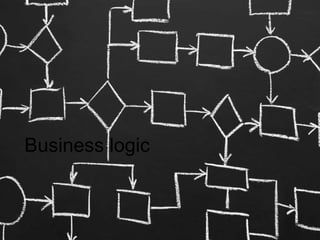
Business logic
Logging
Error handling
Environment handling
Didn't we forget something really important?
Construction of Objects!
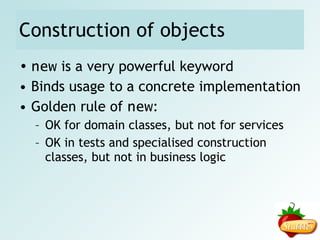
Construction of objects new  is a very powerful keyword
Construction of objects new  is a very powerful keyword Binds usage to a concrete implementation
Construction of objects new  is a very powerful keyword Binds usage to a concrete implementation Golden rule of  new : OK for domain classes, but not for services
Construction of objects new  is a very powerful keyword Binds usage to a concrete implementation Golden rule of  new : OK for domain classes, but not for services OK in tests and specialised construction classes, but not in business logic
Construction of objects II Bad: class Car { public function __construct() { $this->engine = new Engine(); $this->tire  = TireFactory::createTire(); } }
Construction of objects II Bad: class Car { public function __construct() { $this->engine = new Engine(); $this->tire  = TireFactory::createTire(); } } Work in constructor (Anti-Pattern)
Construction of objects II Bad: class Car { public function __construct() { $this->engine = new Engine(); $this->tire  = TireFactory::createTire(); } } Work in constructor (Anti-Pattern) Hard to test
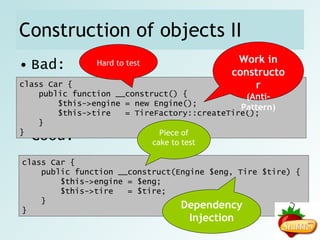
Construction of objects II Bad: Good: class Car { public function __construct() { $this->engine = new Engine(); $this->tire  = TireFactory::createTire(); } } class Car { public function __construct(Engine $eng, Tire $tire) { $this->engine = $eng; $this->tire  = $tire; } } Work in constructor (Anti-Pattern) Hard to test
Construction of objects II Bad: Good: class Car { public function __construct() { $this->engine = new Engine(); $this->tire  = TireFactory::createTire(); } } class Car { public function __construct(Engine $eng, Tire $tire) { $this->engine = $eng; $this->tire  = $tire; } } Work in constructor (Anti-Pattern) Hard to test Piece of cake to test
Construction of objects II Bad: Good: class Car { public function __construct() { $this->engine = new Engine(); $this->tire  = TireFactory::createTire(); } } class Car { public function __construct(Engine $eng, Tire $tire) { $this->engine = $eng; $this->tire  = $tire; } } Work in constructor (Anti-Pattern) Dependency Injection Hard to test Piece of cake to test
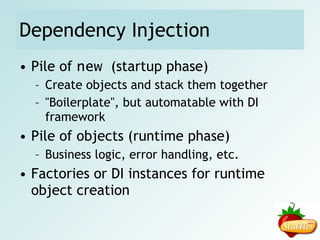
Dependency Injection Pile of  new  (startup phase) Create objects and stack them together "Boilerplate", but automatable with DI framework Pile of objects (runtime phase) Business logic, error handling, etc. Factories or DI instances for runtime object creation
Dependency Injection is viral
Law of Demeter Bad: class Driver { public function drive($miles) { $this->vehicle->engine->start(); $this->vehicle->drive($miles); $this->vehicle->engine->stop(); }
Law of Demeter Bad: class Driver { public function drive($miles) { $this->vehicle->engine->start(); $this->vehicle->drive($miles); $this->vehicle->engine->stop(); } Driver coupled to Engine
Law of Demeter Bad: class Driver { public function drive($miles) { $this->vehicle->engine->start(); $this->vehicle->drive($miles); $this->vehicle->engine->stop(); } Hard to test: test always needs Engine or a mock of it Driver coupled to Engine
Law of Demeter Bad: class Driver { public function drive($miles) { $this->vehicle->engine->start(); $this->vehicle->drive($miles); $this->vehicle->engine->stop(); } Internal state of Vehicle revealed Driver coupled to Engine Hard to test: test always needs Engine or a mock of it
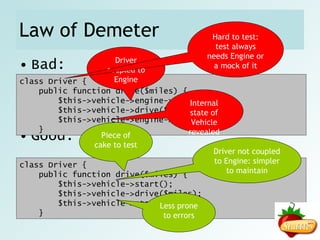
Law of Demeter Bad: Good: class Driver { public function drive($miles) { $this->vehicle->engine->start(); $this->vehicle->drive($miles); $this->vehicle->engine->stop(); } Internal state of Vehicle revealed class Driver { public function drive($miles) { $this->vehicle->start(); $this->vehicle->drive($miles); $this->vehicle->stop(); } Hard to test: test always needs Engine or a mock of it Driver coupled to Engine
Law of Demeter Bad: Good: class Driver { public function drive($miles) { $this->vehicle->engine->start(); $this->vehicle->drive($miles); $this->vehicle->engine->stop(); } Internal state of Vehicle revealed class Driver { public function drive($miles) { $this->vehicle->start(); $this->vehicle->drive($miles); $this->vehicle->stop(); } Driver coupled to Engine Hard to test: test always needs Engine or a mock of it Driver not coupled to Engine: simpler to maintain
Law of Demeter Bad: Good: class Driver { public function drive($miles) { $this->vehicle->engine->start(); $this->vehicle->drive($miles); $this->vehicle->engine->stop(); } Internal state of Vehicle revealed class Driver { public function drive($miles) { $this->vehicle->start(); $this->vehicle->drive($miles); $this->vehicle->stop(); } Piece of cake to test Hard to test: test always needs Engine or a mock of it Driver coupled to Engine Driver not coupled to Engine: simpler to maintain
Law of Demeter Bad: Good: class Driver { public function drive($miles) { $this->vehicle->engine->start(); $this->vehicle->drive($miles); $this->vehicle->engine->stop(); } Internal state of Vehicle revealed class Driver { public function drive($miles) { $this->vehicle->start(); $this->vehicle->drive($miles); $this->vehicle->stop(); } Piece of cake to test Less prone to errors Driver coupled to Engine Hard to test: test always needs Engine or a mock of it Driver not coupled to Engine: simpler to maintain
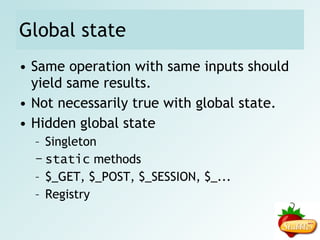
Global state Same operation with same inputs should yield same results. Not necessarily true with global state.
Global state Same operation with same inputs should yield same results. Not necessarily true with global state. Hidden global state Singleton static  methods $_GET, $_POST, $_SESSION, $_... Registry
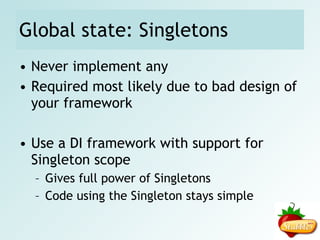
Global state: Singletons Never implement any Required most likely due to bad design of your framework
Global state: Singletons Never implement any Required most likely due to bad design of your framework Use a DI framework with support for Singleton scope Gives full power of Singletons Code using the Singleton stays simple
Singleton with DI framework $binder->bind('Session') ->to('PhpSession')
Singleton with DI framework $binder->bind('Session') ->to('PhpSession') Configure the binding
Singleton with DI framework $binder->bind('Session') ->to('PhpSession') ->in(stubBindingScopes::$SINGLETON); Configure the binding Enforce singletoness: DI framework will only create one instance of PhpSession and inject always this same instance
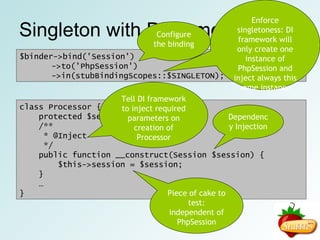
Singleton with DI framework $binder->bind('Session') ->to('PhpSession') ->in(stubBindingScopes::$SINGLETON); class Processor { protected $session; /** * @Inject */ public function __construct(Session $session) { $this->session = $session; } … } Configure the binding Enforce singletoness: DI framework will only create one instance of PhpSession and inject always this same instance
Singleton with DI framework $binder->bind('Session') ->to('PhpSession') ->in(stubBindingScopes::$SINGLETON); class Processor { protected $session; /** * @Inject */ public function __construct(Session $session) { $this->session = $session; } … } Configure the binding Enforce singletoness: DI framework will only create one instance of PhpSession and inject always this same instance Dependency Injection
Singleton with DI framework $binder->bind('Session') ->to('PhpSession') ->in(stubBindingScopes::$SINGLETON); class Processor { protected $session; /** * @Inject */ public function __construct(Session $session) { $this->session = $session; } … } Configure the binding Enforce singletoness: DI framework will only create one instance of PhpSession and inject always this same instance Dependency Injection Tell DI framework to inject required parameters on creation of Processor
Singleton with DI framework $binder->bind('Session') ->to('PhpSession') ->in(stubBindingScopes::$SINGLETON); class Processor { protected $session; /** * @Inject */ public function __construct(Session $session) { $this->session = $session; } … } Configure the binding Enforce singletoness: DI framework will only create one instance of PhpSession and inject always this same instance Dependency Injection Piece of cake to test: independent of PhpSession Tell DI framework to inject required parameters on creation of Processor
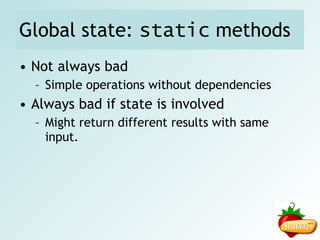
Global state:  static  methods Not always bad Simple operations without dependencies Always bad if state is involved Might return different results with same input.
Global state:  $_GET, $_POST, … Ugly to test
Global state:  $_GET, $_POST, … Ugly to test Rule: never access those vars directly in business logic
Global state:  $_GET, $_POST, … Ugly to test Rule: never access those vars directly in business logic Abstract access to globals with classes Remember: Singleton is evil
Global state:  $_GET, $_POST, … Ugly to test Rule: never access those vars directly in business logic Abstract access to globals with classes Remember: Singleton is evil Even better: interfaces
Global state:  $_GET, $_POST, … Ugly to test Rule: never access those vars directly in business logic Abstract access to globals with classes Remember: Singleton is evil Even better: interfaces Security: use a Request class which enforces filtering/validating input
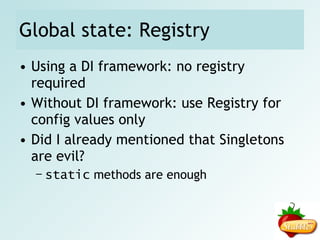
Global state: Registry Using a DI framework: no registry required
Global state: Registry Using a DI framework: no registry required Without DI framework: use Registry for config values only
Global state: Registry Using a DI framework: no registry required Without DI framework: use Registry for config values only Did I already mentioned that Singletons are evil?
Global state: Registry Using a DI framework: no registry required Without DI framework: use Registry for config values only Did I already mentioned that Singletons are evil? static  methods are enough
 
Modify
Simplify Modify
Simplify Improve Modify
Finally… If you remember only one little thing of this presentation it should be…
Singletons are really, really (and I mean really)
Singletons are really, really (and I mean really) EVIL
The End Questions and comments?
The End Questions and comments? Thank you.
Commercial break Stephan Schmidt: PHP Design Patterns
Commercial break Stephan Schmidt: PHP Design Patterns Clean code talks:  http://www.youtube.com/view_play_list?p=79645C72EA595A91
Commercial break Stephan Schmidt: PHP Design Patterns Clean code talks:  http://www.youtube.com/view_play_list?p=79645C72EA595A91 Stubbles: www.stubbles.net

Things to consider for testable Code

  • 1.
    Things to considerfor testable code Frank Kleine, 27.10.2009
  • 2.
    The Speaker: FrankKleine 1&1 Internet AG (Head of Web Infrastructure) PHP since 2000 Lead Developer Stubbles XJConf for PHP vfsStream Technical editor "PHP Design Patterns"
  • 3.
    Separation of ConcernsTypical concerns in applications
  • 4.
  • 5.
  • 6.
  • 7.
  • 8.
    Didn't we forgetsomething really important?
  • 9.
  • 10.
    Construction of objectsnew is a very powerful keyword
  • 11.
    Construction of objectsnew is a very powerful keyword Binds usage to a concrete implementation
  • 12.
    Construction of objectsnew is a very powerful keyword Binds usage to a concrete implementation Golden rule of new : OK for domain classes, but not for services
  • 13.
    Construction of objectsnew is a very powerful keyword Binds usage to a concrete implementation Golden rule of new : OK for domain classes, but not for services OK in tests and specialised construction classes, but not in business logic
  • 14.
    Construction of objectsII Bad: class Car { public function __construct() { $this->engine = new Engine(); $this->tire = TireFactory::createTire(); } }
  • 15.
    Construction of objectsII Bad: class Car { public function __construct() { $this->engine = new Engine(); $this->tire = TireFactory::createTire(); } } Work in constructor (Anti-Pattern)
  • 16.
    Construction of objectsII Bad: class Car { public function __construct() { $this->engine = new Engine(); $this->tire = TireFactory::createTire(); } } Work in constructor (Anti-Pattern) Hard to test
  • 17.
    Construction of objectsII Bad: Good: class Car { public function __construct() { $this->engine = new Engine(); $this->tire = TireFactory::createTire(); } } class Car { public function __construct(Engine $eng, Tire $tire) { $this->engine = $eng; $this->tire = $tire; } } Work in constructor (Anti-Pattern) Hard to test
  • 18.
    Construction of objectsII Bad: Good: class Car { public function __construct() { $this->engine = new Engine(); $this->tire = TireFactory::createTire(); } } class Car { public function __construct(Engine $eng, Tire $tire) { $this->engine = $eng; $this->tire = $tire; } } Work in constructor (Anti-Pattern) Hard to test Piece of cake to test
  • 19.
    Construction of objectsII Bad: Good: class Car { public function __construct() { $this->engine = new Engine(); $this->tire = TireFactory::createTire(); } } class Car { public function __construct(Engine $eng, Tire $tire) { $this->engine = $eng; $this->tire = $tire; } } Work in constructor (Anti-Pattern) Dependency Injection Hard to test Piece of cake to test
  • 20.
    Dependency Injection Pileof new (startup phase) Create objects and stack them together "Boilerplate", but automatable with DI framework Pile of objects (runtime phase) Business logic, error handling, etc. Factories or DI instances for runtime object creation
  • 21.
  • 22.
    Law of DemeterBad: class Driver { public function drive($miles) { $this->vehicle->engine->start(); $this->vehicle->drive($miles); $this->vehicle->engine->stop(); }
  • 23.
    Law of DemeterBad: class Driver { public function drive($miles) { $this->vehicle->engine->start(); $this->vehicle->drive($miles); $this->vehicle->engine->stop(); } Driver coupled to Engine
  • 24.
    Law of DemeterBad: class Driver { public function drive($miles) { $this->vehicle->engine->start(); $this->vehicle->drive($miles); $this->vehicle->engine->stop(); } Hard to test: test always needs Engine or a mock of it Driver coupled to Engine
  • 25.
    Law of DemeterBad: class Driver { public function drive($miles) { $this->vehicle->engine->start(); $this->vehicle->drive($miles); $this->vehicle->engine->stop(); } Internal state of Vehicle revealed Driver coupled to Engine Hard to test: test always needs Engine or a mock of it
  • 26.
    Law of DemeterBad: Good: class Driver { public function drive($miles) { $this->vehicle->engine->start(); $this->vehicle->drive($miles); $this->vehicle->engine->stop(); } Internal state of Vehicle revealed class Driver { public function drive($miles) { $this->vehicle->start(); $this->vehicle->drive($miles); $this->vehicle->stop(); } Hard to test: test always needs Engine or a mock of it Driver coupled to Engine
  • 27.
    Law of DemeterBad: Good: class Driver { public function drive($miles) { $this->vehicle->engine->start(); $this->vehicle->drive($miles); $this->vehicle->engine->stop(); } Internal state of Vehicle revealed class Driver { public function drive($miles) { $this->vehicle->start(); $this->vehicle->drive($miles); $this->vehicle->stop(); } Driver coupled to Engine Hard to test: test always needs Engine or a mock of it Driver not coupled to Engine: simpler to maintain
  • 28.
    Law of DemeterBad: Good: class Driver { public function drive($miles) { $this->vehicle->engine->start(); $this->vehicle->drive($miles); $this->vehicle->engine->stop(); } Internal state of Vehicle revealed class Driver { public function drive($miles) { $this->vehicle->start(); $this->vehicle->drive($miles); $this->vehicle->stop(); } Piece of cake to test Hard to test: test always needs Engine or a mock of it Driver coupled to Engine Driver not coupled to Engine: simpler to maintain
  • 29.
    Law of DemeterBad: Good: class Driver { public function drive($miles) { $this->vehicle->engine->start(); $this->vehicle->drive($miles); $this->vehicle->engine->stop(); } Internal state of Vehicle revealed class Driver { public function drive($miles) { $this->vehicle->start(); $this->vehicle->drive($miles); $this->vehicle->stop(); } Piece of cake to test Less prone to errors Driver coupled to Engine Hard to test: test always needs Engine or a mock of it Driver not coupled to Engine: simpler to maintain
  • 30.
    Global state Sameoperation with same inputs should yield same results. Not necessarily true with global state.
  • 31.
    Global state Sameoperation with same inputs should yield same results. Not necessarily true with global state. Hidden global state Singleton static methods $_GET, $_POST, $_SESSION, $_... Registry
  • 32.
    Global state: SingletonsNever implement any Required most likely due to bad design of your framework
  • 33.
    Global state: SingletonsNever implement any Required most likely due to bad design of your framework Use a DI framework with support for Singleton scope Gives full power of Singletons Code using the Singleton stays simple
  • 34.
    Singleton with DIframework $binder->bind('Session') ->to('PhpSession')
  • 35.
    Singleton with DIframework $binder->bind('Session') ->to('PhpSession') Configure the binding
  • 36.
    Singleton with DIframework $binder->bind('Session') ->to('PhpSession') ->in(stubBindingScopes::$SINGLETON); Configure the binding Enforce singletoness: DI framework will only create one instance of PhpSession and inject always this same instance
  • 37.
    Singleton with DIframework $binder->bind('Session') ->to('PhpSession') ->in(stubBindingScopes::$SINGLETON); class Processor { protected $session; /** * @Inject */ public function __construct(Session $session) { $this->session = $session; } … } Configure the binding Enforce singletoness: DI framework will only create one instance of PhpSession and inject always this same instance
  • 38.
    Singleton with DIframework $binder->bind('Session') ->to('PhpSession') ->in(stubBindingScopes::$SINGLETON); class Processor { protected $session; /** * @Inject */ public function __construct(Session $session) { $this->session = $session; } … } Configure the binding Enforce singletoness: DI framework will only create one instance of PhpSession and inject always this same instance Dependency Injection
  • 39.
    Singleton with DIframework $binder->bind('Session') ->to('PhpSession') ->in(stubBindingScopes::$SINGLETON); class Processor { protected $session; /** * @Inject */ public function __construct(Session $session) { $this->session = $session; } … } Configure the binding Enforce singletoness: DI framework will only create one instance of PhpSession and inject always this same instance Dependency Injection Tell DI framework to inject required parameters on creation of Processor
  • 40.
    Singleton with DIframework $binder->bind('Session') ->to('PhpSession') ->in(stubBindingScopes::$SINGLETON); class Processor { protected $session; /** * @Inject */ public function __construct(Session $session) { $this->session = $session; } … } Configure the binding Enforce singletoness: DI framework will only create one instance of PhpSession and inject always this same instance Dependency Injection Piece of cake to test: independent of PhpSession Tell DI framework to inject required parameters on creation of Processor
  • 41.
    Global state: static methods Not always bad Simple operations without dependencies Always bad if state is involved Might return different results with same input.
  • 42.
    Global state: $_GET, $_POST, … Ugly to test
  • 43.
    Global state: $_GET, $_POST, … Ugly to test Rule: never access those vars directly in business logic
  • 44.
    Global state: $_GET, $_POST, … Ugly to test Rule: never access those vars directly in business logic Abstract access to globals with classes Remember: Singleton is evil
  • 45.
    Global state: $_GET, $_POST, … Ugly to test Rule: never access those vars directly in business logic Abstract access to globals with classes Remember: Singleton is evil Even better: interfaces
  • 46.
    Global state: $_GET, $_POST, … Ugly to test Rule: never access those vars directly in business logic Abstract access to globals with classes Remember: Singleton is evil Even better: interfaces Security: use a Request class which enforces filtering/validating input
  • 47.
    Global state: RegistryUsing a DI framework: no registry required
  • 48.
    Global state: RegistryUsing a DI framework: no registry required Without DI framework: use Registry for config values only
  • 49.
    Global state: RegistryUsing a DI framework: no registry required Without DI framework: use Registry for config values only Did I already mentioned that Singletons are evil?
  • 50.
    Global state: RegistryUsing a DI framework: no registry required Without DI framework: use Registry for config values only Did I already mentioned that Singletons are evil? static methods are enough
  • 51.
  • 52.
  • 53.
  • 54.
  • 55.
    Finally… If youremember only one little thing of this presentation it should be…
  • 56.
    Singletons are really,really (and I mean really)
  • 57.
    Singletons are really,really (and I mean really) EVIL
  • 58.
    The End Questionsand comments?
  • 59.
    The End Questionsand comments? Thank you.
  • 60.
    Commercial break StephanSchmidt: PHP Design Patterns
  • 61.
    Commercial break StephanSchmidt: PHP Design Patterns Clean code talks: http://www.youtube.com/view_play_list?p=79645C72EA595A91
  • 62.
    Commercial break StephanSchmidt: PHP Design Patterns Clean code talks: http://www.youtube.com/view_play_list?p=79645C72EA595A91 Stubbles: www.stubbles.net

Editor's Notes

  • #52 Simplify – remove accidental complexity Improve – smaller methods, better namings. You need unit tests for this.
  • #53 Simplify – remove accidental complexity Improve – smaller methods, better namings. You need unit tests for this.
  • #54 Simplify – remove accidental complexity Improve – smaller methods, better namings. You need unit tests for this.
  • #55 Simplify – remove accidental complexity Improve – smaller methods, better namings. You need unit tests for this.