Indian Recipe Recommendation System
A Content-Based Food Recommendation System for
Diverse Indian Culinary Tastes
Prepared By
Neha Tyagi
M. Tech (CE) 4th
Sem.
Roll no-MRT22PGMCS001
Agenda
• Introduction
• Motivation & Objectives
• Background
• Literature Survey
• Methodology Used
• Evaluation Principles
• Implementation
• Conclusion and Future Directions
What are Recommendation Systems?
• It is an information filtering tool designed to predict a user's
preferences or ratings for specific items.
• These are filtering tools that provide recommendations that might
interest the users.
• Recommendations provided are based on their likes or the likes of
similar users.
Some Popular Websites that use Recommendation System
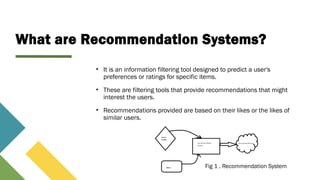
Fig 1 . Recommendation System
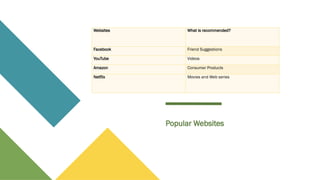
Popular Websites
Websites What is recommended?
Facebook Friend Suggestions
YouTube Videos
Amazon Consumer Products
Netflix Movies and Web series
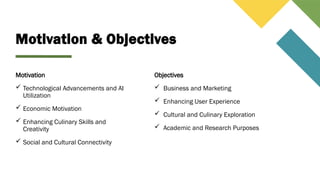
Motivation & Objectives
Motivation
 Technological Advancements and AI
Utilization
 Economic Motivation
 Enhancing Culinary Skills and
Creativity
 Social and Cultural Connectivity
Objectives
 Business and Marketing
 Enhancing User Experience
 Cultural and Culinary Exploration
 Academic and Research Purposes
Types of
Recommendation
Systems
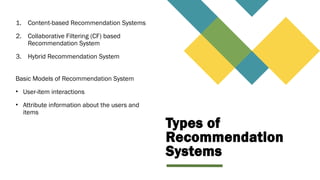
1. Content-based Recommendation Systems
2. Collaborative Filtering (CF) based
Recommendation System
3. Hybrid Recommendation System
Basic Models of Recommendation System
• User-item interactions
• Attribute information about the users and
items
Content-based
Recommendation
Systems
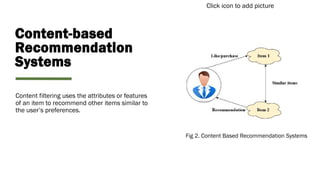
Content filtering uses the attributes or features
of an item to recommend other items similar to
the user’s preferences.
Click icon to add picture
Fig 2. Content Based Recommendation Systems
Collaborative
Filtering based
Recommendation
Systems
Click icon to add picture
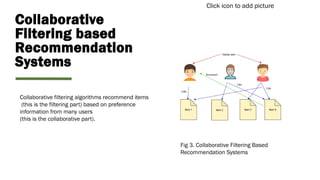
Collaborative filtering algorithms recommend items
(this is the filtering part) based on preference
information from many users
(this is the collaborative part).
Fig 3. Collaborative Filtering Based
Recommendation Systems
Hybrid
Recommendation
Systems
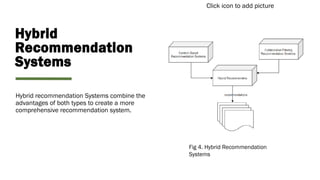
Hybrid recommendation Systems combine the
advantages of both types to create a more
comprehensive recommendation system.
Click icon to add picture
Fig 4. Hybrid Recommendation
Systems
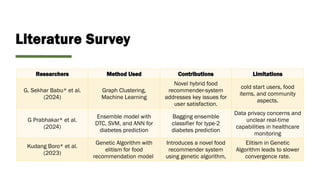
Literature Survey
Researchers Method Used Contributions Limitations
G. Sekhar Babu* et al.
(2024)
Graph Clustering,
Machine Learning
Novel hybrid food
recommender-system
addresses key issues for
user satisfaction.
cold start users, food
items, and community
aspects.
G Prabhakar* et al.
(2024)
Ensemble model with
DTC, SVM, and ANN for
diabetes prediction
Bagging ensemble
classifier for type-2
diabetes prediction
Data privacy concerns and
unclear real-time
capabilities in healthcare
monitoring
Kudang Boro* et al.
(2023)
Genetic Algorithm with
elitism for food
recommendation model
Introduces a novel food
recommender system
using genetic algorithm,
Elitism in Genetic
Algorithm leads to slower
convergence rate.
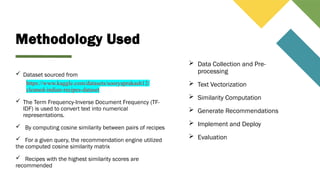
Methodology Used
 Dataset sourced from
https://www.kaggle.com/datasets/sooryaprakash12/
cleaned-indian-recipes-dataset
 The Term Frequency-Inverse Document Frequency (TF-
IDF) is used to convert text into numerical
representations.
 By computing cosine similarity between pairs of recipes
 For a given query, the recommendation engine utilized
the computed cosine similarity matrix
 Recipes with the highest similarity scores are
recommended
 Data Collection and Pre-
processing
 Text Vectorization
 Similarity Computation
 Generate Recommendations
 Implement and Deploy
 Evaluation
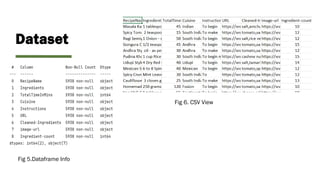
Dataset
Fig 5.Dataframe Info
Fig 6. CSV View
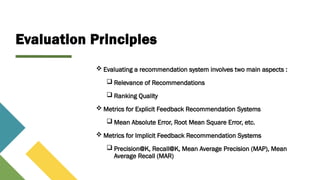
Evaluation Principles
 Evaluating a recommendation system involves two main aspects :
 Relevance of Recommendations
 Ranking Quality
 Metrics for Explicit Feedback Recommendation Systems
 Mean Absolute Error, Root Mean Square Error, etc.
 Metrics for Implicit Feedback Recommendation Systems
 Precision@K, Recall@K, Mean Average Precision (MAP), Mean
Average Recall (MAR)
Some Popular Websites that use Recommendation System
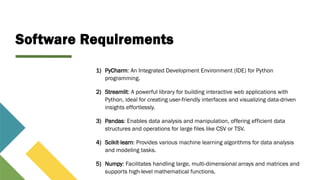
Software Requirements
1) PyCharm: An Integrated Development Environment (IDE) for Python
programming.
2) Streamlit: A powerful library for building interactive web applications with
Python, ideal for creating user-friendly interfaces and visualizing data-driven
insights effortlessly.
3) Pandas: Enables data analysis and manipulation, offering efficient data
structures and operations for large files like CSV or TSV.
4) Scikit-learn: Provides various machine learning algorithms for data analysis
and modeling tasks.
5) Numpy: Facilitates handling large, multi-dimensional arrays and matrices and
supports high-level mathematical functions.
UI Screens
Some Popular Websites that use Recommendation System
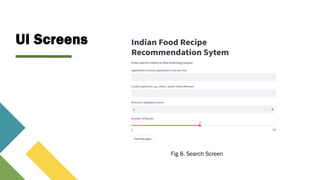
Fig 8. Search Screen
UI Screens
Some Popular Websites that use Recommendation System
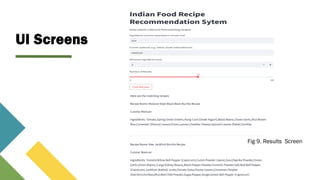
Fig 9. Results Screen
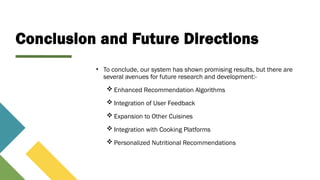
Conclusion and Future Directions
• To conclude, our system has shown promising results, but there are
several avenues for future research and development:-
 Enhanced Recommendation Algorithms
 Integration of User Feedback
 Expansion to Other Cuisines
 Integration with Cooking Platforms
 Personalized Nutritional Recommendations
Thank you
Neha Tyagi
M. Tech (CE)
Roll no-MRT22PGMCS001

Thesis work - ppt- food recommendation system

  • 1.
    Indian Recipe RecommendationSystem A Content-Based Food Recommendation System for Diverse Indian Culinary Tastes Prepared By Neha Tyagi M. Tech (CE) 4th Sem. Roll no-MRT22PGMCS001
  • 2.
    Agenda • Introduction • Motivation& Objectives • Background • Literature Survey • Methodology Used • Evaluation Principles • Implementation • Conclusion and Future Directions
  • 3.
    What are RecommendationSystems? • It is an information filtering tool designed to predict a user's preferences or ratings for specific items. • These are filtering tools that provide recommendations that might interest the users. • Recommendations provided are based on their likes or the likes of similar users. Some Popular Websites that use Recommendation System Fig 1 . Recommendation System
  • 4.
    Popular Websites Websites Whatis recommended? Facebook Friend Suggestions YouTube Videos Amazon Consumer Products Netflix Movies and Web series
  • 5.
    Motivation & Objectives Motivation Technological Advancements and AI Utilization  Economic Motivation  Enhancing Culinary Skills and Creativity  Social and Cultural Connectivity Objectives  Business and Marketing  Enhancing User Experience  Cultural and Culinary Exploration  Academic and Research Purposes
  • 6.
    Types of Recommendation Systems 1. Content-basedRecommendation Systems 2. Collaborative Filtering (CF) based Recommendation System 3. Hybrid Recommendation System Basic Models of Recommendation System • User-item interactions • Attribute information about the users and items
  • 7.
    Content-based Recommendation Systems Content filtering usesthe attributes or features of an item to recommend other items similar to the user’s preferences. Click icon to add picture Fig 2. Content Based Recommendation Systems
  • 8.
    Collaborative Filtering based Recommendation Systems Click iconto add picture Collaborative filtering algorithms recommend items (this is the filtering part) based on preference information from many users (this is the collaborative part). Fig 3. Collaborative Filtering Based Recommendation Systems
  • 9.
    Hybrid Recommendation Systems Hybrid recommendation Systemscombine the advantages of both types to create a more comprehensive recommendation system. Click icon to add picture Fig 4. Hybrid Recommendation Systems
  • 10.
    Literature Survey Researchers MethodUsed Contributions Limitations G. Sekhar Babu* et al. (2024) Graph Clustering, Machine Learning Novel hybrid food recommender-system addresses key issues for user satisfaction. cold start users, food items, and community aspects. G Prabhakar* et al. (2024) Ensemble model with DTC, SVM, and ANN for diabetes prediction Bagging ensemble classifier for type-2 diabetes prediction Data privacy concerns and unclear real-time capabilities in healthcare monitoring Kudang Boro* et al. (2023) Genetic Algorithm with elitism for food recommendation model Introduces a novel food recommender system using genetic algorithm, Elitism in Genetic Algorithm leads to slower convergence rate.
  • 11.
    Methodology Used  Datasetsourced from https://www.kaggle.com/datasets/sooryaprakash12/ cleaned-indian-recipes-dataset  The Term Frequency-Inverse Document Frequency (TF- IDF) is used to convert text into numerical representations.  By computing cosine similarity between pairs of recipes  For a given query, the recommendation engine utilized the computed cosine similarity matrix  Recipes with the highest similarity scores are recommended  Data Collection and Pre- processing  Text Vectorization  Similarity Computation  Generate Recommendations  Implement and Deploy  Evaluation
  • 12.
  • 13.
    Evaluation Principles  Evaluatinga recommendation system involves two main aspects :  Relevance of Recommendations  Ranking Quality  Metrics for Explicit Feedback Recommendation Systems  Mean Absolute Error, Root Mean Square Error, etc.  Metrics for Implicit Feedback Recommendation Systems  Precision@K, Recall@K, Mean Average Precision (MAP), Mean Average Recall (MAR) Some Popular Websites that use Recommendation System
  • 14.
    Software Requirements 1) PyCharm:An Integrated Development Environment (IDE) for Python programming. 2) Streamlit: A powerful library for building interactive web applications with Python, ideal for creating user-friendly interfaces and visualizing data-driven insights effortlessly. 3) Pandas: Enables data analysis and manipulation, offering efficient data structures and operations for large files like CSV or TSV. 4) Scikit-learn: Provides various machine learning algorithms for data analysis and modeling tasks. 5) Numpy: Facilitates handling large, multi-dimensional arrays and matrices and supports high-level mathematical functions.
  • 15.
    UI Screens Some PopularWebsites that use Recommendation System Fig 8. Search Screen
  • 16.
    UI Screens Some PopularWebsites that use Recommendation System Fig 9. Results Screen
  • 17.
    Conclusion and FutureDirections • To conclude, our system has shown promising results, but there are several avenues for future research and development:-  Enhanced Recommendation Algorithms  Integration of User Feedback  Expansion to Other Cuisines  Integration with Cooking Platforms  Personalized Nutritional Recommendations
  • 18.
    Thank you Neha Tyagi M.Tech (CE) Roll no-MRT22PGMCS001