PROPOSAL HEARING
December 14, 2023
Prayer
UNRAVELING THE NEXUS BETWEEN
WORK-LIFE BALANCE, WORK QUALITY,
TO JOB PERFORMANCE AMONG
SECONDARY TEACHERS
Having a healthy work-life balance and quality of work life is crucial for
teachers. It should be noted that in order for the teachers to achieve best
performance, they need to be satisfied and quality of work life can be used to
reach greater performance (Amin, et al 2013). Furthermore, aside from
providing a sense of fulfillment at work, it also aids in achieving greater rates of
retention at educational institutions (Mathews, Jeremiah, & Ursulla, 2021).
Additionally, fostering a climate that is supportive of teachers' work is pivotal
for the schools, which will enhance their performance.
RATIONALE
In order to attain the intended results, work life and personal life must
be balanced (Unal & Dulay, 2022). Moreover, the results in the study of Erturk
(2022) show that teachers' overall assessments on the quality of the work are
moderate in the scale in terms of work-family balance, job stress, working
environment, and career satisfaction dimensions and lacking in work-related
self- control relative to overall well-being. Moreover, according to Praveen
(2022), there is a requirement for creating work-life balance initiatives and
policies for the educational community to facilitate in reconciling their lives and
careers’ needs.
RATIONALE
An article published in Philippine Information Agency on September 12, 2023
reported that public school teachers have 56 ancillary tasks on top of their
teaching tasks and writing lesson plan. This numerous administrative loads results
to teacher’s burnout that compromise their principal task which is to deliver quality
instruction.
RATIONALE
As cited by Joshanloob& Sang-Ah Parkc, 2019, burnout affects both the well-being of
teachers and their effectiveness and is recognized as a significant problem in class
systems round the world. It is a chronic problem which will undermine the standard of
teacher performance, with an impression on student interactions, sometimes resulting in
negative outcomes in terms of their performance. In addition, problems with work-life
balance can lead to depression, burnout, elevated stress and anxiety, difficulties staying
focused at work, a loss of self-control, and a decline in performance as mentioned by
Unal & Dulay (2022).
RATIONALE
This research will aim to explore the nuanced connections between how
teachers manage the demands of their professional lives, the overall quality of
their work experiences, and the subsequent result on their job performance.
Through a comprehensive investigation, this study will seek to contribute
valuable insights that can inform strategies for enhancing the overall well-being
and effectiveness of teachers in their multifaceted roles.
RATIONALE
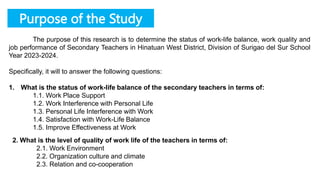
Purpose of the Study
The purpose of this research is to determine the status of work-life balance, work quality and
job performance of Secondary Teachers in Hinatuan West District, Division of Surigao del Sur School
Year 2023-2024.
Specifically, it will to answer the following questions:
1. What is the status of work-life balance of the secondary teachers in terms of:
1.1. Work Place Support
1.2. Work Interference with Personal Life
1.3. Personal Life Interference with Work
1.4. Satisfaction with Work-Life Balance
1.5. Improve Effectiveness at Work
2. What is the level of quality of work life of the teachers in terms of:
2.1. Work Environment
2.2. Organization culture and climate
2.3. Relation and co-cooperation
Purpose of the Study
2.4. Training and Development
2.5. Compensation and Rewards
2.6. Facilities
2.7. Job Satisfaction and Job Security
2.8. Autonomy of Work
2.9. . Adequacy of Resources
3. What is the level of job performance in terms of:
3.1. Task Performance
3.2. Contextual Performance
4. Is there a significant relationship between:
4.1. Work life balance to job performance
4.2. Quality of work life to job performance
5. Which between work life balance and quality of work life significantly
influences job performance?
Schematic Diagram
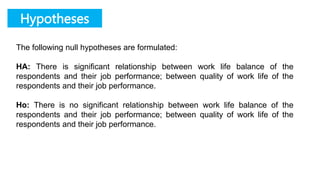
Hypotheses
The following null hypotheses are formulated:
HA: There is significant relationship between work life balance of the
respondents and their job performance; between quality of work life of the
respondents and their job performance.
Ho: There is no significant relationship between work life balance of the
respondents and their job performance; between quality of work life of the
respondents and their job performance.
Methodology
Research Design
This study will use descriptive-correlational research design. A population,
circumstance, or phenomena is intended to be correctly and methodically described through
descriptive study. In this study, descriptive research design will be used to describe the level
of work life balance, work quality, and job performance of secondary teachers in the Hinatuan
West District, Hinatuan, Surigao del Sur. On the other hand, a correlational research design
explores relationships between variables. When using a correlational study design, no
variables are within the researcher's direct control or manipulation. The degree and/or direction
of the association between two (or more) variables is reflected in a correlation. A correlation
may go in either a positive or negative direction. As such, it is fit for this study to establish
whether work life balance and quality of work life influence job performance.
Methodology
Municipality of Hinatuan
Tagasaka National High School
Dugmanon National High School
Bigaan National High School
Roxas National High School
Research Locale
Bingcongan Integrated School
Maligaya Integrated School
Research Respondents
The study's respondents are the
secondary teachers of Hinatuan West
District, Hinatuan, Surigao del Sur. Only
the teaching personnel of the West district
schools will be considered as participants.
Further, since they all qualify to be
respondents of this study, a universal
purposive sampling will be utilized since
all the secondary teaching personnel will
be selected.
Methodology
Research Instrument
This study will utilize three kinds of adapted questionnaires for the three variables. For work
life balance, the questionnaire from the study of Banu and Durainpandian (2014) for Work- life
Balance will be used. For work quality, Quality of Work Life by Swamy et. al (2015) with cronbach
alpha 0.88 will be used and job performance will be measured through Self-reported Measure of
Job Performance by Carlos & Rodrigues (2016) with cronbach alpha 0.878.
The researcher will arrange the questionnaire into three parts (see Appendix E). The first
part is about work life balance, second part is about job satisfaction, and third part is for work
quality. A five-point Likert scale will be used in all the three parts of the survey, precisely according
to the study's objectives. Assessments about the frequency of encountering the operational
problems and usage or application of coping strategies will be having a scale composed of "Never,"
"Rarely," "Sometimes," "Often," and "Always."
Methodology
Data Gathering Procedure
The researcher will send a letter to the District Supervisor of
Hinatuan West District thru the Principals/ School Heads. Then, a
consent letter will be given to the prospect respondents asking
them to participate in the study during their vacant time.
Respondents will be assured that their responses will be kept
confidential and that their names will never appear in any part of
this study.
Methodology
Data Gathering Procedure
Questionnaires will be administered physically and the necessary
health protocol will still be strictly observed such as wearing of face mask,
physical distancing, and sanitizing. Before the questionnaires will be
distributed, the nature and purpose of the study will be explained to the
respondents. Once approved, the researcher will administer the
questionnaires. Then, the retrieval of the questionnaires will be tabulated and
interpreted, analysis, and interpretation. It will be presented through tables
followed by explanations of its implications.
Methodology
Statistical Treatment
The statistical tools to be used for data analysis are as follows:
Mean. In this study, it will be used to determine the level of work life balance, quality of work life,
and job performance.
Standard deviation. It will be used in measuring the dispersion of a data set relative to the resulted
mean of work life balance, quality of work life, and job performance.
Pearson product-moment correlation. This statistical tool will be used to determine the
relationship of work life balance, quality of work life, and job performance.
Regression Analysis. In this study, it will be used to determine whether work life balance and
quality of work life influence job performance
Methodology
REFERENCES
Methodology
REFERENCES
Methodology
REFERENCES
Methodology
REFERENCES
Thank you
and
God bless
us!

Thesis Proposal-Presentation.pptx

  • 1.
  • 2.
  • 3.
    UNRAVELING THE NEXUSBETWEEN WORK-LIFE BALANCE, WORK QUALITY, TO JOB PERFORMANCE AMONG SECONDARY TEACHERS
  • 4.
    Having a healthywork-life balance and quality of work life is crucial for teachers. It should be noted that in order for the teachers to achieve best performance, they need to be satisfied and quality of work life can be used to reach greater performance (Amin, et al 2013). Furthermore, aside from providing a sense of fulfillment at work, it also aids in achieving greater rates of retention at educational institutions (Mathews, Jeremiah, & Ursulla, 2021). Additionally, fostering a climate that is supportive of teachers' work is pivotal for the schools, which will enhance their performance. RATIONALE
  • 5.
    In order toattain the intended results, work life and personal life must be balanced (Unal & Dulay, 2022). Moreover, the results in the study of Erturk (2022) show that teachers' overall assessments on the quality of the work are moderate in the scale in terms of work-family balance, job stress, working environment, and career satisfaction dimensions and lacking in work-related self- control relative to overall well-being. Moreover, according to Praveen (2022), there is a requirement for creating work-life balance initiatives and policies for the educational community to facilitate in reconciling their lives and careers’ needs. RATIONALE
  • 6.
    An article publishedin Philippine Information Agency on September 12, 2023 reported that public school teachers have 56 ancillary tasks on top of their teaching tasks and writing lesson plan. This numerous administrative loads results to teacher’s burnout that compromise their principal task which is to deliver quality instruction. RATIONALE
  • 7.
    As cited byJoshanloob& Sang-Ah Parkc, 2019, burnout affects both the well-being of teachers and their effectiveness and is recognized as a significant problem in class systems round the world. It is a chronic problem which will undermine the standard of teacher performance, with an impression on student interactions, sometimes resulting in negative outcomes in terms of their performance. In addition, problems with work-life balance can lead to depression, burnout, elevated stress and anxiety, difficulties staying focused at work, a loss of self-control, and a decline in performance as mentioned by Unal & Dulay (2022). RATIONALE
  • 8.
    This research willaim to explore the nuanced connections between how teachers manage the demands of their professional lives, the overall quality of their work experiences, and the subsequent result on their job performance. Through a comprehensive investigation, this study will seek to contribute valuable insights that can inform strategies for enhancing the overall well-being and effectiveness of teachers in their multifaceted roles. RATIONALE
  • 9.
    Purpose of theStudy The purpose of this research is to determine the status of work-life balance, work quality and job performance of Secondary Teachers in Hinatuan West District, Division of Surigao del Sur School Year 2023-2024. Specifically, it will to answer the following questions: 1. What is the status of work-life balance of the secondary teachers in terms of: 1.1. Work Place Support 1.2. Work Interference with Personal Life 1.3. Personal Life Interference with Work 1.4. Satisfaction with Work-Life Balance 1.5. Improve Effectiveness at Work 2. What is the level of quality of work life of the teachers in terms of: 2.1. Work Environment 2.2. Organization culture and climate 2.3. Relation and co-cooperation
  • 10.
    Purpose of theStudy 2.4. Training and Development 2.5. Compensation and Rewards 2.6. Facilities 2.7. Job Satisfaction and Job Security 2.8. Autonomy of Work 2.9. . Adequacy of Resources 3. What is the level of job performance in terms of: 3.1. Task Performance 3.2. Contextual Performance 4. Is there a significant relationship between: 4.1. Work life balance to job performance 4.2. Quality of work life to job performance 5. Which between work life balance and quality of work life significantly influences job performance?
  • 11.
  • 12.
    Hypotheses The following nullhypotheses are formulated: HA: There is significant relationship between work life balance of the respondents and their job performance; between quality of work life of the respondents and their job performance. Ho: There is no significant relationship between work life balance of the respondents and their job performance; between quality of work life of the respondents and their job performance.
  • 13.
    Methodology Research Design This studywill use descriptive-correlational research design. A population, circumstance, or phenomena is intended to be correctly and methodically described through descriptive study. In this study, descriptive research design will be used to describe the level of work life balance, work quality, and job performance of secondary teachers in the Hinatuan West District, Hinatuan, Surigao del Sur. On the other hand, a correlational research design explores relationships between variables. When using a correlational study design, no variables are within the researcher's direct control or manipulation. The degree and/or direction of the association between two (or more) variables is reflected in a correlation. A correlation may go in either a positive or negative direction. As such, it is fit for this study to establish whether work life balance and quality of work life influence job performance.
  • 14.
    Methodology Municipality of Hinatuan TagasakaNational High School Dugmanon National High School Bigaan National High School Roxas National High School Research Locale Bingcongan Integrated School Maligaya Integrated School
  • 15.
    Research Respondents The study'srespondents are the secondary teachers of Hinatuan West District, Hinatuan, Surigao del Sur. Only the teaching personnel of the West district schools will be considered as participants. Further, since they all qualify to be respondents of this study, a universal purposive sampling will be utilized since all the secondary teaching personnel will be selected.
  • 16.
    Methodology Research Instrument This studywill utilize three kinds of adapted questionnaires for the three variables. For work life balance, the questionnaire from the study of Banu and Durainpandian (2014) for Work- life Balance will be used. For work quality, Quality of Work Life by Swamy et. al (2015) with cronbach alpha 0.88 will be used and job performance will be measured through Self-reported Measure of Job Performance by Carlos & Rodrigues (2016) with cronbach alpha 0.878. The researcher will arrange the questionnaire into three parts (see Appendix E). The first part is about work life balance, second part is about job satisfaction, and third part is for work quality. A five-point Likert scale will be used in all the three parts of the survey, precisely according to the study's objectives. Assessments about the frequency of encountering the operational problems and usage or application of coping strategies will be having a scale composed of "Never," "Rarely," "Sometimes," "Often," and "Always."
  • 17.
    Methodology Data Gathering Procedure Theresearcher will send a letter to the District Supervisor of Hinatuan West District thru the Principals/ School Heads. Then, a consent letter will be given to the prospect respondents asking them to participate in the study during their vacant time. Respondents will be assured that their responses will be kept confidential and that their names will never appear in any part of this study.
  • 18.
    Methodology Data Gathering Procedure Questionnaireswill be administered physically and the necessary health protocol will still be strictly observed such as wearing of face mask, physical distancing, and sanitizing. Before the questionnaires will be distributed, the nature and purpose of the study will be explained to the respondents. Once approved, the researcher will administer the questionnaires. Then, the retrieval of the questionnaires will be tabulated and interpreted, analysis, and interpretation. It will be presented through tables followed by explanations of its implications.
  • 19.
    Methodology Statistical Treatment The statisticaltools to be used for data analysis are as follows: Mean. In this study, it will be used to determine the level of work life balance, quality of work life, and job performance. Standard deviation. It will be used in measuring the dispersion of a data set relative to the resulted mean of work life balance, quality of work life, and job performance. Pearson product-moment correlation. This statistical tool will be used to determine the relationship of work life balance, quality of work life, and job performance. Regression Analysis. In this study, it will be used to determine whether work life balance and quality of work life influence job performance
  • 20.
  • 21.
  • 22.
  • 23.
  • 24.