11 November 2009 Chris Hippner
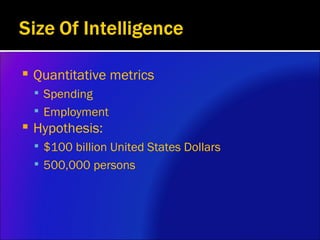
Quantitative metrics Spending Employment Hypothesis: $100 billion United States Dollars 500,000 persons
NOT YET POSSIBLE Method does not exist for international comparisons Assumes: Function, roles, & missions are different WRONG   FEATURES Common features: Collection/analysis Covert action Counterintelligence National   wealth   v.   security   concerns?
Cold War Paradigm Civil-Military Relations Non-Western  Inconsistent/qualitative   variables
Annual reports/disclosers Domestic requirements Pro: Quantitative Con: Irregular reporting All intel. Components?
Brassey’s Intelligence Yearbook Case study format Different attributes Intelligence Resource Program Collected data
Design Descriptive research Intelligence spending Intelligence personnel Gross Domestic Product Population 195 nation-states  Standardizing Spending units US Dollar 2008 = baseline year Personnel definitions Full time equivalents No contractors
DATA RETRIEVAL Internet Sources Traditional Sources Considerations Documents in foreign languages Webpage credibility ESTIMATION PROCESS Spending Create ratio Average ratios Apply Personnel Establish similarity Set ranges Create average Apply
Finding Total world intel.  spending =  $ 106,961,604,308.01  US spends most = 65% US proportion of world GDP = 23.5% US spending is disproportion
Finding 20 countries spend 93% of total Their GDP = 69% world GDP 175 countries spend remaining $7.8 billion Their GDP = 31% world GDP Top 10% average point-to-point variation Top 10% vs. Bottom 90%
Exponential Trend R 2  Value = 0.940 Power Trend R 2  Value = 0.835 Results (cont’d)
Affect of US on Estimating Population (US Included) Population (US Excluded) Average Spending $548,521,047.73 $164,750,537.67 Standard Deviation $5,389,872,754.45 $576,959,565.88 Ratios for Estimating 2/947 1/442 Percent Difference of Estimates 5.22%
Finding Total world intelligence employment =   1,130,104 Russia spends = $18,902.70 per person US spends = $520,833 per person Total: 1,130,104 World 814,104 72%
= Top Intelligence Employers
Top 20 employers =  61% of total Bottom 175 employer = 39% of total Interesting… Top intel. spenders  ≠ top intel. employers Only 6 countries are both
= Top Intelligence Spender and Employer
Found 246 different intel. agencies Average intel. agency per country = 1.28 Financial intel. units generally excluded
CRITIQUE Search methods Alternative estimations methods Intel. spending & Employment Assumed linear Relationship FUTURE   RESEARCH Continuous Regular reporting Intel. spending & employment relationship Employment components Analysts, Linguists, support staff
Contact: Chris Hippner

Thesis Defense Presentation

  • 1.
    11 November 2009Chris Hippner
  • 2.
    Quantitative metrics SpendingEmployment Hypothesis: $100 billion United States Dollars 500,000 persons
  • 3.
    NOT YET POSSIBLEMethod does not exist for international comparisons Assumes: Function, roles, & missions are different WRONG FEATURES Common features: Collection/analysis Covert action Counterintelligence National wealth v. security concerns?
  • 4.
    Cold War ParadigmCivil-Military Relations Non-Western Inconsistent/qualitative variables
  • 5.
    Annual reports/disclosers Domesticrequirements Pro: Quantitative Con: Irregular reporting All intel. Components?
  • 6.
    Brassey’s Intelligence YearbookCase study format Different attributes Intelligence Resource Program Collected data
  • 7.
    Design Descriptive researchIntelligence spending Intelligence personnel Gross Domestic Product Population 195 nation-states Standardizing Spending units US Dollar 2008 = baseline year Personnel definitions Full time equivalents No contractors
  • 8.
    DATA RETRIEVAL InternetSources Traditional Sources Considerations Documents in foreign languages Webpage credibility ESTIMATION PROCESS Spending Create ratio Average ratios Apply Personnel Establish similarity Set ranges Create average Apply
  • 9.
    Finding Total worldintel. spending = $ 106,961,604,308.01 US spends most = 65% US proportion of world GDP = 23.5% US spending is disproportion
  • 10.
    Finding 20 countriesspend 93% of total Their GDP = 69% world GDP 175 countries spend remaining $7.8 billion Their GDP = 31% world GDP Top 10% average point-to-point variation Top 10% vs. Bottom 90%
  • 11.
    Exponential Trend R2 Value = 0.940 Power Trend R 2 Value = 0.835 Results (cont’d)
  • 12.
    Affect of USon Estimating Population (US Included) Population (US Excluded) Average Spending $548,521,047.73 $164,750,537.67 Standard Deviation $5,389,872,754.45 $576,959,565.88 Ratios for Estimating 2/947 1/442 Percent Difference of Estimates 5.22%
  • 13.
    Finding Total worldintelligence employment = 1,130,104 Russia spends = $18,902.70 per person US spends = $520,833 per person Total: 1,130,104 World 814,104 72%
  • 14.
  • 15.
    Top 20 employers= 61% of total Bottom 175 employer = 39% of total Interesting… Top intel. spenders ≠ top intel. employers Only 6 countries are both
  • 16.
    = Top IntelligenceSpender and Employer
  • 17.
    Found 246 differentintel. agencies Average intel. agency per country = 1.28 Financial intel. units generally excluded
  • 18.
    CRITIQUE Search methodsAlternative estimations methods Intel. spending & Employment Assumed linear Relationship FUTURE RESEARCH Continuous Regular reporting Intel. spending & employment relationship Employment components Analysts, Linguists, support staff
  • 19.