ISB INSIGHT 41
Uncertainty: The New Normality
The ruling metaphor to describe the current business
climate is turbulence. Technologies change constantly
and quickly, globalisation brings unforeseen and
non-traditional competition, and customer demands
and preferences become unpredictable. In addition,
unstable governments and fickle regulatory policies,
and changing patterns of labour migration combine
with the threat of employee attrition to complete a
mix that is as potent as the witches’ brew in Macbeth.
In this context, the strategy cycle – the iterative
loop that takes us through strategy planning, design
and implementation – is becoming faster and
faster. Adi Godrej, Chairman of the Godrej Group,
in a recent interview said that in today’s business
climate, we should cease making five-year detailed
plans; instead, he said, three years should be the
maximum planning horizon in any industry. Philip
Kotler and John Caslione go further to say that “the
traditional three-year strategic plan is anachronistic
and worthless.”
Rethinking Risk and Strategy
Turbulent business climates challenge some of the
fundamental assumptions we make about risk and
strategy. Typically, we believed that the goal of strategy
was to arrive at a plan to perform a set of actions in
a future that was uncertain. The problem of strategy
is encapsulated in the word “uncertain.” Till now, we
used to think that the world was predictably uncertain
– that is, that we knew the world was changing, but
changing in a predictable way. So, we assumed that
we could track the trend of the changing world, and
use judgment and analytical tools to come up with a
plan of action. This assumption is under severe threat
today.
The turbulent world requires that we wipe
the dust off some old writing in economics and
re-examine a few basic concepts. In 1921, the
University of Chicago economist, Frank Knight,
classified “uncertainty” to explain the difference
between “risk” and “uncertainty.” To paraphrase
Knight, suppose you and I are playing a game. I show
you a bowl with five black balls and five white balls
and tell you that the game is as follows: If you bet Rs
100, you will be allowed – with a blindfold around
your eyes – to withdraw one ball from the bowl. If
the ball is black, you win Rs 200; if it is white, you
lose your bet. You may or may not bet because you
assess your chances of winning as 50:50. Suppose you
learn that the bowl contains eight black balls and two
white balls. What happens to your willingness to bet?
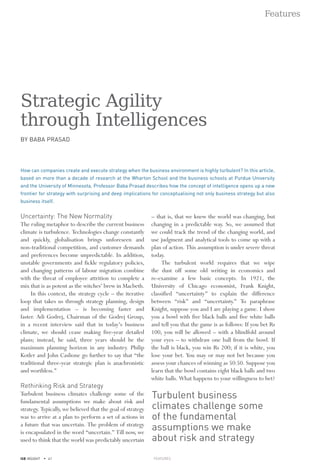
Strategic Agility
through Intelligences
How can companies create and execute strategy when the business environment is highly turbulent? In this article,
based on more than a decade of research at the Wharton School and the business schools at Purdue University
and the University of Minnesota, Professor Baba Prasad describes how the concept of intelligence opens up a new
frontier for strategy with surprising and deep implications for conceptualising not only business strategy but also
business itself.
Turbulent business
climates challenge some
of the fundamental
assumptions we make
about risk and strategy
BY BABA PRASAD
FEATURES
Features
42 ISB INSIGHT
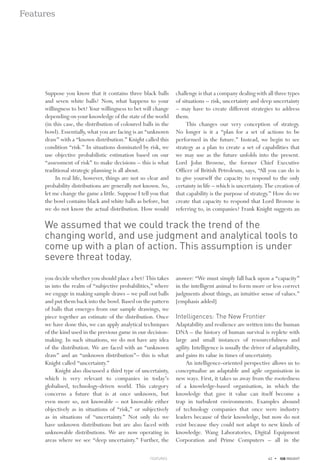
Suppose you know that it contains three black balls
and seven white balls? Now, what happens to your
willingness to bet? Your willingness to bet will change
depending on your knowledge of the state of the world
(in this case, the distribution of coloured balls in the
bowl). Essentially, what you are facing is an “unknown
draw” with a “known distribution.” Knight called this
condition “risk.” In situations dominated by risk, we
use objective probabilistic estimation based on our
“assessment of risk” to make decisions – this is what
traditional strategic planning is all about.
In real life, however, things are not so clear and
probability distributions are generally not known. So,
let me change the game a little. Suppose I tell you that
the bowl contains black and white balls as before, but
we do not know the actual distribution. How would
you decide whether you should place a bet? This takes
us into the realm of “subjective probabilities,” where
we engage in making sample draws – we pull out balls
and put them back into the bowl. Based on the pattern
of balls that emerges from our sample drawings, we
piece together an estimate of the distribution. Once
we have done this, we can apply analytical techniques
of the kind used in the previous game in our decision-
making. In such situations, we do not have any idea
of the distribution. We are faced with an “unknown
draw” and an “unknown distribution”– this is what
Knight called “uncertainty.”
Knight also discussed a third type of uncertainty,
which is very relevant to companies in today’s
globalised, technology-driven world. This category
concerns a future that is at once unknown, but
even more so, not knowable – not knowable either
objectively as in situations of “risk,” or subjectively
as in situations of “uncertainty.” Not only do we
have unknown distributions but are also faced with
unknowable distributions. We are now operating in
areas where we see “deep uncertainty.” Further, the
challenge is that a company dealing with all three types
of situations – risk, uncertainty and deep uncertainty
– may have to create different strategies to address
them.
This changes our very conception of strategy.
No longer is it a “plan for a set of actions to be
performed in the future.” Instead, we begin to see
strategy as a plan to create a set of capabilities that
we may use as the future unfolds into the present.
Lord John Browne, the former Chief Executive
Officer of British Petroleum, says, “All you can do is
to give yourself the capacity to respond to the only
certainty in life – which is uncertainty. The creation of
that capability is the purpose of strategy.” How do we
create that capacity to respond that Lord Browne is
referring to, in companies? Frank Knight suggests an
answer: “We must simply fall back upon a “capacity”
in the intelligent animal to form more or less correct
judgments about things, an intuitive sense of values.”
[emphasis added]
Intelligences: The New Frontier
Adaptability and resilience are written into the human
DNA – the history of human survival is replete with
large and small instances of resourcefulness and
agility. Intelligence is usually the driver of adaptability,
and gains its value in times of uncertainty.
An intelligence-oriented perspective allows us to
conceptualise an adaptable and agile organisation in
new ways. First, it takes us away from the rootedness
of a knowledge-based organisation, in which the
knowledge that gave it value can itself become a
trap in turbulent environments. Examples abound
of technology companies that once were industry
leaders because of their knowledge, but now do not
exist because they could not adapt to new kinds of
knowledge. Wang Laboratories, Digital Equipment
Corporation and Prime Computers – all in the
We assumed that we could track the trend of the
changing world, and use judgment and analytical tools to
come up with a plan of action. This assumption is under
severe threat today.
FEATURES
Features
ISB INSIGHT 43
miniframe computer industry – illustrate this point.
So, instead of the organisation being knowledge-
based, we now think of it as being intelligence-
driven – the kind of organisation that dynamically
and appropriately uses and recombines resources
(including bodies of knowledge), acquires new
ones or even sometimes divests some resources
to continuously generate competitive advantage in
changing business contexts.
Second, an intelligence-oriented perspective
brings the human to the centre of our idea of the firm
and allows us to jointly consider leadership, innovation
and strategy in one framework. Psychologists define
intelligence as that quality that allows one to either
adapt to an environment, shape it or find a new
environment as appropriate to the context. Translated
into strategy terms, this means that intelligence
enables the company to either position itself in its
industry (Porter’s competitive analysis), use its core-
competence to reshape its environment (resource-
based view), or find new areas where no competition
exists (Blue Ocean strategy) in a manner that is
context-sensitive.
Agility and Strategic Agility
It is a common conception that in order to excel
in turbulent environments, a company needs to be
agile. However, it is also becoming apparent that
agility should not be one-dimensional. In fact, as
Donald Sull, puts it, “In turbulent markets, however,
overreliance on a single type of agility can be
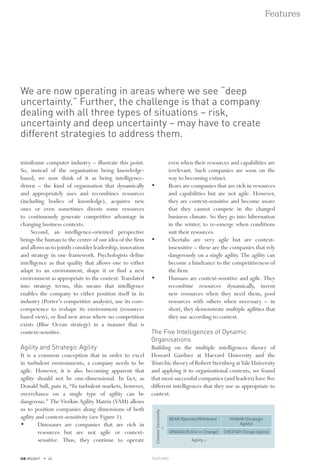
dangerous.” The Vivékin Agility Matrix (VAM) allows
us to position companies along dimensions of both
agility and context-sensitivity (see Figure 1).
• Dinosaurs are companies that are rich in
resources but are not agile or context-
sensitive. Thus, they continue to operate
even when their resources and capabilities are
irrelevant. Such companies are soon on the
way to becoming extinct.
• Bears are companies that are rich in resources
and capabilities but are not agile. However,
they are context-sensitive and become aware
that they cannot compete in the changed
business climate. So they go into hibernation
in the winter, to re-emerge when conditions
suit their resources.
• Cheetahs are very agile but are context-
insensitive – these are the companies that rely
dangerously on a single agility. The agility can
become a hindrance to the competitiveness of
the firm.
• Humans are context-sensitive and agile. They
recombine resources dynamically, invent
new resources when they need them, pool
resources with others when necessary – in
short, they demonstrate multiple agilities that
they use according to context.
The Five Intelligences of Dynamic
Organisations
Building on the multiple intelligences theory of
Howard Gardner at Harvard University and the
Triarchic theory of Robert Sternberg at Yale University
and applying it to organisational contexts, we found
that most successful companies (and leaders) have five
different intelligences that they use as appropriate to
context.
FEATURES
We are now operating in areas where we see “deep
uncertainty.” Further, the challenge is that a company
dealing with all three types of situations – risk,
uncertainty and deep uncertainty – may have to create
different strategies to address them.
BEAR (Operate/Withdraw) HUMAN (Strategic
Agility)
DINOSAUR (Die in Change) CHEETAH (Single Agility)
Agility
Context-Sensitivity
Features
44 ISB INSIGHTFEATURES
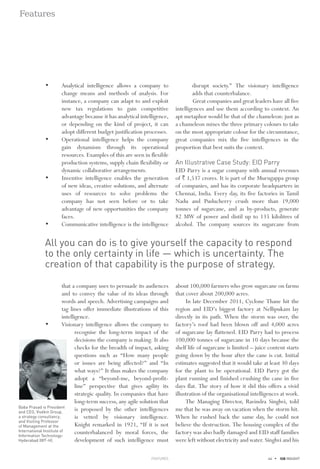
• Analytical intelligence allows a company to
change means and methods of analysis. For
instance, a company can adapt to and exploit
new tax regulations to gain competitive
advantage because it has analytical intelligence,
or depending on the kind of project, it can
adopt different budget justification processes.
• Operational intelligence helps the company
gain dynamism through its operational
resources. Examples of this are seen in flexible
production systems, supply chain flexibility or
dynamic collaborative arrangements.
• Inventive intelligence enables the generation
of new ideas, creative solutions, and alternate
uses of resources to solve problems the
company has not seen before or to take
advantage of new opportunities the company
faces.
• Communicative intelligence is the intelligence
that a company uses to persuade its audiences
and to convey the value of its ideas through
words and speech. Advertising campaigns and
tag lines offer immediate illustrations of this
intelligence.
• Visionary intelligence allows the company to
recognise the long-term impact of the
decisions the company is making. It also
checks for the breadth of impact, asking
questions such as “How many people
or issues are being affected?” and “In
what ways?” It thus makes the company
adopt a “beyond-me, beyond-profit-
line” perspective that gives agility its
strategic quality. In companies that have
long-term success, any agile solution that
is proposed by the other intelligences
is vetted by visionary intelligence.
Knight remarked in 1921, “If it is not
counterbalanced by moral forces, the
development of such intelligence must
disrupt society.” The visionary intelligence
adds that counterbalance.
Great companies and great leaders have all five
intelligences and use them according to context. An
apt metaphor would be that of the chameleon: just as
a chameleon mixes the three primary colours to take
on the most appropriate colour for the circumstance,
great companies mix the five intelligences in the
proportion that best suits the context.
An Illustrative Case Study: EID Parry
EID Parry is a sugar company with annual revenues
of C 1,537 crores. It is part of the Murugappa group
of companies, and has its corporate headquarters in
Chennai, India. Every day, its five factories in Tamil
Nadu and Puducherry crush more than 19,000
tonnes of sugarcane, and as by-products, generate
82 MW of power and distil up to 135 kilolitres of
alcohol. The company sources its sugarcane from
about 100,000 farmers who grow sugarcane on farms
that cover about 200,000 acres.
In late December 2011, Cyclone Thane hit the
region and EID’s biggest factory at Nellipukam lay
directly in its path. When the storm was over, the
factory’s roof had been blown off and 4,000 acres
of sugarcane lay flattened. EID Parry had to process
100,000 tonnes of sugarcane in 10 days because the
shelf life of sugarcane is limited – juice content starts
going down by the hour after the cane is cut. Initial
estimates suggested that it would take at least 30 days
for the plant to be operational. EID Parry got the
plant running and finished crushing the cane in five
days flat. The story of how it did this offers a vivid
illustration of the organisational intelligences at work.
The Managing Director, Ravindra Singhvi, told
me that he was away on vacation when the storm hit.
When he rushed back the same day, he could not
believe the destruction. The housing complex of the
factory was also badly damaged and EID staff families
were left without electricity and water. Singhvi and his
All you can do is to give yourself the capacity to respond
to the only certainty in life — which is uncertainty. The
creation of that capability is the purpose of strategy.
Baba Prasad is President
and CEO, Vivékin Group,
a strategy consultancy,
and Visiting Professor
of Management at the
International Institute of
Information Technology-
Hyderabad (IIIT-H).
Features
ISB Insight_May 2013_Baba Prasad_Strategic Agility through Intelligences