Theorizing The Dynamics Of Social Processes Harry Dahms Editor
Theorizing The Dynamics Of Social Processes Harry Dahms Editor
Theorizing The Dynamics Of Social Processes Harry Dahms Editor
Theorizing The Dynamics Of Social Processes Harry Dahms Editor
Theorizing The Dynamics Of Social Processes Harry Dahms Editor
1.
Theorizing The DynamicsOf Social Processes
Harry Dahms Editor download
https://ebookbell.com/product/theorizing-the-dynamics-of-social-
processes-harry-dahms-editor-2528098
Explore and download more ebooks at ebookbell.com
2.
Here are somerecommended products that we believe you will be
interested in. You can click the link to download.
Analyzing And Theorizing The Dynamics Of The Workplace Incivility
Crisis 1st Edition Michael Leiter Auth
https://ebookbell.com/product/analyzing-and-theorizing-the-dynamics-
of-the-workplace-incivility-crisis-1st-edition-michael-leiter-
auth-4269894
Theorizing The Ideal Sovereign The Rise Of The French Vernacular Royal
Biography 1st Edition Daisy Delogu
https://ebookbell.com/product/theorizing-the-ideal-sovereign-the-rise-
of-the-french-vernacular-royal-biography-1st-edition-daisy-
delogu-51589320
Theorizing The Angura Space Avantgarde Performance And Politics In
Japan 19602000 Peter Eckersall
https://ebookbell.com/product/theorizing-the-angura-space-avantgarde-
performance-and-politics-in-japan-19602000-peter-eckersall-4947548
Theorizing The Local Music Practice And Experience In South Asia And
Beyond Richard Wolf
https://ebookbell.com/product/theorizing-the-local-music-practice-and-
experience-in-south-asia-and-beyond-richard-wolf-4948776
3.
Theorizing The SexualChild In Modernity R Danielle Egan Gail Hawkes
Auth
https://ebookbell.com/product/theorizing-the-sexual-child-in-
modernity-r-danielle-egan-gail-hawkes-auth-5359964
Theorizing The Future Of Science Education Research Vaughan Prain
https://ebookbell.com/product/theorizing-the-future-of-science-
education-research-vaughan-prain-10548900
Theorizing The Sexual Child In Modernity R Danielle Egan Gail Hawkes
https://ebookbell.com/product/theorizing-the-sexual-child-in-
modernity-r-danielle-egan-gail-hawkes-1913454
Theorizing The Sharing Economy Research In The Sociology Of
Organizations Research In The Sociology Of Organizations 66 Indre
Maurer
https://ebookbell.com/product/theorizing-the-sharing-economy-research-
in-the-sociology-of-organizations-research-in-the-sociology-of-
organizations-66-indre-maurer-46209398
Theorizing The European Neighbourhood Policy Sieglinde Gstohl Simon
Schunz
https://ebookbell.com/product/theorizing-the-european-neighbourhood-
policy-sieglinde-gstohl-simon-schunz-44524530
5.
INTRODUCTION
This collection beganas a proposal and a hope. Both were expressed in the
formal call for papers, which invited ‘‘the submission of papers dedicated to
theorizing the dynamics of specific social, cultural, political, and/or
economic processes’’ whether at micro-, meso-, or macro-level of scale –
or even better, across levels for processes that are not scale indifferent. Our
hope was for papers that would accomplish one or more of a few tasks:
� invent, develop, and/or demonstrate a theory (or theories) of a specific
process (or interrelated processes), with sufficient clarity and scope to
serve as an exemplar of such theorizing;
� identify, illustrate by example, and analyze specific problems, including
problems of conceptualization and measurement, associated with theoriz-
ing the dynamics of social, cultural, political, and/or economic processes;
� connect theorizations across different disciplines of inquiry, including
physical, chemical, and biological sciences insofar as the connections are
shown to be relevant to and involve specific processes in social, cultural,
political, and/or economic arenas (e.g., diffusion processes, hysteretic
processes, aggregation processes).
Sometimes ambitious hopes can stimulate interest, even guide the actual
processes. We would like to think that contributions to this volume were so
informed.
It was obvious that we were not breaking new ground. Others have made
similar calls many times before, with greater visibility and sustenance. One of
us recalled an exuberant conversation with Aage Sørensen in the mid-1980s,
for example, when it seemed that a rejuvenated program of sociological
inquiry into the dynamics of processes of various kinds might be coming
together, with research programs in group process and network dynamics
among the vanguard, and books such as Tuma and Hannan’s Social
Dynamics (1984) offering torchlight. It was clear, of course, that the program
would be couched mainly, probably even entirely, in terms of standard
analytic theory (there was still little conversation between it and either critical
theory or, even less, theory built of dialectical as well as analytical logics), but
such would be the necessary beginning of a rejuvenation. The impetus did
not generalize as well as one would have liked, however. The editor of
xi
6.
Current Perspectives inSocial Theory, Dahms has repeatedly stressed in his
works, including some that have appeared in past volumes of this series
(Dahms, 2002, 2008), that greater concerted effort to install and nurture a
systematic program of theory, most especially one of critical theory,
that gives central emphasis to the dynamics of process is and will be vital
to the future health of sociology in particular and of the social sciences in
general. This volume was announced with that background in mind.
The resulting contents offer a variety of responses to the call. At one time we
were brash enough (or one of us was brash enough) to imagine that an
outpouring of manuscripts would yield enough content for two volumes
(27 and 28), not just one. Unfortunately, we must be content with a
singleton, at least for now.
This one volume contains strong, productive statements. A concern
during the planning phase had been that manuscripts which only ‘‘talk
about’’ process would far outnumber manuscripts that go beyond such talk
and actually engage in one or more of the aims stated in the call for papers
(repeated above). Happily, the concern proved to be exaggerated. The main
exceptions, among the chapters that follow, are the propaedeutic chapter
by Hazelrigg, ‘‘On Theorizing the Dynamics of Process,’’ large parts of
which surely qualify as a ‘‘talk about’’ commentary, and Dahms’ ‘‘Affinities
between the Project of Dynamic Theory and the Tradition of Critical
Theory,’’ which, as the subtitle indicates, is a sketch. In Hazelrigg’s chapter,
the trade-off is that the preparatory remarks attempt to be diagnostic and
prognostic, utilizing to those ends a number of illustrative and demonstra-
tive exercises. In the chapter by Dahms, which as a kind of commentary to
the perspective and agenda put forth by Hazelrigg, thus adding one further
dimension to the project of dynamic theory, the purpose is to suggest that
the latter shares common ground with critical theory, especially with the
Frankfurt School tradition. But while critical theorists have been cognizant
of the fact that in modern society, a set of processes are at work that are
incompatible with everyday life assumptions and mainstream perspectives
in the social sciences, dynamic theorists must concern themselves with the
specificity of each of the processes that together sustain modern society.
Joseph Maslen, a young historian just getting his career underway at the
University of Manchester, contributes an analysis and evaluation of a recent
debate about ‘‘class’’ – ‘‘History and the ‘Processing’ of Class in Social
Theory’’ – which has had primary locus in British academic audiences.
Maslen’s chapter affords insight into a process of scholarship by which some
conceptualizations of class have been resituated and revalued within debates
of a politics of identity.
INTRODUCTION
xii
7.
‘‘Domination, Contention, andthe Negotiation of Inequality: A Theoretical
Proposal’’ is the latest product of a long-term project by Viviane Brachet-
Márquez to develop better theory of the relations among contentious politics,
traditional state-making processes, and strongly reproductive structures of
inequality and domination. She and a colleague, Javier Arteaga Pérez, are
presently preparing Spanish and English-language editions of a monographic
report of applications and elaborations of that theory to an extensive dataset
covering much of Latin America.
Paul Paolucci’s chapter, ‘‘The Labor–Value Relation and Its Transfor-
mations,’’ reports another contribution from his long-term project
explicating neglected or misconstrued aspects of Karl Marx’s theoretical
program, virtually all of which was inherently dynamic and processual.
Paolucci utilizes recent events of financial crisis in illustration of much of his
argument. This chapter extends work published in Paolucci’s book, Marx’s
Scientific Dialectics (2007).
In ‘‘Globalization In and Out, or ‘How Can There be a Constructivist
Theory of Globalization?’’’ Jean-Sébastien Guy develops and applies the
distinctive theoretical apparatus of Niklas Luhmann to this, the latest round
of self-conscious ‘‘globalization’’ of relations of production, distribution,
exchange, and consumption, cultural as well as economic and political.
Guy’s presentation builds on a recently published book (Guy, 2007).
Among the chapters addressing ‘‘globalization’’ in one way or another,
P J Rey and George Ritzer’s contribution, ‘‘Conceptualizing Globalization
in Terms of Flows,’’ offers a quick overview of uses of a ‘‘flow’’ metaphor in
prior literatures, in supplement to the first part of Ritzer’s basic text on
Globalization (2009).
Robert B. Smith uses insights gained from agent-based modeling of social
actions and behaviors to develop and test via simulations a systematization
of theories relevant to explanation of ‘‘Why Nazified Germans Killed Jewish
People.’’ Agent-based generative modeling is a set of quasi-experimental
techniques by which empirical data, theories, and systematically explicated
assumptions and conditions are engaged interactively in very large numbers
of simulation runs for any number of combinations and permutations of
process parameters, using the computational power of high-speed compu-
ters. Smith’s chapter is both an instructive illustration of the use of these
modeling procedures and a tested set of conclusions about the conditions
under which one group of humans systematically slaughter another group of
humans – events, needless to say, far too prevalent in the historical record,
yet evidently not of a kind that has been ‘‘outgrown’’ via a process of species
maturation.
Introduction xiii
8.
David Gartman’s ‘‘Economyand Field in the Rise of Postmodern
Architecture’’ utilizes insights from Pierre Bourdieu, among others, as well
as his own acute investigations of primary materials, to extend his project
of inquiry into the relation of architecture to the economy and culture of
Fordist and post-Fordist regimes of accumulation. This comes on the heels
of his recent book, From Autos to Architecture (2009).
REFERENCES
Dahms, H. F. (2002). Sociology in the age of globalization: Toward a dynamic sociological
theory. In: Bringing capitalism back for critique by social theory, Current Perspectives in
Social Theory (Vol. 21, pp. 287–320).
Dahms, H. F. (2008). How social science is impossible without critical theory: The immersion of
mainstream approaches in time and space. In: No social science without critical theory,
Current Perspectives in Social Theory (Vol. 25, pp. 3–61).
Gartman, D. (2009). From autos to architecture. Princeton, NJ: Princeton Architectural Press.
Guy, J.-S. (2007). L’idée de mondialisation. Montréal: Liber.
Paolucci, P. (2007). Marx’s scientific dialectics. Leiden: Brill.
Ritzer, G. (2009). Globalization. New York: Wiley-Blackwell.
Tuma, N. B., & Hannan, M. T. (1984). Social dynamics. Orlando, FL: Academic.
Harry F. Dahms
Lawrence Hazelrigg
Editors
INTRODUCTION
xiv
9.
CURRENT PERSPECTIVES IN
SOCIALTHEORY
Series Editor: Harry F. Dahms
Recent Volumes:
Volume 1: 1980 Edited by Scott G. McNall and Garry N. Howe
Volume 2: 1981 Edited by Scott G. McNall and Garry N. Howe
Volume 3: 1982 Edited by Scott G. McNall
Volume 4: 1983 Edited by Scott G. McNall
Volume 5: 1984 Edited by Scott G. McNall
Volume 6: 1985 Edited by Scott G. McNall
Volume 7: 1986 Edited by John Wilson
Volume 8: 1987 Edited by John Wilson
Volume 9: 1989 Edited by John Wilson
Volume 10: 1990 Edited by John Wilson
Volume 11: 1991 Edited by Ben Agger
Volume 12: 1992 Edited by Ben Agger
Volume 13: 1993 Edited by Ben Agger
Volume 14: 1994 Edited by Ben Agger
Supplement 1: Recent Developments in the Theory of Social Structure, 1994,
Edited by J. David Knottnerus and Christopher Prendergast
Volume 15: 1995 Edited by Ben Agger
Volume 16: 1996 Edited by Jennifer M. Lehmann
Volume 17: 1997 Edited by Jennifer M. Lehmann
Volume 18: 1998 Edited by Jennifer M. Lehmann
Volume 19: 1999 Edited by Jennifer M. Lehmann
Volume 20: 2000 Edited by Jennifer M. Lehmann
Volume 21: Bringing Capitalism Back for Critique by Social Theory, 2001,
Edited by Jennifer M. Lehmann
Volume 22: Critical Theory: Diverse Objects, Diverse Subjects, 2003,
Edited by Jennifer M. Lehmann
Volume 23: Social Theory as Politics in Knowledge, 2005, Edited by
Jennifer M. Lehmann
Volume 24: Globalization Between The Cold War And Neo-Imperialism, 2006,
Edited by Jennifer M. Lehmann and Harry F. Dahms
Volume 25: No Social Science without Critical Theory, 2008,
Edited by Harry F. Dahms
Volume 26: Nature, Knowledge and Negation, 2009, Edited by Harry F. Dahms
10.
CURRENT PERSPECTIVES INSOCIAL THEORY
VOLUME 27
THEORIZING THE
DYNAMICS OF SOCIAL
PROCESSES
EDITED BY
HARRY F. DAHMS
Department of Sociology, University of Tennessee,
Knoxville, USA
LAWRENCE HAZELRIGG
Department of Sociology, Florida State University,
Tallahassee, USA
United Kingdom – North America – Japan
India – Malaysia – China
11.
EDITOR
Harry F. Dahms
Universityof Tennessee (Sociology)
ASSOCIATE EDITORS
Robert J. Antonio Timothy Luke
University of Kansas
(Sociology)
Virginia Polytechnic Institute and
State University (Political Science)
Lawrence Hazelrigg Raymond Morrow
Florida State University (Sociology) University of Alberta (Sociology)
Jennifer Lehmann
Formerly University of Nebraska
(Sociology and Women’s Studies)
EDITORIAL BOARD
Ben Agger
University of Texas – Arlington
(Sociology and Anthropology)
Stanley Aronowitz
City University of New York –
Graduate Center (Sociology)
Molefi Kete Asante
Temple University
(African-American Studies)
David Ashley
University of Wyoming
(Sociology)
Ward Churchill
Formerly University of Colorado
(Ethnic Studies)
Norman K. Denzin
University of Illinois at Urbana –
Champaign (Sociology)
Nancy Fraser
New School for Social Research
(Political Science)
Martha Gimenez
University of Colorado – Boulder
(Sociology)
Robert Goldman
Lewis and Clark College (Sociology
and Anthropology)
Mark Gottdiener
State University of New York at
Buffalo (Sociology)
vii
12.
Douglas Kellner
University ofCalifornia – Los
Angeles (Philosophy of
Education)
Lauren Langman
Loyola University (Sociology)
John O’Neill
York University
(Sociology)
Paul Paolucci
Eastern Kentucky University
(Sociology)
Moishe Postone
University of Chicago
(History)
Lawrence Scaff
Wayne State University
(Political Science)
Steven Seidman
State University of New York at
Albany (Sociology)
Frank Taylor
Edinboro University of Pennsylvania
(Sociology and Anthropology)
Stephen Turner
The University of South Florida
(Philosophy)
Christine Williams
The University of Texas at Austin
(Sociology)
EDITORIAL BOARD
viii
13.
LIST OF CONTRIBUTORS
VivianeBrachet-Márquez Centro de Estudios Sociológicos, El
Colegio de México, México City, México
Harry F. Dahms Department of Sociology, University
of Tennessee, Knoxville, TN, USA
David Gartman Department of Sociology,
Anthropology, and Social Work,
University of South Alabama,
Mobile, AL, USA
Jean-Se´bastien Guy Department of Sociology and Social
Anthropology, Dalhousie University,
Halifax, NS, Canada
Lawrence Hazelrigg Department of Sociology,
Florida State University,
Tallahassee, FL, USA
Joseph Maslen Faculty of Humanities, University of
Manchester, Manchester, UK
Paul Paolucci Department of Anthropology, Sociology
and Social Work, Eastern Kentucky
University, Richmond, KY, USA
P. J. Rey Department of Sociology, University
of Maryland, College Park, MD, USA
George Ritzer Department of Sociology, University
of Maryland, College Park, MD, USA
Robert B. Smith Social Structural Research,
Cambridge, MA, USA
ix
14.
Emerald Group PublishingLimited
Howard House, Wagon Lane, Bingley BD16 1WA, UK
First edition 2010
Copyright r 2010 Emerald Group Publishing Limited
Reprints and permission service
Contact: booksandseries@emeraldinsight.com
No part of this book may be reproduced, stored in a retrieval system, transmitted in any
form or by any means electronic, mechanical, photocopying, recording or otherwise
without either the prior written permission of the publisher or a licence permitting
restricted copying issued in the UK by The Copyright Licensing Agency and in the USA
by The Copyright Clearance Center. No responsibility is accepted for the accuracy of
information contained in the text, illustrations or advertisements. The opinions expressed
in these chapters are not necessarily those of the Editor or the publisher.
British Library Cataloguing in Publication Data
A catalogue record for this book is available from the British Library
ISBN: 978-0-85724-223-5
ISSN: 0278-1204 (Series)
Emerald Group Publishing
Limited, Howard House,
Environmental Management
System has been certified by
ISOQAR to ISO 14001:2004
standards
Awarded in recognition of
Emerald’s production
department’s adherence to
quality systems and processes
when preparing scholarly
journals for print
15.
ON THEORIZING THEDYNAMICS
OF PROCESS: A PROPAEDEUTIC
INTRODUCTION
Lawrence Hazelrigg
Richard Swedberg remarked recently, in his capacity as chairperson of the
theory section of the American Sociological Association, on the difficulties
of theorizing (Swedberg, 2009). It is indeed a difficult enterprise. That is, to
theorize well is difficult. Spinning accounts that lack enough specificity to
intersect with experiences in some sort of empirical analytics through
which claims of the accounts can be assessed for their power in judgments
about those experiences is altogether too easy, much easier than writing
good poetry, say, even easier than composing a few chords of popular
music.1
Those accounts and resulting assessments lend credence, unhappily,
to Plato’s warnings about bewitchments of language. The aim, I assume
Swedberg took for granted, is to theorize well, to end the effort with a
product that is useful in the worlds of experience because it proposes
testable effects in those worlds. The following remarks follow that same
assumption. Empirics are vital not only for testing the worth of a theory,
however; they are vital also for the process of building a theory in the first
place. Empirics provide materials, to be sure, and that experience includes
our understandings of previous offerings, theoretical and empirical. But
empirics also provide benchmarks of guidance and regulation for processes
of theorization itself. An example concerns the processes of simplification
that are inevitable in any explanatory endeavors, most especially those
Theorizing the Dynamics of Social Processes
Current Perspectives in Social Theory, Volume 27, 3–79
Copyright r 2010 by Emerald Group Publishing Limited
All rights of reproduction in any form reserved
ISSN: 0278-1204/doi:10.1108/S0278-1204(2010)0000027005
3
16.
treating dynamics. Slobodkin(1992, p. 10; also p. 216) made an excellent
point about this when he cautioned that while a goal of theory is to further
understanding of a complex reality by applying appropriate simplifications,
‘‘if scientific analysis of difficult and complex subject matter must rely,
in part, on simplification, and if no uniform, testable theory of how this
simplification can be done exists, then might we not conclude with near
certainty that many respectable-sounding intellectual schemes may be no
more valid than astrology?’’
It is especially difficult to theorize process, primarily because human
actors are trained to see and to think in largely cross-sectional terms.
Certainly human beings experience change, think about those experiences,
define differences and measure comparisons, conjecture causes and con-
sequences. But these actions are conducted largely in terms of comparisons
of ‘‘snapshot’’ identities – ‘‘how things are today, versus how they were
before’’ – rather than in terms of the dynamics of process. While a
comparison of cross-sections, even a comparison of three or four cross-
sections in sequence, does generate a sense of change, this sense is mainly a
description of differences, not an understanding of the process(es) that
resulted in the different experiences. To study process is to study the activity
of some phenomenon, including its cause-and-effect relations. One could
say that the focus of inquiry is partly on the mechanism through which a
process occurs, unfolds, and/or evolves; but the word ‘‘mechanism’’ has for
some people a bad reputation owing to old disputes between competing
metaphors: whether social processes are like physical mechanics or like
biological organics. This old rhubarb generated lots of heat, hardly any
light, and deflected serious attention far too long from the actual study of
process. In any case, whereas the study of change as simply the comparison
of cross-sections arrayed in time can be (often is) conducted as an empirical-
descriptive enterprise, the study of process necessarily involves the use of
theoretical models, which means that it is founded necessarily on specific
substantive theories. The aim is to determine what kind of dynamic model
best fits the process trajectory over many repetitions of the process. Once
that determination has been made, variation across repetitions – that is,
variation in the repeated trajectories around the point of attraction – is
not of primary interest (or not unless/until the process as such changes).
Such variation is not irrelevant; it could be clue to weaker regularities or
vulnerabilities of the process. But primary interest lies with the location of
the point of attraction within the mensural grid, why it has that location and
not some other, how stable it is (or isn’t) under varying conditions (i.e., its
sensitivity to various sorts of shock), and how this modeled process
LAWRENCE HAZELRIGG
4
17.
intersects with othermodeled processes. This topic of models will be
continued after some other considerations.
This chapter has been written with intent of ‘‘preparatory instruction,’’ as
the subtitle says, in a number of matters having to do with dynamics of
process. It is elementary, incomplete, suggestive, largely nontechnical, and
idiosyncratic. The main goal is to stimulate reconsiderations of some habits,
some limitations, and some potentials in the conduct of inquiry both
empirical and theoretical. More than a century ago, in a book dedicated to
the twentieth century, ‘‘on the first day of which it was begun,’’ Lester F.
Ward drew a distinction that turned on the notion of equilibrium as a point
of stability or attraction within process, and from that distinction he cast a
postulate: wherever ‘‘the statical condition is represented by structures, the
dynamic condition consists in some change in the type of such structures’’
(1911, p. v, p. 221). The processes by which structures come to be, and are
maintained, were of less interest to Ward’s formulation of a ‘‘dynamic
sociology’’ than were the processes that jolt equilibrium enough to result in
structural change. Ward’s preference is understandable, and I do not argue
against it in the least – except to suggest that the processes of the one might
well be, under certain conditions, the same as, or contain the seeds of,
the processes the other, those that shock a settled state of affairs beyond
reparative reproduction. In any case – and for the moment this is the more
important point – perhaps we could have much better understandings of
the processes that result in and maintain structures, and from there then
better understand the conditions of their equilibrium, if we actually studied
processes rather than cross-sectional differences.
1. ERGODIC VS. NONERGODIC PROCESSES
One crucial but sometimes overlooked fact regarding the difference between
observation in the cross-section and observation over time must be
stated before proceeding further. Tempting though it is to draw conclusions
about the dynamics of a process from cross-sectional observations taken as
a snapshot of that process, it is a fallacious practice except under a very
precise condition that is highly unlikely to obtain in processes of interest to
the social scientist. That condition is known as ergodicity.
All processes, whether social, cultural, physical, chemical, biological,
astronomical, or otherwise described and labeled, can be divided funda-
mentally into two types, ergodic and nonergodic. Those that fit the former
category have a peculiar property: observation in the cross-section at any
On Theorizing the Dynamics of Process: A Propaedeutic Introduction 5
18.
given time andobservation repeated over time will yield exactly the same
information. More carefully put, this means that, by the ergodic theorem,2
the time-average value of a conforming process (the time-average value
being determined by the process dynamics) equals the ensemble-average
value, so that probability sampling performed instantly across a group of
identical instances of the realization of the process will yield exactly the
same information as sampling over time within any one of those instances
of the realization of the process (see Peebles, 2000; Papoulis, 1991).3
This
property is very handy to investigators of stochastic processes that conform
to ergodicity. In order to see how, let’s consider an illustration. Begin with a
simple process from the realm of Newtonian mechanics, the process of force
generated as a mass under acceleration. My observations of an accelerating
mass here today will be entirely consistent with your observations of
an accelerating mass over there today, and both will be entirely consistent
with your or my observations tomorrow of an accelerating mass. All of
the observations will conform equally and precisely well (ignoring errors
of measured observation, and assuming observations within the Newtonian
realm) with the rule of force as a simple product of mass and its rate
of acceleration. I can be confident that whether I sample appropriate
Newtonian observations here or there, or a little bit today and more
tomorrow, I can reliably draw exactly the same conclusions about cause-
and-effect relations of the dynamics of hugely or barely massive objects in
motion. This is because of the tradition within which we regard Newtonian
mechanics as strictly deterministic; that is, there is nothing stochastic
(probabilistic) about the process of accelerating mass.4
Now let’s take a case from the realm of statistical mechanics – say, the
transfer of heat through a simple gas (e.g., a diatomic gas: each molecule
consists of two atoms).5
Our first task is to obtain a reasonably accurate
picture of the specific heat of the gas (assume normal sea-level atmospheric
pressure). A strictly deterministic approach is not possible, because of the
large number of degrees of freedom. The dynamical system contains
approximately 1023
degrees of freedom even when we ignore the subatomic
dynamics and focus only on the macroscopic dynamics of the two-atom
molecules. So we must use a statistical approach: repeat the measured
observations several times and average the results. Note that we will be
averaging over initial conditions (different regions of the volume of gas
will have different properties when we commence observation), over time
(the dynamical system of the gas is evolving), and over degrees of freedom
at the subatomic level. In taking the average of the measured observations,
we are relying on a property of stochastic processes known as ‘‘asymptotic
LAWRENCE HAZELRIGG
6
19.
mean stationarity.’’6
That is,we rely on the assumption that our sample
averages will converge asymptotically to a single expected value with regard
to the stationary mean. What condition must be met in order for that
assumption to obtain? Ergodicity. With a stochastic process that is ergodic,
we can safely assume convergence. If not ergodic, we cannot assume
convergence. We cannot assume uniformity of the time path of the evolving
stochastic process; we cannot assume that the time path is insensitive
to initial conditions; we cannot assume that the actual realization of the
stochastic process as captured in our measured observations is a reasonably
close estimate of the mean of all possible realizations of that process.
Are there any processes in the social, cultural, historical realm that exhibit
ergodicity? None comes to mind. It would seem unlikely, given how easily
the condition of ergodicity is violated in strictly physical stochastic
processes. However, it appears that no one has ever undertaken an
inventory of stochastic processes of social, cultural, historical phenomena
in terms of their ergodic status.7
In fact, this fundamental property of
processes has rarely gotten attention in social science, even though in
principle it settles the question about the conditions under which cross-
sectional observations can be legitimately interpreted as indicative of causal
relations. One of the few recent scholars to make note of that fact is
Molenaar (e.g., 2004, 2005), in his quest to retrieve a strictly psychological
individual from the clutches of social psychology. Molenaar’s rigorous
approach to building strictly longitudinal records for individuals (by his
conception) emphasizes the discrepancy of cross-sectional data.8
John
Dewey did as well, when in 1896 he described what he called ‘‘the historical
fallacy’’ (related to but distinguishable from ‘‘the psychological fallacy’’):
‘‘A set of considerations which hold good only because of a completed
process, is read into the content of the process which conditions this
completed result. A state of things characterizing an outcome is regarded as
a true description of the events which led up to this outcome; when, as a
matter of fact, if this outcome had already been in existence, there would
have been no necessity for the process’’ (Dewey, 1896, p. 367). This well
describes a common tendency in considerations of experiences in the cross-
section, whether casual or disciplined. Causal inference may be unavoidable,
as Kant taught, because we have only our experiences as effects by which to
infer their causes. But that does not relieve us the need to understand
processes in their own times, in their own dynamics, rather than only
infer what ‘‘must have been happening’’ by their completed outcomes.
The ergodic theorem makes clear that variations in the cross-section are a
reliable gauge of variations in time only under very special conditions.
On Theorizing the Dynamics of Process: A Propaedeutic Introduction 7
20.
2. GOOD MOTIVES,BAD HABITS
As suggested above, a prevalent factor in the difficulty of theorizing dynamics
of process is the heavy cross-sectional slant of everyday experiences.
Observationally, we tend to relate through comparisons of being in a given
place at a given time – comparisons of snapshots, from which we can
experience difference and infer change. But experiencing difference and
inferring change do not amount to observing the process(es) that produced
what we have experienced and how that production might have changed,
whether in outcome (product) or, more significantly, in process parameters.
Of the various ways in which the cross-sectional bias manifests, one of the
most basic is as an asymmetry of time–space relationality that characterizes
everyday experience for most people: while it is generally recognized that
one cannot walk through space without also walking through time, most of
us tend to think we walk through time without also walking through space,
at least during relatively short spans of time. The cross-sectional perspective
seems to accord better with the assumption of an inertial or stable platform
from which to observe, and it encourages the fiction (or forgetfulness of
the fictioning) that the observational platform is absolute, not relative.
Moreover, the cross-sectional bias in our experiences is often (probably
usually) an aggregation of process effects – that is, an aggregation of effects
of a given process and an aggregation of effects from two or more processes,
which could be mostly reinforcing, mostly crosscutting, or mostly mutually
independent. Sorting through complexities of aggregations in order to infer
back to the generative processes is well-nigh impossible from observations
that are only, or even mainly, cross-sectional. Yet, more often than not, that
is what we attempt to do.
In the social sciences the tendency of disciplinary activity has been not to
counteract that bias from everyday experience but to strengthen and even
extend it.9
This tendency increased during the twentieth century, especially
the latter half, and one could argue that it reversed what had been the
dominant perspective during the latter half of the nineteenth and early
decades of the twentieth century. Saint Simon, Marx, Spencer, Ward, the
Weber brothers, Durkheim, Pareto, Simmel, Adorno, Habermas, and many
others focused on social, economic, political, and cultural processes of
one kind or another in their works. Even when addressing differences in
cross-section, their motivating questions were about dynamics, generally
of a ‘‘How did this come about?’’ sort. A thing, a state of affairs, an event, a
condition, and so forth, does not first exist and then undergo some process
of change; process is integral to its being what it is. That orientation
continued for many social scientists well into the mid-1900s. But the
LAWRENCE HAZELRIGG
8
21.
orientation evolved intoanother increasingly rapidly thereafter. The main
impetus and attraction within that development consisted in the growing
body of large-sample data sets which offered so many opportunities to analyze
differences. Almost all of the data were cross-sectional, but that limitation was
offset by the fact of large, nationally representative samples of relatively high-
quality data which in turn stimulated the development of techniques of
analyzing large bodies of data. Major gains in inferential statistics followed,
gains both technical-methodological and substantive, and research literatures
blossomed as never before. Generations of scholars learned to manage larger
data sets than any that had preceded – data sets that had fair claim to being
reasonably representative demographically of entire societies at a given date –
and to conduct careful analyses of data that were more systematic and of
better quality control than most of what had preceded. These are hardly small
accomplishments. However, the surfeit of cross-sectional survey data
reinforced the bias in perspective. This consequence was indeliberate, no
doubt. No one argued that ‘‘thinking in the cross-section’’ is all one needs, or
even that it should have priority. But the outcome has been the same
regardless. It was as if some director had designed a training program in cross-
sectional thinking, a program that reinforced already existing bias in favor
of cross-sectional experience. Even when someone argued for longitudinal
designs of observation, these were usually panel designs – that is, repeated
cross-sections which allowed descriptions of aggregate differences. The
very strong interest in maintaining large-population inferential capacity –
accurate description of a large and heterogeneous population at each date
of observation – dominated other interests, including any interest in refined,
multiply repeated observations of the dynamics of specific processes in
operation.10
Because of that large-sample orientation, wave designs (i.e.,
repeated observations of same subjects) were generally prohibitively
expensive, and even when adopted there was much concern about the fact
that the initial sample’s inferential capacity eroded over time.11
Trained bias in favor of cross-sectional thinking has been rampant,
not only in techniques of data analysis but also, more generally, in skills
of reasoning, hypothesis formation, and applications of logic. Three simple
illustrations will here have to serve in place of the very large volume of
evidence.
2.1. Illustration 1: Cohorts as a Conduit of Social Change
This illustration revolves around the concept of ‘‘cohort’’ and its half
century of slow developmental life. During most of that half century, the
On Theorizing the Dynamics of Process: A Propaedeutic Introduction 9
22.
main attraction hasconsisted in the notion that the analysis of processes of
change would be facilitated through an accounting scheme that first
aggregates individual actors (whether they be persons, the most common
unit, or firms or newspapers or some other agent or principal of action) into
cohorts, typically birth cohorts, then calculates for one or more variables of
interest the mean among component members of each of some number of
contiguous cohorts, and compares these means relative to each other and
relative to the variance among members of a given cohort. The argument
is that factors of change can be partitioned between factors that operate
through cohort differences in experience (and thus through cohort
succession) and factors that operate residually through changes in individual
units within a given cohort, relative to the cohort mean, as factors of
individual life cycle or of historical events affecting the individual or of both.
The chief instrument of the accounting scheme is thus a partition of variance
into two parts: the between-cohort variance (difference of means) and
within-cohort variance (dispersion around the cohort mean).
While a substantial fraction of the resulting literature has been devoted
to efforts seemingly designed to reprove the adage about squeezing blood
from a stone (i.e., demonstrations on partitioning variances into three
logically distinct aspects of the clock – age, period, and cohort), there have
also been many applications of the accounting scheme in analyses concerned
with theories of various processes, such as life-cycle theories about change
in political attitudes, voting behavior, and the like. Despite the occasional
caution against imagining that cohort effects are causal – ‘‘Temporal
dimensions such as age, period, and cohort are generally not substantively
interesting in themselves’’ (Rodgers, 1990, p. 436) – analyses based on
cohorts are often conducted as if they were estimating causal effects,
whether with cross-sectional or longitudinal data, indirectly if not directly.
In view of cautions such as the one cited above (see also Heckman &
Robb, 1985, p. 139; Hazelrigg, 1997), and more particularly in view of the
fact that a cohort is defined as an aggregation of component units, with
measurement conducted in terms of the aggregate means, it is well worth
considering this question: under what conditions does cohort as such add
information above and beyond the information presented by the component
units? That is, is there in fact a ‘‘value added’’ component, and if so how is it
constituted? More specifically in terms of any analysis of process, under
what conditions does cohort as such add impetus to any process?
This question has been raised before, though not often. Harrison White,
for one, has observed that ‘‘[c]ohorts of individuals themselves become
actors as they cohere enough around events, in both their own and others’
LAWRENCE HAZELRIGG
10
23.
perceptions, to becalled generations’’ – a generation being a contingent
identity that ‘‘depends upon opportunity and succession as well as inter-
pretation’’ (White, 2002, p. 315; see also 1992b; Coleman, 1964, p. 88). What
constitutes that contingent identity? Shouldn’t that be the focus of analysis,
without which the results of any given application of cohort analysis will
almost surely be swamped by unestimated measurement and/or category
error? The use of cohorts is sometimes defended, as Rodgers (1990, p. 437)
did in conjunction with age and period, ‘‘to the extent that they covary with
(and thus serve as indicators of ) substantive variables.’’ But since there is
seldom any effort to assess the extent to which any one or a set of cohorts
does meet the criterion of an identity that ‘‘cohere(s) enough around
events,’’ the bounds on which those indications of process depend are simply
arbitrary (typically defined as uniform intervals of some number of years).12
It is also worth remembering that Norman Ryder addressed the question
in his oft-cited 1965 essay. Although not the inventor of the concept, Ryder
was the foremost developer and promoter of the cohort concept, and in
this as in other technical realms development and promotion are at least
as consequential as the initial innovation itself. He defined cohort as an
aggregation of individuals who ‘‘experience the same event’’ (1965, p. 845) –
for example, birth during some range of years, as in the case of birth cohort.
Is ‘‘experiencing the same event’’ sufficient to count as added value? Perhaps
it is, insofar as individual persons who were born within the same range of
years tend to identify with one another. But again, the concept of interest,
and the focus of measurement, should be the identification, not the
mere fact of shared birth years. Ryder’s position about such matters seems
rather ambiguous, perhaps ambivalent, and sometimes inconsistent. On
the one hand, he criticized those theorists and analysts who ‘‘have used the
succession of cohorts as the foundation for theories of sociocultural
dynamics’’ (1965, p. 853), and he cautioned that cohort succession does not
cause change but ‘‘permit(s)’’ it and can be treated as a window through
which to study change (1965, p. 844). On the other hand, he also said
that ‘‘cohorts are used to achieve structural transformations’’ (1965, p. 843).
It is pertinent to conclude, as Nı́ Bhrolcháin (1992, p. 603) did, that he
regarded cohorts as ‘‘vehicles of causation,’’ with period effects reflecting
‘‘consequences of cohort behavior.’’ In what way, and to what extent,
the aggregate is a ‘‘vehicle of causation’’ over and above the component
units (e.g., individual persons) cannot be determined from Ryder’s various
statements, however.
Yet understanding Ryder’s motivation for promoting the cohort concept
is relatively easy, given some of his statements. In describing the potentially
On Theorizing the Dynamics of Process: A Propaedeutic Introduction 11
24.
mutually complementary perspectivesof cross-sectional and longitudinal
frameworks, for instance, Ryder (1965, p. 859) noted first the limitation
of the latter – namely, that it ‘‘proliferates hypotheses but ordinarily lacks
that broad evidential basis requisite to generalized verification’’ (i.e.,
sampling or statistical inference).13
He then pointed out the limitation of
the cross-sectional view: its condensation of results in ‘‘simultaneity between
corresponding events from different lives,’’ and this ‘‘over-valuation of the
existing situation’’ is (here he quoted Dollard, 1935) ‘‘the sociological error
par excellence.’’ Cross-sectional analysis ‘‘destroys individual sequences,
and diverts attention from process. By implying that the past is irrelevant,
cross-sectional analysis inhibits dynamic inquiry and fosters the illusion
of immutable structure.’’ Ryder imagined that the cohort concept could
provide a vehicle by which to overcome those inherent limits of
‘‘comparative cross-sectional research’’ (1965, p. 861).
But the accounting scheme was designed for the cross-section and makes
little sense within a dynamic perspective. Nı́ Bhrolcháin (1992, p. 607)
pointed out in her critique of the cohort approach to studying fertility
that the limitations of cohort analysis, and of the cohort concept, have
been masked by the fact that the research generally has not involved time-
varying covariates. ‘‘Survey-based studies typically examine the relationship
between family size or other features of the fertility history and
characteristics that are relatively fixed attributes of individuals, such as
education, social background, income, religion, urban-rural residence, and
so on.’’ Indeed, her observation pertains to most studies of change that have
used the cohort framework. The variance on the driver side of the equations
is mainly (when not entirely) cross-sectional. Thus, the fact that the cohort
perspective is static does not stand out, because the typical ‘‘explanatory
factors,’’ though insensitive to shocks, are represented in cross-sectional
variance as if in variance over time. Often an announced ‘‘cohort effect’’ is
actually only an effect of context, though treated as if an endogenous effect.
Being a member of an unusually small or unusually large cohort is perhaps
the most common example. Context (or a set of conditioning variables)
lacks motive force of its own. As White pointed out, if a cohort is as such to
have motive force – to do anything – it must in some way become bound up
in the identity of actors. This does not mean the postulation of anything like
a ‘‘group mind’’ (to recall an older version of ‘‘emergence’’). An aggregation
process that involves a particular endogeneity can be amply sufficient:
the stronger an individual actor’s identification with the cohort, the more
likely that actor’s behaviors will be modal or mean of the cohort. Indeed,
the endogenous effect can even be internally reinforcing, which means that
LAWRENCE HAZELRIGG
12
25.
‘‘the propensity ofan individual to behave in some way increases with the
prevalence of that behavior in the reference group’’ or cohort (Manski,
1995, p. 128; emphasis added). Catching sight of such effects in cross-
sectional experience is extremely difficult.
2.2. Illustration 2: Scale Effects and Aggregation Reversals
In the usual operations of some processes, and under certain conditions of
operation in other processes, the process dynamics are sensitive to scale. That
is, the process operates in one way at, say, micro-scale and in a different way
at meso- or macro-scale. Collectives of units can be only congeries of units,
which share properties (e.g., criteria of membership) and can have varying
values on those properties; but some collectives are more than congeries
of units, in that they have organizational properties distinctive from
those of their units. The operational difference is probably most often only
quantitative – a difference of degree in this or that parameter, for instance.
There are some known instances in which the difference is qualitative,
however (though an inventory of social processes in this regard, too, remains
to be done). The clearest illustrations of qualitative shift occur in the realms
of physics and chemistry. A textbook case is as follows: steadily apply heat to
a substance that is relatively dense or compacted in molecular scale (‘‘micro-
scale,’’ one might say), and its viscosity decreases. If initially a solid, as heat
is added it melts into a liquid and flows. Pump still more heat into the now-
liquid substance and it becomes still less dense or compacted in molecular
scale; its viscosity decreases further. With enough added heat the substance
phase-changes into gaseous state, a still less dense or compacted molecular
scale (‘‘macro-scale’’). Now add still more heat. What happens? Viscosity
increases. There has been a sign switch in the process with respect to this one
outcome variable, viscosity.
Are there social processes that exhibit not just quantitative but
qualitative scale sensitivity? A few rough examples come to mind as
candidate cases – for instance, ‘‘tipping point’’ or cascade effects in the
spread of rumors – although it is not clear that any of these actually involves
a sign change (or, if so, the conditions under which that could occur).
In general, however, we know so little about the dynamics of most social
processes that judgments about how rarely or commonly they evince scale
sensitivities of a qualitative kind are blind guesses.
Scale sensitivities are sometimes confused with another phenomenon,
‘‘aggregation reversal,’’ which can also manifest qualitative (as well as
On Theorizing the Dynamics of Process: A Propaedeutic Introduction 13
26.
quantitative) differences evento the extent of sign shift. One illustration
comes from voting studies in the United States: whereas individual voters
with higher incomes more likely favor candidates of the Republican Party,
states with higher median incomes (household or personal) tend to favor
presidential candidates of the Democratic Party. This sign difference can be
mistaken as evidence that the generative process is so scale-sensitive that
it operates in one way at the micro-level and in a qualitatively (not just
quantitatively) different way at a meso- or macro-level of scale, though in
fact all that has happened is a compositional effect of aggregation. Again,
observing and thinking cross-sectionally will not leave one prepared to
discriminate the scale-dependent reversals of process outcomes that do
genuinely occur.
Glaeser and Sacerdote (2007) recently proposed a model of how (and
when) sign switching happens simply as an aggregation effect in the cross-
section, and it will be instructive to follow one of their applications of their
model. They began with a cross-sectional observation very much like the
one from voting studies: whereas adults are likelier to attend religious
services at least once a month the greater the number of years of completed
education, the average likelihood of attendance is lower among religious
groupings (confessional groups and, among protestants, denominations) the
higher the group’s mean years of education. Glaeser and Sacerdote base
their model in two processes of utility optimization: just as formal education
is a good that a person attempts to accumulate to some limit of cost
effectiveness, so too attendance at religious services, where personal contacts
and other sorts of social capital (as well as soterial benefits for those
whose beliefs include such) can be accumulated also to some limit of
cost effectiveness. With those two principal motive forces operating at
the individual level, what then could produce the aggregation reversal of
sign? Glaeser and Sacerdote argue that the reversal results from a ‘‘social
multiplier’’ effect, which is another term for a reinforcing endogenous effect.
Here the endogeneity occurs (by hypothesis) in propensity to hold to certain
religious or supernatural beliefs, which the analysts index as belief in the
Christian (or Judeo–Christian) Devil and belief that the Biblical text is
literally ‘‘the word of God.’’ Persons who hold such beliefs are likely to
gravitate to groups in which the same beliefs are dominant; as new members
with such beliefs arrive, existing members are likelier to adopt and/or
express such beliefs; and so on (i.e., a feedback loop or reinforcing
endogeneity). Religious grouping sorts strongly on those beliefs, weakly on
educational attainment (years of school), but relatively strongly on the
correlation between those beliefs and educational attainment.14
Because the
LAWRENCE HAZELRIGG
14
27.
sign of thatlatter correlation (negative) is opposite to that of the direct
relation between educational attainment and the likelihood of attendance at
religious services, the aggregation reversal occurs. Glaeser and Sacerdote
estimated their model with data from the 2004 General Social Survey and
obtained results as just described.
It is clear that Glaeser and Sacerdote were developing an argument of
process: actors are motivated in terms of utility and beliefs (which are partly
pre or extrautilitarian), they learn from signals, and they engage in decisions
and executions in more or less rational fashion. So while the data they
had to work with were cross-sectional, their argument was cast in dynamic
terms. Let’s follow their argument a little more closely in trajectory, and see
what difference the fact of cross-sectional data makes.
The exogenous variable of their model, the ultimate motive force, is years
of education. This is determinant of likelihood of attendance at religious
services ( just as, Glaeser and Sacerdote point out, it is determinant of
variation in a wide array of participatory rates), and it is determinant,
though more weakly, of propensity to certain religious beliefs (those that
emphasize supernaturalism). Years of education displays substantial
variance in the cross-section. But over time it displays none. Its metric is
simply the standard clock interval – which has no motive force, is not the
cause of anything – and variation in it is precisely one unit change per unit
of clock time (e.g., one year per year) until the given individual reaches
completion. Until completion the variance for any individual is precisely
zero; after completion the variable becomes a constant. Granted, the
argument made by Glaeser and Sacerdote implicitly invokes some sort of
substance of educational process, and ‘‘years of schooling’’ is merely a very
poor substitute for that. But in fact the latter, not the former, constituted
their measure; and in fact the former is very seldom measured in social
science research. It is not clear that good measures of the substance of
educational process exist. It is not clear even that good concepts, concepts
that would support good measures, of the substance of educational process
exist. It is clear that ‘‘years of schooling’’ has little worth for purposes of
analysis or theorization of process.15
Leaving that matter to the side, there are other problems to be faced. The
‘‘social multiplier’’ effect that Glaeser and Sacerdote propose in ‘‘the social
formation of belief ’’ was indexed in terms of two beliefs that do exhibit
considerable variance in cross-section even when measured, as they were,
in binary metric. But longitudinally the variance strongly tends to zero: each
individual person either believes or does not, at any given time, and while
shifting back and forth is possible and no doubt does occur, it is unlikely.
On Theorizing the Dynamics of Process: A Propaedeutic Introduction 15
28.
In principle, onecould argue that for any given individual there is an
underlying ‘‘propensity to believe X’’ which varies over time. Such measure
remains to be invented and calibrated, however.
2.3. Illustration 3: Selection and Sorting Processes
The habit of thinking in cross-sectional terms encourages us to neglect the
fact that we have, as Ryder (1965, p. 859) said, ‘‘destroy[ed] individual
sequences.’’ We neglect the fact that states of affairs at any given time
are the results of trajectories that can and usually do involve various sorting
and selection processes. We just saw in the previous illustration an example
of how sorting can result in a cross-sectional relationship that might
be mistaken as evidence that the behavior of an aggregate (in a different
context, e.g., a crowd) is contrary to the behavior of individual members.
Indeed, social organization in general is a strong ‘‘sorting-and-selection
engine.’’ The process is especially potent in voluntary associations such as
religious congregations, but it characterizes many other organizations as
well (e.g., work organizations). Here the focus will be mainly on selection.
When observing a cross-section, one is averaging across initial conditions
of observation on a variety of processes that have been underway for
variable lengths of time. If the primary observational units are individual
persons, for example, the initial conditions pertain to persons who have
been ‘‘caught,’’ so to speak, at various points in the trajectories of relevant
processes. Effects of this averaging across initial conditions can be taken
into account when observation is repeated multiple times at appropriate
intervals for the same persons. But with cross-sectional data we have only
those initial-condition averages. We then face the usually impossible task of
trying to determine each person’s ‘‘preobservation history’’ – that is, the
relevant events recently engaged in, the effects recently absorbed, and so
forth. Retrospective reports by the observed persons are sometimes better
than nothing, but even then they mostly shift the task from guessing about
completely censored information to guessing about censored boundaries of
errors of measurement and classification. Sometimes this ‘‘left-censored’’
information is inescapable for conceptual and/or mensural reasons.
Of the many examples of this condition, Manski (1995, p. 22) cites one of
the classic instances encountered when trying ‘‘to learn how market wages
vary with schooling, work experience, and demographic background’’
(i.e., conditioning variables such as gender, race, etc.). Even when there are
no missing data in a survey data set that includes the relevant variables,
LAWRENCE HAZELRIGG
16
29.
there is amajor problem of left-censoring due to the fact that residents who
do not work do not have wages to report. This means that respondents have
been filtered by a selection process that will affect any effort to estimate
wage equations on the basis of those surveys.
Whereas that problem due to selection will be repeated no matter how
often observations are taken, other difficulties resulting from a selection
process can be addressed directly, though not if one has only cross-sectional
data. As a simple example, imagine that your cross-sectional data describe
the following association: the older people are, the less likely they are to
report being in financial hardship. Assume further that the age gradient
in hardship reports holds even after variation in income has been taken
into account. What should one make of that? One possibility is just that
description, taken at face value but interpreted as a statement of ‘‘life
course’’ change: as people age they become less likely to experience financial
hardship. There are other possibilities, however, and cross-sectional data are
not sufficient to discriminate between the prima facie interpretation and the
alternatives. Indeed, having same-subject observations at two dates will also
be inadequate; without at least three observational dates change could not
be separated from random fluctuation (and having more than three dates
would be better). To begin with, one should resist the temptation to
interpret status variables such as income as exogenous to an experience of
hardship. Rather, it would not be unusual to find that one or another status
variable is actually endogenous to the hardship experience, the reason being
that hardship is generally not a preferred state for most people, and the
response often is to try to make some change. A person could try either or
both of two responses: increase an appropriate status supply (e.g., income)
or decrease the corresponding status demand (income needs). Furthermore,
many persons are rather accomplished at adaptation in another way: change
the boundary of ‘‘hardship.’’ In other words, it is an attitude, whether
the person is cognizant of the maneuver or not, of adjusted expectations
(in effect, a statement of ‘‘lowering my expectations so I won’t be so
disappointed’’).16
Any of those (and other) psychosocial dynamics can play into a selection
process, but the cross-sectional data will fail to detect it. Consider a person
at time of observation t: who was that person at an earlier time, t�1?
Perhaps she was someone who, recently retired, experienced hardship and
went back to paid employment. Or perhaps the experience of hardship had
been lessened, by time t, because she determined that she could reduce
demand on income, or because she decided that ‘‘this is just the way it is
when you get to my age, so why complain?’’ In any one of these scenarios
On Theorizing the Dynamics of Process: A Propaedeutic Introduction 17
30.
she self-selected outof the queue of people who would have reported
hardship at time t�1 and who will report it again at time t. To repeat
Ryder’s point, cross-sections collapse differences in experience and its
sequences. The person who would have said ‘‘yes’’ to a hardship question at
t�1, had he been asked, could then have engaged in one (or more) of three
courses of action by time t: successful effort to overcome hardship; failed
effort to overcome hardship; no effort to overcome hardship. The first
of those would have been reflected in the changed category membership
at time t; but this would not be detectable in the cross-sectional data.
(Nor would differences in how ‘‘success’’ was achieved – e.g., by added
income, by reduced demand on income, or by adapted expectations about
qualification of ‘‘hardship.’’) The second and third alternatives would be
equivalently reflected in unchanged category membership at time t, and the
difference between them would be undetected in the data.
These illustrations of selection and sorting also point to the importance of
knowing where one’s observations are located temporally in the trajectory
of the process(es) being investigated. A more arresting illustration of the
point comes from studies of the process of medical diagnosis. Assume the
existence of a new diagnostic test for a disease that has a high rate of mortal
outcome. Like tests in general, this one is fallible. It has known risks of false
positives and false negatives: because the test is very sensitive, the risk of
false positives is not trivial, while the risk of false negatives is very trivial.
The problem of a false positive test result is that by definition we do
not know that it is false, and any positive result should lead immediately
to procedures first to confirm the diagnosis and then, when confirmed, to
follow with corrective action. Let’s assume that the procedures are invasive,
involving nonnegligible risk of serious trauma. So the cost of a false positive
test result is high. Now assume that the five-year survival rate of people who
were correctly diagnosed via the new test as having the disease and who then
began therapy is 80 percent. The corresponding five-year survival rate of
people who were correctly diagnosed via the older, less sensitive test is
15 percent. Further assume no difference in appropriate therapy between
those two groups. Question: Shouldn’t the new test be used in all future
cases, despite the fact that it has a higher rate of false positives and thus
subjects some people to needless trauma? The correct answer is ‘‘not
necessarily.’’ Given what we know, we have no basis for ruling out the
possibility that no one who is diagnosed with the disease by the new test gets
even one extra day of life. It is tempting to jump to the conclusion that an
80 percent rate of survival is so much better than a 15 percent rate. But we
need to evaluate that difference in terms of where the respective sets of
LAWRENCE HAZELRIGG
18
31.
observations were locatedin the disease process of all people who have the
disease, whether they have been observed (diagnosed) or not. The greater
sensitivity of the new test means that people with the disease are probably
diagnosed earlier in the disease trajectory than they would have been
under the old (less sensitive) test. It is possible that because of that fact alone
these people have a much higher rate of surviving five years from date of
diagnosis.17
3. VARIABLES, MEASURES, AND MODELS
A focus on dynamics of process does not mean a lack of interest in variables.
The contrary view has been popular in some quarters, but it is altogether too
convenient to treat any process as an opaque box wherein ‘‘things just
happen.’’ Granted, some processes are more resistant than are others to
inspection of internal operations. But an analytic orientation to process
dynamics is even more crucial than it is when investigating differences in the
cross-section. Recall Holland (1986, p. 959) pointing out that there can be ‘‘no
causation without manipulation.’’ Part of the main point of that statement
has sometimes been missed: only variables, not constants, are manipulable,
and even if in practice one cannot perform the manipulation, the factor must
be changeable, variable, in time, and the process of manipulation or change
must be observable at an acceptable level of precision. As Holland (1986,
p. 954) also said, inquiry into ‘‘effects of causes’’ takes priority over inquiry
into ‘‘causes of effects.’’ Kant explained the reasoning well before J. S. Mill
and better than David Hume: humans experience causes in ‘‘external
reality’’ – that is, causes that we ourselves do not make – only through
their effects; hence, causal inference. This phrase, ‘‘causal inference,’’ is of
course another way of saying that we are generally most interested in learning
about causes; we experience effects more or less directly, but causes are much
more difficult to reach. In experimental design we manipulate a variable, the
test factor, by hypothesis the cause of such and such effects; and depending on
the outcome of the experiment we may conclude in evidence of causal import.
But the hypothetical status can never be erased by any body of evidence,
experimental or not, because the variable we have selected as test factor might
be only an effect or a correlate of ‘‘the real cause.’’ As Holland (1986, p. 958)
put it with regard to Granger causality, a test factor hypothesized as cause
often has that status ‘‘only temporarily.’’ In any case, however, as Kant
as well as Hume declared, the category of ‘‘cause’’ ultimately remains a
theoretical, not an empirical category.18
On Theorizing the Dynamics of Process: A Propaedeutic Introduction 19
32.
One of theconsequences of the habit of thinking mainly in cross-sectional
terms has been something of a disconnect between the ostensible preference
for causal over correlational analysis and a reliance on variables that are
convenient, standard categories in official records, and often vernacular in
concept and measure, with a cross-sectionally biased consideration of their
variance properties. Recall, for example, the three illustrations recited in the
previous section. They commonly refer to a central question: for any given
variable, how does its interunit (i.e., cross-sectional) variance compare with
its intraunit (e.g., intraindividual) variance? That is, is the variance greater
in the cross-section or over time? Presumably the cross-sectional variance is
nonnegligible; otherwise, the variable would have not attracted much
attention. But what about its variance over time for any given person (or
other unit of observation)? Is it also nonnegligible? Perhaps it is surprising
that this line of questioning is so seldom pursued, either as a feature of
theorization or during the design of an empirical inquiry. As Nı́ Bhrolcháin
(1992) indicated, the central question should be asked more often. Several of
the demographic variables that figure most commonly in research if not in
theory have well-studied quanta of variance in the cross-section but very
little or none temporally; yet they are invoked, implicitly or explicitly, as if
somehow causal. Still other variables, though with appreciable variance
in the cross-section, display so little variance temporally that either they can
have little causal impact or they must be instances of Poincaré’s ‘‘sensitive
dependence’’ causality.19
3.1. Variables and Measures
Consider three of the most frequently invoked demographic variables in
social analyses – gender, race, and ethnicity. Highly favored as factors of
personal identity, each of the three receives much attention in everyday or
vernacular experience, so it is not surprising that each figures so often in
social analyses. Beyond that, the first property to notice is that each factor
is variable only in the cross-section, or very nearly so. That is, excepting
such phenomena as ‘‘passing behavior,’’ ‘‘ethnicity shopping,’’ ‘‘sex change’’
surgery, and the like, each is a static characteristic of an individual actor.
Reference is of course to each of the three as a vernacular categorical
construct. With regard to biophysiological characteristics that are nominally
indexed, the underlying phenomena are indeed processual and complex.
Substantial variance, temporal as well as cross-sectional, in multiple
dimensions (e.g., in hormonal pumps, long-bone sizes, pelvic shapes, etc.,
LAWRENCE HAZELRIGG
20
33.
with regard togender) is reduced into a very small number of categories,
usually two of ‘‘gender’’ and three or four of ‘‘race.’’ These reductions of
complex variances into highly simplified identities are historical processes
that have been little studied, despite the fact that the reductions create
profound pressures, tensions, and stresses for large numbers of persons
(see Hazelrigg, 1995, pp. 248–290).20
The biophysiological characteristics
are also indeed sociocultural constructs, and as such are historical. But,
partly excepting certain ‘‘specialized technical’’ language games (biological
science, etc.), they are subordinated to the vernacular social categories
of binary gender, and trinary or quadrinary race, as well as a larger set of
categories of ethnicity.
We generally do not accord causal potency to factors that are constant,
even if they do vary across units of analysis at any given time. Gender,
race, and ethnicity are for the most part constants. In and of itself, each
of the three does nothing beyond name a constant category membership.
As already acknowledged, the categorizations command attention from
analysts because of their importance in the production of social and thus
personal identities. Gender, race, and ethnicity are perhaps the most basic,
at least among the most basic, of factors by which human beings sort
themselves into categories of population, and the sortings have generally
been regarded (in vernacular or emic consciousness) as temporally static.
The sorting process as such, in principle historical and during any given
historical period potentially dynamic, might not be causal of anything else –
just a sorting of people into inert categories. But it seems rather obscurant
to focus on the vernacular categories of membership to the exclusion of
the processes of categorization and the extensive variations that are masked
therein.
Sorting by the categories is a sorting into specific contexts and conditions
of behaviors – ego actor’s and alter actor’s perceptions, expectations,
intentions, performances, and so forth – such that the categories become
contextualizing and conditioning, enabling and constraining, sets of filters
and channels. Thus, whereas the categories themselves are mostly static
within a person’s lifetime, and as such not causally potent, reactions to
them by self and other can be and often are highly potent. Contexts and
conditions are not motive forces; in that sense they, too, do not do anything.
But motive forces can be contingent on contexts and/or conditions, and in
that way the motive forces of ego actor and alter actor – their intentions,
goal directions, and so forth – can be contingent on perceptions of person-
identity and in particular the mostly static or inert category memberships of
gender, race, ethnicity, and the like.
On Theorizing the Dynamics of Process: A Propaedeutic Introduction 21
34.
It is importantnot to confuse condition or context as process – for
instance, not to confuse gender as a conditioning factor with the process of
gender socialization. As an illustration of the point, consider the evidence
that gender appears to be a conditioning variable with respect to per-
formance on tests of mathematical ability. Numerous snapshot studies have
been cited as indicating that women are poorer than men in mathematical
abilities (e.g., Grandy, 1999). If true, gender would be a conditioning factor
for performance of such abilities at least in general, although there is
probably some degree of selection effect in the disparity of scores on tests,
since neither all men nor all women take any given exam. It is remarkable
that some commentators have seen in the scores evidence of an ‘‘innate’’ or
genetic difference. Difference by gender socialization is likelier, in which
case it would be this factor, a difference in the process of gender sociali-
zation, that is conditioning; but attention usually rests on the outcome of
that process in inert category memberships. Also remarkable is the fact that
the cited evidence of ‘‘a gender difference,’’ is almost always cross-sectional,
based on snapshots of results of cohorts of students taking one of the
standardized tests (GRE, SAT, etc.). If one examines instead the learning
curves of male and female students over relevant intervals of time, the
conclusions are generally different. LoGerfo, Nichols, and Chaplin (2006)
conducted a careful analysis of learning trajectories using two data sets,
the Early Childhood Longitudinal Study and the National Educational
Longitudinal Study of 1988, and demonstrated (1) that there probably was
a gender disparity that increased over time – positive for boys in math,
positive for girls in reading – but (2) that relative to the generally small
increments of progress per interval of time, each of the disparities was
initially also very small and barely increased.21
A tiny fraction of the
80-point gender difference typically seen cross-sectionally in GRE scores
(which is partly compositional), the actual disparity in learning curves, even
if reflecting gender-neutrality in conditions of learning, probably lacks
enough potency to be conditioning of much else. But the mythic proportion
manifested in gender socialization (‘‘girls aren’t good in math’’) persists
in perceptions and their consequences, thus parading as a conditionality
from gender category as such. Profound effects of very subtle signaling
in schoolroom contexts of gender socialization have been demonstrated
repeatedly in studies that actually focused on relevant processes, not simply
cross-sectional snapshots (see, e.g., Beilock, Gunderson, Ramirez, & Levine,
2010; Mehan, 1979; Mehan & Griffin, 1980). As Mehan (1979, p. 5;
emphases added) summarized one of his lessons, ‘‘What are lacking in
most discussions of the influence of schools are descriptions of the actual
LAWRENCE HAZELRIGG
22
35.
processes of education.If we want to know whether [various hypothesized
factors] actually influence the quality of education, then we must be able to
show how they operate in pragmatic educational situations.’’22
Snapshots
cannot do that. Routine inclusion of membership categories of gender, race,
ethnicity, and the like, in cross-sectional studies gains little or no insight
even into the extent to which such memberships are conditional to the actual
operation of specific processes.
It would be a mistake to suppose that only categorical variables such as
gender, race, and ethnicity are prone to zero variance temporally. Recall
the second of the three illustrations recited earlier – the one having to do
with ‘‘aggregation reversal’’ – which featured the example of educational
attainment: typically measured as ‘‘years of school,’’ which can easily be
treated as an interval variable (one year ¼ one year), and even as a ratio
variable (since a person cannot have fewer than zero years of school),23
educational attainment varies within the cross-section of a general
population by a substantial amount. But within the life course of a given
person it has no variance other than that of the clock, one tick for each tock.
Generally speaking, analysts have been sensibly cautious about interpreting
increments of years of school. Few if any would argue that the difference
between years 6 and 7 of school equals the difference between years 14 and
15, or that 20 years of schooling has twice the gravity of 10 years; and there
is often an explicit acknowledgment of limit to the assumption of equal
intervals, as when an analyst adds one or more category variables such as
‘‘high school diploma’’ in recognition that the 12th year is more valuable in
the margin than the 11th year. That said, however, actual practice is
complicated by the fact that the analyst will often be making, indeed relying
on, such claims implicitly, insofar as the algebra of the analysis implies
comparisons among individuals in the cross-section that involve arithmetic
functions beyond addition and subtraction. In fact, qualitative comparison
in practice sometimes involves a facsimile at least of intervality, insofar as
terms such as ‘‘more’’ and ‘‘less’’ are used in a way that assumes imagined
quanta beyond mere rank order, when comparing individual cases.
In order to appreciate better what is given up by the fact that ‘‘years of
school’’ has no variance in time beyond the generic ‘‘duration clock’’ of
process, consider the notion of a preference hierarchy (which pertains to the
educational variable insofar as people agree that more is preferable to less).
Notoriously, preference hierarchies allow only very limited comparison even
in the cross-section, because in general they do not allow the claim of equal
intervals, much less absolute zero. There are exceptions: insofar as one
prefers more income to less, at the very least one can claim that an income of
On Theorizing the Dynamics of Process: A Propaedeutic Introduction 23
36.
$100,000 is morethan, thus preferable to, an income of $90,000. But when
one person prefers $100,000 to $90,000 while another prefers $50,000 to
$40,000, can we conclude that the two persons have equivalent preference
hierarchies? The rub in that is the assumption that the added value of
$10,000 on top of $90,000 is the same as the added value of $10,000 on top
of $40,000. Probably most persons would reject that equivalence, expecting
that proper equilibration should be in terms of proportional difference, and
thus that the value of the $10,000 increment on a base of $40,000 is more
than twice the value of $10,000 added to $90,000. (It is in such recognition
of a ‘‘sliding scale’’ that income is often converted to logarithmic units.)
In effect, that statement is invocation of an absolute zero of income
(‘‘one cannot have an income less than nothing’’).24
Notice, by the way, that
this entire preference hierarchy is based on another assumption: the fiction
that the exchange value of $1 precisely equals any other dollar, is precisely
one-tenth the exchange value of $10, and so forth. In temporal frame,
this assumption is both violated – hence, the existence of a converter
called the discount rate, which varies by individual and over time, usually
inconsistently (see, e.g., Loewenstein & Elster, 1992) – and yet (often)
obeyed. In general, comparing preference hierarchies of a given actor
distributed in time faces complications and limitations even more severe
than those faced by comparison across actors at any given time. It is not that
any given person’s hierarchy is constant over time – to the contrary – but
that measuring the variance in a way that is systematically comparable over
time (as well as across individuals) remains a challenge.
Simply as an output status, educational attainment, primarily a rank-
ordered credential like the goods in a preference hierarchy (except that
educational credentials are publicly standardized, cross-sectionally and
to some extent over time), no doubt has subsequent impacts in a person’s
trajectories through other status hierarchies. But the impacts are those
of conditioning factors – gate cards, for instance, giving entrance to labor
markets at specific occupational levels. Considerable variances are masked
within credential categories, and those variances no doubt carry causal
force. But they are seldom measured and seldom utilized in theories and
models of ‘‘postschooling’’ processes.
Other status variables bring similar problems when the perspective shifts
from cross-sectional to temporal. Consider calendar age, whether of a
person, a firm, or some other organizational unit. As typically conceived
and measured, how could it function at either end of a causal process?
Like years of schooling, it has no temporal variance beyond the ticking
of a clock, and thus is not capable of doing anything other than marking
LAWRENCE HAZELRIGG
24
37.
duration. The sheerstatic status of ‘‘being age A’’ is as lacking in causal
efficacy as the sheer static status of ‘‘being gender G’’ or ‘‘being race R.’’
Again like gender or race, age as such might be thought of as conditioning
to some causal factor in a process, a condition that modifies, dampens or
sharpens, the force of a driver. But unlike gender or race, which (with the
exceptions noted above) will remain a constant indefinitely, the conditional
aspect of ‘‘being age A’’ will last only as long as the temporal unit indexed as
that age status, and in fact therefore it is always already present as unit of
process duration. The supposed conditional status of ‘‘being age A years’’
(assuming duration marked in years) will remain a constant during the
duration of a year, then will switch to a constant conditional status of
‘‘being age A þ 1 years,’’ and so forth, thus only indexing the year-unit
durations of whatever process is under investigation. Looking at it another
way, a causal variable is expressed in units of change, which is itself
expressed in terms of temporal dimension such that both the change and the
rate of change are measured consistently. One can measure change in age
in terms of an interval of time, but numerator and denominator are the
same, for change of age is, for example, one year per year. Thus, too, rate
of change: one year per year. Both are always already expressed in the
dynamics of a modeled process; and ‘‘one year per year,’’ whether change or
rate of change, is a constant.
Surely there are qualities (social, cultural, physical, etc.) that change
beneath, one might say, the heading of ‘‘age.’’ Bodies become less robust
with time, eventually decay; minds sooner or later stutter and unravel;
attitudes and habits sometimes ossify; and so forth. The pace of any of that
is highly variable and not well indexed by calendar age. If a theorist or
analyst believes that some variable of physical being or mental being or
attitudinal plasticity, or whatever, is an element of causal relation, whether
as outcome or as determinant, why not get at that directly? Calendar age is
a very crude substitute, even as description. Our habits of thinking in the
cross-section have drawn a blind over that simple fact, as we forget that a
variation of one year each year is constant over time.
The example of attitudinal variables, mentioned just above, shows that
not only discrete status categories and variables built of clock time display
little or no variance within the life course of individual actors. Typically
constructed with ordinal metric, attitudinal variables are in that way like a
preference hierarchy.25
Imagine a standard Likert metric with five response
categories as illustration. Maximum variance occurs when responses are
distributed uniformly, 20 percent per category, if one ignores rank ordering,
or when responses are divided evenly between extremes. Either of these
On Theorizing the Dynamics of Process: A Propaedeutic Introduction 25
38.
patterns is plausibleif improbable when comparing actors in cross-section.
The likelihood of observing either pattern of variance in time for any given
actor is probably even lower, although less is known about temporal
variance for most attitudes (partly because of reactivity problems with the
usual mensural techniques). Most persons hew toward the median. No
doubt there are instances of a person switching from one extreme to the
other, but this is probably an atypical pattern. A more gradual ‘‘evolution’’
of attitudinal position on one or another issue is probably a more common
pattern of attitudinal change, while a seemingly erratic pattern of change
might signal more than anything else an unreliability of measurement.
So in general it seems likely that variance over time in a given person’s
attitudinal position on a particular issue is less than, and almost surely no
greater than, the corresponding cross-sectional variance, which is usually
well short of maximum. This comparison matters for the following reason.
Reviews of studies of the strength of relation between attitudes and
corresponding behaviors, virtually all of them cross-sectional studies, have
shown that attitudinal variation rarely accounts for more than eight or nine
percent of the variation in corresponding behavior (see, e.g., McGuire,
1989).26
Further, for cross-sectional correlation some part of the eight or
nine percentage points is probably due to a tendency to ex post facto
rationalization – that is, to align attitude with behavior. Now, the ergodic
theorem reminds us that cross-sectional evidence cannot be translated
automatically into processual terms, and that surely pertains to attitudes.
But if for any given attitude its temporal variance is no greater than its
cross-sectional variance, either that small variance is rather highly potent
of variation in subsequent behavioral outcomes or the attitude is not much
of a behavior-process driver. That verdict, if correct, could be as much or
more a statement about adequacy of conceptualization and measurement as
about the underlying processes of attitudinal formation and behavioral
consequences.
So much of this is so simple, and so easy to recognize and to acknowledge.
Where, then, are the alternatives? That question is particularly timely,
poignantly so, in light of another simple fact: the basic message has been
written before, and presumably more or less widely read before (e.g.,
Coleman, 1964; Duncan, 1984; Lieberson, 1985; Sørensen, 1998). Toulmin
and Goodfield’s The Discovery of Time was a major publishing event for the
social sciences, as for history and other disciplines of the academy; but that
was in 1965. Now, nearly a half century on, where is the capacity for the use
of so much information that seems so important to thinking in the cross-
section, for purposes of theorizing and empirical inquiry of the dynamics of
LAWRENCE HAZELRIGG
26
39.
process? At leastpart of the answering fact is not obscure: an absence of
measurement. Conjoined with the habit of thinking in the cross-section
there has been another, the tendency to rely on vernacular measurement.27
That tendency has been reinforced by the state function that supports
the construction of large cross-sectional data sets. Even aside from that,
however, it is remarkable that the social sciences have generally not
supported, as a matter of concerted professional action, programs of
measurement. Without such programs, the social sciences have virtually
no chance of gaining significant standing in, for instance, the National
Institute of Standards and Technology, which supports the development of
measurement technologies both externally and through the programs of its
several NIST laboratories (and in which, at present, social science has
standing mainly only in applied economics, information systems, and law
enforcement standards).
Consider that in the realm of identity politics, for instance, wherein the
category memberships of gender, race, and the like, have such great salience,
there is surely a lot of intracategory variation that is relevant to efforts to,
in the words of Beckett’s Estragon, ‘‘give the impression that we exist.’’
Surely these variations are temporal as well as cross-sectional. Indeed,
inasmuch as the status categories tend to be reproductive of their own
conditions of domination and subordination, it could not be otherwise;
but that fact is buried in the cross-sectional moment (see, e.g., Žižek, 2000).
The category memberships as such, being inert, do nothing in and of
themselves, but they are fields of perception, expectation, intentionality,
contestation, and so forth, that obviously involve some highly potent motive
forces affecting ego actor’s and alter actor’s behavioral trajectories. Little of
that is measured, even in the cross-section. For much of it, the measurement
technology is lacking.
Much the same pertains to other statuses by which we generally identify
ourselves individually in networks of relations. Membership in the category
‘‘married,’’ for instance, has zero variance for the duration of membership,
which can be a very long span of calendar time. Useful analytic techniques
such as event history analysis have been invented to work with such
distributions. Entrance to and exit from a specific status are the events; the
time between events, a ‘‘waiting time’’ – waiting for something to happen.
That approach misses the fact that a lot can be going on within a marriage,
and likewise with the other categories of marital status, during those
‘‘waiting times.’’ Why focus only or even mainly on the unchanging category
membership, neglecting all that might be occurring within it? No doubt the
convenience of available data has something to do with it; ‘‘marital status’’
On Theorizing the Dynamics of Process: A Propaedeutic Introduction 27
40.
is another ofthe near-ubiquitous questions on official forms. We lack
measures, even useful conceptualizations, of some of the probable variations
within each of the categories. Neglecting probable variation for the sake of a
category label is of course one reliable response to the missing measure-
ments: ‘‘if I can’t measure it, it doesn’t exist.’’ But more seriously, why
the missing measurements? Aversion to numbers is only a small part of the
answer. A larger part is the absence of professional-institutional support.
When a discipline’s main journals make it clear that it prizes ‘‘positive
results’’ above all else, where the young scholar who will be foolish enough
to undertake the risky enterprise of inventing new measures of variables,
and perhaps new variables as well? Even more to the point, where the young
scholar who will do that, then perform all the necessary calibrations studies,
and then, if perchance these new measures are of process variables,
undertake the additional risk of conducting the required series of repeated
observations over a sufficient period of time with enough density in time to
detect process variations, and for a large enough selection of observational
units to be able to respond to habitual worries about representational bias?
3.2. Modeling Process
The basic action of modeling process consists in observation, theoretical
and empirical, of the trajectory of a process in operation, from starting
values to outcomes. Whether theoretical or empirical – and in practical
terms it is always a conjunction, even a blending of the two – the mapping of
a process trajectory must assume multiple repetitions, for it is the presence
of a definable pattern of trajectories in the repetitions that one seeks.
These patterns become a major focus of inquiry. One seeks to document
the pattern of a dynamic through multiple repetitions of observation of the
specified process.28
Although there are various complex means of pattern
recognition for mapping process dynamics, a simple place to begin is with
the shape of an outcome or effect variable as it is arrayed in time. Blossfeld
(2009, Figure 5.1) has illustrated a variety of standard patterns, noting how
little attention this variety has received. A couple of illustrations are
presented in the next section of this chapter.
In principle, a process model can be formulated in the terms of experi-
mental design, which allows large numbers of repetitions. But for many
processes of interest either we are limited by ethical considerations from
using experimental design or we do not know how to conduct the
experiment cost-effectively or logistically (or both). An alternative that is
LAWRENCE HAZELRIGG
28
41.
slowly gaining tractionis known by a number of different names, such as
agent-based generative modeling. These are simulation techniques, which
in general have been used productively for some time (see, e.g., Schelling,
1978), but now they are greatly augmented by the power of computational
algorithms as a tool of generation (see, e.g., Epstein, 2006, and Smith’s
chapter in this volume). Computational power enables a theorist or
investigator to examine a huge volume of repetitions – combinations and
permutations of agent-differences, relations, conditions and constraints,
framing assumptions, and so forth – all very quickly and with interactive
feedback. Unlike data mining, the computational approach can be guided
by or, when existing theory is sufficiently specific, determined by sets of
theoretical expectations. Conversely, guided by empirical expectations from
everyday experience and/or prior research, it can aid in the production
of new theory of relatively complex process dynamics.
Analytic simplifications are crucial, especially in the beginning; as
understanding improves, simplifications can be gradually relaxed. Complex
processes can be analyzed into component processes, for example, each
of which can then be organized in a fitting and ethically acceptable
experimental setting. But even when that is possible, the aggregation
problem remains to be dealt with. How does one experimentally observe the
reassembled components – that is, the original complex process as such – in
order to determine whether the lessons learned from the component
experiments scale up to the complex process? Scale indifference cannot be
assumed and left at that. For an unfortunately large number of processes,
we know so little that even our best guesses about scale effects tend to
be undisciplined. This last limitation also affects the use of simulation
techniques. Generative models are certainly capable of developing and
testing theoretical expectations about aggregations from micro to meso to
macro scales, as well as expectations concerning scale transforms in the
opposite direction, but the work of developing those theoretical expectations
mostly remains to be done.
Another kind of model simplification, known as stationarity, is highly
useful.29
Obviously when dealing with process dynamics, ‘‘time matters.’’
In fact, it can matter in different ways, and a theorist or analyst of process
dynamics must be prepared to utilize the distinction as systematically as
possible. First of all, any process is inherently temporal. But, secondly, the
parameters of any process need not be temporal. One might say that a
process need not have a history. Think of the famous ‘‘first law of motion’’
(aka ‘‘law of inertia’’) in Newton’s system of relations: a body at rest
will remain at rest, a body in motion will remain in that state of motion,
On Theorizing the Dynamics of Process: A Propaedeutic Introduction 29
42.
until/unless acted uponby an external force. The dynamic relations are
clearly temporal; the parameters – that is, the ‘‘law’’ – is timeless, has no
history (within the Newtonian system). Specified properties of the process
do not change during or as a function of its operation – that is, as a function
of time. Now, many of the processes of interest to social scientists do have
histories. Because they are not timeless in operation, they are not stationary
processes, and in general this means that they are complex processes, often
highly complex, sometimes intractably complex. Imposing the simplification
of stationarity is sometimes not just useful; it is necessary to any progress
of understanding at all.
Stationarity can exist, or be assumed, for all or only some of the
parameters of a given process. When all are stationary, the process is
described as ‘‘strongly stationary’’; otherwise, ‘‘weakly.’’ More precisely,
stationarity can be said to exist in degrees, in accord with moments of
measurement. The weakest is ‘‘mean stationarity’’: if the mean value of
a specific process variable is unchanging across repetitions of the process,
that parameter is said to be ‘‘mean stationary’’ (as in the illustration
using a diatomic gas early in the chapter).30
Likewise, a process can be
‘‘autocovariance stationary’’ in a specific variable (unchanging covariance
between present and past or future manifestations of a variable during a
specified period); and so forth.
Many of the processes of interest to social scientists, while historical,
operate with parameters that have a rather slow historical clock. The
process itself might be ‘‘fast’’ in its internal dynamics; but the process as such
does not change much if at all within reasonably long spans of time. (Or so it
seems. In fact, our fund of careful knowledge about many social processes is
so sparse that there really is little in the way of an inventory of process
histories.) Think of any process that involves learning, for instance, or
development or fatigue or decay. For many such processes, it is reasonable
to assume stationarity in one degree or another for some period of time.
It should be easy to see that being able to assume stationarity of a dynamical
system greatly facilitates study of that system. Indeed, with processes
that are known to be generally nonstationary, an important first analytic
step is to determine the conditions under which the process dynamics are
stationary (i.e., ‘‘in equilibrium’’), so that one can estimate the stationary
parameters as a benchmark against which to evaluate changes in parameters
as the process dynamics evolve.
As an illustration of the pertinent difference or relationship in a
nonstationary process, consider this empirical example from the Seattle
Longitudinal Study (SLS), concerning processes of growth and decay in
LAWRENCE HAZELRIGG
30
43.
learned skills ofverbal and numeric ability. First of all, the evidence
indicates that within adult lifetimes verbal ability, verbal memory, and
ability in inductive reasoning decline only modestly as a person ages from
young adulthood to the mid-1980s. Numeric ability declines substantially,
however, among both men and women.31
Moreover, whereas the declines in
verbal ability, verbal memory, and inductive reasoning do not begin until
about age 60 or later, the decline in numeric ability begins at ages 35–40
(Schaie, 1996, pp. 107–131). So here we have evidence of some undoubtedly
complex processes of decay of mental ability among specific persons
observed repeatedly over a long period of time. Granted, the evidence is
focused on outcome measures rather than interior dynamics, and based
on that evidence alone we cannot directly determine whether the dynamics
were or were not time sensitive during the long sequence of repeated
observations. However, the analytic design of the SLS does offer indirect
access to a basis for making analytic inferences about stationarity – namely,
by comparing rates of decay for individuals of the same calendar age in
different years (i.e., compare age-specific groups of individuals arrayed by
birth years). These groups can be called birth cohorts, except that the groups
are amalgams of inseparable effects of cohort membership and historical
period. So instead of calling the resultant age-specific rate comparisons
‘‘cohort effects,’’ they will be called ‘‘group effects.’’ And what were the
relevant findings? There were indeed some group trends. The trend was
generally upward for verbal ability, for verbal memory, and for inductive
reasoning; and these three trends were fairly steady across groups, beginning
with the group of individuals who were born just after the turn of the
twentieth century. The group trend for numeric ability, on the other hand,
was upward for the early groups, then flattened for groups of individuals
born circa 1945, but for those who were born circa 1959 or later the trend in
numeric ability was substantially downward (see Schaie, 1996, pp. 137–143,
especially Table 6.1 and Figure 6.1). Thus, here we have some evidence,
admittedly imprecise and ambiguous as to focus, that at least some part of
the relevant processes had not been stationary – that is, some dynamics had
changed. Whether that part had more to do with processes of skill learning
or with processes of skill decay we cannot say. But somewhere in the mix of
processes something of the dynamics had changed, such that later groups
of persons suffered greater decays of numerical ability, on average, during a
specified span of aging, as compared with earlier groups.
There is a large variety of standard models, many of them process models,
and these are a convenient place to begin when beginning either theoriza-
tion or empirical investigation of a particular process or set of processes.32
On Theorizing the Dynamics of Process: A Propaedeutic Introduction 31
44.
That variety canbe classified in different ways. For instance, models can be
grouped according to the kind of memory that is performed in a specific
process. The basic idea is simple, its applications extensive and sometimes
profound. Think of the complete trajectory of a specific process, from its
start to its conclusion; then it starts again; and so forth. Each of these
completed trajectories can be defined as a temporal unit. Assume, for ease of
illustration, that this temporal unit for a given process is of uniform length.
Now let’s break into the on-going process at some point and start
numbering the units – Time Unit 1, Time Unit 2, and so forth. How long is
the process memory of what happened during Time Unit 1? Unless the
process consists of strictly independent units (i.e., invented anew at each
time unit), there is a chain of outcome effects. How long is it? What happens
today, for instance, will influence the process outcome tomorrow, but what
about the next day? And the day after that? That is to say, is all of the effect
of the process during Time Unit 1 absorbed in the repetition of the process
in Time Unit 2, or is there some information left over that affects the process
in Time Unit 3? Put still another way, it is possible that any information
generated by the process during Time Unit 1 that is not absorbed into the
repetition during Time Unit 2 is lost. That sort of process can be described
by a model that allows effects to ‘‘lag’’ only one time unit (e.g., a first degree
finite-state Markov model, an autoregressive or ARIMA model with
parameter q ¼ 1, and so on). Other processes might be better described by a
model that allows a lag of two time units; still others, with long memory
manifested as strong persistence of self-similarity of organization (see,
e.g., Beran, 1994); and so on. Of the relatively small number of process
phenomena in social science that have been systematically studied, it seems
that a model with but one lag is usually adequate to the data. But how far
can that be generalized? In linear models such as ARIMA and Markov,
the autocorrelation function decays exponentially (i.e., a very fast rate of
decay). Is that typical of social processes? A number of factors suggest that
it is not.33
One such factor is that at least some social processes seem to be
characterized by hysteresis, and hysteresis means that memory has been
lengthened. An example is the relative strength of loss aversion: augment a
person’s utility by an increment valued at G; then take away that increment,
still valued at G; chances are very good that the resultant utility experienced
by the erstwhile recipient will be lower than it was prior to the gain, even
though arithmetically G ¼ G.34
Another example is the process of skill
acquisition (as in the adage about teaching someone to fish rather than
giving him a fish). But engaging in ad hoc exemplification is no substitute
for a general inventory. Are longer ‘‘delayed effects’’ unusual in general?
LAWRENCE HAZELRIGG
32
45.
Self-similarity has becomeone of our new talismans, but how often does it
actually apply, and under what conditions? No inventory has yet been made,
because too few processes have been studied sufficiently.
Processes are usually rich in serial dependencies, at least short-term
dependencies. But sometimes the serial dependency is so long and so
profound that the process appears to be ‘‘perfectly natural’’ to their human
participants and observers alike. Think of the way a specific building – its
physical structure – remembers how to be itself, day after day, to such an
extent that its occupants and visitors do not give the fact any notice
whatsoever.35
The memory that is inherent in the dynamics of a process –
which includes the strength of a process’ regulative attractor (see below) –
results in a degree of predictability of outcomes that can be, in at least some
circumstances for some processes, a source of implicit comfort or, in other
circumstances or for other processes, a source of frustration or worse.
Process memory need not consist of strictly deterministic rules producing
serial dependence in order to generate outcomes that are at least in part
predictable. A classic example is the following two-rule set governing
decisions after an initial action. The initial action: take one step in any
direction. The first rule: decide where to step next, with each possibility
equiprobable. The second rule: repeat the first rule continually. This
generates a process known as ‘‘random walk’’: there is no memory in the
trajectory in time, only in the decisional rules. This also describes a pattern
of motion that was named for an early nineteenth-century botanist, Robert
Brown (although the pattern had been observed at least a generation
earlier). At century’s end one of Henri Poincaré’s students, Louis Bachelier,
demonstrated some predictability to this Brownian motion – in particular,
that distance from an initial point increases as the square root of elapsed
time. Albert Einstein demonstrated the same property, apparently without
awareness of Bachelier, a few years later. Virtually common knowledge
today, and highly useful as a model of dynamics for many processes, this
invention was astounding only a century ago and thought peculiar to certain
physical systems only a little more than a generation ago. Today it is highly
useful as a model of dynamics with application in many areas, including
uses in computational models (e.g., cellular automata) and in financial
economics (see, e.g., Ross, 2010, pp. 631–661).36
Random walk serves also
as a contrast, a sort of null hypothesis, against which to evaluate other
processes. Think, for example, of this simple process which most of us have
enacted from time to time: I am motivated to achieve good G, but at this
moment the cost of doing so seems too high. I make a contract with my
future self: ‘‘I will do it tomorrow.’’ Tomorrow comes, and my future self
On Theorizing the Dynamics of Process: A Propaedeutic Introduction 33
46.
repeats the evaluationand consequent bargain. A month from tomorrow, a
year from tomorrow, another in the sequence of my future selves might well
be engaged in the same repetition. There is memory in the repetitions of this
process: the implicit rule is remembered, serial correlation of actual outcome
is perfect, the trials are not independent (even though each future self
probably prefers not to keep a tally of his predecessors’ failings).37
But the
intended outcome, the whole point of each of those contracts, is never
realized. This is not a random walk, yet in that failure of intended outcome
it might as well have been a random walk. An example of what economists
call ‘‘time inconsistent behavior’’ (see, e.g., O’Donoghue & Rabin, 1999),
the inconsistency either does not present as such to the actor in question, or
he can rationalize it away by changing the game, invoking another
preference hierarchy.
Another way in which process models can be classified is by the form of
the time function. The simpler categories include (from more to less simple)
fixed-point and equilibrium models, limit-cycle models, and torus models.
The limit-cycle type of model (aka oscillation model) is exemplified in
Fig. 1(a) and (b). Process dynamics are defined by parameters in two
dimensions (given initial use in electronics, the parameters are often called
‘‘frequency’’ and ‘‘amplitude’’), plus a starting value.38
The limit-torus type
of model extends the limit-cycle model into a third dimension, such that the
periodic motion is not on the surface of a plane but within the volume of a
three-dimensional space (Fig. 1c). Think of a doughnut – not the hole but
the interior space of the doughnut proper. That is the shape of a torus –
although for the sake of accuracy bear in mind that there are many versions
of that shape (the form need not be circular in either plane; it could be,
e.g., elliptical in either or both). The more tightly a process outcome is
constrained, the smaller the outer circumference of the torus in either or
both planes. Another type of model has been the focus of sometimes cultish
attention in the social sciences in recent decades – namely, models of chaotic
nonlinear process. While the cultish attention has involved far more ‘‘talk
about’’ than actual applications of such models, they are indeed useful,
even in conditions not involving sensitive dependence. One illustration is
the famous Lorenz ‘‘butterfly’’ model (Fig. 1d). Another is the Lagrangian
coherent structure of the borders of a moving crowd, borders that a person
can surf between crowds (e.g., crowds in opposing motion, or two
unidirectional crowds moving at different speeds), very much like surfing
a wave off Malibu. Nonlinear models typically require very large numbers
of observational repetitions (hundreds or more), and given current states
of measurement and observation in social sciences present utilities are very
LAWRENCE HAZELRIGG
34
47.
limited. One exampleis a set of models of cascade effects in specific
processes (sometimes typified by the avalanche created when one too many
grains of sand has been added to a slope). On the assumption that one must
learn to walk before running, energy would perhaps be better expended in
developing theories, measures, and data series for processes that do not
typically involve ‘‘exotic’’ qualities such as those found in nonlinear
complexities.
Models of time function can also be described in terms of their dynamic
attractors. The coherent structure of a process’ dynamics can be con-
ceptualized as a response to a distinctive attractor, in much the same way
that water tends to a basin because of the attraction of gravity. Each of the
different types of model is distinguished by its own class of attractors. For
example, a fixed-point model has a fixed-point attractor, one representation
of which is the mean (central tendency) of the outcome distributed in time.
A limit-cycle model is regulated by an attractor that organizes variation of
outcome in some sort of periodicity. A so-called chaotic model is regulated
by a ‘‘strange’’ attractor – an exotic moniker than stuck, although by
Fig. 1. Graphic Representations of Some Dynamic Attractors.
On Theorizing the Dynamics of Process: A Propaedeutic Introduction 35
48.
comparison to afixed-point or a limit-cycle attractor it does have some
unusual features (e.g., a fractional dimension).39
Among the unfortunate consequences of our habituated tendency to
think mainly (sometimes solely) in terms of descriptive, cross-sectional
variations, to the neglect of process, is our predilection to think of the mean
(or other central tendency) as simply the efficient summary description
of a distribution of values. It is that, of course. But if we think in terms of
process, the question of note has to do with the process that generates the
distribution of observed values to begin with: What is it about the generative
process that constrains variation of outcome to gravitate toward the mean?
Why do the process dynamics generate an outcome that tends toward this
one particular value and not some other? Something in the calibration of the
dynamics results in that point of attraction. What is that particular property
of the process? Similar questions pertain to the attractors that characterize
other types of model of process time functions.
Because social processes are stochastic, a large number of repetitions of
observation – at least 50, often 100 or more – will usually be required in
order to obtain estimates of process parameters. A typical pattern of process
outcomes for a fixed-point attractor, for example, will be approximated
by a Rayleigh distribution.40
Lorenz’ butterfly (Fig. 1d) typifies the pattern
for a particular three-parameter nonlinear model. And so forth. In some
experimental designs and in most simulations large numbers of repetitions
can be achieved in relatively short spans of time. But many repetitions of
‘‘real-time’’ observation out in the world, so to speak, cannot be made
quickly enough to avoid reservations about stationarity.41
Thus, a standard
starting point when modeling the time function of a process with a large
number of ‘‘real-time real-world’’ observations is an analysis of trajectory
outcomes, a decomposition into potential component parts. Usually one
begins with a simple point-attractor model and asks whether the mean is
stationary. If it is not, if it is in fact a ‘‘moving average,’’ the point attractor
is defining a trend. One then extracts the trend.42
This is not a throwaway:
that would be as wasteful as ignoring the question why a stable mean has the
value it has. What is the shape of the trend, the shape of the moving average,
its form and its rate of change? Is it simple linear? Quadratic? Hyperbolic?
(Blossfeld’s, 2009, Figure 5.1, is again germane.) What accounts for the
form and the rate of change? Are these endogenous to the process itself, or
are they a function of some exogenous factor, some pressure on the process
dynamics? Having extracted the trend, one then analyzes the remaining
variation in the outcome variable. Can it be further decomposed? Is
some part of the trend-residual variance approximated by, say, a limit-cycle
LAWRENCE HAZELRIGG
36
49.
model? If itis, then that portion of the trend-residual variance is extracted,
with the same sorts of question in tow. What is the form of the limit-cycle?
What is its periodicity? And so forth. Having extracted variance accountable
by a limit-cycle model (if there is any), one then analyzes the now-remaining
variation, looking for some distinctive pattern to it. Eventually, this
decomposition will end with a residual variance that, large or small, displays
no discernable pattern. One has extracted all of the useful information that
was present in the observations of the process outcome. The extracted
components are the composite model of the process time function. Answers
to the questions about those components are integral to explanation of what
drives the process.
Illustrations of several of these procedures and properties will be offered
in the next section.
4. DEMONSTRATING TIME FUNCTIONS
Two very simple demonstrations of an analytic modeling of the time
functions of process are presented in this section. Most available demonstra-
tions are of physical processes, because of demands of data (repeated
observations in time, etc.). These demonstrations are of social processes.
Although not the kinds of processes usually of concern to social scientists,
they at least involve recognizable behaviors performed by human beings,
not the interactions of gases, temperature gradients in ocean tidal action, or
strange dynamics of flowing liquids.
Unlike models of cross-sectional relationships, with time-series data of the
dynamics of a process an early task is to model the time function of the
series. In simple illustration of that task, the following exercises demonstrate
the estimation of time functions for each of two discrete time series. One of
these series consists of the game-by-game performance of each of 30 major
league baseball players during an entire regular season (162 games), as the
player attempts to hit a pitched baseball at each opportunity. The other
series consists of the performance of each of four comedic or dramatic
shows during its entire lifetime on network television (typically hundreds of
episodes), as the show attempts to win the weekly competition for audience.
Neither process – hitting a baseball, competing for viewers – would count
among most social scientists as profound, no doubt. The pair were selected
from a small field of readily available candidates that (1) consist of a large
number of repeated observations on (2) relatively simple process outcomes
for (3) nonaggregated observational units that either are individual human
On Theorizing the Dynamics of Process: A Propaedeutic Introduction 37
50.
actors (baseball players)or can be understood, with relatively little
abstraction, as products (TV shows) of concerted actions of individual
human actors. Most other candidate data sets have few repeated observa-
tions (e.g., two or three waves for a panel), involve more complicated
process outcomes (e.g., GDP time series, individual labor supply rates), are
aggregations (e.g., most economic time series), and/or do not involve,
immediately or at all, human actors in any generally agreed way (e.g., CO2
concentrations stored in Antarctic ice stratigraphy). The chief purpose of
these illustrations is not to reveal any profound insights but rather to
demonstrate in a simple manner some of the analytics that, on one side, can
be applied to empirical data of process outcomes and, on the other, can both
stimulate theorizations of specific dynamics leading to process outcomes and
assess theorizations of differences in dynamics among unit actors cross-
sectionally and in the composition of specific aggregations.
4.1. Demonstration 1: Batter Up!
Few feats in modern sports are as difficult as hitting a baseball pitched by
a major league pitcher. The ball is less than three inches in diameter.
The pitcher stands on a mound elevated as much as 10 in. above the plane
on which the batter stands, 60 ft 6 in. away. The pitcher hurls the small
projectile toward a narrow space in front of the batter at speeds of 90 miles
per hour or more, from a release point that is a few feet less than 60 ft 6 in.
from the batter. As batter your goal is to hit that ball as precisely as you can
with a shaped piece of solid wood that is at most 42 inches long (usually less,
for the sake of bat speed), no more than 2.75 in. in diameter at its thickest
part, and usually 32 to 44 ounces in weight (again, a matter of bat speed).
You have less than one-half second reaction time. You must decide if the
pitch is one that you can potentially hit (i.e., ‘‘in the strike zone’’), where the
ball will be located at potential point of impact, how to posture your body
and its extension into the bat in order to maximize the chance of impact and
convey an impulse into the ball such that the ball will go more or less where
you want it to go. This complex decision – which must occur in much less
than the less-than-half-second arrival time, since you cannot bring your bat
to the arrived ball instantaneously – must be conducted as a function
of embodied skill, embodied knowledge. The time for thought is past; you
must be prepared as you enter the batting zone with knowledge of the
pitcher’s skills, your own relative strengths and weaknesses, the strategic
and tactical considerations of the team-to-team contest at that moment, and
LAWRENCE HAZELRIGG
38
51.
so forth. Therequisite social and psychokinetic skills must be highly
integrated so that the few tenths of a second that a batter has to observe the
incoming ball can be processed with very high efficiency. All in all, it is
remarkable that batters can succeed even a third of the time, as the best ones
do in major league play.
The game-by-game performance of each of 30 major league players
during the 2005 regular season has been compiled as a performance
trajectory over the course of all games in which the player had at least one
‘‘at bat’’ (the minimum eligibility for getting a hit).43
As shown in Table A1,
the number of games played with at least one ‘‘at bat’’ ranged from 74 for
Player 1 to 161 (one short of the entire regular season) for Player 17.
The season-long batting averages ranged from 0.225 to 0.328, with a mean
value of 0.273 across the 30 players. Cross-sectional (i.e., interindividual)
variation around that mean for the season as a whole was a miniscule
0.0005. The variance of primary interest here is not the cross-sectional
variance, however, but each individual player’s game-to-game variance, and
that was considerably larger. This variance (i.e., intraindividual variance)
ranged from 0.039 to 0.243. It averaged 0.076 across the 30 players; but that
is skewed by the performance of Player 29, who was unusually erratic. For
most of the 30 players the intraindividual variance ranged from 0.05 to 0.07,
still considerably larger than the interindividual variance. But this latter
comparison is misleading, the reason having to do with a metrical fact.
Batting average is a ratio of two cardinal variables, each of very limited
range. A player rarely has more than five at bats in a game, usually no more
than four, and rarely succeeds in compiling more than one or two hits per
game. So game-by-game variance in the ratio tends to be rather chunky.
By contrast, the interindividual variance was of season-long batting
averages, which smooth the game-by-game distributions.
It is also true, of course, that these performance data are the outcome of
a long and rather stiff selection process. The 30 players were, like the other
major league players in 2005, generally the very best of all baseball players
in the United States that year – minor leagues, college, and so forth. They
had survived very stiff competition in minor league play during preceding
years (as well as college or high school play) to become major league
professionals who managed, moreover, to remain ‘‘everyday’’ rather than
reserve players on their respective teams for all or most of the entire season
of 162 games. Because of that selection process, we would expect to have a
group of players who, on season-long average performance, varied only
slightly relative to each other, far less than any one of them varied game-by-
game in his own performance trajectory. If we compared the 30 players in
On Theorizing the Dynamics of Process: A Propaedeutic Introduction 39
52.
terms of theirbatting average for each’s 20th game or 50th game, and so on,
the variance across players would more closely approximate the intraindi-
vidual variances.
Having established that background and general framework, let’s turn
now to those individual trajectories of ‘‘batting’’ performance.44
Two of the
30 trajectories are displayed in Fig. 2. Trajectories of the remaining 28 are
not importantly distinguishable from these two. On the face of it, each graph
in the figure seems to contain a lot of information. Our initial task is to
identify the information components, so that they can then be analyzed in
terms of causes and effects. Why the presence of a particular form of game-
to-game variation (i.e., what caused it)? And what difference(s) does that
information make to some other specified process (e.g., winning games,
salary negotiations, etc.)? So let’s proceed by decomposing the informa-
tional content of each of these two graphs. This procedure consists in
modeling the time function of the process outcome of batting performance.
This modeling is undertaken relative to a null hypothesis of ‘‘zero usable
information.’’ That is, it is possible that the variation displayed in either
graph is mostly or even entirely useless ‘‘noise’’ (like static on a radio
receiver).45
Noise is almost certainly present. Useful information (‘‘signal’’)
is separated by abstracting the useless noise.46
A simple first step is to look for a monotonic point of equilibrium.
A player’s season-long average is that, by assumption of monotonicity.
In strictly empirical terms this assumption is never closely met; a batter’s
average fluctuates from game to game by noticeable margin, especially in the
early part of a season but also later, during periods described within
the sport as a ‘‘hitting slump’’ or, alternatively, a ‘‘hot streak.’’ However,
in modeling terms the assumption of a monotonic point of equilibrium is
usually well met: the game-by-game fluctuations return to the point of
equilibrium rather quickly, and that point of attraction is usually defined
early in a player’s season. This was true of nearly all of the 30 players
examined in this study. The graph of Player 8 exemplifies the pattern. Note
the presence of plateaus in the graph (a reflection partly of the cardinal
metric of the underlying variables): the most common of these are at game-
specific averages of 0.500 (21 instances), 0.250 (18 instances), and 0.333
(7 instances) – ignoring, of course, the single most common outcome, zero
hits (40 instances). Now notice that these plateaus tend to run consistently
through the season. There is some clustering – for instance, after game
60 this player had a run of games in which he was getting hits a third of
the time or better (a ‘‘hot streak’’) – but the ‘‘streaks’’ and ‘‘slumps’’ were
scattered throughout the season. Player 8 approximated his eventual season
LAWRENCE HAZELRIGG
40
53.
Fig. 2. Game-by-GameBatting Average, Two MLB Players, 2006 Season.
On Theorizing the Dynamics of Process: A Propaedeutic Introduction 41
54.
average (0.282) bygame 6, and thereafter he fluctuated around that point
attractor.
A point of equilibrium – in other words, the mean outcome of a process –
is, as mentioned earlier, one of the most common attractors in social
processes. A task of both theorizing and empirical inquiry of the dynamics
of process is explanation of the actual value taken by that attractor in any
given process. What is it about the process of hitting the ball that results in a
specific attractor value for one player (e.g., 0.282 for Player 8) and a
different attractor value for another player (e.g., 0.292 for Player 28 or 0.328
for Player 17; see Table A1)? No doubt the varying psychokinetics of
individual players figure into the answer, but there are other factors as well.
In general, processes that include primarily negative feedback loops tend
to settle into equilibrium basins (and thus are generally stable with high
predictability of future trajectory, barring external shocks), whereas
processes featuring primarily or dominantly positive feedback loops tend
to generate complexities that can lead to ‘‘runaway’’ shifts of trajectory
(e.g., cascades), self-reinforcing endogenous chains (‘‘multiplier effects’’),
and so on. Less is known about these matters in the realm of social processes
than in other realms, due to lack of study.
Close on the heels of simple equilibrium is a highly important variant, the
‘‘dynamic equilibrium’’ (‘‘moving average’’), more commonly known as
‘‘trend.’’ A process that has trend in it is governed by a moving attractor.
Moreover, the movement of the attractor can be rate constant, accelerating,
or decelerating, and it can be a function of some part of the process itself.47
The graph of Player 28 evinces a trend. Inspect the plateaus in this graph;
note that the higher plateaus tend to be in the later part of the season.
Obviously, players and team managers value improvement along with
consistency, especially improvement from an acceptable early level of
performance. Player 28 fits the bill (the only one of the 30 players who
clearly does; with one possible exception the others show no evidence
of trend, positive or negative, rate constant or not). But the trend in
performance by Player 28 is weak.48
Judging from the evidence of these
30 players, season-long improvement of performance is highly unusual
(perhaps 3 percent of cases). No doubt the selection process cited earlier is
main explanation of that absence. Having arrived as regular players in a
major league team, these players have attained peak performance. In the
nature of the situation, of course, any trend would be self-limiting; negative
trend would probably lead to loss of regular position, while positive trend,
unless very weak, would be self-exhausting. The simple equilibrium point
proves to be a very strong attractor.
LAWRENCE HAZELRIGG
42
¡Pobre Fernando! Acabade recibir la primera pedrada que el egoísmo
arroja á la inocencia en este mundo! Consuelo, aquella niña que había visto
por vez primera sentada al piano,
«muy sorprendida y risueña
de que mano tan pequeña
moviese tan grande estruendo»,
aquella niña que se había filtrado en su alma como un rayo de luz, no era un
rayo de luz de los cielos, sino de las hogueras del infierno. El oro que
Fernando despreciara por no manchar su conciencia, lo había recogido
Ricardo, y Ricardo había decidido pedir la mano de Consuelo por conducto
de Fulgencio, el mismo día que llegó Fernando. Consuelo á su vez había
decidido casarse con Ricardo. ¡Qué tiene esto de particular! ¿Acaso es la
primera niña que deja un novio y toma otro? Así razonaba ella con
profundidad que encanta y admira á Fulgencio, hombre muy bien afinado
con el sentido moral predominante en nuestra sociedad.
Hay una escena violenta entre Consuelo, Antonia su madre y Fernando.
Antonia, que amaba ya á éste como á un hijo, se desmaya; pero Consuelo se
había comprometido á salir en carruaje con Fulgencio, la señora de éste y
Ricardo, y no tiene más remedio que marcharse apenas vuelve su madre á la
vida. ¡Ay! ¡Fernando la ha perdido para siempre... y su madre también! Así
terminó el acto primero.
Ricardo era un hombre frío, imperioso y egoísta. Nada tiene de extraño
que Consuelo se enamorase de él perdidamente. Ricardo, pasada la luna de
miel, considera á su mujer como el mueble más elegante de su casa. Una
vez satisfecha su vanidad por esta parte, era imprescindible satisfacerla por
otras, y al efecto dedica su amor y sus brazaletes á una renombrada
cantante. Consuelo sorprende una carta y paladea todo el amargor de los
celos. Fulgencio, el dulcísimo Fulgencio, tiene la buena ocurrencia de
convidar á comer en su casa (donde comían también Ricardo y Consuelo) á
Fernando. ¡Con qué jovial indiferencia había escuchado Consuelo esta
noticia! Al saber Fernando que va á sentarse á la mesa en compañía de
Ricardo y Consuelo, trata de irse.
Ya es tarde. Consuelo penetra en la habitación y experimenta una ligera
sorpresa, de la cual bien pronto se repone. Mientras Consuelo habla con
Fulgencio para informarse del concierto donde canta su rival, Fernando,
57.
apoyado en unasilla, no despliega los labios. En este silencio tan natural,
tan delicado, tan conmovedor, se revela bien claramente lo poeta que es el
Sr. Ayala. Un autor observador no hubiese dejado nunca de hacer
prorrumpir al desdichado amante en desesperadas exclamaciones, que
destruirían enteramente el efecto de esta interesantísima escena.
Fernando no quiere quedarse á comer, y Consuelo lo despide diciéndole:
«Pues, Fernando, que nos veas
antes de irte; no seas
ingrato...»
Todos nos hemos oído llamar ingratos de esta suerte por alguna hermosa
dama; pero todos conocemos también la trascendencia de la suave y
distraída sonrisa que suele acompañar á este adjetivo. Por eso Fernando cae
desolado en una silla, cubriéndose el rostro con las manos. ¡Cómo la ama
todavía!
Consuelo, ofuscada por los celos, se arroja á dárselos á su marido con
Fernando, suponiendo que éste, amante suyo en otro tiempo, era el mejor
para el caso. En presencia de Ricardo le escribe una carta invitándole á que
venga á visitarla, y entrega el billete á Ricardo para que lo remita á su
destino (esto es, para que lo lea). Pero Ricardo no lee el billete, porque ha
leído ya todo lo que necesitaba en el alma de Consuelo, y lo deja intacto
sobre la mesa. Llega Fernando, y Fulgencio, que había recogido el billete,
se lo entrega.
¡Por qué se habrá escrito una carta tan infame! Parece increíble que dos
renglones de una letra menuda y desigual vuelvan el entendimiento y hasta
el corazón del revés. Yo, sin embargo, lo creo á pie juntillas. Fernando se
sorprende, se acalora, se llama infame, delira... y resuelve acudir á la cita.
Da fin el acto segundo.
Es de noche. Lorenzo, el criado de Ricardo, después de haber
acompañado al Teatro Real á Consuelo, se entretiene en coloquio amoroso
con Rita la doncella. Algunos tildan de larga esta escena. Yo la encuentro
tan extraordinariamente bella, que nunca me he fijado en sus dimensiones.
El suave donaire, el sosiego y la frescura de esta escena son medios
artísticos de gran delicadeza para que la aparición del drama cause efecto
más seguro. El drama aparece con la entrada repentina y violenta en la
escena de Consuelo. Se dirige al armario de sus joyas, y pide con voz
58.
temblorosa la llaveá Rita. En el teatro había visto á su rival luciendo un
aderezo muy semejante al suyo, y viene á saber si es el mismo. El aderezo
no está en el armario. En el mismo instante aparece Fulgencio, que de
acuerdo con Ricardo, era portador de otro aderezo igual y una mentira. El
portador recibe en pago de sus buenos oficios algunas injurias, y Consuelo
se queda á solas con su amargura y sus celos abrasadores. ¡Cuán lejos
estaba su pensamiento en aquel instante de Fernando! Y, sin embargo, en
aquel instante Fernando entraba en la casa, subía la escalera, alzaba la
cortina del gabinete. ¿Qué venía á hacer allí? Consuelo, la misma Consuelo,
cuya mano había escrito una carta llamándolo, se lo pregunta con sorpresa.
Fernando venía á apurar las heces de aquel cáliz que el destino le
presentó al enamorarse de Consuelo. Venía á saber que no sólo no había
sido amado jamás, sino que su amor había servido en esta ocasión de
señuelo para atraer al precioso é irresistible Ricardo. ¡Y la mujer que se
cebara con tanta saña en su pobre corazón estaba allí, la tenía delante de sus
ojos siempre con su rostro dulce y angelical! Fernando se para á meditar el
estrago que aquel rostro dulce y angelical ha hecho en su alma, y se sienta
con tranquilidad aterradora en una silla. ¿Qué intenta? ¿No repara que
Ricardo vendrá muy pronto? ¡Qué importa! «Hoy habrá penas para todos»,
dice con sonrisa feroz el desdichado amante. Y ni las amenazas ni las
súplicas de Consuelo le conmueven. Mas al fin le disuaden de su propósito
las lágrimas de Antonia, de aquella pobre madre que había protegido su
amor en otro tiempo.
«¡Triunfa el crimen. ¿Quién lo duda,
si hasta le prestan su ayuda
la virtud y la bondad!»
exclama Fernando al partir. Llega Ricardo, y sin sospechar siquiera, ó si lo
sospecha sin dársele nada de los atroces tormentos que sufre Consuelo, se
despide de ella para París. Se va á París con su querida. La infeliz esposa se
arroja á los pies del marido, y con sus lágrimas y ruegos quiere retenerlo.
Todo es en vano. Las lágrimas pueden mucho con los hombres que tienen
corazón, pero nada con los que no lo tienen. Se va Ricardo y aparece
Fernando, que por haber hallado la puerta cerrada, tuvo necesidad de
presenciar la escena anterior desde la habitación contigua. A él se dirige la
infeliz Consuelo pidiéndole perdón. Pero Fernando, el humillado y
59.
escarnecido Fernando, ¡cómose ha de compadecer de sus tormentos, cómo
se ha de apiadar de ella! Se va Fernando como se había ido Ricardo. En
aquel amargo trance, ¿á quién acudir? ¿Quién podía compartir con la
desventurada esposa el dolor de aquel fiero abandono? Tan sólo su madre,
su tierna madre, que tanto la amaba. Mas al dirigirse á su habitación, Rita
sale de ella dando gritos y pidiendo socorro... Su madre se había ido
también á otro mundo mejor!
«¡Dios mío! (exclama Consuelo desplomándose)
¡Que espantosa soledad!»
Sí: la soledad espantosa que el egoísta va formando en torno suyo en esta
vida. El desenlace no es artificioso ni violento: es un desenlace sencillo,
natural y lógico. Obsérvase en él sobre todo la austeridad que debe
acompañar á una catástrofe interior más que exterior. Pero esa misma
austeridad lo hace infinitamente más conmovedor. Aquella figura sola,
terriblemente sola enmedio del escenario, que cierra los ojos para mirar á su
alma, y se desploma lúgubremente sobre el pavimento, es una figura
verdaderamente grande y patética.
He relatado adrede el argumento de Consuelo, por ser éste tal vez la más
sencilla y corriente de las historias que el Sr. Ayala ha elegido para tema de
sus obras. El cómo de esta historia tan vulgar se ha hecho una obra
dramática tan primorosa y exquisita, yo no puedo explicarlo. Vayan ustedes
al teatro, y allá verán cómo se ha hecho. El Sr. Ayala nos trasporta á todos á
las tablas con los mismos cuerpos y almas que tenemos; y sin dejar de ser
los mismos pobres diablos que nos empujamos por las tardes en Recoletos y
tomamos el fresco por las noches en los jardines del Buen Retiro, quedamos
por arte de birlibirloque trasformados en personajes interesantes y poéticos.
Casi estoy por asegurar que el Sr. Ayala sería capaz de presentar en la
escena una discusión del Ateneo, con discurso de Perier y todo, y hacer que
todos estuviésemos embargados y suspensos escuchándola.
Mas yo, que sé decir todas estas lindas cosas de un poeta, me pinto solo
para decir las feas cuando por desgracia las encuentro. Y si no, van ustedes
á ver.
Las obras todas del Sr. Ayala dejan percibir, desde el comienzo hasta el
fin, al artista de corazón y al poeta de nacimiento; mas en ninguna de ellas
se revela el ingenio poderoso que señala ó determina, impulsado por una
60.
fantasía viva yespontánea, nuevos é ignotos derroteros para el arte. Estos
ingenios, que aparecen de tarde en tarde, son por regla general fecundos,
desordenados, sublimes muchas veces, monstruosos y extravagantes otras,
pero siempre grandes y admirables. No concurren estas circunstancias en la
inspiración del Sr. Ayala, por lo cual, á mi entender, no debe ser
comprendido entre tales ingenios, sino mejor entre aquellos otros que
arrojándose con criterio más seguro, pero con menos inventiva y
atrevimiento, por las vías trazadas por los primeros, las asientan y
perfeccionan.
Caracterízanse las obras del Sr. Ayala por una perfecta regularidad y
proporción entre todas sus partes, por un orden acabado en el
desenvolvimiento de la fábula, y principalmente por una discreción nunca
desmentida en todo cuanto dicen y ejecutan sus héroes. Es una discreción
pasmosa. Declaro, no obstante, ingenuamente que tanta discreción me llega
algunas veces á fatigar. Hay ocasiones en las obras de arte en que el lector
desea que el artista le sorprenda por un golpe de mano atrevido de la
imaginación, aunque sea por un disparate estupendo. Llegan momentos en
que realmente siente uno la nostalgia de Grilo. Todo menos ese compás que
el entendimiento—no la fantasía—va marcando fríamente al través de los
parajes de una obra. En las de nuestro poeta percíbese con harta claridad la
mano que escribe y que borra, que torna á escribir y torna á borrar. El arte
es de todo punto necesario, pero conviene siempre ocultar esa mano
entrometida, para que las gentes, en vez de arte, no den en llamarle artificio.
Mas si la inspiración del Sr. Ayala no tiene ni el calor ni la fuerza que la
de nuestros grandes dramaturgos del siglo XVII, en cambio hay en ella
tanta dulzura y elegancia que no puede menos de ser amable para todo el
mundo, aun para aquellos que, como yo, prefieren lo grandioso á lo
correcto. Me gustan más, lo confieso, los aromas penetrantes de un bosque
de naranjos y limoneros, de acacias y magnolias, pero también aspiro con
delicia el perfume suave y delicado de las flores que crecen en los tiestos.
Me gustan más las tierras que naturaleza hizo fértiles, pero me agradan
también mucho las que lo son por la diligencia y el esmero de su dueño.
Tiene, á más de dulzura y elegancia, la inspiración de nuestro poeta un
no sé qué de buen tono, un cierto dejo aristocrático que al trasmitirse á sus
obras se filtra también en el alma de los espectadores. Cuando salgo de
verlas en el teatro, aunque vista camisa de color y americana, sin saber por
qué, me figuro que estoy vestido de frac y corbata blanca, y al poner al pie
61.
en la calleme extraña grandemente que no me espere para llevarme a casa
un ligero y elegante landó con dos caballos.
Hasta las sesiones del Congreso de Diputados notan la presencia de
nuestro poeta cuando toma asiento en el sillón presidencial, reduciéndose á
ser más amenas y correctas. Hay algunas, no obstante, que saben resistir
con buen éxito á la influencia artística del presidente. ¡Cuántas veces le he
visto al declinar la tarde, con sus dos maceros detrás, bostezando una de
estas rebeldes sesiones! Así que llega á persuadirse de que ni sus efusivos
bostezos ni las miradas distraídas que pasea por el ámbito de la sala logran
enternecer á la empedernida sesión, el señor Ayala adopta, como es natural,
las medidas que la prudencia y su alta representación aconsejan. Se echa
hacia atrás, y apoyado el codo en el brazo del sillón, deja reposar
blandamente la mejilla sobre la mano. Sus ojos permanecen abiertos, muy
abiertos, pero su abundante cabellera empieza á descender con lentitud por
el suave declive de la frente, y en breve tiempo logra invadir la mayor parte
de aquel rostro literario más que político. Al poco rato, sobre la silla
presidencial ya no se ven más que cabellos. El Congreso está presidido por
una melena.
La luz que poco antes entraba á torrentes por los medios puntos abiertos
en las alturas del salón, empieza á retraerse disgustada de la inflexibilidad
del reglamento. Lo primero que deja sumido en la sombra es la cabellera
del presidente. Pasa con la mayor indiferencia por encima de la «orden del
día», que se halla extendida sobre la mesa, y baja culebreando y con mucho
cuidado para no hacerse daño por la charolada madera de la tribuna hasta el
redondel, ó como se llame. En el redondel no están más que los taquígrafos,
gente de escasa importancia. La luz los mira de reojo y con altivez, y
marcha hacia el banco azul, donde se encuentra á la sazón un ministro. La
luz se apercibe un momento, como para poner los papeles en orden, y de
repente se encara con él, interpelándole:—¡Eh! señor ministro, ¿qué noticia
tiene S. S. de los desórdenes ocurridos en Navalcarnero? El ministro, como
acontece siempre en tales casos, frunce las cejas, arruga la nariz y cambia
inmediatamente de postura. La luz marcha poco satisfecha del ministro.
Bien se le conoce en la mirada severa y rápida que lanza de una vez á toda
la derecha. Esta mirada va á extenderse también á la izquierda, mas la luz
allí se encuentra casi sola y se quiebra, y se sume tristemente en el
terciopelo de los bancos. Después se pone á escalar con trabajo las paredes,
deteniéndose en cada relieve y en cada adorno para tomar aliento. Después
62.
se asoma ála boca de las tribunas, y al ver su negrura renuncia de buen
grado á esclarecerlas. Sin embargo, allá enfrente, en la tribuna de la
presidencia, muy cerca de una columna, se ve una cabecita blonda, una
cabeza de mujer. La luz, sin respeto alguno á lo sagrado y augusto del
recinto, se detiene frívolamente á jugar con aquella cabeza, y ahora se
empeña con malicia en herirla en los ojos para hacerla sonreir, ahora se
entretiene en retozar con sus cabellos, ahora la baña pérfidamente con viva
claridad, logrando ruborizarla. ¡Ay! ¡quién no se ha detenido alguna vez en
su vida á jugar con una cabecita blonda, sin pensar en el tiempo que pasa!
El tiempo que pasa obliga, no obstante, á la luz á abandonar aquella
cabecita, y se despide de ella con un prolongado beso, primero en los
labios, después en los ojos, después en la frente, después en el pelo. ¡Adiós!
¡adiós! Sube un poco más y llega al techo. Allí se para un buen espacio, y
medrosa quizá de los grifos y cariátides, tiembla y se estremece, lanza vivos
y vacilantes reflejos que iluminan por momentos todos los ángulos, todos
los huecos del vasto recinto, arroja con furia oleadas de sombra á todas
partes, y esparce el terror y el misterio por los rostros y las figuras de los
cuadros. Después, sin saber por dónde, se va como si fuera un duende.
El Sr. Ayala, bien guarecido detrás de su melena, contempla absorto en
esta hora el viaje interesante de la luz. Nadie diría, al verlo con los ojos
desmesuradamente abiertos é inmóviles, que preside una sesión de
diputados de carne y hueso, sino un congreso de fantasmas y de espíritus.
¡Y quién sabe si lo presidirá! ¡Quién sabe si de allá, de los negros
rincones de la estancia, saldrán flotando mil imágenes tristes ó risueñas, de
todos colores y apariencias, que irán á formar en el aire y delante de nuestro
presidente una mágica asamblea! Siendo así (que me perdone el orador que
use á la sazón de la palabra), yo asistiría con más gusto á esos debates
invisibles del espacio que á los que debajo de ellos se efectúan.
63.
D. VENTURA RUIZAGUILERA
I
A ilustre escritora francesa princesa de Ratazzi afirma, en su
último libro sobre España, que el Sr. Ruiz Aguilera es un joven
de muchas esperanzas. Lo mismo se decía de él allá por los años
de 1840 ó 1842. De lo cual se deduce muy naturalmente que el
Sr. Aguilera, en punto á juventud, se ha adelantado muchísimo á su siglo,
haciendo dar un salto prodigioso á la vida media del hombre; ó bien que la
ilustre princesa de Ratazzi no está por completo en lo firme al estampar tal
noticia. Después de conocer personalmente al Sr. Aguilera, me siento
inclinado á pensar lo último, á reserva, no obstante, de reformar mi juicio
en el caso de que la egregia escritora alegase nuevos datos ó probara en
cualquier forma su aserción. De todas suertes, quiero hacer constar que es la
primera vez en mi vida, y plegue á Dios sea la última, que en público ó en
privado me separo á sabiendas de la opinión de una princesa.
D. Ventura Ruiz Aguilera (á quien interinamente consideraremos como
hombre ya entrado en días) ha tenido la mala ocurrencia de nacer poeta.
Mejor le hubiera sido nacer contratista de obras públicas.
Como es fácil de comprender, una vez dado este mal paso, no tuvo otro
remedio que atenerse á las consecuencias, trabajando mucho, viviendo
modestamente, y viéndose al fin de su carrera olvidado del bullicioso
mundo, cuyas orejas ha regalado tantas veces con su cántico. Y aún se da
por contento el pobre con que le dejen abrir por las mañanas el balcón de su
cuarto del barrio de Pozas para recibir el sol, que como un niño inquieto y
revoltoso entra sin pedir permiso, y todo cuanto hay dentro quiere registrar
y palpar en un instante; con que le dejen por las noches sentarse en su
butaca, y mirar atentamente los penachos de humo que forman los carbones
encendidos de la chimenea, y tomar alguna que otra vez la pluma para
trasladar al papel lo que aquellos penachos, tan mudos al parecer, le
cuentan. Durante el día está en la oficina. ¡Ay! ¡Qué poeta se escapa en este
siglo de la oficina! Podrá revolotear locamente en los primeros años de su
vida, como el pájaro que incautamente penetra en una sala. Mas no
consigue nada con volar de aquí para allá, lanzándose con ansia una y otra
vez al espacio en busca de aire y libertad. Los dueños de la casa no tardan
en cerrar los balcones, para acosarle después á su sabor en ruidosa
64.
zalagarda con toallas,pañuelos y sombreros por todos los ángulos, hasta
que, rendido y jadeante, cae en poder de una mano brutal que
inmediatamente lo encierra en una jaula. Allí lo podéis ver todo el día
informando expedientes del modo más deplorable que le es dado.
Dicen que allá en otro tiempo, hace ya muchos siglos, existió una nación
llamada Grecia, donde los poetas, lejos de ser perseguidos, representaban el
papel principal en todas partes, hasta el punto de que no se promovía
empresa ó se preparaba fiesta sin contar con ellos, ni se realizaba hecho
alguno político sin su intervención. Los mismos contratistas de obras
públicas, cuando tropezaban con un poeta en la calle, se quitaban el
sombrero y le hacían un saludo muy reverente, y á un general famoso que
había vertido su sangre en cien combates, no había que hablarle de sus
hazañas y victorias, porque esto era ponerse mal con él, sino de tales ó
cuales coplas que había presentado en un certamen, y que los jueces con
señalada injusticia no habían querido premiar. No satisfechos aquellos
hombres con prodigar á los poetas en vida toda clase de mercedes y
honores, solían después de muertos erigirles estatuas que colocaban en los
templos, ni más ni menos que si fuesen dioses, y no pocas veces aconteció
pasear una de estas estatuas en un espléndido carro por todo el país,
enmedio del entusiasmo y los vítores fervorosos de la multitud.
Si alguno de los poetas de ahora, por ejemplo el Sr. Grilo ó el Sr. Blasco,
pensasen que saco todas estas cosas de mi cabeza, yo les juro por mi vida
que son la pura verdad, ó que por tal la dan al menos las historias más
corrientes. En verdad que fué aquélla una época próspera y dichosa para los
poetas. Bien se puede asegurar que no volverán á verse en otra.
Los romanos, que sucedieron á los griegos, continuaron honrando y
enalteciendo á los poetas, aunque ya con bastante menos ardor, porque
andaban sumamente atareados con sus guerras y expediciones.
Vinieron después los bárbaros, incapaces por entero, como su nombre lo
indica, de entender al señor Revilla, ni menos tomar parte en los debates del
Ateneo.
Pues aun á los bárbaros les gustaba la poesía. En sus fiestas más
ruidosas, en sus orgías más desenfrenadas y brutales, llegaba un momento
de desmayo para el cuerpo y excitación para el espíritu; un momento en que
la imprecación expiraba en los labios, la copa se desprendía suavemente de
las manos, y los ojos buscaban distraídos y arrobados los postreros rayos de
65.
la luz. Enaquel momento aparecía entre tanto rostro fiero un semblante
dulce, expresivo y circundado de dorados bucles, donde brillaban unos ojos
tristes y misteriosos. Era el poeta. Todas las miradas sentían necesidad de
posarse sobre él, y todos los corazones se creían en la obligación de amar á
aquel ser débil y extraño, que de parte de Dios venía á desenterrar los
nobles sentimientos que dentro de ellos se hallaban sepultados. Estos
corazones era lo único que se movía, lo único que sonaba
imperceptiblemente en la estancia al comenzar su canto el trovador. Fuera
sonaba el viento y sonaba el mar. La canción del poeta les hablaba de su
Dios, de su patria, de su amor, de todas las cosas en que el cielo y la tierra
parecen confundirse, como allá á lo lejos en el rojizo horizonte. Y de
aquellos ojos, poco antes inyectados de sangre por la cólera, saltaba á veces
una lágrima que podía contar, si quisiera, muchas cosas de aquel sitio en
que el cielo y la tierra se confunden.
Cesaba el canto. Las cuerdas del laúd seguían vibrando
melancólicamente un momento, y después también cesaban. Alzábase un
murmullo en la estancia, y muchas manos grandes y velludas alargaban
doradas copas al buen trovador. El vino chispeaba en la copa, y la alegría
chispeaba en los ojos del trovador al beberlo. Pero la luz moría, y aún le
quedaba algún camino que andar. Por eso, enmedio de bendiciones y roncos
adioses desaparece de la sala. Si alguno de los alegres convidados quisiera
asomarse poco después á una de las ventanas del castillo, tal vez podría
verle ocultarse lentamente allá en el rojizo horizonte.
También en nuestras fiestas y banquetes llegan momentos de fatiga y
tristeza: que es la alegría como un río impetuoso, que no puede menos de
reposar alguna que otra vez en un sombrío remanso. Mas cuando llega uno
de esos remansos, he aquí que entra por la puerta de la sala un grupo de
botellas rebujadas en papel de estaño. Los criados se apresuran á
desembozarlas, suenan algunas detonaciones y se esparce por las copas un
licor muy ruidoso y fanfarrón, pero insípido y embustero. Los convidados,
no obstante, se regocijan y alborozan de nuevo; ríen, cantan, patean, dicen
chistes y se tiran los platos á la cabeza. ¡Oh! No cabe duda, el champagne
ha reemplazado perfectamente al trovador.
Que la poesía no ha muerto bien lo sé. La poesía es inmortal. Pero que la
estimación concedida al poeta va muriendo, muriendo hasta convertirse en
la sombra de una nada, tampoco puede dudarse. El poeta, en nuestra
sociedad, va siendo cada día más singular y anómalo. Es un ser que, como
66.
el Hijo deMaría, no encuentra una piedra donde reclinar la cabeza. Siguen
naciendo poetas como antes, pero ya nadie se dedica á poeta, porque caería
en ridículo quien tal hiciese. Un poeta, en la actualidad, no es un poeta; es
un diputado constitucional, un ex-ministro, un presidente del Congreso, un
gobernador civil ó un empleado del Banco que escribe versos. Lo cual,
hasta en concepto de ellos mismos, no pasa de ser una flaqueza, inofensiva
de todo punto. Cuando encontráis á cualquier poeta amigo en la calle ó en
un tranvía, y entabláis conversación con él, lo que soléis preguntarle es si
hay esperanza de que su partido suba al poder ó de que caiga, si le han
ascendido, qué sueldo tiene ahora, cuántas horas de oficina, etc., etc. Si por
casualidad os ocurre preguntarle por sus versos, veréisle ruborizarse un
poco, mirar al suelo, sonreirse y mover la cabeza á un lado y otro.—«Phs...
Estos días atrás he escrito una cosilla... una tontería... Ya se la leeré á usted
cuando vaya á almorzar conmigo.»—Á lo mejor esta tontería es La lira rota
ó El Raimundo Lulio, ó La leyenda de Noche-buena ó El nudo gordiano.
Este desprecio que de sus mismas obras hacen los poetas, tiene una
explicación. Es que en la época actual, sin saber cómo y á su despecho, el
alma del contratista de obras públicas ha trasmigrado al poeta. El contratista
que entra con un amigo (solo no entra jamás) en la librería de Fe, al
contemplar tanto libro apilado en los estantes se ve necesariamente
acometido por una reflexión que está siempre emboscada detrás de los
libros para caer de improviso sobre todos los contratistas.—«¡Cuánto se
escribe hoy!» medita. Y sumido hasta el cogote en tan honda consideración,
empieza á tomar libros y á soltarlos, después de darles algunas vueltas en la
mano y leer el título en voz alta, hasta que viene á sacarle de sus
cavilaciones y maniobras la amabilidad del Sr. Fe (que es mucha)
mostrándole las novedades del día.
—Vea usted; aquí tiene La última lamentación de lord Byron...
—Por Gaspar Núñez de Arce (dice el contratista leyendo por encima del
hombro del Sr. Fe). ¡Hombre, sí! Este ha sido secretario de la Presidencia.
Le conocí mucho cuando estuvo de gobernador en Barcelona. Es hombre
despejado...
—Ha llamado mucho la atención este su último poema.
—¿Sí?... Pues me lo llevo (arrollándolo como un plano de carretera).
Si tuvieseis tiempo para ir conmigo aquella misma noche á cierta alcoba
lujosamente decorada, veríais un hombre acostado en una cama, con La
67.
última lamentación delord Byron en la mano. ¡Qué paz y sosiego reinan en
la fisonomía de aquel hombre! ¡Qué gorro de dormir tan admirable ciñe sus
sienes! ¡Qué luz tan suave esparce el quinqué sobre el vaso de agua, el
azucarillo y las galletas inglesas! ¡Qué aire tan respetuoso y sumiso tiene el
almohadón de plumas que está tendido á sus pies!
Mas apenas hacéis atropelladamente estas observaciones, cuando se
escucha un fuerte resoplido, y la alcoba queda á oscuras.
En la alcoba hay todavía un espíritu que dice muy bajo á las tinieblas:
—«Lo más que habrá sacado ese hombre con tanto verso son cuatro ó cinco
mil reales...»
Poco después no queda más que un cuerpo roncando.
II
Decía más arriba, á vueltas de una digresión con la cual no contaba, que
el Sr. Aguilera había nacido poeta. Añado ahora que nació poeta dulce,
ameno, delicado y tierno. En la resignación y sosiego que se observa en
todas sus composiciones trae al recuerdo al maestro Fray Luis de León y á
San Juan de la Cruz. Los huracanes de la vida no han formado jamás en su
alma medrosas tempestades. Las nubes volaron ligeras por ella, dejando
siempre descubierto un fondo azul. Y en ese fondo azul, reverberante de
luz, nadan como brillante polvo de oro los más gratos sueños y los más
nobles sentimientos del corazón. Y ese fondo azul, esa eterna y pura alegría
del alma es la que se descubre bajo todas las composiciones de Aguilera,
aun bajo aquellas que están inspiradas por un sentimiento triste.
Mirad á un cielo azul: ¿qué es lo que veis? Lo primero que se ve en un
cielo azul es á Dios. El autor de estas líneas cree haberlo visto algunas
veces cuando niño, á fuerza de abrir mucho los ojos hasta que le dolían, y
pasando horas enteras tendido con el rostro vuelto al firmamento. Después,
viniendo los años, perdió la costumbre de pasar las horas enteras mirando
hacia arriba, porque necesitaba á todo trance estudiar la ley de organización
del poder judicial. Y sucedió que, en cierta ocasión en que muy festejado y
risueño se tendió como antes para verlo, no lo consiguió. Pero allí estaba.
Lo sabe porque otras veces miró con semblante mucho menos risueño y lo
halló fácilmente.
De la misma manera, lo primero que se encuentra en el fondo azul del
Sr. Aguilera es á Dios. No busquéis en sus composiciones arrebatos
68.
místicos, ni explosionesde entusiasmo por la fe ni encendidas diatribas
contra el impío, ni siquiera gritos del combate con la duda amarga. Pero late
en ellas el amor sincero á lo divino, porque son tiernas, sencillas y bellas, y
Dios no puede estar lejos de lo que es tierno, sencillo y bello. Los cuatro
versos de algunos de sus cantares infunden más fe en el alma que cien
tomos de controversia teológica. Son cuatro versos que abren por un
instante las diamantinas puertas del cielo y dejan entrever lo que hay dentro.
¡Qué más se les puede pedir!
Cuando trata directamente un asunto religioso, como en la Leyenda de
Noche-buena, lo hace con una verdad, con una sencillez, con un
sentimiento tan vivo y tan fresco de los inefables misterios de la Religión,
que necesitamos acudir á los recuerdos de la infancia para hallar algo
parecido en nuestra alma.
El Sr. Aguilera, en este caso, es un hombre que describe y expresa con
fidelidad asombrosa los frescos y puros conceptos de un niño. Léanse, en
confirmación de mi aserto, los siguientes versos que tomo de esta leyenda:
—Golondrinas que en rápido vuelo,
Os tendéis por la atmósfera azul:
¿Dónde vais, dónde vais, golondrinas?
A quitar las agudas espinas
De la angustia que siente Jesús.
—Si Jesús en Belén ha nacido
Coronada su frente de luz,
¿Qué corona, decid, golondrinas,
Qué corona de agudas espinas
Atormenta al divino Jesús?
—Si los hombres sois ciegos del alma
Y con ella no veis su dolor,
Viendo están, viendo están golondrinas,
Que aunque niño, corona de espinas
Ya en su espíritu lleva el Señor.
Hoy nosotras, con pío amoroso,
Templaremos su interna aflicción;
Vendrá un día que irán golondrinas
A quitar en la cruz las espinas
Que la frente herirán del Señor.
69.
¿Qué más seve en el fondo azul del señor Aguilera?—El amor á su
patria; el amor á la tierra española.
¡La patria! ¿Qué es la patria?—La patria es un hombre andrajoso y sucio
que se estrecha con efusión en una soledad de América ó de Asia; la patria
es una frase de desprecio que se pronuncia allá muy lejos, donde no brilla el
sol ni huele el azahar, y hace correr la sangre por el suelo; la patria es un
canto que suena de noche en una ciudad de Inglaterra ó Alemania, haciendo
saltar una lágrima á los ojos de un hombre que lee en su gabinete; la patria
son unos batallones de soldados barbilampiños y morenos que llegan de
Africa, y entran en Madrid con música y banderas desplegadas; la patria es
el gentío inmenso que se arroja gritando á su paso, ebrio de entusiasmo y
orgullo; la patria, últimamente, es una cosa que no se puede definir, como
acontece con otras muchas.
¿Los españoles tenemos patria?—Unas veces se me antoja que sí; otras
que no. Lo que no ofrece duda es que trabajamos todo lo posible por no
tenerla. Hace muchos años que los españoles empleamos lo mejor del
tiempo en zaherir á nuestra patria con la lengua y con la pluma, y en
desgarrarla con la espada. Sería un milagro que quedase todavía algo de
ella.
Por otra parte, la patria ha pasado de moda. Los filósofos han
demostrado recientemente que el sentimiento patriótico no se acuerda con
las exigencias cada día más amplias y universales del espíritu humano. Es
un sentimiento primitivo y grosero, que se aloja por lo común y arraiga con
extremada fuerza en los hombres de inteligencia inculta y de carácter
bravío.
Lleno mi espíritu de estas ideas cosmopolitas y filosóficas, enderecé mis
pasos alguna vez al Museo del Prado. Mi objeto ostensible al dar este paseo
era ver y recrearme con las pinturas que allí hay; mas en el fondo de mi
corazón latía también el deseo de inculcar á los chisperos y manolos que
figuran en el célebre cuadro del Dos de Mayo, de Goya, alguna de las ideas
generales y comprensivas de que iba saturado. Es imposible imaginarse
nada más salvaje que la actitud de aquellos chisperos desharrapados, con
los brazos en alto, erizados los cabellos, los ojos amenazando saltar de las
órbitas, frente á las bocas de los fusiles franceses, y gritando al parecer con
todas sus fuerzas: ¡¡¡Fuego!!!
70.
No conseguí miobjeto. En vano quise persuadirles de que aquella
actitud, si bien en otra época tenía razón de ser, mirando al estado del
progreso, en los momentos actuales era completamente inexplicable, y se
hallaba en abierta oposición á la doctrina corriente entre los tratadistas. En
vano les demostré como pude que el concepto de humanidad era superior al
de patria, y que éste, como más limitado y primitivo, debía subordinarse
siempre á aquél. No querían escuchar nada; no atendían poco ni mucho á
mis razones, y quedaron, como es fácil colegir, tan ignorantes y bárbaros
como antes. De tal modo, que aún podéis verlos cuando queráis, firmes en
su cuadro y cubiertos de sangre, siempre con los brazos en alto y los
cabellos erizados, gritando como energúmenos: ¡¡¡Fuego!!!
Mucho me holgaría de que lo que voy á decir en este instante no lo
escuchase ninguno de los varones que siguen con ahinco y amor los pasos
de la ciencia.
Cierta tarde en que me hallaba frente al mencionado cuadro,
amonestando á aquellos salvajes, como tengo por costumbre siempre que
me pongo al habla con ellos, me distraje al parecer con un rayo de sol, que
vino de repente á herir á un manolo en el rostro. Al mismo tiempo una
mosca grande y azulada empezó á zumbar confusamente algunas cosas á mi
oído, y perdí el hilo del discurso. Sin saber por qué ni cómo, en aquel
momento sentí mucho calor en las mejillas, comenzaron á latirme
fuertemente las sienes, percibí cierto olor á pólvora, y sin saber también por
qué ni cómo (¡qué vergüenza!), pienso que exclamé, dirigiéndome á los
feroces chisperos: «¡Oh, amigos míos, quiero ser bárbaro como vosotros!»
Afortunadamente no había nadie en la sala.
El Sr. Aguilera, al parecer, también quiere ser bárbaro, y escribe sus Ecos
nacionales, inspirados en el amor vivo y ardiente de la madre patria. Estas
composiciones fueron escritas en los años juveniles del autor, y aunque
revelan, bastante inexperiencia artística, que en ocasiones semeja
puerilidad, trasparéntase en ellas un sentimiento tan puro, un candor y una
energía que cautivan y embriagan. Quizá si tuviesen más aliño no
produjeran el mismo efecto. Están destinadas al pueblo, á ese pueblo
español tan noble, tan altivo, tan feliz en otro tiempo, cuando el despotismo
austriaco no había asentado su maldita planta en nuestro suelo. Haga Dios
que algún día ese pueblo español salga de su letargo y se disipen los malos
sueños que oscurecen su frente; no para conquistar tierra, que harta tenemos
ya, sino para ser más dichoso dentro y más respetado fuera.
71.
El pueblo hapagado bien al Sr. Aguilera el amor que le profesa, dándole
lo único que podía darle, su poesía. El pueblo expresa siempre su poesía en
una forma muy breve y concisa. El pobre necesita trabajar, y no tiene
tiempo á componer grandes trozos de versificación. Por tal motivo, se ha
acostumbrado á decir mucho en pocas palabras, y acaso también por llevar
un poco la contraria al Sr. Grilo. El arte supremo de iluminar vivamente el
espíritu con cuatro versos, haciéndole columbrar dilatados y hermosos
horizontes, no lo robó el Sr. Aguilera al pueblo, como se ha dicho; el pueblo
se lo ha regalado, como desquite de una deuda de amor y de sacrificios. No
es tan insignificante el regalo como algunos piensan, incluso quizá el
mismo Sr. Aguilera. A mi juicio, son los cantares la obra maestra de nuestro
poeta y aquella en que no ha tenido, ni tiene, ni es probable que tenga rival.
Los cantares de Aguilera no morirán jamás, porque salen del fondo del
corazón, y como él mismo dice con admirable delicadeza:
Cantar que del alma sale,
Es pájaro que no muere;
Volando de boca en boca
Dios manda que viva siempre.
Volando de boca en boca, y acompañados de la guitarra, los he visto
cruzar á menudo, unas veces tristes, otras alegres, pero siempre dulces y
apasionados.
¿Qué más se ve en fondo azul del Sr. Aguilera?—El amor de la
naturaleza. No hay que confundir el amor que Aguilera siente hacia la
naturaleza con esa afición frívola y afectada, hoy tan en boga entre viajeros
y bañistas, los cuales creen pagar su deuda de admiración á la naturaleza
gritando sin ton ni son en todas partes: «¡Magnífico! ¡Delicioso!
¡Sorprendente!» y poniéndose una rama de madreselva en el sombrero
cuando tornan del paseo. No; el Sr. Aguilera ama la naturaleza como ésta
pide que se la ame, con sentimiento profundo y verdadero, con extática
contemplación y fervoroso culto, con cierto misterioso terror que contrae el
corazón y cierra la boca. Solamente á los que así la aman entrega el tesoro
infinito de sus gracias. Así la ha amado Fray Luis de León, el inmortal autor
de la Vida del campo, con quien guarda nuestro poeta, según creo haber
indicado, un estrecho y singular parentesco, y así la amaron todos los
ingenios que han sabido cantarla.
72.
Mas el amorde la naturaleza para el Sr. Aguilera y para todos los que
residimos en la corte es un amor platónico, porque no gozamos de sus galas
y encantos. En Madrid hay unos árboles en el Retiro y unas montañas hacia
Fuencarral que los miran por encima de las torres y las chimeneas. Lo que
queda entre estas montañas y estos árboles no merece el nombre de
naturaleza. En punto á naturaleza, los madrileños no deben alzar el gallo á
nadie, porque el más zafio y miserable labriego de Asturias ó Galicia es mil
veces más rico que ellos.
No obstante, sería poco decoroso despreciar lo que hay en casa. A mí me
gusta mucho el cachito de naturaleza que posee Madrid. Aquellos árboles
del Retiro son muy hermosos, digan lo que quieran. Son hermosos por la
mañana cuando, regocijados y alegres con la salida del sol, bendicen la
tierra sacudiendo sobre ella, como enormes hisopos; el rocío que vino por la
noche á dormir en sus hojas. Son hermosos al mediodía cuando el sol los
baña, los inunda con su luz amarilla, vistiéndolos de verde y oro, como si
fuesen primeros espadas. Entonces los últimos vapores del rocío se disipan
y se pierden en la atmósfera, la luz consigue penetrar por mil intersticios en
su interior y los hace trasparentes como faroles venecianos, los troncos
parece que están satinados, el sol dibuja con sus ramas negra y tremante red
en la arena, y las hojas chiquitas de las puntas relucen como monedas de
oro acabadas de acuñar. Son hermosos sobre todo á la tarde, cuando se
destacan sobre el azul pálido del cielo con tal limpieza que parecen
recortados á tijera por una mano invisible. Si os sentaseis debajo de uno de
ellos á contemplar la muerte del día, veríais al principio regueros de luz que
cambian á cada instante de cauce, corriendo primero por la parte baja de la
copa, después por el centro, después por la cima, después por ninguna parte.
La sombra lo envuelve en su manto protector, y el árbol, inmóvil y
silencioso, se prepara á dormir, respirando con libertad en el ambiente
fresco y húmedo. Más he aquí que de aquellas montañas del Guadarrama,
un poco soñolientas también, llega una brisa áspera y fría, con el exclusivo
objeto de darle las buenas noches. Una hojita que en el extremo de la rama
más alta parece servir de vigía se estremece primero débilmente, después
empieza á moverse con brío tocando á rebato, y todas las demás, advertidas
de la presencia del emisario, comienzan á bailar alegremente, devolviendo
su cordial saludo al Guadarrama. Cumplido este deber de cortesía, el árbol
se abandona al reposo, y duerme á pierna suelta.
73.
¡Qué hermosos estánaun durante el sueño estos árboles, dibujando sus
fantásticas siluetas en el oscuro azul de la noche! Acaso no sea todo
oscuridad ni duerma todo en el interior de estos árboles. Reparando bien, tal
vez percibáis el brillo suave é intermitente de una de sus hojas. Alzad los
ojos al mismo tiempo, y veréis en el cielo un lucero tan brillante como
presuntuoso. Retiraos, no seáis indiscretos.
Mas hágome cargo, aunque tarde, de que no estoy escribiendo la
semblanza de los árboles del Retiro, sino del Sr. Aguilera, y paso
inmediatamente á otro punto.
¿Qué más se ve en el fondo azul del Sr. Aguilera?
En ese espacio diáfano flotan como claras estrellas dos ojos negros,
grandes, brillantes y serenos que podéis ver retratados en la hoja primera de
sus Elegías y Armonías. Era una niña, era un pedazo del alma del poeta, la
que en otro tiempo los hacía brillar con su sonrisa, los elevaba, los adormía,
los ocultaba un instante en la sombra de sus pestañas y los hacía lucir de
nuevo como dos rayos de sol que hieren el cristal de una fuente.
¡Cuántas veces os habréis sentado en las sillas del paseo de Recoletos!
¿no es cierto? Pues en verdad que no habrá dejado de revolotear en torno
vuestro casi siempre un enjambre de niños que juegan corriendo unos en
pos de otros y lanzando chillidos penetrantes, como golondrinas que se
persiguen por el aire. Á fuerza de contemplar con mirada distraída aquella
escena bulliciosa, concluís por fijaros en una niña de ojos y cabellos negros
y vestido blanco. Os interesa su mirar melancólico y la suavidad y elegancia
de sus movimientos. Al pasar á vuestro lado muy descuidada y risueña, la
pilláis al vuelo por uno de sus bracitos y la atraéis blandamente hacia
vosotros, la aprisionáis entre las rodillas, tomáis entre las vuestras sus
diminutas manos, que parecen dos botones de rosa, y la acariciáis de mil
maneras, interrogándola al mismo tiempo sobre el juego en que se divierte,
cuál es su nombre, cuántos años tiene, cuántos hermanos, etc., etc. Al
principio os mirará con ojos de asombro y temor, se negará resueltamente á
contestar y tratará de arrancarse á vuestras caricias. Mas poco á poco irá
perdiendo el miedo, y á los cinco minutos sois los mejores amigos del
mundo. Á los diez ya sabéis que su hermano menor es un insoportable
glotón, capaz de comerse la parte de dulces de todos los hermanos, y
algunos otros gravísimos secretos. Al cuarto de hora, cuando su aya viene á
llamarla y os presenta la mejilla para que la beséis, vuestra amistad está á
74.
prueba de desavenenciasy disgustos. ¡Oh, bien se puede asegurar que
durante este cuarto de hora no os aburristeis poco ni mucho! Mas cuando la
veis alejarse dando graciosos brincos, ¿no ha cruzado por vuestra mente la
idea de que pudierais tener una hija igual, y que podía morirse? Sí; con
seguridad ha cruzado y habéis sentido todo vuestro cuerpo estremecerse de
súbito con un movimiento de terror, y habéis medido con los ojos de la
imaginación los profundos abismos del más fiero dolor, del dolor de los
dolores.
Pues bien, figuraos que el padre de aquella niña es nuestro poeta y que la
ha perdido. Otro hombre no hubiera podido hacer más que llorarla. Él la ha
llorado y la ha cantado. Y su canto es el más armonioso, el más sentido, el
más tierno que ha salido de su pecho. Las elegías que Aguilera dedica á la
memoria de su hija, por el profundo sentimiento que guardan y por la
delicadeza con que han brotado de la pluma, serán leídas mientras haya
poesía. Parecen escritas como fueron sentidas, en el mismo instante en que
el brillo de un lucero, los ecos lejanos de un organillo ó los lirios que crecen
en un balcón traen á la memoria del poeta su dicha pasada y su desgracia
presente. Detrás de aquellas páginas se escuchan realmente los sollozos.
Voy á coger no más que dos perlas del collar, copiando las siguientes
bellísimas composiciones:
Debajo de mis balcones
Parábase el saboyano;
Ella, la música oyendo,
danzaba al sonido mágico,
y yo de gozo temblaba
como la hoja en el árbol.
Debajo de mis balcones
hoy se paró el saboyano;
levantar le vi los ojos
una, dos, tres veces, cuatro...
¡Y una, dos, tres, cuatro veces
sin esperanza bajarlos!
No mires á mis balcones:
¿por qué miras, saboyano,
si ya no ha de salir ella
75.
á este balcónsolitario,
para echarte la limosna
bendecida por su labio?...
No mires á estos balcones,
y si vuelves, saboyano,
la voz del órgano apaga,
y pase por Dios callando,
pues yo no sé lo que tiene
¡ay! que no puedo escucharlo.
*
* *
—¡Cómo tardan estos lirios,
cómo tardan en dar flor!—
Me decía muchas veces
al regar los del balcón.
—Cuando se abran, serán tuyos
contestábale mi voz;
y esperando el ángel mío,
esperando, se murió.
Vino Mayo ¡ay, no viniera!
y los lirios del balcón
su corola azul abrieron
á los céfiros y al sol.
Y las lágrimas brillaban
que sobre ellos vertí yo,
al dejarlos en la tumba
donde tengo el corazón.
III
Y ahora, ¿qué voy á decir de los defectos del señor Aguilera? He pasado
un rato delicioso escribiendo las anteriores líneas, sin curarme para nada de
ellos. Ni yo lo he sentido, ni acaso el lector lo sienta tampoco. Encadenado
al vuelo del poeta, vime suspenso un instante sobre la tierra. Pienso (Apolo
me perdone la injuria) que fuí poeta el espacio de un relámpago. No es
76.
maravilla que mepese el salir de un grato sueño para dar con verdades frías
y amargas. ¡Es tan triste acostarse poeta y despertar crítico! Pero Dios lo
quiso, y el editor también. ¡Seamos críticos!
No satisfecho el Sr. Aguilera con expresar lo que sentía bien,
verbigracia, los afectos más arriba indicados, quiso también cantar en más
de una ocasión lo que sentía mal ó no sentía de modo alguno. De aquí han
nacido todos sus defectos. En el crecido número de sus composiciones se
encuentran no pocas endebles, fatigosas y descoloridas, sobre todo en el
Libro de las sátiras, no tanto por falta de primor y elegancia en la forma
(que rara vez acontece), como por falta de verdad y de brío en la
inspiración. El Sr. Aguilera ha incurrido en un vicio, harto frecuente por
desgracia en nuestra época; el de acudir á lugares comunes, á frases
llevadas y traídas por todos los que comercian con las Musas. Los lugares
comunes en filosofía admiten excusa y hasta prestan utilidad, mas en el
Parnaso son rechazados y perseguidos como animales dañinos. No es
posible encarecer bastante el horror con que las Musas miran la poesía de
estereotipia, tan en boga al presente. Dicen ellas, y yo soy de su opinión,
que cuando el poeta no tiene nada nuevo que decir ó no encuentra nueva
forma en que expresarlo, debe callarse.
Puesto ya á censurar, también diré que el señor Aguilera introduce
alguna vez en sus poesías lecciones de moral que encajarían mejor en una
plática de Semana Santa. Una cosa es componer poesías, y otra dirigir
pastorales á los católicos de una diócesis. También diré que acostumbra á
desleir sobradamente los conceptos, dando esto por resultado el que se
pierda, ó debilite al menos, el efecto que deben producir, comunicando al
propio tiempo á sus composiciones cierta languidez, que alguno pudiera
calificar de inanición. También diré que la afición á poner estribillo en una
gran parte de sus poesías, produce en ciertos casos el efecto apetecido de
moverlas y animarlas; mas en otros, quizá por rechazarlo la índole del
asunto, ó por no acertar á poner el que conviene, las hace pueriles unas
veces, y otras artificiosas.
Pero no diré más; que ya me voy avergonzando de echar en cara estas
menudencias á un tan insigne y excelente poeta.
77.
D. GASPAR NÚÑEZDE ARCE
UNQUE parezca descortés y hasta irreverente dar comienzo á
la semblanza de un poeta con una apología de la prosa, tengo
razones poderosas para escribirla, y la he de escribir, si en ello
hubiera de irme la fama de atento y comedido. No la escribo porque tenga
en aborrecimiento el verso; que el hecho mismo de consagrar mi pobre
ingenio al estudio de los poetas dice bien claramente lo contrario. Tampoco
porque juzgue, como algunos, que es el verso un lenguaje propio de la
infancia de los pueblos y opuesto á la gravedad de nuestra época, y que ha
de llegar un día en que desaparezca totalmente. Para mí el verso es y será
eternamente el lenguaje genuino de la poesía. Y cuenta que lo dice un
hombre tan pudoroso en esta materia, que para él las columnas de La
Ilustración Española y Americana son selvas vírgenes donde nunca ha
osado poner el pie: incapaz, por consiguiente, de meterse con nadie ni de
escribir un mal soneto, á no ser que le hurguen mucho y de mala manera: en
cuya fe quiere vivir y espera morir. Mas el verso, como todas las grandezas
de la tierra, no necesita apologistas. Por el hecho de existir pregona su
excelencia; mientras la prosa, la prosa vil, al tenor de las causas malas,
necesita campeones que salgan á su defensa. No es bizarro el que ahora se
presenta, pero sí bastante cazurro, y ha de suplir, ciertamente, con
zancadillas y trazas de mala ley lo que le falta de arrojo. Mucho cuidado
con él.
La prosa no es bonita, debo confesarlo, pero no me nieguen ustedes que
es muy expresiva. Tiene las facciones abultadas é incorrectas, le falta
majestad y dulzura en los movimientos, es áspera, indómita y arisca, todo lo
que ustedes quieran; pero no me nieguen ustedes que es muy expresiva.
¡Oh, sí, es muy expresiva! El alma se ve muy pronto por sus ojos grandes y
oscuros. En sus posturas descuidadas y caprichosas, en sus movimientos
desordenados y bruscos, en sus arrebatos y en sus desmayos, hay á veces
mucha gracia. Y luego, ¡tiene unas salidas! Nunca puede estar tranquila ni
caminar con paso mesurado y sereno. Á cada instante se siente acometida
por la necesidad de alargarlo ó acortarlo. Viene un período amplio, terso y
sonoro, de esos que piden á todas horas los pseudo-clásicos, sin saber lo que
piden; en pos de él, otro breve y palpitante como el corazón que lo dicta.
Aparece uno suave y almibarado, como el requiebro de un adolescente, y á
toda prisa surge detrás otro seco y áspero que le deja cortado. La prosa, en
78.
fin, odia demuerte la monotonía, y procura demostrárselo en cuantas
ocasiones se presentan. Quizás por eso se eleva rara vez al cielo. El cielo es
hermoso, pero es monótono.
Mas si no consigue volar por el cielo sereno y límpido, en cambio
discurre admirablemente por la tierra. Alguna vez se mancha con sus lodos
y se pincha con sus abrojos, pero sabe lavarse inmediatamente en sus claras
fuentes, y curarse con el bálsamo de sus flores. No se desdeña de andar á
pie por los parajes más escabrosos, ni penetrar en los lugares más humildes.
A menudo se la ve pararse ante un objeto ínfimo y despreciable,
iluminándolo y describiéndolo con amor. Á veces también, á semejanza del
mar, sabe reflejar el azul del cielo.
No se me oculta, sin embargo, que se la mira generalmente con
desprecio. No se me oculta que al ver á la prosa entrarse por un hospital,
por una fábrica ó por una taberna con la mayor frescura, y ponerse á referir
cuanto allí ocurre, por insignificante y hasta despreciable que sea, hay
muchos que dicen pestes de ella, y se creen humillados al leer lo que juzgan
indigno de toda atención. Sé de sobra que hay mucha gente para quien no
existe ni puede existir arte alguno en la descripción del catre en que duerme
un niño desamparado y pobre, ó en la de la faena de un rudo labrador, ó en
la del tocado breve y sencillo de una costurera. ¡Ah! Tal vez se figura esa
gente que no se encuentra á Dios más que en la sublimidad de la bóveda
celeste poblada de astros luminosos, á cuyo lado el que habitamos no es
más que un leve grano de arena. Si tal se figura, es que no ha mirado jamás
en una gota de agua por el lente de un microscopio. Habiendo mirado, no
dejaría de comprender al instante que es tan fácil llegar á Dios por lo
infinitamente pequeño como por lo infinitamente grande.
Tampoco la prosa carece de ritmo en absoluto. Su ritmo es mucho más
hondo y arcano que el del lenguaje métrico, mas no por eso deja de existir.
Un oído delicado lo percibe como blanda y recóndita música dentro de una
selva oscura. ¿Quién osará negar el ritmo, el número y la armonía á la prosa
de Cervantes, Fenelón ó Manzoni? No seré yo quien cargue con semejante
responsabilidad. Lo que hay es que el ritmo de la prosa no es uniforme y
continuo como el de la versificación. Los vientos del pensamiento lo agitan
á su capricho y le hacen variar á cada instante de rumbo, sin darle jamás
punto de reposo. La prosa, mejor que el verso, obedece á las insinuaciones
del espíritu, dejándose llevar cual dócil pluma, unas veces por regiones
serenas y tranquilas, otras por parajes revueltos y oscuros...
79.
Pero basta yade panegírico; que tal suma de perfecciones voy
acumulando sobre la prosa, y tan devoto de ella me presento, que temo
murmuren las malas lenguas.
Llegó el instante, por mí bastante temido, de dar explicaciones sobre las
causas que engendraron este inoportuno panegírico. Y ála verdad, si ustedes
pudieran pasarse sin ellas, me alegraría en el alma, porque no tengo deseo
alguno de manifestarlas. Mas ustedes no pueden pasar sin explicaciones,
por más que la galantería les mueva á decir otra cosa, y aunque me pese,
creo hallarme en la obligación de remediar su justa curiosidad.
¿Y por qué siento dar explicaciones? Dirélo de una vez: porque temo que
estas explicaciones no agraden al Sr. Núñez de Arce. Tal temor, si bien se
nota, es más lisonjero que ofensivo para el Sr. Núñez de Arce, puesto que si
yo no le respetase y admirase muy de veras, á buen seguro que no me
turbaría más ni menos. Mas, por desgracia, sé lo peligroso que es decir á
una mujer hermosa que no es la más hermosa del mundo, ó á un poeta
inspirado que no es el más inspirado de todos los poetas. Desde Homero
hasta Revilla, no ha habido jamás poeta alguno que escuchase con calma
una afirmación parecida. Compadézcanse ustedes de mi situación, y por
Dios me den algunos alientos, que harto los necesito. Comienzo.
Reconozco, como tendré ocasión de mostrar en el presente artículo,
muchas y notables dotes de poeta en el Sr. Núñez de Arce, mas he dado en
imaginar que las tiene aún más notables y sobresalientes de prosista. En las
cortas páginas que lleva escritas en prosa, he pensado reconocer casi todas
las cualidades que distinguen á los grandes prosadores; flexibilidad,
número, concisión, elegancia, naturalidad, energía. Si se me apurase, tal vez
llegara á decir que en el género histórico es donde pudiera alcanzar mayores
lauros. Tengo la creencia de que si el señor Núñez de Arce hubiese dedicado
su pluma á la historia, dejaría oscurecidas, por lo que toca al aspecto
literario, las glorias de todos nuestros historiadores, excepto Mariana. Y
aquí me salta al encuentro cierta semejanza que hace tiempo he observado
entre nuestro poeta y otro de la nación portuguesa: Alejandro Herculano. A
entrambos los caracteriza la austeridad del pensamiento, la virilidad y
firmeza del tono y la sobriedad de la dicción. Pero Alejandro Herculano,
que no pasa de notable poeta, fué un eminentísimo prosista, el más
eminente quizá de cuantos ha producido la Península Ibérica, en este siglo,
dejando, como es sabido, en la historia y en la novela monumentos
perdurables del arte literario. ¿Sentirá ahora el Sr. Núñez de Arce que le
80.
compare á Herculano?—Losentirá, estoy seguro de ello; y lo sentirá,
porque la comparación, como dicen los filósofos, sólo es exacta en
potencia, dado que el Sr. Núñez de Arce no ha querido hasta el presente
mantener relaciones duraderas con la prosa. Respetando, como me cumple,
su acuerdo en este punto, permítaseme deplorarlo, en gracia siquiera de la
desgraciada defensa que de aquélla acabo de hacer. Y ya no necesito decir
más para explicar el raro modo de dar comienzo á este artículo.
Mas ya que me veo forzado á juzgar en el Sr. Núñez de Arce al poeta y
no al prosista (como fuera mi gusto), debo empezar declarando que ciertas
cualidades que el Sr. Núñez de Arce posee en alto grado, esenciales para el
prosador, no lo son tanto en mi concepto para el poeta, á saber: la concisión
y la energía. Nada más frecuente, cuando se quiere ensalzar la musa del Sr.
Núñez de Arce, que apellidarla viril, como si con este adjetivo quedase
hecha su apología por completo y no hubiese más que decir. Es más: hasta
he leído juicios críticos en que se considera esta cualidad como la más alta
y suprema que el poeta puede recibir del cielo. No lo entiendo yo así.
¡Medrados estaríamos si no hubiese más que virilidad y fuerza en la poesía,
si el poeta hubiese de cantar por necesidad á todas horas asuntos ó temas
viriles! Tanto valdría afirmar que en el terreno metafísico, la belleza y la
forma se confunden. Por fortuna no es esto cierto en ningún terreno. El
elemento femenino ha jugado, juega y jugará un papel principalísimo dentro
del arte. En la humanidad, la belleza no está representada por el hombre,
sino por la mujer. Y la naturaleza, si es sublime en sus aspectos ó momentos
terribles, bella no lo es más que en los de calma y sosiego, y en los lugares
apacibles y amenos.
Tampoco hay que confundir la energía de la expresión, que es ingénita á
todo el que se halla bien penetrado de un sentimiento, sea éste tierno ó viril,
con la índole de los afectos que animan al poeta. Espronceda es más
enérgico para mí en su Canto á Teresa que Quintana cantando el combate
de Trafalgar. Y es porque, á mi entender, le tenían con más cuidado á
Espronceda las liviandades de su querida, que á Quintana la derrota de la
escuadra hispano-francesa.
Por lo dicho, y por algo más que me callo, no soy tan gran admirador
como otros de los poetas viriles (cuando la virilidad reside en la naturaleza
del asunto ó en el tono, y no en la mayor ó menor energía del sentimiento).
Así que no doy la estimación que aquéllos á la virilidad del Sr. Núñez de
Arce. Pudiera muy bien ser más viril que Adán, padre del género humano, y
81.
no tener pizcade poeta. Si lo es, y excelente, no lo debe á los temas viriles
que elige para sus composiciones, ni al tono elevado que adopta para
cantarlos, sino á su ingenio y fantasía.
En cuanto á la concisión, cierto que es una dote que puede cuadrar bien á
un poeta; pero no le es tan indispensable como al prosista. Conviene
distinguir además la concisión ó sobriedad de la frase de la precisión y
fijeza de los conceptos. La primera puede enaltecer las producciones de un
poeta: la segunda no hace más que confundirle con el prosador. El verso es
semejante á la música, y como ésta, sirve para expresar lo más vago, lo más
delicado, lo más inefable de los sentimientos humanos. Cuando se le obliga
á decir cosas que la prosa puede expresar tan bien ó mejor que él, á mi
juicio, se le desnaturaliza. Esto hace en ocasiones el Sr. Núñez de Arce.
Algunas de las composiciones insertas en los Gritos del combate parecen
escritas en prosa sonora y rimada, y semejan manifiestos políticos en verso,
más que verdadera y limpia poesía.
¿Llevará, por ventura, la musa política el feo vicio del prosaísmo? No lo
sé; mas cuando echo la vista á los frutos que ha dado en este siglo dentro y
fuera de España, me siento inclinado á pensarlo. Aunque fijemos nuestra
atención en lo más selecto, por ejemplo, en Quintana y Beránger, yo
encuentro el prosaísmo (el prosaísmo del concepto y del sentimiento, que es
mil veces peor que el de la frase) cebándose sañudamente en un gran
número de sus composiciones, por más que el primero aspire á disfrazarlo
con la pompa del estilo, y el segundo con su donaire. Me parece que en esto
no hago más que seguir la opinión general, porque la fama de ambos poetas
ha desmedrado notablemente con el tiempo. No quiero decir, sin embargo,
que la política no pueda inspirar en ocasiones á los poetas grandes, bellos y
atrevidos pensamientos, aunque sí imagino que la política antigua,
entregada al acaso ó á los golpes de la fortuna y á la espontaneidad de las
fuerzas individuales, servía mejor para el caso que la moderna, sometida
casi por completo á una serie de reglas complicadísimas que la convierten
en una maquinaria inflexible y monótona. Padilla luchando á campo abierto
en Villalar con el emperador Carlos V, es una figura poética; pero un
general que se pronunciara hoy con unos cuantos batallones en favor de la
descentralización, no lo sería gran cosa. Y es porque en el instante en que
las ideas dejan de formar parte de nuestra vida, de nuestra carne, si pudiera
hablar así, como en el caso de Padilla, para convertirse en abstracciones, se
deshace su encanto. El poeta no quiere abstracciones, sino figuras vivas,
82.
imágenes, algo visibley palpable que infunda calor en su corazón y en su
fantasía. El Sr. Núñez de Arce ha caído en el mismo vicio que su maestro
Quintana, y como él ha procurado velar lo descarnado y prosaico del
pensamiento con la magnificencia del estilo. Esto no obstante, debo hacer
una declaración que va á estremecer profundamente muchas orejas clásicas.
Para mí, el discípulo posee más cualidades de poeta que el maestro. Está
muy lejos de superarle, ciertamente, en la profundidad del pensamiento, ni
en el vigor y armonía de la elocución poética, pero le lleva ventaja en el
calor y riqueza de la fantasía, que, por más que á ello se opongan los
pseudo-clásicos, es lo que eternamente caracterizará al poeta. No manejará
la lengua con tanto imperio y maestría, ni escribirá unos versos tan audaces
como los de Quintana, pero éste tampoco escribiría ni el Idilio ni el
Raimundo Lulio de nuestro poeta.
No es sólo la política la que inspira al Sr. Núñez de Arce, aunque sí le
preocupa con exceso. Hay otro orden de pensamientos que le atraen, le
alteran y le mortifican, como puede verse leyendo sus Gritos del combate; y
son los del orden religioso. No me asombra. Las cosas de ultratumba nos
traen revueltos á muchos que no tenemos nada de poetas. Hasta aquí, por
consiguiente, el Sr. Núñez de Arce no es más que uno de tantos. Conviene
ahora saber si esta preocupación constante de la mayor parte de los hombres
en el día inflama su espíritu y le presenta nuevas y originales bellezas, pues
es de lo que se trata.
Nuestro poeta se empeña en hacernos creer que su espíritu vive presa de
la duda más cruel, que no puede deshacerse de ella, que en todos los parajes
y ocasiones le acompaña y le persigue, etc., etc. Y á la verdad, lo que se
vislumbra en las poesías del señor Núñez de Arce no es un alma
atormentada por la duda, sino un hombre descreído que echa menos sus
perdidas creencias. Esto, que hasta cierto punto es una falta de sinceridad,
de la cual tal vez el mismo poeta no se dé cuenta perfecta, contribuye
poderosamente á que tales poesías no hieran la fantasía ni conmuevan el
corazón de quien las lee. Otra razón hay para que estas composiciones, bien
entonadas, correctas y armoniosas, no nos hieran muy vivamente; y es que
los pensamientos en ellas esparcidos tienen más de científicos que de
poéticos. Son los pensamientos que se ocurren á un hombre de talento, y no
á un poeta. El Sr. Núñez de Arce no ha sacado partido del estado de
incertidumbre ó de incredulidad en que necesariamente han de vivir los
poetas de esta época. Byron, Schiller, Heine, Musset, Leopardi y otros
83.
varios, han creído,han dudado, han descreído. Todo esto se trasluce con
bastante claridad en sus obras, aunque ellos muy rara vez nos lo digan
concretamente. Y la enfermedad que les devora presta á sus poesías diversas
tintas ó colores, según los estados por que atraviesa; unas veces oscuros y
lúgubres, otras vagos y desvaídos, otras dulces y melancólicos. Pero
siempre, siempre buscando la belleza con admirable instinto. Así que, para
mí, sus figuras son mucho más interesantes y amables que la del Sr. Núñez
de Arce, el cual se revuelve airadamente contra su siglo y contra Voltaire,
Darwin y todo el cortejo de filósofos modernos, á quienes achaca la culpa
de que él no viva feliz y satisfecho. Es muy lamentable; mas para el arte es
aún más lamentable que la duda ó el esceptismo no hayan logrado descubrir
tesoros de más valía dentro de su espíritu.
Los defectos que dejo apuntados proceden, si no en todo, en gran parte al
menos, de que el Sr. Núñez de Arce no está completamente en su cuerda en
la poesía lírica. La índole de su ingenio y de su inspiración es mucho más
épica que lírica. Y si fuera permitido á un hombre humilde y desautorizado,
como yo, invocar el auxilio de dos palabras tan augustas, diría que es más
objetiva que subjetiva. Lejos de mi la idea de entrarme de rondón, por esto,
en el dominio de las divisiones literarias. Entre todos los españoles que
saben leer y escribir, no habrá otro menos amigo de clasificaciones. Creo
que las divisiones en el arte son como las que se hacen en el mar: tan pronto
hechas como borradas. Pueden los retóricos á su antojo dividir el arte en
géneros, á semejanza de los astrónomos que dividen el firmamento en zonas
para mejor estudiar sus estrellas. Dios en el cielo y el poeta en el arte nunca
tendrán en cuenta para nada tales divisiones. Mas una cosa es trazar
clasificaciones y otra determinar el carácter y naturaleza de la inspiración
de un poeta. Á esto únicamente me dirijo cuando digo que el Sr. Núñez de
Arce es más épico que lírico.
Como poeta lírico, carece de aquella delicadeza y escrupulosidad con
que los grandes modelos exploran todos los pliegues de su alma y sondean
sus más profundos misterios; carece de aquella exquisita sensibilidad que
les mueve de un modo irresistible á exhalar sus afectos. Pero en cambio su
imaginación viva y osada, su briosa entonación y su maestría para describir
y narrar, le están pregonando como un gran poeta épico. Así lo ha
comprendido él mismo al cabo, decidiéndose á escribir algunos poemas que
son los cimientos más seguros de su gloria. Entre ellos, dos, el titulado
Raimundo Lulio y el que por un extraño capricho titula Idilio, compiten con
84.
lo más hermosoy selecto que este siglo puede ofrecer en poesía á los
futuros.
El Idilio es una prueba más de que en la vida lo pequeño es muchas
veces lo grande. Casi tantas como lo grande es lo pequeño.
¡Lo pequeño y lo grande! ¿Quién se atreverá á decidir sobre uno y otro?
Cuando niños nos hacen llorar cosas que hacen reir á los hombres. ¿Me
negaréis que aquellas lágrimas son tan sinceras y tan vivas como todas las
demás que se vierten en el mundo? Cuando jóvenes nos desesperan ó nos
arrebatan de alegría ciertas cosas que los viejos desprecian. En cambio los
jóvenes suelen mirar con soberano desdén otras que preocupan á los viejos.
Y si esto acontece en un mismo hombre, ¿qué no sucederá entre hombres
diferentes? Preguntadle al comerciante de enfrente qué es lo que opina del
ruido que hacen las hojas al caer ahora por otoño. Preguntadle á un poeta
qué juzga de la subida de los algodones. Preguntadle á una madre que ve á
su hijo partir á la guerra qué es lo que opina de la autonomía de los Estados.
Preguntadle á un diplomático cuánto le preocupa el dolor de aquella madre.
¡Lo pequeño y lo grande! ¿Quién se atreverá á decidir sobre uno y otro?
El asunto ó tema del Idilio del Sr. Núñez de Arce quizás será para otros
muy pequeño; para mí es muy grande. La amistad cándida y pura de un
niño y una niña que crecen bajo un mismo techo, transformada por virtud
de la edad y de cierta separación en amor apasionado: el término fatal que
la muerte viene á dar á este naciente amor. Así es el tema en resumen. He
dicho que para algunos tal vez será pequeño, porque los hombres suelen á
menudo burlarse de estos afectos ó pasiones de la adolescencia y llamarlos
niñerías. Quizá tengan razón; mas antes que yo se la dé, precisa que me
demuestren que los afectos ó apetitos que después cautivan su alma valen
más que estas niñerías. Que estos hombres pongan la mano en su pecho y
me digan ingenuamente si á los cincuenta años de edad se sienten más
nobles, más desinteresados, más valerosos, más compasivos y más prontos
al sacrificio que á los diez y ocho. Que me digan también si los sustanciosos
devaneos de la edad viril les han proporcionado más goces y menos
remordimientos que los amores tontos y platónicos de la adolescencia. Así
que me lo digan (y yo los crea), renunciaré de buen grado á parar mientes
en tales menudencias. Mientras tanto, no extrañen ustedes que adore estas
niñerías, considerándolas como flores que exhalan su fragancia, no sólo por
los años en que viven, sino aun por toda la existencia cuando se guardan
85.
como preciosas reliquiasdentro del corazón. Sigamos ahora con la niñería
del Sr. Núñez de Arce.
Aunque no tenga á la vista su precioso Idilio, y lo haya leído hace ya
bastante tiempo, recuerdo muy bien todos sus detalles; prueba incontestable
de que me ha impresionado fuertemente. Recuerdo aquella partida del
estudiante novel á la ciudad, aquel caballo overo que aguarda á la puerta,
aquella tierna despedida de la madre, la reprimida aunque no menos tierna
del padre, y la triste y candorosa de la huérfana que ha sido su compañera;
recuerdo su gozosa vuelta, sus inocentes recreos, aquel carro del vecino en
que tornaba á su casa por la tarde; recuerdo aquella esquivez
incomprensible para él de su compañera de la infancia; recuerdo aquella
tarde en que á solas con sus pensamientos trepa al castillo derruído, y la
magnífica descripción que el autor hace entonces de los campos de Castilla,
la tempestad que le sorprende en aquel sitio y su fatal caída; recuerdo aquel
rostro angelical que el estudiante ve siempre cerca de su lecho, y que
apenas se pone bueno desaparece; recuerdo aquella delicada y naturalísima
declaración de amor, las nobles promesas de la madre, la nueva partida, la
nueva vuelta... En fin, lo recuerdo todo, y todo me encanta hasta un grado
indecible. Yo sé dónde está el secreto del hechizo que para todo el mundo
tiene este poema. Sí, yo lo sé. No hay en él otro secreto que la verdad del
sentimiento. Créanme ustedes, cuando un autor siente una cosa, tiene
mucho adelantado para hacer sentir con ella á los demás.
De muy distinto modo, pero no con menos fuerza, me ha impresionado
la lectura de Raimundo Lulio. Trátase de un personaje tan insigne, y al
mismo tiempo tan misterioso, que cuanto á él se refiera no puede menos de
tener mucho interés y excitar la imaginación. Raimundo Lulio es el faro que
desde una isla del Mediterráneo esclarece las tinieblas de la Edad Media.
Lo que sirve de argumento al poema es un episodio de su vida terrible
hasta lo sumo, y tan dramático... Pero antes de pasar más adelante, necesito
escribir una carta al Sr. Núñez de Arce. Suplico á ustedes el favor de
entregársela en propia mano y no leerla por el camino.
86.
Sr. D. GasparNúñez de Arce.
Muy señor mío y de mi mayor aprecio: Si algo puede con usted la
sincera admiración, y aun el cariño que le profeso, acoja con indulgencia la
respetuosa súplica, con honores de consejo, que voy á hacerle.
Por su propio interés y por el de la poesía española, que tiene en usted un
tan ilustre representante, le ruego que cuando llegue el día de dar á la
estampa una nueva edición de su Raimundo Lulio, vea de modificar,
enmendar, ó para mejor hacer, suprimir la introducción que le pone,
dedicada «á un amigo de la infancia». Las razones que para desear tal
supresión tengo son las siguientes:
1.ª La introducción me parece, á más de inoportuna, prosaica, y que no
corresponde al tono inspirado y majestuoso del poema.
2.ª Las pestes que usted dice en ella de la ciencia me parecen indignas de
quien se llama á renglón seguido «hijo de su siglo».
3.ª El supuesto de que Raimundo Lulio, desengañado de la ciencia, cuyo
símbolo es Blanca de Castelo, dijo adiós al mundo me parece falso. Lo que
se saca de la vida de este varón, siendo también lo más lógico, es que,
desengañado del mundo, buscó abrigo en la religión y en la ciencia.
4.ª Aun concediendo que todo fuese cierto, nunca debió usted declarar
que Blanca de Castelo es un símbolo. Estas declaraciones se dejan para los
críticos, retóricos y demás gente menuda. El poeta debe amar los hijos de su
fantasía como si fuesen de carne y hueso; por lo que son, y no por lo que
pueden representar.
Perdóneme el atrevimiento, en gracia del afán que siento por no ver
deslucida una joya de tanto precio. Y considere que convertir una figura
hermosa y divina, como la de Blanca de Castelo, en una abstracción, es un
sacrilegio casi tan grande como el de su amante al penetrar en el templo á
caballo.
Suyo, devoto y afectísimo,
A. Palacio Valdés.
Calificaba más arriba el episodio que se narra en el Raimundo Lulio de
terrible y dramático. Así es, en efecto. El amor impuro y fogoso del
protagonista recibe una lección tremenda, como venida de aquel cielo triste
y severo de la Edad Media. El sacrílego jinete que penetra en el templo
87.
Welcome to ourwebsite – the perfect destination for book lovers and
knowledge seekers. We believe that every book holds a new world,
offering opportunities for learning, discovery, and personal growth.
That’s why we are dedicated to bringing you a diverse collection of
books, ranging from classic literature and specialized publications to
self-development guides and children's books.
More than just a book-buying platform, we strive to be a bridge
connecting you with timeless cultural and intellectual values. With an
elegant, user-friendly interface and a smart search system, you can
quickly find the books that best suit your interests. Additionally,
our special promotions and home delivery services help you save time
and fully enjoy the joy of reading.
Join us on a journey of knowledge exploration, passion nurturing, and
personal growth every day!
ebookbell.com



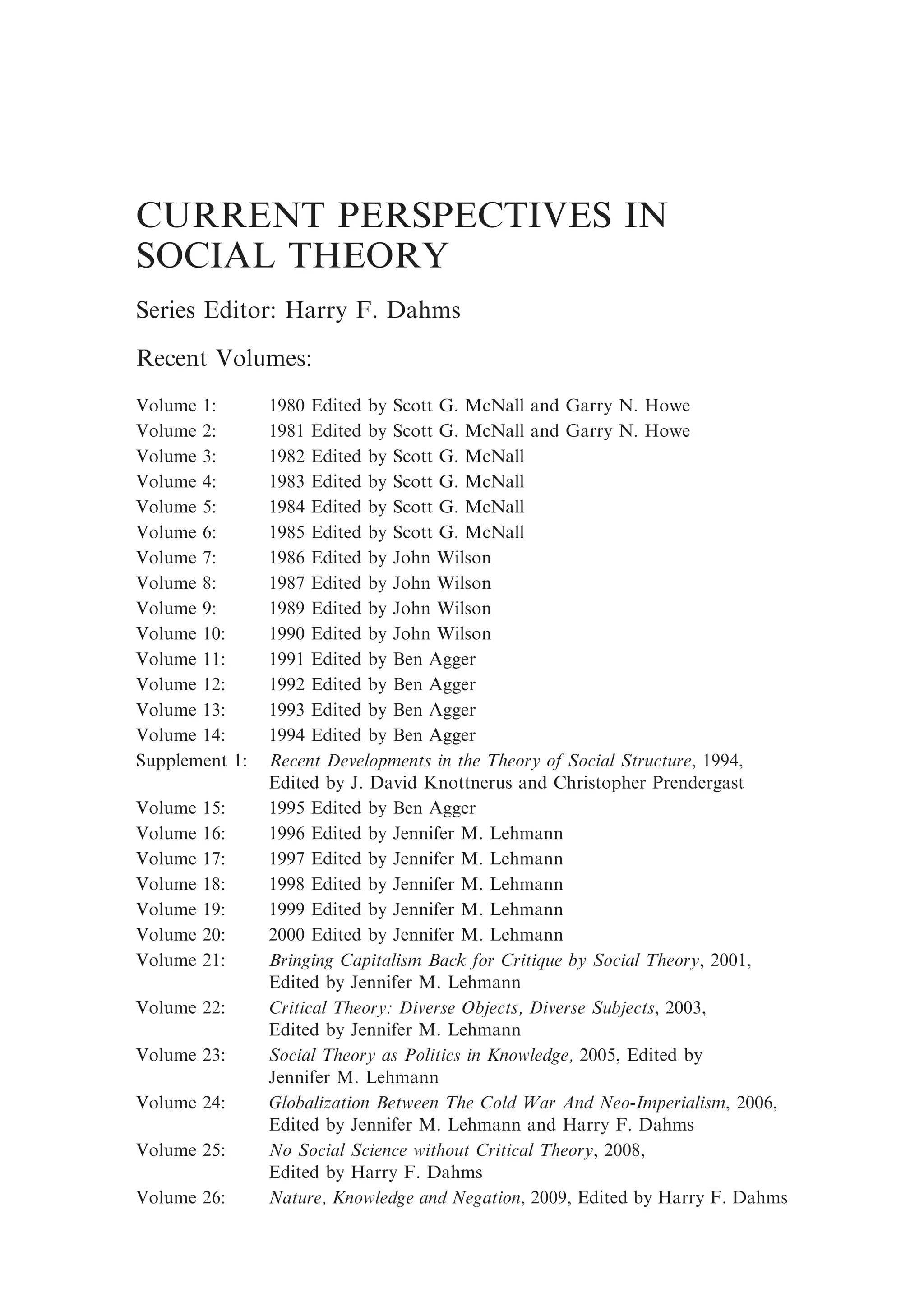




![main attraction has consisted in the notion that the analysis of processes of
change would be facilitated through an accounting scheme that first
aggregates individual actors (whether they be persons, the most common
unit, or firms or newspapers or some other agent or principal of action) into
cohorts, typically birth cohorts, then calculates for one or more variables of
interest the mean among component members of each of some number of
contiguous cohorts, and compares these means relative to each other and
relative to the variance among members of a given cohort. The argument
is that factors of change can be partitioned between factors that operate
through cohort differences in experience (and thus through cohort
succession) and factors that operate residually through changes in individual
units within a given cohort, relative to the cohort mean, as factors of
individual life cycle or of historical events affecting the individual or of both.
The chief instrument of the accounting scheme is thus a partition of variance
into two parts: the between-cohort variance (difference of means) and
within-cohort variance (dispersion around the cohort mean).
While a substantial fraction of the resulting literature has been devoted
to efforts seemingly designed to reprove the adage about squeezing blood
from a stone (i.e., demonstrations on partitioning variances into three
logically distinct aspects of the clock – age, period, and cohort), there have
also been many applications of the accounting scheme in analyses concerned
with theories of various processes, such as life-cycle theories about change
in political attitudes, voting behavior, and the like. Despite the occasional
caution against imagining that cohort effects are causal – ‘‘Temporal
dimensions such as age, period, and cohort are generally not substantively
interesting in themselves’’ (Rodgers, 1990, p. 436) – analyses based on
cohorts are often conducted as if they were estimating causal effects,
whether with cross-sectional or longitudinal data, indirectly if not directly.
In view of cautions such as the one cited above (see also Heckman &
Robb, 1985, p. 139; Hazelrigg, 1997), and more particularly in view of the
fact that a cohort is defined as an aggregation of component units, with
measurement conducted in terms of the aggregate means, it is well worth
considering this question: under what conditions does cohort as such add
information above and beyond the information presented by the component
units? That is, is there in fact a ‘‘value added’’ component, and if so how is it
constituted? More specifically in terms of any analysis of process, under
what conditions does cohort as such add impetus to any process?
This question has been raised before, though not often. Harrison White,
for one, has observed that ‘‘[c]ohorts of individuals themselves become
actors as they cohere enough around events, in both their own and others’
LAWRENCE HAZELRIGG
10](https://image.slidesharecdn.com/1264049-250523184125-d4eeae0f/75/Theorizing-The-Dynamics-Of-Social-Processes-Harry-Dahms-Editor-22-2048.jpg)
![In principle, one could argue that for any given individual there is an
underlying ‘‘propensity to believe X’’ which varies over time. Such measure
remains to be invented and calibrated, however.
2.3. Illustration 3: Selection and Sorting Processes
The habit of thinking in cross-sectional terms encourages us to neglect the
fact that we have, as Ryder (1965, p. 859) said, ‘‘destroy[ed] individual
sequences.’’ We neglect the fact that states of affairs at any given time
are the results of trajectories that can and usually do involve various sorting
and selection processes. We just saw in the previous illustration an example
of how sorting can result in a cross-sectional relationship that might
be mistaken as evidence that the behavior of an aggregate (in a different
context, e.g., a crowd) is contrary to the behavior of individual members.
Indeed, social organization in general is a strong ‘‘sorting-and-selection
engine.’’ The process is especially potent in voluntary associations such as
religious congregations, but it characterizes many other organizations as
well (e.g., work organizations). Here the focus will be mainly on selection.
When observing a cross-section, one is averaging across initial conditions
of observation on a variety of processes that have been underway for
variable lengths of time. If the primary observational units are individual
persons, for example, the initial conditions pertain to persons who have
been ‘‘caught,’’ so to speak, at various points in the trajectories of relevant
processes. Effects of this averaging across initial conditions can be taken
into account when observation is repeated multiple times at appropriate
intervals for the same persons. But with cross-sectional data we have only
those initial-condition averages. We then face the usually impossible task of
trying to determine each person’s ‘‘preobservation history’’ – that is, the
relevant events recently engaged in, the effects recently absorbed, and so
forth. Retrospective reports by the observed persons are sometimes better
than nothing, but even then they mostly shift the task from guessing about
completely censored information to guessing about censored boundaries of
errors of measurement and classification. Sometimes this ‘‘left-censored’’
information is inescapable for conceptual and/or mensural reasons.
Of the many examples of this condition, Manski (1995, p. 22) cites one of
the classic instances encountered when trying ‘‘to learn how market wages
vary with schooling, work experience, and demographic background’’
(i.e., conditioning variables such as gender, race, etc.). Even when there are
no missing data in a survey data set that includes the relevant variables,
LAWRENCE HAZELRIGG
16](https://image.slidesharecdn.com/1264049-250523184125-d4eeae0f/75/Theorizing-The-Dynamics-Of-Social-Processes-Harry-Dahms-Editor-28-2048.jpg)
![processes of education. If we want to know whether [various hypothesized
factors] actually influence the quality of education, then we must be able to
show how they operate in pragmatic educational situations.’’22
Snapshots
cannot do that. Routine inclusion of membership categories of gender, race,
ethnicity, and the like, in cross-sectional studies gains little or no insight
even into the extent to which such memberships are conditional to the actual
operation of specific processes.
It would be a mistake to suppose that only categorical variables such as
gender, race, and ethnicity are prone to zero variance temporally. Recall
the second of the three illustrations recited earlier – the one having to do
with ‘‘aggregation reversal’’ – which featured the example of educational
attainment: typically measured as ‘‘years of school,’’ which can easily be
treated as an interval variable (one year ¼ one year), and even as a ratio
variable (since a person cannot have fewer than zero years of school),23
educational attainment varies within the cross-section of a general
population by a substantial amount. But within the life course of a given
person it has no variance other than that of the clock, one tick for each tock.
Generally speaking, analysts have been sensibly cautious about interpreting
increments of years of school. Few if any would argue that the difference
between years 6 and 7 of school equals the difference between years 14 and
15, or that 20 years of schooling has twice the gravity of 10 years; and there
is often an explicit acknowledgment of limit to the assumption of equal
intervals, as when an analyst adds one or more category variables such as
‘‘high school diploma’’ in recognition that the 12th year is more valuable in
the margin than the 11th year. That said, however, actual practice is
complicated by the fact that the analyst will often be making, indeed relying
on, such claims implicitly, insofar as the algebra of the analysis implies
comparisons among individuals in the cross-section that involve arithmetic
functions beyond addition and subtraction. In fact, qualitative comparison
in practice sometimes involves a facsimile at least of intervality, insofar as
terms such as ‘‘more’’ and ‘‘less’’ are used in a way that assumes imagined
quanta beyond mere rank order, when comparing individual cases.
In order to appreciate better what is given up by the fact that ‘‘years of
school’’ has no variance in time beyond the generic ‘‘duration clock’’ of
process, consider the notion of a preference hierarchy (which pertains to the
educational variable insofar as people agree that more is preferable to less).
Notoriously, preference hierarchies allow only very limited comparison even
in the cross-section, because in general they do not allow the claim of equal
intervals, much less absolute zero. There are exceptions: insofar as one
prefers more income to less, at the very least one can claim that an income of
On Theorizing the Dynamics of Process: A Propaedeutic Introduction 23](https://image.slidesharecdn.com/1264049-250523184125-d4eeae0f/75/Theorizing-The-Dynamics-Of-Social-Processes-Harry-Dahms-Editor-35-2048.jpg)