The Spring Framework
A quick overview
The Spring Framework
1. Spring principles: IoC
2. Spring principles: AOP
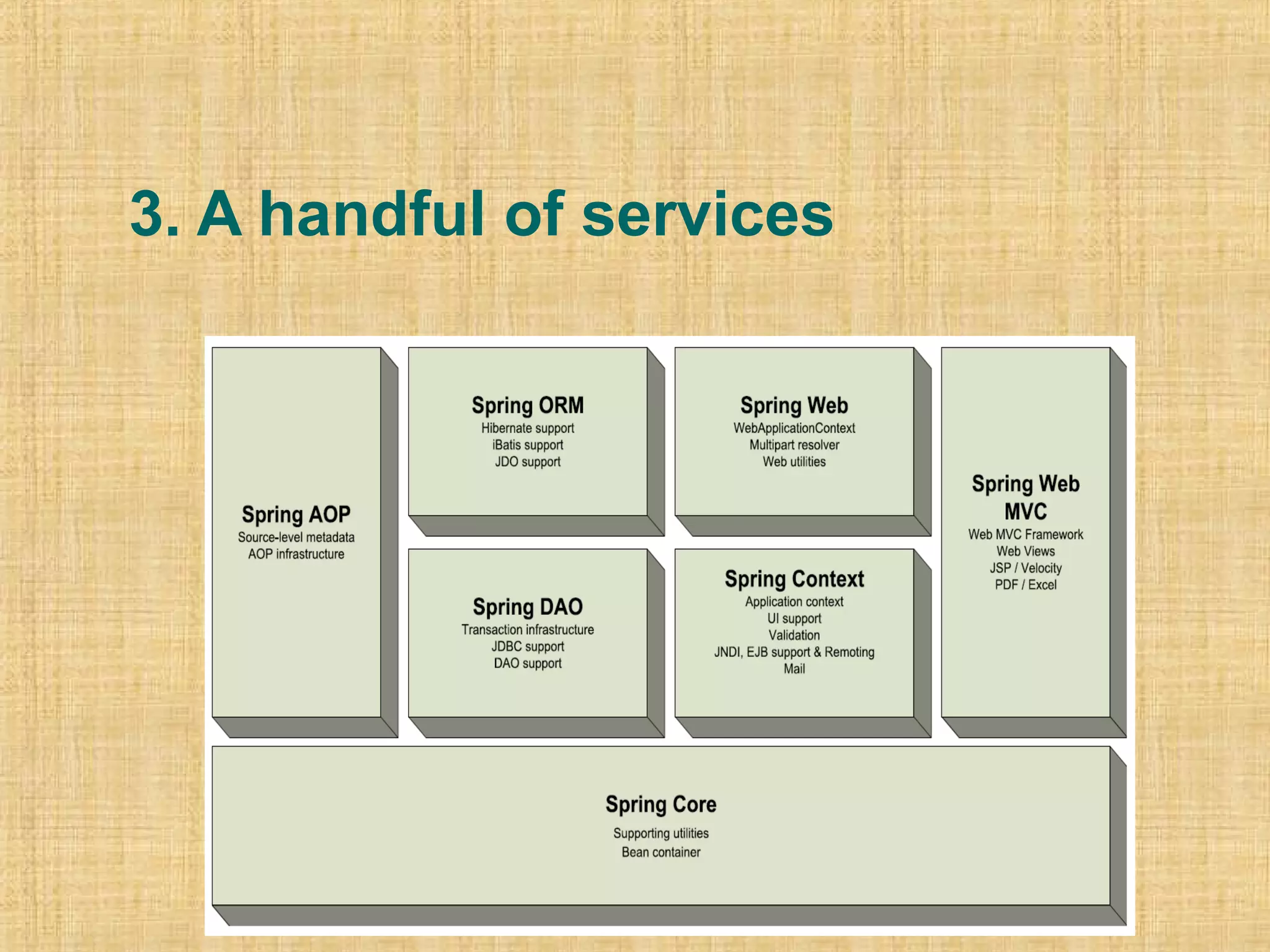
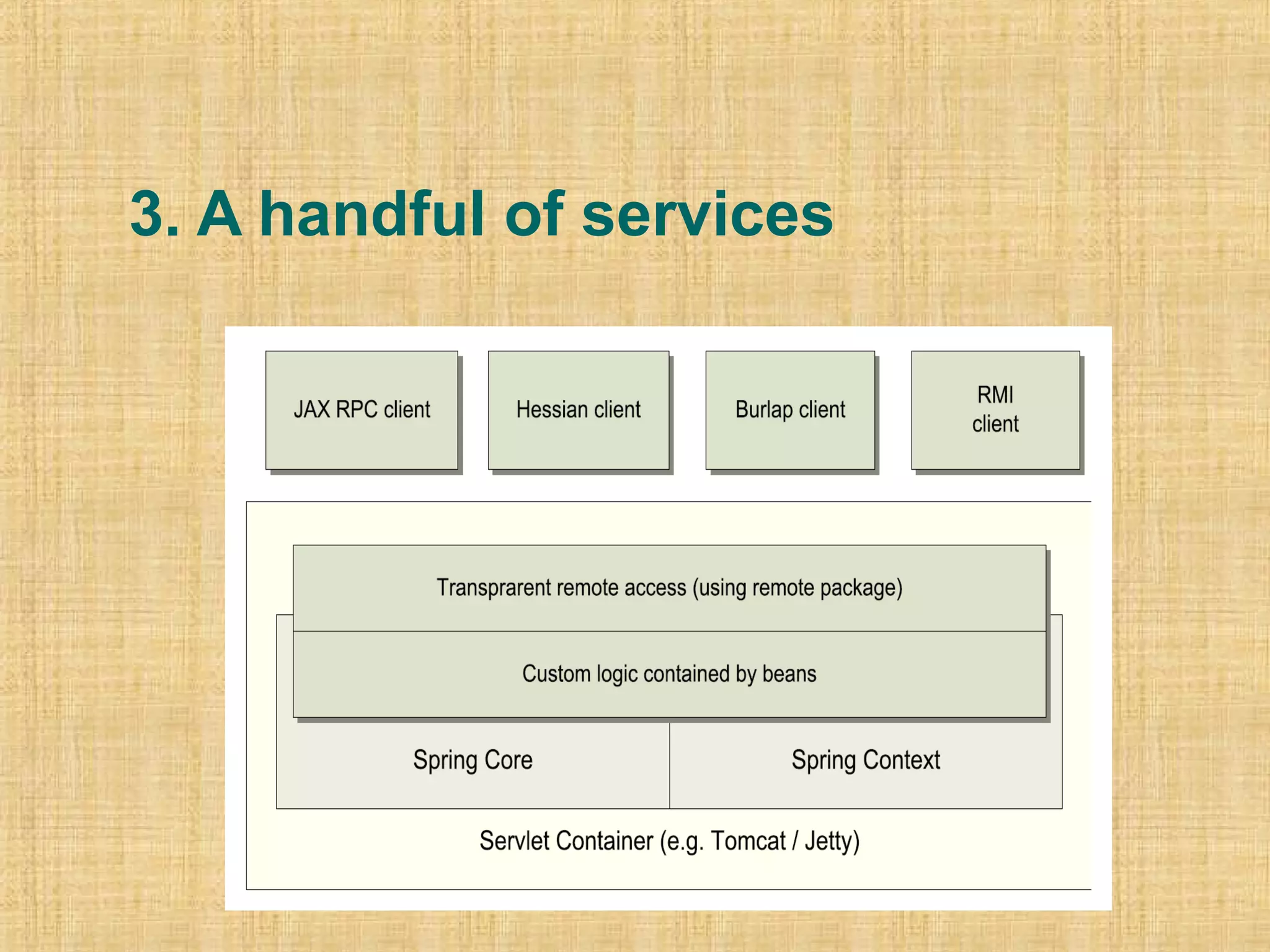
3. A handful of services
4. A MVC framework
5. Conclusion
1. Spring principles: IoC
 Inversion of Control: an
object interacts with its
environment
 Objects are « plugged »
one in another
 The environment is set
up by the container
instead of the object
itself
1. Spring principles: IoC
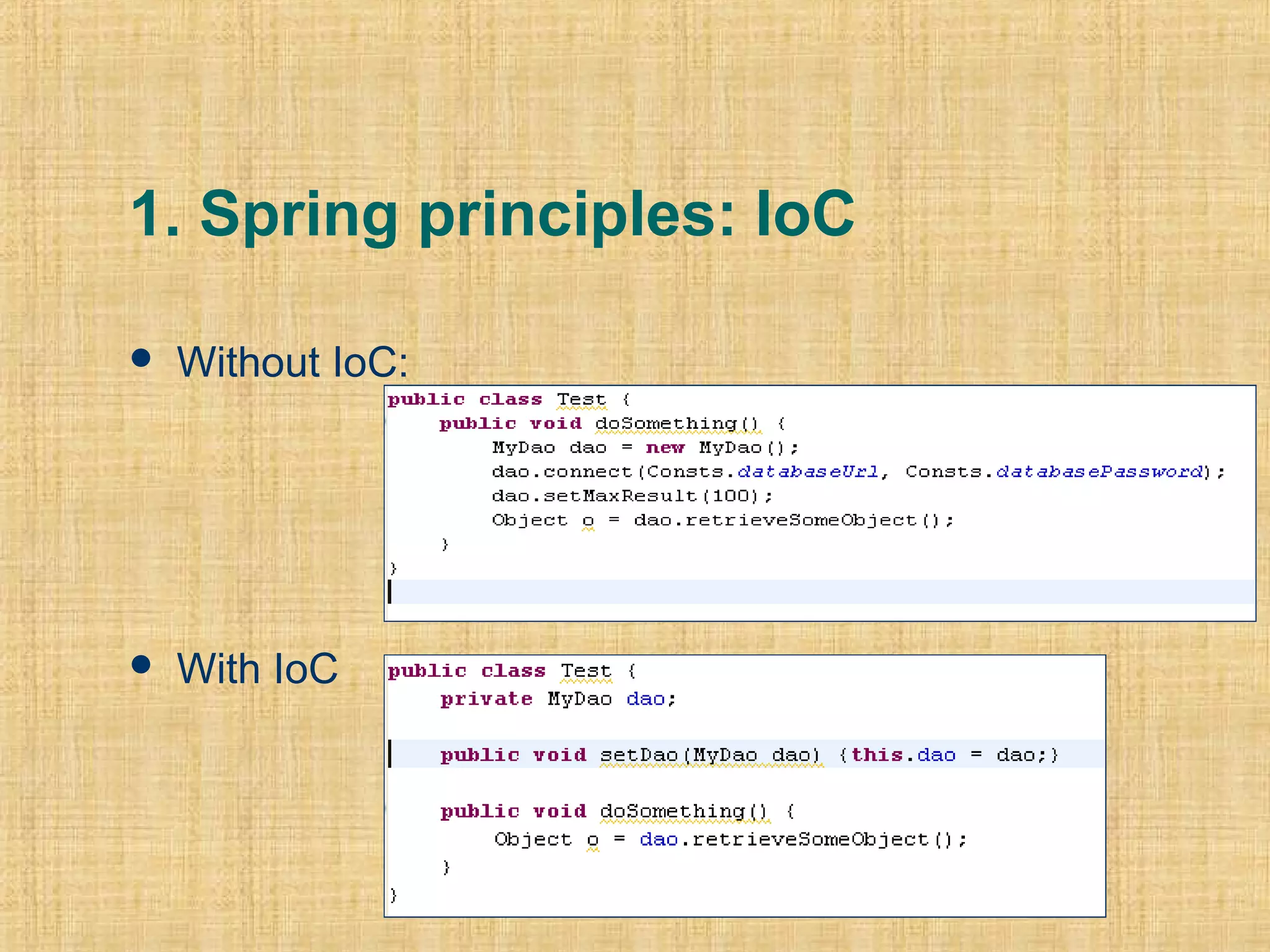
 Without IoC:
 With IoC
1. Spring principles: IoC
 Useful for separating dao and business layer
 Useful for separating controllers and
business layer
 The code is more extensible, easier to
read, and modules/layers can easily be
replaced
2. Spring principles: AOP
 Separates the core business
code from the aspects we
wrap around it: security,
transaction management, …
 Through AOP, we add
transversal functionalities
to objects (ie not directly
related to the code it
contains)
2. Spring principles: AOP
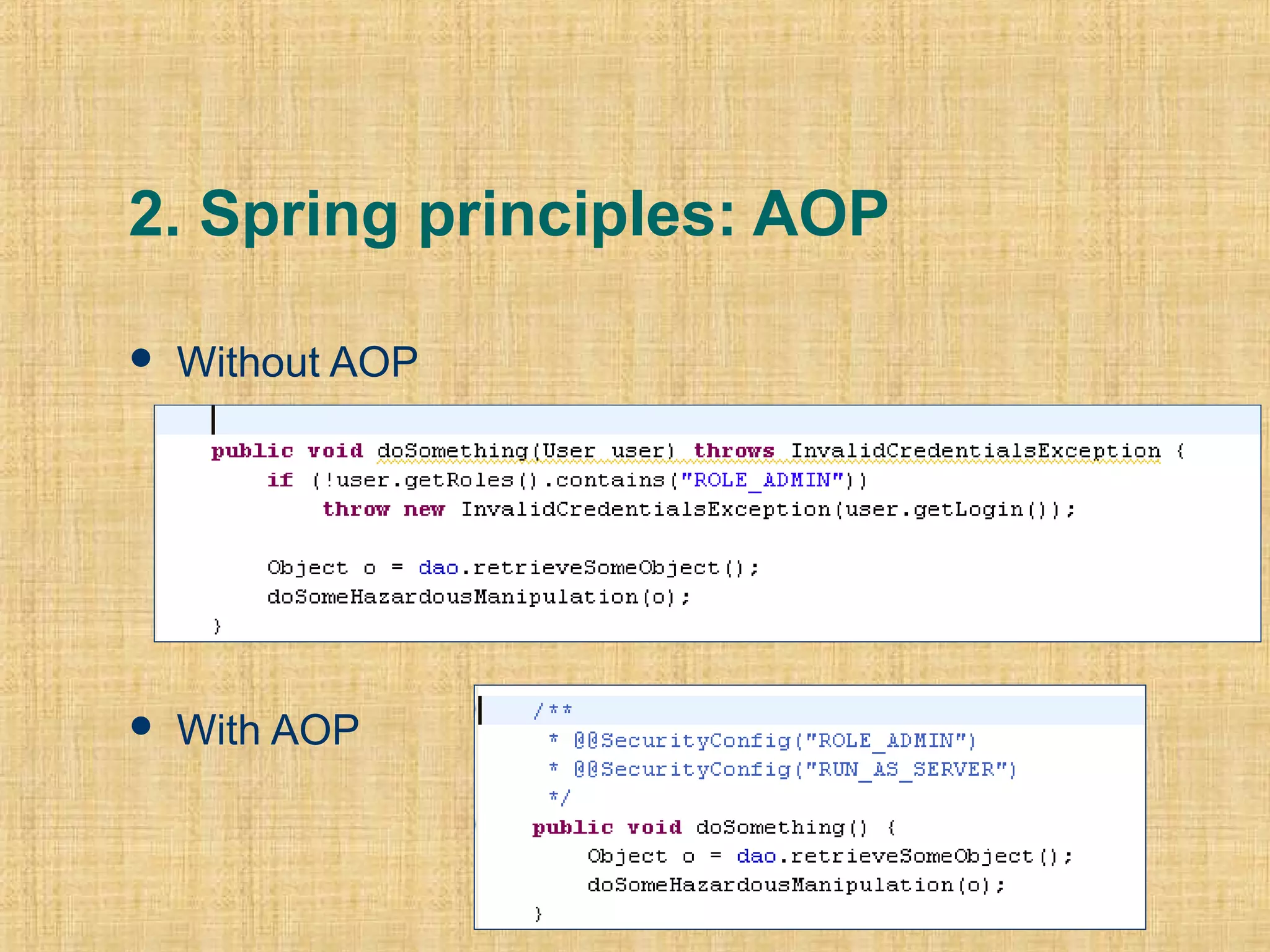
 Without AOP
 With AOP
2. Spring principles: AOP
 Useful for automatic handling of transaction
with Hibernate
 Useful for Acegi (automatic credentials
checking before executing some methods)
 Code smaller, easier to read (not polluted
by transversal aspects not directly relevant)
3. A handful of services
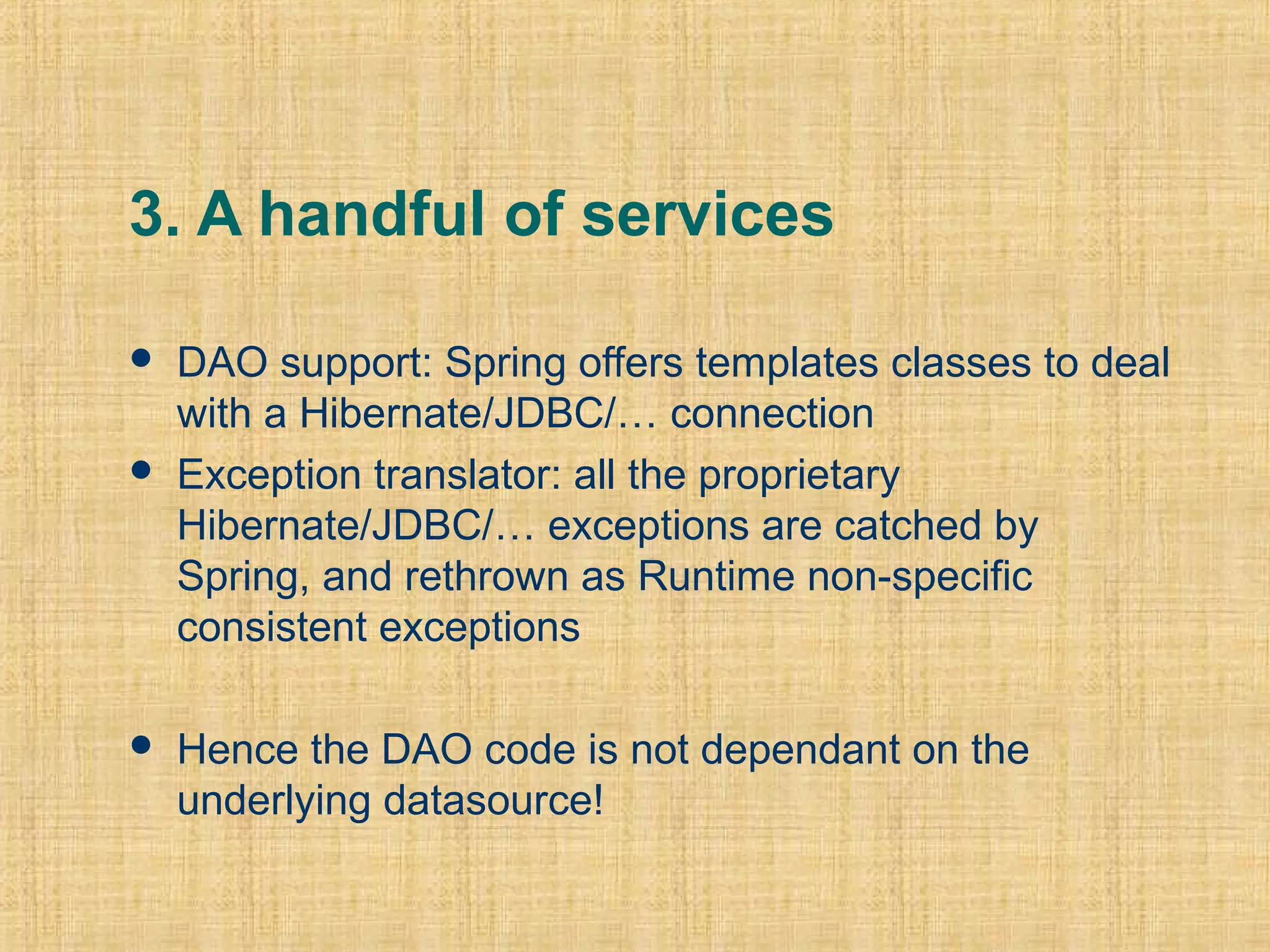
 DAO support: Spring offers templates classes to deal
with a Hibernate/JDBC/… connection
 Exception translator: all the proprietary
Hibernate/JDBC/… exceptions are catched by
Spring, and rethrown as Runtime non-specific
consistent exceptions
 Hence the DAO code is not dependant on the
underlying datasource!
3. A handful of services
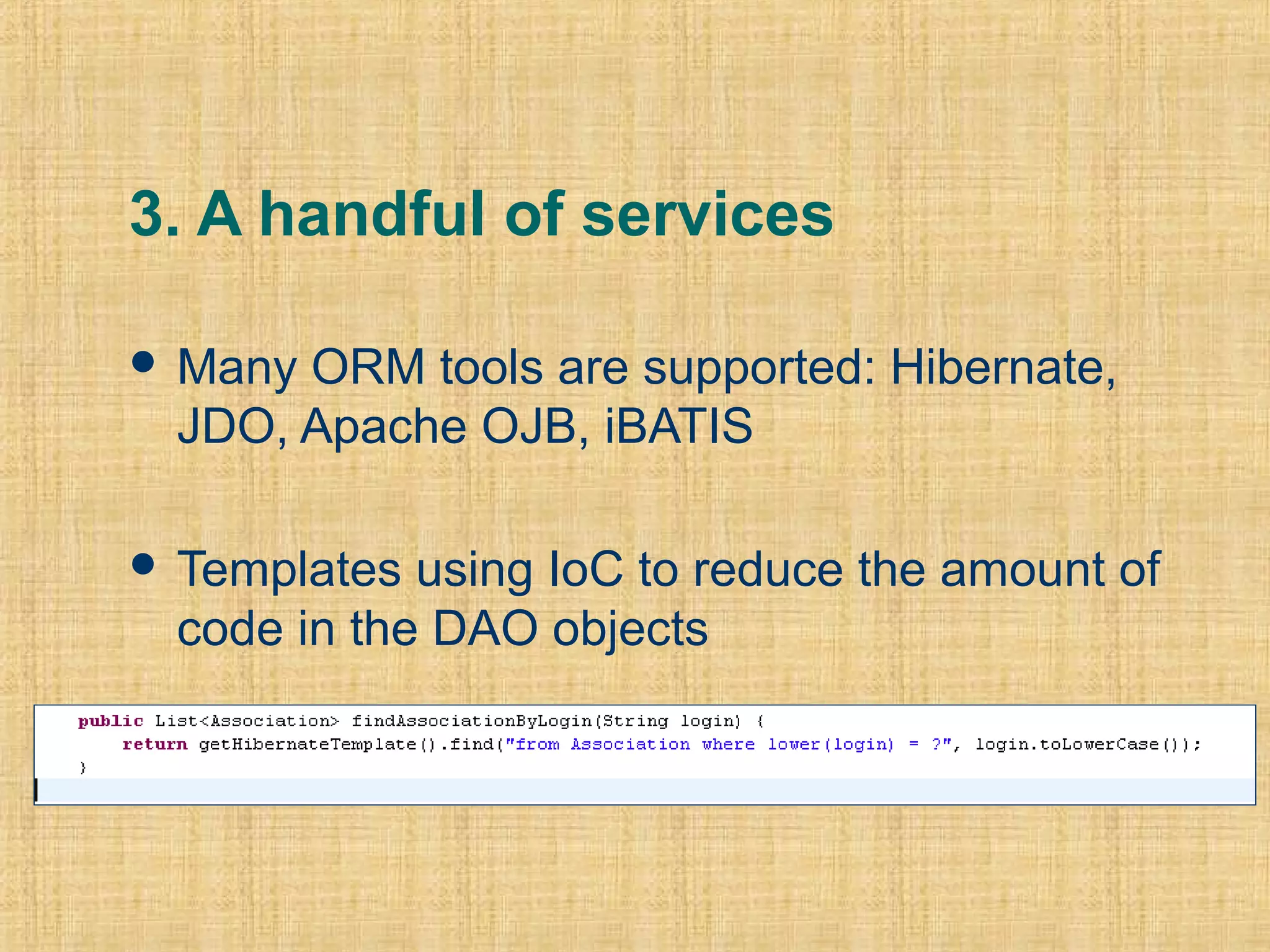
 Many ORM tools are supported: Hibernate,
JDO, Apache OJB, iBATIS
 Templates using IoC to reduce the amount of
code in the DAO objects
3. A handful of services
 Support of RMI
 Very easy to expose and connect to
webservices
 Support of JMS
 JMS templates, JMSException translation
3. A handful of services
 A mail abstraction layer
– Templates
 Jobs scheduling
(Quartz, Timer)
– Cron
– Business layer unaware
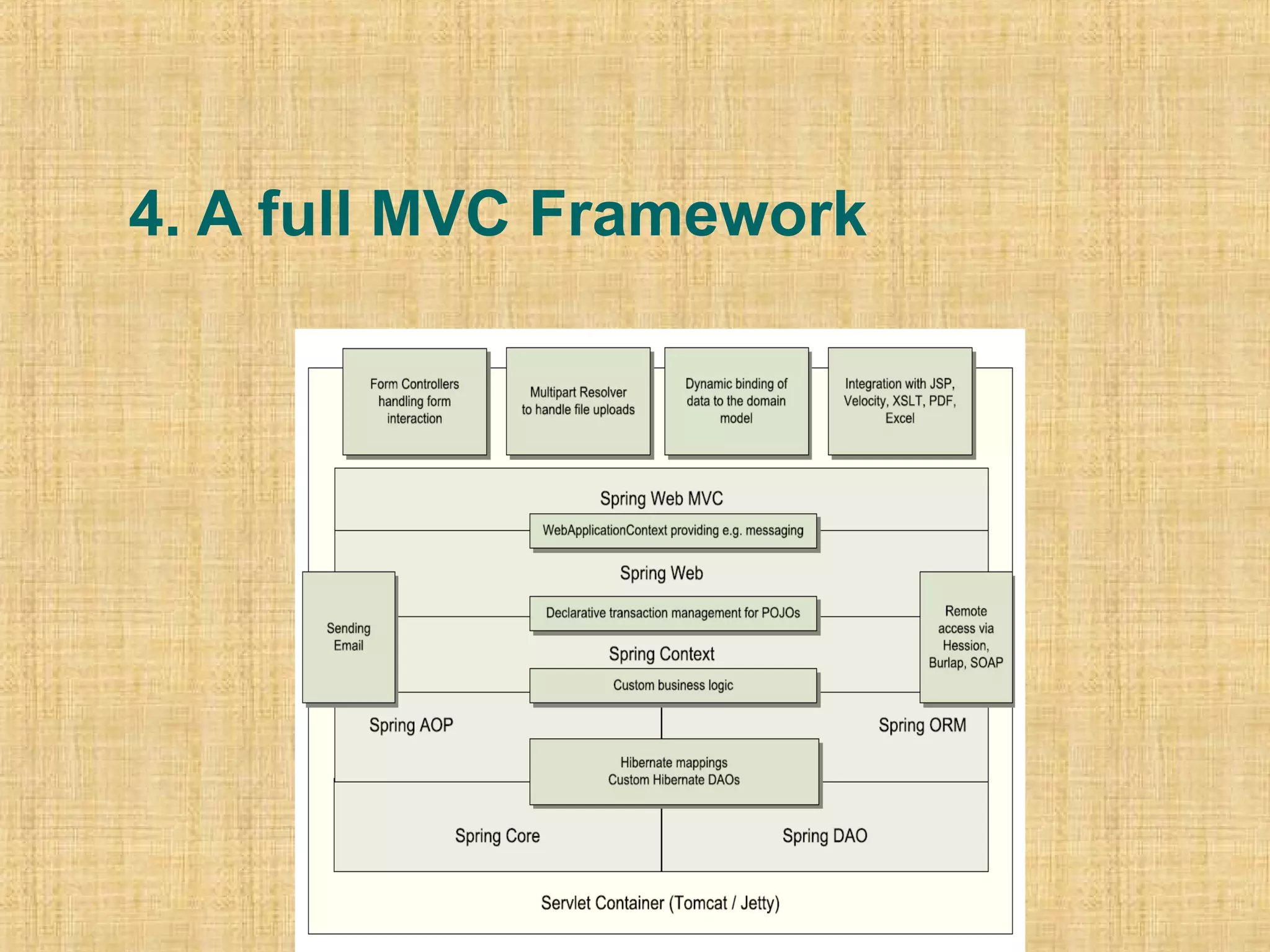
4. A full MVC Framework
 Clear separation of roles: controller, validator,
form object, Dispatch servlet, View resolver,
…
 Extensible and adaptable
 Several views of a result (pdf, excel, html, …)
 Can be wired (possible to use transparently
the IoC pattern)
4. A full MVC Framework
 Can be used with other frameworks: JSF,
Struts, Tapestry, Webwork
 Completely transparent: no need to change
anything in what is done by these other
frameworks
4. A full MVC Framework
5. Conclusion
 Learning curve
 XML configuration & annotations
 Tiny
 Open-source and free
 Active development
 Linked with several important Java projects
(Hibernate, Acegi, …)

The spring framework

  • 1.
    The Spring Framework Aquick overview
  • 2.
    The Spring Framework 1.Spring principles: IoC 2. Spring principles: AOP 3. A handful of services 4. A MVC framework 5. Conclusion
  • 3.
    1. Spring principles:IoC  Inversion of Control: an object interacts with its environment  Objects are « plugged » one in another  The environment is set up by the container instead of the object itself
  • 4.
    1. Spring principles:IoC  Without IoC:  With IoC
  • 5.
    1. Spring principles:IoC  Useful for separating dao and business layer  Useful for separating controllers and business layer  The code is more extensible, easier to read, and modules/layers can easily be replaced
  • 6.
    2. Spring principles:AOP  Separates the core business code from the aspects we wrap around it: security, transaction management, …  Through AOP, we add transversal functionalities to objects (ie not directly related to the code it contains)
  • 7.
    2. Spring principles:AOP  Without AOP  With AOP
  • 8.
    2. Spring principles:AOP  Useful for automatic handling of transaction with Hibernate  Useful for Acegi (automatic credentials checking before executing some methods)  Code smaller, easier to read (not polluted by transversal aspects not directly relevant)
  • 9.
    3. A handfulof services
  • 10.
    3. A handfulof services  DAO support: Spring offers templates classes to deal with a Hibernate/JDBC/… connection  Exception translator: all the proprietary Hibernate/JDBC/… exceptions are catched by Spring, and rethrown as Runtime non-specific consistent exceptions  Hence the DAO code is not dependant on the underlying datasource!
  • 11.
    3. A handfulof services  Many ORM tools are supported: Hibernate, JDO, Apache OJB, iBATIS  Templates using IoC to reduce the amount of code in the DAO objects
  • 12.
    3. A handfulof services  Support of RMI  Very easy to expose and connect to webservices  Support of JMS  JMS templates, JMSException translation
  • 13.
    3. A handfulof services
  • 14.
    3. A handfulof services  A mail abstraction layer – Templates  Jobs scheduling (Quartz, Timer) – Cron – Business layer unaware
  • 15.
    4. A fullMVC Framework  Clear separation of roles: controller, validator, form object, Dispatch servlet, View resolver, …  Extensible and adaptable  Several views of a result (pdf, excel, html, …)  Can be wired (possible to use transparently the IoC pattern)
  • 16.
    4. A fullMVC Framework  Can be used with other frameworks: JSF, Struts, Tapestry, Webwork  Completely transparent: no need to change anything in what is done by these other frameworks
  • 17.
    4. A fullMVC Framework
  • 18.
    5. Conclusion  Learningcurve  XML configuration & annotations  Tiny  Open-source and free  Active development  Linked with several important Java projects (Hibernate, Acegi, …)