Spring Framework1
Overview
 Introduction
 History
 Modules of the Framework
 Overview of Spring Framework
 Spring Details
 Advantages
 Spring Solutions
 Inversion of Control( IoC )
 How to Start Using Spring
2
Introduction
 The Spring Framework is an open source application framework and inversion of
control container for the Java platform.
 The framework's core features can be used by any Java application, but there are
extensions for building web applications on top of the Java EE platform.
 Although the framework does not impose any specific programming model, it has
become popular in the Java community as an alternative to, replacement for, or
even addition to the Enterprise JavaBean (EJB) model.
3
History
 The first version was written by Rod Johnson, who released the framework with the
publication of his book Expert One-on-One J2EE Design and Development in
October 2002.
 The framework was first released under the Apache 2.0 license in June 2003. The first
milestone release, 1.0, was released in March 2004, with further milestone releases in
September 2004 and March 2005.
 The Spring 1.2.6 framework won a Jolt productivity award and a JAX Innovation
Award in 2006. Spring 2.0 was released in October 2006, Spring 2.5 in November
2007, Spring 3.0 in December 2009, Spring 3.1 in December 2011, and Spring 3.2.5 in
November 2013.
 The current version is Spring Framework 4.0, which was released in December
2013.Notable improvements in Spring 4.0 include support for Java SE 8, Groovy 2,
some aspects of Java EE7, and WebSockets.
 Philosophy: J2EE should be easier to use, “Lightweight Container” concept
4
What are Lightweight Frameworks?
 No container requirements
 Simplify application development
• Remove re-occurring pattern code
• Productivity friendly
 Very pluggable
 Usually open source
 Examples:
• Spring, Pico, Hivemind
• Hibernate, IBatis, Castor
• WebWork
• Quartz
• Sitemesh
5
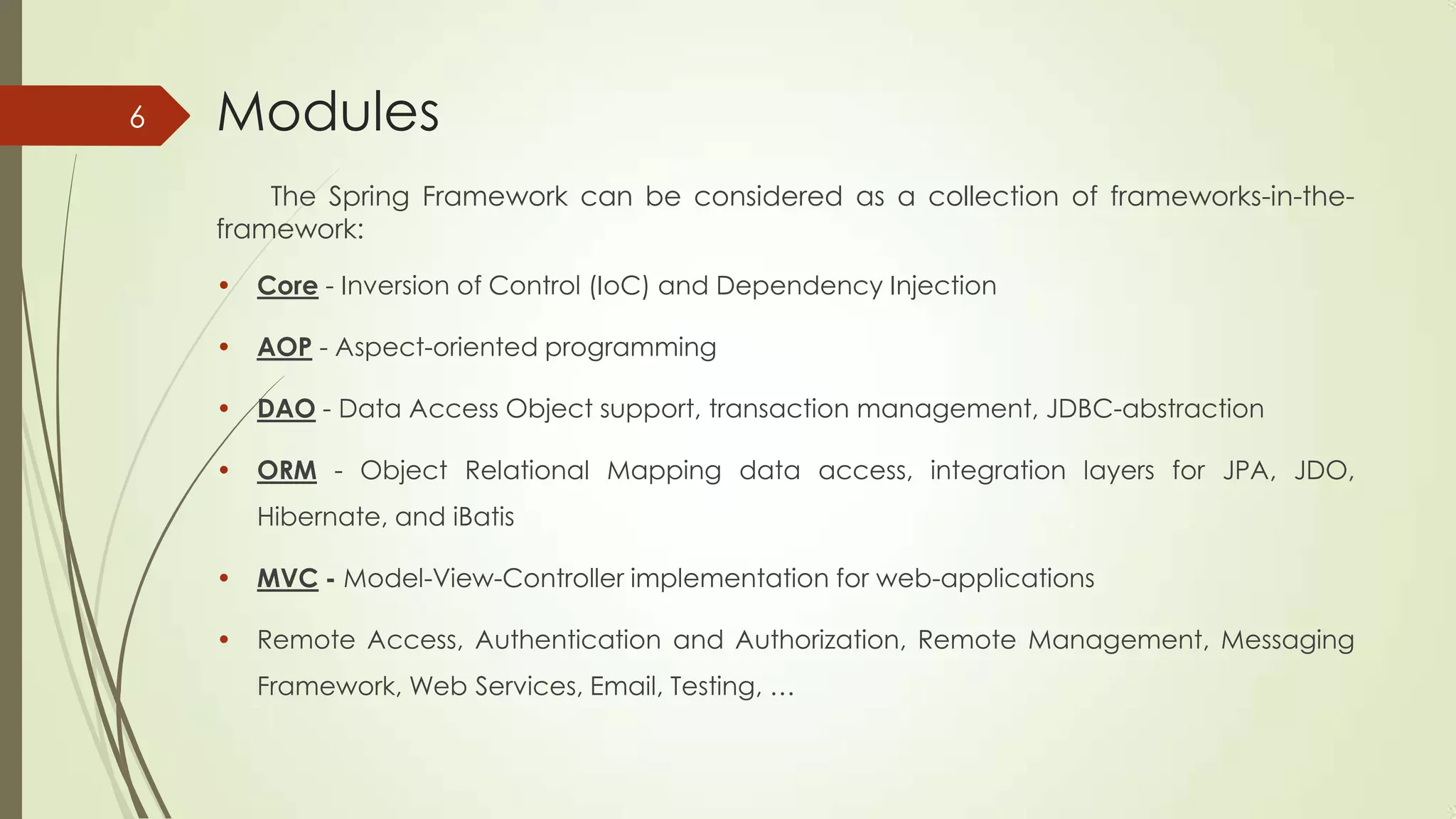
Modules
The Spring Framework can be considered as a collection of frameworks-in-the-
framework:
• Core - Inversion of Control (IoC) and Dependency Injection
• AOP - Aspect-oriented programming
• DAO - Data Access Object support, transaction management, JDBC-abstraction
• ORM - Object Relational Mapping data access, integration layers for JPA, JDO,
Hibernate, and iBatis
• MVC - Model-View-Controller implementation for web-applications
• Remote Access, Authentication and Authorization, Remote Management, Messaging
Framework, Web Services, Email, Testing, …
6
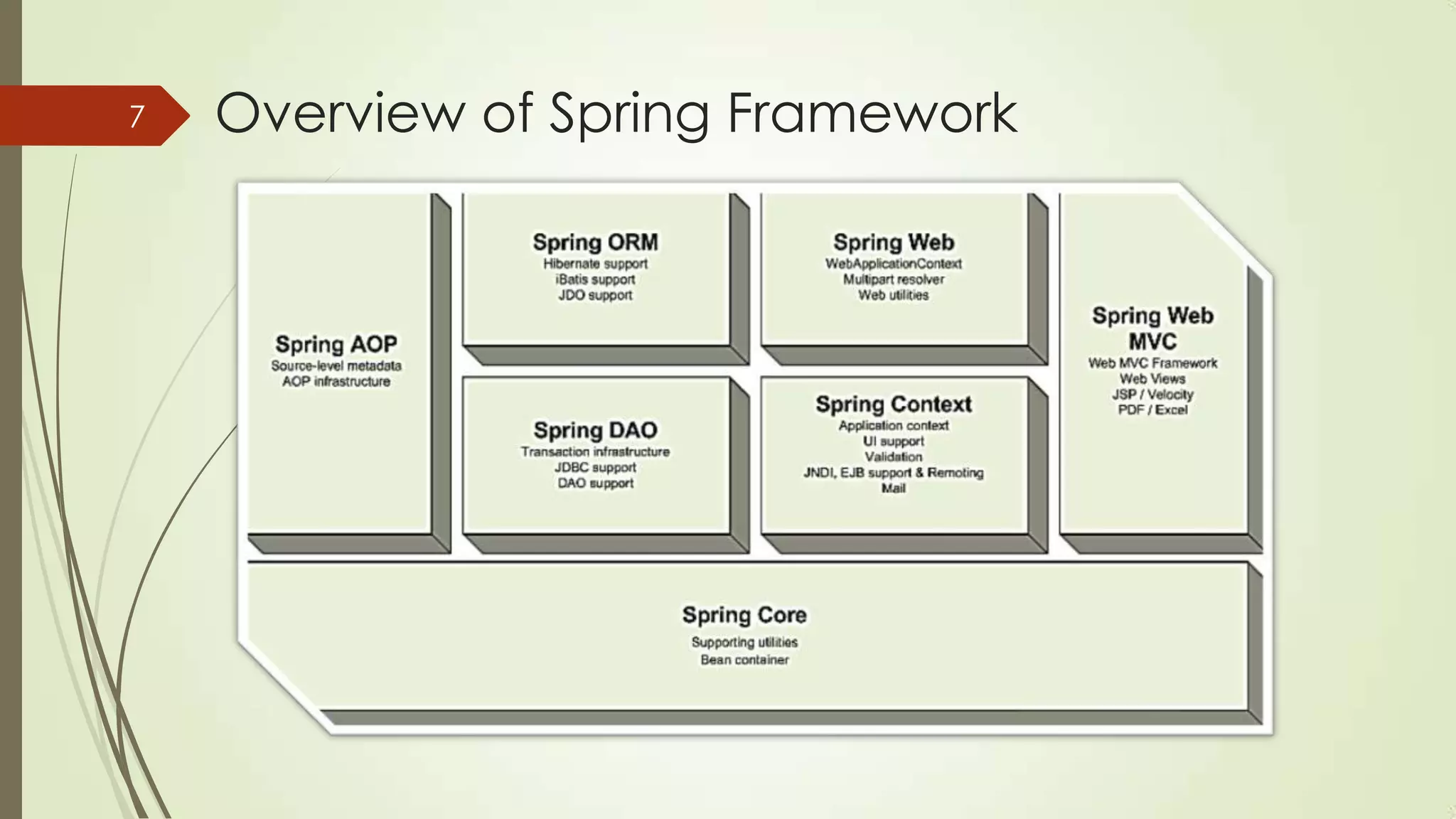
Overview of Spring Framework7
Spring Details
 Spring allows to decouple software layers by injecting a component’s dependencies at
runtime rather than having them declared at compile time via importing and
instantiating classes.
 Spring provides integration for J2EE services such as EJB, JDBC, JNDI, JMS, JTA. It also
integrates several popular ORM toolkits such as Hibernate and JDO and assorted other
services as well.
 One of the highly touted features is declarative transactions, which allows the
developer to write transaction-unaware code and configure transactions in Spring
config files.
 Spring is built on the principle of unchecked exception handling. This also reduces code
dependencies between layers. Spring provides a granular exception hierarchy for data
access operations and maps JDBC, EJB, and ORM exceptions to Spring exceptions so
that applications can get better information about the error condition.
 With highly decoupled software layers and programming to interfaces, each layer is
easier to test. Mock objects is a testing pattern that is very useful in this regard.
8
Advantages
 Enable you to write powerful, scalable applications using POJOs
 Lifecycle – responsible for managing all your application components, particularly
those in the middle tier container sees components through well-defined lifecycle:
init(), destroy()
 Dependencies - Spring handles injecting dependent components without a
component knowing where they came from (IoC)
 Configuration information - Spring provides one consistent way of configuring
everything, separate configuration from application logic, varying configuration
 In J2EE (e.g. EJB) it is easy to become dependent on container and deployment
environment, proliferation of pointless classes (locators/delegates); Spring
eliminates them
 Cross-cutting behavior (resource management is cross-cutting concern, easy to
copy-and-paste everywhere)
 Portable (can use server-side in web/EJB app, client-side in swing app, business
logic is completely portable)
9
Spring Solutions
 Solutions address major J2EE problem areas:
• Web application development (MVC)
• Enterprise Java Beans (EJB, JNDI)
• Database access (JDBC, iBatis, ORM)
• Transaction management (JTA, Hibernate, JDBC)
• Remote access (Web Services, RMI)
 Each solution builds on the core architecture
 Solutions foster integration, they do not re-invent the wheel
10
Inversion of Control( IoC )
 Central in the Spring is its Inversion of Control container
 Based on “Inversion of Control Containers and the Dependency Injection pattern” (Martin
Fowler)
 Provides centralized, automated configuration, managing and wiring of application Java
objects
 Container responsibilities:
• creating objects,
• configuring objects,
• calling initialization methods
• passing objects to registered callback objects
 All together form the object lifecycle which is one of the most important features
11
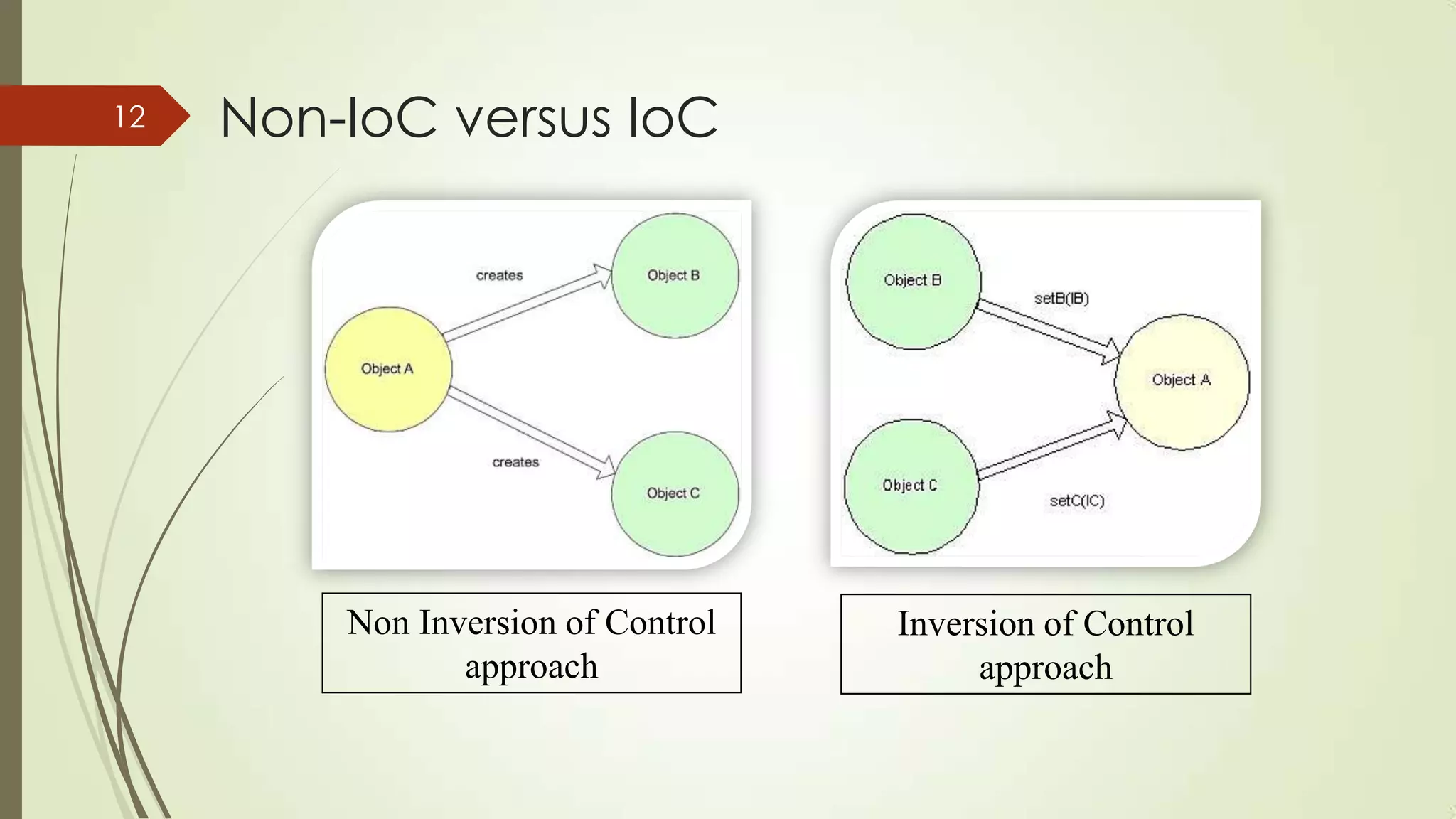
Non-IoC versus IoC
Non Inversion of Control
approach
Inversion of Control
approach
12
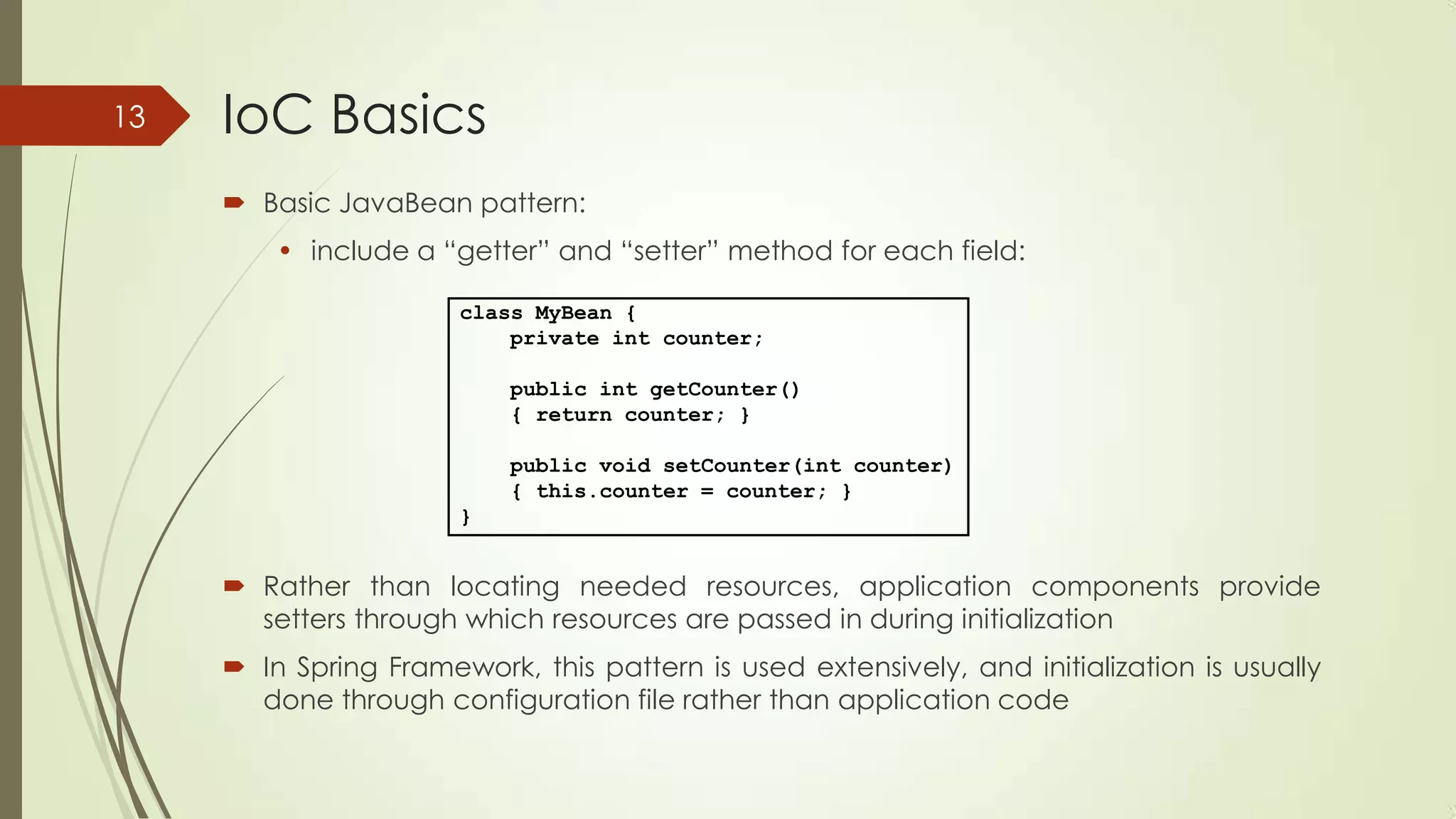
IoC Basics
 Basic JavaBean pattern:
• include a “getter” and “setter” method for each field:
 Rather than locating needed resources, application components provide
setters through which resources are passed in during initialization
 In Spring Framework, this pattern is used extensively, and initialization is usually
done through configuration file rather than application code
class MyBean {
private int counter;
public int getCounter()
{ return counter; }
public void setCounter(int counter)
{ this.counter = counter; }
}
13
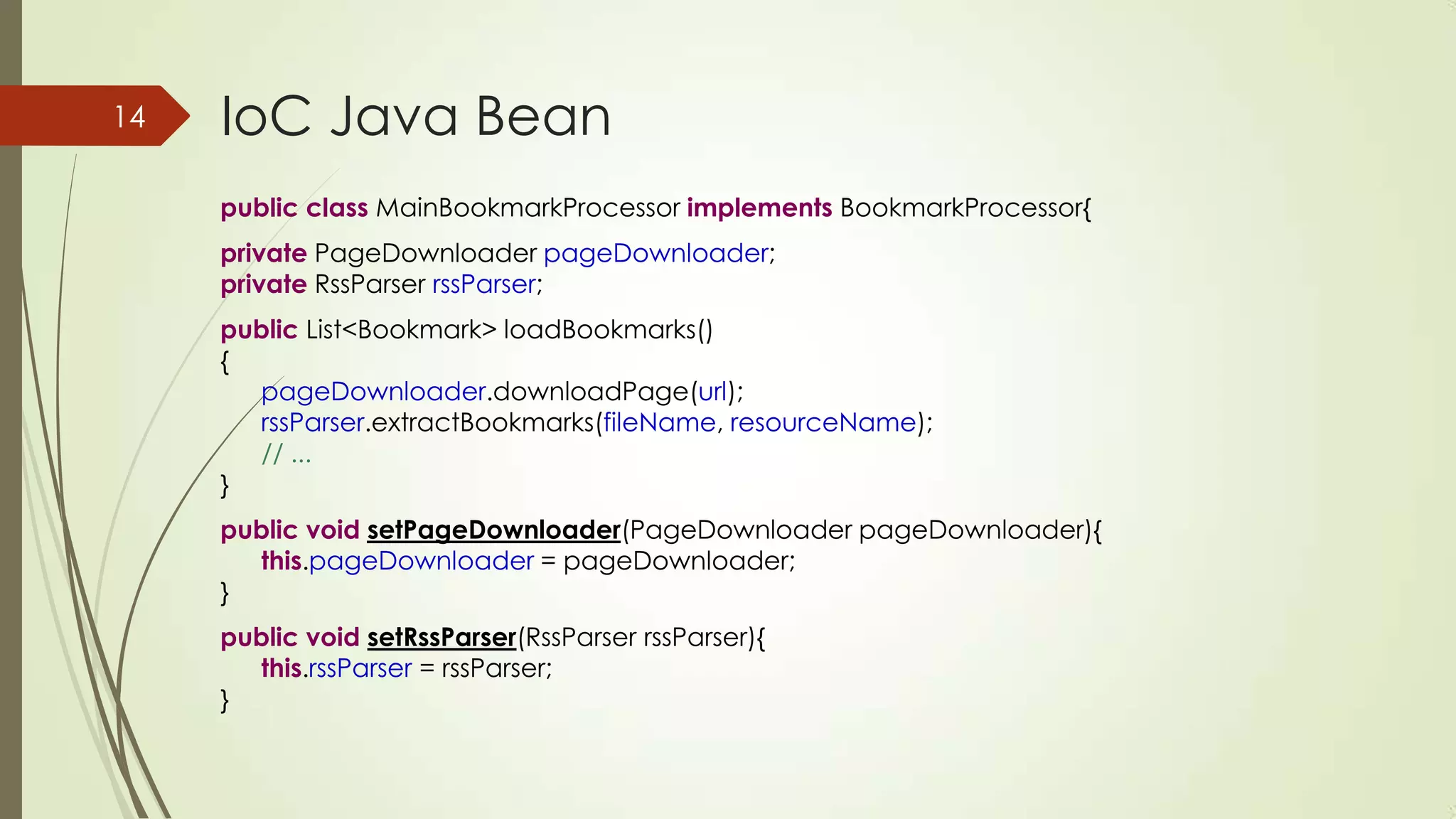
IoC Java Bean
public class MainBookmarkProcessor implements BookmarkProcessor{
private PageDownloader pageDownloader;
private RssParser rssParser;
public List<Bookmark> loadBookmarks()
{
pageDownloader.downloadPage(url);
rssParser.extractBookmarks(fileName, resourceName);
// ...
}
public void setPageDownloader(PageDownloader pageDownloader){
this.pageDownloader = pageDownloader;
}
public void setRssParser(RssParser rssParser){
this.rssParser = rssParser;
}
14
How to Start Using Spring
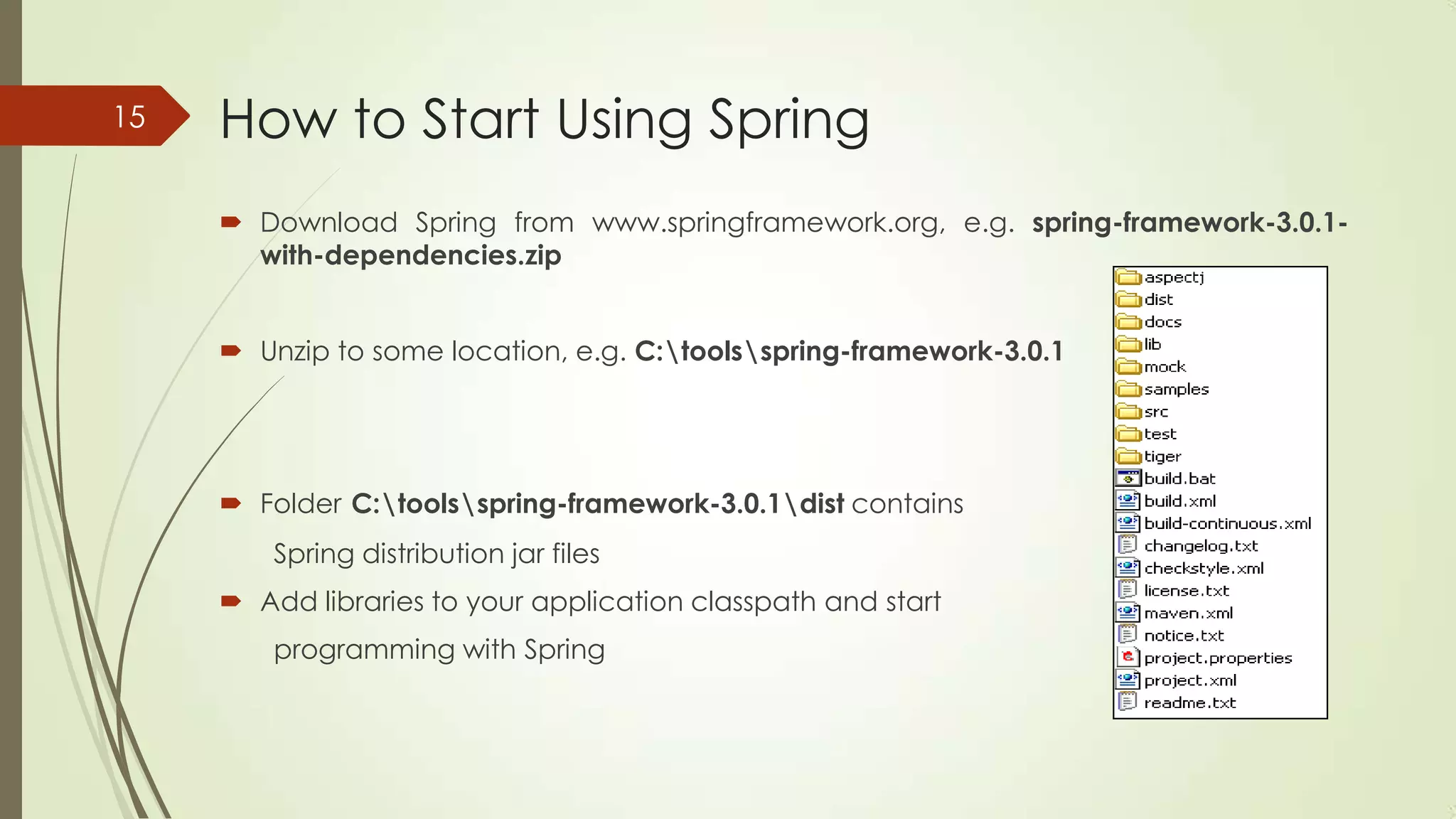
 Download Spring from www.springframework.org, e.g. spring-framework-3.0.1-
with-dependencies.zip
 Unzip to some location, e.g. C:toolsspring-framework-3.0.1
 Folder C:toolsspring-framework-3.0.1dist contains
Spring distribution jar files
 Add libraries to your application classpath and start
programming with Spring
15

Spring framework

  • 1.
  • 2.
    Overview  Introduction  History Modules of the Framework  Overview of Spring Framework  Spring Details  Advantages  Spring Solutions  Inversion of Control( IoC )  How to Start Using Spring 2
  • 3.
    Introduction  The SpringFramework is an open source application framework and inversion of control container for the Java platform.  The framework's core features can be used by any Java application, but there are extensions for building web applications on top of the Java EE platform.  Although the framework does not impose any specific programming model, it has become popular in the Java community as an alternative to, replacement for, or even addition to the Enterprise JavaBean (EJB) model. 3
  • 4.
    History  The firstversion was written by Rod Johnson, who released the framework with the publication of his book Expert One-on-One J2EE Design and Development in October 2002.  The framework was first released under the Apache 2.0 license in June 2003. The first milestone release, 1.0, was released in March 2004, with further milestone releases in September 2004 and March 2005.  The Spring 1.2.6 framework won a Jolt productivity award and a JAX Innovation Award in 2006. Spring 2.0 was released in October 2006, Spring 2.5 in November 2007, Spring 3.0 in December 2009, Spring 3.1 in December 2011, and Spring 3.2.5 in November 2013.  The current version is Spring Framework 4.0, which was released in December 2013.Notable improvements in Spring 4.0 include support for Java SE 8, Groovy 2, some aspects of Java EE7, and WebSockets.  Philosophy: J2EE should be easier to use, “Lightweight Container” concept 4
  • 5.
    What are LightweightFrameworks?  No container requirements  Simplify application development • Remove re-occurring pattern code • Productivity friendly  Very pluggable  Usually open source  Examples: • Spring, Pico, Hivemind • Hibernate, IBatis, Castor • WebWork • Quartz • Sitemesh 5
  • 6.
    Modules The Spring Frameworkcan be considered as a collection of frameworks-in-the- framework: • Core - Inversion of Control (IoC) and Dependency Injection • AOP - Aspect-oriented programming • DAO - Data Access Object support, transaction management, JDBC-abstraction • ORM - Object Relational Mapping data access, integration layers for JPA, JDO, Hibernate, and iBatis • MVC - Model-View-Controller implementation for web-applications • Remote Access, Authentication and Authorization, Remote Management, Messaging Framework, Web Services, Email, Testing, … 6
  • 7.
  • 8.
    Spring Details  Springallows to decouple software layers by injecting a component’s dependencies at runtime rather than having them declared at compile time via importing and instantiating classes.  Spring provides integration for J2EE services such as EJB, JDBC, JNDI, JMS, JTA. It also integrates several popular ORM toolkits such as Hibernate and JDO and assorted other services as well.  One of the highly touted features is declarative transactions, which allows the developer to write transaction-unaware code and configure transactions in Spring config files.  Spring is built on the principle of unchecked exception handling. This also reduces code dependencies between layers. Spring provides a granular exception hierarchy for data access operations and maps JDBC, EJB, and ORM exceptions to Spring exceptions so that applications can get better information about the error condition.  With highly decoupled software layers and programming to interfaces, each layer is easier to test. Mock objects is a testing pattern that is very useful in this regard. 8
  • 9.
    Advantages  Enable youto write powerful, scalable applications using POJOs  Lifecycle – responsible for managing all your application components, particularly those in the middle tier container sees components through well-defined lifecycle: init(), destroy()  Dependencies - Spring handles injecting dependent components without a component knowing where they came from (IoC)  Configuration information - Spring provides one consistent way of configuring everything, separate configuration from application logic, varying configuration  In J2EE (e.g. EJB) it is easy to become dependent on container and deployment environment, proliferation of pointless classes (locators/delegates); Spring eliminates them  Cross-cutting behavior (resource management is cross-cutting concern, easy to copy-and-paste everywhere)  Portable (can use server-side in web/EJB app, client-side in swing app, business logic is completely portable) 9
  • 10.
    Spring Solutions  Solutionsaddress major J2EE problem areas: • Web application development (MVC) • Enterprise Java Beans (EJB, JNDI) • Database access (JDBC, iBatis, ORM) • Transaction management (JTA, Hibernate, JDBC) • Remote access (Web Services, RMI)  Each solution builds on the core architecture  Solutions foster integration, they do not re-invent the wheel 10
  • 11.
    Inversion of Control(IoC )  Central in the Spring is its Inversion of Control container  Based on “Inversion of Control Containers and the Dependency Injection pattern” (Martin Fowler)  Provides centralized, automated configuration, managing and wiring of application Java objects  Container responsibilities: • creating objects, • configuring objects, • calling initialization methods • passing objects to registered callback objects  All together form the object lifecycle which is one of the most important features 11
  • 12.
    Non-IoC versus IoC NonInversion of Control approach Inversion of Control approach 12
  • 13.
    IoC Basics  BasicJavaBean pattern: • include a “getter” and “setter” method for each field:  Rather than locating needed resources, application components provide setters through which resources are passed in during initialization  In Spring Framework, this pattern is used extensively, and initialization is usually done through configuration file rather than application code class MyBean { private int counter; public int getCounter() { return counter; } public void setCounter(int counter) { this.counter = counter; } } 13
  • 14.
    IoC Java Bean publicclass MainBookmarkProcessor implements BookmarkProcessor{ private PageDownloader pageDownloader; private RssParser rssParser; public List<Bookmark> loadBookmarks() { pageDownloader.downloadPage(url); rssParser.extractBookmarks(fileName, resourceName); // ... } public void setPageDownloader(PageDownloader pageDownloader){ this.pageDownloader = pageDownloader; } public void setRssParser(RssParser rssParser){ this.rssParser = rssParser; } 14
  • 15.
    How to StartUsing Spring  Download Spring from www.springframework.org, e.g. spring-framework-3.0.1- with-dependencies.zip  Unzip to some location, e.g. C:toolsspring-framework-3.0.1  Folder C:toolsspring-framework-3.0.1dist contains Spring distribution jar files  Add libraries to your application classpath and start programming with Spring 15