The Significance of Software Compliance Testing.pdf
Compliance testing is the process of verifying whether a software application or system adheres to internal policies, industry standards, or government regulations.
The Significance of Software Compliance Testing.pdf
1.
The Significance ofSoftware Compliance
Testing
In today's competitive software industry, meeting global compliance standards for software
performance and safety is essential before releasing products or services. Compliance testing,
a set of processes to ensure adherence to acceptable standards, is crucial for organizations to
protect customers and mitigate risks of penalties or litigation.
As per Gartner's prediction, by 2026, 70% of regulated enterprises will have integrated
compliance as code into their DevOps toolchains, resulting in improved risk management and
reduced lead time by at least 15%. Despite the challenges of time-consuming and complex
compliance testing, it is a necessary practice for software companies to prioritize in order to
meet end-user expectations and ensure the success of their business.
In this blog, we delve into the details of compliance testing, outlining its components and
providing guidance on how to initiate it within your organization.
Why Do Testers Need to Perform Compliance Testing?
In every organization, there are established standards, procedures, and policies that dictate how
products and services should be developed and delivered. Compliance testing ensures that
each product aligns with these internal standards. It is a non-functional testing approach that
2.
follows a systematicprocess to validate whether the software in production adheres to
pre-defined policies. This audit aims to push the product's boundaries and enhance its quality by
refining the standards it needs to meet.
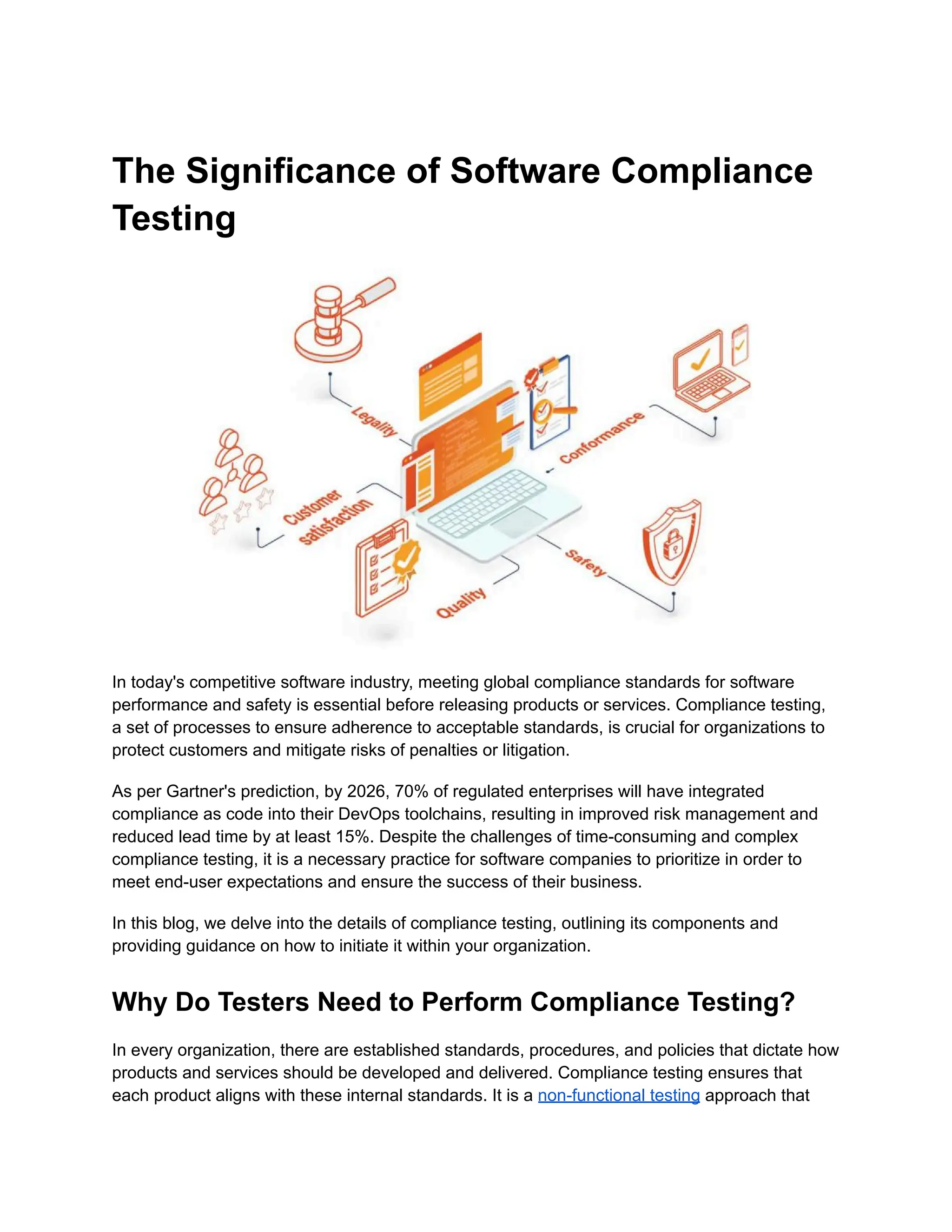
Organizations have compelling reasons to conduct compliance testing for their products and
services. Let's explore them below.
● Safety
Compliance testing is crucial for ensuring product safety in the market. It helps organizations
identify and address vulnerabilities that may have been overlooked due to shortcuts,
carelessness, or ignorance of safety measures.
● Quality
Compliance testing ensures product and service effectiveness, efficiency, and quality. Regular
audits are conducted to ensure satisfactory performance.
● Legality
Releasing a product or service into the market without meeting required testing standards would
violate the law.
● Customer satisfaction
Companies can safeguard their reputation, maintain customer trust, and ensure satisfaction by
conducting compliance testing.
● Conformance
Compliance with uniform standards ensures that products in the market are compatible and
aligned with other standard products.
How Are Standards Determined in Compliance Testing?
Compliance testing often relies on recognized standards established by professional bodies or
government agencies, which serve as reference points for many organizations. However,
companies also have the flexibility to develop their own standards to define the expected
performance of their products or services upon launch.
Professional bodies and regulatory agencies are critical in establishing standards that ensure
compliance in various industries. Some notable examples include:
3.
● World WideWeb Consortium (W3C) establishes standards for the development of HTML
and CSS code, which are widely used in website development.
● The General Data Protection Regulation (GDPR), which implements regulations to
protect against the misuse of personal data.
● The IEEE, or the Institute of Electrical and Electronics Engineers, is a reputable
organization that promotes and establishes standards in the domains of engineering and
technology.
● The Health Insurance Portability and Accountability Act—HIPAA is a comprehensive
legislation that sets forth standards aimed at safeguarding sensitive patient data within
the healthcare industry.
● The Consumer Financial Protection Bureau (CFPB), which regulates fair pricing from
banks, lenders, and other financial institutions.
What Are the Types of Compliance Testing That
Enterprises Need to Be Aware of?
Compliance testing is essential in the software testing life cycle, ensuring deliverable
compliance in each development phase. It can be conducted internally or externally by a
third-party organization.
Testing may be mandatory or optional, depending on the product and its requirements.
Testing Mandated by Law
● Conducted by external organizations or government-approved agencies.
● Certification obtained through this testing is required for legal operations.
● Failure in this test may result in actions such as retraction of government contracts,
fines, damages, public notifications, and reputational damage.
Testing Due to Other Obligations
● Mandatory compliance testing may be demanded by stakeholders, external
organizations, or the company's head office.
● Failure to meet the required standards may result in loss of business, reputational
damage, or potential lawsuits.
Testing Initiated Voluntarily
● Engage third-party organizations with authority to perform compliance testing.
● Invite them or establish contracts to ensure performance and obtain certifications.
Testing to Meet Internal Standards
4.
● Perform internaltesting for product, service, and process performance and efficiency.
● Crucial for ensuring smooth organizational function.
● Conducted as a cautionary measure in management.
Conducting Software Compliance Testing: A Step-by-Step
Guide
Developing and implementing compliance testing methodology varies based on regulations and
standards. Successful programs typically follow these steps:
Step 1: Building the Compliance Testing Requirements Repository
Consult with compliance experts to create a comprehensive requirements library that includes
specific rules and steps for ensuring compliance.
1. Map requirements to applicable business units and identify responsible employees or
departments.
2. Define compliance requirements and risks in clear language understandable to all
employees, avoiding legalese and technical jargon.
3. Identify existing controls and processes to mitigate compliance risks and identify gaps in
the compliance program.
4. Treat the requirements library as the primary source of information for compliance
requirements, controls, and testing.
5. Update the requirements library for changes in conditions, laws, or testing findings,
following strict policies and consulting with compliance experts before making changes.
Step 2: Assessing Compliance Risk
After establishing the requirements library, conducting a compliance risk assessment is crucial.
This involves defining the parameters of the assessment based on the requirements library and
identifying relevant data sources. Risks should be evaluated and prioritized, considering the
likelihood of compliance violations and their potential consequences for the company. Based on
this assessment, mitigating controls can be identified and prioritized for testing.
Step 3: Defining the Methodology of Compliance Testing
Next, you need to define your compliance testing methodology, which includes the following:
1. Purpose, scope, and objectives
2. Data collection methods
3. Issue management procedure
4. Compliance issue validation
5. Reporting requirements
5.
Communicate this methodologyto stakeholders and business units, and be prepared to modify
it as you improve your compliance program.
Step 4: Determining the Testing Schedule
To determine the frequency of your compliance testing, refer to your compliance risk
assessment. High-risk areas may require quarterly testing until all issues are resolved. Share
the testing schedule with relevant departments for preparation. Alternatively, consider
continuous testing with an automated compliance solution. This allows for immediate detection
and remediation of violations, preventing further drift from compliance and facilitating timely
resolution.
Step 5: Performing A Compliance Test
After developing your compliance testing methodology, communicate the testing schedule to all
business units and ensure they have adequate time to prepare. Document each step and
preserve evidence during the manual compliance test. Follow up on any identified issues to
validate their accuracy. Communicate your findings to relevant parties. For manual testing,
repeat this process as per the schedule. With automated testing, manually follow up on initial
findings and set up alerts or monitoring dashboards for future violations and remediations.
Step 6: Implementing Issue Management Procedure
In step 3, you would have defined your issue management procedure, and now it's time to
implement it. Assign any issues identified during the compliance test to the responsible parties,
and define the severity and priority of each violation. Ensure that the affected business units
document the underlying cause and remediation plan. Automated compliance testing can
streamline this process by automatically implementing these procedures as soon as a violation
is detected.
Step 7: Validating Issue Remediation
After completing the manual remediation process for identified issues, it is essential to validate
that the remediation plan has been effective. This may involve additional testing to provide
evidence of the successful resolution of individual violations. Even with an automated
compliance testing methodology, verifying the success of remediation efforts is recommended.
This can be done through email alerts or graphical dashboards to ensure stakeholders are
notified of violations found and remediated, providing visibility into the effectiveness of the
remediation process.
Step 8: Monitoring Compliance Sustainability
The severity of issues uncovered during manual compliance testing may require sustainability
monitoring to prevent reoccurrence. Automated compliance testing continuously monitors and
6.
notifies of violations,reducing human error. Automation is critical for effective compliance
management.
How HeadSpin Simplifies the Process of Ensuring
Software Compliance For Global Organizations
HeadSpin offers a data science-driven test automation platform for comprehensive software
testing, including functional, performance, load, and non-functional testing, with real-time KPI
monitoring for superior user experience.
HeadSpin is the preferred choice for comprehensive software testing due to its key features,
which include the following:
● CI/CD Integration for Automated App Testing
HeadSpin offers seamless CI/CD integration for automated app testing, supporting many open
test frameworks. With valuable insights into app performance regression, bug identification, and
faster time to market, HeadSpin is the top choice for comprehensive app testing.
● Secured Testing Platform
The HeadSpin Platform is SOC 2-compliant, certified in passive reconnaissance, automated
vulnerability scanning, and manual testing by a trusted third-party validator. This guarantees
exceptional security testing for global organizations.
● Global Testing
HeadSpin's extensive global device infrastructure enables comprehensive end-to-end testing on
real devices across 50+ locations worldwide, ensuring operational consistency for global
companies.
● AI-enabled Insights
HeadSpin's AI-powered engine evaluates user journeys, identifies performance issues, and
provides actionable insights to improve app performance. This unique feature empowers testers
to proactively fix customer-facing errors, perfecting the digital experience for enterprises.
Conclusion
Compliance testing is a critical type of non-functional testing that ensures the alignment of
software products with development processes and industry regulations. While functional testing
is widely recognized, non-functional testing, including compliance testing, is equally vital in
ensuring user satisfaction and mitigating risks associated with regulatory breaches. By
7.
documenting standards and,policies and correcting non-compliant areas, companies can
protect their organization, enhance profits, and build a reputable brand image as a trusted
developers.
Optimize software quality and security while ensuring regulatory compliance, with the advanced
capabilities of the HeadSpin Platform.
Article Source:
This article was originally published on:
https://www.headspin.io/blog/why-and-how-to-conduct-compliance-testing-on-software


![Compliance superpowers aws chicago meetup august 16, 2018 [public]](https://cdn.slidesharecdn.com/ss_thumbnails/compliancesuperpowers-awschicagomeetupaugust162018public-180817144322-thumbnail.jpg?width=640&height=640&fit=bounds)


