The Scaffolding Theory 
ANA JULIA EGAS 
TOPICS IN LINGUISTICS
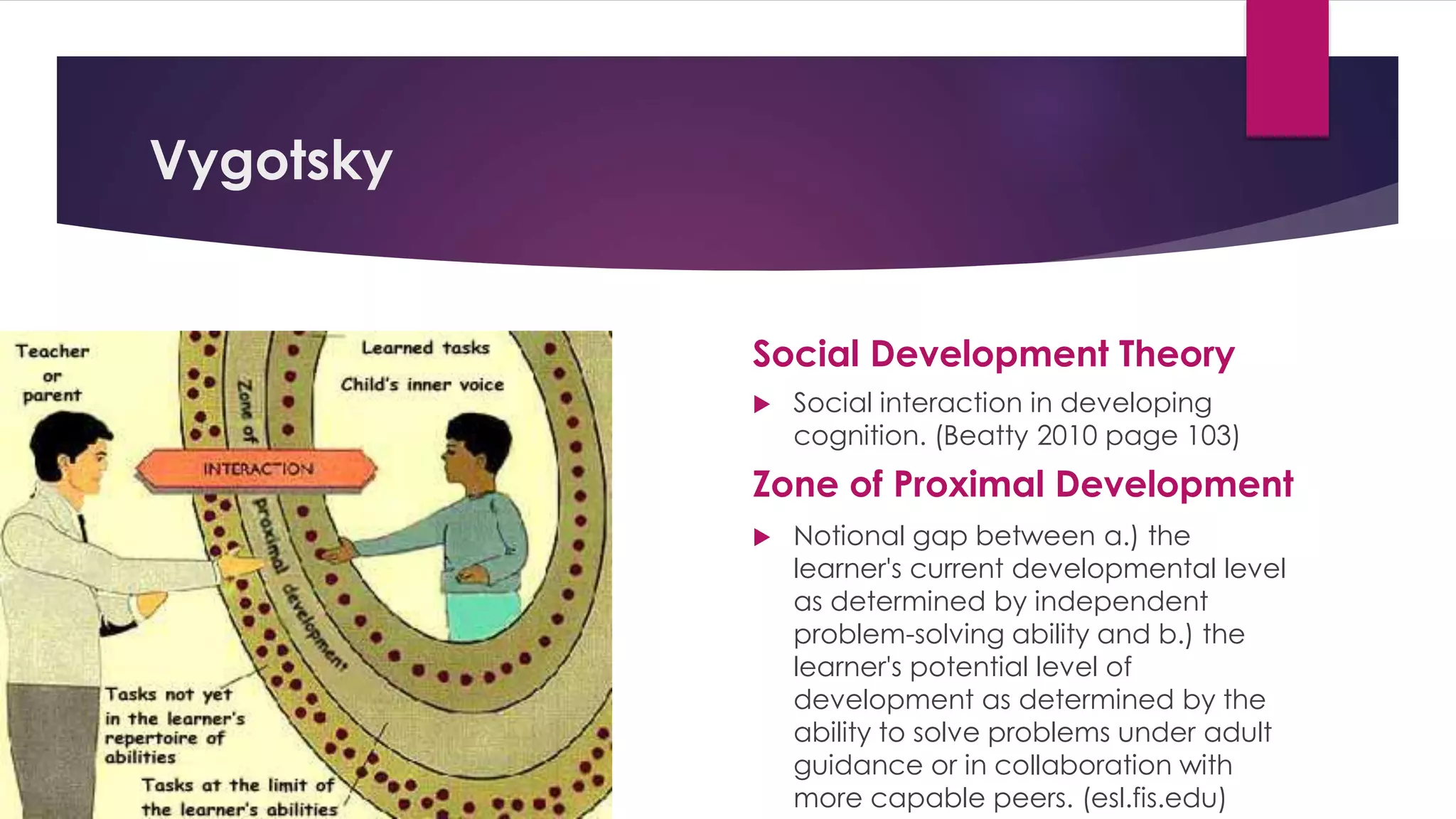
Vygotsky 
Social Development Theory 
 Social interaction in developing 
cognition. (Beatty 2010 page 103) 
Zone of Proximal Development 
 Notional gap between a.) the 
learner's current developmental level 
as determined by independent 
problem-solving ability and b.) the 
learner's potential level of 
development as determined by the 
ability to solve problems under adult 
guidance or in collaboration with 
more capable peers. (esl.fis.edu)
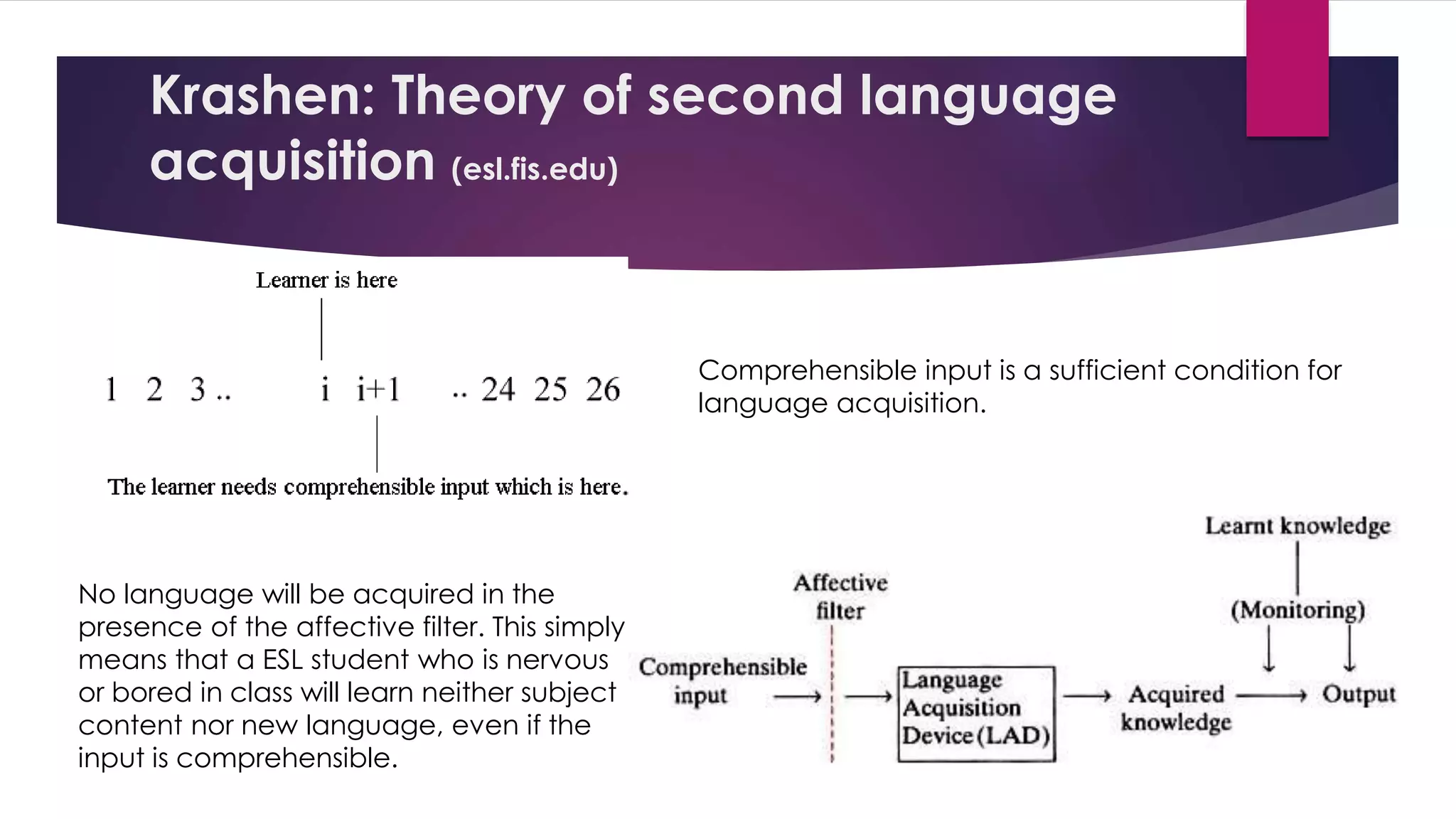
Krashen: Theory of second language 
acquisition (esl.fis.edu) 
Comprehensible input is a sufficient condition for 
language acquisition. 
No language will be acquired in the 
presence of the affective filter. This simply 
means that a ESL student who is nervous 
or bored in class will learn neither subject 
content nor new language, even if the 
input is comprehensible.
Bruner: Scaffolding (esl.fis.edu) 
 Jerome Bruner, researcher in cognitive and educational psychology, 
coined the term scaffolding as a description for the kind of assistance 
given by the teacher or more knowledgeable peer in providing 
comprehensible input and moving the learner into the zone of proximal 
development. 
 Scaffolding includes all the things that teachers do already when they 
predict the kinds of difficulty that the class or individual students in it will 
have with a given task. Typical examples are the activation of background 
knowledge at the beginning of the lesson or a brief review of key 
vocabulary at the end of it. The Writing Process is another prime example 
of scaffolding.
What is it? 
 Scaffolding is the language that an interlocutor uses to support the 
communicative success of another speaker. It may include the provision of 
missing vocabulary or the expansion of the speaker’s incomplete 
sentence. (Lightbrown and Spada 2011 Glossary 204s) 
 C. Chaudron “Scaffolding instruction is the provision through conversation 
of linguistics structures that promote a learner’s recognition or production 
or associated forms”.(Beatty 2010 Page 112) 
 In the field of education, the term scaffolding refers to a process in which 
teachers model or demonstrate the problem-solving process, then step 
back and offer support as needed. Psychologist and instructional designer 
Jerome Bruner first used the term 'scaffolding' back in the 1960s. 
(education-portal.com: Mary Firestone)
Theory 
 The theory is that when students are given the support they need early on when 
they're learning something new, they stand a better chance of using that 
material independently. Bruner recommends positive interaction and three 
modes of representation during teaching: actions, images, and symbols 
(language). (education-portal.com: Mary Firestone) 
 According to Bruner’s scaffolding theory, children are somewhat dependent on 
those who have more knowledge or competency than they do in certain 
areas, such as reading or calculating square roots, when they begin learning. 
As students gain more independence and confidence, the help from teachers 
and parents decreases until the students are independent learners, much as 
scaffolding used to support construction workers and their materials is removed 
as a building project nears completion. (wisegeek.org) 
 The paradigm or idea behind Bruner’s scaffolding theory can be used across all 
age and grade levels and across all subject areas. (wisegeek.org)
General Process 
(education-portal.com: Mary Firestone) 
 First, a teacher begins teaching at the level at which students understand, and then she 
builds on that understanding. She then presents the problem and thinks aloud as she 
goes about solving it. In the process, she shows how it's done by combining actions, 
images and language. She then does the following: 
 She repeats this process two more times, asking questions of the students along the way. 
 Each answer, right or wrong, receives a positive response from her, to encourage participation. 
 More students are asked to respond to the questions each time it is repeated. 
 Correction is provided as needed but reinforced positively. 
 When understanding appears to be achieved, students join her in solving a new problem. 
 Understanding is checked as they solve it. If more instruction is needed, more modeling is 
provided. 
 If students then demonstrate knowledge, she fades (steps away) and allows students to work 
independently, offering support as needed.
Scaffolding in education
Collaboration and negotiation of 
meaning (Beatty 2010 Page 112) 
 Ellis (1998) “Acquisition is promoted when the input to which learners are 
exposed is made comprehensible as a result of interactional modifications 
that arise from a communication breakdown- a process known as the 
negotiation of meaning” (Beatty 2010 page 86) 
 Stevens (1992) Conversation between: 
 Learners and peers 
 Learner and teacher 
 Learner and a computer 
 All three present opportunities for negotiation of meaning and SLA as a 
result of scaffolded instruction.
Ellis Six points to make scaffolded 
instruction successful (Beatty 2010 Page112) 
1. Recruiting interest in the task 
2. Simplifying the task 
3. Maintaining pursuit of the goal 
4. Marking critical features and discrepancies between what has been 
produced and the ideal solution 
5. Controlling frustrations during problem solving 
6. Demonstrating an idealized version of the act to be performed
Collaborative Scaffolding (Donato 1994) 
 Collaborative work among language learners provides the same 
opportunity for scaffolded help as in expert-novice relationships in the 
everyday setting. 
 During open-ended collaborative tasks, second language learners 
mutually construct a scaffold out of the discursive process of negotiating 
contexts of shared understanding, or what Rommetveit calls 
intersubjectivity. 
 Change of role of the teacher to a guide.
The importance of visual scaffolding 
for ESL students (esl.fis.edu) 
 ESL students are particularly dependent on scaffolding*, but often the 
purely oral scaffolding undertaken by the teacher is not enough. ESL 
students greatly benefit from the type of scaffolding that makes extensive 
use of visual aids – hence the term visual scaffolding. When students can 
see an image of what the teacher is describing or see the key words that 
the teacher is explaining, this not only serves to make the input 
considerably more comprehensible, but serves to remove the affective 
filter which results from the fear or boredom that comes of understanding 
very little in class. 
 The Smartboard and its software are excellent tools for the production and 
viewing of content that is both interesting and comprehensible.
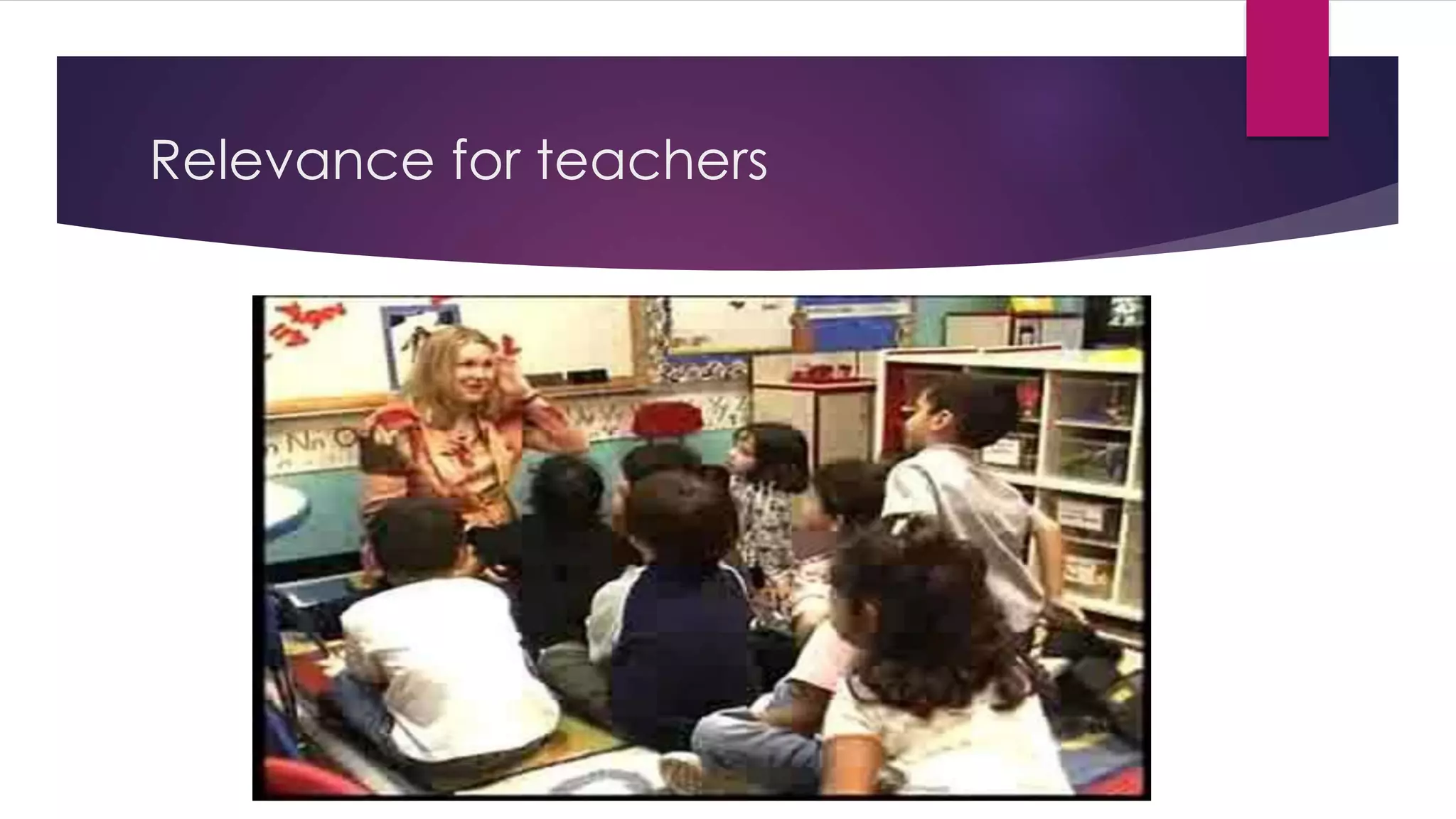
Relevance for teachers
Applications 
Jack C. Richards 
 USING TECHNOLOGY TO 
FACILITATE PEER-SUPPORTED 
LEARNING 
• Using Voicethread (Pontese and 
Shimamuzi) CPE Preparation 
• E-mediated tándem learning 
(Sasaki) 
 COLLABORATING ON OUT-OF-CLASS 
PROJECTS 
• A video documentary 
• Public service announcement 
video
Bibliography 
 Information 
 “Teaching and Researching computing-assited Language Learning” Ken Beatty (2010) 
 “How languages are learned” Lightbrown and Spada 3rd edition (2011) 
 “Learning English Beyond the Classroom” Jack C Richards 
 “Colective Scaffolding in Second Language Learnind” Donato, Richard (1994) 
 http://esl.fis.edu/teachers/fis/scaffold/page1.htm 
 http://education-portal.com/academy/lesson/scaffolding-in-education-definition-theory-examples.html#lesson 
 http://www.wisegeek.org/what-is-bruners-scaffolding-theory.htm 
 Images: 
 http://esl.fis.edu/teachers/fis/scaffold/page1.htm 
 Videos 
 https://www.youtube.com/watch?v=b1ZXJExy9eE 
 https://www.youtube.com/watch?v=ktXhlPUUPDs 
 https://www.youtube.com/watch?v=URpejW8E-kc 
 https://www.youtube.com/watch?v=lmJoOjLQM3U

The Scaffolding Theory

  • 1.
    The Scaffolding Theory ANA JULIA EGAS TOPICS IN LINGUISTICS
  • 2.
    Vygotsky Social DevelopmentTheory  Social interaction in developing cognition. (Beatty 2010 page 103) Zone of Proximal Development  Notional gap between a.) the learner's current developmental level as determined by independent problem-solving ability and b.) the learner's potential level of development as determined by the ability to solve problems under adult guidance or in collaboration with more capable peers. (esl.fis.edu)
  • 3.
    Krashen: Theory ofsecond language acquisition (esl.fis.edu) Comprehensible input is a sufficient condition for language acquisition. No language will be acquired in the presence of the affective filter. This simply means that a ESL student who is nervous or bored in class will learn neither subject content nor new language, even if the input is comprehensible.
  • 4.
    Bruner: Scaffolding (esl.fis.edu)  Jerome Bruner, researcher in cognitive and educational psychology, coined the term scaffolding as a description for the kind of assistance given by the teacher or more knowledgeable peer in providing comprehensible input and moving the learner into the zone of proximal development.  Scaffolding includes all the things that teachers do already when they predict the kinds of difficulty that the class or individual students in it will have with a given task. Typical examples are the activation of background knowledge at the beginning of the lesson or a brief review of key vocabulary at the end of it. The Writing Process is another prime example of scaffolding.
  • 5.
    What is it?  Scaffolding is the language that an interlocutor uses to support the communicative success of another speaker. It may include the provision of missing vocabulary or the expansion of the speaker’s incomplete sentence. (Lightbrown and Spada 2011 Glossary 204s)  C. Chaudron “Scaffolding instruction is the provision through conversation of linguistics structures that promote a learner’s recognition or production or associated forms”.(Beatty 2010 Page 112)  In the field of education, the term scaffolding refers to a process in which teachers model or demonstrate the problem-solving process, then step back and offer support as needed. Psychologist and instructional designer Jerome Bruner first used the term 'scaffolding' back in the 1960s. (education-portal.com: Mary Firestone)
  • 6.
    Theory  Thetheory is that when students are given the support they need early on when they're learning something new, they stand a better chance of using that material independently. Bruner recommends positive interaction and three modes of representation during teaching: actions, images, and symbols (language). (education-portal.com: Mary Firestone)  According to Bruner’s scaffolding theory, children are somewhat dependent on those who have more knowledge or competency than they do in certain areas, such as reading or calculating square roots, when they begin learning. As students gain more independence and confidence, the help from teachers and parents decreases until the students are independent learners, much as scaffolding used to support construction workers and their materials is removed as a building project nears completion. (wisegeek.org)  The paradigm or idea behind Bruner’s scaffolding theory can be used across all age and grade levels and across all subject areas. (wisegeek.org)
  • 7.
    General Process (education-portal.com:Mary Firestone)  First, a teacher begins teaching at the level at which students understand, and then she builds on that understanding. She then presents the problem and thinks aloud as she goes about solving it. In the process, she shows how it's done by combining actions, images and language. She then does the following:  She repeats this process two more times, asking questions of the students along the way.  Each answer, right or wrong, receives a positive response from her, to encourage participation.  More students are asked to respond to the questions each time it is repeated.  Correction is provided as needed but reinforced positively.  When understanding appears to be achieved, students join her in solving a new problem.  Understanding is checked as they solve it. If more instruction is needed, more modeling is provided.  If students then demonstrate knowledge, she fades (steps away) and allows students to work independently, offering support as needed.
  • 8.
  • 9.
    Collaboration and negotiationof meaning (Beatty 2010 Page 112)  Ellis (1998) “Acquisition is promoted when the input to which learners are exposed is made comprehensible as a result of interactional modifications that arise from a communication breakdown- a process known as the negotiation of meaning” (Beatty 2010 page 86)  Stevens (1992) Conversation between:  Learners and peers  Learner and teacher  Learner and a computer  All three present opportunities for negotiation of meaning and SLA as a result of scaffolded instruction.
  • 10.
    Ellis Six pointsto make scaffolded instruction successful (Beatty 2010 Page112) 1. Recruiting interest in the task 2. Simplifying the task 3. Maintaining pursuit of the goal 4. Marking critical features and discrepancies between what has been produced and the ideal solution 5. Controlling frustrations during problem solving 6. Demonstrating an idealized version of the act to be performed
  • 11.
    Collaborative Scaffolding (Donato1994)  Collaborative work among language learners provides the same opportunity for scaffolded help as in expert-novice relationships in the everyday setting.  During open-ended collaborative tasks, second language learners mutually construct a scaffold out of the discursive process of negotiating contexts of shared understanding, or what Rommetveit calls intersubjectivity.  Change of role of the teacher to a guide.
  • 12.
    The importance ofvisual scaffolding for ESL students (esl.fis.edu)  ESL students are particularly dependent on scaffolding*, but often the purely oral scaffolding undertaken by the teacher is not enough. ESL students greatly benefit from the type of scaffolding that makes extensive use of visual aids – hence the term visual scaffolding. When students can see an image of what the teacher is describing or see the key words that the teacher is explaining, this not only serves to make the input considerably more comprehensible, but serves to remove the affective filter which results from the fear or boredom that comes of understanding very little in class.  The Smartboard and its software are excellent tools for the production and viewing of content that is both interesting and comprehensible.
  • 13.
  • 14.
  • 15.
    Applications Jack C.Richards  USING TECHNOLOGY TO FACILITATE PEER-SUPPORTED LEARNING • Using Voicethread (Pontese and Shimamuzi) CPE Preparation • E-mediated tándem learning (Sasaki)  COLLABORATING ON OUT-OF-CLASS PROJECTS • A video documentary • Public service announcement video
  • 16.
    Bibliography  Information  “Teaching and Researching computing-assited Language Learning” Ken Beatty (2010)  “How languages are learned” Lightbrown and Spada 3rd edition (2011)  “Learning English Beyond the Classroom” Jack C Richards  “Colective Scaffolding in Second Language Learnind” Donato, Richard (1994)  http://esl.fis.edu/teachers/fis/scaffold/page1.htm  http://education-portal.com/academy/lesson/scaffolding-in-education-definition-theory-examples.html#lesson  http://www.wisegeek.org/what-is-bruners-scaffolding-theory.htm  Images:  http://esl.fis.edu/teachers/fis/scaffold/page1.htm  Videos  https://www.youtube.com/watch?v=b1ZXJExy9eE  https://www.youtube.com/watch?v=ktXhlPUUPDs  https://www.youtube.com/watch?v=URpejW8E-kc  https://www.youtube.com/watch?v=lmJoOjLQM3U