Transformations of scaffolding metaphor
in socio-technical systems
Kai Pata
Associated professor of adult and informal learning
School of Educational Sciences, Tallinn University
Erno Lehtinen Online Colloquium, February, 2nd, 2022
The topic of my talk
How has scaffolding concept changed as
learning moved from natural to digitally mediated
and hybrid forms?
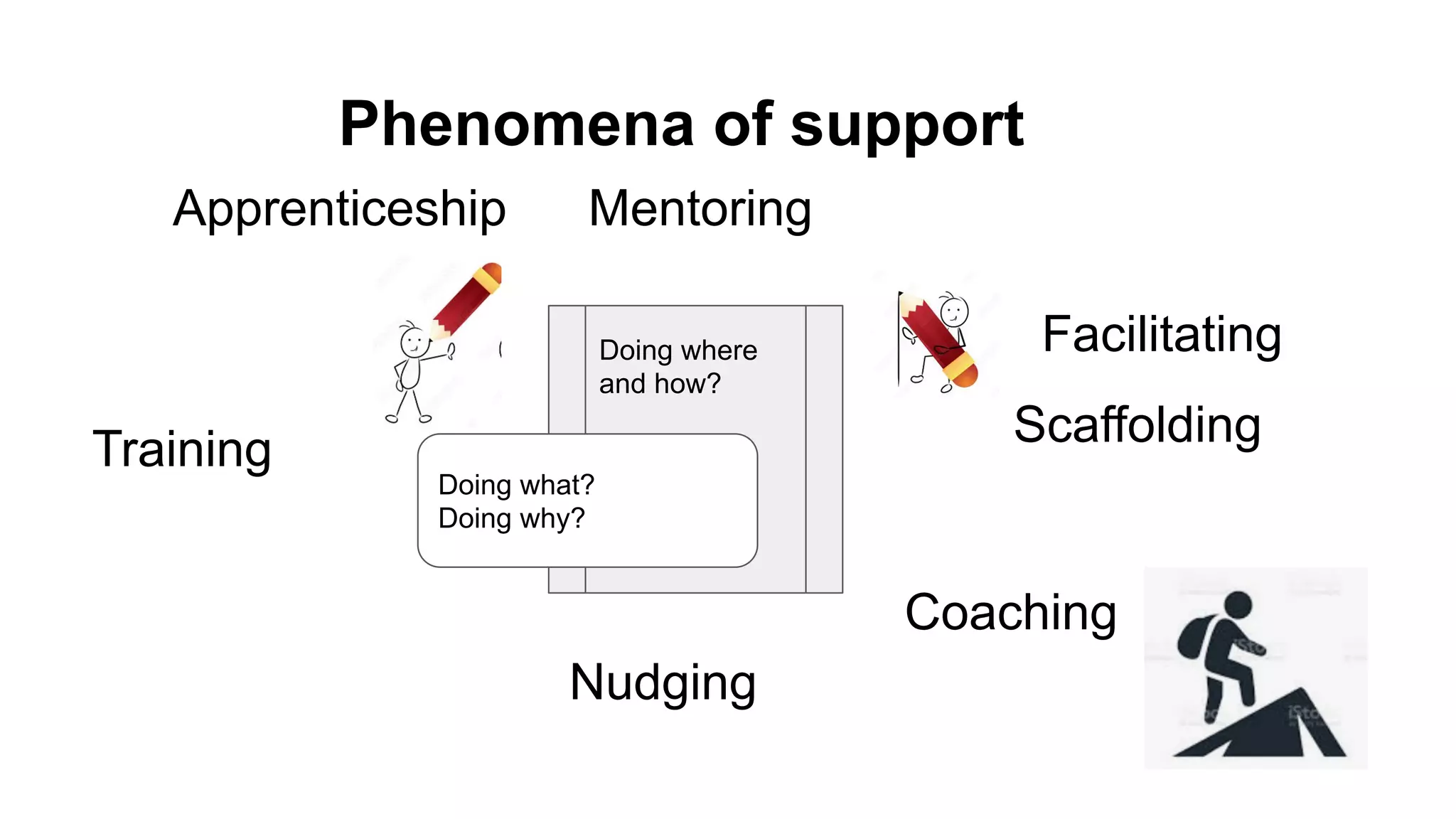
Doing where
and how?
Phenomena of support
Training
Mentoring
Scaffolding
Nudging
Coaching
Facilitating
Apprenticeship
Doing what?
Doing why?
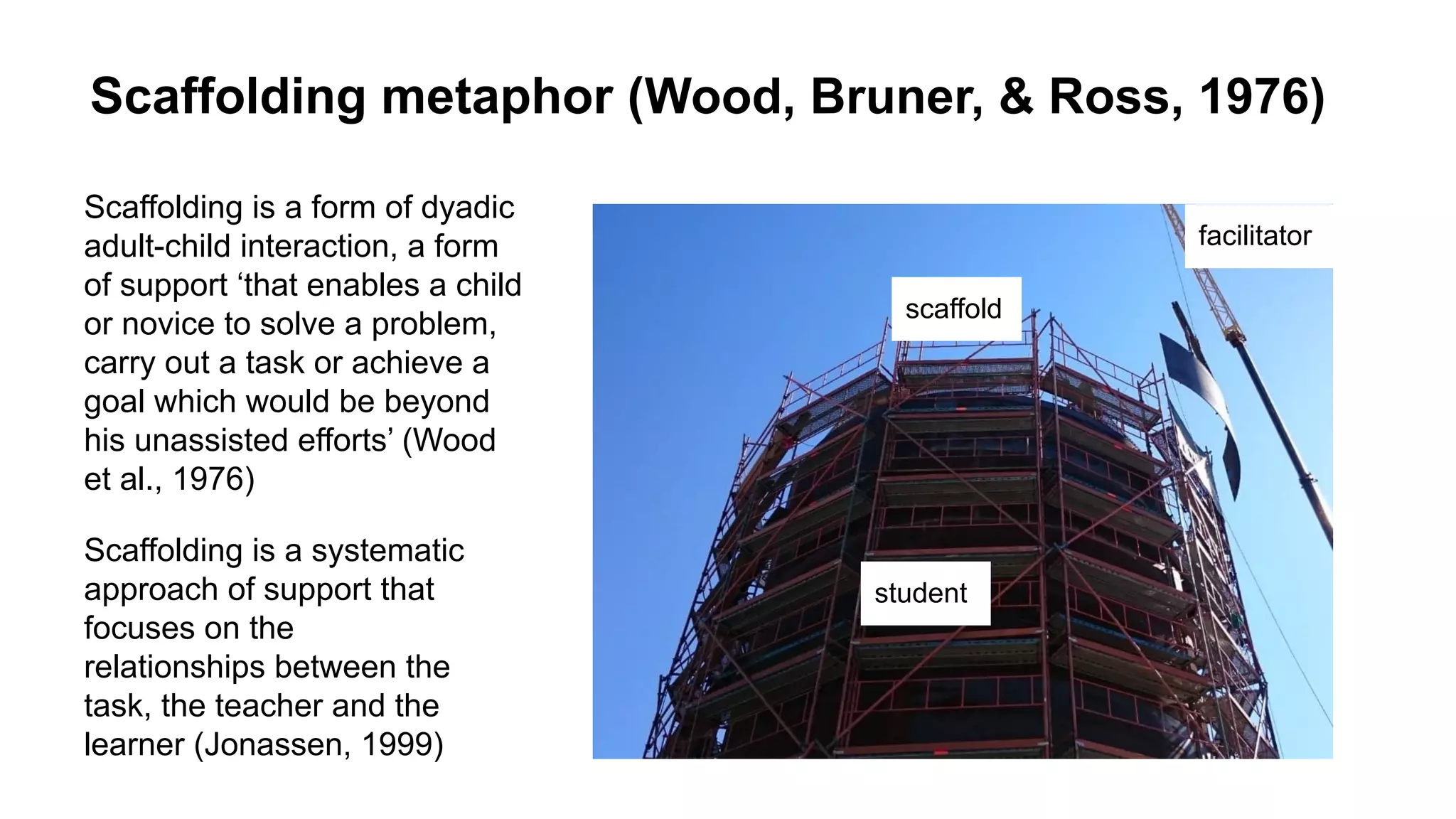
Scaffolding metaphor (Wood, Bruner, & Ross, 1976)
Scaffolding is a systematic
approach of support that
focuses on the
relationships between the
task, the teacher and the
learner (Jonassen, 1999)
Scaffolding is a form of dyadic
adult-child interaction, a form
of support ‘that enables a child
or novice to solve a problem,
carry out a task or achieve a
goal which would be beyond
his unassisted efforts’ (Wood
et al., 1976)
scaffold
facilitator
student
Scaffolding in dialogic situations
The metaphor of scaffolding (Wood, Bruner, & Ross, 1976) is used to illustrate the effective
supportive processes that enable the learners to solve a problem, carry out a task, or achieve a
goal that would be beyond their unassisted efforts.
Scaffolding is:
‘‘providing support at the right level of the current skill while a student is carrying out the task and
then gradually fading out of assistance’’ (Järvelä, 1995)
‘‘providing assistance to students on an as-needed basis with fading out of assistance as the
competence increases’’ (Pressley, Hogan, Wharton-McDonald, Mistretta, & Ettenberger, 1996)
According to the concept of the zone of proximal development (Vygotsky, 1978), scaffolding
helps to decrease the distance between students’ actual developmental level, as determined
by independent problem solving, and the level of their potential development as determined
through problem solving under adult or peer guidance.
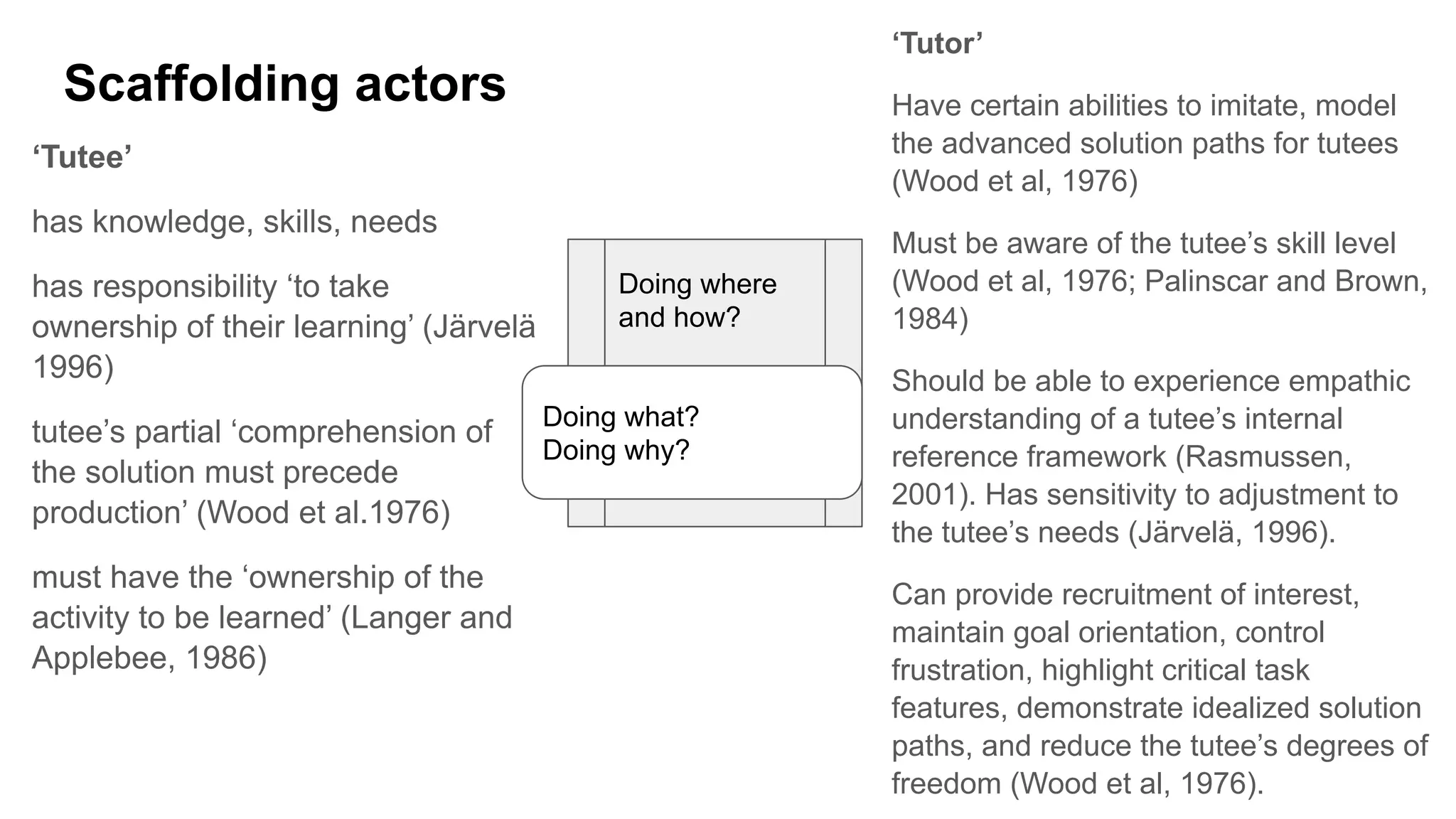
Scaffolding actors
‘Tutee’
has knowledge, skills, needs
has responsibility ‘to take
ownership of their learning’ (Järvelä
1996)
tutee’s partial ‘comprehension of
the solution must precede
production’ (Wood et al.1976)
must have the ‘ownership of the
activity to be learned’ (Langer and
Applebee, 1986)
‘Tutor’
Have certain abilities to imitate, model
the advanced solution paths for tutees
(Wood et al, 1976)
Must be aware of the tutee’s skill level
(Wood et al, 1976; Palinscar and Brown,
1984)
Should be able to experience empathic
understanding of a tutee’s internal
reference framework (Rasmussen,
2001). Has sensitivity to adjustment to
the tutee’s needs (Järvelä, 1996).
Can provide recruitment of interest,
maintain goal orientation, control
frustration, highlight critical task
features, demonstrate idealized solution
paths, and reduce the tutee’s degrees of
freedom (Wood et al, 1976).
Doing where
and how?
Doing what?
Doing why?
Scaffolding process
The ‘scaffolding process’
● The tutees must be actively involved and enforced to participate in turn taking with the
tutor (Palinscar & Brown, 1984; Järvelä, 1995; Vauras et al., 1993).
● Actors must have a mutual understanding of each other’s intentions and the way the goal is
conceptualized (Fleer 1992)
● Delicate negotiation processes (Merrill et al., 1995)
● Not the completion of the task must be scaffolded but the understanding of the tutee how
to conceptualize the task through the proper steps of action (Stone, 1998).
● Is increasing the tutee’s growing appreciation of the new procedure (Stone, 1998).
● Tutee’s ‘internalization’ will be evoked, that is based not the adult’s situation definition, but the
jointly elaborated situation definition of two actors (Langer & Applebee, 1986; Elbers et
al., 1992)
● Tutor provides the support at the right level of skill, which comprises the teacher’s sensitive
regulation on the basis of the students’ interactions, and fading out of assistance when
students’ competence increases (Järvelä, 1995; Pressley et al.,1996)
Scaffolding situation
The ‘scaffolding situation’
● Influences the interchange with specific features and captures the ‘who, what, where,
when, and why of an event’ (Tharp & Gallimore, 1988)
● Takes place in a certain context, with the culture of the particular community (Rogoff,
1990)
● The tutee interprets any communal moves in the activity context (Tharp & Gallimore,
1988)
● Only if the scaffolding activity is goal-embedded motivation will be provided Palinscar
and Brown (1984)
● Activity context influences the extent of tutee’s affective engagement in the task and the
interpersonal exchange.
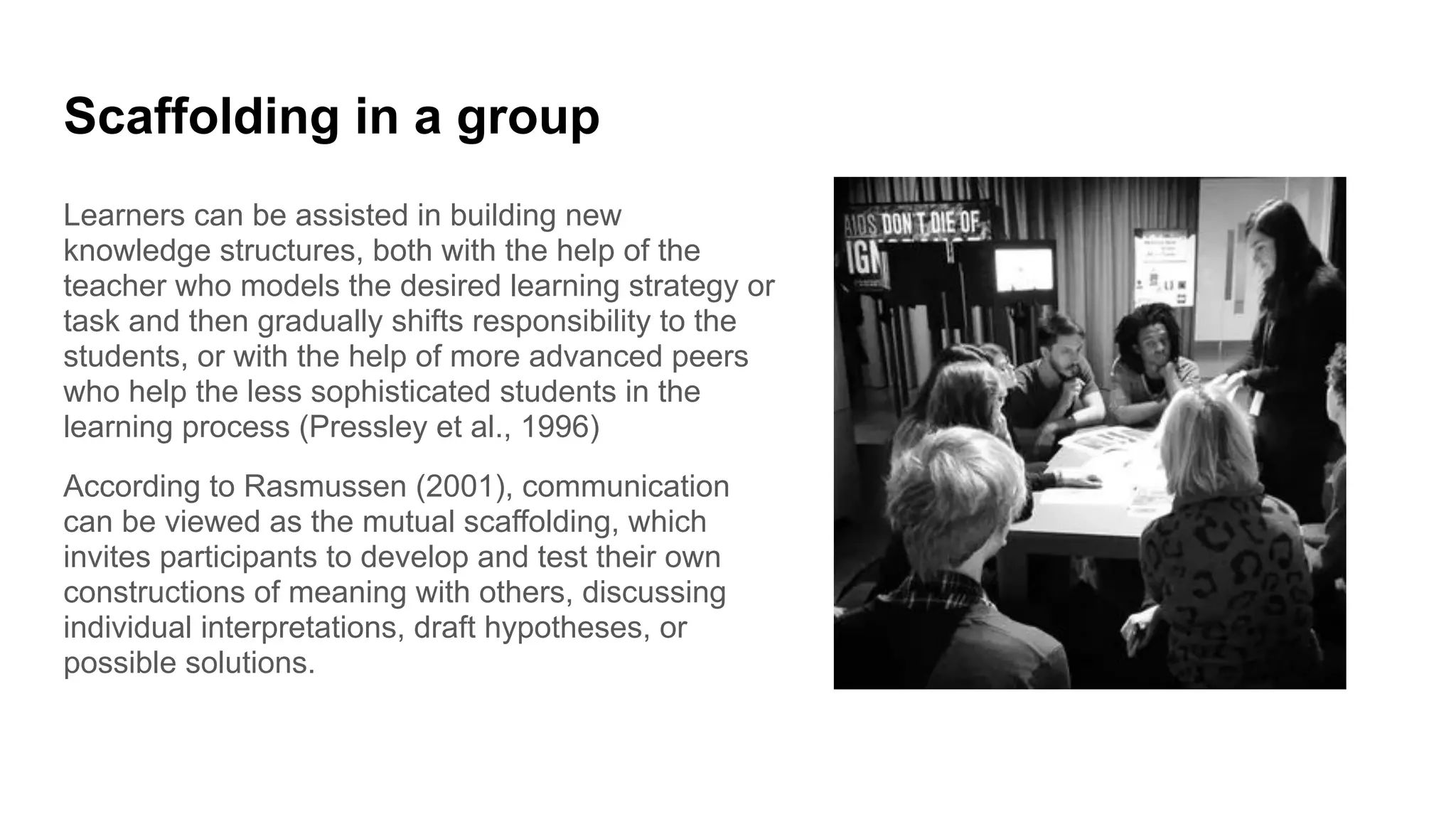
Scaffolding in a group
Learners can be assisted in building new
knowledge structures, both with the help of the
teacher who models the desired learning strategy or
task and then gradually shifts responsibility to the
students, or with the help of more advanced peers
who help the less sophisticated students in the
learning process (Pressley et al., 1996)
According to Rasmussen (2001), communication
can be viewed as the mutual scaffolding, which
invites participants to develop and test their own
constructions of meaning with others, discussing
individual interpretations, draft hypotheses, or
possible solutions.
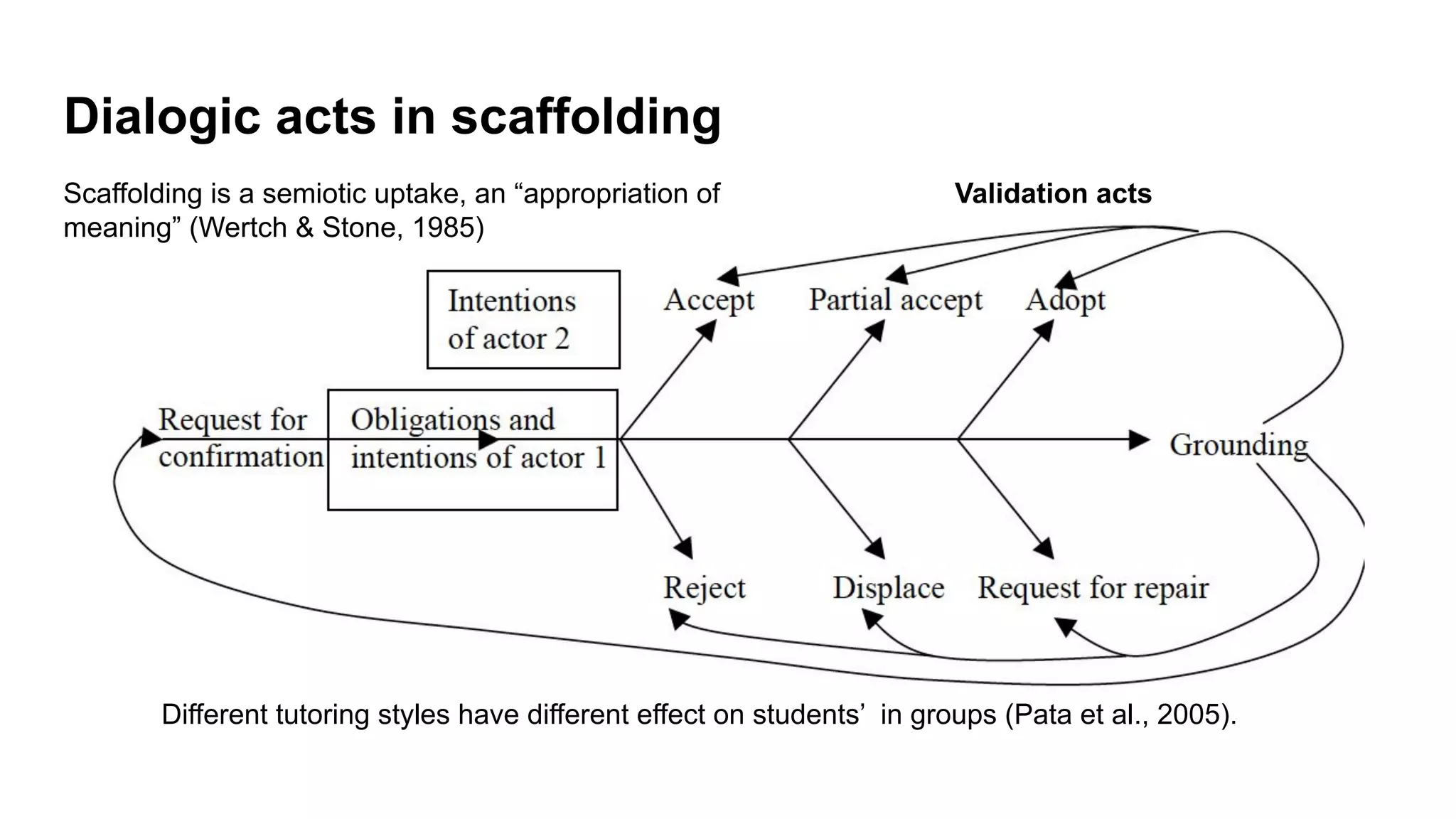
Dialogic acts in scaffolding
Different tutoring styles have different effect on students’ in groups (Pata et al., 2005).
Validation acts
Scaffolding is a semiotic uptake, an “appropriation of
meaning” (Wertch & Stone, 1985)
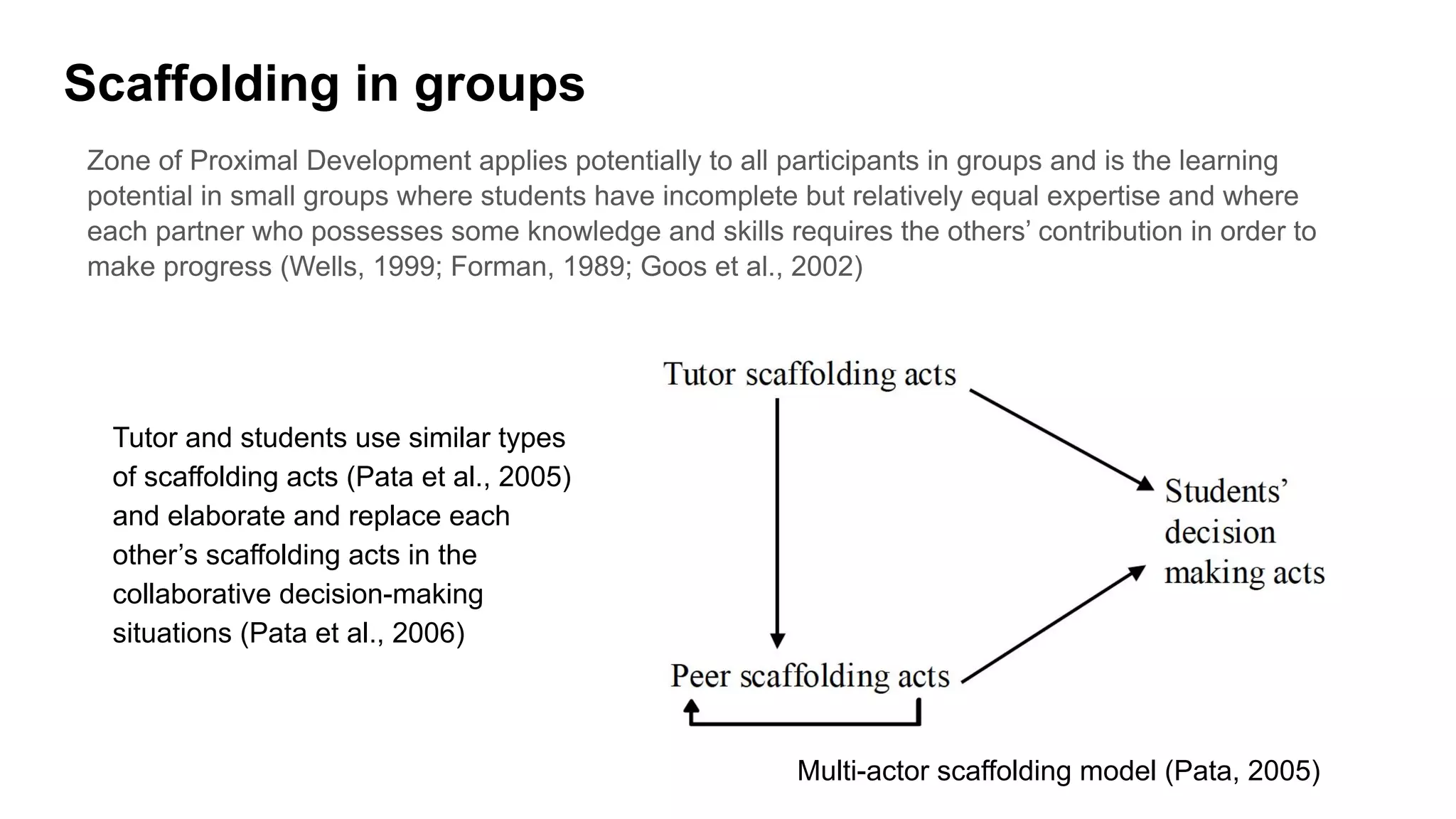
Scaffolding in groups
Zone of Proximal Development applies potentially to all participants in groups and is the learning
potential in small groups where students have incomplete but relatively equal expertise and where
each partner who possesses some knowledge and skills requires the others’ contribution in order to
make progress (Wells, 1999; Forman, 1989; Goos et al., 2002)
Tutor and students use similar types
of scaffolding acts (Pata et al., 2005)
and elaborate and replace each
other’s scaffolding acts in the
collaborative decision-making
situations (Pata et al., 2006)
Multi-actor scaffolding model (Pata, 2005)
Technology mediated scaffolding
In technology mediated scaffolding situations the technology can preserve the
dialogic (between agents) and trialogic acts (agents’ interactions with artifacts)
● In real time - in chatlog, on the ‘wall’, (and preserved by algorithm)
● Asynchronously - as a logfile, as a production history with artifact or variations
of artifacts accumulated in the system
Technology functionalities may replace some of the dialogic acts: with likes, stars,
emoticons
Scaffolding acts act as dynamic signals, for mutual interaction (like in flocks)
Scaffolding acts may accumulate in the environment in the form of collective
phenomena (e.g. trust) and grow or dissipate in time as other communicative acts
(like signal traits of ants)
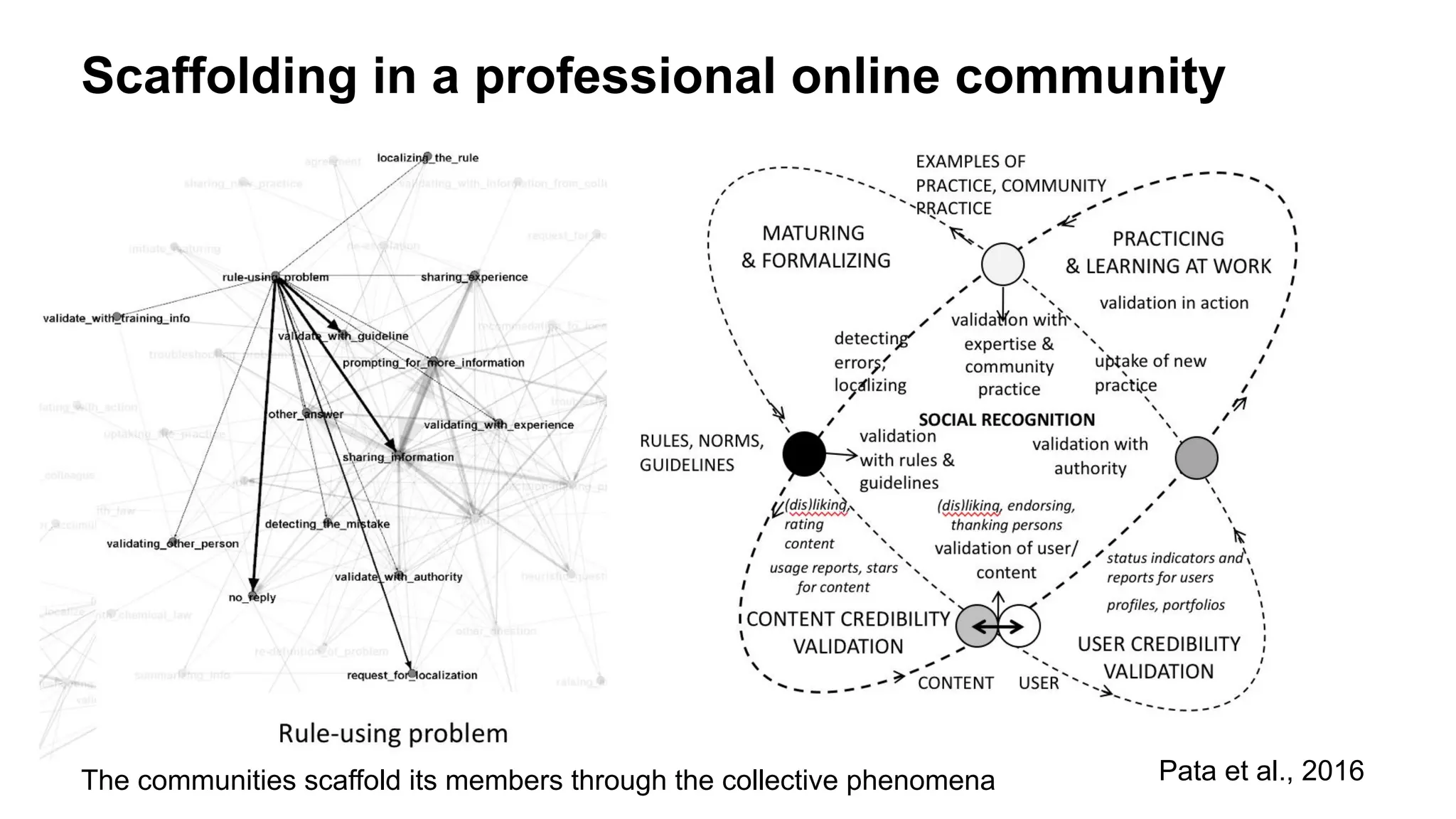
Scaffolding in a professional online community
Pata et al., 2016
The communities scaffold its members through the collective phenomena
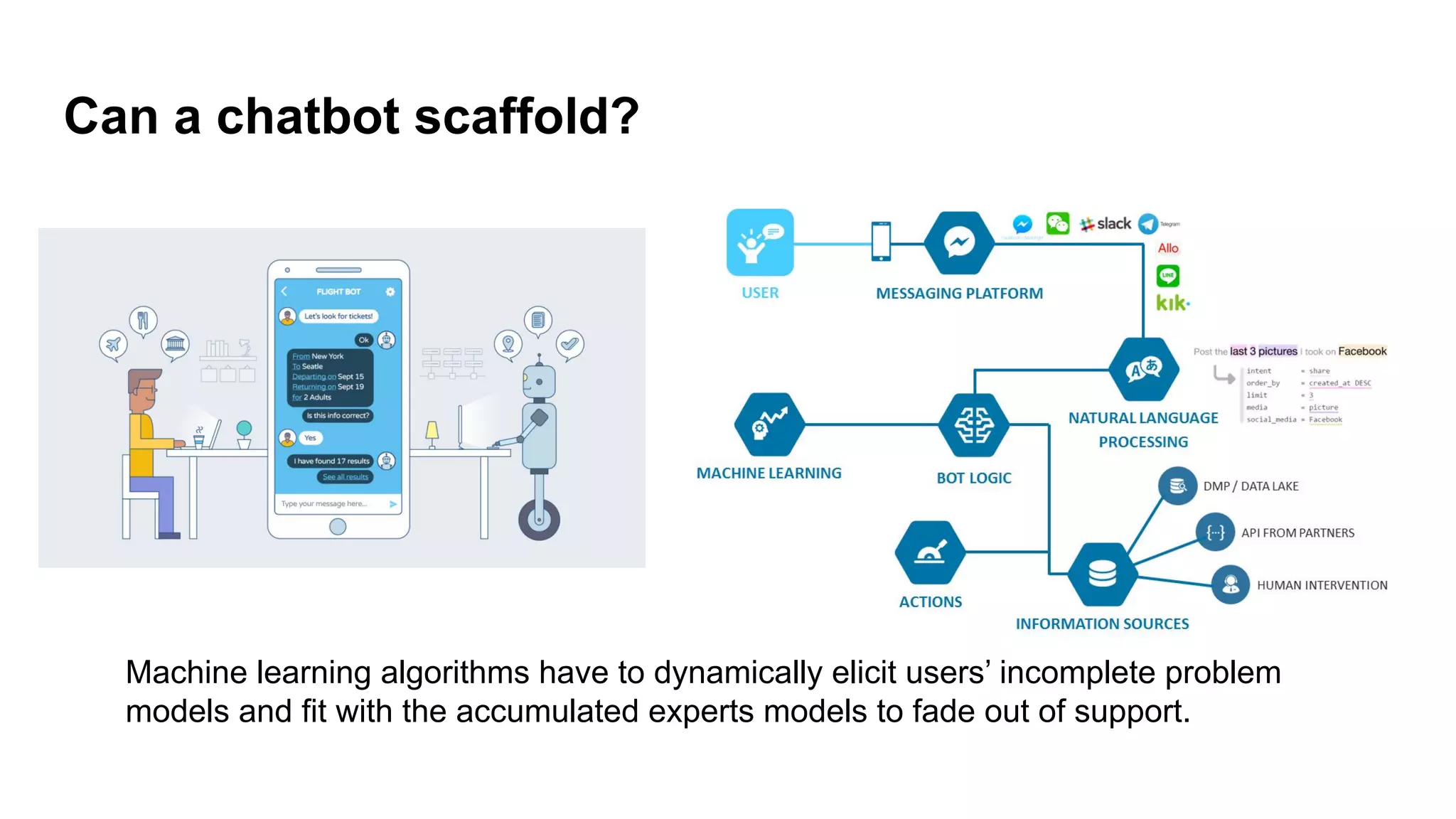
Can a chatbot scaffold?
Machine learning algorithms have to dynamically elicit users’ incomplete problem
models and fit with the accumulated experts models to fade out of support.
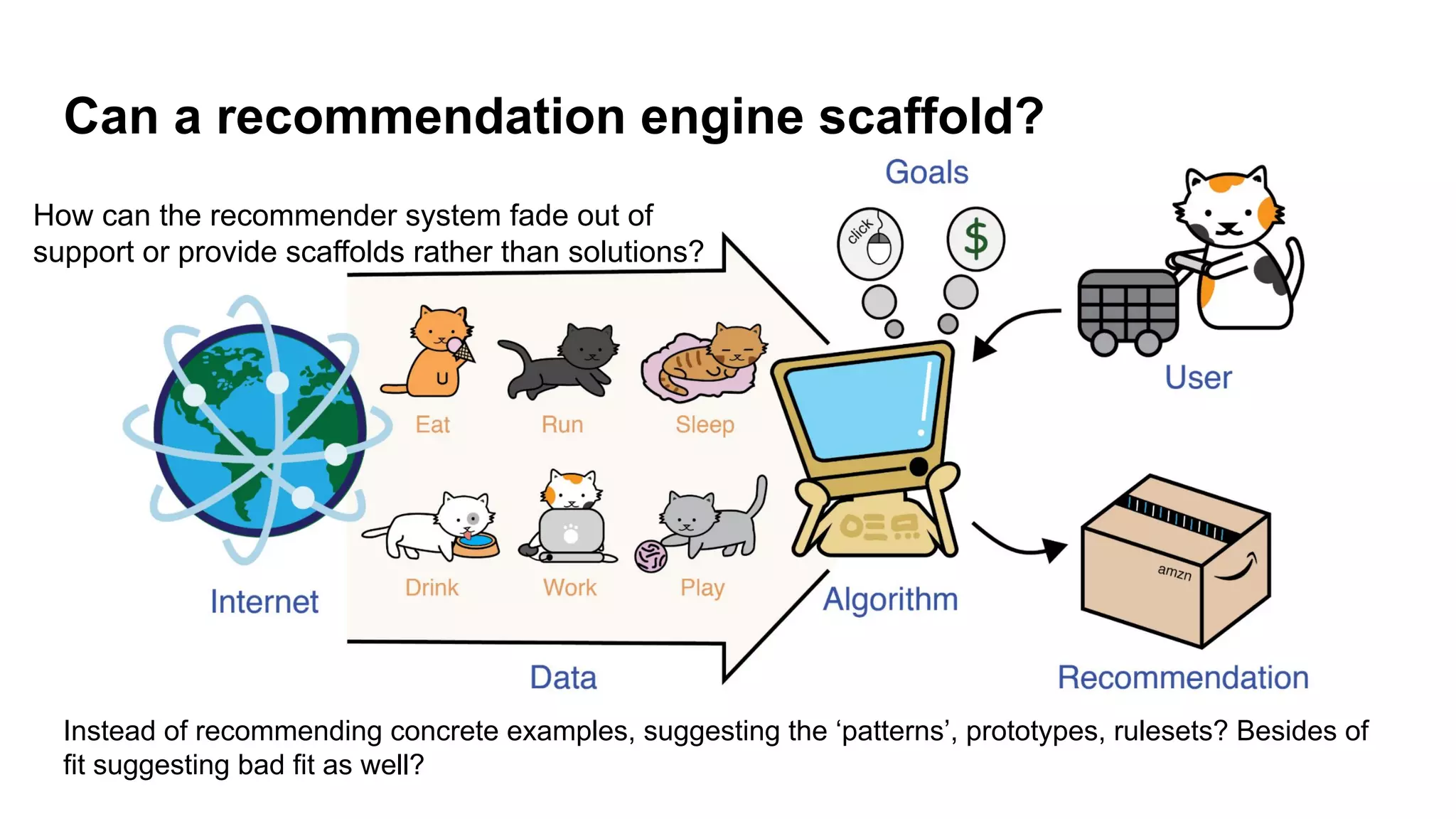
Can a recommendation engine scaffold?
How can the recommender system fade out of
support or provide scaffolds rather than solutions?
Instead of recommending concrete examples, suggesting the ‘patterns’, prototypes, rulesets? Besides of
fit suggesting bad fit as well?
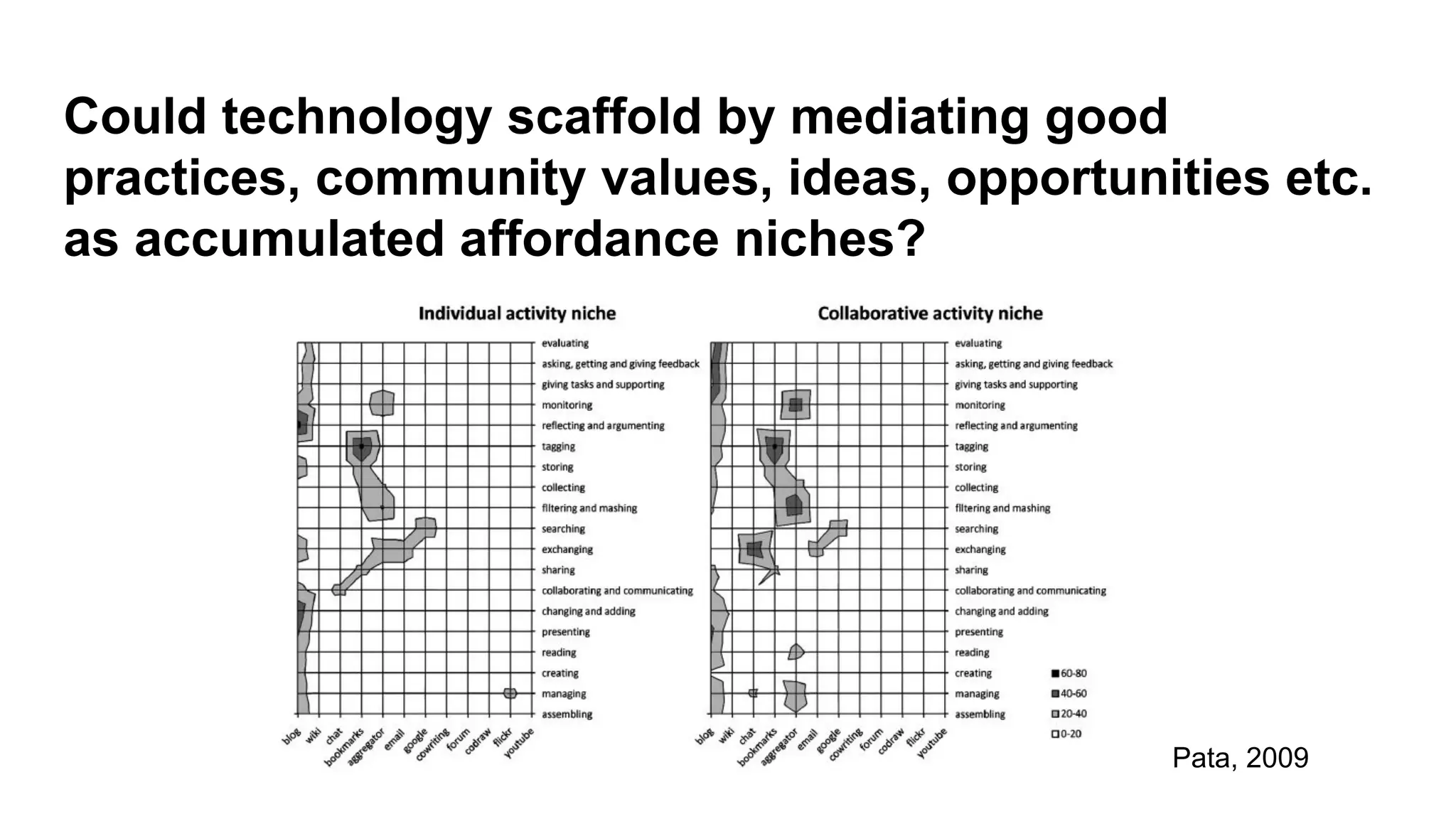
Could technology scaffold by mediating good
practices, community values, ideas, opportunities etc.
as accumulated affordance niches?
Pata, 2009
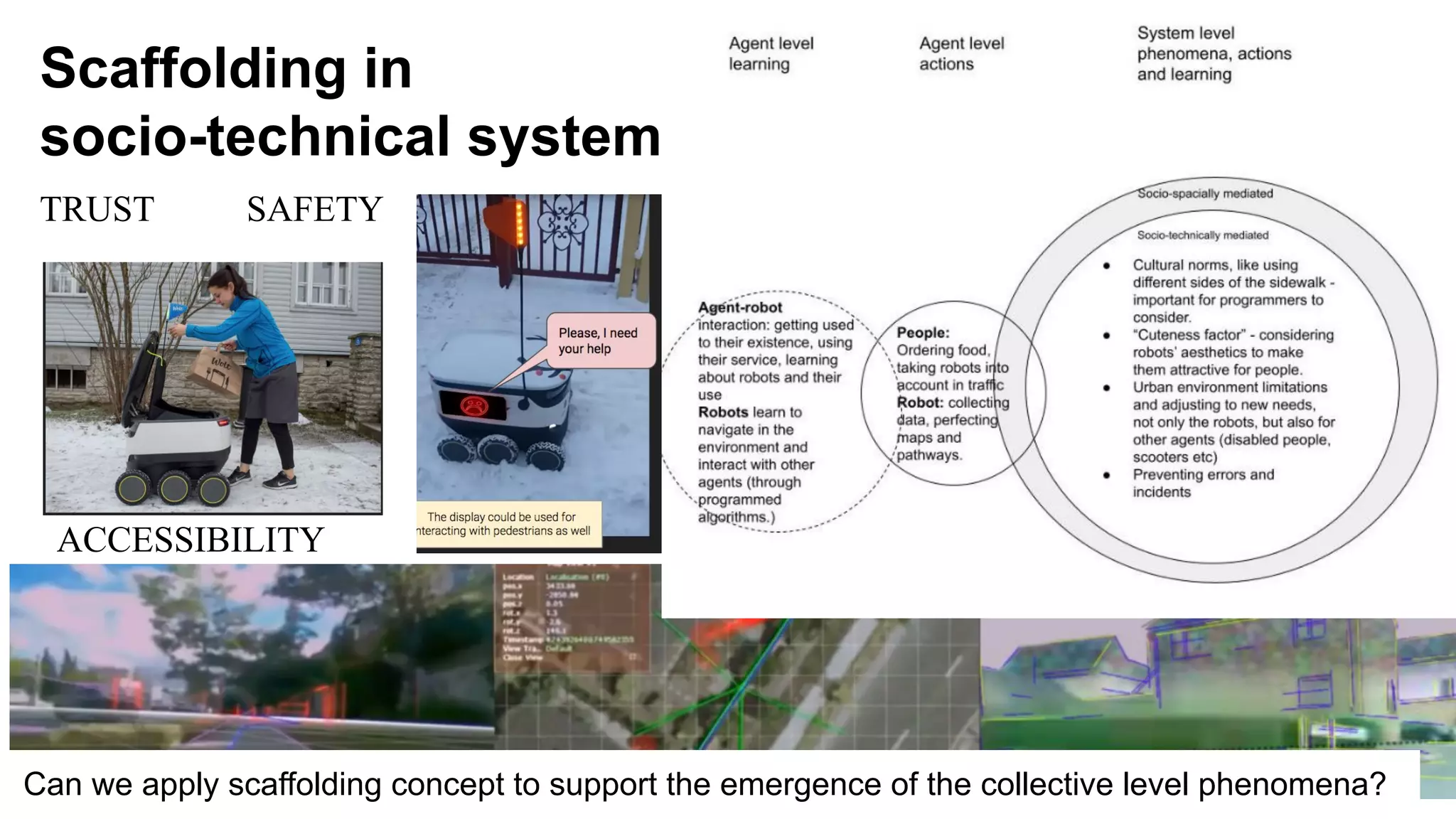
Scaffolding in
socio-technical systems
TRUST SAFETY
ACCESSIBILITY
Can we apply scaffolding concept to support the emergence of the collective level phenomena?
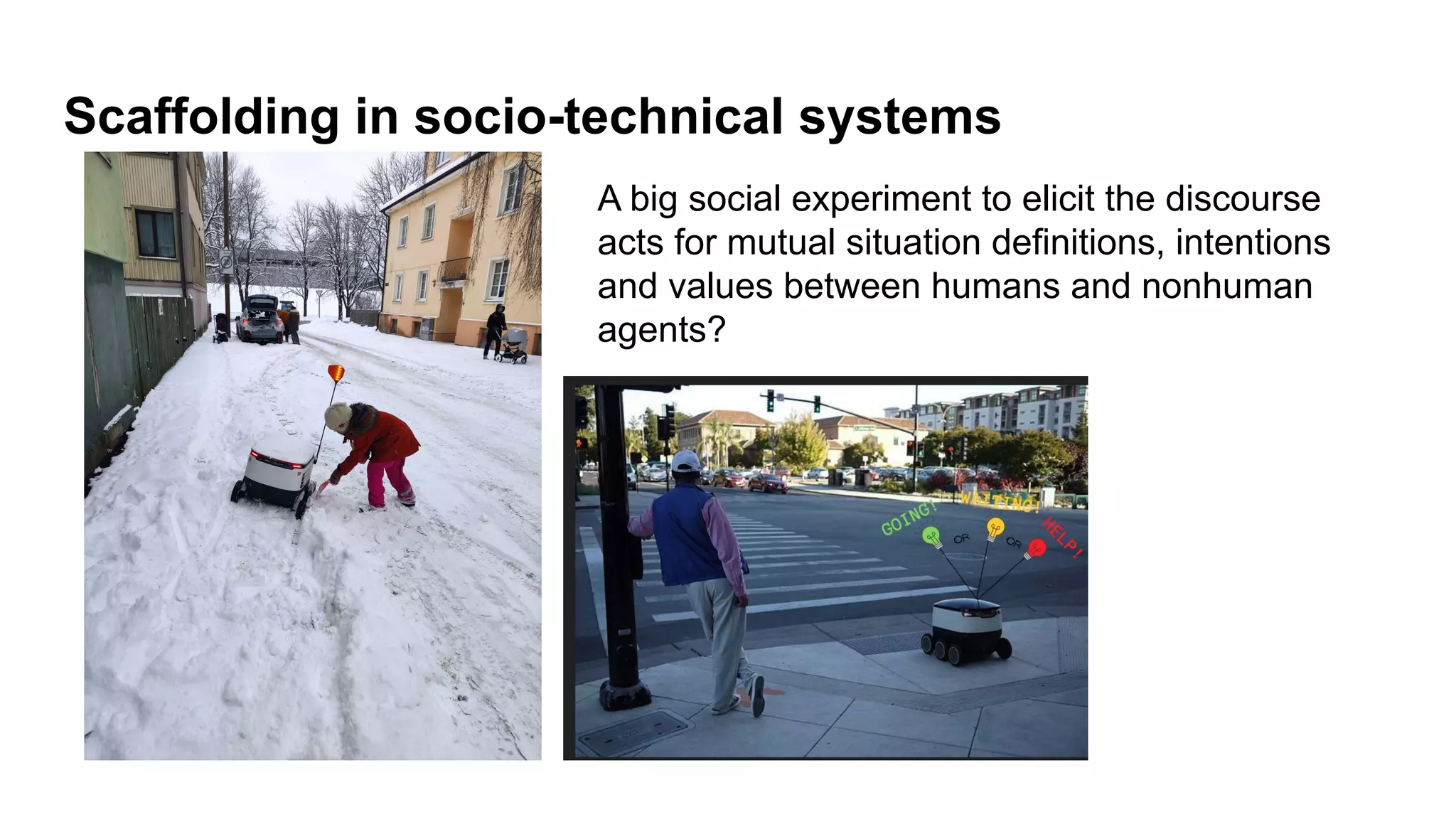
Scaffolding in socio-technical systems
A big social experiment to elicit the discourse
acts for mutual situation definitions, intentions
and values between humans and nonhuman
agents?
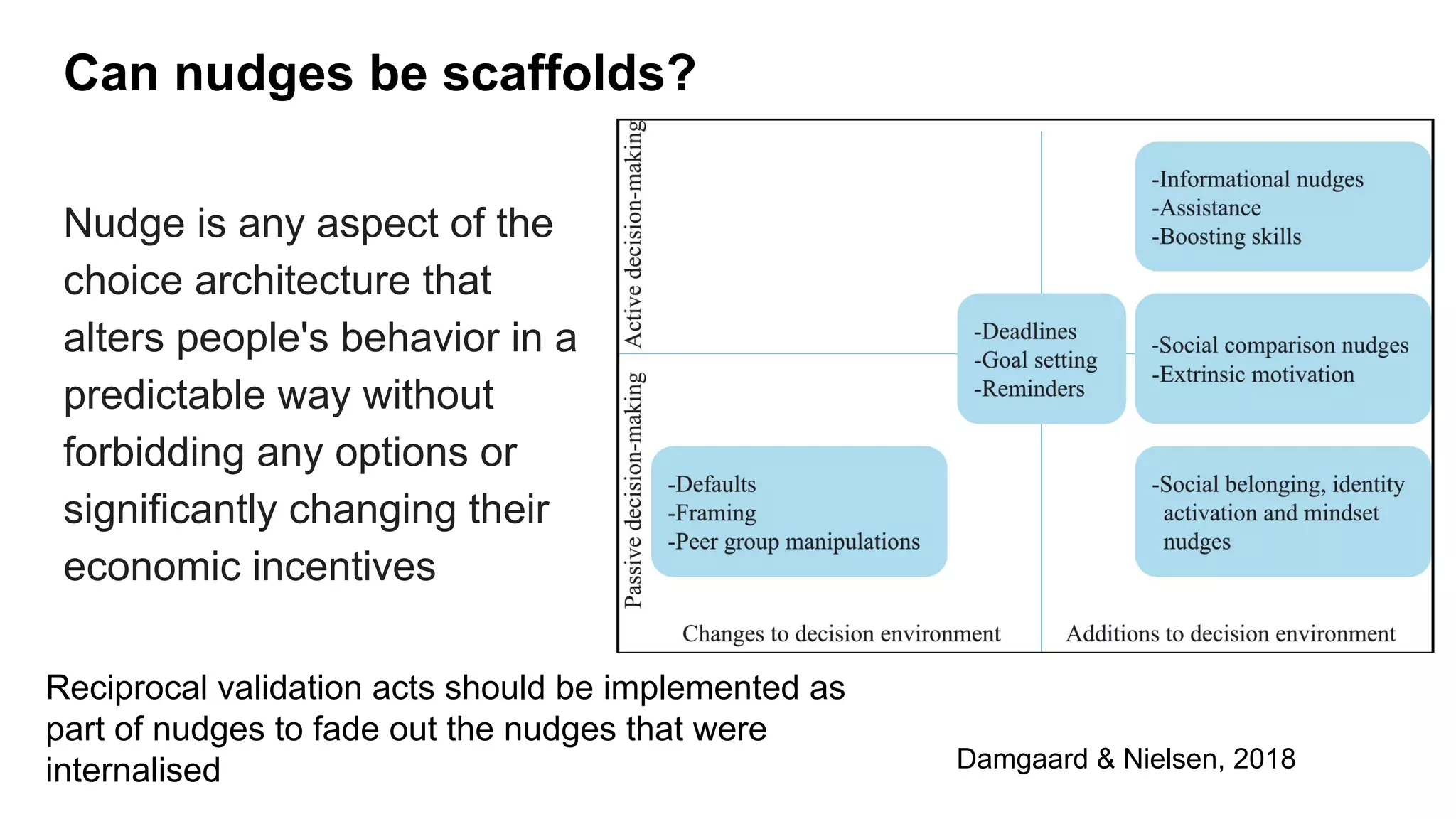
Can nudges be scaffolds?
Nudge is any aspect of the
choice architecture that
alters people's behavior in a
predictable way without
forbidding any options or
significantly changing their
economic incentives
Damgaard & Nielsen, 2018
Reciprocal validation acts should be implemented as
part of nudges to fade out the nudges that were
internalised
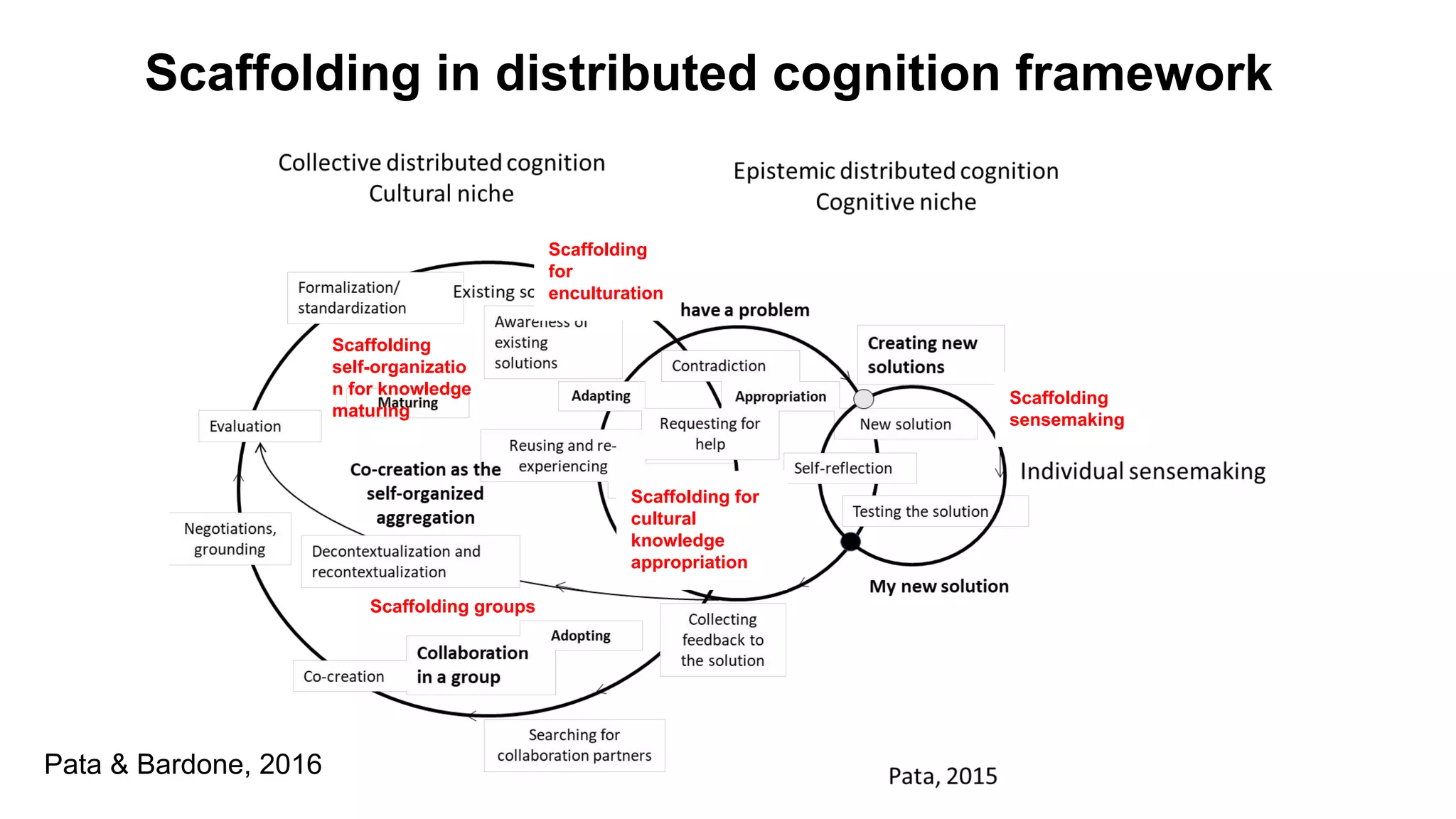
Scaffolding in distributed cognition framework
Pata & Bardone, 2016
Scaffolding groups
Scaffolding
self-organizatio
n for knowledge
maturing
Scaffolding for
cultural
knowledge
appropriation
Scaffolding
sensemaking
Scaffolding
for
enculturation
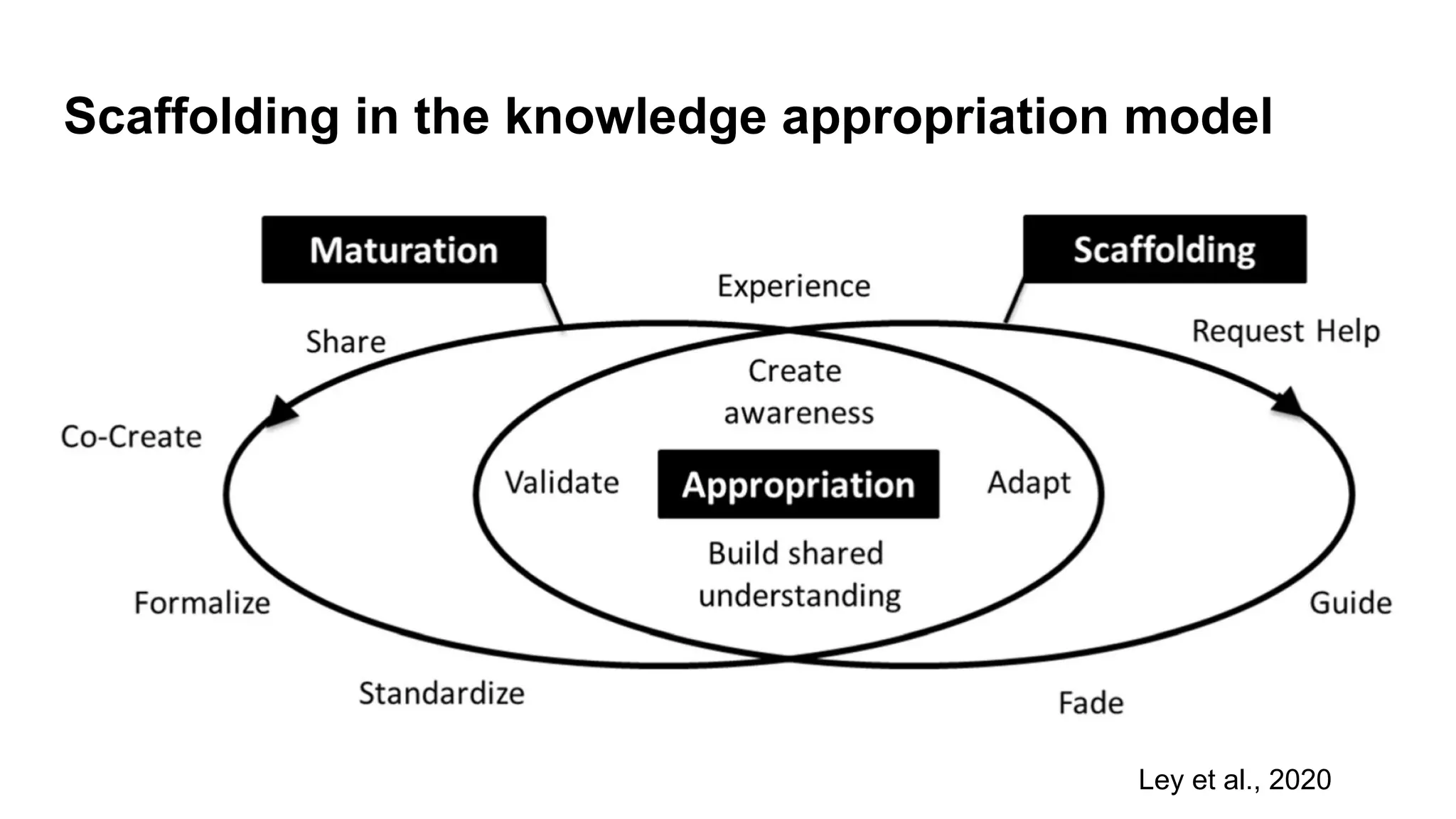
Scaffolding in the knowledge appropriation model
Ley et al., 2020
Why is scaffolding concept still useful in
socio-technical systems?
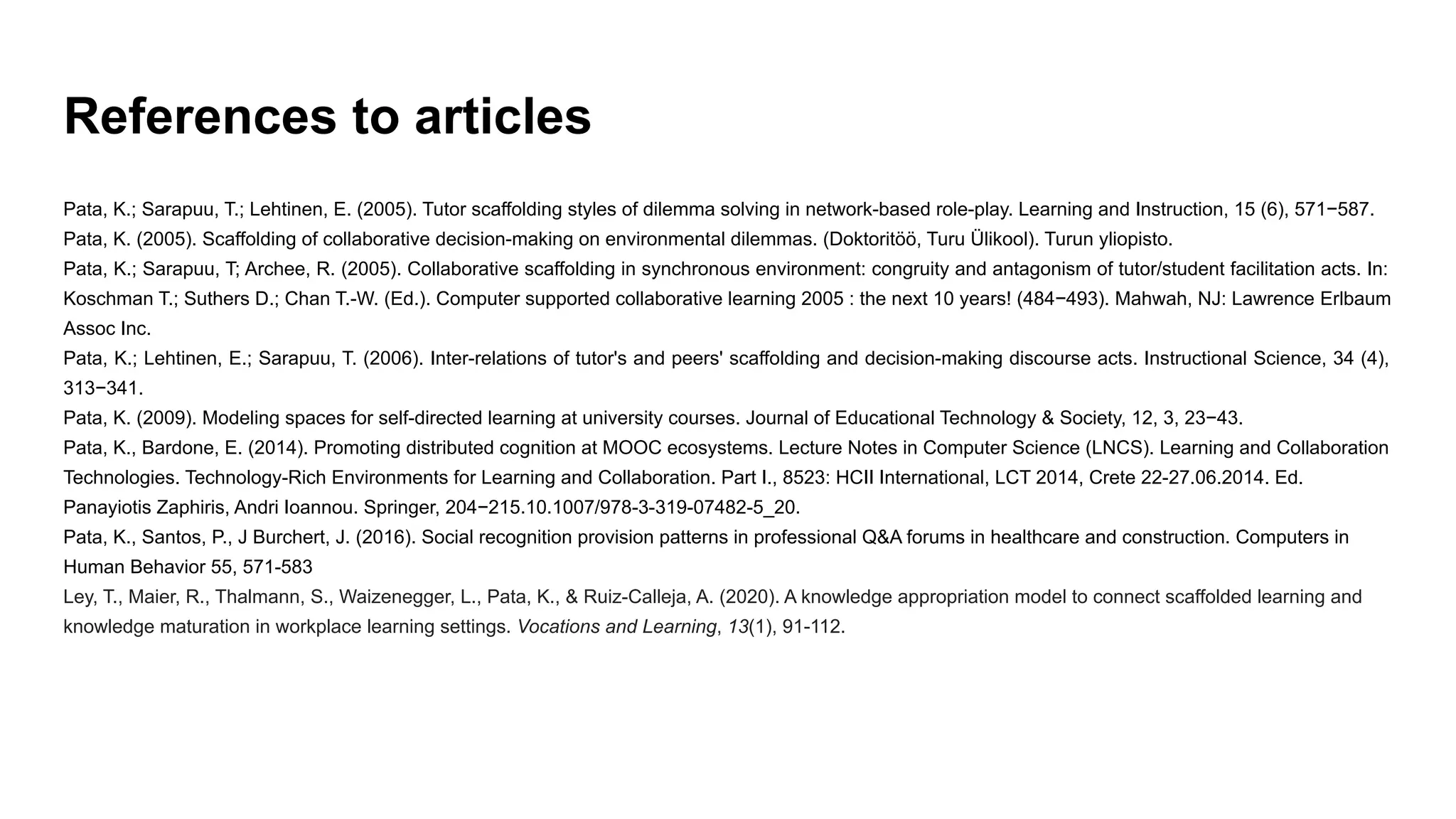
References to articles
Pata, K.; Sarapuu, T.; Lehtinen, E. (2005). Tutor scaffolding styles of dilemma solving in network-based role-play. Learning and Instruction, 15 (6), 571−587.
Pata, K. (2005). Scaffolding of collaborative decision-making on environmental dilemmas. (Doktoritöö, Turu Ülikool). Turun yliopisto.
Pata, K.; Sarapuu, T; Archee, R. (2005). Collaborative scaffolding in synchronous environment: congruity and antagonism of tutor/student facilitation acts. In:
Koschman T.; Suthers D.; Chan T.-W. (Ed.). Computer supported collaborative learning 2005 : the next 10 years! (484−493). Mahwah, NJ: Lawrence Erlbaum
Assoc Inc.
Pata, K.; Lehtinen, E.; Sarapuu, T. (2006). Inter-relations of tutor's and peers' scaffolding and decision-making discourse acts. Instructional Science, 34 (4),
313−341.
Pata, K. (2009). Modeling spaces for self-directed learning at university courses. Journal of Educational Technology & Society, 12, 3, 23−43.
Pata, K., Bardone, E. (2014). Promoting distributed cognition at MOOC ecosystems. Lecture Notes in Computer Science (LNCS). Learning and Collaboration
Technologies. Technology-Rich Environments for Learning and Collaboration. Part I., 8523: HCII International, LCT 2014, Crete 22-27.06.2014. Ed.
Panayiotis Zaphiris, Andri Ioannou. Springer, 204−215.10.1007/978-3-319-07482-5_20.
Pata, K., Santos, P., J Burchert, J. (2016). Social recognition provision patterns in professional Q&A forums in healthcare and construction. Computers in
Human Behavior 55, 571-583
Ley, T., Maier, R., Thalmann, S., Waizenegger, L., Pata, K., & Ruiz-Calleja, A. (2020). A knowledge appropriation model to connect scaffolded learning and
knowledge maturation in workplace learning settings. Vocations and Learning, 13(1), 91-112.

Transformations of scaffolding concept in socio-technical systems.pdf

  • 1.
    Transformations of scaffoldingmetaphor in socio-technical systems Kai Pata Associated professor of adult and informal learning School of Educational Sciences, Tallinn University Erno Lehtinen Online Colloquium, February, 2nd, 2022
  • 2.
    The topic ofmy talk How has scaffolding concept changed as learning moved from natural to digitally mediated and hybrid forms?
  • 3.
    Doing where and how? Phenomenaof support Training Mentoring Scaffolding Nudging Coaching Facilitating Apprenticeship Doing what? Doing why?
  • 4.
    Scaffolding metaphor (Wood,Bruner, & Ross, 1976) Scaffolding is a systematic approach of support that focuses on the relationships between the task, the teacher and the learner (Jonassen, 1999) Scaffolding is a form of dyadic adult-child interaction, a form of support ‘that enables a child or novice to solve a problem, carry out a task or achieve a goal which would be beyond his unassisted efforts’ (Wood et al., 1976) scaffold facilitator student
  • 5.
    Scaffolding in dialogicsituations The metaphor of scaffolding (Wood, Bruner, & Ross, 1976) is used to illustrate the effective supportive processes that enable the learners to solve a problem, carry out a task, or achieve a goal that would be beyond their unassisted efforts. Scaffolding is: ‘‘providing support at the right level of the current skill while a student is carrying out the task and then gradually fading out of assistance’’ (Järvelä, 1995) ‘‘providing assistance to students on an as-needed basis with fading out of assistance as the competence increases’’ (Pressley, Hogan, Wharton-McDonald, Mistretta, & Ettenberger, 1996) According to the concept of the zone of proximal development (Vygotsky, 1978), scaffolding helps to decrease the distance between students’ actual developmental level, as determined by independent problem solving, and the level of their potential development as determined through problem solving under adult or peer guidance.
  • 6.
    Scaffolding actors ‘Tutee’ has knowledge,skills, needs has responsibility ‘to take ownership of their learning’ (Järvelä 1996) tutee’s partial ‘comprehension of the solution must precede production’ (Wood et al.1976) must have the ‘ownership of the activity to be learned’ (Langer and Applebee, 1986) ‘Tutor’ Have certain abilities to imitate, model the advanced solution paths for tutees (Wood et al, 1976) Must be aware of the tutee’s skill level (Wood et al, 1976; Palinscar and Brown, 1984) Should be able to experience empathic understanding of a tutee’s internal reference framework (Rasmussen, 2001). Has sensitivity to adjustment to the tutee’s needs (Järvelä, 1996). Can provide recruitment of interest, maintain goal orientation, control frustration, highlight critical task features, demonstrate idealized solution paths, and reduce the tutee’s degrees of freedom (Wood et al, 1976). Doing where and how? Doing what? Doing why?
  • 7.
    Scaffolding process The ‘scaffoldingprocess’ ● The tutees must be actively involved and enforced to participate in turn taking with the tutor (Palinscar & Brown, 1984; Järvelä, 1995; Vauras et al., 1993). ● Actors must have a mutual understanding of each other’s intentions and the way the goal is conceptualized (Fleer 1992) ● Delicate negotiation processes (Merrill et al., 1995) ● Not the completion of the task must be scaffolded but the understanding of the tutee how to conceptualize the task through the proper steps of action (Stone, 1998). ● Is increasing the tutee’s growing appreciation of the new procedure (Stone, 1998). ● Tutee’s ‘internalization’ will be evoked, that is based not the adult’s situation definition, but the jointly elaborated situation definition of two actors (Langer & Applebee, 1986; Elbers et al., 1992) ● Tutor provides the support at the right level of skill, which comprises the teacher’s sensitive regulation on the basis of the students’ interactions, and fading out of assistance when students’ competence increases (Järvelä, 1995; Pressley et al.,1996)
  • 8.
    Scaffolding situation The ‘scaffoldingsituation’ ● Influences the interchange with specific features and captures the ‘who, what, where, when, and why of an event’ (Tharp & Gallimore, 1988) ● Takes place in a certain context, with the culture of the particular community (Rogoff, 1990) ● The tutee interprets any communal moves in the activity context (Tharp & Gallimore, 1988) ● Only if the scaffolding activity is goal-embedded motivation will be provided Palinscar and Brown (1984) ● Activity context influences the extent of tutee’s affective engagement in the task and the interpersonal exchange.
  • 9.
    Scaffolding in agroup Learners can be assisted in building new knowledge structures, both with the help of the teacher who models the desired learning strategy or task and then gradually shifts responsibility to the students, or with the help of more advanced peers who help the less sophisticated students in the learning process (Pressley et al., 1996) According to Rasmussen (2001), communication can be viewed as the mutual scaffolding, which invites participants to develop and test their own constructions of meaning with others, discussing individual interpretations, draft hypotheses, or possible solutions.
  • 10.
    Dialogic acts inscaffolding Different tutoring styles have different effect on students’ in groups (Pata et al., 2005). Validation acts Scaffolding is a semiotic uptake, an “appropriation of meaning” (Wertch & Stone, 1985)
  • 11.
    Scaffolding in groups Zoneof Proximal Development applies potentially to all participants in groups and is the learning potential in small groups where students have incomplete but relatively equal expertise and where each partner who possesses some knowledge and skills requires the others’ contribution in order to make progress (Wells, 1999; Forman, 1989; Goos et al., 2002) Tutor and students use similar types of scaffolding acts (Pata et al., 2005) and elaborate and replace each other’s scaffolding acts in the collaborative decision-making situations (Pata et al., 2006) Multi-actor scaffolding model (Pata, 2005)
  • 12.
    Technology mediated scaffolding Intechnology mediated scaffolding situations the technology can preserve the dialogic (between agents) and trialogic acts (agents’ interactions with artifacts) ● In real time - in chatlog, on the ‘wall’, (and preserved by algorithm) ● Asynchronously - as a logfile, as a production history with artifact or variations of artifacts accumulated in the system Technology functionalities may replace some of the dialogic acts: with likes, stars, emoticons Scaffolding acts act as dynamic signals, for mutual interaction (like in flocks) Scaffolding acts may accumulate in the environment in the form of collective phenomena (e.g. trust) and grow or dissipate in time as other communicative acts (like signal traits of ants)
  • 13.
    Scaffolding in aprofessional online community Pata et al., 2016 The communities scaffold its members through the collective phenomena
  • 14.
    Can a chatbotscaffold? Machine learning algorithms have to dynamically elicit users’ incomplete problem models and fit with the accumulated experts models to fade out of support.
  • 15.
    Can a recommendationengine scaffold? How can the recommender system fade out of support or provide scaffolds rather than solutions? Instead of recommending concrete examples, suggesting the ‘patterns’, prototypes, rulesets? Besides of fit suggesting bad fit as well?
  • 16.
    Could technology scaffoldby mediating good practices, community values, ideas, opportunities etc. as accumulated affordance niches? Pata, 2009
  • 17.
    Scaffolding in socio-technical systems TRUSTSAFETY ACCESSIBILITY Can we apply scaffolding concept to support the emergence of the collective level phenomena?
  • 18.
    Scaffolding in socio-technicalsystems A big social experiment to elicit the discourse acts for mutual situation definitions, intentions and values between humans and nonhuman agents?
  • 19.
    Can nudges bescaffolds? Nudge is any aspect of the choice architecture that alters people's behavior in a predictable way without forbidding any options or significantly changing their economic incentives Damgaard & Nielsen, 2018 Reciprocal validation acts should be implemented as part of nudges to fade out the nudges that were internalised
  • 20.
    Scaffolding in distributedcognition framework Pata & Bardone, 2016 Scaffolding groups Scaffolding self-organizatio n for knowledge maturing Scaffolding for cultural knowledge appropriation Scaffolding sensemaking Scaffolding for enculturation
  • 21.
    Scaffolding in theknowledge appropriation model Ley et al., 2020
  • 22.
    Why is scaffoldingconcept still useful in socio-technical systems?
  • 23.
    References to articles Pata,K.; Sarapuu, T.; Lehtinen, E. (2005). Tutor scaffolding styles of dilemma solving in network-based role-play. Learning and Instruction, 15 (6), 571−587. Pata, K. (2005). Scaffolding of collaborative decision-making on environmental dilemmas. (Doktoritöö, Turu Ülikool). Turun yliopisto. Pata, K.; Sarapuu, T; Archee, R. (2005). Collaborative scaffolding in synchronous environment: congruity and antagonism of tutor/student facilitation acts. In: Koschman T.; Suthers D.; Chan T.-W. (Ed.). Computer supported collaborative learning 2005 : the next 10 years! (484−493). Mahwah, NJ: Lawrence Erlbaum Assoc Inc. Pata, K.; Lehtinen, E.; Sarapuu, T. (2006). Inter-relations of tutor's and peers' scaffolding and decision-making discourse acts. Instructional Science, 34 (4), 313−341. Pata, K. (2009). Modeling spaces for self-directed learning at university courses. Journal of Educational Technology & Society, 12, 3, 23−43. Pata, K., Bardone, E. (2014). Promoting distributed cognition at MOOC ecosystems. Lecture Notes in Computer Science (LNCS). Learning and Collaboration Technologies. Technology-Rich Environments for Learning and Collaboration. Part I., 8523: HCII International, LCT 2014, Crete 22-27.06.2014. Ed. Panayiotis Zaphiris, Andri Ioannou. Springer, 204−215.10.1007/978-3-319-07482-5_20. Pata, K., Santos, P., J Burchert, J. (2016). Social recognition provision patterns in professional Q&A forums in healthcare and construction. Computers in Human Behavior 55, 571-583 Ley, T., Maier, R., Thalmann, S., Waizenegger, L., Pata, K., & Ruiz-Calleja, A. (2020). A knowledge appropriation model to connect scaffolded learning and knowledge maturation in workplace learning settings. Vocations and Learning, 13(1), 91-112.