The Road Not Taken
by Robert Frost
Robert Frost (1874-1963)
• Robert Frost was the most popular American
poet of the twentieth century.
• Most Americans recognize his name, the titles
of and lines from his best-known poems, and
even his face and the sound of his voice.
Aspects of Frost's poetry:
• using contraries and
contradictions
• using common, everyday
speech
• poems set in nature
• deep meanings exist
beneath a simple
exterior
The Road Not Taken( poem)
Robert Frost’s ‘The Road Not Taken’ is a poem about
the choices faced in life. To illustrate these
choices, Frost uses a metaphor of a forked path in
a wood. One way is well-trodden and the other is
fresh with grass. The first symbolises a safe, easy
choice which others often take. The second, the
one Frost chooses, is more risky and unknown.
Frost regrets that he ‘could not travel both’ but, just
as life’s decisions are irreversible, the path he
chooses leads on to further paths.
THE ROAD NOT TAKEN- ROBERT FROST
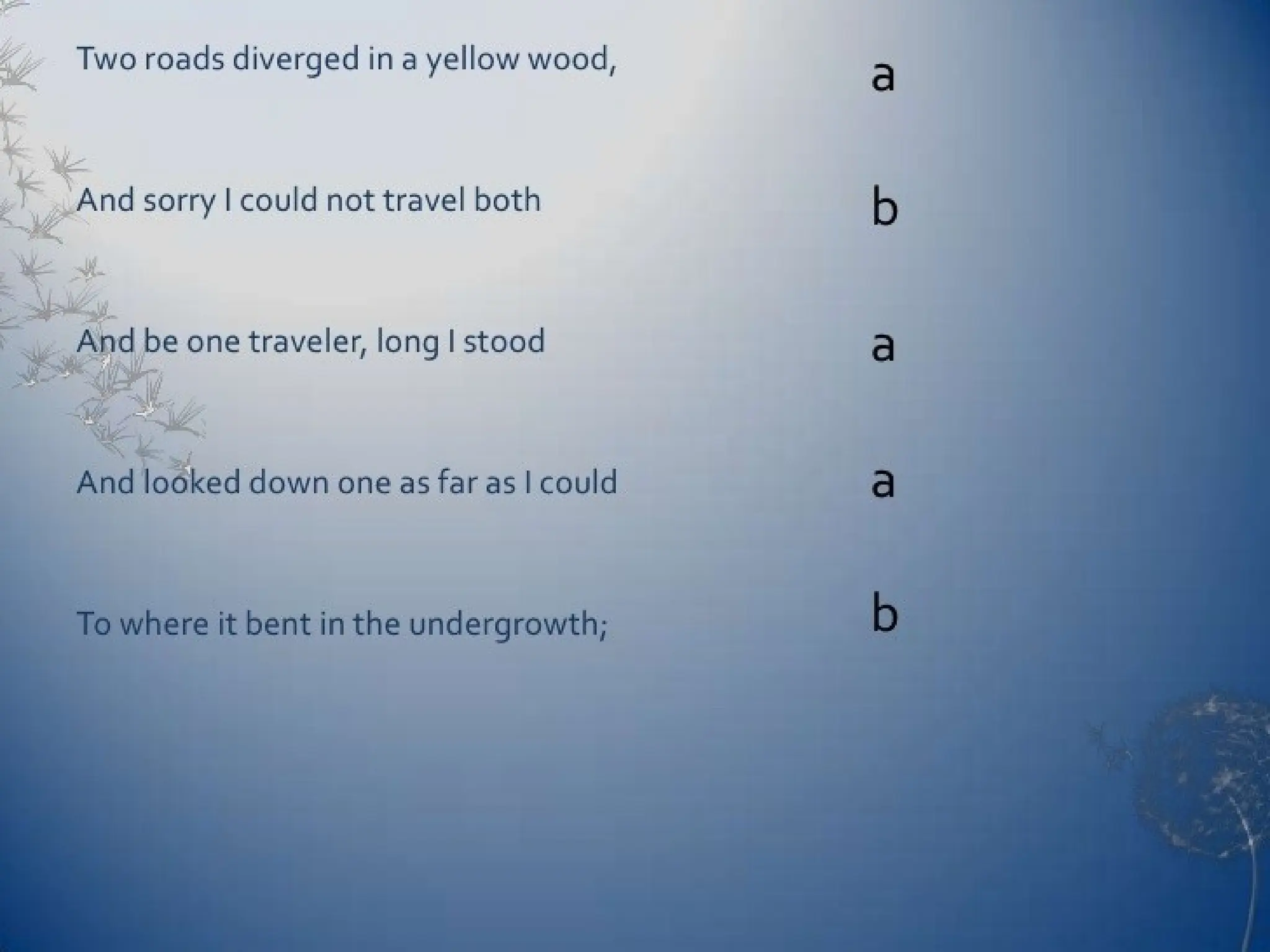
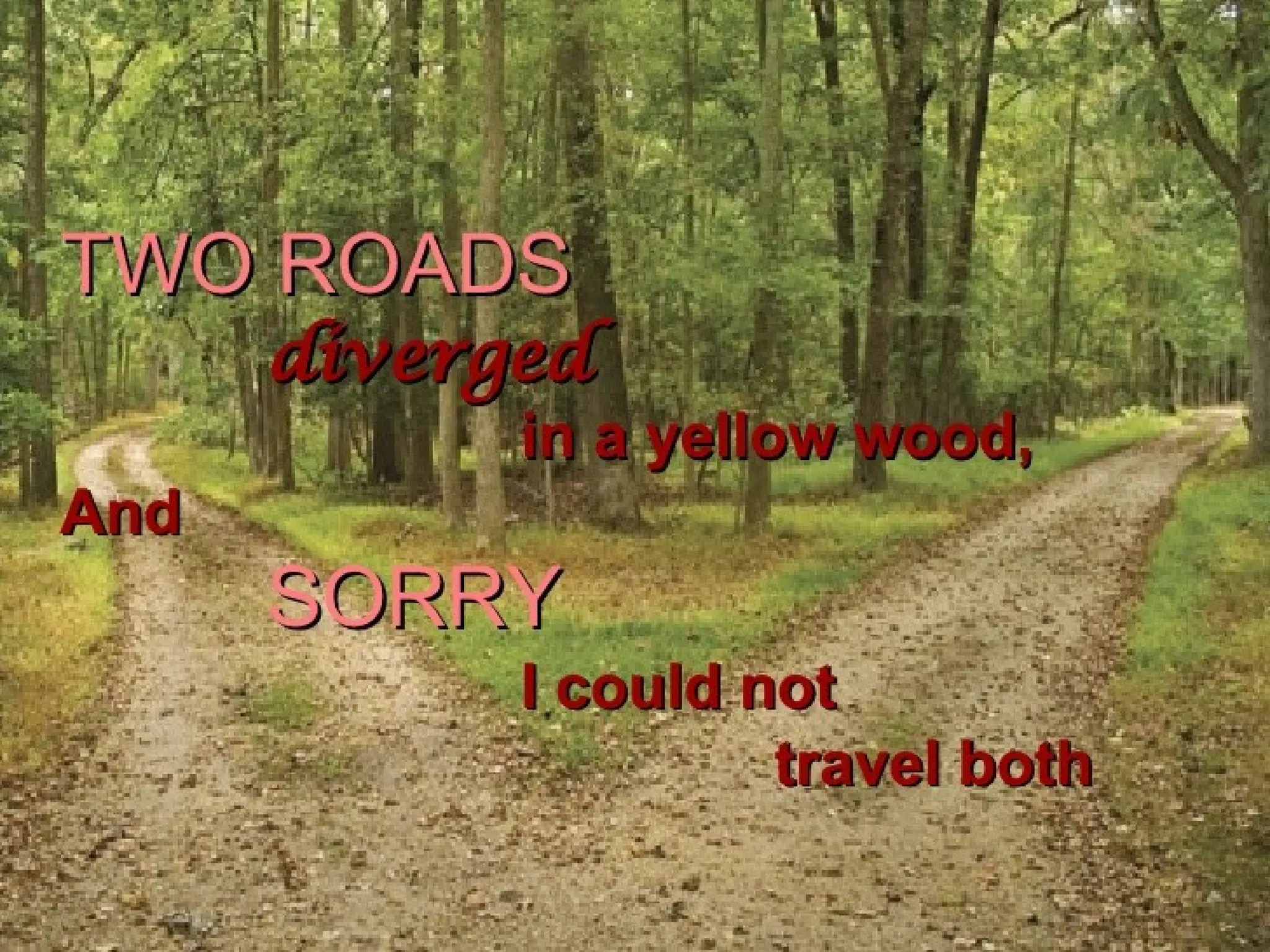
Two roads diverged in a yellow wood,
And sorry I could not travel both
And be one traveler,
long I stood
And looked down one as far as I could
To where it bent in the undergrowth;
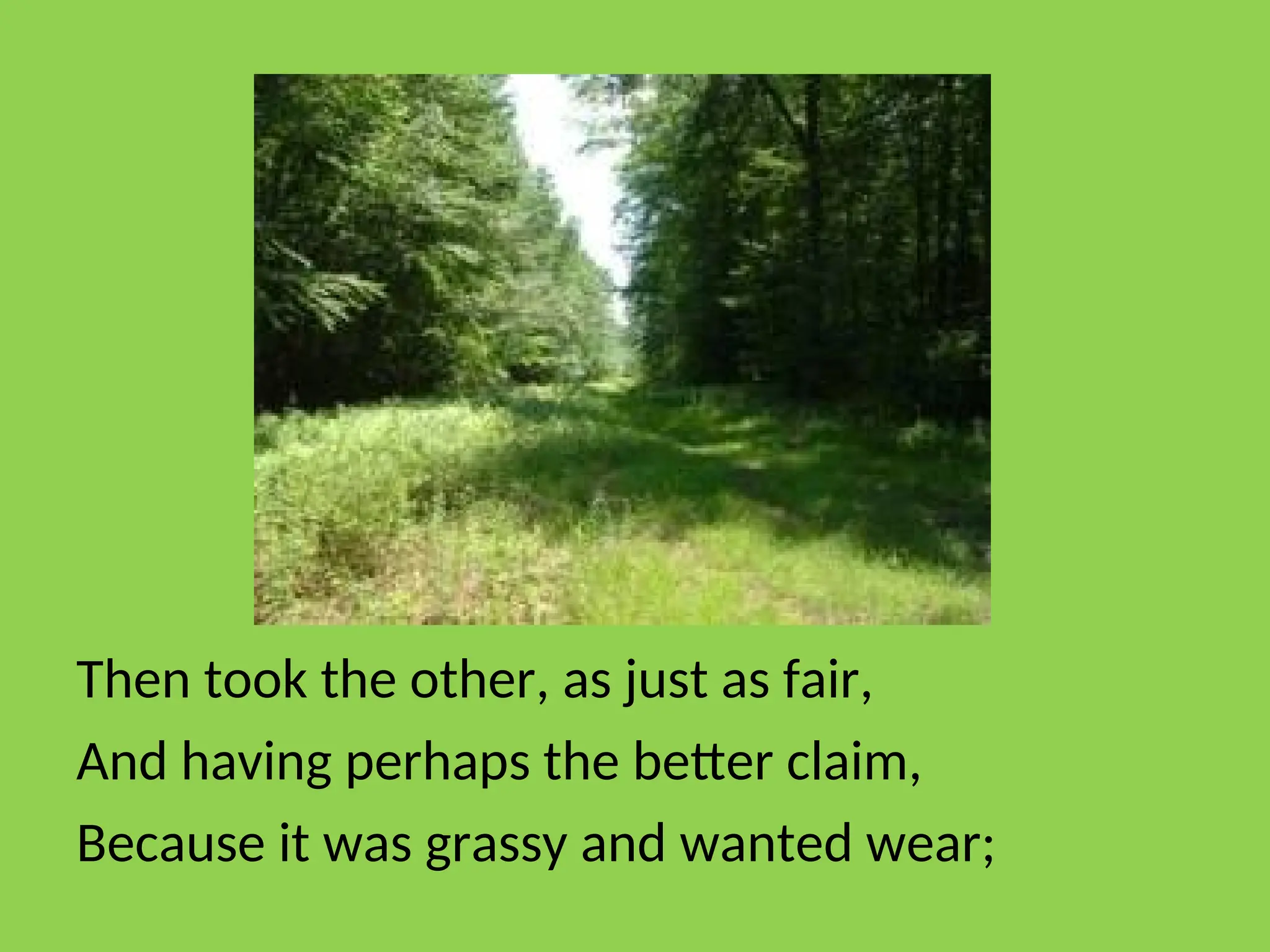
Then took the other, as just as fair,
And having perhaps the better claim,
Because it was grassy and wanted wear;
Though as for that the passing there
Had worn them really about the same,
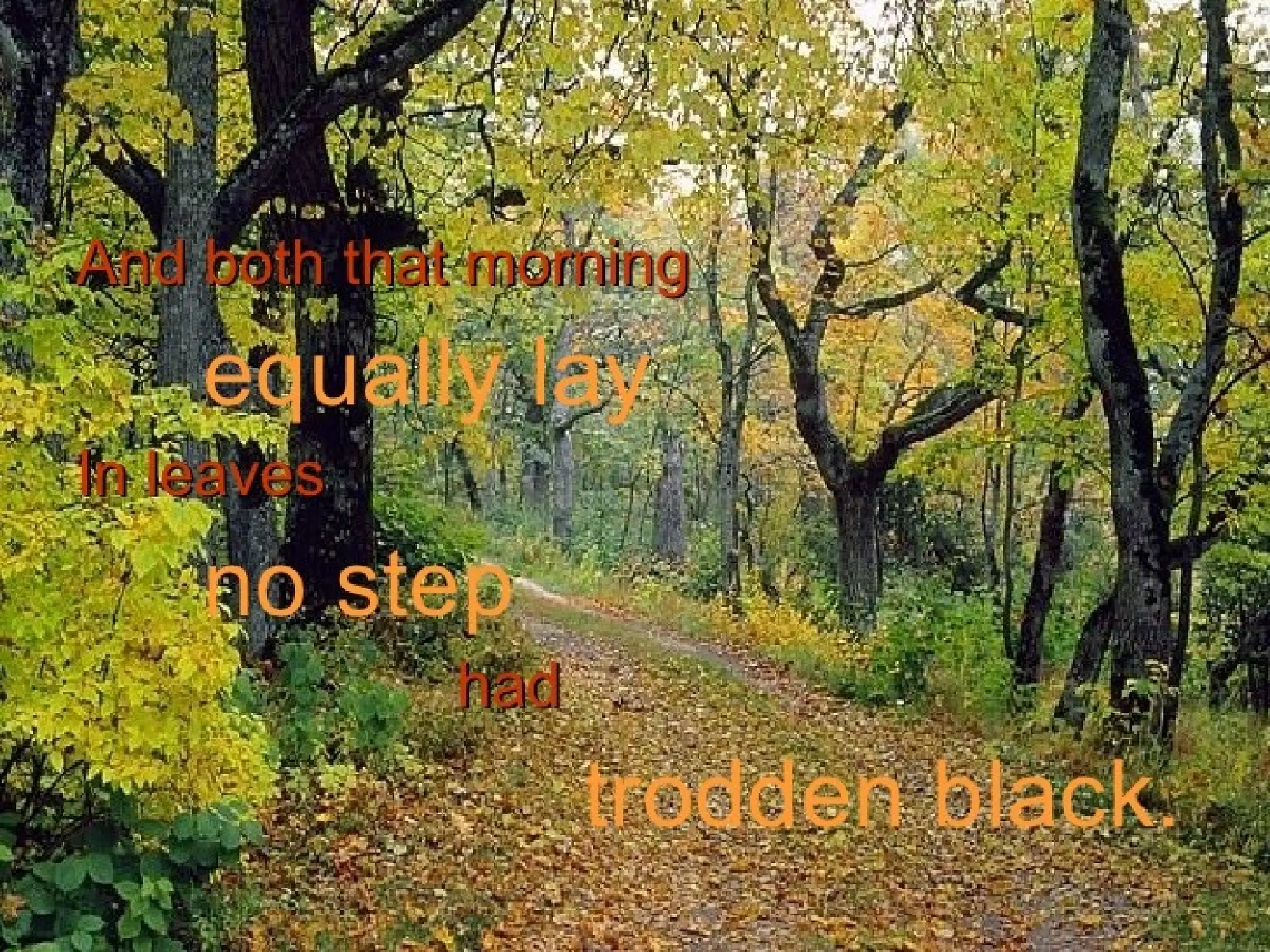
And both that morning equally lay
In leaves no step had trodden black.
Oh, I kept the first for another day!
Yet knowing how way leads on to way,
I doubted if I should ever come back.
I shall be telling this with a sigh
Somewhere ages and ages hence:
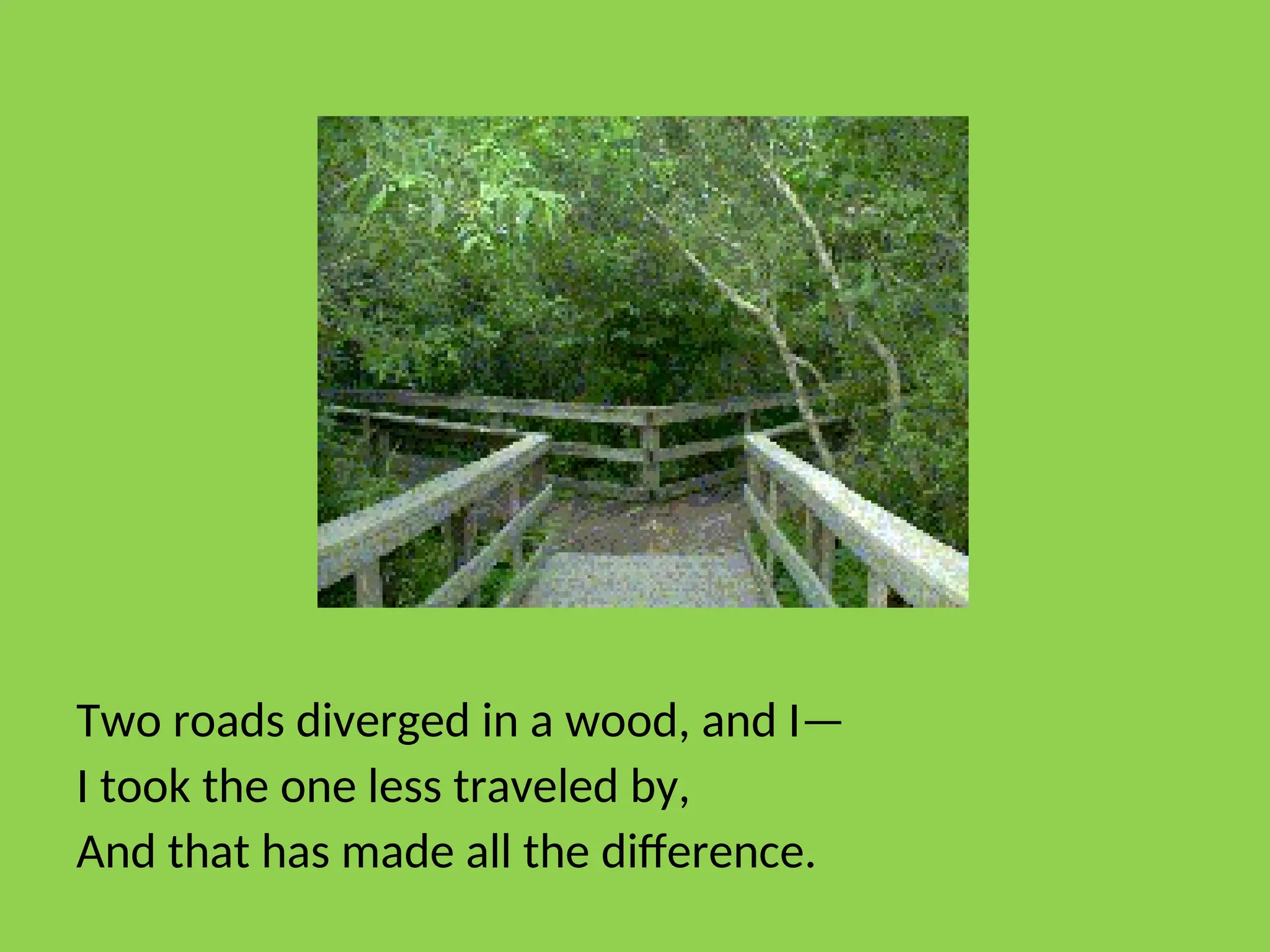
Two roads diverged in a wood, and I—
I took the one less traveled by,
And that has made all the difference.
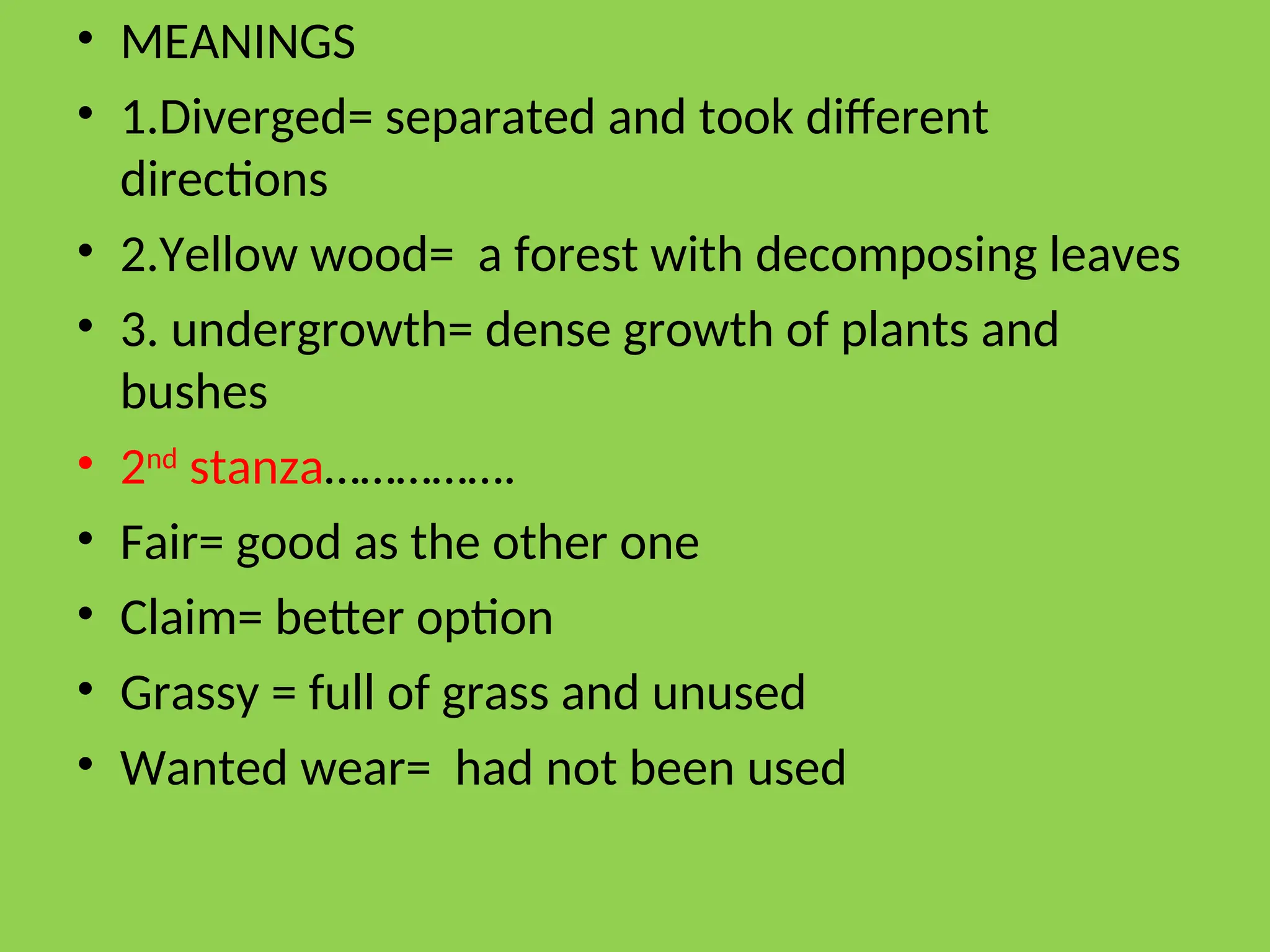
• MEANINGS
• 1.Diverged= separated and took different
directions
• 2.Yellow wood= a forest with decomposing leaves
• 3. undergrowth= dense growth of plants and
bushes
• 2nd
stanza…………….
• Fair= good as the other one
• Claim= better option
• Grassy = full of grass and unused
• Wanted wear= had not been used
Then took the other, as just as fair,
And having perhaps the better claim,
Because it was grassy and wanted wear;
• 3rd
stanza
• Trodden= walked over
• ……………………..
• Last stanza
• Sigh = deep breath
• Hence= (here) in the future
The Road Not Taken by Robert Frost
literary devices./ POETIC DEVICES / FIGURES OF SPEECH
1.Metaphor: The road in the poem is the metaphor of life, while
the fork on the road metaphorically represents the choices we
make to determine the course of our lives.
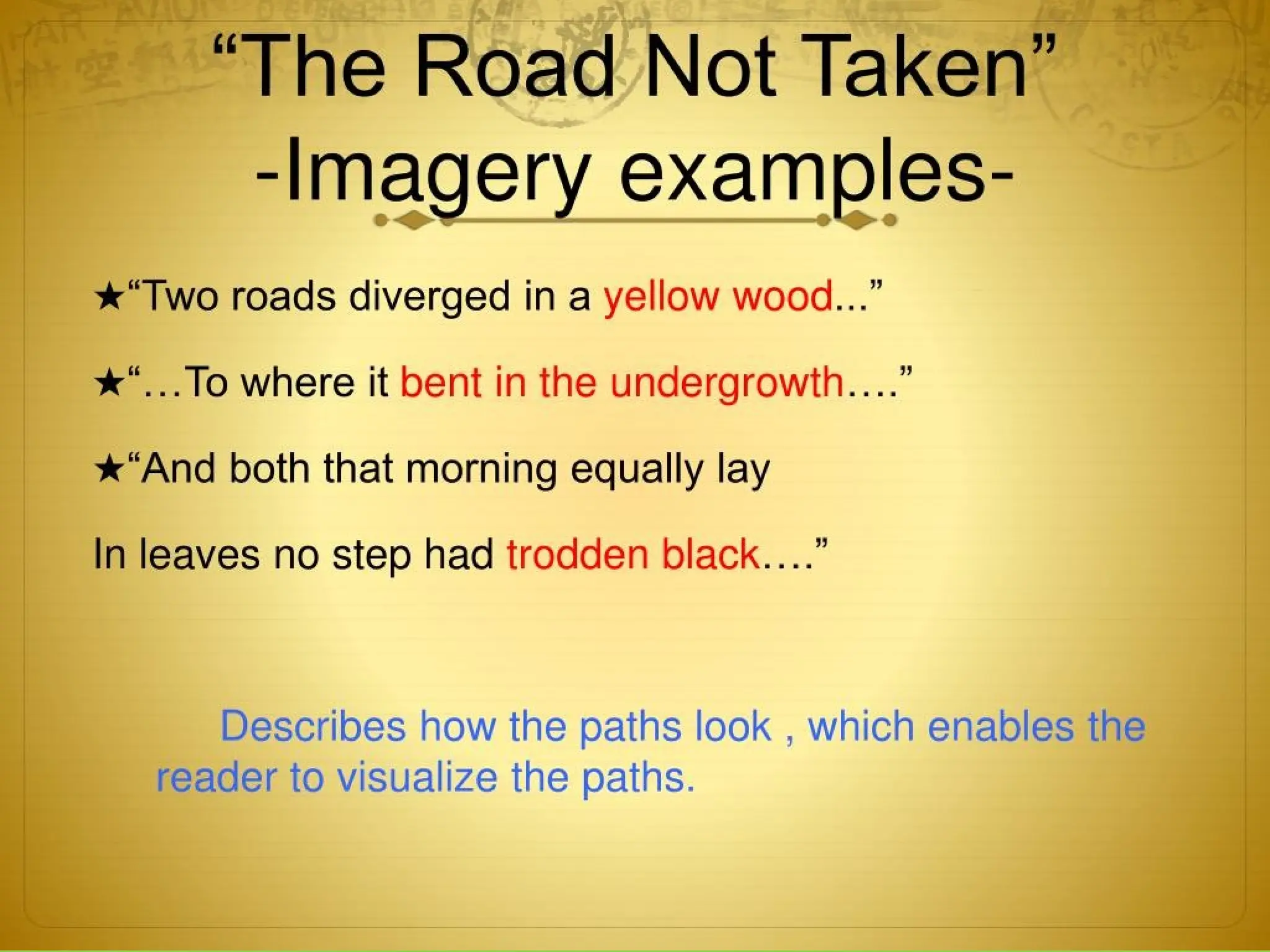
2.Imagery: .Ex. Two roads diverged in a yellow wood
To where it bent in the undergrowth
Both That morning equally lay
in leaves no step had trodden black
3.Simile: A simile is a device used to compare things with ;like’.
Or ‘as’
Ex. “ just as fair”.
4 Repetition “ - Ex. “Somewhere ages and ages hence.”
5. Personification: Robert Frost has personified road in the third
line of the second stanza.
Ex. “Because it was grassy and wanted wear” as if the road is
human, and that it wants to wear and tear.
6. Anaphora— 2 or 3 consecutive lines beginning with the same
words
“And sorry I could not travel both”
“And be only one traveler long I stood”
“And looked down once as far as I could”
7. Alliteration-
Ex. Because it was grassy and wanted wear
Then took the other
I shall be telling this with a sigh
And that has made all the difference
Rhyme Scheme- abaab
• Major Themes of the Poem: The poem comprises
uncertainty and perplexing situation of the minds of people
about what they may face when standing on the verge of
making choices. It is because life is full of choices, and the
choices we make, define the whole course of our lives.
Similarly, the narrator faces a situation during his travel. He
finds two roads at a point where he has to choose one and
must abide by his choice. He thinks he may come back one
day to travel on the other road. However, he also has a
feeling that his choice will confront him with new
adventures and challenges. Though there is some regret
over his choice, yet he realizes that the things he has
encountered and the places he has visited, because of this
path, have made all the difference in his life.
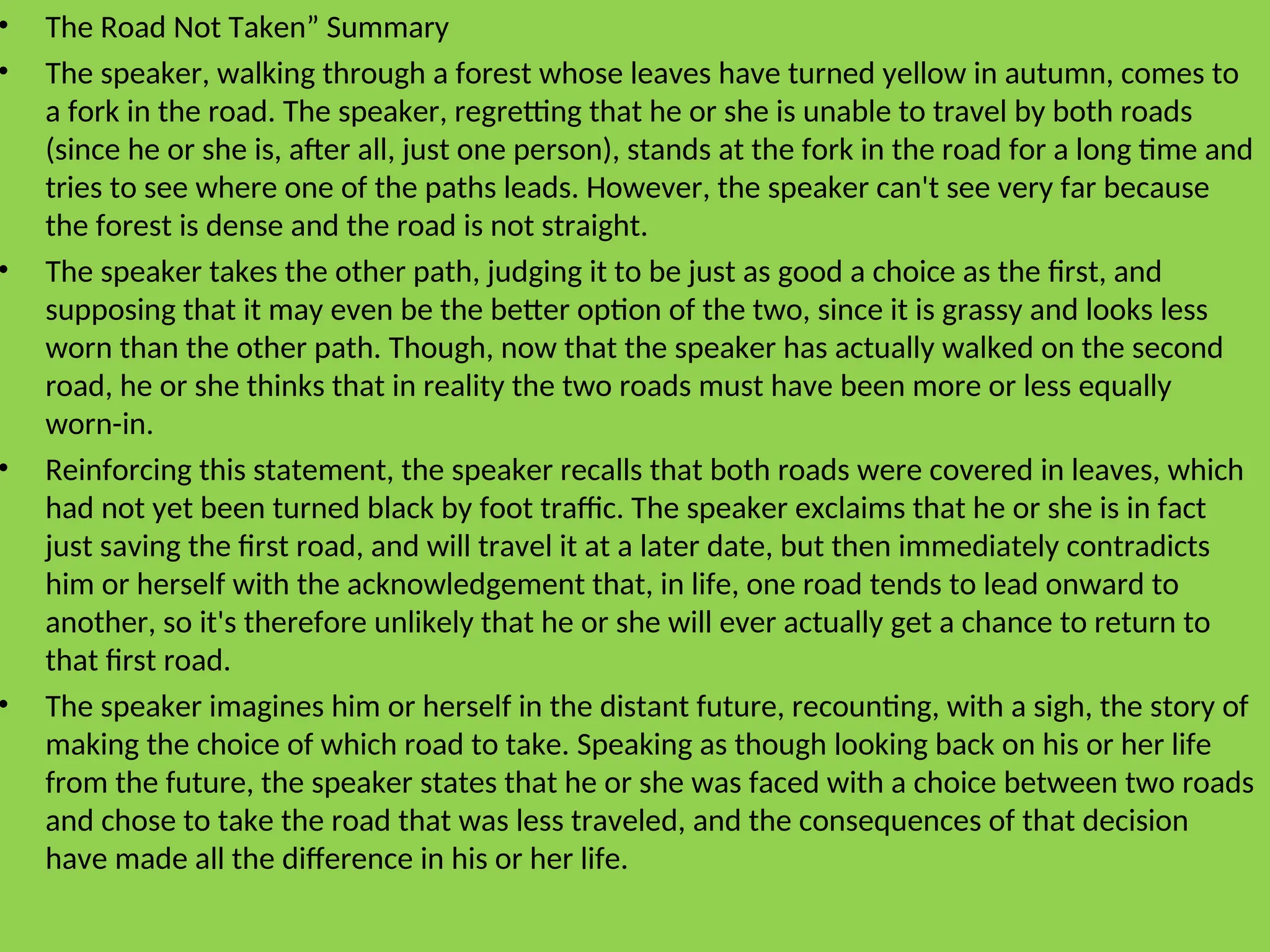
• The Road Not Taken” Summary
• The speaker, walking through a forest whose leaves have turned yellow in autumn, comes to
a fork in the road. The speaker, regretting that he or she is unable to travel by both roads
(since he or she is, after all, just one person), stands at the fork in the road for a long time and
tries to see where one of the paths leads. However, the speaker can't see very far because
the forest is dense and the road is not straight.
• The speaker takes the other path, judging it to be just as good a choice as the first, and
supposing that it may even be the better option of the two, since it is grassy and looks less
worn than the other path. Though, now that the speaker has actually walked on the second
road, he or she thinks that in reality the two roads must have been more or less equally
worn-in.
• Reinforcing this statement, the speaker recalls that both roads were covered in leaves, which
had not yet been turned black by foot traffic. The speaker exclaims that he or she is in fact
just saving the first road, and will travel it at a later date, but then immediately contradicts
him or herself with the acknowledgement that, in life, one road tends to lead onward to
another, so it's therefore unlikely that he or she will ever actually get a chance to return to
that first road.
• The speaker imagines him or herself in the distant future, recounting, with a sigh, the story of
making the choice of which road to take. Speaking as though looking back on his or her life
from the future, the speaker states that he or she was faced with a choice between two roads
and chose to take the road that was less traveled, and the consequences of that decision
have made all the difference in his or her life.
The analysis of literary devices explains the hidden meanings of a literary text or a poem.
The use of literary devices is intended to bring richness and clarity to the text with different
meanings. The Road Not Taken by Robert Frost is also filled with important undertones
with the following literary devices.
1.Metaphor: There are many metaphors in the poem like road, fork in the road and
yellowwoods. The road in the poem is the metaphor of life, while the fork on the road
metaphorically represents the choices we make to determine the course of our lives.
Similarly, yellow woods are the metaphor of making decisions during the hard times of a
person’s life. These metaphors used in this poem emphasize the importance of different
decisions we make in different situations and their impacts on our lives.
2.Imagery: Imagery is used to make the readers feel things through their five senses. The
poet has used images of the sense of sights such as leaves, yellowwoods and These
images help readers to actually perceive things they are reading. The image of the road
helps readers to visualize the road providing a navigation route to the traveler.
3.Simile: A simile is a device used to compare things with familiar things to let the readers
know it easily. There is one simile used in the second stanza such as “as just as fair”. It
shows how the poet has linked the road less taken to the easy way through life.
4.Assonance: Assonance is the repetition of vowel sounds such as the sound of /a/
and /o/ in quick succession in “though as far that the passing” and in “Somewhere ages
and ages hence.”

The Road Not Taken ...... - Copy (1).ppt

  • 1.
    The Road NotTaken by Robert Frost
  • 2.
    Robert Frost (1874-1963) •Robert Frost was the most popular American poet of the twentieth century. • Most Americans recognize his name, the titles of and lines from his best-known poems, and even his face and the sound of his voice.
  • 3.
    Aspects of Frost'spoetry: • using contraries and contradictions • using common, everyday speech • poems set in nature • deep meanings exist beneath a simple exterior
  • 5.
    The Road NotTaken( poem) Robert Frost’s ‘The Road Not Taken’ is a poem about the choices faced in life. To illustrate these choices, Frost uses a metaphor of a forked path in a wood. One way is well-trodden and the other is fresh with grass. The first symbolises a safe, easy choice which others often take. The second, the one Frost chooses, is more risky and unknown. Frost regrets that he ‘could not travel both’ but, just as life’s decisions are irreversible, the path he chooses leads on to further paths.
  • 6.
    THE ROAD NOTTAKEN- ROBERT FROST Two roads diverged in a yellow wood, And sorry I could not travel both And be one traveler,
  • 7.
    long I stood Andlooked down one as far as I could To where it bent in the undergrowth;
  • 8.
    Then took theother, as just as fair, And having perhaps the better claim, Because it was grassy and wanted wear;
  • 9.
    Though as forthat the passing there Had worn them really about the same, And both that morning equally lay In leaves no step had trodden black.
  • 10.
    Oh, I keptthe first for another day! Yet knowing how way leads on to way, I doubted if I should ever come back.
  • 11.
    I shall betelling this with a sigh Somewhere ages and ages hence:
  • 12.
    Two roads divergedin a wood, and I— I took the one less traveled by, And that has made all the difference.
  • 17.
    • MEANINGS • 1.Diverged=separated and took different directions • 2.Yellow wood= a forest with decomposing leaves • 3. undergrowth= dense growth of plants and bushes • 2nd stanza……………. • Fair= good as the other one • Claim= better option • Grassy = full of grass and unused • Wanted wear= had not been used
  • 23.
    Then took theother, as just as fair, And having perhaps the better claim, Because it was grassy and wanted wear;
  • 27.
    • 3rd stanza • Trodden=walked over • …………………….. • Last stanza • Sigh = deep breath • Hence= (here) in the future
  • 34.
    The Road NotTaken by Robert Frost literary devices./ POETIC DEVICES / FIGURES OF SPEECH 1.Metaphor: The road in the poem is the metaphor of life, while the fork on the road metaphorically represents the choices we make to determine the course of our lives. 2.Imagery: .Ex. Two roads diverged in a yellow wood To where it bent in the undergrowth Both That morning equally lay in leaves no step had trodden black 3.Simile: A simile is a device used to compare things with ;like’. Or ‘as’ Ex. “ just as fair”. 4 Repetition “ - Ex. “Somewhere ages and ages hence.”
  • 35.
    5. Personification: RobertFrost has personified road in the third line of the second stanza. Ex. “Because it was grassy and wanted wear” as if the road is human, and that it wants to wear and tear. 6. Anaphora— 2 or 3 consecutive lines beginning with the same words “And sorry I could not travel both” “And be only one traveler long I stood” “And looked down once as far as I could” 7. Alliteration- Ex. Because it was grassy and wanted wear Then took the other I shall be telling this with a sigh And that has made all the difference Rhyme Scheme- abaab
  • 36.
    • Major Themesof the Poem: The poem comprises uncertainty and perplexing situation of the minds of people about what they may face when standing on the verge of making choices. It is because life is full of choices, and the choices we make, define the whole course of our lives. Similarly, the narrator faces a situation during his travel. He finds two roads at a point where he has to choose one and must abide by his choice. He thinks he may come back one day to travel on the other road. However, he also has a feeling that his choice will confront him with new adventures and challenges. Though there is some regret over his choice, yet he realizes that the things he has encountered and the places he has visited, because of this path, have made all the difference in his life.
  • 37.
    • The RoadNot Taken” Summary • The speaker, walking through a forest whose leaves have turned yellow in autumn, comes to a fork in the road. The speaker, regretting that he or she is unable to travel by both roads (since he or she is, after all, just one person), stands at the fork in the road for a long time and tries to see where one of the paths leads. However, the speaker can't see very far because the forest is dense and the road is not straight. • The speaker takes the other path, judging it to be just as good a choice as the first, and supposing that it may even be the better option of the two, since it is grassy and looks less worn than the other path. Though, now that the speaker has actually walked on the second road, he or she thinks that in reality the two roads must have been more or less equally worn-in. • Reinforcing this statement, the speaker recalls that both roads were covered in leaves, which had not yet been turned black by foot traffic. The speaker exclaims that he or she is in fact just saving the first road, and will travel it at a later date, but then immediately contradicts him or herself with the acknowledgement that, in life, one road tends to lead onward to another, so it's therefore unlikely that he or she will ever actually get a chance to return to that first road. • The speaker imagines him or herself in the distant future, recounting, with a sigh, the story of making the choice of which road to take. Speaking as though looking back on his or her life from the future, the speaker states that he or she was faced with a choice between two roads and chose to take the road that was less traveled, and the consequences of that decision have made all the difference in his or her life.
  • 38.
    The analysis ofliterary devices explains the hidden meanings of a literary text or a poem. The use of literary devices is intended to bring richness and clarity to the text with different meanings. The Road Not Taken by Robert Frost is also filled with important undertones with the following literary devices. 1.Metaphor: There are many metaphors in the poem like road, fork in the road and yellowwoods. The road in the poem is the metaphor of life, while the fork on the road metaphorically represents the choices we make to determine the course of our lives. Similarly, yellow woods are the metaphor of making decisions during the hard times of a person’s life. These metaphors used in this poem emphasize the importance of different decisions we make in different situations and their impacts on our lives. 2.Imagery: Imagery is used to make the readers feel things through their five senses. The poet has used images of the sense of sights such as leaves, yellowwoods and These images help readers to actually perceive things they are reading. The image of the road helps readers to visualize the road providing a navigation route to the traveler. 3.Simile: A simile is a device used to compare things with familiar things to let the readers know it easily. There is one simile used in the second stanza such as “as just as fair”. It shows how the poet has linked the road less taken to the easy way through life. 4.Assonance: Assonance is the repetition of vowel sounds such as the sound of /a/ and /o/ in quick succession in “though as far that the passing” and in “Somewhere ages and ages hence.”