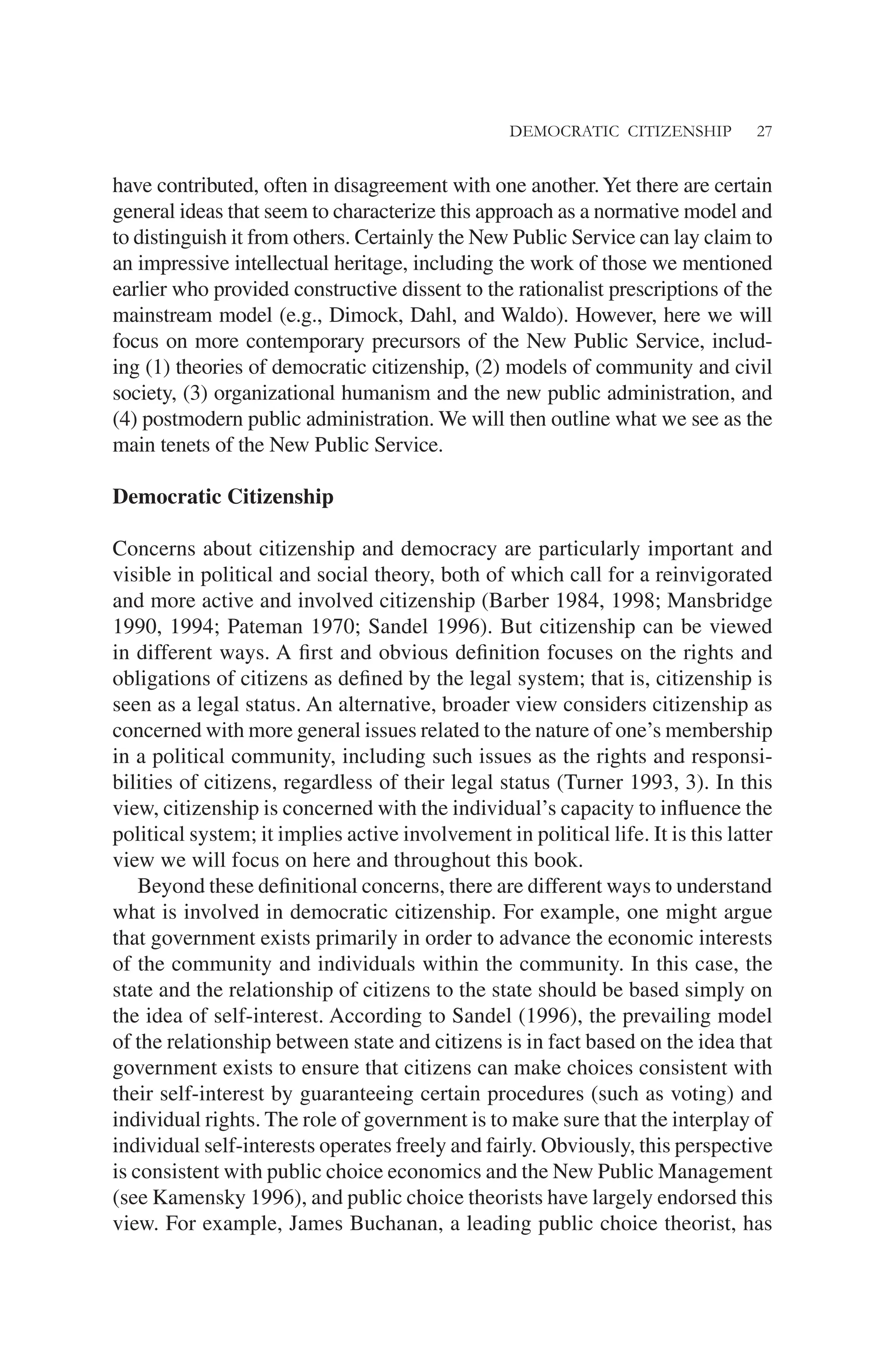
The New Public Service Serving Not Steering Janet Vinzant Denhardt
The New Public Service Serving Not Steering Janet Vinzant Denhardt
The New Public Service Serving Not Steering Janet Vinzant Denhardt
The New Public Service Serving Not Steering Janet Vinzant Denhardt
The New Public Service Serving Not Steering Janet Vinzant Denhardt
1.
Visit https://ebookultra.com todownload the full version and
explore more ebooks
The New Public Service Serving Not Steering
Janet Vinzant Denhardt
_____ Click the link below to download _____
https://ebookultra.com/download/the-new-public-service-
serving-not-steering-janet-vinzant-denhardt/
Explore and download more ebooks at ebookultra.com
2.
Here are somesuggested products you might be interested in.
Click the link to download
Macroeconomics at the Service of Public Policy 1st Edition
Thomas J. Sargent
https://ebookultra.com/download/macroeconomics-at-the-service-of-
public-policy-1st-edition-thomas-j-sargent/
Achieving Competencies in Public Service The Professional
Edge 2nd Edition James S. Bowman
https://ebookultra.com/download/achieving-competencies-in-public-
service-the-professional-edge-2nd-edition-james-s-bowman/
The New Catholic Encyclopedia 2nd Edition 3rd Volume Can
Col Janet Halfmann
https://ebookultra.com/download/the-new-catholic-encyclopedia-2nd-
edition-3rd-volume-can-col-janet-halfmann/
The Great Lakes Janet Piehl
https://ebookultra.com/download/the-great-lakes-janet-piehl/
3.
Automotive Suspension SteeringSystems Classroom Manual
5th Edition Don Knowles
https://ebookultra.com/download/automotive-suspension-steering-
systems-classroom-manual-5th-edition-don-knowles/
Automotive Steering Suspension and Alignment 5th Edition
James D. Halderman
https://ebookultra.com/download/automotive-steering-suspension-and-
alignment-5th-edition-james-d-halderman/
The New Chinese Documentary Film Movement For the Public
Record Chris Berry
https://ebookultra.com/download/the-new-chinese-documentary-film-
movement-for-the-public-record-chris-berry/
Lost Scriptures Books that Did Not Make It into the New
Testament Bart D. Ehrman
https://ebookultra.com/download/lost-scriptures-books-that-did-not-
make-it-into-the-new-testament-bart-d-ehrman/
Power Service Humility A New Testament Ethic 1st Edition
Reinhard Feldmeier
https://ebookultra.com/download/power-service-humility-a-new-
testament-ethic-1st-edition-reinhard-feldmeier/
5.
The New PublicService Serving Not Steering Janet
Vinzant Denhardt Digital Instant Download
Author(s): Janet Vinzant Denhardt, Robert B. Denhardt
ISBN(s): 9780765619983, 0765619989
Edition: Expanded
File Details: PDF, 1.05 MB
Year: 2007
Language: english
JANET V. DENHARDT
ANDROBERT B. DENHARDT
THE
NEW PUBLIC
SERVICE
E X P A N D E D E D I T I O N
SERVING, NOT STEERING
M.E.Sharpe
Armonk, New York
London, England
DenhardtTitleHalf.qxd 2/13/2007 1:56 PM Page 3
vii
Contents
Preface xi
Acknowledgments xv
Chapter1. Public Administration and the New Public Management 3
The Old Public Administration 5
The New Public Management 12
Engaging the Debate 22
Chapter 2. The Roots of the New Public Service 25
Democratic Citizenship 27
Models of Community and Civil Society 32
Organizational Humanism and the New Public Administration 35
Postmodern Public Administration 39
The New Public Service 42
Chapter 3. Serve Citizens, Not Customers 45
Civic Virtue and Democratic Citizenship 46
Public Service as an Extension of Citizenship 53
The Old Public Administration and Client Service 57
The New Public Management and Customer Satisfaction 57
The New Public Service and Quality Service for Citizens 60
Conclusion 63
13.
viii CONTENTS
Chapter 4.Seek the Public Interest 65
What Is the Public Interest? 67
The Old Public Administration and the Public Interest 74
The New Public Management and the Public Interest 76
The New Public Service and the Public Interest 77
Conclusion 81
Chapter 5. Value Citizenship over Entrepreneurship 83
A Governance Perspective 84
The Old Public Administration and the Administrator’s Role 88
The New Public Management and the Administrator’s Role 90
The New Public Service and the Administrator’s Role 93
Conclusion 100
Chapter 6. Think Strategically, Act Democratically 103
Implementation in Historical Perspective 104
The Old Public Administration and Implementation 111
The New Public Management and Implementation 112
The New Public Service and Implementation 114
Conclusion 116
Chapter 7. Recognize that Accountability Isn’t Simple 119
The Classic Debate 120
Administrative Responsibility: To Whom for What? 124
The Old Public Administration and Accountability 129
The New Public Management and Accountability 130
The New Public Service and Accountability 131
Conclusion 137
Chapter 8. Serve Rather than Steer 139
Changing Perspectives on Leadership 139
The Old Public Administration and Executive Management 141
The New Public Management and Entrepreneurship 143
The New Public Service and Leadership 145
Conclusion 153
14.
CONTENTS ix
Chapter 9.Value People, Not Just Productivity 155
Human Behavior in Organizations: Key Concepts 156
Groups, Culture, and Democratic Administration 159
The Old Public Administration: Using Control to
Achieve Efficiency 162
The New Public Management: Using Incentives to
Achieve Productivity 163
The New Public Service: Respecting Public Service Ideals 163
Conclusion 167
Chapter 10. The New Public Service in Action 169
Listening to the City—The Rebuilding of New York 170
Iowa’s Citizen-Initiated Performance Assessment 173
National Park Service Civic Engagement Initiative 176
New Public Service in Greenville, Wisconsin 178
Civic Engagement Around the World 181
The Future of the New Public Service 187
Chapter 11. Conclusion 189
References 197
Index 213
About the Authors 223
16.
xi
Preface
This book hastwo primary aims. The first is to synthesize some of the many
ideas and voices calling for the reaffirmation of democratic values, citizen-
ship, and service in the public interest as the normative foundations for
the field of public administration. The second is to provide a framework to
organize those ideas around principles, giving them a name, a mantle, and a
voice that we believe has been lacking. This book is a call to think about and
act on our values. It is intended as a challenge for us to think carefully and
critically about what public service is, why it is important, and what values
ought to guide what we do and how we do it. We want to celebrate what is
distinctive, important, and meaningful about public service and to consider
how we might better live up to those ideals and values.
Two themes form both the theoretical core and the heart of this book: (1) to
advance the dignity and worth of public service, and (2) to reassert the values
of democracy, citizenship, and the public interest as the preeminent values of
public administration. It is our hope that the ideas presented here may help
us not only to initiate more conversations, but also to look within ourselves
for the soul of what we do. We want words like “democracy” and “citizen”
and “pride” to be more prevalent in both our speech and our behavior than
words like “market” and “competition” and “customers.” Public servants do
not deliver customer service; they deliver democracy.
These themes—the dignity and worth of public service and the values
of democracy, citizenship, and the public interest—were the subject of two
online articles we wrote for the American Society for Public Administration
Web site following the September 11 attacks on the United States. In the
first article, we expressed our grief and disbelief, along with our admiration
17.
xii PREFACE
for thebrave public servants who went to the aid of those in need. The story
of the police and firefighters running up the stairs of the World Trade Center
as others struggled down was particularly compelling to us:
These people showed America, once again, that they stand apart. What
makes them different is their quiet, often anonymous heroism. They are
public servants. They serve their fellow citizens in a way that many people
would find very difficult if not impossible to understand. . . . In a peculiar
way, this ghastly act of terrorism reminds us of why we are in the public
service. We care about our country, our community, and our neighbors.
Each of us, whether we wear a uniform, a suit, a jacket, coveralls, or a
hard hat, plays a role in improving the lives of others. Service to the
public—helping people in trouble, making the world safer and cleaner,
helping children learn and prosper, literally going where others would not
go—is our job and our calling. (Denhardt and Denhardt 2001a)
In the second article, we wrote about our continuing admiration for the
many public servants who work tirelessly on our behalf and also about the
importance of citizenship and our responsibility to promote citizens’ active
involvement in their government:
The spirit of public service extends beyond those formally working for
government, those we think of as public servants. Ordinary citizens have
also wished to contribute. However, the avenues through which they might
bring their many talents to bear have been somewhat limited, in part, we
think, because over the past several decades we have severely constrained
the citizenship role, preferring to think of people as customers or consum-
ers rather than citizens. (Denhardt and Denhardt 2001b)
We were gratified and a little surprised at the response. Many people wrote
to us and talked with us about what the articles meant to them and, most
importantly, how much they wanted to hear and talk about the values, the
soul, and the nobility of public service. In this book, we are trying to extend
that discussion by grounding it in history and in the development of thought
and practice in public administration. The ideas are not new, but they are
beginning to have a clearer voice and spark a renewed interest. What hap-
pened to the ideals of public service, and when did we stop hearing about
them? How have changes in management philosophy and theories about
the proper role and identity of government altered how public servants act,
think, and behave? What values of public service, especially those that give
the field dignity, courage, and commitment, have been lost in the process?
How can we rediscover and affirm them?
18.
PREFACE xiii
In thetime since the first edition of The New Public Service was published,
this discussion has continued. We have been grateful for the opportunity to
visit with and listen to the ideas of those interested in the New Public Service
in communities and organizations across the United States as well as in Brazil,
Sweden, the Netherlands, Italy, Korea, and China, where a Chinese translation
of the book was published in 2004. The insights and ideas we gained from
these discussions have reinforced our convictions and deepened our respect
for the very difficult and important work of public servants in democratic
governance. It reminds us of why we wrote this book in the first place—not
to lay claim to a set of novel and original ideas, but rather to give voice to the
democratic ideals and perspectives that are so critical to effective governance
but have too often become overshadowed by other efforts to use business
values and approaches to reinvent and otherwise “fix” government.
One of the most frequent questions we have been asked since The New
Public Service was first published is “How can the principles of the New
Public Service be put into practice?” Our answer has been, and continues to
be, that practicing public administrators in particular jurisdictions and orga-
nizations are in the best position to consider the ways in which the principles
of citizen engagement and democratic values can be instilled and enhanced
in the governance process. With that caveat, we have added a new chapter to
this edition entitled “The New Public Service in Action” to describe a few
of the broad array of activities at the local, state, and federal levels in the
United States, as well as in countries around the world, that are consistent
with the values of the New Public Service.
We do not pretend to provide all the answers or to stake a claim to articu-
lating the “correct” values of the field; rather, we want people to start talking
about them again, a little louder and a little more forcefully. We want to initiate
conversations about the nobility and calling of public service and to help public
servants rediscover the soul and meaning of what they do and why they do it.
Janet and Robert Denhardt
20.
xv
Acknowledgments
We are indebtedto many people for their guidance and help during our work
on this project. We especially want to acknowledge the important models
of public service and civic engagement provided by forward-looking public
servants and active and engaged citizens across the country and around the
world. These are the people who have already established the “New Public
Service.” We have simply given their work a name. We also want to thank
friends and colleagues in the academic community for their assistance and
support during our work on this project. Among the many practitioners and
academics we might mention, we especially want to recall the intellectual
contributions, support, and friendship of such people as Marvin Andrews,
Maria Aristigueta, Lynn Bailey, Joel Benton, Eric Bergrud, Dick Bowers,
Harry Briggs, Patra Carroll, Joe Cayer, Linda Chapin, Jeff Chapman, Tom
Eichler, Eileen Eisen, Frank Fairbanks, Mark Glaser, Joe Gray, Joe Grubbs,
Jay Hakes, John Hall, Mary Hamilton, Mark Holzer, Ed Jennings, Cheryl
King, Christiaan Lako, Roz Lasker, Brian Marson, Barbara McCabe, Cynthia
McSwain, John Nalbandian, Nico Nelissen, Robert O’Neill, Phil Penland,
Jan Perkins, Mark Platts, Jeff Raffel, Dan Rich, Faye Schmidt, Camilla
Stivers, Larry Terry, John Thomas, and Orion White. We also owe a very
special thanks to Kelly Campbell and Qian Hu, our wonderful research as-
sistants, whom we know will make great contributions to the field of public
administration. A sincere thanks to all! And as always, we want to express
our love and admiration for our children: Michael, Ben, Cari, and Mary.
3
Chapter 1
Public Administrationand the
New Public Management
Government shouldn’t be run like a business; it should be run like a democ-
racy. Across this country and around the world, both elected and appointed
public servants are acting on this principle and expressing renewed com-
mitment to such ideals as the public interest, the governance process, and
expanding democratic citizenship. As a result, they are learning new skills
in policy development and implementation, recognizing and accepting the
complexity of the challenges they face, and treating their fellow public ser-
vants and citizens with renewed dignity and respect. Public employees are
feeling more valued and energized as this sense of service and community
expands. In the process, public servants are also reconnecting with citizens.
Administrators are realizing that they have much to gain by “listening” to
the public rather than “telling,” and by “serving” rather than “steering.” At
the invitation of public servants, even their urging, ordinary citizens are once
again becoming engaged in the governance process. Citizens and public of-
ficials are working together to define and to address common problems in a
cooperative and mutually beneficial way.
We suggest that this new attitude and new involvement are evidence of an
emerging movement in public administration, which we will call the “New
Public Service.” The New Public Service seeks to pose and inform a number
of central normative questions about the field. How can we define the essen-
tial character of what we do in the public service? What is the motivating
force that propels our actions? What gives us strength and capacity when the
trials and turmoil of our work get us down? How can we keep going even as
25.
4 PUBLIC ADMINISTRATIONAND THE NEW PUBLIC MANAGEMENT
we face problems that are complex and intractable with extremely limited
resources and a public that often resents and criticizes what we do? We think
the answer lies in our commitment to public service.
We find no other reasonable explanation for the extraordinary dedica-
tion and commitment of the people who work to make the world safer and
cleaner, to improve our health, to teach our children, and to unravel the host
of societal maladies that confront us. Where else can we find the foundations
for our efforts to facilitate citizenship and public engagement as a central
part of our work? What else can keep the firefighters, the police officers,
the social workers, the planners and the inspectors, the receptionists and the
clerks, the managers and the analysts serving their communities and their
country with energy, resolve, and determination?
Research tells us that the ideals of public service are critically important in
understanding how public servants can be successful in the work they do. But
what seems missing today is a unifying set of themes and principles that both
express and reaffirm the importance of these public service values. Questions
about these values have, of course, been debated throughout the history of
public administration in this country and elsewhere, but there seems to be
more concern for these issues today than before. Certainly there are some
important “driving forces” that have been widely discussed in the field of
public administration: the New Public Management, the National Performance
Review, the Managing for Results movement, and total quality management
(TQM)—to name just a few. While all these influences have been important,
none has satisfied our more basic yearning to answer some core questions:
Who are we? Why are we here? What does all this mean? People in public
administration throughout the history of our field have been encouraged to
make things work, but that’s only a partial answer. We also want to do some-
thing of societal value.
Therein lies the soul of public administration. What is most significant,
and most valuable, about public administration is that we serve citizens to
advance the common good. Public administrators are responsible for im-
proving the public health, for maintaining public safety, for enhancing the
quality of our environment, and myriad other tasks. Ultimately, for them,
for us, what really matters is not how efficiently we have done our jobs, but
how we have contributed to a better life for all. In this book, we call for an
affirmation of the soul of the profession through the New Public Service,
a movement grounded in the public interest, in the ideals of democratic
governance, and in a renewed civic engagement. This movement, we will
argue, is now being manifest in the way we interact with political leaders,
in the way we engage with citizens, and in the way we bring about positive
changes in our organizations and our communities.
26.
THE OLD PUBLICADMINISTRATION 5
We will approach the task of describing the various elements of the
New Public Service by contrasting it with both traditional and more
contemporary approaches to public policy and public administration. In
this chapter, we will very briefly review the history and development of
traditional public administration, what we must now call the Old Public
Administration. Then we will outline what we see as the dominant or
mainstream approach to contemporary public administration today, the
New Public Management. In Chapter 2, we will note some of the most
important alternative views of public administration, views that have been
less than “mainstream” throughout the history of the field, but are now
being voiced with increasing urgency. Having examined the context and
historical grounding for understanding the New Public Service, in Chap-
ters 3 through 9, we will explore seven aspects of the New Public Service
that we find most compelling. In Chapter 10 we provide some examples
of how New Public Service values are being implemented in the United
States and around the world. At the outset, we should note that we have not
attempted to develop a complete theoretical argument for the New Public
Service nor catalog all of the many examples of its practice. Rather our
purpose is to simply lay out, in a very basic way, the normative issues and
the alternative ways of thinking about public administration that may be
helpful to those working to build the New Public Service.
The Old Public Administration
While governments have used complex structures of management and orga-
nization throughout human history, public administration as a self-conscious
field of study and practice is generally thought to have begun around the
turn of the century. Its American version, for example, is typically dated to a
well-known essay by Woodrow Wilson, then college professor, later president
of the United States. Wilson acknowledged the growing and increasingly
complex administrative tasks of government by commenting that “it is
getting harder to run a constitution than to frame one” (Wilson 1987/1887,
200). In order to more effectively run government, Wilson advised that we
look to the field of business, since “the field of administration is a field of
business” (209). In order to follow the model of business, Wilson advised,
government should establish executive authorities, controlling essentially
hierarchical organizations and having as their goal achieving the most reli-
able and efficient operations possible.
Those residing at these centers of power, however, were not to be ac-
tively or extensively involved in the development of policy. Their tasks
were instead the implementation of policy and the provision of services,
27.
6 PUBLIC ADMINISTRATIONAND THE NEW PUBLIC MANAGEMENT
and in those tasks they were expected to act with neutrality and profes-
sionalism to execute faithfully the directives that came their way. They
were to be watched carefully and held accountable to elected political
leaders, so as not to deviate from established policy. Wilson recognized
a potential danger in the other direction as well, the possibility that poli-
tics, or more specifically, corrupt politicians might negatively influence
administrators in their pursuit of organizational efficiency. This concern
led to Wilson’s well-known dictum, “Administration lies outside the proper
sphere of politics. Administrative questions are not political questions.
Although politics sets the tasks for administration, it should not be suf-
fered to manipulate its offices” (Wilson 1987/1887, 210). Thus, Wilson
established what was known for many years as the politics-administration
(or policy-administration) dichotomy.
Two Key Themes
In Wilson’s essay, we find two key themes that served as a focus for the
study of public administration for the next half century or more. First, there
was the distinction between politics (or policy) and administration, with its
associated ideas of accountability to elected leaders and neutral competence
on the part of administrators. Second, there was concern for creating struc-
tures and strategies of administrative management that would permit public
organizations and their managers to act in the most efficient way possible.
Each of these ideas deserves further comment.
First, the idea of separating politics and administration received much
early commentary and came to guide practice in a number of important
ways. For example, the dichotomy is clearly the basis for the council-man-
ager form of local government, which involves the council being given the
responsibility of establishing policy and the city manager being charged
with implementing it. Of course, in the council-manager example, as in
other areas, a strict separation of politics and administration proved difficult.
Members of governing bodies, whether members of city councils or state
or federal legislators, always maintained an active interest in the operations
of administrative agencies. Especially through the oversight function, they
exercised considerable influence in the operations of agencies. Conversely,
administrators came to play a more active role in the policy process, espe-
cially as they brought expert advice to bear on the legislative process. Over
time, many commentators such as Luther Gulick, first city administrator of
NewYork and a founder of the American Society for Public Administration,
argued that policy and administration could not be separated, that every act
of a public manager involves a “seamless web of discretion and action”
28.
THE OLD PUBLICADMINISTRATION 7
(1933, 561). Others, such as Paul Appleby, dean of the Maxwell School at
Syracuse University, were even more to the point, “public administration is
policymaking” (Appleby 1949, 170).
The distinction Wilson drew between politics and administration has cer-
tainly blurred over time.Yet, in many ways, the relationship between politics
and administration remains important to the field of public administration.
While a “dichotomy” between politics and administration is overdrawn,
the interaction of political and administrative concerns is certainly key to
understanding how government operates even today. Perhaps more impor-
tant, however, the separation of politics and administration lies at the heart
of the Old Public Administration’s version of accountability, one in which
appointed administrators were held to be accountable to their political “mas-
ters”—and only through them to the citizenry. In this view, the requirements
of democratic governance are satisfied where a neutral and competent civil
service is controlled by and accountable to elected political leaders. Frederick
Cleveland, an early writer, commented that democratic accountability is main-
tained where there is a “representative body (such as a legislature) outside of
the administration with power to determine the will of the membership (the
citizens) and to enforce (that) will on the administration” (Cleveland 1920,
15, parentheses added). In this view, the legislature operates somewhat like
a board of directors overseeing a business operation.
Second, Wilson held, and others agreed, that public organizations should
seek the greatest possible efficiency in their operations and that such effi-
ciency was best achieved through unified and largely hierarchical structures
of administrative management. Certainly that view was consistent with think-
ing among business managers of the period. Many, such as the efficiency
expert Frederick W. Taylor (1923), employed a “scientific management”
approach to try to learn, through detailed “time and motion” studies, exactly
how the productive process could be improved. Taylor, for example, sought
to determine the “one best way” to shovel dirt by designing an experiment
that would calculate the ideal weight of a single shovelful of dirt, ideal in
the sense of producing the most shoveled dirt per day!
Other early theorists, such as Leonard White (1926) and W.F. Willoughby
(1927), focused on building organizational structures that would operate
with high efficiency. Again, most found attractive the idea of a strong chief
executive vested with the power and authority to carry out the work assigned
to the agency. Moreover, that chief executive would be most successful if he
or she operated through an organizational structure characterized by unity
of command, hierarchical authority, and a strict division of labor. The job
of the executive, therefore, was to determine the best division of labor, then
to develop the appropriate means of coordination and control. Or, following
29.
8 PUBLIC ADMINISTRATIONAND THE NEW PUBLIC MANAGEMENT
Gulick’s classic acronym POSDCORB, the work of the executive was plan-
ning, organizing, staffing, directing, coordinating, reporting, and budgeting
(1937, 13). But again, efficiency was the key value accepted by most early
writers and practitioners.
Dissenting Views
That is not to say, however, that all accepted efficiency as the ultimate
criterion by which to judge administrators. Marshall Dimock, an academic
and practitioner, challenged that idea, writing that mechanical efficiency is
“Coldly calculating and inhuman,” whereas, “successful administration is
warm and vibrant. It is human” (Dimock 1936, 120). Successful adminis-
tration, he continued, “is more than a lifeless pawn. It plans, it contrives, it
philosophizes, it educates, it builds for the community as a whole” (133). Oth-
ers suggested that administrators as well as political leaders were ultimately
concerned with issues such as justice, liberty, freedom, and equality—issues
far more formidable and difficult than efficiency alone.
Finally, many writers noted that the search for organizational efficiency
might easily occur at the expense of involving citizens in the work of gov-
ernment. Writing somewhat later, Dwight Waldo, perhaps the best known
public administration theorist of his generation, summarized the emerging
orthodoxy in the field of public administration by writing that “The means
and measurements of efficiency, it was felt and strongly stated, were the same
for all administration. Democracy, if it were to survive, could not afford to
ignore the lessons of centralization, hierarchy, and discipline” (Waldo 1948,
200). Moreover, he commented, “Both private and public administration were
in an important . . . sense false to the ideal of democracy . . . by reason of
their insistence that democracy, however good and desirable, is nevertheless
something peripheral to administration” (Waldo 1952, 7).
So, in contrast to using efficiency as the sole criterion for assessing
administrative performance, one might employ other criteria, such as
responsiveness to the concerns of citizens. An appealing view, one might
say. Yet these alternative voices were counterpoint at best, as the emerging
field of public administration moved firmly through the ideas of “politics and
administration,” “scientific management,” “administrative management,”
and “bureaucratic management.” In each case, theory and practice confirmed
the importance of tightly integrated hierarchical structures controlled from
the top by managers interested in achieving the organization’s goals and
objectives in the most efficient manner possible. Interestingly, even as the
field moved through the next several decades and into its behavioral or
“scientific” phase, these same issues continued to be highlighted. Though
30.
THE OLD PUBLICADMINISTRATION 9
the justification was somewhat different, the resulting recommendations
were much the same.
The Rational Model
The classic Administrative Behavior (1957), written by Herbert Simon, a
political scientist who later won a Nobel Prize in economics, laid out the
argument best. According to the positive science viewpoint Simon repre-
sented, statements may be classified according to whether they are true
or false. Scientists, of course, are concerned with establishing the truth of
certain propositions. In order to do so they must strip away those pesky
“values” that tend to interfere in human affairs. So those terms that speak to
individual or group preferences are not to be admitted into scientific study,
in this case the study of administrative behavior. Rather Simon argued that
a single standard, the standard of efficiency, may be used to help remove
values from the discussion of organized action.
The key to this argument is the concept of rationality. According to Si-
mon, human beings are limited in the degree of rationality they can obtain
in reference to the problems they face; but they can join together in groups
and organizations to deal effectively with the world around them, and they
can do so in a rational manner. After all, in the abstract, it’s not hard to de-
velop a rational course of action to achieve most objectives. The problem
comes when we insert real live people, with all their human concerns and
idiosyncrasies, into the picture. The issue then becomes one of how to match
these people with the rational plan and how to assure that human behavior
follows the most efficient path possible.
In contrast to a long philosophical tradition that holds human reason to be
concerned with such issues as justice, equality, and freedom, Simon’s more
restricted view is that rationality is concerned with coordinating the proper
means to accomplish the desired ends. In this view, rationality is equated with
efficiency. For what Simon called “administrative man,” the most rational
behavior is that which moves an organization efficiently toward its objectives.
“Administrative man accepts the organizational goals as the value premises of
his decisions, is particularly sensitive and reactive to the influence upon him
on the other members of the organization, forms stable expectations regarding
his own role . . . and has high morale in regard to the organization’s goals”
(Simon, Smithburg, and Thompson 1950, 82). Then, through what is called
the inducements-contributions model, by controlling the inducements offered
to members of the organization, its leaders could secure their contribution
and compliance with the rational design of the organization, the result being
a far more efficient and productive organization.
31.
10 PUBLIC ADMINISTRATIONAND THE NEW PUBLIC MANAGEMENT
Public Choice
Some years after Simon’s work an interesting interpretation of administra-
tive behavior, and one more closely allied with the classic “economic man”
position, emerged. This new approach, called “public choice theory,” actually
provides an interesting bridge between the Old Public Administration and
the New Public Management, for while public choice theory was developed
during the time period we generally associate with the Old Public Admin-
istration, as we will see later, public choice became much more significant
later as the key theoretical basis for the New Public Management. For this
reason, we will only briefly outline public choice theory here, but return to
it frequently throughout the material that follows.
Public choice theory is based on several key assumptions. First, and most
important, public choice theory focuses on the individual, assuming that the
individual decision maker, like the traditional “economic man,” is rational,
self-interested, and seeks to maximize his or her own “utilities.” According
to this view, individuals seek the greatest benefit (at the least cost) in any
decision situation, acting to “always seek the biggest possible benefits and
the least costs in the decisions. People are basically egoistic, self-regarding
and instrumental in their behavior” (Dunleavy 1991, 3). Even if people are
not that way, economists and public choice theorists argue that it enables us
to better explain human behavior if we assume that they are. Second, public
choice theory focuses on the idea of “public goods” as the output of public
agencies. These can be distinguished from private goods in that a public good,
like national defense, when provided to one person will be provided to all.
A third idea associated with public choice is that different kinds of
decision rules or decision situations will result in different approaches to
choice making. For this reason, structuring decision rules to influence hu-
man choice, and in turn human behavior, is a key to the operations of public
agencies and the governance system more generally. In this view, “public
agencies are viewed as a means for allocating decision-making capabilities
in order to provide public goods and services responsive to the preferences
of individuals in different social contexts” (Ostrom and Ostrom 1971, 207).
In other words, the public choice approach involves the application of
economic models and approaches to nonmarket circumstances, especially
government and political science, so as to provide structures and incentives
to guide human behavior.
There are a number of questions that have been raised about public choice
theory. The first and most obvious is the empirical one. Do individuals really
consistently act in a self-interested way so as to maximize their utilities?
Obviously, there are many situations in which they do, but also many in
32.
THE OLD PUBLICADMINISTRATION 11
which they do not. This means that the public choice model must sacrifice
behavioral accuracy in order to put forward a key construct upon which
the rest of its theorizing is based. The result is a set of logical propositions
based on assumptions that may only remotely correspond to actual human
behavior. To an even greater extent than Simon’s model of “administrative
man,” the more purely “economic man” of the public choice model is based
on an assumption of complete rationality. One might ask, “Why not focus on
other aspects of the human experience, such as feelings or intuition?” For the
public choice theorist, the answer is that, in order to provide better explana-
tions for human behavior, we should concentrate on the way individuals and
groups attempt to maximize their own interests and on the way that market
mechanisms both influence and respond to individual choices.
As Yale political scientist Robert Dahl (1947) pointed out in a critique
of Simon’s view, a critique also applicable to the more recent public choice
model, to say that an action is rational is not to say that it serves moral or
politically responsible purposes, but merely to say that it moves the organi-
zation forward more efficiently. Dahl suggested that, in contrast, efficiency
is itself a value and should compete with other values, such as individual
responsibility or democratic morality. In many cases, argued Dahl, efficiency
would not be the primary value chosen. For example, how would we evaluate
the operation of the German prison camps in World War II, camps that by
all accounts were run quite efficiently? Or, more to the current point, how
would we balance a concern for administrative efficiency in a public agency
with the need for that agency to involve citizens in its decision processes? We
think that is a important question. But Dahl’s point, like similar arguments
made by Waldo and others, was relegated to a position somewhat outside
the mainstream in the emerging dialogue about the structure and conduct of
public organizations.
Core Ideas
Obviously many other scholars and practitioners contributed to the early
development of the field of public administration. And, as we have seen,
there is not a single set of ideas agreed to by all those who contributed over
the decades to the Old Public Administration. However, we think that it is
fair to say that the following elements generally represent the mainstream
view of the Old Public Administration:
• The focus of government is on the direct delivery of services through
existing or through newly authorized agencies of government.
• Public policy and administration are concerned with designing
33.
12 PUBLIC ADMINISTRATIONAND THE NEW PUBLIC MANAGEMENT
and implementing policies focused on a single, politically defined
objective.
• Public administrators play a limited role in policymaking and gov-
ernance; rather they are charged with the implementation of public
policies.
• The delivery of services should be carried out by administrators
accountable to elected officials and given limited discretion in
their work.
• Administrators are responsible to democratically elected political
leaders.
• Public programs are best administered through hierarchical orga-
nizations, with managers largely exercising control from the top
of the organization.
• The primary values of public organizations are efficiency and
rationality.
• Public organizations operate most efficiently as closed systems;
thus citizen involvement is limited.
• The role of the public administrator is largely defined as plan-
ning, organizing, staffing, directing, coordinating, reporting, and
budgeting.
There’s no question that the Old Public Administration should be given a
considerable amount of credit. Administrators operating largely within the
confines of this view made (and continue to make) dramatic and important con-
tributions to society, in areas ranging from national defense, to social security,
to transportation, to public health, and to the protection of the environment.
The Old Public Administration has allowed us to deal effectively with ex-
tremely complex and difficult problems and to maintain a balance between
political and administrative concerns. Given the circumstances of its time, the
Old PublicAdministration served well, even if imperfectly. It continues to do
so. Most government agencies still follow this basic model of organization
and management—or at least this model seems to be the “default” position
for agencies at all levels of government. But the old model has come under
increasing attack, especially by proponents of what we will call the New
Public Management.
The New Public Management
As it is used here, the New Public Management refers to a cluster of con-
temporary ideas and practices that seek, at their core, to use private sector
and business approaches in the public sector. While, as we have seen, there
34.
THE NEW PUBLICMANAGEMENT 13
have long been calls to “run government like a business,” the current version
of this debate involves more than just the use of business techniques. Rather,
the New Public Management has become a normative model, one signaling
a profound shift in how we think about the role of public administrators, the
nature of the profession, and how and why we do what we do.
Over the past couple of decades, the New Public Management has liter-
ally swept the nation and the world. As a result, a number of highly positive
changes have been implemented in the public sector (Osborne and Gaebler
1992; Osborne and Plastrik 1997; Kettl 2000a; Kettl and Milward 1996;
Lynn 1996; Pollitt and Bouckaert 2000). The common theme in the myriad
of applications of these ideas has been the use of market mechanisms and
terminology, in which the relationships between public agencies and their
customers is understood as involving transactions similar to those that occur
in the marketplace. “Painted with the broadest brush, these reforms sought
to replace the traditional rule-based, authority-driven processes with market-
based, competition-driven tactics” (Kettl 2000a, 3).
In the New Public Management, public managers are challenged either
to find new and innovative ways to achieve results or to privatize functions
previously provided by government. They are urged to “steer, not row,”
meaning they should not assume the burden of service delivery themselves,
but, wherever possible, should define programs that others would then carry
out, through contracting or other such arrangements. The key is that the New
Public Management relies heavily on market mechanisms to guide public
programs. Harvard’s Linda Kaboolian explains that these arrangements might
include “competition within units of government and across government
boundaries to the non-profit and for profit sectors, performance bonuses,
and penalties” (Kaboolian 1998, 190). The aim is to loosen what advocates
of the New Public Management see as an inefficient monopoly franchise of
public agencies and public employees. Elaborating on this point, Christo-
pher Hood of the London School of Economics writes that the New Public
Management moves away from traditional modes of legitimizing the public
bureaucracy, such as procedural safeguards on administrative discretion,
in favor of “trust in the market and private business methods . . . ideas . . .
couched in the language of economic rationalism” (1995, 94).
Following these ideas, many public managers have initiated efforts to
increase productivity and to find alternative service-delivery mechanisms
based on economic assumptions and perspectives. They have concentrated on
accountability to customers and high performance, restructuring bureaucratic
agencies, redefining organizational missions, streamlining agency processes,
and decentralizing decision making. In many cases, governments and govern-
ment agencies have succeeded in privatizing previously public functions, hold-
35.
14 PUBLIC ADMINISTRATIONAND THE NEW PUBLIC MANAGEMENT
ing top executives accountable for measurable performance goals, establishing
new processes for measuring productivity and effectiveness, and reengineering
departmental systems to reflect a strengthened commitment to accountability
(Barzelay 2001; Boston et al. 1996; Pollitt and Bouckaert 2000).
Donald Kettl of the Brookings Institution sees what he calls the “global
public management reform” focusing on six core issues:
1. How can governments find ways to squeeze more services from the
same or a smaller revenue base?
2. How can government use market-style incentives to root out the pa-
thologies of bureaucracy; how can traditional bureaucratic command-
and-control mechanisms be replaced with market strategies that will
change the behavior of program managers?
3. How can government use market mechanisms to give citizens (now
often called “customers”) greater choices among services—or at least
encourage greater attention to serving customers better?
4. How can government make programs more responsive? How can gov-
ernment decentralize responsibility to give front-line managers greater
incentives to serve?
5. How can government improve its capacity to devise and track policy?
How can government separate its role as a purchaser of services (a
contractor) from its role in actually delivering services?
6. How can governments focus on outputs and outcomes instead of
processes or structures? How can they replace top-down, rule-driven
systems with bottom-up, results-driven systems? (Adapted from Kettl
2000a, 1–2)
Similarly, New Zealand’s Jonathon Boston had earlier characterized the
central features or doctrines of the New Public Management, as follows:
[An] emphasis on management rather than policy; a shift from the use
of input controls . . . to a reliance on quantifiable output measures and
performance targets; the devolution of management control coupled
with the development of new reporting, monitoring, and accountability
mechanisms; the disaggregation of large bureaucratic structures into
quasi-autonomous agencies, in particular the separation of commercial
from non-commercial functions . . . ; a preference for private ownership,
contracting out, and contestability in public service provision; the imitation
of certain private sector management practices, such as . . . the develop-
ment of corporate plans (and) performance agreements, the introduction of
performance-linked remuneration systems, . . . and a greater concern for
36.
THE NEW PUBLICMANAGEMENT 15
corporate image; a general preference for monetary incentives rather than
non-monetary incentives, such as ethics, ethos, and status; and a stress on
cost-cutting, efficiency, and cutback management. (Boston 1991, 9–10)
Around the World
The effectiveness of this practical reform agenda in such countries as New
Zealand,Australia, Great Britain, and later the United States put governments
around the world on notice that new standards were being sought and new
roles established. That is not to say that each of these countries followed
exactly the same pattern in seeking management reform in the public sector.
As leading European scholars Christopher Pollitt and Geert Bouckaert are
careful to point out, efforts to reform are constrained by the philosophy and
culture of governance within a particular country, by the nature and struc-
ture of that country’s government, and by luck and coincidence. However,
“Certain regimes look as though they are much more open to the ‘perfor-
mance-driven,’market-favouring ideas of the New Public Management than
others, particularly the ‘Anglo-Saxon’ countries, Australia, Canada, New
Zealand, the UK, and the USA” (2000, 60–61).
New Zealand’s reform efforts were noteworthy, beginning in the mid-
1980s as the Labor Party came to power after nine years out of office. At the
time, New Zealand’s economy had stagnated and the country found it hard
to sustain its traditionally generous social programs and economic support.
“The New Zealand reforms began with a top down approach that sought to
privatize programs wherever possible, to substitute market incentives for com-
mand-and-control bureaucracies; and to focus single-mindedly on outputs and
results instead of inputs.” (Kettl 2000a, 8). The key principles underlying the
model seemed to be that the government should only be involved in activi-
ties that could not be more efficiently and effectively handled elsewhere and
that government should, wherever possible, be organized along the lines of
private enterprise. Additionally, there was a strong dependence on incentive
systems and the use of explicit contracts between ministers and managers
or between purchasers (agencies) and providers (contractors) (Boston et al.
1996, 4–6). In terms of management systems, New Zealand essentially did
away with its civil service system, allowing managers to negotiate their own
contracts with employees and to introduce budget systems more focused on
performance and results. The result was a massive transformation of public
management in New Zealand.
Similar changes in the Australian approach to public administration and
management in the 1980s and beyond were also triggered by difficult eco-
nomic times but went far beyond simply enabling the government to make
37.
16 PUBLIC ADMINISTRATIONAND THE NEW PUBLIC MANAGEMENT
deep cuts in public programs.As early as 1983, the government under Prime
Minister Robert Hawke had endorsed the notion of “managing for results” and
had initiated a series of financial management and other reforms to achieve
this objective. Again, a variety of efforts at privatization, governmental
restructuring, and efforts to evaluate programs in terms of specific desired
results were implemented. Managers were encouraged to use corporate-style
planning processes to identify priorities, goals, and objectives, to reconstitute
financial management processes so as to better track expenditures in light
of desired results, and to emphasize efficiency, productivity, and account-
ability for results.
The British reforms largely were triggered by Margaret Thatcher’s neo-
conservative efforts to reduce the size of the state. A key early effort was to
reduce costs and spin off those activities that might be better accomplished
in the private sector, while subjecting those that remained to market com-
petition wherever possible. Additionally, the Financial Management Initia-
tive centered on identifying specific centers of responsibility, associating
costs with outcomes, and holding managers contractually responsible for
achieving those outcomes. A later “citizens charter” exercise sought to hold
agencies responsible for meeting specific service standards. “The (British
version of) the new public management stemmed from the basic economic
argument that government suffered from the defects of monopoly, high
transaction costs, and information problems that bred great inefficiencies. By
substituting market competition—and marketlike incentives—the reformers
believed they could shrink government’s size, reduce its costs, and improve
its performance” (Kettl 2000a, 14).
The American Experience
These ideas were first crystallized and popularized in the United States by
David Osborne and Ted Gaebler’s best-selling book, Reinventing Government
(1992; see also Osborne and Plastrik 1997). Drawing on the experiences of
other countries, especially New Zealand, as well as experiences at the state
and local level in America, Osborne and Gaebler, a journalist and a former
city manager, provided a number of now-familiar “principles” through which
“public entrepreneurs” might bring about massive governmental reform,
ideas that remain at the core of the New Public Management:
1. Catalytic Government, Steering Rather than Rowing: Public entrepre-
neurs move beyond existing policy options, serving instead as catalysts
within their communities to generate alternate courses of action. They
choose to steer, recognizing a wide range of possibilities and striking a
38.
THE NEW PUBLICMANAGEMENT 17
balance between resources and needs, rather than rowing, concentrat-
ing on a single objective. Those who steer define their future, rather
than simply relying on traditional assumptions (Osborne and Gaebler
1992, 35).
2. Community-Owned Government, Empowering Rather than Serving:
Public entrepreneurs have learned that past efforts to serve clients pro-
duced dependence, as opposed to economic and social independence.
Rather than maintain this approach, these entrepreneurs shift owner-
ship of public initiatives into the community. They empower citizens,
neighborhood groups, and community organizations to be the sources
of their own solutions (Osborne and Gaebler 1992, 52).
3. Competitive Government, Injecting Competition into Service Delivery:
Public entrepreneurs have recognized that attempting to provide every
service not only places a drain on public resources but also causes
public organizations to overextend their capabilities, thus reducing
service quality and effectiveness. These entrepreneurs counter this
trend by fostering competition among public, private, and nongovern-
mental service providers. The results are “greater efficiency, enhanced
responsiveness, and an environment that rewards innovation” (Osborne
and Gaebler 1992, 80–83).
4. Mission-Driven Government, Transforming Rule-Driven Organizations:
Public entrepreneurs have seen how excessive rule-making in bureau-
cratic organizations stifles innovation and limits government perfor-
mance. Such rule-making is further supported by rigid systems of
budgeting and human resources. In contrast, public entrepreneurs focus
first on the mission of the group—what the organization strives for
internally and externally. Then, the budget, human resources, and
other systems are designed to reflect the overall mission (Osborne and
Gaebler 1992, 110).
5. Results-Oriented Government, Funding Outcomes, Not Inputs: Public
entrepreneurs believe that government should be dedicated to achiev-
ing substantive public goals, or outcomes, as opposed to concentrat-
ing strictly on controlling the public resources expended in doing the
job. Current evaluation and reward systems focus mainly on fiscal
efficiency and control, rarely asking what impacts were gained from
each public initiative. Public entrepreneurs transform these systems to
be more results oriented—that is, accountability based on government
performance (Osborne and Gaebler 1992, 140–141).
6. Customer-Driven Government, Meeting the Needs of the Customer,
Not the Bureaucracy: Public entrepreneurs have learned from their
private-sector counterparts that unless one focuses on the customer, the
39.
18 PUBLIC ADMINISTRATIONAND THE NEW PUBLIC MANAGEMENT
citizen will never be happy. Since legislative bodies provide most public
resources to government agencies, these agencies operate completely
blind of their customer base. They function according to their own
priorities, and those demanded of them by the funding source, instead
of what they customers actually need. Public entrepreneurs stand this
system on its head, serving the customer first (Osborne and Gaebler
1992, 166–167).
7. Enterprising Government, Earning Rather than Spending: Public entre-
preneurs face the same fiscal constraints as their traditional counterparts,
but the difference is in the way they respond. Rather than raise taxes
or slash public programs, public entrepreneurs find innovative ways
to do more with less. By instituting the concept of profit motive into
the public realm—for example, relying on charges and fees for public
services and investments to fund future initiatives—public entrepre-
neurs are able to add value and ensure results, even in tight financial
times (Osborne and Gaebler 1992, 203–206).
8. Anticipatory Government, Prevention Rather than Cure: Public en-
trepreneurs have grown tired of funneling resources into programs to
resolve public problems. Instead, they believe the primary concern
should be prevention, stopping the problem before it ever occurs.
Government in the past prided itself on service delivery—on being
able to put forth initiatives aimed at curing public ills. However, as the
problems in postindustrial society became more complex, government
lost its capacity to respond. By returning to prevention, public organiza-
tions will be more efficient and effective for the future (Osborne and
Gaebler 1992, 219–221).
9. Decentralized Government, from Hierarchy to Participation and Team-
work: Public entrepreneurs appreciate the role centralized organizations
served in the industrial age. These institutions represented the first steps
toward professionalization in the field of public administration.Yet, the
age of the hierarchical institution has passed. Advances in informa-
tion technology, improved communications systems, and increases in
workforce quality have brought in a new age of more flexible, team-
based organizations. Decision making has been extended throughout
the organization—placed in the hands of those who can innovate and
determine the high-performance course (Osborne and Gaebler 1992,
250–252).
10. Market-Oriented Government, Leveraging Change Through the
Market: Public entrepreneurs respond to changing conditions not
with traditional approaches, such as attempting to control the entire
situation, but rather with innovative strategies aimed at shaping the
40.
THE NEW PUBLICMANAGEMENT 19
environment to allow market forces to act. Each jurisdiction—wheth-
er a nation, a state, or a local community—represents a market, a
collection of people, interests, and social and economic forces. Public
entrepreneurs realize that these markets remain beyond the control
of any single political body. So, their strategy centers on structur-
ing the environment so that the market can operate most effectively,
thus ensuring quality of life and economic opportunity (Osborne and
Gaebler 1992, 280–282).
Osborne and Gaebler intended these ten principles to serve as a new
conceptual framework for public administration—an analytical checklist to
transform the actions of government. “What we are describing is nothing less
than a shift in the basic model of governance used in America. This shift is
under way all around us, but because we are not looking for it—because we
assume that all governments have to be big, centralized, and bureaucratic—we
seldom see it. We are blind to the new realities, because they do not fit our
preconceptions” (Osborne and Gaebler 1992, 321).
In the United States, the effort to “reinvent government” came later
than those in other Anglo-Saxon countries, was more highly politicized,
and, in part for that reason, had its effect less on the overall structure of
governance in the country and more on managerial practices. Two efforts
were particularly important, the National Performance Review (NPR) and
the Government Performance and Results Act. The National Performance
Review was President Bill Clinton’s effort, spearheaded by Vice President
Al Gore, to create a government that “works better and costs less.” To do so,
scores of government employees were sent throughout government agencies
seeking out ways in which operations could be streamlined and made less
costly. Specific recommendations numbered in the hundreds and including
procurement reforms, changes in personnel policy, and developments in
information technology. Moreover, there was a strong emphasis on serving
the “customers” of government. The National Performance Review, how-
ever, took place against a political backdrop necessitating serious cutbacks
in federal employment, because this was the one activity that could produce
rapid savings. Meanwhile, the congressionally driven Government Perfor-
mance and Results Act required managers to establish specific performance
standards and to “manage for results.” Summarizing the first five years of
the National Performance Review, Kettl writes that, despite its shortcomings,
the NPR “saved a significant amount of money, brought substantial mana-
gerial reforms (especially in customer service and procurement processes),
and promoted a more performance-based discussion about the functions of
government” (Kettl 2000a, 29).
41.
20 PUBLIC ADMINISTRATIONAND THE NEW PUBLIC MANAGEMENT
Intellectual Support
To this point, we have discussed the New Public Management in terms of
the practical efforts undertaken in governments around the world to reform
government operations. But we should also note the various intellectual
justifications for the New Public Management. These justifications, as Lynn
(1996) notes, largely came from the “public policy” schools that developed
in the 1970s and from the “managerialist” movement around the world
(Pollitt 1993).
The policy perspective that emerged in schools of public affairs and es-
pecially schools of public policy in the last couple of decades had its roots
more clearly in economics as opposed to the more political science–oriented
programs in public administration. Many, though certainly not all, policy
analysts and those engaged in policy evaluation were trained in or at least
familiar with economics, and quite at home with terms such as “market
economics,” “costs and benefits,” and “rational models of choice.” In turn,
these schools began to turn their attention to policy implementation, which
they called “public management” to distinguish it from the earlier “public
administration,” notwithstanding the fact that both public management and
public administration are concerned with implementing public policy through
the conduct and operation of the various agencies of government. (The two
terms can be used synonymously and often are, but if there is a difference, it is
that discussions of public management tend to show a bias toward economic
interpretations of managerial behavior as opposed to discussions of public
administration, which are more likely based in political science, sociology,
or organizational analysis.)
As the ultimate extension of the economic view, the New Public Manage-
ment is clearly linked to the rationalist perspective and, as we noted earlier,
especially public choice theory. One important variation on public choice
theory that has also influenced the development of the New Public Manage-
ment is what is called “agency theory” or “principal agent theory.” Simply
put, agency theory is concerned with the relation between principals and
agents. “Agency” refers to a situation in which one individual (the agent)
acts on behalf of another (the principal). For example, if I hire a lawyer, I
am the principal and the lawyer is my agent, but the lawyer has multiple
incentives—win the case (my goal) and maximize billable hours (his goal).
Because our objectives aren’t consistent, all sorts of problems arise. In the
New Public Management, agency theory can be employed either to analyze
issues arising within a particular bureaucracy (e.g., what incentives might a
principal provide to assume compliance on the part of an agent?) or to assess
the effects of different institutional structures (e.g., how might the multiple
42.
THE OLD PUBLICADMINISTRATION 21
interests influencing police officers’ behavior affect a decision to privatize
a police force?).
Public choice (and its companion agency theory) not only afford an elegant
and, to some, compelling model of government, they have also served as a
kind of intellectual road map for practical efforts to reduce government and
make it less costly. For example, Boston and colleagues argue that “one of
the most distinctive and striking features of New Zealand’s public manage-
ment reforms was the way they were shaped by . . . public choice theory
and organizational economics, especially agency theory” (1996, 16). As we
have seen, in its simplest form, public choice views the government from
the standpoint of markets and customers. In turn, the commitment of public
choice theory to rational choice implies a selection of values, most often a
commitment to efficiency and productivity. It is not surprising then, as Hood
suggests, that the New Public Management has clearly placed its emphasis
on values such as efficiency, eliminating waste, or matching resources to
clear goals (what he calls “sigma values”). However, he also points out that
achieving those values may come at the expense of honesty and fair deal-
ing, the avoidance of bias, or the pursuit of accountability (“theta values”)
or security, resilience, and the capacity to adapt (“lambda values”) (Hood
1991; see also Hood and Jackson 1991, 14).
The second intellectual justification suggests that the New Public Manage-
ment is deeply rooted in what has been termed “managerialism” or “neo-
managerialism.” In the managerialist view, business and public sector success
depends on the quality and professionalism of managers. Christopher Pollitt
has described “managerialism” as the belief that the road to social progress
is through greater productivity, that such productivity will be enhanced by
the discipline imposed by managers oriented toward greater efficiency and
productivity, and that to perform this important (even apocalyptic) role,
managers must be given what is variously termed the “freedom to manage”
or even the “right to manage” (Pollitt 1993, 1–3).
Some have argued, in addition, that the rise of the New Public Management
is attributable not only to managerialism, but to the increasing influence of
“managerialists.” Interestingly, in both New Zealand and Australia, a part of
the transformation that occurred was very clearly linked to the emergence of
a managerial class dominated by economists and those trained in econom-
ics. The Australian scholar AnnaYeatman, for example, argues that the turn
toward managerialism in theAustralian public service occurred when a large
number of university-educated candidates, highly committed to a rationalized
and task-oriented concept of public administration, were hired into high-level
positions (Yeatman 1987). Michael Pusey of the University of New South
Wales supports that view, arguing that, in Australia’s central agencies, staff
43.
22 PUBLIC ADMINISTRATIONAND THE NEW PUBLIC MANAGEMENT
drawn from economics or business-related professions—a group he terms
“economic rationalists”—were able to capture the line bureaucracies and,
especially by threatening to withhold resources, draw them into the rationalist
perspective (Pusey 1991).
We have seen that the New Public Management, as the Old PublicAdmin-
istration before it, is not just about the implementation of new techniques, but
that it carries with it a new set of values, a set of values in this case largely
drawn from market economics and business management. As already noted,
there is a longstanding tradition in public administration supporting the idea
that “government should be run like a business.” For the most part, this recom-
mendation has meant that government agencies should adopt those practices,
ranging from “scientific management” to “total quality management,” that
have been found useful in the private sector. The New Public Management
takes this idea one step further, arguing that government should adopt not
only the techniques of business administration but certain business values as
well. Today, the New Public Management is presented as a normative model
for public administration and public management.
Engaging the Debate
Certainly the New Public Management has not been without its critics.
Many scholars and practitioners have expressed concerns about the implica-
tions of the New Public Management and the role for public managers this
model suggests. For example, in a Public Administration Review symposium
on leadership, democracy, and public management, a number of authors
thoughtfully considered the opportunities and challenges presented by the
New Public Management. Those challenging the New Public Management
in the symposium and elsewhere ask questions about the inherent contra-
dictions in the movement (Fox 1996), the values it promotes (Frederickson
1996; deLeon and Denhardt 2000; Schachter 1997), the tensions between the
emphasis on decentralization promoted in the market model and the need for
coordination in the public sector (Peters and Savoie 1996), and the implied
roles and relationships of the executive and legislative branches (Carroll and
Lynn 1996). Others have questioned the implications of the privatization
movement for democratic values and the public interest (McCabe and Vinz-
ant 1999) and how entrepreneurship and what Terry (1993, 1998) has called
“neomanagerialism” threaten to undermine democratic and constitutional
values such as fairness, justice, representation, and participation.
Osborne and Gaebler (1992) told us to steer, not row, the boat. Our ques-
tion is this: As the field of public administration has increasingly abandoned
the idea of rowing and accepted responsibility for steering, has it simply
44.
THE NEW PUBLICMANAGEMENT 23
traded one “adminicentric” view for another? In other words, have we traded
one model in which public managers seek to achieve greater efficiency and
productivity by controlling their agencies and their clients for another model
in which the same thing occurs? Osborne and Gaebler write, “those who
steer the boat have far more power over its destination than those who row
it” (1992, 32). If that is the case, the shift from rowing to steering may have
not only left administrators in charge of the boat—choosing its goals and
directions and charting a path to achieve them—but also given them more
power to do so.
In our rush to steer, perhaps we are forgetting who owns the boat. In their
book, Government Is Us (1998), King and Stivers remind us that the govern-
ment belongs to its citizens (see also Box 1998; Cooper 1991; King, Feltey,
and O’Neill 1998; Stivers 1994a, 1994b; Thomas 1995).Accordingly, public
administrators should focus on their responsibility to serve and empower
citizens as they manage public organizations and implement public policy. In
other words, with citizens at the forefront, the emphasis should not be placed
on either steering or rowing the governmental boat, but rather on building
public institutions marked by integrity and responsiveness.
Importantly, in making their case, proponents of New Public Management
have often used the Old PublicAdministration as the foil against which prin-
ciples of entrepreneurship can be seen as clearly superior. Note, for example,
how Osborne and Gaebler contrast their principles to an alternative of rigid
bureaucracies plagued with excessive rules, restricted by rule-bound budget-
ing and personnel systems, and preoccupied with control. These traditional
bureaucracies are described as ignoring citizens, shunning innovation, and
serving their own needs. According to Osborne and Gaebler, “The kind of
governments that developed during the industrial era, with their sluggish,
centralized bureaucracies, their preoccupation with rules and regulations,
and their hierarchical chains of command, no longer work very well” (1992,
11–12). In fact, while they served their earlier purposes, “bureaucratic insti-
tutions . . . increasingly fail us” (15).
If the principles of New Public Management are compared with the Old
PublicAdministration, the New Public Management clearly looks like a pre-
ferred alternative. But even a cursory examination of the literature in public
administration clearly demonstrates that these two approaches do not fully
embrace contemporary government theory or practice (Box 1998; Bryson
and Crosby 1992; Carnavale 1995; Cook 1996; Cooper 1991; deLeon 1997;
Denhardt 1993; Farmer 1995; Fox and Miller 1995; Frederickson 1997;
Gawthrop 1998; Goodsell 1994; Harmon 1995; Hummel 1994; Ingraham
et al. 1994; Light 1997; Luke 1998; McSwite 1997; Miller and Fox 1997;
Perry 1996; Rabin, Hildreth, and Miller 1998; Rohr 1998; Stivers 1993; Terry
45.
24 PUBLIC ADMINISTRATIONAND THE NEW PUBLIC MANAGEMENT
1995, 1998; Thomas 1995;Vinzant and Crothers 1998; Wamsley et al. 1990;
Wamsley and Wolf 1996). The field of public administration, of course, has
not been stuck in progressive reform rhetoric for the last hundred years.
Instead, there has been a rich and vibrant intellectual and practical evolution
in thought and practice, with important and substantial developments that
cannot be subsumed under the title “New Public Management.” Thus there
are more than two choices.
We reject the notion that the reinvented, market-oriented New Public
Management should be compared only to the Old Public Administration,
which, despite its many important contributions, has come to be seen as
synonymous with bureaucracy, hierarchy, and control. As we said, if that is
the comparison, the New Public Management will always win. In contrast, we
will suggest that what is missing in the debate is a set of organizing principles
for a more contemporary alternative to the New Public Management. We
would like to suggest that the New Public Management should be contrasted
with what we will term the New Public Service, a set of ideas about the role
of public administration in the governance system that places public service,
democratic governance, and civic engagement at the center.
46.
25
Chapter 2
The Rootsof the New Public Service
In the first chapter, we traced the development of the Old PublicAdministra-
tion and the New Public Management. Before moving on, it will be helpful
to review some of the themes that emerged in that analysis. First, for at
least the first three quarters of the twentieth century, the mainstream model
of public administration was that articulated by writers such as Woodrow
Wilson, Frederick Taylor, Luther Gulick, and Herbert Simon. Even though
many of its advocates portrayed orthodox public administration as neutral
with respect to values, it wasn’t. It was a normative model for the conduct
of public agencies. Among the value choices made in the construction of
this model were a particular description of the public administrator’s role,
especially in relation to the political (or policy) process, the choice of ef-
ficiency (as opposed to responsiveness, etc.) as the primary criterion for as-
sessing the work of administrative agencies, and an emphasis on designing
public agencies as largely closed systems, featuring a single “controlling”
executive having substantial authority and operating in a top-down fashion.
Perhaps the most striking feature of this model, evident in its early versions
but especially clear in its later versions, was the use of “rational choice” as
the primary theoretical foundation of public administration.
Second, despite the dominance of this model, the prevailing assumptions
of the mainstream version of the Old Public Administration were countered,
frequently and eloquently, by a series of writers and practitioners who
argued for greater discretion, greater responsiveness, and greater openness
in the administrative process. These alternative views—which we would
associate with figures such as Marshall Dimock, Robert Dahl, and, most of all,
Dwight Waldo—provided a counterpoint to the overall model, important to
47.
26 THE ROOTSOF THE NEW PUBLIC SERVICE
remember and often accepted in particular situations, but rarely if ever
dominant. Indeed, it might be proper to say that these ideas were “embed-
ded” within the prevailing model, to which they were largely subservient.
Third, the New Public Management has presented itself as an alternative
to the traditional “bureaucratic” way of conducting the public’s “business.”
The New Public Management holds that government should engage in only
those activities that cannot be privatized or contracted out and that, more
generally, market mechanisms should be employed wherever possible so
that citizens will be presented with choices among service delivery options.
In addition, the New Public Management suggests a special role for man-
agers, especially entrepreneurial managers, who are given greater latitude
in improving efficiency and productivity, primarily through “managing for
results.” Finally, the New Public Management suggests that public managers
“steer rather than row,” that is, that they move toward becoming monitors of
policy implementation or purchasers of services rather than being directly
involved in service delivery itself. At the base of these recommendations,
there are theoretical commitments to such ideas as public choice theory;
agency theory; and, in general, the use of economic models in the design
and implementation of public policy
What is interesting is that while the New Public Management has been
touted as an alternative to the Old Public Administration, it actually has
much in common with the mainstream model of public administration,
specifically a dependence on and commitment to models of rational choice.
For example, as we discussed earlier, principal agent theory can be applied
to the relationship between public executives and those who report to them.
When used in this way, a central question would be: What incentive struc-
ture is appropriate to secure the cooperation or even compliance of lower
employees? Such an approach bears striking similarity to Herbert Simon’s
inducements-contributions model of a half-century ago. In that view, a chief
question facing the organization’s “controlling group” is how to provide suffi-
cient and appropriate inducements so that lower participants would contribute
to the work of the organization. In either case, what makes the model work
is a commitment to rational choice. So while there are clearly differences
between the Old PublicAdministration and the New Public Management, the
basic theoretical foundations of these two “mainstream” versions of public
administration and public policy are in fact very much alike.
In contrast to these mainstream models of public administration or public
management that are rooted in the idea of rational choice, we suggest an al-
ternative, the New Public Service (see Table 1 on pages 28–29). Like the New
Public Management and the Old PublicAdministration, the New Public Service
consists of many diverse elements, and many different scholars and practitioners
48.
DEMOCRATIC CITIZENSHIP 27
havecontributed, often in disagreement with one another.Yet there are certain
general ideas that seem to characterize this approach as a normative model and
to distinguish it from others. Certainly the New Public Service can lay claim to
an impressive intellectual heritage, including the work of those we mentioned
earlier who provided constructive dissent to the rationalist prescriptions of the
mainstream model (e.g., Dimock, Dahl, and Waldo). However, here we will
focus on more contemporary precursors of the New Public Service, includ-
ing (1) theories of democratic citizenship, (2) models of community and civil
society, (3) organizational humanism and the new public administration, and
(4) postmodern public administration. We will then outline what we see as the
main tenets of the New Public Service.
Democratic Citizenship
Concerns about citizenship and democracy are particularly important and
visible in political and social theory, both of which call for a reinvigorated
and more active and involved citizenship (Barber 1984, 1998; Mansbridge
1990, 1994; Pateman 1970; Sandel 1996). But citizenship can be viewed
in different ways. A first and obvious definition focuses on the rights and
obligations of citizens as defined by the legal system; that is, citizenship is
seen as a legal status. An alternative, broader view considers citizenship as
concerned with more general issues related to the nature of one’s membership
in a political community, including such issues as the rights and responsi-
bilities of citizens, regardless of their legal status (Turner 1993, 3). In this
view, citizenship is concerned with the individual’s capacity to influence the
political system; it implies active involvement in political life. It is this latter
view we will focus on here and throughout this book.
Beyond these definitional concerns, there are different ways to understand
what is involved in democratic citizenship. For example, one might argue
that government exists primarily in order to advance the economic interests
of the community and individuals within the community. In this case, the
state and the relationship of citizens to the state should be based simply on
the idea of self-interest. According to Sandel (1996), the prevailing model
of the relationship between state and citizens is in fact based on the idea that
government exists to ensure that citizens can make choices consistent with
their self-interest by guaranteeing certain procedures (such as voting) and
individual rights. The role of government is to make sure that the interplay of
individual self-interests operates freely and fairly. Obviously, this perspective
is consistent with public choice economics and the New Public Management
(see Kamensky 1996), and public choice theorists have largely endorsed this
view. For example, James Buchanan, a leading public choice theorist, has
49.
28 THE ROOTSOF THE NEW PUBLIC SERVICE
Table
1
Comparing
Perspectives:
Old
Public
Administration,
New
Public
Management,
and
New
Public
Service
Old
Public
Administration
New
Public
Management
New
Public
Service
Primary
theoretical
and
epistemological
foundations
Political
theory,
social
and
political
commentary
augmented
by
naive
social
science
Economic
theory,
more
sophisticated
dialogue
based
on
positivist
social
science
Democratic
theory,
varied
approaches
to
knowledge
including
positive,
interpretive,
and
critical
Prevailing
rationality
and
associated
models
of
human
behavior
Synoptic
rationality,
“administrative
man”
Technical
and
economic
rationality,
“economic
man,”
or
the
self-
interested
decision
maker
Strategic
or
formal
rationality,
multiple
tests
of
rationality
(political,
economic,
and
organizational)
Conception
of
the
public
interest
Public
interest
is
politically
defined
and
expressed
in
law
Public
interest
represents
the
aggregation
of
individual
interests
Public
interest
is
the
result
of
a
dialogue
about
shared
values
To
whom
are
public
servants
responsive
Clients
and
constituents
Customers
Citizens
Role
of
government
Rowing
(designing
and
implementing
policies
focusing
on
a
single,
politically
defined
objective)
Steering
(acting
as
a
catalyst
to
unleash
market
forces)
Serving
(negotiating
and
brokering
interests
among
citizens
and
community
groups,
creating
shared
values)
More than anhour elapsed after Dorothy fled from her father's presence
before she could control herself sufficiently to seek her mother, who also
had been fighting a mighty battle in the solitude of her own room. Even
then the girl's eyes were red and swollen from excessive weeping; neither
had she been able to overcome wholly the grief-laden sobs which, for the
time, had utterly prostrated her.
"Mamma, he has told me, and—he has gone," she faltered, almost on the
verge of breaking down again, as she threw herself upon her knees by her
mother's side and searched with anxious eyes the white, set face of the
deserted wife.
"Yes, dear; I heard him go."
"Do you think it will be forever?"
"That is what a divorce—a legal separation—means, Dorothy."
The girl dropped her head upon her mother's shoulder, with a moan of
pain, and Helen slipped a compassionate arm around the trembling form.
"Mamma," Dorothy began again, after a few moments of silence.
"Well, dear?"
"I think it is awful—what he is doing; but don't you think that we—you
and I—can be happy again, by and by, just by ourselves?"
"I am sure we can, dearest," was the brave response, as Helen
Hungerford drew her daughter closer to her in a loving embrace.
Dorothy seized her mother's hand and kissed it passionately, two great,
burning tears dropping upon it as she did so.
"He asked me to go with him—to live with him some of the time," she
presently resumed.
"And you told him——" breathed Helen, almost inaudibly.
53.
"I was verydisrespectful, mamma," confessed the girl humbly; "but I
couldn't help it when I thought what it all meant. I said I wouldn't live with
him for anything—I almost told him that I wouldn't care if I never saw him
again. Where will he go now? What will he do? Will—he marry that
woman?" she concluded, her voice growing hard and tense again.
Her mother's lips grew blue and pinched with the effort she made to
stifle a cry of agony at the shameful suggestion. But she finally forced
herself to reply, with some semblance of composure:
"I do not know, Dorothy, and we will try not to worry over anything that
he may do. However, when he secures the necessary decree from the court
he will have the legal right to do as he pleases."
"The legal right," repeated Dorothy reflectively.
"Yes, the law will give him the right to marry again if he wishes to do
so."
"What an abominable law! And what a shameful thing for any man to
want to do, when he already has a family! What will people think of us if he
does?" queried the girl, with a shiver of repulsion.
"My dear, ask rather what people will think of him," said her mother
tenderly, as she laid her lips in a gentle caress against the child's forehead.
"Of course, I know that nice people will not respect him; but I can't help
feeling that the shame of it will touch us, too," opposed sensitive Dorothy.
"No, dear; what he has done, or may do, cannot harm either you or me in
the estimation of our real friends," replied Helen, throwing a note of cheer
she was far from feeling into her tones. "It can only bring condemnation
upon himself, and you are not to feel any sense of degradation because of
your father's wrongdoing. We are simply the innocent victims of
circumstances over which we have no control; and, Dorrie, you and I will
so live that all who know us will be compelled to respect us for ourselves."
54.
Dorothy heaved adeep sigh of relief as her mother concluded, and her
somber eyes brightened perceptibly. She sat silently thinking for f several
minutes; then a cloud again darkened her face.
"Mamma," she began hesitatingly, "you said the law would give p—him
the right to do as he pleases—to marry that woman. Can you do as you
please? Could you——"
"Oh, hush, Dorothy!" gasped the tortured wife, in a shocked tone, and
laying an icy hand over the girl's lips. "When I married your father," she
went on more calmly after a little, "I promised to be true to him while we
both lived, and you must never think of anything like that for me—never—
never! He may choose another, but I—— Oh, God, my burden is heavier
than I can bear!"
Helen Hungerford buried her agonized face in her hands, cowering and
shrinking from the repulsive suggestion as if she had been smitten with a
lash.
Dorothy was shocked by the effect of her thoughtless question. She had
never seen her mother so unnerved before.
"Oh, mamma, don't!" she cried wildly. "I love you dearly—dearly—I did
not mean to hurt you so, and I hate him for making you so wretched—for
putting this dreadful disgrace upon us both. I will never forgive him—I
never want to see him again. I know it is wicked to hate, but I can't help it—
I don't care! I do—I do——"
These incoherent utterances ended in a piercing shriek as the
overwrought girl threw herself prone upon the floor at her mother's feet, in
a violent paroxysm of hysteria.
She was a sensitively organized child, proud as a young princess, and
possessed of a high sense of honor; and grief over the threatened break in
the family, together with fear of the opprobrium which she believed it
would entail upon her idolized mother, as well as upon herself, had been
preying upon her mind for several weeks; and now the climax had come,
55.
the cloud hadburst, and, with the strenuous excitement and experiences of
the day, had resulted in this nervous collapse.
Hours elapsed before Helen succeeded in soothing her into any degree of
calmness, and when at last she fell into a deep sleep, from utter exhaustion,
the forsaken wife found something very like hatred surging within her own
heart toward the faithless man who had ruthlessly wrecked their happiness.
"Neither will I forgive him for imposing this lifelong sorrow and taint
upon my child," she secretly vowed as she sat through the long, lonely
hours of the night, and watched beside the couch of her daughter.
In due time, she received formal announcement that her husband had
secured his divorce, and that she also was free, by the decree of the court;
and, following close upon this verdict, came the news that John
Hungerford, the artist, had gone abroad again to resume his studies in Paris.
It was significant, too, at least to Helen, that the same papers stating this
fact also mentioned that the Wells Opera Company, which had just finished
a most successful season in San Francisco, was booked for a long
engagement, with Madam Marie Duncan as leading soprano, in the same
city; the opening performance was set for a date in the near future.
CHAPTER III.
A BACKWARD GLANCE.
Helen Gregory Appleton was the only child of cultured people, who,
possessing a moderate fortune, had spared no pains or expense to give their
daughter a thorough education, with the privilege of cultivating whatever
accomplishments she preferred, or talent that she possessed.
56.
Helen was anexceptionally bright girl, and, having conscientiously
improved her opportunities, she had graduated from high school at the age
of seventeen, and from a popular finishing school at twenty, a beautiful and
accomplished young woman, the joy and pride of her devoted parents, who
anticipated for her not only a brilliant social career, but also an auspicious
settlement in life.
Her only hobby throughout her school life had been music, of which,
from childhood, she had been passionately fond. "I don't care for drawing or
painting," she affirmed, "so I will stick to music, and try to do one thing
well." And with no thought of ever making it a profession, but simply for
love of it, she had labored tirelessly to acquire proficiency in this
accomplishment, with the result that she not only excelled as a pianist, but
was also a pleasing vocalist—attainments which, later in life, were destined
to bring her rich returns for her faithful study.
It was during her last year in school that she had met John Hungerford, a
graduate of Yale College, and a promising young man, possessing great
personal attractions. He was bright, cheerful, and witty, always looking for
the humorous side of life; while, being of an easy-going temperament, he
avoided everything like friction in his intercourse with others, which made
him a very harmonious and much-sought-after companion. Naturally
courteous, genial, and quick at repartee, enthusiastically devoted to athletic
sports, ever ready to lead in a frolic and to entertain lavishly, he was
generally voted an "all-around jolly good fellow." Hence he had early
become a prime favorite with his class, and also with the faculty, and
remained such throughout his course.
He was not a brilliant scholar, however, and barely succeeded in winning
his degree at the end of his four years' term. He did not love study; he
lacked application and tenacity of purpose, except in sports, or such things
as contributed to his personal entertainment. At the same time, he had too
much pride to permit him to fail to secure his diploma, and he managed to
win out; but with just as little work and worry as possible.
The only direction in which he had ever shown a tendency to excel was
in art, the love of which he had inherited from his paternal grandfather,
who, in his day, had won some renown, both abroad and in his own country,
57.
as a landscapepainter; and from early boyhood "John Hungerford,
Second"—his namesake—had shown unmistakable talent in the same
direction.
Possessing a small fortune, which had fallen to him from this same
relative, the young man had given scarcely a serious thought to his future.
Life had always been a bright gala day to him; money was easy, friends
were plenty, and, with perfect health, what more could he ask of the years to
come? And when questioned regarding what business or profession he
purposed to follow, on leaving college, he would reply, with his usual
irresponsible manner: "It will be time enough to decide that matter later on.
I propose to see something of the world, and have some fun, before settling
down to the humdrum affairs of life."
Once the formality of their introduction was over, John had proceeded
forthwith to fall desperately in love with beautiful Helen Appleton, and, as
she reciprocated his affection, an early engagement had followed. Six
months later they were married, and sailed for Europe, with the intention of
making an extensive tour abroad.
Helen's parents had not sanctioned this hurried union without
experiencing much anxiety and doubt regarding the wisdom of giving their
idolized daughter to one whom they had known for so short a time. But
young Hungerford's credentials had appeared to be unquestionable, his
character above reproach, his personality most winning, and his means
ample; thus there had seemed no reasonable objection to the marriage.
The young man's wooing had been so eager, and Helen so enamored of
her handsome lover, who swept before him every argument or obstacle
calculated to retard the wedding with such plausible insistence, that the
important event had been consummated almost before they could realize
what it might mean to them all when the excitement and glamour had worn
away.
Frequent letters came to them from the travelers, filled with loving
messages, with enthusiastic descriptions of their sight-seeing, and
expressions of perfect happiness in each other; and the fond father and
58.
mother, though lonelywithout their dear one, comforted themselves with
assurances that all was well with her, and they would soon have her back
with them again.
After spending a year in travel and sight-seeing, the young couple drifted
back to Paris, from which point they intended, after John had made another
round of the wonderful art galleries, which had enthralled him upon their
previous visit, to proceed directly home. But the artist element in him
became more and more awakened, as, day after day, he studied the world-
renowned treasures all about him, until he suddenly conceived the idea of
making art his profession and life work; whereupon, he impulsively
registered himself for a course in oils, under a popular artist and teacher,
Monsieur Jacques by name.
Helen would have preferred to return to her parents, for she yearned for
familiar scenes, and particularly for her mother at this time; but she yielded
her will to her husband's, and they made a pretty home for themselves in an
attractive suburb of Paris, where, a little later, there came to the young wife,
in her exile—for such it almost seemed to her—a great joy.
A little daughter, the Dorothy of our opening chapter, was born to John
and Helen Hungerford a few weeks after the anniversary of their marriage;
and, being still deeply in love with each other, it seemed to them as if their
cup of happiness was filled to the brim.
Shortly afterward, however, with only a few days between the two sad
events, cable messages brought the heartbreaking tidings that Helen's father
and mother had both been taken from her, and the blow, for the time,
seemed likely to crush her.
John, in his sympathy for his wife, was for immediately throwing up his
work, and taking her directly home; but Helen, more practical and less
impulsive than her husband, reasoned that there was nothing to be gained
by such a rash move, while much would have to be sacrificed in forfeiting
his course of lessons, which had been paid for in advance; while she feared
that such an interruption would greatly abate his enthusiasm, if it did not
wholly discourage him from the task of perfecting himself in his studies.
59.
She knew thather father's lawyer, who had been his adviser for many
years, was amply qualified to settle Mr. Appleton's business; and, having
unbounded confidence in him, she felt that whatever would be required of
her could be done as well by correspondence as by her personal presence.
Consequently it was decided best to remain where they were until John
should become well grounded in his profession, and able to get on without a
teacher.
But when Mr. Appleton's affairs were settled it was learned that the scant
sum of five thousand dollars was all that his daughter would inherit from
his estate. This unlooked-for misfortune was a great surprise to the young
husband and wife; a bitter disappointment, also, particularly to John
Hungerford, who had imagined, when he married her, that Helen would
inherit quite a fortune from her father, who, it was generally believed, had
amassed a handsome property.
Helen very wisely decided that the five thousand dollars must be put
aside for Dorothy's future education, and she directed the lawyer to invest
the money for the child, as his best judgment dictated, and allow the interest
to accumulate until they returned to America.
Three years slipped swiftly by after this, and during this time John, who
seemed really to love his work, gave promise of attaining proficiency, if not
fame, in his profession. At least, Monsieur Jacques, who appeared to take a
deep interest in his student's progress, encouraged him to believe he could
achieve something worth while in the future, provided he applied himself
diligently to that end.
Helen, though chastened and still grieving sorely over the loss of her
parents, was happy and content to live very quietly, keeping only one
servant, and herself acting the part of nurse for Dorothy. Before her
marriage she had supposed John to be the possessor of considerable wealth,
and this belief had been confirmed during their first year abroad by his
lavish expenditure. He had spared no expense to contribute to her pleasure,
had showered expensive gifts upon her, and gratified every whim of his
own. But when her father's estate had been settled he had betrayed deep
disappointment and no little anxiety in view of the small amount coming to
Helen; and it had finally come out that his own fortune had been a very
60.
moderate one, thegreater portion of which had been consumed during their
extravagant honeymoon.
This startling revelation set Helen to thinking very seriously. She
realized that the limited sum remaining to them would have to be carefully
husbanded, or they would soon reach the end of their resources. John's
studies were expensive, and it might be some time yet before he could
expect to realize from his profession an income that could be depended
upon, while, never yet having denied himself anything he wanted, he had no
practical idea of economy.
At length he sold a few small pictures, which, with some help in
touching up from monsieur, were very creditable to him. But instead of
being elated that his work was beginning to attract attention and be
appreciated, he was greatly chagrined at the prices he received for them,
and allowed himself to become somewhat discouraged in view of these
small returns; and, during his fourth year, it became evident that his interest
was waning, and he was growing weary of his work.
He had never been a systematic worker, much to the annoyance of his
teacher, who was rigidly methodical and painstaking in every detail. John
would begin a subject which gave promise of being above the ordinary, and
work well upon it for a while; but after a little it would pall upon his fancy,
and be set aside to try something else, while Monsieur Jacques would look
on with grave disapproval, and often sharply criticize such desultory efforts.
This, of course, caused strained relations between teacher and student, and
conditions drifted from bad to worse, until he began to absent himself from
the studio; at first for only a day in the week; then, as time went on, he grew
more and more irregular, and sometimes several days would elapse during
which he would do nothing at his easel, while no one seemed to know
where, or with whom, he was spending his time.
Monsieur Jacques was very forbearing. He knew the young man
possessed rare talent, if not real genius; he believed there was the promise
of a great artist in him, and he was ambitious to have him make his mark in
the world. He was puzzled by his peculiar moods and behavior, and strove
in various ways to arouse his waning enthusiasm. He knew nothing of his
circumstances, except that he had a lovely wife and child, of whom he
61.
appeared to bevery fond and proud, and he believed him to be possessed of
ample means, for he spent money freely upon himself and his fellow
students, with whom he was exceedingly popular; hence he was wholly
unable to account for his growing indifference and indolence, unless there
were some secret, subtle influence that was leading him astray—beguiling
him from his high calling.
Two years more passed thus, and still he had made no practical
advancement. He worked by fits and starts, but rarely completed and sold
anything, even though everything he attempted was, as far as developed,
alive with brilliant possibilities.
Helen had also realized, during this time, that something was very wrong
with her husband. He was often away from home during the evening, and
had little to say when she questioned him regarding his absence; sometimes
he told her he had been at the theater with the boys, or he had been bowling
at the club, or having a game of whist at the studio.
She was very patient; she believed in him thoroughly, and not a
suspicion arose in her loyal heart that he would tell her a falsehood to
conceal any wrongdoing on his part.
But one night he did not return at all; at least, it was early morning
before he came in, and, not wishing to disturb his wife, he threw himself,
half dressed, upon the couch in the library, where Helen found him, in a
deep sleep, when she came downstairs in the morning. She appeared
relieved on seeing him, and stood for a minute or two curiously searching
his face, noting how weary and haggard he looked after his night of evident
dissipation, while the odor of wine was plainly perceptible in his heavy
breathing.
Her heart was very sore, but she was careful not to wake him, for she felt
he needed to sleep, and she presently moved away from him, gathering up
the light overcoat he had worn the previous evening, and which he had
heedlessly thrown in a heap upon a chair on removing it. She gently shook
out the wrinkles, preparatory to putting the garment away in its place, when
something bright, hanging from an inner pocket, caught her eye.
62.
With the colorfading from her face, she drew it forth and gazed at it as
one dazed.
It was a long, silken, rose-hued glove, that exhaled a faint odor of attar
of roses as it slipped from its hiding place. It was almost new, yet the shape
of the small hand that had worn it was plainly discernible, while on one of
the rounded finger tips there was a slight stain, like a drop of wine.
To whom did the dainty thing belong? How had it come into her
husband's possession? Had it been lost by some one returning from a ball,
or the opera, and simply been found by him? Or had it some more
significant connection with the late hours and carousal of the previous night
and of many other nights?
A hundred questions and cruel suspicions flashed thick and fast through
her mind and stung her to the quick, as she recalled the many evenings he
had spent away from her of late, and his evasive replies whenever she had
questioned him regarding his whereabouts.
She shivered as she stood there, almost breathless, with that creepy,
slippery thing that seemed almost alive, and a silent, mocking witness to
some tantalizing mystery, in her hand.
What should she do about it? Should she wake John, show him what she
had found, and demand an explanation from him? Or would it be wiser to
return the glove to its place of concealment, say nothing, and bide her time
for further developments?
She had never been a dissembler. As a girl, she was artless and
confiding, winning and keeping friends by her innate sincerity. As a wife,
she had been absolutely loyal and trustful—never before having entertained
the slightest doubt of her husband's faithfulness to her. Could she now begin
to lead a double life, begin to be suspicious of John, to institute a system of
espionage upon his actions and pursuits, and thus create an ever-increasing
barrier between them? The thought was utterly repulsive to her, and yet it
might perhaps be as well not to force, for a time, at least, a situation which
perchance would ere long be unfolded to her without friction or
estrangement.
63.
She glanced fromthe rose-hued thing in her hand to the sleeper on the
couch, stood thoughtfully studying his face for a moment; then she silently
slipped the glove into the pocket where she had found it, dropped the coat
back in a heap upon the chair, and stole noiselessly from the room.
CHAPTER IV.
A YOUNG WIFE'S BRAVE STRUGGLES.
Another year slipped by, with no change for the better in the domestic
conditions of the Hungerfords. When he felt like it, John would work at his
easel; when he did not, he would dawdle his time away at his club, or about
town, with companions whom, Helen began to realize, were of no
advantage to him, to say the least. Meantime, his money was fast melting
away, and there seemed to be no prospect of a reliable income from his art.
Helen became more and more anxious regarding their future, and often
implored her husband to finish some of his pictures, try to get them hung at
different exhibitions, and in this way perhaps find a market for them.
He was never really unkind to her, though often irritable; yet he was far
from being the devoted husband he had been during the first three or four
years of their married life. He would often make fair promises to do better,
and perhaps work well for a while; then, his interest flagging again, he
would drop back into his indolent ways, and go on as before.
One morning, just as he was leaving the house, John informed his wife
that he was going, with several other artists, to visit a noted château a few
miles out of Paris, where there was a wonderful collection of paintings,
comprising several schools of art, some of the oldest and best masters being
represented; and the owner of these treasures, the Duc de Mouvel, had
kindly given them permission to examine them and take notes at their
64.
leisure. It wasa rare opportunity, he told her, and she was not to be anxious
about him if he did not reach home until late in the evening.
Helen was quite elated by this information; it seemed to indicate that
John still loved his art, and she hoped that his enthusiasm would be newly
aroused by this opportunity to study such priceless pictures, and he would
resume his work with fresh zeal upon his return.
She was very happy during the day, refreshing herself with these
sanguine hopes, and did not even feel troubled that John did not come back
at all that night. The owner of the château had probably extended his
hospitality, and given the students another day to study his pictures, she
thought.
The third day dawned, and still her husband had not returned; neither
had he sent her any message explaining his protracted absence.
Unable longer to endure the suspense, Helen went in town, to the studio,
hoping that Monsieur Jacques might be able to give her some information
regarding the expedition to the Château de Mouvel.
But her heart sank the moment she came into the artist's presence.
He greeted her most cordially, but searched her face curiously; then
gravely inquired:
"And where is Monsieur Hungerford, madame? I hope not ill? For a
week now his brushes they have been lying idle."
"A week!" repeated Helen, with an inward shock of dismay. "Then,
Monsieur Jacques, you know nothing about the excursion to the château of
le Duc de Mouvel?"
"Excursion to the galleries of le Duc de Mouvel!" exclaimed the artist,
astonished. "But surely I know nothing of such a visit—no, madame."
Helen explained more at length, and mentioned the names of some of
those whom John had said were to be of the party.
65.
Her companion's browcontracted in a frown of mingled sorrow and
displeasure.
"I know nothing of it," he reiterated; "and the persons madame has
named are dilettante—they are 'no good,' as you say in America. They
waste time—they have a love for wine, women, and frolic; and it is
regrettable that monsieur finds pleasure in their company."
Helen sighed; her heart was very heavy.
"Monsieur is one natural artist," the master resumed, bending a
compassionate gaze on her white face; "born with talent and the love of art.
He has the true eye for color, outline, perspective; the free, steady, skillful
hand. He would do great work with the stable mind, but—pardon, madame
—he is what, in English, you call—lazy. He will not exercise the necessary
application. To make the great artist there must be more, much more, than
mere talent, the love of the beautiful, and skillful wielding of the brush;
there must be the will to work, work, work. Ah, if madame could but inspire
monsieur with ambition—real enthusiasm—to accomplish something, to
finish his pictures, he might yet win fame for himself; but the indifference,
the indolence, the lack of moral responsibility, and the love of pleasure—
ah, it all means failure!"
"But—the Duc de Mouvel—is there such a man? Has he a rare
collection?" faltered Helen, thus betraying her suspicion that her husband
had deceived her altogether regarding the motive of his absence.
"Yes, my child; I have the great pleasure of acquaintance with le Duc de
Mouvel," kindly returned Monsieur Jacques, adding: "He is a great
connoisseur in, and a generous patron of, all that is best in art; and if he has
extended to your husband and his friends an invitation to view the
wonderful pictures in his magnificent château at —— they have been
granted a rare honor and privilege."
In her heart, Helen doubted that they had ever been the recipients of such
an invitation; she believed it all a fabrication to deceive her and perhaps
others. It was a humiliating suspicion; but it forced itself upon her and
thrust its venomed sting deep into her soul.
66.
"If there isanything I can do for madame at any time, I trust she will not
fail to command me," Monsieur Jacques observed, with gentle courtesy, and
breaking in upon the troubled reverie into which she had fallen.
Helen lifted her sad eyes to his.
"I thank you, monsieur," she gratefully returned. "You are—you always
have been—most kind and patient." Then, glancing searchingly around the
room, the walls of which were covered with beautiful paintings, she
inquired: "Are there any of Mr. Hungerford's pictures here?"
"Ah! Madame would like to see some of the work monsieur has been
doing of late?" said the artist alertly, and glad to change the subject, for he
saw that his proffered kindness had well-nigh robbed her of her composure.
"Come this way, if you please, and I will show you," he added, turning to
leave the room.
He led her through a passage to a small room in the rear of the one they
had just left; and, some one coming to speak to him just then, excusing
himself, he left her there to look about at her leisure.
This was evidently John's private workroom; but it was in a very dusty
and untidy condition, and Helen was appalled to see the many unfinished
subjects which were standing against the walls, in the windows, and even
upon chairs. Some were only just begun; others were well under way, and it
would have required but little time and effort to have completed them and
made them salable.
She moved slowly about the place, pausing here and there to study
various things that appealed to her, and at the same time recognizing the
unmistakable talent that was apparent in almost every stroke of the brush.
At length she came to a small easel that had been pushed close into a
corner. There was a canvas resting on it, with its face turned to the wall, and
curiosity prompted her to reverse it to ascertain the subject, when a cry of
surprise broke from her lips as she found herself gazing upon the unfinished
portrait of a most beautiful woman.
67.
John had neverseemed to care to do portraits—they were uninteresting,
he had always said—and she had never known of his attempting one before;
hence her astonishment.
The figure had been painted full length. It was slight, but perfect in its
proportions; the pose exceedingly graceful and natural, the features delicate,
the coloring exquisite. The eyes were a deep blue, arch and coquettish in
expression; the hair a glossy, waving brown, a few bewitching locks falling
softly on the white forehead, beneath a great picture hat. The costume was
an evening gown of black spangled net, made décoletté, and with only an
elaborate band of jet over the shoulders, the bare neck and beautifully
molded arms making an effective contrast against the glittering, coal-black
dress.
The girl was standing by a small oval table, one hand resting lightly
upon it, the other hanging by her side, and loosely holding a pair of long
silken gloves.
Helen's face flooded crimson as her glance fell upon the gloves. Even
though they were black, they were startlingly suggestive to her, and her
thought instantly reverted to the one, so bright-hued, which she had found
in the inner pocket of her husband's overcoat some months previous.
Had she to-day inadvertently stumbled upon the solution of that mystery
which had never ceased to rankle, with exceeding bitterness, in her heart
from that day to this?
There was still much to be done before the picture would be finished,
though it was a good deal further along than most of its companions.
Enough had been accomplished, however, to show that there had been no
lack of interest on the part of the artist while at work upon it.
Who was she—this blue-eyed, brown-haired siren in glittering black?
When and where had the portrait been painted? Had the woman come there,
to John's room, for sittings? Or was she some one whom he met often, and
had painted from memory? Helen did not believe she could be a model;
there was too much about her that hinted at high life, and of habitual
association with the fashionable world—possibly of the stage.
68.
She stood along time before the easel, studying every line of the lovely
face until she found that, with all its beauty, there was a suggestion of
craftiness and even cruelty in the dark-blue eyes and in the lines about the
mouth and sensuous chin.
A step behind her caused Helen to start and turn quickly, to find
Monsieur Jacques almost beside her, his eyes fastened intently, and in
unmistakable surprise, upon the picture she had discovered.
"Who is she?" she demanded, almost sharply, and voicing the query she
had just put to herself.
"Madame, I have never before looked upon the picture—I did not even
know that Monsieur Hungerford had attempted a portrait," gravely returned
the artist. "It is finely done, however," he added approvingly.
"Has no woman been here for sittings?"
"No, madame; no one except our own models—I am sure not. That is not
allowed in my studio without my sanction and supervision," was the reply.
"It may be simply a study, original with monsieur; if so, it is very beautiful,
and holds great promise," the man concluded, with hearty appreciation.
Helen replaced the portrait as she had found it, somewhat comforted by
her companion's assurance and high praise of her husband's effort; then she
turned to leave the room.
"I thank you, monsieur, for your courtesy," she said, holding out to him a
hand that trembled visibly from inward excitement.
"Pray do not mention it, but come again, my child, whenever I can be of
service to you. Au revoir," he responded kindly, as he accompanied her to
the door and bowed her out.
Helen went home with a heavy heart. She was well-nigh discouraged
with what she had heard and seen. She had long suspected, and she was
now beginning to realize, that her husband's chief aim in life was personal
entertainment and love of ease; that he was sadly lacking in force of
69.
character, practical application,and moral responsibility; caring more about
being rated a jolly good fellow by his boon companions than for his duties
as a husband and father, or for attaining fame in his profession.
Thus she spent a very unhappy day, haunted continually by that portrait,
and brooding anxiously over what the future might hold for them; while, at
the same time, she was both indignant and keenly wounded in view of
John's improvidence, prodigality, and supreme selfishness, and of his
apparent indifference to her peace of mind and the additional burdens he
was constantly imposing upon her.
John returned that evening, in a most genial mood. He made light of his
protracted absence and of Helen's anxiety on account of it, but offered no
apologies for keeping her in suspense for so long. He briefly remarked that
the party had concluded to extend their tour, and make more of an outing
than they had at first planned. It had evidently been a very enjoyable one,
although he did not go into detail at all, and when Helen inquired about the
Duc de Mouvel's wonderful collection of paintings, he appeared somewhat
confused, but said they were "grand, remarkable, and absolutely priceless!"
then suddenly changed the subject.
Helen's suspicion that the party had never been inside the Château de
Mouvel was confirmed by his manner; but she was too hurt and proud to
question him further, and so did not pursue the subject. She thought it only
right, however, to tell him of her visit to Monsieur Jacques, and what the
artist had said about his talent, and the flattering possibilities before him, if
he would conscientiously devote himself to his work. She referred to his
disapproval of his present course, and the company he was keeping;
whereupon John became exceedingly angry, in view of her "meddling," as
he termed it; said Monsieur Jacques would do better to give more attention
to his own affairs, and less to his; then, refusing to discuss the situation
further, he abruptly left the room in a very sulky frame of mind.
Helen had debated with herself as to the advisability of telling him of her
discovery of the portrait. She did not like to conceal anything from her
husband. She felt that every such attempt only served to establish a more
formidable barrier between them; but after the experience of to-night she
thought it would be wiser not to refer to the matter—at least until later.
70.
John evidently didsome thinking on his own part that night, for he was
more like his former self when he appeared at breakfast the next morning,
and proceeded directly to the studio on leaving the house. He did better for
a couple of months afterward, manifested more interest in his work, and
finished a couple of pictures, which, through the influence of Monsieur
Jacques, were hung at an exhibition and sold at fair prices, greatly to
Helen's joy.
But instead of being inspired to even greater effort by this success, John
seemed content to rest upon his honors, and soon began to lapse again into
his former indolent ways, apparently indifferent to the fact that his money
was almost gone, and poverty staring himself and his family in the face.
Long before this, Helen had given up her maid, had practiced economy
in every possible way, and denied herself many things which she had
always regarded as necessary to her comfort. But the more she gave up, the
more John appeared to expect her to give up; the harder she worked, the
less he seemed to think he was obliged to do himself. Thus, with her
domestic duties, her sewing, and the care of Dorothy, every moment of the
day, from the hour of rising until she retired at night, the young wife was
heavily burdened with toilsome and unaccustomed duties.
It was a bitter experience for this delicately nurtured girl, but no word of
repining ever escaped her lips. She had pledged herself to John "for better
or worse," and, despite the unremitting strain upon her courage, patience,
and strength, despite her increasing disappointment in and constantly
waning respect for her husband, she had no thought but to loyally abide by
her choice, and share his lot, whatever it might be.
The day came, however, when John himself awoke to the fact that he had
about reached the end of his rope—when he was startled to find that less
than two hundred dollars remained to his credit in the bank, and poverty
treading close upon his heels. He knew he could no longer go on in this
desultory way; something radical must be done, and done at once. He was
tired of his art; he was tired of facing, day after day, Monsieur Jacques'
grave yet well-deserved disapproval; while, for some reason, he had
become weary of Paris, and, one morning, to Helen's great joy—for she
71.
believed it thebest course to pursue—he suddenly announced his intention
to return to the United States.
They sublet their house, and were fortunate in selling their furniture, just
as it stood, to the new tenant, thus realizing sufficient funds, with what
money they already possessed, to comfortably defray all expenses back to
San Francisco, which had been their former home, and to which Helen had
firmly insisted upon returning, although John had voiced a decided
preference for New York.
"No, I am going home—to my friends," she reiterated, but with her
throat swelling painfully as she thought she would find no father and
mother there to greet her. "I have lived in exile long enough; I need—I am
hungry to see familiar faces."
"But——" John began, with a rising flush.
"Yes, I know, we are going back poor," said his wife, reading his thought
as he hesitated; "but my real friends will not think any the less of me for
that, and they will be a comfort to me. Besides, all the furniture of my old
home is stored there, and it will be useful to us in beginning life again."
During the voyage Helen seemed happier than she had been for months.
The freedom from household cares and drudgery was a great boon to her,
and the rest, salt air, and change of food were doing her good; while the
anticipation of once more being among familiar scenes and faces was
cheering, even exhilarating, to her.
To Dorothy the ocean was a great marvel and delight, and it was a
pleasant sight to see the beautiful mother and her attractive little daughter
pacing the deck together, enjoying the novelty of their surroundings,
watching the white-capped waves, or the foaming trail in the wake of the
huge vessel, their bright faces and happy laughter attracting the attention of
many an appreciative observer.
John, on the contrary, was listless and moody, spending his time mostly
in reading, smoking, and sleeping in his steamer chair, apparently taking
72.
little interest inanything that was going on about him, or giving much
thought to what was before him at his journey's end.
One morning Helen came on deck with two or three recent magazines,
which a chance acquaintance had loaned her. She handed two of them to her
husband, and, tucking herself snugly into her own chair, proceeded to look
over the other, with Dorothy standing beside her to see the pictures.
By and by the child ran away to play, and Helen became interested in a
story. A half hour passed, and she had become deeply interested in the tale
she was reading, when she was startled by a smothered exclamation from
John.
She glanced at him, to find him gazing intently at a picture in one of the
magazines she had given him. The man's face was all aglow with
admiration and pleased surprise, and she noted that the hand which held the
periodical trembled from some inward emotion.
Wondering what could have moved him so, yet feeling unaccountably
reluctant to question him, she appeared not to notice his excitement, and
composedly went on with her reading. Presently he arose, saying he was
going aft for a smoke, and left her alone; but, to her great disappointment,
taking the magazine with him.
Later in the day, on going to their stateroom, however, she found it in his
berth, tucked under his pillow!
Eagerly seizing it, she began to search it through, when suddenly, on
turning a leaf, a great shock went quivering through her, for there on the
page before her was the picture of a woman, the exact counterpart of the
half-finished portrait she had seen in John's work-room during her visit to
Monsieur Jacques.
Like a flash, her eyes dropped to the name beneath it.
"Marie Duncan, with the Wells Opera Company, now in Australia," was
what she read.
73.
On the oppositepage was a brief account of the troupe and the musical
comedy, which, during the past season, had had an unprecedented run in
Paris, and was now making a great hit in Melbourne, Miss Duncan, the star,
literally taking the public by storm.
"Well, that mystery is finally solved! And doubtless she was the owner
of that pink glove, also," mused Helen, her lips curling with fine scorn, as
she studied the fascinating face before her. "Thank fortune," she presently
added, with a sigh of thankfulness, as she closed the book and replaced it
under the pillow, "she is away in Australia, and we are every day increasing
the distance between us."
She kept her own counsel, however, and gave no sign of the discovery
she had made.
The day preceding their landing in New York, Helen asked her husband
what plans he had made for their future, how he expected to provide for
their support upon reaching San Francisco.
"Oh, I don't know!" he replied, somewhat irritably. "Possibly I may ask
Uncle Nathan to give me a position in his office."
"And give up your art, John!" exclaimed Helen, in a voice of dismay,
adding: "You are better fitted for that than for anything else."
"But I shall have to do something to get a start. You know, it takes
money to live while one is painting pictures," he moodily returned.
"But it would not take very long to finish up some of them—the best
ones; and I feel sure they would sell readily," said his wife.
"The best ones would require the help of a good teacher, or an expert
artist, to complete," her husband curtly replied.
Helen sighed regretfully over the time which had been so wantonly
wasted in Paris, and during which, under the skillful supervision of
Monsieur Jacques, he might have finished much of his work, and at the
74.
same time perfectedhimself upon many important points. She preserved a
thoughtful silence for several moments; then gravely inquired:
"Do you suppose, John, that, with another year of study, with some good
teacher, you could finish and dispose of the various subjects you have
begun?"
"Possibly I might," he briefly observed, but there was very little
enthusiasm in his tone or manner.
"Do you feel in the mood? Have you any ambition for honest,
painstaking effort—for hard work, John, to attempt this under a first-class
artist?" Helen persisted.
The man began to grow restive; he could never bear to be pinned down
to committing himself to anything, or to yield a point.
"You have no idea, Helen, what a grind it is to sit before an easel day
after day, and wield a brush," he said, in an injured tone, and with a frown
of annoyance.
"Everything is a grind unless you put your heart into your work—unless
one is governed by principle and a sense of moral responsibility," said
Helen gravely.
"Is that the way you have baked and brewed, washed dishes and made
beds the past year?" queried her husband, with a covert sneer.
"I certainly never baked and brewed, or washed dishes, solely from love
of the work," she quietly but significantly replied, as her glance rested upon
her wrist, where a faint scar was visible—the fading reminder of a serious
burn sustained when she first began her unaccustomed duties as cook and
maid of all work.
John observed it also, then quickly looked away, as he remembered that
she had never murmured or neglected a single duty on account of it.
75.
"But where isthe money for a teacher coming from?" he inquired, after a
moment, and referring to Helen's unanswered question regarding his
unfinished work.
"You know Dorothy's money has been accumulating all these years," she
began in reply. "The interest now amounts to upward of fifteen hundred
dollars, and I will consent to use it for this purpose, if you will agree to do
your level best to make your unfinished pictures marketable during the
coming year."
Her husband flushed hotly—not because he experienced either gratitude
or a sense of shame in view of becoming dependent upon his wife's bounty,
but because it angered him to have conditions made for him.
He appeared to be utterly devoid of ambition for his future, and Helen's
suggestion possessed no real attraction for him. Painting had become a bore
—the last thing he had really taken any interest in having been the portrait
his wife had discovered in his studio just previous to the sailing of its
original for Australia.
John Hungerford had never performed a day's manual labor in his life,
and even though he had said he might ask his uncle for a position on his
arrival in San Francisco, he had no relish for the prospect of buckling down
to a humdrum routine of duties in Nathan Young's flourishing manufactory.
He sat chewing the cud of sullen discontent for some time, while
considering the situation, and finally gave Helen a half-hearted promise to
stick to his art, under a teacher, for another year. But his consent had been
so reluctantly given, his manner was so indifferent, Helen felt that she had
received very little encouragement to warrant that the future would show
any better results than the past, and the outlook seemed rather dark to her.
76.
Welcome to ourwebsite – the ideal destination for book lovers and
knowledge seekers. With a mission to inspire endlessly, we offer a
vast collection of books, ranging from classic literary works to
specialized publications, self-development books, and children's
literature. Each book is a new journey of discovery, expanding
knowledge and enriching the soul of the reade
Our website is not just a platform for buying books, but a bridge
connecting readers to the timeless values of culture and wisdom. With
an elegant, user-friendly interface and an intelligent search system,
we are committed to providing a quick and convenient shopping
experience. Additionally, our special promotions and home delivery
services ensure that you save time and fully enjoy the joy of reading.
Let us accompany you on the journey of exploring knowledge and
personal growth!
ebookultra.com








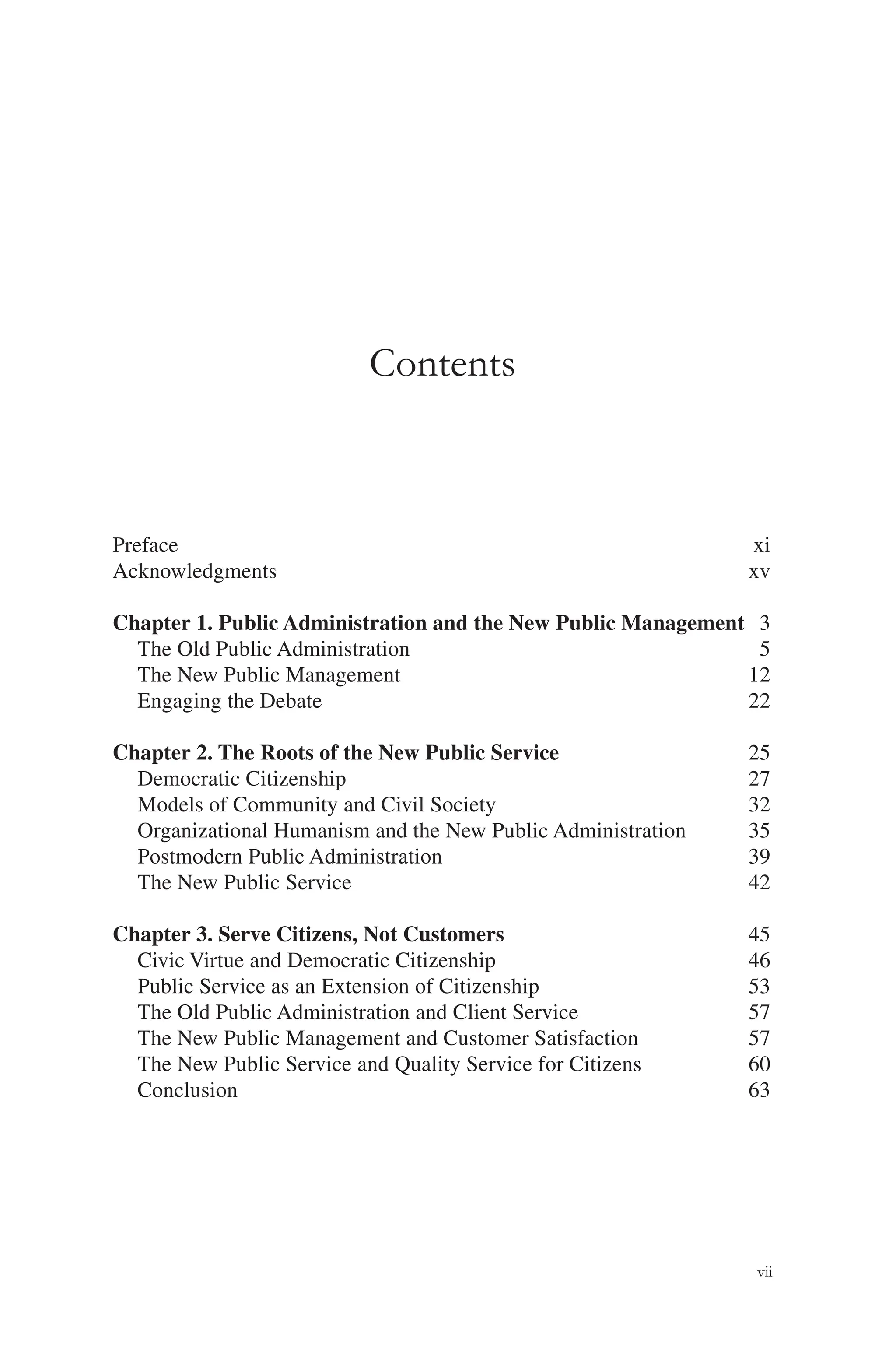
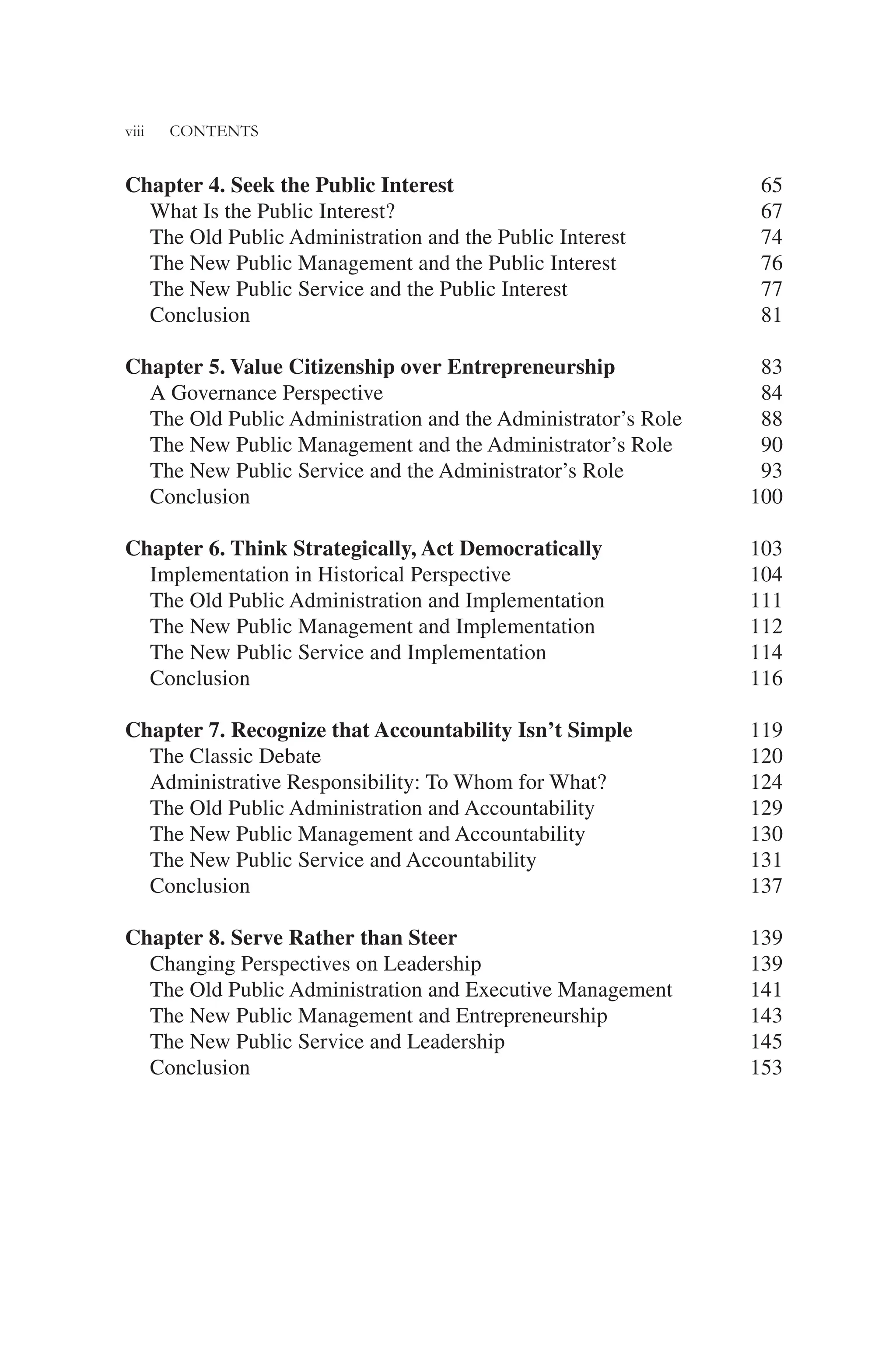




![14 PUBLIC ADMINISTRATION AND THE NEW PUBLIC MANAGEMENT
ing top executives accountable for measurable performance goals, establishing
new processes for measuring productivity and effectiveness, and reengineering
departmental systems to reflect a strengthened commitment to accountability
(Barzelay 2001; Boston et al. 1996; Pollitt and Bouckaert 2000).
Donald Kettl of the Brookings Institution sees what he calls the “global
public management reform” focusing on six core issues:
1. How can governments find ways to squeeze more services from the
same or a smaller revenue base?
2. How can government use market-style incentives to root out the pa-
thologies of bureaucracy; how can traditional bureaucratic command-
and-control mechanisms be replaced with market strategies that will
change the behavior of program managers?
3. How can government use market mechanisms to give citizens (now
often called “customers”) greater choices among services—or at least
encourage greater attention to serving customers better?
4. How can government make programs more responsive? How can gov-
ernment decentralize responsibility to give front-line managers greater
incentives to serve?
5. How can government improve its capacity to devise and track policy?
How can government separate its role as a purchaser of services (a
contractor) from its role in actually delivering services?
6. How can governments focus on outputs and outcomes instead of
processes or structures? How can they replace top-down, rule-driven
systems with bottom-up, results-driven systems? (Adapted from Kettl
2000a, 1–2)
Similarly, New Zealand’s Jonathon Boston had earlier characterized the
central features or doctrines of the New Public Management, as follows:
[An] emphasis on management rather than policy; a shift from the use
of input controls . . . to a reliance on quantifiable output measures and
performance targets; the devolution of management control coupled
with the development of new reporting, monitoring, and accountability
mechanisms; the disaggregation of large bureaucratic structures into
quasi-autonomous agencies, in particular the separation of commercial
from non-commercial functions . . . ; a preference for private ownership,
contracting out, and contestability in public service provision; the imitation
of certain private sector management practices, such as . . . the develop-
ment of corporate plans (and) performance agreements, the introduction of
performance-linked remuneration systems, . . . and a greater concern for](https://image.slidesharecdn.com/88834-250226093814-9b1fad0d/75/The-New-Public-Service-Serving-Not-Steering-Janet-Vinzant-Denhardt-35-2048.jpg)