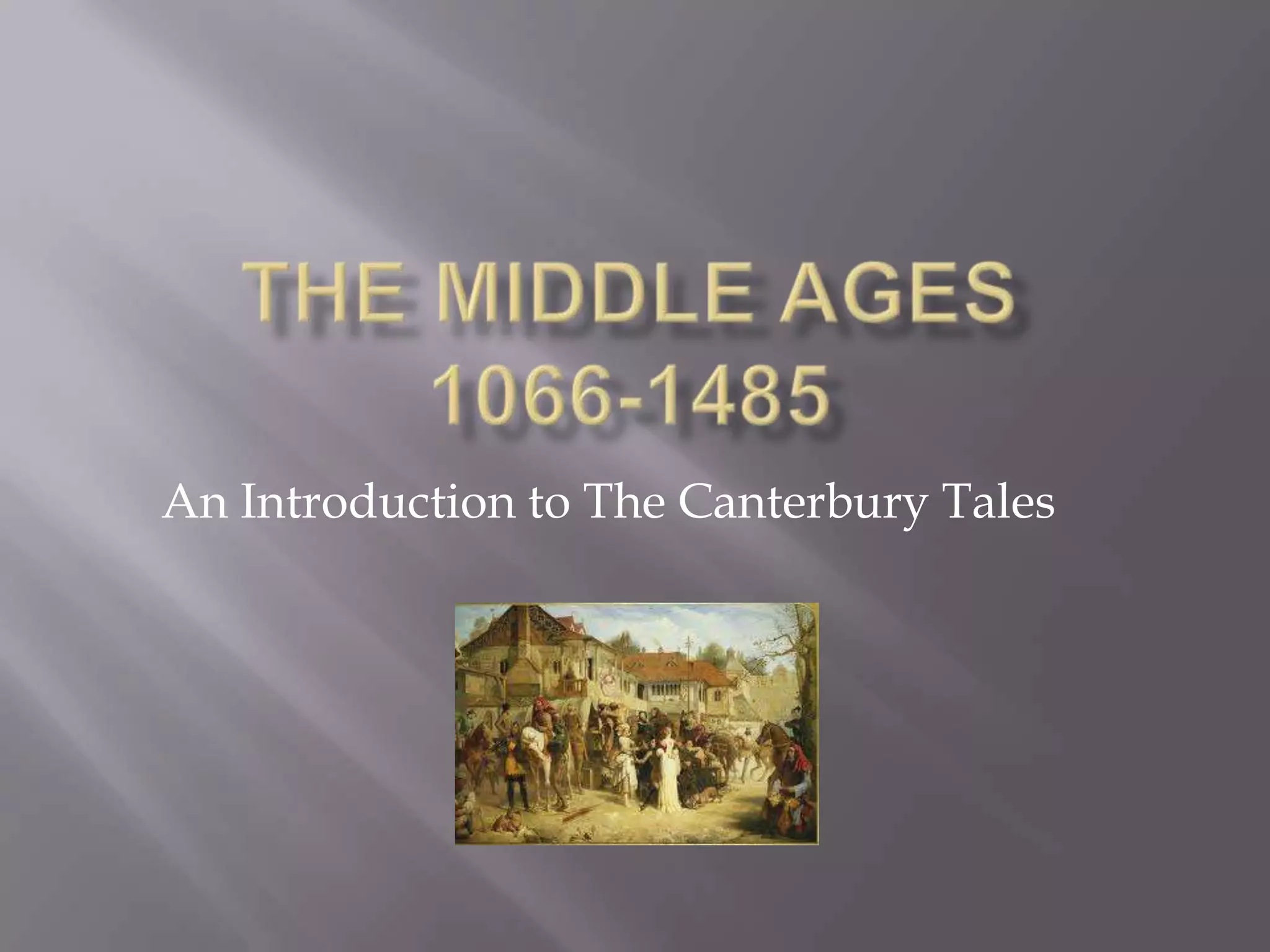
An Introduction to The Canterbury Tales
   The Doomsday Book: Survey of all the lands
    and possessions of England

   The Magna Carta: Allowed for the formation of
    a powerful parliament
     The Church - The Church was to be free from royal
      interference, especially in the election of bishops
     Taxes - No taxes except the regular feudal dues were to be
      levied, except by the consent of the Great Council, or Parliament
     The right to due process which led to Trial by Jury
     Weights and Measures - All weights and measures to be kept
      uniform throughout the realm
   Key Dates relating to the event: This terrible plague started in Europe in 1328 and lasted
    until 1351 although there were outbreaks for the next sixty years
   Why was the disease called the Black Death? The disease was called the Black Death
    because one of the symptoms produced a blackening of the skin around the swellings. or
    buboes. The buboes were red at first, but later turned a dark purple, or black. When a
    victim's blood was let the blood that exuded was black, thick and vile smelling with a
    greenish scum mixed in it.
   How the disease was spread: The Black Death was spread by fleas that were carried by rats
    or other small rodents
   The spread of the Black Death followed all of the Trade Routes to every country
   The Black Death of the Middle Ages was believed to have originated in the Gobi Desert
   Key People relating to the event: Nearly one third of the population of died - about 200
    million people in Europe
   The 1328 outbreak in China caused the population to drop from 125 million to 90 million in
    just fifty years
   7500 victims of the disease were dying every day
   The Black Death in England raged from 1348-1350
   Why the Black Death was important to the history of England: The population drop resulted
    in a higher value being placed on labor - the Peasants Revolt followed in 1381. Farming
    changed and the wool industry boomed. People became disillusioned with the church and
    its power and influence went into decline. This ultimately resulted in the English
    reformation
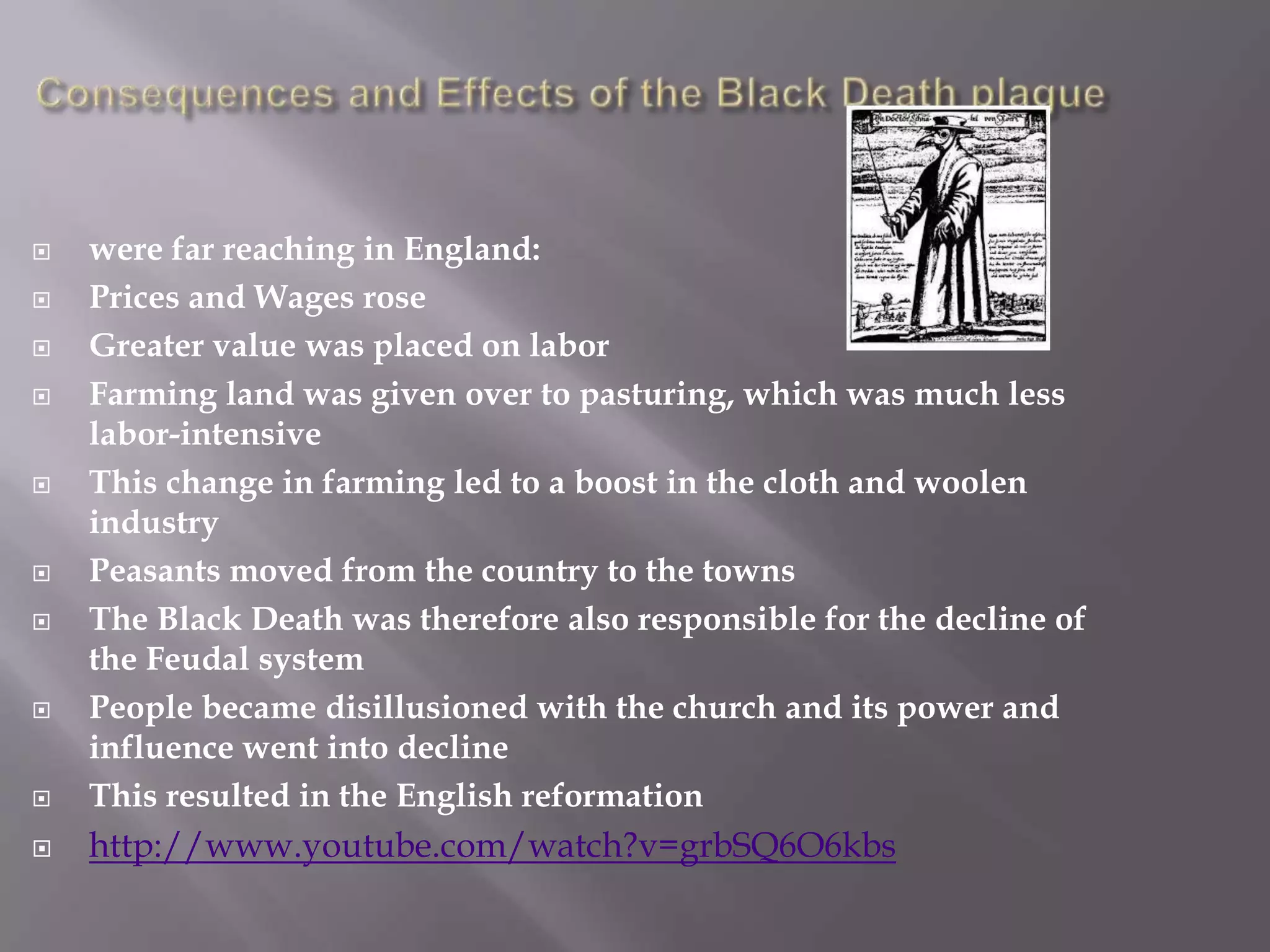
   were far reaching in England:
   Prices and Wages rose
   Greater value was placed on labor
   Farming land was given over to pasturing, which was much less
    labor-intensive
   This change in farming led to a boost in the cloth and woolen
    industry
   Peasants moved from the country to the towns
   The Black Death was therefore also responsible for the decline of
    the Feudal system
   People became disillusioned with the church and its power and
    influence went into decline
   This resulted in the English reformation
   http://www.youtube.com/watch?v=grbSQ6O6kbs
   Feudalism in England was established by William the
    Conqueror and the Normans following the defeat of the English
    Anglo Saxons at the Battle of Hastings in 1066. The system and
    structure of feudalism had been well established in Europe for
    some time and the Normans imposed feudalism in England.


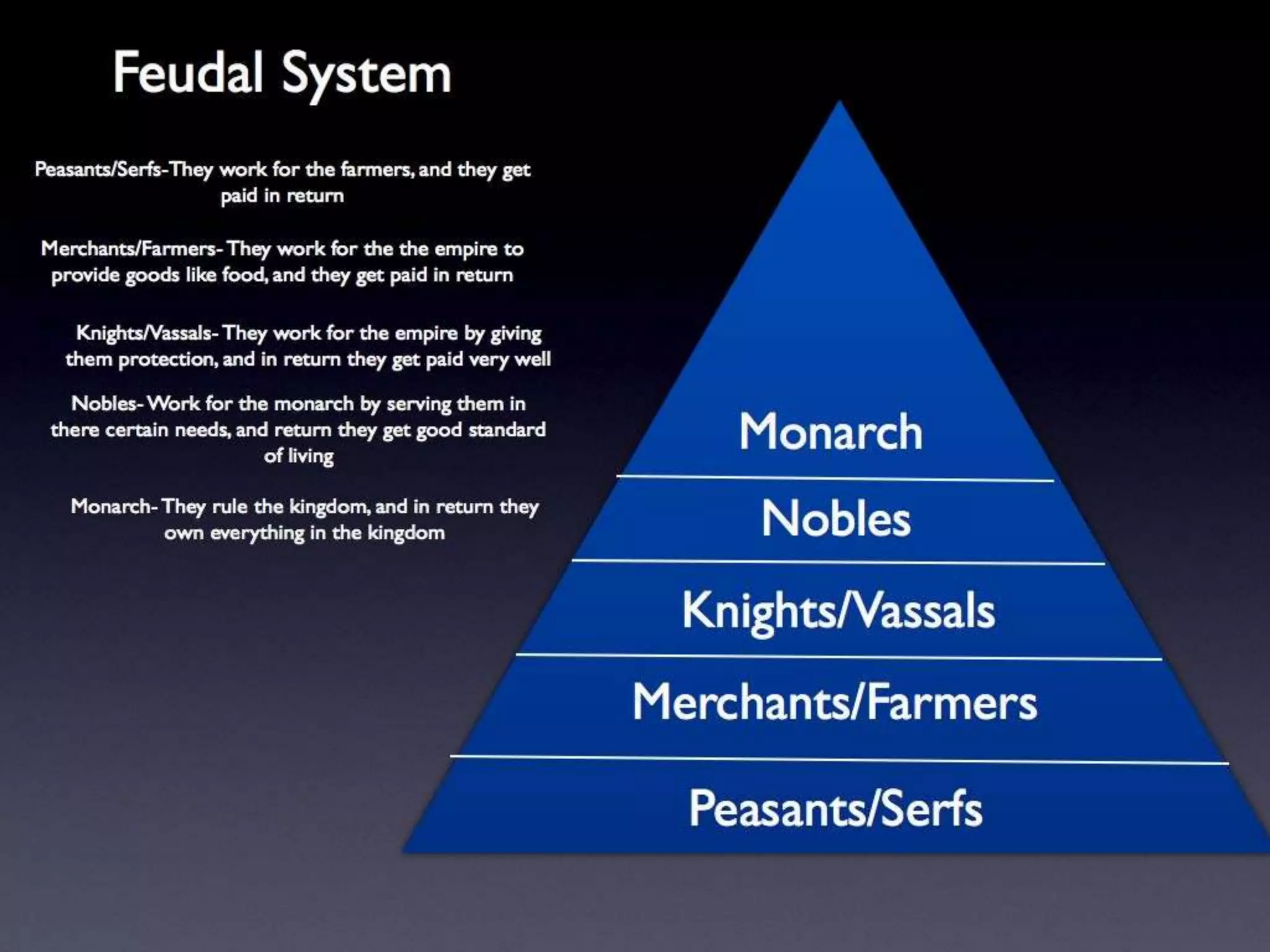
   Feudalism was based on the exchange of land for military
    service. King William the Conqueror used the concept of
    feudalism to reward his Norman supporters for their help
    in the conquest of England. Life lived under the Medieval
    Feudal System, or Feudalism, demanded that everyone
    owed allegiance to the King and their immediate superior.
http://www.youtube.com/watch?v=Qaxzwlg9N_Q


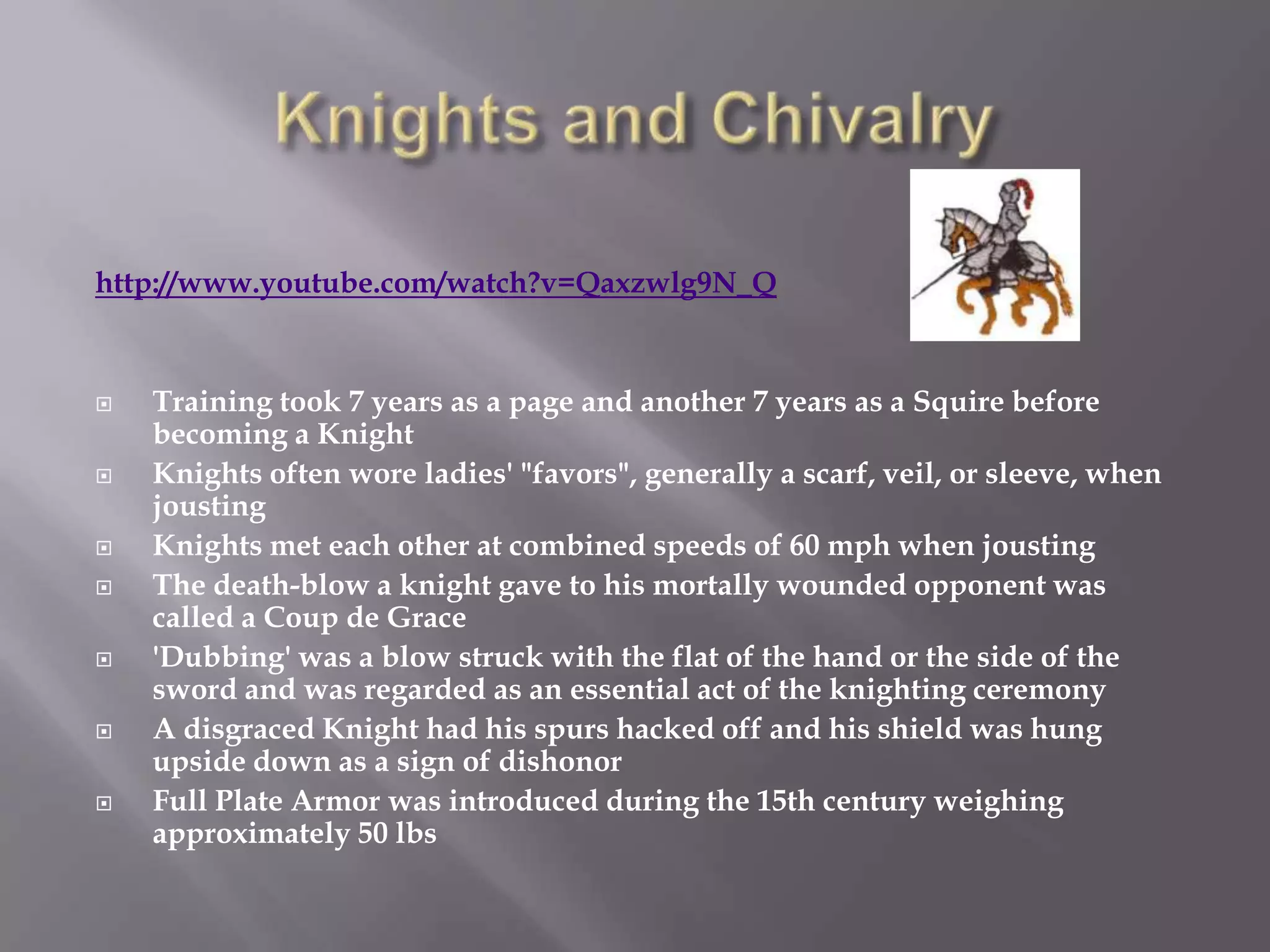
   Training took 7 years as a page and another 7 years as a Squire before
    becoming a Knight
   Knights often wore ladies' "favors", generally a scarf, veil, or sleeve, when
    jousting
   Knights met each other at combined speeds of 60 mph when jousting
   The death-blow a knight gave to his mortally wounded opponent was
    called a Coup de Grace
   'Dubbing' was a blow struck with the flat of the hand or the side of the
    sword and was regarded as an essential act of the knighting ceremony
   A disgraced Knight had his spurs hacked off and his shield was hung
    upside down as a sign of dishonor
   Full Plate Armor was introduced during the 15th century weighing
    approximately 50 lbs
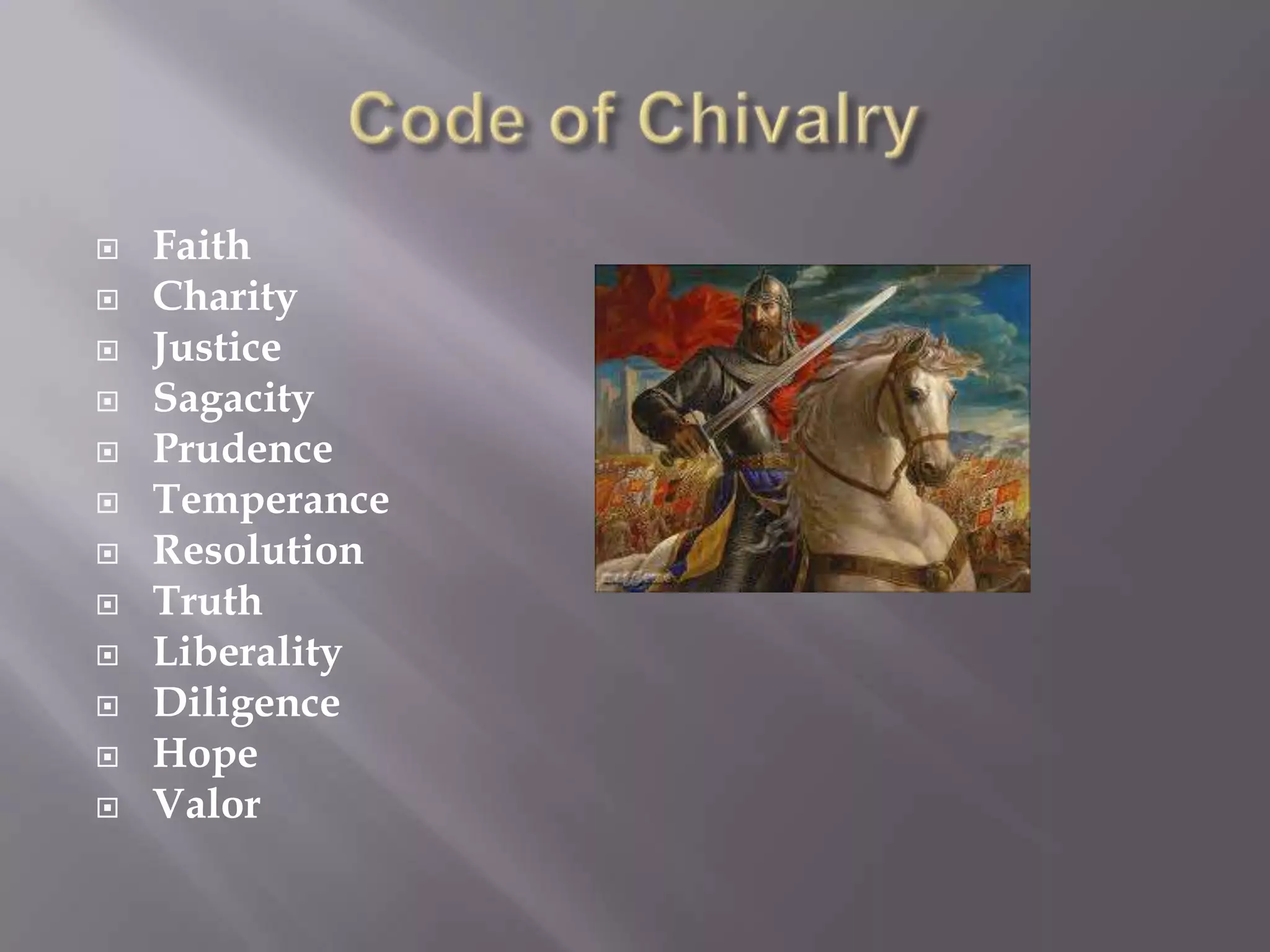
   Faith
   Charity
   Justice
   Sagacity
   Prudence
   Temperance
   Resolution
   Truth
   Liberality
   Diligence
   Hope
   Valor
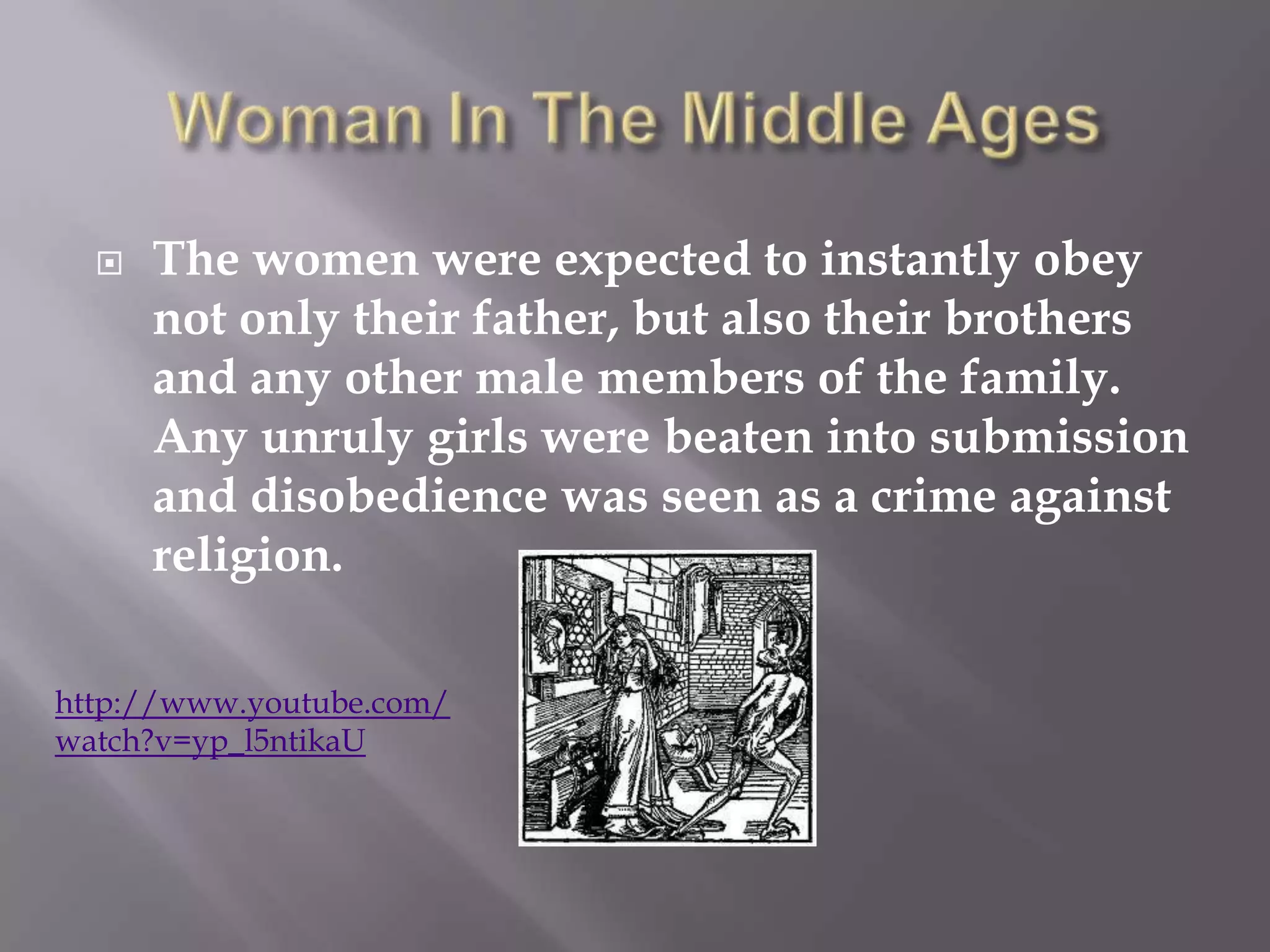
   The women were expected to instantly obey
      not only their father, but also their brothers
      and any other male members of the family.
      Any unruly girls were beaten into submission
      and disobedience was seen as a crime against
      religion.

http://www.youtube.com/
watch?v=yp_l5ntikaU
   The daily life of a peasant woman started at started in the summer as early as 3am
   She first had to prepare a breakfast, usually of pottage
   Work in the fields or on the land started by dawn and the daily life of a peasant
    woman during the Middle Ages would include this type of hard work during busy
    times especially harvest
   Preparations had to be started in order to provide the daily meals
   Peasant women were expected to look after small animals - geese, chickens etc
   Weaving, spinning and making and mending clothes were also part of a woman's
    work
   Preparing rushes for lighting
   Making preserves
   Tending the vegetable plot and collecting berries and herbs
   Women were also responsible for the children and need an understanding of
    medicines and herbs for basic nursing requirements
   Outside work finished at dusk, working hours were therefore longer during the
    summer months
   Women generally ate when her husband and children had finished and had little
    leisure time
   Nationality: English
   Also Known by the Nickname: Father of English Literature
   Family connections : He was the son of a vintner
   Education: Geoffrey Chaucer was well educated and studied law
    at the Inner Temple in London
   Career: Geoffrey Chaucer was an author, poet, philosopher,
    courtier, and diplomat.
   Date of Death: Geoffrey Chaucer died in 1400 ( his exact date of
    death is unknown)
   Character of Geoffrey Chaucer: Intelligent, loyal and hard
    working
   Accomplishments or why Geoffrey Chaucer was famous: as the
    author of Canterbury Tales. Geoffrey Chaucer also wrote 'The
    Book of the Duchess' which was an elegy for Blanche of
    Lancaster who was the first wife of John of Gaunt.
   The work was never finished, but what was
    written amounted to about 17,000 lines, written for
    the most part in heroic couplets.
   In The Canterbury Tales, a party of twenty-nine
    pilgrims gathers at the Tabard Inn in Southwark in
    preparation for their pilgrimage to the shrine of
    Thomas Becket in Canterbury. The host of the inn
    proposes to go along on the pilgrimage as
    guide, and as a way to pass the time he suggests
    that the pilgrims each tell two stories on the way
    out and on the way back. That would mean a total
    of 116 tales all together. The pilgrim with the best
    stories would have a free dinner once all are
    returned to Southwark.
   The work of The Canterbury Tales begins with a General
    Prologue, which is what in medieval terms is called an “estates
    satire.” “Estate” is a term for “class.” So it is a survey of the
    various “classes” of late medieval society.

   Each class is represented by a group of figures. The knight and
    squire represent the nobility. The monk and prioress represent the
    religious orders. At the other end of the social spectrum are the
    Parson and Plowman. They are idealized types, shining examples
    of the pious, hardworking and dutiful lower orders.

   The “satire” aspect comes from the fact that all these characters are
    often figures of fun. They are there to be ridiculed, or
    censured, or, occasionally, admired. People have often wondered
    why Chaucer put the Tales together. He is actually playing with
    the “estates satire” to give a picture of a society in the process of
    change in the England of the 1380s and 1390s.
   Chaucer's decision to write in his country's
    language, English, rather than in the Latin of so
    many of his educated colleagues, was something of
    a risk, and a big break with learned tradition.
   The risk paid off – we know The Canterbury Tales
    were enormously popular because so many more
    manuscripts of the tales survived than almost any
    other work of this time period.
   The Canterbury Tales were still going strong when
    the first printers made their way to England.
    William Caxton published the first printed version
    of The Canterbury Tales in 1470.
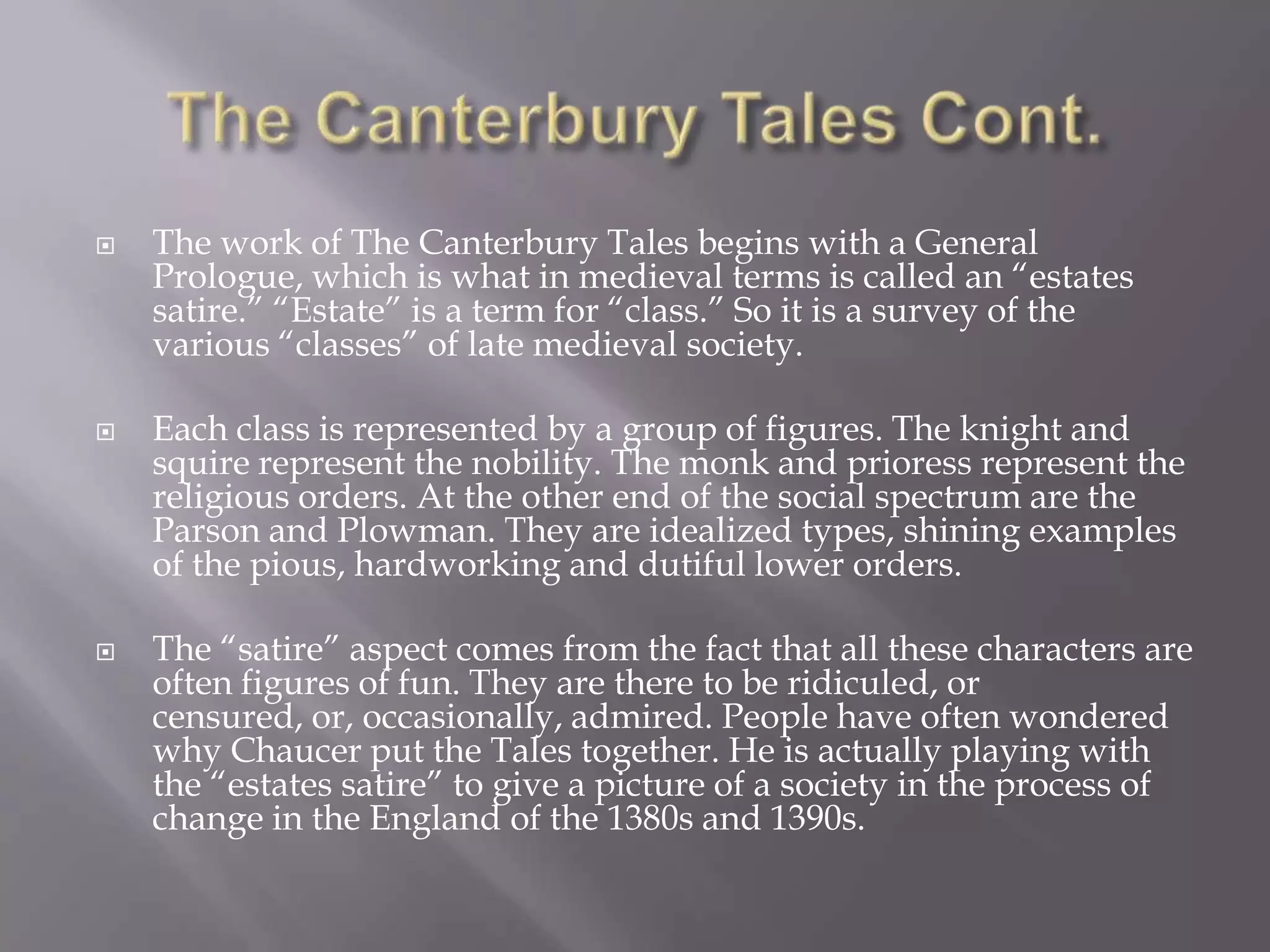
http://www.youtube.com/watch?v=4E-
   0PaK4RtI


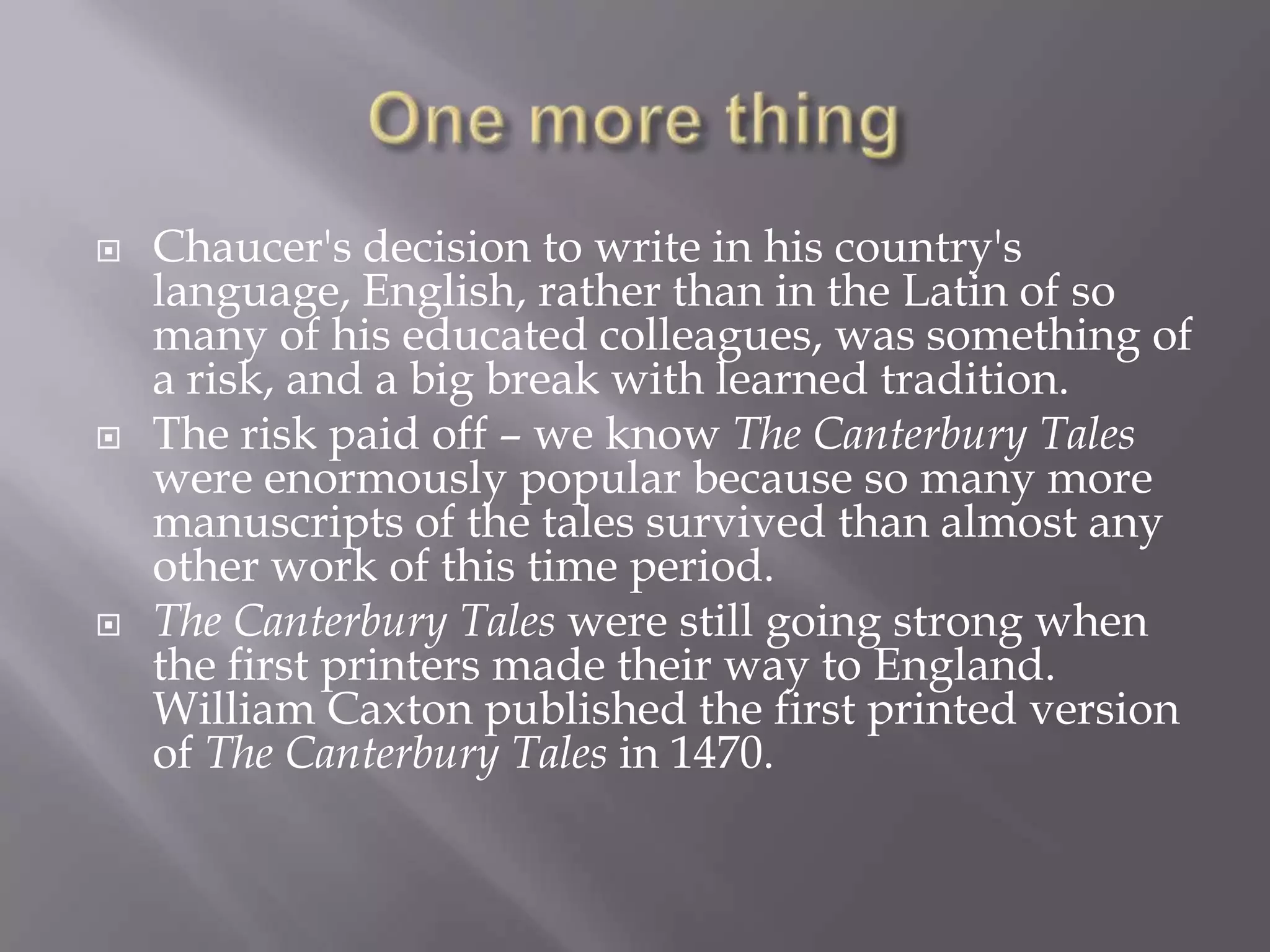
http://www.youtube.com/watch?v=caIlw
Ci6JCc
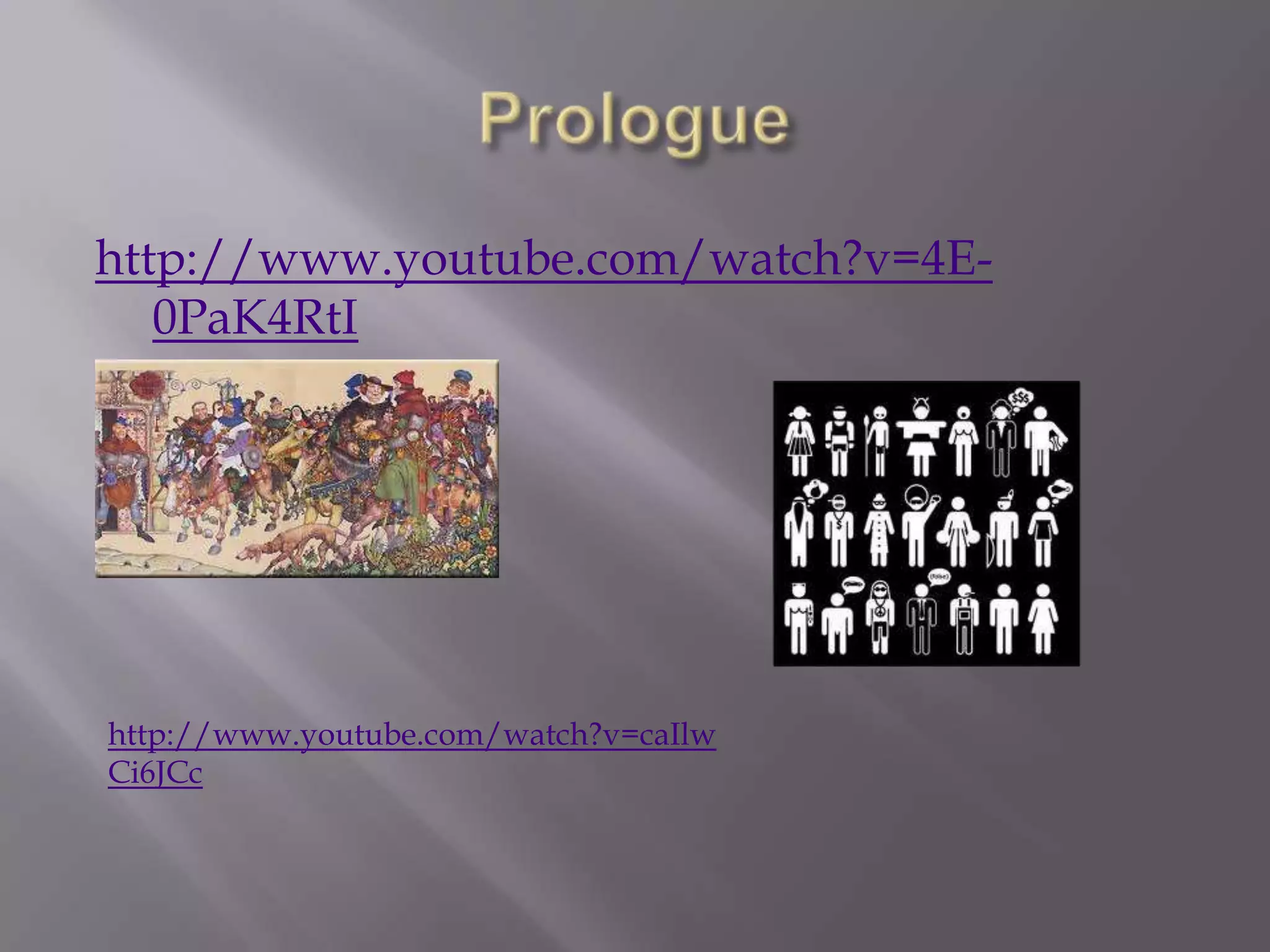
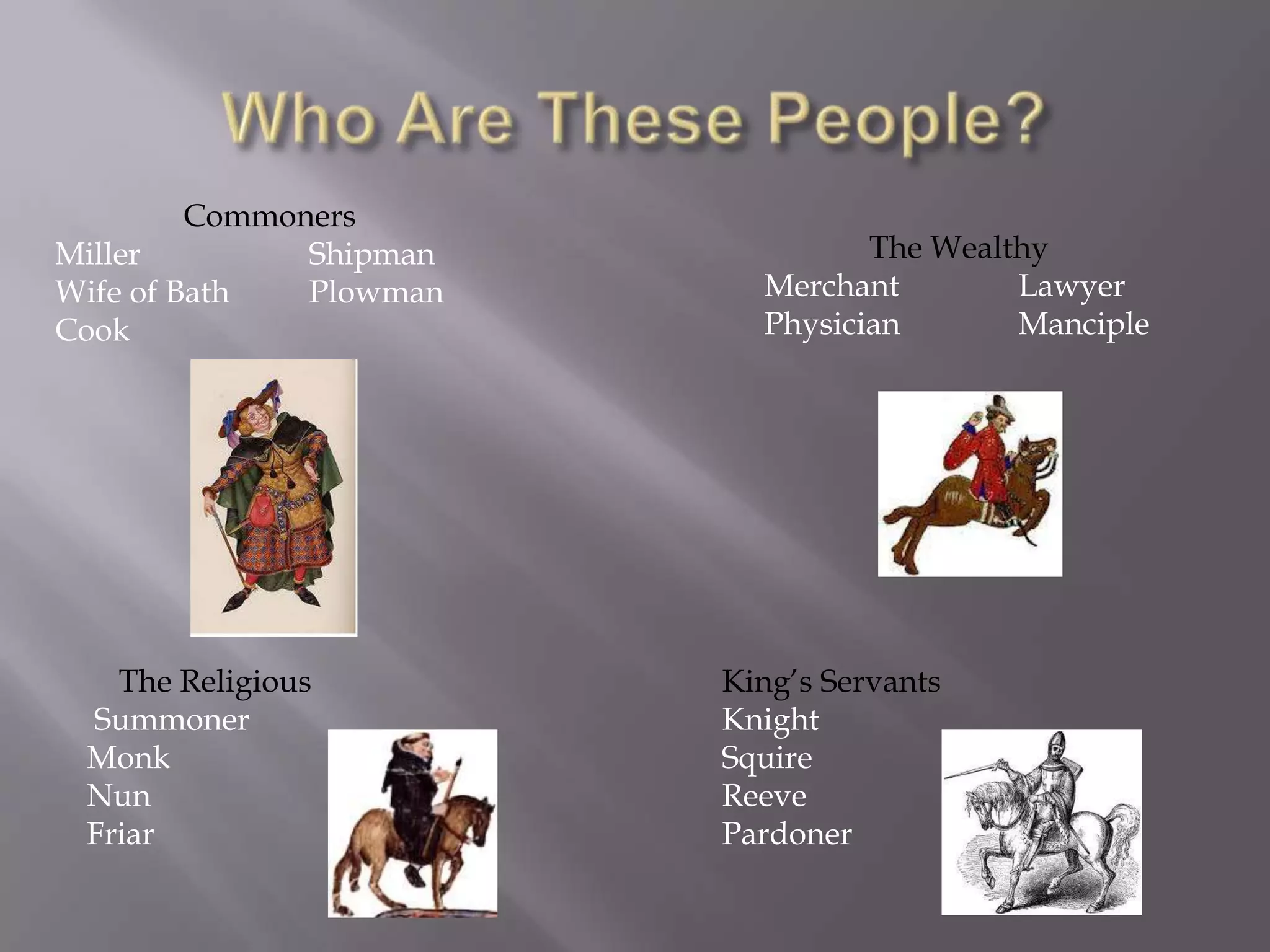
Commoners
Miller         Shipman            The Wealthy
Wife of Bath   Plowman     Merchant        Lawyer
Cook                       Physician       Manciple


   The Religious         King’s Servants
 Summoner                Knight
 Monk                    Squire
 Nun                     Reeve
 Friar                   Pardoner

The middle ages

  • 1.
    An Introduction toThe Canterbury Tales
  • 2.
    The Doomsday Book: Survey of all the lands and possessions of England  The Magna Carta: Allowed for the formation of a powerful parliament  The Church - The Church was to be free from royal interference, especially in the election of bishops  Taxes - No taxes except the regular feudal dues were to be levied, except by the consent of the Great Council, or Parliament  The right to due process which led to Trial by Jury  Weights and Measures - All weights and measures to be kept uniform throughout the realm
  • 3.
    Key Dates relating to the event: This terrible plague started in Europe in 1328 and lasted until 1351 although there were outbreaks for the next sixty years  Why was the disease called the Black Death? The disease was called the Black Death because one of the symptoms produced a blackening of the skin around the swellings. or buboes. The buboes were red at first, but later turned a dark purple, or black. When a victim's blood was let the blood that exuded was black, thick and vile smelling with a greenish scum mixed in it.  How the disease was spread: The Black Death was spread by fleas that were carried by rats or other small rodents  The spread of the Black Death followed all of the Trade Routes to every country  The Black Death of the Middle Ages was believed to have originated in the Gobi Desert  Key People relating to the event: Nearly one third of the population of died - about 200 million people in Europe  The 1328 outbreak in China caused the population to drop from 125 million to 90 million in just fifty years  7500 victims of the disease were dying every day  The Black Death in England raged from 1348-1350  Why the Black Death was important to the history of England: The population drop resulted in a higher value being placed on labor - the Peasants Revolt followed in 1381. Farming changed and the wool industry boomed. People became disillusioned with the church and its power and influence went into decline. This ultimately resulted in the English reformation
  • 4.
    were far reaching in England:  Prices and Wages rose  Greater value was placed on labor  Farming land was given over to pasturing, which was much less labor-intensive  This change in farming led to a boost in the cloth and woolen industry  Peasants moved from the country to the towns  The Black Death was therefore also responsible for the decline of the Feudal system  People became disillusioned with the church and its power and influence went into decline  This resulted in the English reformation  http://www.youtube.com/watch?v=grbSQ6O6kbs
  • 5.
    Feudalism in England was established by William the Conqueror and the Normans following the defeat of the English Anglo Saxons at the Battle of Hastings in 1066. The system and structure of feudalism had been well established in Europe for some time and the Normans imposed feudalism in England.  Feudalism was based on the exchange of land for military service. King William the Conqueror used the concept of feudalism to reward his Norman supporters for their help in the conquest of England. Life lived under the Medieval Feudal System, or Feudalism, demanded that everyone owed allegiance to the King and their immediate superior.
  • 7.
    http://www.youtube.com/watch?v=Qaxzwlg9N_Q  Training took 7 years as a page and another 7 years as a Squire before becoming a Knight  Knights often wore ladies' "favors", generally a scarf, veil, or sleeve, when jousting  Knights met each other at combined speeds of 60 mph when jousting  The death-blow a knight gave to his mortally wounded opponent was called a Coup de Grace  'Dubbing' was a blow struck with the flat of the hand or the side of the sword and was regarded as an essential act of the knighting ceremony  A disgraced Knight had his spurs hacked off and his shield was hung upside down as a sign of dishonor  Full Plate Armor was introduced during the 15th century weighing approximately 50 lbs
  • 8.
    Faith  Charity  Justice  Sagacity  Prudence  Temperance  Resolution  Truth  Liberality  Diligence  Hope  Valor
  • 9.
    The women were expected to instantly obey not only their father, but also their brothers and any other male members of the family. Any unruly girls were beaten into submission and disobedience was seen as a crime against religion. http://www.youtube.com/ watch?v=yp_l5ntikaU
  • 10.
    The daily life of a peasant woman started at started in the summer as early as 3am  She first had to prepare a breakfast, usually of pottage  Work in the fields or on the land started by dawn and the daily life of a peasant woman during the Middle Ages would include this type of hard work during busy times especially harvest  Preparations had to be started in order to provide the daily meals  Peasant women were expected to look after small animals - geese, chickens etc  Weaving, spinning and making and mending clothes were also part of a woman's work  Preparing rushes for lighting  Making preserves  Tending the vegetable plot and collecting berries and herbs  Women were also responsible for the children and need an understanding of medicines and herbs for basic nursing requirements  Outside work finished at dusk, working hours were therefore longer during the summer months  Women generally ate when her husband and children had finished and had little leisure time
  • 11.
    Nationality: English  Also Known by the Nickname: Father of English Literature  Family connections : He was the son of a vintner  Education: Geoffrey Chaucer was well educated and studied law at the Inner Temple in London  Career: Geoffrey Chaucer was an author, poet, philosopher, courtier, and diplomat.  Date of Death: Geoffrey Chaucer died in 1400 ( his exact date of death is unknown)  Character of Geoffrey Chaucer: Intelligent, loyal and hard working  Accomplishments or why Geoffrey Chaucer was famous: as the author of Canterbury Tales. Geoffrey Chaucer also wrote 'The Book of the Duchess' which was an elegy for Blanche of Lancaster who was the first wife of John of Gaunt.
  • 12.
    The work was never finished, but what was written amounted to about 17,000 lines, written for the most part in heroic couplets.  In The Canterbury Tales, a party of twenty-nine pilgrims gathers at the Tabard Inn in Southwark in preparation for their pilgrimage to the shrine of Thomas Becket in Canterbury. The host of the inn proposes to go along on the pilgrimage as guide, and as a way to pass the time he suggests that the pilgrims each tell two stories on the way out and on the way back. That would mean a total of 116 tales all together. The pilgrim with the best stories would have a free dinner once all are returned to Southwark.
  • 13.
    The work of The Canterbury Tales begins with a General Prologue, which is what in medieval terms is called an “estates satire.” “Estate” is a term for “class.” So it is a survey of the various “classes” of late medieval society.  Each class is represented by a group of figures. The knight and squire represent the nobility. The monk and prioress represent the religious orders. At the other end of the social spectrum are the Parson and Plowman. They are idealized types, shining examples of the pious, hardworking and dutiful lower orders.  The “satire” aspect comes from the fact that all these characters are often figures of fun. They are there to be ridiculed, or censured, or, occasionally, admired. People have often wondered why Chaucer put the Tales together. He is actually playing with the “estates satire” to give a picture of a society in the process of change in the England of the 1380s and 1390s.
  • 14.
    Chaucer's decision to write in his country's language, English, rather than in the Latin of so many of his educated colleagues, was something of a risk, and a big break with learned tradition.  The risk paid off – we know The Canterbury Tales were enormously popular because so many more manuscripts of the tales survived than almost any other work of this time period.  The Canterbury Tales were still going strong when the first printers made their way to England. William Caxton published the first printed version of The Canterbury Tales in 1470.
  • 15.
    http://www.youtube.com/watch?v=4E- 0PaK4RtI http://www.youtube.com/watch?v=caIlw Ci6JCc
  • 16.
    Commoners Miller Shipman The Wealthy Wife of Bath Plowman Merchant Lawyer Cook Physician Manciple The Religious King’s Servants Summoner Knight Monk Squire Nun Reeve Friar Pardoner