Analysis of the major themes
  and climax of Macbeth

          by
 Basmah Mahdi AL-Bogami
       0879474
Major Themes

Ambition

Deception

Temptation

Guilt

Loyalty
Ambition

The theme of ambition in Macbeth is linked to that of
good and evil. Like many other passions and impulses,
ambition can be both foul and fair. Through Macbeth,
we see that it can be fair when put to good uses, and
when it is kept in check by one’s sense of right and
wrong. But ambition is foul when it becomes so
powerful that it destroys a person’s morality.

Unleashed, such ambition wreaks havoc on the
individual, and on his society.

Macbeth and Lady Macbeth are driven by the ambition
for personal status, and for power. The play is deeply
concerned with political power: with the power of a
king over his subjects, and with the good and bad uses
of power. The ideal is a king who governs wisely, justly,
and strongly.
Deception
    In Macbeth, evil frequently wears a pretty cloak. Early in the play, the three witches
declare that “fair is foul,” a paradox suggesting that whatever appears good is really bad. For
example, murdering Duncan appears to be a “fair” idea to Macbeth and Lady Macbeth, for
Macbeth would accede to the throne. But Macbeth soon discovers that only bad has come
of their deed, and their very lives–and immortal souls–are in jeopardy. Macbeth also
perceives the prophecies made by the “armed head” and the “bloody child” as good omens;
in fact, these prophecies are deceptive wordplays that foretell Macbeth’s downfall.
The theme of deception can also be found when Duncan was deceived by the Thane of
Cawdor“ earlier in the play and rewarded Macbeth with his title who eventually became a
traitor.
  Other quotations that describes this theme are the following:
Look like the innocent flower,
But be the serpent under ’t.

Away, and mock the time with fairest show:
False face must hide what the false heart doth know.

To show an unfelt sorrow is an office
Which the false man does easy.
One cannot read a man’s mind in his face. Our outward appearance does not reveal our
inward thoughts/plans.
Temptation

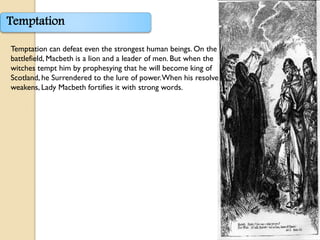
Temptation can defeat even the strongest human beings. On the
battlefield, Macbeth is a lion and a leader of men. But when the
witches tempt him by prophesying that he will become king of
Scotland, he Surrendered to the lure of power. When his resolve
weakens, Lady Macbeth fortifies it with strong words.
Loyalty

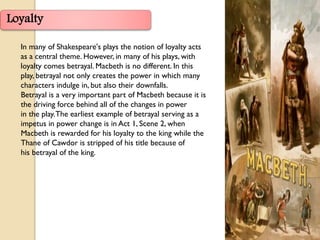
  In many of Shakespeare's plays the notion of loyalty acts
  as a central theme. However, in many of his plays, with
  loyalty comes betrayal. Macbeth is no different. In this
  play, betrayal not only creates the power in which many
  characters indulge in, but also their downfalls.
  Betrayal is a very important part of Macbeth because it is
  the driving force behind all of the changes in power
  in the play. The earliest example of betrayal serving as a
  impetus in power change is in Act 1, Scene 2, when
  Macbeth is rewarded for his loyalty to the king while the
  Thane of Cawdor is stripped of his title because of
  his betrayal of the king.
Guilt

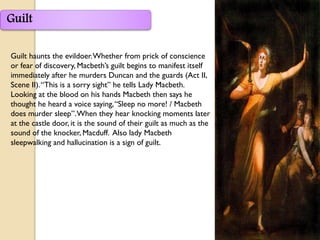
Guilt haunts the evildoer. Whether from prick of conscience
or fear of discovery, Macbeth’s guilt begins to manifest itself
immediately after he murders Duncan and the guards (Act II,
Scene II). “This is a sorry sight” he tells Lady Macbeth.
Looking at the blood on his hands Macbeth then says he
thought he heard a voice saying, “Sleep no more! / Macbeth
does murder sleep”. When they hear knocking moments later
at the castle door, it is the sound of their guilt as much as the
sound of the knocker, Macduff. Also lady Macbeth
sleepwalking and hallucination is a sign of guilt.
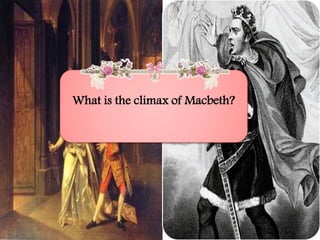
What is the climax of Macbeth?
The Climax
1)The turning point in a plot or dramatic action, especially one marking
                 a change in the protagonist's affairs.

2)The turning point at which the conflict begins to resolve itself for better
                                 or worse.
There have been a great debate about the climax of Macbeth which are:


   Macbeth’s murder of Duncan in Act 2 represents the point of no return, after which
  Macbeth is forced to continue butchering his subjects to avoid the consequences of his
  crime.

   At the banquet scene, Macbeth can no longer hide his torment and guilt. He
  incriminates himself saying "Thou canst say I did it." From this point forward in the play,
  there is no hope for Macbeth. His mind and his country sink into chaos. It is obvious that
  he is beyond the point of recovery, and his story will end tragically.

  When the prophecies of the witches become true in act 5; Macbeth discover that he
  was deceived by the witches and left to face his death in the battle field.
References:


http://www.pinkmonkey.com/booknotes/monkeynot
es/pmMacbeth04.asp

http://www.sparknotes.com/shakespeare/macbeth/
The major themes by basmah

The major themes by basmah

  • 1.
    Analysis of themajor themes and climax of Macbeth by Basmah Mahdi AL-Bogami 0879474
  • 2.
  • 3.
    Ambition The theme ofambition in Macbeth is linked to that of good and evil. Like many other passions and impulses, ambition can be both foul and fair. Through Macbeth, we see that it can be fair when put to good uses, and when it is kept in check by one’s sense of right and wrong. But ambition is foul when it becomes so powerful that it destroys a person’s morality. Unleashed, such ambition wreaks havoc on the individual, and on his society. Macbeth and Lady Macbeth are driven by the ambition for personal status, and for power. The play is deeply concerned with political power: with the power of a king over his subjects, and with the good and bad uses of power. The ideal is a king who governs wisely, justly, and strongly.
  • 4.
    Deception In Macbeth, evil frequently wears a pretty cloak. Early in the play, the three witches declare that “fair is foul,” a paradox suggesting that whatever appears good is really bad. For example, murdering Duncan appears to be a “fair” idea to Macbeth and Lady Macbeth, for Macbeth would accede to the throne. But Macbeth soon discovers that only bad has come of their deed, and their very lives–and immortal souls–are in jeopardy. Macbeth also perceives the prophecies made by the “armed head” and the “bloody child” as good omens; in fact, these prophecies are deceptive wordplays that foretell Macbeth’s downfall. The theme of deception can also be found when Duncan was deceived by the Thane of Cawdor“ earlier in the play and rewarded Macbeth with his title who eventually became a traitor. Other quotations that describes this theme are the following: Look like the innocent flower, But be the serpent under ’t. Away, and mock the time with fairest show: False face must hide what the false heart doth know. To show an unfelt sorrow is an office Which the false man does easy. One cannot read a man’s mind in his face. Our outward appearance does not reveal our inward thoughts/plans.
  • 5.
    Temptation Temptation can defeateven the strongest human beings. On the battlefield, Macbeth is a lion and a leader of men. But when the witches tempt him by prophesying that he will become king of Scotland, he Surrendered to the lure of power. When his resolve weakens, Lady Macbeth fortifies it with strong words.
  • 6.
    Loyalty Inmany of Shakespeare's plays the notion of loyalty acts as a central theme. However, in many of his plays, with loyalty comes betrayal. Macbeth is no different. In this play, betrayal not only creates the power in which many characters indulge in, but also their downfalls. Betrayal is a very important part of Macbeth because it is the driving force behind all of the changes in power in the play. The earliest example of betrayal serving as a impetus in power change is in Act 1, Scene 2, when Macbeth is rewarded for his loyalty to the king while the Thane of Cawdor is stripped of his title because of his betrayal of the king.
  • 7.
    Guilt Guilt haunts theevildoer. Whether from prick of conscience or fear of discovery, Macbeth’s guilt begins to manifest itself immediately after he murders Duncan and the guards (Act II, Scene II). “This is a sorry sight” he tells Lady Macbeth. Looking at the blood on his hands Macbeth then says he thought he heard a voice saying, “Sleep no more! / Macbeth does murder sleep”. When they hear knocking moments later at the castle door, it is the sound of their guilt as much as the sound of the knocker, Macduff. Also lady Macbeth sleepwalking and hallucination is a sign of guilt.
  • 8.
    What is theclimax of Macbeth?
  • 9.
    The Climax 1)The turningpoint in a plot or dramatic action, especially one marking a change in the protagonist's affairs. 2)The turning point at which the conflict begins to resolve itself for better or worse.
  • 10.
    There have beena great debate about the climax of Macbeth which are:  Macbeth’s murder of Duncan in Act 2 represents the point of no return, after which Macbeth is forced to continue butchering his subjects to avoid the consequences of his crime.  At the banquet scene, Macbeth can no longer hide his torment and guilt. He incriminates himself saying "Thou canst say I did it." From this point forward in the play, there is no hope for Macbeth. His mind and his country sink into chaos. It is obvious that he is beyond the point of recovery, and his story will end tragically. When the prophecies of the witches become true in act 5; Macbeth discover that he was deceived by the witches and left to face his death in the battle field.
  • 11.