The language of the
                            user interface.
                                Ajay Ganapathy


Tuesday, January 22, 13
Examples of languages
                    • Spoken language
                    • sign language
                    • written language
                    • body language
                    • design language
                    • programming language
                    • mathematical language
Tuesday, January 22, 13
Languages aren’t just
                                spoken!


Tuesday, January 22, 13
language |ˈlaNGgwij|
    noun
    1 the method of human communication, either spoken or written, consisting of the use of words in a
    structured and conventional way: a study of the way children learn language | [ as modifier ] : language
    development.
    • any nonverbal method of expression or communication: a language of gesture and facial expression.
    2 the system of communication used by a particular community or country: the book was translated into
    twenty-five languages.
    • Computing a system of symbols and rules for writing programs or algorithms: a new programming
    language.
    3 the manner or style of a piece of writing or speech: he explained the procedure in simple, everyday language.
    • the phraseology and vocabulary of a certain profession, domain, or group of people: legal language.
    • (usu. as bad/strong language) coarse, crude, or offensive language: strong language.
    PHRASES
    speak the same language understand one another as a result of shared opinions or values.
    ORIGIN Middle English: from Old French langage, based on Latin lingua ‘tongue.’


Tuesday, January 22, 13
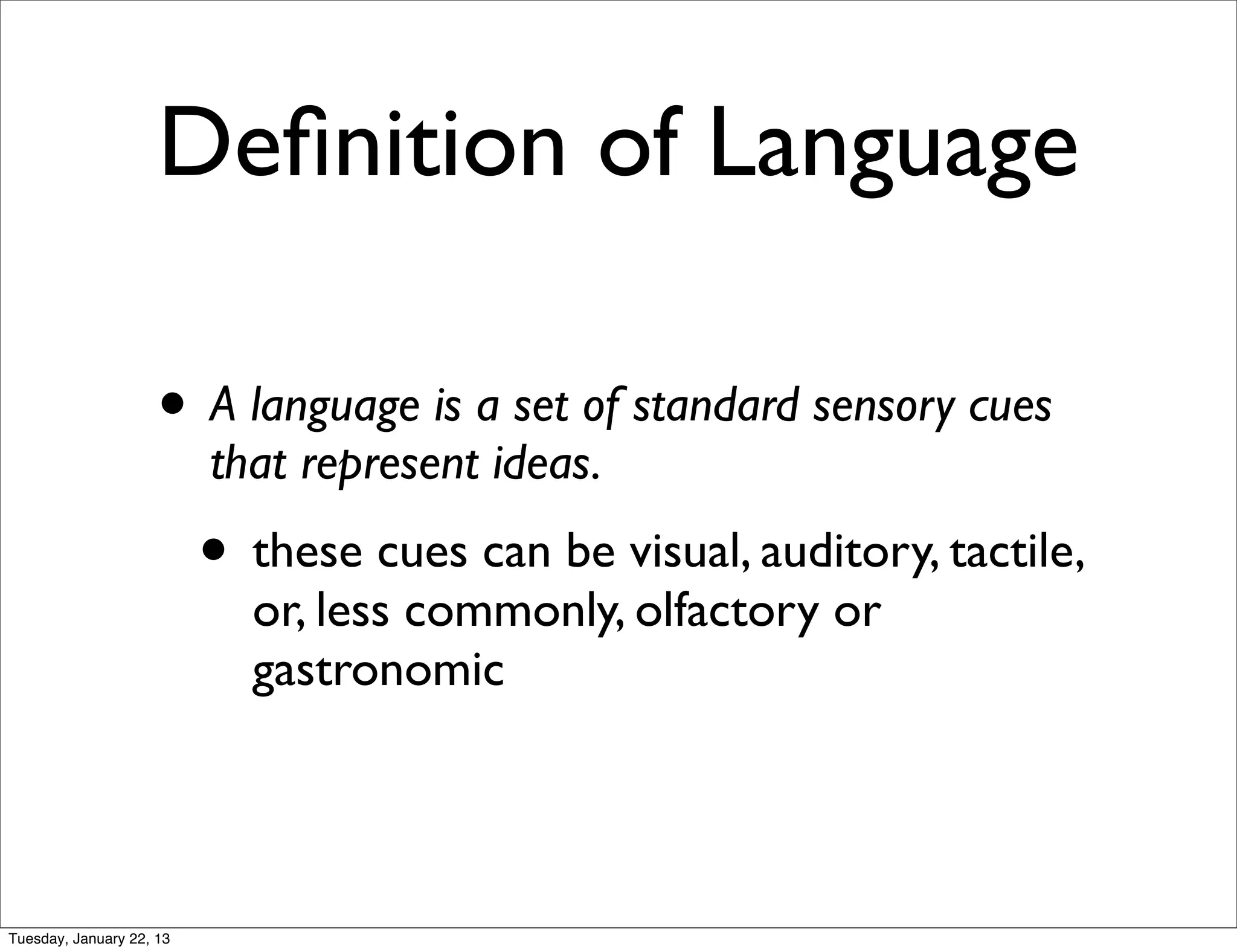
Definition of Language

                    • A language is a set of standard sensory cues
                          that represent ideas.
                          • these cues can be visual, auditory, tactile,
                            or, less commonly, olfactory or
                            gastronomic


Tuesday, January 22, 13
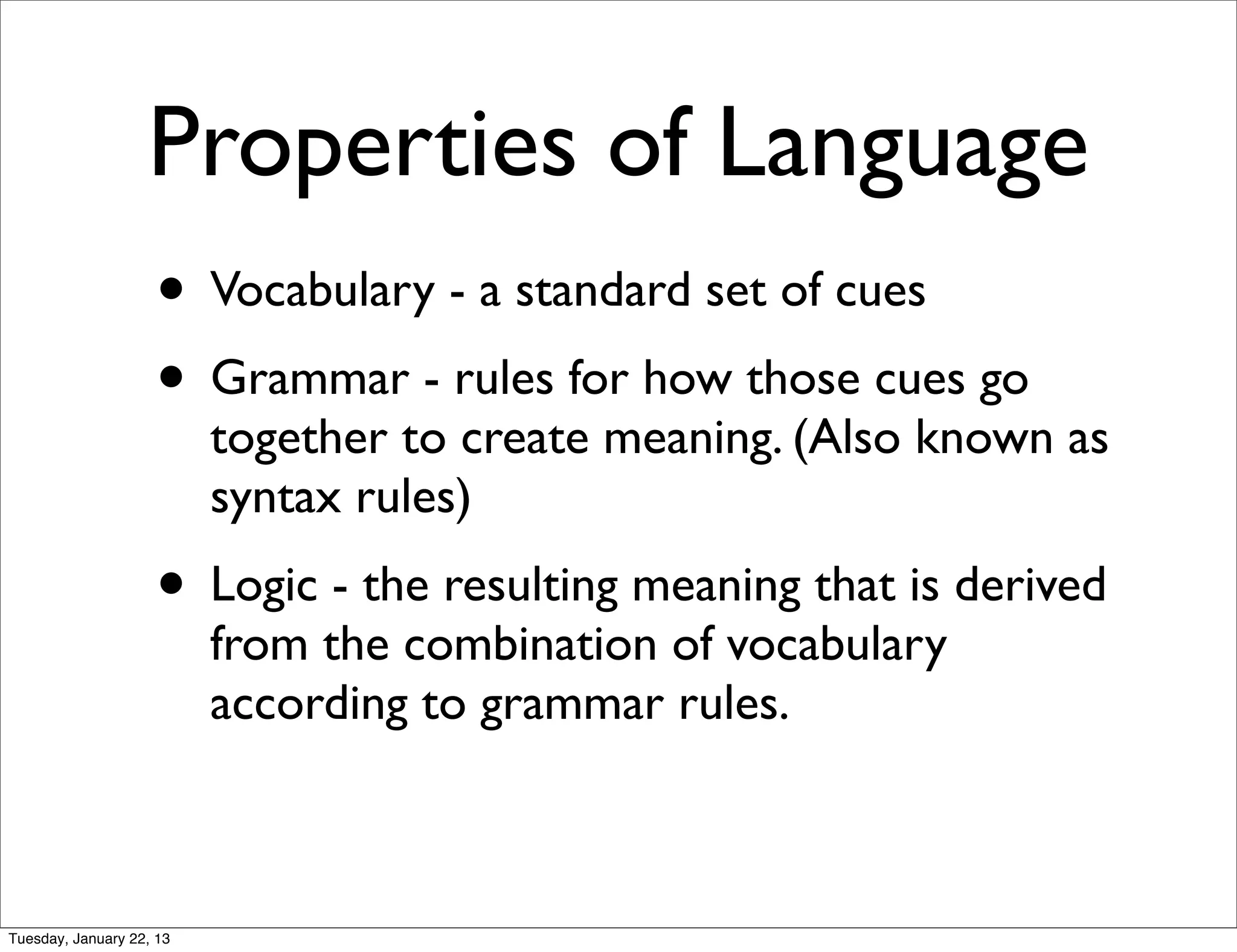
Properties of Language
                    • Vocabulary - a standard set of cues
                    • Grammar - rules for how those cues go
                          together to create meaning. (Also known as
                          syntax rules)
                    • Logic - the resulting meaning that is derived
                          from the combination of vocabulary
                          according to grammar rules.


Tuesday, January 22, 13
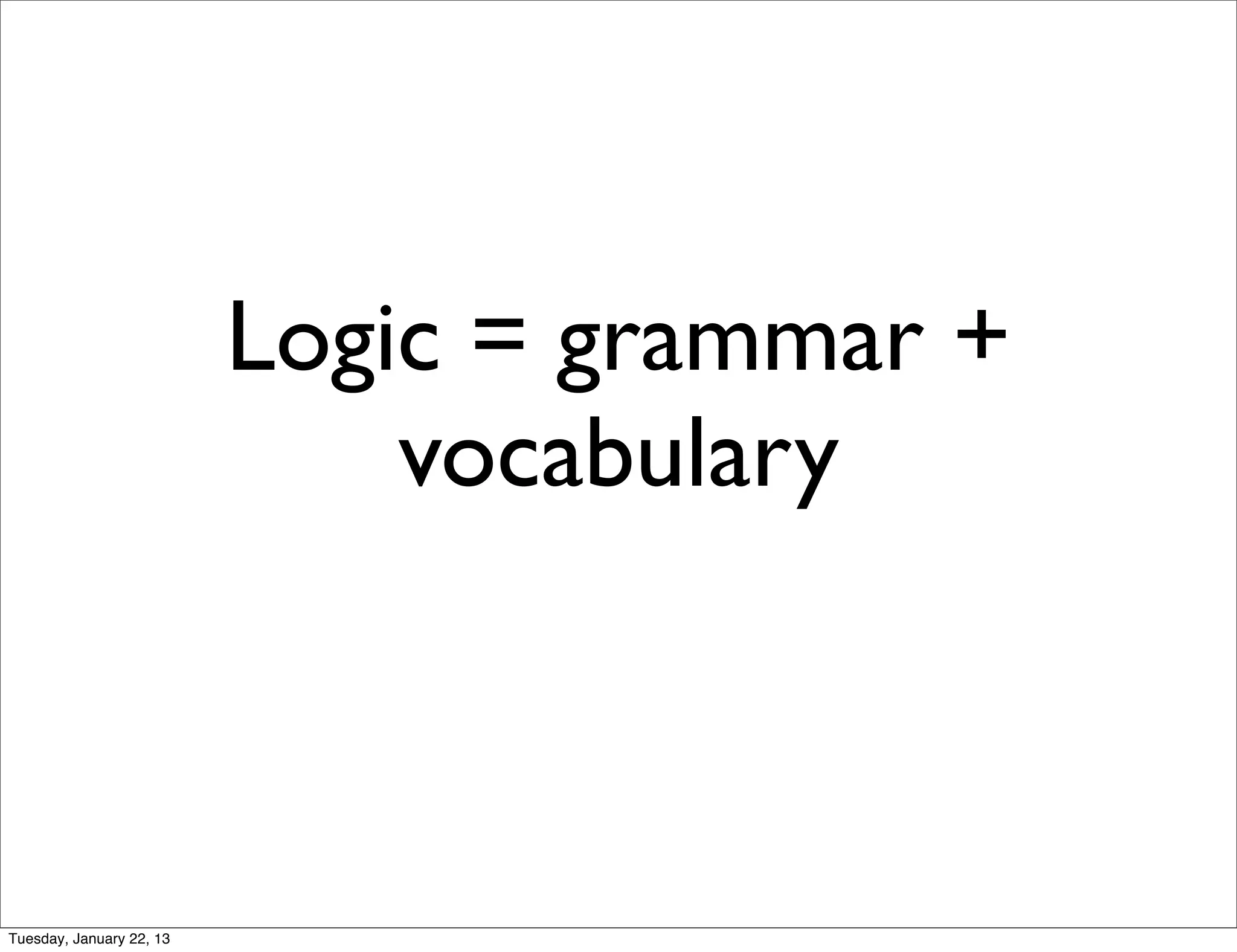
Logic = grammar +
                              vocabulary


Tuesday, January 22, 13
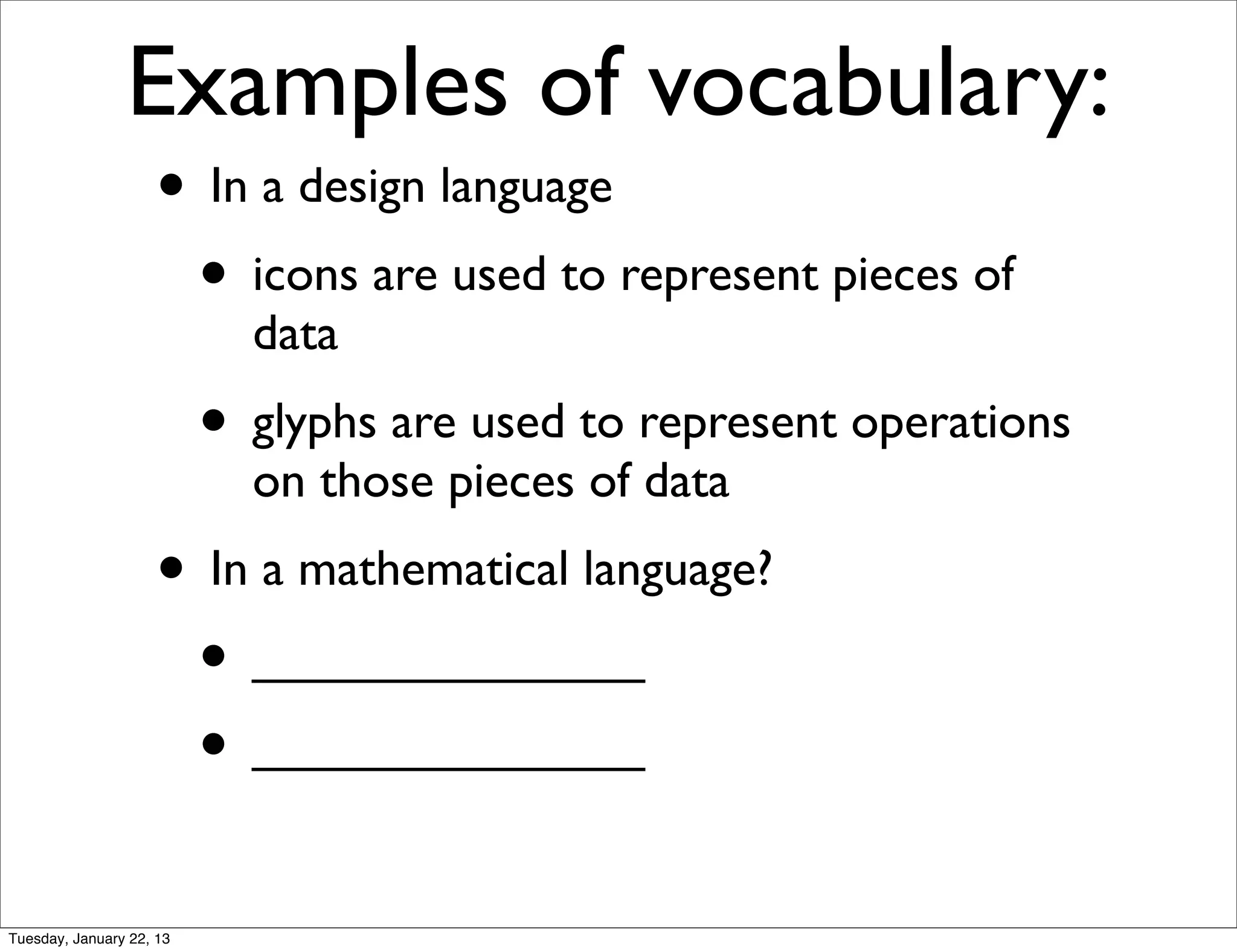
Examples of vocabulary:
                    • In a design language
                     • icons are used to represent pieces of
                            data
                          • glyphs are used to represent operations
                            on those pieces of data
                    • In a mathematical language?
                     • ______________
                     • ______________
Tuesday, January 22, 13
Grammar in languages

                    • In a mathematical language:
                     • “A+B” means add A and B together
                    • In a design language?
                     • ______________________

Tuesday, January 22, 13
Logic in Languages


                    • All languages convey ideas.
                    • All ideas are built upon logic.


Tuesday, January 22, 13
Basic logic

                    • All ideas are made up of statements that
                          are either true or false.
                          • ie: I am wearing a red jacket.
                           • is this true or false?


Tuesday, January 22, 13
Statements
                    • All statements are made up of subjects and
                          predicates
                          • ie: I am wearing a red jacket.
                           • “I” is the subject
                           • “am wearing a red jacket” is the
                              predicate
                           • The predicate is a property of the
                              subject


Tuesday, January 22, 13
Statement = subject +
                            predicate
                    • Or, the relationship between subject and
                          predicate is a statement that is either true
                          or false.


Tuesday, January 22, 13
Subjects and Predicates
                    • Can be viewed as:
                     • message and recipient
                     • action and target
                     • nouns and verbs
                     • values and operands
                     • objects and methods
                     • Data and functions
Tuesday, January 22, 13
In interface design:

                    • The purpose of an interface is to facilitate
                          the manipulation of data.
                          • In this case, the data is the subject
                          • the manipulation is the predicate


Tuesday, January 22, 13
Interface as a language
                    • In an interface, we represent both data and
                          operations visually.
                          • Data can be represented as an icon, a 2D
                            image on a canvas, a 3D model in a
                            viewport, or even text in a document
                          • Operations can be represented buttons,
                            list items, cursors, callouts, tooltips, etc.


Tuesday, January 22, 13
• By understanding the logical implications of
                          an interface we can do the following:
                          • choose appropriate imagery to describe
                            both the data and the operations we are
                            representing
                          • visually group interface elements in an
                            intuitive scheme that makes it easy to
                            access
                          • combine and reduce multiple interface
                            elements into a single, all-encompassing
                            element. (This is the same as shortening a
                            sentence in a written language.)
Tuesday, January 22, 13

The language of the user interface

  • 1.
    The language ofthe user interface. Ajay Ganapathy Tuesday, January 22, 13
  • 2.
    Examples of languages • Spoken language • sign language • written language • body language • design language • programming language • mathematical language Tuesday, January 22, 13
  • 3.
    Languages aren’t just spoken! Tuesday, January 22, 13
  • 4.
    language |ˈlaNGgwij| noun 1 the method of human communication, either spoken or written, consisting of the use of words in a structured and conventional way: a study of the way children learn language | [ as modifier ] : language development. • any nonverbal method of expression or communication: a language of gesture and facial expression. 2 the system of communication used by a particular community or country: the book was translated into twenty-five languages. • Computing a system of symbols and rules for writing programs or algorithms: a new programming language. 3 the manner or style of a piece of writing or speech: he explained the procedure in simple, everyday language. • the phraseology and vocabulary of a certain profession, domain, or group of people: legal language. • (usu. as bad/strong language) coarse, crude, or offensive language: strong language. PHRASES speak the same language understand one another as a result of shared opinions or values. ORIGIN Middle English: from Old French langage, based on Latin lingua ‘tongue.’ Tuesday, January 22, 13
  • 5.
    Definition of Language • A language is a set of standard sensory cues that represent ideas. • these cues can be visual, auditory, tactile, or, less commonly, olfactory or gastronomic Tuesday, January 22, 13
  • 6.
    Properties of Language • Vocabulary - a standard set of cues • Grammar - rules for how those cues go together to create meaning. (Also known as syntax rules) • Logic - the resulting meaning that is derived from the combination of vocabulary according to grammar rules. Tuesday, January 22, 13
  • 7.
    Logic = grammar+ vocabulary Tuesday, January 22, 13
  • 8.
    Examples of vocabulary: • In a design language • icons are used to represent pieces of data • glyphs are used to represent operations on those pieces of data • In a mathematical language? • ______________ • ______________ Tuesday, January 22, 13
  • 9.
    Grammar in languages • In a mathematical language: • “A+B” means add A and B together • In a design language? • ______________________ Tuesday, January 22, 13
  • 10.
    Logic in Languages • All languages convey ideas. • All ideas are built upon logic. Tuesday, January 22, 13
  • 11.
    Basic logic • All ideas are made up of statements that are either true or false. • ie: I am wearing a red jacket. • is this true or false? Tuesday, January 22, 13
  • 12.
    Statements • All statements are made up of subjects and predicates • ie: I am wearing a red jacket. • “I” is the subject • “am wearing a red jacket” is the predicate • The predicate is a property of the subject Tuesday, January 22, 13
  • 13.
    Statement = subject+ predicate • Or, the relationship between subject and predicate is a statement that is either true or false. Tuesday, January 22, 13
  • 14.
    Subjects and Predicates • Can be viewed as: • message and recipient • action and target • nouns and verbs • values and operands • objects and methods • Data and functions Tuesday, January 22, 13
  • 15.
    In interface design: • The purpose of an interface is to facilitate the manipulation of data. • In this case, the data is the subject • the manipulation is the predicate Tuesday, January 22, 13
  • 16.
    Interface as alanguage • In an interface, we represent both data and operations visually. • Data can be represented as an icon, a 2D image on a canvas, a 3D model in a viewport, or even text in a document • Operations can be represented buttons, list items, cursors, callouts, tooltips, etc. Tuesday, January 22, 13
  • 17.
    • By understandingthe logical implications of an interface we can do the following: • choose appropriate imagery to describe both the data and the operations we are representing • visually group interface elements in an intuitive scheme that makes it easy to access • combine and reduce multiple interface elements into a single, all-encompassing element. (This is the same as shortening a sentence in a written language.) Tuesday, January 22, 13