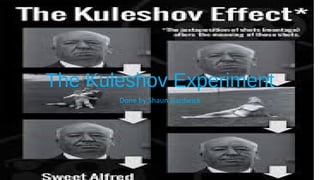
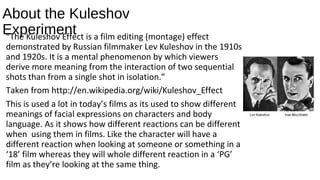
The Kuleshov Experiment was conducted in the early 20th century by Russian filmmaker Lev Kuleshov. It demonstrated that viewers derive more meaning from the interaction of two sequential shots rather than a single shot alone. Known as the Kuleshov Effect, it showed how facial expressions and body language can take on different meanings depending on the context provided by subsequent shots. Filmmakers now widely use this technique to influence how audiences interpret characters and scenes.