Matt SimpsonThe Jesuit Relations
IntroductionThe Jesuit Relations are, essentially, annual reports of French missionaries on their efforts to convert the Indians of the Northeast to Catholic Christianity.The  Jesuits were  incredibly literate and were very accurate in their descriptions of the Native Indians.The Jesuits were members of a religious order known as the Society of Jesus and took vows of poverty and obedience that distinguished then from ordinary priests.Every Jesuit was a college teacher at some point in his career and therefore was well equipped for his job due to his training in learning and rhetoric.In the early seventeenth century, the Jesuits entered North America and began studying the languages and cultures  they encountered.The Jesuits entered a continent that was still under Indian control, being ruled by two distinctive groups knows as the Iroquoians and Algonquians.Over the course of nearly two centuries, the Jesuits dealt with  almost every Indian nation in the Northeast. This text, however, focuses on four  of those nations: The Montagnais, Algonquins, Hurons and Iroquois.Even though they were not displaced or defeated, the Indian nations experienced tremendous change brought about by the colonization of New France.
Introduction (Continued)Missionary efforts had two main focuses: While some tried to convert the Montagnais and Algonquins, others traveled into the interior to convert the Hurons.The Jesuit mission to New France was filled with disappointment at first due to the fact that they were not used to lacking coercive power. The missionaries were forced to learn the native languages and take part in the rituals of the tribes they encountered.Because the four main tribes of this text were being killed off by disease, war , and economic dependency, the missionaries began to convert them to Catholicism.There is an undeniable  cultural gap separating the observers of this text and the observed. The observations were clearly written by Europeans for other Europeans and native society was always viewed by the Jesuits as an “external object”.
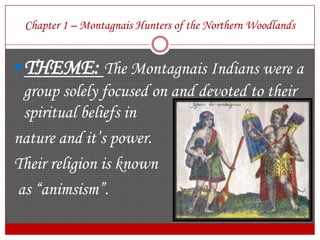
Chapter 1 – Montagnais Hunters of the Northern WoodlandsTHEME: The Montagnais Indians were a group solely focused on and devoted to their spiritual beliefs in nature and it’s power. Their religion is known as “animsism”.
Chapter 1 – Montagnais Hunters of the Northern WoodlandsLives of the Aboriginals:The Montagnais and Algonquins were technically sophisticated and excelled in transportation.They believed that a being named Atahocam created the world and one named Messou restored it.They recognize two progenitors of the seasons. Nipinoukle brings spring and summer. Pipounoukhe brings the cold season.They possess physical advantages in abundance: They are tall, erect, strong, well proportioned and agile.Education and instruction are lacking.Since they lack civil regulation and dignities, they never kill one another to acquire honors.They are content, and thus never get angry.They cooperate very well.
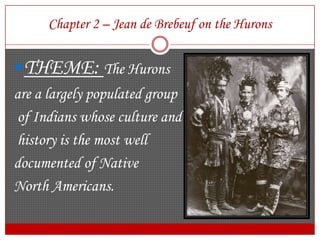
Chapter 2 – Jean de Brebeuf on the HuronsTHEME: The Huronsare a largely populated group of Indians whose culture and history is the most well documented of Native North Americans.
Chapter 2 – Jean de Brebeuf on the HuronsLives of the Aboriginals:The greater part of their language is composed of vowels.To speak to them of a deceased loved one is to insult them.They have some verbs for living things and different ones for inanimate objects.They are unwilling to acknowledge God.They take pride in deriving their origin from heavenThey believe that Iouskeha is the sun and Aataentsic is the moon.They address themselves to the earth, the rivers, the lakes, and the sky in the belief that these things are animate and some spirit resides there.They believe that fish, deer and moose are possessed of reason and do not throw their bones to the dogs.They have a faith in dreams. The dream is the oracle that these people consult and listen to.They have four types of feastsAthataion is the feast of farewells.Enditeuhwa is the feast of Thanksgiving and gratitude.Atourontaochien is a feast for singing.Awataerohi is a feast for deliverane from sickness.They do not exhibit angerThey live in  villages with sometimes as many as  fifty, sixty or a hundred cabins.
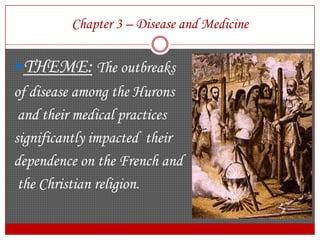
Chapter 3 – Disease and MedicineTHEME:The outbreaks of disease among the Hurons and their medical practices significantly impacted  their dependence on the French and the Christian religion.
Chapter 3 – Disease and MedicineLives of the Aboriginals:The priority of the Jesuits was saving souls, and when epidemics struck, they put most of their efforts toward baptizing the dying rather than saving the living.The medical specialists (shamans) of the natives had no aim other than to help the sick recover.Often, they administered medicines derived from the roots, bark, or leaves of particular plants and trees.Accounts of superstitious healing occupy a large part of the text.The natives did not see disease as a purely physical problem. Rather, it is a mental issue as well.The Hurons kept their sick in the midst of the village and they considered each person an integral part of the society.The Jesuits were concerned that the successes of the Huron’s spiritual healing challenged their beliefs.
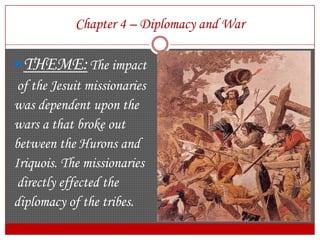
Chapter 4 – Diplomacy and WarTHEME:The impact of the Jesuit missionarieswas dependent upon the wars a that broke out between the Hurons and Iriquois. The missionaries directly effected the diplomacy of the tribes.
Chapter 4 – Diplomacy and WarLives of the Aboriginals: Armed conflict pitted Christian forces against Iriquois, allowing the Jesuits to adopt the rhetoric of crusader narratives.Native wars became more intense and deadly in the 17th century due to the adoption of  European weaponry and the pressures caused by epidemics and trade.The main lines of conflict separated the Five Nations of the Iriquois in the south from a northern alliance involving the Hurons, Algonquins, Montagnais, and French.

The jesuit relations pp

  • 1.
  • 2.
    IntroductionThe Jesuit Relationsare, essentially, annual reports of French missionaries on their efforts to convert the Indians of the Northeast to Catholic Christianity.The Jesuits were incredibly literate and were very accurate in their descriptions of the Native Indians.The Jesuits were members of a religious order known as the Society of Jesus and took vows of poverty and obedience that distinguished then from ordinary priests.Every Jesuit was a college teacher at some point in his career and therefore was well equipped for his job due to his training in learning and rhetoric.In the early seventeenth century, the Jesuits entered North America and began studying the languages and cultures they encountered.The Jesuits entered a continent that was still under Indian control, being ruled by two distinctive groups knows as the Iroquoians and Algonquians.Over the course of nearly two centuries, the Jesuits dealt with almost every Indian nation in the Northeast. This text, however, focuses on four of those nations: The Montagnais, Algonquins, Hurons and Iroquois.Even though they were not displaced or defeated, the Indian nations experienced tremendous change brought about by the colonization of New France.
  • 3.
    Introduction (Continued)Missionary effortshad two main focuses: While some tried to convert the Montagnais and Algonquins, others traveled into the interior to convert the Hurons.The Jesuit mission to New France was filled with disappointment at first due to the fact that they were not used to lacking coercive power. The missionaries were forced to learn the native languages and take part in the rituals of the tribes they encountered.Because the four main tribes of this text were being killed off by disease, war , and economic dependency, the missionaries began to convert them to Catholicism.There is an undeniable cultural gap separating the observers of this text and the observed. The observations were clearly written by Europeans for other Europeans and native society was always viewed by the Jesuits as an “external object”.
  • 4.
    Chapter 1 –Montagnais Hunters of the Northern WoodlandsTHEME: The Montagnais Indians were a group solely focused on and devoted to their spiritual beliefs in nature and it’s power. Their religion is known as “animsism”.
  • 5.
    Chapter 1 –Montagnais Hunters of the Northern WoodlandsLives of the Aboriginals:The Montagnais and Algonquins were technically sophisticated and excelled in transportation.They believed that a being named Atahocam created the world and one named Messou restored it.They recognize two progenitors of the seasons. Nipinoukle brings spring and summer. Pipounoukhe brings the cold season.They possess physical advantages in abundance: They are tall, erect, strong, well proportioned and agile.Education and instruction are lacking.Since they lack civil regulation and dignities, they never kill one another to acquire honors.They are content, and thus never get angry.They cooperate very well.
  • 6.
    Chapter 2 –Jean de Brebeuf on the HuronsTHEME: The Huronsare a largely populated group of Indians whose culture and history is the most well documented of Native North Americans.
  • 7.
    Chapter 2 –Jean de Brebeuf on the HuronsLives of the Aboriginals:The greater part of their language is composed of vowels.To speak to them of a deceased loved one is to insult them.They have some verbs for living things and different ones for inanimate objects.They are unwilling to acknowledge God.They take pride in deriving their origin from heavenThey believe that Iouskeha is the sun and Aataentsic is the moon.They address themselves to the earth, the rivers, the lakes, and the sky in the belief that these things are animate and some spirit resides there.They believe that fish, deer and moose are possessed of reason and do not throw their bones to the dogs.They have a faith in dreams. The dream is the oracle that these people consult and listen to.They have four types of feastsAthataion is the feast of farewells.Enditeuhwa is the feast of Thanksgiving and gratitude.Atourontaochien is a feast for singing.Awataerohi is a feast for deliverane from sickness.They do not exhibit angerThey live in villages with sometimes as many as fifty, sixty or a hundred cabins.
  • 8.
    Chapter 3 –Disease and MedicineTHEME:The outbreaks of disease among the Hurons and their medical practices significantly impacted their dependence on the French and the Christian religion.
  • 9.
    Chapter 3 –Disease and MedicineLives of the Aboriginals:The priority of the Jesuits was saving souls, and when epidemics struck, they put most of their efforts toward baptizing the dying rather than saving the living.The medical specialists (shamans) of the natives had no aim other than to help the sick recover.Often, they administered medicines derived from the roots, bark, or leaves of particular plants and trees.Accounts of superstitious healing occupy a large part of the text.The natives did not see disease as a purely physical problem. Rather, it is a mental issue as well.The Hurons kept their sick in the midst of the village and they considered each person an integral part of the society.The Jesuits were concerned that the successes of the Huron’s spiritual healing challenged their beliefs.
  • 10.
    Chapter 4 –Diplomacy and WarTHEME:The impact of the Jesuit missionarieswas dependent upon the wars a that broke out between the Hurons and Iriquois. The missionaries directly effected the diplomacy of the tribes.
  • 11.
    Chapter 4 –Diplomacy and WarLives of the Aboriginals: Armed conflict pitted Christian forces against Iriquois, allowing the Jesuits to adopt the rhetoric of crusader narratives.Native wars became more intense and deadly in the 17th century due to the adoption of European weaponry and the pressures caused by epidemics and trade.The main lines of conflict separated the Five Nations of the Iriquois in the south from a northern alliance involving the Hurons, Algonquins, Montagnais, and French.