The Java EE 6 Tutorial Basic Concepts 4th Edition Eric Jendrock
The Java EE 6 Tutorial Basic Concepts 4th Edition Eric Jendrock
The Java EE 6 Tutorial Basic Concepts 4th Edition Eric Jendrock
The Java EE 6 Tutorial Basic Concepts 4th Edition Eric Jendrock
The Java EE 6 Tutorial Basic Concepts 4th Edition Eric Jendrock
1.
The Java EE6 Tutorial Basic Concepts 4th
Edition Eric Jendrock download
https://ebookultra.com/download/the-java-ee-6-tutorial-basic-
concepts-4th-edition-eric-jendrock/
Explore and download more ebooks or textbooks
at ebookultra.com
2.
We believe theseproducts will be a great fit for you. Click
the link to download now, or visit ebookultra.com
to discover even more!
Java EE 5 Development with NetBeans 6 1st Edition
Heffelfinger
https://ebookultra.com/download/java-ee-5-development-with-
netbeans-6-1st-edition-heffelfinger/
Java EE 7 Essentials 1st Edition Arun Gupta
https://ebookultra.com/download/java-ee-7-essentials-1st-edition-arun-
gupta/
Big Java Compatible with Java 5 6 and 7 4th Edition Cay S.
Horstmann
https://ebookultra.com/download/big-java-compatible-with-
java-5-6-and-7-4th-edition-cay-s-horstmann/
Java EE 7 for Beginners 1st Edition Sharanam Shah
https://ebookultra.com/download/java-ee-7-for-beginners-1st-edition-
sharanam-shah/
3.
The Java TutorialA Short Course on the Basics 5th Edition
Java Series Zakhour
https://ebookultra.com/download/the-java-tutorial-a-short-course-on-
the-basics-5th-edition-java-series-zakhour/
Java EE 5 Development using GlassFish Application Server
1st Ed. Edition David Heffelfinger
https://ebookultra.com/download/java-ee-5-development-using-glassfish-
application-server-1st-ed-edition-david-heffelfinger/
JBoss R Seam Simplicity and Power Beyond Java TM EE 1st
Edition Michael Juntao Yuan
https://ebookultra.com/download/jboss-r-seam-simplicity-and-power-
beyond-java-tm-ee-1st-edition-michael-juntao-yuan/
Java concepts 5th Edition Cay S. Horstmann
https://ebookultra.com/download/java-concepts-5th-edition-cay-s-
horstmann/
WSO Basic Science Concepts and Applications Student
Workbook Water Supply Operations 4th Edition Multiple
Contributors
https://ebookultra.com/download/wso-basic-science-concepts-and-
applications-student-workbook-water-supply-operations-4th-edition-
multiple-contributors/
5.
The Java EE6 Tutorial Basic Concepts 4th Edition Eric
Jendrock Digital Instant Download
Author(s): Eric Jendrock, Ian Evans, Devika Gollapudi, KimHaase, Chinmayee
Srivathsa
ISBN(s): 9780137081851, 0137081855
Edition: 4
File Details: PDF, 34.14 MB
Year: 2010
Language: english
6.
The Java EE6 Tutorial
Basic Concepts
Fourth Edition
Eric Jendrock, Ian Evans, Devika Gollapudi,
Kim Haase, Chinmayee Srivathsa
AAddison-Wesley
Upper Saddle River, NJ • Boston • Indianapolis • San Francisco
New York • Toronto • Montreal • London • Munich • Paris • Madrid
Capetown • Sydney • Tokyo • Singapore • Mexico City
Contents
Preface xxi
Part IIntroduction 1
1 Overview 3
Java EE 6 Platform Highlights 4
Java EE Application Model 5
Distributed Multitiered Applications 6
Security 7
Java EE Components 8
Java EE Clients 8
Web Components 10
Business Components 11
Enterprise Information System Tier 12
Java EE Containers 13
Container Services 13
Container Types 14
Web Services Support 15
XML 15
SOAP Transport Protocol 16
WSDL Standard Format 16
Java EE Application Assembly and Deployment 17
Packaging Applications 17
Development Roles 19
Java EE Product Provider 20
Tool Provider 20
Application Component Provider 20
9.
Contents
Application Assembler 21
ApplicationDeployer and Administrator 21
Java EE 6 APIs 22
Enterprise JavaBeans Technology 25
Java Servlet Technology 26
JavaServer Faces Technology 26
JavaServer Pages Technology 27
JavaServer Pages Standard Tag Library 27
Java Persistence API 28
Java Transaction API 28
Java API for RESTful Web Services 28
Managed Beans 28
Contexts and Dependency Injection for the Java EE Platform (JSR 299) 29
Dependency Injection for Java (JSR 330) 29
Bean Validation 29
Java Message Service API 29
Java EE Connector Architecture 29
JavaMail API 30
Java Authorization Contract for Containers 30
Java Authentication Service Provider Interface for Containers 30
Java EE 6 APIs in the Java Platform, Standard Edition 6.0 31
Java Database Connectivity API 31
Java Naming and Directory Interface API 31
JavaBeans Activation Framework 32
Java API for XML Processing 32
Java Architecture for XML Binding 33
SOAP with Attachments API for Java 33
Java API for XML Web Services 33
Java Authentication and Authorization Service 33
GlassFish Server Tools 34
2 Using theTutorial Examples 37
Required Software 37
Java Platform, Standard Edition 37
Java EE 6 Software Development Kit 38
vi The Java EE 6Tutorial: Basic Concepts
10.
Contents
Java EE 6Tutorial Component 38
NetBeans IDE 40
Apache Ant 41
Starting and Stopping the GlassFish Server 41
Starting the Administration Console 42
• To Start the Administration Console in NetBeans IDE 43
Starting and Stopping the Java DB Server 43
• To Start the Database Server Using NetBeans IDE 43
Building the Examples 44
Tutorial Example Directory Structure 44
Getting the Latest Updates to the Tutorial 44
• To Update the Tutorial Through the Update Center 45
Debugging Java EE Applications 45
Using the Server Log 45
Using a Debugger 46
Part II The Web Tier 47
3 Getting Started with Web Applications 49
Web Applications 50
Web Application Lifecycle 51
Web Modules: The hellol Example 53
Examining the hellol Web Module 54
Packaging a Web Module 57
Deploying a Web Module 59
Running a Deployed Web Module 59
Listing Deployed Web Modules 60
Updating a Web Module 60
Dynamic Reloading 60
Undeploying Web Modules 61
Configuring Web Applications: The hello2 Example 62
Mapping URLs to Web Components 62
Examining the hello2 Web Module 63
Building, Packaging, Deploying, and Running the hello2 Example 64
Declaring Welcome Files 66
11.
Contents
Setting Context andInitialization Parameters 66
Mapping Errors to Error Screens 67
Declaring Resource References 68
Further Information about Web Applications 71
4 JavaServer Faces Technology 73
What Is a JavaServer Faces Application? 74
JavaServer Faces Technology Benefits 75
Creating a Simple JavaServer Faces Application 77
Developing the Backing Bean 77
Creating the Web Page 78
Mapping the FacesServlet Instance 78
The Lifecycle of the hello Application 79
• To Build, Package, Deploy, and Run the Application in NetBeans IDE 80
Further Information about JavaServer Faces Technology 81
5 Introduction to Facelets 83
What Is Facelets? 83
Developing a Simple Facelets Application 85
Creating a Facelets Application 85
Configuring the Application 88
Building, Packaging, Deploying, and Running the guessnumber Facelets
Example 89
Templating 91
Composite Components 94
Resources 96
6 Expression Language 99
Overview of the EL 99
Immediate and Deferred Evaluation Syntax 100
Immediate Evaluation 101
Deferred Evaluation 101
Value and Method Expressions 102
Value Expressions 102
Method Expressions 106
viii The Java EE 6Tutorial: Basic Concepts
12.
Contents
Defining a TagAttribute Type 108
Literal Expressions 109
Operators I l l
Reserved Words I l l
Examples of EL Expressions 112
7 Using JavaServer FacesTechnology in Web Pages 113
Setting Up a Page 113
Adding Components to a Page Using HTML Tags 114
Common Component Tag Attributes 117
Adding HTML Head and Body Tags 119
Adding a Form Component 120
Using Text Components 121
Using Command Component Tags for Performing Actions and Navigation .... 126
Adding Graphics and Images with the h:graphiclmage Tag 127
Laying Out Components with the h: panelGrid and h: panelGroup Tags 128
Displaying Components for Selecting One Value 130
Displaying Components for Selecting Multiple Values 132
Using the f : selectltem and f : selectltems Tags 133
Using Data-Bound Table Components 135
Displaying Error Messages with the h: message and h: messages Tags 138
Creating Bookmarkable URLs with the h: button and h: link Tags 139
Using View Parameters to Configure Bookmarkable URLs 140
Resource Relocation Using h: output Tags 141
Using Core Tags 143
8 Using Converters, Listeners, and Validators 145
Using the Standard Converters 145
Converting a Components Value 146
Using DateTimeConverter 147
Using NumberConverter 149
Registering Listeners on Components 151
Registering a Value-Change Listener on a Component 151
Registering an Action Listener on a Component 152
Using the Standard Validators 152
13.
Contents
Validating a ComponentsValue 153
Using LongRangeValidator 154
Referencing a Backing Bean Method 154
Referencing a Method That Performs Navigation 155
Referencing a Method That Handles an Action Event 156
Referencing a Method That Performs Validation 156
Referencing a Method That Handles a Value-Change Event 156
9 Developing with JavaServer FacesTechnology 159
Backing Beans 159
Creating a Backing Bean 160
Using the EL to Reference Backing Beans 161
Writing Bean Properties 162
Writing Properties Bound to Component Values 163
Writing Properties Bound to Component Instances 168
Writing Properties Bound to Converters, Listeners, or Validators 170
Writing Backing Bean Methods 170
Writing a Method to Handle Navigation 171
Writing a Method to Handle an Action Event 172
Writing a Method to Perform Validation 173
Writing a Method to Handle a Value-Change Event 173
Using Bean Validation 174
Validating Null and Empty Strings 177
10 Java Servlet Technology 179
What Is a Servlet? 180
Servlet Lifecycle 180
Handling Servlet Lifecycle Events 180
Handling Servlet Errors 182
Sharing Information 182
Using Scope Objects 182
Controlling Concurrent Access to Shared Resources 183
Creating and Initializing a Servlet 183
Writing Service Methods 184
Getting Information from Requests 185
x The Java EE 6Tutorial: Basic Concepts
14.
Contents
Constructing Responses 186
FilteringRequests and Responses 187
Programming Filters 187
Programming Customized Requests and Responses 188
Specifying Filter Mappings 189
Invoking Other Web Resources 191
Including Other Resources in the Response 192
Transferring Control to Another Web Component 192
Accessing the Web Context 193
Maintaining Client State 193
Accessing a Session 193
Associating Objects with a Session 193
Session Management 194
Session Tracking 195
Finalizing a Servlet 195
Tracking Service Requests 196
Notifying Methods to Shut Down 196
Creating Polite Long-Running Methods 197
The mood Example Application 198
Components of the mood Example Application 198
Building, Packaging, Deploying, and Running the mood Example 198
Further Information about Java Servlet Technology 200
Part III Web Services 201
11 Introduction to Web Services 203
What Are Web Services? 203
Types of Web Services 203
"Big" Web Services 204
RESTful Web Services 204
Deciding Which Type of Web Service to Use 206
12 Building Web Services with JAX-WS 207
Creating a Simple Web Service and Clients with JAX-WS 208
15.
Contents
Requirements of aJAX-WS Endpoint 209
Coding the Service Endpoint Implementation Class 210
Building, Packaging, and Deploying the Service 210
Testing the Methods of a Web Service Endpoint 211
A Simple JAX-WS Application Client 212
A Simple JAX-WS Web Client 214
Types Supported by JAX-WS 217
Web Services Interoperability and JAX-WS 217
Further Information about JAX-WS 217
13 Building RESTful Web Services with JAX-RS 219
What Are RESTful Web Services? 219
Creating a RESTful Root Resource Class 220
Developing RESTful Web Services with JAX-RS 221
Overview of a JAX-RS Application 222
The @Path Annotation and URI Path Templates 223
Responding to HTTP Resources 226
Using (¡Consumes and@Produces to Customize Requests and Responses 229
Extracting Request Parameters 231
Example Applications for JAX-RS 235
A RESTful Web Service 235
The rsvp Example Application 237
Real-World Examples 240
Further Information about JAX-RS 240
Part IV Enterprise Beans 243
14 Enterprise Beans 245
What Is an Enterprise Bean? 245
Benefits of Enterprise Beans 246
When to Use Enterprise Beans 246
Types of Enterprise Beans 246
What Is a Session Bean? 247
Types of Session Beans 247
xii The Java EE 6Tutorial: Basic Concepts
16.
Contents
When to UseSession Beans 248
What Is a Message-Driven Bean? 249
What Makes Message-Driven Beans Different from Session Beans? 249
When to Use Message-Driven Beans 251
Accessing Enterprise Beans 251
Using Enterprise Beans in Clients 252
Deciding on Remote or Local Access 253
Local Clients 254
Remote Clients 255
Web Service Clients 256
Method Parameters and Access 257
The Contents of an Enterprise Bean 258
Packaging Enterprise Beans in EJB JAR Modules 258
Packaging Enterprise Beans in WAR Modules 259
Naming Conventions for Enterprise Beans 260
The Lifecycles of Enterprise Beans 261
The Lifecycle of a Stateful Session Bean 261
The Lifecycle of a Stateless Session Bean 262
The Lifecycle of a Singleton Session Bean 262
The Lifecycle of a Message-Driven Bean 263
Further Information about Enterprise Beans 264
15 Getting Started with Enterprise Beans 265
Creating the Enterprise Bean 265
Coding the Enterprise Bean Class 266
Creating the conve rte r Web Client 266
Building, Packaging, Deploying, and Running the conve rte r Example 267
Modifying the Java EE Application 269
• To Modify a Class File 269
16 Running the Enterprise Bean Examples 271
The cart Example 271
The Business Interface 272
Session Bean Class 273
The (¡Remove Method 276
17.
Contents
Helper Classes 276
Building,Packaging, Deploying, and Running the ca rt Example 276
A Singleton Session Bean Example: counter 278
Creating a Singleton Session Bean 278
The Architecture of the counter Example 283
Building, Packaging, Deploying, and Running the counte r Example 285
A Web Service Example: helloservice 286
The Web Service Endpoint Implementation Class 287
Stateless Session Bean Implementation Class 287
Building, Packaging, Deploying, and Testing the helloservice Example 288
Using the Timer Service 290
Creating Calendar-Based Timer Expressions 290
Programmatic Timers 293
Automatic Timers 294
Canceling and Saving Timers 296
Getting Timer Information 296
Transactions and Timers 296
The timersession Example 297
Building, Packaging, Deploying, and Running the timersession Example 299
Handling Exceptions 300
PartV Contexts and Dependency Injection for the Java EE Platform 303
17 Introduction to Contexts and Dependency Injection for the Java EE Platform 305
Overview of CDI 306
About Beans 307
About Managed Beans 307
Beans as Injectable Objects 308
Using Qualifiers 309
Injecting Beans 310
Using Scopes 310
Giving Beans EL Names 312
Adding Setter and Getter Methods 312
Using a Managed Bean in a Facelets Page 313
Injecting Objects by Using Producer Methods 314
xiv The Java EE 6Tutorial: Basic Concepts
18.
Contents
Configuring a CDIApplication 315
Further Information about CDI 315
18 Running the Basic Contexts and Dependency Injection Examples 317
The simplegreeting CDI Example 317
The simplegreeting Source Files 318
The Facelets Template and Page 318
Configuration Files 319
Building, Packaging, Deploying, and Running the simpleg reeting CDI
Example 320
The guessnumber CDI Example 322
The guessnumber Source Files 322
The Facelets Page 326
Building, Packaging, Deploying, and Running the guessnumber CDI
Example 328
Part VI Persistence 331
19 Introduction to the Java Persistence API 333
Entities 333
Requirements for Entity Classes 334
Persistent Fields and Properties in Entity Classes 334
Primary Keys in Entities 339
Multiplicity in Entity Relationships 341
Direction in Entity Relationships 342
Embeddable Classes in Entities 344
Entity Inheritance 345
Abstract Entities 345
Mapped Superclasses 345
Non-Entity Superclasses 346
Entity Inheritance Mapping Strategies 347
Managing Entities 349
The EntityManager Interface 349
Persistence Units 353
Querying Entities 355
19.
Contents
Further Information aboutPersistence 355
20 Running the Persistence Examples 357
The order Application 357
Entity Relationships in the order Application 358
Primary Keys in the o rde r Application 360
Entity Mapped to More Than One Database Table 363
Cascade Operations in the o rde r Application 363
BLOB and CLOB Database Types in the o rde r Application 364
Temporal Types in the o rde r Application 365
Managing the o rde r Application s Entities 365
Building, Packaging, Deploying, and Running the o rde r Application 368
The roster Application 369
Relationships in the roste r Application 369
Entity Inheritance in the roste r Application 370
Criteria Queries in the roster Application 372
Automatic Table Generation in the roster Application 374
Building, Packaging, Deploying, and Running the roste r Application 374
The add ress - book Application 376
Bean Validation Constraints in add ress - book 376
Specifying Error Messages for Constraints in add ress - book 377
Validating Contact Input from a JavaServer Faces Application 378
Building, Packaging, Deploying, and Running the add ress - book Application .379
21 The Java Persistence Query Language 381
Query Language Terminology 382
Creating Queries Using the Java Persistence Query Language 382
Named Parameters in Queries 383
Positional Parameters in Queries 383
Simplified Query Language Syntax 384
Select Statements 384
Update and Delete Statements 385
Example Queries 385
Simple Queries 385
Queries That Navigate to Related Entities 386
xvi The Java EE 6Tutorial: Basic Concepts
20.
Contents
Queries with OtherConditional Expressions 388
Bulk Updates and Deletes 389
Full Query Language Syntax 390
BNF Symbols 390
BNF Grammar of the Java Persistence Query Language 391
FROM Clause 394
Path Expressions 398
WHERE Clause 400
SELECT Clause 410
ORDER BY Clause 412
GROUP BY and HAVING Clauses 412
22 Using the Criteria API to Create Queries 415
Overview of the Criteria and Metamodel APIs 415
Using the Metamodel API to Model Entity Classes 417
Using Metamodel Classes 418
Using the Criteria API and Metamodel API to Create Basic Typesafe Queries 418
Creating a Criteria Query 418
Query Roots 419
Querying Relationships Using Joins 420
Path Navigation in Criteria Queries 421
Restricting Criteria Query Results 421
Managing Criteria Query Results 424
Executing Queries 425
Part VII Security 427
23 Introduction to Security in the Java EE Platform 429
Overview of Java EE Security 430
A Simple Security Example 430
Features of a Security Mechanism 433
Characteristics of Application Security 434
Security Mechanisms 435
Java SE Security Mechanisms 435
church, before whichall will be expected to bow the knee, as the
pagans demanded of the primitive church to adore their false gods.
Active negotiations for this object are being carried on between five
states of the ancient diocese of Basel, the cantons of Zurich,
Schaffhausen, Ticino, Geneva, etc. It has been decided to have a
bishop. All will be required to submit to this bishop. But he will have
a superior in the form of a synod composed of sectaries of all creeds
or of no creed, and these will enjoy, in his regard, the right of
deposition. It is asserted that M. Reinkens will consecrate the new
bishop. The consecration of an apostate does not share in the
promise of indefectibility.
Anyhow, the Old Catholics will not succeed in erecting a serious
edifice. To found a church there are needed faith, zeal, devotedness,
religious conviction. Radicals and free-thinkers have none of these.
Without belief of any kind, their one aim is the overthrow of all
religion. Let them, then, seize our churches—let them decree the
formation of an ecclesiastical hierarchy! The profaned churches will
be deserted, their priests will be despised, and again they will be
taught the lesson that the Living God does not preside over
schismatics and heretics!
COFFIN FLOWERS.
23.
And doth SaintPeter ope the gates
Of heaven to such a toll?
Or do you think this show of flowers
Will deck my naked soul?
Perhaps you wish the folks to know
How much you can afford;
And prove upon my coffin-lid
You don’t “let out,” nor board.
Oh! cast an humble flower or two
Upon my funeral bier;
And drop upon my lifeless form
One true, love-speaking tear.
But take away these shop-made things,
They mock my sighs and groans;
And soon, like me, will rot, and show
Their framework, like my bones.
God only asks if my poor soul
A wedding garment wears.
A bridal wreath? Yes, make it up
Of flowers. God’s flowers are prayers!
ARE YOU MY WIFE?
BY THE AUTHOR OF “PARIS BEFORE THE WAR,” “NUMBER
THIRTEEN,” “PIUS VI.,” ETC.
CHAPTER VII.
THE SEARCH RENEWED.
24.
Everybody was latenext day at the Court; everybody except Clide
de Winton, whose waking dreams being brighter than any that his
pillow could suggest, had deserted it at a comparatively early hour,
and had been for a stroll in the park before breakfast. He re-entered
the house whistling an air from Don Giovanni, and went into the
library, where he expected to find Sir Simon. The baronet generally
came in there to read his letters when there were people staying in
the house. The library was a noble room with its six high pointed
windows set in deep mullions, and its walls wainscoted with books
on the east and west—rich-clad volumes of crimson and brown, with
the gold letters of their names relieving the sombre hues like thin
streaks of light, while at intervals great old florentines in folios
“garmented in white” made a break in the general solemnity. The
end opposite the windows was left clear for a group of family
portraits; and beneath these, as Clide burst into the room, there
stood a living group, conversing together in low tones, and with
anxious, harassed faces. Mrs. de Winton, contrary to her custom,
had on a gray cashmere dressing-gown, whose soft, clinging drapery
gave her tall figure some resemblance to a classical statue; she was
leaning her arm on the high mantel-piece, with an open letter in her
hand, which she was apparently discussing with deep annoyance,
and with a cloud of incredulity on her handsome, cold features; the
admiral was striking the marble with his clenched hand, and looking
steadily at the bronze clock, as if vehemently remonstrating with it
for marking ten minutes to eleven; Sir Simon was standing with his
hands in his pockets, his back against the base of Cicero’s bust, very
nearly as white as the Roman orator himself.
The three figures started when Clide opened the door. He felt
instantaneously that something was amiss, but there was a
momentary pause before he said:
“Has anything happened?”
Mrs. de Winton, seeing that no one else spoke, came forward:
“Nothing that we are certain of; but your uncle has received a letter
that has shocked and startled us a good deal, although it seems on
25.
the face ofit quite impossible that the thing can be true. But you will
be brave, Clide, and meet it as becomes a Christian.” She spoke
calmly, but her voice trembled a little.
“For heaven’s sake what is it?” said Clide, a horrible thought
darting through him like a sting. Why did his uncle keep looking
away from him? “Uncle, what is it?”
“It is a letter from Ralph Cromer—you remember your uncle’s old
valet?—he is in London now; he was at Glanworth on that dreadful
night.… My dear boy,” laying her hand kindly on his arm, “it may be
a mere fancy of his; in fact, it seems impossible for a moment to
admit of its being anything else; but Cromer says he has seen her.…”
“Seen whom? My dead wife … Isabel! The man is mad!”
“It must be a delusion; we are certain it is; but still it has given us
a shock,” said his stepmother.
“What does the man say? Show me his letter!”
She handed it to him.
“Honored Master: I am hard set to believe it; but if it an’t her, it’s
her ghost as I seen this mornin’ comin’ out of a house in Wimpole
Street, and though I ran after her as hard as my bad leg ’ud let me,
she jumped into a cab and was off before I could get another look of
her. It was the young missis, Master Clide’s wife, as you buried eight
year ago, Sir, as I’m a live man; unless I went blind of a sudden and
saw wrong, which an’t likely, as you know to the last my eyes was
strong and far-seein’. I went back to the house, but the man could
tell me nothin’ except as all sorts of people keep comin’ and goin’
with the toothache, in and out, his employer bein’ a dentist, and too
busy to be disturbed with questions as didn’t pay. I lose no time in
acquaintin’ you of, honored master, and remain yours dutifully to
command,
Ralph Cromer.”
There was a dead silence in the room while Clide read the letter.
Every one of the six eyes was fixed on him eagerly. He crushed the
26.
paper in hishand, and sat down without uttering a word.
“Don’t let yourself be scared too quickly, De Winton,” said Sir
Simon; “it is perfectly clear to my mind that the thing is a mere
imagination of Cromer’s; he’s nearly in his dotage; he sees
somebody who bears a strong likeness to a person he knew nearly
eight years ago, and he jumps at the conclusion that it is that
person.”
Clide made no answer to this, but turned round and faced his
uncle, who still stood with his hand clenched stolidly on the mantel-
piece.
“Uncle, what do you think of it?” he said hoarsely.
The admiral walked deliberately towards the sofa and sat down
beside his nephew. Before he spoke he held out his horny palm, and
grasped Clide’s hand tightly. The action was too significant not to
convey to Clide all it was meant—perhaps unconsciously—to
express.
The admiral did not believe the story to be the phantom of
dotage; he believed Cromer had seen Isabel.
“My boy,” he said, speaking in a harsh, abrupt tone, as if the
words were being dragged out of him, “I can say nothing until we
have investigated the matter. An hour ago I would have sworn it was
absurd, impossible. I would have said, with an oath, it cannot be
true. I saw her laid in her coffin and buried at St. Valéry. But I might
have sworn falsely. Several days had elapsed between the death and
the burial; the features were swollen, scarcely recognizable. I took it
perhaps too readily for granted that they were hers; I ought to have
looked closer and longer; but I shrank from looking at all; I only
glanced; they showed me the hair; it was the same length and
apparently the same color, deep jet black; the height too
corresponded. This, as well as all the collateral evidence, satisfied
me at once as to the identity. It may be that I was too rash, too
anxious to be convinced.”
Clide was silent for a few moments. Then he said:
27.
“Where did thedentist live that gave us the clew before?”
“In Wimpole Street.”
Clide drew away his hand quickly from his uncle’s with a visible
shudder. The coincidence had done its work with the others before
he came in. An inarticulate exclamation, full of passionate emotion
of some sort, broke from him.
“Come, come,” said Sir Simon, striding towards the window, “it’s
sheer nonsense to take for granted that the house is burnt down
because there’s a smell of fire. The coincidences are strange, very
singular certainly; but such things happen every day. I stick to my
first impression that it’s nothing but a delusion of Cromer’s in the
first instance, to which the chance similarity of the dentist’s address
gives a color of reality too faint to be worth more than it actually is.
You must go up to town at once, and clear away the mistake; it’s too
monstrous to be anything else.”
He spoke in a very determined manner, as if he were too
thoroughly convinced himself to doubt of convincing others. Clide
made a resolute effort to be convinced.
“Yes, you say truly; it’s unreasonable to accept the story without
further evidence. I will go in search of it without an hour’s delay.
Uncle, you will come with me?”
“Yes, my boy, yes; we will go together; we must start in about an
hour from this”—pulling out his watch—“meantime, come in and
have your breakfast; it wont help matters to travel on an empty
stomach.”
Mrs. de Vinton left the room hurriedly; the others were following;
but Clide had weightier things on his mind than breakfast; he closed
the door after his uncle and turned round, facing Sir Simon.
The latter was the first to speak.
“Has anything definite passed between you and Franceline?”
28.
It was preciselyto speak about this that he had detained Sir
Simon, yet when the baronet broached the subject in this frank,
straight-to-the-point way, he answered him almost savagely: “What’s
the use of reminding me of her now! As if the thought were not
already driving me mad!”
“I must speak of it. Whatever misery may be in store for the rest
of us, I am responsible for her share in it. I insist upon knowing how
far things have gone between you. Have you distinctly committed
yourself?”
“If following a woman like her shadow, and hanging on every
word she says, and telling her by every look and tone that he
worships the ground she walks on—if you call that distinctly
committing myself, I shouldn’t think you needed to ask.”
“Have you asked her to be your wife?”
“Not in so many words.”
“Does she care for you? De Winton, be honest with me. This is no
time for squeamishness. Speak out to me as man to man. I feel
towards this young girl as if she were my own child. I have known
all along how it was with you. But how about her? Have I guessed
right—does she love you?”
“God help me! God help us both!” And with this passionate cry
Clide turned away and, hiding his face in his hands, let himself fall
into a chair.
“God help you, my poor lad! And God forgive me!” muttered Sir
Simon.
The accent of self-reproach in which the prayer was uttered smote
Clide to the heart; it stirred all that was noble and unselfish within
him, and in the midst of his overwhelming anguish bade him forget
himself to comfort his friend.
“You have nothing to reproach yourself with; you acted like a true
friend, like a father to me. You meant to make me the happiest of
men, to give me a treasure that I never could be worthy of. God
29.
bless you forit!” He held out his hand, and grasped Sir Simon’s. “No,
nobody is to blame; it is my own destiny that pursues me. I thought
I had lived it down; but I was mistaken. I am never to live it down. I
could bear it if it fell upon myself alone. I had grown used to it. But
that it should fall upon her! What has she done to deserve it?…
What do I not deserve for bringing this curse upon her?” He rose up
with flashing eye, his whole frame quivering with passion—he struck
out against the air with both arms, as if striving to burst some
invisible, unendurable bond.
Sir Simon started back affrighted. Kind-hearted, easy-going Sir
Simon had never experienced the overmastering force of passion,
whether of anger or grief, love or joy; his was one of those natures
that when the storm comes lie down and let it sweep over them. He
was brought now for the first time in his life in contact with the
spectacle of one who did not bend under the tempest, but rose up in
frantic defiance, breasting and resisting it. He quailed before the
sight; he could not make a sign or find a word to say. But the
transient paroxysm of madness spent itself, and after a few minutes
Clide said, hopelessly yet fiercely:
“Speak to me, why don’t you, Harness?” Emotion swept away his
habitual tone of respect towards the man who might have been his
father. “Help me to help her! What can I do to stand between her
and this misery? I must see her before I go, and what in Heaven’s
name shall I say to her?”
“You shall not see her,” said Sir Simon; “you would not think of
such a thing if you were in your right mind; but you are mad, De
Winton. Say to her, indeed! That you find you are a married man—I
don’t believe it, mind—but what else could you say if you were to
see her? While there is the shadow of a doubt on this head you must
not see her, must not directly or indirectly hold any communication
with her.”
“And I am to sneak off without a word of explanation, and leave
her to think of me as a heartless, dishonorable scoundrel!”
30.
“A bitter alternative;but it is better to seem a scoundrel than to
be one,” answered Sir Simon. “What could you say to her if you saw
her?”
“I would tell her the truth and ask her to forgive me,” said the
young man, his face kindling with tenderness and passion of a softer
kind than that which had just convulsed its fine lineaments. “I would
bless her for what the memory of her love must be to me while I
live. Harness, if it is only to say ‘God bless you and forgive me!’ I
must see her.”
“I’ll shoot you first!” said the baronet, clutching his arm and
arresting his steps toward the door. “You call that love? I call it the
basest selfishness. You would see the woman who loves you for the
sole purpose of planting yourself so firmly in the ruins of her broken
heart that nothing could ever uproot it; but then she would worship
you as a victim—a victim of her own making, and this would be
compensation to you for a great deal. I thought better of you, De
Winton, than to suppose you capable of such heartless foppery.”
It was Clide’s turn to quail. But he answered quickly:
“You are right. It would be selfish and cruel. I was mad to think of
it.”
“Of course you were. I knew you would see it in a moment.”
“But there is no reason why I should not see her father,” said
Clide; “it is only fit that I should speak to him. Shall I go there, or
will you bring him up here?”
“You shall not see him, here or anywhere else,” was the
peremptory reply. “Have you spoken to him already?”
“No. I went down this morning for the purpose, but he was not
up.”
“That was providential. And about Franceline, am I to understand
there is a distinct engagement between you?”
“As distinct as need be for a man of honor.”
31.
“Since when?”
“Last night.”
SirSimon winced. This at any rate was his doing. He had taken
every pains to precipitate what now he would have given almost
anything he possessed to undo.
“I’ll tell you what it is, you must leave the matter in my hands. I
will see the count as soon as you are gone. I will tell him that your
uncle has been called off suddenly on important business that
required your presence, and that you have gone with him. For the
present it is not necessary to say more; it would be cruel to do so.”
“I will abide by your advice,” said Clide submissively; “but
afterwards—what if this terrible news turns out to be true?”
“It has yet to be proved.”
“If it is proved it will kill her!” exclaimed Clide, speaking rather to
himself than to his companion.
“Pooh! nonsense! All fancy that. Lovers’ dead are easily buried,”
said Sir Simon, affecting a cheerfulness he was very far from feeling.
He knew better than Clide how ill-fitted Franceline was, both by the
sensitive delicacy of her own nature and the inherited delicacy of a
consumptive mother, to bear up against such a blow as that which
threatened her; but he would not lacerate the poor fellow’s heart by
letting him share these gloomy forebodings that were based on surer
ground than the sentimental fears of a lover. Perhaps the expression
of his undisciplined features—the brow that could frown but knew
not how to dissemble; the lip that could smile so kindly, or curl in
contempt, but knew not how to lie; the eye that was the faithful,
even when the unconscious, interpreter of the mind—may have said
more to Clide than was intended.
“I trust you to watch over her,” he said; and then added in a tone
that went to Sir Simon’s very heart, “don’t spare me if it can help
you to spare her. Tell her I am a blackguard—it’s true by
comparison; compared to her snow-white purity and angelic
32.
innocence of heart,I am no better than a false and selfish brute.
Blacken me as much as you like—make her hate me—anything
rather than that she should suffer, or guess what I am suffering. God
knows I would bear it and ten times worse to shield her from one
pang!”
“That is spoken like yourself,” said the baronet. “I recognize your
father’s son now.”
They grasped each other’s hands in silence. Clide was opening the
door when suddenly he turned round and said with a smile of
touching pathos:
“You will not begin the blackening process at once? You will wait
till we know if it is necessary?”
“All right—you may trust me,” was the rejoinder, and they went
together into the breakfast-room.
They had the carriage to themselves. Clide was glad of it. It was a
strange fatality that drew these two men, alike only in name, so
closely together in the most trying crises of the younger man’s life.
He spoke of it gratefully, but bitterly.
“Yes, your support is the one drop of comfort granted me in this
trouble, as it was in the other,” he said, as the train carried them
through the green fields and past many a spot made dear and
beautiful by memory; “it is abominably selfish of me to use it as I
do, but where should I be without it! I should have been in a mad-
house before this if it were not for you, uncle, hunted as I am like a
mad-dog. What have I done so much worse than other men to be
cursed like this!”
The admiral had hitherto been as gentle towards his nephew as a
fond but awkward nurse handling a sick child; but he turned on him
now with a severe countenance.
“What right have you to turn round on your Maker and upbraid
him for the consequences of your own folly? You talk of being
33.
cursed; we makeour own curses. We commit follies and sins, and
we have to pay for it, and then we call it destiny! It is your own
misdoing that is hunting you. You thought to make life into a
holiday; to shirk every duty, everything that was the least irksome or
distasteful; you flew in the face of common-sense, and family
dignity, and all the responsibilities of life in your marriage; you
rushed into the most solemn act of a man’s life with about as much
decency and reverence as a masquerader at a fancy ball. Instead of
acting openly in the matter and taking counsel with your relatives,
you fall in love with a pretty face and marry it without even as much
prudence as a man exercises in hiring a groom. You pay the penalty
of this, and then, forsooth, you turn round on Providence and
complain of being cursed! I don’t want to be hard on you, and I’m
not fond of playing Job’s comforter; but I can’t sit here and listen to
you blaspheming without protesting against it.”
When the admiral had finished this harangue, the longest he ever
made in his life, he took out his snuff-box and gave it a sharp tap
preparatory to taking a pinch.
“You are quite right, sir; you are perfectly right,” said Clide; “I
have no one to blame but myself for that misfortune.”
“Well, if you see it and own it like a man that’s a great point,” said
the admiral, mollified at once. “The first step towards getting on the
right tack is to see that we have been going on the wrong one.”
“I was very young too,” pleaded Clide; “barely of age. That ought
to count for something in my favor.”
“So it does; of course it does, my boy,” assented his uncle warmly.
“I came to see the folly and the sinfulness of it all—of shirking my
duties, as you say—and I was resolved to turn over a new leaf and
make up for what I had left undone too long. M. de la Bourbonais
said to me, ‘We most of us are asleep until the sting of sorrow wakes
us up.’ It had taken a long time to do it, but it did wake me up at
last; and just as I was thoroughly stung into activity, into a desire to
be of use to somebody, to make my life what it ought to be, there
34.
comes down thisthunderclap upon me, and dashes it all to pieces
again. That is what I complain of. That is what is hard. This has
been no doing of mine.”
“Whose doing is it? It is the old mistake sticking to you still. It is
the day of reckoning that comes sooner or later after every man’s
guilt or folly. We bury it out of sight, but it rises up like a day of
judgment on us when we least expect it.”
“I was not kept long waiting for the day of reckoning to my first
folly—call it sin, if you like—” said Clide bitterly. “I should have
thought it was expiated by this. Eight of the best years of my life
wasted in wretchedness.”
“You wasted them because you liked it; because it was pleasanter
to you to go mooning about the world than to come back to your
post at home, and do your duty to God and yourself and your fellow-
men,” retorted the admiral gruffly. “If we swallow poison, are its
gripings to be reckoned merit to us? You spent eight years eating
the fruit of your own act, and you expect the bitterness to count as
an atonement. My boy, I have no right to preach to you, or to any
one; I have too many holes in my own coat; but I have this
advantage over you—that I see where the holes are and what made
them. We need never expect things to go right with us unless we do
the right thing; and if we do right and things seem to go wrong,
they are sure to be right all the same, though we can’t see it. It is
not all over here; the real reckoning is on the other side. But we
have not come to that yet,” he added, in an encouraging tone; “this
threat may turn out to be a vain one, and if so you will be none the
worse for it—probably all the better. We want to be reminded every
now and then that we don’t command either waves or wind; that
when we are brought through smooth seas safe into port, a Hand
mightier than ours has been guiding the helm for us. We are not
quite such independent, fine fellows as we like to think. But come
what may, fine weather or foul, you will meet it like a Christian, you
will bow your head and submit.”
35.
The admiral tappedhis snuff-box again at this climax, took
another pinch, and then fell back on the cushions and opened his
paper.
Clide was glad to be left to himself, although his thoughts were
not cheerful.
Sir Simon had said truly, he was or ought to have been a Catholic.
At almost the very outset of his acquaintance with Franceline, he
had intimated this fact to her, and though she did not inform her
father of it, the knowledge undoubtedly went far in attracting her
towards the young man and inspiring the confidence that she
yielded to him so quickly and unquestioningly.
Mrs. de Winton, Clide’s mother, had been a sincere Catholic,
although her heart had beguiled her into the treacherous error of
marrying a man who was not of her faith. She had stipulated
unconditionally that her children should be brought up Catholics; and
on her death-bed demanded a renewal of the promise—then, as
formerly, freely given—that Clide, their only child, should be carefully
educated in his mother’s religion. But these things can never safely
be entrusted to the good-will of any human being. The mother
compromised—if she did not betray—her solemn trust, and her child
paid the penalty. Mr. de Winton kept his promise as far as he could.
He had no prejudices against the old religion—he was too indifferent
to religion in the main for that—the antiquity and noble traditions of
the Catholic Church claimed his intellectual sympathies, while its
spirit and teaching, as exemplified in the life of her whom he revered
as the model of all the virtues, inclined him to look on the doctrines
of Catholicity with an indulgence leaning to reverence, even where
he felt them most antagonistic.
Clide had a Catholic nurse to wash and scold him in his infantine
days, and when, too soon after his father’s second marriage, the boy
became an orphan and was left to the care of a stepmother, that
cold but conscientious lady carried out her husband’s dying
injunctions by engaging a Catholic governess to teach him his
letters. Conscience, however, gave other promptings which Mrs. de
36.
Winton found ithard to reconcile with the faithful discharge of her
late husband’s wishes. She maintained the Catholic influence at
home, but she would not prolong the evil day an hour more than
was absolutely necessary. She felt justified, therefore, in
precipitating Clide’s entrance at Eton at an age when many children
were still in the nursery. The Catholic catechism was not on the list
of Etonian school-books, and he would be otherwise safe from the
corroding influence which as yet could scarcely have penetrated
below the surface of his mind. It was reasonably to be hoped that in
course of time the false tenets he had imbibed would fade out of his
mind altogether, and that when he was of an age to choose for
himself the boy would elect the more respectable and rational creed
of the De Wintons. His stepmother carried her conscientious scruples
so far in this respect, however, as to inform the dame who was
charged with the care of Clide’s linen, and the tutor who was to train
his mind, that the boy was a Catholic and that his religion was to be
respected. This injunction was, after a certain fashion, strictly
obeyed. The subject of religion was carefully avoided, never
mentioned to Clide directly or indirectly; and he was left to grow up
with about as much spiritual culture as the laborer bestows on the
flowers of the field. The seeds sown by his mother’s hand were
quickly carried away by the winds that blow from the four points of
the compass in those early, youthful days. If some sunk deeper and
remained, they had not sun or dew enough to blossom forth and
fructify. Perhaps, nevertheless, they did their work, and acted as an
antidote in the virgin, untilled soil, and preserved the young infidel
from the vicious vapors that tainted the air around him. It is certain
that Clide left the immoral atmosphere of the great public school
quite uncorrupted, guileless and upright, and still calling himself a
Catholic, although he had practically broken off from all communion
with the church of his childhood. He was more to be pitied than
blamed. He was thinking so now as he lay back in the railway
carriage, while the admiral sat beside him grunting complacently
over the leading article, and mentally prognosticating that the
country was going to the dogs, thanks to those blundering,
unpatriotic Whigs. Yes, Clide pitied himself as he surveyed the past,
37.
and saw howhis young life had been wasted and shipwrecked. If he
felt that he had been too severely punished for follies that he had
never been warned against, you must make allowance for him. His
face wore a very sad, subdued look as he gazed out vacantly at the
quiet fields and villages and steeples flying past. Why does he
suddenly make that almost imperceptible movement, starting as if a
voice had sounded close to his side? Was it fancy, or did he really
hear a voice, low and soft, like faint, distant music that stirred his
soul, making it vibrate to some dimly remembered melody? Could it
be his mother’s voice echoing through the far-off years when he was
a little child and knelt with his small hands clasped upon her knee,
and lisped out some forgotten words that she dictated? Was it a trick
of his imagination, or did some one stand at his side, gently
touching his right hand and constraining him to lift it to his forehead,
while his tongue mechanically accompanied the movement with
some once familiar, long disused formula? There was in truth a
presence near him, and a voice sounding from afar, murmuring
those notes of memory which are the mother-tongue of the soul,
subtle, persuasive, irresistible; accents that live when we have
forgotten languages acquired with mature choice and arduous study;
a presence that clings to us through life, and reveals itself when we
have the will and the gift to see and to recognize it. That power is
mostly the purchase of a great pain; the answer to our soul’s cry in
the hour of its deepest need.
It flashed suddenly upon Clide, as that sweet and solemn
influence pervaded and uplifted him, that here lay the unexpected
solution of the problem—the missing key of life. He had fancied for a
moment that he had found it in M. de la Bourbonais’ serene theories
and practical philosophy. These had done much for him, it is true;
but they had fallen away; they failed like a broken sword in the hour
of trial; they did well enough for peaceful times, but they could not
help and rescue him when all the forces of the enemy were let
loose. Yet they seemed to have sufficed for Raymond.
Clide did not know that the calm philosophy was grafted on a root
of faith in the French gentleman’s mind; his faith was not dead; far
38.
from it, andits vital heat had fed the strength which philosophy
alone could never have supplied. Poor Clide! If any one had been at
hand to interpret to him the message of that voice from his
childhood, the whole aspect of life might there and then have
changed for him. But no spiritual guide, no gentle monitor was there
to tell him what it meant. The music died away; the presence was
clouded over and ceased to be felt. When the train entered the
station the passing emotion had disappeared, drowned without by
the roar of the great city; within, by the agitation of the present
which other thoughts had for a moment lulled to sleep.
The travellers drove straight from the railway station to Wimpole
Street. Mr. Peckett, the dentist, was at home. They were admitted at
once, and a few minutes’ conversation sufficed to confirm their
worst forebodings. There could be no doubt but that the person
whom Cromer had recognized in that transitory glimpse the day
before was the beautiful and mysterious creature, Clide’s wife.
The dentist had very little definite information to give concerning
her. He could only certify that she was the same who had come to
him nearly ten years ago to have a silver tooth made. It was a
fantastic idea of her own, and in spite of all his remonstrances she
insisted on having it carried out; it had seriously injured the
neighboring tooth—nearly eaten it away. This was what Mr. Peckett
had foretold. He was launching out into a rather excited
denunciation of the thing, an absurdity against all the laws of
dentistry, when the admiral called him back to the point. Did this
tooth still exist? Yes; and if it was of no other use, it would serve to
identify the wearer. She had been to have it arranged about four
years ago, and again within the last few days. Mr. Peckett said she
was very little changed in appearance; as beautiful as ever, and
considerably developed in figure; but in manner she was greatly
altered. Her former childlike gayety was quite gone; she sat demure
and silent, and when she spoke it was with a sort of frightened
restraint; if a door opened, or if he asked a question abruptly, she
started as if in terror. It was not the ordinary starting of a nervous
person; there was something in the expression of the face, in the
39.
quivering of themouth and the wavering glance of the eyes, that
had on one occasion especially suggested to him the idea of a
person whose mental faculties had suffered some derangement. She
gave him the impression, in fact, of one who either had been or
might on slight provocation become mad. She never gave any name
or address, but had always been accompanied by either the man
whom she called “uncle,” or an elderly woman with the manner of a
well-to-do shopkeeper; and she seemed in great awe of both of
them. Yesterday was the first time she had ever come by herself,
and Mr. Peckett thought that very likely either of these persons was
waiting for her in the cab into which she had jumped so quickly
when Cromer was trying to come up with her. She had left no clew
as to her residence or projected movements; only once, in reply to
some question about a recipe which her uncle wanted the dentist to
see, she said that it had been forgotten in St. Petersburg. His answer
seemed to imply that they meant to return there. Mr. Peckett was
quite sure she sang in public, but whether on the stage or only in
concerts he could not say.
This was all he had to tell about his mysterious patient. He was
very frank, and appeared anxious to give any assistance in his
power, and promised to let Admiral de Winton know if she came to
him again. But he thought this was not likely for some time, at any
rate. He had finished with her on the last visit, and there was no
reason that he foresaw for her coming back at present.
There was not a shadow of doubt on Clide’s mind but that the
person in question was his lost Isabel. The admiral, however, stoutly
continued to pooh-pooh the idea as absurd and impossible. He was
determined, at any rate, not to give in to it until he had been to St.
Valéry, and investigated the question of the dead Isabel whom he
had seen buried there. So he left Clide to open communications once
more with Scotland Yard, and set the police in motion amongst the
managers of theatres and other agents of the musical world, while
he went on board the steamer to Dieppe. He was not long searching
for the link he dreaded to find. The young woman whom he had so
hastily concluded to be his nephew’s missing wife had been proved
40.
to be thedaughter of a Spanish merchant, whose ship had
foundered on the Normandy coast in the gales that had done so
much damage during that eventful week. He himself had been saved
almost miraculously, and after many weeks of agonized suspense as
to the fate of his child, he heard of a body having been washed
ashore at St. Valéry, and buried after waiting several days for
recognition. He hastened to the spot, and, in spite of the swift
ravages of death, recognized it beyond a doubt as that of his child.
The English milord who had paid for all the expenses of the little
grave, and manifested such emotion on beholding the body, turning
away without another glance when he saw the long hair sweeping
over it like a veil, had left no address, so the authorities had no
means of communicating with him.
This was the intelligence which Clide received two days after his
interview with the dentist. It only confirmed his previous conviction.
He was as satisfied that his wife was alive as if he had seen and
spoken to her. About an hour after his uncle’s return there came a
note from Mr. Peckett saying that “the person in question” was on
her way to Berlin, if she had not already arrived there. The landlady
of the house where she had been lodging, under the name of Mme.
Villar, had called at Wimpole Street for a pocket-book which her late
tenant believed she must have dropped there. While she was
inquiring about it of the servant, Mr. Peckett came out; he inquired
after his patient; the landlady was glad to say she was well, and
sorry to say she was gone; she had left the day before for Berlin,
going via Paris.
“Now, uncle, we must part,” said Clide; “I can’t drag you about on
this miserable business any more. I must do what remains to be
done myself. I will start at once for Berlin, and once there, à la grace
de Dieu! you will hear from me when I have anything to say.”
“I shall hear from you as soon as you arrive; you must write to me
without waiting for news,” said the admiral. “You will take Stanton
with you?”
41.
“I suppose Ihad better; he knows everything, so there is no need
to shirk him, and he’s a discreet fellow, as well as intelligent and
good-natured. He may be of use to me.”
“Then God be with you both, my boy. Bear up, and keep a stout
heart whatever comes,” said the admiral, wringing his hand.
“You will write to Harness for me,” said Clide; “tell him I can’t
write myself; and say I trust to his doing whatever is best for me.…”
He turned away abruptly; and so they parted.
No incident broke the monotony of the road until Clide reached
Cologne. There, as he was crossing the platform, a lady passed him;
she looked at him, and started, or he fancied she did, and instead of
getting into the carriage that they were both evidently making for,
she hurried on to the one higher up. He drew his hand across his
forehead, and stood for a moment trying to remember where he had
seen the face, but his memory failed him. His curiosity was roused,
however, and he was in that frame of mind when every insignificant
trifle comes to us pregnant with unlooked-for possibilities. He went
on to the carriage the lady had entered. There was only another
occupant beside herself, an elderly German, with a beery
countenance and brick-red whiskers. Clide got in and seated himself
opposite the lady, who was at the other end of the compartment,
and steadily looking out of the window. He felt sure she had seen
him come up to the door, but she did not turn round when he
opened it and closed it again with a bang. They had five minutes to
wait before the train started. Clide employed them in getting out a
book and making himself comfortable for the long ride in prospect.
The lady was still absorbed in the landscape. The German made his
preparations by taking a clay pipe from his pocket, filling it as full as
it would hold with tobacco, and then striking a light. Clide had
started bolt upright, and was watching in amazement. The lady was
in front of him. Did the brute mean to puff his disgusting weed into
her face? He was making a chimney of his hand to let the match
light thoroughly. Perhaps Clide’s vehement look of indignation
42.
touched him mesmerically,for before applying it to the pipe he
looked round at him and said in very intelligible English:
“I hope you don’t object to smoking?”
“I can’t say I much relish tobacco, but I sha’n’t interfere with you
if this lady does not object.”
Mein herr asked her if she did. She was compelled to turn round
at the question.
“I am sorry to say I do, sir; the smell of tobacco makes me quite
sick.”
Hem! She is not a lady, at any rate, thought Clide.
“Oh! I am sorry for that,” said the German; “for you’ll have the
trouble of getting out.”
Before Clide could recover sufficient presence of mind to collar the
man and pitch him headforemost out of the window, the lady had
grasped her bag, rug, and umbrella, and was standing on the
platform. The impending ejectment was clearly a most welcome
release; nothing but the utmost goodwill could have enabled her to
effect such a rapid exit. Clide was so struck by it that he forgot to
collar the German, who had begun with equal alacrity to puff away
at his pipe, and the train moved on.
The first thing Clide saw on alighting at the next station was his
recent vis-à-vis marshalling an array of luggage that struck even his
inexperienced eye as somewhat out of keeping with a person who
said “sir” and travelled without a servant. What could one lone
woman want with such a lot of boxes, and such big ones? She
waylaid a porter, who proceeded to pile them on a truck while she
stood mounting guard over them.
“Follow that man and see where he is taking that luggage to,”
Clide whispered to Stanton, and the latter, leaving his master to look
after their respective portmanteaux, hurried on in the direction
indicated.
43.
“They are goingto the Hotel of the Great Frederick, sir,” he said,
returning in a few minutes.
“Then call a cab and let us drive there.”
The Hotel of the Great Frederick was not one of the fashionable
caravansaries of the place; it was a large, old-fashioned kind of
hostelry, chiefly frequented by business people, travelling clerks,
dress-makers, etc.; and its customers were numerous enough to
make it often difficult to secure accommodation there on short
notice. This was a busy season; everybody was flitting to and from
the watering-places, where the invalids and gamblers of Europe
were ruining or repairing their fortunes and their constitutions, so
that Mr. de Winton was obliged to content himself with two small
rooms in the third story for the night; to-morrow many travellers
would be moving on, and he could have more convenient quarters.
“Stanton, keep a lookout after that person. I am in a mood for
suspecting everything and everybody; but I don’t think it’s all fancy
in this case. I believe the woman is trying to avoid me; and if so, she
must have a motive for it. Ask for the visitors’ book, and bring it to
me at once.”
Stanton brought the book, and while his master was running his
eye searchingly over the roll of names, hoping and dreading to see
Mme. Villar among the number, he set off to look after the woman
with the multitude of boxes. She was lodging on the first floor, and
had been expected by a lady and gentleman who had taken rooms
in the house the day before. This much Stanton learned from a
Kellner,[148] whom he met coming out of the said rooms with a tray
in his hands.
“I think I know her,” said Stanton. “What is her name?”
But before the Kellner could answer the door opened, and the lady
herself stood face to face with Mr. de Winton’s valet. Their eyes met
with a sudden flash of recognition; Stanton turned away with an
almost inaudible whistle, and was vaulting up to the third story in
the twinkling of an eye.
44.
“I’ve seen her,sir, and I can tell you who she is. She is the
dressmaker that made Mrs. de Winton’s gowns before you brought
her to Glanworth. I remembered her the moment I saw her without
a bonnet. I had been twice to her place in Brook Street, with
messages and a band-box from Mrs. de Winton.”
Clide had started up with an exclamation of anger and triumph.
Here, then, was a clew. Evidently the woman held communication or
was in some way connected with Isabel, else why should she have
shrunk from meeting him? It was clear as daylight now that she did
shrink.
“Tell the landlord I wish to speak to him,” said Clide.
He was walking up and down the room, his hands in his pockets,
and his head tossed back like an impatient horse, when the owner of
the Great Frederick came in.
“I want to have a word of conversation with you; sit down, pray,”
said Clide; but he continued walking, as we are apt to do when
agitation is too vehement to bear immobility, and must have an
outlet in motion. The landlord had taken a chair as desired, but rose
again on seeing that his guest did not sit down; the hotel-keeper
was a well-mannered man. There was a lapse of two or three
moments while Clide considered what he should say. It was
impossible to acknowledge the real motive of his curiosity about the
occupants of the first-floor rooms, and how otherwise could he
justify any inquiries about them and their movements? He recoiled
from the odious necessity that drove him to pry into people’s affairs,
to ask questions and set watches like a police agent; but this was
the mere husk of the bitter kernel he had to eat. It may have been
the extraordinary agitation visible in the young man’s face and gait
and manner that aroused the hotel-keeper’s suspicions and put him
on the defensive, or it may have been that some one had been
beforehand with Clide, and cut the ground from under his feet by
warning the landlord not to give any information; but at any rate the
latter acted with a circumspection that was remarkable in a person
so unskilled in the science of diplomacy. These first-floor people
45.
were good customers;this was the third time they had stopped at
the Great Frederick, and it was not likely to be the last, unless,
indeed, the house should be made objectionable to them in some
way; and no landlord who knew his duty to his customers could be a
party to such a proceeding.
“Mme. Brack is a most excellent customer, but no dressmaker—
that I can assure milord of; she has many boxes because she goes
to spend many months at Vienna; that is her custom, as also that of
the friends she travels with—M. Roncemar and his daughter, people
of quality like milord, and large fortune. Unfortunately they do not
tarry long at the Great Frederick, only remaining three days to rest
themselves; their rooms are already bespoke from Friday morning,
when they start by the midday train. But why should not milord go
himself and ask of M. Roncemar any information he desires? M.
Roncemar is a most polite gentleman, and would no doubt be happy
to see a compatriot.”
This was all that Clide could extract from the wily master of the
Great Frederick. If he had been more outspoken, he might have
been more successful; but he could not bring himself to this; he
spoke so vaguely that his motives might have borne the most
opposite constructions. The landlord’s private opinion was that there
was a money-claim in the way, and that he was on the track of some
fugitive, perhaps fraudulent, debtor; it was no part of a landlord’s
business to pry into matters of this sort, or bring a customer into
trouble.
“Well, sir?” said Stanton, coming in when he saw the landlord
come out.
“I did not make much out of him; the fellow either knows more
than he cares to tell, or we are on the wrong scent. You must lose
no time in finding out from the waiters whether these names are the
real ones; whether, at least, they are the same the people have
borne here before, and also if it is true that the rooms are taken till
Friday next; if so, it gives me time to go to the consul and take
proper legal steps for their arrest. But it may be a dodge of his; if
46.
the woman recognizedus both, as I am strongly inclined to believe,
they have put the landlord up to telling me this, just to prevent my
entrapping them, and so as to give them time to escape. The people
whom he calls Roncemar have been here at any rate before the
alarm came, and it will be known most likely whether they are on
their way to Vienna or not. Be cautious, Stanton; don’t rouse
suspicion by asking too pointed questions, because you see it may
be that as yet there is no suspicion, it may be my fancy about the
man’s throwing me off the scent. He urged me to go and see M.
Roncemar myself, which was either a proof that he suspects nothing,
or that he is the cleverest knave who ever outwitted another. Be off
and see what you can learn. I will dine at the table d’hôte.”
The few details that Stanton gleaned from the kellner attached to
the first floor corroborated all that the landlord had said: the party
were to remain until Friday—in fact they were not quite decided
about going so soon; the younger lady was in delicate health, and
greatly fatigued by the journey; it was possible they might remain
until the Monday. “So if you are counting on the rooms you may be
disappointed,” he added, winking at Stanton as he whipped up a tray
and darted up the stairs like a monkey, three steps at a time.
So far, then, Clide was sure of his course. He walked about after
dinner—supper, as it was called there—and called at the consulate;
but the consul had been out of town for the last week, and was not
expected home until the next day.
“And he is sure to be here to-morrow?” inquired the visitor.
“Yes, sir; he has an appointment of great importance at one
o’clock. We expect him home at twelve.”
“Then I will call at two. You will not neglect to give him this card?”
He wrote a line in pencil on it announcing his visit at two next day,
and returned to the hotel. As he was crossing the hall he heard the
heavy tramp of hobnailed shoes on the stairs, and a noise as of men
toiling under a weight. It was a piano. Clide walked slowly up after
the carriers, saw them halt at the rooms on the first floor, saw the
47.
doors thrown openand the instrument carried in; there was no
mistake about it; the occupants meant to remain there for some few
days at least.
He sat down and wrote a long letter to the admiral, lit a cigar, and
killed time as best he could with the newspapers until, physically
worn out, he lay down in hopes of catching a few hours’ sleep.
Stanton, satisfied with the information he already possessed, felt it
might be unwise to ask further questions, and contented himself
with hanging about the corridors in the neighborhood of Mrs. Brack’s
rooms, in hopes of seeing her coming in or out, and catching a
glimpse, perhaps, of another inmate who interested him more
closely. It may seem irrational in him, and especially in his master, to
have jumped at a positive conclusion as to the identity of that
inmate on such a flimsy tissue of evidence; but when our minds are
entirely possessed by an idea, we magnify trifles into important
facts, and see all things colored by the medium of our
prepossessions, and go on hooking link after link in the chain of
witnesses till we have completed it, and made our internal evidence
do the work of substantial testimony.
It was a glorious day, and when Clide had breakfasted he was glad
to go out and reconnoitre the town instead of sitting in his dingy
room, or lounging about the reading-room. He was a trained walker,
thanks to his years of travel, and once set going he would go on for
hours, oblivious of time, and quite unconscious of fatigue as long as
the landscape offered him beauty or novelty enough to interest him.
It was about half-past ten when he left the house, and he tramped
on far beyond the town, and walked for nearly two hours, when the
chimes of a village Angelus bell reminded him that time was
marching too, and that he had better be retracing his steps. It was
close upon two o’clock when he appeared at the consul’s door. On
entering the hall, the first person he saw was Stanton.
“Sir, I’ve been waiting here these two hours for you. You’d better
please let me have a word with you before you go in”; and Clide
turned into the dining-room, which the servant of the house civilly
48.
opened for him.“We’ve been sold. They were off this morning at six.
The three started together. They are gone to Berlin—at least so one
of the kellners let out to me; the one I spoke to yesterday was
coached-up by the landlord and the people themselves, I suppose,
for he told me it was Vienna they were gone to; he had a trumped-
up story about the fraulein’s mother being taken suddenly ill and
telegraphing for them. They are a cunning lot. That piano was a
dodge to put us to sleep, sir.”
“What proof have you that they are gone to Berlin? That other
man may be mistaken, or lying to order like the rest? I must see the
consul and take advice with him. This scoundrel of a landlord shall
pay for his lies,” said Clide, beating his foot with a quick, nervous
movement on the ground; “he must be forced to speak, and to
speak the truth.”
“No need, sir; I’ve found it out without him. I’ve been to the
railway. I made believe I was the servant following with luggage that
was forgotten, and they told me the train they started by and the
hour it arrives, and described them all three as true as life,” said
Stanton.
“And it is she?”
“Not a doubt of it, sir. As certain as I’m Stanton.” Clide felt
nevertheless that it would be well to see the consul; the case was so
delicate, so fraught with difficulties on all sides, that it was desirable
at any cost of personal feeling to furnish himself with all the
information he could get as to how he should now proceed, so as
not to entangle things still further.
On hearing his visitor’s strange tale, the consul’s advice was that
he should see with his own eyes the person whom he took for
granted was his wife, before venturing on any active steps. “The fact
is quite clear to you,” he remarked, “and from what you say it is
equally clear to me; but the evidence on which we build this
assumption would not hold water for one minute before a
49.
magistrate. Suppose, afterall, it turns out to be a case of mistaken
identity; what a position you would be in!”
“That is impossible,” affirmed Clide.
“No, not impossible; highly improbable, I grant you; but such
improbable things occur every day. You must have more substantial
ground than second-hand evidence and corroborating circumstances
to go upon before you stir in the matter, and then you must do
nothing without proper legal advice.”
Clide recognized the common-sense and justice of this, and
determined to be advised. He started for Berlin, and on arriving
there went straight from the railway to the British Embassy, where
he obtained a letter from the ambassador to the Minister of Police,
requesting that functionary to give the young Englishman every
assistance and facility. The minister was going to bed; it was near
twelve o’clock; the ambassador’s letter, however, secured the
untimely visitor immediate admission, and a civil and attentive
hearing. He took some notes down from Clide’s dictation, and
promised that all the resources of the body which he controlled
should be enlisted in the matter, and as soon as they had discovered
where the party they were in pursuit of had alighted, he would
communicate with Mr. de Winton.
The latter then went to the hotel, where Stanton had preceded
him, and was waiting impatiently for his arrival. The moment he
entered the room, Stanton was struck by his pale, haggard look; he
had not noticed it on the journey; when the train stopped, they saw
each other in the shade or in the dark, and after exchanging a hasty
word passed each to his separate buffets and carriages. It was
indeed no wonder his master should be worn out after the terrible
emotions of the last few days, added to the continued travelling and
scarcely any sleep or food, but it did not look like ordinary fatigue.
“You had better go to bed, sir; you’ll be used up if you take on like
this; and that won’t mend much,” he said, when Clide, after lighting
50.
Welcome to ourwebsite – the ideal destination for book lovers and
knowledge seekers. With a mission to inspire endlessly, we offer a
vast collection of books, ranging from classic literary works to
specialized publications, self-development books, and children's
literature. Each book is a new journey of discovery, expanding
knowledge and enriching the soul of the reade
Our website is not just a platform for buying books, but a bridge
connecting readers to the timeless values of culture and wisdom. With
an elegant, user-friendly interface and an intelligent search system,
we are committed to providing a quick and convenient shopping
experience. Additionally, our special promotions and home delivery
services ensure that you save time and fully enjoy the joy of reading.
Let us accompany you on the journey of exploring knowledge and
personal growth!
ebookultra.com
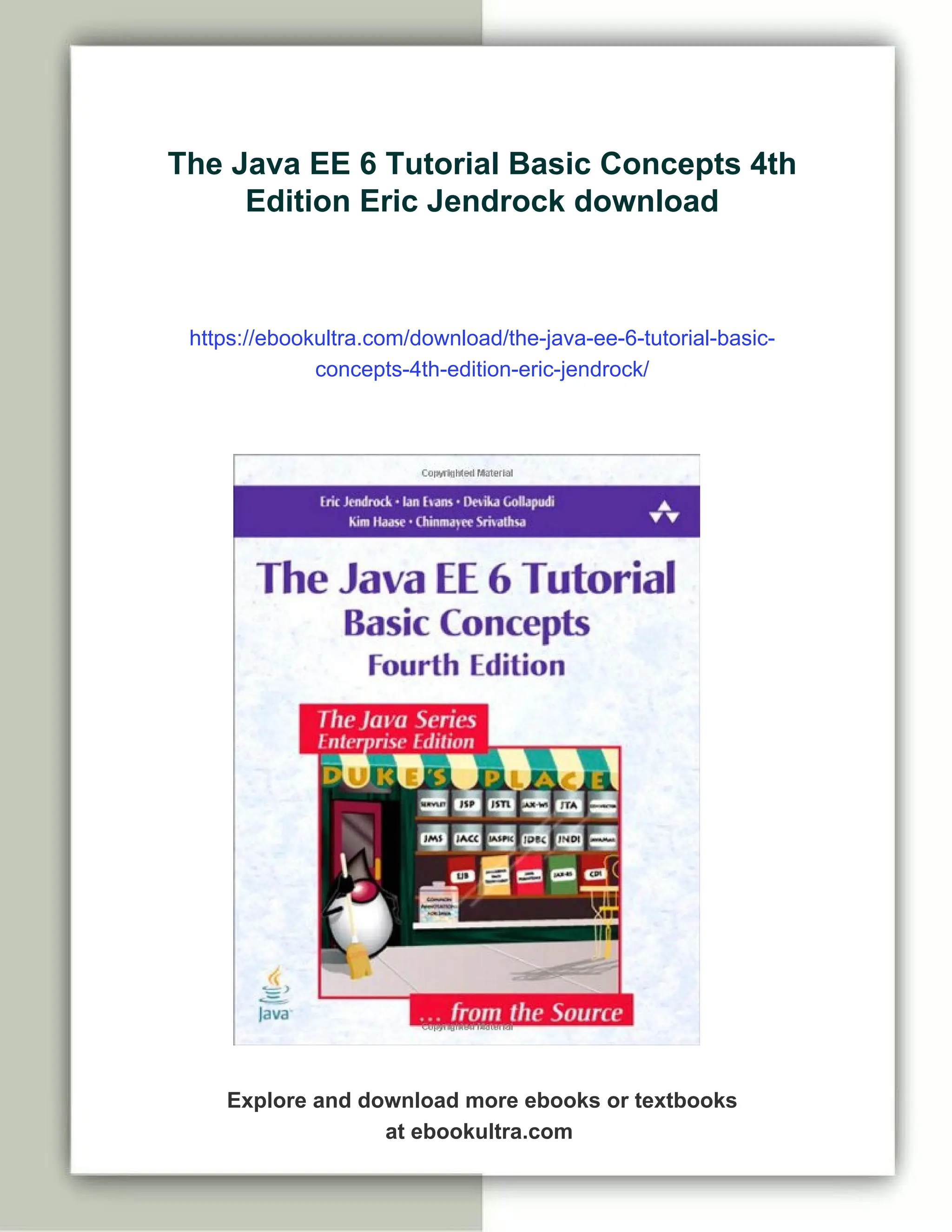




![Many of the designations used by manufacturers and sellers to distinguish their products are claimed as trademarks. Where those
designations appear in this book, and the publisher was aware of a trademark claim, the designations have been printed with initial
capital letters or in all capitals.
Oracle and Java are registered trademarks of Oracle and/or its affiliates. Other names maybe trademarks of their respective owners.
The authors and publisher have taken care in the preparation of this book, but make no expressed or implied warranty of any kind
and assume no responsibility for errors or omissions. No liability is assumed for incidental or consequential damages in connection
with or arising out of the use of the information or programs contained herein.
This document is provided for information purposes only and the contents hereofare subject to change without notice. This
document is not warranted to be error-free, nor subject to any other warranties or conditions, whether expressed orally or implied
in law, including implied warranties and conditions of merchantability or fitness for a particular purpose. We specifically disclaim
any liability with respect to this document and no contractual obligations are formed either directly or indirectly by this document.
This document may not be reproduced or transmitted in any form or by any means, electronic or mechanical, for any purpose,
without our prior written permission.
The publisher offers excellent discounts on this book when ordered in quantity for bulk purchases or special sales, which may
include electronic versions and/or custom covers and content particular to your business, training goals, marketing focus, and
branding interests. For more information, please contact
U.S. Corporate and Government Sales
(800) 382-3419
corpsales@pearsontechgroup.com
For sales outside the United States, please contact
International Sales
international@pearsoned.com
Visit us on the Web: informit.com/ph
Library of Congress Cataloging-in-Publication Data
The Java EE 6 tutorial: basic concepts / Eric Jendrock... [et al.]. —
4th ed.
p. cm.
Includes index.
ISBN 0-13-708185-5 (pbk.: alk. paper)
1. Java (Computer program language) 2. Application program interfaces
(Computer software) 3. Application software—Development. 4. Internet
programming. I. Jendrock, Eric.
QA76.73.J38J3652 2010
006.7'6—dc22
2010025759
Copyright © 2011, Oracle and/or its affiliates. All rights reserved.
500 Oracle Parkway, Redwood Shores, CA 94065
Printed in the United States of America. This publication is protected by copyright, and permission must be obtained from
the publisher prior to any prohibited reproduction, storage in a retrieval system, or transmission in any form or by any means,
electronic, mechanical, photocopying, recording, or likewise. For information regarding permissions, write to:
Pearson Education, Inc.
Rights and Contracts Department
501 Boylston Street, Suite 900
Boston, MA 02116
Fax: (617) 671-3447
ISBN-13:978-013-708185-1
ISBN-10: 0-137-08185-5
Text printed in the United States on recycled paper at Edwards Brothers in Ann Arbor, Michigan.
First printing, August, 2010](https://image.slidesharecdn.com/76066-250507100455-ebea6b1f/85/The-Java-EE-6-Tutorial-Basic-Concepts-4th-Edition-Eric-Jendrock-7-320.jpg)

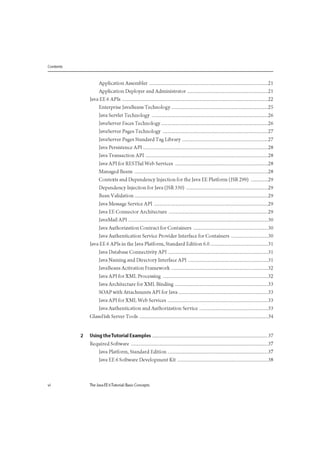
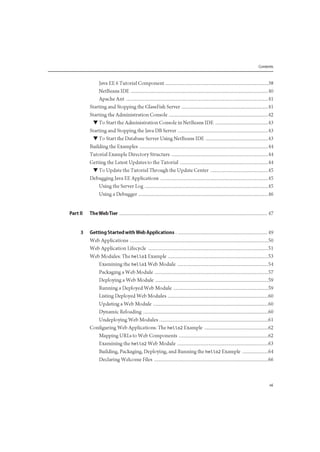
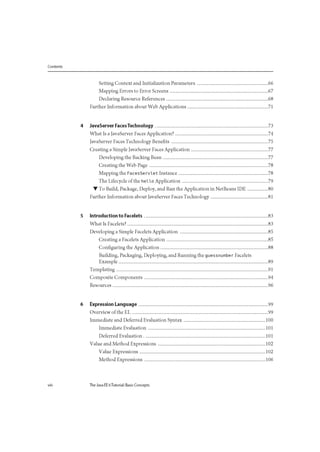




![“They are going to the Hotel of the Great Frederick, sir,” he said,
returning in a few minutes.
“Then call a cab and let us drive there.”
The Hotel of the Great Frederick was not one of the fashionable
caravansaries of the place; it was a large, old-fashioned kind of
hostelry, chiefly frequented by business people, travelling clerks,
dress-makers, etc.; and its customers were numerous enough to
make it often difficult to secure accommodation there on short
notice. This was a busy season; everybody was flitting to and from
the watering-places, where the invalids and gamblers of Europe
were ruining or repairing their fortunes and their constitutions, so
that Mr. de Winton was obliged to content himself with two small
rooms in the third story for the night; to-morrow many travellers
would be moving on, and he could have more convenient quarters.
“Stanton, keep a lookout after that person. I am in a mood for
suspecting everything and everybody; but I don’t think it’s all fancy
in this case. I believe the woman is trying to avoid me; and if so, she
must have a motive for it. Ask for the visitors’ book, and bring it to
me at once.”
Stanton brought the book, and while his master was running his
eye searchingly over the roll of names, hoping and dreading to see
Mme. Villar among the number, he set off to look after the woman
with the multitude of boxes. She was lodging on the first floor, and
had been expected by a lady and gentleman who had taken rooms
in the house the day before. This much Stanton learned from a
Kellner,[148] whom he met coming out of the said rooms with a tray
in his hands.
“I think I know her,” said Stanton. “What is her name?”
But before the Kellner could answer the door opened, and the lady
herself stood face to face with Mr. de Winton’s valet. Their eyes met
with a sudden flash of recognition; Stanton turned away with an
almost inaudible whistle, and was vaulting up to the third story in
the twinkling of an eye.](https://image.slidesharecdn.com/76066-250507100455-ebea6b1f/85/The-Java-EE-6-Tutorial-Basic-Concepts-4th-Edition-Eric-Jendrock-43-320.jpg)