Knowledge
Development Box
(“KDB”)
February 2016
PwC
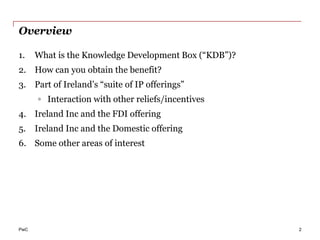
Overview
1. What is the Knowledge Development Box (“KDB”)?
2. How can you obtain the benefit?
3. Part of Ireland’s “suite of IP offerings”
◦ Interaction with other reliefs/incentives
4. Ireland Inc and the FDI offering
5. Ireland Inc and the Domestic offering
6. Some other areas of interest
2
PwC
1. The KDB
• International tax changes
• Changes in corporate tax residence rules & phasing out of the “double Irish”
• Introduction of the KDB
3
PwC
1. The KDB
International Developments and the “Modified Nexus”
4
Oct 2014
Ireland
announces
KDB
Nov 2014
OECD announces
modified nexus
approach
Dec 2014
UK and Germany
agree on modified
nexus approach
Jan 2015
EU endorses
modified nexus
Feb 2015
OECD paper on
Action 5 endorses
modified nexus
approach
April to October
2015
Public consultation
process
Publication of
Feedback Statement
Budget 2016 –
Introduction of “The
first OECD compliant
KDB in the world”
PwC
1. The KDB
5
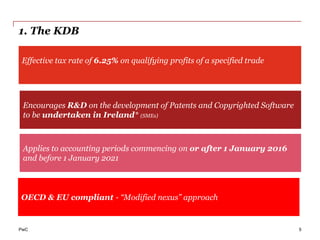
Effective tax rate of 6.25% on qualifying profits of a specified trade
Encourages R&D on the development of Patents and Copyrighted Software
to be undertaken in Ireland* (SMEs)
Applies to accounting periods commencing on or after 1 January 2016
and before 1 January 2021
OECD & EU compliant - “Modified nexus” approach
PwC
2. How can you obtain benefit?
R&D activities
Qualifying asset
Specified trade
KDB allowance
Carry on qualifying R&D activities in the
EEA
Which give rise to a qualifying asset
(Patents or Copyrighted Software)
Qualifying profits are effectively
taxed at 6.25%
The qualifying asset is exploited as part of
an Irish trade
6
PwC
Irish Operating
Company
Qualifying
IP
Qualifying
R&D
activities
Specified
trading
activities
7
2. How can you obtain benefit?
PwC
• Costs incurred carrying on in-
house R&D
• Payment made to 3rd party for
outsourced R&D services
• Payment made via related
party to 3rd party for
outsourced R&D services
provided no mark up
Lower of:
• 30% of qualifying
expenditure: or
• The aggregate of IP
acquisition costs plus
the related party
outsourced R&D costs
• Total qualifying
expenditure
• Aggregate of
acquisition costs and
related party
outsourced R&D costs
Qualifying Expenditure + Uplift
Expenditure
Overall Expenditure
Profit of
specified
trade
x =
Qualifying
profits
• Total tax adjusted profits
relating to the specified
trade after the deduction
of capital allowances (IP
amortisation)
8
2. How can you obtain benefit?
PwC
2. How can you obtain benefit?
Specified
trading
activities
Related Party
Irish Operating
Company
Qualifying R&D
activities
Specified
trading
activities
Qualifying IP
Third Party
9
Qualifying
IP
Specified
trading
activities
Qualifying
R&D
activities
a
a
X
PwC
Issues to
consider
Tracking &
tracing
Qualifying R&D
Expenditure
How is IP
expolited?
Groupstructure/
locationofIP
Outsourcing - Group
and third
parties
Transfer
pricing
3. Key factors for consideration
Type of IP
10
PwC
3. Ireland’s suite of IP offerings
R&D tax credit
• R&D expenditure qualifies
for a tax credit at 25% and a
normal deduction for R&D
expenditure (12.5%)
• Effective corporation tax
benefit of 37.5%
• R&D tax credit can be carried
back against prior year
profits
• Excess R&D tax credit may be
monetised over 3 years
IP tax
amortisation
(“291A”)
• Applies to the acquisition of
a wide range of IP
• Tax deduction (12.5%) for
IP amortisation
• No clawback if IP is sold
after 5 years
KDB
• Effective tax rate of 6.25%
on qualifying profits arising
from qualifying IP
• The calculation of qualifying
profits is linked to the R&D
costs incurred developing
qualifying IP
Incentive for companies to
bring existing IP into Ireland
Incentive for companies to
generate new IP in Ireland
Incentive for companies to
carry on R&D activities in
Ireland
11
Interaction between reliefs
PwC
3. Interaction with R&D tax credit & IP tax
amortisation
R&D tax credit & KDB
• Both the R&D tax credit and KDB
relief can be claimed in respect of the
same activities
• No cap on costs incurred on
outsourcing R&D activities
• KDB relief cannot increase the R&D
tax credit claim/monetised refund
• R&D tax credit claim should be
calculated before the calculation of
the KDB relief
IP tax amortisation & KDB
• Both KDB and IP tax amortisation
can be claimed on the same asset
• Calculate KDB based on profits after
the deduction of IP tax amortisation
• Cost of acquisition of 291A IP needs
to be included in qualifying profits
calculation
• Probably difficult to get a significant
tax amortisation and KDB benefit on
the same asset.
• 291A = Existing IP / KDB = Newly
developed IP
12
PwC
4. Ireland Inc and the FDI Offering
Existing IP Newly developed IP
• Significant activities in Ireland • Significant activities in Ireland
• Income taxed at 12.5% • Income taxed at 6.25%
• Tax deduction for amortisation based on IP
acquisition cost
• Linked to R&D activities
• R&D tax credit • R&D tax credit
Sustainable “onshore” effective model
13
PwC
5. Ireland Inc and the Domestic Offering
• PLCs/Large corporates
- Benefit will depend on where are R&D activities are carried out and where
IP is located
• SMEs
- Irish start ups, software developers may benefit from KDB
- Track and trace qualifying income and expenditure
• Universities
- No impact on KDB calculation if outsourcing R&D to Irish or foreign
university
- Substance in Ireland does matter
14
PwC
6. Some other areas of interest – Joint venture
Irish JVCo
Qualifying IP created
internally as a result
of qualifying R&D
activities
Irish Operating
Company
Specified trading
activities (Sales to
Customers)
Pharma/Tech
Co
Qualifying
IP
15
Qualifying
IP
Specified
trading
activities
Qualifying
R&D
activities
Qualifying
IP created
internally
Specified
trading
activities
Qualifying
R&D
activities
PwC
In summary ……..
Qualifying R&D activities
16
Qualifying R&D activities
2
3
4
Initial disappointment with regime
Significant compliance and documentation burden
Part of a “Suite” of offerings
Opportunities exist for all companies – FDI, PLC,
large corps, SMEs, universities
Provides a long-term and sustainable option
PwC
PwC IP/KDB Team Contact Details
Harry Harrison - harry.harrison@ie.pwc.com
Sarah Moloney - sarah.moloney@ie.pwc.com
Joe Tynan - joe.tynan@ie.pwc.com
R&D – Leader
Stephen Merriman - stephen.merriman@ie.pwc.com
17

The Irish Knowledge Development box

  • 1.
  • 2.
    PwC Overview 1. What isthe Knowledge Development Box (“KDB”)? 2. How can you obtain the benefit? 3. Part of Ireland’s “suite of IP offerings” ◦ Interaction with other reliefs/incentives 4. Ireland Inc and the FDI offering 5. Ireland Inc and the Domestic offering 6. Some other areas of interest 2
  • 3.
    PwC 1. The KDB •International tax changes • Changes in corporate tax residence rules & phasing out of the “double Irish” • Introduction of the KDB 3
  • 4.
    PwC 1. The KDB InternationalDevelopments and the “Modified Nexus” 4 Oct 2014 Ireland announces KDB Nov 2014 OECD announces modified nexus approach Dec 2014 UK and Germany agree on modified nexus approach Jan 2015 EU endorses modified nexus Feb 2015 OECD paper on Action 5 endorses modified nexus approach April to October 2015 Public consultation process Publication of Feedback Statement Budget 2016 – Introduction of “The first OECD compliant KDB in the world”
  • 5.
    PwC 1. The KDB 5 Effectivetax rate of 6.25% on qualifying profits of a specified trade Encourages R&D on the development of Patents and Copyrighted Software to be undertaken in Ireland* (SMEs) Applies to accounting periods commencing on or after 1 January 2016 and before 1 January 2021 OECD & EU compliant - “Modified nexus” approach
  • 6.
    PwC 2. How canyou obtain benefit? R&D activities Qualifying asset Specified trade KDB allowance Carry on qualifying R&D activities in the EEA Which give rise to a qualifying asset (Patents or Copyrighted Software) Qualifying profits are effectively taxed at 6.25% The qualifying asset is exploited as part of an Irish trade 6
  • 7.
  • 8.
    PwC • Costs incurredcarrying on in- house R&D • Payment made to 3rd party for outsourced R&D services • Payment made via related party to 3rd party for outsourced R&D services provided no mark up Lower of: • 30% of qualifying expenditure: or • The aggregate of IP acquisition costs plus the related party outsourced R&D costs • Total qualifying expenditure • Aggregate of acquisition costs and related party outsourced R&D costs Qualifying Expenditure + Uplift Expenditure Overall Expenditure Profit of specified trade x = Qualifying profits • Total tax adjusted profits relating to the specified trade after the deduction of capital allowances (IP amortisation) 8 2. How can you obtain benefit?
  • 9.
    PwC 2. How canyou obtain benefit? Specified trading activities Related Party Irish Operating Company Qualifying R&D activities Specified trading activities Qualifying IP Third Party 9 Qualifying IP Specified trading activities Qualifying R&D activities a a X
  • 10.
    PwC Issues to consider Tracking & tracing QualifyingR&D Expenditure How is IP expolited? Groupstructure/ locationofIP Outsourcing - Group and third parties Transfer pricing 3. Key factors for consideration Type of IP 10
  • 11.
    PwC 3. Ireland’s suiteof IP offerings R&D tax credit • R&D expenditure qualifies for a tax credit at 25% and a normal deduction for R&D expenditure (12.5%) • Effective corporation tax benefit of 37.5% • R&D tax credit can be carried back against prior year profits • Excess R&D tax credit may be monetised over 3 years IP tax amortisation (“291A”) • Applies to the acquisition of a wide range of IP • Tax deduction (12.5%) for IP amortisation • No clawback if IP is sold after 5 years KDB • Effective tax rate of 6.25% on qualifying profits arising from qualifying IP • The calculation of qualifying profits is linked to the R&D costs incurred developing qualifying IP Incentive for companies to bring existing IP into Ireland Incentive for companies to generate new IP in Ireland Incentive for companies to carry on R&D activities in Ireland 11 Interaction between reliefs
  • 12.
    PwC 3. Interaction withR&D tax credit & IP tax amortisation R&D tax credit & KDB • Both the R&D tax credit and KDB relief can be claimed in respect of the same activities • No cap on costs incurred on outsourcing R&D activities • KDB relief cannot increase the R&D tax credit claim/monetised refund • R&D tax credit claim should be calculated before the calculation of the KDB relief IP tax amortisation & KDB • Both KDB and IP tax amortisation can be claimed on the same asset • Calculate KDB based on profits after the deduction of IP tax amortisation • Cost of acquisition of 291A IP needs to be included in qualifying profits calculation • Probably difficult to get a significant tax amortisation and KDB benefit on the same asset. • 291A = Existing IP / KDB = Newly developed IP 12
  • 13.
    PwC 4. Ireland Incand the FDI Offering Existing IP Newly developed IP • Significant activities in Ireland • Significant activities in Ireland • Income taxed at 12.5% • Income taxed at 6.25% • Tax deduction for amortisation based on IP acquisition cost • Linked to R&D activities • R&D tax credit • R&D tax credit Sustainable “onshore” effective model 13
  • 14.
    PwC 5. Ireland Incand the Domestic Offering • PLCs/Large corporates - Benefit will depend on where are R&D activities are carried out and where IP is located • SMEs - Irish start ups, software developers may benefit from KDB - Track and trace qualifying income and expenditure • Universities - No impact on KDB calculation if outsourcing R&D to Irish or foreign university - Substance in Ireland does matter 14
  • 15.
    PwC 6. Some otherareas of interest – Joint venture Irish JVCo Qualifying IP created internally as a result of qualifying R&D activities Irish Operating Company Specified trading activities (Sales to Customers) Pharma/Tech Co Qualifying IP 15 Qualifying IP Specified trading activities Qualifying R&D activities Qualifying IP created internally Specified trading activities Qualifying R&D activities
  • 16.
    PwC In summary …….. QualifyingR&D activities 16 Qualifying R&D activities 2 3 4 Initial disappointment with regime Significant compliance and documentation burden Part of a “Suite” of offerings Opportunities exist for all companies – FDI, PLC, large corps, SMEs, universities Provides a long-term and sustainable option
  • 17.
    PwC PwC IP/KDB TeamContact Details Harry Harrison - harry.harrison@ie.pwc.com Sarah Moloney - sarah.moloney@ie.pwc.com Joe Tynan - joe.tynan@ie.pwc.com R&D – Leader Stephen Merriman - stephen.merriman@ie.pwc.com 17