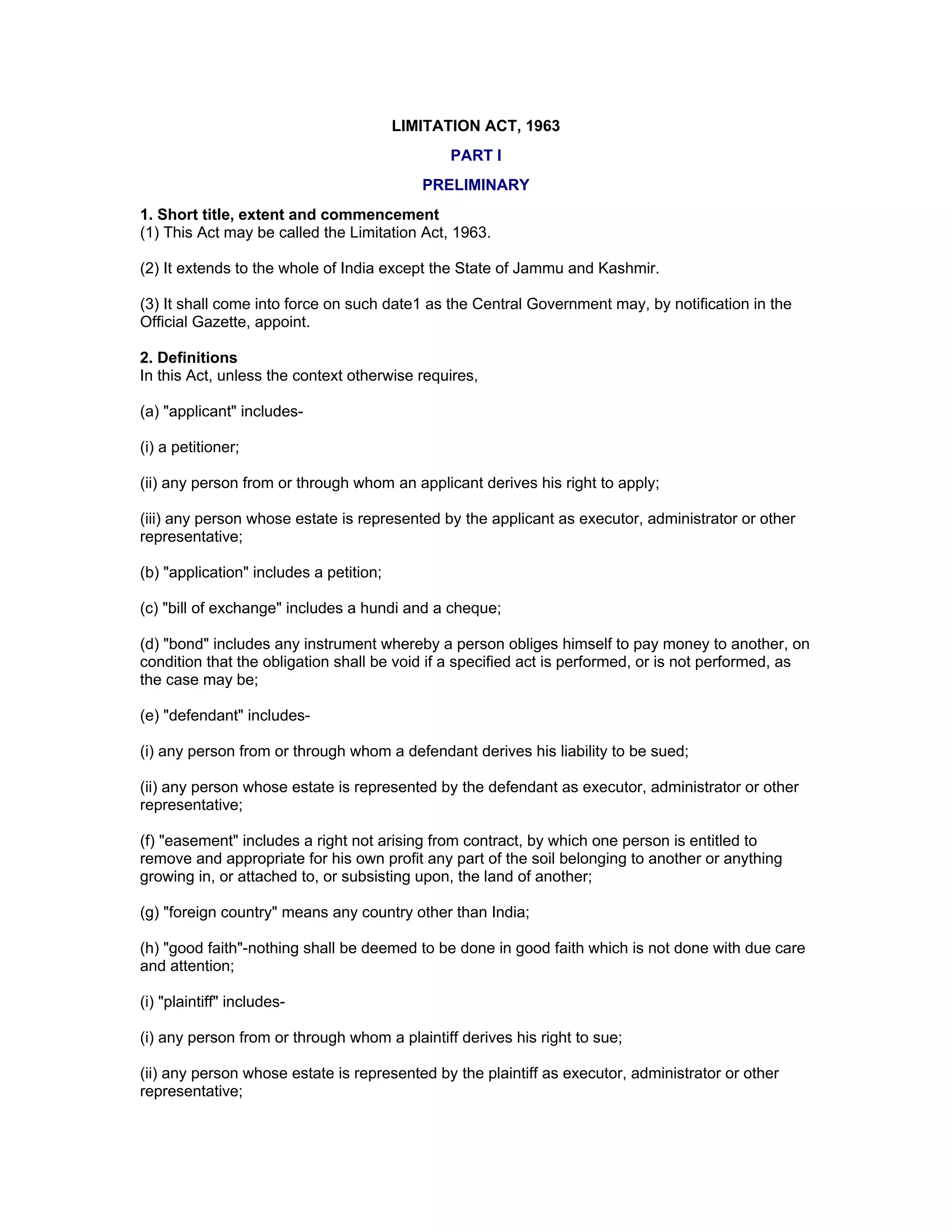
LIMITATION ACT, 1963 
PART I 
PRELIMINARY 
1. Short title, extent and commencement 
(1) This Act may be called the Limitation Act, 1963. 
(2) It extends to the whole of India except the State of Jammu and Kashmir. 
(3) It shall come into force on such date1 as the Central Government may, by notification in the 
Official Gazette, appoint. 
2. Definitions 
In this Act, unless the context otherwise requires, 
(a) "applicant" includes- 
(i) a petitioner; 
(ii) any person from or through whom an applicant derives his right to apply; 
(iii) any person whose estate is represented by the applicant as executor, administrator or other 
representative; 
(b) "application" includes a petition; 
(c) "bill of exchange" includes a hundi and a cheque; 
(d) "bond" includes any instrument whereby a person obliges himself to pay money to another, on 
condition that the obligation shall be void if a specified act is performed, or is not performed, as 
the case may be; 
(e) "defendant" includes- 
(i) any person from or through whom a defendant derives his liability to be sued; 
(ii) any person whose estate is represented by the defendant as executor, administrator or other 
representative; 
(f) "easement" includes a right not arising from contract, by which one person is entitled to 
remove and appropriate for his own profit any part of the soil belonging to another or anything 
growing in, or attached to, or subsisting upon, the land of another; 
(g) "foreign country" means any country other than India; 
(h) "good faith"-nothing shall be deemed to be done in good faith which is not done with due care 
and attention; 
(i) "plaintiff" includes- 
(i) any person from or through whom a plaintiff derives his right to sue; 
(ii) any person whose estate is represented by the plaintiff as executor, administrator or other 
representative;
(j) "period of limitation" means the period of limitation prescribed for any suit, appeal or 
application by the Schedule, and "prescribed period" means the period of limitation computed in 
accordance with the provisions of this Act; 
(k) "promissory note" means any instrument whereby the maker engages absolutely to pay a 
specified sum of money to another at a time therein limited, or on demand, or at sight; 
(l) "suit" does not include an appeal or an application; 
(m) "tort" means a civil wrong which is not exclusively the breach of a contract or the breach of a 
trust; 
(n) "trustee" does not include a benamidar, a mortgagee remaining in possession after the 
mortgage has been satisfied or a person in wrongful possession without title. 
PART II 
LIMITATION OF SUITS, APPEALS AND APPLICATIONS 
3. Bar of limitation 
(1) Subject to the provisions contained in sections 4 to 24 (inclusive), every suit instituted, appeal 
preferred, and application made after the prescribed period shall be dismissed although limitation 
has not been set up as a defence. 
(2) For the purposes of this Act- 
(a) a suit is instituted- 
(i) in an ordinary case, when the plaint is presented to the proper officer; 
(ii) in the case of a pauper, when his application for leave to sue as a pauper is made; and 
(iii) in the case of a claim against a company which is being wound up by the court, when the 
claimant first sends in his claim to the official liquidator; 
(b) any claim by way of a set off or a counter claim, shall be treated as a separate suit and shall 
be deemed to have been instituted- 
(i) in the case of a set off, on the same date as the suit in which the set off is pleaded; 
(ii) in the case of a counter claim, on the date on which the counter claim is made in court; 
(c) an application by notice of motion in a High Court is made when the application is presented 
to the proper officer of that court. 
4. Expiry of prescribed period when court is closed 
Where the prescribed period for any suit, appeal or application expires on a day when the court is 
closed, the suit, appeal or application may be instituted, preferred or made on the date when the 
court reopens. 
Explanation: A court shall be deemed to be closed on any day within the meaning of this section if 
during any part of its normal working hours it remains closed on that day. 
5. Extension of prescribed period in certain cases 
Any appeal or any application, other than an application under any of the provisions of Order XXI 
of the Code of Civil Procedure, 1908, may be, admitted after the prescribed period, if the 
appellant or the applicant satisfies the court that he had sufficient cause for not preferring the
appeal or making the application within such period. 
Explanation: The fact that the appellant or the applicant was misled by any order, practice or 
judgement of the High Court in ascertaining or computing the prescribed period may be sufficient 
cause within the meaning of this section. 
6. Legal disability 
(1) Where a person entitled to institute a suit or make an application for the execution of a decree, 
is at the time from which the prescribed period is to be reckoned, a minor or insane, or an idiot, 
he may institute the suit or make the application within the same period after the disability has 
ceased, as would otherwise have been allowed from the time specified therefor in the third 
column of the Schedule. 
(2) Where such person is, at the time from which the prescribed period is to be reckoned, affected 
by two such disabilities, or where, before his disability has ceased, he is affected by another 
disability, he may institute the suit or make the application within the same period after both 
disabilities have ceased, as would otherwise have been allowed from the times so specified. 
(3) Where the disability continues up to the death of that person, his legal representative may 
institute the suit or make the application within the same period after the death, as would 
otherwise have been allowed from the time so specified. 
(4) Where the legal representative referred to in sub-section (3) is, at the date of the death of the 
person whom he represents, affected by any such disability, the rules contained in sub-sections 
(1) and (2) shall apply. 
(5) Where a person under disability dies after the disability ceases but within the period allowed to 
him under this section, his legal representative may institute the suit or make the application 
within the same period after the death, as would otherwise have been available to that person 
had he not died. 
Explanation: For the purposes of this section 'minor' includes a child in the womb. 
7. Disability of one of several persons 
Where one of several persons jointly entitled to institute a suit or make an application for the 
execution of a decree is under any such disability, and a discharge can be given without the 
concurrence of such person, time will run against them all; but, where no such discharge can be 
given, time will not run as against any of them until one of them becomes capable of giving such 
discharge without the concurrence of the others or until the disability has ceased. 
Explanation I : This section applies to a discharge from every kind of liability, including a liability in 
respect of any immovable property. 
Explanation II: For the purposes of this section, the manager of a Hindu undivided family 
governed by the Mitakshara law shall be deemed to be capable of giving a discharge without the 
concurrence of the other members of the family only if he is in management of the joint family 
property. 
8. Special exceptions 
Nothing in section 6 or in section 7 applies to suits to enforce rights of pre-emption, or shall be 
deemed to extend, for more than three years from the cessation of the disability or the death of 
the person affected thereby, the period of limitation for any suit or application. 
9. Continuous running of time 
Where once time has begun to run, no subsequent disability or inability to institute a suit or make 
an application stops it:
PROVIDED that where letters of administration to the estate of creditor have been granted to his 
debtor, the running of the period of limitation for a suit to recover the debt shall be suspended 
while the administration continues. 
10. Suits against trustees and their representatives 
Notwithstanding anything contained in the foregoing provisions of this Act, no suit against a 
person in whom property has become vested in trust for any specific purpose, or against his legal 
representatives or assigns (not being assigns for valuable consideration), for the purpose of 
following in his or their hands such property, or the proceeds thereof, or for an account of such 
property or proceeds, shall be barred by any length of time. 
Explanation: For the purposes of this section any property comprised in a Hindu, Muslim or 
Buddhist religious or charitable endowment shall be deemed to be property vested in trust for a 
specific purpose and the manager of the property shall be deemed to be the trustee thereof. 
11. Suits on contracts entered into outside the territories to which the Act extends 
(1) Suits instituted in the territories to which this Act extends on contracts entered into in the State 
of Jammu and Kashmir or in a foreign country shall be subject to the rules of limitation contained 
in this Act. 
(2) No rule of limitation in force in the State of Jammu and Kashmir or in a foreign country shall be 
a defence to a suit instituted in the said territories on a contract entered into in that State or in a 
foreign country unless- 
(a) the rule has extinguished the contract; and 
(b) the parties were domiciled in that State or in the foreign country during the period prescribed 
by such rule. 
PART III 
COMPUTATION OF PERIOD OF LIMITATION 
12. Exclusion of time in legal proceedings 
(1) In computing the period of limitation for any suit, appeal or application, the day from which 
such period is to be reckoned, shall be excluded. 
(2) In computing the period of limitation for an appeal or an application for leave to appeal or for 
revision or for review of a judgement, the day on which judgement complained of was 
pronounced and the time requisite for obtaining a copy of the decree, sentence or order appealed 
from or sought to be revised or reviewed shall be excluded. 
(3) Where a decree or order is appealed from or sought to be revised or reviewed, or where an 
application is made for leave to appeal from a decree or order, the time requisite for obtaining a 
copy of the judgement 2[***] shall also be excluded. 
(4) In computing the period of limitation for an application to set aside an award, the time requisite 
for obtaining a copy of the award shall be excluded. 
Explanation: In computing under this section the time requisite for obtaining a copy of a decree or 
an order, any time taken by the court to prepare the decree or order before an application for a 
copy thereof is made shall not be excluded.
13. Exclusion of time in cases where leave to sue or appeal as a pauper is applied for 
In computing the period of limitation prescribed for any suit or appeal in any case where an 
application for leave to sue or appeal as a pauper has been made and rejected, the time during 
which the applicant has been prosecuting in good faith his application for such leave shall be 
excluded, and the court may, on payment of the court fees prescribed for such suit or appeal, 
treat the suit or appeal as having the same force and effect as if the court fees had been paid in 
the first instance. 
14. Exclusion of time of proceeding bona fide in court without jurisdiction 
(1) In computing the period of limitation for any suit the time during which the plaintiff has been 
prosecuting with due diligence another civil proceeding, whether in a court of first instance or of 
appeal or revision, against the defendant shall be excluded, where the proceeding relates to the 
same matter in issue and is prosecuted in good faith in a court which, from defect of jurisdiction or 
other cause of a like nature, is unable to entertain it. 
(2) In computing the period of limitation for any application, the time during which the applicant 
has been prosecuting with due diligence another civil proceeding, whether in a court of first 
instance or of appeal or revision, against the same party for the same relief shall be excluded, 
where such proceeding is prosecuted in good faith in a court which, from defect of jurisdiction or 
other cause of a like nature, is unable to entertain it. 
(3) Notwithstanding anything contained in rule 2 of Order XXIII of the Code of Civil Procedure, 
1908 (5 of 1908), the provisions of sub-section (1) shall apply in relation to a fresh suit instituted 
on permission granted by the court under rule 1 of that Order, where such permission is granted 
on the ground that the first suit must fail by reason of a defect in the jurisdiction of the court or 
other cause of a like nature. 
Explanation: For the purposes of this section- 
(a) in excluding the time during which a former civil proceeding was pending, the day on which 
that proceeding was instituted and the day on which it ended shall both be counted; 
(b) a plaintiff or an applicant resisting an appeal shall be deemed to be prosecuting a proceeding; 
(c) misjoinder of parties or of causes of action shall be deemed to be a cause of a like nature with 
defect of jurisdiction. 
15. Exclusion of time in certain other cases 
(1) In computing the period of limitation of any suit or application for the execution of a decree, 
the institution or execution of which has been stayed by injunction or order, the time of the 
continuance of the injunction or order, the day on which it was issued or made, and the day on 
which it was withdrawn, shall be excluded. 
(2) In computing the period of limitation for any suit of which notice has been given, or for which 
the previous consent or sanction of the government or any other authority is required, in 
accordance with the requirements of any law for the time being in force, the period of such notice 
or, as the case may be, the time required for obtaining such consent or sanction shall be 
excluded. 
Explanation: In excluding the time required for obtaining the consent or sanction of the 
government or any other authority, the date on which the application was made for obtaining the 
consent or sanction and the date of receipt of the order of the government or other authority shall 
both be counted. 
(3) In computing the period of limitation for any suit or application for execution of a decree by any 
receiver or interim receiver appointed in proceedings for the adjudication of a person as an
insolvent or by any liquidator or provisional liquidator appointed in proceedings for the winding up 
of a company, the period beginning with the date of institution of such proceeding and ending with 
the expiry of three months from the date of appointment of such receiver or liquidator, as the case 
may be, shall be excluded. 
(4) In computing the period of limitation for a suit for possession by a purchaser at a sale in 
execution of a decree, the time during which a proceeding to set aside the sale has been 
prosecuted shall be excluded. 
(5) In computing the period of limitation for any suit the time during which the defendant has been 
absent from India and from the territories outside India under the administration of the Central 
Government, shall be excluded. 
16. Effect of death on or before the accrual of the right to sue 
(1) Where a person who would, if he were living, have a right to institute a suit or make an 
application dies before the right accrues, or where a right to institute a suit or make an application 
accrues only on the death of a person, the period of limitation shall be computed from the time 
when there is a legal representative of the deceased capable of instituting such suit or making 
such application. 
(2) Where a person against whom, if he were living, a right to institute a suit or make an 
application would have accrued dies before the right accrues, or where a right to institute a suit or 
make an application against any person accrues on the death of such person, the period of 
limitation shall be computed from the time7 when there is a legal representative of the deceased 
against whom the plaintiff may institute such suit or making such application. 
(3) Nothing in sub-section (1) or sub-section (2) applies to suits to enforce rights of pre-emption or 
to suits for the possession of immovable property or of a hereditary office. 
17. Effect of fraud or mistake 
(1) Where, in the case of any suit or application for which a period of limitation is prescribed by 
this Act- 
(a) the suit or application is based upon the fraud of the defendant or respondent or his agent; or 
(b) the knowledge of the right or title on which suit or application is founded is concealed by the 
fraud of any such person as aforesaid; or 
(c) the suit or application is for relief from the consequences of a mistake; or 
(d) where any document necessary to establish the right of the plaintiff or applicant has been 
fraudulently concealed from him; 
the period of limitation shall not begin to run until the plaintiff or applicant has discovered the 
fraud or the mistake or could, with reasonable diligence, have discovered it; or in the case of a 
concealed document, until the plaintiff or the applicant first had the means of producing the 
concealed document or compelling its production: 
PROVIDED that nothing in this section shall enable any suit to be instituted or application to be 
made to recover or enforce any charge against, or set aside any transaction affecting, any 
property which- 
(i) in the case of fraud, has been purchased for valuable consideration by a person who was not a 
party to the fraud and did not at the time of the purchase know, or have reason to believe, that 
any fraud had been committed, or
(ii) in the case of mistake, has been purchased for valuable consideration subsequently to the 
transaction in which the mistake was made, by a person who did not know, or have reason to 
believe, that the mistake had been made, or 
(iii) in the case of concealed document, has been purchased for valuable consideration by a 
person who was not a party to the concealment and, did not at the time of purchase know, or 
have reason to believe, that the document had been concealed. 
(2) Where a judgement-debtor has, by fraud or force, prevented the execution of a decree or 
order with the period of limitation, the court may, on the application of the judgement-creditor 
made after the expiry of the said period extend the period for execution of the decree or order: 
PROVIDED that such application is made within one year from the date of the discovery of the 
fraud or the cessation of force, as the case may be. 
18. Effect of acknowledgement in writing 
(1) Where, before the expiration of the prescribed period for a suit or application in respect of any 
property or right, an acknowledgement of liability in respect of such property or right has been 
made in writing signed by the party against whom such property or right is claimed, or by any 
person through whom he derives his title or liability, a fresh period of limitation shall be computed 
from the time when the acknowledgement was so signed. 
(2) Where the writing containing the acknowledgement is undated, oral evidence may be given of 
the time when it was signed; but subject to the provisions of the Indian Evidence Act, 1872 (1 of 
1872), oral evidence of its contents shall not be received,. 
Explanation : For the purposes of this section- 
(a) an acknowledgement may be sufficient though it omits to specify the exact nature of the 
property or right, or avers that the time for payment, delivery, performance or enjoyment has not 
yet come or is accompanied by a refusal to pay, deliver, perform or permit to enjoy, or is coupled 
with a claim to set-off, or is addressed to a person other than a person entitled to the property or 
right; 
(b) the word "signed" means signed either personally or by an agent duly authorised in this 
behalf; and 
(c) an application for the execution of a decree or order shall not be deemed to be an application 
in respect of any property or right. 
19. Effect of payment on account of debt or of interest on legacy 
Where payment on account of a debt or of interest on a legacy is made before the expiration of 
the prescribed period by the person liable to pay the debt or legacy or by his agent duly 
authorised in this behalf, a fresh period of limitation shall be computed from the time when the 
payment was made: 
PROVIDED that, save in the case of payment of interest made before the 1st day of January, 
1928, an acknowledgement of the payment appears in the handwriting of, or in a writing signed 
by, the person making the payment. 
Explanation: For the purposes of this section - 
(a) where mortgaged land is in the possession of the mortgagee, the receipt of the rent or 
produce of such land shall be deemed to be a payment; 
(b) "debt" does not include money payable under a decree or order of a court.
20. Effect of acknowledgement or payment by another person 
(1) The expression "agent duly authorised in this behalf" in sections 18 and 19 shall, in the case 
of a person under disability, include his lawful guardian, committee or manager or an agent duly 
authorised by such guardian, committee or manager to sign the acknowledgement or make the 
payment. 
(2) Nothing in the said sections renders one of several joint contractors, partners, executors or 
mortgagees chargeable by reason only of a written acknowledgement signed by, or of a payment 
made by, or by the agent of, any other or others of them. 
(3) For the purposes of the said sections,- 
(a) an acknowledgement signed or a payment made in respect of any liability by or by the duly 
authorised agent of, any limited owner of property who is governed by Hindu law, shall be a valid 
acknowledgement or payment, as the case may be, against a reversioner succeeding to such 
liability; and 
(b) where a liability has been incurred by or on behalf of a Hindu undivided family as such, an 
acknowledgement or payment made by, or by the duly authorised agent of, the manager of the 
family for the time being shall be deemed to have been made on behalf of the whole family. 
21. Effect of substituting or adding new plaintiff or defendant 
(1) Where after the institution of a suit, a new plaintiff or, defendant is substituted or added, the 
suit shall, as regards him, be deemed to have been instituted when he was so made a party: 
PROVIDED that where the court is satisfied that the omission to include a new plaintiff or 
defendant was due to a mistake made in good faith it may direct that the suit as regards such 
plaintiff or defendant shall be deemed to have been instituted on any earlier date. 
(2) Nothing in sub-section (1) shall apply to a case where a party is added or substituted owing to 
assignment or devolution of any interest during the pendency of a suit or where a plaintiff is made 
a defendant or a defendant is made a plaintiff. 
22. Continuing breaches and torts 
In the case of a continuing breach of contract or in the case of a continuing tort, a fresh period of 
limitation begins to run at every moment of the time during which the breach or the tort, as the 
case may be, continues. 
23. Suits for compensation for acts not actionable without special damage 
In the case of a suit for compensation for an act which does not give rise to a cause of action 
unless some specific injury actually results therefrom, the period of limitation shall be computed 
from the time when the injury results. 
24. Computation of time mentioned in instruments 
All instruments shall for the purposes of this Act be deemed to be made with reference to the 
Gregorian calendar. 
PART IV 
ACQUISITION OF OWNERSHIP BY POSSESSION 
25. Acquisition of easement by prescription 
(1) Where the access and use of light or air to and for any building have been peaceably enjoyed 
therewith as an easement, and as of right, without interruption, and for twenty years, and where 
any way or watercourse or the use of any water or any other easement (whether affirmative or 
negative) has been peaceably and openly enjoyed by any person claiming title thereto as an
easement and as of right without interruption and for twenty years, the right to such access and 
use of light or air, way, watercourse, use of water, or other easement shall be absolute and 
indefeasible. 
(2) Each of the said periods of twenty years shall be taken to be a period ending within two years 
next before the institution of the suit wherein the claim to which such period relates is contested. 
(3) Where the property over which a right is claimed under sub-section (1) belongs to the 
government that sub-section shall be read as if for the words "twenty years" the words "thirty 
years" were substituted. 
Explanation : Nothing is an interruption with the meaning of this section, unless where there is an 
actual discontinuance of the possession or enjoyment by reason of an obstruction by the act of 
some person other than the claimant, and unless such obstruction submitted to or acquiesced in 
for one year after the claimant has notice thereof and of the person making or authorising the 
same to be made. 
26. Exclusion in favour of reversioner of servient tenement 
Where any land or water upon, over or from, which any easement has been enjoyed or derived 
has been held under or by virtue of any interest for life or in terms of years exceeding three years 
from the granting thereof the time of the enjoyment of such easement during the continuance of 
such interest or term shall be excluded in the computation of the period of twenty years in case 
the claim is, within three years next after the determination of such interests or term resisted by 
the person entitled on such determination to the said land or water. 
27. Extinguishment of right to property 
At the determination of the period hereby limited to any person for instituting a suit for possession 
of any property, his right to such property shall be extinguished. 
PART V 
MISCELLANEOUS 
28. Amendment of certain Acts 
[Rep. by the Repealing and Amending Act, 1974 (56 of 1974) s. 2 and First Sch.] 
29. Saving 
(1) Nothing in this Act shall affect section 25 of the Indian Contract Act, 1872 (9 of 1872). 
(2) Where any special or local law prescribes for any suit, appeal or application a period of 
limitation different from the period prescribed by the Schedule, the provisions of s. 3 shall apply 
as if such periods were the periods prescribed by the Schedule and for the purpose of 
determining any period of limitation prescribed for any suit, appeal or application by any special or 
local law, the provisions contained in sections 4 to 24 (inclusive) shall apply only in so far as, and 
to the extent to which, they are not expressly excluded by such special or local law. 
(3) Save as otherwise provided in any law for the time being in force with respect to marriage and 
divorce, nothing in this Act shall apply to any suit or other proceeding under any such law. 
(4) Sections 25 and 26 and the definition of "easement" in section 2 shall not apply to cases 
arising in the territories to which the Indian Easements Act, 1882 (5 of 1882), may for the time 
being extend. 
30. Provision for suits, etc., for the prescribed period is shorter than the period prescribed 
by the Indian Limitation Act, 1908 
Notwithstanding anything contained in this Act-
(a) any suit for which the period of limitation is shorter than the period of limitation prescribed by 
the Indian Limitation Act, 1908 (9 of 1908), may be instituted within a period of 3[seven years] 
next after the commencement of this Act or within the period prescribed for such suit by the 
Indian Limitation Act, 1908, whichever period expires earlier: 
4[PROVIDED that if in respect of any such suit, the said period of seven years expires earlier 
than the period of limitation prescribed therefor under the Indian Limitation Act, 1908 and the said 
period of seven years together with so much of the period of limitation in respect of such suit 
under the Indian Limitation Act, 1908 (9 of 1908), as has already expired before the 
commencement of this Act is shorter than the period prescribed for such suit under this Act, then, 
the suit may be instituted within the period of limitation prescribed therefor under this Act;] 
(b) any appeal or application for which the period of limitation is shorter than the period of 
limitation prescribed by the Indian Limitation Act, 1908, may be preferred or made within a period 
of ninety days next after the commencement of this Act or within a period prescribed for such 
appeal or application by the Indian Limitation Act, 1908, whichever period expires earlier. 
31. Provisions as to barred or pending suits, etc. 
Nothing in this Act shall- 
(a) enable any suit, appeal or application to be instituted, preferred or made, for which the period 
of limitation prescribed by the Indian Limitation Act, 1908, expired before the commencement of 
this Act; or 
(b) affect any suit, appeal or application instituted, preferred or made before, and pending at, 
such commencement. 
32. Repeal 
[Rep. by the Repealing and Amending Act, 1974 (56 of 1974)] 
THE SCHEDULE: PERIODS OF LIMITATION 
[Sections 2 (j) and 3] 
FIRST DIVISION-SUITS 
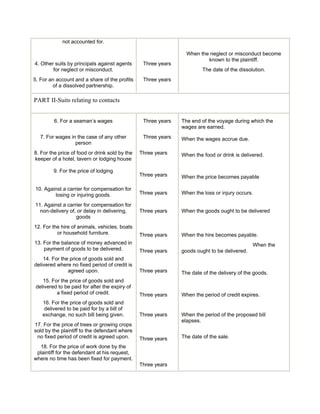
Description of suits Period of 
limitation 
Time from which period begins to run 
PART I- Suits relating to accounts 
1. For the balance due on a mutual, open 
and current account, where there have been 
reciprocal demands between the parties. 
2. Against a factor for an account 
3. By a principal against his agent for 
movable property received by the latter and 
Three years 
Three years 
Three years 
The close of the year in which the last item 
admitted or proved is entered in the account; 
such year to be computed as in the account. 
When the account is, during the continuance of 
the agency, demanded and refused or, where 
no such demand is made, when the agency 
terminates. 
When the account is, during the continuance of 
the agency, demanded and refused or, where 
no such demand is made, when the agency 
terminates.
not accounted for. 
4. Other suits by principals against agents 
for neglect or misconduct. 
5. For an account and a share of the profits 
of a dissolved partnership. 
Three years 
Three years 
When the neglect or misconduct become 
known to the plaintiff. 
The date of the dissolution. 
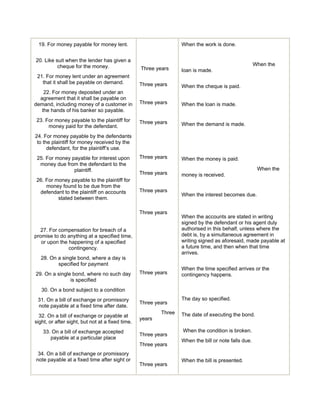
PART II-Suits relating to contacts 
6. For a seaman’s wages 
7. For wages in the case of any other 
person 
8. For the price of food or drink sold by the 
keeper of a hotel, tavern or lodging house 
9. For the price of lodging 
10. Against a carrier for compensation for 
losing or injuring goods. 
11. Against a carrier for compensation for 
non-delivery of, or delay in delivering, 
goods 
12. For the hire of animals, vehicles, boats 
or household furniture. 
13. For the balance of money advanced in 
payment of goods to be delivered. 
14. For the price of goods sold and 
delivered where no fixed period of credit is 
agreed upon. 
15. For the price of goods sold and 
delivered to be paid for after the expiry of 
a fixed period of credit. 
16. For the price of goods sold and 
delivered to be paid for by a bill of 
exchange, no such bill being given. 
17. For the price of trees or growing crops 
sold by the plaintiff to the defendant where 
no fixed period of credit is agreed upon. 
18. For the price of work done by the 
plaintiff for the defendant at his request, 
where no time has been fixed for payment. 
Three years 
Three years 
Three years 
Three years 
Three years 
Three years 
Three years 
Three years 
Three years 
Three years 
Three years 
Three years 
Three years 
The end of the voyage during which the 
wages are earned. 
When the wages accrue due. 
When the food or drink is delivered. 
When the price becomes payable 
When the loss or injury occurs. 
When the goods ought to be delivered 
When the hire becomes payable. 
When the 
goods ought to be delivered. 
The date of the delivery of the goods. 
When the period of credit expires. 
When the period of the proposed bill 
elapses. 
The date of the sale.
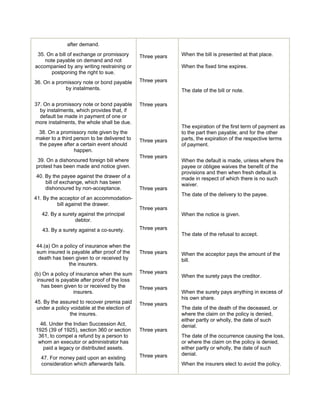
19. For money payable for money lent. 
20. Like suit when the lender has given a 
cheque for the money. 
21. For money lent under an agreement 
that it shall be payable on demand. 
22. For money deposited under an 
agreement that it shall be payable on 
demand, including money of a customer in 
the hands of his banker so payable. 
23. For money payable to the plaintiff for 
money paid for the defendant. 
24. For money payable by the defendants 
to the plaintiff for money received by the 
defendant, for the plaintiff’s use. 
25. For money payable for interest upon 
money due from the defendant to the 
plaintiff. 
26. For money payable to the plaintiff for 
money found to be due from the 
defendant to the plaintiff on accounts 
stated between them. 
27. For compensation for breach of a 
promise to do anything at a specified time, 
or upon the happening of a specified 
contingency. 
28. On a single bond, where a day is 
specified for payment 
29. On a single bond, where no such day 
is specified 
30. On a bond subject to a condition 
31. On a bill of exchange or promissory 
note payable at a fixed time after date. 
32. On a bill of exchange or payable at 
sight, or after sight, but not at a fixed time. 
33. On a bill of exchange accepted 
payable at a particular place 
34. On a bill of exchange or promissory 
note payable at a fixed time after sight or 
Three years 
Three years 
Three years 
Three years 
Three years 
Three years 
Three years 
Three years 
Three years 
Three years 
Three 
years 
Three years 
Three years 
Three years 
When the work is done. 
When the 
loan is made. 
When the cheque is paid. 
When the loan is made. 
When the demand is made. 
When the money is paid. 
When the 
money is received. 
When the interest becomes due. 
When the accounts are stated in writing 
signed by the defendant or his agent duly 
authorised in this behalf, unless where the 
debt is, by a simultaneous agreement in 
writing signed as aforesaid, made payable at 
a future time, and then when that time 
arrives. 
When the time specified arrives or the 
contingency happens. 
The day so specified. 
The date of executing the bond. 
When the condition is broken. 
When the bill or note falls due. 
When the bill is presented.
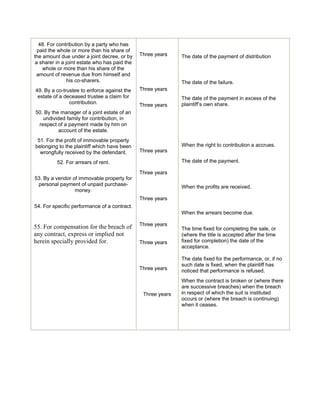
after demand. 
35. On a bill of exchange or promissory 
note payable on demand and not 
accompanied by any writing restraining or 
postponing the right to sue. 
36. On a promissory note or bond payable 
by instalments. 
37. On a promissory note or bond payable 
by instalments, which provides that, if 
default be made in payment of one or 
more instalments, the whole shall be due. 
38. On a promissory note given by the 
maker to a third person to be delivered to 
the payee after a certain event should 
happen. 
39. On a dishonoured foreign bill where 
protest has been made and notice given. 
40. By the payee against the drawer of a 
bill of exchange, which has been 
dishonoured by non-acceptance. 
41. By the acceptor of an accommodation-bill 
against the drawer. 
42. By a surety against the principal 
debtor. 
43. By a surety against a co-surety. 
44.(a) On a policy of insurance when the 
sum insured is payable after proof of the 
death has been given to or received by 
the insurers. 
(b) On a policy of insurance when the sum 
insured is payable after proof of the loss 
has been given to or received by the 
insurers. 
45. By the assured to recover premia paid 
under a policy voidable at the election of 
the insures. 
46. Under the Indian Succession Act, 
1925 (39 of 1925), section 360 or section 
361, to compel a refund by a person to 
whom an executor or administrator has 
paid a legacy or distributed assets. 
47. For money paid upon an existing 
consideration which afterwards fails. 
Three years 
Three years 
Three years 
Three years 
Three years 
Three years 
Three years 
Three years 
Three years 
Three years 
Three years 
Three years 
Three years 
Three years 
When the bill is presented at that place. 
When the fixed time expires. 
The date of the bill or note. 
The expiration of the first term of payment as 
to the part then payable; and for the other 
parts, the expiration of the respective terms 
of payment. 
When the default is made, unless where the 
payee or obligee waives the benefit of the 
provisions and then when fresh default is 
made in respect of which there is no such 
waiver. 
The date of the delivery to the payee. 
When the notice is given. 
The date of the refusal to accept. 
When the acceptor pays the amount of the 
bill. 
When the surety pays the creditor. 
When the surety pays anything in excess of 
his own share. 
The date of the death of the deceased, or 
where the claim on the policy is denied, 
either partly or wholly, the date of such 
denial. 
The date of the occurrence causing the loss, 
or where the claim on the policy is denied, 
either partly or wholly, the date of such 
denial. 
When the insurers elect to avoid the policy.
48. For contribution by a party who has 
paid the whole or more than his share of 
the amount due under a joint decree, or by 
a sharer in a joint estate who has paid the 
whole or more than his share of the 
amount of revenue due from himself and 
his co-sharers. 
49. By a co-trustee to enforce against the 
estate of a deceased trustee a claim for 
contribution. 
50. By the manager of a joint estate of an 
undivided family for contribution, in 
respect of a payment made by him on 
account of the estate. 
51. For the profit of immovable property 
belonging to the plaintiff which have been 
wrongfully received by the defendant. 
52. For arrears of rent. 
53. By a vendor of immovable property for 
personal payment of unpaid purchase-money. 
54. For specific performance of a contract. 
55. For compensation for the breach of 
any contract, express or implied not 
herein specially provided for. 
Three years 
Three years 
Three years 
Three years 
Three years 
Three years 
Three years 
Three years 
Three years 
Three years 
The date of the payment of distribution 
The date of the failure. 
The date of the payment in excess of the 
plaintiff’s own share. 
When the right to contribution a accrues. 
The date of the payment. 
When the profits are received. 
When the arrears become due. 
The time fixed for completing the sale, or 
(where the title is accepted after the time 
fixed for completion) the date of the 
acceptance. 
The date fixed for the performance, or, if no 
such date is fixed, when the plaintiff has 
noticed that performance is refused. 
When the contract is broken or (where there 
are successive breaches) when the breach 
in respect of which the suit is instituted 
occurs or (where the breach is continuing) 
when it ceases.
THE SCHEDULE: PERIODS OF LIMITATION 
[Sections 2 (j) and 3] 
FIRST DIVISION-SUITS 
PART III- Suits relating to declarations 
56. To declare the forgery of an instrument issued or 
registered. 
57. To obtain the declaration that an alleged adoption 
is invalid, or never, in fact, took place. 
58. To obtain any other declaration. 
Three years 
Three years 
Three years 
When the issue or registration becomes known 
to the plaintiff. 
When the alleged adoption becomes known to 
the plaintiff. 
When the right to sue first accrues. 
PART IV-Suits relating to decrees and instruments 
59. To cancel or set aside an instrument or decree or 
for the rescission of a contract. 
60. To set aside a transfer of property made by the 
guardian of a ward 
(a) by the ward who has attained majority; 
(b) by the ward’s legal representative- 
(i) When the ward dies within three years from the 
date of attaining majority; 
(ii) When the ward dies before attaining majority. 
Three years 
Three years 
Three years 
Three years 
When the facts entitling the plaintiff to have the 
instrument or decree cancelled or set aside or 
the contract rescinded first become known to 
him. 
When the ward attains majority. 
When the ward dies.
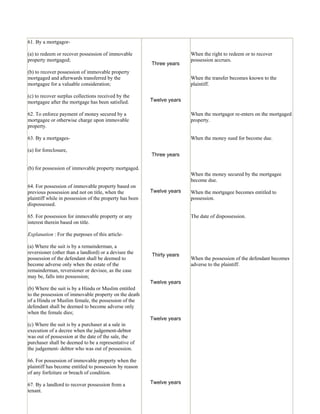
61. By a mortgagor- 
(a) to redeem or recover possession of immovable 
property mortgaged; 
(b) to recover possession of immovable property 
mortgaged and afterwards transferred by the 
mortgagee for a valuable consideration; 
(c) to recover surplus collections received by the 
mortgagee after the mortgage has been satisfied. 
62. To enforce payment of money secured by a 
mortgagee or otherwise charge upon immovable 
property. 
63. By a mortgages- 
(a) for foreclosure, 
(b) for possession of immovable property mortgaged. 
64. For possession of immovable property based on 
previous possession and not on title, when the 
plaintiff while in possession of the property has been 
dispossessed. 
65. For possession for immovable property or any 
interest therein based on title. 
Explanation : For the purposes of this article- 
(a) Where the suit is by a remainderman, a 
reversioner (other than a landlord) or a devisee the 
possession of the defendant shall be deemed to 
become adverse only when the estate of the 
remainderman, reversioner or devisee, as the case 
may be, falls into possession; 
(b) Where the suit is by a Hindu or Muslim entitled 
to the possession of immovable property on the death 
of a Hindu or Muslim female, the possession of the 
defendant shall be deemed to become adverse only 
when the female dies; 
(c) Where the suit is by a purchaser at a sale in 
execution of a decree when the judgement-debtor 
was out of possession at the date of the sale, the 
purchaser shall be deemed to be a representative of 
the judgement- debtor who was out of possession. 
66. For possession of immovable property when the 
plaintiff has become entitled to possession by reason 
of any forfeiture or breach of condition. 
67. By a landlord to recover possession from a 
tenant. 
Three years 
Twelve years 
Three years 
Twelve years 
Thirty years 
Twelve years 
Twelve years 
Twelve years 
When the right to redeem or to recover 
possession accrues. 
When the transfer becomes known to the 
plaintiff. 
When the mortgagor re-enters on the mortgaged 
property. 
When the money sued for become due. 
When the money secured by the mortgagee 
become due. 
When the mortgagee becomes entitled to 
possession. 
The date of dispossession. 
When the possession of the defendant becomes 
adverse to the plaintiff.
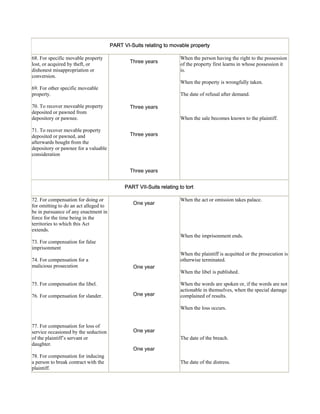
PART VI-Suits relating to movable property 
68. For specific movable property 
lost, or acquired by theft, or 
dishonest misappropriation or 
conversion. 
69. For other specific moveable 
property. 
70. To recover moveable property 
deposited or pawned from 
depository or pawnee. 
71. To recover movable property 
deposited or pawned, and 
afterwards bought from the 
depository or pawnee for a valuable 
consideration 
Three years 
Three years 
Three years 
Three years 
When the person having the right to the possession 
of the property first learns in whose possession it 
is. 
When the property is wrongfully taken. 
The date of refusal after demand. 
When the sale becomes known to the plaintiff. 
PART VII-Suits relating to tort 
72. For compensation for doing or 
for omitting to do an act alleged to 
be in pursuance of any enactment in 
force for the time being in the 
territories to which this Act 
extends. 
73. For compensation for false 
imprisonment 
74. For compensation for a 
malicious prosecution 
75. For compensation the libel. 
76. For compensation for slander. 
77. For compensation for loss of 
service occasioned by the seduction 
of the plaintiff’s servant or 
daughter. 
78. For compensation for inducing 
a person to break contract with the 
plaintiff. 
One year 
One year 
One year 
One year 
One year 
When the act or omission takes palace. 
When the imprisonment ends. 
When the plaintiff is acquitted or the prosecution is 
otherwise terminated. 
When the libel is published. 
When the words are spoken or, if the words are not 
actionable in themselves, when the special damage 
complained of results. 
When the loss occurs. 
The date of the breach. 
The date of the distress.
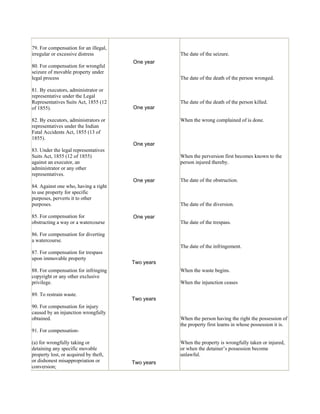
79. For compensation for an illegal, 
irregular or excessive distress 
80. For compensation for wrongful 
seizure of movable property under 
legal process 
81. By executors, administrator or 
representative under the Legal 
Representatives Suits Act, 1855 (12 
of 1855). 
82. By executors, administrators or 
representatives under the Indian 
Fatal Accidents Act, 1855 (13 of 
1855). 
83. Under the legal representatives 
Suits Act, 1855 (12 of 1855) 
against an executor, an 
administrator or any other 
representatives. 
84. Against one who, having a right 
to use property for specific 
purposes, perverts it to other 
purposes. 
85. For compensation for 
obstructing a way or a watercourse 
86. For compensation for diverting 
a watercourse. 
87. For compensation for trespass 
upon immovable property 
88. For compensation for infringing 
copyright or any other exclusive 
privilege. 
89. To restrain waste. 
90. For compensation for injury 
caused by an injunction wrongfully 
obtained. 
91. For compensation- 
(a) for wrongfully taking or 
detaining any specific movable 
property lost, or acquired by theft, 
or dishonest misappropriation or 
conversion; 
One year 
One year 
One year 
One year 
One year 
Two years 
Two years 
Two years 
The date of the seizure. 
The date of the death of the person wronged. 
The date of the death of the person killed. 
When the wrong complained of is done. 
When the perversion first becomes known to the 
person injured thereby. 
The date of the obstruction. 
The date of the diversion. 
The date of the trespass. 
The date of the infringement. 
When the waste begins. 
When the injunction ceases 
When the person having the right the possession of 
the property first learns in whose possession it is. 
When the property is wrongfully taken or injured, 
or when the detainer’s possession become 
unlawful.
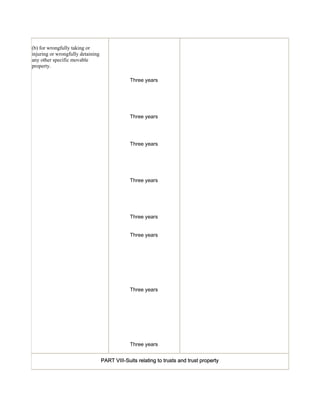
(b) for wrongfully taking or 
injuring or wrongfully detaining 
any other specific movable 
property. 
Three years 
Three years 
Three years 
Three years 
Three years 
Three years 
Three years 
Three years 
PART VIII-Suits relating to trusts and trust property
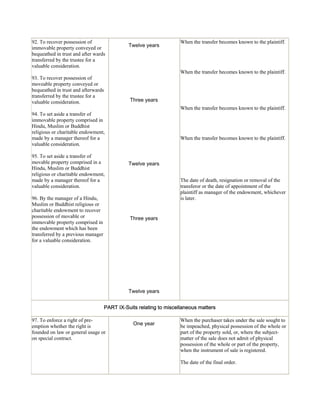
92. To recover possession of 
immovable property conveyed or 
bequeathed in trust and after wards 
transferred by the trustee for a 
valuable consideration. 
93. To recover possession of 
moveable property conveyed or 
bequeathed in trust and afterwards 
transferred by the trustee for a 
valuable consideration. 
94. To set aside a transfer of 
immovable property comprised in 
Hindu, Muslim or Buddhist 
religious or charitable endowment, 
made by a manager thereof for a 
valuable consideration. 
95. To set aside a transfer of 
movable property comprised in a 
Hindu, Muslim or Buddhist 
religious or charitable endowment, 
made by a manager thereof for a 
valuable consideration. 
96. By the manager of a Hindu, 
Muslim or Buddhist religious or 
charitable endowment to recover 
possession of movable or 
immovable property comprised in 
the endowment which has been 
transferred by a previous manager 
for a valuable consideration. 
Twelve years 
Three years 
Twelve years 
Three years 
Twelve years 
When the transfer becomes known to the plaintiff. 
The date of death, resignation or removal of the 
transferor or the date of appointment of the 
plaintiff as manager of the endowment, whichever 
is later. 
PART IX-Suits relating to miscellaneous matters 
97. To enforce a right of pre-emption 
whether the right is 
founded on law or general usage or 
on special contract. 
One year 
When the purchaser takes under the sale sought to 
be impeached, physical possession of the whole or 
part of the property sold, or, where the subject-matter 
of the sale does not admit of physical 
possession of the whole or part of the property, 
when the instrument of sale is registered. 
The date of the final order.
98. By a person against whom 5[an 
order referred to in rule 63 or in 
rule 103] of Order XXI of the Code 
of Civil Procedure, 1908 (5 of 
1908) or an order under section 28 
of the Presidency Small Cause 
Courts Act, 1882 (15 of 1882) has 
been made, to establish the right 
which he claims to the property 
comprised in the order. 
99. To Set aside a sale by a civil or 
revenue court or a sale for arrears 
of government revenue or for any 
demand recoverable as such arrears. 
100. To alter or set aside any 
decision or order of a civil court in 
any proceeding other than a suit or 
any act or order of an officer of 
government in his official capacity. 
101. Upon a judgement including a 
foreign judgement, or a 
recognisance 
102. For property which the 
plaintiff has conveyed while insane. 
103. To make good out of the 
general estate of a deceased trustee 
the loss occasioned by a breach of 
trust. 
104. To establish a periodically 
recurring right. 
105. By a Hindu for arrears of 
maintenance. 
106. For a legacy or for a share of a 
residue bequeathed by a testator or 
for a distributive share of the 
property of an intestate against an 
executor or an administrator or 
some other person legally charged 
with the duty of distributing the 
estate. 
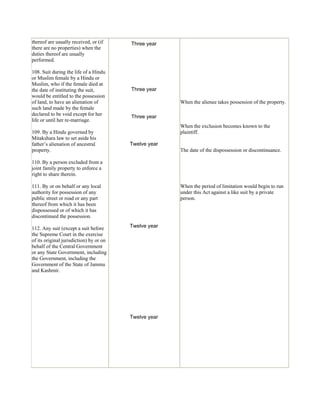
107. For possession of a hereditary 
office. 
Explanation : A hereditary office is 
possessed when the properties 
One year 
One year 
One year 
Three year 
Three year 
When the sale is confirmed or would otherwise 
have become final and conclusive had no such suit 
been brought. 
The date of the final decision or order by the court 
or the date of the act or order of the officer as the 
case may be. 
The date of the judgement or recognisance. 
When the plaintiff is restored to sanity and has 
knowledge of the conveyance. 
The date of the trustee’s death or if the loss has not 
then resulted, the date of the loss. 
When the plaintiff is first refused the enjoyment of 
the right 
When the arrears are payable. 
When the legacy or share becomes payable or 
deliverable. 
When the defendant takes possession of the office 
adversely to the Plaintiff. 
The date of the alienation.
thereof are usually received, or (if 
there are no properties) when the 
duties thereof are usually 
performed. 
108. Suit during the life of a Hindu 
or Muslim female by a Hindu or 
Muslim, who if the female died at 
the date of instituting the suit, 
would be entitled to the possession 
of land, to have an alienation of 
such land made by the female 
declared to be void except for her 
life or until her re-marriage. 
109. By a Hindu governed by 
Mitakshara law to set aside his 
father’s alienation of ancestral 
property. 
110. By a person excluded from a 
joint family property to enforce a 
right to share therein. 
111. By or on behalf or any local 
authority for possession of any 
public street or road or any part 
thereof from which it has been 
dispossessed or of which it has 
discontinued the possession. 
112. Any suit (except a suit before 
the Supreme Court in the exercise 
of its original jurisdiction) by or on 
behalf of the Central Government 
or any State Government, including 
the Government, including the 
Government of the State of Jammu 
and Kashmir. 
Three year 
Three year 
Three year 
Twelve year 
Twelve year 
Twelve year 
When the alienee takes possession of the property. 
When the exclusion becomes known to the 
plaintiff. 
The date of the dispossession or discontinuance. 
When the period of limitation would begin to run 
under this Act against a like suit by a private 
person.
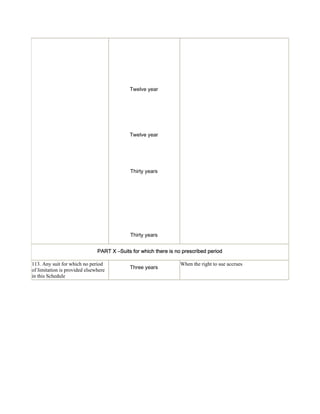
Twelve year 
Twelve year 
Thirty years 
Thirty years 
PART X –Suits for which there is no prescribed period 
113. Any suit for which no period 
of limitation is provided elsewhere 
in this Schedule 
Three years When the right to sue accrues

Bare Act- The Indian Limitation Act, 1963

  • 1.
    LIMITATION ACT, 1963 PART I PRELIMINARY 1. Short title, extent and commencement (1) This Act may be called the Limitation Act, 1963. (2) It extends to the whole of India except the State of Jammu and Kashmir. (3) It shall come into force on such date1 as the Central Government may, by notification in the Official Gazette, appoint. 2. Definitions In this Act, unless the context otherwise requires, (a) "applicant" includes- (i) a petitioner; (ii) any person from or through whom an applicant derives his right to apply; (iii) any person whose estate is represented by the applicant as executor, administrator or other representative; (b) "application" includes a petition; (c) "bill of exchange" includes a hundi and a cheque; (d) "bond" includes any instrument whereby a person obliges himself to pay money to another, on condition that the obligation shall be void if a specified act is performed, or is not performed, as the case may be; (e) "defendant" includes- (i) any person from or through whom a defendant derives his liability to be sued; (ii) any person whose estate is represented by the defendant as executor, administrator or other representative; (f) "easement" includes a right not arising from contract, by which one person is entitled to remove and appropriate for his own profit any part of the soil belonging to another or anything growing in, or attached to, or subsisting upon, the land of another; (g) "foreign country" means any country other than India; (h) "good faith"-nothing shall be deemed to be done in good faith which is not done with due care and attention; (i) "plaintiff" includes- (i) any person from or through whom a plaintiff derives his right to sue; (ii) any person whose estate is represented by the plaintiff as executor, administrator or other representative;
  • 2.
    (j) "period oflimitation" means the period of limitation prescribed for any suit, appeal or application by the Schedule, and "prescribed period" means the period of limitation computed in accordance with the provisions of this Act; (k) "promissory note" means any instrument whereby the maker engages absolutely to pay a specified sum of money to another at a time therein limited, or on demand, or at sight; (l) "suit" does not include an appeal or an application; (m) "tort" means a civil wrong which is not exclusively the breach of a contract or the breach of a trust; (n) "trustee" does not include a benamidar, a mortgagee remaining in possession after the mortgage has been satisfied or a person in wrongful possession without title. PART II LIMITATION OF SUITS, APPEALS AND APPLICATIONS 3. Bar of limitation (1) Subject to the provisions contained in sections 4 to 24 (inclusive), every suit instituted, appeal preferred, and application made after the prescribed period shall be dismissed although limitation has not been set up as a defence. (2) For the purposes of this Act- (a) a suit is instituted- (i) in an ordinary case, when the plaint is presented to the proper officer; (ii) in the case of a pauper, when his application for leave to sue as a pauper is made; and (iii) in the case of a claim against a company which is being wound up by the court, when the claimant first sends in his claim to the official liquidator; (b) any claim by way of a set off or a counter claim, shall be treated as a separate suit and shall be deemed to have been instituted- (i) in the case of a set off, on the same date as the suit in which the set off is pleaded; (ii) in the case of a counter claim, on the date on which the counter claim is made in court; (c) an application by notice of motion in a High Court is made when the application is presented to the proper officer of that court. 4. Expiry of prescribed period when court is closed Where the prescribed period for any suit, appeal or application expires on a day when the court is closed, the suit, appeal or application may be instituted, preferred or made on the date when the court reopens. Explanation: A court shall be deemed to be closed on any day within the meaning of this section if during any part of its normal working hours it remains closed on that day. 5. Extension of prescribed period in certain cases Any appeal or any application, other than an application under any of the provisions of Order XXI of the Code of Civil Procedure, 1908, may be, admitted after the prescribed period, if the appellant or the applicant satisfies the court that he had sufficient cause for not preferring the
  • 3.
    appeal or makingthe application within such period. Explanation: The fact that the appellant or the applicant was misled by any order, practice or judgement of the High Court in ascertaining or computing the prescribed period may be sufficient cause within the meaning of this section. 6. Legal disability (1) Where a person entitled to institute a suit or make an application for the execution of a decree, is at the time from which the prescribed period is to be reckoned, a minor or insane, or an idiot, he may institute the suit or make the application within the same period after the disability has ceased, as would otherwise have been allowed from the time specified therefor in the third column of the Schedule. (2) Where such person is, at the time from which the prescribed period is to be reckoned, affected by two such disabilities, or where, before his disability has ceased, he is affected by another disability, he may institute the suit or make the application within the same period after both disabilities have ceased, as would otherwise have been allowed from the times so specified. (3) Where the disability continues up to the death of that person, his legal representative may institute the suit or make the application within the same period after the death, as would otherwise have been allowed from the time so specified. (4) Where the legal representative referred to in sub-section (3) is, at the date of the death of the person whom he represents, affected by any such disability, the rules contained in sub-sections (1) and (2) shall apply. (5) Where a person under disability dies after the disability ceases but within the period allowed to him under this section, his legal representative may institute the suit or make the application within the same period after the death, as would otherwise have been available to that person had he not died. Explanation: For the purposes of this section 'minor' includes a child in the womb. 7. Disability of one of several persons Where one of several persons jointly entitled to institute a suit or make an application for the execution of a decree is under any such disability, and a discharge can be given without the concurrence of such person, time will run against them all; but, where no such discharge can be given, time will not run as against any of them until one of them becomes capable of giving such discharge without the concurrence of the others or until the disability has ceased. Explanation I : This section applies to a discharge from every kind of liability, including a liability in respect of any immovable property. Explanation II: For the purposes of this section, the manager of a Hindu undivided family governed by the Mitakshara law shall be deemed to be capable of giving a discharge without the concurrence of the other members of the family only if he is in management of the joint family property. 8. Special exceptions Nothing in section 6 or in section 7 applies to suits to enforce rights of pre-emption, or shall be deemed to extend, for more than three years from the cessation of the disability or the death of the person affected thereby, the period of limitation for any suit or application. 9. Continuous running of time Where once time has begun to run, no subsequent disability or inability to institute a suit or make an application stops it:
  • 4.
    PROVIDED that whereletters of administration to the estate of creditor have been granted to his debtor, the running of the period of limitation for a suit to recover the debt shall be suspended while the administration continues. 10. Suits against trustees and their representatives Notwithstanding anything contained in the foregoing provisions of this Act, no suit against a person in whom property has become vested in trust for any specific purpose, or against his legal representatives or assigns (not being assigns for valuable consideration), for the purpose of following in his or their hands such property, or the proceeds thereof, or for an account of such property or proceeds, shall be barred by any length of time. Explanation: For the purposes of this section any property comprised in a Hindu, Muslim or Buddhist religious or charitable endowment shall be deemed to be property vested in trust for a specific purpose and the manager of the property shall be deemed to be the trustee thereof. 11. Suits on contracts entered into outside the territories to which the Act extends (1) Suits instituted in the territories to which this Act extends on contracts entered into in the State of Jammu and Kashmir or in a foreign country shall be subject to the rules of limitation contained in this Act. (2) No rule of limitation in force in the State of Jammu and Kashmir or in a foreign country shall be a defence to a suit instituted in the said territories on a contract entered into in that State or in a foreign country unless- (a) the rule has extinguished the contract; and (b) the parties were domiciled in that State or in the foreign country during the period prescribed by such rule. PART III COMPUTATION OF PERIOD OF LIMITATION 12. Exclusion of time in legal proceedings (1) In computing the period of limitation for any suit, appeal or application, the day from which such period is to be reckoned, shall be excluded. (2) In computing the period of limitation for an appeal or an application for leave to appeal or for revision or for review of a judgement, the day on which judgement complained of was pronounced and the time requisite for obtaining a copy of the decree, sentence or order appealed from or sought to be revised or reviewed shall be excluded. (3) Where a decree or order is appealed from or sought to be revised or reviewed, or where an application is made for leave to appeal from a decree or order, the time requisite for obtaining a copy of the judgement 2[***] shall also be excluded. (4) In computing the period of limitation for an application to set aside an award, the time requisite for obtaining a copy of the award shall be excluded. Explanation: In computing under this section the time requisite for obtaining a copy of a decree or an order, any time taken by the court to prepare the decree or order before an application for a copy thereof is made shall not be excluded.
  • 5.
    13. Exclusion oftime in cases where leave to sue or appeal as a pauper is applied for In computing the period of limitation prescribed for any suit or appeal in any case where an application for leave to sue or appeal as a pauper has been made and rejected, the time during which the applicant has been prosecuting in good faith his application for such leave shall be excluded, and the court may, on payment of the court fees prescribed for such suit or appeal, treat the suit or appeal as having the same force and effect as if the court fees had been paid in the first instance. 14. Exclusion of time of proceeding bona fide in court without jurisdiction (1) In computing the period of limitation for any suit the time during which the plaintiff has been prosecuting with due diligence another civil proceeding, whether in a court of first instance or of appeal or revision, against the defendant shall be excluded, where the proceeding relates to the same matter in issue and is prosecuted in good faith in a court which, from defect of jurisdiction or other cause of a like nature, is unable to entertain it. (2) In computing the period of limitation for any application, the time during which the applicant has been prosecuting with due diligence another civil proceeding, whether in a court of first instance or of appeal or revision, against the same party for the same relief shall be excluded, where such proceeding is prosecuted in good faith in a court which, from defect of jurisdiction or other cause of a like nature, is unable to entertain it. (3) Notwithstanding anything contained in rule 2 of Order XXIII of the Code of Civil Procedure, 1908 (5 of 1908), the provisions of sub-section (1) shall apply in relation to a fresh suit instituted on permission granted by the court under rule 1 of that Order, where such permission is granted on the ground that the first suit must fail by reason of a defect in the jurisdiction of the court or other cause of a like nature. Explanation: For the purposes of this section- (a) in excluding the time during which a former civil proceeding was pending, the day on which that proceeding was instituted and the day on which it ended shall both be counted; (b) a plaintiff or an applicant resisting an appeal shall be deemed to be prosecuting a proceeding; (c) misjoinder of parties or of causes of action shall be deemed to be a cause of a like nature with defect of jurisdiction. 15. Exclusion of time in certain other cases (1) In computing the period of limitation of any suit or application for the execution of a decree, the institution or execution of which has been stayed by injunction or order, the time of the continuance of the injunction or order, the day on which it was issued or made, and the day on which it was withdrawn, shall be excluded. (2) In computing the period of limitation for any suit of which notice has been given, or for which the previous consent or sanction of the government or any other authority is required, in accordance with the requirements of any law for the time being in force, the period of such notice or, as the case may be, the time required for obtaining such consent or sanction shall be excluded. Explanation: In excluding the time required for obtaining the consent or sanction of the government or any other authority, the date on which the application was made for obtaining the consent or sanction and the date of receipt of the order of the government or other authority shall both be counted. (3) In computing the period of limitation for any suit or application for execution of a decree by any receiver or interim receiver appointed in proceedings for the adjudication of a person as an
  • 6.
    insolvent or byany liquidator or provisional liquidator appointed in proceedings for the winding up of a company, the period beginning with the date of institution of such proceeding and ending with the expiry of three months from the date of appointment of such receiver or liquidator, as the case may be, shall be excluded. (4) In computing the period of limitation for a suit for possession by a purchaser at a sale in execution of a decree, the time during which a proceeding to set aside the sale has been prosecuted shall be excluded. (5) In computing the period of limitation for any suit the time during which the defendant has been absent from India and from the territories outside India under the administration of the Central Government, shall be excluded. 16. Effect of death on or before the accrual of the right to sue (1) Where a person who would, if he were living, have a right to institute a suit or make an application dies before the right accrues, or where a right to institute a suit or make an application accrues only on the death of a person, the period of limitation shall be computed from the time when there is a legal representative of the deceased capable of instituting such suit or making such application. (2) Where a person against whom, if he were living, a right to institute a suit or make an application would have accrued dies before the right accrues, or where a right to institute a suit or make an application against any person accrues on the death of such person, the period of limitation shall be computed from the time7 when there is a legal representative of the deceased against whom the plaintiff may institute such suit or making such application. (3) Nothing in sub-section (1) or sub-section (2) applies to suits to enforce rights of pre-emption or to suits for the possession of immovable property or of a hereditary office. 17. Effect of fraud or mistake (1) Where, in the case of any suit or application for which a period of limitation is prescribed by this Act- (a) the suit or application is based upon the fraud of the defendant or respondent or his agent; or (b) the knowledge of the right or title on which suit or application is founded is concealed by the fraud of any such person as aforesaid; or (c) the suit or application is for relief from the consequences of a mistake; or (d) where any document necessary to establish the right of the plaintiff or applicant has been fraudulently concealed from him; the period of limitation shall not begin to run until the plaintiff or applicant has discovered the fraud or the mistake or could, with reasonable diligence, have discovered it; or in the case of a concealed document, until the plaintiff or the applicant first had the means of producing the concealed document or compelling its production: PROVIDED that nothing in this section shall enable any suit to be instituted or application to be made to recover or enforce any charge against, or set aside any transaction affecting, any property which- (i) in the case of fraud, has been purchased for valuable consideration by a person who was not a party to the fraud and did not at the time of the purchase know, or have reason to believe, that any fraud had been committed, or
  • 7.
    (ii) in thecase of mistake, has been purchased for valuable consideration subsequently to the transaction in which the mistake was made, by a person who did not know, or have reason to believe, that the mistake had been made, or (iii) in the case of concealed document, has been purchased for valuable consideration by a person who was not a party to the concealment and, did not at the time of purchase know, or have reason to believe, that the document had been concealed. (2) Where a judgement-debtor has, by fraud or force, prevented the execution of a decree or order with the period of limitation, the court may, on the application of the judgement-creditor made after the expiry of the said period extend the period for execution of the decree or order: PROVIDED that such application is made within one year from the date of the discovery of the fraud or the cessation of force, as the case may be. 18. Effect of acknowledgement in writing (1) Where, before the expiration of the prescribed period for a suit or application in respect of any property or right, an acknowledgement of liability in respect of such property or right has been made in writing signed by the party against whom such property or right is claimed, or by any person through whom he derives his title or liability, a fresh period of limitation shall be computed from the time when the acknowledgement was so signed. (2) Where the writing containing the acknowledgement is undated, oral evidence may be given of the time when it was signed; but subject to the provisions of the Indian Evidence Act, 1872 (1 of 1872), oral evidence of its contents shall not be received,. Explanation : For the purposes of this section- (a) an acknowledgement may be sufficient though it omits to specify the exact nature of the property or right, or avers that the time for payment, delivery, performance or enjoyment has not yet come or is accompanied by a refusal to pay, deliver, perform or permit to enjoy, or is coupled with a claim to set-off, or is addressed to a person other than a person entitled to the property or right; (b) the word "signed" means signed either personally or by an agent duly authorised in this behalf; and (c) an application for the execution of a decree or order shall not be deemed to be an application in respect of any property or right. 19. Effect of payment on account of debt or of interest on legacy Where payment on account of a debt or of interest on a legacy is made before the expiration of the prescribed period by the person liable to pay the debt or legacy or by his agent duly authorised in this behalf, a fresh period of limitation shall be computed from the time when the payment was made: PROVIDED that, save in the case of payment of interest made before the 1st day of January, 1928, an acknowledgement of the payment appears in the handwriting of, or in a writing signed by, the person making the payment. Explanation: For the purposes of this section - (a) where mortgaged land is in the possession of the mortgagee, the receipt of the rent or produce of such land shall be deemed to be a payment; (b) "debt" does not include money payable under a decree or order of a court.
  • 8.
    20. Effect ofacknowledgement or payment by another person (1) The expression "agent duly authorised in this behalf" in sections 18 and 19 shall, in the case of a person under disability, include his lawful guardian, committee or manager or an agent duly authorised by such guardian, committee or manager to sign the acknowledgement or make the payment. (2) Nothing in the said sections renders one of several joint contractors, partners, executors or mortgagees chargeable by reason only of a written acknowledgement signed by, or of a payment made by, or by the agent of, any other or others of them. (3) For the purposes of the said sections,- (a) an acknowledgement signed or a payment made in respect of any liability by or by the duly authorised agent of, any limited owner of property who is governed by Hindu law, shall be a valid acknowledgement or payment, as the case may be, against a reversioner succeeding to such liability; and (b) where a liability has been incurred by or on behalf of a Hindu undivided family as such, an acknowledgement or payment made by, or by the duly authorised agent of, the manager of the family for the time being shall be deemed to have been made on behalf of the whole family. 21. Effect of substituting or adding new plaintiff or defendant (1) Where after the institution of a suit, a new plaintiff or, defendant is substituted or added, the suit shall, as regards him, be deemed to have been instituted when he was so made a party: PROVIDED that where the court is satisfied that the omission to include a new plaintiff or defendant was due to a mistake made in good faith it may direct that the suit as regards such plaintiff or defendant shall be deemed to have been instituted on any earlier date. (2) Nothing in sub-section (1) shall apply to a case where a party is added or substituted owing to assignment or devolution of any interest during the pendency of a suit or where a plaintiff is made a defendant or a defendant is made a plaintiff. 22. Continuing breaches and torts In the case of a continuing breach of contract or in the case of a continuing tort, a fresh period of limitation begins to run at every moment of the time during which the breach or the tort, as the case may be, continues. 23. Suits for compensation for acts not actionable without special damage In the case of a suit for compensation for an act which does not give rise to a cause of action unless some specific injury actually results therefrom, the period of limitation shall be computed from the time when the injury results. 24. Computation of time mentioned in instruments All instruments shall for the purposes of this Act be deemed to be made with reference to the Gregorian calendar. PART IV ACQUISITION OF OWNERSHIP BY POSSESSION 25. Acquisition of easement by prescription (1) Where the access and use of light or air to and for any building have been peaceably enjoyed therewith as an easement, and as of right, without interruption, and for twenty years, and where any way or watercourse or the use of any water or any other easement (whether affirmative or negative) has been peaceably and openly enjoyed by any person claiming title thereto as an
  • 9.
    easement and asof right without interruption and for twenty years, the right to such access and use of light or air, way, watercourse, use of water, or other easement shall be absolute and indefeasible. (2) Each of the said periods of twenty years shall be taken to be a period ending within two years next before the institution of the suit wherein the claim to which such period relates is contested. (3) Where the property over which a right is claimed under sub-section (1) belongs to the government that sub-section shall be read as if for the words "twenty years" the words "thirty years" were substituted. Explanation : Nothing is an interruption with the meaning of this section, unless where there is an actual discontinuance of the possession or enjoyment by reason of an obstruction by the act of some person other than the claimant, and unless such obstruction submitted to or acquiesced in for one year after the claimant has notice thereof and of the person making or authorising the same to be made. 26. Exclusion in favour of reversioner of servient tenement Where any land or water upon, over or from, which any easement has been enjoyed or derived has been held under or by virtue of any interest for life or in terms of years exceeding three years from the granting thereof the time of the enjoyment of such easement during the continuance of such interest or term shall be excluded in the computation of the period of twenty years in case the claim is, within three years next after the determination of such interests or term resisted by the person entitled on such determination to the said land or water. 27. Extinguishment of right to property At the determination of the period hereby limited to any person for instituting a suit for possession of any property, his right to such property shall be extinguished. PART V MISCELLANEOUS 28. Amendment of certain Acts [Rep. by the Repealing and Amending Act, 1974 (56 of 1974) s. 2 and First Sch.] 29. Saving (1) Nothing in this Act shall affect section 25 of the Indian Contract Act, 1872 (9 of 1872). (2) Where any special or local law prescribes for any suit, appeal or application a period of limitation different from the period prescribed by the Schedule, the provisions of s. 3 shall apply as if such periods were the periods prescribed by the Schedule and for the purpose of determining any period of limitation prescribed for any suit, appeal or application by any special or local law, the provisions contained in sections 4 to 24 (inclusive) shall apply only in so far as, and to the extent to which, they are not expressly excluded by such special or local law. (3) Save as otherwise provided in any law for the time being in force with respect to marriage and divorce, nothing in this Act shall apply to any suit or other proceeding under any such law. (4) Sections 25 and 26 and the definition of "easement" in section 2 shall not apply to cases arising in the territories to which the Indian Easements Act, 1882 (5 of 1882), may for the time being extend. 30. Provision for suits, etc., for the prescribed period is shorter than the period prescribed by the Indian Limitation Act, 1908 Notwithstanding anything contained in this Act-
  • 10.
    (a) any suitfor which the period of limitation is shorter than the period of limitation prescribed by the Indian Limitation Act, 1908 (9 of 1908), may be instituted within a period of 3[seven years] next after the commencement of this Act or within the period prescribed for such suit by the Indian Limitation Act, 1908, whichever period expires earlier: 4[PROVIDED that if in respect of any such suit, the said period of seven years expires earlier than the period of limitation prescribed therefor under the Indian Limitation Act, 1908 and the said period of seven years together with so much of the period of limitation in respect of such suit under the Indian Limitation Act, 1908 (9 of 1908), as has already expired before the commencement of this Act is shorter than the period prescribed for such suit under this Act, then, the suit may be instituted within the period of limitation prescribed therefor under this Act;] (b) any appeal or application for which the period of limitation is shorter than the period of limitation prescribed by the Indian Limitation Act, 1908, may be preferred or made within a period of ninety days next after the commencement of this Act or within a period prescribed for such appeal or application by the Indian Limitation Act, 1908, whichever period expires earlier. 31. Provisions as to barred or pending suits, etc. Nothing in this Act shall- (a) enable any suit, appeal or application to be instituted, preferred or made, for which the period of limitation prescribed by the Indian Limitation Act, 1908, expired before the commencement of this Act; or (b) affect any suit, appeal or application instituted, preferred or made before, and pending at, such commencement. 32. Repeal [Rep. by the Repealing and Amending Act, 1974 (56 of 1974)] THE SCHEDULE: PERIODS OF LIMITATION [Sections 2 (j) and 3] FIRST DIVISION-SUITS Description of suits Period of limitation Time from which period begins to run PART I- Suits relating to accounts 1. For the balance due on a mutual, open and current account, where there have been reciprocal demands between the parties. 2. Against a factor for an account 3. By a principal against his agent for movable property received by the latter and Three years Three years Three years The close of the year in which the last item admitted or proved is entered in the account; such year to be computed as in the account. When the account is, during the continuance of the agency, demanded and refused or, where no such demand is made, when the agency terminates. When the account is, during the continuance of the agency, demanded and refused or, where no such demand is made, when the agency terminates.
  • 11.
    not accounted for. 4. Other suits by principals against agents for neglect or misconduct. 5. For an account and a share of the profits of a dissolved partnership. Three years Three years When the neglect or misconduct become known to the plaintiff. The date of the dissolution. PART II-Suits relating to contacts 6. For a seaman’s wages 7. For wages in the case of any other person 8. For the price of food or drink sold by the keeper of a hotel, tavern or lodging house 9. For the price of lodging 10. Against a carrier for compensation for losing or injuring goods. 11. Against a carrier for compensation for non-delivery of, or delay in delivering, goods 12. For the hire of animals, vehicles, boats or household furniture. 13. For the balance of money advanced in payment of goods to be delivered. 14. For the price of goods sold and delivered where no fixed period of credit is agreed upon. 15. For the price of goods sold and delivered to be paid for after the expiry of a fixed period of credit. 16. For the price of goods sold and delivered to be paid for by a bill of exchange, no such bill being given. 17. For the price of trees or growing crops sold by the plaintiff to the defendant where no fixed period of credit is agreed upon. 18. For the price of work done by the plaintiff for the defendant at his request, where no time has been fixed for payment. Three years Three years Three years Three years Three years Three years Three years Three years Three years Three years Three years Three years Three years The end of the voyage during which the wages are earned. When the wages accrue due. When the food or drink is delivered. When the price becomes payable When the loss or injury occurs. When the goods ought to be delivered When the hire becomes payable. When the goods ought to be delivered. The date of the delivery of the goods. When the period of credit expires. When the period of the proposed bill elapses. The date of the sale.
  • 12.
    19. For moneypayable for money lent. 20. Like suit when the lender has given a cheque for the money. 21. For money lent under an agreement that it shall be payable on demand. 22. For money deposited under an agreement that it shall be payable on demand, including money of a customer in the hands of his banker so payable. 23. For money payable to the plaintiff for money paid for the defendant. 24. For money payable by the defendants to the plaintiff for money received by the defendant, for the plaintiff’s use. 25. For money payable for interest upon money due from the defendant to the plaintiff. 26. For money payable to the plaintiff for money found to be due from the defendant to the plaintiff on accounts stated between them. 27. For compensation for breach of a promise to do anything at a specified time, or upon the happening of a specified contingency. 28. On a single bond, where a day is specified for payment 29. On a single bond, where no such day is specified 30. On a bond subject to a condition 31. On a bill of exchange or promissory note payable at a fixed time after date. 32. On a bill of exchange or payable at sight, or after sight, but not at a fixed time. 33. On a bill of exchange accepted payable at a particular place 34. On a bill of exchange or promissory note payable at a fixed time after sight or Three years Three years Three years Three years Three years Three years Three years Three years Three years Three years Three years Three years Three years Three years When the work is done. When the loan is made. When the cheque is paid. When the loan is made. When the demand is made. When the money is paid. When the money is received. When the interest becomes due. When the accounts are stated in writing signed by the defendant or his agent duly authorised in this behalf, unless where the debt is, by a simultaneous agreement in writing signed as aforesaid, made payable at a future time, and then when that time arrives. When the time specified arrives or the contingency happens. The day so specified. The date of executing the bond. When the condition is broken. When the bill or note falls due. When the bill is presented.
  • 13.
    after demand. 35.On a bill of exchange or promissory note payable on demand and not accompanied by any writing restraining or postponing the right to sue. 36. On a promissory note or bond payable by instalments. 37. On a promissory note or bond payable by instalments, which provides that, if default be made in payment of one or more instalments, the whole shall be due. 38. On a promissory note given by the maker to a third person to be delivered to the payee after a certain event should happen. 39. On a dishonoured foreign bill where protest has been made and notice given. 40. By the payee against the drawer of a bill of exchange, which has been dishonoured by non-acceptance. 41. By the acceptor of an accommodation-bill against the drawer. 42. By a surety against the principal debtor. 43. By a surety against a co-surety. 44.(a) On a policy of insurance when the sum insured is payable after proof of the death has been given to or received by the insurers. (b) On a policy of insurance when the sum insured is payable after proof of the loss has been given to or received by the insurers. 45. By the assured to recover premia paid under a policy voidable at the election of the insures. 46. Under the Indian Succession Act, 1925 (39 of 1925), section 360 or section 361, to compel a refund by a person to whom an executor or administrator has paid a legacy or distributed assets. 47. For money paid upon an existing consideration which afterwards fails. Three years Three years Three years Three years Three years Three years Three years Three years Three years Three years Three years Three years Three years Three years When the bill is presented at that place. When the fixed time expires. The date of the bill or note. The expiration of the first term of payment as to the part then payable; and for the other parts, the expiration of the respective terms of payment. When the default is made, unless where the payee or obligee waives the benefit of the provisions and then when fresh default is made in respect of which there is no such waiver. The date of the delivery to the payee. When the notice is given. The date of the refusal to accept. When the acceptor pays the amount of the bill. When the surety pays the creditor. When the surety pays anything in excess of his own share. The date of the death of the deceased, or where the claim on the policy is denied, either partly or wholly, the date of such denial. The date of the occurrence causing the loss, or where the claim on the policy is denied, either partly or wholly, the date of such denial. When the insurers elect to avoid the policy.
  • 14.
    48. For contributionby a party who has paid the whole or more than his share of the amount due under a joint decree, or by a sharer in a joint estate who has paid the whole or more than his share of the amount of revenue due from himself and his co-sharers. 49. By a co-trustee to enforce against the estate of a deceased trustee a claim for contribution. 50. By the manager of a joint estate of an undivided family for contribution, in respect of a payment made by him on account of the estate. 51. For the profit of immovable property belonging to the plaintiff which have been wrongfully received by the defendant. 52. For arrears of rent. 53. By a vendor of immovable property for personal payment of unpaid purchase-money. 54. For specific performance of a contract. 55. For compensation for the breach of any contract, express or implied not herein specially provided for. Three years Three years Three years Three years Three years Three years Three years Three years Three years Three years The date of the payment of distribution The date of the failure. The date of the payment in excess of the plaintiff’s own share. When the right to contribution a accrues. The date of the payment. When the profits are received. When the arrears become due. The time fixed for completing the sale, or (where the title is accepted after the time fixed for completion) the date of the acceptance. The date fixed for the performance, or, if no such date is fixed, when the plaintiff has noticed that performance is refused. When the contract is broken or (where there are successive breaches) when the breach in respect of which the suit is instituted occurs or (where the breach is continuing) when it ceases.
  • 15.
    THE SCHEDULE: PERIODSOF LIMITATION [Sections 2 (j) and 3] FIRST DIVISION-SUITS PART III- Suits relating to declarations 56. To declare the forgery of an instrument issued or registered. 57. To obtain the declaration that an alleged adoption is invalid, or never, in fact, took place. 58. To obtain any other declaration. Three years Three years Three years When the issue or registration becomes known to the plaintiff. When the alleged adoption becomes known to the plaintiff. When the right to sue first accrues. PART IV-Suits relating to decrees and instruments 59. To cancel or set aside an instrument or decree or for the rescission of a contract. 60. To set aside a transfer of property made by the guardian of a ward (a) by the ward who has attained majority; (b) by the ward’s legal representative- (i) When the ward dies within three years from the date of attaining majority; (ii) When the ward dies before attaining majority. Three years Three years Three years Three years When the facts entitling the plaintiff to have the instrument or decree cancelled or set aside or the contract rescinded first become known to him. When the ward attains majority. When the ward attains majority. When the ward dies.
  • 16.
    61. By amortgagor- (a) to redeem or recover possession of immovable property mortgaged; (b) to recover possession of immovable property mortgaged and afterwards transferred by the mortgagee for a valuable consideration; (c) to recover surplus collections received by the mortgagee after the mortgage has been satisfied. 62. To enforce payment of money secured by a mortgagee or otherwise charge upon immovable property. 63. By a mortgages- (a) for foreclosure, (b) for possession of immovable property mortgaged. 64. For possession of immovable property based on previous possession and not on title, when the plaintiff while in possession of the property has been dispossessed. 65. For possession for immovable property or any interest therein based on title. Explanation : For the purposes of this article- (a) Where the suit is by a remainderman, a reversioner (other than a landlord) or a devisee the possession of the defendant shall be deemed to become adverse only when the estate of the remainderman, reversioner or devisee, as the case may be, falls into possession; (b) Where the suit is by a Hindu or Muslim entitled to the possession of immovable property on the death of a Hindu or Muslim female, the possession of the defendant shall be deemed to become adverse only when the female dies; (c) Where the suit is by a purchaser at a sale in execution of a decree when the judgement-debtor was out of possession at the date of the sale, the purchaser shall be deemed to be a representative of the judgement- debtor who was out of possession. 66. For possession of immovable property when the plaintiff has become entitled to possession by reason of any forfeiture or breach of condition. 67. By a landlord to recover possession from a tenant. Three years Twelve years Three years Twelve years Thirty years Twelve years Twelve years Twelve years When the right to redeem or to recover possession accrues. When the transfer becomes known to the plaintiff. When the mortgagor re-enters on the mortgaged property. When the money sued for become due. When the money secured by the mortgagee become due. When the mortgagee becomes entitled to possession. The date of dispossession. When the possession of the defendant becomes adverse to the plaintiff.
  • 17.
    PART VI-Suits relatingto movable property 68. For specific movable property lost, or acquired by theft, or dishonest misappropriation or conversion. 69. For other specific moveable property. 70. To recover moveable property deposited or pawned from depository or pawnee. 71. To recover movable property deposited or pawned, and afterwards bought from the depository or pawnee for a valuable consideration Three years Three years Three years Three years When the person having the right to the possession of the property first learns in whose possession it is. When the property is wrongfully taken. The date of refusal after demand. When the sale becomes known to the plaintiff. PART VII-Suits relating to tort 72. For compensation for doing or for omitting to do an act alleged to be in pursuance of any enactment in force for the time being in the territories to which this Act extends. 73. For compensation for false imprisonment 74. For compensation for a malicious prosecution 75. For compensation the libel. 76. For compensation for slander. 77. For compensation for loss of service occasioned by the seduction of the plaintiff’s servant or daughter. 78. For compensation for inducing a person to break contract with the plaintiff. One year One year One year One year One year When the act or omission takes palace. When the imprisonment ends. When the plaintiff is acquitted or the prosecution is otherwise terminated. When the libel is published. When the words are spoken or, if the words are not actionable in themselves, when the special damage complained of results. When the loss occurs. The date of the breach. The date of the distress.
  • 18.
    79. For compensationfor an illegal, irregular or excessive distress 80. For compensation for wrongful seizure of movable property under legal process 81. By executors, administrator or representative under the Legal Representatives Suits Act, 1855 (12 of 1855). 82. By executors, administrators or representatives under the Indian Fatal Accidents Act, 1855 (13 of 1855). 83. Under the legal representatives Suits Act, 1855 (12 of 1855) against an executor, an administrator or any other representatives. 84. Against one who, having a right to use property for specific purposes, perverts it to other purposes. 85. For compensation for obstructing a way or a watercourse 86. For compensation for diverting a watercourse. 87. For compensation for trespass upon immovable property 88. For compensation for infringing copyright or any other exclusive privilege. 89. To restrain waste. 90. For compensation for injury caused by an injunction wrongfully obtained. 91. For compensation- (a) for wrongfully taking or detaining any specific movable property lost, or acquired by theft, or dishonest misappropriation or conversion; One year One year One year One year One year Two years Two years Two years The date of the seizure. The date of the death of the person wronged. The date of the death of the person killed. When the wrong complained of is done. When the perversion first becomes known to the person injured thereby. The date of the obstruction. The date of the diversion. The date of the trespass. The date of the infringement. When the waste begins. When the injunction ceases When the person having the right the possession of the property first learns in whose possession it is. When the property is wrongfully taken or injured, or when the detainer’s possession become unlawful.
  • 19.
    (b) for wrongfullytaking or injuring or wrongfully detaining any other specific movable property. Three years Three years Three years Three years Three years Three years Three years Three years PART VIII-Suits relating to trusts and trust property
  • 20.
    92. To recoverpossession of immovable property conveyed or bequeathed in trust and after wards transferred by the trustee for a valuable consideration. 93. To recover possession of moveable property conveyed or bequeathed in trust and afterwards transferred by the trustee for a valuable consideration. 94. To set aside a transfer of immovable property comprised in Hindu, Muslim or Buddhist religious or charitable endowment, made by a manager thereof for a valuable consideration. 95. To set aside a transfer of movable property comprised in a Hindu, Muslim or Buddhist religious or charitable endowment, made by a manager thereof for a valuable consideration. 96. By the manager of a Hindu, Muslim or Buddhist religious or charitable endowment to recover possession of movable or immovable property comprised in the endowment which has been transferred by a previous manager for a valuable consideration. Twelve years Three years Twelve years Three years Twelve years When the transfer becomes known to the plaintiff. When the transfer becomes known to the plaintiff. When the transfer becomes known to the plaintiff. When the transfer becomes known to the plaintiff. The date of death, resignation or removal of the transferor or the date of appointment of the plaintiff as manager of the endowment, whichever is later. PART IX-Suits relating to miscellaneous matters 97. To enforce a right of pre-emption whether the right is founded on law or general usage or on special contract. One year When the purchaser takes under the sale sought to be impeached, physical possession of the whole or part of the property sold, or, where the subject-matter of the sale does not admit of physical possession of the whole or part of the property, when the instrument of sale is registered. The date of the final order.
  • 21.
    98. By aperson against whom 5[an order referred to in rule 63 or in rule 103] of Order XXI of the Code of Civil Procedure, 1908 (5 of 1908) or an order under section 28 of the Presidency Small Cause Courts Act, 1882 (15 of 1882) has been made, to establish the right which he claims to the property comprised in the order. 99. To Set aside a sale by a civil or revenue court or a sale for arrears of government revenue or for any demand recoverable as such arrears. 100. To alter or set aside any decision or order of a civil court in any proceeding other than a suit or any act or order of an officer of government in his official capacity. 101. Upon a judgement including a foreign judgement, or a recognisance 102. For property which the plaintiff has conveyed while insane. 103. To make good out of the general estate of a deceased trustee the loss occasioned by a breach of trust. 104. To establish a periodically recurring right. 105. By a Hindu for arrears of maintenance. 106. For a legacy or for a share of a residue bequeathed by a testator or for a distributive share of the property of an intestate against an executor or an administrator or some other person legally charged with the duty of distributing the estate. 107. For possession of a hereditary office. Explanation : A hereditary office is possessed when the properties One year One year One year Three year Three year When the sale is confirmed or would otherwise have become final and conclusive had no such suit been brought. The date of the final decision or order by the court or the date of the act or order of the officer as the case may be. The date of the judgement or recognisance. When the plaintiff is restored to sanity and has knowledge of the conveyance. The date of the trustee’s death or if the loss has not then resulted, the date of the loss. When the plaintiff is first refused the enjoyment of the right When the arrears are payable. When the legacy or share becomes payable or deliverable. When the defendant takes possession of the office adversely to the Plaintiff. The date of the alienation.
  • 22.
    thereof are usuallyreceived, or (if there are no properties) when the duties thereof are usually performed. 108. Suit during the life of a Hindu or Muslim female by a Hindu or Muslim, who if the female died at the date of instituting the suit, would be entitled to the possession of land, to have an alienation of such land made by the female declared to be void except for her life or until her re-marriage. 109. By a Hindu governed by Mitakshara law to set aside his father’s alienation of ancestral property. 110. By a person excluded from a joint family property to enforce a right to share therein. 111. By or on behalf or any local authority for possession of any public street or road or any part thereof from which it has been dispossessed or of which it has discontinued the possession. 112. Any suit (except a suit before the Supreme Court in the exercise of its original jurisdiction) by or on behalf of the Central Government or any State Government, including the Government, including the Government of the State of Jammu and Kashmir. Three year Three year Three year Twelve year Twelve year Twelve year When the alienee takes possession of the property. When the exclusion becomes known to the plaintiff. The date of the dispossession or discontinuance. When the period of limitation would begin to run under this Act against a like suit by a private person.
  • 23.
    Twelve year Twelveyear Thirty years Thirty years PART X –Suits for which there is no prescribed period 113. Any suit for which no period of limitation is provided elsewhere in this Schedule Three years When the right to sue accrues