The
Climate
Institute


            The Human Impacts of Heatwaves &
                            Extreme Weather
                                         1
Global Review 2012
                                     Introduction

The Human Impacts of Heatwaves & Extreme Weather

                ‘The symptoms we see now, in individuals and communities beleaguered by
                fire, storms, floods and drought, are the early warning signs. There is still time to
                avoid the human and other costs of global warming blowing out, time to realise the
                many health and social benefits of action, and so time to restore wellbeing and
                hope.’

                                                         Tony McMichael AO, MB BS, PhD, FAFPHM, FTSE
                                                  Professor of Population Health and NHMRC Australia Fellow
                                                        National Centre for Epidemiology & Population Health
                                                                                 Australian National University


This presentation explores the human impacts, including stress, anxiety and mental illness
that arise or are exacerbated by extreme weather events.


www.climateinstitute.org.au/explore-climate-change.html

                                                                                                           2
Global Review 2012
                                     Introduction

In the last century, Australia's average temperature rose by slightly less than one degree
over the preindustrial average.

Without concerted action by all countries, including Australia, the world is on a path
to exceeding 4 C by the 2060s.

While some further warming is already locked in to the climate system, the worst is still
avoidable. The tasks now are to avoid the unmanageable consequences of full-blown
climate change and, at the same time, manage the unavoidable. This means recognising
the full human cost of disasters, an early investment in community resilience—
strengthening communities’ capacity to recovery, as well proper resourcing of emergency
services.


www.climateinstitute.org.au/explore-climate-change.html

                                                                                         3
A Continental Heatwave
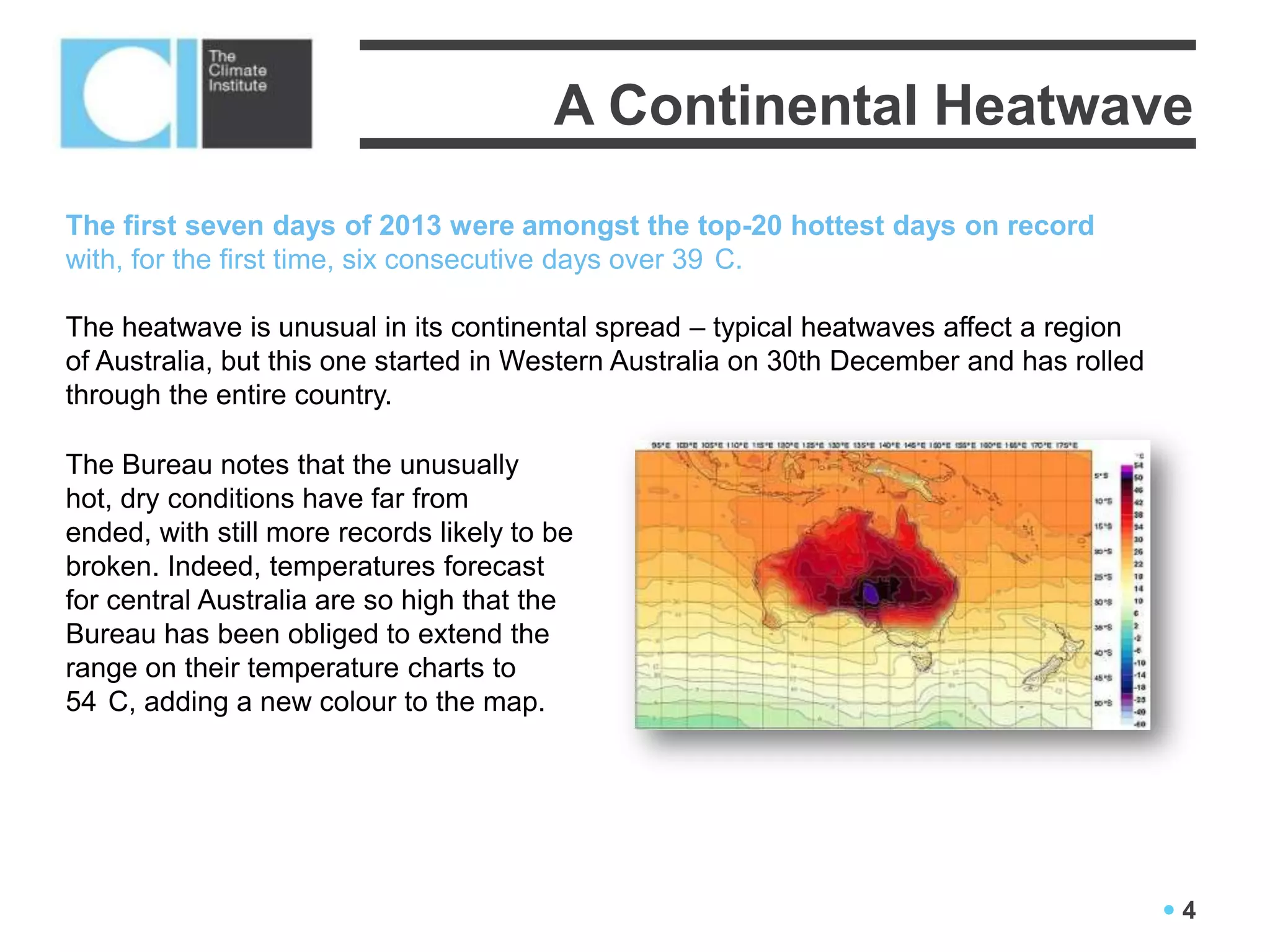
The first seven days of 2013 were amongst the top-20 hottest days on record
with, for the first time, six consecutive days over 39 C.

The heatwave is unusual in its continental spread – typical heatwaves affect a region
of Australia, but this one started in Western Australia on 30th December and has rolled
through the entire country.

The Bureau notes that the unusually
hot, dry conditions have far from
ended, with still more records likely to be
broken. Indeed, temperatures forecast
for central Australia are so high that the
Bureau has been obliged to extend the
range on their temperature charts to
54 C, adding a new colour to the map.


                                                                                          4
Human health & wellbeing
The Australian climate is inherently        Our Creative
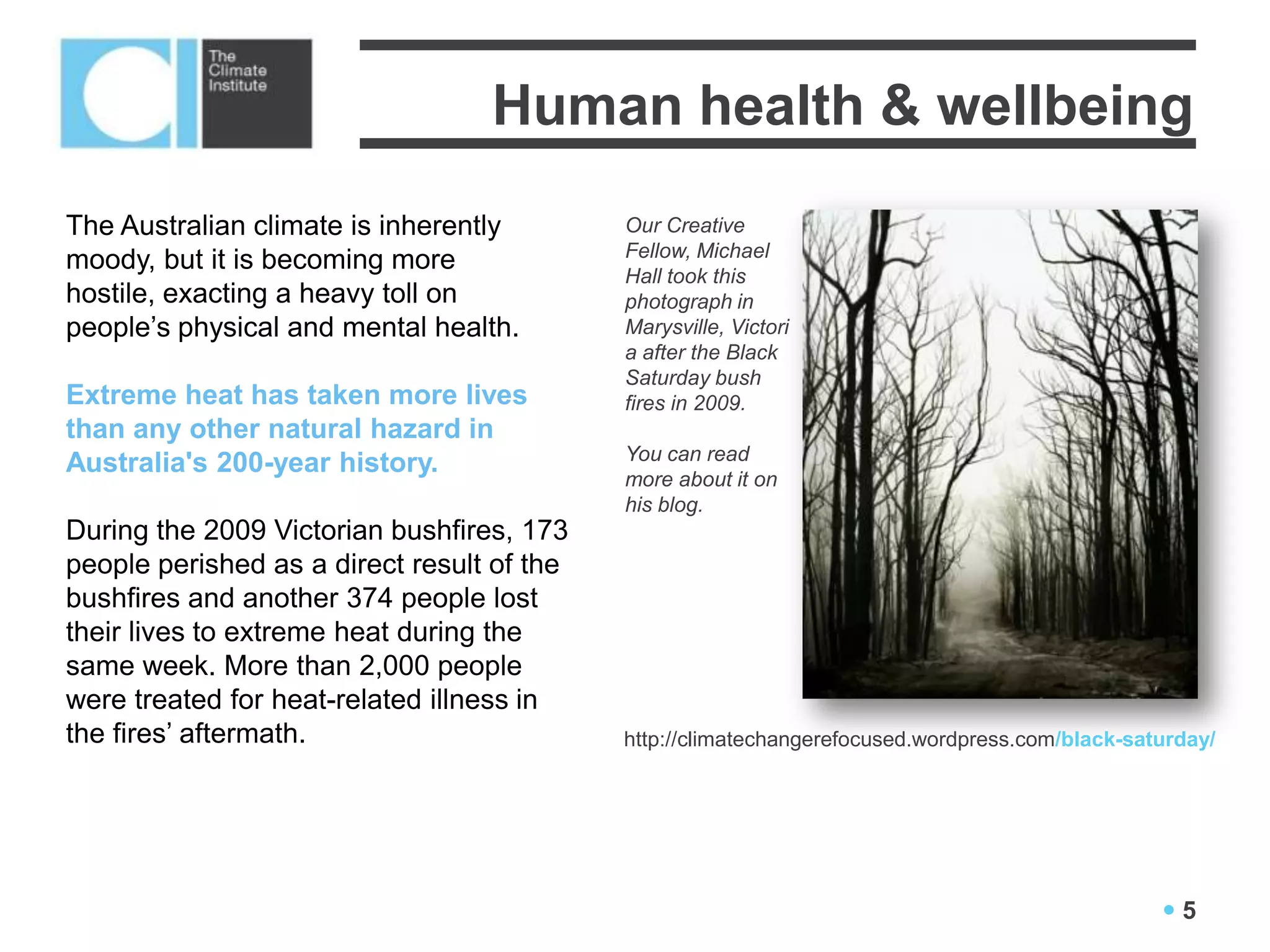
                                            Fellow, Michael
moody, but it is becoming more
                                            Hall took this
hostile, exacting a heavy toll on           photograph in
people’s physical and mental health.        Marysville, Victori
                                            a after the Black
                                            Saturday bush
Extreme heat has taken more lives           fires in 2009.
than any other natural hazard in
                                            You can read
Australia's 200-year history.
                                            more about it on
                                            his blog.
During the 2009 Victorian bushfires, 173
people perished as a direct result of the
bushfires and another 374 people lost
their lives to extreme heat during the
same week. More than 2,000 people
were treated for heat-related illness in
the fires’ aftermath.                       http://climatechangerefocused.wordpress.com/black-saturday/


                                                                                                 5
Stress, anxiety & despair
Following a severe weather event, as many as one in five people will suffer the debilitating
effects of extreme stress, emotional injury and despair. An increasingly hostile climate will
spell a substantial rise in the incidence of post-traumatic stress, anxiety and depression.

                                       •   Heat waves can lead to restless, sleepless
                                           nights. Temperature outside of mid-20 s Celsius
                                           can lead to impaired sleep, leading to tiredness
                                           and diminished productivity.
                                       •   In a heat wave, people quickly become
                                           grumpier, more strained. Tempers flare. Thinking
                                           and concentration are impaired. Normal road
                                           rage is amplified. Domestic disputes turn nasty
                                           more easily. This has costs and consequences: it
                                           ties up law enforcement, hospitals, and other
                                           critical services.
                                       •   Literature shows that aggressive, anti-social
                                           behaviour is also heightened during a heat
                                           wave, aided and abetted by binge-drinking and
                                           other kinds of drug abuse.


                                                                                          6
The lingering effects
The emotional and psychological toll of extreme weather events can linger for
months, even years.

 •   Higher rates of drug and alcohol
     misuse, violence, family dissolution, and suicide are
     more likely to follow more extreme weather events.
     Evidence is beginning to emerge that drought and heat
     waves lead to higher rates of self-harm and suicide, as
     much as 8 per cent higher.
 •   More than 1 in 10 primary school children were
     suffering from post-traumatic stress disorder the three
     months following Cyclone Larry in Northern
     Queensland in March 2006. Common symptoms
     included flashbacks, nightmares and general state of
     distress, all of which may have had a deleterious effect
     on the children’s education and future life prospects.
 •   Following the 2009 tragedy at
     Kinglake, Victoria, reports have emerged of higher-
     than-normal drug and alcohol abuse, as well as
     disempowerment following an initial burst of solidarity
     in the first few months post-disaster.


                                                                                7
Mental illness

Mental illness is already the second largest contributor to the disease burden in
Australia. In any given year, one in five Australians suffers from a mental disorder of
some kind, potentially making millions of people more vulnerable to mental ill-health in
an increasingly hostile climate.


                        •   The treatment and management of mental health problems
                            already costs taxpayers over $5 billion per year, while the
                            cost in lost productivity is estimated at another $2.7 billion—
                            costs set to rise in a changing climate. Mental health
                            problems also tend to coalesce with economic and social
                            ones, meaning that the overall toll is likely to be larger still.
                        •   Just how much Australians’ mental health burden grows in the
                            future depends significantly on how quickly and substantially
                            we act on climate change now. Seeing action on climate
                            change as an investment in preventative health care is an
                            important first step.


                                                                                          8
Strained resources
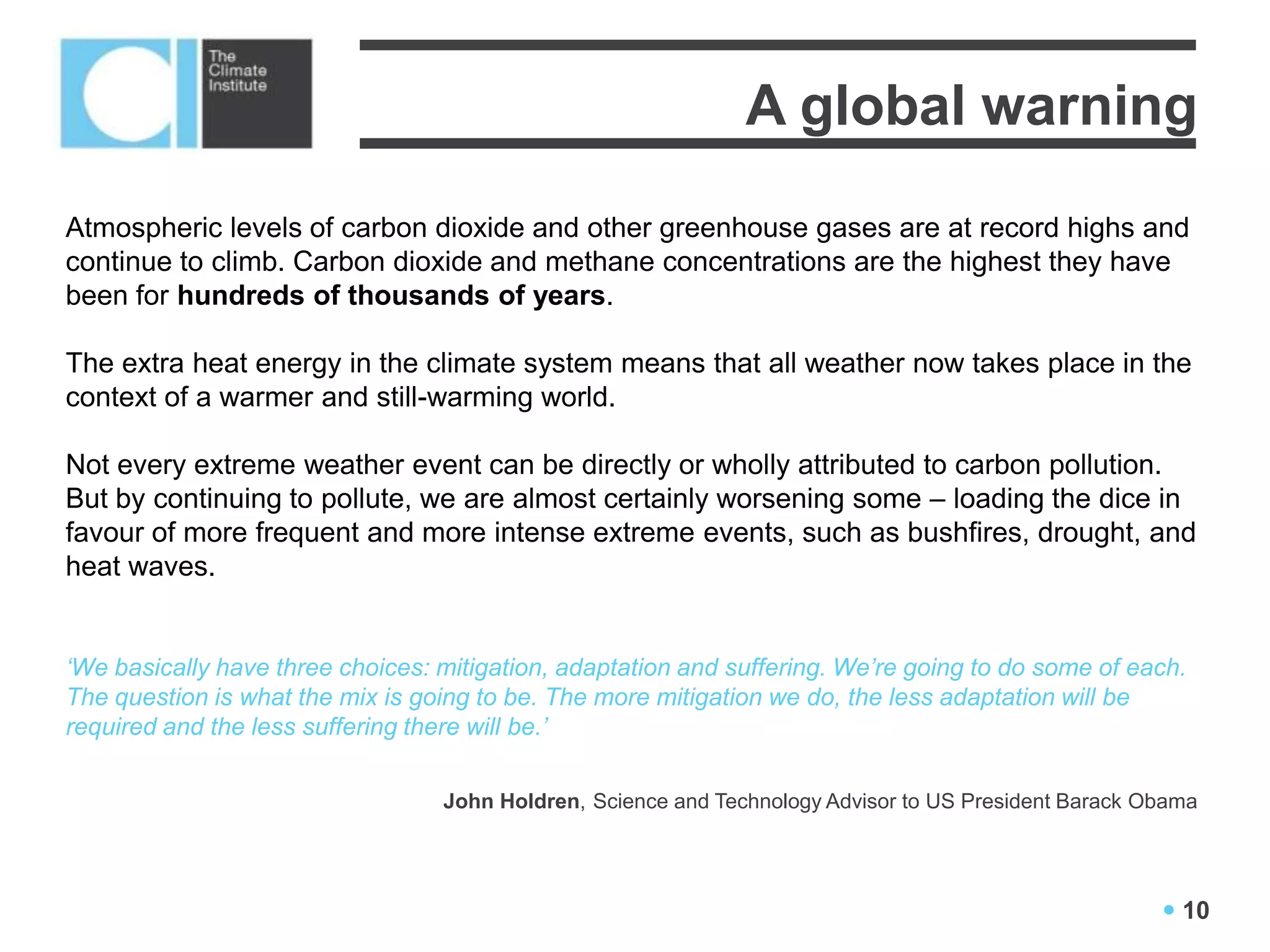
The 2009 Black Saturday bushfires and the 2011 floods in Queensland showed that
while top-down disaster response and recovery efforts play vital roles, local-level
organisations are also critical. But as extreme weather events like the current
heatwaves unfold, community organisations struggle to cope.


•   Ambulance transport and hospital admissions rise
    significantly during extreme weather events, straining
    emergency responders.
•   The Australian Council of Social Service (ACOSS) has
    said that many community organisations, which typically
    rely heavily on volunteers and provide a range of vital
    services, including support for young
    mothers, childcare, welfare and aged care, are likely to
    permanently collapse. This would leave society's most
    disadvantaged, including the elderly, mentally ill and the
    homeless, ''at real and increased risk of death''.


                                                                                      9
A global warning
Atmospheric levels of carbon dioxide and other greenhouse gases are at record highs and
continue to climb. Carbon dioxide and methane concentrations are the highest they have
been for hundreds of thousands of years.

The extra heat energy in the climate system means that all weather now takes place in the
context of a warmer and still-warming world.

Not every extreme weather event can be directly or wholly attributed to carbon pollution.
But by continuing to pollute, we are almost certainly worsening some – loading the dice in
favour of more frequent and more intense extreme events, such as bushfires, drought, and
heat waves.


‘We basically have three choices: mitigation, adaptation and suffering. We’re going to do some of each.
The question is what the mix is going to be. The more mitigation we do, the less adaptation will be
required and the less suffering there will be.’

                                  John Holdren, Science and Technology Advisor to US President Barack Obama


                                                                                                        10
Additional Resources


For a comprehensive         In 2011, The Climate Institute prepared a report entitled A Climate of
list of references for      Suffering: The Real Cost of Living with Inaction on Climate
the figures cited in this   Change that sought to raise awareness of the mental health
presentation download       consequences of extreme weather events and climate change.
the Media Brief.            Alongside the report, a video was produced which explores the mental
                            health impacts of those involved in extreme weather events like the
                            Black Saturday Bushfires of 2009.

                            http://www.climateinstitute.org.au/a-climate-of-suffering.html

                                                                                                 11
More Information


www.climateinstitute.org.au/explore-climate-change.html


                                                       12

The Human Impacts of Heatwaves & Extreme Weather

  • 1.
    The Climate Institute The Human Impacts of Heatwaves & Extreme Weather 1
  • 2.
    Global Review 2012 Introduction The Human Impacts of Heatwaves & Extreme Weather ‘The symptoms we see now, in individuals and communities beleaguered by fire, storms, floods and drought, are the early warning signs. There is still time to avoid the human and other costs of global warming blowing out, time to realise the many health and social benefits of action, and so time to restore wellbeing and hope.’ Tony McMichael AO, MB BS, PhD, FAFPHM, FTSE Professor of Population Health and NHMRC Australia Fellow National Centre for Epidemiology & Population Health Australian National University This presentation explores the human impacts, including stress, anxiety and mental illness that arise or are exacerbated by extreme weather events. www.climateinstitute.org.au/explore-climate-change.html 2
  • 3.
    Global Review 2012 Introduction In the last century, Australia's average temperature rose by slightly less than one degree over the preindustrial average. Without concerted action by all countries, including Australia, the world is on a path to exceeding 4 C by the 2060s. While some further warming is already locked in to the climate system, the worst is still avoidable. The tasks now are to avoid the unmanageable consequences of full-blown climate change and, at the same time, manage the unavoidable. This means recognising the full human cost of disasters, an early investment in community resilience— strengthening communities’ capacity to recovery, as well proper resourcing of emergency services. www.climateinstitute.org.au/explore-climate-change.html 3
  • 4.
    A Continental Heatwave Thefirst seven days of 2013 were amongst the top-20 hottest days on record with, for the first time, six consecutive days over 39 C. The heatwave is unusual in its continental spread – typical heatwaves affect a region of Australia, but this one started in Western Australia on 30th December and has rolled through the entire country. The Bureau notes that the unusually hot, dry conditions have far from ended, with still more records likely to be broken. Indeed, temperatures forecast for central Australia are so high that the Bureau has been obliged to extend the range on their temperature charts to 54 C, adding a new colour to the map. 4
  • 5.
    Human health &wellbeing The Australian climate is inherently Our Creative Fellow, Michael moody, but it is becoming more Hall took this hostile, exacting a heavy toll on photograph in people’s physical and mental health. Marysville, Victori a after the Black Saturday bush Extreme heat has taken more lives fires in 2009. than any other natural hazard in You can read Australia's 200-year history. more about it on his blog. During the 2009 Victorian bushfires, 173 people perished as a direct result of the bushfires and another 374 people lost their lives to extreme heat during the same week. More than 2,000 people were treated for heat-related illness in the fires’ aftermath. http://climatechangerefocused.wordpress.com/black-saturday/ 5
  • 6.
    Stress, anxiety &despair Following a severe weather event, as many as one in five people will suffer the debilitating effects of extreme stress, emotional injury and despair. An increasingly hostile climate will spell a substantial rise in the incidence of post-traumatic stress, anxiety and depression. • Heat waves can lead to restless, sleepless nights. Temperature outside of mid-20 s Celsius can lead to impaired sleep, leading to tiredness and diminished productivity. • In a heat wave, people quickly become grumpier, more strained. Tempers flare. Thinking and concentration are impaired. Normal road rage is amplified. Domestic disputes turn nasty more easily. This has costs and consequences: it ties up law enforcement, hospitals, and other critical services. • Literature shows that aggressive, anti-social behaviour is also heightened during a heat wave, aided and abetted by binge-drinking and other kinds of drug abuse. 6
  • 7.
    The lingering effects Theemotional and psychological toll of extreme weather events can linger for months, even years. • Higher rates of drug and alcohol misuse, violence, family dissolution, and suicide are more likely to follow more extreme weather events. Evidence is beginning to emerge that drought and heat waves lead to higher rates of self-harm and suicide, as much as 8 per cent higher. • More than 1 in 10 primary school children were suffering from post-traumatic stress disorder the three months following Cyclone Larry in Northern Queensland in March 2006. Common symptoms included flashbacks, nightmares and general state of distress, all of which may have had a deleterious effect on the children’s education and future life prospects. • Following the 2009 tragedy at Kinglake, Victoria, reports have emerged of higher- than-normal drug and alcohol abuse, as well as disempowerment following an initial burst of solidarity in the first few months post-disaster. 7
  • 8.
    Mental illness Mental illnessis already the second largest contributor to the disease burden in Australia. In any given year, one in five Australians suffers from a mental disorder of some kind, potentially making millions of people more vulnerable to mental ill-health in an increasingly hostile climate. • The treatment and management of mental health problems already costs taxpayers over $5 billion per year, while the cost in lost productivity is estimated at another $2.7 billion— costs set to rise in a changing climate. Mental health problems also tend to coalesce with economic and social ones, meaning that the overall toll is likely to be larger still. • Just how much Australians’ mental health burden grows in the future depends significantly on how quickly and substantially we act on climate change now. Seeing action on climate change as an investment in preventative health care is an important first step. 8
  • 9.
    Strained resources The 2009Black Saturday bushfires and the 2011 floods in Queensland showed that while top-down disaster response and recovery efforts play vital roles, local-level organisations are also critical. But as extreme weather events like the current heatwaves unfold, community organisations struggle to cope. • Ambulance transport and hospital admissions rise significantly during extreme weather events, straining emergency responders. • The Australian Council of Social Service (ACOSS) has said that many community organisations, which typically rely heavily on volunteers and provide a range of vital services, including support for young mothers, childcare, welfare and aged care, are likely to permanently collapse. This would leave society's most disadvantaged, including the elderly, mentally ill and the homeless, ''at real and increased risk of death''. 9
  • 10.
    A global warning Atmosphericlevels of carbon dioxide and other greenhouse gases are at record highs and continue to climb. Carbon dioxide and methane concentrations are the highest they have been for hundreds of thousands of years. The extra heat energy in the climate system means that all weather now takes place in the context of a warmer and still-warming world. Not every extreme weather event can be directly or wholly attributed to carbon pollution. But by continuing to pollute, we are almost certainly worsening some – loading the dice in favour of more frequent and more intense extreme events, such as bushfires, drought, and heat waves. ‘We basically have three choices: mitigation, adaptation and suffering. We’re going to do some of each. The question is what the mix is going to be. The more mitigation we do, the less adaptation will be required and the less suffering there will be.’ John Holdren, Science and Technology Advisor to US President Barack Obama  10
  • 11.
    Additional Resources For acomprehensive In 2011, The Climate Institute prepared a report entitled A Climate of list of references for Suffering: The Real Cost of Living with Inaction on Climate the figures cited in this Change that sought to raise awareness of the mental health presentation download consequences of extreme weather events and climate change. the Media Brief. Alongside the report, a video was produced which explores the mental health impacts of those involved in extreme weather events like the Black Saturday Bushfires of 2009. http://www.climateinstitute.org.au/a-climate-of-suffering.html  11
  • 12.