
The Defence &
Security Implications of
Climate Change
Professor Alan Dupont
Chronology
 UN debates political & security implications of
Climate Change in 2007 for the first time
 CIA and ONA do classified assessments
 Pentagon and Australian Defence& NS studies
 At centre of Europe’s foreign policy
2009 Defence White Paper
 Neighbourhood will be particularly affected.
 Exacerbate existing precursors for conflict.

 Could give rise to very old forms of confrontation and
war, such as clashes between states over resources.
 More frequent and severe natural disasters and
weather – humanitarian assistance and disaster relief.
2009 Defence White Paper
“Uncertainty about the effects of climate
change and the period of time over which
potential impacts may develop makes it
difficult to assess its strategic consequences.”
 Strategic consequences will not be felt before
2030.
2013 Defence White Paper
Issue framed as a driver of resource insecurity.
“Global energy, food and water resources are
under pressure from population growth, rising
affluence and climate change”
Why is Climate Change a Security
Issue?
 Necessitates judgements about political & strategic
risk – a threat multiplier
 Poses fundamental questions of human security,
survival and stability of nation states
 Central problem is the rate at which temperatures
are rising – little time to adapt and mitigate
How Will Climate Change Affect
Security?
 Negative consequences for food, energy and water
and hence economic and political stability
 Increased frequency and devastation of natural
disasters, generating more humanitarian disasters
requiring international relief
 Environmental refugees and population
displacements
How Will Climate Change Affect
Security?
 Spread of infectious diseases
 Will reduce the carrying capacity of developing
countries in Australia’s neighbourhood
 Impact will be magnified where other problems
exist eg. terrorism, ethnic tensions, pandemics,
civil war.
Climate Wild Cards
 Low probability but high impact events
 Wild Cards – rapid or abrupt climate change

 Tipping Points
 Reduction in aerosol masking; accelerated
deforestation; rapid melting of the tundra ice or
polar ice
Policy Recommendation
 “Strategic planners ought to include worse case
climate change scenarios in their contingency
planning as they do for terrorism, infectious
diseases and conventional military challenges to
national security.” Alan Dupont (2006)
Climate Change and Defence
 Climate Change will affect where, when, why and
how the ADF operates
 It will shape Defence’s operating environment
 Asia Pacific particularly affected
 Defence still has no climate change strategy
Operational & Personnel
Implications
 Greater numbers of stabilisation operations
 Regional cooperation on Climate Change

 More humanitarian and disaster relief ops
including domestic
 Greater demand for engineers, doctors, transport,
intelligence
Operational & Personnel
Implications
 New design standards such as shelters for fighter
aircraft, munitions storage, runways
 Conforming to environmental regulations
 Energy considerations. Defence accounts for 70%
of total govt energy use
 More stresses and demands on force structure
Conclusions
Climate change increasingly factored into
defence and security assessments.
Australia lagging behind other DCs.
Residual CC scepticism has stalled momentum
towards more robust policy stances.
Compounded by conservatism of Defence.
Unclear how CC will be dealt with in a Coalition
government.
END
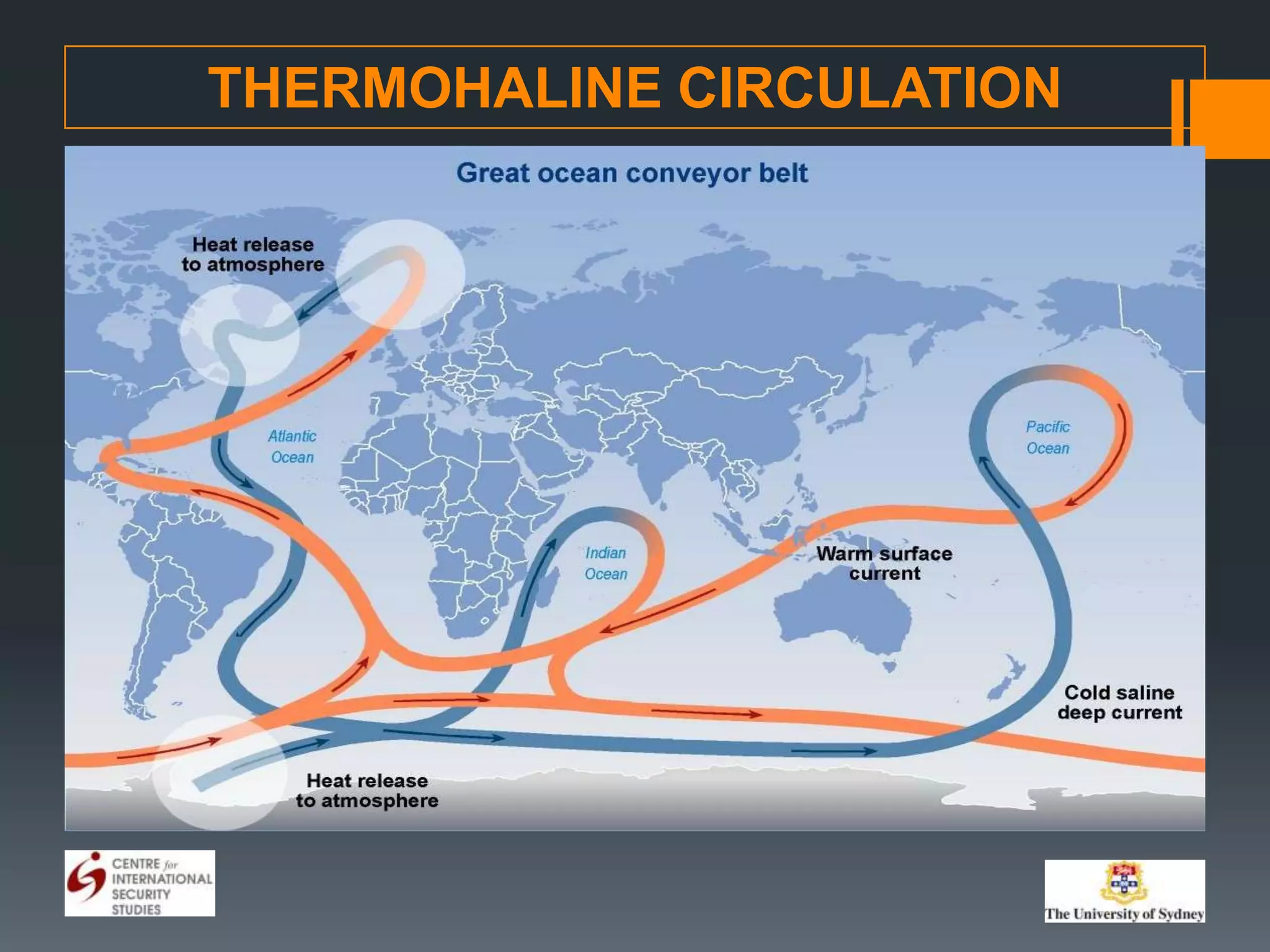
THERMOHALINE CIRCULATION
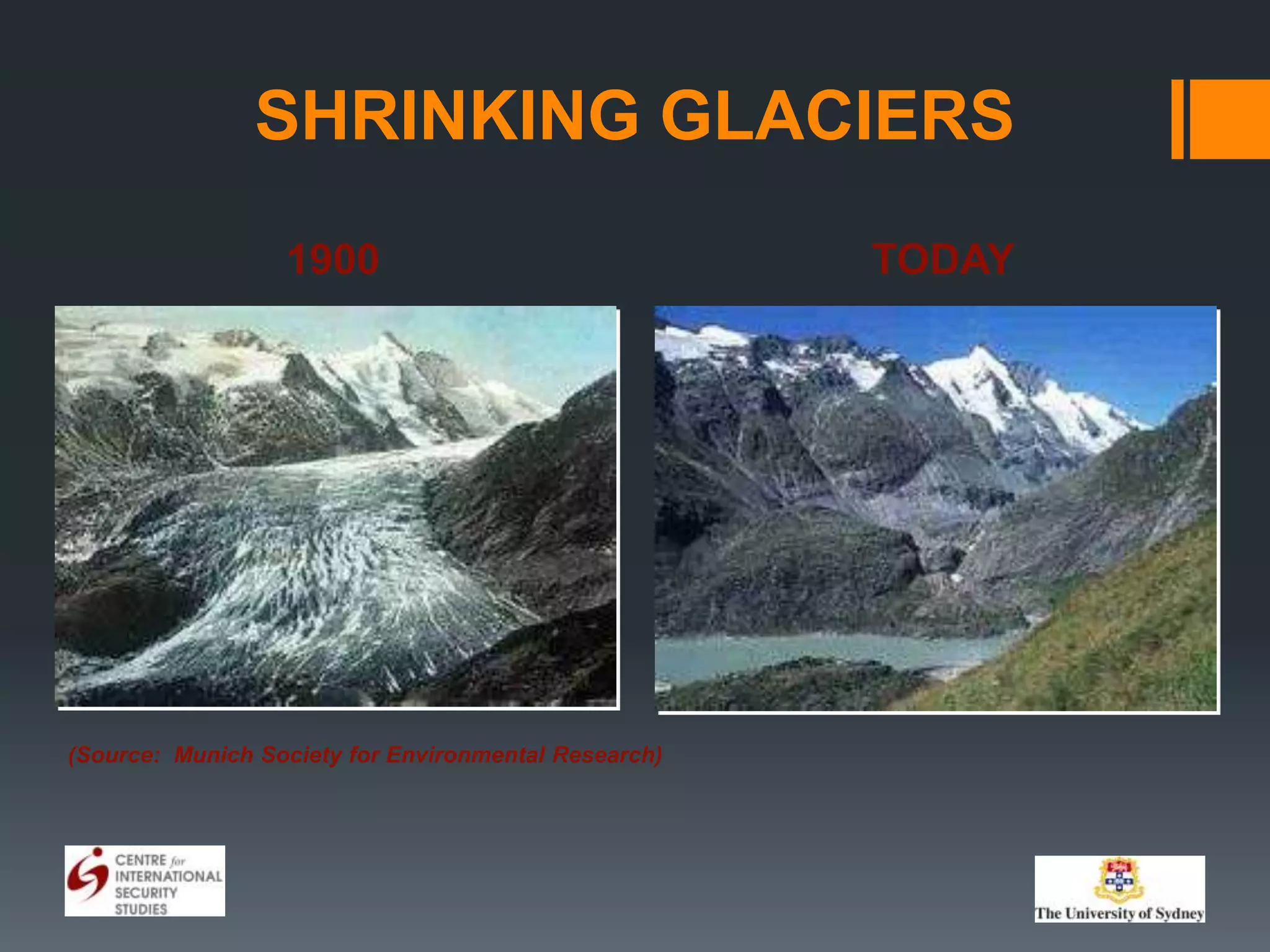
SHRINKING GLACIERS
1900

(Source: Munich Society for Environmental Research)

TODAY

The Defence and Security Implications of Climate Change

  • 1.
    The Defence & SecurityImplications of Climate Change Professor Alan Dupont
  • 2.
    Chronology  UN debatespolitical & security implications of Climate Change in 2007 for the first time  CIA and ONA do classified assessments  Pentagon and Australian Defence& NS studies  At centre of Europe’s foreign policy
  • 3.
    2009 Defence WhitePaper  Neighbourhood will be particularly affected.  Exacerbate existing precursors for conflict.  Could give rise to very old forms of confrontation and war, such as clashes between states over resources.  More frequent and severe natural disasters and weather – humanitarian assistance and disaster relief.
  • 4.
    2009 Defence WhitePaper “Uncertainty about the effects of climate change and the period of time over which potential impacts may develop makes it difficult to assess its strategic consequences.”  Strategic consequences will not be felt before 2030.
  • 5.
    2013 Defence WhitePaper Issue framed as a driver of resource insecurity. “Global energy, food and water resources are under pressure from population growth, rising affluence and climate change”
  • 6.
    Why is ClimateChange a Security Issue?  Necessitates judgements about political & strategic risk – a threat multiplier  Poses fundamental questions of human security, survival and stability of nation states  Central problem is the rate at which temperatures are rising – little time to adapt and mitigate
  • 7.
    How Will ClimateChange Affect Security?  Negative consequences for food, energy and water and hence economic and political stability  Increased frequency and devastation of natural disasters, generating more humanitarian disasters requiring international relief  Environmental refugees and population displacements
  • 8.
    How Will ClimateChange Affect Security?  Spread of infectious diseases  Will reduce the carrying capacity of developing countries in Australia’s neighbourhood  Impact will be magnified where other problems exist eg. terrorism, ethnic tensions, pandemics, civil war.
  • 9.
    Climate Wild Cards Low probability but high impact events  Wild Cards – rapid or abrupt climate change  Tipping Points  Reduction in aerosol masking; accelerated deforestation; rapid melting of the tundra ice or polar ice
  • 10.
    Policy Recommendation  “Strategicplanners ought to include worse case climate change scenarios in their contingency planning as they do for terrorism, infectious diseases and conventional military challenges to national security.” Alan Dupont (2006)
  • 11.
    Climate Change andDefence  Climate Change will affect where, when, why and how the ADF operates  It will shape Defence’s operating environment  Asia Pacific particularly affected  Defence still has no climate change strategy
  • 12.
    Operational & Personnel Implications Greater numbers of stabilisation operations  Regional cooperation on Climate Change  More humanitarian and disaster relief ops including domestic  Greater demand for engineers, doctors, transport, intelligence
  • 13.
    Operational & Personnel Implications New design standards such as shelters for fighter aircraft, munitions storage, runways  Conforming to environmental regulations  Energy considerations. Defence accounts for 70% of total govt energy use  More stresses and demands on force structure
  • 14.
    Conclusions Climate change increasinglyfactored into defence and security assessments. Australia lagging behind other DCs. Residual CC scepticism has stalled momentum towards more robust policy stances. Compounded by conservatism of Defence. Unclear how CC will be dealt with in a Coalition government.
  • 15.
  • 16.
  • 17.
    SHRINKING GLACIERS 1900 (Source: MunichSociety for Environmental Research) TODAY