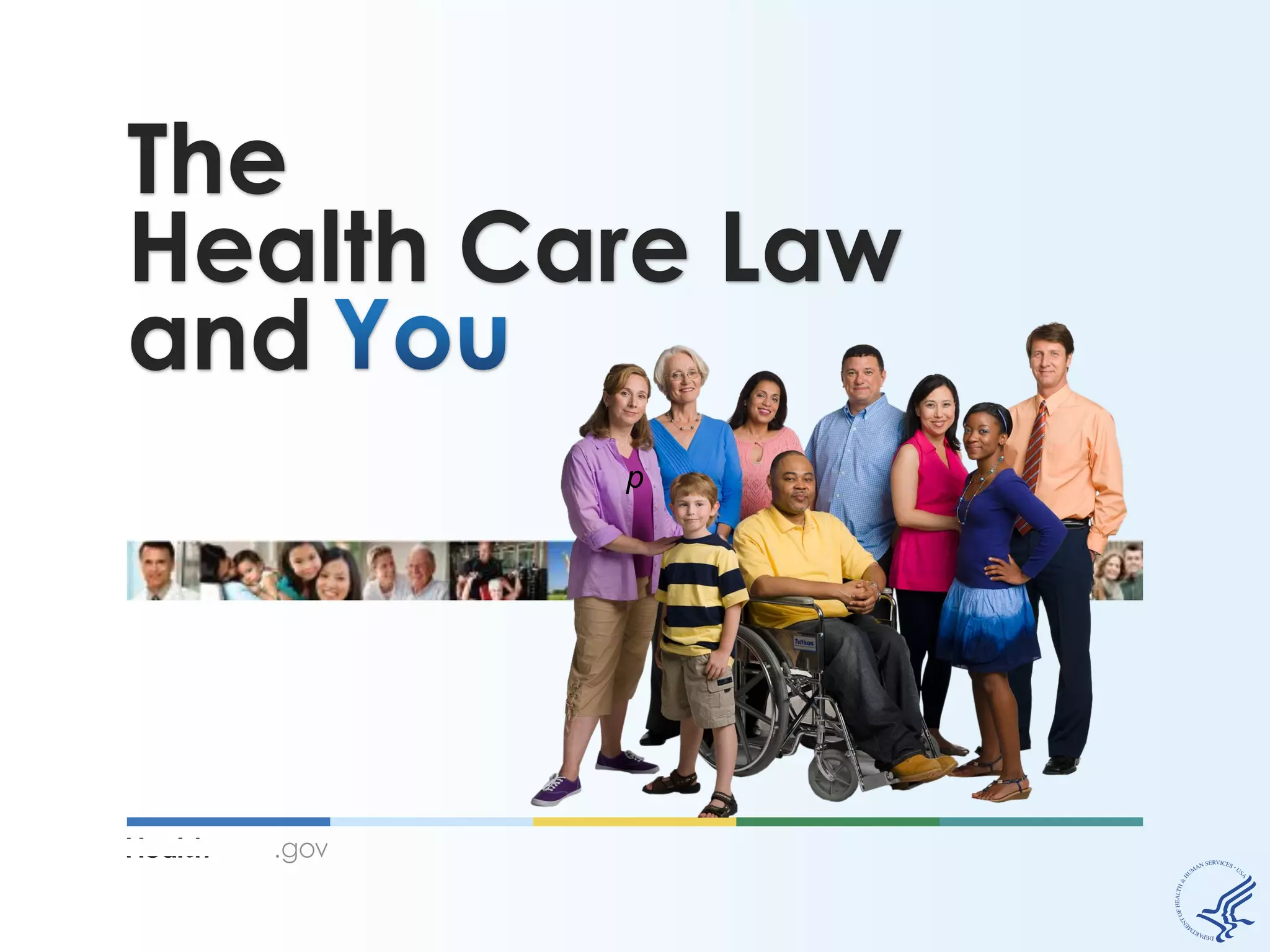
The
Health Care Law
and
         p
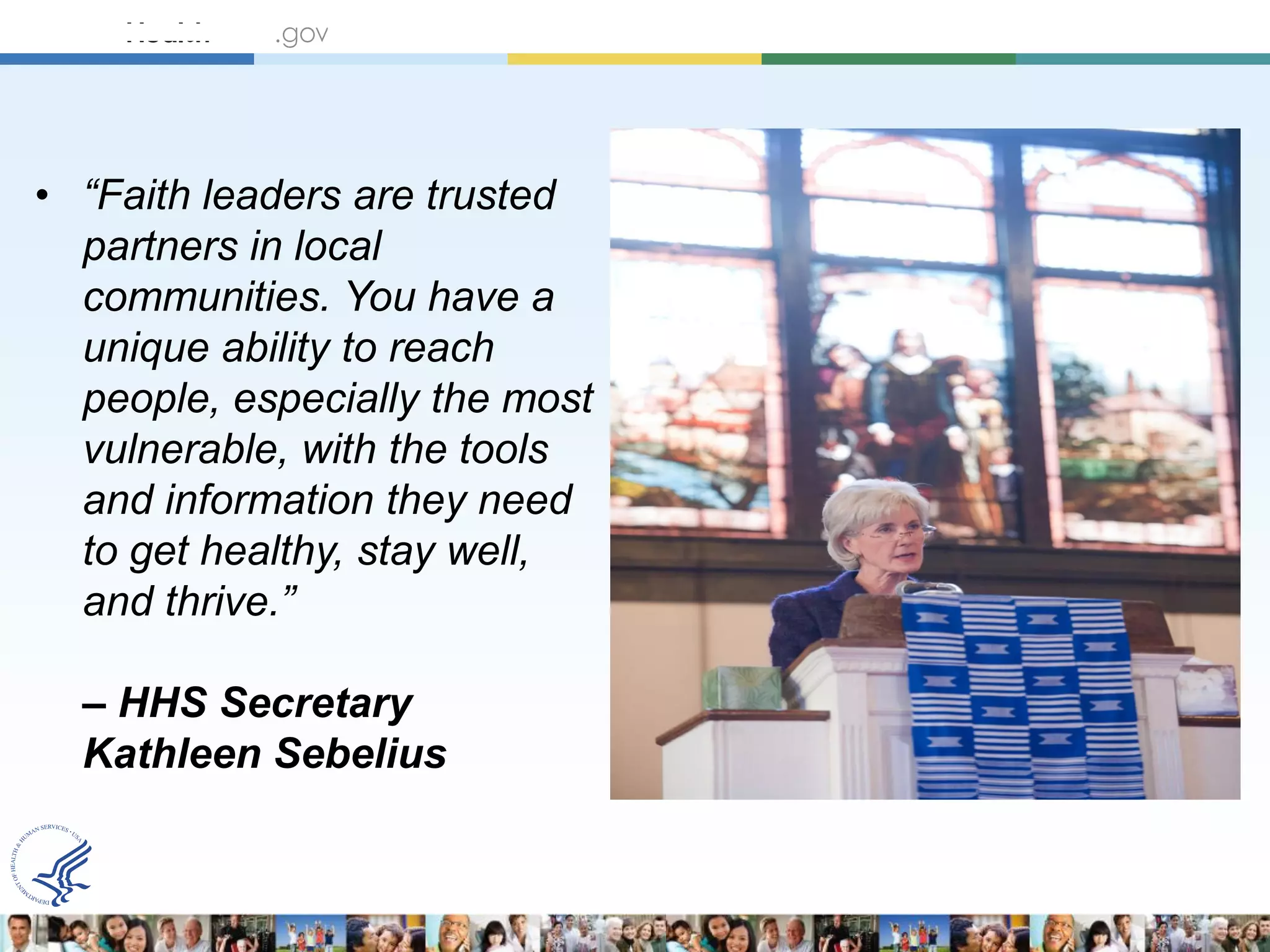
• “Faith leaders are trusted
  partners in local
  communities. You have a
  unique ability to reach
  people, especially the most
  vulnerable, with the tools
  and information they need
  to get healthy, stay well,
  and thrive.”

  – HHS Secretary
  Kathleen Sebelius
The Problem
• Insurance companies could deny care or charge you
  more if you are one of the 129 million Americans with
  pre-existing conditions.

• Premiums had more than doubled over the last decade,
  while insurance company profits were soaring.

• Fifty million Americans were uninsured, tens of millions
  more were underinsured, and those that had coverage
  were often afraid of losing it.
The Health Care Law
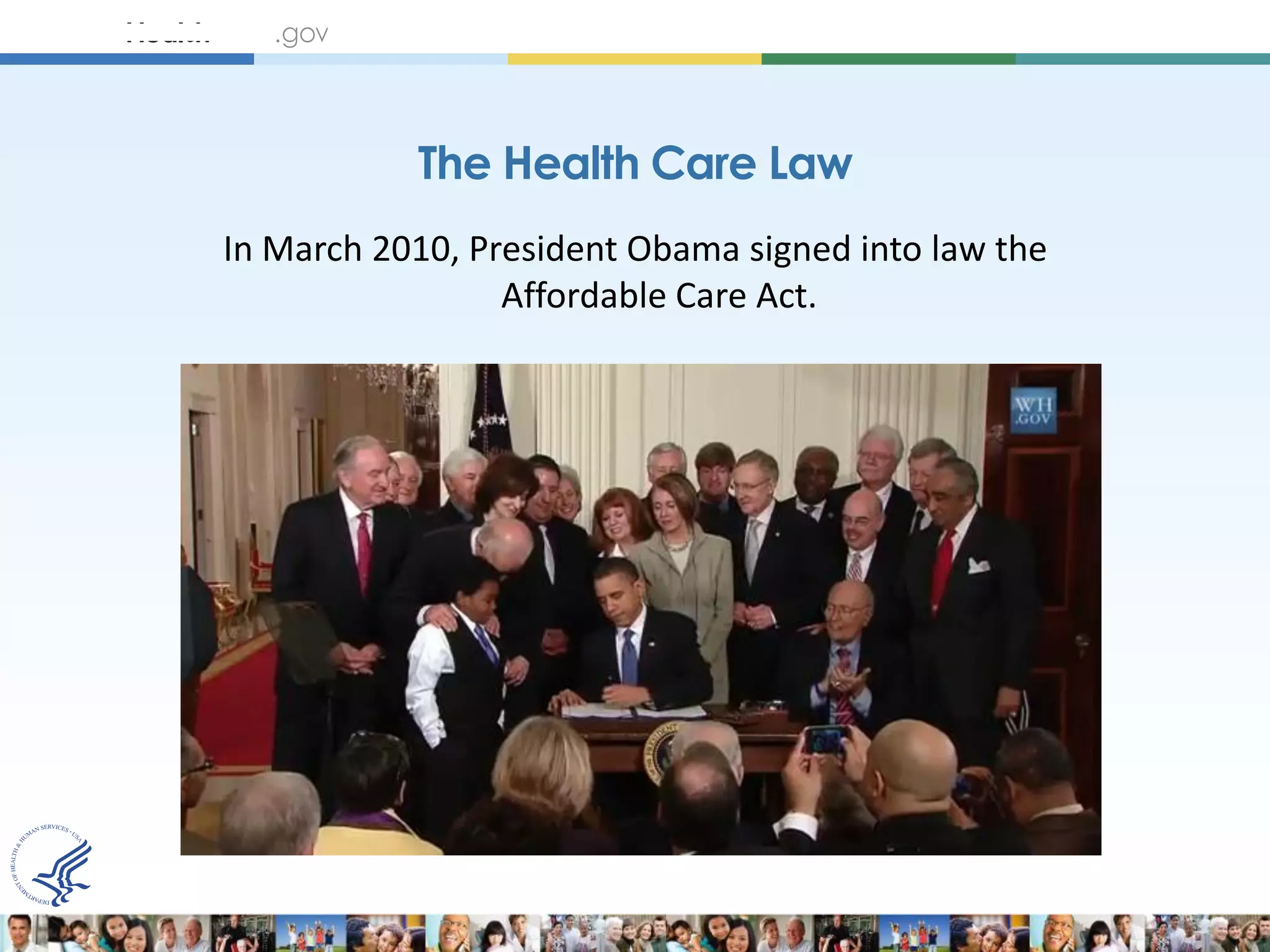
In March 2010, President Obama signed into law the
                 Affordable Care Act.
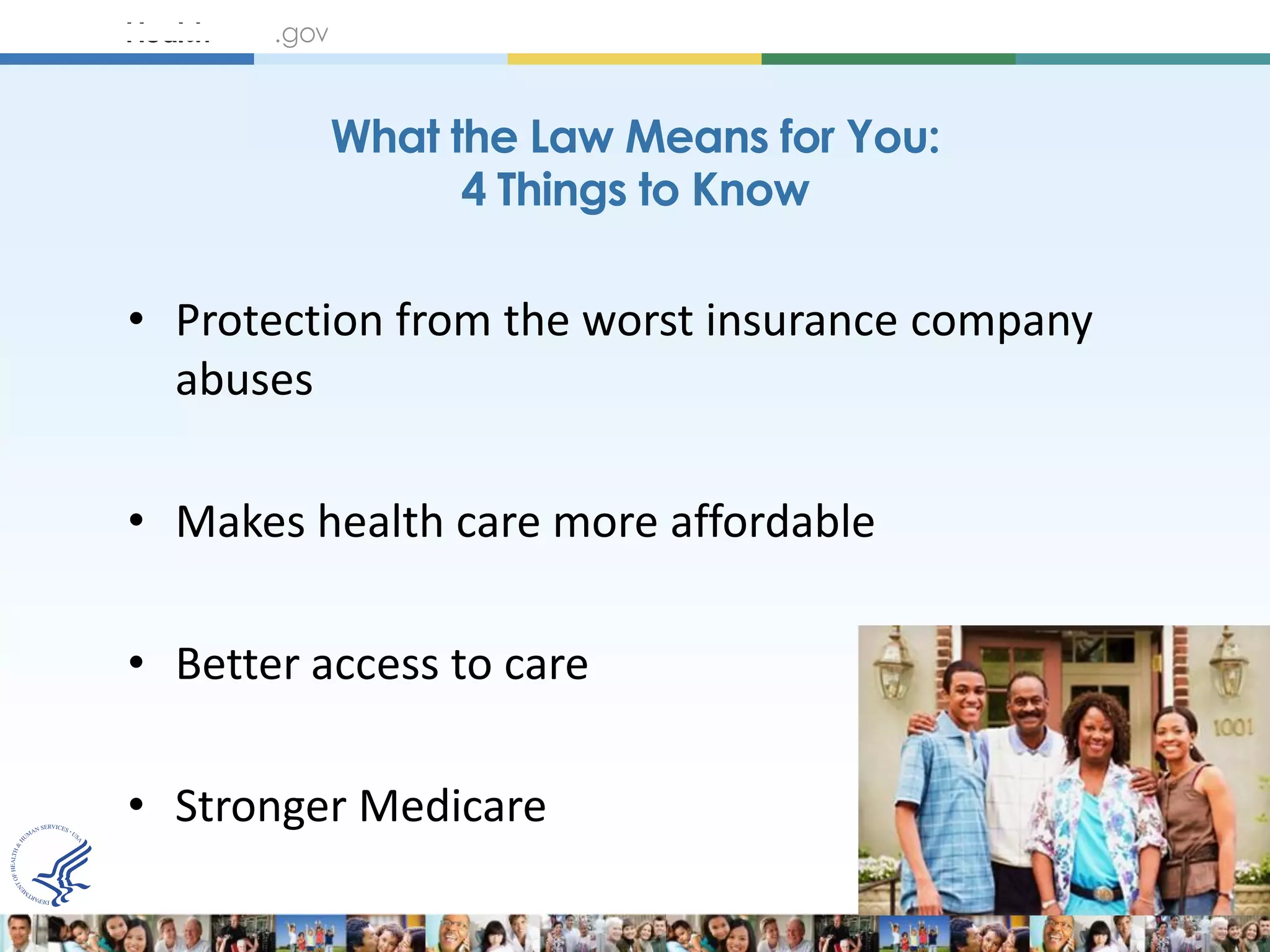
What the Law Means for You:
                4 Things to Know

• Protection from the worst insurance company
  abuses

• Makes health care more affordable

• Better access to care

• Stronger Medicare
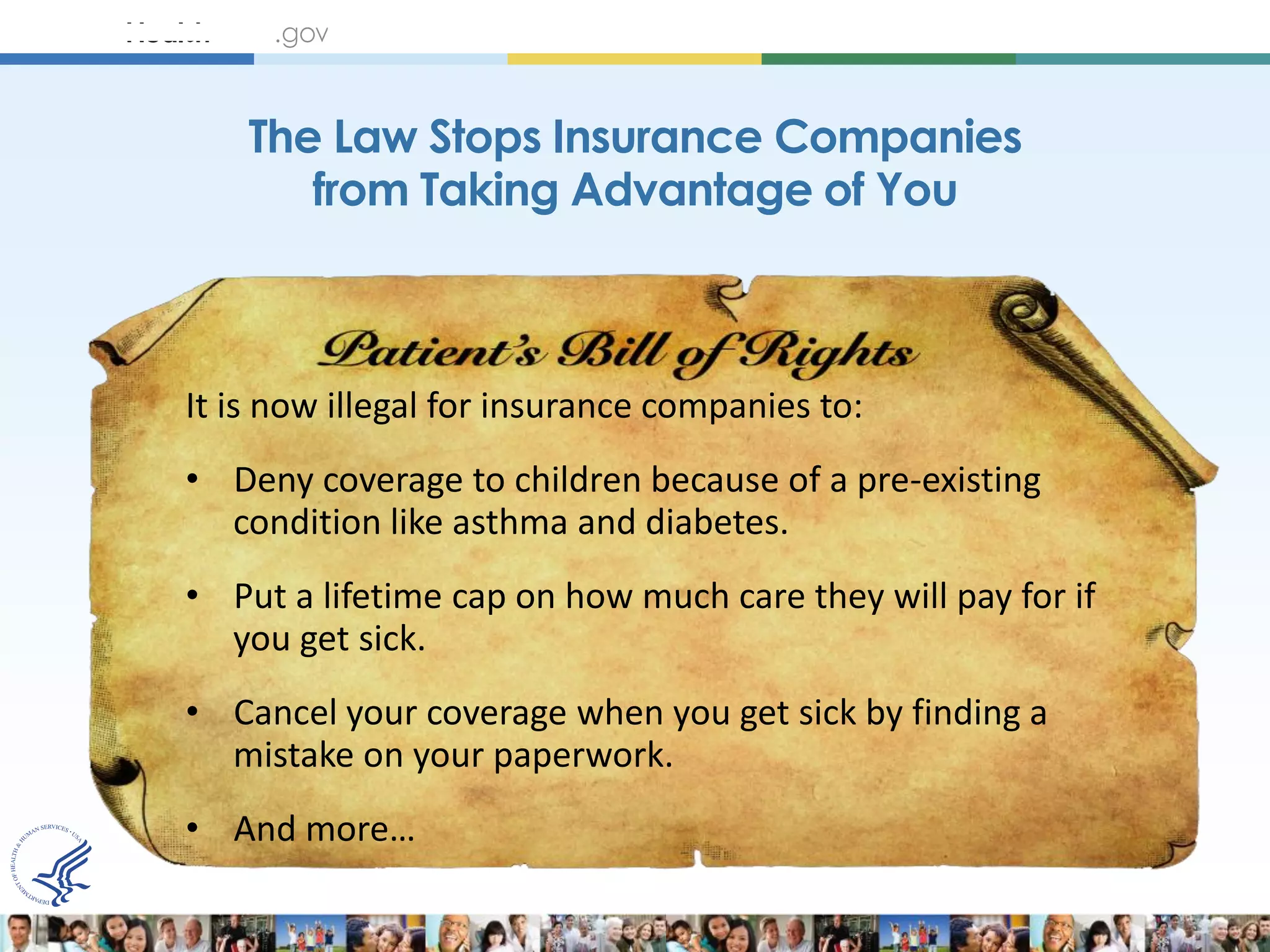
The Law Stops Insurance Companies
       from Taking Advantage of You


It is now illegal for insurance companies to:
• Deny coverage to children because of a pre-existing
  condition like asthma and diabetes.
• Put a lifetime cap on how much care they will pay for if
  you get sick.
• Cancel your coverage when you get sick by finding a
  mistake on your paperwork.
• And more…
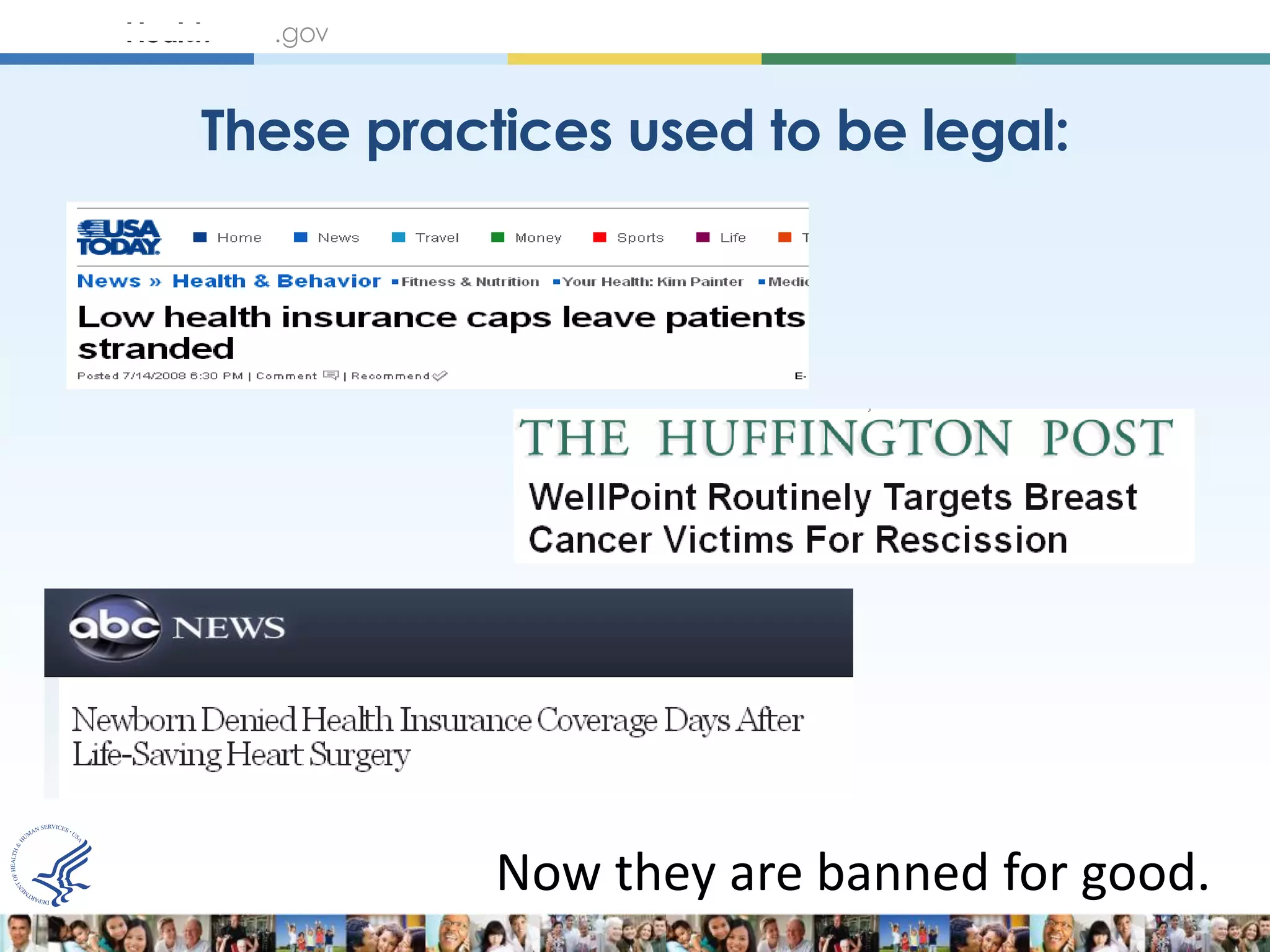
These practices used to be legal:


           Now they are banned for good.
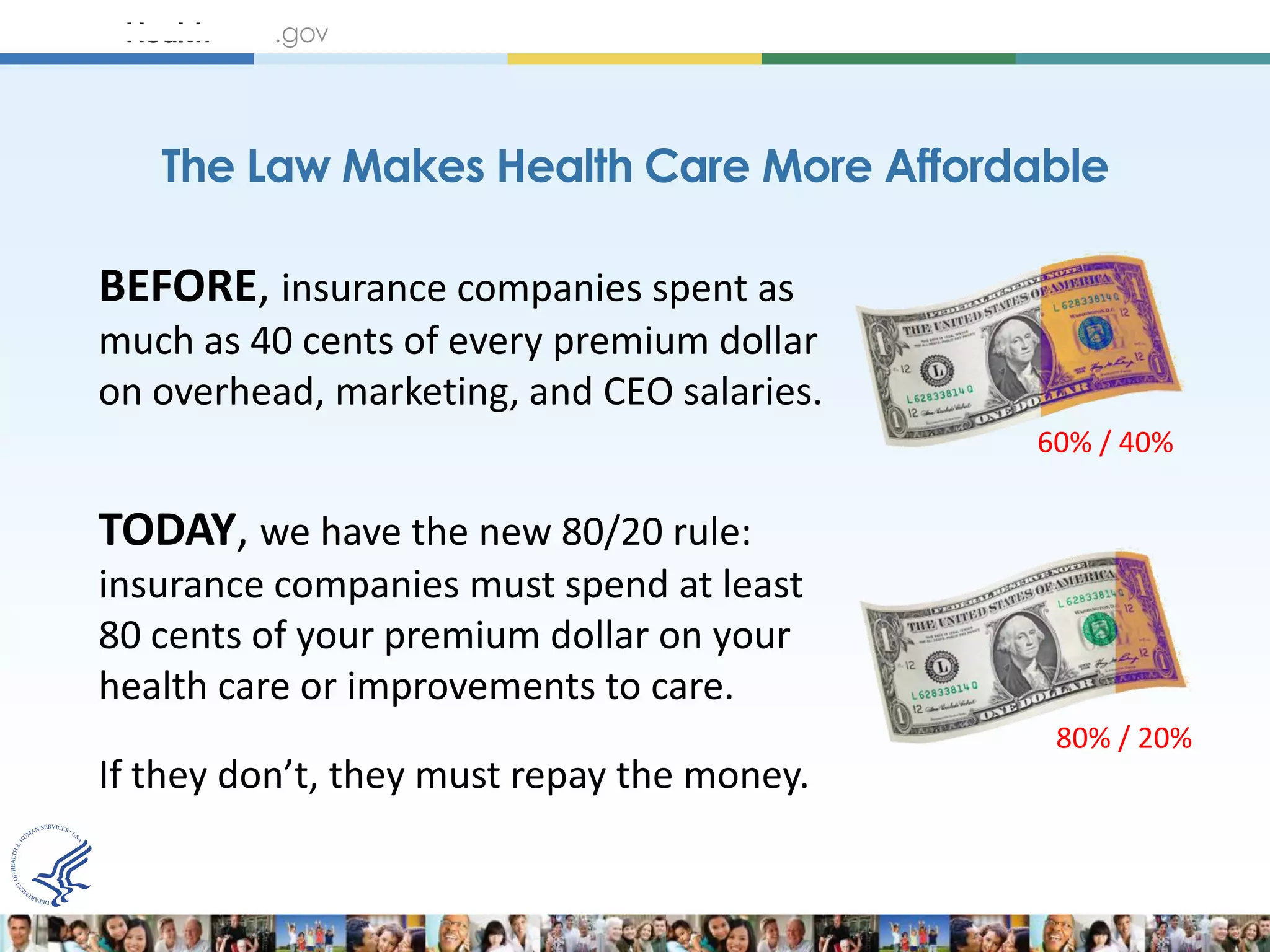
The Law Makes Health Care More Affordable

BEFORE, insurance companies spent as
much as 40 cents of every premium dollar
on overhead, marketing, and CEO salaries.
                                            60% / 40%

TODAY, we have the new 80/20 rule:
insurance companies must spend at least
80 cents of your premium dollar on your
health care or improvements to care.
                                             80% / 20%
If they don’t, they must repay the money.
The Law Makes Health Care More Affordable


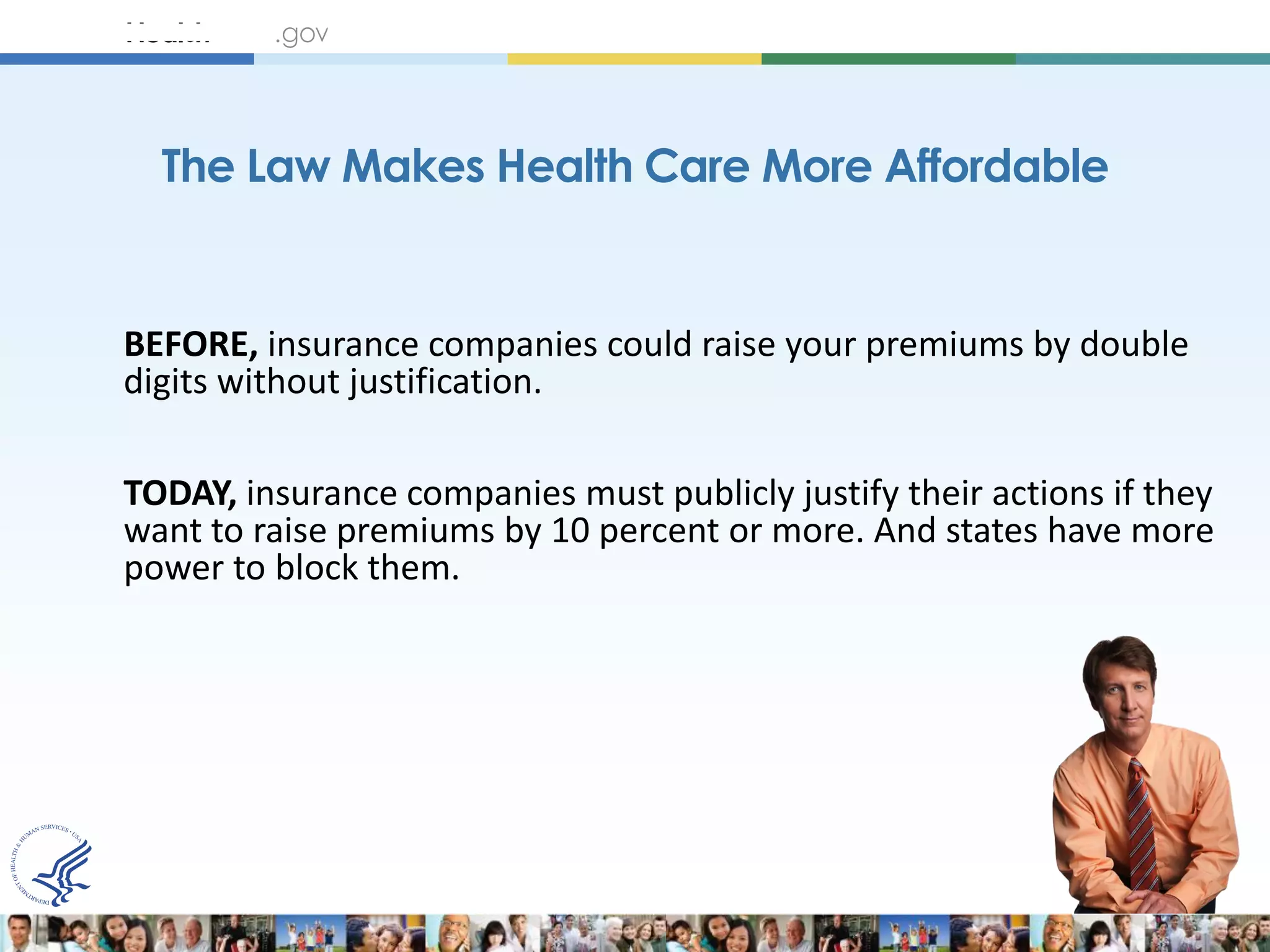
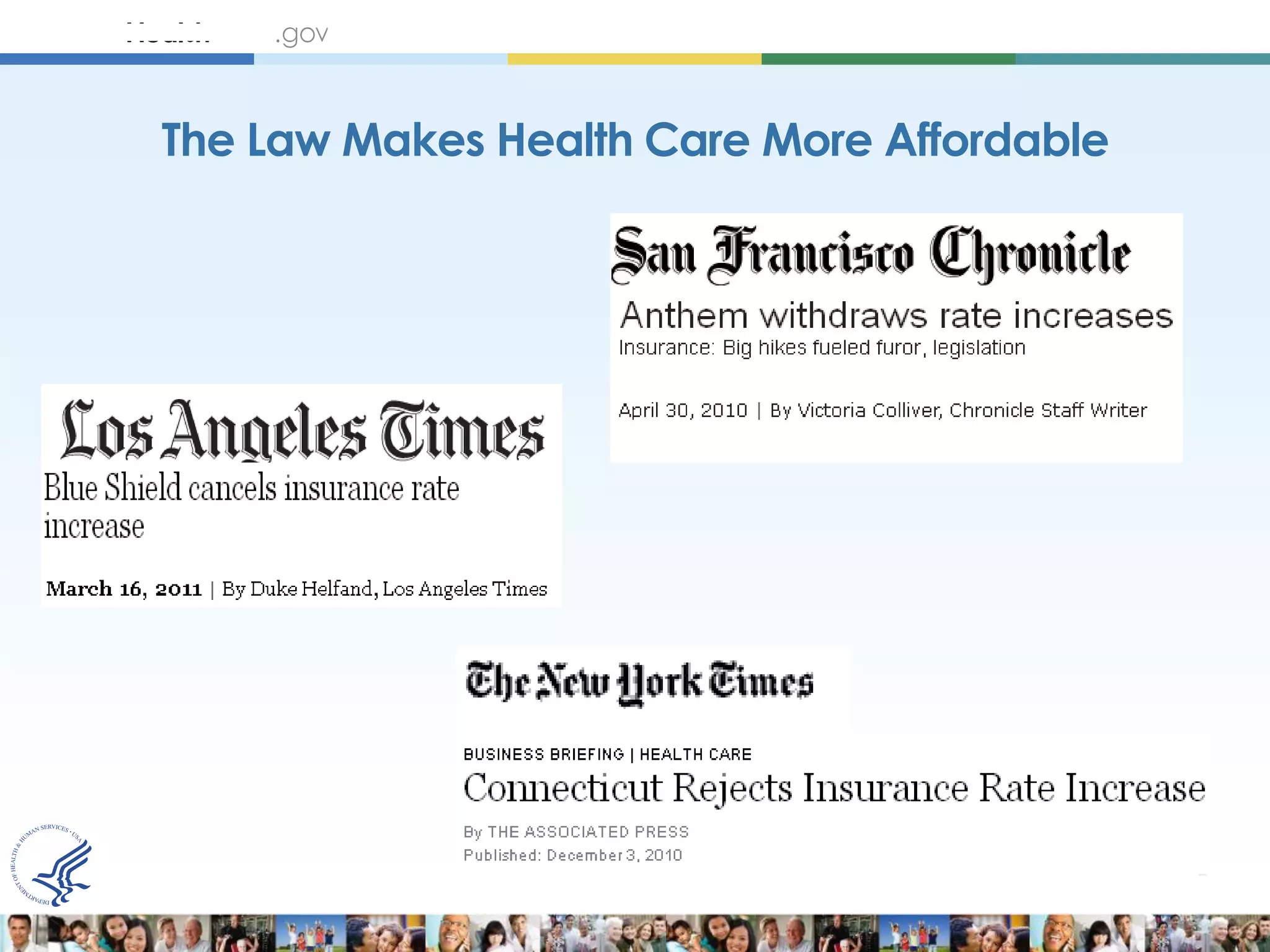
BEFORE, insurance companies could raise your premiums by double
digits without justification.

TODAY, insurance companies must publicly justify their actions if they
want to raise premiums by 10 percent or more. And states have more
power to block them.
The Law Makes Health Care More Affordable

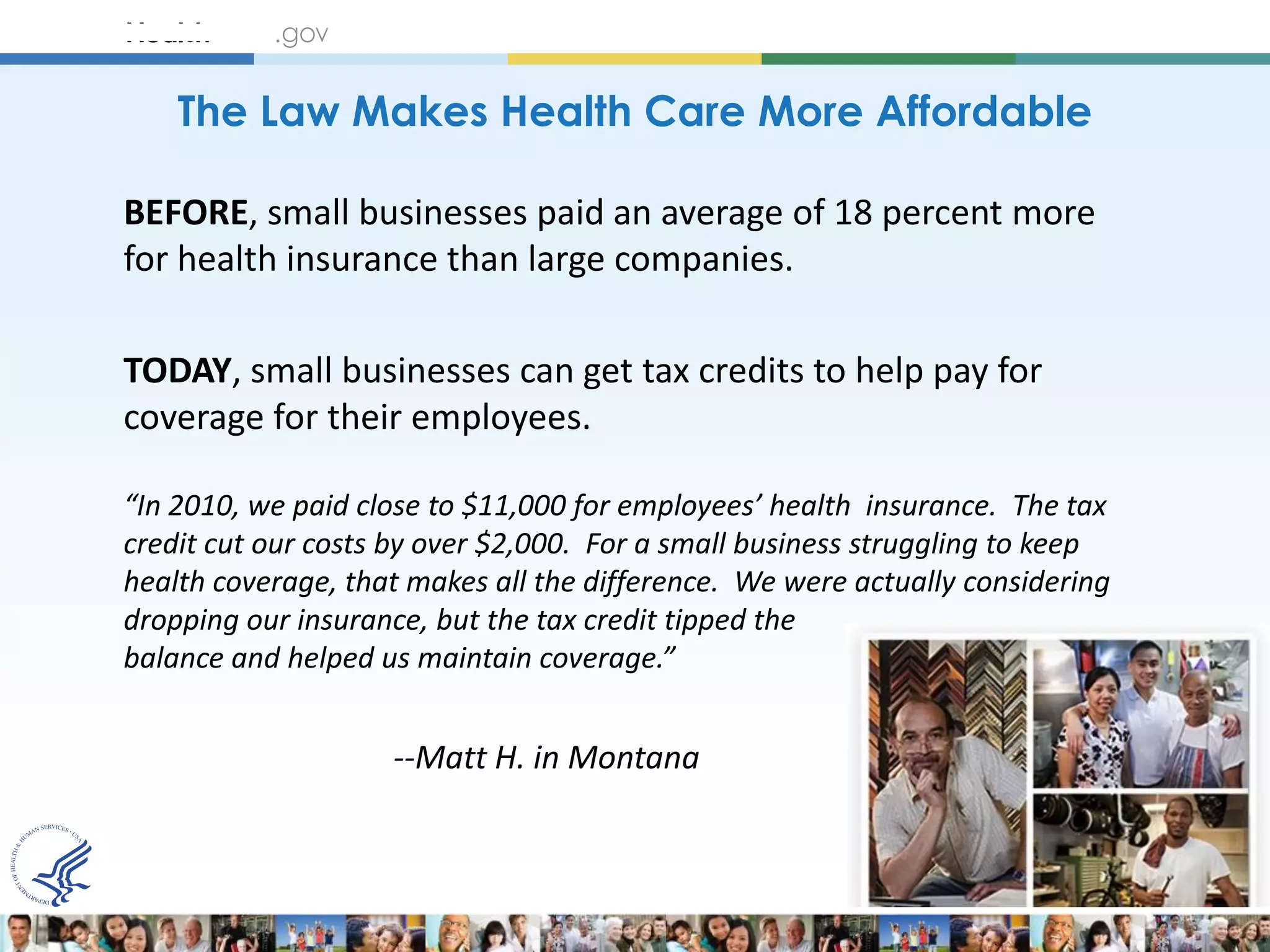
BEFORE, small businesses paid an average of 18 percent more
for health insurance than large companies.

TODAY, small businesses can get tax credits to help pay for
coverage for their employees.

“In 2010, we paid close to $11,000 for employees’ health insurance. The tax
credit cut our costs by over $2,000. For a small business struggling to keep
health coverage, that makes all the difference. We were actually considering
dropping our insurance, but the tax credit tipped the
balance and helped us maintain coverage.”


                    --Matt H. in Montana
The Law Increases Your Access to Affordable Care


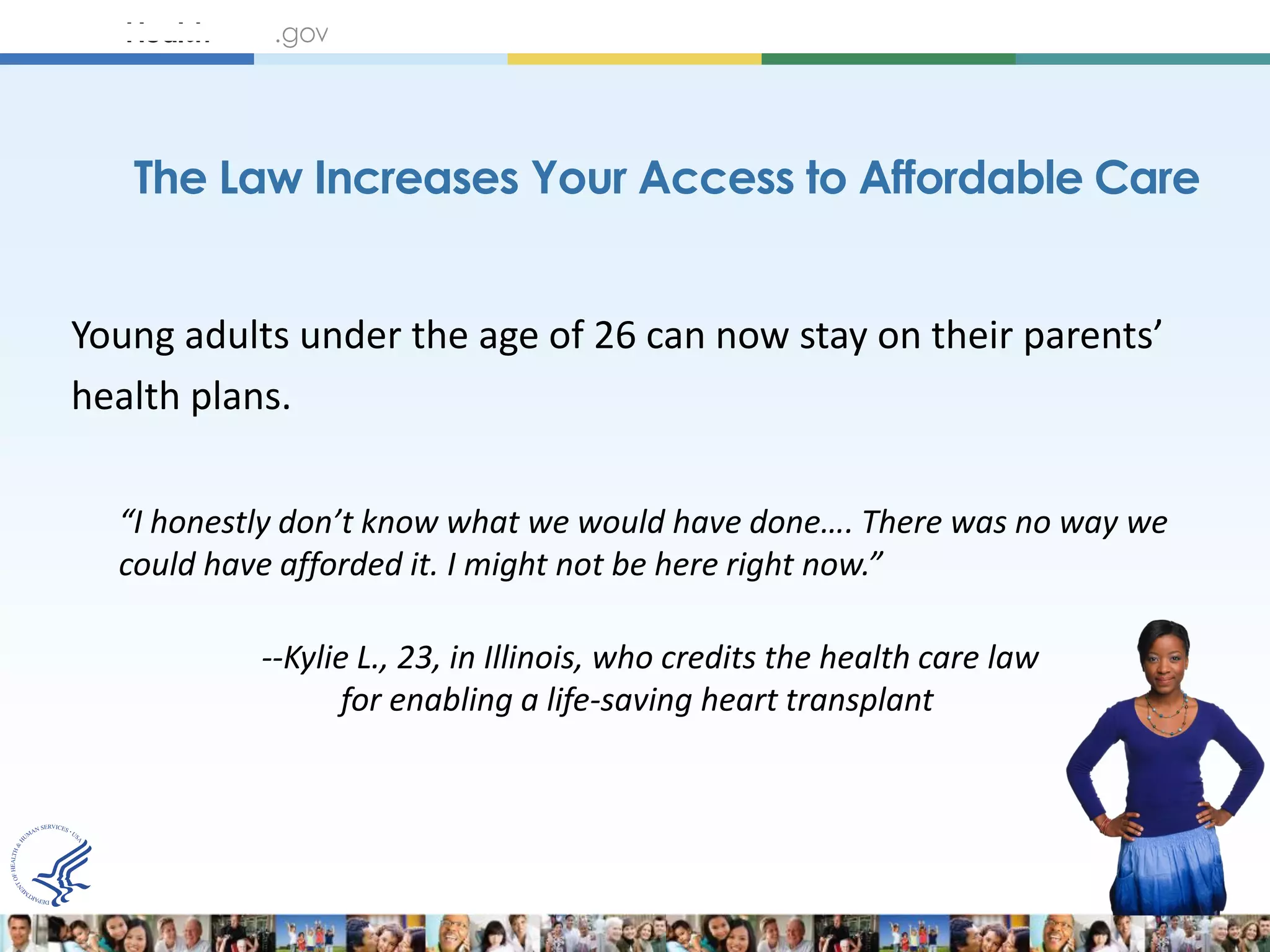
Young adults under the age of 26 can now stay on their parents’
health plans.

  “I honestly don’t know what we would have done…. There was no way we
  could have afforded it. I might not be here right now.”

           --Kylie L., 23, in Illinois, who credits the health care law
                  for enabling a life-saving heart transplant
The Law Increases Your Access to Affordable Care
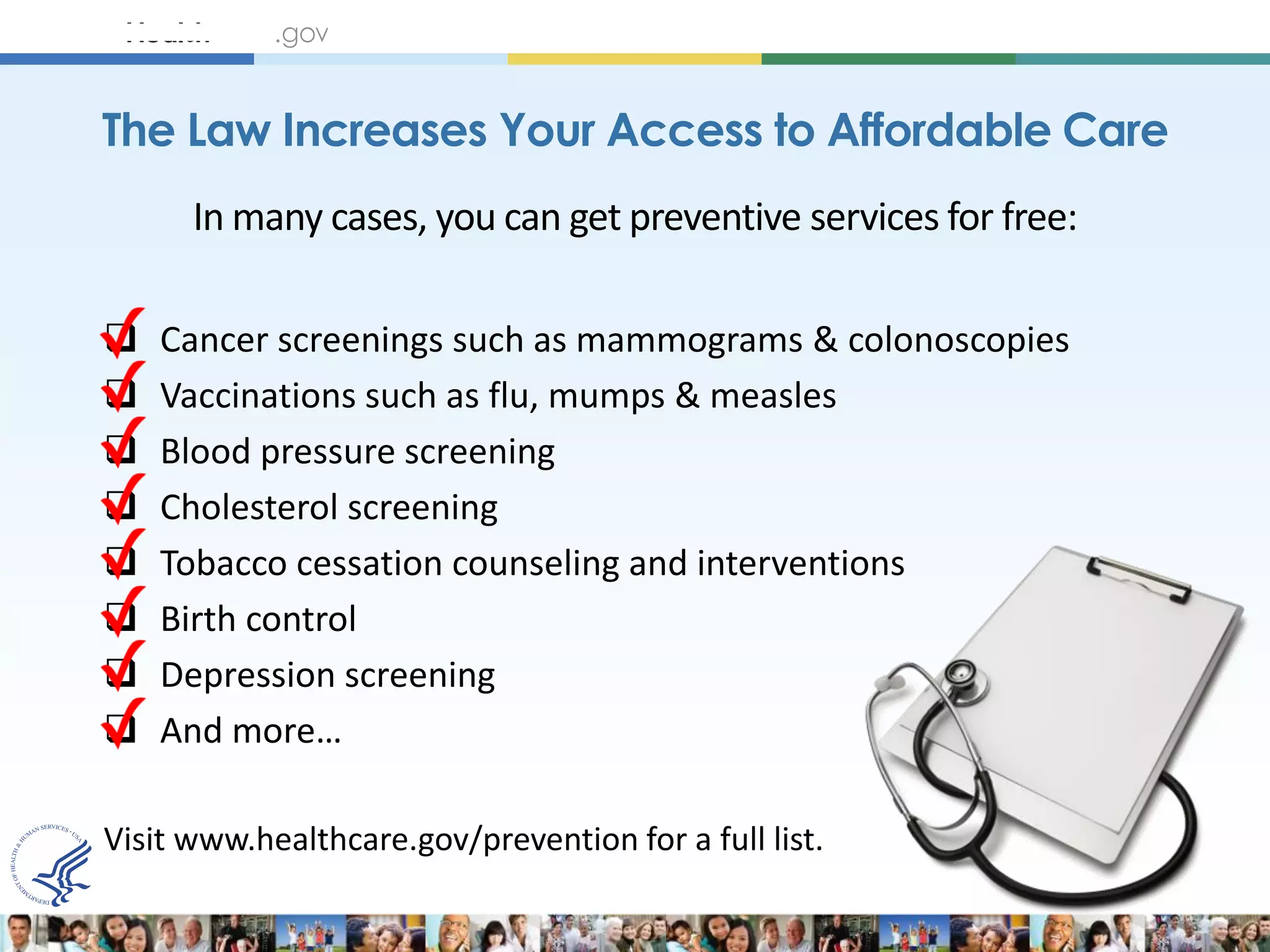
      In many cases, you can get preventive services for free:

   Cancer screenings such as mammograms & colonoscopies
   Vaccinations such as flu, mumps & measles
   Blood pressure screening
   Cholesterol screening
   Tobacco cessation counseling and interventions
   Birth control
   Depression screening
   And more…

Visit www.healthcare.gov/prevention for a full list.
The Law Increases Your Access to Affordable Care

 • People in need of long term supports and services will
   have increased access to care in a home and
   community-based setting rather than an institutional
   setting.

 • HHS has created a new organization, the Administration
   for Community Living (ACL) with the goal of increasing
   access to community supports and full participation,
   while focusing attention and resources on the unique
   needs of older Americans and people with disabilities.
The Law Increases Your Access to Affordable Care

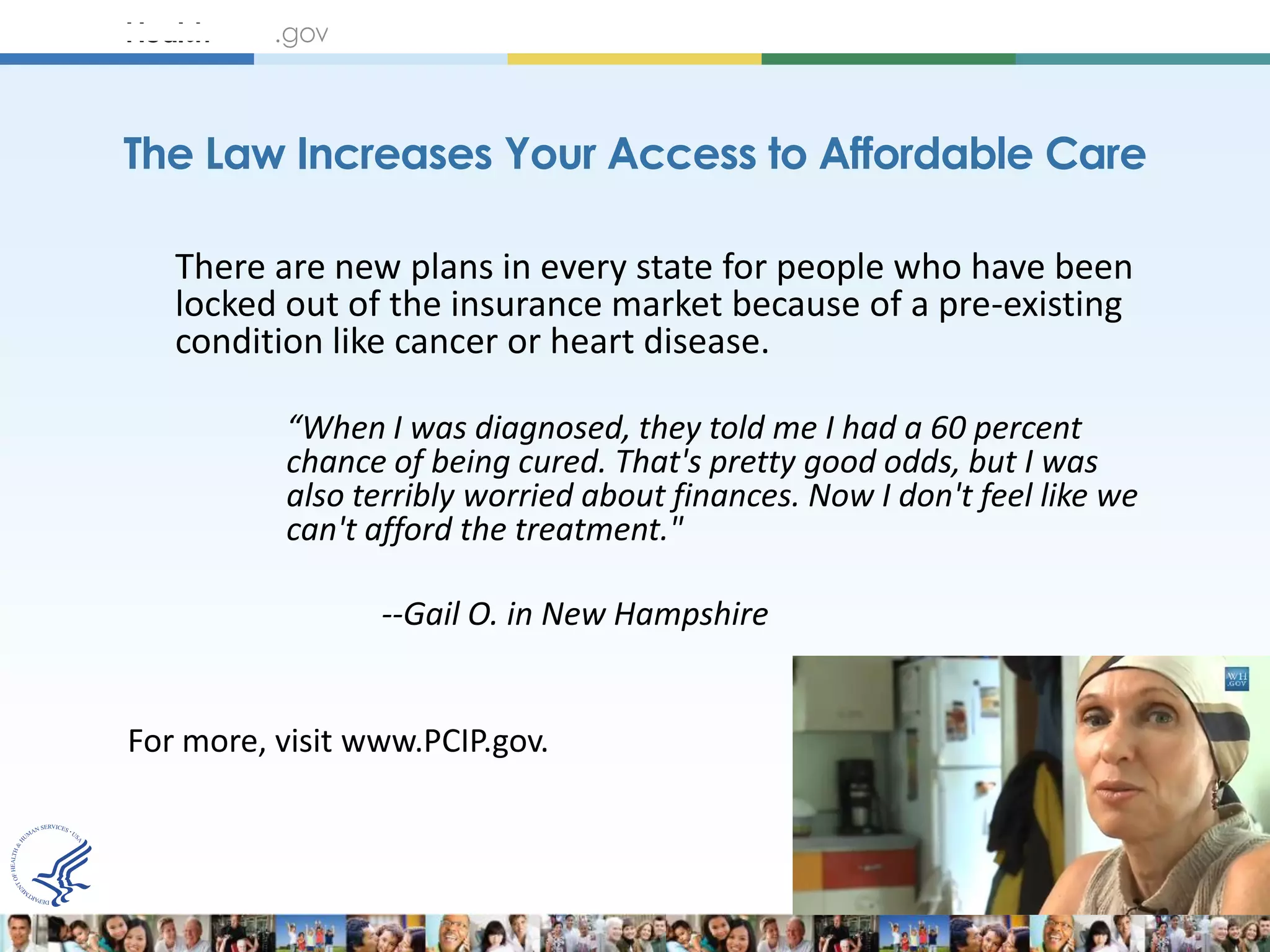
   There are new plans in every state for people who have been
   locked out of the insurance market because of a pre-existing
   condition like cancer or heart disease.

          “When I was diagnosed, they told me I had a 60 percent
          chance of being cured. That's pretty good odds, but I was
          also terribly worried about finances. Now I don't feel like we
          can't afford the treatment."

                 --Gail O. in New Hampshire


For more, visit www.PCIP.gov.
The Law Increases Your Access to Affordable Care
 The law ensures your right to appeal health insurance plan
 decisions--to ask that your plan reconsider its decision to
 deny payment for a service or treatment.

 If your plan still denies payment after considering your appeal,
 the law permits you to have an independent review
 organization decide whether to uphold or overturn the plan’s
 decision.

 •More information can be found at
    –http://www.healthcare.gov/law/features/rights/appealing-
    decisions/index.html
    –http://www.healthcare.gov/news/factsheets/2012/06/appeals06152012a
    .html
The Law Increases Your Access to Affordable Care
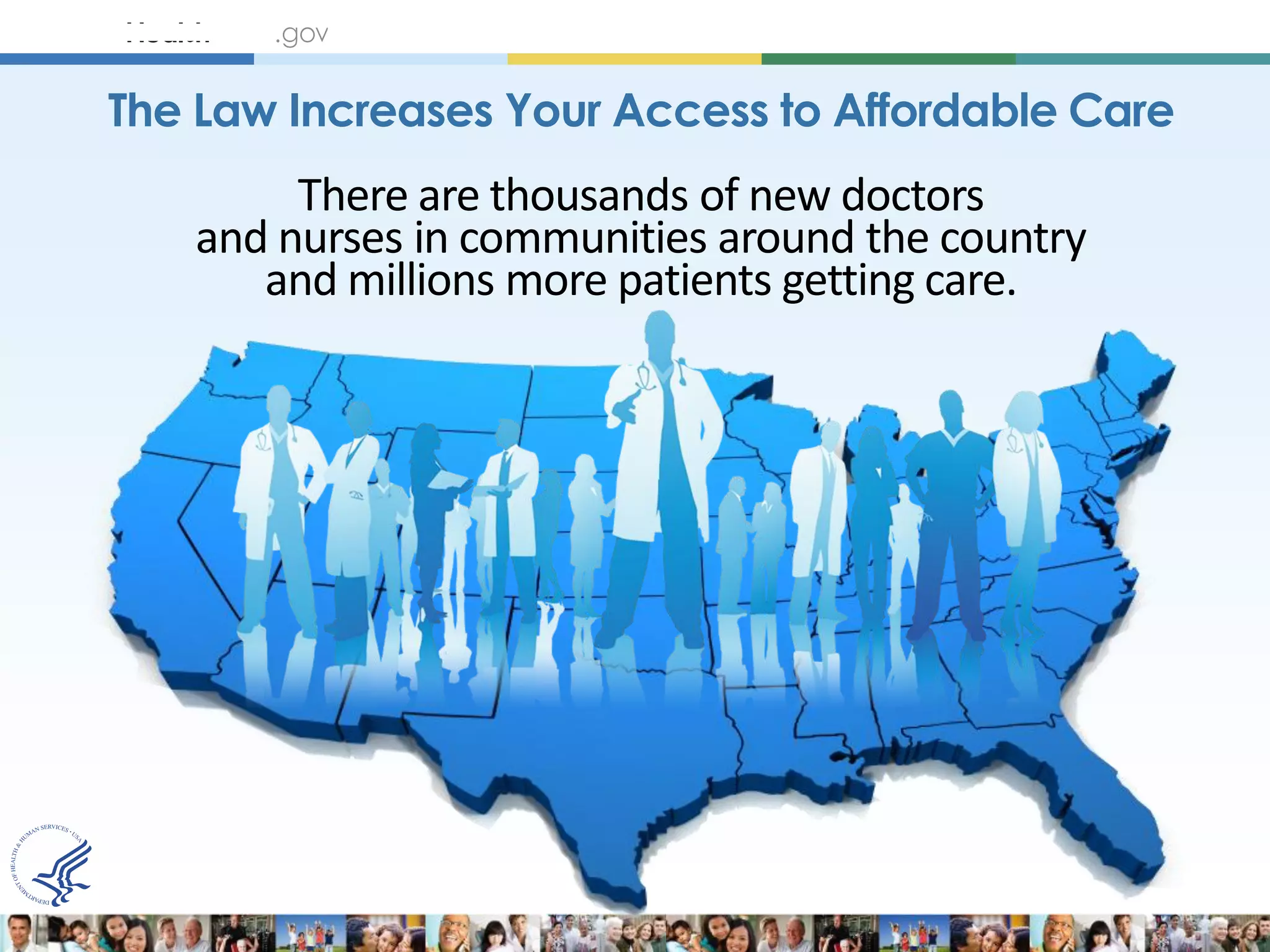
        There are thousands of new doctors
   and nurses in communities around the country
      and millions more patients getting care.
The Law Increases Your Access to Affordable Care


• People with low or no incomes will have
  greater access to care through an
  expanded network of community health
  centers. To find a health center near
  you, go to www.hrsa.gov.
The Law Increases Your Access to Affordable Care

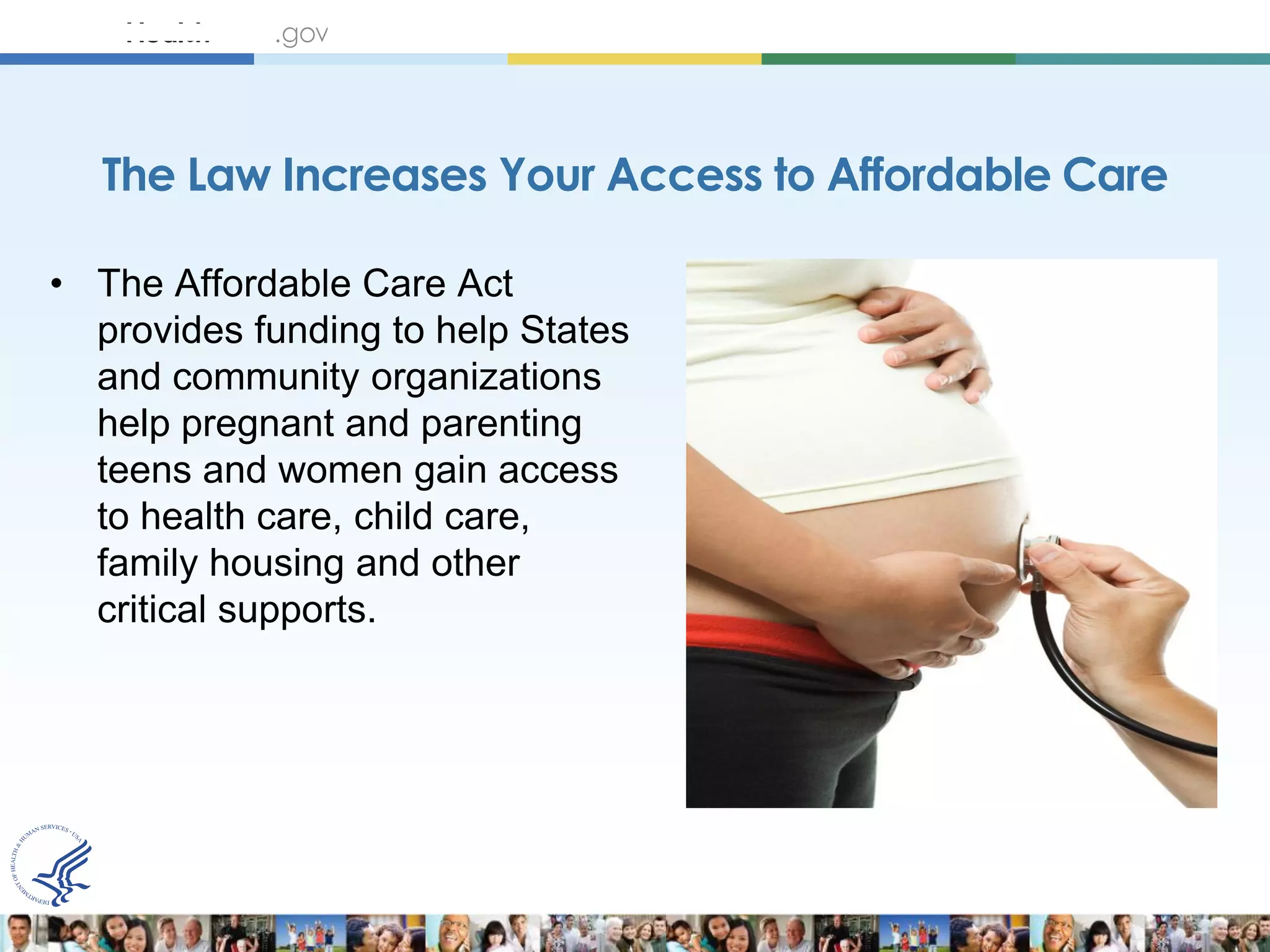
• The Affordable Care Act
  provides funding to help States
  and community organizations
  help pregnant and parenting
  teens and women gain access
  to health care, child care,
  family housing and other
  critical supports.
More Improvements to Come

In 2 years:
• Discriminating against anyone because of a pre-existing
  condition will be illegal.
• Insurance companies won't be able to charge women more than
  men.
• Tax credits will make buying insurance more affordable.
• There will be new State-based marketplaces – called Affordable
  Insurance Exchanges – where private insurers will compete for
  your business.
So no matter your circumstances…

  If you start a new business, change jobs, move
  to another state, or retire early…

You’ll have access to affordable health insurance.
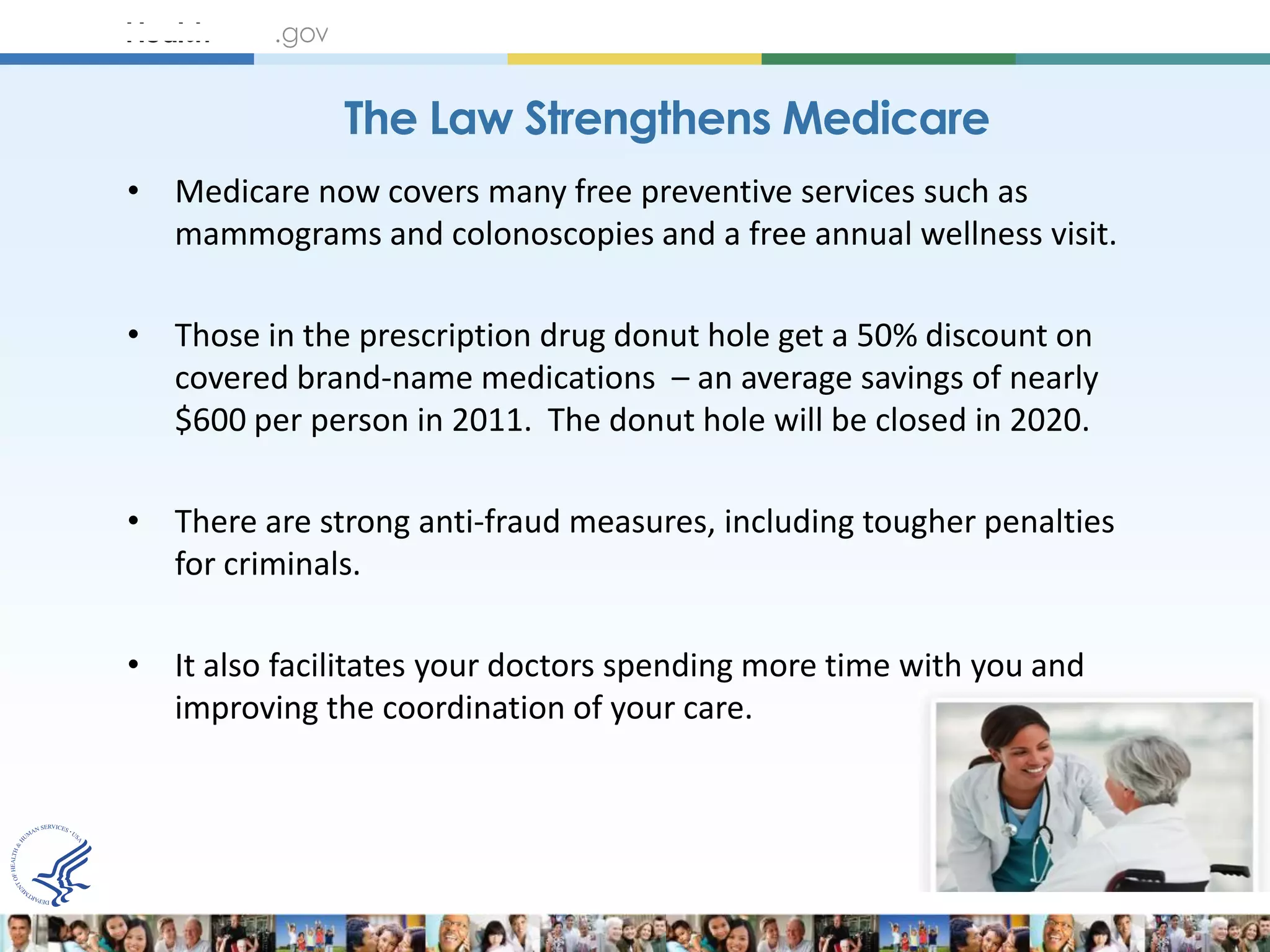
The Law Strengthens Medicare
• Medicare now covers many free preventive services such as
  mammograms and colonoscopies and a free annual wellness visit.

• Those in the prescription drug donut hole get a 50% discount on
  covered brand-name medications – an average savings of nearly
  $600 per person in 2011. The donut hole will be closed in 2020.

• There are strong anti-fraud measures, including tougher penalties
  for criminals.

• It also facilitates your doctors spending more time with you and
  improving the coordination of your care.
Did You Know…

• The law builds on our private health insurance
  system.

• The law gives states significant flexibility in
  implementing the law. If states can identify their own
  path to accomplish the same goals, they’re free to take
  it.

• The law does not add to the deficit.
  According to the independent Congressional
  Budget Office, the law is paid for.
4 Things to Remember About the Law

• Protection from the worst insurance company
  abuses

• Makes health care more affordable

• Better access to care

• Stronger Medicare
Learn More

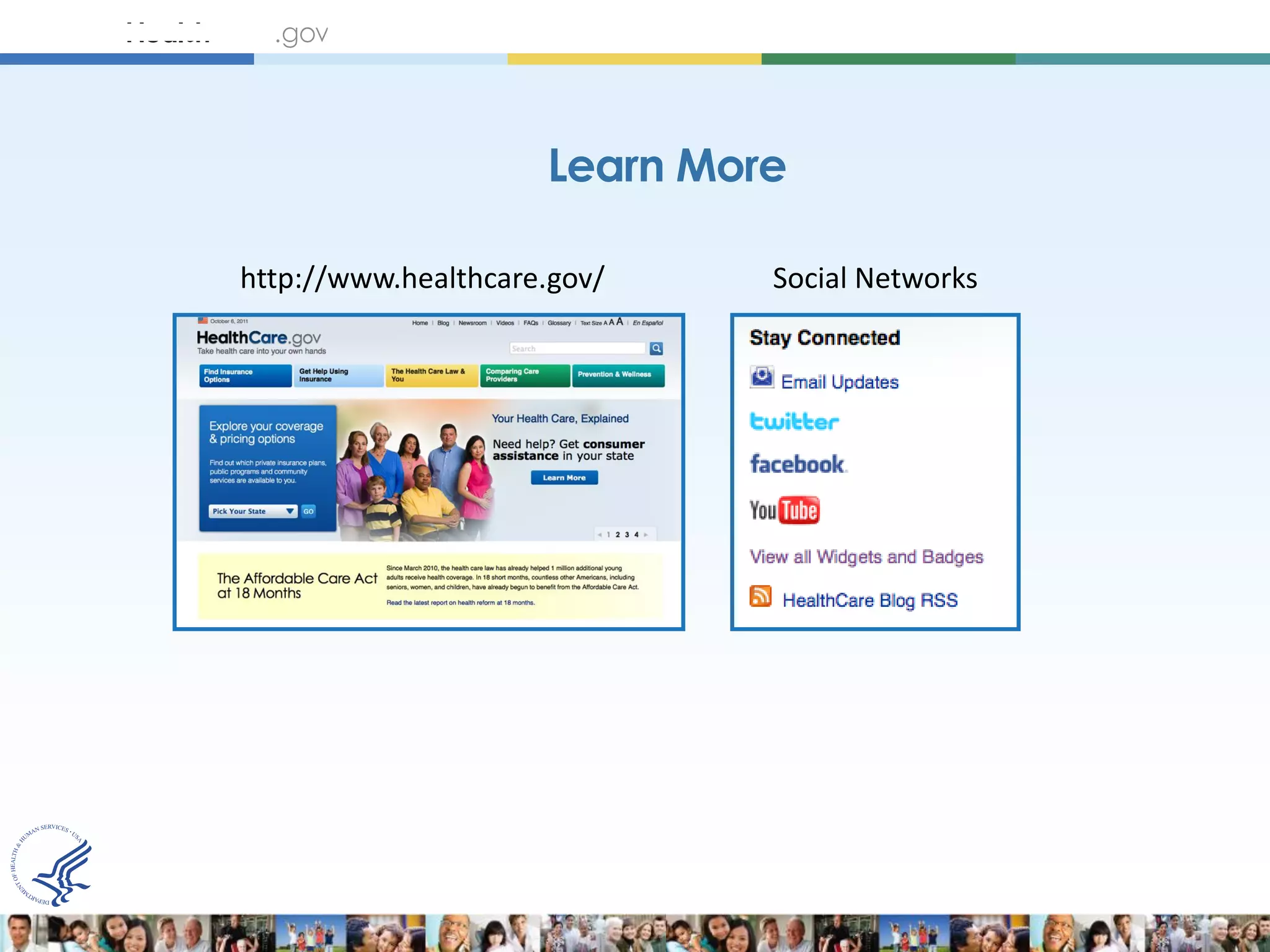
http://www.healthcare.gov/    Social Networks
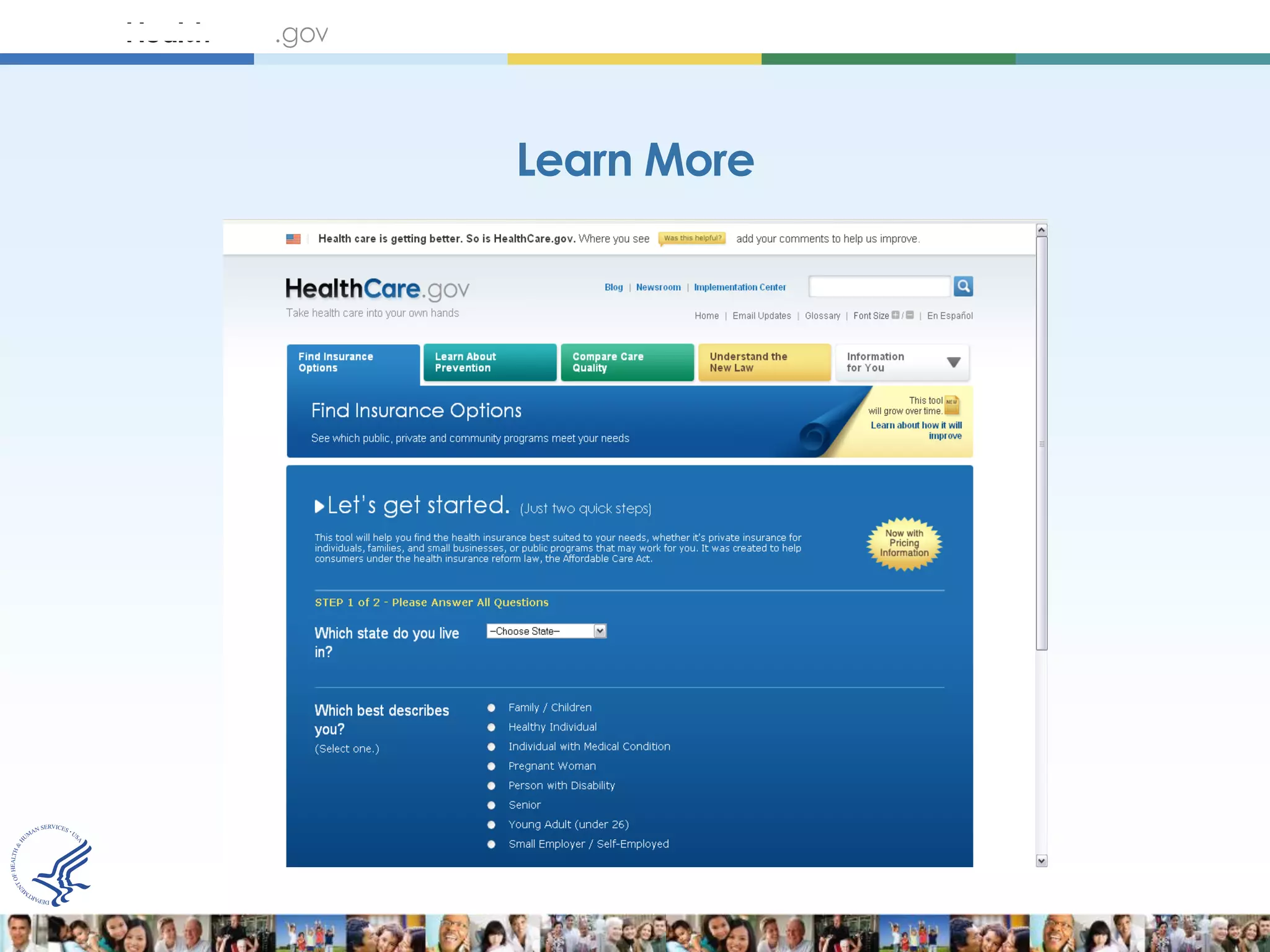
Learn More
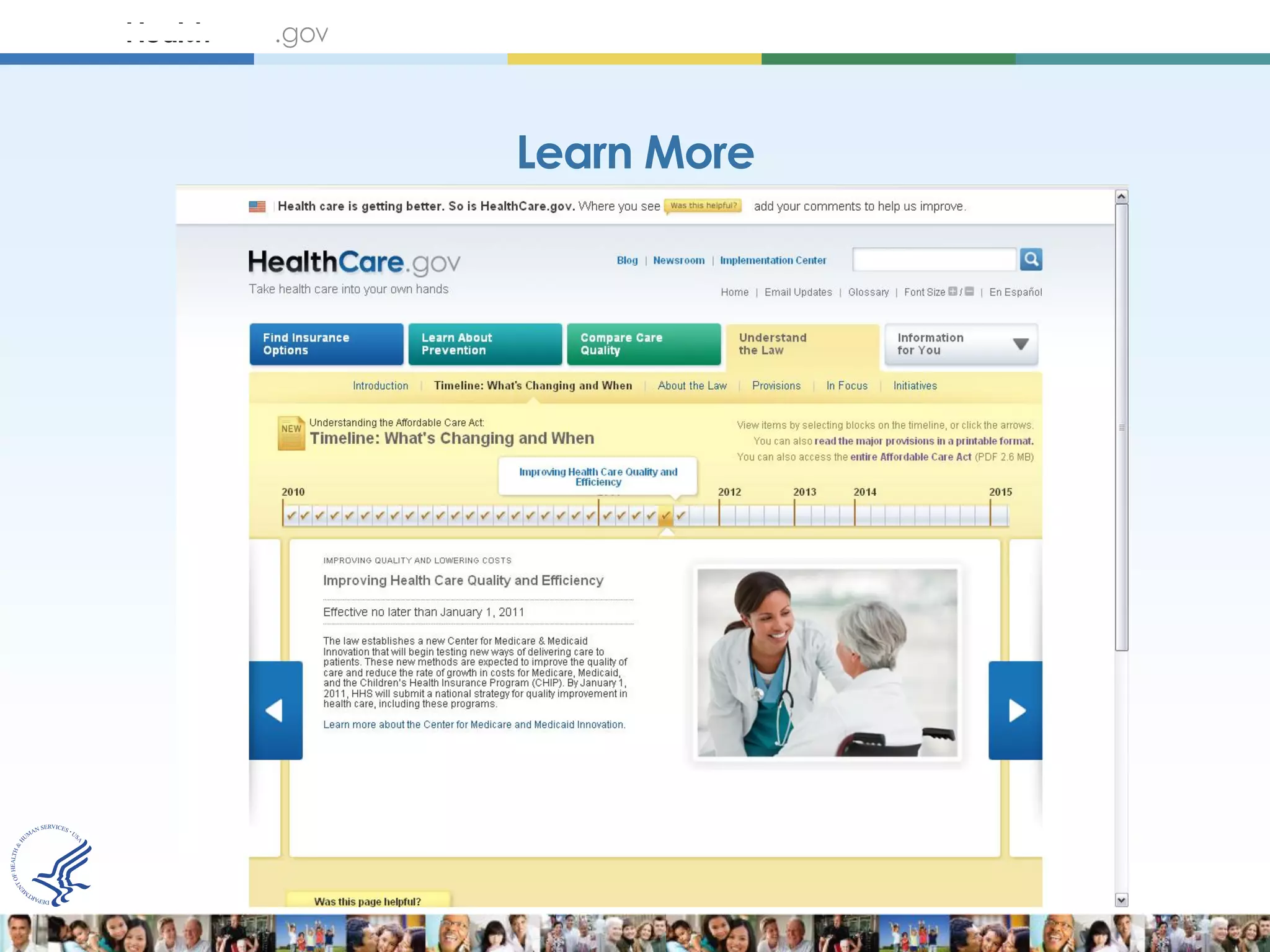
Learn More
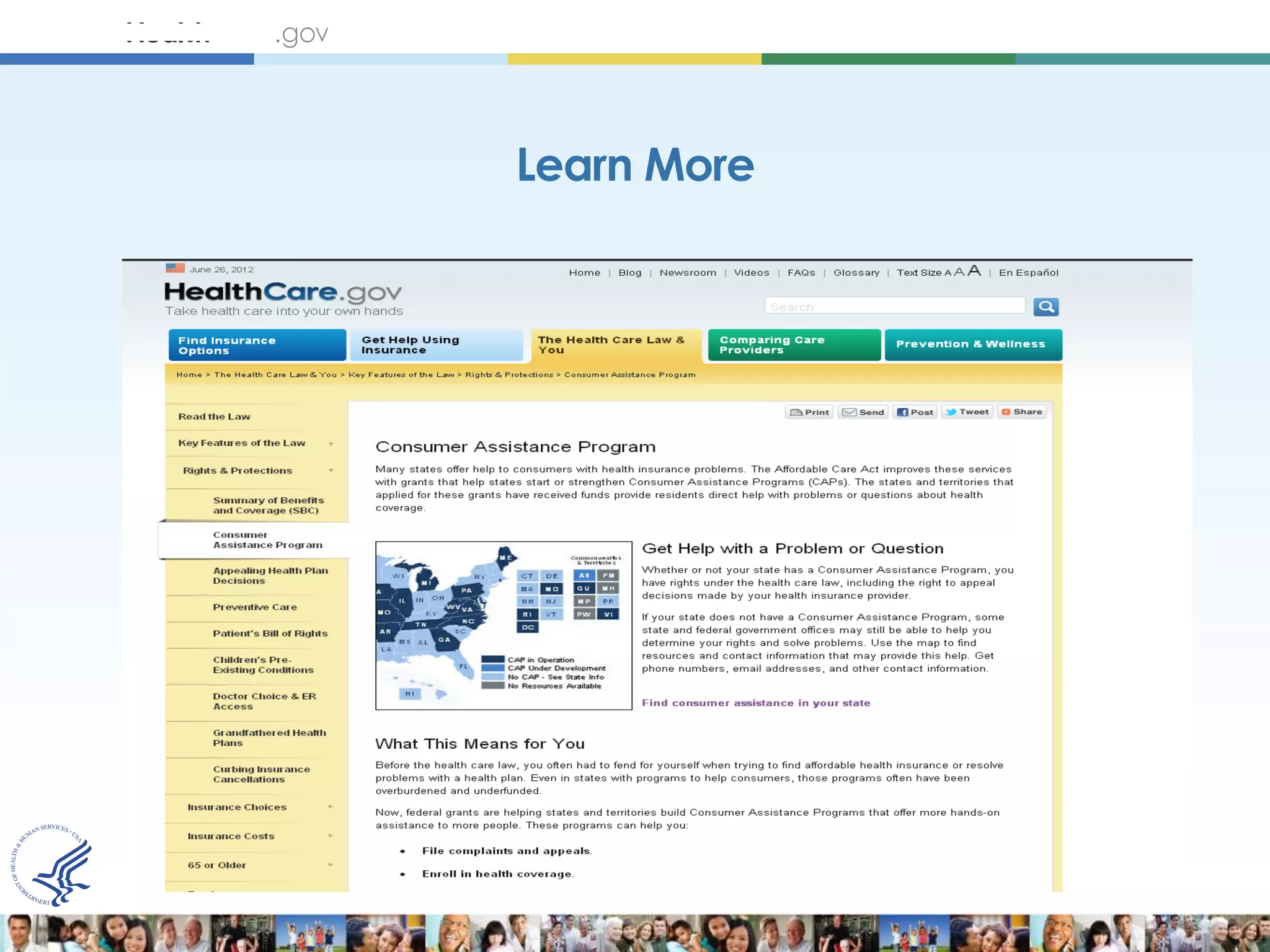
Learn More
What You Can Do:
•   Share the Health Care Law 101 and other conference calls
    and webinars with others and encourage them to
    participate.

•   Host an adult forum, adult study class or informational
    session on the health care law. Use materials from our
    website, www.hhs.gov/partnerships.

•   Post information about www.HealthCare.gov in your
    congregation bulletin.

•   Partner with a community health center that assists those
    without insurance. Visit www.hrsa.gov.

•   Sign up to receive the HHS Partnership Newsletter at
    www.hhs.gov/partnerships.
U.S. Department of Health & Human Services


          www.hhs.gov/partnerships

         Email: partnerships@hhs.gov
           Phone: 202-358-3595

The Health Care Law Power Point Slides

  • 1.
  • 2.
    • “Faith leadersare trusted partners in local communities. You have a unique ability to reach people, especially the most vulnerable, with the tools and information they need to get healthy, stay well, and thrive.” – HHS Secretary Kathleen Sebelius
  • 3.
    The Problem • Insurancecompanies could deny care or charge you more if you are one of the 129 million Americans with pre-existing conditions. • Premiums had more than doubled over the last decade, while insurance company profits were soaring. • Fifty million Americans were uninsured, tens of millions more were underinsured, and those that had coverage were often afraid of losing it.
  • 4.
    The Health CareLaw In March 2010, President Obama signed into law the Affordable Care Act.
  • 5.
    What the LawMeans for You: 4 Things to Know • Protection from the worst insurance company abuses • Makes health care more affordable • Better access to care • Stronger Medicare
  • 6.
    The Law StopsInsurance Companies from Taking Advantage of You It is now illegal for insurance companies to: • Deny coverage to children because of a pre-existing condition like asthma and diabetes. • Put a lifetime cap on how much care they will pay for if you get sick. • Cancel your coverage when you get sick by finding a mistake on your paperwork. • And more…
  • 7.
    These practices usedto be legal: Now they are banned for good.
  • 8.
    The Law MakesHealth Care More Affordable BEFORE, insurance companies spent as much as 40 cents of every premium dollar on overhead, marketing, and CEO salaries. 60% / 40% TODAY, we have the new 80/20 rule: insurance companies must spend at least 80 cents of your premium dollar on your health care or improvements to care. 80% / 20% If they don’t, they must repay the money.
  • 9.
    The Law MakesHealth Care More Affordable BEFORE, insurance companies could raise your premiums by double digits without justification. TODAY, insurance companies must publicly justify their actions if they want to raise premiums by 10 percent or more. And states have more power to block them.
  • 10.
    The Law MakesHealth Care More Affordable
  • 11.
    The Law MakesHealth Care More Affordable BEFORE, small businesses paid an average of 18 percent more for health insurance than large companies. TODAY, small businesses can get tax credits to help pay for coverage for their employees. “In 2010, we paid close to $11,000 for employees’ health insurance. The tax credit cut our costs by over $2,000. For a small business struggling to keep health coverage, that makes all the difference. We were actually considering dropping our insurance, but the tax credit tipped the balance and helped us maintain coverage.” --Matt H. in Montana
  • 12.
    The Law IncreasesYour Access to Affordable Care Young adults under the age of 26 can now stay on their parents’ health plans. “I honestly don’t know what we would have done…. There was no way we could have afforded it. I might not be here right now.” --Kylie L., 23, in Illinois, who credits the health care law for enabling a life-saving heart transplant
  • 13.
    The Law IncreasesYour Access to Affordable Care In many cases, you can get preventive services for free:  Cancer screenings such as mammograms & colonoscopies  Vaccinations such as flu, mumps & measles  Blood pressure screening  Cholesterol screening  Tobacco cessation counseling and interventions  Birth control  Depression screening  And more… Visit www.healthcare.gov/prevention for a full list.
  • 14.
    The Law IncreasesYour Access to Affordable Care • People in need of long term supports and services will have increased access to care in a home and community-based setting rather than an institutional setting. • HHS has created a new organization, the Administration for Community Living (ACL) with the goal of increasing access to community supports and full participation, while focusing attention and resources on the unique needs of older Americans and people with disabilities.
  • 15.
    The Law IncreasesYour Access to Affordable Care There are new plans in every state for people who have been locked out of the insurance market because of a pre-existing condition like cancer or heart disease. “When I was diagnosed, they told me I had a 60 percent chance of being cured. That's pretty good odds, but I was also terribly worried about finances. Now I don't feel like we can't afford the treatment." --Gail O. in New Hampshire For more, visit www.PCIP.gov.
  • 16.
    The Law IncreasesYour Access to Affordable Care The law ensures your right to appeal health insurance plan decisions--to ask that your plan reconsider its decision to deny payment for a service or treatment. If your plan still denies payment after considering your appeal, the law permits you to have an independent review organization decide whether to uphold or overturn the plan’s decision. •More information can be found at –http://www.healthcare.gov/law/features/rights/appealing- decisions/index.html –http://www.healthcare.gov/news/factsheets/2012/06/appeals06152012a .html
  • 17.
    The Law IncreasesYour Access to Affordable Care There are thousands of new doctors and nurses in communities around the country and millions more patients getting care.
  • 18.
    The Law IncreasesYour Access to Affordable Care • People with low or no incomes will have greater access to care through an expanded network of community health centers. To find a health center near you, go to www.hrsa.gov.
  • 19.
    The Law IncreasesYour Access to Affordable Care • The Affordable Care Act provides funding to help States and community organizations help pregnant and parenting teens and women gain access to health care, child care, family housing and other critical supports.
  • 20.
    More Improvements toCome In 2 years: • Discriminating against anyone because of a pre-existing condition will be illegal. • Insurance companies won't be able to charge women more than men. • Tax credits will make buying insurance more affordable. • There will be new State-based marketplaces – called Affordable Insurance Exchanges – where private insurers will compete for your business.
  • 21.
    So no matteryour circumstances… If you start a new business, change jobs, move to another state, or retire early… You’ll have access to affordable health insurance.
  • 22.
    The Law StrengthensMedicare • Medicare now covers many free preventive services such as mammograms and colonoscopies and a free annual wellness visit. • Those in the prescription drug donut hole get a 50% discount on covered brand-name medications – an average savings of nearly $600 per person in 2011. The donut hole will be closed in 2020. • There are strong anti-fraud measures, including tougher penalties for criminals. • It also facilitates your doctors spending more time with you and improving the coordination of your care.
  • 23.
    Did You Know… •The law builds on our private health insurance system. • The law gives states significant flexibility in implementing the law. If states can identify their own path to accomplish the same goals, they’re free to take it. • The law does not add to the deficit. According to the independent Congressional Budget Office, the law is paid for.
  • 24.
    4 Things toRemember About the Law • Protection from the worst insurance company abuses • Makes health care more affordable • Better access to care • Stronger Medicare
  • 25.
  • 26.
  • 27.
  • 28.
  • 29.
    What You CanDo: • Share the Health Care Law 101 and other conference calls and webinars with others and encourage them to participate. • Host an adult forum, adult study class or informational session on the health care law. Use materials from our website, www.hhs.gov/partnerships. • Post information about www.HealthCare.gov in your congregation bulletin. • Partner with a community health center that assists those without insurance. Visit www.hrsa.gov. • Sign up to receive the HHS Partnership Newsletter at www.hhs.gov/partnerships.
  • 30.
    U.S. Department ofHealth & Human Services www.hhs.gov/partnerships Email: partnerships@hhs.gov Phone: 202-358-3595