Human rights in
health care
Presentation by:
Shahzenan Al-azzawi
What is the Human Right
to Health and Health Care?
The human right to health means that everyone
has the right to the highest attainable standard
of physical and mental health, which includes
access to all medical services, sanitation,
adequate food, decent housing, healthy working
conditions, and a clean environment.
Human right in health
The human right to health guarantees a system
of health protection for all.
Everyone has the right to the health care they
need, and to living conditions that enable us to
be healthy, such as adequate food, housing, and
a healthy environment.
Health care must be provided as a public good
for all, financed publicly and equitably.
health care system
standards
Universal Access: Access to health care must be universal, guaranteed for all on an
equitable basis. Health care must be affordable and comprehensive for everyone, and
physically accessible where and when needed.
Availability: Adequate health care infrastructure (e.g. hospitals, community health
facilities, trained health care professionals), goods (e.g. drugs, equipment), and services (e.g.
primary care, mental health) must be available in all geographical areas and to all
communities.
Acceptability and Dignity: Health care institutions and providers must respect
dignity, provide culturally appropriate care, be responsive to needs based on gender, age,
culture, language, and different ways of life and abilities. They must respect medical ethics
and protect confidentiality.
Quality: All health care must be medically appropriate and of good quality, guided by
quality standards and control mechanisms, and provided in a timely, safe, and patient-
centered manner.
Alternative look at Human
right to health care
• An alternative way to look at consider both patient and provider rights in the delivery of
healthcare services
• Patient rights in health care delivery include: the right to privacy, information, life, and
quality care, as well as freedom from discrimination, torture, and cruel, inhumane, or
degrading treatment.
• Marginalized groups, such as migrants and persons who have been displaced, racial
and ethnic minorities, women, sexual minorities, and those living with HIV, are
particularly vulnerable to violations of human rights in healthcare settings.
• Provider rights include: the right to quality standards of working conditions, the right to
associate freely, and the right to refuse to perform a procedure based on their morals.
• Healthcare providers often experience violations of their rights. For instance,
particularly in countries with weak rule of law, healthcare providers are often forced to
perform procedures which negate their morals, deny marginalized groups the best
possible standards of care, breach patient confidentiality, and conceal crimes against
humanity and torture.
The Human Right to Health is protected in:
Article 25 of the Universal Declaration of Human Rights
Articel 12 of the International Covenant on Economic, Social and
Cultural Rights
Article 24 of the Convention on the Rights of the Child
Article 5 of the Convention on the Elimination of All Forms of Racial
Discrimination
Articles 12 & 14 of the Convention on the Elimination of All Forms of
Discrimination Against Women
Article XI (11) of the American Declaration on Rights and Duties of
Man
Article 25 of the Convention on the Rights of Persons with Disabilities
United Nations on
health
the United Nations General Assembly in Paris on 10 December
1948, announced the universal declaration of human rights.
Article 25 of the United Nations' Universal Declaration of
Human Rights 1948 states that "Everyone has the right to a
standard of living adequate for the health and well-being of
himself and of his family, including food, clothing, housing
and medical care and necessary social services."
The United Nations established World Health Organization
(WHO) to lead the efforts in health around the world.
(WHO) constitution came into force on 7 April 1948 - a date we
now celebrate every year as World Health Day.
World Medicine
Association's documentation
• The World Medical Association (WMA) is an
international and independent confederation of
free professional medical associations, therefore
representing physicians worldwide
• The Declaration of Helsinki (DoH) is a set of
ethical principles regarding human
experimentation developed for the medical
community by the World Medical Association
(WMA)
Criticism
• health care should not be considered a human right because
• “the difficulty of defining what it entails and where the
'minimum standard' of entitlements under the right
ought to be established”
• “who holds the social responsibility for the right to
health”
• “right to health does not consider adequately the
responsibility that an individual has to uphold his or her
own health”
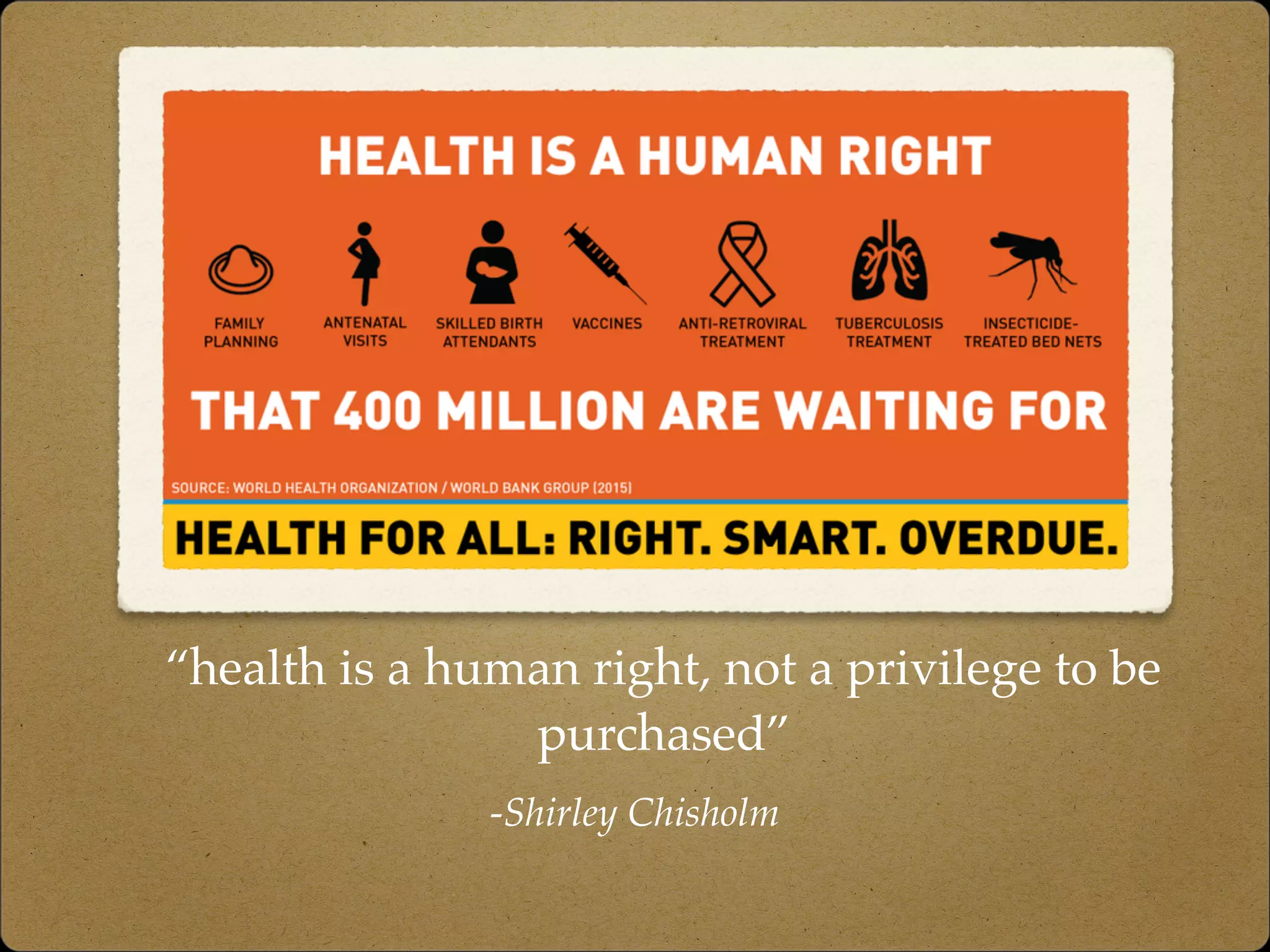
-Shirley Chisholm
“health is a human right, not a privilege to be
purchased”
Resources
https://en.wikipedia.org/wiki/Right_to_health
http://www.un.org/en/sections/issues-depth/health/
http://www.un.org/en/universal-declaration-human-
rights/
https://www.nesri.org/programs/what-is-the-human-
right-to-health-and-health-care
https://en.wikipedia.org/wiki/World_Medical_Association
https://en.wikipedia.org/wiki/Declaration_of_Helsinki
Thank you
for your
attention

Human rights in health care

  • 1.
    Human rights in healthcare Presentation by: Shahzenan Al-azzawi
  • 2.
    What is theHuman Right to Health and Health Care? The human right to health means that everyone has the right to the highest attainable standard of physical and mental health, which includes access to all medical services, sanitation, adequate food, decent housing, healthy working conditions, and a clean environment.
  • 3.
    Human right inhealth The human right to health guarantees a system of health protection for all. Everyone has the right to the health care they need, and to living conditions that enable us to be healthy, such as adequate food, housing, and a healthy environment. Health care must be provided as a public good for all, financed publicly and equitably.
  • 4.
    health care system standards UniversalAccess: Access to health care must be universal, guaranteed for all on an equitable basis. Health care must be affordable and comprehensive for everyone, and physically accessible where and when needed. Availability: Adequate health care infrastructure (e.g. hospitals, community health facilities, trained health care professionals), goods (e.g. drugs, equipment), and services (e.g. primary care, mental health) must be available in all geographical areas and to all communities. Acceptability and Dignity: Health care institutions and providers must respect dignity, provide culturally appropriate care, be responsive to needs based on gender, age, culture, language, and different ways of life and abilities. They must respect medical ethics and protect confidentiality. Quality: All health care must be medically appropriate and of good quality, guided by quality standards and control mechanisms, and provided in a timely, safe, and patient- centered manner.
  • 5.
    Alternative look atHuman right to health care • An alternative way to look at consider both patient and provider rights in the delivery of healthcare services • Patient rights in health care delivery include: the right to privacy, information, life, and quality care, as well as freedom from discrimination, torture, and cruel, inhumane, or degrading treatment. • Marginalized groups, such as migrants and persons who have been displaced, racial and ethnic minorities, women, sexual minorities, and those living with HIV, are particularly vulnerable to violations of human rights in healthcare settings. • Provider rights include: the right to quality standards of working conditions, the right to associate freely, and the right to refuse to perform a procedure based on their morals. • Healthcare providers often experience violations of their rights. For instance, particularly in countries with weak rule of law, healthcare providers are often forced to perform procedures which negate their morals, deny marginalized groups the best possible standards of care, breach patient confidentiality, and conceal crimes against humanity and torture.
  • 6.
    The Human Rightto Health is protected in: Article 25 of the Universal Declaration of Human Rights Articel 12 of the International Covenant on Economic, Social and Cultural Rights Article 24 of the Convention on the Rights of the Child Article 5 of the Convention on the Elimination of All Forms of Racial Discrimination Articles 12 & 14 of the Convention on the Elimination of All Forms of Discrimination Against Women Article XI (11) of the American Declaration on Rights and Duties of Man Article 25 of the Convention on the Rights of Persons with Disabilities
  • 7.
    United Nations on health theUnited Nations General Assembly in Paris on 10 December 1948, announced the universal declaration of human rights. Article 25 of the United Nations' Universal Declaration of Human Rights 1948 states that "Everyone has the right to a standard of living adequate for the health and well-being of himself and of his family, including food, clothing, housing and medical care and necessary social services." The United Nations established World Health Organization (WHO) to lead the efforts in health around the world. (WHO) constitution came into force on 7 April 1948 - a date we now celebrate every year as World Health Day.
  • 8.
    World Medicine Association's documentation •The World Medical Association (WMA) is an international and independent confederation of free professional medical associations, therefore representing physicians worldwide • The Declaration of Helsinki (DoH) is a set of ethical principles regarding human experimentation developed for the medical community by the World Medical Association (WMA)
  • 9.
    Criticism • health careshould not be considered a human right because • “the difficulty of defining what it entails and where the 'minimum standard' of entitlements under the right ought to be established” • “who holds the social responsibility for the right to health” • “right to health does not consider adequately the responsibility that an individual has to uphold his or her own health”
  • 10.
    -Shirley Chisholm “health isa human right, not a privilege to be purchased”
  • 11.
  • 12.