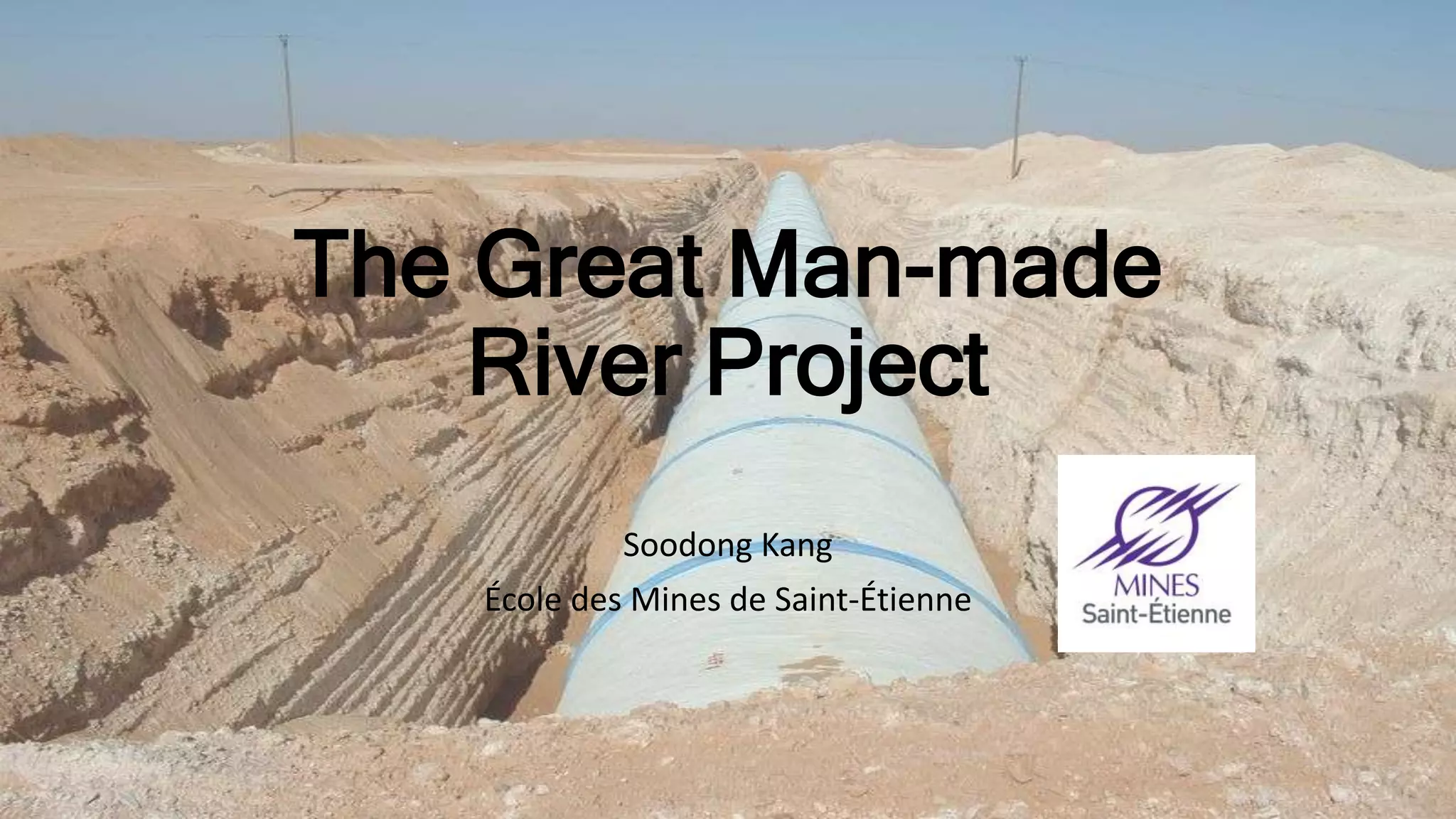
The Great Man-made
River Project
Soodong Kang
École des Mines de Saint-Étienne
What is the Man-Made River Project?
 The Great Man-Made River(GMR) is a network of pipes that supplies
water to the Sahara in Libya, from the Nubian Sandstone Aquifer.
 It is the largest underground network of pipes (4,000 kilometers) and
aqueducts in the world.
 It consists of more than 1,300 wells, most more than 500 m deep, and
supplies 6,500,000 m3 of fresh water per day to the cities.
 The late Libyan Leader Muammar Gaddafi described it as the “Eighth
Wonder of the World”.
The Aim of GMR
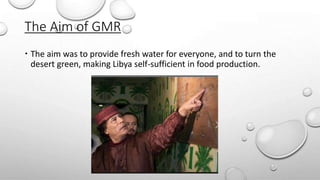
 The aim was to provide fresh water for everyone, and to turn the
desert green, making Libya self-sufficient in food production.
Necessity of GMR
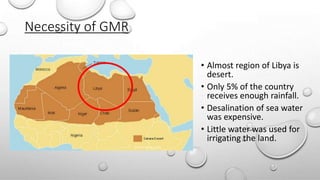
• Almost region of Libya is
desert.
• Only 5% of the country
receives enough rainfall.
• Desalination of sea water
was expensive.
• Little water was used for
irrigating the land.
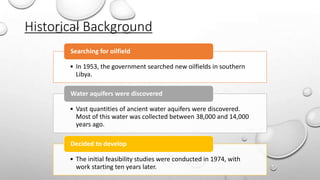
Historical Background
• In 1953, the government searched new oilfields in southern
Libya.
Searching for oilfield
• Vast quantities of ancient water aquifers were discovered.
Most of this water was collected between 38,000 and 14,000
years ago.
Water aquifers were discovered
• The initial feasibility studies were conducted in 1974, with
work starting ten years later.
Decided to develop
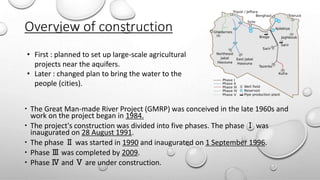
Overview of construction
 The Great Man-made River Project (GMRP) was conceived in the late 1960s and
work on the project began in 1984.
 The project's construction was divided into five phases. The phase Ⅰ was
inaugurated on 28 August 1991.
 The phase Ⅱ was started in 1990 and inaugurated on 1 September 1996.
 Phase Ⅲ was completed by 2009.
 Phase Ⅳ and Ⅴ are under construction.
• First : planned to set up large-scale agricultural
projects near the aquifers.
• Later : changed plan to bring the water to the
people (cities).
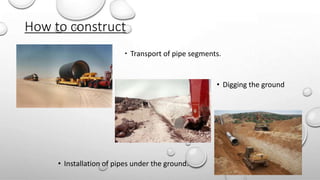
How to construct
 Transport of pipe segments.
• Digging the ground
• Installation of pipes under the ground.
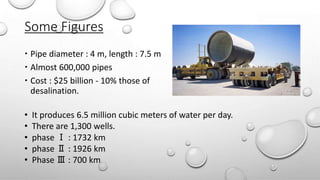
Some Figures
 Pipe diameter : 4 m, length : 7.5 m
 Almost 600,000 pipes
 Cost : $25 billion - 10% those of
desalination.
• It produces 6.5 million cubic meters of water per day.
• There are 1,300 wells.
• phase Ⅰ : 1732 km
• phase Ⅱ : 1926 km
• Phase Ⅲ : 700 km
Evaluation of GMR
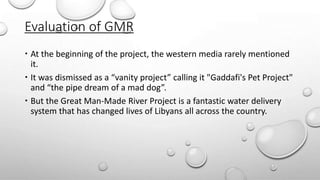
 At the beginning of the project, the western media rarely mentioned
it.
 It was dismissed as a “vanity project” calling it "Gaddafi's Pet Project"
and “the pipe dream of a mad dog”.
 But the Great Man-Made River Project is a fantastic water delivery
system that has changed lives of Libyans all across the country.
Evaluation of GMR
“It will last for
thousands of
years.”
“There will be no
more water after
50 years”
Difficult circumstances
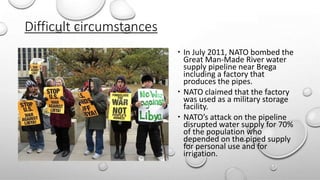
 In July 2011, NATO bombed the
Great Man-Made River water
supply pipeline near Brega
including a factory that
produces the pipes.
 NATO claimed that the factory
was used as a military storage
facility.
 NATO’s attack on the pipeline
disrupted water supply for 70%
of the population who
depended on the piped supply
for personal use and for
irrigation.
Reference
 https://en.wikipedia.org/wiki/Great_Man-Made_River
 http://www.amusingplanet.com/2015/07/the-great-man-made-river-
of-libya.html
 https://humanrightsinvestigations.org/2011/07/27/great-man-made-
river-nato-bombs/
 http://www.great-man-made-river.algaddafi.org/great-man-made-
river-gmmr--facts-figures
Thank you for attention!

The great manmade river project

  • 1.
    The Great Man-made RiverProject Soodong Kang École des Mines de Saint-Étienne
  • 2.
    What is theMan-Made River Project?  The Great Man-Made River(GMR) is a network of pipes that supplies water to the Sahara in Libya, from the Nubian Sandstone Aquifer.  It is the largest underground network of pipes (4,000 kilometers) and aqueducts in the world.  It consists of more than 1,300 wells, most more than 500 m deep, and supplies 6,500,000 m3 of fresh water per day to the cities.  The late Libyan Leader Muammar Gaddafi described it as the “Eighth Wonder of the World”.
  • 3.
    The Aim ofGMR  The aim was to provide fresh water for everyone, and to turn the desert green, making Libya self-sufficient in food production.
  • 4.
    Necessity of GMR •Almost region of Libya is desert. • Only 5% of the country receives enough rainfall. • Desalination of sea water was expensive. • Little water was used for irrigating the land.
  • 5.
    Historical Background • In1953, the government searched new oilfields in southern Libya. Searching for oilfield • Vast quantities of ancient water aquifers were discovered. Most of this water was collected between 38,000 and 14,000 years ago. Water aquifers were discovered • The initial feasibility studies were conducted in 1974, with work starting ten years later. Decided to develop
  • 6.
    Overview of construction The Great Man-made River Project (GMRP) was conceived in the late 1960s and work on the project began in 1984.  The project's construction was divided into five phases. The phase Ⅰ was inaugurated on 28 August 1991.  The phase Ⅱ was started in 1990 and inaugurated on 1 September 1996.  Phase Ⅲ was completed by 2009.  Phase Ⅳ and Ⅴ are under construction. • First : planned to set up large-scale agricultural projects near the aquifers. • Later : changed plan to bring the water to the people (cities).
  • 7.
    How to construct Transport of pipe segments. • Digging the ground • Installation of pipes under the ground.
  • 8.
    Some Figures  Pipediameter : 4 m, length : 7.5 m  Almost 600,000 pipes  Cost : $25 billion - 10% those of desalination. • It produces 6.5 million cubic meters of water per day. • There are 1,300 wells. • phase Ⅰ : 1732 km • phase Ⅱ : 1926 km • Phase Ⅲ : 700 km
  • 9.
    Evaluation of GMR At the beginning of the project, the western media rarely mentioned it.  It was dismissed as a “vanity project” calling it "Gaddafi's Pet Project" and “the pipe dream of a mad dog”.  But the Great Man-Made River Project is a fantastic water delivery system that has changed lives of Libyans all across the country.
  • 10.
    Evaluation of GMR “Itwill last for thousands of years.” “There will be no more water after 50 years”
  • 11.
    Difficult circumstances  InJuly 2011, NATO bombed the Great Man-Made River water supply pipeline near Brega including a factory that produces the pipes.  NATO claimed that the factory was used as a military storage facility.  NATO’s attack on the pipeline disrupted water supply for 70% of the population who depended on the piped supply for personal use and for irrigation.
  • 12.
    Reference  https://en.wikipedia.org/wiki/Great_Man-Made_River  http://www.amusingplanet.com/2015/07/the-great-man-made-river- of-libya.html https://humanrightsinvestigations.org/2011/07/27/great-man-made- river-nato-bombs/  http://www.great-man-made-river.algaddafi.org/great-man-made- river-gmmr--facts-figures
  • 13.
    Thank you forattention!

Editor's Notes

  • #3 One of the biggest civilian development project that Libya’s ex-president Gaddafi undertook during his rule was the Great Man-Made River.
  • #5 Libya is one of the sunniest and driest countries in the world. There are places where decades may pass without seeing any rainfall at all, and even in the highlands rainfall seldom happens, like once every 5 to 10 years. Less than 5% of the country receives enough rainfall for settled agriculture. Much of Libya's water supply used to come from desalination plants on the coast, which were expensive and therefore used only for domestic purposes. Little was left for irrigating the land.
  • #6 In 1953, while searching for new oilfields in southern Libya, vast quantities of ancient water aquifers were discovered. The exploration team discovered four huge basins with estimated capacities of each ranging between 4,800 and 20,000 cubic km. Most of this water was collected between 38,000 and 14,000 years ago, before the end of the last ice age, when the Saharan region enjoyed a temperate climate.
  • #7 Initially, Gaddafi planned to set up large-scale agricultural projects in the desert where the water was found, but when the people displayed reluctance to move, he conceived a plan to bring the water to the people instead. The Great Man-made River Project (GMRP) was conceived in the late 1960s and work on the project began in 1984. The project's construction was divided into five phases. The first phase required 85 million m³ of excavation and was inaugurated on 28 August 1991. The second phase was inaugurated on 1 September 1996. Phase III was completed by 2009.