THE GLOBAL CITY
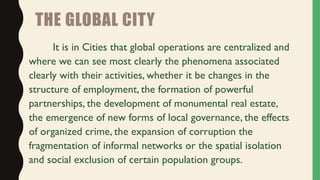
Itis in Cities that global operations are centralized and
where we can see most clearly the phenomena associated
clearly with their activities, whether it be changes in the
structure of employment, the formation of powerful
partnerships, the development of monumental real estate,
the emergence of new forms of local governance, the effects
of organized crime, the expansion of corruption the
fragmentation of informal networks or the spatial isolation
and social exclusion of certain population groups.
9.
THE GLOBAL CITY
Alsocalled WORLD CITY or sometimes ALPHA
CITY or WORLD CENTER, is a City which is a primary
node in the Global Economic Network.
10.
THREE KEY TENDENCIESSEEM TO FOLLOW
FROM THESE STRUCTURAL FACTS ABOUT
GLOBAL CITIES
One is a concentration of wealth in the hands of owners,
partners and professionals associated with the high-end firms in this
system.
Second is a growing disconnection between the City and its
Region.
Third is a growth of a large marginalized population that has a
very hard time earning a living in the marketplace defined by these
high-end activities.
11.
CHARACTERISTICS OF AGLOBAL CITY
• A variety of financial services, notably in finance, insurance, real estate, banking,
accountancy and marketing.
• Headquarters of several multinational corporations.
• The existence of financial headquarters, a stock exchange and major financial
institutions.
• Domination of the trade and economy of a large surrounding area.
• Major manufacturing centers with port and container facilities.
• Considerable decision-making power on a daily basis and at a global level.
• Centers of new ideas and innovation in business, economics, culture and
politics.
12.
REASONS OF INCREASEIN GLOBAL CITIES
The increase in global cities is linked to the globalization of
economics and the centralization of mass production within
urban centers.
Criticism of Global Cities
Despite of playing significant roles in the global economy, global city
thesis has been known for being a threat to state-centric
perspectives.These cities have been accused of focusing their reach
to other global cities and neglecting cities within the national
outreach.These cities are more connected to the outside world than
to their domestic economy.
14.
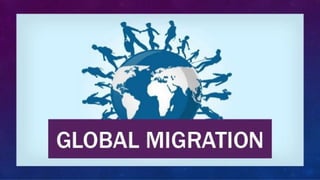
THE GLOBAL MIGRATION
Whydo people move?
SOCIAL FACTORS
Socially factors are things that affect someone’s lifestyle.
These could include wealth, religion, buying habits, educational level, family
size and structure and population density.
CULTURAL FACTORS
The idea of culture is vital to understanding the implications
for translation and despite the differences of opinion as to whether
language is a part of culture or not, the two are connected. Culture range
from syntax, ideologies, religion, language and dialect, art and literacy.
15.
WHY DO PEOPLEMOVE?
• PUSH-PULL FACTOR
In geographical terms, the push-pull factors are those that
drive people away from a place and draw people to a new location.A
combination of push-pull factors helps determine migration or
immigration of particular populations from one land to another.
PUSH FACTOR: REASONSTO LEAVE
Factors that help migrants decide to leave their home.
PULL FACTOR: REASONSTO MIGRATE
Factors that attract people and area where immigrants are
going.
16.
MIGRATION AFFECTS BOTHTHE PLACE OF ORIGIN AND
THE PLACE OF DESTINATION ON THE VARIOUS ASPECTS
SUCH AS ENVIRONMENTAL, ECONOMIC, HEALTH AND
SOCIAL ASPECTS
Environmental Aspects
Migration of people has the direct effect on both, the place of origin
and the place of destination. Problems like settlement, over-exploitation of
resources, and the pollution of different kinds will be visible.
Economic Aspects
The consequence on the place of origin will be a loss of
economically active groups of the population.
17.
MIGRATION AFFECTS BOTHTHE PLACE OF ORIGIN AND
THE PLACE OF DESTINATION ON THE VARIOUS ASPECTS
SUCH AS ENVIRONMENTAL, ECONOMIC, HEALTH AND
SOCIAL ASPECTS
Health and Social Aspects
The place of destination are normally those places
where facilities are made available to a limited extent so as
to fulfill the needs of the native dwellers. However, the
places overcrowd with the constant flow of migrants, and
facilities and other needs become insufficient.
21.
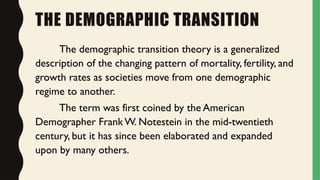
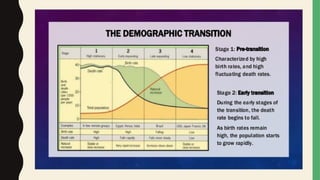
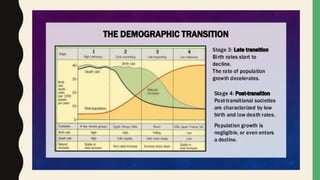
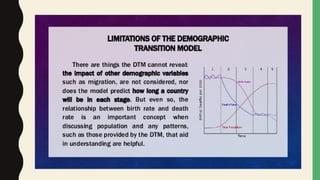
THE DEMOGRAPHIC TRANSITION
Thedemographic transition theory is a generalized
description of the changing pattern of mortality, fertility, and
growth rates as societies move from one demographic
regime to another.
The term was first coined by the American
Demographer Frank W. Notestein in the mid-twentieth
century, but it has since been elaborated and expanded
upon by many others.
24.
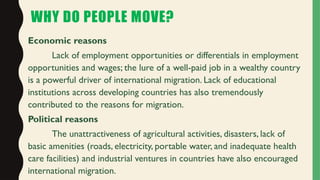
WHY DO PEOPLEMOVE?
Economic reasons
Lack of employment opportunities or differentials in employment
opportunities and wages; the lure of a well-paid job in a wealthy country
is a powerful driver of international migration. Lack of educational
institutions across developing countries has also tremendously
contributed to the reasons for migration.
Political reasons
The unattractiveness of agricultural activities, disasters, lack of
basic amenities (roads, electricity, portable water, and inadequate health
care facilities) and industrial ventures in countries have also encouraged
international migration.
27.
QUIZ
Instructions: Choose thebest answer for each
question.
1.What is another term for a global city?
a) Smart City
b) Industrial City
c) World City
d) Mega City
28.
2.Which of thefollowing is NOT a characteristic
of a global city?
a) Hosts multinational corporate headquarters
b) Major financial institutions and stock exchanges
c) Focuses only on rural development
d) A center for new ideas and innovation
29.
3.What is amajor criticism of global cities?
a) They focus too much on domestic economies
b) They are more connected to other global cities
than their own country
c) They do not influence the global economy
d) They do not attract investments
30.
4.Why do globalcities concentrate wealth in
the hands of a few?
a) Due to the presence of high-end firms and
financial hubs
b) Because they rely on agriculture
c) Due to lack of international trade
d) Because they have no economic influence
31.
5.Which of thefollowing industries is NOT
commonly found in a global city?
a) Finance and banking
b) Insurance and real estate
c) Traditional farming
d) Marketing and trade
32.
6.Which of thefollowing is a push factor for
migration?
a) High wages
b) Better healthcare
c) Political instability
d) Educational opportunities
33.
7.What is acommon pull factor for migration?
a) War and conflict
b) Economic crisis
c) Job opportunities
d) Natural disasters
34.
8.What are thetwo major types of migration
factors?
a) Social and political
b)Voluntary and forced
c) Push and pull
d) Temporary and permanent
35.
9. How doesmigration affect the economy of
the origin country?
a) It strengthens local businesses
b) It leads to loss of skilled workers
c) It reduces unemployment
d) It decreases population growth
36.
10.What is anegative effect of migration on the
destination country?
a) Increased economic output
b) Overcrowding and strain on public services
c) Greater cultural diversity
d) Development of new industries
37.
11.Who introduced theDemographic Transition
Theory?
a) Karl Marx
b) Max Weber
c) Frank W. Notestein
d) Adam Smith
38.
12.What does theDemographic TransitionTheory
explain?
a) The movement of people across borders
b) The shift in birth and death rates as societies
develop
c)The causes of global warming
d) The impact of financial markets on cities
39.
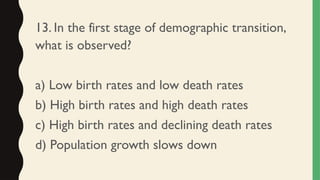
13. In thefirst stage of demographic transition,
what is observed?
a) Low birth rates and low death rates
b) High birth rates and high death rates
c) High birth rates and declining death rates
d) Population growth slows down
40.
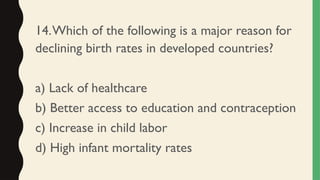
14.Which of thefollowing is a major reason for
declining birth rates in developed countries?
a) Lack of healthcare
b) Better access to education and contraception
c) Increase in child labor
d) High infant mortality rates
41.
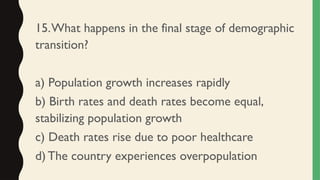
15.What happens inthe final stage of demographic
transition?
a) Population growth increases rapidly
b) Birth rates and death rates become equal,
stabilizing population growth
c) Death rates rise due to poor healthcare
d) The country experiences overpopulation
42.
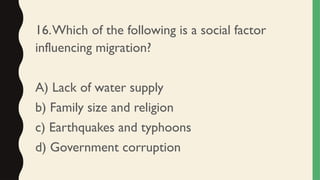
16.Which of thefollowing is a social factor
influencing migration?
A) Lack of water supply
b) Family size and religion
c) Earthquakes and typhoons
d) Government corruption
43.
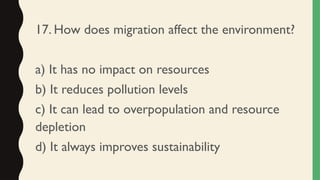
17. How doesmigration affect the environment?
a) It has no impact on resources
b) It reduces pollution levels
c) It can lead to overpopulation and resource
depletion
d) It always improves sustainability
44.
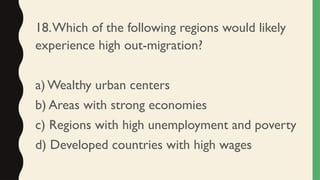
18.Which of thefollowing regions would likely
experience high out-migration?
a) Wealthy urban centers
b) Areas with strong economies
c) Regions with high unemployment and poverty
d) Developed countries with high wages
45.
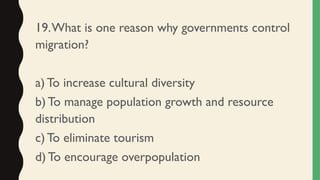
19.What is onereason why governments control
migration?
a) To increase cultural diversity
b) To manage population growth and resource
distribution
c) To eliminate tourism
d) To encourage overpopulation
46.
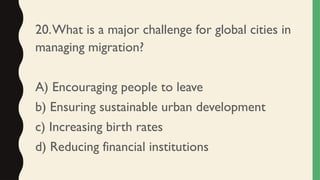
20.What is amajor challenge for global cities in
managing migration?
A) Encouraging people to leave
b) Ensuring sustainable urban development
c) Increasing birth rates
d) Reducing financial institutions