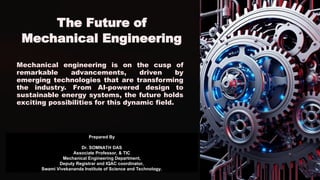
The Future of
Mechanical Engineering
Mechanical engineering is on the cusp of
remarkable advancements, driven by
emerging technologies that are transforming
the industry. From AI-powered design to
sustainable energy systems, the future holds
exciting possibilities for this dynamic field.
Prepared By
Dr. SOMNATH DAS
Associate Professor, & TIC
Mechanical Engineering Department,
Deputy Registrar and IQAC coordinator,
Swami Vivekananda Institute of Science and Technology.
Advancements in Computer-Aided Design (CAD)
and Simulation
Intelligent CAD Tools
AI-powered CAD software will
streamline the design process,
optimizing part geometry and
simulating performance with
unprecedented accuracy.
Immersive Visualization
Virtual and augmented reality will
bring mechanical designs to life,
allowing engineers to interact with 3D
models in real-time.
Simulation Advancements
Highly sophisticated simulation
capabilities will enable rapid
prototyping and testing, reducing
physical development time and costs.
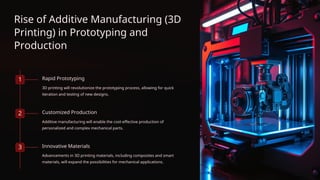
Rise of Additive Manufacturing (3D
Printing) in Prototyping and
Production
1 Rapid Prototyping
3D printing will revolutionize the prototyping process, allowing for quick
iteration and testing of new designs.
2 Customized Production
Additive manufacturing will enable the cost-effective production of
personalized and complex mechanical parts.
3 Innovative Materials
Advancements in 3D printing materials, including composites and smart
materials, will expand the possibilities for mechanical applications.
Adoption of Robotics and Automation in Industrial
Processes
Collaborative Robots
AI-powered robotic systems will work
seamlessly alongside human operators,
enhancing efficiency and safety in industrial
settings.
Sensor Integration
The integration of advanced sensors will
enable real-time monitoring and
optimization of automated processes.
Cloud-Connected Systems
The connectivity of industrial automation to
cloud-based platforms will allow for remote
monitoring, data analytics, and predictive
maintenance.
Sustainable and Energy-Efficient Mechanical
Systems
Renewable Energy Integration
Mechanical systems will increasingly
utilize renewable energy sources, such
as solar and wind power, to reduce
carbon footprint.
Advanced Thermal
Management
Innovative cooling and heating
technologies will enhance the energy
efficiency of mechanical systems,
minimizing waste and environmental
impact.
Circular Economy Principles
Mechanical engineering will embrace
the principles of the circular economy,
focusing on reuse, recycling, and
sustainable material sourcing.
Integrating Artificial Intelligence
and Machine Learning
AI-Assisted Design
AI algorithms will optimize mechanical designs, suggesting innovative
solutions and identifying potential failure points.
Predictive Maintenance
Machine learning models will enable predictive maintenance,
anticipating and preventing breakdowns in mechanical systems.
Autonomous Systems
Mechanical systems will become increasingly autonomous, leveraging
AI to make real-time adjustments and decisions.
Developments in Materials Science and
Composites
1 Lightweight and Durable
Innovative composite materials
will combine high strength, low
weight, and enhanced durability
for mechanical applications.
2 Smart Materials
The integration of sensors and
responsive materials will enable
self-monitoring and self-healing
mechanical systems.
3 Nanomaterials
Advancements in nanotechnology
will lead to the development of
ultra-strong, lightweight, and
highly efficient mechanical
components.
Concluding Thoughts and
Future Directions
The future of mechanical engineering holds immense promise, with
transformative technologies poised to reshape the industry. By embracing
these advancements, mechanical engineers will drive innovation, improve
sustainability, and unlock new possibilities for solving global challenges.

The-Future-of-Mechanical-Engineering.ppt

  • 1.
    The Future of MechanicalEngineering Mechanical engineering is on the cusp of remarkable advancements, driven by emerging technologies that are transforming the industry. From AI-powered design to sustainable energy systems, the future holds exciting possibilities for this dynamic field. Prepared By Dr. SOMNATH DAS Associate Professor, & TIC Mechanical Engineering Department, Deputy Registrar and IQAC coordinator, Swami Vivekananda Institute of Science and Technology.
  • 2.
    Advancements in Computer-AidedDesign (CAD) and Simulation Intelligent CAD Tools AI-powered CAD software will streamline the design process, optimizing part geometry and simulating performance with unprecedented accuracy. Immersive Visualization Virtual and augmented reality will bring mechanical designs to life, allowing engineers to interact with 3D models in real-time. Simulation Advancements Highly sophisticated simulation capabilities will enable rapid prototyping and testing, reducing physical development time and costs.
  • 3.
    Rise of AdditiveManufacturing (3D Printing) in Prototyping and Production 1 Rapid Prototyping 3D printing will revolutionize the prototyping process, allowing for quick iteration and testing of new designs. 2 Customized Production Additive manufacturing will enable the cost-effective production of personalized and complex mechanical parts. 3 Innovative Materials Advancements in 3D printing materials, including composites and smart materials, will expand the possibilities for mechanical applications.
  • 4.
    Adoption of Roboticsand Automation in Industrial Processes Collaborative Robots AI-powered robotic systems will work seamlessly alongside human operators, enhancing efficiency and safety in industrial settings. Sensor Integration The integration of advanced sensors will enable real-time monitoring and optimization of automated processes. Cloud-Connected Systems The connectivity of industrial automation to cloud-based platforms will allow for remote monitoring, data analytics, and predictive maintenance.
  • 5.
    Sustainable and Energy-EfficientMechanical Systems Renewable Energy Integration Mechanical systems will increasingly utilize renewable energy sources, such as solar and wind power, to reduce carbon footprint. Advanced Thermal Management Innovative cooling and heating technologies will enhance the energy efficiency of mechanical systems, minimizing waste and environmental impact. Circular Economy Principles Mechanical engineering will embrace the principles of the circular economy, focusing on reuse, recycling, and sustainable material sourcing.
  • 6.
    Integrating Artificial Intelligence andMachine Learning AI-Assisted Design AI algorithms will optimize mechanical designs, suggesting innovative solutions and identifying potential failure points. Predictive Maintenance Machine learning models will enable predictive maintenance, anticipating and preventing breakdowns in mechanical systems. Autonomous Systems Mechanical systems will become increasingly autonomous, leveraging AI to make real-time adjustments and decisions.
  • 7.
    Developments in MaterialsScience and Composites 1 Lightweight and Durable Innovative composite materials will combine high strength, low weight, and enhanced durability for mechanical applications. 2 Smart Materials The integration of sensors and responsive materials will enable self-monitoring and self-healing mechanical systems. 3 Nanomaterials Advancements in nanotechnology will lead to the development of ultra-strong, lightweight, and highly efficient mechanical components.
  • 8.
    Concluding Thoughts and FutureDirections The future of mechanical engineering holds immense promise, with transformative technologies poised to reshape the industry. By embracing these advancements, mechanical engineers will drive innovation, improve sustainability, and unlock new possibilities for solving global challenges.