B Y E V O N N E M W A N G A L E K I P T I N N E S S
C O M 8 3 0 X
FAMILY COMMUNICATION
PROCESS
WHAT IS A FAMILY?
A family
 According to the Australian Bureau of Statistics,2011
 A family is a group of two or more people that are related by
blood, marriage (registered or de facto), adoption, step or
fostering, and who usually live together in the same household.
 This includes newlyweds without children, gay partners,
couples with dependants, single mums or dads with children,
siblings living together, and many other variations. At least
one person in the family has to be over 15.
 Cambridge dictionary
 a group of people who are related to each other, such as
a mother, a father, and their children
 The family is a fundamental social group in society
Why is family important
 The family is the most important social unit of
society (Wilson, 2013). It is also
 the basic sexual unit
 the basic child-raising unit
 the basic communication unit
 the basic all-around fun
 The basic friendship unit.
 The family sets the standard of what society will look
like and how we all interact with each other.
Types of families
 Nuclear – father, mother, child/children
 Single parent – one parent and child/children
 Extended – includes grandparents, uncles, aunties,
cousins…
Family Communication
 Family communication refers to the way verbal and
non-verbal information is exchanged between family
members (Epstein, Bishop, Ryan, Miller, & Keitner,
(1993).
 Communication within the family is extremely
important because it enables members to express
their needs, wants, and concerns to each other.
 Open and honest communication creates an
atmosphere that allows family members to express
their differences as well as love and admiration for
one another.
The family Communication process
 The process through which verbal and non-verbal
information is exchanged between family members
(Epstein, Bishop, Ryan, Miller, & Keitner, (1993).
 This process aligns itself with the typical
communication process (sender-encodes a message-
through a channel-decode-receiver), however the
relationship between the sender and receiver is close
and unique
The Family Communication Process
 The communication process in the family involves
 Who says what
 to whom?
 When?
 Where?
 How?
 Factors that affect the family communication process
 Instrumental and Affective Communication
 Clear vs marked
 Direct vs Indirect communication
 Family communication patterns
Instrumental and Affective communication
 Instrumental communication is the exchange of
factual information that enables individuals to fulfill
common family functions (e.g., telling a child that
he/she will be picked up from school at a specific
time and location).
 Affective communication is the way individual family
members share their emotions with one another
(e.g., sadness, anger, joy).
 Healthy families are able to communicate well in
both areas.
Clear vs. Masked and Direct vs. Indirect
Communication
 Clear communication occurs when messages are
spoken plainly and the content is easily understood
by other family members.
 Masked communication occurs when the message is
muddied or vague.
 Communication is direct if the person spoken to is
the person for whom the message is intended.
 Communication is indirect if the message is not
directed to the person for whom it is intended.
HOW TO BUILD EFFECTIVE FAMILY
COMMUNICATION
 Communicate Frequently – find time to communicate.
 Communicate clearly and directly
 Be an active listener
 Pay attention to non verbal cues
 Be positive
 effective communication is primarily positive.
 Marital and family researchers have discovered that unhappy family
relationships are often the result of negative communication patterns
(e.g., criticism, contempt, defensiveness).
 Researchers found that satisfied married couples had five positive
interactions to every one negative interaction (Gottman, 1994).
 Couples who are very dissatisfied with their relationships typically
engage in more negative interactions than positive.
 It is very important for family members to verbally compliment and
encourage one another.
 Researchers have discovered a strong link between
communication patterns and satisfaction with family
relationships (Noller & Fitzpatrick, 1990).
 One researcher discovered that the more positively
couples rated their communication, the more
satisfied they were with their relationship five and a
half years later (Markman, 1981).
 Poor communication is also associated with an
increased risk of divorce and marital separation and
more behavioral problems in children.
VIDEO
 https://www.youtube.com/watch?v=cKcNyfXbQzQ
REFERENCES
 Australian Bureau of Statistics (2011), Labour Force, Australia: Labour Force
Status and Other Characteristics of Families. Government of Australia Press
 Epstein, N. B. Bishop, D., Ryan, C., Miller, & Keitner, G., (1993). The McMaster
Model View of Healthy Family Functioning. In From a Walsh (Eds.), Normal
Family Processes (pp. 138-160). The Guilford Press: New York/London.
 Noller, P., & Fitzpatrick, M. A. (1990). Marital communication in the eighties.
Journal of Marriage and the Family, 52, 832-843.
 Koerner, A. F., & Fitzpatrick, M. A. (1997). Family type and conflict: The impact
of conversation orientation and conformity orientation on conflict in the family.
Journal of Communication Studies, 48(1), 59-75.
 Wilson, L. (2013). The family unit and its importance. Center for Development
 Gottman, J.M. (1994). Why marriages succeed or fail. New York: Simon &
Schuster.
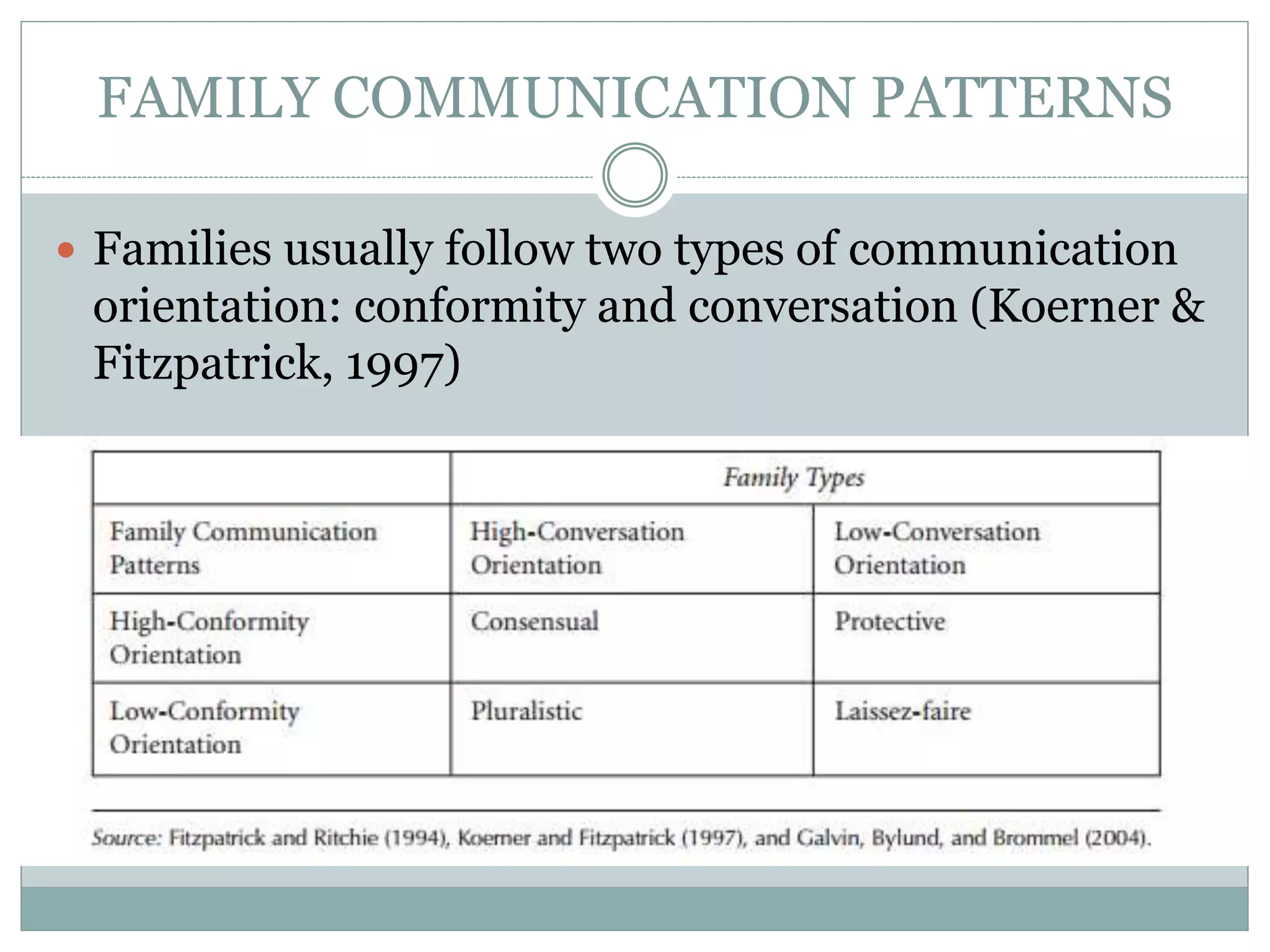
FAMILY COMMUNICATION PATTERNS
 Families usually follow two types of communication
orientation: conformity and conversation (Koerner &
Fitzpatrick, 1997)
FAMILY COMMUNICATION PATTERNS
 Conformity orientation
 A family that has a conformity orientation is one where
common attitudes, beliefs, and values are expected.
 This family opposes conflict and stresses compliance to the
decisions made by parents or older family members.
 Conversation orientation
 allows the family members of all ages the freedom to express
their opinions openly and freely.
From these two orientations, four family
communication patterns emerge

The Family communication process

  • 1.
    B Y EV O N N E M W A N G A L E K I P T I N N E S S C O M 8 3 0 X FAMILY COMMUNICATION PROCESS
  • 2.
    WHAT IS AFAMILY?
  • 3.
    A family  Accordingto the Australian Bureau of Statistics,2011  A family is a group of two or more people that are related by blood, marriage (registered or de facto), adoption, step or fostering, and who usually live together in the same household.  This includes newlyweds without children, gay partners, couples with dependants, single mums or dads with children, siblings living together, and many other variations. At least one person in the family has to be over 15.  Cambridge dictionary  a group of people who are related to each other, such as a mother, a father, and their children  The family is a fundamental social group in society
  • 4.
    Why is familyimportant  The family is the most important social unit of society (Wilson, 2013). It is also  the basic sexual unit  the basic child-raising unit  the basic communication unit  the basic all-around fun  The basic friendship unit.  The family sets the standard of what society will look like and how we all interact with each other.
  • 5.
    Types of families Nuclear – father, mother, child/children  Single parent – one parent and child/children  Extended – includes grandparents, uncles, aunties, cousins…
  • 6.
    Family Communication  Familycommunication refers to the way verbal and non-verbal information is exchanged between family members (Epstein, Bishop, Ryan, Miller, & Keitner, (1993).  Communication within the family is extremely important because it enables members to express their needs, wants, and concerns to each other.  Open and honest communication creates an atmosphere that allows family members to express their differences as well as love and admiration for one another.
  • 7.
    The family Communicationprocess  The process through which verbal and non-verbal information is exchanged between family members (Epstein, Bishop, Ryan, Miller, & Keitner, (1993).  This process aligns itself with the typical communication process (sender-encodes a message- through a channel-decode-receiver), however the relationship between the sender and receiver is close and unique
  • 8.
    The Family CommunicationProcess  The communication process in the family involves  Who says what  to whom?  When?  Where?  How?  Factors that affect the family communication process  Instrumental and Affective Communication  Clear vs marked  Direct vs Indirect communication  Family communication patterns
  • 9.
    Instrumental and Affectivecommunication  Instrumental communication is the exchange of factual information that enables individuals to fulfill common family functions (e.g., telling a child that he/she will be picked up from school at a specific time and location).  Affective communication is the way individual family members share their emotions with one another (e.g., sadness, anger, joy).  Healthy families are able to communicate well in both areas.
  • 10.
    Clear vs. Maskedand Direct vs. Indirect Communication  Clear communication occurs when messages are spoken plainly and the content is easily understood by other family members.  Masked communication occurs when the message is muddied or vague.  Communication is direct if the person spoken to is the person for whom the message is intended.  Communication is indirect if the message is not directed to the person for whom it is intended.
  • 11.
    HOW TO BUILDEFFECTIVE FAMILY COMMUNICATION  Communicate Frequently – find time to communicate.  Communicate clearly and directly  Be an active listener  Pay attention to non verbal cues  Be positive  effective communication is primarily positive.  Marital and family researchers have discovered that unhappy family relationships are often the result of negative communication patterns (e.g., criticism, contempt, defensiveness).  Researchers found that satisfied married couples had five positive interactions to every one negative interaction (Gottman, 1994).  Couples who are very dissatisfied with their relationships typically engage in more negative interactions than positive.  It is very important for family members to verbally compliment and encourage one another.
  • 12.
     Researchers havediscovered a strong link between communication patterns and satisfaction with family relationships (Noller & Fitzpatrick, 1990).  One researcher discovered that the more positively couples rated their communication, the more satisfied they were with their relationship five and a half years later (Markman, 1981).  Poor communication is also associated with an increased risk of divorce and marital separation and more behavioral problems in children.
  • 13.
  • 14.
    REFERENCES  Australian Bureauof Statistics (2011), Labour Force, Australia: Labour Force Status and Other Characteristics of Families. Government of Australia Press  Epstein, N. B. Bishop, D., Ryan, C., Miller, & Keitner, G., (1993). The McMaster Model View of Healthy Family Functioning. In From a Walsh (Eds.), Normal Family Processes (pp. 138-160). The Guilford Press: New York/London.  Noller, P., & Fitzpatrick, M. A. (1990). Marital communication in the eighties. Journal of Marriage and the Family, 52, 832-843.  Koerner, A. F., & Fitzpatrick, M. A. (1997). Family type and conflict: The impact of conversation orientation and conformity orientation on conflict in the family. Journal of Communication Studies, 48(1), 59-75.  Wilson, L. (2013). The family unit and its importance. Center for Development  Gottman, J.M. (1994). Why marriages succeed or fail. New York: Simon & Schuster.
  • 17.
    FAMILY COMMUNICATION PATTERNS Families usually follow two types of communication orientation: conformity and conversation (Koerner & Fitzpatrick, 1997)
  • 18.
    FAMILY COMMUNICATION PATTERNS Conformity orientation  A family that has a conformity orientation is one where common attitudes, beliefs, and values are expected.  This family opposes conflict and stresses compliance to the decisions made by parents or older family members.  Conversation orientation  allows the family members of all ages the freedom to express their opinions openly and freely. From these two orientations, four family communication patterns emerge