

COMMUNICATION:
Building Better
Family
Relationship
Grade 7 Class Guidance SY 2015-2016
Mrs. Millie C. Eustaquio
Introduction
Each family has a unique
system of communicating with
each other.
Good communication is an
important rule to maintain good
relationships among members
of the family
Definition of Terms
• Communication involves the ability to pay
attention to what others are thinking and
feeling. In other words, an important part of
communication is not just talking, but
listening to what others have to say
• Communication is the basic building block of
our relationships. It is through communication
that we convey our thoughts, feelings, and
connection to one another.
Activity: Making Connections
On a piece of paper, the
students will be asked to draw
the members of their family
seated on a Dinner table.
The students will be asked to
describe their relationship with
a particular family member
thru different lines
 Straight thin line –
communicates factual
information
 Straight thick line –
communicates factual
information,
emotions, opinions
and almost
everything
 Broken lines –
seldom
communicates
 Curve line – often
has disagreement
when communicating
 Red broken line –
never communicate
Communication
is about more
than just
exchanging
information. It's
about
understanding
the emotion and
intentions behind
the information.
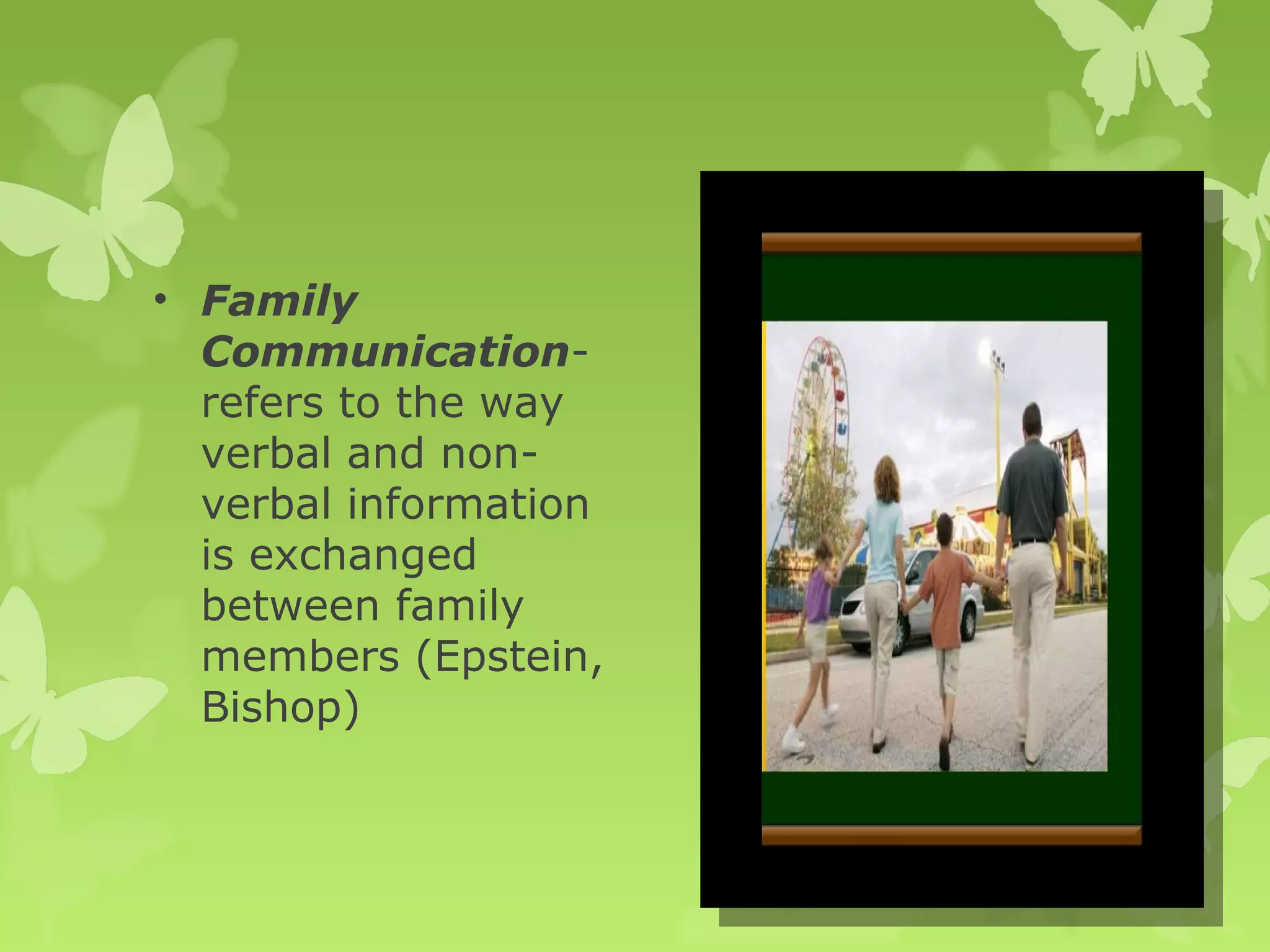
• Family
Communication-
refers to the way
verbal and non-
verbal information
is exchanged
between family
members (Epstein,
Bishop)
• Communication within the family is
extremely important because it enables
members to express their needs, wants,
and concerns to each other.
• Open and honest communication creates
an atmosphere that allows family
members to express their differences as
well as love and admiration for one
another.
• It is through communication that family
members are able to resolve the
unavoidable problems that arise in all
families.
What is effective communication?
Effective communication is also a
two-way street. It’s not only how
you convey a message so that it is
received and understood by
someone in exactly the way you
intended, it’s also how you listen to
gain the full meaning of what’s
being said and to make the other
person feel heard and understood.
Instrumental and Affective
Communication
 Instrumental communication is the
exchange of factual information that
enables individuals to fulfill common
family functions (e.g., telling a child that
he/she will be picked up from school at a
specific time and location).
 Affective communication is the way
individual family members share their
emotions with one another (e.g., sadness,
anger, joy).
Clear vs. Masked and Direct vs.
Indirect Communication
• Communication can be clear or masked
and direct or indirect (Epstein, Bishop,
Ryan, Miller, & Keitner, 1993). Clear
communication occurs when messages are
spoken plainly and the content is easily
understood by other family members.
Masked communication occurs when the
message is muddied or vague.
• Communication is direct if the
person spoken to is the person
for whom the message is
intended. In contrast,
communication is indirect if the
message is not directed to the
person for whom it is intended.
Four Styles of Communication
Epstein et al. (1993)
1. Clear and Direct Communication
2. Clear and Indirect Communication
3. Masked and Direct Communication
4. Masked and Indirect Communication
Keys to Building Effective
Family Communication
Communicate Frequently
Communicate Clearly and Directly
Be An Active Listener
open and honest with one another
Think About the Person With Whom
You Are Communicating
Pay Attention to Non-Verbal
Messages
Keep stress in check
Be Positive
Pick your time
Plan what to say
Assert yourself
Model good communication
Communication is a key to
successful family functioning.
Researchers agree that clear, open,
and frequent communication is a
basic characteristic of a strong,
healthy family. Families that
communicate in healthy ways are
more capable of problem-solving
and tend to be more satisfied with
their relationships.
Generally, when we feel heard, we
are less angry, stressed, and more
open to resolving problems than
when we feel misunderstood.
Feeling heard and understood also
develops trust and caring between
people.
Many things can get in the
way of good communication.
When we assume we know what
others are thinking, or that they
should know what we are thinking.
When we focus on what we want to
say while others are talking—instead
of listening to them.
 When we bring up other problems
and issues unrelated to the topic at hand.
 When we assume we know what is right
for others and try to convince them
of this.
 All of these things either keep us from
sending a clear message or keep us from
receiving the message the other person is
trying to send.
Communicating well
takes practice and
effort.
“Family is the most important
thing in the world.”
– Princess Diana
Family is not an important
thing, it’s everything.
- Michael J. Fox
“A man travels the world over
in search of what he needs,
and returns home to find it.”
– George Moore
“The strength of a nation
derives from the integrity of
the home.”
– Confucius
Thank You!!!

Communication

  • 1.
    COMMUNICATION: Building Better Family Relationship Grade 7Class Guidance SY 2015-2016 Mrs. Millie C. Eustaquio
  • 2.
    Introduction Each family hasa unique system of communicating with each other. Good communication is an important rule to maintain good relationships among members of the family
  • 3.
    Definition of Terms •Communication involves the ability to pay attention to what others are thinking and feeling. In other words, an important part of communication is not just talking, but listening to what others have to say • Communication is the basic building block of our relationships. It is through communication that we convey our thoughts, feelings, and connection to one another.
  • 4.
    Activity: Making Connections Ona piece of paper, the students will be asked to draw the members of their family seated on a Dinner table. The students will be asked to describe their relationship with a particular family member thru different lines
  • 5.
     Straight thinline – communicates factual information  Straight thick line – communicates factual information, emotions, opinions and almost everything  Broken lines – seldom communicates  Curve line – often has disagreement when communicating  Red broken line – never communicate
  • 6.
    Communication is about more thanjust exchanging information. It's about understanding the emotion and intentions behind the information.
  • 7.
    • Family Communication- refers tothe way verbal and non- verbal information is exchanged between family members (Epstein, Bishop)
  • 8.
    • Communication withinthe family is extremely important because it enables members to express their needs, wants, and concerns to each other. • Open and honest communication creates an atmosphere that allows family members to express their differences as well as love and admiration for one another. • It is through communication that family members are able to resolve the unavoidable problems that arise in all families.
  • 10.
    What is effectivecommunication? Effective communication is also a two-way street. It’s not only how you convey a message so that it is received and understood by someone in exactly the way you intended, it’s also how you listen to gain the full meaning of what’s being said and to make the other person feel heard and understood.
  • 11.
    Instrumental and Affective Communication Instrumental communication is the exchange of factual information that enables individuals to fulfill common family functions (e.g., telling a child that he/she will be picked up from school at a specific time and location).  Affective communication is the way individual family members share their emotions with one another (e.g., sadness, anger, joy).
  • 12.
    Clear vs. Maskedand Direct vs. Indirect Communication • Communication can be clear or masked and direct or indirect (Epstein, Bishop, Ryan, Miller, & Keitner, 1993). Clear communication occurs when messages are spoken plainly and the content is easily understood by other family members. Masked communication occurs when the message is muddied or vague.
  • 13.
    • Communication isdirect if the person spoken to is the person for whom the message is intended. In contrast, communication is indirect if the message is not directed to the person for whom it is intended.
  • 14.
    Four Styles ofCommunication Epstein et al. (1993) 1. Clear and Direct Communication 2. Clear and Indirect Communication 3. Masked and Direct Communication 4. Masked and Indirect Communication
  • 15.
    Keys to BuildingEffective Family Communication Communicate Frequently Communicate Clearly and Directly Be An Active Listener open and honest with one another
  • 16.
    Think About thePerson With Whom You Are Communicating Pay Attention to Non-Verbal Messages Keep stress in check Be Positive
  • 17.
    Pick your time Planwhat to say Assert yourself Model good communication
  • 18.
    Communication is akey to successful family functioning. Researchers agree that clear, open, and frequent communication is a basic characteristic of a strong, healthy family. Families that communicate in healthy ways are more capable of problem-solving and tend to be more satisfied with their relationships.
  • 19.
    Generally, when wefeel heard, we are less angry, stressed, and more open to resolving problems than when we feel misunderstood. Feeling heard and understood also develops trust and caring between people.
  • 20.
    Many things canget in the way of good communication. When we assume we know what others are thinking, or that they should know what we are thinking. When we focus on what we want to say while others are talking—instead of listening to them.
  • 21.
     When webring up other problems and issues unrelated to the topic at hand.  When we assume we know what is right for others and try to convince them of this.  All of these things either keep us from sending a clear message or keep us from receiving the message the other person is trying to send.
  • 22.
  • 23.
    “Family is themost important thing in the world.” – Princess Diana
  • 25.
    Family is notan important thing, it’s everything. - Michael J. Fox
  • 26.
    “A man travelsthe world over in search of what he needs, and returns home to find it.” – George Moore
  • 27.
    “The strength ofa nation derives from the integrity of the home.” – Confucius
  • 28.