 First Act passed in 1881 – primarily to protect children and to
provide certain safety and health measures.
 Followed by Acts of 1891, 1911, 1922 and 1934 which had number
of defects and weaknesses , no effective administration, provisions
were inadequate and unsatisfactory.
 Large growth in industrial activities was seen.
 Radical law relating to factories was necessary.
 Hence The Factories Act 1948 passed, came into force on 1st April
1949
 Provisions of the Act based on ILO conventions and
recommendations.
 Definition of the term ‘factories ’ was widened. Included workers in
all establishments employing 10 or more/ 20 or more workers.
 Distinction between seasonal and non seasonal factories was
abolished.
 Extension of the basic provisions of the old Act relating to health,
safety and welfare of workers, irrespective of number of workers
employed.
 Splitting up of Chapter III of the old Act into three parts of health,
safety and welfare of workers.
 Raising of age of admission of children for work from 12 to 14
years and decreasing their working hours.
 Provisions for licensing and registration of factories, and prior
scrutiny by inspectors of plans and factory buildings.
 Granting power to State Govts. to make rules requiring association
of workers in management for welfare of workers.
 To regulate the conditions of work in manufacturing
establishments defined as factories.
 To regulate working hours
 To protect health of workers
 To provide safety to workers
 To ensure welfare of workers
 To ensure the construction of factories is as per plan.
 TO appoint factory inspectors and surgeons
 To impose fines and penalties
In Bhikusa Yamasa Kshatri)ya (P Ltd. V. Union of India the court
observed that the Act has been enacted primarily with the object
of protecting workers employed in factories against industrial and
occupational hazards. For that purpose it seeks to impose upon
the owner or occupier certain obligations to protect the workers
and to secure for them employment conditions conducive to their
safety and health.
"factory" means any premises including the precincts thereof-
(i) whereon ten or more workers are working, or were working on any day
of the preceding twelve months, and in any part of which a
manufacturing process is being carried on with the aid of power, or is
ordinarily so carried on, or
(ii) Whereon twenty or more workers are working, or were working on any
day of the preceding twelve months, and in any part of which a
manufacturing process is being carried on without the aid of power, or is
ordinarily so carried on,-but does not include a mine subject to the
operation of 9[the Mines Act, 1952 (35 of 1952)] or 10[a mobile unit
belonging to the armed forces of the Union, a railway running shed or a
hotel, restaurant or eating place].
7[Explanation 11[I] : For computing the number of workers for the purposes
of this clause all the workers in 12[different groups and relays] in a day
shall be taken into account;]
13[Explanation II: For the purposes of this clause, the mere fact that an
Electronic Data Processing Unit or a Computer Unit is installed in any
premises or part thereof, shall not be construed to make it a factory if
no manufacturing process is being carried on in such premises or part
thereof;]
In simple words, a factory is a premises whereon 10 or more persons
are engaged if power is used, and 20 or more persons are engaged
if power is not used.
 No distinction between perennial and seasonal factories.
 Premises – building or open land or land with building.
 Precincts – a space enclosed by the walls or fences of a factory.
 Two conditions to determine whether an establishment is a factory-
1. that a manufacturing process is being carried on in any part of
the premises; and
2. there are prescribed number of workers working.
"manufacturing process" means any process for-
(i) making, altering, repairing, ornamenting, finishing, packing, oiling,
washing, cleaning, breaking up, demolishing, or otherwise treating
or adapting any article or substance with a view to its use, sale,
transport, delivery or disposal, or
5[(ii) pumping oil, water, sewage or any other substance; or]
(iii) generating, transforming or transmitting power; or
6[(iv) composing types for printing, printing by letter press,
lithography, photogravure or other similar process or book
binding;] 7[or]
(v) constructing, reconstructing, repairing, refitting, finishing or
breaking up ships or vessels; 7[or]
7[(vi) preserving or storing any article in cold storage;
Examples: Bidi making
• Moulding and transformation of raw cinematography films into a
finished product.
• Work done in salt works for converting sea water into salt.
• Use of refrigerator in treating or adapting any article with a view to
its sale.
 To determine whether a process is manufacturing process or not,
regard is to be given to the circumstances.
 There must be some transformation of an article i.e. the article that
is put up for sale must be different from what it originally existed.
 Activity must result in the emergence of a marketable commodity
with a distinctive name.
"worker" means a person 8[employed, directly or by or through any
agency (including a contractor) with or without the knowledge of the
principal employer, whether for remuneration or not], in any
manufacturing process, or in cleaning any part of the machinery or
premises used for a manufacturing process, or in any other kind of
work incidental to, or connected with, the manufacturing process, or
the subject of the manufacturing process 7[but does not include any
member of the armed forces of the Union];
 Those carrying out work incidental to, or connected with, the
manufacturing processes have been held as workers.
 Relationship of master and servant must exist between the employer
and employee.
 Does not matter whether wages are paid or not.
 There should be some contract of employment.
"competent person", in relation to any provision of this Act, means a
person or an institution recognized as such by the Chief Inspector
for the purposes of carrying out tests, examinations and inspections
required to be done in a factory under the provisions of this Act
having regard to-
(i) the qualifications and experience of the person and facilities
available at his disposal; or
(ii) the qualifications and experience of the persons employed in
such institution and facilities available therein, with regard to the
conduct of such tests, examinations and inspections, and more than
one person or institution can be recognized as a competent person
in relation to a factory;
"hazardous process" means any process or activity in relation to an
industry specified in the First Schedule where, unless special care is
taken, raw materials used therein or the intermediate or finished
products, bye-products, wastes, or effluents thereof would-
(i) cause material impairment to the health of the persons engaged
in or connected therewith, or
(ii) result in the pollution of the general environment:
PROVIDED that the State Government may, by notification in the
Official Gazette, amend the First Schedule by way of addition,
omission or variation of any industry, specified in the said Schedule;]
 Adult:"adult" means a person who has completed his eighteenth year
of age;
 Adolescent: "adolescent" means a person who has completed his
fifteenth year of age but has not completed his eighteenth year;
 Calendar: [(bb) "calendar year" means the period of twelve months
beginning with the first day of January in any year;]
 Child : "child" means a person who has not completed his fifteenth
year of age
 Young person "young person" means a person who is either a child
or an adolescent
“occupier” of a factory means the person who has ultimate control over
the affairs of the factory, 8[***] 9
[Provided that- (i) in the case of a firm or other association of
individuals, any one of the individual partners or members thereof
shall be deemed to be the occupier;
(ii) in the case of a company, any one of the directors, shall be deemed
to be the occupier;
(iii) in the case of a factory owned or controlled by the Central
Government, or any State Government, or any local authority, the
person or persons appointed to manage the affairs of the factory by
the Central Government, the State Government or the local authority,
as the case may be, shall be deemed to be the occupier.
 Inspectors [Sec.8(1)]: State Government may appoint by notification
in Official Gazette, such person who possesses the qualification
prescribed to be inspectors under this Act and assign them local
limits.
 Chief Inspectors [Sec 8 (2)]: State Government may appoint by
notification in Official Gazette, any person to be Chief Inspector. He
has an additional power of Inspector throughout the State.
 Additional Chief Inspector, Joint Chief Inspector Etc. to be appointed
to assist Chief inspector and exercise powers assigned to them by
notification.
 (a) enter, with such assistants, being persons in the service of the
Government, or any local or other public authority, 1[or with an
expert] as he thinks fit, any place which is used, or which he has
reason to believe is used, as a factory;
 [(b) make examination of the premises, plant, machinery, article or
substance.
 (c) inquire into any accident or dangerous occurrence, whether
resulting in bodily injury, disability or not, and take on the spot or
otherwise statements of any person which he may consider
necessary for such inquiry;
 (d) require the production of any prescribed register or any other
document relating to the factory;
 (e) seize, or take copies of any register, record or other document
or any portion thereof, as he may consider necessary in respect of
any offence under this Act, which he has reason to believe, has been
committed;
 (f) direct the occupier that any premises or any part thereof, or
anything lying therein, shall be left undisturbed (whether generally
or in particular respects) for so long as is necessary for the purpose
of any examination under clause (b);
 (g) take measurements and photographs and make such recordings
as he considers necessary for the purpose of any examination under
clause (b), taking with him any necessary instrument or equipment;
 (h) in case of any article or substance found in any premises, being
an article or substance which appears to him as having caused or is
likely to cause danger to the health or safety of the workers, direct it
to be dismantled or subject it to any process or test (but not so as to
damage or destroy it unless the same is, in the circumstances
necessary, for carrying out the purposes of this Act), and take
possession of any such article or substance or a part thereof, and
detain it for so long as is necessary for such examination;
 (i) exercise such other powers as may be prescribed.
The [State] Government may appoint qualified medical practitioners to be certifying surgeons
for the purposes of this Act within such local limits or for such factory or class or description
of factories as it may assign to them respectively.
A certifying surgeon may, with the approval of the [State] Government, authorise any qualified
medical practitioner to exercise any of his powers under this Act for such period as the
certifying surgeon may specify and subject to specified conditions.
Duties:
(a) the examination and certification of young persons under this Act;
(b) (b) the examination of persons engaged in factories in such dangerous occupations or
processes as may be prescribed;
(c) (c) the exercising of such medical supervision as may be prescribed for any factory or class or
description of factories where- (i) cases of illness have occurred which it is reasonable to
believe are due to the nature of the manufacturing process carried on, or other conditions of
work prevailing therein;
(ii) by reason of any change in the manufacturing process carried on or in the substances
used therein or by reason of the adoption of any new manufacturing process or of any new
substance for use in a manufacturing process, there is a likelihood of injury to the health of
workers employed in that manufacturing process;
(iii) young persons are, or are about to be, employed in any work which is likely to cause
injury to their health. Explanation.-In this section “qualified medical practitioner” means a
person holding a qualification granted by an authority specified in the Schedule to the Indian
Medical Degrees Act, 1916 (VII of 1916), or in the Schedules to the Indian Medical Council
Act.
(ii) by reason of any change in the manufacturing process carried on
or in the substances used therein or by reason of the adoption of
any new manufacturing process or of any new substance for use in
a manufacturing process, there is a likelihood of injury to the health
of workers employed in that manufacturing process;
(iii) young persons are, or are about to be, employed in any work
which is likely to cause injury to their health. Explanation.-In this
section “qualified medical practitioner” means a person holding a
qualification granted by an authority specified in the Schedule to
the Indian Medical Degrees Act, 1916 (VII of 1916), or in the
Schedules to the Indian Medical Council Act.
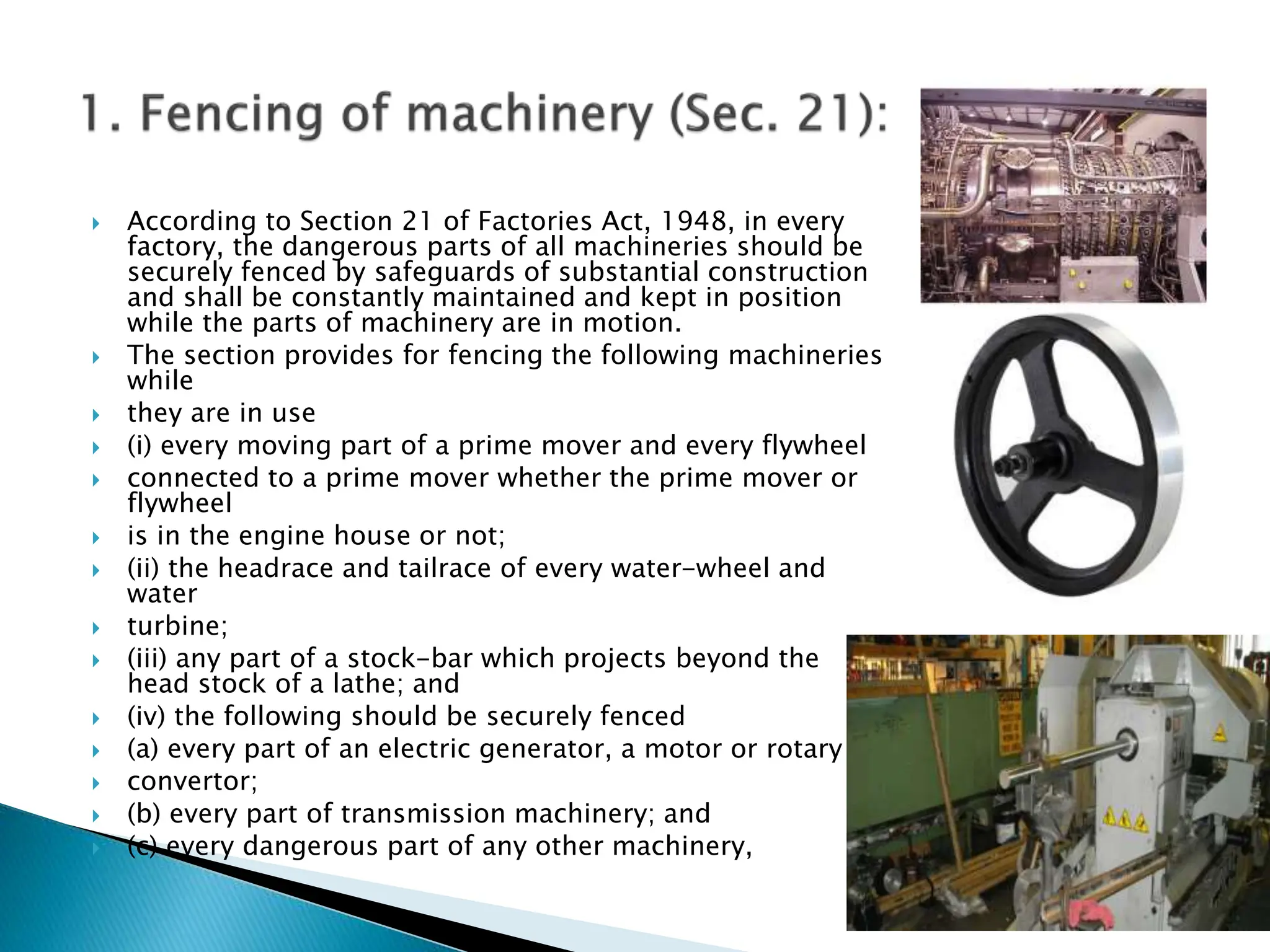
 According to Section 21 of Factories Act, 1948, in every
factory, the dangerous parts of all machineries should be
securely fenced by safeguards of substantial construction
and shall be constantly maintained and kept in position
while the parts of machinery are in motion.
 The section provides for fencing the following machineries
while
 they are in use
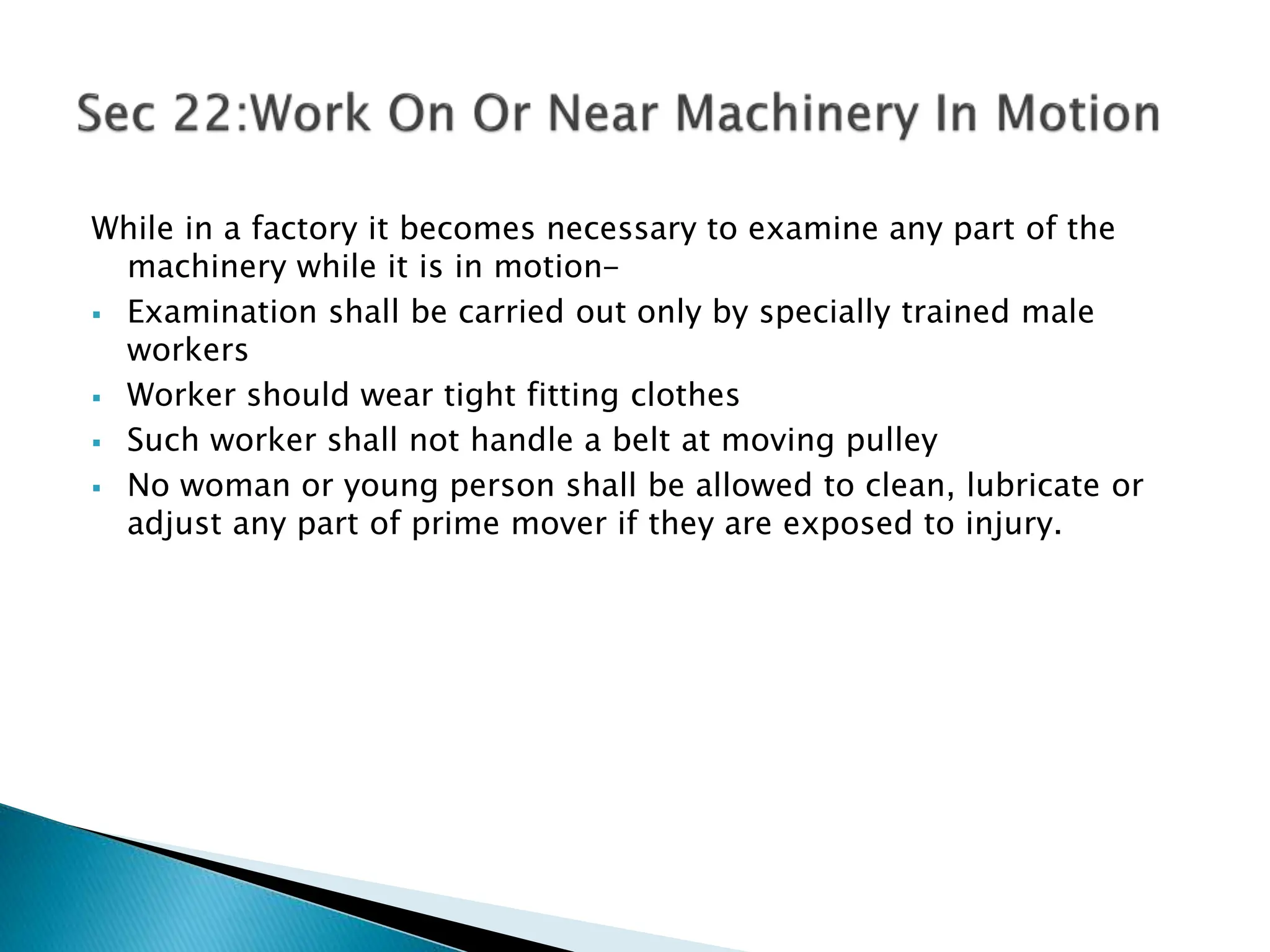
 (i) every moving part of a prime mover and every flywheel
 connected to a prime mover whether the prime mover or
flywheel
 is in the engine house or not;
 (ii) the headrace and tailrace of every water-wheel and
water
 turbine;
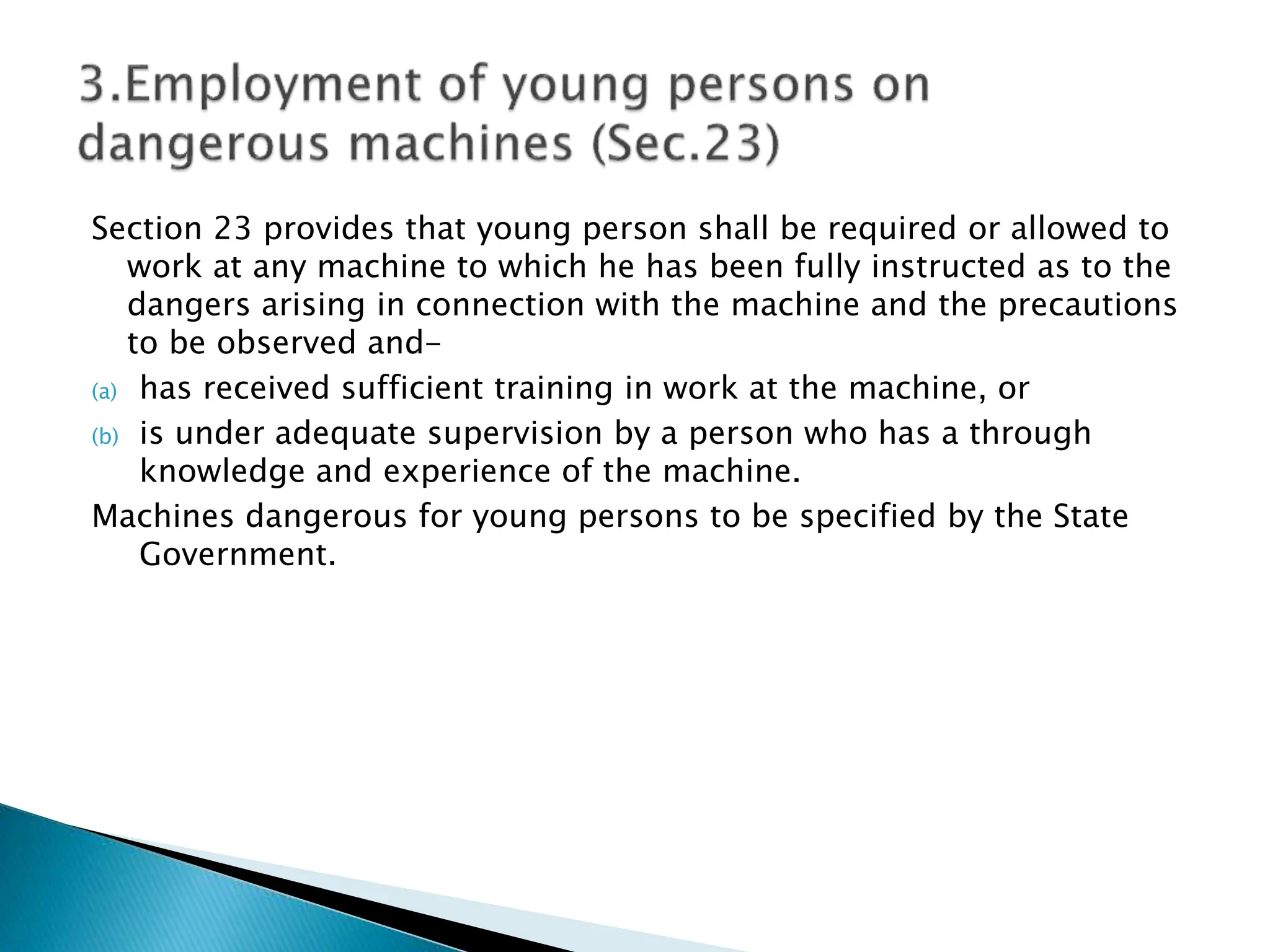
 (iii) any part of a stock-bar which projects beyond the
head stock of a lathe; and
 (iv) the following should be securely fenced
 (a) every part of an electric generator, a motor or rotary
 convertor;
 (b) every part of transmission machinery; and
 (c) every dangerous part of any other machinery,
While in a factory it becomes necessary to examine any part of the
machinery while it is in motion-
 Examination shall be carried out only by specially trained male
workers
 Worker should wear tight fitting clothes
 Such worker shall not handle a belt at moving pulley
 No woman or young person shall be allowed to clean, lubricate or
adjust any part of prime mover if they are exposed to injury.
Section 23 provides that young person shall be required or allowed to
work at any machine to which he has been fully instructed as to the
dangers arising in connection with the machine and the precautions
to be observed and-
(a) has received sufficient training in work at the machine, or
(b) is under adequate supervision by a person who has a through
knowledge and experience of the machine.
Machines dangerous for young persons to be specified by the State
Government.
Section 24 provides that suitable
striking gear or other efficient
mechanical appliance shall be
maintained and used to move
driving belts to and from fast
and loose pulleys which form
part of the transmission
machinery, and such gear or
appliances shall be so
constructed, placed and
maintained as to prevent the
belt from creeping back on to
the fast pulley. Further driving
belts, when not in use, shall not
be allowed to rest or ride upon
shafting in motion. Besides
these, in every factory suitable
devices for cutting off power in
emergencies from running
machinery shall be provided and
maintained in every work-room.
No traversing part of a self-acting machine in any factory and no
material carried thereon shall, if the space over which it runs is a
space over which any person is liable to pass, whether in the course
of his employment or otherwise, be allowed to run on its outward or
inward traverse within a distance of forty-five centimeters from any
fixed structure which is not part of the machine.
Locking device in safe position to prevent accidental starting of
transmission machinery when a device which can inadvertently shift
from ‘off’ to ‘on’ position is provided in a factory to cut off power.
Section 26 provides further safeguards for casing of new machinery of
dangerous nature. In all machinery driven by power and installed in
any factory
 (a) every set screw, bolt or key on any revolving shaft, spindle, wheel
or pinion shall be so sunk, encased or otherwise effectively guarded
as to prevent danger;
 (b) all spur, worm and other toothed or friction gearing which does
not require frequent adjustment while in motion, shall be completely
encased unless it is so situated as to be so safe as it would be if it
were completely encased.
 The section places statutory obligation on all persons who sell or let
on hire or as agent of seller or hire to comply with the section and in
default shall be liable to punishment with imprisonment for a term
which may extend to 3 months or with fine which may extend to Rs.
500 or with both.
In any part of a factory where a cotton-opener is at work for
pressing cotton, no woman or child shall be employed. Provided
that the Inspector may in any particular case specify in writing that
the women and children may be employed on the side of the
partition where the feed-end is situated.
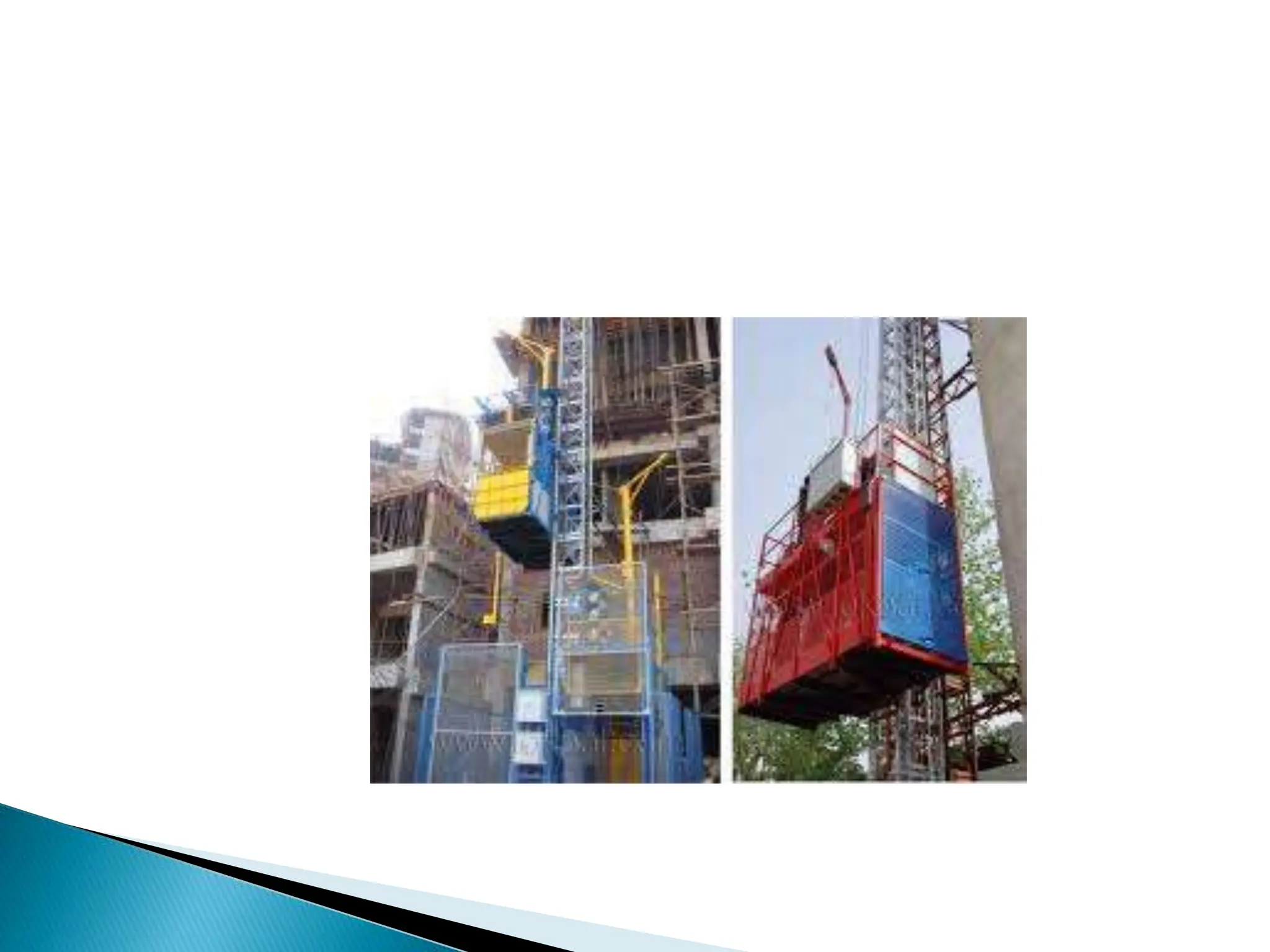
 Section 28 provides that in every factory:
(i) every hoist and lift shall be of good mechanical construction, sound
material and adequate strength. It shall be properly maintained and
thoroughly examined by a competent person at least once in every
period of six months and a register shall be kept containing the
prescribed particulars of every such examination,
(ii) every hoist way and lift way shall be sufficiently protected by an
enclosure fitted with gates and the hoist or lift and every such enclosure
shall be so constructed as to prevent any person or thing from being
trapped between any part of the hoist or lift and any fixed structure or
moving part,
(iii) the maximum safe working load shall be marked on every hoist or lift
and no load greater, than such load shall be marked on every hoist or lift
and no load greater than such load shall be carried thereon,
(iv) the cage of every hoist and lift shall be fitted with a gate on each side
from which access is afforded to a landing,
(v) such gates of the hoist and lift shall be fitted with interlocking or other
efficient device to secure that the gate cannot be opened except
when the cage is at the landing and that the cage cannot be moved
unless the gate is closed.
In terms of Section 29, in any factory the following provisions shall
be complied with respect of every lifting machine (other than a hoist
and lift) and every chain, rope and lifting tackle for the purpose of
raising or lowering persons, goods or materials:
 (a) all parts including the working gear, whether fixed or movable,
shall be
(i) of good construction, sound material and adequate strength and
free from defects;
(ii) properly maintained;
(iii) thoroughly examined – by a competent person at least once in
every period of 12 months or at such intervals as Chief Inspector
may specify in writing and a register shall be kept containing the
prescribed particulars of every such examination;
contd….
 (b) no lifting machine or no chain, rope or lifting tackle, shall, except
for the purpose of test, be loaded beyond the safe working load
which shall be plainly marked thereon together with an identification
mark and duly entered in the prescribed register and where it is not
practicable, a table showing the safe working loads of every kind
and size of lifting machine or chain, rope or lifting tackle in use shall
be displayed in prominent positions on that premises;
 (c) while any person is employed or working on or near the wheel
track of a travelling crane in any place where he would be liable to
be struck by the crane, effective measures shall be taken to ensure
that the crane does not approach within 6 meters of that place
Section 30 of the Act prescribes for permanently affixing or placing a
notice in every factory in which process of grinding is carried on.
Such notice shall indicate maximum safe working peripheral speed
of every grindstone or abrasive wheel, the speed of the shaft or
spindle upon such shaft or spindle necessary to secure such safe
working peripheral-speed. Speed indicated in the notice shall not be
exceeded and effective measures in this regard shall be taken.
 Section 31 provides for taking effective measures to ensure that safe
working pressure of any plant and machinery, used in manufacturing
process operated at pressure above atmospheric pressure, does not
exceed the limits.
 The State Government may make rules to regulate such pressures or
working and may also exempt any part of any plant or machinery
from the compliance of this section.
In every factory
 (a) all floors, steps, stairs passages and gangways shall be of sound
construction and properly maintained and shall be kept free from
obstruction and substances likely to cause persons to slip and where
it is necessary to ensure safety, steps, stairs passages and gangways
shall be provided with substantial handrails,
 (b) there shall, be so far as is reasonably practicable, be provided,
and maintained safe means of access of every place at which any
person is at any time required to work;
 (c) when any person has to work at a height from where he is likely
to fall, provision shall be made, so far as is reasonably, practicable,
by fencing or otherwise, to ensure the safety of the person so
working.
 In every factory every fixed vessel, sump, tank, pit or opening in the
ground or in a floor which, by reason of its depth, situation,
construction, or contents is or may be source of danger shall be
either securely covered or securely fence.
 The State Government may exempt any factory from the compliance
of the provisions of this Section subject to such conditions as it may
prescribe.
 No person shall be employed in any factory to lift, carry or make any
load so heavy as to be likely to cause him injury.
 The State Government may make rules prescribing the maximum
weights which may be lifted, carried or moved by adult men, adult
women, adolescents and children employed in factories or in any
class or description of factories or in carrying on any specified
process.
The State Government has the power to make rules and require for
providing the effective screens or suitable goggles for the protection
of persons employed on or in immediate vicinity of any such
manufacturing process carried on in any factory which involves
(i) risk of injury to the eyes from particles or fragments thrown off in
the course of the process or;
(ii) risk to the eyes by reason of exposure to excessive light.
(1) No person shall be required or allowed to enter any chamber, tank, vat,
pit, pipe, flu or other confined space in any factory in which any gas,
fume, vapor or dust is likely to be present to such an extent as to involve
risk to persons being overcome thereby, unless it is provided with a
manhole of adequate size or other effective means of egress.
(2) No person shall be required or allowed to enter any confined space
as is referred to in sub-section (1), until all practicable measures have
been taken to remove any gas, fume, vapor or dust, which may be
present so as to bring its level within the permissible limits and to
prevent any ingress of such gas, fume, vapor and unless:
(a) a certificate in writing has been given by a competent person, based
on a test carried out by himself that the space is reasonably free from
dangerous gas, fume, vapor or dust; or
(b) such person is wearing suitable breathing apparatus and a belt
securely attached to a rope, the free end of which is held by a person
outside the confined space.
1. No portable electric light or any other electric appliance of voltage
exceeding 24 volts shall be permitted for use inside any chamber,
tank, vat, pit, pipe, flu or other confined space unless adequate
safety devices are provided; and
2. if any inflammable gas, fume or dust is likely to be present in such
chamber, tank, vat, pit, pipe, flu or other confined space unless
adequate safety devices are provided, no lamp or light other than
that of flame proof construction shall be permitted to be used
therein.
In every factory where any manufacturing process produces dust,
gas, fume or vapor of such character and to such extent to be likely
to explode on ignition, all practicable measures shall be taken to
prevent any such explosion by
(a) effective enclosure of the plant or machinery used in the process
(b) removal or prevention of the accumulation of such dust, gas fume
or vapor, and
(c) exclusion or effective enclosure of all possible sources of ignition.
Section 38 provides that in every factory all practicable measures
shall be taken to outbreak of fire and its spread, both internally and
externally and to provide and maintain
(a) safe means of escape for all persons in the event of fire, and
(b) the necessary equipment and facilities for extinguishing fire.
Effective measures shall be taken to ensure that in every factory all
the workers are familiar with the means of escape in case of fire
and have been adequately trained in the outline to be followed in
such case.
The State Government may make rules in requiring the measures o
be adopted to give effect to this provision.
The inspectors in case of dangerous conditions of building or any
part of ways, machinery or plant requires the manager or occupier
or both to take such measures which in his opinion should be
adopted and require them to be carried out before a specified date.
(Sec.40) In case the danger to human life is immediate and imminent
from such usage of building, ways of machinery he may order
prohibiting the use of the same unless it is repaired or altered.
If it appears to the inspector that any building or part of it is in such
a state of disrepair which may lead to conditions detrimental to the
health and welfare of workers he may serve on the manager or
occupier or both, an order in writing specifying the measures to be
carried out before a specified date.
In every factory
(i) where 1,000 or more workers are ordinarily employed or
(ii) where the manufacturing process or operation involves risk of
bodily injury, poisoning or disease or any other hazard to health of
the persons employed therein, the occupier shall employ such
number of safety officers as may be specified in the notification with
such duties and qualifications and conditions of service as may be
prescribed by State Government.
This is vested in the State Government under Section 41 for such
devices and measures to secure the safety of the workers employed
in the factory.
 Efficiency of workers in the factories is linked with the atmosphere
prevailing in their place of work.
 Colonies of workers lack basic amenities affecting their efficiency.
 Provision for washing place and water to be obligatory for workers
involved in dirty processes.
 Sec. 42 to 50 of The Factories Act deal with facilities for welfare of
workers to be provided by the occupier.
• In every factory adequate washing facilities should be provided
for both male and female workers.
• They should be conveniently accessible and kept clean.
• The State Government prescribes standards for adequate and
suitable facilities for washing.
• There should be suitable places for keeping the clothing not
worn during working hours and for the drying of the wet clothing.
In every factory suitable arrangements for sitting as well as
standing shall be provided and maintained for all workers for
rest which they may require in course of their work.
• There should be readily accessible during all working hours the
first-aid boxes or cupboards equipped with the prescribed contents,
and the number of such boxes or cupboards to be provided and
maintained shall not be less than one for 150 workers ordinarily
employed.
• Each first-aid box or cupboard shall be kept in the charge of a
separate responsible person.
(1) In every factory wherein more than 150 workers are ordinarily employed adequate
and suitable shelters or rest-rooms and a suitable lunch-room, with provision for
drinking water, where workers can eat meals brought by them, shall be provided
and maintained for the use of the workers:
Provided that any canteen maintained in accordance with the provisions of section
46 shall be regarded as part of the requirements of this sub-section:
Provided further that where a lunch-room exists no worker shall eat any food in
the work-room.
(2) The shelters or rest-room or lunch-room to be provided under sub-section (1)
shall be sufficiently lighted and ventilated and shall be maintained in a cool and
clean condition.
(3) The State Government may-
• (a) prescribe the standards, in respect of construction accommodation, furniture
and other equipment of shelters, rest-rooms and lunch-rooms to be provided
under this section;
• (b) by notification in the Official Gazette, exempt any factory or class or description
of factories from the requirements of this section.
• In a factory wherein more than 250 workers are ordinarily employed,
a canteen or canteens shall be provided.
• Besides the foodstuffs to be served therein, the construction,
accommodation, furniture and other equipment of the canteen
should be of good standards.
• The shelters or rest rooms or lunch rooms to be provided under
sub-section (1) shall be sufficiently lighted and ventilated and shall
be maintained in a cool and clean condition.
• Wherein more than thirty women workers are ordinarily employed
in a factory, there shall be provided and maintained a suitable room
or rooms for the use of the children under the age of six years of
such women.
• The rooms should be adequately lighted and ventilated, shall be
maintained in a clean and sanitary condition and;
• It shall be under the charge of women trained in the care of children
and infants.
Wherein 500 or more workers are ordinarily employed in a factory the
occupier shall employ such number of welfare officers as may be
prescribed by the State Government.
The State Government may make rules-
(a) exempting any factory or class or description of factories from
compliance with any of the provisions from Sec. 42 to 50.
(b) requiring in any factory or class or description of factories that the
representatives of the workers employed in the factory shall be
associated with the management of welfare arrangements of the
workers.
 Provisions laid down regarding daily working hours of adult workers,
weekly holidays, compensatory holidays, intervals for rest and
restriction on double employment etc.
 The occupier or manager is required to comply with the statutory
requirements failing which he can be punished in the Act.
 Manager required to maintain register of all the adult workers
employed in the factory.
• Sec.51-Weekly hours not more than 48 hours a week
• Sec.52-First day of the week i.e. Sunday shall be a weekly holiday •
Sec.53-Compensatory holidays shall be allowed where a worker is
deprived of weekly holidays.
• Where a weekly holiday is denied he shall be allowed to avail the
compensatory holiday within a month.
• Sec.54-Daily working hours- no adult worker shall be allowed to
work in a factory for more than nine hours in any day.
• Sec.55-Intervals for rest-no worker shall work for more than 5 hours
before he has had an interval for rest of at least 1/2 an hour. •
• Inspector may increase it upto six hours
• Inclusive of rest intervals they shall not spread over more than 10-
1/2 hours in any day.
• Inspector may increase the spread over up to 12 hours
If shift extends beyond midnight , a holiday for a worker will mean a
period of 24 hours beginning when his shift ends.
• Work shall not be carried in any factory by means of system of shifts
so arranged that more than one relay of workers is engaged in the
work of same kind at the same time.
• The State Government or Chief Inspector may grant exemption to a
factory or a class of factories from this provision.
If workers work for more than 9 hours a day or more than 48 hour a
week, extra wages should be given.
Wages at twice the ordinary Rate.
No worker is allowed to work in any factory on any day on which he
has already been working in any other factory.
Notice to be displayed at some Conspicuous place.
Periods to be fixed beforehand
Classification of workers-Groups.
 Form of notice of periods of work may be prescribed by State
Government.
Copy of Notice in Duplicate & any change to be sent to Inspector.
• The manager should maintain Register of Adult workers showing-
-Name
• - Nature of work
• - The Group etc. of each & every Adult Worker in the factory
• The Register shall be available to the Inspector at all time during
working hours. R
 Detailed provisions for the protection of child labour.
 Provisions from Sec.67 to 77 deal with employment of young
persons.
 In M.C. Mehta V. Union of India AIR 1991, the Supreme Court held
that the employment of children within match factories directly
connected with the manufacturing process up to final production of
match sticks or fireworks should not at all be permitted.
No child who has not completed his 14th year allowed to work in
Factory.
A child who has completed his 14th year may be allowed to work in
factory if:-
a) a certificate of fitness for such work is in custody of manager of
factory.
b) Such child or adolescent carries , a token giving a reference to
such Certificate.
Is a certificate issued by a certifying surgeon after examining him &
ascertaining his fitness for work in factory.
• Valid for 12 Months.
• Revocation of Certificate by surgeon , if child is no longer fit.
• Fee payable by Employer:-Fee & Renewable Fee
• Effect of Certificate of Fitness:-deemed to be an adult for the
purpose of hours of work.
Working Hours limited to 4-1/2
Not during Nights.
Period of work limited to 2 shifts.
Entitled to weekly Holidays.
Female to work only between 6am to 7 pm.
Fixation of periods of work beforehand.
• The manager should maintain Register of Adult workers showing
-Name
-Nature of work
-The Group etc.
- the relay to which he is allotted
- Number of certificate of fitness granted
Inspector has the power to direct manager to have medical
examination of young persons working in case-
• Young Persons working without License.
• They no longer seem to be Fit.
• Prohibition of women workers at night shift
• Women shall not be allowed to work in any factory except between
the hours of 6 A.M. and 7 P.M..
• The inspector may relax this norm but prohibited between 10 P.M.
and 5 A.M.
• Working hours not more than-weekly 48 hours & daily 9 hours
THE FACTORIES ACT,1948 (2).pptx   labour

THE FACTORIES ACT,1948 (2).pptx labour

  • 2.
     First Actpassed in 1881 – primarily to protect children and to provide certain safety and health measures.  Followed by Acts of 1891, 1911, 1922 and 1934 which had number of defects and weaknesses , no effective administration, provisions were inadequate and unsatisfactory.  Large growth in industrial activities was seen.  Radical law relating to factories was necessary.  Hence The Factories Act 1948 passed, came into force on 1st April 1949  Provisions of the Act based on ILO conventions and recommendations.
  • 3.
     Definition ofthe term ‘factories ’ was widened. Included workers in all establishments employing 10 or more/ 20 or more workers.  Distinction between seasonal and non seasonal factories was abolished.  Extension of the basic provisions of the old Act relating to health, safety and welfare of workers, irrespective of number of workers employed.  Splitting up of Chapter III of the old Act into three parts of health, safety and welfare of workers.  Raising of age of admission of children for work from 12 to 14 years and decreasing their working hours.  Provisions for licensing and registration of factories, and prior scrutiny by inspectors of plans and factory buildings.  Granting power to State Govts. to make rules requiring association of workers in management for welfare of workers.
  • 4.
     To regulatethe conditions of work in manufacturing establishments defined as factories.  To regulate working hours  To protect health of workers  To provide safety to workers  To ensure welfare of workers  To ensure the construction of factories is as per plan.  TO appoint factory inspectors and surgeons  To impose fines and penalties In Bhikusa Yamasa Kshatri)ya (P Ltd. V. Union of India the court observed that the Act has been enacted primarily with the object of protecting workers employed in factories against industrial and occupational hazards. For that purpose it seeks to impose upon the owner or occupier certain obligations to protect the workers and to secure for them employment conditions conducive to their safety and health.
  • 5.
    "factory" means anypremises including the precincts thereof- (i) whereon ten or more workers are working, or were working on any day of the preceding twelve months, and in any part of which a manufacturing process is being carried on with the aid of power, or is ordinarily so carried on, or (ii) Whereon twenty or more workers are working, or were working on any day of the preceding twelve months, and in any part of which a manufacturing process is being carried on without the aid of power, or is ordinarily so carried on,-but does not include a mine subject to the operation of 9[the Mines Act, 1952 (35 of 1952)] or 10[a mobile unit belonging to the armed forces of the Union, a railway running shed or a hotel, restaurant or eating place]. 7[Explanation 11[I] : For computing the number of workers for the purposes of this clause all the workers in 12[different groups and relays] in a day shall be taken into account;] 13[Explanation II: For the purposes of this clause, the mere fact that an Electronic Data Processing Unit or a Computer Unit is installed in any premises or part thereof, shall not be construed to make it a factory if no manufacturing process is being carried on in such premises or part thereof;]
  • 6.
    In simple words,a factory is a premises whereon 10 or more persons are engaged if power is used, and 20 or more persons are engaged if power is not used.  No distinction between perennial and seasonal factories.  Premises – building or open land or land with building.  Precincts – a space enclosed by the walls or fences of a factory.  Two conditions to determine whether an establishment is a factory- 1. that a manufacturing process is being carried on in any part of the premises; and 2. there are prescribed number of workers working.
  • 7.
    "manufacturing process" meansany process for- (i) making, altering, repairing, ornamenting, finishing, packing, oiling, washing, cleaning, breaking up, demolishing, or otherwise treating or adapting any article or substance with a view to its use, sale, transport, delivery or disposal, or 5[(ii) pumping oil, water, sewage or any other substance; or] (iii) generating, transforming or transmitting power; or 6[(iv) composing types for printing, printing by letter press, lithography, photogravure or other similar process or book binding;] 7[or] (v) constructing, reconstructing, repairing, refitting, finishing or breaking up ships or vessels; 7[or] 7[(vi) preserving or storing any article in cold storage;
  • 8.
    Examples: Bidi making •Moulding and transformation of raw cinematography films into a finished product. • Work done in salt works for converting sea water into salt. • Use of refrigerator in treating or adapting any article with a view to its sale.  To determine whether a process is manufacturing process or not, regard is to be given to the circumstances.  There must be some transformation of an article i.e. the article that is put up for sale must be different from what it originally existed.  Activity must result in the emergence of a marketable commodity with a distinctive name.
  • 9.
    "worker" means aperson 8[employed, directly or by or through any agency (including a contractor) with or without the knowledge of the principal employer, whether for remuneration or not], in any manufacturing process, or in cleaning any part of the machinery or premises used for a manufacturing process, or in any other kind of work incidental to, or connected with, the manufacturing process, or the subject of the manufacturing process 7[but does not include any member of the armed forces of the Union];  Those carrying out work incidental to, or connected with, the manufacturing processes have been held as workers.  Relationship of master and servant must exist between the employer and employee.  Does not matter whether wages are paid or not.  There should be some contract of employment.
  • 10.
    "competent person", inrelation to any provision of this Act, means a person or an institution recognized as such by the Chief Inspector for the purposes of carrying out tests, examinations and inspections required to be done in a factory under the provisions of this Act having regard to- (i) the qualifications and experience of the person and facilities available at his disposal; or (ii) the qualifications and experience of the persons employed in such institution and facilities available therein, with regard to the conduct of such tests, examinations and inspections, and more than one person or institution can be recognized as a competent person in relation to a factory;
  • 11.
    "hazardous process" meansany process or activity in relation to an industry specified in the First Schedule where, unless special care is taken, raw materials used therein or the intermediate or finished products, bye-products, wastes, or effluents thereof would- (i) cause material impairment to the health of the persons engaged in or connected therewith, or (ii) result in the pollution of the general environment: PROVIDED that the State Government may, by notification in the Official Gazette, amend the First Schedule by way of addition, omission or variation of any industry, specified in the said Schedule;]
  • 12.
     Adult:"adult" meansa person who has completed his eighteenth year of age;  Adolescent: "adolescent" means a person who has completed his fifteenth year of age but has not completed his eighteenth year;  Calendar: [(bb) "calendar year" means the period of twelve months beginning with the first day of January in any year;]  Child : "child" means a person who has not completed his fifteenth year of age  Young person "young person" means a person who is either a child or an adolescent
  • 13.
    “occupier” of afactory means the person who has ultimate control over the affairs of the factory, 8[***] 9 [Provided that- (i) in the case of a firm or other association of individuals, any one of the individual partners or members thereof shall be deemed to be the occupier; (ii) in the case of a company, any one of the directors, shall be deemed to be the occupier; (iii) in the case of a factory owned or controlled by the Central Government, or any State Government, or any local authority, the person or persons appointed to manage the affairs of the factory by the Central Government, the State Government or the local authority, as the case may be, shall be deemed to be the occupier.
  • 14.
     Inspectors [Sec.8(1)]:State Government may appoint by notification in Official Gazette, such person who possesses the qualification prescribed to be inspectors under this Act and assign them local limits.  Chief Inspectors [Sec 8 (2)]: State Government may appoint by notification in Official Gazette, any person to be Chief Inspector. He has an additional power of Inspector throughout the State.  Additional Chief Inspector, Joint Chief Inspector Etc. to be appointed to assist Chief inspector and exercise powers assigned to them by notification.
  • 15.
     (a) enter,with such assistants, being persons in the service of the Government, or any local or other public authority, 1[or with an expert] as he thinks fit, any place which is used, or which he has reason to believe is used, as a factory;  [(b) make examination of the premises, plant, machinery, article or substance.  (c) inquire into any accident or dangerous occurrence, whether resulting in bodily injury, disability or not, and take on the spot or otherwise statements of any person which he may consider necessary for such inquiry;  (d) require the production of any prescribed register or any other document relating to the factory;  (e) seize, or take copies of any register, record or other document or any portion thereof, as he may consider necessary in respect of any offence under this Act, which he has reason to believe, has been committed;
  • 16.
     (f) directthe occupier that any premises or any part thereof, or anything lying therein, shall be left undisturbed (whether generally or in particular respects) for so long as is necessary for the purpose of any examination under clause (b);  (g) take measurements and photographs and make such recordings as he considers necessary for the purpose of any examination under clause (b), taking with him any necessary instrument or equipment;  (h) in case of any article or substance found in any premises, being an article or substance which appears to him as having caused or is likely to cause danger to the health or safety of the workers, direct it to be dismantled or subject it to any process or test (but not so as to damage or destroy it unless the same is, in the circumstances necessary, for carrying out the purposes of this Act), and take possession of any such article or substance or a part thereof, and detain it for so long as is necessary for such examination;  (i) exercise such other powers as may be prescribed.
  • 17.
    The [State] Governmentmay appoint qualified medical practitioners to be certifying surgeons for the purposes of this Act within such local limits or for such factory or class or description of factories as it may assign to them respectively. A certifying surgeon may, with the approval of the [State] Government, authorise any qualified medical practitioner to exercise any of his powers under this Act for such period as the certifying surgeon may specify and subject to specified conditions. Duties: (a) the examination and certification of young persons under this Act; (b) (b) the examination of persons engaged in factories in such dangerous occupations or processes as may be prescribed; (c) (c) the exercising of such medical supervision as may be prescribed for any factory or class or description of factories where- (i) cases of illness have occurred which it is reasonable to believe are due to the nature of the manufacturing process carried on, or other conditions of work prevailing therein; (ii) by reason of any change in the manufacturing process carried on or in the substances used therein or by reason of the adoption of any new manufacturing process or of any new substance for use in a manufacturing process, there is a likelihood of injury to the health of workers employed in that manufacturing process; (iii) young persons are, or are about to be, employed in any work which is likely to cause injury to their health. Explanation.-In this section “qualified medical practitioner” means a person holding a qualification granted by an authority specified in the Schedule to the Indian Medical Degrees Act, 1916 (VII of 1916), or in the Schedules to the Indian Medical Council Act.
  • 18.
    (ii) by reasonof any change in the manufacturing process carried on or in the substances used therein or by reason of the adoption of any new manufacturing process or of any new substance for use in a manufacturing process, there is a likelihood of injury to the health of workers employed in that manufacturing process; (iii) young persons are, or are about to be, employed in any work which is likely to cause injury to their health. Explanation.-In this section “qualified medical practitioner” means a person holding a qualification granted by an authority specified in the Schedule to the Indian Medical Degrees Act, 1916 (VII of 1916), or in the Schedules to the Indian Medical Council Act.
  • 19.
     According toSection 21 of Factories Act, 1948, in every factory, the dangerous parts of all machineries should be securely fenced by safeguards of substantial construction and shall be constantly maintained and kept in position while the parts of machinery are in motion.  The section provides for fencing the following machineries while  they are in use  (i) every moving part of a prime mover and every flywheel  connected to a prime mover whether the prime mover or flywheel  is in the engine house or not;  (ii) the headrace and tailrace of every water-wheel and water  turbine;  (iii) any part of a stock-bar which projects beyond the head stock of a lathe; and  (iv) the following should be securely fenced  (a) every part of an electric generator, a motor or rotary  convertor;  (b) every part of transmission machinery; and  (c) every dangerous part of any other machinery,
  • 20.
    While in afactory it becomes necessary to examine any part of the machinery while it is in motion-  Examination shall be carried out only by specially trained male workers  Worker should wear tight fitting clothes  Such worker shall not handle a belt at moving pulley  No woman or young person shall be allowed to clean, lubricate or adjust any part of prime mover if they are exposed to injury.
  • 21.
    Section 23 providesthat young person shall be required or allowed to work at any machine to which he has been fully instructed as to the dangers arising in connection with the machine and the precautions to be observed and- (a) has received sufficient training in work at the machine, or (b) is under adequate supervision by a person who has a through knowledge and experience of the machine. Machines dangerous for young persons to be specified by the State Government.
  • 22.
    Section 24 providesthat suitable striking gear or other efficient mechanical appliance shall be maintained and used to move driving belts to and from fast and loose pulleys which form part of the transmission machinery, and such gear or appliances shall be so constructed, placed and maintained as to prevent the belt from creeping back on to the fast pulley. Further driving belts, when not in use, shall not be allowed to rest or ride upon shafting in motion. Besides these, in every factory suitable devices for cutting off power in emergencies from running machinery shall be provided and maintained in every work-room.
  • 23.
    No traversing partof a self-acting machine in any factory and no material carried thereon shall, if the space over which it runs is a space over which any person is liable to pass, whether in the course of his employment or otherwise, be allowed to run on its outward or inward traverse within a distance of forty-five centimeters from any fixed structure which is not part of the machine. Locking device in safe position to prevent accidental starting of transmission machinery when a device which can inadvertently shift from ‘off’ to ‘on’ position is provided in a factory to cut off power.
  • 24.
    Section 26 providesfurther safeguards for casing of new machinery of dangerous nature. In all machinery driven by power and installed in any factory  (a) every set screw, bolt or key on any revolving shaft, spindle, wheel or pinion shall be so sunk, encased or otherwise effectively guarded as to prevent danger;  (b) all spur, worm and other toothed or friction gearing which does not require frequent adjustment while in motion, shall be completely encased unless it is so situated as to be so safe as it would be if it were completely encased.  The section places statutory obligation on all persons who sell or let on hire or as agent of seller or hire to comply with the section and in default shall be liable to punishment with imprisonment for a term which may extend to 3 months or with fine which may extend to Rs. 500 or with both.
  • 26.
    In any partof a factory where a cotton-opener is at work for pressing cotton, no woman or child shall be employed. Provided that the Inspector may in any particular case specify in writing that the women and children may be employed on the side of the partition where the feed-end is situated.
  • 27.
     Section 28provides that in every factory: (i) every hoist and lift shall be of good mechanical construction, sound material and adequate strength. It shall be properly maintained and thoroughly examined by a competent person at least once in every period of six months and a register shall be kept containing the prescribed particulars of every such examination, (ii) every hoist way and lift way shall be sufficiently protected by an enclosure fitted with gates and the hoist or lift and every such enclosure shall be so constructed as to prevent any person or thing from being trapped between any part of the hoist or lift and any fixed structure or moving part, (iii) the maximum safe working load shall be marked on every hoist or lift and no load greater, than such load shall be marked on every hoist or lift and no load greater than such load shall be carried thereon, (iv) the cage of every hoist and lift shall be fitted with a gate on each side from which access is afforded to a landing, (v) such gates of the hoist and lift shall be fitted with interlocking or other efficient device to secure that the gate cannot be opened except when the cage is at the landing and that the cage cannot be moved unless the gate is closed.
  • 29.
    In terms ofSection 29, in any factory the following provisions shall be complied with respect of every lifting machine (other than a hoist and lift) and every chain, rope and lifting tackle for the purpose of raising or lowering persons, goods or materials:  (a) all parts including the working gear, whether fixed or movable, shall be (i) of good construction, sound material and adequate strength and free from defects; (ii) properly maintained; (iii) thoroughly examined – by a competent person at least once in every period of 12 months or at such intervals as Chief Inspector may specify in writing and a register shall be kept containing the prescribed particulars of every such examination; contd….
  • 30.
     (b) nolifting machine or no chain, rope or lifting tackle, shall, except for the purpose of test, be loaded beyond the safe working load which shall be plainly marked thereon together with an identification mark and duly entered in the prescribed register and where it is not practicable, a table showing the safe working loads of every kind and size of lifting machine or chain, rope or lifting tackle in use shall be displayed in prominent positions on that premises;  (c) while any person is employed or working on or near the wheel track of a travelling crane in any place where he would be liable to be struck by the crane, effective measures shall be taken to ensure that the crane does not approach within 6 meters of that place
  • 31.
    Section 30 ofthe Act prescribes for permanently affixing or placing a notice in every factory in which process of grinding is carried on. Such notice shall indicate maximum safe working peripheral speed of every grindstone or abrasive wheel, the speed of the shaft or spindle upon such shaft or spindle necessary to secure such safe working peripheral-speed. Speed indicated in the notice shall not be exceeded and effective measures in this regard shall be taken.
  • 32.
     Section 31provides for taking effective measures to ensure that safe working pressure of any plant and machinery, used in manufacturing process operated at pressure above atmospheric pressure, does not exceed the limits.  The State Government may make rules to regulate such pressures or working and may also exempt any part of any plant or machinery from the compliance of this section.
  • 33.
    In every factory (a) all floors, steps, stairs passages and gangways shall be of sound construction and properly maintained and shall be kept free from obstruction and substances likely to cause persons to slip and where it is necessary to ensure safety, steps, stairs passages and gangways shall be provided with substantial handrails,  (b) there shall, be so far as is reasonably practicable, be provided, and maintained safe means of access of every place at which any person is at any time required to work;  (c) when any person has to work at a height from where he is likely to fall, provision shall be made, so far as is reasonably, practicable, by fencing or otherwise, to ensure the safety of the person so working.
  • 34.
     In everyfactory every fixed vessel, sump, tank, pit or opening in the ground or in a floor which, by reason of its depth, situation, construction, or contents is or may be source of danger shall be either securely covered or securely fence.  The State Government may exempt any factory from the compliance of the provisions of this Section subject to such conditions as it may prescribe.
  • 35.
     No personshall be employed in any factory to lift, carry or make any load so heavy as to be likely to cause him injury.  The State Government may make rules prescribing the maximum weights which may be lifted, carried or moved by adult men, adult women, adolescents and children employed in factories or in any class or description of factories or in carrying on any specified process.
  • 36.
    The State Governmenthas the power to make rules and require for providing the effective screens or suitable goggles for the protection of persons employed on or in immediate vicinity of any such manufacturing process carried on in any factory which involves (i) risk of injury to the eyes from particles or fragments thrown off in the course of the process or; (ii) risk to the eyes by reason of exposure to excessive light.
  • 37.
    (1) No personshall be required or allowed to enter any chamber, tank, vat, pit, pipe, flu or other confined space in any factory in which any gas, fume, vapor or dust is likely to be present to such an extent as to involve risk to persons being overcome thereby, unless it is provided with a manhole of adequate size or other effective means of egress. (2) No person shall be required or allowed to enter any confined space as is referred to in sub-section (1), until all practicable measures have been taken to remove any gas, fume, vapor or dust, which may be present so as to bring its level within the permissible limits and to prevent any ingress of such gas, fume, vapor and unless: (a) a certificate in writing has been given by a competent person, based on a test carried out by himself that the space is reasonably free from dangerous gas, fume, vapor or dust; or (b) such person is wearing suitable breathing apparatus and a belt securely attached to a rope, the free end of which is held by a person outside the confined space.
  • 38.
    1. No portableelectric light or any other electric appliance of voltage exceeding 24 volts shall be permitted for use inside any chamber, tank, vat, pit, pipe, flu or other confined space unless adequate safety devices are provided; and 2. if any inflammable gas, fume or dust is likely to be present in such chamber, tank, vat, pit, pipe, flu or other confined space unless adequate safety devices are provided, no lamp or light other than that of flame proof construction shall be permitted to be used therein.
  • 39.
    In every factorywhere any manufacturing process produces dust, gas, fume or vapor of such character and to such extent to be likely to explode on ignition, all practicable measures shall be taken to prevent any such explosion by (a) effective enclosure of the plant or machinery used in the process (b) removal or prevention of the accumulation of such dust, gas fume or vapor, and (c) exclusion or effective enclosure of all possible sources of ignition.
  • 40.
    Section 38 providesthat in every factory all practicable measures shall be taken to outbreak of fire and its spread, both internally and externally and to provide and maintain (a) safe means of escape for all persons in the event of fire, and (b) the necessary equipment and facilities for extinguishing fire. Effective measures shall be taken to ensure that in every factory all the workers are familiar with the means of escape in case of fire and have been adequately trained in the outline to be followed in such case. The State Government may make rules in requiring the measures o be adopted to give effect to this provision.
  • 41.
    The inspectors incase of dangerous conditions of building or any part of ways, machinery or plant requires the manager or occupier or both to take such measures which in his opinion should be adopted and require them to be carried out before a specified date. (Sec.40) In case the danger to human life is immediate and imminent from such usage of building, ways of machinery he may order prohibiting the use of the same unless it is repaired or altered.
  • 42.
    If it appearsto the inspector that any building or part of it is in such a state of disrepair which may lead to conditions detrimental to the health and welfare of workers he may serve on the manager or occupier or both, an order in writing specifying the measures to be carried out before a specified date.
  • 43.
    In every factory (i)where 1,000 or more workers are ordinarily employed or (ii) where the manufacturing process or operation involves risk of bodily injury, poisoning or disease or any other hazard to health of the persons employed therein, the occupier shall employ such number of safety officers as may be specified in the notification with such duties and qualifications and conditions of service as may be prescribed by State Government.
  • 44.
    This is vestedin the State Government under Section 41 for such devices and measures to secure the safety of the workers employed in the factory.
  • 45.
     Efficiency ofworkers in the factories is linked with the atmosphere prevailing in their place of work.  Colonies of workers lack basic amenities affecting their efficiency.  Provision for washing place and water to be obligatory for workers involved in dirty processes.  Sec. 42 to 50 of The Factories Act deal with facilities for welfare of workers to be provided by the occupier.
  • 46.
    • In everyfactory adequate washing facilities should be provided for both male and female workers. • They should be conveniently accessible and kept clean. • The State Government prescribes standards for adequate and suitable facilities for washing.
  • 47.
    • There shouldbe suitable places for keeping the clothing not worn during working hours and for the drying of the wet clothing.
  • 48.
    In every factorysuitable arrangements for sitting as well as standing shall be provided and maintained for all workers for rest which they may require in course of their work.
  • 49.
    • There shouldbe readily accessible during all working hours the first-aid boxes or cupboards equipped with the prescribed contents, and the number of such boxes or cupboards to be provided and maintained shall not be less than one for 150 workers ordinarily employed. • Each first-aid box or cupboard shall be kept in the charge of a separate responsible person.
  • 50.
    (1) In everyfactory wherein more than 150 workers are ordinarily employed adequate and suitable shelters or rest-rooms and a suitable lunch-room, with provision for drinking water, where workers can eat meals brought by them, shall be provided and maintained for the use of the workers: Provided that any canteen maintained in accordance with the provisions of section 46 shall be regarded as part of the requirements of this sub-section: Provided further that where a lunch-room exists no worker shall eat any food in the work-room. (2) The shelters or rest-room or lunch-room to be provided under sub-section (1) shall be sufficiently lighted and ventilated and shall be maintained in a cool and clean condition. (3) The State Government may- • (a) prescribe the standards, in respect of construction accommodation, furniture and other equipment of shelters, rest-rooms and lunch-rooms to be provided under this section; • (b) by notification in the Official Gazette, exempt any factory or class or description of factories from the requirements of this section.
  • 51.
    • In afactory wherein more than 250 workers are ordinarily employed, a canteen or canteens shall be provided. • Besides the foodstuffs to be served therein, the construction, accommodation, furniture and other equipment of the canteen should be of good standards. • The shelters or rest rooms or lunch rooms to be provided under sub-section (1) shall be sufficiently lighted and ventilated and shall be maintained in a cool and clean condition.
  • 52.
    • Wherein morethan thirty women workers are ordinarily employed in a factory, there shall be provided and maintained a suitable room or rooms for the use of the children under the age of six years of such women. • The rooms should be adequately lighted and ventilated, shall be maintained in a clean and sanitary condition and; • It shall be under the charge of women trained in the care of children and infants.
  • 53.
    Wherein 500 ormore workers are ordinarily employed in a factory the occupier shall employ such number of welfare officers as may be prescribed by the State Government.
  • 54.
    The State Governmentmay make rules- (a) exempting any factory or class or description of factories from compliance with any of the provisions from Sec. 42 to 50. (b) requiring in any factory or class or description of factories that the representatives of the workers employed in the factory shall be associated with the management of welfare arrangements of the workers.
  • 55.
     Provisions laiddown regarding daily working hours of adult workers, weekly holidays, compensatory holidays, intervals for rest and restriction on double employment etc.  The occupier or manager is required to comply with the statutory requirements failing which he can be punished in the Act.  Manager required to maintain register of all the adult workers employed in the factory.
  • 56.
    • Sec.51-Weekly hoursnot more than 48 hours a week • Sec.52-First day of the week i.e. Sunday shall be a weekly holiday • Sec.53-Compensatory holidays shall be allowed where a worker is deprived of weekly holidays. • Where a weekly holiday is denied he shall be allowed to avail the compensatory holiday within a month.
  • 57.
    • Sec.54-Daily workinghours- no adult worker shall be allowed to work in a factory for more than nine hours in any day. • Sec.55-Intervals for rest-no worker shall work for more than 5 hours before he has had an interval for rest of at least 1/2 an hour. • • Inspector may increase it upto six hours
  • 58.
    • Inclusive ofrest intervals they shall not spread over more than 10- 1/2 hours in any day. • Inspector may increase the spread over up to 12 hours
  • 59.
    If shift extendsbeyond midnight , a holiday for a worker will mean a period of 24 hours beginning when his shift ends.
  • 60.
    • Work shallnot be carried in any factory by means of system of shifts so arranged that more than one relay of workers is engaged in the work of same kind at the same time. • The State Government or Chief Inspector may grant exemption to a factory or a class of factories from this provision.
  • 61.
    If workers workfor more than 9 hours a day or more than 48 hour a week, extra wages should be given. Wages at twice the ordinary Rate.
  • 62.
    No worker isallowed to work in any factory on any day on which he has already been working in any other factory.
  • 63.
    Notice to bedisplayed at some Conspicuous place. Periods to be fixed beforehand Classification of workers-Groups.  Form of notice of periods of work may be prescribed by State Government. Copy of Notice in Duplicate & any change to be sent to Inspector.
  • 64.
    • The managershould maintain Register of Adult workers showing- -Name • - Nature of work • - The Group etc. of each & every Adult Worker in the factory • The Register shall be available to the Inspector at all time during working hours. R
  • 65.
     Detailed provisionsfor the protection of child labour.  Provisions from Sec.67 to 77 deal with employment of young persons.  In M.C. Mehta V. Union of India AIR 1991, the Supreme Court held that the employment of children within match factories directly connected with the manufacturing process up to final production of match sticks or fireworks should not at all be permitted.
  • 66.
    No child whohas not completed his 14th year allowed to work in Factory.
  • 67.
    A child whohas completed his 14th year may be allowed to work in factory if:- a) a certificate of fitness for such work is in custody of manager of factory. b) Such child or adolescent carries , a token giving a reference to such Certificate.
  • 68.
    Is a certificateissued by a certifying surgeon after examining him & ascertaining his fitness for work in factory. • Valid for 12 Months. • Revocation of Certificate by surgeon , if child is no longer fit. • Fee payable by Employer:-Fee & Renewable Fee • Effect of Certificate of Fitness:-deemed to be an adult for the purpose of hours of work.
  • 69.
    Working Hours limitedto 4-1/2 Not during Nights. Period of work limited to 2 shifts. Entitled to weekly Holidays. Female to work only between 6am to 7 pm. Fixation of periods of work beforehand.
  • 70.
    • The managershould maintain Register of Adult workers showing -Name -Nature of work -The Group etc. - the relay to which he is allotted - Number of certificate of fitness granted
  • 71.
    Inspector has thepower to direct manager to have medical examination of young persons working in case- • Young Persons working without License. • They no longer seem to be Fit.
  • 72.
    • Prohibition ofwomen workers at night shift • Women shall not be allowed to work in any factory except between the hours of 6 A.M. and 7 P.M.. • The inspector may relax this norm but prohibited between 10 P.M. and 5 A.M. • Working hours not more than-weekly 48 hours & daily 9 hours